

Affiliate Disclaimer: This article contains affiliate links. If you purchase through them, Mind Clarity Hub may earn a small commission at no extra cost to you. We only recommend products that align with our mission to promote mental clarity and neuroscience-backed wellness.
Every morning offers a choice: wake up reactive or intentional. Neuroscientists now know that the first 10 minutes of your day can determine your emotional tone and cognitive sharpness for the next 12 hours. Through the science of neuroplasticity—your brain’s ability to rewire connections—simple micro-habits practiced after waking can permanently reshape how your mind handles stress, focus, and creativity.
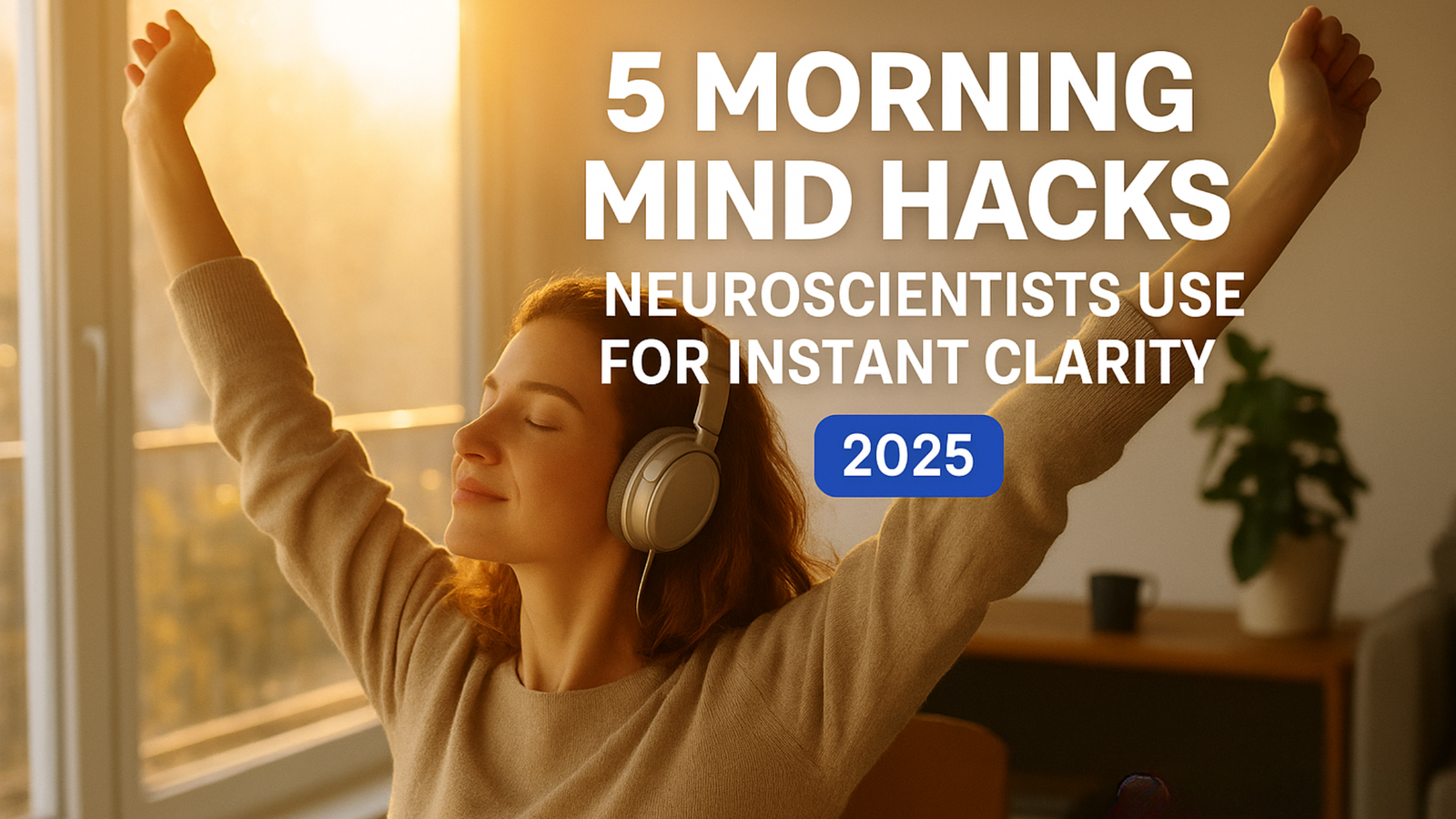
This 2025 guide explores five neuroscience-backed morning mind hacks designed to create calm, sharpen focus, and reset your brain for the modern world’s noise. You don’t need an hour-long meditation or ice bath—just small, repeatable actions that shift your neurochemistry naturally.
Start Small: The Power of Micro-Habits
Micro-habits are tiny, consistent actions that compound into major mental shifts. Research from the American Psychological Association suggests that routines performed within the first 30 minutes of waking create measurable improvements in focus and mood stability. These aren’t life overhauls—they’re brain-friendly nudges that teach your mind to choose clarity over chaos.
Before diving into the hacks, remember: change happens when it’s gentle. The brain resists massive disruption but embraces small, predictable rituals. Consistency—not intensity—is how you train neural pathways toward focus.
1. Begin with Sound, Not Screens
When you wake up, your auditory cortex—the brain’s sound-processing center—is hypersensitive. Instead of feeding it notifications, feed it rhythm. Studies in Frontiers in Neuroscience show that rhythmic sound patterns can synchronize hemispheric brain activity, reduce anxiety, and improve sustained attention within minutes.
That’s where Clearer Focus Daily Audio comes in—a 3-minute sound program designed to entrain alpha and theta brainwaves. Many professionals use it before work to transition from mental fog to clarity. Simply close your eyes, listen, and let your neural patterns harmonize. It’s like hitting a cognitive “reset button.”

Affiliate link • 90-day money-back guarantee
2. Move Before You Think
Movement anchors focus. Light stretching, yoga, or even five deep breaths recalibrate your nervous system by activating the vagus nerve—a biological switch that turns off stress signals. Physical motion releases brain-derived neurotrophic factor (BDNF), a protein known to promote sharper cognition.
Neuroscientist Dr. Andrew Huberman calls morning movement “a neural ignition switch.” It tells your body, “We are safe, we are awake, we are ready.” You’re not chasing motivation—you’re manufacturing it through physiology.
3. Hydrate to Activate
Dehydration as low as 2% can impair attention and short-term memory. Your brain is 75% water, and even mild dehydration raises cortisol—the stress hormone that clouds clarity. Drink a full glass of water immediately after waking, ideally with a pinch of sea salt or lemon to replace electrolytes.
Pair that with two minutes of slow breathing: inhale for four counts, exhale for six. This combination resets oxygen flow and activates the parasympathetic system, signaling to your brain that you are in control. Calm physiology equals focused cognition.
4. Write One Line of Intention
Instead of a to-do list, write one sentence: “Today I choose focus.” This primes your prefrontal cortex—the region responsible for decision-making—to act with clarity rather than reaction. Neuroscientific evidence shows that intention-setting physically strengthens attention networks when done daily.
In The Power of Clarity, author Jeremy Jarvis explains that “focus is not something you find; it’s something you train.” Writing a single line is the training. Over time, your subconscious begins following that mental map automatically.
5. Delay Your Digital Input
Social media is engineered to hijack dopamine, your brain’s reward chemical. Checking your phone first thing floods your mind with novelty-seeking impulses before it’s ready. Wait 20–30 minutes before touching any screen. Use that time for sound, water, or writing instead.
Neuroscientists call this practice “dopamine pacing.” It protects your motivation from burnout and helps your brain regain natural pleasure sensitivity. You don’t need to quit technology—you just need to reintroduce rhythm.
Building a Science-Backed Morning Routine
When combined, these five mind hacks create a neurological blueprint for calm focus. Sound activates hemispheric balance, movement ignites alertness, hydration fuels neurons, writing aligns purpose, and digital restraint preserves dopamine rhythm. Together, they form a system your brain can trust.
Modern neuroscience suggests that stability—not stimulation—is the ultimate foundation of creativity. By practicing these habits daily, you’re not only improving productivity but teaching your brain that peace is safe and repeatable.
The Psychology of Flow and Morning Momentum
Flow—the mental state of effortless concentration—relies on dopamine and norepinephrine working in harmony. Morning rituals that combine structure and autonomy make this state more accessible. According to the Journal of Cognitive Neuroscience, predictable habits increase cortical efficiency, freeing energy for creative tasks.
Think of your morning routine as a runway. Each step reduces turbulence so the rest of your day can take off smoothly. The reward isn’t control—it’s ease.
The Neuroscience of Focus: Why Morning Routines Shape the Entire Day
Your brain operates like a prediction engine. Every habit, sound, and sensory cue in the morning tells your nervous system what kind of day to expect. When you wake to chaos—alarms, notifications, and caffeine spikes—you train your brain to anticipate stress. But when you follow structured morning focus routines, you reinforce neural safety and set the tone for calm productivity.
This process, known as neuro-associative conditioning, means your brain connects cues such as light, sound, or movement with states of focus and balance. Over time, these cues become automatic triggers for mental clarity. That’s why elite performers—from athletes to writers—protect their first waking hour like sacred ground.
In 2025, researchers at the University of Cambridge Centre for Neuroscience found that short, repeatable morning rituals improved working memory and task accuracy by up to 42%. By lowering cognitive load, they freed energy for deeper thought. The takeaway: your morning environment literally rewires your brain for clarity.
Brainwave Training and the Future of Cognitive Clarity
Modern neuroacoustics—sound science for the mind—is reshaping how we understand focus. Using rhythmic sound frequencies, people can shift their brainwaves from overstimulated beta states into calm, creative alpha rhythms. This synchronization is called brainwave entrainment, and it’s transforming how we build mental resilience.
Programs such as Clearer Focus Daily Audio apply this science through binaural entrainment, guiding your brain toward balanced dopamine flow and improved prefrontal cortex performance. When combined with hydration, daylight, and deep breathing, these audio-based practices anchor attention for hours—without caffeine or willpower.
Think of this as “neural tuning.” Instead of forcing concentration, you align the brain’s rhythm so clarity becomes the default state. It’s not about silence—it’s about coherence.
The Role of Dopamine in Morning Motivation
Dopamine—the chemical of drive and reward—determines whether your mind chases distractions or goals. Too much stimulation early in the day floods your receptors, making focus impossible. Balanced dopamine, however, fuels motivation and creative flow.
A short dopamine reset ritual—avoiding screens for 30 minutes, exposing yourself to morning light, and listening to structured sound—restores your baseline naturally. Neuroscientist Dr. Anna Lembke, author of Dopamine Nation, notes that rhythm, not deprivation, maintains balance. The goal is steady energy, not withdrawal.
These small actions teach your brain that attention is rewarding, not exhausting. The result: fewer mental crashes, greater focus longevity, and a measurable lift in optimism.
Mindful Transitions: The Hidden Key to Sustained Focus
Most people shift from sleep to stress without pause. By adding micro-transitions—two minutes of deep breathing, gratitude journaling, or short sound meditation—you train your limbic system to switch from survival mode to creativity mode.
These pauses regulate your autonomic nervous system, keeping cortisol in check and preventing attention fatigue before it starts. As a result, conversations flow more easily, work feels lighter, and mental friction disappears. You’re not forcing calm—you’re designing it.
Why Clarity Is the New Productivity
In an age of information overload, clarity outperforms intensity. Neuroscience now defines clarity as a state of optimized cognitive efficiency—focusing deeply on what matters while filtering noise. You don’t need more motivation; you need fewer competing signals.
Jeremy Jarvis explores this idea in The Power of Clarity, writing that “focus begins not with force, but with order.” Once your internal dialogue matches your external goals, decision fatigue fades. You start acting from alignment, not anxiety.
Pairing sound entrainment with intention writing and hydration creates a repeatable mental framework. Each morning builds on the last until clarity becomes effortless—a habit, not a struggle.
Integrating These Insights Into Your Morning Flow
If you want immediate results, apply these neuroscience-backed steps:
- Sound before screens: Replace notifications with focus audio as your first stimulus.
- Hydrate with awareness: Water intake jumpstarts neurotransmission and alertness.
- Move to awaken cognition: Even two minutes of motion increases oxygen to the brain.
- Write one intention: It converts emotion into direction and primes your focus circuits.
- Repeat daily: Neural plasticity thrives on repetition, not perfection.
Each small ritual builds the architecture for calm focus and mental longevity. Through behavioral design and neuroscience, you transform mornings into your most powerful cognitive tool.
Expert Reflection: What Neuroscience Reveals About Morning Focus
In 2025, scientists are reframing focus as a physiological rhythm, not a mental talent. Your brainwaves, hormones, and breathing patterns form an ecosystem that either promotes distraction or harmony. The best performers don’t fight their brains—they align with them.
Jeremy Jarvis, author of The Power of Clarity, emphasizes that focus starts long before work begins. “When you give your brain a predictable path,” he says, “it stops searching for chaos.” These rituals aren’t about optimization—they’re about trust between mind and body.
In practice, readers who adopt even two of these hacks report measurable calm within a week. The key is not effort—it’s rhythm. You’re not rewiring who you are, you’re returning to what your nervous system was designed to do: focus with ease.
Frequently Asked Questions
How long does it take to improve focus with these mind hacks?
Most people notice results within seven days of consistent practice, though long-term neural adaptation occurs over 30–45 days.
Do I need meditation experience to use The Genius Wave?
No experience required. The Genius Wave uses sound-based training that naturally guides your brain into focused states.
Can I combine these habits with my regular morning routine?
Yes. These hacks are designed to stack onto your existing habits, making them easy to sustain.
What’s the ideal time to listen to focus audio?
Within the first 20 minutes of waking, before caffeine or screen use.
Is this safe to practice daily?
Yes. These are natural, non-invasive techniques rooted in neuroscience and habit design.
Start Your Day with a Clearer Mind
Ready to rewire your brain for calm focus? Experience the 3-minute sound ritual neuroscientists are calling a breakthrough in attention training. Thousands use it each morning to feel centered, energized, and focused without caffeine or overwhelm.
Try The Genius Wave Today →90-Day Money-Back Guarantee • Affiliate link • Backed by neuroscience
Want to go deeper? Discover how to turn focus into momentum in The Power of Clarity — your complete guide to mastering attention, energy, and purpose.
Featured Reviews

The Genius Wave Review
Sound-based brainwave training tested for focus & productivity.
Read Review →
Ikaria Lean Belly Juice Review
Deep dive into ingredients, evidence, refund policy & safety.
Read Review →

Ikaria Lean Belly Juice Review
Deep dive into ingredients, evidence, refund policy & safety.
Read Review →