

Last updated: December 2025
Welcome to the Mind Clarity Hub focus and digital wellness blog—a home for calm, science-informed guidance in an always-on world. Here you will find long-form articles that translate neuroscience, psychology, and attention research into practical routines you can actually live with.
As you explore the posts below, you will discover step-by-step frameworks for rebuilding focus, easing digital fatigue, setting healthier boundaries with screens, and protecting your mental clarity in 2025 and beyond. Bookmark this page whenever you need grounded support—not quick hacks—for your brain, your habits, and your digital life.
About Mind Clarity Hub
Mind Clarity Hub is written and curated by Jeremy Jarvis, a researcher and author focused on attention, digital wellness, and executive function. Articles on this blog are grounded in peer-reviewed research, clinical summaries, and real-world experience helping readers navigate screen time, mental fatigue, and focus in modern life.
When relevant, posts reference organizations such as the American Psychological Association and current cognitive science research, so you can trace ideas back to established sources instead of generic productivity hacks.
- How to Run a Stop-Doing Audit of Your Commitments
 An audit of your commitments clears the mental clutter that keeps attention scattered. This guide walks through load maps, exit scripts, and sunset timelines so you can stop doing what drains you and protect focus for what matters.
 - A Priority Triage Flowchart for When Everything Feels Urgent
 A printable priority triage flowchart that turns a wall of urgent work into three calm questions, plus examples for remote work, focus blocks, and inbox overload.
 - Build a Minimal Capture Kit for Ideas on the Go
 A practical guide to building a minimal capture kit so ideas never get lost between walks, meetings, and commutes, with tool choices, routing rules, and examples.
 - Timebox Social Media With Timers and Focus Modes
 Learn how to timebox social media with timers, focus modes, and shortcut automations so scrolling stays intentional instead of accidental.
 - Set Up a Calm Family Command Center Without the Clutter
 Set up a calm family command center without the clutter. Pick surfaces, inboxes, and rules so shared logistics stop eating your evening attention.
 - Create Personal Default Lists to Cut Decision Fatigue
 A practical, non-clinical guide to create personal default lists for meals, outfits, workouts, and social replies so you spend less mental energy on small daily choices.
 - Design a Minimal Phone Home Screen for Fewer Distractions
 Learn how to design a minimal phone home screen to reduce distractions and improve focus and productivity.
 - A Simple Digital Photo Declutter Workflow for Busy Families
 Learn a straightforward digital photo decluttering process to keep your family’s memories organized and accessible.
 - Reclaim Time With a Monthly Calendar Audit: 7 Clear Steps
 Learn how to reclaim your time by conducting a monthly calendar audit. Discover 7 clear steps to optimize your time management and productivity.
 - A Two-Step Inbox Zero Routine You Can Keep
 Learn the two-step process to achieve Inbox Zero and keep your inbox organized. This practical guide helps reduce stress and increase productivity.
 - Mental Rehearsal Morning Routine Focus: A Practical Guide With Real Numbers
 Discover the power of mental rehearsal in your morning routine to boost focus and productivity. Learn practical steps and real-world examples to enhance your mental clarity and daily performance.
 - How to Maintain Deep Focus While Reading Dense Technical Specifications
 Learn practical steps to maintain deep focus while reading dense technical specifications. This guide offers actionable tips and strategies for professionals and students.
 - Digital Detox Strategies: A Practical Guide With Real Numbers
 Discover practical digital detox strategies backed by real numbers and expert insights. Learn how to reduce screen time and improve focus and cognitive clarity.
 - Self-Discipline Practices: A Practical Guide With Real Numbers
 Discover practical self-discipline practices backed by real numbers and expert insights. Learn how to improve your focus, set goals, and achieve success in your personal and professional life.
 - A Calm Quarterly Life Review: Checklist and Prompts That Actually Help
 Discover the power of a calm quarterly review to enhance your life and work. Learn how to create a practical checklist and use prompts for goal setting, productivity, and personal growth.
 - How to Stop Overcomplicating Productivity and Pick a System You Will Use
 Struggling with tool bloat, planner hopping, and complex routines? Learn a simple way to choose, test, and keep a lightweight system you’ll actually use.
 - Monthly Reset Checklist: Home, Calendar, Money, and Mind
 A clear, repeatable monthly reset checklist to refresh your home, calendar, money, and mind in about 90 minutes. Use the step-by-step flow, quick tables, and prompts.
 - Simple Weekly Meal Planning Routine for Less Decision Fatigue
 Cut evening chaos with a simple weekly meal planning routine that takes 20–30 minutes. Batch decisions once, shop smarter, and enjoy calmer dinners all week.
 - Brain Dump Checklist: Turn Mental Noise Into a Clear Next Step List
 Use this brain dump checklist to capture mental clutter, sort it fast, and turn it into a simple next-step plan you can trust and review in minutes.
 - Desk Organization Ideas for Focus: What to Keep, Move, and Remove
 Use a simple Keep–Move–Remove system to clear visual noise, place tools with intent, and build a desk layout that protects deep work. Learn practical steps, quick wins, and ergonomic tips you can apply today.
 - Calm Weekly Cleaning Schedule for Small Spaces and Busy People
 A gentle, repeatable weekly home reset for tiny homes and tight calendars. Use 20-minute resets, room loops, and simple checklists to keep calm and clean.
 - One-Hour Life Admin Reset: Bills, Inbox, Calendar, and Next Steps
 Use a one hour life admin reset to clear bills, tame your inbox, audit your calendar, and plan next steps. A practical, step-by-step 60‑minute system.
 - How to Organize Digital Notes Without Building a Complicated System
 A simple, durable setup to capture, name, file, and find your notes across apps—without a complex PKM rabbit hole. Build it in minutes and keep it forever.
 - How to Make Routines Stick Without Starting Over Every Week
 Learn how to make routines stick with cues, small steps, low-friction setup, restart rules, and weekly reviews that survive real life.
 - Minimalist Productivity System: Fewer Tools, Better Follow-Through
 Build a minimalist productivity system with one task list, one calendar, clear notes, and a weekly review for calmer follow-through.
 - Mental Clutter Examples: How to Notice and Reduce the Noise
 See clear mental clutter examples across work, home, and digital life. Name what drains your focus, use quick resets, and build a calmer daily routine.
 - Productivity Reset After Burnout: A Gentle Way to Restart
 A gentle seven-day productivity reset after burnout with recovery blocks, smaller task fields, clear boundaries, and source-backed restart steps.
 - Simple Habit Tracker Ideas That Do Not Feel Overwhelming
 Tired of fussy tracking systems? Use tiny, flexible formats and low‑friction prompts to build habits that stick. Get paper, digital, and hybrid options with weekly review tips.
 - Home Office Reset Checklist: Clear Your Desk, Mind, and Week
 A practical weekly system to reset your space, files, and schedule. Use this home office reset checklist to clear clutter, tune ergonomics, and plan a calm, focused week.
 - Weekly Reflection Questions for Clarity, Energy, and Better Decisions
 Use weekly reflection questions to review what worked, clear mental clutter, and choose one calmer next step for the week ahead.
 - ADHD-Friendly Decluttering Tips: Small Steps That Reduce Friction
 Use ADHD-friendly decluttering tips to clear one small zone with timers, reset bins, visible homes, and maintenance habits that stick.
 - Paper Planner vs Digital Planner: How to Choose the Right System
 Compare paper planner vs digital planner options and build a calm hybrid system for reminders, focus, weekly planning, and follow-through.
 - Morning Reset Routine for Focus: A Gentle Start That Works
 Use a morning reset routine for focus to clear mental clutter, choose one priority, and start work with calmer energy.
 - Evening Shutdown Routine for Remote Workers: Close the Day With Less Stress
 A step-by-step, research-backed shutdown routine you can run in 10–45 minutes to end on time, reset your brain, and protect your evenings when you work from home.
 - Morning Reset Routine for Focus: A Gentle Start That Works
 Build a calm morning reset routine for focus with water, light, a brain dump, one useful priority, and a gentle first work block.
 - Mental Clarity Books: Build a Reading Plan That Works
 A practical guide to choosing mental clarity books, building a four-week reading plan, and linking the right book to focus, burnout, or decision fatigue.
 - A Calm Sunday Night Reset to Ease Monday Anxiety
 Dread Mondays? Use a short, calm Sunday reset to quiet worry and start the week clear. Get a 20-30 minute ritual, a two-song variant, and a printable checklist.
 - Build a Five-Senses Grounding Kit for Remote Work Days
 Create a simple, portable sensory toolkit you can reach for when stress spikes during remote work. Get item ideas by sense, a fast-use protocol, a refill schedule, and a printable checklist.
 - Digital Hygiene for Slack and Teams: A Weekly Reset Routine
 A clear, repeatable weekly reset for Slack and Microsoft Teams that trims noise, protects focus time, and keeps hybrid teams aligned. Includes checklists, tables, and source-backed steps.
 - Roommate-Friendly Fridge Labeling System to Cut Waste
 Set clear zones, add date dots, and run a 10‑minute weekly reset. This simple roommate-friendly fridge labeling system helps you cut waste, save money, and end mix‑ups.
 - Set Up a Family Morning Launchpad by the Front Door
 Cut morning chaos with a simple front-door launchpad: personal hooks, labeled bins, a safe charging dock, and a grab-and-go checklist—plus a fast weekly reset.
 - A 5-Minute Bathroom Counter Reset After the Morning Rush
 A practical five-minute bathroom counter reset that clears morning clutter, handles damp items, wipes touch points, and sets up tomorrow’s first step.
 - Focus Timer Alternatives to Pomodoro for Anxious Brains
 Compare focus timer alternatives to Pomodoro for anxious brains, with calmer work blocks, break rules, and a simple way to choose today.
 - End-of-Day Shutdown Checklist for Remote Workers
 Use an end-of-day shutdown checklist for remote workers to close tasks, protect focus, and start tomorrow with less mental noise.
 - A Pre-Sleep Journaling Template to Quiet Looping Thoughts
 A Pre-Sleep Journaling Template to Quiet Looping Thoughts Do you find your mind racing when you try to sleep? Many people struggle with looping.
 - Inbox Zero, Without the Stress: A Routine for Freelance Creatives
 A client-safe inbox zero routine for freelance creatives: triage messages, protect deep work, and keep replies, invoices, and approvals visible.
 - An ADHD-Friendly Morning Routine for Work‑From‑Home Parents
 Time-boxed blocks, prompts that cut friction, and kid handoff checkpoints you can repeat. Build a calm, ADHD-friendly morning routine that fits your home.
 - The Capsule To-Do List Method for Overwhelmed Professionals
 Use the capsule to-do list method for overwhelmed professionals to sort tasks into Must Move, Should Support, and Could Wait.
 - Weekly Finance Paperwork Power Hour for Solo Entrepreneurs
 As a solo entrepreneur, you wear many hats. You are the CEO, the marketing department, the sales team, and often, the finance manager. Keeping your.
 - Evening Smartphone Boundaries Checklist for Better Sleep
 A practical evening phone checklist for calmer nights: Focus settings, app limits, charger placement, replacement cues, and morning re-entry rules.
 - The Wednesday Midweek Reset to Prevent Burnout
 A practical, science-aware Wednesday reset you can run in 15 minutes: calendar triage, task pruning, and a space refresh—plus checklists and quick wins.
 - Fridge Declutter Checklist Organized by Food Safety Priority
 Clear space, cut waste, and keep meals safer. Use this safety‑first fridge declutter checklist to triage by risk, set smart zones, and stay on a simple reminder cadence.
 - Paper Clutter Triage System for a Calmer Home Office
 End paper piles with a simple three-bin flow, a weekly 15-minute review, and clear labels. Follow the photo walkthrough and quick-start checklists to set up your calm, compliant home office today.
 - Create a Focus Zone in an Open-Plan Studio Apartment
 Create a Focus Zone in an Open-Plan Studio Apartment Living in an open-plan studio apartment offers unique challenges. It can be hard to separate.
 - Calm Home Organization Habits for Small Spaces and Busy Weeks
 A step-by-step system to build calm home organization habits that work in tight spaces and on busy weeks. Use tiny resets, simple storage, and clear routines.
 - A Gentle Evening Wind-Down Routine for Overthinking Minds
 A simple, science-backed 30–45 minute night ritual to lower mental noise using light cues, slow breathing, and guided journaling. Includes a printable sequence.
 - Focus Routine for Remote Work: A Simple System That Sticks
 Build a focus routine for remote work that protects deep work blocks, controls communication, and ends with a clean shutdown—so your attention lasts longer and work stays sustainable.
 - A Pre-Sleep Journaling Template to Quiet Looping Thoughts
 Use a short pre-sleep journaling template to offload looping thoughts, park tomorrow’s tasks, and settle into a calmer bedtime routine.
 - The Unfollow Sprint: Tidy Your Instagram and TikTok in 20 Minutes
 Feeling overwhelmed by your social media feeds? This social media unfollow sprint guide for Instagram and TikTok overwhelm helps you declutter your digital space in just 20 minutes. Learn how to curate a more positive, focused online experience by strategically unfollowing and muting accounts that no longer serve you.
 - A Weekly Planning Routine for Busy Adults Who Need More Calm
 A calm, step-by-step weekly reset you can finish in about an hour. Use simple tools, clear priorities, and repeatable checklists to ease stress and protect focus.
 - Tame Your Tabs: Session-Based Browser Groups for Anxious Brains
 Use session-based browser groups to cut tab overload, calm anxious browsing, and keep current work, reference pages, and admin tasks in the right lane.
 - Digital Declutter Checklist: Reset Your Screens Without Overwhelm
 A practical, step-by-step digital declutter checklist to cut noise, clean files and inboxes, simplify apps, and protect focus without starting from zero.
 - 15-Minute Sunday Wardrobe Reset to Cut Outfit Anxiety
 A simple, professional-ready system to plan five outfits in 15 minutes every Sunday. Cut decision fatigue, save time, and feel composed all week.
 - ADHD-Friendly Task Handoff Checklist for Small Remote Teams
 Make task handoffs calm, clear, and async-ready. Use this ADHD-friendly checklist, templates, and examples to prevent dropped balls across time zones.
 - Device-Free Family Dinner with Toddler-Friendly Conversation Starters
 Build a calm, screen‑free dinner rhythm for young families. Use a phone basket, a visual timer, simple toddler prompts, and a clean‑up song—plus printable cards and a meltdown‑safe plan.
 - Calendar Triage for Overcommitted Volunteers
 A practical, step-by-step system for community and parent volunteers to clear calendar overload, set fair boundaries, and say no with grace—without guilt.
 - Post-Dinner Kitchen Sink Reset to Save Your Tomorrow Morning
 A fast, proven 7-minute sink reset for busy households that clears dishes, wipes counters, refreshes tools, and sets up a calmer tomorrow morning. Includes allergen-safe steps and a mini playlist.
 - A Quarterly Google Photos Declutter Workflow That Actually Sticks
 Tame your photo hoard with a repeatable quarterly Google Photos cleanup. Use this 45‑minute sprint, smart search filters, and album hygiene to keep order.
 - Gentle Morning Activation for Sensory-Sensitive Adults
 A low-stimulation, step-by-step morning routine that starts with light, then sound, temperature, hydration, and a movement ladder—plus 10/20/30-minute menus.
 - ADHD-Friendly Email Batching System for Team Leads
 A practical, ADHD-aware email workflow for busy team leads: three daily batches, triage labels, canned replies, smart filters, and guardrails that protect focus while keeping your team supported.
 - Five-Minute Entryway Drop Zone Reset for Apartment Dwellers
 Build a renter-friendly landing spot that resets in five minutes. Use clear containers for keys, mail, and masks, add a nightly micro-routine, and run a quick weekly purge so clutter stays gone.
 - Mindful Notification Settings Templates for iOS and Android
 Cut noise and stay present with ready-to-use notification profiles for Work, Deep Focus, Commute, and Sleep. Follow the step-by-step iOS Focus and Android Do Not Disturb templates, with clear toggles and screenshot guidance.
 - Set Up a Household Command Center for Shared Apartments
 Build a clean, shared system to run your place: calendar, keys, mail, chores, and bills—organized in one spot. Use our checklist to get it done in an hour.
 - Create a Weekly Tech Charging and Reset Station
 Build a calm, repeatable Sunday-night system for every device you own. This step-by-step station plan covers cable management, device rotation, labels, and a simple reset ritual.
 - After-School Transition Routine for Neurodivergent Kids
 A step-by-step, evidence-informed after-school transition routine for neurodivergent kids. Set up sensory decompression, snack-hydrate-move, visual schedule cards, and calm homework timing options.
 - The Laundry Loop System to Prevent Clothing Pile-Ups
 Streamline laundry with a simple closed loop from hamper to closet. Use basket zones, day‑of‑week tags, and 20‑minute micro-steps to end clothing pile‑ups for good.
 - A Weekly Meal Planning Routine to Reduce Decision Fatigue
 Build a calm, repeatable meal plan in minutes. Use theme nights, a pantry-first audit, and a 10-minute template to cut choices, waste, and stress all week.
 - Mindful Budgeting Check‑In Routine for Couples
 Run calm, productive 20‑minute money talks each week. Use our roles, agenda, step‑by‑step script, values‑to‑categories map, and a shared sheet template.
 - The Capsule To-Do List Method for Overwhelmed Professionals
 A step-by-step guide to the Capsule To-Do List with a simple template, real-world examples, and pitfalls to avoid. Limit to 3 categories and a Daily Big 3 for calm focus.
 - Create a Sleep Sanctuary: Declutter Plan for Small Bedrooms
 Turn your tiny bedroom into a calm sleep zone in under an hour. Follow a zone-by-zone plan, smart under-bed rules, and easy light and noise fixes.
 - A Microbreak Routine to Cut Screen Fatigue Without Losing Flow
 An evidence-based microbreak routine to reduce screen fatigue without losing your focus. Get clear intervals, a posture reset, an eye relief script, and browser reminders, plus a one-page routine card you can print.
 - Small Space Reset Routine: A Calm Room-by-Room System
 A practical, room-by-room reset you can finish fast. Use tiny cues, short timers, and smart storage to clear visual noise and keep calm in a small home.
 - Emotional Regulation For Men
 A practical, non-clinical playbook for everyday calm: quick skills, scripts, and sleep-backed habits that make emotions easier to manage and discuss.
 - Mental Fog Recovery Habits
 Practical daily routines that clear mental haze without medical claims. Build a simple plan for sleep, hydration, light movement, and focus to regain steady clarity.
 - User Data Deletion
 User Data Deletion Effective Date: May 4, 2026 Mind Clarity Hub respects your privacy and your right to request deletion of personal data associated with our website, apps, tools, forms, analytics, advertising, or connected social login features. This… Read more: User Data Deletion
 - Best Focus Recovery Routine For Knowledge Workers
 A complete, research-backed focus recovery routine for knowledge workers: fast resets, decision guides, and weekly habits that protect deep work.
 - Google Ads Keyword Planner For Blog Ideas
 Turn ad data into blog topics that rank. This step‑by‑step guide shows how to use Google Ads Keyword Planner to find demand, map intent, and build briefs.
 - AI Side Hustle Planning Without Burnout
 Plan a calm, focused AI-powered side hustle. Protect energy, set weekly limits, and ship steady work without burning out. Includes templates, tools, and FAQs.
 - Prompt Routines For Creators
 Build durable prompt workflows you can run every day. Use role-based playbooks, reusable templates, and QA checks to ship clearer, faster creative work.
 - Ai Productivity System For Beginners
 A practical, step‑by‑step starter stack and workflow to build your first AI system for email, notes, research, and planning—plus prompts, safety, and weekly cadence.
 - Chatgpt Workflow For Daily Planning
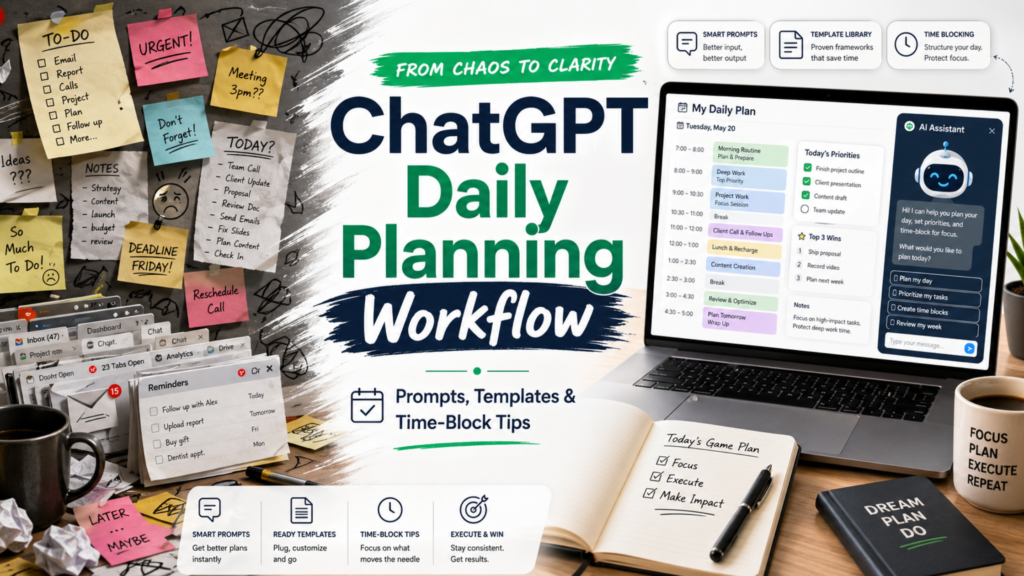 Turn chaos into clear action with a repeatable ChatGPT planning loop. Learn prompts, time-blocking, and daily review steps to plan faster and finish focused.
 - Attention Residue at Work: A 7-Step Reset for Focus
 Use a practical attention residue at work reset to close mental loops, recover focus after meetings, and protect deep work.
 - Digital Clarity vs Digital Detox: Which Reset Fits You?
 Digital clarity helps you reduce screen noise without quitting useful technology. Compare digital detox plans and build a calmer focus system.
 - Unlock Success: Key Qualities of a Professional
 Your workday probably starts before your brain is ready for it. Slack pings. Email stacks up. A meeting gets moved forward. Then someone asks for “a quick update” on a task you barely touched. That’s why many people… Read more: Unlock Success: Key Qualities of a Professional
 - Achieve Fitness with 30 Minute Workout Plans
 Your calendar is full. Your brain is already juggling messages, deadlines, and unfinished tasks. Then exercise becomes the thing you keep postponing because you assume it needs a full hour, a shower window, and a level of energy… Read more: Achieve Fitness with 30 Minute Workout Plans
 - TUDCA vs Milk Thistle: Which Is Best for Liver & Focus?
 You open your laptop early, promise yourself a cleaner workday, and still feel mentally muddy by noon. That pattern is familiar. Coffee helps a little. A better workflow usually helps more. Still, many busy professionals notice a physical… Read more: TUDCA vs Milk Thistle: Which Is Best for Liver & Focus?
 - Vitamin C or D? A Guide for Immunity, Mood & Focus
 Monday starts with a scratchy throat, a foggy head, and a calendar that does not care. You search “vitamin c or d,” open five tabs, and get the same recycled advice. One says take vitamin C at the… Read more: Vitamin C or D? A Guide for Immunity, Mood & Focus
 - Lunch Break AI: A 20-Minute Reset for Focus & Calm
 By noon, many people are not taking a break. They are eating quickly, checking Slack, clearing inboxes, and carrying half-finished thoughts into the afternoon. The body sits still, but the mind keeps sprinting. That is why lunch break… Read more: Lunch Break AI: A 20-Minute Reset for Focus & Calm
 - Your Guide to Affirmations for Happiness in 2026
 Affirmations for happiness aren’t about pretending everything is perfect. They’re concise, positive statements you use to deliberately redirect your internal monologue. By consistently repeating a phrase like, “I am capable and worthy of happiness,” you can start to… Read more: Your Guide to Affirmations for Happiness in 2026
 - Overcoming Feelings of Inadequacy in 2026
 Feelings of inadequacy aren’t just a fleeting moment of self-doubt. It’s that persistent, nagging sense that you are not good enough, often in the face of clear evidence that you are. This feeling creates a painful gap between… Read more: Overcoming Feelings of Inadequacy in 2026
Research-grounded articles on focus, digital wellness, and modern attention
The Mind Clarity Hub blog brings together a focus and digital wellness blog in one place, so you do not have to sort through scattered advice on social media. Each article is designed to translate neuroscience, psychology, and cognitive science into practical steps you can use in everyday life—even when you are tired, busy, or overwhelmed.
Here you will find deep dives such as Why Can’t I Focus Anymore? (Real Causes, Not Clichés) , The Hidden Costs of Screen Time: What 2025 Research Shows About Your Brain , and What Is Digital Fatigue and How Do I Recover Faster? . Taken together, they form a library for anyone who feels mentally overloaded, unfocused, or stuck in constant distraction.
How to use this blog to rebuild clarity and attention
Because attention struggles rarely have a single cause, it helps to move through this focus and digital wellness blog in layers. First, explore the core problem pieces that explain mental fog, digital overload, attention drift, and executive function challenges. Then, gradually experiment with the practical routines and tools described in each article.
For understanding what is happening under the surface, start with:
- Why Do I Feel Mentally Exhausted After Doing Nothing? – how “fake rest,” passive scrolling, and background stress drain your brain and attention span.
- Modern Attention Diet & Dopamine Detox – why dopamine, habits, and high-stimulation feeds quietly reshape your focus, motivation, and mental clarity.
- Why You Can’t Read Long Articles Anymore – step-by-step ways to rebuild reading stamina and deep thinking in a short-form world.
Once those foundations are clearer, you can move into systems and routines that support long-term clarity. Useful starting points include:
- The Neuroscience of Single-Tasking – how to design work blocks that protect deep focus instead of inviting constant multitasking.
- The “Clarity Morning” Routine for Executive Function – a 10–12 minute morning ramp that steadies your brain and reduces decision fatigue before the day fills up.
- How Long Does It Take to Rewire Your Brain for Focus? – realistic timelines for attention change, habit rewiring, and cognitive resilience.
Topics you will find across the Mind Clarity Hub blog
As you scroll through the articles on this page, you will notice several themes repeating. This is intentional. Modern distraction has many entry points, so this blog approaches them from multiple angles while staying grounded in science-aware, human-first explanations.
Common topics include:
- Chronic distraction and attention drift – why it is so hard to stay focused in open-tab, open-app days.
- Screen time and digital overwhelm – how screens affect sleep, mood, and cognitive performance over time.
- Brain fog and mental fatigue – the subtle ways stress, poor rest, and sensory overload cloud thinking.
- Executive function and decision fatigue – why planning, prioritizing, and starting tasks often feel heavier than they “should.”
- Routines, habits, and daily structure – practical frameworks for rebuilding rhythm without becoming rigid.
- Attention longevity and aging – how to protect focus, memory, and cognitive health as you get older.
- Meaning, purpose, and direction – how clarity connects to values, relationships, and the stories you tell yourself about your life.
Because each piece stands alone, you can jump into any topic that feels most urgent. However, when you read across several articles, you start to see a bigger picture of how your brain, body, environment, and technology habits interact to shape your focus.
A calm, science-aware alternative to productivity hype
Many readers arrive here feeling burned out on productivity hacks that ignore mental health, chronic stress, and nervous-system limits. The Mind Clarity Hub blog is intentionally different. Articles are written in plain language, cite current research where useful, and emphasize sustainable changes over quick fixes.
Instead of pushing you to “optimize every minute,” the writing here helps you notice what your brain is already trying to tell you. For example, if you feel more scattered after “resting” with your phone, pieces like Why Do I Feel Mentally Exhausted After Doing Nothing? explain why that happens in the first place. This kind of context turns vague guilt into concrete, changeable patterns around screen time, rest, and recovery.
You will also see frequent references to organizations such as the American Psychological Association , along with sleep and cognitive neuroscience research, so you can trace ideas back to a broader evidence base. That blend of lived experience, readable science, and practical tools is at the heart of this focus and digital wellness blog.
Navigating by themes: from screen time to attention longevity
As the archive grows, it can help to think in themes instead of reading strictly in date order. For instance, you might start with the “why” behind your fog, then move into routines, and finally into long-term attention longevity and resilience.
A few helpful mini-pathways include:
- Screen time and nervous system health: start with the 2025 screen time research article, then pair it with pieces on digital fatigue and “rest” that does not feel restful.
- Executive function and daily structure: read the Clarity Morning routine, then layer on single-tasking and habit rewiring guides to build a more stable workday.
- Feeling lost, stuck, or directionless: combine articles such as The Quiet Crisis: Why So Many People Feel Unfocused and Lost Right Now with pieces on values, meaning, and tiny clarity projects.
- Aging, focus, and cognitive health: explore guides like Attention Longevity: How to Protect Your Focus As You Age to understand how to care for your brain across the decades.
By following these small pathways, you turn the blog from “a long list of posts” into a guided curriculum for mental clarity, digital balance, and cognitive health.
Turning insight into small, realistic experiments
Reading about focus is helpful; however, change happens when you turn insight into small experiments. That is why many Mind Clarity Hub articles end with one-week or two-week “micro challenges” you can actually try in real life.
For instance, you might:
- Test a simple “no-phone first hour” experiment alongside the Clarity Morning routine.
- Run a seven-day screen-time audit inspired by the screen time and digital fatigue guides.
- Try one new single-tasking block each workday and track how your brain feels after two weeks.
- Adjust your evening habits using tips from the screen time and sleep articles, then notice what changes in your morning clarity.
Because these experiments are small, they respect the reality of busy schedules, family responsibilities, chronic health issues, and variable energy. You do not have to “fix your life” overnight. You only need to keep nudging your nervous system toward a calmer, clearer baseline.
Why this archive exists: a home base for clarity seekers
This page exists as a single place where you can see every Mind Clarity Hub article on focus, digital wellness, attention, and clarity in one view. When life gets noisy again—as it inevitably does—you can return here and quickly find the next piece that matches what you are struggling with right now.
Over time, this blog archive becomes a kind of personal reference library. You might revisit the digital fatigue articles during a demanding work season, then lean on the attention longevity or screen time guides as your routines shift. You may even share specific posts with friends, family, or colleagues who describe the same fog and distraction you have felt.
As new posts are added, they build on earlier work instead of repeating generic advice. That means the longer you stay connected to Mind Clarity Hub, the more detailed and tailored your mental “toolkit” becomes.
Keep exploring: your brain is still capable of change
feeling distracted, unfocused, or mentally tired does not mean you are broken. It means your brain is responding to a fast, loud environment. The purpose of this blog is to give you kinder language, better frameworks, and realistic tools so you can respond back.
As you explore the posts on this page, move slowly. Bookmark the pieces that resonate, return to them when you have more energy, and pick one or two ideas at a time to test. With steady, compassionate adjustments, it is entirely possible to build a life that is more focused, more intentional, and gentler on your nervous system—even in a world that constantly pulls your attention away.
Mind Clarity Hub blog FAQ
Who is the Mind Clarity Hub blog for?
The blog is for anyone who feels distracted, mentally exhausted, or overwhelmed by screen time and wants research-aware, practical guidance instead of quick-fix productivity hacks.
Are these focus and digital wellness articles based on research?
Yes. Posts draw on neuroscience, psychology, and cognitive science. Whenever possible, they link to recognized organizations and summaries from sources such as the American Psychological Association.
How should I navigate the Mind Clarity Hub blog if I feel burned out?
If you feel burned out, start with the articles on mental fatigue, digital overwhelm, and executive function, then move into routines like the Clarity Morning and single-tasking guides. The archive intro above suggests reading paths.
Do these articles replace medical or psychological advice?
No. The blog is educational, not diagnostic. If your focus, mood, or sleep problems are severe or long-lasting, it is important to talk with a qualified healthcare or mental health professional.