

Affiliate Disclaimer: This post contains affiliate links. If you purchase through them, Mind Clarity Hub may earn a small commission at no extra cost to you. We only recommend products aligned with our focus and wellness philosophy.
In an age of constant distraction, your brain’s ability to focus has become its most valuable skill. Yet beneath the chaos of notifications and dopamine loops lies an elegant truth: your mind can be trained to focus — not through force, but through frequency. Welcome to the world of neuro-sound rituals, a 2025 breakthrough at the intersection of neuroscience and audio therapy.
Scientists now know that sound doesn’t just move air — it moves neurons. Through rhythmic stimulation, specific sound frequencies can synchronize your brain’s electrical activity, reducing anxiety and enhancing clarity. The result is a calm, alert state known as alpha coherence, where focus flows effortlessly. Let’s explore how this works, and how tools like The Genius Wave are making it accessible to everyone.
1. How Sound Influences Brainwaves
Your brain operates in distinct electrical patterns — beta for active thinking, alpha for relaxed focus, theta for creativity, delta for deep rest. When life bombards you with noise and stress, these rhythms fall out of sync. Audio-based focus training works by gently nudging the brain back into alignment.
Research in Frontiers in Neuroscience confirms that auditory stimulation, such as binaural beats and harmonic layering, can entrain the brain — meaning external rhythms guide internal ones. This synchronization promotes calm awareness and improves executive function without pharmaceuticals or meditation experience.
For example, when two slightly different tones are played in each ear, the brain perceives a third “phantom” frequency equal to their difference. This phenomenon can shift brainwaves from the restless beta range into focused alpha states. That’s the same state elite athletes enter during flow or meditation masters sustain for hours.
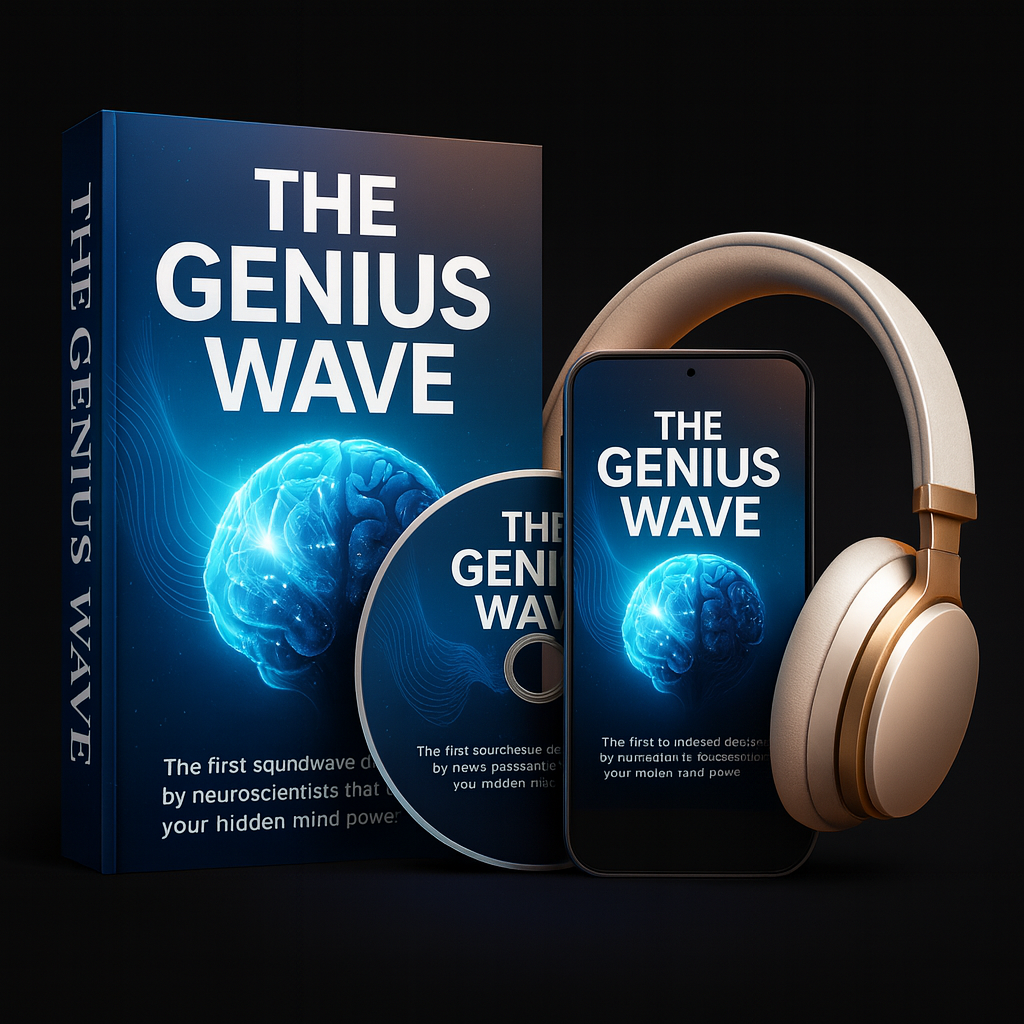
Affiliate link • Backed by a 90-day money-back guarantee
2. The Rise of Audio-Based Focus Training
In the 1990s, sound therapy was dismissed as pseudoscience. But modern neuroimaging has changed everything. fMRI scans now show that auditory entrainment can increase neural coherence between hemispheres — literally improving communication across your brain. That means faster problem-solving, reduced anxiety, and heightened creative output.
Major universities, from MIT to Stanford, are now exploring sound’s ability to modulate neural oscillations. Early data suggest it may support ADHD treatment and mental resilience training. Unlike stimulants, it doesn’t overstimulate dopamine receptors — it stabilizes them.
Products like The Genius Wave take these lab findings and distill them into a practical daily ritual. Three minutes of curated frequencies guide your brain into a calm, attentive rhythm before work or study — no learning curve required.
3. The Physiology of Focus
Behind every thought, your brain emits electromagnetic waves. Focus isn’t mental toughness — it’s a neurochemical harmony between dopamine, acetylcholine, and serotonin. Audio training optimizes this balance naturally by reducing stress-driven beta dominance.
4. Real-World Uses of Neuro-Sound Rituals
Audio-based focus training isn’t just a laboratory curiosity—it’s finding real application across multiple fields. High-performing professionals, students, and even athletes are adopting daily listening rituals to optimize their brain states before demanding tasks.
5. Emotional Regulation and the Sound–Stress Connection
Calm focus isn’t just about mental clarity—it’s about emotional stability. Every thought pattern in your brain carries a biological echo: heart rate, muscle tone, and hormonal shifts. When your nervous system is overactivated, even small distractions feel like emergencies. Sound entrainment works by doing the opposite—it gently lowers the body’s physiological arousal, giving your emotions room to breathe.
According to research published in the Frontiers in Psychology, rhythmic auditory cues can reduce cortisol by up to 20% within ten minutes of exposure. That’s because slow, coherent sound patterns stimulate the vagus nerve—the communication highway between your brain and organs. When this nerve is calm, so are you.
Users of The Genius Wave often describe this state as “still alertness”—not sedation, but balance. It’s a precise physiological signature of calm focus: steady heartbeat, deep breathing, quiet mind. Over time, your nervous system learns this as a new baseline. The result is less reactivity and more resilience, even under pressure.
Creative professionals report entering deeper “flow” states faster, describing it as the mental equivalent of stretching before a workout. Entrepreneurs use sound sessions during strategic planning or deep work blocks to prevent burnout and decision fatigue. Even educators are beginning to introduce neuro-sound breaks between classes to help students transition from distraction to attention.
For remote workers and digital creators, sound training provides a sensory reset that caffeine or productivity apps can’t replicate. It gives the nervous system a rhythm cue—a biological reminder that it’s time to focus, not doom-scroll. In that sense, The Genius Wave isn’t a gadget; it’s a ritual bridge between chaos and clarity.
Studies in Scientific Reports (Nature) have shown that rhythmic sound stimulation increases alpha amplitude and coherence — markers of cognitive readiness. Participants reported improved concentration, reduced mental fatigue, and better emotional regulation.
In practical terms, this means you feel grounded yet energized — the mental sweet spot for productivity, flow, and emotional stability.
6. The Ritual Effect: Why Repetition Matters
Neuroplasticity thrives on repetition. Each time you pair a sound frequency with a mental state, your brain associates them. Over time, you don’t even need the sound — your nervous system learns to recall that calm focus on command.
This is the same mechanism behind mindfulness, but faster. The sound acts as a shortcut into the brain’s relaxation and attention circuits. Morning sessions are especially potent because your brain is in a hypnagogic (theta-dominant) state — ideal for rewiring.
Users of The Genius Wave report noticeable changes within a week: reduced mental clutter, smoother workflow transitions, and a tangible “quiet alertness.”
7. The Future of Sound and Cognitive Enhancement
The frontier of neuroscience is moving toward precision audio therapy — personalized sound programs based on brainwave mapping. As consumer EEG headsets improve, custom frequency sets will adapt to your unique neural patterns. The future of focus may arrive not as a pill or an app, but as a tone.
8. The Genius Wave vs. Traditional Meditation
Traditional meditation trains awareness by stilling thought. Neuro-sound entrainment does something complementary: it trains awareness by structuring thought. Instead of resisting mental activity, it uses rhythmic input to channel it into coherence.
In meditation, your attention wanders until the mind quiets naturally. With sound-based training, frequencies guide that quieting process externally—like holding a tuning fork to your nervous system. This external rhythm acts as a stabilizer for those who find conventional meditation difficult or time-consuming.
Users often report that after several weeks, their meditation deepens naturally because their brains “remember” the relaxed focus pattern. This synergy explains why combining short sound sessions with mindfulness produces stronger long-term results. It’s not about choosing one over the other—it’s about accelerating the learning curve of calm awareness.
9. Why Sound May Be the Next Frontier of Focus Science
As brain imaging grows more precise, the future of focus training may lie not in willpower or supplements, but in sound. Neuroscientists are exploring “closed-loop feedback” systems that adjust frequencies in real time based on EEG readings—meaning your headphones could one day sense distraction and automatically recalibrate your brain’s rhythm.
While this technology evolves, simple entrainment programs like The Genius Wave give you access to the same foundational mechanism today: rhythm-guided neuroplasticity. It’s a quiet revolution—happening not in labs, but in living rooms each morning.
Sound is one of the few tools that bypasses language, bias, and thought. It doesn’t demand belief; it elicits biology. Every time you listen with intention, your brain learns harmony. And in a distracted world, harmony is the rarest—and most powerful—form of focus there is.
10. Integrating Sound Rituals Into Daily Life
Consistency beats intensity. The real transformation happens not in one perfect session, but in repeated practice that teaches your brain safety and rhythm. The simplest way to integrate sound-based focus training is to anchor it to an existing morning cue—such as after hydration, during journaling, or while stretching.
Three minutes of sound each morning creates a “neural bookmark” that tells your brain: this is focus time. Over weeks, your nervous system begins anticipating that rhythm and enters coherence faster. Many users find that after 21 to 30 days, they no longer need reminders—their body cues them naturally to start the day with clarity.
Sound training also pairs beautifully with other tools from the Mind Clarity Hub ecosystem. For example, The Power of Clarity provides the mental frameworks that match the physiological state created by sound. When you combine those two—focused brain and focused thought—you create a sustainable loop of calm performance.
In a noisy, overstimulated world, peace itself becomes a competitive advantage. And the path to it begins not with willpower, but with rhythm.
At its core, neuro-sound training represents a philosophical shift: instead of forcing the mind to obey, we learn to guide it harmonically. In the symphony of human attention, sound is the conductor that brings order to mental noise.
Explore how neuroscience meets sound for peak focus.
Further Reading and Resources
- Rewire Your Brain for Calm Focus (2025 Science-Backed Morning Rituals)
- 7 Morning Rituals to Reset Your Brain and Unlock Focus (2025 Guide)
- The Power of Clarity — Unlock Mental Focus and Build Momentum
Frequently Asked Questions
What are neuro-sound rituals?
They are short, intentional listening sessions that use specific sound frequencies to synchronize brainwaves for calm focus and improved cognitive performance.
Are audio-based focus programs like The Genius Wave safe?
Yes. They are non-invasive and rely on natural auditory stimulation, suitable for daily use.
How long before I notice results?
Most users report measurable calm and concentration within a week, with lasting neural benefits after 30–45 days.
Can I use sound training with meditation?
Absolutely. It enhances meditation by helping your brain enter alpha and theta states more quickly.
Does sound entrainment really work?
Peer-reviewed research in neuroscience journals confirms that rhythmic sound can modulate brainwave activity and improve focus when practiced consistently.
Affiliate link • Backed by neuroscience • 90-day money-back guarantee
Featured Reviews

The Genius Wave Review
Sound-based brainwave training tested for focus & productivity.
Read Review →
Ikaria Lean Belly Juice Review
Deep dive into ingredients, evidence, refund policy & safety.
Read Review →

Ikaria Lean Belly Juice Review
Deep dive into ingredients, evidence, refund policy & safety.
Read Review →