


Published:
Deep work is the ability to lock in, distraction-free, on a mentally demanding task. It’s a state of intense, single-minded concentration that pushes your brain to its limits. This allows you to produce exceptional work and master complex skills in record time.
Affiliate Disclosure: This article may contain affiliate links. If you make a purchase through these links, we may earn a small commission at no extra cost to you.
What Is Deep Work? A Practical Introduction
Picture a master watchmaker, completely absorbed in their craft. They’ve tuned out the entire world. Consequently, every tiny movement is precise and deliberate. That state of intense, distraction-free focus is the essence of deep work.
The term was popularized by author Cal Newport. He argues it’s the key to producing anything of value in our increasingly noisy world.

The opposite of deep work is shallow work. These are the logistical, low-value tasks we often do while distracted. For instance, answering emails, hopping on status calls, or scrolling through feeds. These activities make us feel busy, but they rarely create new, significant value.
In fact, research shows that the constant task-switching between shallow activities can burn up to 40% of a worker’s productive time. This is due to the mental cost of changing focus. It’s a staggering loss hidden in plain sight. You can discover more insights about these productivity costs on Flown.com.
Deep Work vs Shallow Work At a Glance
To quickly spot the difference in your own day, this table breaks down the core characteristics. Use it to identify where your best energy is going. Then, you can start to reclaim it for higher-impact activities.
| Characteristic | Deep Work | Shallow Work |
|---|---|---|
| Cognitive Strain | High; pushes your mental limits | Low; can be done on autopilot |
| Attention Required | Full, sustained concentration | Partial, fragmented attention |
| Value Creation | High; produces new, valuable output | Low; supports existing work |
| Replicability | Hard to replicate; requires expertise | Easy to replicate; requires little skill |
| Examples | Writing a strategic plan, learning a new coding language, analyzing complex data | Answering routine emails, scheduling meetings, browsing social media |
| Outcome | Mastery, innovation, high-quality results | Busyness, maintenance, minimal impact |
Seeing the contrast laid out like this makes it clear why a day packed with shallow work can leave you feeling exhausted. Moreover, you may have little to show for it. The goal isn’t to eliminate shallow work entirely—it’s often necessary. Instead, you should protect your best energy for the deep work that truly moves the needle. A helpful tool for this can be a productivity journal.
The Core Difference: Busy vs. Productive
Understanding deep work starts with seeing the gap between high-impact focus and low-value busyness. Our modern work culture often celebrates the appearance of being busy. For example, a packed calendar, a buzzing phone, or a flurry of Slack messages.
But this busyness is usually just a collection of shallow tasks. These prevent us from tackling the complex problems that matter.
Deep work isn’t about working harder; it’s about working smarter on what truly matters. It’s the practice of allocating your best energy to your most important tasks, free from interruption.
For instance, a marketing manager might spend their day firing off dozens of Slack messages and emails (shallow work). In contrast, a single, uninterrupted 90-minute block spent developing a new campaign strategy (deep work) would create far more value. This focused approach is a core theme in my book, The Power of Clarity.
This constant connectivity is a recipe for mental exhaustion. Learning what is digital fatigue and how to recover faster is a crucial first step toward reclaiming the energy needed for deep focus.
Why This Skill Is a Superpower in the Modern Workplace
Here’s the paradox: in our economy, the ability to perform deep work is becoming increasingly rare. This is happening at the exact same time it’s becoming increasingly valuable.
The constant flood of notifications has eroded our collective capacity for sustained focus. As a result, anyone who cultivates an environment for deep concentration gains a massive professional advantage.
They can learn complex subjects faster and solve difficult problems more effectively. In addition, they produce elite-level work that stands out. Cultivating this skill isn’t just about productivity. It’s about reclaiming your attention to find real fulfillment in what you do.
The Neuroscience Behind Uninterrupted Focus
Ever wonder why sinking into deep work feels so powerful? It’s not just about willpower. When you get into that state of intense, uninterrupted focus, you’re physically changing your brain for the better. This is the biological engine that helps you master hard things faster and produce work that actually stands out.

A key process at play here is called myelination. Think of the neural circuits in your brain like small, quiet country roads. Every time you practice a specific skill with intense concentration, your brain wraps those circuits in a fatty tissue called myelin. This coating acts like insulation, letting the electrical signals fire faster and more efficiently.
In short, deep work turns those slow country roads into a neural superhighway. It’s the same reason a guitarist can eventually switch between chords without thinking. Their brain has built a fast, reliable connection for that exact action through focused repetition.
The Hidden Cost of Task Switching
The opposite happens when we constantly jump between tasks. Every time you glance at an email or check a notification, you trigger what’s known as attention residue. It’s a cognitive switching cost. This means that even after you get back to your main task, part of your brain is still thinking about the thing you just looked at.
This mental fog can sabotage your focus for up to 20 minutes following a single, brief interruption. Your brain simply can’t commit its full resources to the complex problem in front of you. This happens because it’s still processing the leftover thoughts from the last distraction.
This scientific reality shows that creating an interruption-free zone isn’t a luxury; it’s a cognitive necessity for high-quality thinking.
Understanding this makes it clear why a good pair of noise canceling headphones or a simple phone lock box timer can have such a dramatic impact. These tools aren’t just blocking out sound; they’re preserving your cognitive resources by preventing the residue that fragments your focus. Protecting your mind this way is at the heart of effective single-tasking, a concept we explore in our guide on the neuroscience of single-tasking.
Getting into a state of uninterrupted focus often requires a calm mind. You might consider a short practice like a guided meditation to clear your mind before a deep work session. By quieting the mental noise first, you create the ideal conditions for your brain to build those strong, myelinated pathways.
The Transformative Benefits of Deep Work
Adopting a deep work practice pays dividends far beyond just a checked-off to-do list. This focused approach can genuinely reshape your career and accelerate your skills. It can also improve your sense of well-being by letting you operate at your cognitive peak. It’s the difference between being merely busy and being truly effective.
One of the most powerful outcomes is the ability to master complex skills rapidly. As we touched on, intense focus strengthens neural pathways. This means a developer who carves out time for deep work can learn a new coding language in weeks instead of months. This is because their brain is building efficient connections without the constant drag of interruptions.
Produce Elite-Level Work with the Power of Deep Work
In a world saturated with digital noise, the quality of your output has become the new currency. Deep work is what allows you to produce work that is difficult to replicate. Consequently, it actually stands out from the crowd.
Think of a marketer who sets aside an uninterrupted morning using a visual timer for desk. They can craft a game-changing campaign strategy. This task is flat-out impossible to do while fielding a constant stream of Slack messages. This kind of high-quality output is a direct result of achieving a state of flow. When you’re completely immersed in a task, your brain makes novel connections. You can explore our guide on how to achieve a flow state to learn practical techniques for reaching this peak mental condition.
Find Deeper Fulfillment and Meaning
Constantly switching between shallow tasks is mentally draining and unsatisfying. You often end the day feeling exhausted but with little sense of real accomplishment. Deep work provides a powerful antidote. It connects your daily efforts directly to meaningful outcomes.
This sense of purpose comes from applying your full capability to a worthy challenge. Research in psychology shows that humans find deep satisfaction not in passive leisure but in structured, goal-oriented activities that stretch their abilities.
For anyone feeling scattered, committing to focused work is a powerful step toward managing digital burnout. By intentionally creating space for concentration, you regain a sense of control and pride in your work. This is a key concept in my book, Burnout Interrupted. Protecting your focus also protects your mental energy. Instead of feeling depleted, you end your sessions with a tangible result. This reinforces a positive feedback loop that makes challenging work feel rewarding.
How to Build Your Deep Work Routine
Knowing what deep work is and why it matters is one thing. Actually making it a habit is another. The real trick is building a routine that makes intense focus feel natural. It should not feel like a constant battle against your own brain. It’s about reducing the friction it takes to get started.
First, you need a high-level approach—a philosophy that actually fits your life. Not everyone can just disappear into a cabin for a week. Cal Newport outlines four styles, and one of them will likely feel more realistic for you than the others.
- The Monastic Approach: This is the most extreme path. You drastically reduce or even eliminate shallow work to maximize deep work. It’s a good fit for people with a single, all-consuming professional goal. For example, an author on a deadline or a scientist cracking a problem.
- The Bimodal Approach: This model involves splitting your time into clear, extended chunks. You might dedicate two full, uninterrupted days a week to deep work. You would then leave the other three for meetings, email, and everything else. It’s a powerful rhythm if your schedule allows for it.
- The Rhythmic Approach: For most people, this is the most sustainable method. You build a simple, repeatable habit of doing deep work for the same block of time each day. For instance, the first 90 minutes of every morning. This turns focus into a steady beat. A habit tracker journal can be a great tool for keeping the rhythm going.
- The Journalistic Approach: This is an advanced technique for the mentally agile. It involves dropping into deep work whenever a pocket of free time appears. It requires an incredible amount of discipline to switch gears on a dime.
Once you’ve picked a style that feels right, you can start designing the actual sessions.
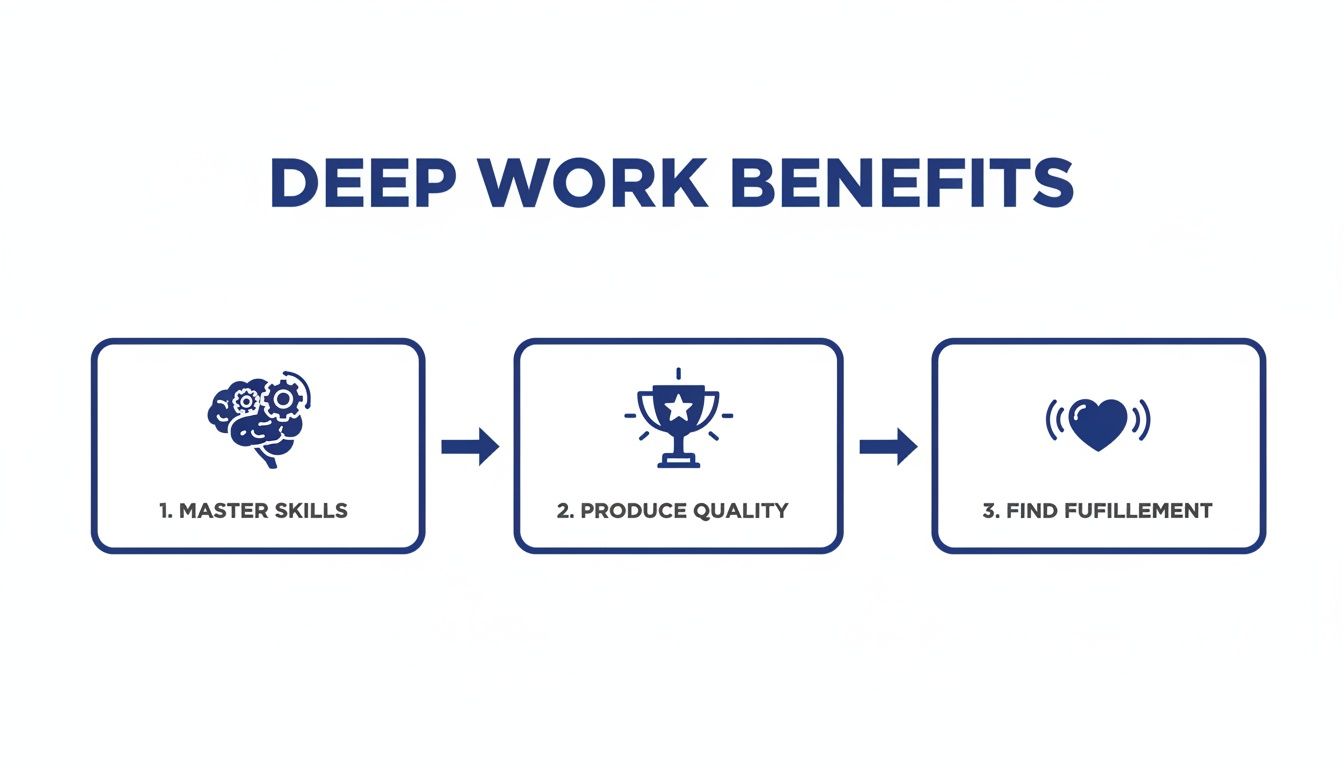
This process is about more than just getting things done. It’s a path toward mastering valuable skills. This in turn allows you to produce work of exceptional quality. Ultimately, this cycle is what leads to a deep sense of professional fulfillment.
Schedule and Prepare Your Space for Deep Work
The foundation of any real routine is the schedule. Get out a time blocking planner and book non-negotiable appointments with yourself for deep work. You have to treat this time with the same seriousness you’d give a meeting with your most important client. It’s protected time.
Next, you need to create rituals that signal to your brain it’s time to focus. These are small, repeatable actions that act as psychological triggers. It could be as simple as clearing your desk, adjusting your laptop stand for desk, or turning on a specific monitor light bar. These cues prime your mind for concentration. We dive deeper into crafting these signals in our guide on how to create a morning routine.
Execute with Intention and Unwavering Focus
With your time blocked and your space prepared, the final piece is execution. This is where you have to be ruthless about protecting your attention from distractions.
Put your phone in another room. Seriously. If that’s not enough, use a phone lock box timer to remove the temptation entirely. To signal your unavailability to others, you might even consider implementing a ‘Do Not Disturb’ light so colleagues can see at a glance that you’re in the zone.
But here’s the most critical part: you must have absolute clarity on what you’re trying to achieve. A vague goal like “work on the project” invites procrastination.
Before you start, define a specific, challenging, and measurable objective. Without a clear target, even the most perfect, distraction-free environment won’t produce meaningful results. My book, The Power of Clarity, offers a complete system for identifying exactly what to focus on for the biggest impact.
Editor’s Take: What Really Works for Deep Work
Let’s be honest: becoming a deep work master doesn’t happen overnight. While the principles are powerful, putting them into practice in the real world requires patience and a bit of self-compassion. This advice is best for knowledge workers, creatives, and anyone whose role demands thoughtful problem-solving and strategic thinking. It may be less applicable for roles requiring constant, real-time responsiveness.
The most sustainable way to get started is with the ‘Rhythmic’ approach. Forget trying to carve out a perfect four-hour block right away; that’s just a recipe for discouragement. Instead, aim to schedule just 60-90 minutes of protected, focused time each day. A pomodoro timer can be an excellent tool to structure these sessions.
Consistency is far more important than duration, especially in the beginning. While tools like an ergonomic keyboard and an ergonomic mouse can certainly improve physical comfort during long sessions, the foundational habit is scheduling and fiercely protecting that time. That’s the real core of learning how to focus better at work.
The key is to start small, stay consistent, and forgive yourself when interruptions inevitably happen. Progress, not perfection, is the goal. Each focused session, no matter how short, builds your capacity for concentration over time.
This gradual approach lets your brain adapt without feeling overwhelmed. It helps turn deep work into a sustainable part of your professional life. This is better than a stressful, all-or-nothing effort you’re bound to abandon. Improving sleep with a sunrise alarm clock or sleep mask blackout can also dramatically boost your focus reserves for the next day.
Key Takeaways: Mastering the Skill of Deep Work
- Deep Work is a Skill: It’s the trained ability to focus without distraction on a cognitively demanding task. It’s not just “working hard”; it’s working with intense, uninterrupted concentration.
- The Brain Changes: Deep work practices physically change your brain through a process called myelination. This strengthens neural circuits, allowing you to learn faster and perform at a higher level.
- Shallow Work is the Enemy: Constant multitasking, checking emails, and responding to notifications fragment your attention. This creates “attention residue” that kills productivity.
- Start with a Rhythm: The most sustainable way to start is the “Rhythmic” approach. Schedule a recurring 60-90 minute block of deep work each day, and protect it fiercely.
- Environment Over Willpower: Don’t rely on willpower to avoid distractions. Instead, engineer your environment. This includes silencing your phone, using noise-canceling headphones, and communicating your focus time to others.
- Clarity is Crucial: A deep work session is only as good as the goal you set for it. Before you start, define a specific, measurable outcome for that block of time.
Frequently Asked Questions About Deep Work
Even after you’ve got a plan, putting deep work into practice brings up real-world questions. Here are straightforward answers to the most common ones. They are designed to help you bridge the gap between theory and your actual workday.
1. How Long Should a Deep Work Session Be?
When you’re just starting out, aim for 60 to 90 minutes. That’s the sweet spot. It’s long enough to get into a state of flow, but not so long that you burn out. As your focus “muscle” gets stronger, you can stretch these sessions to two hours or even more. But always remember, consistency beats duration.
2. Can I Do Deep Work in a Noisy or Open Office?
Yes, but you have to be deliberate. High-quality noise canceling headphones are not a luxury here; they’re essential equipment. You can also create a temporary “cave” by booking a small conference room or finding an empty office. A simple desk sign can also work wonders to signal to colleagues that you’re in a focus block.
3. What If My Job Requires Me to Be Constantly Available?
This is a huge challenge, especially in management or client-facing roles. The answer isn’t to disappear for four hours. Instead, you adopt a “bimodal” or “rhythmic” approach. Schedule shorter, fiercely protected deep work sessions during known lulls. Communicate your plan to your team so they know when to expect you back online.
4. How Do I Handle Interruptions from Colleagues or Family?
The best defense is a good offense: proactive communication. Let people know your deep work schedule ahead of time. For those that still get through, have a polite but firm script ready. Something like, “I’m right in the middle of a focused session, can I circle back with you in an hour?” works perfectly.
5. What’s the Best Time of Day for Deep Work?
This is 100% personal and depends on your chronotype—your brain’s natural energy rhythm. Many people have the most cognitive horsepower in the morning. But if you’re a “night owl,” your peak thinking time might be late afternoon. Experiment and track your energy levels in a productivity journal to find your personal prime time.
Understanding what is deep work and its greatest obstacle
6. What Is Deep Work’s Biggest Enemy?
Hands down, the biggest enemy is unstructured connectivity. This is the modern default of being perpetually online and available through email, Slack, and texts. This habit creates an environment of constant context switching. This is the neurological opposite of the sustained focus that deep work requires. You can learn to fight this in Digital Clarity.
7. Does Listening to Music Count as Deep Work?
It depends. For many people, instrumental music—think classical, ambient, or lo-fi beats—can be a huge help. It blocks out distracting background noise. The key is to avoid music with lyrics, as that can engage the language centers of your brain and create a subtle drag on your focus.
8. What If I Feel Restless or Unfocused During a Session?
That’s completely normal, especially when you’re building the habit. Don’t fight the feeling. Instead, acknowledge it and take a very short, scheduled break. A pomodoro timer is brilliant for this. A little restlessness isn’t a sign of failure; it’s a sign you’re stretching your cognitive limits.
9. How Do I Decide What to Work On During My Sessions?
Clarity is everything. Before you start a session, you need one specific, challenging, and measurable goal. A vague intention like “work on the quarterly report” invites your brain to wander. A much better goal is: “Write the first draft of the market analysis section.” My book, The Power of Clarity, offers a full framework for setting these kinds of high-impact goals.
10. How Long Does It Take to Get Good at Deep Work?
Think of it like training for a marathon. You wouldn’t show up on day one and expect to run 26 miles. Building your capacity for sustained focus is a gradual process that takes weeks, and sometimes months, of consistent practice. Be patient with yourself and celebrate the small wins.
Disclaimer: This article contains affiliate links, and we may earn a small commission at no extra cost to you. The content is for educational purposes only and is not a substitute for professional medical or psychological advice. Please consult a qualified healthcare provider for any health concerns or before making any decisions related to your health or treatment. This information is not intended to diagnose, treat, cure, or prevent any disease.
Ready to build a system that makes deep work an effortless part of your daily routine? At Mind Clarity Hub, we specialize in providing science-backed guides to help you master focus, overcome distraction, and achieve your most important goals.
Explore our full library of books on productivity and mental clarity at https://mindclarityhub.com.
