


Published:
Affiliate Disclosure: This post may contain affiliate links. If you make a purchase through these links, we may earn a small commission at no extra cost to you. This support helps us continue to create valuable content.
A focus portal is your personalized, distraction-free command center. It’s not a single app you download. Instead, it is an entire environment you build. This integrated system of digital tools and daily routines is designed to protect your attention and make deep work possible.
What Is a Focus Portal and Why You Need One Now
Ever feel like you’re drowning in a sea of open tabs? Are scattered to-do lists and a never-ending inbox overwhelming you? You’re not alone. This digital chaos drains your mental energy through constant context-switching. Neuroscience research shows this process overloads the prefrontal cortex, the part of your brain responsible for planning and decision-making.
A focus portal is your defense against that overload. It’s a dedicated space, both digital and mental, that you engineer for concentration. Instead of reacting to a constant barrage of alerts, you create a system that serves your goals. This allows you to proactively engage with your most important work.
This isn’t just a personal productivity hack; it mirrors a major shift happening in the business world. Companies are scrambling to build centralized hubs for collaboration, with the global enterprise portal market projected to hit USD 93.82 billion by 2035. Why? They know that cutting through the information overload plaguing 70% of digital workers is essential for survival.
The Science Behind a Dedicated Focus Space
Your brain thrives on cues. When you consistently use a specific digital setup for demanding work, you create powerful psychological associations. Behavioral psychology refers to this as “context-dependent learning.” The environment you’re in helps you recall information and get into the right state of mind.
By designing a focus portal, you’re essentially telling your brain: “This is the place where we concentrate.”
This approach helps you drop into the state of intense concentration we explore in our guide on what is deep work. Creating this intentional space reduces the cognitive load of deciding what to do next. It also fights the temptation of multitasking. Studies show multitasking can slash your productivity by as much as 40%. A simple phone lock box timer can be a great physical tool to prevent this.
“A focus portal turns your computer from a source of constant distraction into a powerful tool for concentration. It’s about designing your environment to make focus the path of least resistance.”
Books like The Power of Clarity and Digital Clarity dig deep into these ideas. They show how intentional systems help you escape digital burnout. When you build a focus portal, you are not just organizing your apps. You are structuring your attention and reclaiming your mental energy for what truly matters.
This article is for educational purposes only. It is not a substitute for professional medical or psychological advice, diagnosis, or treatment. If you are experiencing symptoms of anxiety, depression, ADHD, burnout, or sleep problems, please consult a qualified healthcare provider.
Designing Your Focus Portal Blueprint
Before you build a house, you need a blueprint. The same is true for a powerful focus portal. Without a clear plan, your efforts can become just another source of digital clutter. It can become another well-intentioned system that gets abandoned in a week.
A successful blueprint rests on four core pillars. They work together to create an environment where concentration can actually flourish. These pillars are not separate, but interconnected. A well-designed physical space cues your brain for the mental frameworks you’ll use. Meanwhile, your daily routines reinforce the digital boundaries you’ve set.
The Four Pillars of an Effective Focus Portal
A truly effective system addresses every aspect of your work life—not just the apps on your screen. Think of these four pillars as the foundation for building your personalized command center for attention.
- The Digital Environment: This is all about curating your apps and taming notifications. It involves creating a streamlined digital workspace. It’s about deciding what gets your attention and when, instead of letting your devices choose for you.
- The Physical Space: Your desk, chair, and even the lighting are powerful signals to your brain. Optimizing this space tells your mind, on a subconscious level, that it’s time for deep work. Using an ergonomic keyboard can reduce physical strain, helping your mind focus.
- The Mental Framework: This is your internal operating system. It includes battle-tested strategies like time blocking and techniques for managing cognitive load. It also includes the mental models you use to approach your work.
- Daily Routines: These are the simple rituals that bookend your day. A consistent startup and shutdown routine creates structure. It signals a clear, non-negotiable transition between “on” and “off.”
When the digital environment is left to chance, it actively works against you. This leads to a state of constant cognitive overload.
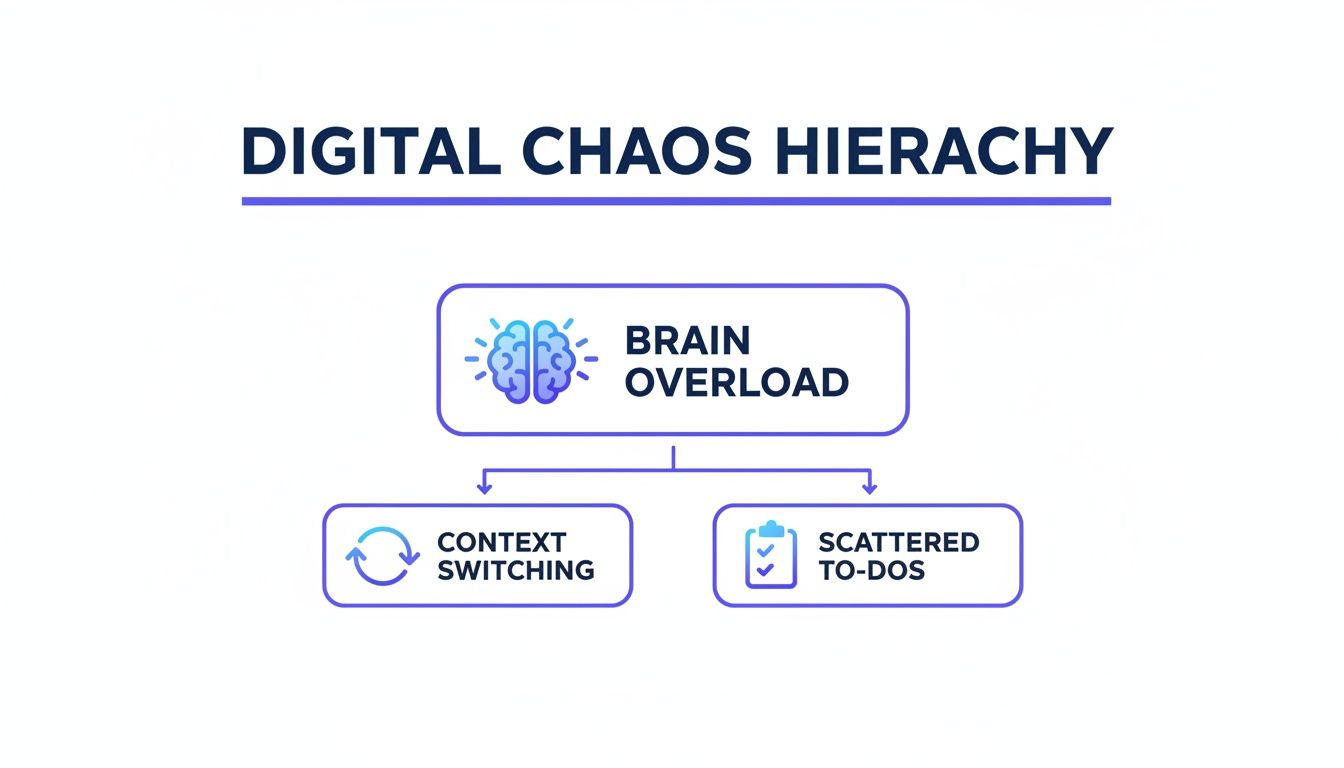
As you can see, the constant need to switch between tasks and manage disorganized information directly fuels mental fatigue. This makes focused work feel nearly impossible.
Pillar 1: Your Physical Workspace
Your physical environment is the first line of defense against distraction. Your brain is highly sensitive to external cues. Therefore, designing a workspace for focus is a non-negotiable first step. The goal here is simple: make concentration the path of least resistance.
For example, a freelance writer might set up their desk with a good laptop stand for desk to improve posture. They could also use a pair of high-quality noise canceling headphones to block out household sounds. This simple setup creates a clear physical boundary that signals “work time” to both the writer and their family.
Small changes, like adding a monitor light bar to reduce eye strain during long sessions, can also make a huge difference in how long you can sustain your focus.
Your brain doesn’t like ambiguity. When your workspace is distinct and used consistently for deep work, you create a powerful habit loop that makes it easier to drop into a state of flow.
You can find more inspiration by exploring our guide on home office organizing ideas to build the perfect physical foundation for your focus portal.
Pillar 2: Your Digital Environment
Next up is your digital world. You have to be intentional—even ruthless—about what apps, tabs, and notifications you allow into your awareness. The default settings on our devices are designed for corporate engagement, not for our personal productivity.
Start by conducting a “digital audit.” Remove any apps from your phone and computer that you don’t use or that consistently pull you away from your priorities. Then, turn off all non-essential notifications. This one action alone can dramatically slash the cognitive cost of context switching.
A graphic designer could create different browser profiles in Google Chrome for each client. For instance, one profile contains only the links, bookmarks, and logins for “Client A.” Another profile is dedicated entirely to “Client B.” This kind of segmentation prevents the mental clutter that comes from seeing irrelevant information when you’re trying to focus.
Choosing Your Focus Portal Core Components
To build out the physical and digital pillars, you’ll need a few core tools. The table below compares some popular options to help you decide what fits your work style. Remember, the “best” tool is always the one you’ll actually use consistently.
| Component Type | Popular Option A (e.g., Notion) | Popular Option B (e.g., Trello) | Best For… |
|---|---|---|---|
| Project Hub | Notion – A flexible, all-in-one workspace for notes, databases, and wikis. | Trello – A visual, card-based system for tracking tasks through stages. | Notion is great for thinkers who love building custom systems; Trello is ideal for visual, workflow-based projects. |
| Task Management | Todoist – A clean, powerful to-do list app with natural language input. | A simple physical notebook or time blocking planner. | Todoist excels at capturing and organizing tasks on the fly; a physical planner is better for deliberate, daily planning. |
| Distraction Blocker | Freedom – An app that blocks distracting websites and apps across all your devices. | An under desk walking pad – A way to channel restless energy into movement instead of digital distraction. | Freedom is for disciplined digital blocking; a walking pad is for those who think better while moving. |
| Physical Setup | An ergonomic chair and adjustable standing desk. | A simple desk with a good ergonomic mouse and external keyboard. | An ergonomic setup is a long-term investment for full-time remote workers; a simpler setup works well for students or hybrid workers. |
Ultimately, don’t get stuck in analysis paralysis. Pick a simple starting stack. This could be Notion for projects, a notebook for daily tasks, and a good pair of headphones. Then, refine it as you go.
Pillar 3: Your Mental Framework
With your physical and digital spaces dialed in, it’s time to build your mental framework. This pillar is all about adopting strategies that align with how your brain actually works. It’s about managing your energy and attention, not just your time.
Time blocking is a cornerstone of this framework. Instead of working from a long, overwhelming to-do list, you schedule specific blocks of time in your calendar for specific tasks. For example, a marketing manager might block 9-11 AM for “Write Weekly Report” and nothing else. This practice gives your brain the structure it craves and fiercely protects your most important work from interruptions.
Another key mental model is recognizing the limits of your executive function. These are the brain processes responsible for planning, focusing, and resisting impulses. By reducing the number of small decisions you have to make throughout the day (like what to work on next), you conserve that precious mental resource for the work itself.
Pillar 4: Your Daily Routines
Finally, routines tie everything together. They provide the structure that makes your focus portal sustainable over the long haul. These are not rigid, minute-by-minute schedules. Instead, they are flexible rituals that guide your day.
Your Startup Routine: This is a short sequence of actions you perform at the beginning of each workday. It could be as simple as brewing coffee, reviewing your plan for the day in a productivity journal, and opening only the apps needed for your first task. This ritual gently eases you into a productive state without relying on willpower.
Your Shutdown Routine: Just as important is how you end your day. A shutdown routine might involve clearing your inbox, planning tomorrow’s top three priorities, and closing all work-related tabs. This creates a clear psychological separation between work and personal life. Consequently, it helps prevent the kind of burnout that creeps up when you never truly unplug. Getting a good night’s rest with a sleep mask blackout can also help you recharge for the next day.
Crafting Your Digital Command Center
Alright, let’s get practical. It’s time to build the digital heart of your focus portal: your command center. This isn’t just another dashboard; it’s your single source of truth. It is a central hub that pulls in everything you need and aggressively filters out what you don’t. Think of it as the cockpit for your productivity—designed for clarity, not clutter.
First things first: you need to choose your hub. This doesn’t have to be complicated. It could be a clean Notion page or a visual Trello board. It could even be a simple, customized browser start page like Momentum. The goal is to create a launchpad for your day. This launchpad stops you from getting sucked into the vortex of your email inbox or social media feeds first thing.
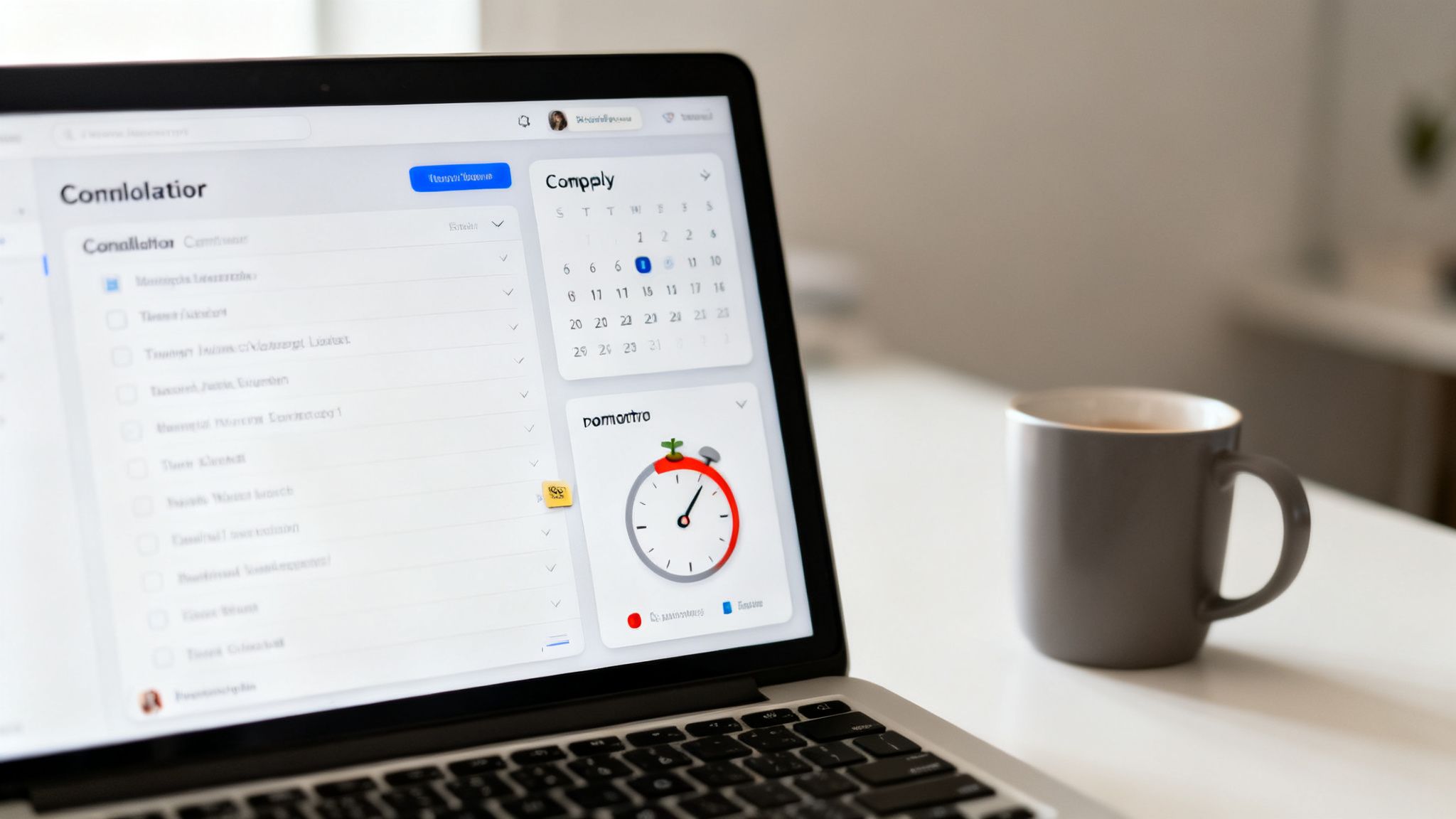
Building Your Central Hub
Let’s ground this with a real-world example. Imagine a freelance writer juggling three main clients. Each client comes with its own tasks, deadlines, and a trail of documents. Instead of wrestling with scattered files and emails, they build a simple dashboard in Notion.
You can streamline this kind of setup by starting with a dedicated Notion client portal template to centralize information from the get-go.
Their dashboard might include:
- A master task list they can filter by client.
- Quick links to each client’s Google Drive folder.
- An embedded calendar showing all deadlines at a glance.
- A scratchpad section for brainstorming and rough notes.
This simple setup means no more hunting for information. When they start their day, they open this one page. Their entire workload is visible and organized. This cuts down on the “decision fatigue” that comes from constantly figuring out what to do next.
Taming the Notification Beast
Once your hub is in place, the next job is to manage notifications. Uncontrolled alerts are the enemy of deep work. From a neuroscience perspective, each ping is a tiny hit of novelty. It hijacks your brain’s attention-switching network and shatters your concentration.
Setting up “Focus Modes” on your phone (iOS) or “Focus” on Android is non-negotiable. Don’t just turn them on; customize them. Create different modes for different activities, like “Deep Work,” “Meetings,” or “Personal Time.”
For example, a software developer’s “Deep Work” mode could block all notifications except for urgent alerts from a specific monitoring system. This creates a digital sanctuary where they can work uninterrupted for sustained periods.
This proactive approach is so much more effective than relying on willpower to ignore the constant buzzing. You’re designing your environment to support your intentions, not test your discipline. Wearing blue light blocking glasses during these sessions can also reduce digital eye strain.
The Power of Segmentation and Timers
To take this a step further, segment your entire digital environment. A powerful but underused technique is creating different browser profiles. You can use them in Chrome, Edge, or Firefox for different contexts.
Imagine a student working on their thesis while also managing a part-time job. They could have:
- A “Thesis” Profile: Logged into university accounts, with bookmarks only for research databases and writing tools.
- A “Work” Profile: Logged into their work email and project management software.
- A “Personal” Profile: For social media, news, and everything else.
This separation prevents crossover distractions. When they’re in their “Thesis” profile, they won’t get a tempting YouTube recommendation or a notification from their work chat. It’s a simple way to build digital walls between the different parts of your life. A gentle analog alarm clock can signal the end of a work session without a jarring digital alert.
Pairing this strategy with a timer solidifies the habit. Using a simple pomodoro timer, you commit to working within one profile for a 25-minute sprint. When you track these sessions in a time blocking planner, you get a clear visual record of where your attention is actually going.
Why This Matters More Than Ever
The need for these intentional systems isn’t just a feeling; the market reflects it. The global Focus App industry was valued at USD 745 million in 2024 and is expected to keep growing. Why? Because over 40% of knowledge workers report struggling with distractions at home.
Research shows that structured interventions like a focus portal can boost productive time by 30-50%. This is a crucial defense against the burnout affecting a staggering 77% of workers.
Crafting a digital command center is about taking back control. It’s the move from a reactive state, where your devices dictate your attention, to a proactive one, where your tools serve your goals. And if you’re interested in taking your efficiency even further, check out our guide on powerful https://mindclarityhub.com/ai-tools-for-productivity/ that can plug right into your new command center.
Using AI and Automation to Sharpen Your Focus
Let’s be honest: the last thing most of us need is another piece of tech pulling at our attention. But what if artificial intelligence could be the quiet, ruthlessly efficient assistant that powers your focus portal behind the scenes?
The goal isn’t to chase every shiny new AI tool. Instead, it’s to build smart, simple systems that handle the busywork so you don’t have to.
Think about the entrepreneur who spends the first hour of every morning just sorting and triaging their inbox. By setting up a single automation with a tool like Zapier, they can have any flagged email automatically turned into a task in their project manager.
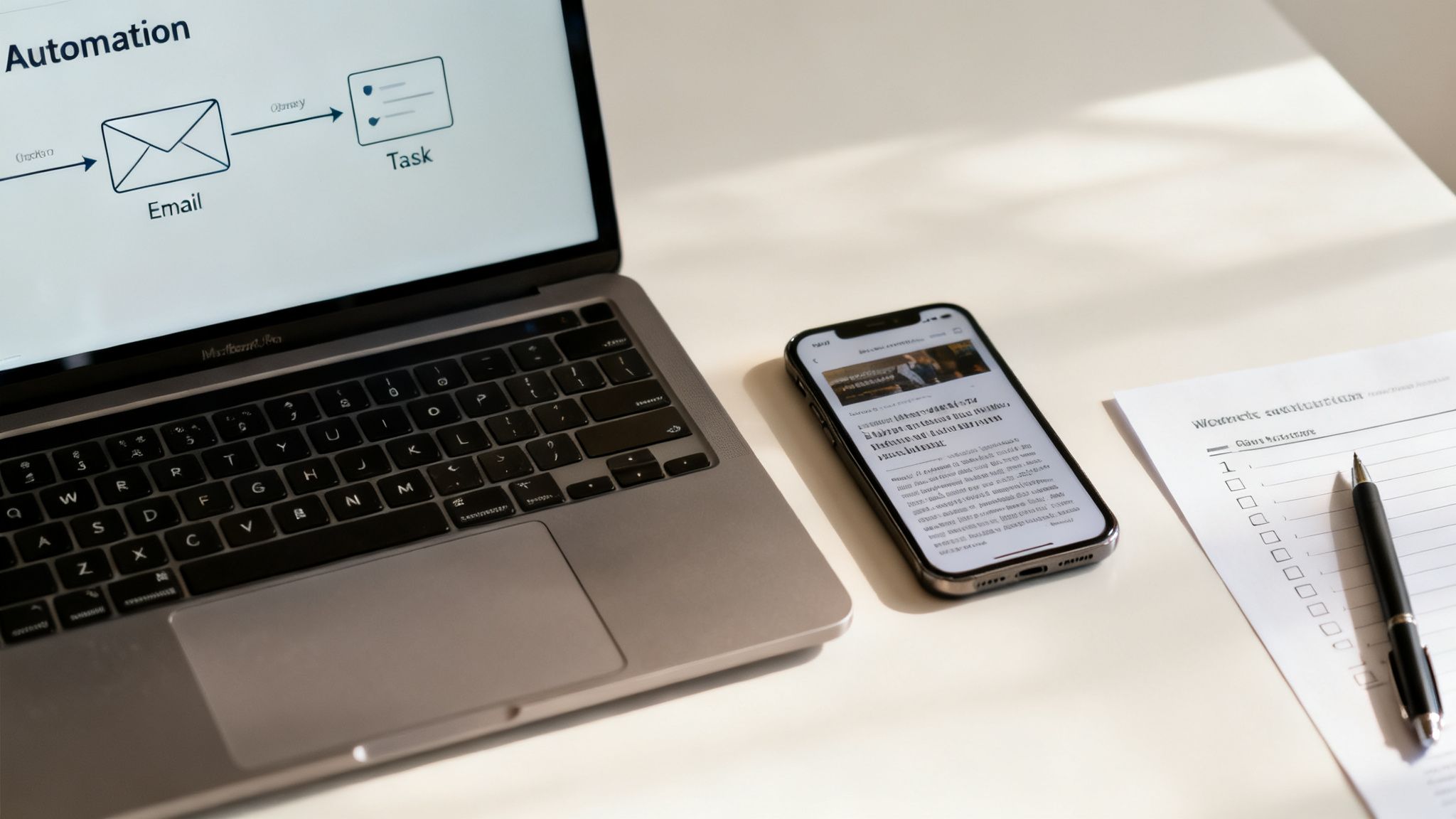
That one workflow might save them five hours a week. More importantly, it protects their most valuable mental energy right at the start of the day.
Automating the Mundane to Protect Your Attention
The core principle here is simple: delegate low-value tasks to technology. Your brain’s prefrontal cortex—the part that handles focus and complex decisions—is an easily drained resource. Every tiny, trivial choice you make, like where to save a file or how to phrase a meeting reminder, chips away at your capacity for deep work.
AI can shoulder that load. For example, instead of spending 30 minutes wading through a dense industry report, you could use an AI tool to generate a crisp, bullet-point summary in seconds. This lets you grab the key insights without sacrificing a huge slice of your most productive time.
Here are a few practical automations you can build into your focus portal right away:
- Email to Task: Automatically send starred emails in Gmail directly to your task manager (like Todoist or Asana).
- Meeting Agendas: Use an AI writing assistant to create a standard agenda template for any recurring meetings.
- Content Summaries: Paste the URL of a long article into an AI tool and get the main points back instantly.
- Social Media Drafts: Generate first drafts for social media posts based on your latest blog content.
These small efficiencies add up. They create more space for the strategic thinking that actually moves the needle. You can see more examples in our guide on how to use AI for productivity.
Building an Intelligent System That Works for You
To make this work, it helps to understand how to compare AI models so you can pick the right tools for the job. A small business owner, for instance, could use an AI-powered scheduler to handle all their client bookings. This completely eliminates the back-and-forth emails that constantly shatter their concentration.
This isn’t just a productivity hack; it’s a reflection of a massive shift in how work gets done. The market for digital transformation—which includes automation and AI tools—is projected to hit USD 1,864.94 billion by 2031.
Businesses are pouring money into these systems because they know streamlined workflows are the key to growth. AI analytics, the fastest-growing part of this market, is already helping automate around 40% of routine tasks. For anyone struggling with distractions, that’s a game-changer. It helps recover much of the 23 minutes typically lost every time our focus breaks.
By automating decision-making and routine tasks, you’re not just saving time. You are actively preserving your most valuable asset: your ability to think deeply and creatively.
This principle is the foundation of books like Marketing Magic and The 6-Figure Creator. These books explore how intelligent systems can amplify your impact. When you build automation into your focus portal, it stops being a static organizer. It becomes a dynamic assistant that actively helps you concentrate on what truly matters.
Maintaining and Adapting Your Focus Portal
Your focus portal isn’t a trophy you build once and then admire on a shelf. It’s a living system, more like a garden than a sculpture. To keep it effective, you have to tend to it. You need to prune what’s no longer serving you and adapt to the changing seasons of your work and life.
Without that regular maintenance, even the most perfectly designed system will eventually become a source of clutter itself. A cluttered system increases cognitive load, defeating the portal’s entire purpose.
The best way I’ve found to handle this is with a simple, recurring maintenance routine. Think of it as a “weekly clarity check-in.” This is a dedicated 15-minute block you schedule every Friday afternoon. This isn’t time for doing work; it’s time for working on your work system.
This short ritual is your best defense against “system creep.” This is the natural tendency for our digital spaces to accumulate new tools, apps, and workflows until they become bloated and inefficient. It happens to all of us. The brain’s constant desire for novelty can lead you to add things that seem helpful in the moment but ultimately just add complexity. A sunrise alarm clock can help you wake up refreshed, ready to tackle your day with a clear mind.
The Weekly Clarity Check-In
During your weekly review, you’ll ask yourself a few simple but powerful questions about your focus portal. The goal here is effectiveness, not perfection, so be honest with your answers.
- Is my main dashboard getting cluttered? If your central hub looks chaotic, it’s a sign that you need to archive old projects or simplify the layout. A messy dashboard creates subtle cognitive friction every single time you look at it.
- Are my notification rules still serving me? Did you allow alerts from a new app and forget to turn them off? Now’s the time to revisit your settings. Ensure only the most critical pings are getting through.
- What felt difficult or frustrating this week? If you constantly struggled to find a specific file or felt distracted during a certain time of day, that’s a signal. It points directly to a friction point in your system that needs a small adjustment.
Using a simple habit tracker journal can give you invaluable data for this review. Seeing a visual record of your work sprints, distractions, and energy levels helps you make smart, evidence-based tweaks rather than just guessing what needs to change.
Adapting Your Portal for Different Seasons
Your work intensity isn’t constant, and your focus portal shouldn’t be either. The system you need for a high-stakes product launch is completely different from the one you need during a quiet holiday period. The key is to be intentional about adapting it.
A rigid system is a brittle one. The true power of a focus portal lies in its flexibility—its ability to expand and contract based on your current demands without breaking.
During a project launch, for example, you might temporarily add a dedicated project dashboard with real-time metrics right on your portal’s homepage. In contrast, during a slower week, you could simplify your view to show only your top three long-term goals. Using a white noise machine can help maintain focus during both intense and quiet periods.
This is all about managing your energy, not just your time. You must ensure your system supports your current mental state.
By embracing this cycle of review and refinement, you create a resilient, evolving focus portal that supports you for the long haul. It helps you avoid the kind of system-induced overwhelm that can lead to burnout. This is a topic explored in depth in Burnout Breakthrough.
Key Takeaways
- A Focus Portal is a Personalized System: It’s an integrated environment, not a single app. It combines your digital tools, physical space, and daily habits to protect your attention.
- Build on Four Pillars: A strong portal rests on your Digital Environment, Physical Space, Mental Frameworks (like time blocking), and Daily Routines (startup/shutdown rituals).
- Your Brain Needs Cues: A dedicated space and consistent routines create powerful psychological triggers that help you enter a state of deep work more easily.
- Automate to Conserve Energy: Use AI and automation tools to handle repetitive, low-value tasks. This saves your brain’s limited cognitive resources for high-impact work.
- Regular Maintenance is Crucial: A focus portal requires a weekly 15-minute check-in to stay clean, effective, and aligned with your current priorities. This prevents system bloat and keeps it useful.
- Adaptability is Key: Your portal should be flexible, changing with the demands of different projects and work seasons. A rigid system will eventually break or be abandoned.
Editor’s Take
Here’s the honest truth: the most effective focus portal is one that starts simple and grows with you. The specific apps you choose matter far less than the principles behind them—intention, focus, and firm boundaries.
This system can be a game-changer for knowledge workers, students, and freelancers—really, for anyone who has some control over their digital world. But I want to be upfront: it takes a real investment of time to get it right, and it won’t run itself. You have to maintain it.
The payoff, though? It’s more than worth it. You’re trading a bit of setup time for a massive reduction in daily stress and a huge boost in the work that actually matters. It’s a commitment that pays you back, day after day, in clarity and accomplishment. If you’re serious about deep work, this is how you start taking your attention back.
Frequently Asked Questions About Building a Focus Portal
We get a lot of questions about what it really takes to design and maintain a personalized focus portal. Here are some of the most common ones, with clear answers.
1. How long does this actually take to set up?
The initial setup can be surprisingly fast—as little as one to two hours. That’s enough time to pick your central hub, do a quick desktop clear, and set some basic notification rules. If you want to get fancier with automations, set aside a full afternoon. But remember, a focus portal is meant to evolve. Start small and make tiny improvements each week.
2. Can I build a focus portal without buying new software?
Absolutely. You can build an incredibly effective portal using free tools you probably already use. A Google Doc can be your central hub. Your phone’s built-in “Focus Mode” can handle notifications. A simple browser extension can block distracting sites. The principles matter more than the price tag.
3. How do I stick with it when I get really busy?
This is where your daily startup and shutdown routines become non-negotiable. When you’re slammed, lean on a simple, two-minute startup ritual. Just open your portal and look at your single top priority for the day. That’s it. This consistency creates a powerful habit loop that makes using your portal automatic, especially under pressure.
4. What’s the biggest mistake people make when starting out?
Overcomplicating it from day one. People try to build the “perfect” system with a dozen new apps and complex automations. This creates a system that’s fragile and exhausting to maintain. The best approach is to start with the simplest possible version. Only add complexity when you feel a specific pain point a new tool would solve.
5. Is a focus portal a good fit for creative work?
Yes, it’s practically designed for it. Creative work like writing or design demands long, uninterrupted stretches of concentration. A focus portal creates those conditions by acting as a shield against the context-switching that kills creative flow. It gives your brain the quiet space it needs to connect ideas.
Optimizing Your Focus Portal for Different Projects
6. How can I adapt my portal for different projects?
A great way to handle this is through segmentation. For instance, you could create different browser profiles in Chrome for each major project, each with its own set of bookmarks and logins. Inside your central hub like Notion, create separate pages for each project and link to them from your main portal homepage. This keeps project-specific info contained.
7. Will this system work if I have ADHD?
While this guide isn’t medical advice, many people with ADHD find that externalizing their executive functions is a game-changer. A focus portal acts as an “external brain.” It provides the structure, visual cues, and clear priorities that can make it easier to stay on track. For some, adding a visual timer for desk can also be a fantastic tool to make time feel more concrete.
8. How often should I tweak or update my focus portal?
A quick, 15-minute review once a week is perfect. Use that time to clean up your dashboard, check notification settings, and ask what worked and what felt clunky. Consistent, small adjustments are far more effective than massive overhauls. This idea of refinement is a core theme in books like Attention Unleashed.
9. Can a focus portal genuinely help with work-life balance?
Definitely. The shutdown routine is the key. By consciously closing down your work systems and planning for tomorrow, you create a clear psychological boundary. This ritual signals to your brain that the workday is over, helping you disengage and be more present. It’s a core concept in Burnout Interrupted. A magnesium glycinate supplement might also support relaxation and sleep.
10. What’s the very first step I should take today?
Clear your computer’s desktop. Right now. Drag every file into a new folder named “Sort Later.” A clean desktop is a clean slate. It instantly reduces visual noise and gives you a feeling of control. It’s a simple, powerful first step toward building a space where you can actually think.
Disclaimer: This article is for informational and educational purposes only and does not constitute medical or psychological advice. The content is not intended to be a substitute for professional medical advice, diagnosis, or treatment. It may contain affiliate links, which means we may earn a commission if you make a purchase at no extra cost to you.
Ready to build a life with less distraction and more intention? At Mind Clarity Hub, we publish science-backed books that give you the blueprint for reclaiming your focus. Start your journey with our foundational guides.
