


Published:
Feeling paralyzed by a massive to-do list? It’s a modern work epidemic. The answer isn't about finding more willpower or just working longer hours. It's about building a smart, simple system to take the load off your brain and make clear choices.
Affiliate Disclosure: Please note that this article contains affiliate links. If you make a purchase through these links, we may earn a small commission at no extra cost to you. This helps support our work in bringing you research-backed content.
Why Prioritizing Tasks Feels Impossible in a Distracted World
You’ve been there. Urgent client emails are piling up, a huge project deadline is looming, and your bookkeeping is three weeks overdue. Instead of picking one thing and starting, you end up doing nothing. You feel frozen by the sheer volume of choices.
This isn’t a personal failing. It’s a predictable outcome of how our brains handle being overloaded.
This state often feels like mental exhaustion, a topic we explore in our guide on what causes brain fog. It's known as decision fatigue. Your brain’s prefrontal cortex is responsible for planning and making choices. It runs on a limited daily energy reserve. Every decision chips away at it. When you constantly jump between tasks—a behavior called context switching—you drain that reserve even faster. This makes it nearly impossible to think clearly about what actually matters.
Educational Note: This article provides information for educational purposes only. It is not a substitute for professional medical or psychological advice, diagnosis, or treatment. If you are experiencing symptoms of anxiety, depression, ADHD, burnout, or sleep problems, please consult a qualified healthcare provider.
The Neuroscience of Overwhelm
The struggle to prioritize isn't just a feeling; it's a documented phenomenon. One research review found that a staggering 98.2% of people struggle with prioritizing tasks effectively. Over 75% face severe difficulty in the middle of a fragmented workday. You can find that data over at Reclaim.ai. This just confirms what we all feel: winging it doesn't work. Having a system is far more reliable than just hoping for motivation to show up.
Often, the real challenge isn’t just about the clock. It’s about recognizing the crucial distinction between Energy Management vs Time Management. This has a huge impact on your ability to focus. The goal isn't just to manage hours. It's to protect your mental energy for the work that delivers real value.
Creating a dedicated, focused environment is a practical first step. Something as simple as putting on a pair of noise canceling headphones can signal to your brain that it's time to concentrate. This dramatically reduces the cognitive cost of blocking out distractions.
By building a system to offload decisions and protect your focus, you can finally move from feeling overwhelmed to being in control.
The 4-Step Framework for Effective Task Prioritization
When you're feeling overwhelmed, that's a clear signal your current system—or lack of one—isn't cutting it. To move from chaos to clarity, you need a simple, repeatable framework. The goal is to get all those swirling tasks out of your head and onto the page. There, you can make objective decisions instead of letting a stressed-out brain call the shots.
This approach is about externalizing your thoughts. You can see them, sort them, and act on them with confidence. This concept is a cornerstone of my book, The Power of Clarity.
Step 1: Capture Everything in One Place
Stop using your brain as a storage unit. It’s brilliant at coming up with ideas, but it’s a terrible filing cabinet. Trying to hold onto every single task creates a constant, low-level cognitive strain. This quietly drains your focus and energy throughout the day.
The fix is simple. Capture every task, idea, and to-do in a single, trusted source. This could be a dedicated productivity journal, a digital app like Todoist, or even a plain notebook. The tool doesn't matter as much as the consistency. Just get it all down.
When that to-do list lives in your head, it's easy to get caught in a downward spiral. The sheer volume of tasks leads to brain drain, which in turn leads to paralysis. You end up doing nothing because you can't figure out where to even start.
Real-World Example: Imagine you're a freelance writer. Instead of trying to remember client deadlines, article ideas, and invoicing dates, you capture everything. You might jot down "Follow up with Client X," "Outline blog post on AI," and "Send invoice for May." This simple act frees up mental space.
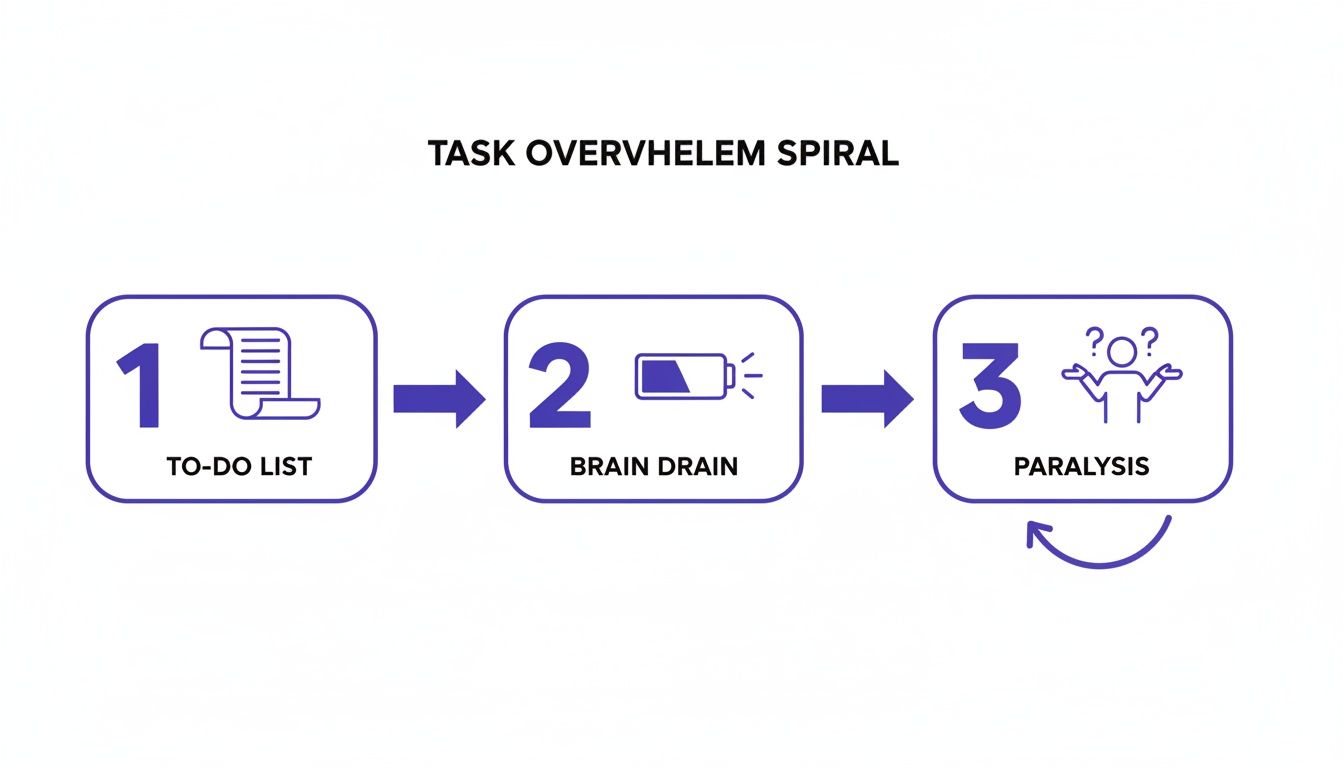
This cycle is what keeps so many smart people stuck. The key is to break it at the very first step by getting everything out of your head.
Step 2: Clarify and Triage Your Task List
Once everything is captured, it’s time to bring clarity to the chaos. Go through each item on your list. Ask yourself one simple question: "What does 'done' actually look like for this?"
A vague task like "work on website" is impossible to prioritize. It's not a single action. It’s a project in disguise. Break it down into a concrete next step, like "write the final copy for the 'About Us' page." This small act of defining the outcome makes the task less intimidating. It's far easier to assess. This is a vital skill for anyone managing competing priorities, turning abstract worries into steps you can actually take.
Mini-Scenario: Let's say your list has "plan vacation." That's too vague. Clarifying it might produce smaller tasks. Examples include "research flights to Italy," "book hotel for first three nights," and "ask for time off." Now you have clear, actionable items.
Step 3: Score Your Priorities With the Impact vs. Effort Matrix
Now for the fun part. With a list of clear, actionable tasks, you can start scoring them. Use a simple but incredibly powerful tool: the Impact vs. Effort matrix. This is a visual way to sort your tasks quickly. It helps you get past the "analysis paralysis" that can keep you stuck.
Use this simple matrix to quickly score your tasks. Plotting each task helps overcome analysis paralysis and clarifies your true priorities. It shows you where to focus your energy for the best results.
| Category | Description | Action |
|---|---|---|
| High Impact / Low Effort | Quick Wins that deliver significant value with minimal time or energy. | Do these first. They build momentum and create immediate results. |
| High Impact / High Effort | Major Projects that are crucial for long-term goals but require deep focus. | Schedule these. Block out dedicated time on your calendar to make real progress. |
| Low Impact / Low Effort | Fill-in Tasks that are necessary but don't move the needle much. | Batch these. Knock them out in a single, low-energy block of time. |
| Low Impact / High Effort | Time Sinks that consume a lot of energy for very little return. | Avoid or delegate. Question if these tasks need to be done at all. |
Let's say you're a small business owner prepping for a product launch. You'd plot your tasks like this:
- Quick Win: Sending an announcement email to your subscriber list. (High Impact, Low Effort)
- Major Project: Building the new product pages on your website. (High Impact, High Effort)
- Fill-in Task: Archiving old project files from last quarter. (Low Impact, Low Effort)
- Time Sink: Manually redesigning a minor graphic hardly anyone will notice. (Low Impact, High Effort)
This matrix isn't just about sorting tasks; it's about giving yourself permission to focus on what creates real value and to intentionally sideline what doesn't.
Step 4: Select and Schedule Your Work
With your priorities scored and sorted, there's just one step left: get them on the calendar. A to-do list tells you what you need to do. Your calendar tells you when you'll do it. For this, a time blocking planner is your best friend.
Assign your "Major Projects" to dedicated, uninterrupted blocks of deep work. Maybe that's Tuesday and Thursday mornings from 9 AM to 11 AM. Slot your "Quick Wins" in at the start of the week. This builds momentum and creates some early victories.
This final step turns your abstract list of priorities into a concrete, actionable plan for the week ahead. It leaves no doubt about what to work on and when.
Protecting Your Focus With Neuroscience-Backed Habits
A perfectly organized to-do list is useless if your brain is too fried to execute it. Your prioritization system is only as good as the focus you bring to the table. This is where a few simple, science-backed habits can make all the difference. They protect your attention so you can actually do the work that matters.
One of the most battle-tested methods is the Pomodoro Technique. It's not just a cute timer. It's a way of working with your brain's natural energy cycles, not against them. Behavioral research shows that structured breaks can restore focus. By committing to a focused 25-minute sprint followed by a 5-minute break, you prevent mental fatigue. I highly recommend using a physical pomodoro timer on your desk. It’s a simple visual cue that keeps you off your phone and locked into the task.
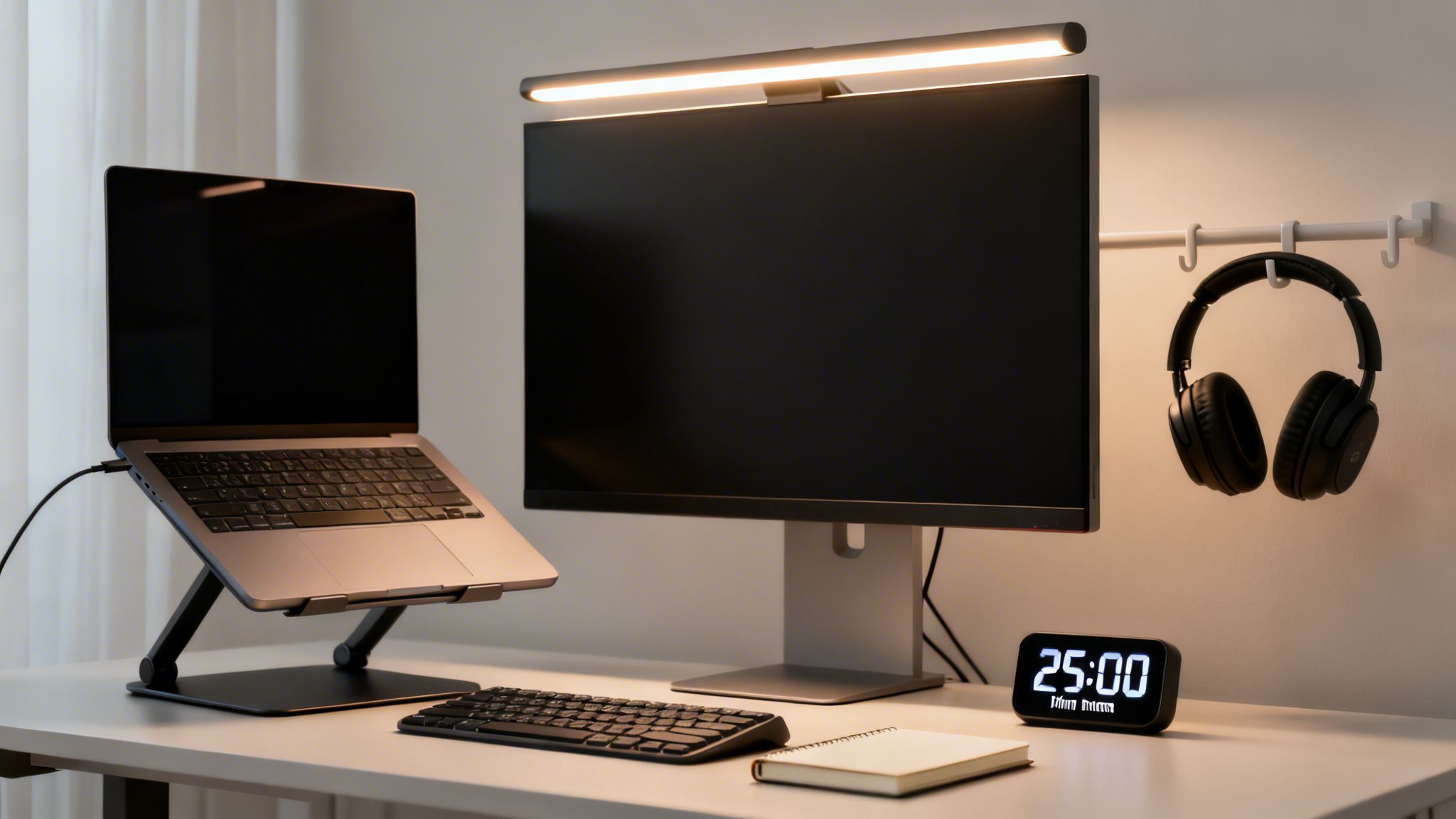
Don't underestimate your physical environment, either. It plays a massive role in your ability to concentrate. An uncomfortable setup creates a low-grade physical stress that quietly drains your mental resources all day. Small ergonomic tweaks—like using a laptop stand for desk to get your screen to eye level or investing in a comfortable ergonomic keyboard—remove that friction and preserve your energy for deep work. You can explore these ideas further in my book on productivity, Focus Recharged.
Design Your Deep Work Zone for Effective Task Prioritization
Think of your workspace less like a desk and more like a cockpit designed for focus. Every element should support your goal of sustained concentration, not distract from it. This is a non-negotiable principle for anyone serious about improving focus and concentration.
Real-World Example: A remote worker I know designed their desk as a dedicated "deep work zone." They added a monitor light bar to reduce eye strain during long writing sessions. They also physically moved their phone to another room during those blocks, perhaps using a phone lock box timer. This intentional design makes it dramatically easier to slip into a state of flow because you’ve removed temptations ahead of time.
Immediate feedback is another powerful, often-overlooked tool. Observational studies show that getting high-quality, instant feedback on tasks can improve multitasking performance by 20-30% in controlled settings. Why? Because that feedback loop clarifies priorities on the fly and reassures your brain that your effort is pointed in the right direction.
Create a Clear End to Your Day
Finally, one of the most crucial habits for avoiding burnout is building a "shutdown ritual." It doesn't have to be complicated. At the end of your workday, take five minutes. Review what you accomplished. Capture any new tasks that popped up. Then define your top one or two priorities for tomorrow.
This small ritual acts as a powerful signal to your brain. It says the workday is officially over. Psychology research suggests that such routines help create boundaries, which are essential for mental recovery. This allows you to mentally disengage and truly recharge, preventing the chronic stress that leads to burnout. Creating a clean break between "work" and "rest" is the only way to protect your focus for the long haul, a concept I cover in Burnout Interrupted.
Using AI and Simple Rules for Effortless Prioritization
Even the best prioritization system can feel sluggish when you’re staring down a mountain of tasks. This is where modern tools and simple decision-making shortcuts come in. They can dramatically speed up your workflow. This saves precious mental energy for the deep work that actually moves the needle.
One of the most powerful techniques is assisted triage using artificial intelligence. Instead of manually sorting a chaotic list, you offload the initial heavy lifting to an AI tool.
Mini-Scenario: Imagine you just wrapped up a one-hour brainstorming session. A project manager could paste the entire meeting transcript into an AI. Then they can ask it to "extract and categorize all action items by owner."
Just like that, a wall of text becomes a clean, actionable list. It’s a concept we explore more deeply in our guide on how to use AI for productivity.
Automate Small Decisions with Simple Heuristics
Beyond high-tech solutions, you can streamline your day with simple rules, or heuristics. These rules kill off tiny decisions before they even start. They are like mental shortcuts that keep decision fatigue at bay.
Here are two of the most effective ones you can start using immediately:
- The Two-Minute Rule: Popularized by David Allen, this rule is beautifully simple. If a new task pops up and you can knock it out in two minutes or less, just do it right then. This stops tiny to-dos from cluttering up your list and your mind.
- The One-Touch Rule for Emails: The moment you open an email, decide its fate. You can archive it, delete it, reply (if it takes less than two minutes), or move it to a "to-do" folder for later. The one thing you don't do is close it and leave it in your inbox to be re-read later.
To get these rules to stick without getting sidetracked, I’ve found a visual timer for desk works wonders. Setting it for just two minutes creates a real, tangible boundary. It stops you from accidentally falling down a rabbit hole. For an even more comprehensive strategy, check out these tips on how to use AI for productivity effectively.
The real point of these rules isn't just about speed. It's about preserving your best cognitive resources for high-impact work by putting the small stuff on autopilot.
The data backs this up. While global productivity growth has been slow, AI-heavy firms are reporting 72% higher productivity. They also report 59% better employee satisfaction. Even more impressive, generative AI is boosting knowledge worker efficiency by 66% or more. Integrating smart tools with simple rules isn't just a nice idea. It's a proven way to get more of the right things done.
Editor's Take: What Really Works to Prioritize Tasks
After testing dozens of systems, I always come back to two practices that consistently deliver results, especially when life gets chaotic.
First, the Impact/Effort Matrix is the single best tool for instant clarity. It forces an honest conversation with yourself about what’s truly valuable versus what just feels urgent. This exercise is a game-changer for anyone who struggles to see the forest for the trees. It’s the fastest way to stop majoring in minor things.
Second, time blocking is the only method that reliably protects my deep work. If a high-impact task doesn't have a specific block reserved for it on my calendar, it almost never happens. It just gets pushed around by a flood of emails and small requests. A good habit tracker journal can help make this practice stick.
This combination is best for busy professionals, freelancers, and students. It's for anyone tired of ending the day feeling busy but not productive. The key caveat is that this system requires a weekly review. You must set aside 30 minutes to clean up your list and plan the week ahead. Without that, even the best system will fall into chaos. The goal isn't perfection; it's about building a reliable system for consistent, meaningful progress.
Key Takeaways on Task Prioritization
- Externalize Your Brain: Don't use your mind for storage. Capture every task in a single, trusted system like a notebook or app to free up cognitive resources.
- Clarify Before You Organize: Vague tasks like "work on report" cause overwhelm. Break them down into specific, actionable steps like "draft report outline" before prioritizing.
- Use the Impact vs. Effort Matrix: This simple 2×2 grid is the fastest way to sort your tasks into Quick Wins, Major Projects, Fill-in Tasks, and Time Sinks. This visual sorting kills analysis paralysis.
- Schedule Your Priorities: A to-do list is a wish list until it's on your calendar. Use time blocking to reserve specific, uninterrupted slots for your most important work.
- Protect Your Focus: Your system is useless without the mental energy to execute it. Use neuroscience-backed habits like the Pomodoro Technique and create a distraction-free work zone to protect your focus. An ergonomic mouse might seem small, but it reduces physical strain, saving mental energy.
- Automate Small Decisions: Use simple rules like the "Two-Minute Rule" to handle small tasks immediately. This prevents them from cluttering your mind and list, preserving your decision-making power for what matters.
Final Words
When it comes down to it, getting a real handle on your priorities isn't about a magic app or a single productivity hack. It’s about building a simple, repeatable system that cuts through the noise. It lets you focus on what actually moves the needle. The goal is to move from feeling reactive and overwhelmed to feeling intentional and in control of your day. A great sunrise alarm clock can even help start your day with intention instead of panic.
The goal isn't perfection. It's about building a reliable system that helps you make consistent, meaningful progress on the things that actually matter.
Disclaimer: This article contains affiliate links. If you purchase a product through these links, we may receive a small commission at no extra cost to you. The content provided here is for educational and informational purposes only and is not a substitute for professional medical or psychological advice, diagnosis, or treatment.
Frequently Asked Questions (FAQ)
Even with the best system in place, questions pop up. Life is messy, and a good prioritization framework needs to be flexible enough to handle reality. Here are some of the most common questions about making this stick.
1. What do I do about unexpected "urgent" tasks?
This is going to happen. The real skill isn't preventing surprises; it's learning how to filter them without derailing your entire day. Before you react, run the new task through your system. Ask yourself: "Is this truly high-impact for our goals, or is it just someone else's poor planning disguised as urgency?" If it's a genuine "Do First" crisis, you'll have to adjust. But if it's not, your system gives you the confidence to calmly say, "I can look at that this afternoon."
2. What if everything feels like a high-impact, high-effort task?
This is a classic sign of overwhelm. When everything feels like the number one priority, it usually means your tasks are too big and vague. A task like "Launch New Product" isn't a task; it's a massive project. Your list should have things like "Draft the first launch email" or "Finalize product photos." Breaking it down into smaller, concrete actions makes them much easier to score and schedule.
3. How often should I re-prioritize my list?
For most people, a two-part rhythm works best: a quick daily check-in and a more thoughtful weekly review.
- Daily Triage (5-10 minutes): First thing in the morning, give your list and calendar a quick scan to confirm your 1-3 Most Important Tasks for the day.
- Weekly Review (30 minutes): Set aside a block of time, maybe Friday afternoon, to look back at what you accomplished and map out your big priorities for the week ahead.
4. How can this system help a procrastinator?
Procrastination is rarely about laziness. It's usually a symptom of feeling overwhelmed or unclear. This system tackles that head-on. By forcing you to define a small, clear next step, you lower the barrier to getting started. Pairing this with a pomodoro timer is a game-changer. It's far less daunting to commit to just 25 minutes of focused work than to face the entire project at once.
5. My team members all have different priorities. How do we align?
A shared, visual framework becomes your best friend. Pull up an Impact/Effort Matrix in your next team meeting. Plotting tasks together shifts the conversation from subjective feelings to a more objective discussion about what will move the needle on the team's shared goals. This single practice can prevent countless conflicts.
Strategies for how to prioritize tasks effectively
6. What if I have zero motivation for my high-priority tasks?
A lack of motivation is often a sign of a disconnect from the "why" or simple decision fatigue. Reconnect with the task's purpose. How does finishing it get you closer to a bigger goal? Also, be honest about your energy. If you're running on empty, you might need to prioritize foundational habits like sleep first. Better sleep, perhaps with a sleep mask blackout or a white noise machine, can dramatically improve your mood and motivation.
7. How do I stick with this system when I get insanely busy?
The busier you are, the more you need a system. When things get chaotic, your brain can't hold all the details. The key is making the habit as frictionless as possible. Keep your capture tool—like a productivity journal—always within arm's reach. If you fall off the wagon for a day or two, don't beat yourself up. Just do a quick "brain dump" and jump back in.
8. What’s the "Two-Minute Rule" and how does it fit in?
This is a simple but powerful decision rule. It goes like this: if a new task appears and you can do it in two minutes or less, do it immediately instead of adding it to your list. Think of things like answering a quick scheduling email. This prevents tiny tasks from piling up and creating mental clutter.
9. Are there any apps you recommend for this?
While a simple notebook is incredibly effective, plenty of digital tools can support this workflow.
- Todoist is great for capturing tasks and using labels for your priority quadrants.
- Asana or Trello are excellent for managing team projects with visual boards.
The best tool is always the one you'll actually use every single day.
10. How can I prioritize when I feel completely burned out?
When you're burned out, your number one priority is recovery, a topic I detail in my book Burnout Breakthrough. Trying to force productivity will only dig the hole deeper. Be ruthless with your task list. Aggressively cut out any "Time Sinks." Focus only on the handful of things that are truly mission-critical and give yourself permission to let the rest go for now. When your cognitive resources are low, as explained in our article on what is decision fatigue, managing them is everything.
