


Published:
Monday dread is real. A simple sunday night reset ritual to reduce monday anxiety can turn your weekend close into a calm launchpad. In twenty to thirty unrushed minutes, you can tidy the mental and physical clutter, review your week, pre-commit to small choices, soften your body with a short stretch, and set a clean tech boundary so your brain powers down. This guide gives you a steady flow you can keep even on busy weeks, with a printable checklist and a quick two-song timer version. When you repeat it, your brain learns the cues and settles faster.
Key takeaways for your Sunday night reset to ease Monday anxiety
- Use a sunday night reset ritual to reduce monday anxiety in 20-30 minutes: light tidy, calendar glance, outfit/meal pre-commit, gentle stretch, and a firm tech boundary.
- Keep it light: you are closing a week, not cramming a whole life overhaul into Sunday night.
- Pair it with a two-song timer on hectic weekends so you still get a quick win.
- Add clear stop rules (5 minutes for tidy, 4 for plan) so perfectionism cannot take over.
- Sleep and screen choices matter: dim lights, wind down, and cut blue‑light screens at least 30–60 minutes before bed for better rest.
- Print the checklist below and keep it where you’ll see it. Small consistency beats big perfection.
Why does Monday create anxiety for many professionals—and how a Sunday night routine for Monday calm helps?
For many knowledge workers, Monday stacks uncertainty (new tasks), social pressure (meetings), and time pressure (deadlines). Your brain tries to predict what’s coming and, without a plan, fills the gap with worry loops. That mix can show up as restlessness on Sunday evening, a tight chest, or a jumpy mind that won’t settle. Because your body links predictability with safety, even a small, predictable ritual reduces guesswork and builds a sense of control. Therefore, when you give your brain a short, soothing close to the week, it stops scanning for threats and starts trusting your plan.
Choice overload feeds the problem. If you face a messy desk, a vague calendar, and a dozen open tabs, your working memory gets crowded. Light order and one clear “first move” free up attention so you can sleep. A tidy chair and a one-line plan are small, but they change the tone of Monday morning.
Sleep also plays a role. Late‑night scrolling, bright light, or weekend schedule drift can delay melatonin and push your sleep later than usual. That makes Monday feel harsh. Simple wind‑down cues (warm lamp, gentle movement, analog notes) help your brain switch modes. Evidence and expert guidance support these ideas. Clinicians note that the “Sunday scaries” often blend work stress with poor sleep habits; practical steps like planning and wind‑down help break the cycle (Cleveland Clinic). Broad stress research shows that small, controllable actions ease perceived stress (American Psychological Association). Sleep experts advise reducing evening blue‑light exposure and keeping regular wind‑down cues (Sleep Foundation; CDC).
What is a sunday night reset ritual to reduce monday anxiety?
Think of this sunday night reset ritual to reduce monday anxiety as a gentle weekly close. It is not a strict productivity boot camp. Instead, it’s a short flow that restores order, answers “What’s first?” and lets your nervous system know the week is under control. It mixes five moves: a light tidy, a fast calendar glance, a couple of small pre-commitments for tomorrow, a soothing stretch, and a clean tech boundary. As a result, you finish Sunday with less rumination and start Monday with less friction.

Get the 7-Day Mind Clarity Reset (Free Workbook)
10-15 minutes a day to reduce mental noise and rebuild momentum (with templates you can reuse).
Your 20-30 minute sunday night reset ritual to reduce monday anxiety
Here is a sunday night reset ritual to reduce monday anxiety you can finish in under half an hour. Keep the tone calm and unhurried. Also, set a soft lamp, play a mellow playlist, and breathe deeply while you move. The phrase sunday night reset ritual to reduce monday anxiety sounds long, but the practice is deliberately short.
Step 1 — Light tidy for your Sunday night reset (5 minutes)
Use one basket or bag. Walk the three main areas you’ll see Monday morning (entry, desk, kitchen). Pick up only what is out of place and put it in the basket. Then make two micro‑resets that matter most to “Monday‑you”: clear your chair and wipe the desk. Because visible order lowers cognitive load, this single sweep cuts Monday friction.
- Goal: remove obvious clutter from sightlines.
- Stop rule: five minutes. Do not deep clean. You are setting a floor, not chasing a ceiling.
- If you work on‑site: stage your bag, keys, and badge near the door.
- If you work from home: clear your chair, close your laptop, and put the charger away so the desk looks “done.”
- With kids or roommates: do the sweep together for two minutes; set a timer and stop as a team.
Step 2 — Calendar glance and one-line plan (4 minutes)
Sit with your planner or calendar app open. Scan Monday and Tuesday. Also, note the one meeting or deliverable with the biggest stakes. Then write a one-line plan in simple language: “Start report outline before 10 a.m.; slides after lunch.” Because your brain loves specifics, this cuts vague dread.
- Block your first 60–90 minutes for deep work when possible.
- Also write one sentence to mark a small, doable win for Monday: “Send the kickoff email by 9:30.”
Examples by role (adapt as needed):
- Manager: “Draft 3 questions for 10 a.m. one‑on‑one.”
- Designer: “Open Figma and outline hero section by 9:45.”
- Analyst: “Run weekly revenue query; save results to dashboard.”
- Educator/Student: “Print lesson outline/pack laptop + charger.”
- Healthcare shift: “Check badge, water, and snacks; confirm start time.”
Step 3 — Outfit and meal pre-commit for the Sunday scaries reset (5 minutes)
Decide once for tomorrow. Lay out your outfit down to socks. Then choose a simple breakfast and lunch. In addition, stage what you can now (oats soaking, leftovers portioned). Because decisions drain energy, removing two morning choices gives you a calmer start.
- Keep a default pair: “Black pants, neutral top, flats.”
- Keep a default meal pair: “Oats + fruit; salad + protein.”
- On‑site day: add transit pass, ID, and a snack to your bag now.
- Remote day: set your water bottle and mug on the desk before lights‑out.
Step 4 — Gentle stretch and breath (5 minutes)
Use a light sequence: neck rolls, shoulder circles, forward fold, hip opener, and a doorway chest stretch. Meanwhile, breathe in through the nose four counts, out six counts. Also, keep movements slow and pleasant. This signals safety to your body and calms the fight‑or‑flight response.
- Option: lie down with legs up the wall for 1–2 minutes to soothe the nervous system.
- Stop if anything hurts. You are settling, not training.
- Breath options: try box breathing (4‑4‑4‑4) or lengthen exhale (4 in, 8 out) if you feel wired.
Step 5 — Tech boundary in your Sunday night reset to ease Monday anxiety (1–3 minutes)
Decide your last screen time for the night. Then set your phone to Do Not Disturb; leave it charging outside the bedroom if you can. Also, dim lights and switch to analog wind‑down (paper book, soft music, journaling). Research links blue light and late‑night scrolling with poorer sleep and alertness the next day (Sleep Foundation), so this small boundary pays off on Monday.
- Set a wind‑down alarm 60–90 minutes before bedtime.
- Use grayscale or a minimalist home screen to cut doomscrolling.
- Schedule Do Not Disturb/Focus Mode to turn on automatically every night.
- If needed, move your charger to another room as a physical cue.
Bonus — 3‑minute micro‑journal (optional)
If your mind still hums, write two lines: “What I did well this week…” and “What I’m doing first tomorrow…” Then close the notebook. As a result, you park the noise and step into evening calm.
That is the core flow. In practice, this sunday night reset ritual to reduce monday anxiety takes about 22-25 minutes. However, even if it runs long one week, keep the gentle tone and the clear stop rules. Consistency beats scale: a quiet 10/10 on the two-song version will help more than a frantic 0/10 on the full flow you skipped.
Sunday night reset flow (text‑light overview)
- Tidy: basket sweep of desk, entry, kitchen
- Glance: Monday/Tuesday + one-line plan
- Pre‑commit: outfit + breakfast/lunch
- Stretch: 5 gentle moves + slow breath
- Boundary: DND on phone + dim lights
Keep it calm. 20-30 minutes. Stop rules >> perfect results.
Tools for a sunday night reset ritual to reduce monday anxiety
You do not need fancy gear. However, a few low‑friction helpers make the habit stick. Use what you already own first.
| Item | Why it helps | Budget option |
|---|---|---|
| Small basket or tote | Speeds the tidy sweep without room‑by‑room detours | Grocery bag or backpack |
| Analog notebook | Parks thoughts without screens; anchors the one-line plan | Folded paper or sticky notes |
| Soft lamp or warm bulbs | Signals wind‑down; avoids harsh blue light | Use a table lamp with a warm bulb |
| Doorway hook | Pre‑stage Monday outfit where you’ll see it | Back of chair or a hanger on a knob |
| Simple timer or calming playlist | Keeps steps short and steady; prevents over‑cleaning | Phone timer or free playlist |
| Phone Do Not Disturb schedule | Automates the tech boundary every night | Built‑in DND/Focus mode |
| Analog alarm clock | Lets you charge the phone outside the bedroom | Inexpensive clock or repurpose an old one |
| Sticky note or mini whiteboard | Makes the one-line plan visible at your desk | Index card taped near monitor |
| Eye mask or darker curtains | Reduces light, supporting easier sleep onset | T‑shirt over eyes or clip curtain closed |
How a Sunday night routine for Monday calm helps sleep and focus
By clearing visual clutter and naming a first task, you cut uncertainty. Therefore, your mind is less likely to spin on “Am I forgetting something?” As you dim lights and move your body gently, you cue a state change away from work arousal. In addition, by breaking with screens earlier, you reduce blue‑light exposure that can delay melatonin and disrupt sleep timing (Sleep Foundation). Also, regular wind‑down routines support healthier sleep patterns (CDC: Sleep Hygiene), which improves Monday focus.
Two more levers help: implementation intentions and friction cuts. When you write “At 9:15 p.m., I’ll set Do Not Disturb and put the phone on the kitchen charger,” you reduce decisions at the moment of action. When you lay out an outfit and portion leftovers, you remove common snag points that slow mornings.
Finally, predictable cues teach your brain to downshift. A lamp that switches on at the same time, the same two stretches, and the same notebook all signal safety. Over a few Sundays, those cues begin to calm you faster.
Only have two songs? Try this Sunday scaries reset
Busy Sunday? Use the two-song timer. Pick two calm tracks (6–8 minutes total). Then do a compressed version: fast tidy in song one, quick calendar glance and pre-commit in song two, and one 60‑second stretch before you cut screens. Even a micro‑reset reduces friction and protects sleep.
| Track | Time | Action |
|---|---|---|
| Song 1 | 3–4 min | Basket tidy: desk, entry, kitchen; wipe desk |
| Song 2 | 3–4 min | Glance Monday/Tuesday; write a one-line plan; choose outfit |
| Final 60 sec (silence) | 1 min | One gentle stretch; set Do Not Disturb; lights down |
Can you still keep a sunday night reset ritual to reduce monday anxiety on the busiest weekends? Yes. Because the point is consistency, the two-song version keeps the habit alive without demanding extra time. Choose a playlist you like and reuse it so the cue becomes automatic.
Common mistakes in a Sunday night reset to ease Monday anxiety
- Going too big: Keep the tidy light. Also, stop when the timer ends.
- Screen spiral: Decide the last screen time before you start, then set DND.
- Unclear first task: Write one clear line you can act on without thinking.
- Too late: Start the ritual 60–90 minutes before bed so you end on a calm note.
- All‑or‑nothing thinking: If the full flow won’t fit, run the two-song version.
- Hidden clutter traps: If one area always eats time (junk drawer, inbox), skip it on Sundays and handle it another day.
Quick reference for your Sunday night routine for Monday calm
| Element | 20-30 minute flow | Two‑song timer |
|---|---|---|
| Tidy | 5 min basket sweep + desk wipe | 3–4 min basket sweep only |
| Plan | 4 min calendar glance + one-line plan | 2 min glance + one line |
| Pre‑commit | 5 min outfit + meal stage | 2 min outfit only |
| Stretch | 5 min gentle flow + breath | 60 sec favorite stretch |
| Tech boundary | DND + phone outside bedroom; dim lights | DND + dim lights |
Photo examples to cue your Sunday night reset
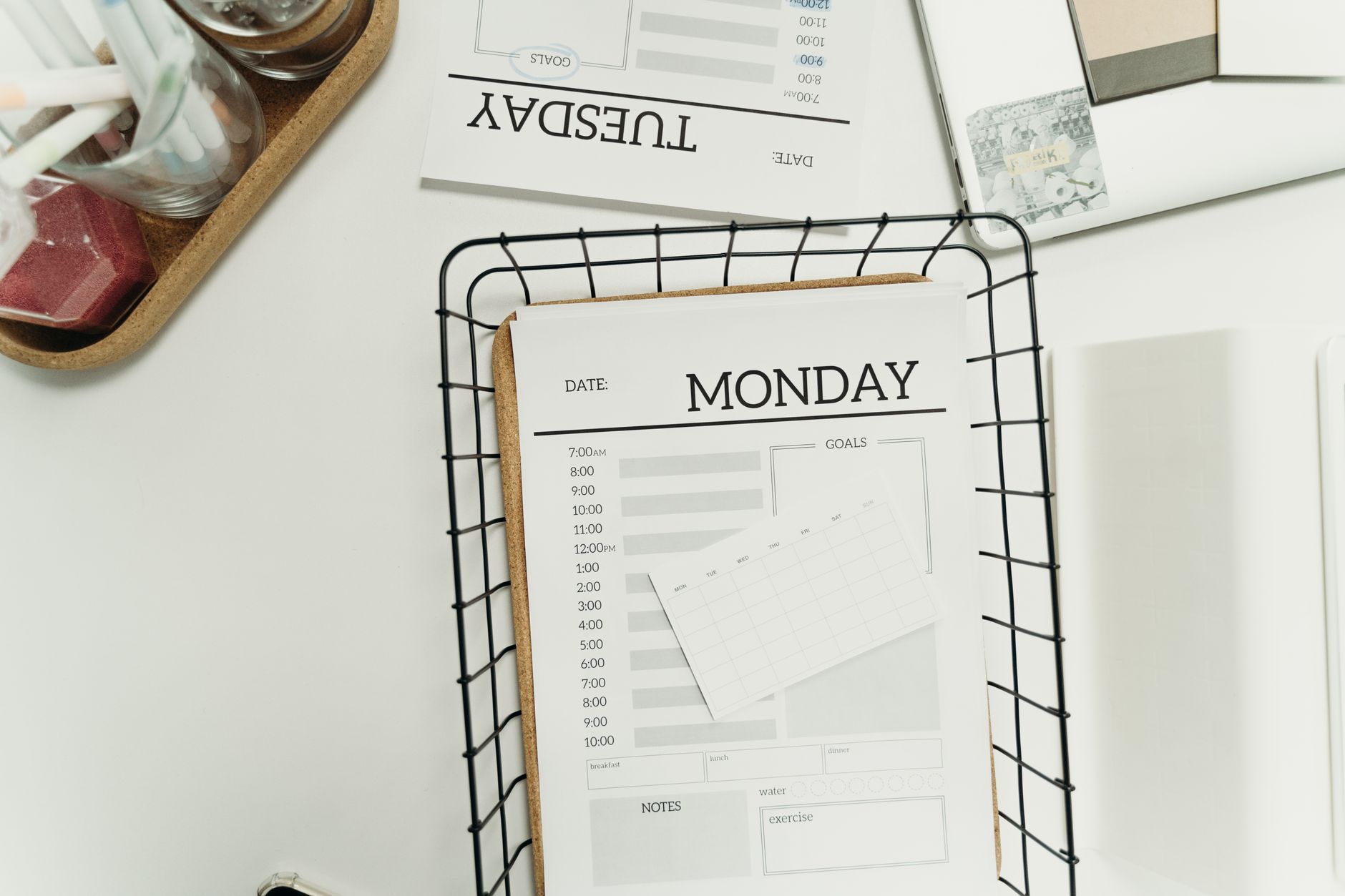
Provenance: Pexels image ID 7428859 by cottonbro studio — source.

Provenance: Pexels image ID 9063392 by cottonbro studio — source.
Sunday night reset questions to ask yourself
- Name the single most important thing for Monday morning.
- Pick two small decisions you can remove from tomorrow.
- Choose a 5‑minute tidy that Monday‑you will appreciate.
- Decide when you will stop screens tonight and what you’ll do instead.
Will this help even if my job is unpredictable?
Yes. Because the ritual focuses on readiness, not on locking down every detail, it helps even when Monday can change. You are removing friction you can control and setting a clear “first move” you can adjust if needed.
If your week starts on a different day or rotates, run the same steps the night before your workweek starts. Keep the order and stop rules; only the timing shifts.
Optional add‑ons for your Sunday scaries reset
Optional add‑ons can help, but only if they are truly easy:
- Fill a water bottle and set it by your bag.
- Write a quick “not doing this week” line to protect focus.
- Place one encouraging note on your desk for Monday morning.
- Stage keys, transit card, and ID badge in one spot.
Short video to support your Sunday night reset
If the embed does not load, watch on YouTube: Experiencing Morning Anxiety? Listen Up.
Who benefits most from a sunday night reset ritual to reduce monday anxiety?
Professionals who juggle meetings and deep work, managers who carry the emotional tone for a team, and anyone who sleeps poorly on Sunday nights. Because this ritual is brief and non‑perfectionist, it fits new parents, caregivers, and students as well.
Obstacles and fixes
| Obstacle | Why it happens | Simple fix |
|---|---|---|
| “I forget on Sundays.” | No cue or visual trigger in your space | Place the basket and notebook where you sit Sunday evening |
| “I get sucked into email.” | Screen opens too early in the ritual | Do analog steps first; open calendar on paper or a lock‑screen widget only |
| “My partner needs the living room.” | Competing routines at the same time | Run the two-song timer in the bedroom or kitchen; stretch beside the bed |
| “I over‑clean and run late.” | Perfectionism and no stop rule | Set a 5‑minute timer and stop on the beep; leave the rest |
| “Kids’ bedtime runs long.” | Your start time slides past wind‑down | Shift the ritual earlier; use the two-song version if it’s already late |
| “I scroll in bed anyway.” | Phone within reach and no replacement habit | Charge in another room; set a book or journal on the pillow as a cue |
| “I share a room/walls are thin.” | Noise and light make it hard to settle | Use earplugs, a soft eye mask, and a lamp with a warm bulb |
| “I forget meals and buy fast food.” | No default choice and low energy in the morning | Pick a standing pair (oats + fruit; salad + protein) every Sunday |
Can a sunday night reset ritual to reduce monday anxiety hurt sleep?
It should help sleep, not hurt it. However, if you start too late or stare at screens during the plan, you may feel wired. Therefore, begin 60–90 minutes before bed, keep lights warm, and shut screens when you hit your last step. Evidence links evening blue‑light exposure with sleep delays (Sleep Foundation), and general sleep hygiene supports a steady wind‑down (CDC). If sleep is often poor, consider whether caffeine, late meals, or stress are factors and adjust gently.
Printable checklist
Print this section or copy it to a single page. Check each box on Sunday night. Keep it easy.
- [ ] Start soft lamp; play a calm playlist
- [ ] 5‑minute basket tidy: entry, desk, kitchen
- [ ] Wipe desk; clear chair for Monday‑you
- [ ] Calendar glance: Monday + Tuesday
- [ ] One‑line Monday plan: __________________________
- [ ] Outfit set (top to socks) on the hook/chair
- [ ] Breakfast and lunch pre-commit
- [ ] 5‑minute gentle stretch + slow breath
- [ ] Phone to Do Not Disturb; last screen time set
- [ ] Optional 3‑minute micro‑journal
Tip: Clip this to your fridge or place it on your desk. Because visibility drives behavior, a simple paper cue boosts follow‑through.
FAQ
What if my Sunday evenings are already packed?
Run the two-song timer. You will still get the biggest wins (a quick tidy, a one-line plan, and a phone boundary). Because consistency matters more than duration, the short version protects your Monday without stealing your evening.
Does a sunday night reset ritual to reduce monday anxiety replace therapy or medical care?
No. It is a practical routine for organization, sleep‑friendly choices, and stress reduction. If anxiety disrupts your life or sleep often, consider talking with a licensed clinician. In addition, use reputable health resources to learn more about stress and coping (APA: Stress).
How long until I notice a difference?
Many people feel lighter after the first run because clutter drops and the first task is clear. Also, after 2–3 Sundays, you will likely notice calmer Monday mornings as the habit sticks and sleep improves.
Should I avoid screens on Sunday night?
As much as you can. Dim lights and switch to analog wind‑down 60–90 minutes before bed. Because blue light can suppress melatonin, this helps you fall asleep and wake more refreshed (Sleep Foundation).
What if I work non‑traditional hours?
Shift the ritual to the night before your “Monday”—whatever day starts your workweek. Keep the same flow and stop rules; only the day changes.
Putting it together tonight
Choose your version—full flow or two-song timer—and pick a start time that ends at least 60 minutes before bed. Then follow the steps and stop on the timer. Finally, move to a calm, screen‑free wind‑down. When you wake, you will have fewer choices to make and a clear first step.
- If‑then plan: “If it’s 8:45 p.m., then I start the reset.”
- Habit pair: attach the ritual to an existing cue (after dishes, before skincare).
- Visible cue: place the basket and notebook in your favorite chair at noon on Sunday.
- Floor version: when tired, do the two-song timer and stop.
- Morning review: glance at your one-line plan with your first sip of coffee.
Helpful next steps
- Explore our books hub for deeper skills on focus, routines, and stress relief.
- Find practical tools in our reviews to support calm workdays.
Sources and further reading
- Cleveland Clinic — Sunday Scaries: What They Are and How to Deal With Them
- American Psychological Association — Stress: What You Need to Know
- Sleep Foundation — How Blue Light Affects Sleep
- Centers for Disease Control and Prevention — Sleep Hygiene Tips
Start your sunday night reset ritual to reduce monday anxiety tonight. Keep it short, kind, and consistent. Your future self will feel the difference Monday morning.
Helpful resources for your next step
Affiliate disclosure: As an Amazon Associate, Mind Clarity Hub may earn from qualifying purchases at no extra cost to you. Use this link only if it genuinely helps your planning.
If A Calm Sunday Night Reset to Ease Monday Anxiety is a routine you want to keep using, a simple workbook, planner, or desk tool can make the steps easier to repeat.
Compare related planners, workbooks, and organization tools on Amazon.
