


An attitude of gratitude is more than just saying “thank you.” It’s a consistent way of seeing the world, an intentional practice of appreciating the good in your life. This mindset shift actively rewires your brain for greater happiness and resilience, pulling your focus from what’s missing to what’s already there.
Think of it as building a powerful foundation for positive change, one thankful thought at a time.
Mindful Gratitude Disclosure: Some links in this article may be affiliate links. If you make a purchase, we may earn a small commission at no extra cost to you. This helps support our work in creating helpful, science-backed content.
Understanding the Neuroscience of Your Attitude of Gratitude
Cultivating an attitude of gratitude isn’t just a feel-good philosophy; it’s a practical, brain-changing activity. When you consciously practice being thankful, you’re lighting up key areas of your brain tied to mood, social connection, and reward. According to neuroscience, this process can physically alter your neural pathways over time, nudging positivity to become your brain’s new default setting.
At its core, gratitude activates the brain’s reward system. When you bring to mind something you’re thankful for, it triggers a release of dopamine and serotonin—two crucial neurotransmitters that boost your mood. The more you do it, the stronger those neural circuits get, making it easier to tap into positive emotions down the road. This is why a simple habit, like jotting down small daily wins, can be so incredibly effective at shaping your behavior.

For a busy professional feeling swamped, just acknowledging minor achievements—finishing a report, having a productive meeting—starts to push back against the brain’s natural negativity bias. Behavioral research explains this as our built-in tendency to dwell on bad experiences more than good ones, a leftover survival instinct that doesn’t always serve us in the modern world. Gratitude is a direct counter-practice to this bias.
How Thankfulness Shapes Your Brain and Focus
When you practice gratitude, you’re essentially training your attention. Neuroimaging studies have shown that gratitude practices fire up the medial prefrontal cortex, a brain region linked to understanding others’ points of view and feeling relief. In plain language, this mental shift helps you see the positive intentions behind people’s actions and fosters a much deeper sense of connection.
Gratitude is a tangible practice, not just a fleeting feeling. Research shows that people who actively practice gratitude—through journaling or other exercises—report higher levels of joy and well-being. The act itself invites positive emotions into our lives.
For example, instead of getting frustrated by a delayed train, someone with a well-practiced attitude of gratitude might use that extra time to appreciate a quiet moment to read or listen to music. This cognitive reframing doesn’t ignore the inconvenience; it just shifts the emotional response toward something more constructive, improving their mood.
This whole process is closely related to how we can retrain our emotional responses, an area we explore in concepts like limbic system retraining.
Ultimately, building this mindset is all about consistency. Each small act of thankfulness is like a rep for your brain, strengthening your “gratitude muscle” over time.
The Real-World Benefits of Practicing Gratitude
Beyond just feeling a bit better, what does an attitude of gratitude actually do? The real-world benefits are surprisingly far-reaching, transforming not just your headspace but your physical health and social life, too.
Think of a consistent gratitude practice as a powerful buffer against daily stressors. It works by shifting your brain’s focus. Instead of getting stuck ruminating on worries or frustrations, you actively train your attention on what’s good. This isn’t a quick fix, but a sustained practice that builds a strong foundation for both mental and physical well-being.
Stronger Health and Better Sleep Through an Attitude of Gratitude
The ripple effects of gratitude run deep into your physical health. When you experience genuine thankfulness, your brain sends signals to your body that it’s safe, which can help regulate your heart rate and lower blood pressure. According to psychological research, this creates a state of calm that’s far more conducive to restorative rest.
So many people tell me that a quick gratitude practice before bed helps quiet a racing mind, making it easier to fall and stay asleep. Over time, this improved sleep quality compounds, leading to better energy, sharper focus, and stronger overall health.
Research has linked gratitude with measurable improvements in longevity. One study found that older women who scored highest on a gratitude questionnaire had a 9% lower risk of all-cause mortality over a four-year period. You can read more about the health findings on gratitude from Harvard.
Deeper Social Connections
Gratitude is also one of the most powerful tools for strengthening relationships. When you actively appreciate the people in your life, it changes how you interact with them, fostering deeper bonds and pushing back against feelings of isolation.
Take a freelance designer who often feels lonely working from home. By consciously practicing gratitude for their clients—appreciating their clear communication, timely payments, or interesting projects—they start to see these professional relationships as genuine human connections. This simple shift can dramatically improve their entire outlook on work and help combat those feelings of isolation. For anyone struggling with this, we have more strategies in our guide on how to deal with loneliness.
Expressing that gratitude outwardly creates a positive feedback loop. When you thank someone sincerely, it not only makes them feel seen and valued but also reinforces your own positive feelings, solidifying the social connection between you. It’s why an attitude of gratitude is such a key ingredient in building a supportive and fulfilling social life.
Your Daily Blueprint for an Attitude of Gratitude
Turning the idea of gratitude into a real, daily habit is where the magic happens. A practical blueprint helps you build and keep an attitude of gratitude, even when life gets hectic or tough. The goal isn’t huge, dramatic gestures; it’s the small, consistent actions that add up over time.
Forget generic advice that doesn’t really fit into a busy schedule. Let’s dig into a few specific, actionable methods you can start using today.
Choosing Your Daily Gratitude Practice
The best gratitude practice is the one you’ll actually do. Whether you have two minutes or twenty, there’s an approach that will work for you.
Take the classic gratitude journal. This isn’t just a diary; it’s a powerful tool for rewiring your thinking. Instead of just listing things you’re thankful for, the most effective journaling prompts push you to explore why you feel grateful. That extra step is what deepens the mental impact and strengthens the neural pathways tied to positive emotions.
For example, a remote worker might pair a five-minute journaling session with their morning coffee. By connecting the new habit (journaling) to an existing one (coffee), they’re using a technique from behavioral science called habit stacking to make it stick. You can build a similar routine using our guide to the 7-Minute Clarity Ritual.
This is how you start to see real benefits, like a better mood, more resilience, and even improved sleep.
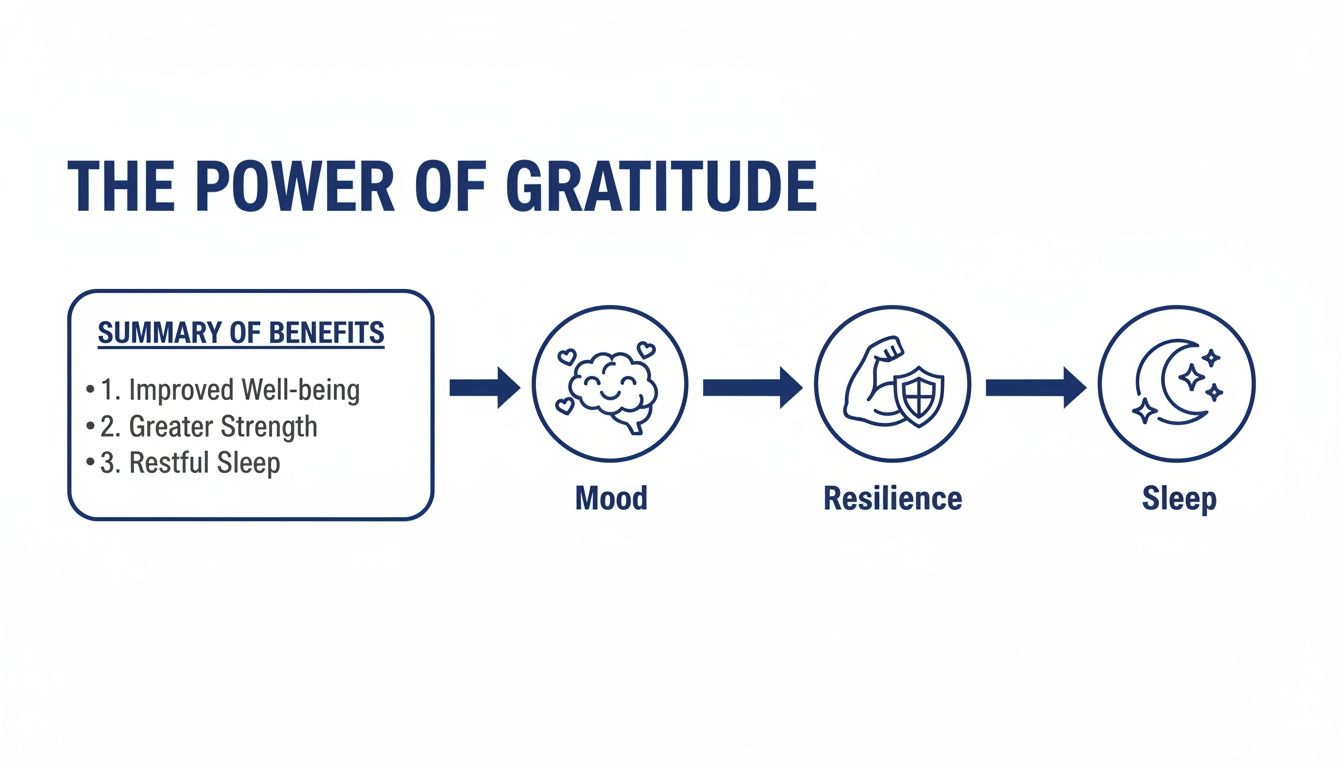
These daily actions create a positive upward spiral in your well-being. And this isn’t just feel-good thinking; it’s backed by solid research. A huge 2025 meta-analysis covering over 24,000 participants confirmed that gratitude practices like journaling consistently produce real improvements in well-being across different cultures.
Finding the Right Fit for Your Lifestyle
So, how do you pick the right practice? It really comes down to your schedule, your personality, and what feels most genuine to you. Not every method works for every person, and that’s perfectly okay.
To help you find your starting point, here’s a quick comparison of a few popular gratitude exercises.
Choosing Your Daily Gratitude Practice
| Practice | Time Commitment | Best For | Pro Tip |
|---|---|---|---|
| Gratitude Journal | 5-10 min/day | Introspective people who enjoy writing and reflection. | Go beyond what you’re grateful for and explore the why. This adds emotional depth and makes the practice more powerful. |
| Gratitude Jar | 1-2 min/day | Visual thinkers and families looking for a simple, shared activity. | Write down moments of gratitude on small slips of paper. Read them all at the end of the month for a huge boost. |
| Gratitude Letters | 15-30 min/week | Anyone wanting to strengthen social connections and express thanks directly. | Focus on one person each week. Describe the specific, positive impact they had on your life for a more meaningful message. |
| Thankful Thoughts | 30-60 sec/anytime | Busy individuals who need a quick, on-the-go mental reset. | Habit-stack this by pairing it with a routine task, like washing your hands or waiting for a file to download. |
Ultimately, the method you choose matters less than the mindset you bring to it.
The real work is in the simple act of intentionally focusing your attention on what is good, however small. That’s what trains your brain. Pick one of these methods and give it a real try for two weeks. See how it feels—you might be surprised.
How to Practice an Attitude of Gratitude in a Digital World
Let’s be honest: staying mindful and grateful can feel like swimming upstream when our phones are buzzing with endless notifications. Digital devices are engineered to grab our attention and keep us scrolling, often pulling us into a reactive, almost robotic state.
The answer isn’t to throw your phone in a river. It’s about being smarter than your apps. The key is to weave gratitude practices into our digital lives, turning moments of distraction into opportunities for a quick mental reset.
Gratitude Micro-Practices for a Packed Schedule
You don’t need an hour-long meditation session to cultivate thankfulness. Gratitude micro-practices are quick, intentional pauses—often lasting less than 60 seconds—that you can sprinkle throughout even the most chaotic days.
Think of them as tiny circuit breakers for your brain’s autopilot mode. Instead of reflexively grabbing your phone the second you feel bored or anxious, you consciously choose a moment of gratitude. It’s a small act of rebellion against the attention economy.
Here are a few simple micro-practices you can try today:
- The Inbox Pause: Before you open your email for the first time, take one deep breath. Bring to mind one person whose work makes your own job just a little bit easier. This tiny habit shifts your mindset from reactive dread to quiet appreciation before the day’s demands take over.
- The Thankful Thought: Stuck in traffic or waiting for your coffee? Think of one simple, physical thing you’re grateful for right now. Maybe it’s the comfort of your shoes, the warmth of the sun, or the song playing in your headphones. This pulls you back into the present moment.
- The Connection Moment: The moment you close a social media app, take just 30 seconds to appreciate a real, flesh-and-blood connection in your life—a friend, a partner, a pet. This is a powerful way to counteract the often-hollow feeling of online interactions.
These small habits are surprisingly powerful. They interrupt the mindless loops and inject a sliver of genuine awareness back into your day.
Habit Stacking for Digital Clarity
One of the most effective ways to make these new habits stick is a technique from behavioral psychology called habit stacking. It’s simple: you link a new gratitude habit to an existing digital routine you already do without thinking.
For example, a startup founder constantly battling afternoon burnout can set a recurring daily calendar reminder on their computer for 2 PM labeled “Gratitude Reset.” When the alarm chimes, they step away from the screen for just one minute and think of one thing that went well that day. It’s a simple, actionable way to fight off mental fatigue without adding another big task to their plate.
By pairing a gratitude exercise with a digital trigger—like closing a browser tab or ending a video call—you create a powerful new routine. This helps you build a more intentional relationship with your technology.
This strategy is a cornerstone of a healthier digital life. If you’re looking for more ways to manage your screen time and reclaim your focus, our guide on effective digital detox tips is a great next step.
When you combine these strategies, you stop letting technology dictate your mental state. Instead, you start using your digital triggers to build a more grounded, positive mindset—one small, intentional action at a time.
Turning Your Attitude of Gratitude into Meaningful Action
Gratitude isn’t just an internal feeling; it’s a powerful force for connection when you actually share it. A true attitude of gratitude really gains momentum when you translate those private thoughts into tangible, positive actions.
Making that shift from feeling to doing is what reinforces the habit and deeply strengthens your relationships.
By expressing gratitude outwardly, you create a positive feedback loop. Sharing appreciation makes others feel good, which in turn makes you feel good. Behavioral research shows this reinforces the behavior, neurologically locking it in and making the habit much more likely to stick.

From Thought to Action
The key is to move from a general feeling of thankfulness to a specific, expressed acknowledgment. This doesn’t require grand gestures. The small, sincere actions have the biggest impact.
For example, a team leader wants to improve group dynamics. Instead of just feeling thankful for her team, she starts each weekly meeting by genuinely acknowledging one person’s specific contribution from the previous week. “Sarah, your detailed analysis on the Q3 report saved us hours. Thank you for being so thorough.” It’s a small act, but it completely transforms the tone of the meeting, fostering a more collaborative and positive environment.
Action is the bridge between inner gratitude and outer connection. When you express thanks, you aren’t just being polite—you’re actively building a more supportive world for yourself and others.
This kind of prosocial behavior has actually seen a notable increase globally. Recent analyses show that benevolent acts like helping strangers have remained significantly higher than pre-pandemic levels, suggesting a worldwide rise in gratitude-linked kindness. You can discover more about these global kindness trends in the World Happiness Report.
Practical Ways to Share Gratitude
Weaving these actions into your daily life can be simple. The goal is just to be present and specific in your appreciation. For more guidance on this, our article on how to be present in your daily interactions is a great place to start.
Here are a few concrete examples you can try today:
- The Specific Thank-You Email: Don’t just send a generic “thanks.” Write to a colleague and detail exactly how their help on a recent project made a difference. Mention a specific skill they used or a challenge they helped you overcome.
- The Public Shout-Out: If a local coffee shop or business provides outstanding service, don’t just think it—share it. Leave a detailed, glowing review online. This supports the business and spreads that positive energy.
- The Handwritten Note: In a world of endless digital pings, a simple, handwritten thank-you note for a friend or family member who supported you can feel incredibly meaningful and personal. It cuts through the noise.
Editor’s Take: What Really Works for an Attitude of Gratitude
Here’s the honest truth about building an attitude of gratitude: consistency always wins over intensity. A simple, daily three-minute practice is far more effective at rewiring your brain’s focus than an ambitious hour-long session you only manage once a month.
This advice is best for anyone feeling digitally fatigued, overwhelmed, or just looking for a science-backed way to improve their mood and focus. Think of it as a practical anchor in a chaotic world, helping you reclaim your attention one thankful thought at a time. The key limitation to remember is that while gratitude is a powerful tool for well-being, it is not a cure for clinical conditions like major depression or anxiety disorders. It should be used to complement, never replace, professional care from a licensed therapist or doctor.
Disclaimer: This article is for educational purposes and is not a substitute for professional medical or psychological advice. Some links in this guide may be affiliate links, meaning we may earn a small commission at no extra cost to you if you make a purchase. If you are experiencing symptoms of anxiety, depression, or burnout, please consult a qualified healthcare provider.
Frequently Asked Questions About Gratitude
As you start building this new habit, a few common questions always pop up. Here are some straightforward answers to help you navigate the process with a bit more clarity.
How Long Until I Actually Feel the Benefits?
You’ll probably notice a small, immediate mood lift right after a gratitude exercise. That’s the quick hit of feel-good neurotransmitters like dopamine, and it’s a great sign you’re on the right track.
But the deeper, more lasting changes—like a genuinely resilient mindset and a more positive outlook—take consistency. Lasting neurological shifts, where your brain physically builds and strengthens new positive pathways, typically require several weeks of dedicated, daily practice. Stick with it. The results compound in a way that’s hard to appreciate at first.
What If I’m Just Not Feeling Grateful Today?
This is completely normal. In fact, it’s one of the most common hurdles, especially when you’re starting out or just having a tough day. The key is to remember that gratitude is a practice, not just a feeling. It’s a muscle you build through repetition.
On days like this, start incredibly small. Don’t try to force yourself to feel thankful for big, abstract concepts. Instead, anchor your attention in simple, sensory experiences.
- The warmth of your coffee mug against your hands.
- The comfort of a soft blanket or a favorite sweater.
- The simple fact that your internet connection is working.
By practicing with these tiny, undeniable truths, you start training your brain to scan for the good. Often, the feeling of gratitude follows the action of looking for it.
Is a Journal or an App Better for This?
Honestly, the best tool is whichever one you’ll actually use consistently. Both physical journals and digital apps have their place, and the most important factor is your intentional focus, not the medium itself.
That said, there’s interesting research suggesting the physical act of writing can have unique cognitive benefits. Forming letters by hand engages more areas of your brain, which can help deepen how you process and remember your thoughts and feelings.
An app offers convenience and reminders, which can be a game-changer for building the initial habit. A physical journal provides a quiet, screen-free space for deeper reflection. Why not try both and see which one feels more natural for you?
At Mind Clarity Hub, we build practical, science-backed guides to help you create habits that stick. You can explore our full library of books on focus, digital wellness, and mindful productivity at the Mind Clarity Hub website.
Free download: 7-Day Mind Clarity Reset
A short daily reset you can actually stick with (no fluff).
Affiliate note: This section mentions books and simple tools. Some links on this page may be affiliate links. If you purchase through them, we may earn a small commission at no extra cost to you. Thank you for supporting thoughtful, practical content.
Answer first: Gratitude sticks when it’s specific, shared, and scheduled—keep it small and repeatable.
If you want an attitude of gratitude that lasts, aim for three moves you can see: notice one concrete good thing, name why it matters, and share or act on it (a note, a message, a small helpful gesture). Done in minutes, this loop builds calm focus without pretending everything is perfect.
Practical examples you can use today
- Morning anchor (2 minutes): While your coffee brews, notice one small comfort (warm mug), name why it helps (signals a calm start), and send a 1–sentence thank‑you text to someone who made yesterday easier.
- Work reset (90 seconds): Finish a task? Write one line: “What went right + why.” Add it to a running “wins” note. This trains attention away from only fixing problems.
- Commute or walk (3 minutes): Pick one sense (sight, sound, or touch). Name three specifics you appreciate about your surroundings. Specific beats grand.
- After conflict (2 minutes): Note one caring intention the other person may have had, even if execution faltered. This doesn’t erase issues; it keeps your mind flexible for repair.
- Evening wind‑down (3 minutes): Jot one micro‑gratitude, one effort you made, and one thing you’ll make easier tomorrow.
- Relationship boost (2 minutes): Leave a sticky note naming a specific behavior you valued (“Thanks for rinsing the dishes when I was on a call—took pressure off”).
5‑minute gratitude menu (choose 1)
- Three‑line journal: What I appreciated, why it mattered, how I’ll pay it forward.
- Gratitude walk: 10 slow breaths; each breath pairs with one noticed detail (light, air, tree, sound…).
- Photo roll: Save one picture per day that captures something you’re glad exists; add a 5‑word caption.
- Thank‑you micro‑note: 40–80 words to someone specific; send or place it where they’ll find it.
- Future‑you memo: “Thanks, future me, for…” Name one tiny action you’ll take tomorrow that makes life easier.
Checklist: Make gratitude stick (keep it observable)
- [ ] Specific over vague: Name concrete details (“sun on desk,” not “everything”).
- [ ] Sensed in the body: Add one sensory word (warm, crisp, steady).
- [ ] Shared or acted on: Express it or do a small helpful thing.
- [ ] Scheduled: Attach to a daily anchor (coffee, login, commute, lights‑out).
- [ ] Small and finishable: 2–5 minutes is enough.
Which practice fits your day?
- Journal (paper or app) – Best for reflection; low friction if it lives next to your morning drink.
- Walk & notice – Best for mid‑day reset; moves energy while training attention outward.
- Micro‑note – Best for relationships; builds connection and accountability.
- Photo roll – Best if you’re visual; creates a quick highlight reel for tough days.
Simple 7‑day starter plan
Keep this light. The goal is consistency, not perfection.
- Day 1: Set your anchor (when + where). Prepare tools (small notebook or notes app).
- Day 2: Three‑line journal (2–3 minutes). Circle one word that stands out.
- Day 3: Gratitude walk (5 minutes). Name three sensed details out loud.
- Day 4: Micro‑note to a colleague or friend (40–80 words).
- Day 5: Photo roll entry with a 5‑word caption.
- Day 6: Repeat your favorite; add one “pay it forward” action under 3 minutes.
- Day 7: Reflect: What made this easy? What will you keep next week?
Gentle guardrails
- Gratitude isn’t denial. You can acknowledge stress and still name one thing that helps you meet it.
- Small counts. Brief, repeatable practices often outperform occasional grand gestures.
- Support your attention. If helpful, set a 2‑minute timer for focus while you practice.
Want more ways to build calm focus and clarity? Explore other guides at Mind Clarity Hub.
FAQs
How long before gratitude feels natural?
Many people notice a shift in 1–3 weeks of brief, consistent practice. Keep it small and tied to a daily anchor.
What if I can’t think of anything to be grateful for?
Zoom in: choose one sense (sound, sight, touch) and name a single neutral or helpful detail you notice right now.
Is journaling or meditation better for gratitude?
Whichever you’ll repeat. Journaling helps you see patterns; a brief noticing meditation helps in the moment. Try both and keep the one with less friction.
Can gratitude improve focus at work?
It can support focus by training attention toward what’s working and by reducing rumination. Use a 1‑line “win” log after tasks to reinforce this.
Should I practice daily or is weekly enough?
Daily micro‑practice builds the habit faster. If weekly is what you can do, start there and add one extra micro‑moment on busy days.
How do I avoid toxic positivity?
Name real challenges and one helpful resource side by side. Gratitude complements problem‑solving; it doesn’t replace it.
Helpful resources for your next step
Affiliate disclosure: As an Amazon Associate, Mind Clarity Hub may earn from qualifying purchases at no extra cost to you. Use this link only if it genuinely helps your planning.
If How to Build a Lasting Attitude of Gratitude is a routine you want to keep using, a simple workbook, planner, or desk tool can make the steps easier to repeat.
Compare related planners, workbooks, and organization tools on Amazon.
