
Published:
Affiliate Disclosure: This post may contain affiliate links. If you purchase through these links, we may earn a small commission at no extra cost to you.
Mental clarity isn’t just about feeling “not stressed.” It’s that sharp, grounded state where your thoughts are organized, your focus is steady, and you can process what’s in front of you without feeling scattered. In psychology, this is often linked to executive functions—the set of mental skills that include working memory, flexible thinking, and self-control.
Think of it as the foundation for everything else. Without it, productivity grinds to a halt and your emotional balance feels shaky at best.
Understanding Clarity Mental Health and Why It Matters
Does your day ever feel like a constant battle against digital noise?
You’re trying to nail down a critical report, but your phone keeps buzzing. Emails pour in. Slack notifications demand an immediate reply. Each little ping pulls your attention away, and by lunchtime, your focus is completely fragmented. This is a common contributor to burnout and anxiety in the modern workplace.
That feeling—often called “brain fog”—has become the default state for countless professionals, entrepreneurs, and students. Behavioral research suggests this is due to constant context-switching, which depletes our finite cognitive resources. If it sounds familiar, our guide on what causes brain fog breaks down the hidden drivers behind it.

This isn’t just a minor annoyance; it points to a much bigger challenge. Globally, over 1 billion people are now living with a mental health condition, a significant jump from 970 million just a few years back. With anxiety and depression leading the way, achieving mental clarity has moved from a “nice-to-have” to a necessary tool for navigating modern life.
Disclaimer: This article is for educational purposes only and is not a substitute for professional medical or psychological advice, diagnosis, or treatment. If you are experiencing symptoms of anxiety, depression, ADHD, burnout, or sleep problems, please consult a qualified healthcare provider.
Why a Clear Mind Matters for Your Mental Health Now More Than Ever
When you achieve mental clarity, you reclaim your cognitive resources. Instead of just reacting to every distraction that pops up, you can finally engage in deep, meaningful work. This process strengthens your ability to manage your mood and behavior effectively.
This state of focused awareness allows you to:
- Make Better Decisions: A clear mind weighs options logically, free from the clouds of stress and mental clutter. Neuroscience shows that stress impairs the prefrontal cortex, the brain’s decision-making center.
- Boost Productivity: When you can fully concentrate on one thing at a time, both the quality and efficiency of your work skyrocket. This is a core principle of behavioral psychology known as “deep work.”
- Enhance Well-being: Mental clarity dials down the feelings of overwhelm and anxiety, giving you a greater sense of calm and control over your life, which directly impacts your mood.
Learning to manage our own mental faculties is a game-changer. For a deeper look into this, the concepts around the power of the mind offer practical insights. Ultimately, this guide provides a neuroscience-backed roadmap to help you cut through the noise and get your focus back.
The Neuroscience of a Cluttered Mind and Poor Clarity Mental Health
Ever wonder what’s actually happening in your brain when you feel scattered and overwhelmed? It’s not just a vague feeling—it’s a biological response grounded in neuroscience. Getting a handle on the neuroscience behind a cluttered mind is the first real step toward reclaiming your focus and improving your clarity mental health.
Think of your brain’s prefrontal cortex (PFC) as its Chief Executive Officer. This area, right behind your forehead, is in charge of complex decisions, planning, and holding your focus steady. But just like any CEO, it has a limited capacity and can get completely overloaded.
When your phone buzzes with notifications or you’re trying to juggle a dozen open tabs, you’re flooding your PFC with more information than it can process. This cognitive overload is a direct cause of mental fog and poor focus.
How Your Brain’s Focus Gets Hijacked
Modern digital life has created a perfect storm for cognitive overload. Two key players in this hijack are the neurochemicals dopamine and cortisol, and their effects on your brain and behavior are incredibly powerful.
- Dopamine Loops: Have you ever found yourself mindlessly scrolling through a social media feed, only to look up and realize an hour has vanished? Many apps are engineered from behavioral psychology principles to trigger a dopamine loop. Dopamine is a neurotransmitter tied to pleasure and motivation. Each notification or “like” delivers a tiny hit of it, training your brain to seek out more and more. This creates a powerful habit cycle that hijacks your attention, making it incredibly difficult to focus on tasks that don’t offer the same instant reward.
- Cortisol Overload: Chronic stress, whether from looming deadlines or the pressure of constant connectivity, keeps your body stuck in a state of high alert. This floods your system with cortisol, the main stress hormone. While cortisol is useful in short bursts for “fight or flight” moments, neuroscience research shows that sustained high levels are damaging. It can directly impair memory, shrink the prefrontal cortex, and interfere with clear thinking and mood regulation.
When your brain is constantly chasing dopamine hits and swimming in cortisol, its ability to do deep, focused work is severely compromised. This isn’t a failure of willpower; it’s a predictable neurological reaction affecting your behavior.
A Real-World Example of Cognitive Overload
Imagine a remote worker, Alex, who is trying to finalize an important quarterly report. The deadline is just hours away.
Suddenly, a Slack message from her manager pops up. An email notification follows. Then her phone buzzes with a social media alert. In just five minutes, her brain is forced to switch contexts three separate times. Each one of those switches drains a small amount of mental energy, pulling her further and further away from her main task.
Her PFC is struggling to keep all the mental “tabs” open—the report data, the manager’s request, the new email. Her brain starts pumping out cortisol because of the deadline pressure, clouding her judgment even more. The quick dopamine hit from checking her phone makes the report seem even more boring and difficult by comparison.
The result? Alex feels frazzled, unproductive, and mentally exhausted. Her mental clarity has taken a serious hit.
This scenario shows exactly how our daily digital habits impact our brain’s performance and behavior. The key isn’t to blame ourselves, but to learn how to manage these external triggers. In fact, developing strategies for improving focus and concentration is a core part of rebuilding your mental clarity in a noisy world. By understanding these neurological processes, you can start to work with your brain instead of against it.
Identifying the Obstacles to Your Clarity Mental Health
Knowing the science behind a cluttered mind is a great first step. Now, let’s get specific and pinpoint the culprits actively stealing your focus and draining your mental energy. Recognizing these obstacles is what allows you to move from a vague feeling of being overwhelmed to a clear plan for rebuilding your clarity mental health.
For most of us, mental fog isn’t random. It usually stems from a few common, powerful sources that feed off each other. The four biggest roadblocks are digital overload, chronic stress, poor sleep, and a lack of routine.
Digital Overload: The Constant Barrage
Digital overload is what happens when the sheer volume of information, pings, and notifications simply overwhelms your brain’s capacity to process it all. Your prefrontal cortex—the part of your brain in charge of focus and decision-making—gets short-circuited by the constant context switching. This isn’t just a feeling of being busy; it’s a neurological state of perpetual interruption.
A perfect example is Sarah, a freelance graphic designer. She starts her morning with a solid plan to finish a major client project. But within the first hour, she’s hit with three client emails, a dozen Slack messages, and countless social media alerts. Each ping yanks her focus away, and by noon, she’s frazzled and has made almost zero progress on her most important task. Her mood sours as a result.
Her productivity tanked not from a lack of skill, but because of constant digital interruptions. This scenario highlights a core problem you can explore further in our guide on the neurology of digital overwhelm and attention hijacking.
This chart helps visualize how even tiny interruptions can cascade into a significant loss of focus.
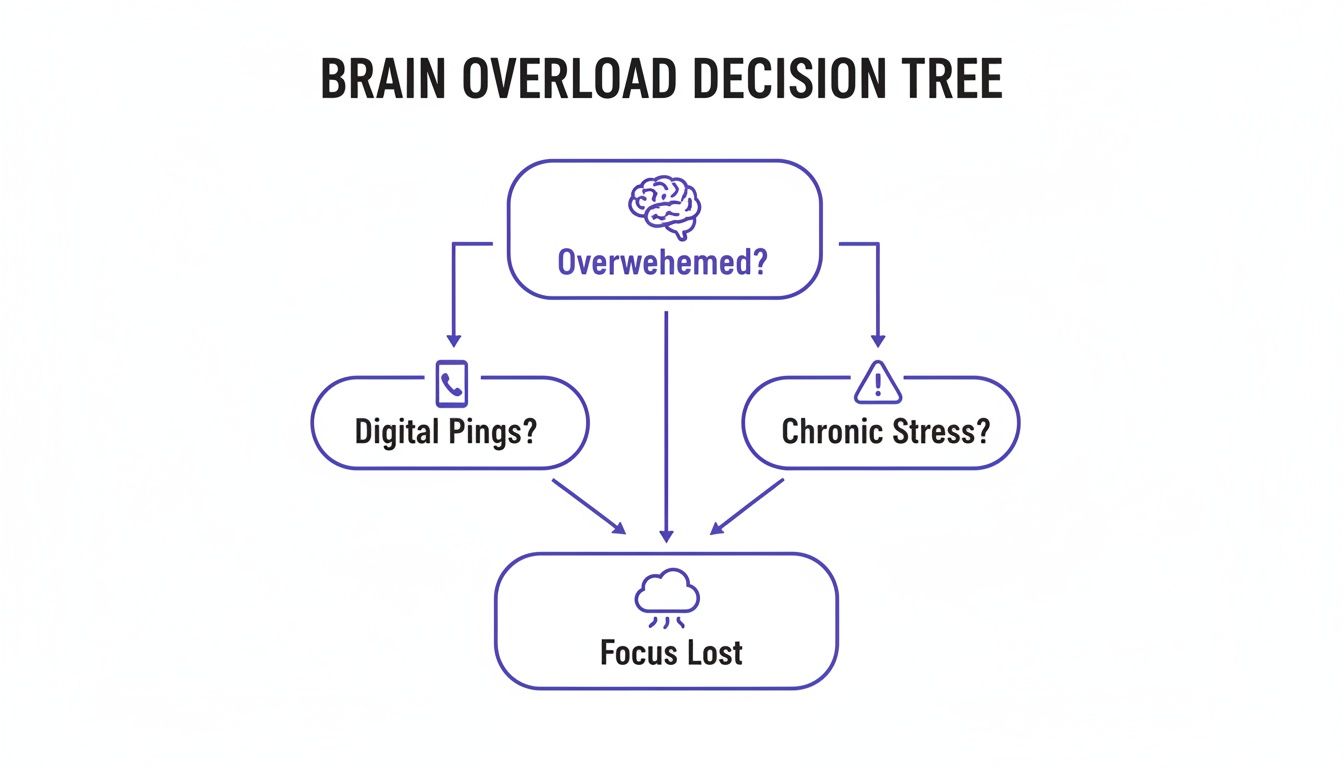
As you can see, both the constant digital pings and the slow burn of chronic stress are direct pathways to feeling overwhelmed and losing your focus.
To help you connect these concepts to your own experience, the table below breaks down the common causes of mental fog and their tangible effects on daily life.
Common Obstacles to Mental Clarity and Their Impact
| Obstacle | Neurological Impact (Simplified) | Real-World Example |
|---|---|---|
| Digital Overload | Overwhelms the prefrontal cortex with constant context switching, leading to attention fragmentation. | Bouncing between emails, Slack, and project tabs leaves you feeling busy but unproductive at the end of the day. |
| Chronic Stress | Elevates cortisol, which impairs memory, executive function, and clear decision-making. | Feeling constantly “on edge” makes it hard to solve complex problems or think creatively under pressure. |
| Poor Sleep | Prevents the brain from clearing metabolic waste and consolidating memories, resulting in grogginess. | Forgetting key details from a meeting the previous day because you only got four hours of restless sleep. |
| Lack of Routine | Leads to decision fatigue by forcing the brain to make countless minor choices, depleting mental energy. | Wasting your best morning energy deciding what to work on first instead of starting your most important task. |
By identifying which of these obstacles are most active in your life, you can choose the right strategies to counter them effectively and start reclaiming your cognitive space.
Chronic Stress: The Silent Focus Killer
While a little short-term stress can be motivating, chronic stress does the exact opposite. When you’re constantly under pressure, your body is flooded with the stress hormone cortisol. As we’ve touched on, elevated cortisol levels directly get in the way of memory formation and executive functions, making clear thinking feel next to impossible. This negatively impacts your mood and overall behavior.
It’s like trying to run complex software on a computer that has a virus chewing up resources in the background—everything slows down, lags, and becomes prone to crashing. Over time, this sustained stress leads to burnout and a persistent state of mental fog.
Poor Sleep Hygiene: The Unseen Saboteur of Your Brain
Mental clarity and quality sleep are fundamentally tied together. During deep sleep, your brain is hard at work clearing out metabolic waste products that build up while you’re awake, a process neuroscientists call the glymphatic system. This is also when your brain consolidates memories, moving important information from short-term to long-term storage.
When you don’t get enough restorative sleep, these vital housekeeping processes get cut short. You’re essentially starting the day with a brain that hasn’t been properly “cleaned,” leaving you feeling groggy, irritable, and mentally slow.
Take Mark, a college student prepping for finals. He pulls two all-nighters, thinking more study time means better grades. In the exam, however, he struggles to recall concepts he reviewed just hours before. His brain, deprived of the sleep it needed to lock in that information, simply couldn’t hold onto it.
A single night of poor sleep can significantly reduce cognitive performance. Consistently neglecting sleep is one of the fastest ways to erode your mental clarity.
Lack of Routine: The Drain of Decision Fatigue
A day without any structure might sound freeing, but it often has the opposite effect. Without established habits, your brain is forced to make an endless stream of small decisions from the moment you wake up. What should I work on first? When should I take a break? What’s for lunch?
Each one of these choices, no matter how tiny, consumes a bit of your finite mental energy. This phenomenon, known as decision fatigue in behavioral psychology, wears down your self-control and your ability to make sharp, high-level decisions later on. A solid routine automates the small stuff, saving your best cognitive resources for the work that actually matters.
Actionable Strategies to Restore Your Clarity Mental Health
Understanding what’s clouding your mind is the first step. Now, it’s time to actually do something about it.
Restoring your focus and finding that state of clear thinking doesn’t mean you have to overhaul your entire life overnight. Instead, it’s about weaving small, evidence-backed strategies into your daily rhythm.
These techniques are designed to work with your brain’s natural wiring, not against it. By making a few practical shifts in your habits, you can start dialing down the mental static and reclaim your best thinking for what truly matters.
The Gentle Dopamine Detox for Better Brain Function
The phrase “dopamine detox” often conjures up extreme images, like locking your phone in a safe for a week. A more sustainable—and frankly, more realistic—approach is about creating intentional boundaries, not total deprivation.
The real goal is simple: give your brain’s reward system a much-needed break from the constant, low-grade stimulation that shatters your attention into a million tiny pieces. This helps reset your focus and improve your mood.
A powerful way to begin is with a “digital sunset.” This just means setting a firm cutoff time for all screens each evening, ideally 60-90 minutes before you plan to sleep. This one habit dramatically lowers the cognitive buzz that interferes with sleep, which is your brain’s prime time for mental restoration.
Here’s how to make it stick:
- Set a hard stop: Pick a non-negotiable time, like 9:00 PM, when you shut down work emails, social media feeds, and news alerts for the night.
- Swap screens for something analog: Instead of scrolling, pick up a physical book, listen to a calming podcast, or do some light stretching. This helps your brain shift down a gear naturally.
- Charge your phone in another room: This is a game-changer. Removing the temptation for “one last check” is the easiest way to protect your wind-down period.
Build a Focused Work Routine with Proven Methods
When your day lacks structure, your brain is forced to make hundreds of tiny decisions, which leads straight to decision fatigue and wasted mental energy. A focused work routine automates those choices, saving your best cognitive horsepower for deep, meaningful work.
One of the most effective and time-tested methods for this is the Pomodoro Technique.
Developed by Francesco Cirillo in the late 1980s, this time-management method is built on a simple psychological insight: our brains work better when we know a break is coming soon. It uses a concept called “timeboxing” to encourage you to dedicate specific, uninterrupted chunks of time to planned tasks.
The Pomodoro Technique works because it creates a gentle sense of urgency while reassuring your brain that rest is just around the corner. This brilliant balance lowers the mental resistance to starting a tough task and helps you sustain high-quality focus.
The process is refreshingly simple:
- Choose one single task you need to work on.
- Set a timer for 25 minutes and give that task your undivided attention. No interruptions.
- When the timer goes off, take a short 5-minute break. Get up, stretch, grab some water—just step away from your screen.
- After four “Pomodoros,” take a longer, more restorative break of 15-30 minutes.
This cycle trains your attention span and gives your brain regular chances to rest and consolidate what you’ve just worked on. When mental clutter gets overwhelming, it’s vital to have both immediate and long-term coping mechanisms. You can discover more practical strategies for coping with overwhelming feelings to regain a sense of control and clarity.
Automate and Delegate with AI Tools for Mental Health
Let’s be honest: some of the biggest drains on our mental energy today come from repetitive, low-impact administrative tasks. Answering the same questions via email, scheduling meetings back and forth, and summarizing long documents are all necessary evils that tax our cognitive reserves.
This is where you can intelligently use AI to your advantage.
By offloading these tasks, you free up your prefrontal cortex to concentrate on the good stuff: complex problem-solving, creative thinking, and strategic planning. Think of AI not as a replacement for your brain, but as a cognitive assistant that handles the busywork. This approach is a powerful way to reclaim your focus and improve your clarity mental health. For more techniques like this, our guide on how to reset your brain offers additional powerful strategies.
Here are a few ways to put this into practice right now:
- Email Management: Use tools with AI features to automatically sort your inbox, draft replies to common questions, or create summaries of long, messy email chains.
- Meeting Support: Let an AI tool transcribe your meetings and generate a clean summary with key action items. This frees you from the mental load of taking detailed notes.
- Research and Summarization: Instead of slogging through dozens of articles, use an AI assistant to pull out the key findings, giving you the core information in a fraction of the time.
Implementing even one of these strategies can significantly reduce your daily cognitive load. The key is to start small. Pick a method that tackles your biggest headache and practice it consistently. Over time, these actions compound, creating a strong foundation for lasting mental clarity.
Disclaimer: The strategies mentioned in this section are for educational purposes. For concerns related to anxiety, depression, ADHD, burnout, or sleep problems, please consult a qualified healthcare professional. This content is not a substitute for medical or psychological care.
Key Takeaways for Lasting Clarity Mental Health
Achieving lasting mental clarity isn’t about some grand, one-time fix. It’s about the small, consistent things you do every day to realign your focus and lower your cognitive load. Think of this section as your cheat sheet for a clearer mind.
Come back to these core ideas anytime you feel that familiar brain fog creeping in. They’re a quick reset to get you back on track for better clarity mental health.
Core Principles for a Clearer Mind
Mental clarity is an active state. It’s not just the absence of stress—it’s an organized, sharp mind that allows for better decisions and deeper focus every day.
Your brain has limits. The prefrontal cortex, your brain’s CEO, gets overloaded by constant digital pings and chronic stress. This isn’t a personal failure; it’s a predictable neurological response.
Pinpoint what’s blocking you. The most common culprits behind mental fog are digital overload, chronic stress, poor sleep, and a lack of routine. Figuring out your main obstacle is the first real step toward a solution.
Dopamine loops hijack your attention. Modern apps are engineered to deliver tiny, frequent rewards that train your brain to seek distraction. A gentle dopamine detox helps reset that balance.
Structure creates freedom. Routines like the Pomodoro Technique reduce decision fatigue. By automating when and how you work, you save your best mental energy for the tasks that truly count.
Remember, the goal isn’t perfection—it’s consistent practice. Every small step you take to manage distractions and support your brain’s natural rhythms builds momentum toward sustained mental clarity. These takeaways are your foundation for a more focused, intentional life.
Editor’s Take: What Really Works for Clarity Mental Health
Let’s be honest: genuine mental clarity isn’t something you achieve once and then you’re done. It’s a practice—a quiet commitment you make every day to build more intentional habits. This advice is best for busy professionals, students, and creators who feel like modern digital life is slowly draining their cognitive battery.
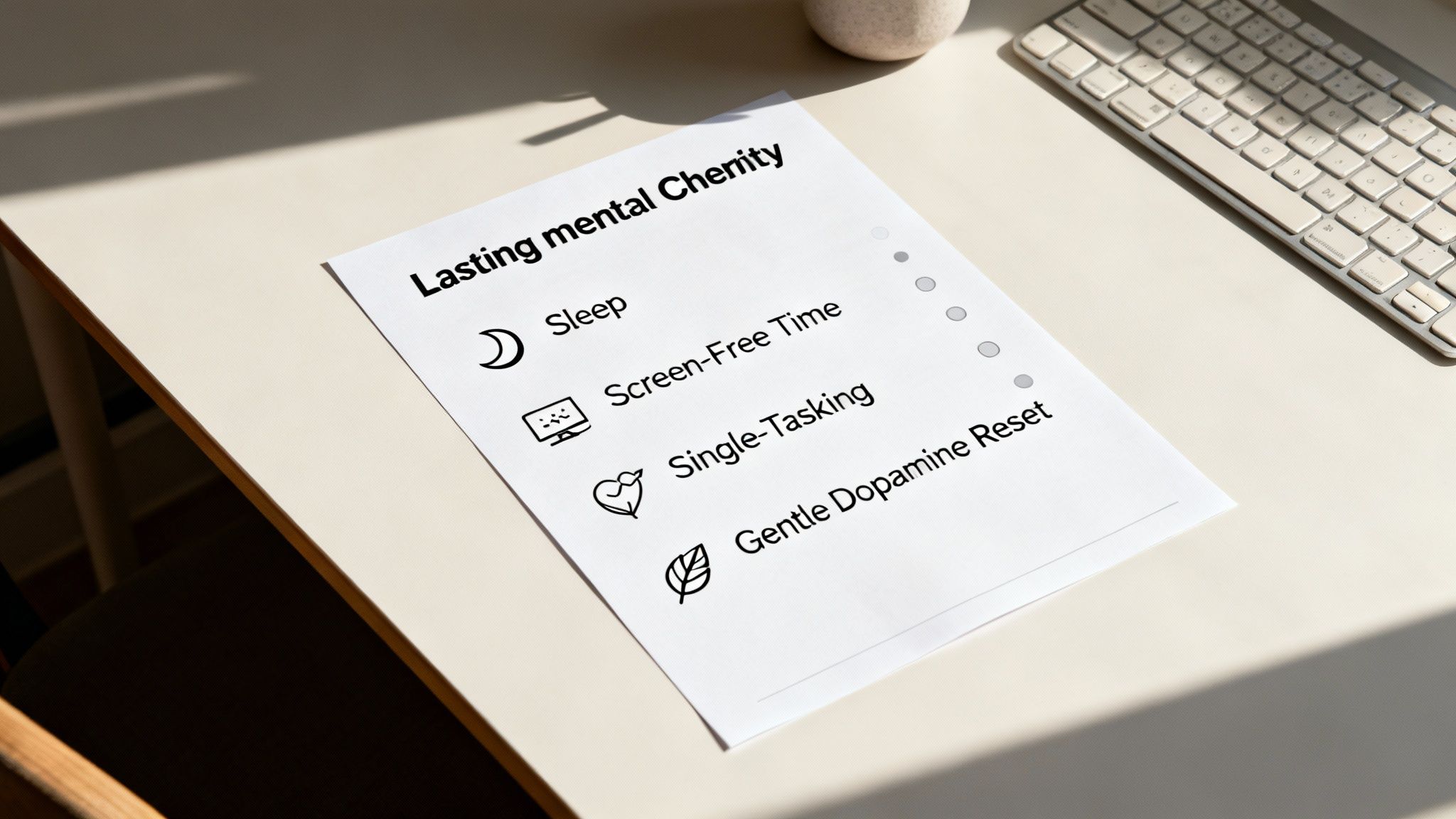
What actually works? The most effective strategies are almost always the simplest ones. Things like consistent sleep, carving out screen-free time, and a stubborn refusal to multitask have a powerful ripple effect over time. There’s a real economic incentive, too. While the global cost of anxiety and depression is staggering, some research suggests even a 5% boost in productivity from better mental clarity could unlock hundreds of billions in economic gains. You can explore the full study on the economic impact of mental wellbeing to see the numbers for yourself.
A critical caveat: this guide is here to help you build better cognitive habits, but it is not a substitute for professional help. If you’re navigating clinical anxiety, depression, or ADHD, please connect with a qualified professional. Progress here is slow and steady, so be patient with yourself as you learn.
The goal isn’t perfection—it’s consistency. Small, repeated actions are what build real mental clarity and resilience.
FAQ: Your Clarity Mental Health Questions Answered
As you start to tune into your own mental state, questions naturally come up. Here, we’ve gathered some of the most common ones we hear from our community, with straightforward answers to reinforce what we’ve covered.
1. Is brain fog the same as a medical condition?
For most people, brain fog is a temporary feeling of sluggishness or confusion caused by lifestyle factors like poor sleep, stress, or diet. However, if your brain fog is persistent and severe, it could be a symptom of an underlying medical condition like chronic fatigue syndrome, thyroid issues, or long COVID. This content is educational only; please consult a doctor for diagnosis.
2. How long should a dopamine detox really last?
A more accurate term is a dopamine reset. Forget extreme, week-long shutdowns. Instead, focus on building small, consistent boundaries like a “digital sunset” (no screens 60-90 minutes before bed) or a screen-free morning. The goal is consistency over intensity to help your brain become less dependent on constant digital stimulation.
3. Can you achieve mental clarity with ADHD?
Yes, absolutely. While ADHD presents unique challenges to focus, achieving clarity is possible by working with your brain’s wiring. Strategies like structured routines (e.g., the Pomodoro Technique), externalizing information with planners, and incorporating movement breaks are incredibly effective. This is educational information, not a substitute for professional ADHD treatment.
4. What is the difference between mental clarity and mindfulness?
They are closely related. Mindfulness is the practice of paying attention to the present moment without judgment. Mental clarity is the result—the state of having a sharp, organized, and focused mind that often arises from a consistent mindfulness practice. Think of mindfulness as the act of tidying your mental workspace and clarity as the clean, organized space itself.
5. How can I stay focused in a noisy office?
Create a “do not disturb” signal, such as wearing noise-canceling headphones. Use timeboxing to block out specific “deep work” periods on your calendar. If possible, find a quiet space like an empty meeting room for tasks requiring intense concentration. These habits signal to your brain and your colleagues that it’s focus time.
6. Is burnout just another word for stress?
No, they are different. Stress is often characterized by over-engagement and urgency—a feeling of “too much.” Burnout is a state of chronic exhaustion, cynicism, and detachment. It’s a feeling of “not enough”—feeling empty, unmotivated, and depleted. Burnout is a more severe condition that requires significant rest and strategic life changes.
7. Does diet really affect mental clarity?
Profoundly. Your brain uses about 20% of your body’s calories. A diet high in processed foods and sugar can cause inflammation that impairs cognitive function. Conversely, foods rich in omega-3 fatty acids (like salmon), antioxidants (like berries), and complex carbs (like oats) provide the steady fuel your brain needs for optimal focus and mood.
8. Can AI tools actually help with burnout?
Yes, when used intentionally. Burnout is often fueled by a workload of repetitive, low-impact tasks. By using AI to automate things like summarizing meetings, drafting routine emails, or organizing data, you reduce your cognitive load. This frees up your mental energy for the meaningful, creative, and strategic work that feels rewarding.
9. How do I start building mental clarity today?
Start small. Don’t try to overhaul your entire life at once. Pick one simple strategy from this guide and commit to it for a week. For example, charge your phone outside your bedroom tonight, try one 25-minute Pomodoro session tomorrow, or take a 10-minute walk without your phone. A small win builds momentum for lasting change.
10. Why is routine so important for clarity mental health?
Routines reduce decision fatigue. Every small choice you make throughout the day (what to wear, what to eat, what to work on first) drains a tiny bit of your mental energy. A solid routine automates these minor decisions, preserving your brain’s best resources for complex problem-solving and deep focus, which is crucial for maintaining good clarity mental health.
Final Disclaimer: This article is for educational purposes and is not a substitute for medical or psychological advice. It may contain affiliate links, which means we may earn a commission on purchases at no extra cost to you. Always consult a healthcare professional for health concerns.
At Mind Clarity Hub, we curate science-based guides and books to help you cut through the noise and reclaim your focus. Explore our full library of resources designed for busy professionals, students, and anyone looking to build a clearer, more productive life.