


Published:
This article may contain affiliate links. If you purchase a product through one of our links, we may earn a small commission at no extra cost to you.
To get a handle on your thoughts, the first move is always to get them out of your head. You need to externalize them—dump every last idea, task, and worry onto paper or a screen. This isn’t just about making a list. From a neuroscience perspective, it’s about reducing the cognitive load on your brain. This frees up the mental space you need to think clearly and set priorities.
Why a Cluttered Mind Is Costing You More Than Just Peace
Ever feel like your brain has way too many tabs open? It’s a universal feeling these days, but it’s more than just a minor annoyance. That constant state of mental chaos directly torpedoes your ability to focus, make good decisions, and keep stress at bay.

From a neuroscience standpoint, this is a real phenomenon called cognitive overload. Your brain’s prefrontal cortex—the part responsible for high-level functions like planning and decision-making—gets completely overwhelmed. When you force it to juggle too much information at once, its ability to function properly plummets. This isn’t a personal failing; it’s a predictable consequence of modern life’s relentless demands. The good news is that organizing your thoughts is a learnable skill, not an innate talent. And it all starts with that crucial first step: getting everything out.
A note on mental health: While organizing your thoughts can help manage feelings of stress or being overwhelmed, this article is for educational purposes only. It is not a substitute for professional medical or psychological advice, diagnosis, or treatment. If you are experiencing symptoms of anxiety, depression, ADHD, or burnout, please consult a qualified healthcare provider.
The Real Cost of Mental Disorganization
This mental clutter isn’t just an internal struggle; it has tangible, real-world consequences. At work, disorganized thoughts quickly turn into lost productivity and a lack of engagement. It’s a quiet killer of performance.
In fact, the global economy loses a staggering $438 billion annually in lost productivity tied directly to low employee engagement—a problem often fueled by this very kind of mental disorganization. With only 21% of workers worldwide feeling genuinely engaged, there’s a massive opportunity for improvement.
Once you grasp the true cost of a disorganized mind, it’s easier to get motivated. There are proven strategies to improve mental clarity and reclaim your focus, and they can pull you out of that constant mental fog. This guide will give you the tools to finally shut down those distracting mental notifications and start thinking clearly again.
The goal is to create a system where your mind is for having ideas, not holding them. By offloading the mental burden, you free up cognitive resources for what truly matters: problem-solving, creativity, and deep thinking.
Getting to this state of mental organization is the foundation of books like The Power of Clarity, which lays out a roadmap for turning mental chaos into focused action. You can start that journey today by committing to the simple, effective techniques we’re about to cover.
The Brain Dump: Your Practical Guide to Mental Decluttering
If you’re searching for the single most effective way to quiet the constant noise in your head, look no further than the brain dump. This simple exercise is the fastest route I know to mental clarity. It’s all about getting every single thought, worry, and to-do item out of your mind and onto paper or a screen.
The psychology behind why this works so well is refreshingly straightforward. Your working memory—the part of your brain juggling information for immediate use—has a surprisingly small capacity. When you try to hold everything in there at once (project deadlines, grocery lists, that brilliant middle-of-the-night idea), you overload the system. This mental multitasking is exhausting, draining your cognitive resources and leaving you feeling scattered and stressed. A brain dump acts as an external hard drive for your mind. It frees up that precious mental RAM for actual thinking and problem-solving.
How to Do a Brain Dump That Actually Works
Getting started is the easy part. The goal here is raw, unfiltered output. Forget about grammar, organization, or what anyone else would think. This is for your eyes only.
First, grab a dedicated productivity journal or just open a blank document. Some people find that putting on a pair of comfortable noise canceling headphones helps signal to the brain that it’s time to focus and minimize distractions.
Next, set a pomodoro timer for just 15 minutes. A short, defined window like this makes the task feel much less intimidating. For those 15 minutes, your only job is to write.

Let everything flow out without judgment. Capture every single thing that crosses your mind, no matter how small or random:
- Tasks: “Email finance about that invoice.”
- Worries: “I’m really nervous about that upcoming presentation.”
- Ideas: “What if we tried a completely new marketing angle for the Q3 launch?”
- Random thoughts: “I need to remember to buy new running shoes.”
The real key is to keep your pen moving or your fingers typing for the entire 15 minutes. Don’t stop to edit or analyze anything. Just get it all out. This process is the foundational first step toward the kind of mental peace explored in books like Reclaiming Silence.
A Real-World Brain Dump Scenario
Let’s imagine a project manager named Sarah. She’s completely swamped. Her team is facing three major deadlines, a key designer is out sick, and her inbox is a relentless flood of new requests. She feels totally overwhelmed, jumping from one “urgent” task to another without making any real progress.
Feeling paralyzed by the chaos, she decides to try a brain dump. She blocks off 15 minutes on her calendar, puts on some quiet instrumental music, and just starts writing in a notebook.
“Client X report is due Friday… need to follow up with Mark on the graphics… the budget is way too tight this quarter… did I remember to schedule that dentist appointment?… I’m worried the client is going to hate the new design… need to prep for the team meeting tomorrow… we have to hire a new designer, this isn’t sustainable…”
After 15 minutes, the page is a mess of chaotic, jumbled notes. But for the first time all week, Sarah feels a wave of relief. Seeing everything listed in one place, outside of her head, makes the mountain of stress feel surprisingly manageable. The overwhelming cloud of anxiety starts to lift, replaced by a clear, comprehensive list she can now start to organize and tackle. She has taken back a sense of control.
Once you have everything out of your head, a great next step is to learn how to create a mind map to visually organize and connect all your captured thoughts. And if you find this practice helpful, exploring different types of journals for productivity can help you find the perfect tool to make brain-dumping a regular habit.
Turning Mental Chaos into an Actionable Plan
Getting everything out of your head with a brain dump is a huge win. It’s the first real step to reclaiming your mental space, but it’s only half the battle. Now you’re left with a raw, unfiltered list of thoughts. The next move is to turn that chaos into a clear, organized plan you can actually use. The goal isn’t just to look at your thoughts; it’s to make sense of them. This is where you bring order to the chaos, shifting from feeling overwhelmed to being in control.
A Simple System for Sorting Your Thoughts
First, you need to sort every item from your brain dump into one of three simple buckets. This initial triage stops you from trying to tackle everything at once—a classic recipe for overwhelm. Your brain’s prefrontal cortex, which handles planning and decision-making, works best when it can focus on one type of task at a time.
Here’s the simple sorting framework I use:
- Actionable: These are concrete tasks you need to do. Think “email the client,” “schedule a doctor’s appointment,” or “outline the project report.” They have a clear verb attached.
- Incubate: These are ideas or possibilities that aren’t ready for action yet. This bucket holds your future business idea, that vacation you want to plan, or a skill you want to learn someday. Give them a separate home so they don’t clutter your immediate to-do list.
- Non-Actionable: This category is for your worries, anxieties, and random mental noise that don’t require a task. It’s crucial to acknowledge them, but they absolutely do not belong on your to-do list.
This whole process is about getting thoughts out of your head so you can deal with them logically.
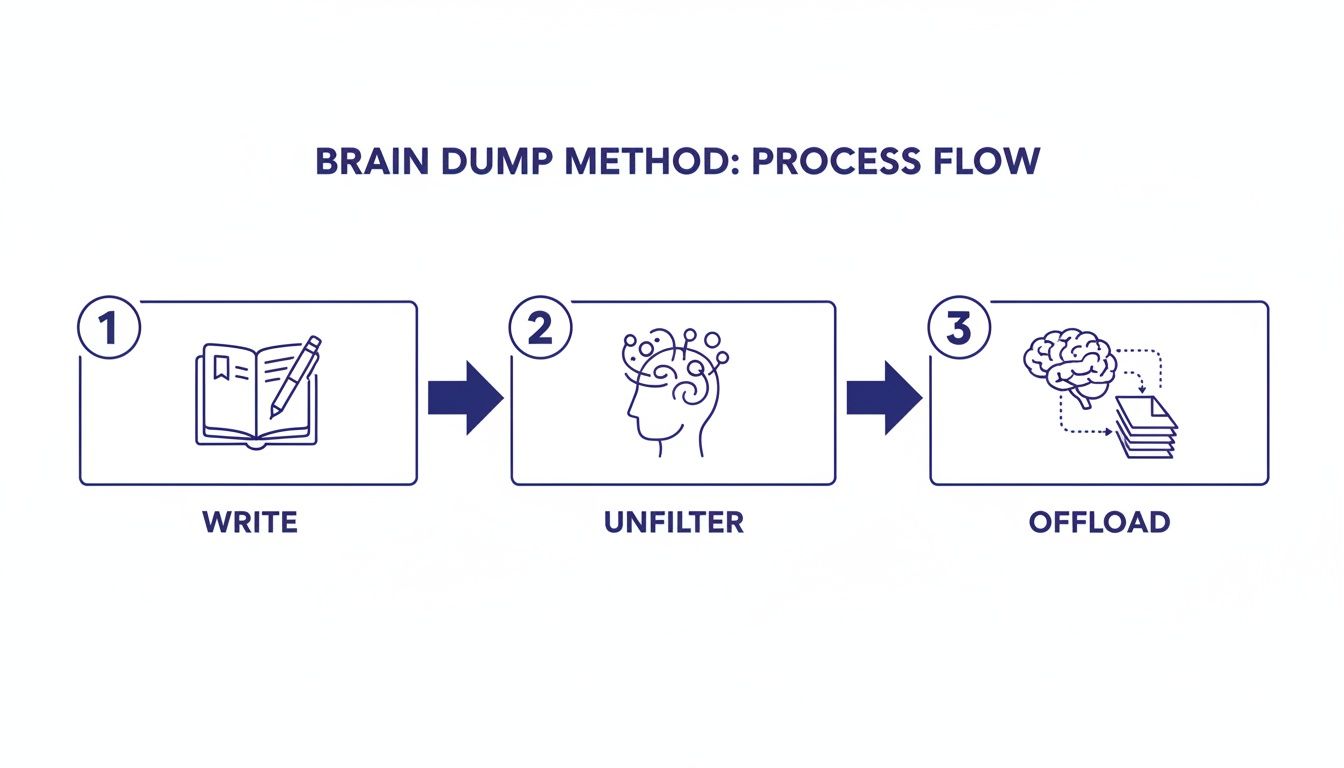
This flow—Write, Unfilter, Offload—is the essential first step before you can sort and prioritize effectively.
Prioritizing Your Actionable Tasks with the Eisenhower Matrix
Now, set aside the “Incubate” and “Non-Actionable” lists and focus entirely on your ‘Actionable’ items. To figure out what to do first, the Eisenhower Matrix is an incredibly effective tool. It forces you to distinguish between what feels urgent and what is truly important—a common stumbling block that leads people to learn how to stop procrastinating.
The matrix divides your tasks into four quadrants based on their urgency and importance. This isn’t just a theoretical exercise; it’s a practical way to decide what gets a spot in your time blocking planner today.
The Eisenhower Matrix A Framework for Prioritizing Your Tasks
Use this table to sort your actionable tasks from your brain dump. This method helps you focus on what truly matters, separating urgent distractions from important, goal-oriented activities.
| Quadrant | Description | Example Tasks |
|---|---|---|
| Urgent & Important | Tasks with immediate deadlines and significant consequences. Do these first. | Finish a client report due today, respond to a project crisis, fix a critical website bug. |
| Important & Not Urgent | Tasks that contribute to long-term goals and personal growth. Schedule time for these. | Plan next quarter’s strategy, learn a new skill for your career, exercise and meal prep. |
| Urgent & Not Important | Tasks that demand immediate attention but don’t move you toward your goals. Delegate if possible. | Answering some emails, scheduling meetings for others, responding to non-critical interruptions. |
| Neither Urgent nor Important | Distractions and time-wasters. Eliminate or minimize these. | Mindless social media scrolling, watching irrelevant videos, sorting old junk mail. |
By sorting your ‘Actionable’ list into these four boxes, you create an instant roadmap for your time and energy. You’ll know exactly what needs your attention now, what can be scheduled for later, and what you can safely ignore.
Applying the Matrix in Real Life
Let’s make this concrete. Imagine a student named Alex who just did a brain dump right before a week of final exams. His actionable list is a jumbled mess of assignments, study topics, and personal errands.
Using the matrix, he sorts his tasks:
- Do (Urgent & Important): “Finish history paper due tomorrow.” “Study for the calculus exam in two days.”
- Schedule (Important & Not Urgent): “Start research for final biology project.” “Go to the gym three times this week.”
- Delegate (Urgent & Not Important): He can’t really delegate schoolwork. However, he realizes that instantly responding to every group chat notification is an “urgent but not important” time sink. He decides to check it only twice a day.
- Eliminate (Not Urgent & Not Important): “Binge-watch that new TV series.” “Scroll through social media for hours.”
With this new clarity, Alex can open his planner and block out specific times. He allocates the rest of today to the history paper. He also dedicates focused study blocks for calculus tomorrow. By sorting his thoughts and protecting his time, he’s moved from a state of panic to having a structured, actionable plan.
Building Daily Habits for a Consistently Organized Mind
A brain dump and a well-sorted plan can feel like a massive relief. But that clarity won’t last if it’s just a one-off cleanup. True, lasting mental organization isn’t about grand gestures; it’s built through small, consistent habits that stop the clutter from piling up in the first place. This is about creating a default state of order for your mind.

The secret isn’t willpower—that’s a finite resource that runs out. A much smarter approach is to use a behavioral psychology trick called habit stacking. You simply link a new, tiny routine you want to build onto a habit you already do without even thinking.
Create a Morning Launchpad
Instead of grabbing your phone first thing and getting sucked into a vortex of notifications and emails, you can stack a new habit onto making your morning coffee or tea. Think of it as your “morning launchpad”—a quick, five-minute planning session that sets the trajectory for your entire day.
While the coffee brews, just grab a notebook and jot down the answers to three simple questions:
- What is my single most important task for today?
- What potential distractions are likely to get in my way?
- What will a successful day look like when I’m done?
This tiny ritual shifts your brain from a reactive state into a proactive one. You’re starting the day with a clear target, making it far easier to organize your thoughts as new demands inevitably pop up. For a deeper dive, check out our complete guide on how to create a morning routine that actually sticks.
Implement an Evening Shutdown
Just as you start the day with intention, it’s crucial to end it with a sense of closure. An “evening shutdown” is a 10-minute habit you can stack onto brushing your teeth or getting ready for bed. This routine acts as a signal to your brain that the workday is officially over. This prevents tasks and worries from bleeding into your personal time and wrecking your sleep.
During your shutdown, you can:
- Glance at your to-do list and move any unfinished items to tomorrow’s plan.
- Do a quick, two-minute brain dump of any last-minute thoughts or anxieties.
- Confirm your schedule and top priority for the next day.
This practice offloads the mental burden of trying to remember loose ends. Research shows this directly interferes with your ability to relax and get restorative sleep. A simple habit tracker journal can be a great tool to help make both your morning launchpad and evening shutdown feel automatic.
Optimize Your Environment to Support an Organized Mind
Your physical and digital spaces have a profound impact on your ability to think clearly. Your brain is constantly adapting to its surroundings; a cluttered desk or a chaotic desktop almost always encourages cluttered thinking. The good news is that a few simple tweaks can reduce that friction and support deep focus.
An organized desk, maybe with a good laptop stand for desk and an ergonomic mouse, does more than just look nice—it reduces physical strain and distraction. This frees up your cognitive resources to stay on task instead of being pulled away by discomfort.
Digitally, constant notifications are the number one source of mental fragmentation. To get anything meaningful done, you need to create protected blocks of focus. A phone lock box timer can be a surprisingly effective tool, physically removing your biggest source of distraction for a set period. These practices are essential for preventing the kind of mental drain detailed in Burnout Breakthrough, helping you build a workflow that’s truly sustainable. When you shape your environment, you make it almost effortless for your mind to stay organized.
Editor’s Take on Organizing Your Thoughts
The most effective strategy here, without a doubt, is the daily brain dump. It’s not glamorous, but it works every single time. It acts as a pressure-release valve for your mind. This advice is best for professionals, students, and parents who feel constantly overwhelmed by a high volume of tasks and mental clutter. The main limitation is that it’s a capture tool, not a full system. You must follow it up with sorting and prioritizing, otherwise you just create a new source of stress: a messy, unorganized list. For best results, pair it with the Eisenhower Matrix to turn the raw data into a real action plan.
A Quick-Reference Guide to Organizing Your Thoughts
Mastering your mind isn’t about finding one magic bullet. It’s about building a reliable system that consistently turns mental noise into actionable clarity. This is your quick-reference guide to the most powerful strategies we’ve covered. It is designed to reinforce the core principles you need to organize your thoughts for good.
Think of these takeaways as the foundational pillars for a more focused, organized mind. Each one tackles a different aspect of mental clutter. They range from getting thoughts out of your head to building the daily habits that keep them from piling up again.
The Core Principles of Mental Organization
The journey from chaos to clarity really comes down to a few key actions. Practicing these consistently will build mental muscle and create lasting change. Start by integrating just one or two, then build from there.
Schedule Regular Brain Dumps. Your working memory is for processing, not for storage. Get into the habit of externalizing every task, idea, and worry onto paper or a digital document at least once a day. This single act frees up an incredible amount of cognitive bandwidth, much like clearing the RAM on a computer. You can learn more about finding this kind of focus in my book, Attention Unleashed.
Prioritize with a Framework. A raw, unsorted list is just a different kind of overwhelm. Once your thoughts are out, use a proven system like the Eisenhower Matrix to sort your actionable tasks. Learning to distinguish what is truly important from what is merely urgent is probably the single most critical skill for effective time management and focus.
Build Small, Consistent Daily Habits. Lasting clarity is a result of routine, not a one-time effort. A five-minute “morning launchpad” to set your daily intention and a ten-minute “evening shutdown” to clear your mind for rest are non-negotiable. Using a good sunrise alarm clock can help make waking up for your morning routine easier.
Optimize Your Physical and Digital Spaces. Your environment is a powerful, often overlooked, tool for thought organization. A clean workspace, an ergonomic keyboard, and intentional digital boundaries all work together to minimize distractions. This proactive approach prevents mental clutter from forming in the first place, supporting the deep work principles detailed in The Power of Clarity.
Key Takeaways: How to Organize Your Thoughts
- Externalize Everything: The most critical first step is to get all thoughts, tasks, and worries out of your head and onto paper or a screen using a “brain dump.” This reduces cognitive load on your working memory.
- Sort and Categorize: Don’t stop at the dump. Sort every item into actionable tasks, ideas to incubate for later, and non-actionable worries. This brings order to the chaos.
- Prioritize Ruthlessly: Use a framework like the Eisenhower Matrix to separate urgent tasks from truly important ones. This ensures your energy goes toward what matters most.
- Build Daily Routines: Lasting mental clarity comes from small, consistent habits. Implement a 5-minute morning planning session and a 10-minute evening shutdown to maintain organization.
- Control Your Environment: A cluttered physical or digital workspace leads to cluttered thinking. Optimize your desk and manage notifications to support focus and prevent overwhelm.
Disclaimer: This article may contain affiliate links, which means we may earn a small commission if you make a purchase. All content is for educational and informational purposes only and is not a substitute for professional medical or psychological advice.
Frequently Asked Questions About Organizing Your Thoughts
Common Questions on Getting Your Mind Organized
We get a lot of questions about the nuts and bolts of this system. Here are some of the most common ones. We have straight-ahead answers based on what we’ve seen work for thousands of people trying to find clarity in the noise.
1. How often should I really do a brain dump?
For most people, a daily 10-minute brain dump is the sweet spot. Doing it first thing in the morning helps you map out the day with a clear head. An evening session, on the other hand, is great for offloading the day’s clutter so you can actually rest. That said, if you’re in a particularly chaotic season at work or home, don’t be afraid to do them more often. A quick, 5-minute capture session can be a lifesaver when you feel the overwhelm creeping in.
2. I’m so overwhelmed I don’t even know where to start. What then?
Feeling too overwhelmed to start is the exact sign that you need this process the most. It’s a common paradox. The trick is to make the first step ridiculously small. Forget about a perfect, exhaustive list. Just grab a visual timer for desk, set it for three minutes, and write down whatever is loudest in your head. That’s it. Giving yourself a tiny, non-threatening runway is often all it takes to break that feeling of paralysis.
3. Is technology a friend or foe in all this?
Honestly, it’s both. Digital note-taking apps and mind-mapping software can be incredible allies for capturing and sorting your thoughts. They’re fast, searchable, and always with you. But let’s be real: the constant pings, alerts, and notifications from our devices are a primary source of mental clutter. The key is to be the master of your tech, not the other way around. Use it with intention. That means turning off non-essential notifications, using focus modes, and setting firm boundaries around your digital tools.
4. Are there specific strategies here that work well for ADHD brains?
While this guide isn’t a substitute for professional medical advice, many people with ADHD find that externalizing their thoughts is a game-changer. Techniques like brain dumps, mind mapping, and using a time blocking planner are often effective because they take the immense pressure off of working memory. Visual and tactile tools can also be incredibly helpful. Think sticky notes on a whiteboard, a physical planner you can touch, or color-coded lists. These methods are more engaging for the ADHD brain and can make it easier to maintain focus.
5. What do I do with all the recurring negative thoughts that come up?
A brain dump is the perfect place to put them. When you drag a negative thought out of the dark corners of your mind and onto a piece of paper, it often loses some of its power. You can see it for what it is—just a thought, not an absolute truth. Simply acknowledge it without judgment. Park it in your “Non-Actionable” or “Worries” category. If you find these thoughts are persistent and causing you real distress, that’s a good signal to reach out to a mental health professional for more dedicated support.
How This System Helps You Get More Done
6. Isn’t this just a fancy way of making a to-do list?
Not at all. A to-do list is just one small outcome of organizing your thoughts. A to-do list only captures your “Actionable” items. True thought organization is the entire process: capturing everything floating around in your head—tasks, half-baked ideas, worries, random memories—and then sorting it all into its proper place. This clears out the other 90% of mental clutter that a simple to-do list never touches, which is what gives you that feeling of genuine clarity.
7. How can I use this to prepare for a difficult conversation?
This is one of the most powerful applications of the whole system. Before you walk into that conversation, do a brain dump focused entirely on that topic. Get it all out:
- The absolute must-say points you need to communicate.
- What a successful outcome would look like for you.
- Your fears and anxieties about how it might go.
- How the other person might react, and how you could respond calmly.
By organizing these thoughts beforehand, you arm yourself with clarity. You’re far more likely to stay focused and articulate, rather than getting hijacked by in-the-moment emotions.
8. Will these techniques help with brainstorming and creative work?
Absolutely. Mind mapping, in particular, is a powerhouse for creativity because it mirrors how your brain naturally forms connections—non-linearly. You start with a central idea and let your thoughts branch out organically, uncovering associations you’d never find in a straight list. A good old-fashioned brain dump can also be a goldmine for innovation, unearthing brilliant ideas that were simply buried under the noise of your daily mental clutter.
9. What happens to the ‘Incubate’ and ‘Non-Actionable’ lists? Do they just sit there?
Great question. Your “Incubate” list—the home for your future ideas and “someday/maybe” projects—is a treasure chest. You’ll want to review it periodically, maybe once a week or once a month. This keeps those brilliant ideas alive without having them clog up your day-to-day thinking. For the “Non-Actionable” list of worries and anxieties, the simple act of writing them down is often the most important step. It externalizes them and shrinks their power. This process is a core part of managing things like decision fatigue, as it frees up mental energy you were spending on unproductive loops.
10. How long will it take before this feels natural?
You’ll feel a sense of relief from your very first brain dump. That’s the immediate win. But turning it into a consistent, automatic habit? That usually takes a few weeks of practice. The secret is consistency over intensity. A small, daily routine is far more powerful than a massive, perfect overhaul you only do once. Stick with it, and you’ll find that mental clarity slowly but surely becomes your new normal.
At Mind Clarity Hub, we’re focused on giving you science-backed, actionable strategies to reclaim your focus and build a more intentional life. Explore our collection of books to find the perfect guide for your journey.
