


Published:
Improving your critical thinking skills isn’t about some massive overnight personality change. It’s really about the small, conscious shift from a reactive, emotional gut-check to a more analytical, evidence-based mindset. It’s learning to hit pause, question your own assumptions, evaluate what you’re seeing objectively, and genuinely consider other viewpoints before you land on a conclusion.
(Affiliate Disclosure: This article may contain affiliate links. If you make a purchase, we may earn a small commission at no extra cost to you.)
What Critical Thinking Is and Why Improving Your Skills Matters Now
In a world completely saturated with information, notifications, and now AI-generated content, the ability to think clearly has become a genuine superpower. Critical thinking isn’t some dusty, academic concept; it’s a practical, everyday skill for navigating decisions with intention and clarity.
It’s the active, methodical process of analyzing, synthesizing, and evaluating information to form a solid judgment.
Think about the last time a perfectly targeted ad popped up in your social media feed.
- Reactive Thinking: You see the ad and immediately click “buy.” It hits an emotional nerve or makes a persuasive claim, and you just go with it.
- Critical Thinking: You pause. Who is behind this ad? What are they really selling me? Is there any actual evidence for their claims? You might check a few independent reviews, compare prices, or just ask yourself, “Do I honestly need this right now?”
That deliberate pause is more than a good habit; it’s a neurological process. When you engage in critical thinking, you’re firing up your brain’s prefrontal cortex—its executive control center. This part of the brain helps regulate impulses and allows for higher-order reasoning. It effectively puts the brakes on the more primitive, reactive parts of your brain that love to jump to quick conclusions. Mastering this skill is a cornerstone of books like The Power of Clarity, which is all about building systems for intentional thought.
To make this a bit more concrete, you can break the big idea of “critical thinking” into four core pillars. It’s a useful way to see the different muscles you’re trying to build.
The Four Pillars of Critical Thinking
| Pillar | What It Means | Everyday Example |
|---|---|---|
| Analysis | Breaking down information into its fundamental parts to understand how they relate to each other. | Reading a news article and separating the reported facts from the journalist’s opinion or interpretation. |
| Inference | Drawing logical conclusions based on the evidence and reasoning you have available. | Noticing that your project team has missed three straight deadlines and concluding that the current workflow is flawed. |
| Evaluation | Assessing the credibility, relevance, and strength of arguments and evidence. | Listening to a political debate and judging the candidates’ statements based on their evidence, not just their charisma. |
| Interpretation | Understanding and explaining the meaning of information, data, or a particular situation. | Looking at a sales report and explaining not just what the numbers are, but why they might be trending up or down. |
Seeing it laid out like this makes it feel less like an abstract ideal and more like a set of practical skills you can actually practice, one pillar at a time.
The Urgency for Better Thinking Skills
There’s a surprising gap between how much we value critical thinking and how much we actually practice it. A 2020 survey revealed that while 94% of people believe critical thinking is ‘extremely’ or ‘very important,’ only 55% felt their own skills had improved since high school.
Respondents pointed to modern technology and changing societal norms as major roadblocks, which highlights a clear need for deliberate, focused practice. This skill isn’t just about avoiding a bad purchase online; it’s fundamental to your professional success and personal well-being.
One of the biggest payoffs here is that as you develop your critical thinking, you’ll naturally improve problem solving skills and learn to approach challenges more strategically.
Instead of feeling overwhelmed by a complex issue, you’ll have the tools to break it down, analyze its parts, and map out logical solutions. This methodical approach is a game-changer for reducing stress and getting better outcomes, whether you’re trying to manage a project, resolve a conflict on your team, or make a major life decision.
Building a Daily Routine for Sharper Thinking Skills
Great thinking isn’t an accident. It’s a habit. Like building muscle in the gym, sharpening your critical thinking skills happens through consistent, deliberate practice. You can train your brain to move from knee-jerk reactions to more thoughtful, analytical responses by weaving small, intentional routines into your day.
This is all about creating protected time to actually think. I’ve found that using a time blocking planner to schedule these moments is a game-changer. It signals to your brain that this is deep work time, especially when you pair it with something like noise canceling headphones to wall off distractions.
The goal is to shift from reactive to reflective thinking.
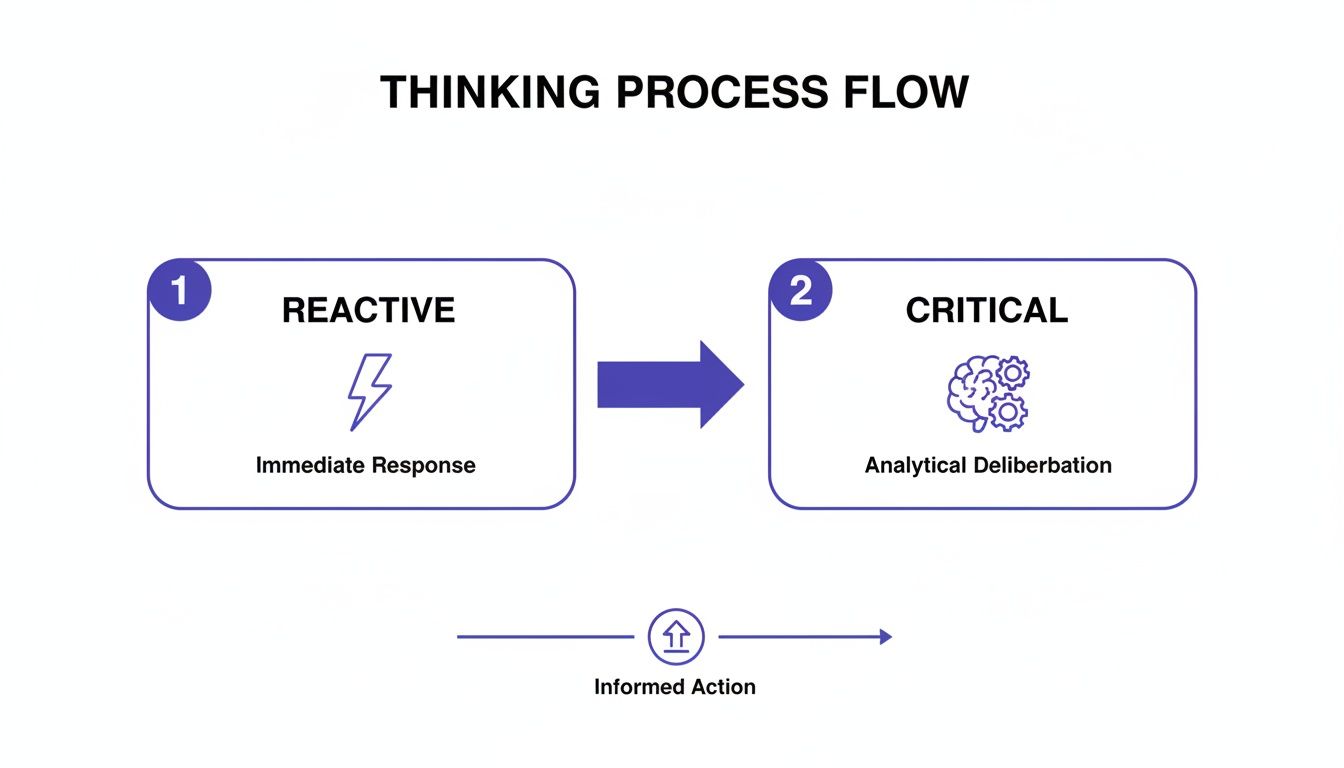
This diagram gets it right—critical thinking is about inserting a deliberate pause between a trigger and your response. That pause is where analysis happens.
Start Your Day with a Questioning Mindset
Before you even think about opening your inbox, carve out the first 15 minutes of your workday to tackle one specific challenge. A fantastic tool for this is the “5 Whys” method. It’s a simple but surprisingly powerful way to dig past surface-level symptoms and uncover the real root of a problem.
Let’s walk through a real-world example. Say you notice website traffic dipped by 10% last week.
- Why #1? Why did traffic drop? Because our organic search traffic was lower.
- Why #2? Why was it lower? Because our ranking for a key blog post slipped.
- Why #3? Why did the ranking slip? A competitor published a more comprehensive article on the same topic.
- Why #4? Why is their article better? It includes recent data and expert interviews that ours is missing.
- Why #5? Why don’t we have those things? We haven’t set up a process for periodically updating our best content.
And there it is. You went from a vague problem (“traffic is down”) to a concrete, actionable solution: create a content refresh schedule. This kind of structured thinking is all about creating systems to manage your mental energy and get to the core of an issue.
Curate Your Information Diet
You’re consuming information all day long, but are you doing it on purpose? A critical thinker is intentional about their inputs. Cognitive psychology is clear on this: our brains have a finite amount of high-quality attention. When you flood it with low-quality, biased, or irrelevant junk, you create “cognitive load,” leaving less bandwidth for the decisions that actually matter.
Take 10 minutes in the middle of your day to do a quick cleanup.
- Unfollow social media accounts that thrive on outrage or unverified claims.
- Unsubscribe from those newsletters you signed up for but never actually read.
- Set up targeted news alerts for specific topics you need to track, instead of just passively scrolling headlines.
This isn’t about becoming uninformed; it’s about being deliberate. You’re curating your inputs to create the mental space you need to think deeply. Maybe you can use a laptop stand for desk to create a more organized and intentional workspace.
End Your Day with Structured Reflection
The final piece of the daily puzzle is a brief, structured reflection. This habit is what makes the day’s lessons stick and trains your brain to review its own decisions without bias. Before you log off, grab a productivity journal and analyze one key decision you made.
Ask yourself these four questions:
- What was the decision I made?
- What assumptions was it based on?
- What was the actual outcome?
- What would I do differently next time?
This simple exercise closes the learning loop for the day. It’s the kind of deliberate practice that research confirms is essential for building any skill. For instance, a major study of 120,000 students found that a full one-fifth performed at the lowest level of critical thinking. The researchers’ conclusion? Targeted daily practice and measurement—the very heart of this routine—are what drive real improvement. You can see the full study by the Council for Aid to Education to dig into the data yourself.
By putting this simple, three-part routine into practice, you build a powerful daily habit for sharper thinking. And if you’re looking for more strategies to get your thoughts in order, our guide on how to organize your thoughts for greater clarity is a great next step.
Go Deeper: Challenging Your Assumptions with Weekly Exercises for Improving Critical Thinking Skills
Daily routines are fantastic for building habits, but to really sharpen your critical thinking, you need to stretch your mind with a few focused weekly workouts. Think of these as the mental equivalent of hitting the gym for a longer, more intense session.
These exercises are designed to pull you out of your intellectual comfort zone. They force you to dismantle arguments, confront your own biases, and spot problems before they snowball. To stay on track, I recommend blocking out a specific time each week and logging your progress in a simple habit tracker journal. Consistency is what turns effort into skill.

Exercise 1: Play Devil’s Advocate
One of the quickest ways to expose your own blind spots is to actively argue against your strongest opinions. We all naturally gravitate toward information that confirms what we already believe—psychologists call this confirmation bias. This exercise is a direct counter-attack.
Once a week, pick a belief you hold firmly, especially one related to your work. Maybe you’re convinced that “remote work is always more productive.”
Your mission is to build the strongest possible case against that belief.
- Real-World Scenario: A marketing manager believes Instagram is the best platform for their new campaign. To play devil’s advocate, she spends an hour researching why TikTok or LinkedIn might be superior, even though she doubts it. She finds data showing her target audience is highly active on TikTok, forcing her to reconsider her initial, biased assumption.
The goal isn’t to change your mind. It’s a powerful workout in cognitive flexibility that forces you to engage with opposing views, strengthening your overall grasp of the issue.
Exercise 2: Deconstruct an Argument
You’re surrounded by persuasion every single day, from targeted ads to LinkedIn thought leaders. This exercise trains you to see the architecture behind the arguments, making you a much more discerning consumer of information.
Each week, choose one persuasive piece of content—a news editorial, a viral social media post, or even a marketing email. Your job is to map out its logical structure.
- First, find the core conclusion. What is the single main point the author wants you to believe?
- Next, list the supporting premises. What evidence or reasons do they offer?
- Then, hunt for logical fallacies. Is the author using flawed reasoning to make their point?
We see flawed arguments everywhere, from political debates to social media threads. Being able to spot them separates a well-reasoned point from one that just feels emotionally convincing. Here are a few of the most common ones to get you started.
Common Logical Fallacies to Spot in the Wild
| Fallacy Name | What It Is | Example You Might See |
|---|---|---|
| Straw Man | Misrepresenting an opponent’s argument to make it easier to attack. | “You support reducing the marketing budget? So you just want the company to fail.” |
| Ad Hominem | Attacking the person making the argument instead of the argument itself. | “We can’t trust his analysis of the data; he didn’t even go to a top university.” |
| False Dichotomy | Presenting two options as the only possibilities when more exist. | “We either have to work weekends to finish this project, or we accept total failure.” |
| Appeal to Authority | Claiming something is true simply because an authority figure said it. | “Our CEO said this is the best strategy, so it must be.” |
Learning to spot these errors is a critical thinking superpower. Once you start looking for them, you’ll see them pop up in meetings, articles, and advertisements constantly.
Exercise 3: Conduct a “Premortem”
This technique, borrowed from the business world, is an incredible way to sharpen your foresight and planning skills. Instead of conducting a “postmortem” after a project fails, you hold a “premortem” before it even begins.
Pick a project you’re about to start—either at work or in your personal life. Now, fast forward in your mind. It’s six months from now, and the project has been a complete disaster.
Get a small group together (or just do this solo) and brainstorm all the plausible reasons for this epic failure. Write everything down, no matter how unlikely it seems.
- Real-World Scenario: A team planning a software launch holds a premortem. They imagine the launch failed spectacularly. Potential reasons emerge: “A key developer got sick,” “Marketing didn’t understand the product,” and “A competitor launched a similar feature first.” By identifying these risks upfront, they can now build contingency plans, like cross-training developers and preparing competitive response messaging.
This exercise flips the script from hopeful planning to proactive risk management. By identifying potential points of failure, you can build safeguards into your strategy from day one. It’s a powerful way of improving problem-solving skills because it trains you to anticipate obstacles instead of just reacting when they hit.
Using Technology and AI to Improve Your Critical Thinking Abilities
Technology often feels like the enemy of deep thought—a constant stream of pings and notifications pulling you away from anything that requires real concentration. But when you use it with intention, technology and AI can become powerful partners in sharpening your critical thinking.
The secret is to stop using these tools for quick answers and start using them to ask better, deeper questions. Instead of treating an AI chatbot like a glorified search engine, think of it as an intellectual sparring partner. This requires a whole different way of prompting—one that invites challenge instead of just asking for information.

Prompting AI as a Socratic Partner
Let’s say you have a new business idea. The reactive, low-effort approach is to ask an AI, “Is my business idea good?” You’ll get a generic, unhelpful summary every time.
A critical thinking approach uses a much more strategic prompt.
Your Prompt: “Act as a skeptical but fair Socratic partner. I will present my new business idea for a subscription box for indoor plant enthusiasts. Your role is to challenge my core assumptions, point out potential blind spots, and ask probing questions about my target market, pricing model, and competitive advantages. Do not provide answers, only ask questions that force me to justify my reasoning.”
This simple shift transforms the AI from an information vending machine into a tool that actively sharpens your own thinking. It forces you to defend your ideas against scrutiny, revealing the weak spots you would have otherwise missed.
Creating an Environment for Deep Thought
Of course, using AI as a thinking partner only works if you can actually focus. It’s hard to think critically when your phone is buzzing every two minutes with notifications. This is where a few low-tech tools can support your high-level thinking.
- A phone lock box timer can create a mandatory, distraction-free bubble for an hour of intense work.
- Investing in a quality monitor light bar can reduce digital eye strain during long research sessions, helping you stay focused for longer without the headache.
- Sometimes, even a simple tool like an ergonomic keyboard can reduce physical distractions that pull your focus away from complex problems.
These simple tweaks to your environment support the sustained concentration that critical analysis demands.
Evaluating AI Content Critically
It’s crucial to remember that AI-generated content is not gospel. In fact, critically evaluating its output is, in itself, a powerful exercise.
Always cross-reference significant claims, statistics, or data points with trusted, independent sources. This turns the process from passive consumption into active verification, reinforcing your analytical muscles with every check. You can learn more about using AI for productivity while maintaining that critical edge in our detailed guide.
This human-AI dynamic is only becoming more important. A recent bibliometric analysis of critical thinking research revealed a massive spike in publications between 2017 and 2021, driven largely by tech-forward nations. This academic surge shows that as AI gets more capable, the global focus on honing human critical thinking has intensified, positioning it as the essential counterpart to machine intelligence.
Editor’s Take on What Really Works
Let’s be honest for a second: consistency beats complexity every single time. A simple 15-minute daily reflection habit is far more powerful than a rare, multi-hour deep dive into abstract theories.
This advice isn’t for academic philosophers; it’s for busy professionals who feel like their brain has too many tabs open. The most important thing to know is that these skills build over months, not days. There are no shortcuts here, and real progress demands patience.
Simple Tools, Internal Work
Tools can definitely help grease the wheels. A basic pomodoro timer is fantastic for carving out a protected block of time for an exercise. A dedicated productivity journal can give your end-of-day reflections some much-needed structure.
But the real work? That’s always internal. The single biggest obstacle you’ll face is your own set of cognitive biases. Genuine critical thinking demands a willingness to question your own assumptions and—most importantly—to be wrong. It’s uncomfortable, but that discomfort is where all the growth happens.
This practical, no-hype philosophy is the heart of Mind Clarity Hub. We focus on building sustainable habits that lead to clearer thought, a theme we explore in depth in books like The Power of Clarity and Attention Unleashed.
These exercises are incredible for analyzing new information, which is a huge part of learning. But to make those new insights actually stick, you also need to know how to retain what you read and integrate it into your mental toolkit for good.
Key Takeaways: Your Core Critical Thinking Toolkit
Improving your critical thinking isn’t about some massive, overnight transformation. It’s about building small, intentional habits that compound over time. Think of this as your quick-start guide—a scannable summary of the core actions you can take right now.
Build a Daily Thinking Routine
Consistency is everything. A brief daily practice builds the mental muscle for deeper, more analytical thought. This could be as simple as using the “5 Whys” method to dig into a problem at work or spending just ten minutes with a productivity journal to reflect on the day’s decisions.
Challenge Your Assumptions Weekly
Go a step further with a focused weekly exercise. Deliberately play devil’s advocate against one of your own long-held beliefs. Deconstruct a persuasive argument you find online, or run a “premortem” on an upcoming project to spot weaknesses before they happen. These drills are designed to fight cognitive bias head-on.
Use Technology as a Socratic Partner
Instead of asking AI for answers, start using it to ask better questions. Prompt a chatbot to challenge your ideas or poke holes in your logic. You can also use simple tech to protect your focus, like a phone lock box timer, to carve out the uninterrupted mental space required for deep thinking.
Engineer a Focused Environment
Your physical space shapes your mental state. Small, deliberate changes can signal to your brain that it’s time to concentrate. A good pair of noise canceling headphones, for example, does more than block out sound—it creates a clear boundary between you and the world of distractions. Ultimately, the goal is to consistently apply what you’ve learned about how to build critical thinking skills and turn these practices into a reliable toolkit for making smarter, more reasoned decisions in everything you do.
Frequently Asked Questions About Improving Critical Thinking Skills
Let’s dig into some of the most common questions that come up when you start taking critical thinking seriously. The goal here is to give you straight, practical answers that build on the ideas we’ve already covered.
1. How Long Does It Take to See Real Improvement?
There’s no magic number, but you’ll probably notice small shifts within a few weeks of consistent practice. It might be as simple as catching yourself pausing to question a news headline instead of just scrolling past. That’s a win. But developing deep-seated critical thinking habits—the kind that fundamentally change how you solve problems—is a longer game. For significant, noticeable upgrades in your decision-making, you’re likely looking at several months of dedicated effort. The key is consistency, not cramming.
2. What Is the Best First Step for a Total Beginner?
Start a daily reflection habit. It’s low-effort but has a massive payoff over time. At the end of each day, take five or ten minutes with a productivity journal. Pick one decision you made and ask yourself:
- What was my gut reaction or initial assumption?
- What information did I actually use?
- How did it turn out?
- Knowing what I know now, what would I do differently?
This simple act builds the foundational skill of metacognition—thinking about your thinking. It’s the absolute cornerstone of critical analysis.
3. Can Critical Thinking Help with Procrastination?
Absolutely. Procrastination is often just a symptom of feeling overwhelmed or unsure where to even begin. That feeling of being stuck is what’s known as “analysis paralysis.” Critical thinking is the perfect antidote. It gives you the tools to break down huge, intimidating projects into small, logical, and manageable steps. By analyzing the real problem and identifying the very next action, you build clarity and momentum. We actually have a whole guide on how to overcome analysis paralysis with structured thinking if you want to go deeper.
4. Are There Any Tools That Can Help?
Yes, but think of them as support systems, not magic solutions. The best tools often just help you create the right environment for deep thought. For example, a visual timer for desk use can help you commit to short, focused bursts of analysis. In the same way, a good pair of noise canceling headphones can carve out a distraction-free zone, signaling to your brain that it’s time to concentrate. These tools help you manage your environment so you can do the real internal work.
5. How Can I Apply These Skills in a Team Setting?
This is where critical thinking really shines. You can start by practicing active listening in meetings—genuinely trying to understand a colleague’s viewpoint before you formulate your own response. Another powerful move is to introduce structured questioning. When a new idea is on the table, gently ask clarifying questions like, “What assumptions are we making with this plan?” or “What are the potential second-order effects we haven’t considered?” This steers the conversation away from gut feelings and toward a more evidence-based discussion.
6. Improving critical thinking skills and reading comprehension
How can I improve my critical thinking skills when reading? The trick is to read actively, not passively. Instead of just letting the words wash over you, turn it into a mental workout by constantly asking questions. As you read, keep these in your back pocket:
- What is the author’s core argument here?
- What evidence are they using to back it up?
- Is that evidence actually credible? Where did it come from?
- Are there any obvious logical fallacies in their reasoning?
This approach transforms reading from consumption into an analytical exercise. It’s a habit that strengthens your ability to evaluate information in every part of your life.
7. Can Critical Thinking Reduce Stress and Anxiety?
Yes, it can be an incredibly powerful tool for managing stress, but this is not medical advice. Much anxiety is fueled by vague, looping worries or catastrophizing about what might happen. Critical thinking allows you to put those anxious thoughts on trial. You can ask yourself, “What is the actual, objective evidence that this worst-case scenario will happen?” or “What’s a more realistic, alternative outcome?” This process helps you challenge irrational fears and ground yourself in reality, which can dial down your stress levels significantly. This content is educational and not a substitute for professional psychological care.
8. What Role Does Environment Play in Critical Thinking?
Your environment plays a massive role. It is incredibly difficult to think deeply when you’re surrounded by a firehose of distractions and interruptions. Creating a focused space is non-negotiable. This might mean using a phone lock box timer to quarantine your biggest distraction for an hour. It could also be as simple as upgrading your workspace with an ergonomic mouse and other tools that eliminate physical discomfort that constantly pulls at your attention.
9. Is It Possible to Overthink Instead of Thinking Critically?
Yes, and this is a crucial distinction to make. Critical thinking is a focused, goal-oriented process. You’re analyzing and evaluating information with the clear aim of solving a problem or making a sound decision. It’s productive. Overthinking, on the other hand, is usually an anxious, repetitive thought loop without a clear purpose or endpoint. It’s dwelling on a problem without moving toward a solution. The key difference is that critical thinking leads to clarity, while overthinking leads to paralysis.
10. How Do I Know if My Critical Thinking Is Improving?
You’ll start to see it in the small things. You might find yourself questioning your own gut reactions more often, or you’ll spot the flawed logic in an advertisement that would have flown right past you a month ago. Another key indicator is how you communicate. You’ll likely get better at articulating why you believe something, backing up your opinions with solid reasoning, and genuinely understanding different viewpoints in a debate. Keeping a journal to track your decision-making process is also a great way to see tangible proof of your progress over time.
(Disclaimer: This article may contain affiliate links. If you make a purchase, we may earn a small commission at no extra cost to you. This content is for educational purposes only and is not a substitute for professional medical or psychological advice, diagnosis, or treatment.)
At Mind Clarity Hub, we are dedicated to providing practical, science-based guides to help you achieve mental clarity and focus. If you’re ready to build a system for intentional thought and make smarter decisions, explore our cornerstone book, The Power of Clarity, and start your journey today.
