


Published:
Quick answer: A morning reset routine for focus is a short sequence that helps you land in the day, clear mental clutter, choose one priority, and begin with a small focus sprint. It is not a perfect 5 a.m. lifestyle plan. It is a practical reset you can run in 10 to 20 minutes before email, messages, and other people start shaping your attention.
If your mornings start with a phone, a rushed drink, and an instant list of everyone else’s needs, focus has to fight uphill. The goal of this routine is simple: remove avoidable friction before the first real task. You give your body a few cues, move loose thoughts out of your head, pick the next useful action, and start before the day becomes noisy.
If this post is describing your situation with focus and start, I built FocusFix: The Emotional Clarity Kit for Real-World Distraction Killers as the step-by-step version of what this article covers. It is my own product, and it goes considerably deeper than a blog post can.
This guide is written for busy adults, remote workers, students, creators, and anyone who wants a calmer first hour without pretending life is perfectly controllable. Use the whole flow when you can. Use the three-minute version when the morning is already messy.
What Is a Morning Reset Routine for Focus?
A morning reset routine for focus is a repeatable set of small actions that lowers decision load before your first meaningful work block. It usually includes a body cue, a quick capture step, one priority decision, and a protected start.
Free download: 7-Day Mind Clarity Reset
A short daily reset you can actually stick with (no fluff).
The reset works because it separates preparation from performance. Instead of asking your brain to wake up, triage, plan, and produce at the same time, you give each job a small place. You do not need a special planner, a long meditation, or a productivity app. You need a sequence you can trust even when you are tired.
For Mind Clarity Hub readers, this routine also supports the same idea behind the Jeremy Jarvis books hub: clear systems beat vague motivation. If you want a deeper companion for daily attention and follow-through, the Focus Recharged productivity book is the most natural next step.
Why Does Morning Focus Break So Easily?
Morning focus breaks when your attention gets claimed before you choose where it should go. A phone notification, an open inbox, a messy desk, or a half-remembered obligation can become the first steering wheel of the day.
Sleep quality matters too. The National Heart, Lung, and Blood Institute notes that poor or insufficient sleep can make it harder to focus on tasks and think clearly. That does not mean a morning routine can replace rest. It means the routine should be gentle enough for a real human morning, not built around heroic willpower.
Movement also helps. The CDC explains that physical activity can support thinking, learning, and problem-solving. A focus reset does not need to become a workout. Even a short walk, light mobility, or a few minutes of standing movement can tell your body that the day has started.
The third pressure is work design. Microsoft WorkLab has reported that meetings, messages, and app switching can crowd the hours when many people are trying to do focused work. That is why this routine protects the start. It gives your best attention somewhere to go before scattered inputs multiply.
Morning Reset Routine for Focus: The 5-Step Flow
The easiest version of a morning reset routine for focus has five steps: land, clear, choose, prime, and begin. Each step is small. Each step answers one question your brain would otherwise keep reopening.
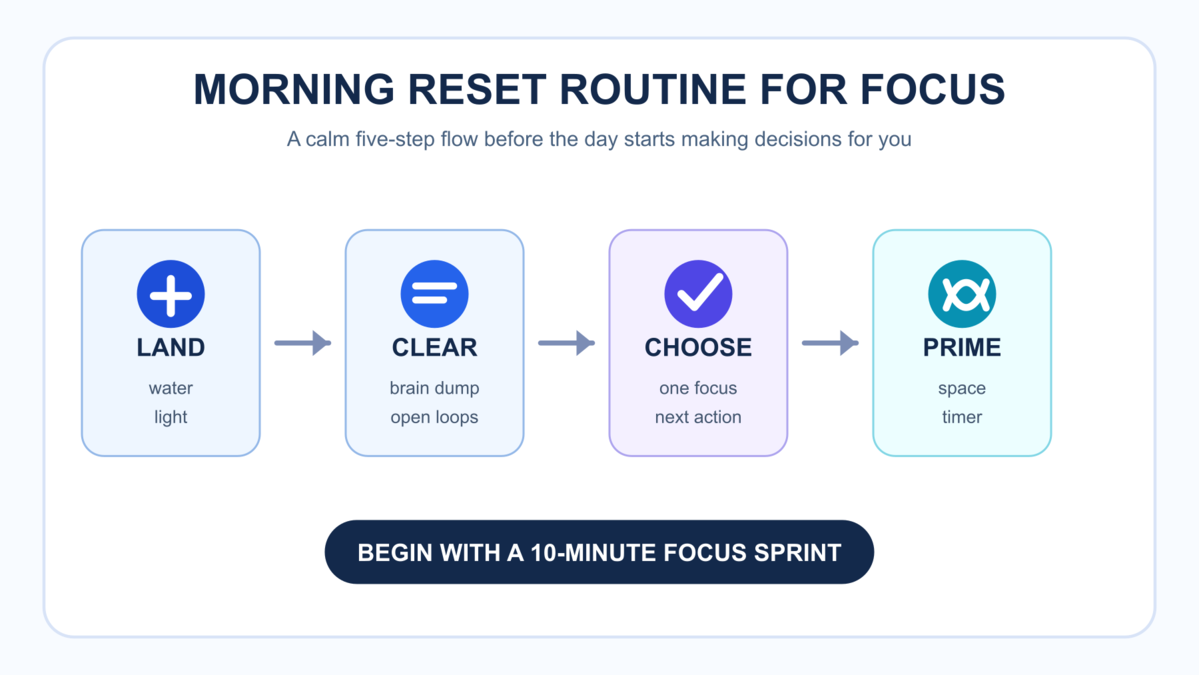
Step 1: Land Before You Plan
Start with a physical cue before you ask your mind to make decisions. Drink water. Open a curtain. Step outside for a minute if that is realistic. Stretch your neck and shoulders. Put both feet on the floor and take a few slower breaths.
This step is intentionally basic. It prevents the routine from becoming another thinking task. You are not trying to optimize your nervous system with a complicated protocol. You are helping your body receive the message that it is morning and that you are safe enough to choose the next action.
Step 2: Clear the Open Loops
Write down the loose thoughts that are already trying to pull attention: errands, replies, worries, ideas, reminders, and small tasks. Keep this to three minutes. The goal is capture, not organization.
A good brain dump might include “send invoice,” “check school form,” “finish outline,” “reply to Jordan,” and “buy coffee filters.” Once those thoughts are outside your head, they stop competing as loudly with your first focus block. If your list is long, circle only the items that matter today.
Step 3: Choose One Focus Target
Ask: What would make this morning feel meaningfully started? Pick one answer. Not five. Not a full life plan. One focus target.
Good targets are concrete: draft the introduction, review the budget, outline the client email, process ten receipts, read one chapter, or plan the top three tasks. Weak targets are vague: be productive, catch up, get organized, or fix everything. A morning reset routine for focus works best when the target can survive contact with a normal day.
Step 4: Prime the Space
Prepare only what the first task needs. Close unrelated tabs. Put the phone away or turn on a focus mode. Place the notebook, document, or tool in front of you. Set a timer for 10, 15, or 25 minutes.
Priming is not procrastination if it is short and specific. It becomes avoidance when you spend 45 minutes choosing music, cleaning the whole room, or rebuilding your task system. Keep the rule simple: prepare the launchpad, then launch.
Step 5: Begin With a Small Sprint
Start the first focus sprint before checking the inbox. Ten minutes is enough. The goal is not to finish the project. The goal is to prove that attention has a direction.
Once the sprint starts, do not renegotiate the whole day. If a thought appears, write it on a capture line and return to the task. If the task is too large, shrink it. Write the first paragraph. Name the file. Open the spreadsheet. Sort the first five items. Progress that can be seen is easier to continue.
How Long Should a Morning Reset Routine for Focus Take?
A morning reset routine for focus should take 10 to 20 minutes on a normal day. On a rushed day, use the three-minute version: water, one-line brain dump, one next action.
Longer is not always better. A routine that takes 60 minutes may feel good on a quiet weekend and fail on a Tuesday. The best routine is short enough to repeat when the house is loud, the calendar is crowded, or you did not sleep perfectly.
| Available Time | What to Do | Best Use Case |
|---|---|---|
| 3 minutes | Water, capture three thoughts, choose one next action | Late start or family-heavy morning |
| 10 minutes | Land, brain dump, pick focus, clear space, start timer | Most workdays |
| 20 minutes | Add light movement, quick review, and a longer first sprint | Deep work, studying, writing, planning |
What Should You Avoid During a Morning Reset Routine for Focus?
Avoid anything that turns the reset into a second job. The morning reset should reduce choices, not create a new performance standard.
- Avoid the inbox first. Email turns your morning into a reaction list before you choose a direction.
- Avoid social feeds. They add other people’s urgency, mood, and comparison before your own priorities are named.
- Avoid full-system rebuilding. Do not redesign your planner during the reset. Use the system you have today.
- Avoid vague goals. “Focus more” is not a task. “Outline the first section” is a task.
- Avoid self-criticism. A reset is a return point, not proof that you failed yesterday.
How Do You Pick the First Priority in a Morning Reset Routine for Focus?
Pick the first priority by looking for the task that reduces the most useful friction. It may be important, urgent, emotionally heavy, or simply the task that unlocks the rest of the day.
Use this quick filter when everything feels equally loud:
- What has a real deadline or consequence?
- Which task would make other tasks easier once it is started?
- Name the thing that has been mentally open for too long.
- What can I move forward in 10 minutes?
If two tasks compete, choose the one with the clearest next action. Clarity beats size in the first sprint. You can handle larger planning later, after attention has warmed up.
Morning Reset Routine for Focus Examples
Examples make the routine easier to adapt. The structure stays the same, but the first priority changes by life context.
| Reader | Reset Focus | First Sprint |
|---|---|---|
| Remote worker | Close yesterday’s open loops before meetings start | Write the status update and send one key reply |
| Student | Begin the hardest study block before checking messages | Review notes and create five recall questions |
| Parent | Protect one small adult priority after the household launch | Process the appointment form or plan dinner |
| Creator | Make one draft move before research expands | Write the opening scene, outline, or script hook |
How Can You Personalize the Morning Reset Without Overbuilding It?
Personalize the reset by changing the cue, the capture tool, and the first sprint length while keeping the same order. The order matters because it protects attention from jumping straight into planning before your body and environment are ready.
If you like paper, keep one index card near your desk. Write the date, one focus target, and the first visible action. When the sprint ends, move the card into a small stack. This gives you proof that the routine is working without building a complicated tracking system.
If you prefer digital tools, use one pinned note called “morning reset.” Keep the note boring. Add five lines only: land, clear, choose, prime, begin. A notes app can support attention, but it can also become a doorway into messages, files, and tabs. Open only the reset note before the first sprint.
If you are a verbal processor, record a 60-second voice note. Say what is on your mind, name the priority, and state the next action. Then stop. Do not turn the reset into a morning podcast to yourself. The value comes from choosing a direction, not from explaining every detail.
If you share space with other people, make the routine visible and quiet. A small card on the table can say, “first focus sprint.” Headphones, a closed door, or a specific chair can become the signal. The reset should not require everyone else to change their morning before you can begin.
Morning Reset Routine for Focus Mistakes to Avoid
The most common mistake is making the routine too impressive. A reset that looks beautiful but needs perfect conditions will disappear when life gets normal. Build the version you can do on an average weekday.
Another mistake is adding too many wellness goals. Morning sunlight, movement, journaling, breakfast, reading, and planning can all be useful. Still, the reset has one job: help you begin the first meaningful focus block. Add other habits only when they support that job.
A third mistake is treating the reset as a mood test. You do not have to feel inspired before you begin. You only have to make the next action visible enough that starting is easier than avoiding. In practice, the first five minutes often create the focus you were waiting to feel.
Finally, do not use the reset to hide from hard prioritizing. If every day begins with easy admin while the important work keeps moving forward untouched, the routine has become a comfort loop. Put one meaningful task near the front at least a few days each week.
What If You Wake Up Tired?
If you wake up tired, make the routine smaller and more physical. Do not punish yourself with a complex planning session. Start with water, light, a gentle movement cue, and one low-friction task.
The NHLBI’s sleep guidance is a useful reminder: lack of quality sleep can affect clear thinking and attention. A morning routine can help you begin, but it cannot erase a pattern of poor sleep. If sleep problems are persistent or disruptive, treat sleep as a core system to improve and talk with a qualified clinician when needed.
On low-energy days, choose a “minimum viable focus” target. That might mean answering the one message blocking a project, creating a rough outline, or setting up tomorrow’s first task. This keeps trust with yourself without pretending your energy is unlimited.
How Can Remote Workers Use a Morning Reset Routine for Focus?
Remote workers can use a morning reset routine for focus to create a boundary between home mode and work mode. Without a commute, the brain often lacks a clear transition. A short reset can become that transition.
Try this version:
- Leave the phone outside the workspace for the first sprint.
- Write the first work block on paper before opening chat.
- Check the calendar only after the focus target is named.
- Set one visible stop point for the first task.
- Keep a capture note for messages that can wait.
The American Psychological Association has also highlighted the value of breaks for energy and well-being. For remote work, that matters because the morning reset is only the first anchor. You still need pauses during the day so your focus does not depend on one perfect start.
How Is a Morning Reset Routine for Focus Different From a Morning Routine?
A morning routine may include exercise, breakfast, reading, journaling, family care, chores, or commuting. A morning reset routine for focus is narrower. It exists to help attention choose a direction.
That difference is helpful. You can keep your normal morning life and still add the reset. It does not require replacing breakfast, parenting, prayer, exercise, or quiet time. It simply creates a short bridge between waking up and beginning meaningful work.
What Tools Do You Need for a Morning Reset Routine for Focus?
You need fewer tools than you think. A notebook and timer are enough. Notes apps can work. Task apps can work too. Even a sticky note is fine.
Useful tools include:
- A capture page for open loops
- A daily card with one focus target
- A timer for the first sprint
- A focus mode or app blocker if your phone is the main leak
- A short checklist you can reuse without thinking
If tools become the main project, simplify. The reset should be portable. It should work in a notebook, on a hotel desk, at a kitchen table, or before a work shift.
How Should You Review the Routine Each Week?
Review the routine once a week for five minutes. Ask what helped, what dragged, and what made starting harder than it needed to be. This review is not a grade. It is a design check.
Look for patterns. Maybe the routine works when your phone stays in another room. The brain dump may get too large when you skip a weekly planning session. Your first sprint might be easier after movement but harder after opening news. These observations tell you where the system needs less friction.
Keep one small adjustment for the next week. Move the checklist. Shorten the capture step. Choose the first task the night before. Put the book, notebook, or laptop file in place before bed. Small changes compound because they make the reset easier to start.
How Do You Make the Routine Stick?
Make the routine stick by attaching it to a cue you already have. Try it after coffee. Use it after brushing teeth. Start after school drop-off. Run it after opening the laptop. The cue matters more than the perfect time.
Keep the checklist visible for two weeks. Use the same words every day: land, clear, choose, prime, begin. Repetition lowers the decision cost. Once the pattern feels familiar, you will not need to negotiate every step.
Also track friction, not perfection. If you skip three days, ask what made the reset too hard. Was it too long? Did it require a quiet room? Did it start after the inbox was already open? Fix the design instead of blaming your character.
What If Your Morning Is Chaotic?
If your morning is chaotic, run the reset after the chaos settles. A reset does not have to happen at sunrise. It can happen at 8:47 a.m., in a parked car, at a desk, or after the kids leave.
Use this short script:
I am here. The day has already started, but I can still choose the next useful action.
Then write one sentence: “The next useful action is…” Finish the sentence. Start there. This is the entire emergency version of the morning reset routine for focus.
How We Use This Advice at Mind Clarity Hub
Mind Clarity Hub publishes practical systems for attention, reading, planning, and calmer follow-through. This article is based on a tool-agnostic method: reduce morning decision load, protect one first focus block, and support the body without making medical promises.
Source-backed claims in this guide are limited to broad, practical points about sleep, physical activity, breaks, and attention pressure. For deeper reading, see the CDC on physical activity and brain health, the NHLBI on sleep and clear thinking, the APA on breaks, and Microsoft WorkLab on modern focus pressure.
For a book-based next step, visit the Mind Clarity books hub. A focused productivity path starts with Focus Recharged. Comparison-style guides and evidence notes live in the reviews and science deep dives hub.
Morning Reset Routine for Focus Checklist
Use this checklist tomorrow. Keep it short enough that you can finish before the day gets crowded.
- Drink water or use another simple body cue.
- Open light or step outside briefly when possible.
- Capture loose thoughts for three minutes.
- Choose one focus target for the morning.
- Write the next visible action.
- Close unrelated tabs and move the phone away.
- Set a timer for 10 to 25 minutes.
- Begin before checking the inbox.
FAQ
What is the best morning reset routine for focus?
The best morning reset routine for focus is one you can repeat: land with a body cue, clear open loops, choose one priority, prime your space, and begin a short focus sprint.
Can a morning reset routine replace sleep?
No. A morning reset can help you start with less friction, but it does not replace enough quality sleep. If poor sleep is frequent, treat sleep as a separate health and schedule priority.
Should I meditate during the reset?
Meditation can help some people, but it is optional. If it supports your attention, use two to five minutes. If it becomes another obstacle, use breathing, light movement, or a short written check-in.
How do I use this if I have ADHD?
Keep the reset external and visible: a printed checklist, a timer, a short capture list, and one next action. This guide is educational and not a treatment plan, so adapt it with professional support if needed.
Should I check my calendar before choosing a priority?
Yes, but keep it brief. Look for fixed commitments, then choose your first focus target. Avoid opening messages or inboxes until the target is written down.
What is the three-minute version?
The three-minute version is water, capture, choose. Drink water, write down the loudest loose thoughts, and name the next useful action. Then begin for five to ten minutes.
Helpful Sources
- CDC: Physical Activity Boosts Brain Health
- NHLBI: Why Is Sleep Important?
- American Psychological Association: Give me a break
- Microsoft WorkLab: Breaking down the infinite workday
Helpful resources for your next step
Affiliate disclosure: As an Amazon Associate, Mind Clarity Hub may earn from qualifying purchases at no extra cost to you. Use this link only if it genuinely helps your planning.
If Morning Reset Routine for Focus: A Gentle Start That Works is a routine you want to keep using, a simple workbook, planner, or desk tool can make the steps easier to repeat.
Compare related planners, workbooks, and organization tools on Amazon.
