

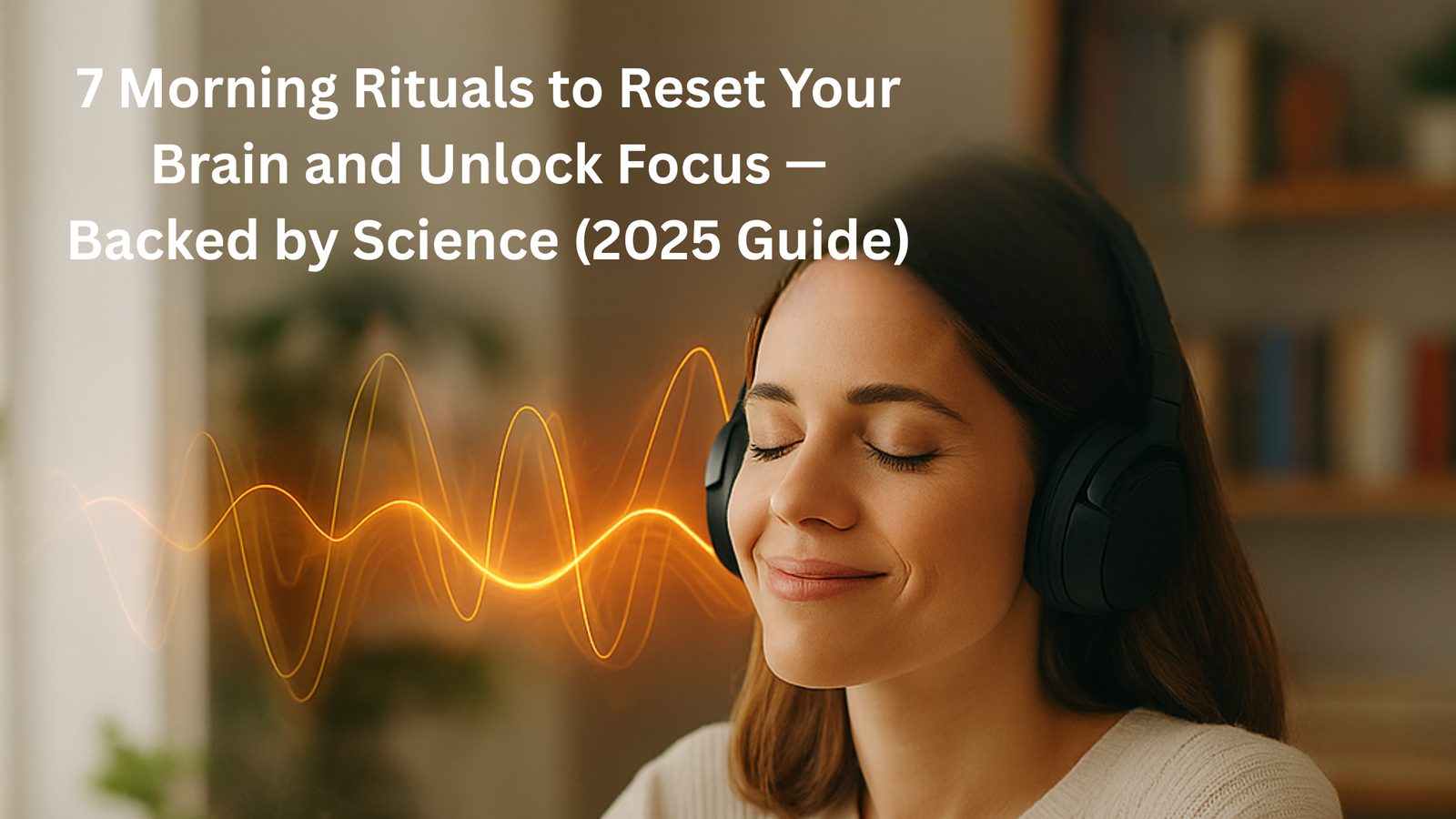
Discover evidence-based habits that clear brain fog, steady your mind, and set the tone for focus all day.
Affiliate Disclaimer: This post contains affiliate links. If you buy through them, Mind Clarity Hub may earn a small commission at no extra cost to you. This article is educational only and does not provide medical advice.
Morning rituals are not about perfection or aesthetics. They are about how your nervous system is being trained in the first 30–60 minutes of the day. According to Harvard Health, early-morning choices strongly influence mood regulation, cognitive flexibility, and the way your attention behaves hours later.
Right after waking, your brain chemistry shifts quickly: cortisol peaks, dopamine ramps, and your prefrontal cortex is still “booting up.” If you pour chaos into that window, your day tends to feel chaotic. If you pour a few deliberate inputs into that same window, the whole day feels more stable. This guide walks through seven neuroscience-backed morning rituals that support clarity, including a short daily audio for focus that has become a cornerstone tool for our readers.
You do not need to adopt all seven at once. Instead, treat this guide as a menu. Start with one or two rituals that feel realistic, then layer others over time. The goal is not a rigid “perfect morning,” but a repeatable pattern that tells your brain: it is safe to slow down, focus, and do meaningful work.
1. Start with a 3-3-3 Breath Reset
Before coffee, before notifications, and before touching your inbox, give your nervous system a clear signal: we are not in a rush. A simple 3-3-3 pattern works surprisingly well—inhale for three seconds, hold for three, exhale for three, then rest briefly before repeating.
This pattern engages the vagus nerve and helps shift your physiology from a sympathetic “threat” state toward a parasympathetic “rest-and-digest” state. Researchers connected to the Huberman Lab and similar programs have highlighted how short, deliberate breathing can reduce amygdala activity and support sustained attention for hours afterward.
Practical way to do it:
- Sit or stand near a window, ideally with natural light.
- Place one hand on your chest, the other on your belly, and follow the 3-3-3 rhythm for three to five rounds.
- Notice the moment your thoughts begin to slow and your body feels a fraction heavier and calmer.
Over time, your brain learns to associate this pattern with arriving in the day. It becomes a micro-switch from “I woke up in the middle of everything” to “I am allowed to arrive in my own time.”
2. Delay Your First Screen by 10–15 Minutes
Reaching for your phone before you have even sat up fully is a training signal. It tells your brain that the first priority of the day is novelty, not clarity. Social feeds, email, and notifications deliver rapid-fire dopamine spikes that scatter attention and make later focus feel like swimming upstream.
In observational and lab studies, even small delays in morning screen exposure have been linked to better mid-day concentration and lower stress. The mechanism is straightforward: you are giving your prefrontal cortex time to come online before it is asked to triage inputs.
Try this:
- Set your alarm on a separate device or use airplane mode at night.
- Commit to 10–15 minutes of analog activity: breathing, stretching, water, or a short written intention.
- Only after that window do you allow yourself to open messages or feeds.
This tiny change is uncomfortable at first. After a week or two, many people describe a sense of “space” in the morning that they did not realize they were missing.
3. Sync Your Brain with Sound (Without Adding Another App)
Sound is one of the most efficient ways to influence brain state. The National Institutes of Health and other research groups have shown that specific rhythmic and frequency patterns can enhance neural synchrony, memory consolidation, and subjective calm.
The Genius Wave daily audio, highlighted in our cornerstone guide Simple Daily Audio for Focus, uses precisely structured sound to ease your brain toward an alpha–theta crossover state: calm but awake, settled but not sleepy. That combination is ideal for planning, writing, or starting deep work.

The advantage of this approach is that it does not demand willpower or complex tracking. You press play, follow a few gentle cues, and let the audio do the heavy lifting while your mind transitions from “foggy” to “available.” Many readers report that within one to two weeks of using a simple daily audio for focus, they experience fewer scattered mornings and more predictable work blocks.
How to Use Morning Audio Without Overcomplicating It
- Keep headphones near your bed or desk so there is no friction.
- Listen once each morning before opening work apps, for three to seven minutes.
- Have one small task ready—planning your day, writing a paragraph, or reviewing a priority list.
The key is not volume of listening, but consistency. The brain learns patterns. When it recognizes a familiar audio ritual, it begins to anticipate focus before you consciously decide to “try harder.”
4. Write One Clear Intention (Instead of a Giant To-Do List)
Your brain is constantly asking a quiet question: “What matters right now?” If you do not answer it on purpose, it will default to answering it based on whatever is most urgent, loud, or emotionally charged.
Intention journaling is one of the simplest ways to respond deliberately. Rather than writing a massive to-do list, you capture a single sentence that defines the tone and direction of your day. For example:
- “Today I move slowly and finish one important thing.”
- “Today I protect my focus blocks even if my inbox is noisy.”
- “Today I notice when my brain is tired and pause instead of pushing.”
Research on the reticular activating system (RAS) suggests that these kinds of clear, written intentions help your brain filter incoming information. You begin to notice opportunities that align with your stated focus and feel slightly less pulled by everything else.
Keep this practice analog if you can. Pen and paper engage motor and sensory pathways that are different from typing on a glowing screen. That difference matters more than most people realize.
5. Hydrate and Nourish Your Brain Before Heavy Stimulation
Your brain is approximately 73 percent water. Overnight, you lose fluid through breathing and sweating, and you are fasting for six to eight hours or more. Going straight to stimulants and heavy digital input in that state is like flooring the gas pedal on an engine that has almost no oil.
A simple formula works well:
- One glass of water right after waking (plain, or with a pinch of mineral salt or lemon).
- A small amount of protein and fat within the first hour—yogurt, eggs, nuts, or a balanced smoothie.
- Caffeine a little later, once you have hydrated and eaten.
Hydration and stable blood glucose support neurotransmitters like acetylcholine, which is linked to learning and attention. This is not a rigid diet prescription; it is about giving your brain raw materials before you ask it to perform.
6. Move for Three to Five Minutes (Even in a Small Apartment)
Long workouts are great, but they are not required for cognitive benefits. Studies in journals such as Neuroscience Letters indicate that even short bouts of movement can increase alertness, improve reaction time, and elevate mood.
A simple “micro-movement” sequence might look like:
- 10–15 bodyweight squats.
- 30–60 seconds of marching in place or light jogging.
- A few slow shoulder rolls and neck stretches to release overnight tension.
Pair the movements with your breath. Inhale as you prepare, exhale as you move. This pairing teaches your nervous system to associate gentle exertion with calm, rather than stress. Over time, these short bursts of movement become a cue: “We are waking up on purpose now.”
7. Prime Your First Focus Block with a Simple Audio Ritual
Before you open email, project management tools, or social feeds, give your brain a single, clear “focus prelude.” This is where the Simple Daily Audio for Focus from our cornerstone Genius Wave guide fits naturally.
You listen for three to seven minutes, eyes soft or lightly closed, while the audio gradually guides your attention away from background noise and toward a steady internal rhythm. When the track ends, you go directly into one prepared task—no detours, no inbox, no quick “just checking” of messages.

Try the 7-Minute Audio Our Readers Use as a “Morning Focus Switch”
In our full cornerstone guide, Simple Daily Audio for Focus: The Genius Wave Review, we break down how the program works, what to expect in week one, and how to pair it with habits like breath, movement, and intention journaling. Many readers treat it as a low-friction way to anchor an entire morning routine without adding another complex app.
How to Combine These Rituals into a 20-Minute Morning Flow
You do not need a two-hour ritual to reset your brain. In many cases, 15–20 minutes is enough to change the entire feel of your day. Here is a realistic example that many readers adapt:
- Minutes 0–3: 3-3-3 breath reset by a window, with no phone in hand.
- Minutes 3–5: Quick micro-movement sequence and a glass of water.
- Minutes 5–7: Write one intention sentence and review your single most important task.
- Minutes 7–14: Listen to a simple daily audio for focus while sitting comfortably.
- Minutes 14–20: Begin your first five to ten minutes of focused work immediately.
Adjust the timing to fit your life. Parents, shift workers, and people with health conditions will naturally adapt this outline. The core idea is to create a predictable, gentle ramp into the day rather than jumping straight into digital noise.
Who These Morning Rituals Help Most (and When to Be Cautious)
These habits tend to be most helpful for people who feel mentally “scattered but motivated.” If you care about your work, but your brain feels overstimulated or foggy, small shifts to breath, sound, and intention can make a noticeable difference within a couple of weeks.
If you are experiencing severe mood symptoms, chronic insomnia, or debilitating anxiety, these practices may still be supportive, but they are not a substitute for medical or psychological care. In those cases, consider using morning rituals alongside professional guidance rather than instead of it.
Always check with a clinician if you have concerns about audio-based tools, breathing practices, or movement, especially if you live with cardiovascular, neurological, or respiratory conditions.
Final Thoughts — Focus Is a Signal, Not a Force
Focus is not about pushing yourself harder; it is about sending your brain a clear, consistent signal. When your mornings start with breath, light, movement, a simple intention, and a short focus ritual, you are rewiring that signal day by day. Distraction does not disappear overnight, but the baseline of your nervous system shifts from frantic to steady.
You do not have to implement all seven morning rituals immediately. Pick one practice to test tomorrow and pair it with a short audio session from our Genius Wave cornerstone guide. After a week, review how your mornings feel. If there is even a small improvement in clarity or calm, keep going and add the next layer.
Over months, these small, repeatable choices compound. They become the invisible structure that protects your attention, your creativity, and your ability to do focused work in a noisy world.
Frequently Asked Questions
How soon will I notice changes from these rituals?
Most readers notice subtle changes—slightly calmer mornings, easier task starting, less urge to scroll—within 5–7 days of consistent practice. The biggest benefits usually appear over 2–4 weeks, as your nervous system begins to recognize the new pattern.
Do I have to wake up earlier to do all seven rituals?
Not necessarily. Many of these habits can be combined into a 15–20 minute window. You can also start with one or two practices and fold them into your existing wake-up time. The goal is sustainability, not a perfect two-hour routine.
Can I listen to the audio while meditating or journaling?
Yes. Many people play a simple daily audio for focus quietly in the background while they journal, plan, or breathe. If you find it distracting, use it before those practices instead. Experiment and notice which sequence gives you the calmest, clearest start.
Is this compatible with caffeine or supplements?
Yes. These rituals are behavioral and sensory; they can complement coffee, tea, or well-chosen supplements. Some readers find that after a few weeks of consistent morning habits, they naturally need less caffeine to feel awake. Always consult a clinician regarding any supplement routine.
What if I miss a morning or fall off the routine?
That is normal. Treat morning rituals like gentle training, not an exam. If you miss a day or a week, simply restart with the smallest version of your routine—a couple of breaths and a short audio session—and build from there. Consistency over months matters more than perfection in any single week.
Featured Reviews

The Genius Wave Review
Sound-based brainwave training tested for focus & productivity.
Read Review →
Ikaria Lean Belly Juice Review
Deep dive into ingredients, evidence, refund policy & safety.
Read Review →

Ikaria Lean Belly Juice Review
Deep dive into ingredients, evidence, refund policy & safety.
Read Review →