
Heads up: This post contains affiliate links. If you buy something through a link, we may earn a small commission at no extra cost to you. We only recommend products we trust. Thanks for your support!
The zero inbox method is a system for processing emails with one clear goal: keeping your inbox empty, or nearly empty, at all times.
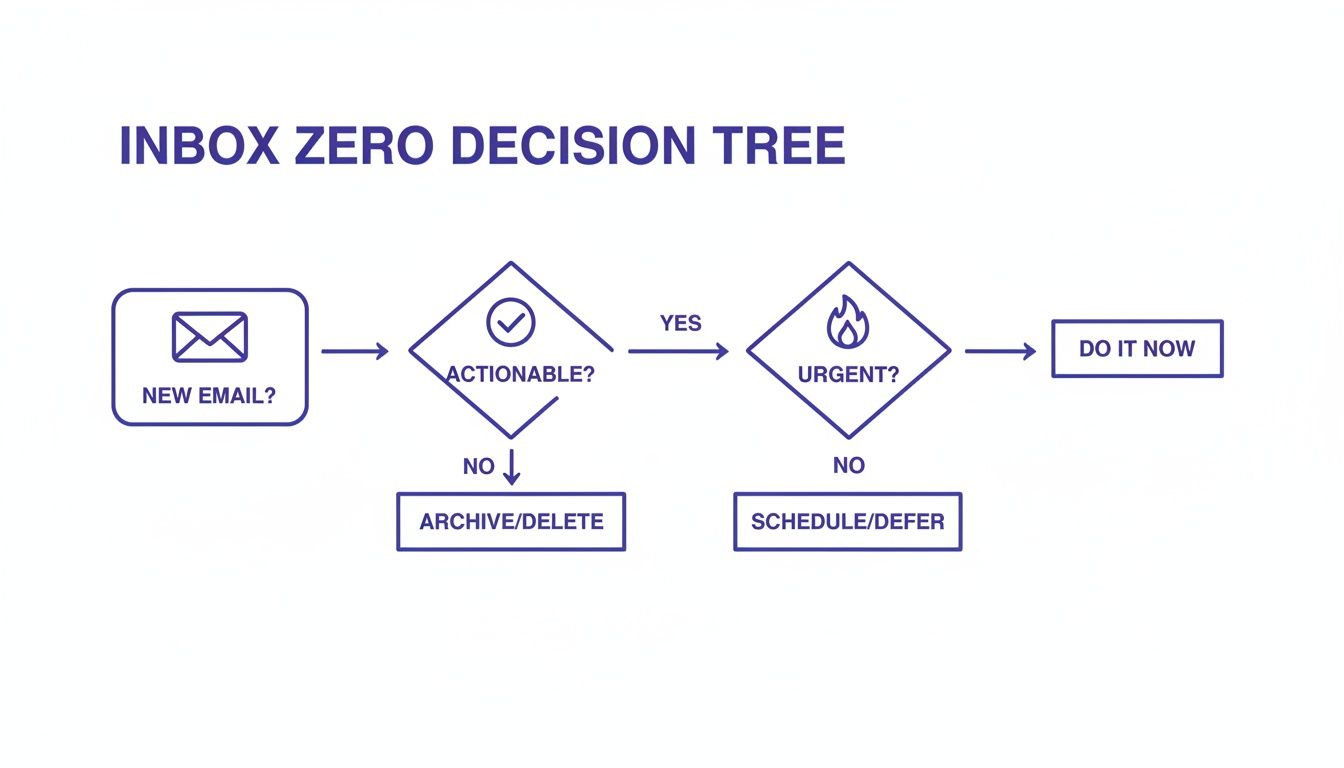
It’s not about deleting everything in sight. Instead, it’s about making a quick, decisive call on every single email that arrives: delete, delegate, respond, defer, or do. This simple practice stops your inbox from becoming a stressful, cluttered, and endless to-do list.
Why the Zero Inbox Method Matters for Your Brain
That wall of unread emails you stare at every morning? It’s more than just a messy digital habit. From a neuroscience perspective, it’s a silent drain on your brain’s resources. It directly sabotages your ability to do meaningful work.
Every unread message represents an open loop. This is a micro-decision your brain feels compelled to process. It chips away at your mental energy before you’ve even had your coffee. This low-level, constant demand leads straight to what psychologists call decision fatigue. Behavioral research is clear: the quality of our decisions craters after a long session of making choices. Your cluttered inbox forces you to make hundreds of tiny, often meaningless, decisions before you even start your most important tasks for the day.
The Real Cost of Context Switching
Each time you even glance at an email notification, your brain performs a “context switch.” This yanks your attention from your main task over to the inbox. The problem isn’t just the interruption itself; it’s the long recovery time.
Psychological studies show that after checking and handling emails, it can take several minutes to regain your previous level of focus. This constant back-and-forth fragments your attention. It also makes it nearly impossible to enter a state of deep work, a state of peak concentration.
- Mini-Scenario: Sarah, a project manager, is finalizing a critical project plan with a deadline two hours away. As she works, notifications for new messages and unimportant CCs keep popping up. Even without opening them, her focus shatters. She sees a subject line from her boss. Her mind immediately starts wondering what it’s about, completely derailing her train of thought.
This is a perfect, everyday example of how a chaotic inbox directly torpedoes productivity. The zero inbox method isn’t just a tidiness hack; it’s a strategic system for reclaiming your mental clarity. Understanding what is cognitive overload helps explain why managing this digital noise is so crucial. A huge part of reclaiming your focus also lies in implementing strong, proactive email communication best practices.
Drowning in Digital Communication: The Zero Inbox Method Solution
The sheer volume of email we face is staggering. Global email traffic is projected to hit 392.5 billion emails sent and received daily.
For the average knowledge worker, this breaks down to around 117 emails hitting their inbox every single day. The cognitive cost is real and measurable. Microsoft data found that workers are interrupted about every two minutes. This leads to significant “cognitive recovery costs” as they struggle to refocus. You can explore more data on how email impacts focus on this detailed analysis.
By adopting the zero inbox method, you’re not just cleaning up. You’re building a defensive strategy against this digital flood. It’s a necessary approach for anyone who wants to protect their focus and energy.
The 5 Core Actions Of The Zero Inbox Method
The real secret to Inbox Zero isn’t a complex new app. It’s a simple, decisive triage system built around 5 core actions. It’s not about getting to zero messages for the sake of it. It’s about making a quick, firm decision on every email you touch. Think of it less like a passive holding pen. Think of it more like an active processing station for your digital life. The goal is to spend less mental energy in your inbox so you have more for the work that matters.
This idea was first mapped out by productivity expert Merlin Mann in 2006. His core insight was brilliant: the problem isn’t the volume of email, but the mental real estate it occupies. He famously defined ‘zero’ not as zero messages, but as “the amount of time an employee’s brain is in his inbox.” The five-action system he created—Delete, Delegate, Respond, Defer, and Do—is still the gold standard. You can find more on the origin story over on Ohai.ai’s blog.
Letting emails pile up has a real, tangible cost. It actively sabotages your focus and output.

As the visual shows, an unchecked inbox creates a direct line from digital clutter to a serious drop in productivity. It’s an attention drain we can no longer afford.
Delete or Archive Fearlessly
Your first and most powerful move is to either delete or archive. Be ruthless here. A huge portion of your inbox is likely informational. This includes CC’d conversations, automated reports, or newsletters you’ve already skimmed. The “delete” key is your new best friend for anything you’ll never need again.
For anything you might need to reference later, hit “Archive.” This whisks the email out of your immediate view but keeps it safe and searchable. The psychological payoff is enormous. Every archived email is a closed mental loop, freeing up your cognitive bandwidth.
- Mini-Scenario: An automated daily sales report lands in your inbox. You glance at the key metric, see everything is on track, and immediately hit “Archive.” The task is done. Total time spent: three seconds.
Delegate to the Right Person
Just because an email landed in your inbox doesn’t mean it’s your job. A critical skill for the zero inbox method is quickly spotting tasks that belong to someone else.
When you do this, don’t just forward the email with a vague “FYI.” That just creates more work and confusion. Instead, add a single, clear sentence at the top explaining what needs to happen.
- Mini-Scenario: A customer emails you with a technical bug report. You forward it straight to the support team with a note: “Hi team, can you please help this customer with their login issue and CC me on the resolution? Thanks.” The task is now off your plate.
Respond Immediately with the Two-Minute Rule
The two-minute rule is a cornerstone of this system. It’s simple: if you can read, understand, and reply in under two minutes, do it right then and there.
This simple habit prevents tiny, easy tasks from piling up into a mountain of dread. A quick response gets the item out of your inbox and, more importantly, out of your head. It never even gets a chance to fester on your to-do list.
- Mini-Scenario: A colleague pings you: “Are you free for a quick 15-minute call tomorrow at 2 PM?” Instead of letting it sit, you glance at your calendar and reply instantly: “Yep, 2 PM works. Sending an invite now.” Done.
Defer for Deeper Work
Of course, some emails require more thought than two minutes. These are the messages you defer. But here’s the crucial part: deferring does not mean leaving it in your inbox to “deal with later.” Your inbox is a terrible to-do list.
Instead, you need to move the task to a dedicated system. This could be your task manager, a calendar event, or even a simple productivity journal. This action clears the email from your inbox while guaranteeing the task won’t be forgotten.
- Mini-Scenario: Your boss sends a detailed proposal and asks for feedback. You know this needs at least 30 minutes of focused attention. You immediately move the email to a “To-Do” folder. Then you create a task in your planner: “Friday, 10 AM: Review and send feedback on X proposal.” Then you archive the original email, confident the work is captured.
Do It Now
Finally, there’s the “Do” category. These are tasks that are both important and can be completed relatively quickly, maybe a bit longer than two minutes. They’re high-priority items you can knock out during your scheduled email-processing time. Making these firm decisions is a core part of building mental clarity, a theme we explore in our book, The Power of Clarity.
- Mini-Scenario: You get an urgent email to approve a small expense report that’s holding up a team member’s reimbursement. You open the link, review the items, click “approve,” and archive the email. The whole thing takes five minutes and is done on the spot. For more strategies like this, read our guide on how to manage email overload.
Setting Up Your Inbox for Automated Zero Inbox Method Success
If you’re sorting every single email by hand, you’re on a fast track to decision fatigue. The real secret to a sustainable zero inbox method habit isn’t willpower; it’s smart automation. By teaching your email client what to do for you, you create a much calmer inbox. Only the truly important messages—the ones sent by actual humans—will be waiting for your attention.
The goal here is to build a system that pre-sorts all the digital noise. This lets you engage with your inbox on your own terms. Instead of constantly reacting to a flood of new messages, you get to manage it proactively. This is a foundational principle we explore in our book, Digital Clarity, because it shifts you from a reactive posture to an intentional one.

Create Your Automatic Filing System
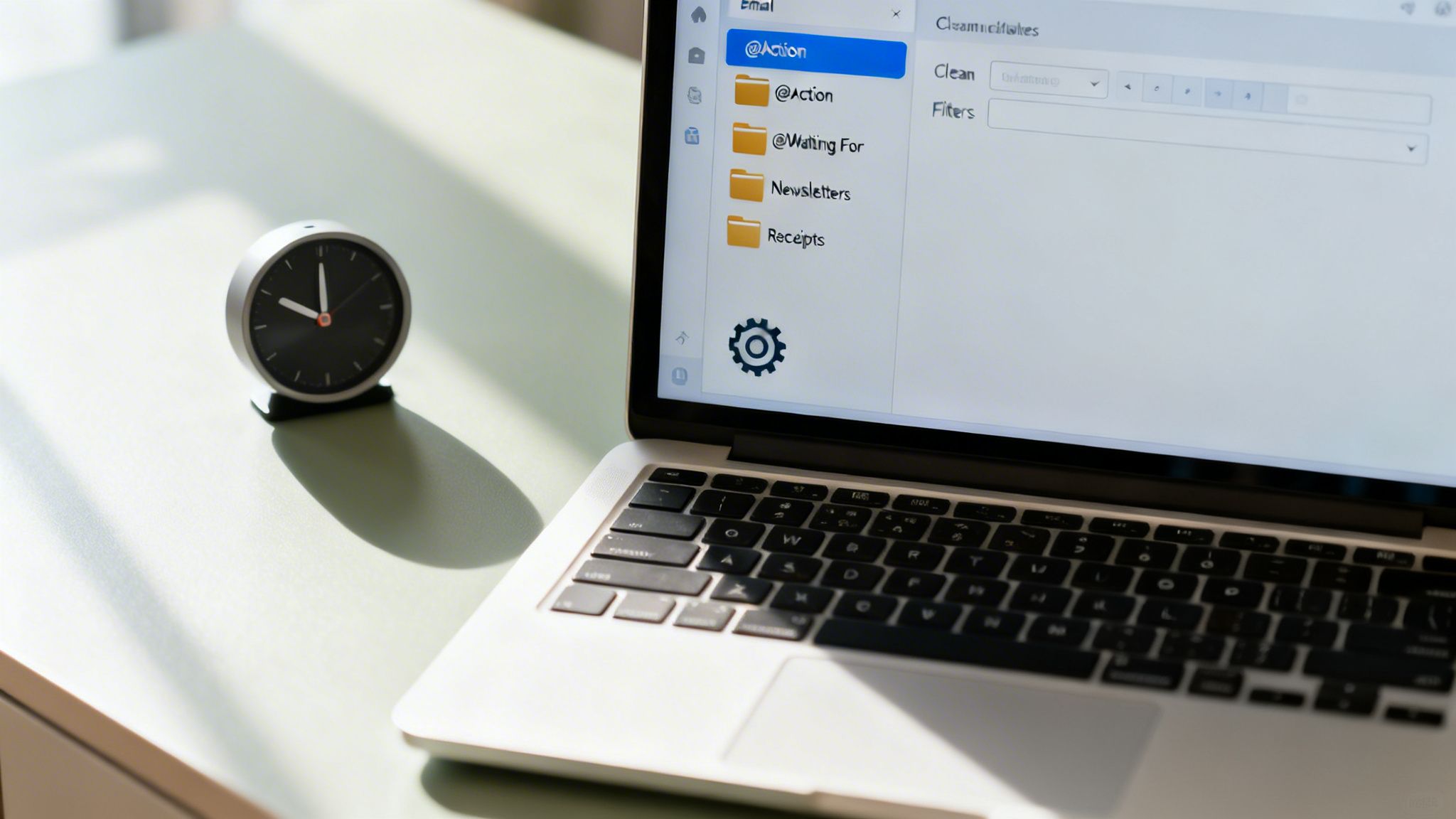
Your first move is to set up a few simple filters and rules. Think of these as your own personal digital assistant. They work 24/7 to keep your primary inbox clean before you even see it. Both Gmail and Outlook have powerful, built-in tools for exactly this.
The idea is simple: you identify a type of email and tell your inbox what to do with it. For example, you can create rules that:
- Auto-Archive Newsletters: Any email from a mailing list can be set to “Mark as Read” and “Archive.” It skips the inbox entirely but is still there if you need to search for it.
- Label Client Communication: Emails from specific client domains (like @clientcompany.com) can be automatically tagged with a “Clients” label, making them easy to spot.
- Filter Low-Priority Notifications: Internal system alerts or project management pings (like “new comment added”) can be filtered into a separate folder you only check once a day.
Best Automation Rule for Beginners
If you’re just starting your zero inbox method journey, one rule delivers an outsized impact. It is a filter for all your newsletters and marketing emails. These messages often make up the bulk of inbox clutter.
To get started, just find a recent newsletter in your inbox. In Gmail, click the three-dot menu and select “Filter messages like these.” From there, you can create a filter that automatically archives these messages and applies a “Newsletters” label. This one move can dramatically quiet the noise in your inbox overnight.
Mini-Scenario: A Freelancer’s Setup
Alex, a freelance graphic designer, is constantly juggling emails. They receive messages from three active clients, pitches from potential leads, invoices from software subscriptions, and at least a dozen marketing newsletters. It’s a mess.
To get a handle on it, Alex sets up these three rules:
- Rule 1 (Clients): Emails from
@clientA.com,@clientB.com, and@clientC.comare automatically labeled “Active Clients” and stay in the inbox. These are top priority.- Rule 2 (Admin): Emails with words like “invoice,” “receipt,” or “payment” from services like Adobe or Dropbox get labeled “Admin” and archived. Alex just reviews this folder once a week.
- Rule 3 (Marketing): Emails from known marketing lists are automatically marked as read, labeled “Newsletters,” and archived. They never even hit the main inbox.
Instantly, Alex’s inbox is transformed. Instead of 50 mixed messages, only the 5-7 critical client emails are waiting. The mental load is lifted. You can find more strategies like this in our guide on how to automate repetitive tasks.
How to Choose Your Automation Level
Not everyone needs a complex web of rules. The right amount of automation depends on your role and how much email you get. A good way to decide is to observe your inbox for a day. What are the most common types of low-value emails you receive? Start by creating filters for those. Then, browse the library of options to see what fits your goal.
Automation Level Comparison
| Automation Level | Who It’s For | Example Rule |
|---|---|---|
| Basic | People with low email volume or just starting with the zero inbox method. | Auto-archive and label all newsletters. |
| Intermediate | Freelancers or managers juggling multiple projects. | Separate rules for each client; filter internal notifications. |
| Advanced | Executives or those in high-volume communication roles. | Complex rules for VIP senders, specific keywords, and team routing. |
You can always adjust your system as your workflow changes. The key is to start small and build on what works for you.
Finally, remember that automation works best with solid time management. Once your inbox is calmer, you can schedule specific blocks for processing email. Using a time blocking planner helps you dedicate focused periods to your inbox. This prevents that constant, distracting “just checking” habit that slowly drains your day.
Choosing The Right Tools For The Zero Inbox Method
While the zero inbox method is really a mindset, the right tools can act as powerful guardrails for your new habits. Think of it less as buying more gear and more as building a personalized support system. The goal here is to make smart, targeted choices that reinforce your focus and make automation feel seamless.
This is all about creating an environment where your brain can do its best work. From a neuroscience perspective, that means reducing the external stimuli that trigger context switching. When you create dedicated blocks of time for email, you are far more effective if you can eliminate the distractions that constantly pull your attention away.
Best Focus Tools for the Zero Inbox Method
Protecting your scheduled email processing time is non-negotiable. This is where physical tools can be surprisingly effective. They create clear, tangible boundaries that both you and others can see.
Investing in a good pair of noise canceling headphones is a game-changer. They create an instant bubble of concentration. This signals to your brain—and just as importantly, to your colleagues—that you are in a deep work session. This simple act reduces the cognitive load of processing ambient sounds, freeing up mental resources.
Another powerful ally is a visual timer for desk. Setting it for a 25-minute email sprint leverages a psychological principle known as timeboxing. The visual cue of a shrinking timer creates a healthy sense of urgency and commitment. It helps you stick to the task without getting sidetracked.
Best Triage and Automation Tools
Your primary tools are the email clients you already use, like Gmail and Outlook. Their built-in features for filters, labels, and rules are the foundation of your automated success. However, a few third-party apps and services can take this a step further.
For those who find themselves constantly pulled away by technology, finding strategies to manage digital distractions is crucial. We explore this in-depth in our book, Burnout Interrupted. It offers practical roadmaps for creating healthier digital boundaries that stick.
Your Zero Inbox Method Toolkit Comparison
Choosing the right tool depends on your specific needs and email volume. This comparison breaks down the options to help you decide what to start with.
| Tool Category | What It Does | Best for Beginners | Best for Busy Professionals |
|---|---|---|---|
| Email Triage Apps | Offers built-in snoozing, keyboard shortcuts, and fast triage features. | Native Gmail/Outlook features are a great starting point. | Apps like Superhuman or Spark are built for maximum speed. |
| Time Management | Helps you schedule and protect dedicated email processing sessions. | A simple phone timer or blocking off time in your digital calendar works well. | A physical visual timer for desk creates a clear and respected focus zone. |
| Focus Aids | Hardware that helps you concentrate during your scheduled email time. | Simply turning off all notifications on your computer and phone is highly effective. | Investing in quality noise canceling headphones actively blocks out external noise. |
| Automation Services | Services like Unroll.me or SaneBox to automatically filter unimportant emails. | Manually unsubscribing from newsletters each day helps build awareness of clutter. | Using an automated service saves significant time by managing newsletter clutter for you. |
Ultimately, the best tools integrate smoothly into your workflow without adding friction. You don’t need all of them. Start with one or two that address your biggest pain points. Compare options to find the best fit. For instance, many people find that exploring AI-powered assistants can be a significant step up in their productivity. You can learn more about how to leverage AI tools for productivity in our dedicated guide. Remember, every tool should serve the primary goal: spending less of your brain’s valuable time inside the inbox.
Now that you have your tools, let’s look at what can go wrong.
Common Inbox Zero Mistakes To Avoid
Getting started with the zero inbox method is a huge step toward reclaiming your focus. But the journey almost always has a few bumps. Someone gets excited, tries the system, gets frustrated, and gives up, concluding it doesn’t work.
But the problem usually isn’t the method itself. It’s a few common, fixable mistakes in how it’s applied. By understanding these pitfalls ahead of time, you can sidestep them and build a habit that actually sticks.

Chasing Perfection Over Progress
The single biggest mistake is taking “zero” literally. This creates a perfectionistic obsession where even one email at the end of the day feels like a failure. Psychologically, this all-or-nothing thinking is a recipe for burnout. Your brain starts to see the task as impossibly rigid, which leads to anxiety and avoidance.
The real goal isn’t an empty screen; it’s an empty mind. “Zero” doesn’t mean zero messages; it means “zero time wasted thinking about email.” The true objective is to simply make a decision on every email and get it out of sight.
Mini-Scenario: The Post-Vacation Avalanche
Imagine returning from a week off to find 300+ emails. The perfectionist approach? Sit there for hours, trying to clear every single one. You’d quickly get overwhelmed and quit.
A better way is to accept that it will take time. First, scan for anything truly urgent. Then, bulk archive or delete all the newsletters and non-critical CCs. Finally, schedule two or three dedicated 30-minute blocks over the next day to process the rest. That’s progress, not perfection.
Using Your Inbox as a To-Do List
Another critical error is letting important but non-urgent emails sit there as reminders. This turns your inbox—a space for communication—into a disorganized, high-stress task list. Every time you open your email, you’re hit with a wall of pending work. This quietly fuels a state of chronic, low-level stress and may contribute to feelings of anxiety.
The fix is to immediately move any email that requires real work (more than two minutes) into a dedicated system. This creates a clean separation between communication and tasks.
- Move It Out: When an email with a real task lands, get it out of your inbox. Transfer the actual work to an external tool you trust.
- Be Specific: A productivity journal or a task app is perfect for this. Write down the specific action and a deadline.
- Archive Immediately: Once the task is captured somewhere else, archive the email. Your inbox is now clear, and the task is safely logged where it belongs.
Failing to Schedule Email Time
Finally, many people fail because they don’t treat email like a scheduled task. They leave their inbox open all day long, letting it constantly interrupt their real work. This reactive approach is the enemy of the zero inbox method, which is built on proactive, batch processing.
By constantly reacting to pings, you’re fragmenting your attention and draining your cognitive resources. The mental cost of these constant choices is very real—it’s a major contributor to what psychologists call decision fatigue.
The only sustainable way forward is to schedule specific times to process email. This flips the script from reactive to proactive. It puts you back in control of your attention and energy.
Key Takeaways: The Zero Inbox Method
- It’s a Mindset, Not a Number: The goal is not a literal “zero” messages, but zero time wasted thinking about what’s in your inbox. Make a decision on every email.
- Use the 5 Core Actions: Your strategy for every email is one of five things: Delete, Delegate, Respond (if under 2 mins), Defer (move to a task list), or Do.
- Automation is Your Ally: Set up filters to automatically archive newsletters and sort low-priority mail. This keeps your main inbox for human-to-human communication.
- Schedule Your Email Time: Process email in scheduled batches instead of reacting to notifications all day. This protects your focus and prevents context switching.
- Your Inbox is Not a To-Do List: Move tasks out of your inbox and into a dedicated system like a planner or task app. This reduces mental clutter and stress.
Disclaimer: This article contains affiliate links. Purchases may generate a small commission at no extra cost to you. The content provided is for educational and informational purposes only and is not a substitute for professional medical or psychological advice, diagnosis, or treatment.
Editor’s Take
So, what’s the real story with the zero inbox method? Let’s be honest: the true value isn’t a perfectly empty inbox. That’s just a side effect.
The real win is the mental freedom that comes from building a decisive, scheduled processing habit. This system is a game-changer for knowledge workers, freelancers, and anyone feeling crushed by digital communication. It is a powerful tool to reduce cognitive load and the mental strain that can contribute to burnout.
That said, it might be a tough fit for roles that demand constant, real-time email monitoring. Remember, this is a system, not a magic wand. It works best when you pair it with clear communication boundaries and smart time management.
These are the core ideas we dive into in The Power of Clarity, which offers a full roadmap for building the decisive mindset needed to make the zero inbox method a lasting success.
Frequently Asked Questions About the Zero Inbox Method
As you start to put these ideas into practice, a few common questions always seem to pop up. Here are some honest answers based on helping people wrestle their inboxes into submission.
How long does it take to reach inbox zero the first time?
The initial clear-out is the biggest hurdle. If you have thousands of messages, set aside 2-3 hours for the first purge. Be ruthless. Bulk-archive anything older than a month. Aggressively delete old newsletters. The goal is momentum, not perfection. You are creating a clean slate so the new habits can stick.
What if my job requires me to be in my email all day?
You can still use the principles of the zero inbox method. Instead of staying in your inbox, schedule frequent but short “processing blocks.” Try a 20-minute email sprint every hour. During that sprint, apply the five core actions (Delete, Delegate, Respond, Defer, Do). This respects your job’s demands but stops email from hijacking your day.
Is it okay to have a few emails in my inbox at the end of the day?
Absolutely. “Zero” is more a state of mind than a literal number. The real goal is to have zero unanswered questions about what’s left. If you sign off with three emails you’ve intentionally deferred to handle tomorrow, you’ve won. The problem isn’t having emails; it’s having a pile of undecided messages that create mental static and anxiety.
What is the two-minute rule and should I always follow it?
The two-minute rule is a guideline: if a task takes less than two minutes, do it immediately. It’s fantastic for clearing out quick hits. However, if you are in a state of deep focus, do not break your concentration for a trivial email. Protect your focus first. Let that quick reply wait for your next scheduled email block.
Can I use the zero inbox method on my phone?
Yes, and you should! Your phone is perfect for quick triage—deleting, archiving, and fast replies. Use small pockets of downtime, like waiting in line, to clear out junk. For longer, more thoughtful replies, it’s almost always better to wait until you are at a proper keyboard. Some people even find a phone lock box timer useful for creating firm boundaries with their devices.
For a broader look at how automation can supercharge these efforts, you might find some useful ideas in these answers to common business automation questions.
Mind Clarity Hub helps readers find the perfect book to build focus and restore calm. If you’re struggling with distraction and information overload, the next step is building durable habits.
See our book on building lasting focus systems.
Free download: 7-Day Mind Clarity Reset
A short daily reset you can actually stick with (no fluff).
Helpful resources for your next step
Affiliate disclosure: As an Amazon Associate, Mind Clarity Hub may earn from qualifying purchases at no extra cost to you. Use this link only if it genuinely helps your planning.
If Mastering The Zero Inbox Method To Reclaim Your Focus is a routine you want to keep using, a simple workbook, planner, or desk tool can make the steps easier to repeat.
Compare related planners, workbooks, and organization tools on Amazon.