...

Tag: how to take notes

  • How to Build a Note Taking System That Actually Works

    How to Build a Note Taking System That Actually Works

    A good note taking system isn’t a fancy app or a neat stack of notebooks. It’s a reliable process for catching, connecting, and using what you know. It turns that chaotic junk drawer of ideas, links, and meeting notes into a personal knowledge base that actually helps you think.

    The goal is to stop being a passive collector of information and become an active builder of knowledge. This shift is what separates a digital dumping ground from a second brain. To get a handle on just how taxing this overload can be, you can find a solid path in our book, The Power of Clarity.

    Affiliate Disclosure: Please note that this article contains affiliate links. If you make a purchase through these links, we may earn a small commission at no extra cost to you. This helps support our work in creating valuable content.

    Why Your Current Note Taking System Feels Chaotic

    If your current “system” is a mix of cryptic sticky notes, a dozen different apps, and a desktop littered with untitled documents, you’re not alone. So many of us start with good intentions. Yet we end up with a tangled mess of information that creates more stress than it solves. This isn’t a personal failure. It’s the predictable result of facing an avalanche of information without a structure to handle it.

    From a neuroscience perspective, every disconnected note is an “open loop” in your brain. Your mind registers them as unfinished business. This quietly drains your mental energy and splinters your focus. Research in psychology shows that these incomplete tasks, known as the Zeigarnik effect, create a constant, low-grade cognitive strain. This makes it harder to concentrate on the work that actually matters.

    The Real-World Cost of a Disorganized Note Taking System

    This happens all the time. Imagine a project manager, let’s call her Sarah, on an urgent client call. The client asks about a key decision made two months back. Sarah knows she wrote it down. But where? She’s frantically clicking through her notes app, scanning random documents, and searching her email. She might even wish she had a simple habit tracker journal just to log her daily notes. That awkward silence on the line kills her credibility. It also floods her with stress. The detail is buried, lost in a sea of digital clutter.

    This is the exact moment a collection of notes becomes a source of anxiety instead of a tool for confidence. The goal is to build a reliable note taking system that serves you.

    A productive desk setup with a laptop, smartphone, sticky notes, and a pen, with the phone displaying a note-taking app that highlights a practical note taking system.

    From Mental Clutter to Mental Clarity

    That feeling of frustration is a clear signal. Your current method isn’t working with your brain; it’s working against it. Instead of letting your ideas scatter, the first step is to commit to a single, trusted hub for your thoughts. This doesn’t mean you need a complicated, feature-packed system. Consistency is what matters. A simple, reliable process you stick with will always beat a powerful tool you never open. Getting to this point is about building simple, sustainable habits. If you feel swamped, a structured approach like the one in Focus Recharged is the only way out.

    The Four Pillars of a Powerful Note Taking System

    A truly powerful note taking system isn’t about finding the perfect tool. It’s about building a reliable process that turns fleeting ideas into something you can actually use. A good system should support your thinking, not add to the mental clutter. I’ve found it helps to break this process down into four distinct stages: Capture, Organize, Distill, and Express. Think of it as the CODE framework for knowledge work.

    Flat lay of a desk showing a CODE Framework note taking system with the steps Capture, Organize, Distill, and Express.

    Each stage tackles a crucial part of the journey, from a raw thought to a finished idea.

    Capture: Frictionless Idea Collection in Your System

    First, you need a way to get ideas out of your head and into your system with almost zero effort. Your brain is brilliant at having ideas but terrible at holding them. Every thought you try to “remember for later” creates an open loop that quietly drains your focus. This is the Zeigarnik effect in action—our minds fixate on incomplete tasks. A great capture habit is your secret weapon for closing those loops on demand.

    Real-World Scenario: A freelance writer is walking her dog when a brilliant article idea strikes. Instead of mentally rehearsing it, she pulls out her phone, opens a notes app, and dictates the core concept. The thought is now safely in her inbox, and her mind is free again. That’s a note taking system doing its job.

    The key is to have a capture tool that’s always with you. It could be a simple phone app, a pocket notebook, or a voice recorder. The specific tool matters less than its instant availability.

    Organize: Your Personal Library within the Note Taking System

    Once you’ve captured a note, it needs a home. This is where most people get bogged down, creating complex webs of tags and folders that quickly become overwhelming. Instead of building a filing cabinet, think of your note taking system as a personal library. The goal isn’t just archival; it’s about connection and action.

    Start with a few broad categories that make sense for your life. A simple, effective structure might include:

    • Projects: These are tasks with a clear deadline and outcome (e.g., “Launch New Website,” “Plan Q3 Marketing Campaign”).
    • Areas: These are your ongoing responsibilities that don’t have an end date (e.g., “Health & Fitness,” “Personal Finances,” “Professional Development”).
    • Resources: This is your reference library of articles, book notes, and materials on topics that interest you.
    • Archive: This is where you move completed projects and old notes. They’re out of sight but still searchable.

    This approach keeps your active workspace clean. It makes it easy to find what you need. It’s a key step in learning how to build a better system.

    Distill: Find the Core Insight of Your Notes

    This is where the real learning begins. Distilling is the act of reviewing your notes, pulling out the most important ideas, and rewriting them in your own words. It’s far more powerful than just highlighting or rereading. This process forces you to use active recall. Neuroscience shows that struggling to retrieve information from your memory is what makes that memory stronger. The harder you have to work to pull an idea out, the more deeply it gets wired into your brain.

    Real-World Scenario: A college student gets back from a lecture with pages of messy notes. Instead of just rereading them, she opens a fresh page. She writes a single paragraph summarizing the lecture’s main argument. That simple act of distillation solidifies her understanding. It also creates a potent study guide for later. Using a good monitor light bar for late-night study sessions can also reduce eye strain.

    When you pair this with spaced repetition—reviewing your distilled notes at increasing intervals—you’re using a scientifically proven method to lock in knowledge for the long term.

    Express: Turn Your Knowledge into Action

    Finally, your notes aren’t just for collecting; they’re for creating. The Express stage is about turning what you’ve learned into something tangible. This is the ultimate purpose of any note taking system.

    Putting your knowledge to work could mean anything from:

    • Writing an article based on your collected insights.
    • Building a presentation for a team meeting.
    • Starting a new personal project.
    • Simply sharing what you’ve learned with a friend or colleague.

    When you regularly use your notes to produce something, you create a powerful feedback loop. It gives your system a clear purpose. It transforms you from a passive consumer of information into an active creator of value. Your notes become an indispensable partner in everything you do.

    How to Choose the Right Tools for Your Note Taking System

    Choosing the right tools for your note taking system can feel surprisingly high-stakes. With a seemingly endless parade of sleek apps and beautiful notebooks, it’s easy to get stuck in analysis paralysis. But the secret isn’t finding the one “best” app. It’s about finding tools that disappear into your workflow. They should match how your brain actually works.

    The real question isn’t, “Which app is the most popular?” Instead, ask, “Which tool supports how I naturally think and organize?” A tool that feels liberating for a visual artist might be a cage for a software developer. Your goal is to match the tool to your personal need for structure, flexibility, or pure simplicity.

    Best Option for Beginners: Method First, Then Tools

    Before you download another piece of software, think about the method you want your tools to support. Different systems are built for different goals. When your tool aligns with your method, the whole system just clicks into place. Without that alignment, you’re just creating friction.

    • Zettelkasten: This is fantastic for academics, writers, and anyone whose goal is to connect ideas over the long haul. It’s a “bottom-up” approach where you link small, individual notes to build a sprawling web of knowledge over time.
    • P.A.R.A. (Projects, Areas, Resources, Archives): This is perfect if you’re action-oriented and need to organize information around concrete goals and responsibilities. It’s a “top-down” system that gives you immediate, practical structure.
    • Bullet Journaling (BuJo): This is for anyone who craves a flexible, screen-free analog system to track tasks, events, and notes all in one place. It’s a highly personalizable way to combine planning, doing, and reflecting.

    Your primary goal will point you to the right method.

    How to Choose Your Note Taking Method: A Comparison

    This quick comparison helps you see which approach fits your personal and professional life. Compare options to see what feels most natural.

    MethodBest ForCore PrinciplePotential Downside
    ZettelkastenAcademics, researchers, and writers building a long-term “second brain.”Linking atomic, single-idea notes to discover novel connections.Can feel abstract and slow to show value initially; requires discipline.
    P.A.R.A.Project managers, freelancers, and professionals managing multiple active commitments.Organizing information by its actionability and relevance to your current goals.Can become rigid if not maintained; requires regular reviews.
    Bullet JournalVisual thinkers, creatives, and anyone seeking a mindful, screen-free planning method.Rapid logging of tasks, events, and notes using a simple, flexible syntax.Limited searchability and can be time-consuming to set up and maintain.

    Once you have a sense of which philosophy fits, then you can go looking for tools.

    Best Note Taking System for Busy Professionals: Digital vs. Analog

    With a method in mind, the tool choice becomes much easier. Digital apps like Obsidian or Roam Research are brilliant for the Zettelkasten method. For P.A.R.A., structured apps like Notion, Evernote, or Microsoft OneNote are a natural fit. And for Bullet Journaling, a good notebook and a pen you love are all you need. A dedicated time blocking planner can be a fantastic analog partner to a digital system.

    Many people land on a hybrid approach that works beautifully. They might use a digital app as a long-term resource library. Simultaneously, they use a physical notebook for daily planning. The key is to be intentional about what goes where so you’re not creating more chaos.

    The Rise of AI and Collaborative Tools

    The world of note-taking is evolving fast. AI integration is a huge driver of this growth. Features like smart summarization and semantic search are becoming standard. They help us make sense of information overload. AI can digest long articles into key takeaways, saving you massive time. Our book, Marketing Magic: ChatGPT & AI Marketing, dives deep into these tools.

    For teams, collaborative tools make group note-taking smoother. Many platforms also weave in task management features, blurring the lines between notes and to-do lists.

    Building your own note taking system is like laying the foundation for a house you’ll improve for years. The first step is to create a single entry point. Think of it as a digital foyer. Every new thought, meeting note, or random idea goes into this “inbox” first. This simple rule eliminates friction. Your only job is to get it out of your head and into the system.

    Defining Your Core Structure for Your Note Taking System

    With a central inbox, the next step is a simple organizational spine. The biggest mistake is over-engineering with dozens of nested folders. A complicated system is one you won’t use when you’re tired or busy.

    Start with just a few top-level categories:

    • Projects: For anything with a defined goal and a finish line.
    • Areas: For your ongoing roles and responsibilities.
    • Resources: Your personal library for articles and book summaries.
    • Archive: A place for completed or irrelevant items.

    This framework keeps your active workspace clean and focused. It’s a modern spin on principles used for centuries. Our digital tools just make it much easier.

    The Power of Templates and Automation

    To make your system truly work for you, automate the small stuff. Templates are a game-changer here. They dramatically reduce decision fatigue. Behavioral science shows that good templates automate setup, freeing your cognitive bandwidth for the actual content.

    Start with templates for common notes:

    • Meeting Notes: Date, attendees, agenda, key takeaways, action items.
    • Project Plans: Goals, timelines, stakeholders, success metrics.
    • Book Summaries: Main argument, key quotes, your reflections.

    As your system grows, understanding concepts like workflow automation will help you cut out more manual work.

    A Freelancer’s Migration: A Real-World Example

    Let’s make this tangible. A freelance designer, Alex, had notes scattered across Google Docs, a paper notebook, and a notes app. Here’s the simple plan we used:

    1. Chose a Hub: Alex picked a single digital app to become the new central note taking system.
    2. Created the Structure: We set up four primary folders: Projects, Clients (Area), Inspiration (Resource), and Archive.
    3. Migrated Actively: Alex only moved notes for active projects and key client info. Old notes were left behind. This “just-in-time” migration prevents overwhelm.
    4. Established a Habit: Alex blocked out 15 minutes every Friday afternoon to process the inbox and file new notes.

    This step-by-step approach made the new system immediately useful.

    Creating Your Review Habit

    A note taking system is only as good as your habit of reviewing it. Without regular maintenance, it will become a digital junk drawer. Schedule short, consistent review sessions. A pomodoro timer can help you stay focused during these sessions, making the habit easier to stick with. This whole process is about refining your own process, not finding a magic app.

    A visual three-step process flow for choosing note tools, covering comparison, selection, and implementation.

    The flow from comparing options to implementing them shows that building your system is a journey, not a single event. It’s about making conscious choices that fit how you think and work.

    Editor’s Take: What Really Works for a Note Taking System

    After years of chasing the perfect productivity setup, here’s the most honest thing I can tell you. The best note taking system is the one that actually sticks. All the complex tagging, backlinking, and beautiful templates are worthless if the friction is too high to use them every day. My advice? Forget building a flawless digital brain overnight. Just start with one reliable digital app and one simple notebook.

    Who Is This Stripped-Down Approach For?

    This hybrid method is a lifesaver for knowledge workers, students, and creatives drowning in information. If your goal is to turn ideas into action—not just hoard them—this is for you. The biggest trap is “productivity procrastination.” This is when you spend more time tweaking your system than actually thinking. A good system should get out of your way, not become a new full-time job.

    The real magic happens when you focus on the Distill and Express pillars. This is where you transform raw notes into valuable insights. It’s the entire point of having a note taking system. Our guide on note taking from books is a great place to start mastering that skill. See the book that fits your goal to start applying these principles today.

    This simple hybrid approach lets you build momentum from day one. You can always add complexity later when a specific need arises. A simple system you use daily will always beat a perfect one you abandon after a week.

    Key Takeaways: Building Your Note Taking System

    Here’s a look back at the core ideas for building a note taking system that moves you from scattered information to structured clarity.

    One Hub to Rule Them All

    The most critical first step is deciding on a single, central place for everything. Whether it’s a specific app or a simple notebook, one inbox stops the mental energy drain from scattered notes. This is about making capture as frictionless as possible.

    Your System Needs a Job to Do

    A powerful note taking system is a dynamic process for thinking. The CODE framework gives your notes a purpose beyond storage.

    • Capture: Get thoughts out of your head quickly to close mental loops.
    • Organize: Use a simple, action-focused structure like P.A.R.A.
    • Distill: Rewrite notes in your own words to force understanding.
    • Express: Turn what you’ve learned into something new.

    Method First, Tool Second

    It’s incredibly easy to get lost searching for the “perfect” app. First, figure out how you want to work. Do you need to connect ideas like with Zettelkasten, or manage active projects with a system like PARA? Once you know your method, you can find a tool that supports it.

    A Garden Needs Weeding

    Your system is a living thing. If you don’t tend to it, it will become overgrown and useless. Set aside a short, recurring block of time each week to review, organize, and process your notes. This simple habit is what keeps the system trustworthy and powerful.

    FAQ: Your Note Taking System Questions Answered

    1. How do I move my old notes without it turning into a monster project?

    Don’t try to migrate everything at once. That’s a path to burnout. Instead, use a “just-in-time” approach. Only move a note from your old system to your new one when you actively need it for a current project. For everything else, create a single “Archive” folder in your old setup. This keeps your new workspace clean and relevant.

    2. Is it better to use a notebook or an app for creativity?

    Neither is inherently “better.” A hybrid approach works best for most people. Use an analog notebook for messy, initial brainstorming. The physical act can foster new connections. Then, transfer the refined, important ideas into your digital note taking system for long-term organization, search, and connection.

    3. How often should I actually look at my notes again?

    A system without a review process is just a digital graveyard. The single most important habit is the weekly review. Block out 30 minutes at the end of your week to process your inbox, file loose notes, and check in on active projects. This simple ritual keeps your system trustworthy and prevents digital clutter.

    4. What’s the biggest mistake people make when starting a new note taking system?

    The biggest mistake is “productivity procrastination.” This is when you spend more time tweaking your system—customizing themes, finding plugins, building elaborate folders—than actually using it. Start with the absolute simplest version. Your focus should be on building the habits of capturing and reviewing. An imperfect system you use daily is infinitely better than a perfect one you abandon.

    5. Can a good note taking system help with burnout or ADHD?

    Yes, it can be a powerful tool. A well-designed note taking system acts as an external brain. It reduces the cognitive load that contributes to burnout and feelings of being overwhelmed, which can be particularly helpful for managing ADHD symptoms. By getting tasks, ideas, and reminders out of your head and into a trusted place, you quiet mental chatter. However, this article is for educational purposes only. It is not a substitute for professional medical or psychological advice. If you are struggling with burnout, ADHD, or other mental health concerns, please consult a qualified healthcare provider. For more strategies on this topic, our book Burnout Breakthrough offers a practical roadmap.


    Disclaimer: This article contains affiliate links that may generate a commission for us at no extra cost to you. The content provided is for informational and educational purposes only and should not be considered medical or psychological advice. Always consult with a qualified professional for personal health concerns.

    Looking for a clear path to manage stress and prevent burnout? At Mind Clarity Hub, we create practical, science-backed books to help you find focus and balance.

    Explore Our Books on Burnout and Productivity
  • A Smarter System for Note Taking From Books

    A Smarter System for Note Taking From Books

    Taking effective notes from books isn’t about passively highlighting text—it’s about building a system to actively engage with ideas. It transforms reading from a quiet monologue into a lively conversation with the author. This creates real knowledge you can actually recall and use long after you’ve closed the cover.

    This post may contain affiliate links. If you make a purchase, we may receive a small commission at no extra cost to you.

    Editor’s Note: The biggest takeaway here is that a repeatable system beats fancy software every time. This guide is for readers who want to stop passively consuming books and start building a genuine, interconnected web of knowledge they can use in their life and work. It’s about building a habit, not just finding a tool. The methods are straightforward and effective, but the real power comes from consistent application.

    Why Your Current Note-Taking From Books Fails

    How many times have you finished a fantastic book, full of brilliant insights, only to forget its key ideas a month later? Your Kindle is a rainbow of highlights, but the wisdom feels just out of reach. If topics like this bring up feelings of anxiety or burnout, please remember this article is for educational purposes only and is not a substitute for professional medical or psychological care.

    If this sounds familiar, the problem isn’t your memory; it’s your method.

    An open book with highlighted text, a yellow highlighter, and a notebook on a wooden table, representing ineffective note taking from books.

    Most note-taking systems fail because they’re passive. Mindlessly dragging a highlighter across a page or copying quotes verbatim creates the illusion of learning. However, it doesn’t build any real, durable knowledge. These actions simply don’t require much cognitive effort.

    From a neuroscience perspective, deep learning happens when your brain actively works to process information. This process, known as active recall, involves retrieving information without looking at the source. When you pause to summarize a concept in your own words or question an author’s argument, you’re forcing your brain to forge stronger neural pathways. This makes the information more stable and easier to access later. Passive highlighting, by contrast, is just a recognition task—it’s easy, but it doesn’t stick.

    Shifting From Consumer to Conversationalist for Better Note Taking

    The core of this entire approach is a mindset shift. You have to move from being a passive consumer of information to an active participant in a conversation with the author. This means engaging with the text critically and thoughtfully, not just absorbing it.

    Here’s a real-world example: A marketing manager reading a book on consumer behavior.

    • Passive approach: Highlighting interesting statistics about buying habits.
    • Active approach: After reading a chapter, she closes the book and jots down, “How does the ‘social proof’ concept explain our last product launch’s failure?” She’s questioning, connecting, and applying the ideas to her own context.

    This intentional system is far more important than any specific app or tool. The global note-taking software market was valued at USD 7.36 billion in 2023 and is projected to grow substantially. This reflects a huge demand for better information management. Still, no app can do the thinking for you.

    Ultimately, the goal isn’t to create a perfect archive of quotes. It’s to build a personalized, interconnected web of knowledge that you can actually use to solve problems, generate ideas, and think more clearly.

    This approach also prevents the mental exhaustion that comes from trying to absorb a firehose of information. By being selective and active, you avoid the pitfalls of what is cognitive overload. The right system turns reading into a powerful engine for lifelong learning, not just another task on your to-do list.

    Set Your Intention Before Opening The Book for Note Taking

    A great note-taking session doesn’t start on page one. It starts before you even open the book, with a clear intention. Adopting a simple pre-reading ritual is one of the fastest ways to prime your brain for deeper focus. This turns passive consumption into an active hunt for knowledge.

    It all begins with defining your ‘why’ for picking up this specific book. Are you trying to solve a client’s problem? Learn a new skill for a side project? Or just find a jolt of creative inspiration? Answering this question activates a part of your brain called the reticular activating system (RAS). You can think of the RAS as your brain’s bouncer. By giving it a clear goal, you’re telling it exactly what kind of information to let past the velvet rope.

    From Passive Reading to a Focused Mission

    Imagine a freelance designer reading a book on brand strategy. Instead of just diving in, she first jots down three specific questions about an upcoming client project in her productivity journal. Suddenly, her reading is no longer a passive skim. It becomes a focused mission to find tangible, actionable answers. She’s now actively searching for solutions instead of just hoping to find them.

    This tiny act changes the entire experience. Every chapter, example, and case study is now seen through the lens of her specific needs. This focused approach is a core idea in my book, The Power of Clarity, which digs into how setting clear intentions is the foundation for any meaningful work.

    By knowing exactly what you’re looking for, you empower your brain to find it. You’ll notice relevant passages and connect ideas in ways you would have otherwise missed.

    Your environment matters, too. Before you start, clear your physical or digital workspace of anything that might pull your focus. A good laptop stand for desk can improve posture and focus during long reading sessions. Set a timer for a 25-minute block of pure, uninterrupted reading. This practice, often called timeboxing, builds a powerful habit loop for deep work. It’s a simple signal to your brain that it’s time to concentrate, making it much easier to slip into a state of flow. If you want to dive deeper into building these kinds of routines, you might find our guide on how to read more books helpful.

    By taking these small steps before you even start reading, you lay a powerful foundation. You shift from hoping to learn something to intentionally seeking the knowledge you need. This ensures every minute spent taking notes is as productive as possible.

    How to Actively Engage With The Text for Better Note Taking from Books

    True learning starts the moment you begin a conversation with the book. It’s time to move past passive highlighting. This habit often creates the illusion of understanding without any real retention. Instead, we need to adopt active annotation methods that force your brain to engage directly.

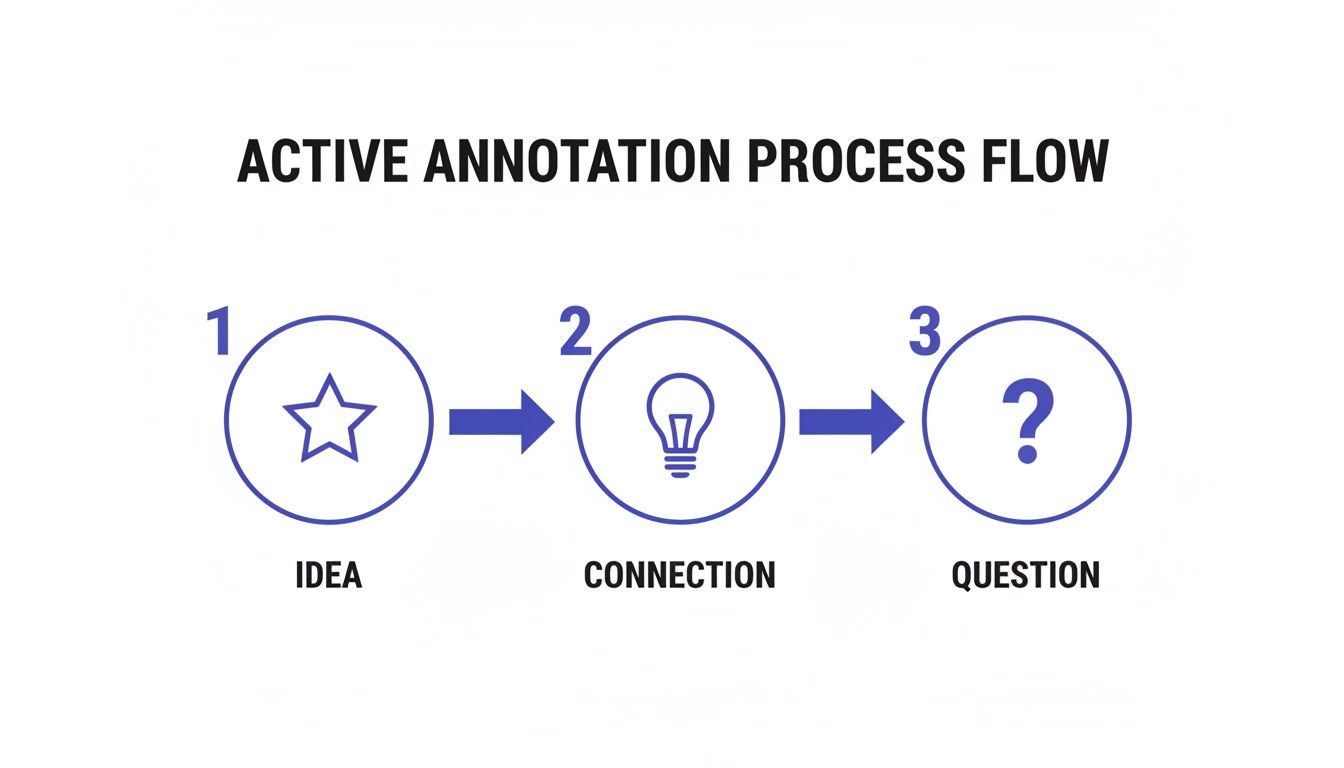
    This is where you start translating the author’s ideas into your own mental language. A powerful place to begin is by creating your own symbol legend right in the margins of the book. This doesn’t need to be some complex, color-coded system. A few simple symbols can completely transform how you interact with the text.

    The very act of creating these symbols is a form of encoding. Psychologically, encoding is the critical first step in creating a new memory. By assigning your own meaning—a star for a key idea, a question mark for something confusing—you’re processing the information on a much deeper level than just passively reading it. This makes recall worlds easier later on.

    Make Your Annotations Instantly Scannable

    Imagine a project manager reading a new book on leadership. They could use a simple, personalized shorthand to categorize ideas on the fly:

    • A star (★) for a game-changing insight they want to implement immediately with their team.
    • A lightbulb (💡) for a new connection they just made between this book and another concept.
    • A question mark (?) for a topic that feels fuzzy and needs further exploration.
    • An “A” (A) for an actionable team exercise or framework.

    This personal legend makes their notes instantly scannable and genuinely useful when they come back to the book weeks later. The goal isn’t to slow down your reading to a crawl. It’s about capturing your initial thoughts, questions, and reactions in the moment without killing your momentum.

    The most effective note-taking from books happens when you capture not just what the author said, but what you thought when you read it.

    While this guide focuses on reading, the principles of capturing information apply much more broadly. For instance, the same active mindset is crucial for effective note-taking from audio, helping you retain more from podcasts and lectures.

    To go even deeper on this, check out our full guide on active reading techniques. This foundation of active engagement is the bedrock for building a knowledge system that actually works for you.

    Turning Raw Notes Into Connected Knowledge

    Your in-book annotations are just the beginning—fleeting thoughts captured in the moment. The real magic happens when you process them. This is where you transform raw highlights and scribbled margin notes into a structured, interconnected, and genuinely useful knowledge base. Without this step, even the best annotations risk being forgotten on the shelf.

    The goal is to move from simply capturing information to truly understanding it. One of the best ways I’ve found to do this is with summarization frameworks like the Feynman Technique. It’s a simple but powerful test. Can you explain a concept in the simplest possible terms, as if teaching it to a total beginner? If you can’t, it’s a clear signal you haven’t fully grasped the idea, prompting you to dig back into the material.

    A three-step active annotation process flow: Idea (star), Connection (lightbulb), and Question (question mark), a key strategy for note taking from books.

    This simple flow—from noticing an idea to forming your own connections and questions—ensures your final notes are rich with your own thinking. Your notes will not just be a parrot of the author’s words.

    From Linear Lists to a Web of Ideas

    After you’ve summarized the core ideas in your own words, the next move is to get them into a central digital hub. This is where the concept of “atomic notes” becomes a game-changer. Instead of creating one long, linear document for each book, you break down the big ideas into their smallest possible components—their “atoms.”

    Here’s a scenario: You’re reading a book on habit formation.

    • Traditional method: A long note titled “Habit Book Summary.”
    • Atomic method: You create separate notes for “The Habit Loop,” “Implementation Intentions,” and “Habit Stacking.”
      Each note contains just one core idea, explained entirely in your own words. You then explicitly link these notes together. Your ‘Habit Stacking’ note links to ‘The Habit Loop.’ This networked approach mimics how your brain actually learns, building a web of ideas rather than a siloed list of facts. It’s much easier to spot new patterns and retrieve exactly what you need. This philosophy is often called building a second brain method, where you use tools to augment your thinking.

    The explosive growth in the note-taking app market shows just how powerful this shift is. The global market was valued at around USD 7.91 billion in 2024 and is projected to skyrocket past USD 49.47 billion by 2035. This trend is fueled by a massive demand for smarter ways to manage information. You can see the full breakdown in this market research report. By embracing an atomic system, you’re aligning your process with the best practices these tools support.

    Choosing Your Digital Note Taking System

    Deciding on the right app can feel overwhelming. The key isn’t to find the “perfect” app. Instead, find one whose philosophy aligns with how you want to think and work. Each app encourages a slightly different style of organizing knowledge.

    Note-Taking StyleCore ConceptBest For…Example Apps
    Networked ThoughtFocuses on linking individual “atomic” notes to create a web of interconnected ideas, much like a personal wiki.Synthesizing knowledge, discovering new connections, and long-term research projects.Obsidian, Roam Research, Logseq
    Hierarchical StructureOrganizes notes in a top-down, folder-and-file structure, similar to a digital filing cabinet.Storing and organizing large volumes of reference material in a clear, linear way.Evernote, Microsoft OneNote
    Minimalist & FlexibleProvides a clean, block-based canvas that allows for a mix of writing, databases, and project management.Creating customized dashboards, managing projects alongside notes, and visual thinkers.Notion, Craft
    Simple & Quick CapturePrioritizes speed and ease of capture with a clean interface and straightforward tagging.Getting ideas down quickly without friction, daily journaling, and simple to-do lists.Bear, Apple Notes

    Think about your primary goal. Are you trying to build a lifelong web of knowledge (Networked Thought)? Or do you just need a reliable place to store information (Hierarchical)? Your answer will point you toward the right tool. For deep work, pairing your app with noise canceling headphones can create an ideal focus environment.

    Using Spaced Repetition to Improve Your Note Taking from Books

    Capturing knowledge from books is a great first step. However, retaining it is a completely different game. Our brains are actually wired to forget. This isn’t a personal failure. It’s a well-documented principle from psychology called the “forgetting curve.” It shows how our memory of new information fades exponentially unless we actively do something to keep it.

    The most effective way to fight this natural decay is a technique called spaced repetition. It’s a simple but incredibly powerful method for hitting the pause button on the forgetting process. You review information at specific, ever-increasing intervals.

    Three stacks of white flashcards on a calendar, labeled '1 day', '7 days', and '30 days', symbolizing spaced repetition for effective note taking from books.

    While plenty of apps can automate this, there’s real power in the manual act of reviewing your own processed notes. To truly embed what you learn and make it part of your thinking, integrating a robust spaced repetition system into your workflow is non-negotiable.

    A Practical Review Schedule for Your Book Notes

    You don’t need complicated software to get started. A simple schedule in your time blocking planner can be remarkably effective. Once you’ve processed your raw annotations into structured, atomic notes, just schedule a few review sessions on your calendar.

    Here is a simple, battle-tested schedule to lock your book notes into long-term memory:

    • 1 Day Later: Your first review should happen within 24 hours. This is the most important one. It interrupts the steepest part of the forgetting curve right away.
    • 7 Days Later: A week after that initial review, revisit the notes again. This second pass further strengthens the neural pathways you’re building.
    • 30 Days Later: The final review, one month out, helps cement the information. This is what moves it from short-term recall into your durable, long-term knowledge base.

    Let’s imagine an entrepreneur who just finished a book on negotiation. They spend 20 minutes processing their notes into a clear summary. Then, they block out a 15-minute review for the next day. They schedule another for the following week right before a big sales meeting, and a final one a month later. This simple act embeds those strategies into their working memory, making them instantly accessible when it actually counts. This principle of intentional focus is a major theme in my book, Attention Unleashed.

    A Quick Recap of the Note Taking System

    If you want to turn what you read into knowledge that actually sticks, it comes down to a few core habits. Think of this as the high-level map for the entire system. These are the principles that make the difference between passive highlighting and active learning.

    • Read with Purpose: Before you even open the book, get clear on what you’re trying to learn. This simple step shifts your brain from passively scanning words to actively hunting for answers.

    • Engage Actively: Ditch the highlighter. Instead, use a personal set of symbols in the margins to argue with, question, and connect ideas. This turns reading into a conversation.

    • Process Your Notes: The real work happens after you close the book. Your goal is to move your thoughts—not just the author’s words—from the page into a central digital hub. This means summarizing, not just transcribing.

    • Build a Knowledge Web: Think small. Create single-idea notes, often called ‘atomic’ notes, and then link them together. You’re not just filing information; you’re building a network of insights that mirrors how your brain connects ideas.

    • Review Intelligently: To beat the forgetting curve, you need a system. A simple spaced repetition schedule—reviewing notes 1, 7, and 30 days later—is all it takes to move information into your long-term memory.


    Key Takeaways for Effective Note Taking from Books

    • Active Over Passive: The core principle is to engage with the text actively. Ask questions and summarize in your own words rather than passively highlighting. This creates stronger neural pathways for memory.
    • Intention is Everything: Start by defining why you are reading the book. This primes your brain to find the specific information you need, making your reading and note-taking far more efficient.
    • Separate Capture from Processing: While reading, use a simple symbol system to capture ideas quickly without breaking your flow. Process these raw notes into structured summaries later.
    • Build a Network, Not a List: Use an “atomic notes” system. Break down big ideas into single-concept notes and link them together. This mimics how your brain works and makes knowledge more accessible.
    • Use Spaced Repetition: Consistently review your notes at increasing intervals (e.g., 1 day, 7 days, 30 days). This is the most effective, research-backed way to combat the natural forgetting curve and retain information long-term.

    Disclaimer: This article contains affiliate links. The content provided is for educational and informational purposes only and does not constitute medical or psychological advice. Always consult a qualified professional for any health concerns or before making any decisions related to your health or well-being.

    Frequently Asked Questions About Taking Notes From Books

    As you start building a system for reading and remembering, a few common questions always pop up. Here are some honest answers based on what actually works in the real world.

    How Much Should I Write Down?

    It’s tempting to transcribe every clever line the author writes, but that’s not where the real value is. The goal isn’t to create a perfect mirror of the book; it’s to build a library of your own thinking. Focus on capturing your thoughts, questions, and connections. A great note is a concise summary of a core idea, explained entirely in your own words. That mental wrestling—the act of translating their ideas into your language—is what makes knowledge stick. Quality over quantity, always.

    Is a Digital or Physical Notebook Better for Note Taking?

    Neither is inherently better. The right choice is the one that fits your life and lowers the friction of actually taking and reviewing notes. Digital systems are incredible for searching, linking ideas together, and handling huge volumes of information. If you want to connect a thought from a book you read three years ago to something you learned today, digital is your best friend. On the other hand, there’s a beautiful simplicity to a physical notebook. It’s tactile, personal, and completely free of digital distractions. For some, the physical act of writing by hand is a powerful memory aid. The best system for you is simply the one you’ll use consistently.

    How Do I Take Notes Without Ruining My Reading Flow?

    This is a huge trap. If note-taking feels like a chore that constantly breaks your momentum, you’ll stop doing it. The key is to separate the capture from the processing. While you’re reading, develop a simple, personal symbol system. You don’t need a complex legend that requires a decoder ring. A quick star for a key idea, an underline for a powerful quote, or a question mark in the margin is usually enough. This allows you to flag a passage in seconds without breaking your reading stride. Save the deeper work—the summarizing and connecting—for after your reading session is over.

    How Often Should I Review My Notes from Books?

    Notes you never review are just a well-organized form of forgetting. To combat this, lean on the principles of spaced repetition. This just means reviewing information at increasing intervals to move it from short-term recall into your long-term memory. A great starting rhythm is to review your processed notes 1 day, 7 days, 30 days, and then 90 days after you first create them. Put these quick review sessions on your calendar. It’s a small investment that pays huge dividends in retention.

    Can AI Help Me Take Better Notes From Books?

    Absolutely. AI tools can be fantastic assistants, especially for speeding up the initial processing phase. You can use them to summarize dense chapters, generate thought-provoking questions about the text, or even suggest connections to other ideas. But here’s the crucial part: AI should always supplement, not replace, your own thinking. The most durable and valuable part of note-taking is the mental effort you invest in wrestling with the ideas yourself. Use AI as a smart assistant, but never outsource the critical thinking.


    At Mind Clarity Hub, we’re dedicated to helping you build systems for focus and deep learning. If you’re ready to master your attention and build a powerful knowledge base, explore our full library of books designed for modern challenges, including The Power of Clarity.