
Heads up: Purchases through our links may earn us a small commission at no extra cost to you. We only recommend what we trust.
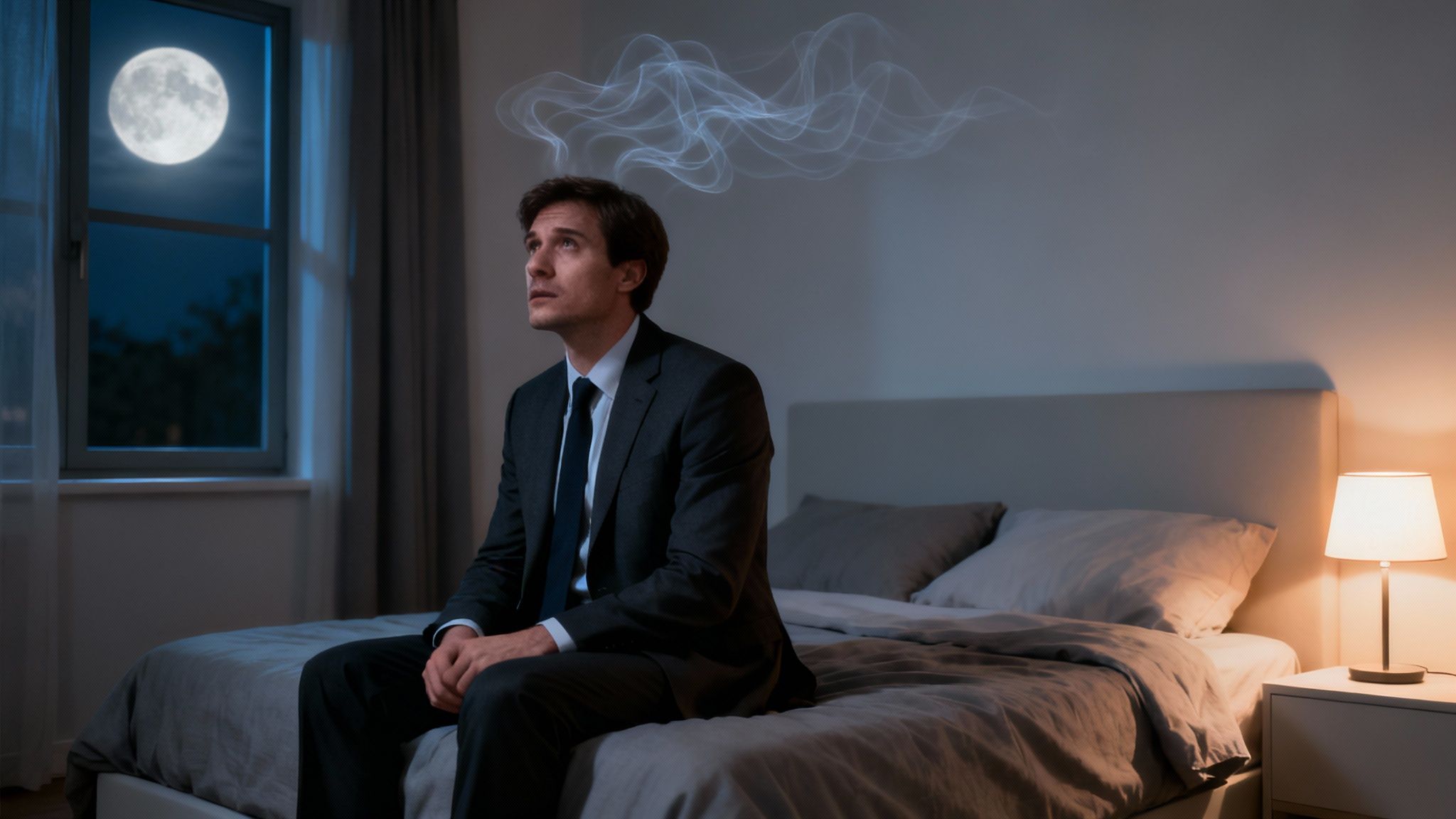
It’s a classic, frustrating pattern: the moment your head hits the pillow is the exact moment your brain decides to run a highlight reel of every awkward conversation, looming deadline, and half-forgotten to-do list item from the last decade. If you wrestle with anxiety at bedtime, you know this feeling intimately. The quiet of the night, which should be calming, somehow makes your inner world the loudest it’s been all day.
Editor’s Take
What truly works for anxiety at bedtime is consistency. The single most effective strategy is a 10-minute “brain dump” before bed—writing down all your worries and to-dos. This physically gets them out of your head. This advice is best for professionals, students, and parents whose minds race with plans and anxieties. However, these techniques are for managing symptoms, not a cure for chronic anxiety or insomnia. If your sleep issues are severe or persistent, they are best used alongside professional medical care, not as a replacement.
Why Your Brain Gets So Loud When the World Gets Quiet
That late-night flood of anxiety isn’t just a bad habit; it’s grounded in the way your brain is wired to work. All day long, you’re juggling tasks, answering messages, and putting out fires. This keeps your brain’s “task-positive network” firing on all cylinders. But when you finally lie down in a dark, quiet room, all those external distractions fall away.
This is when your brain’s “default mode network” (DMN) boots up. Think of the DMN as your brain’s internal screensaver—it activates when you aren’t focused on an immediate outside goal. Behavioral research shows this network is responsible for self-reflection, remembering, and future planning. For many of us, especially high-achievers, this network can slip into overdrive at night, turning quiet reflection into a high-speed loop of worries and what-ifs.
The Cortisol Connection to Bedtime Anxiety
Hormones are also a key part of the story. Cortisol, often dubbed the “stress hormone,” is supposed to follow a natural daily rhythm, a process governed by our internal body clock, or circadian rhythm. Its levels should peak in the morning to help you wake up and then steadily decline all day, hitting their lowest point at bedtime so you can drift off to sleep.
Chronic stress—from work, life, or just the pressure to be constantly available—disrupts that system. Neuroscience explains that if your cortisol levels stay high into the evening, your body remains in a state of low-grade alert. This makes it almost impossible for your nervous system to shift into a relaxed state, leaving you feeling “wired but tired.”
- Real-World Example: Imagine Sarah, a project manager. She spends her evenings checking work emails. Even after she puts her phone down, her cortisol levels remain elevated. When she tries to sleep, her mind keeps cycling through project risks and tomorrow’s meeting agenda, a classic sign her brain is still in “problem-solving” mode instead of “rest” mode.

A Global Sleep Struggle
If this sounds like your nightly routine, you are far from alone. Bedtime anxiety has become a global issue. In fact, a 2023 Global Sleep Survey from ResMed revealed that a stunning 8 in 10 adults show signs of sleep disruption.
Anxiety and depression were named as a primary cause, with 45% of respondents in the US saying it keeps them awake. For many professionals, this anxiety is directly linked to racing thoughts about the next day’s workload. You can dig into the full global sleep findings from the survey.
This creates a vicious cycle that’s tough to break:
- You get anxious about not getting enough sleep to function tomorrow.
- That very anxiety is what keeps you from falling asleep.
- The resulting sleep debt makes you more vulnerable to stress the next day.
Editor’s Note: This article is for educational purposes only and is not a substitute for professional medical or psychological advice. If you are struggling with anxiety, depression, or persistent sleep problems, please consult a qualified healthcare provider.
Breaking this cycle isn’t about forcing your mind to go “blank”—an impossible task that only creates more frustration. It’s about gently giving your brain a new, calmer job to do. The goal is to guide your attention away from those spinning, anxious thoughts and toward a state of rest. For some, a simple tool like a white noise machine can work wonders by creating a consistent soundscape that masks jarring noises and lets anxious thoughts fade.
Ultimately, understanding why your mind races is the first real step toward reclaiming your peace at night. By recognizing the roles of your brain’s default mode network and your stress hormones, you can start applying targeted strategies that actually quiet the noise. If you’re looking for a structured way to build that mental quiet, The Power of Clarity offers frameworks designed to help you filter out the mental clutter.
Cognitive Strategies to Quiet Anxiety at Bedtime
If you want to get a handle on anxiety at bedtime, you have to give your racing mind somewhere to go. Trying to force your thoughts into silence rarely works. A better approach is a cognitive wind-down ritual—an active way to process the day’s mental clutter and signal to your brain that it’s finally safe to rest.
This is more important than ever. A 2024 poll from the American Psychiatric Association found that 43% of US adults feel more anxious than they did just a year ago. With 70% feeling anxious about current events, it’s no surprise those worries show up the moment our heads hit the pillow. You can read the full research on rising anxiety levels if you want to dig into the broader context.
Master the Brain Dump for Nighttime Anxiety
One of the most effective ways to quiet a racing mind is the “Brain Dump,” sometimes called a worry journal. This isn’t just about making another to-do list. It’s the physical act of getting every single thought, worry, idea, and nagging task out of your head and onto a piece of paper.

From a behavioral psychology perspective, this works because your brain is just trying to be helpful by reminding you of things it thinks are important. By writing them down, you acknowledge those thoughts and create an external record. This simple act sends a clear message back to your brain: “I’ve got this handled; you don’t need to keep reminding me.” And that’s what helps turn off the mental alarm bells.
- Real-World Example: Think of a freelancer who’s worried about a big project deadline. Instead of letting those fears circle all night, they could spend ten minutes with a productivity journal and get it all out.
- To-Do: Draft the final three sections of the report.
- Worry: I’m worried the client won’t like the new design.
- Idea: Maybe I should add a case study to strengthen the proposal.
By getting it all onto the page, they’ve effectively closed the mental tabs for the night. The worries aren’t gone, but they are contained and scheduled for tomorrow. This process is a foundational step in building mental quiet, a core theme we explore in our book Reclaiming Silence for those looking to build their own mental quiet zone.
Practice Thought Labeling for Mental Space
Another powerful tool is “thought labeling.” This isn’t about clearing your mind or stopping your thoughts—it’s about changing your relationship with them. It’s a mindfulness practice, grounded in psychology, where you learn to observe your thoughts from a distance without getting tangled up in their emotional pull.
When a stressful thought pops into your head, you simply and non-judgmentally give it a label.
- If your mind serves up, “Did I remember to send that important email?” you can silently note, “a thought” or “worrying.”
- If a cringey moment from five years ago suddenly appears, you just label it “a memory.”
This creates a small but crucial gap between you and the thought. You aren’t the thought; you are the one observing it. This simple act of de-identification strips the thought of its power to hijack your emotional state and send you spiraling down a rabbit hole of anxiety.
Learning cognitive skills like this is a key part of any effective strategy to manage anxiety. If you want more guidance on these kinds of in-the-moment techniques, our guide on how to calm down when you feel overwhelmed is a great place to start.
By consistently practicing brain dumps and thought labeling, you train your brain to disengage from the anxious cycles that sabotage sleep. It’s not about achieving a perfectly empty mind—it’s about creating a peaceful one.
Bring Your Body Into a State of Calm
After you’ve worked on quieting your mind, the next step is to get your body on the same page. When anxiety strikes at bedtime, it’s not just your thoughts that are racing—your body is often physically stuck in a state of high alert. A behavioral wind-down routine uses physical exercises to send a direct signal to your nervous system that it’s safe to power down.
Think of it this way: anxiety keeps your sympathetic nervous system (the body’s gas pedal) floored, leaving you with a pounding heart, tight muscles, and shallow breathing. Your goal here is to gently tap the brakes by activating your parasympathetic nervous system, the “rest and digest” mode that guides your body back to a state of calm. This isn’t just a nice idea; it’s a physiological necessity for sleep.

Release Hidden Tension With Progressive Muscle Relaxation
One of the most effective ways to do this is with Progressive Muscle Relaxation (PMR). It’s a powerful technique for releasing physical tension you might not even realize you’re carrying. The practice is simple: you intentionally tense specific muscle groups for a few seconds, then release them completely, paying close attention to the feeling of warmth and heaviness that follows.
This does more than just relax you. It actively retrains your brain to recognize the difference between a state of tension and a state of deep relaxation, giving you more conscious control over your physical state.
Here’s a simple PMR sequence you can walk through while lying in bed tonight:
- Feet and Calves: Start by curling your toes as tightly as you can and pointing your feet. Hold that tension for 5-7 seconds, then let it all go. Notice how the tension just dissolves.
- Thighs: Now, squeeze your thigh muscles. Imagine you’re trying to lift your knees toward the ceiling. Hold it tight, and then release. Feel the difference.
- Hands and Arms: Make tight fists and flex your biceps. Squeeze firmly, hold it, and then let your arms fall heavy and limp at your sides.
- Shoulders and Neck: Shrug your shoulders all the way up to your ears, as if you’re trying to hide your neck. Feel the strain, hold it there, and then let them drop completely.
- Face and Jaw: Finally, clench your jaw, furrow your brow, and squeeze your eyes shut. Hold this tense expression, and then consciously let every single muscle in your face go slack.
- Real-World Example: Consider Mark, who works at a computer all day. At night, he realizes his jaw is clenched and his shoulders are tight. By deliberately doing a PMR sequence focusing on his shoulders and jaw, he consciously releases that stored-up physical stress, making it easier for his body to relax into sleep.
Regulate Your Nervous System With Deep Breathing
Paired with PMR, diaphragmatic breathing—often called belly breathing—is one of the fastest ways to calm your body’s alarm system. This specific way of breathing directly stimulates the vagus nerve, a major nerve running from your brain down to your abdomen. Toning this nerve is a biological shortcut to switching your body into its restorative, parasympathetic mode.
Here’s the practice:
- Lie on your back, maybe with your knees slightly bent. Put one hand on your upper chest and the other on your belly, right below your ribcage.
- Breathe in slowly through your nose for a count of four. As you inhale, focus on letting your belly rise and push your hand up. Your chest should stay relatively still.
- Hold your breath for just a moment.
- Exhale slowly and completely through your mouth for a longer count of six. Feel your belly fall as you gently push all the air out.
The key here is making your exhale longer than your inhale. This extended exhale is what really enhances the calming effect on your nervous system. To make these exercises even more powerful, a simple sleep mask blackout can help by blocking out distracting light and signaling to your brain that it’s time for total rest.
Of course, your wind-down routine is part of a bigger picture. It helps to be mindful of habits that can disrupt sleep, like the 3 things to avoid before bedtime that many people don’t realize are problematic. If muscle tension is a constant battle for you, some people find relief with a magnesium glycinate supplement, which can support muscle relaxation. As with any supplement, it’s always best to check with your doctor first. For a focused next step, you can browse the library of resources for better sleep.
Optimize Your Environment to Reduce Anxiety Triggers
Your bedroom should be a sanctuary for rest, not a stage for your daily stresses. When you’re wrestling with anxiety at night, your environment can either soothe your nervous system or unknowingly keep it on high alert. A few strategic tweaks to light, sound, and temperature can create a space that actively signals to your brain that it’s safe to power down.
Think of it this way: neuroscience tells us our surroundings provide powerful, non-verbal cues that influence our internal state. A cluttered, bright, or noisy room can undermine every other technique you’re using, keeping your brain stuck in a state of vigilance. The goal here is simple: minimize stimulation and maximize calm.
Master Your Light Exposure for Better Sleep
Light is arguably the most powerful environmental lever for your sleep-wake cycle. The blue light from phones, tablets, and even bright overhead bulbs can trick your brain into thinking it’s still daytime, suppressing the production of melatonin—the very hormone that signals sleepiness.
Behavioral science shows that creating a deliberate “dim light” period before bed is incredibly effective. Here’s how to put that into practice:
Create a Digital Sunset: Stop using all screens at least 60-90 minutes before you plan to sleep. This is non-negotiable.
Get Protective Eyewear: If you absolutely must be on a screen in the evening, a quality pair of blue light blocking glasses can help reduce the damage to your melatonin production.
Swap Your Lightbulbs: Use warm, low-wattage bulbs in your bedroom lamps. This creates a softer, more calming ambiance that supports your wind-down routine.
Real-World Example: Maria used to scroll on her phone in bed until she felt tired. Now, she sets a reminder for 9 PM, puts her phone on a charger in the living room, and reads a physical book under a warm lamp. This one habit change dramatically reduced the time it took her to fall asleep. Many people find that switching to a simple analog alarm clock is the single most powerful change.
Regulate Temperature and Sound for Less Anxiety
A cool room is a sleep-friendly room. Research points to an ideal sleeping temperature of around 65°F (18.3°C). Your body’s core temperature naturally drops to initiate sleep, and a cool environment helps that process along, encouraging deeper, more restorative rest.
Sudden noises are just as disruptive, often jolting you out of a relaxed state and triggering the very stress response you’re trying to avoid. Your brain continues to process sounds even while you’re asleep, which is why a dripping faucet or a distant siren can feel so jarring. To quiet a racing mind despite these external factors, it can be useful to incorporate practical grounding techniques for anxiety into your routine.
Your sleep environment is the foundation of your entire wind-down routine. A dark, cool, and quiet room sends a powerful, consistent message to your brain that the day is over and it is safe to switch off.
For those especially sensitive to noise, creating a consistent and calming soundscape can be a game-changer. You can learn more about how music can help you sleep and discover what works best for your own nervous system. For more ideas on creating a calmer evening, our guide on ways to reduce screen time is a great place to start.
Best Option for Your Bedtime Anxiety
Finding the right way to calm anxiety at bedtime isn’t about some magic bullet. It’s about building a personalized toolkit. After all, what works for a mind racing with to-do lists might do nothing for a body buzzing with physical tension. The best strategy always starts with getting honest about what you’re actually experiencing when your head hits the pillow.
The need for a personal approach is clearer than ever. A 2023 survey from SleepFoundation.org revealed a sobering trend: 37% of Americans said their sleep had gotten worse over the past year. With 20% waking up at night and 17% unable to fall asleep in the first place, it’s obvious a one-size-fits-all plan is bound to fail.
The good news is that you can dramatically increase your chances of success by matching your wind-down strategy to your specific symptoms. Think of it like this: you wouldn’t use a hammer to fix a leaky faucet. The same logic applies here.

What to Buy First for Bedtime Anxiety
If you’re on a budget and can only invest in one thing, start with your environment. A good sleep mask blackout or a pair of blue light blocking glasses offers a high return for a small investment. They directly tackle the environmental triggers that disrupt melatonin production, making all your other relaxation efforts more effective.
Compare Bedtime Anxiety Strategies
| If You Feel… | Best for Beginners | Best for Busy Professionals | Best for Physical Tension |
|---|---|---|---|
| Mind is Racing | Simple Brain Dump | Thought Labeling | – |
| Body is Tense | Deep Breathing | – | Progressive Muscle Relaxation |
| Sensitive to Noise | Use a Fan | White Noise Machine | Noise Canceling Headphones |
| Sensitive to Light | Dim Bedroom Lights | Blackout Curtains | Sleep Mask Blackout |
Remember, building a new routine takes time and consistency. If you struggle to make these practices stick, a simple habit tracker journal can be a surprisingly powerful ally. It provides the structure and gentle accountability needed to turn these new actions into solid evening rituals.
For those looking for a complete, structured system to guide them, our book offers a comprehensive framework. It’s designed to help you build out your entire personalized sleep routine, step by step.
You can see the book that fits your goal and start creating your own path to calmer nights. As you build your routine, you might also be interested in our article exploring if you can take probiotics at night to support your overall wellness.
Key Takeaways for Quieting Bedtime Anxiety
Trying to force yourself to sleep when your mind is racing rarely works. In fact, it often backfires. The key isn’t to fight the anxiety, but to gently guide your mind and body toward a state of rest with a few consistent, science-backed steps.
The single most powerful change you can make is creating a consistent wind-down routine every single night. This ritual acts as a clear signal to your brain, telling it that the day is over and it’s time to begin powering down. A good routine combines a few simple cognitive and physical relaxation tools.
Your Actionable Summary for Calmer Nights
- Perform a “Brain Dump” Before Bed. Grab a notebook and write down everything that’s spinning in your head: worries, to-do items, random thoughts, you name it. Externalizing this mental load tells your brain it’s safe to let go for the night because those thoughts are captured and waiting for you tomorrow.
- Activate Your Body’s “Off” Switch. Use physical relaxation techniques like Progressive Muscle Relaxation (PMR) or simple deep belly breathing. These practices directly counteract the physical “fight or flight” symptoms of anxiety, activating your body’s calmer “rest and digest” nervous system instead.
- Turn Your Bedroom into a Sanctuary. Your sleep environment matters more than you think. Keep your room cool, dark, and quiet. Critically, get rid of blue light from screens for at least an hour before bed. If you can, try leaving your phone outside the bedroom entirely.
If you happen to wake up with anxiety in the middle of the night, resist the urge to grab your phone. Instead, try a few rounds of slow breathing until the feeling passes. For a much deeper look at creating the conditions for truly restorative sleep, you might find our full guide helpful to get some rest.
Affiliate & Educational Disclaimer: This article contains affiliate links, which may generate a small commission at no extra cost to you. The content provided is for educational purposes only and is not a substitute for professional medical or psychological advice, diagnosis, or treatment. Always seek the advice of a qualified health provider with any questions you may have regarding a medical condition.
Bedtime Anxiety FAQ: Your Questions, Answered
Making sense of nighttime anxiety in the real world. Here are some of the most common questions people have, with honest answers to help you put these strategies into practice.
How long should my wind-down routine actually be?
Aim for a consistent window of 30–60 minutes each night. But honestly, the specific duration matters less than the consistency of the ritual itself. Your brain thrives on predictability, and a regular routine is a powerful signal that it’s time to start powering down for sleep. Even 15 minutes of focused relaxation—like a quick brain dump—is worlds better than doing nothing. It’s about building the habit.
What if I wake up with anxiety in the middle of the night?
First, resist that intense urge to check your phone or flick on a bright light. That will only jolt your brain further awake. Instead, stay in bed and try a few minutes of the diaphragmatic breathing we talked about earlier. Often, that’s enough to calm your nervous system and help you drift back to sleep. If you’re still awake after 15-20 minutes, get out of bed. Go to another room with dim light and do something calm, like reading a physical book. Only return to bed when you feel sleepy again. This prevents your brain from associating your bed with wakeful anxiety.
Can certain foods really make my bedtime anxiety worse?
Absolutely. What you eat and drink in the hours before bed can directly impact your nervous system. The biggest culprits to avoid in the evening are caffeine, high-sugar foods, and heavy meals. Caffeine is a direct stimulant. Sugary snacks can cause blood sugar crashes that disrupt sleep. And a large meal can trigger digestive discomfort. If you’re hungry, try a light, sleep-friendly snack like a small banana or a handful of almonds.
Is it bad to use my phone in bed if I have a blue light filter on?
While a blue light filter is better than nothing, it doesn’t get to the root of the problem. The content itself—social media, news, emails—is designed to be inherently stimulating. It engages your brain, which is the exact opposite of what you need. From a behavioral psychology standpoint, the gold standard is to make your bedroom a strict no-phone zone. This creates a powerful environmental cue that your bed is for sleep only.
When should I talk to a doctor about my anxiety at bedtime?
If your anxiety feels severe, has been going on for several weeks, or is seriously impacting your ability to function, it’s time to talk to a professional. You should also seek help if you’ve tried these self-help techniques and they just aren’t bringing relief. A doctor or licensed mental health professional can offer a proper diagnosis and create a personalized treatment plan that goes deeper than what a guide like this can provide.