


Affiliate Disclosure: This article may contain affiliate links. If you make a purchase through these links, we may earn a small commission at no extra cost to you. We only recommend products we trust and believe will add value to our readers.
For most people, the verdict is in: the best time of day to take vitamin b12 is in the morning, right after you wake up. Taking it with a glass of water on an empty stomach gives it the best shot at absorption. This timing also syncs nicely with your body’s natural energy cycles. It can set you up for a more focused and alert day.
Why Timing Your Vitamin B12 Intake Is Crucial
You have a vitamin B12 supplement on your counter, but just remembering to take it isn’t the whole story. When you take it can make a huge difference in how well it works. From a behavioral psychology perspective, this is about habit stacking. You link a new habit (taking a vitamin) to an existing one (waking up). This simple action gets your brain and body ready for the day ahead.
This guide isn’t about generic wellness tips. We’re going to get into the science of B12 timing. We will explore how it works with your body’s internal clock—your circadian rhythm. Nailing this relationship is the key to unlocking the full potential of your supplement. This can lead to sustained energy and mental clarity.
This article is for educational purposes only. It is not a substitute for professional medical or psychological advice, diagnosis, or treatment. Always seek the advice of your physician or another qualified health provider with any questions you may have regarding a medical condition. Do not disregard professional medical advice or delay in seeking it because of something you have read here.
What You Will Learn in This Guide
This article is for busy professionals, students, or anyone looking to sharpen their cognitive edge. We’ll give you science-backed strategies you can put into practice immediately.
Here’s a quick look at what we’ll cover:
- Maximizing Absorption: Why an empty stomach first thing in the morning is the gold standard.
- Energy and Sleep: How B12 can either power your day or mess with your night.
- Actionable Tips: Simple, real-world routines you can actually stick with.
- Dosage and Forms: Figuring out what works best for your specific needs.
Knowing when to take B12 is a huge piece of the energy puzzle. For a wider view on how different nutrients fit in, you can check out guides to the best vitamins for energy. Our goal here is to give you the knowledge to make smart decisions. This turns that little pill into a powerful tool for managing your energy, not just your time.

The Best Time of Day to Take Vitamin B12 For Peak Absorption
To get why morning is the undisputed best time to take vitamin B12, we need to look at how your body actually uses it. The whole process hinges on a special protein your stomach makes called Intrinsic Factor (IF).
Think of Intrinsic Factor as a dedicated ferry service. It is designed for one job and one job only: to shuttle B12 from your gut into your bloodstream where it can get to work. From a neuroscience perspective, this is the first crucial step for B12 to support neuron health and cognitive function.
When you wake up after fasting all night, your stomach is empty. This means the IF ferry is also empty, docked, and ready for its first and most important passenger. Taking your B12 with a simple glass of water gives it VIP treatment. It gets a clear, unobstructed ride with zero competition.

The Problem with a Protein-Packed Breakfast
Now, picture taking that same B12 supplement alongside a big, protein-rich breakfast. For example, scrambled eggs or a protein shake. The proteins from your food also need to be broken down and processed. This creates a chaotic, crowded dock.
Suddenly, your B12 has to fight for a spot on the ferry. This competition can seriously slash how much of the vitamin actually makes it into your system.
By taking B12 first thing in the morning, you give it a clear, unobstructed path into your system. This simple timing strategy helps you get the maximum benefit from every dose.
This isn’t just theory; it has real-world consequences. Research confirms that B12 absorption is highest on an empty stomach. This is because your body’s Intrinsic Factor capacity is fully reset and waiting. It lines up perfectly with your natural circadian rhythm for peak uptake.
While bioavailability from supplements is already about 50% higher than from food, absorption rates plummet once the IF system gets saturated. This makes that first-morning dose absolutely crucial. You can learn more about B12 absorption science from the NIH.
A Tale of Two Project Managers
Let’s look at a practical scenario to see how this plays out.
Scenario 1: Sarah, the Early Bird
Sarah is a project manager with a demanding schedule who needs to stay sharp. She has made taking her B12 a non-negotiable part of her routine. (You can find more ideas in our guide on morning rituals to boost your metabolism and energy.) She takes it with water as soon as she wakes up. This is a good 30 minutes before her first cup of coffee or breakfast. By the time her 9 AM team meeting rolls around, she feels alert, focused, and ready to tackle whatever comes her way.Scenario 2: Mark, the Breakfast Taker
Her colleague Mark also takes B12, but he just washes it down with his morning coffee and protein smoothie. While he’s not getting zero benefit, the effect is far less noticeable. He often feels his energy slump mid-morning. He also struggles to maintain the same deep focus as Sarah.
The only difference is timing. Sarah’s morning habit gives her B12 a direct, express route to absorption. Mark’s approach, on the other hand, creates a traffic jam. This simple adjustment can be the difference between feeling a clear boost in mental clarity and wondering if your supplement is even working at all.
The Best Time of Day To Take Vitamin B12 To Avoid Sleep Issues
While you can technically take B12 at night, it might not be the wisest choice if you value your sleep quality. Because B12 is so central to your body’s energy production, taking it right before bed can sometimes act like a mild stimulant. This can gently nudge your brain to stay awake.
For some of us, a late-day dose basically signals ‘daytime’ to the brain. This happens precisely when it should be winding down for the night. This can make it tougher to fall asleep and get that deep, restorative rest your mind needs. Your brain needs this rest to perform at its peak the next day. This isn’t a universal rule, though.
How you react depends on a few things: your individual sensitivity, the specific dose you’re taking, and even the form of B12. Not everyone feels this energizing effect, but the risk is definitely there.
The Brain on B12: Stimulant or Sleep Aid?
From a neuroscience standpoint, the connection comes down to B12’s role in converting food into adenosine triphosphate (ATP). This is the primary energy currency for every cell in your body. An evening dose could theoretically ramp up this process. This would promote alertness just as your natural circadian rhythm is trying to hit the brakes.
Think of a college student cramming for finals. After popping their B12 supplement during a late-night study session, they find they just can’t switch their brain off and fall asleep. The next day, they feel groggy and mentally sluggish. This happens even though they got a full eight hours in bed.
Scenario in Action: The student decides to switch their B12 to the morning. After just a few days, they notice a huge difference. They can still study late. But when their head finally hits the pillow, they drift off easily and wake up feeling refreshed and sharp for their exams.
This simple timing adjustment shows how you can better align your supplement routine with your brain’s natural sleep-wake cycle. For a deeper look at how other external factors can influence rest, you might find our article exploring if music can help you sleep interesting.
To help you make the best choice, let’s put the two timing options head-to-head.
Morning vs. Night B12 Timing at a Glance
This table breaks down the pros and cons of taking Vitamin B12 in the morning versus at night. It gives you a clear summary to help you decide what’s best for your goals.
Morning (Recommended)
- Energy Cycle: Syncs perfectly with your body’s natural energy production for daytime use.
- Sleep Quality: Zero interference; supports a well-rested state for the next day.
- Absorption: Optimal on an empty stomach right after your overnight fast.
- Best For: Anyone looking to boost daytime energy, focus, and mental clarity.
Night (Use with Caution)
- Energy Cycle: May create an energy spike that directly conflicts with your sleep cycle.
- Sleep Quality: Potential to delay sleep onset or cause restless sleep in sensitive people.
- Absorption: Absorption can be hindered by your evening meal, reducing the supplement’s punch.
- Best For: Generally not recommended, but might be tolerable for those who aren’t sensitive.
Ultimately, listening to your body is key. But for most knowledge workers aiming for peak daily performance and restorative sleep, the evidence points clearly toward making B12 a part of your morning routine.
How Your Body Actually Uses Vitamin B12
To get the most out of your vitamin B12, it helps to understand how your body actually absorbs it. This isn’t just a simple case of swallowing a pill. Your body has a surprisingly sophisticated, two-part system for getting this nutrient into your bloodstream. Then it can go to work on your energy and focus.
The first, and most efficient, pathway relies on a special protein called Intrinsic Factor (IF). Think of it as a dedicated ferry service. It is designed to carry small, dietary amounts of B12 from your gut into your system. This process is incredibly effective but has a tiny capacity. It’s like a ferry that can only take a few passengers at a time.
The Two Pathways for B12 Absorption
Now, when you take a large supplemental dose, your body has to switch to a backup plan: passive diffusion. This is less like a ferry and more like a huge wave crashing onto the shore. While the wave is massive, only a tiny fraction of the water—around 1% of a 1,000 mcg dose—actually makes it inland and gets absorbed.
This is exactly why you can’t just absorb 100% of a high-dose B12 supplement. Your body’s VIP ferry system gets completely overwhelmed. This leaves the far less effective wave method to pick up the slack. This biological reality makes your dosage and timing absolutely critical.
Knowing about these two pathways helps explain why timing is so important. By taking your supplement in the morning, you give the efficient “ferry” system the first and best chance to work without interference.
This concept map shows why taking B12 at night is a bad idea. It can fire up your energy systems right when your body should be powering down for sleep.
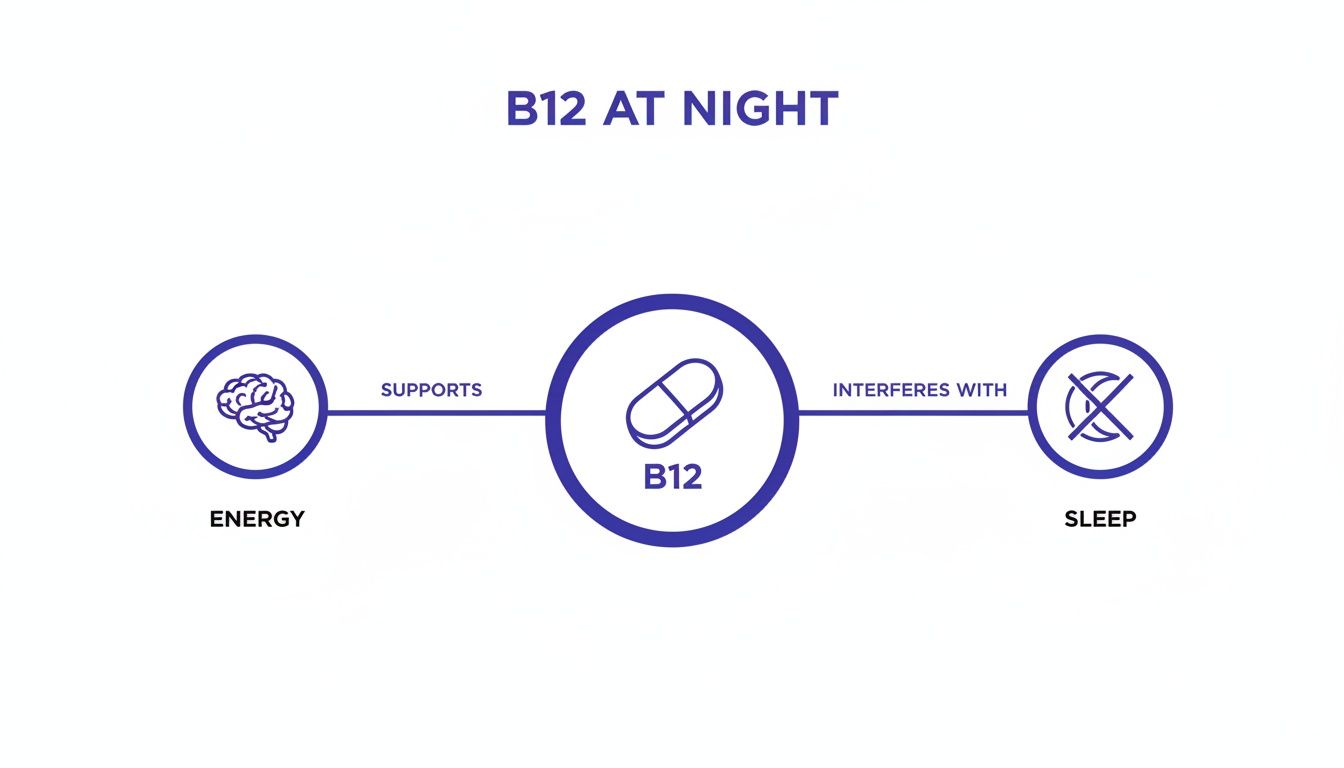
As you can see, B12 supplementation is directly linked to increased energy production. This makes it a poor fit for any pre-sleep routine.
Optimizing Your Timing with Science
To get the most out of this two-part system, timing is everything. Research suggests taking B12 in the morning, ideally between 6-9 AM, can maximize its impact. This is especially true if you’re looking for a productivity boost. This window lines up perfectly with your body’s natural circadian rhythm. At this time, dips in cortisol and melatonin create the ideal environment for that IF-mediated “ferry” absorption.
Taken in the morning, your B12 levels will then hit their peak in your bloodstream about 3-4 hours later. This is right when you need that mental lift. You can find more tips in our guide to the best vitamins to help with brain fog.
This morning strategy also sidesteps competition. Proteins from a big lunch can interfere with absorption. This is a big deal since your body can only absorb about 1.5-2.5 mcg per meal through that highly efficient IF pathway. By working with your body’s natural processes, you turn that supplement into a powerful tool for your day.
Editor’s Take: What Actually Works for B12 Timing
So, what’s the bottom line? For most people trying to sharpen their focus and get a real energy lift, taking vitamin B12 first thing in the morning on an empty stomach is the simplest and most effective move you can make.
This small habit works with your body’s natural absorption rhythms, not against them. It’s a straightforward way to get the best possible return on your investment. This is especially true for busy professionals, students, or anyone who’s just tired of feeling drained every single day.
But here’s the thing: biology is personal. Your own health history and circumstances always play the lead role in what works for you. This advice is best for individuals who are generally healthy and are using B12 for energy and cognitive support, not to treat a severe deficiency.
Who Needs to Be More Careful
If any of these sound like you, a one-size-fits-all approach isn’t going to cut it:
- You’re on certain medications: Common drugs like metformin (for diabetes) are known to interfere with B12 absorption.
- You have digestive issues: Conditions like Crohn’s disease or atrophic gastritis can seriously limit how well your body can even access B12.
- You’re over 50: As we age, stomach acid levels naturally decline. This makes it harder to absorb B12 from food sources.
Think of the morning routine as a powerful starting point. However, it is never a substitute for professional medical advice. It’s essential to talk to your doctor to figure out the right dosage and timing for your unique health profile.
Finding the best time of day to take vitamin b12 is all about learning to work with your body’s specific needs. Sometimes that requires a plan tailored just for you. Nothing replaces that personalized guidance for your long-term health.
Final Checklist for Your B12 Routine
When it comes to getting the most out of your vitamin B12 supplement, a little bit of timing and a whole lot of consistency make all the difference. Think of these takeaways as your quick-reference guide to building a smart routine that actually works. This routine is designed to boost your energy and sharpen your focus.
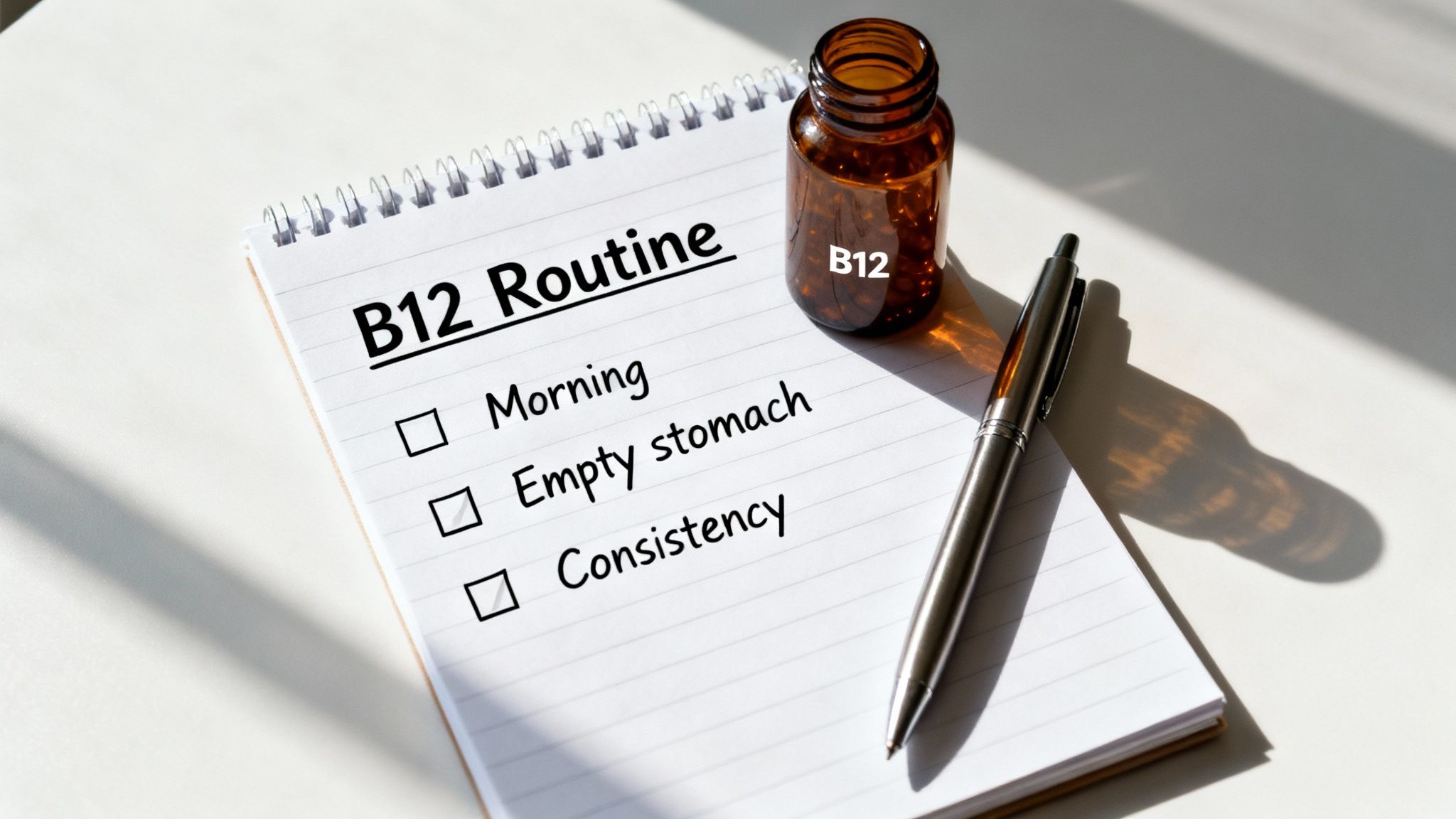
Actionable B12 Best Practices
These are the core rules for dialing in your supplement strategy. Nail these, and you’ll be well on your way.
Morning Is Your Best Bet: The ideal time is first thing in the morning, on an empty stomach. This gives your body a clean slate for maximum absorption before food gets in the way.
Steer Clear of Nighttime Doses: B12 is a key player in your body’s energy production. Taking it right before bed can mess with your natural sleep cycle and might leave you feeling restless.
Watch Out for Interactions: If you take high doses of vitamin C, be mindful. It can interfere with B12 absorption. A good rule of thumb is to space them out by at least two hours to make sure you get the full benefit of each.
The single most powerful habit you can build is taking your B12 with a glass of water right after you wake up. It’s a simple move that works with your body’s natural rhythms, giving you the best shot at feeling a real, tangible difference in your energy.
For anyone on a plant-based diet, staying on top of key nutrients is vital. You can learn more by Spotting Vegan Vitamin Deficiency Symptoms.
At the end of the day, consistency is what separates a supplement that works from one that doesn’t. Stick with it, and you’ll unlock the long-term cognitive and physical benefits B12 has to offer.
Key Takeaways
- Morning on an Empty Stomach: The absolute best time to take vitamin B12 is in the morning, at least 30 minutes before food or coffee, to maximize absorption.
- Avoid Nighttime Doses: B12 can interfere with sleep due to its role in energy production. It’s best to avoid taking it in the evening.
- Consistency is Crucial: To experience the full benefits for energy and mental clarity, make taking your B12 a consistent part of your daily morning routine.
- Form Matters: Methylcobalamin is a highly bioavailable form of B12 that the body can use immediately without conversion.
- Consult a Professional: While morning is a great general rule, always consult with your doctor, especially if you have underlying health conditions or take other medications.
Disclaimer: This article is for informational and educational purposes only and does not constitute medical or psychological advice. It may contain affiliate links, which means we may earn a commission if you make a purchase. Always consult with a qualified healthcare professional before making any decisions about your health or supplement regimen.
Frequently Asked Questions
1. What is the absolute best time to take vitamin B12?
Hands down, the consensus points to one clear winner: first thing in the morning, on an empty stomach. Taking your B12 with a glass of water at least 30 minutes before your first meal or coffee gives it a clean runway for absorption. This timing also works with your body’s natural energy rhythms.
2. Can I take vitamin B12 with my morning coffee?
It’s better to wait a little while. While a cup of coffee won’t completely cancel out the benefits, caffeine can slightly reduce how well your body absorbs B vitamins. For the best outcome, take your B12 with water and wait at least 30 minutes before your coffee.
3. I forgot to take my B12 this morning—what should I do?
No need to stress if you miss a dose. Just take it as soon as you remember, as long as it’s not too close to bedtime. If it’s already late afternoon or evening, your best bet is to simply skip that day’s dose and get back on your regular morning schedule the next day.
4. Does the form of B12 I take actually matter?
Yes, the form can make a real difference. Methylcobalamin is the active, bioavailable form that your body can put to use immediately, no conversion required. This is often a better choice than cyanocobalamin, which your body has to process first.
5. Can I take vitamin B12 and vitamin C together?
You can, but timing is key. High doses of vitamin C can interfere with your body’s ability to absorb vitamin B12 properly. To get around this, just space them out by at least two hours. A simple approach is to take your B12 first thing in the morning and then take your vitamin C with lunch.
6. Will taking B12 on an empty stomach upset my stomach?
It’s unlikely. Vitamin B12 is water-soluble and is generally very well-tolerated on an empty stomach. Unlike some other supplements like iron or fat-soluble vitamins, it rarely causes any digestive issues. However, if you have a sensitive stomach, you can try it with a small snack.
7. How long does it take to feel the effects of B12?
This really varies from person to person. Some people report feeling a noticeable energy lift within just a few hours of their first dose. For others, especially those correcting a deficiency, it might take several days or even a few weeks of consistent use to see significant improvements.
8. Is it okay to take B12 every single day?
For most people, yes. Daily supplementation is both safe and effective, particularly if you have a diagnosed deficiency or fall into a risk category (like following a vegan diet). Just be sure to stick to the dosage recommended by your healthcare provider.
9. Can vitamin B12 really help with brain fog?
Absolutely. B12 plays a vital role in neurological function. A deficiency is often linked to symptoms like fatigue and that frustrating feeling of what causes brain fog. By restoring your B12 levels, you’re giving your brain the raw materials it needs for sharper cognitive performance.
10. Should I take B12 with other B vitamins?
It’s a great idea. The B vitamins are a team, and they often work best together. Taking B12 as part of a B-complex supplement can be highly effective because these vitamins are synergistic. For example, B6 and folate work hand-in-hand with B12 to support healthy methylation, a process essential for mood regulation.
Discover practical, science-backed strategies to reclaim your focus and build lasting habits with the digital library at Mind Clarity Hub. Explore our curated collection of books designed for busy minds seeking calm and productivity. Start your journey at https://mindclarityhub.com.