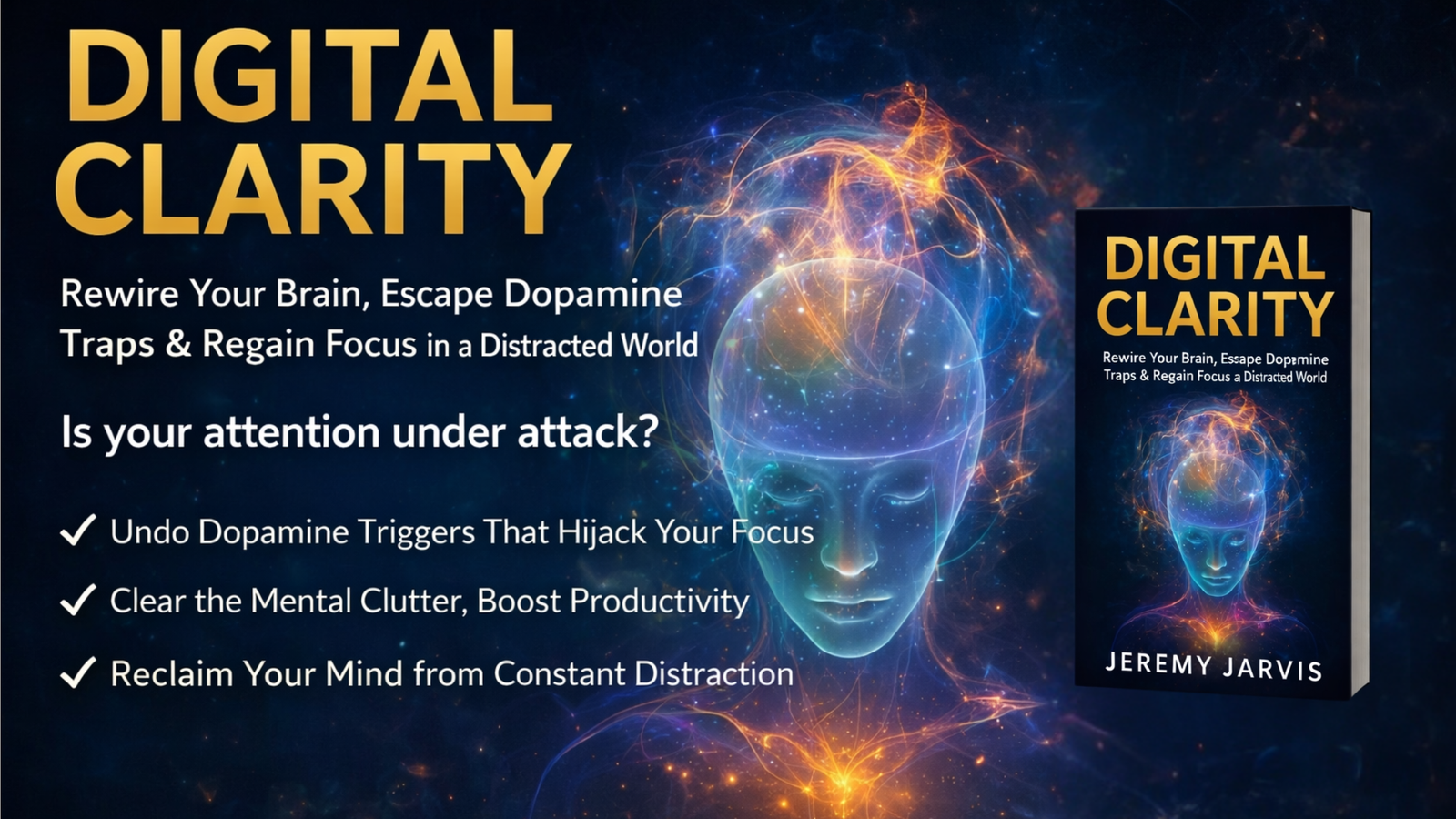
Rewire Your Brain, Escape Dopamine Traps & Regain Focus in a Distracted World
As an Amazon Associate I earn from qualifying purchases.
Why “delete all your apps” usually backfires
A total shutdown can feel satisfying at first. Still, if your work, relationships, and daily logistics depend on technology, “delete everything” often creates a rebound cycle: you white-knuckle for a few days, then the brain grabs novelty even harder. In many cases, the issue isn’t just screen time. Instead, it’s the attention system you’ve been training: constant switching, constant input, and constant micro-rewards that condition your nervous system to expect stimulation on demand.
Meanwhile, the “all-or-nothing” mindset can add pressure. When perfectionism shows up in your tech habits, one slip becomes a full collapse, which quietly reinforces shame and keeps the cycle going. If that pattern feels familiar, it can help to understand the mechanics of modern distraction. Start with Why Can’t I Focus Anymore?, then come back here with clearer language for what you’re experiencing.
Additionally, extreme rules don’t teach digital self-control in the real environment you actually live in. As soon as the apps return, the old cues return too. That’s why Digital Clarity is built around a durable approach: reduce triggers, redesign inputs, and build focus habits that hold under stress. In other words, this digital clarity book helps you create technology boundaries that support calm, focus, and cognitive control long after the first burst of motivation fades.
Move from restriction to structure
“Delete your apps” is a restriction strategy. However, restriction is fragile when your nervous system is already overloaded. Structure is sturdier. With structure, you change the default conditions: fewer interruptions, fewer surprise triggers, and fewer open loops that keep your brain scanning for the next hit of novelty.
For example, the Clarity Protocol starts with notification hygiene and “friction” for compulsive checking, because those are environmental levers that reduce dopamine spikes without requiring heroic self-control. If you want the deeper why behind this, the companion piece Digital Overwhelm: Neurology and Attention Hijacking explains how modern inputs can keep your brain in a reactive posture.
Why willpower collapses when the environment is engineered
Under pressure, the brain defaults to quick relief. Therefore, scrolling, notifications, and constant novelty can become a stress response rather than a choice. When your day is filled with micro-interruptions, your attention never fully “lands,” and the mind starts to feel restless, foggy, and impatient with anything that requires depth.
The problem becomes even more stubborn when you’re dealing with digital fatigue. In that state, it’s hard to tell if you’re bored, tired, anxious, or simply overstimulated—so you keep checking because it briefly changes how you feel. If you relate to that, read What Is Digital Fatigue and How to Recover Faster to understand the recovery side of the equation.
Rebuild attention the way you rebuild strength
A sustainable reset doesn’t only remove distractions; it rebuilds the skill of attention. That includes reducing context switching, practicing single-tasking, and retraining your mind to tolerate boredom without panic. Over time, that process reduces mental fog and increases attention span.
Because attention is trainable, Digital Clarity treats focus as a capacity you can restore—not a personality trait you either have or don’t have. For a more science-forward explanation of why single-tasking works, pair this section with Neuroscience of Single-Tasking. Then, bring those principles back into the 30-day protocol for faster momentum.
Replace dopamine traps with clarity rituals that actually scale
When the brain is overstimulated, it doesn’t crave “productivity.” It craves relief. Consequently, the book focuses on repeatable resets that calm your nervous system and restore mental space: low-stimulation mornings, clean transitions, and brief “reset pauses” that interrupt automatic scrolling.
Instead of demanding perfect discipline, Digital Clarity helps you create “default calm” through environmental design and routine anchors. For example, you learn how to protect your best thinking hours with deep work blocks, while also reducing the attention leaks that come from constant switching. If you want an additional framework for reclaiming mental space, continue with Focus Reset: Mental Space.
Why a gentler reset works better when you’re already exhausted
If burnout is already present, harsh rules can add stress instead of reducing it. As a result, many people “fail” at detox plans and conclude something is wrong with them. In reality, the plan was too rigid for a depleted nervous system.
That’s why Digital Clarity focuses on stress-aware boundaries and recovery-friendly routines that rebuild capacity first, then performance. For support on the recovery side, consider How to Recover from Burnout. If you’re confused by feeling depleted even on “easy” days, the article Mentally Exhausted After Doing Nothing can help you name what’s happening.
Design a tech life you can repeat on your worst days
The best system is the one you can keep when life gets loud. Therefore, the protocol emphasizes “repeatability” over intensity: habits that are small enough to sustain, yet powerful enough to change your baseline. That includes calmer inputs, fewer interruptions, and a daily rhythm that supports clarity rather than steals it.
If your mind feels like it’s being pulled in ten directions at once, attention training matters. For a longer-form guide to rebuilding attention in a distracting world, read Rebuild Attention in a World of Distraction. After that, Digital Clarity gives you the step-by-step structure to make those principles concrete over 30 days.
Ultimately, Digital Clarity is not about living without technology. Instead, it’s about rewiring your brain so you can use tech with intention, protect your mental clarity, and regain the calm confidence that comes from being able to focus on purpose. When you stop fighting your brain and start changing your inputs, the noise finally quiets down—and your best thinking comes back online.

Print length: 275 pages · Publication date: May 20, 2025
ISBN-13: 979-8284650752
Buy Digital Clarity and start your 30-day reset
If you want a realistic plan for escaping dopamine traps, this book is designed to be used, not just read. One chapter at a time, you’ll build clarity through environment design, attention training, and calmer tech boundaries.
Most importantly, the protocol aims for progress that holds. As your mind quiets down, deep focus becomes less fragile and more dependable.
Disclosure: This page includes affiliate links that may earn a commission at no extra cost to you.