


Published: December 15, 2025
Let’s be honest: the old idea of productivity is broken. For years, we were told that getting more done meant grinding harder and pushing through exhaustion. But that “hustle” mindset usually just leads to burnout, not meaningful results. Real productivity isn’t about cramming more tasks into your day. It’s about achieving what truly matters with less stress and more clarity by working with your brain’s natural rhythms—not against them.

Affiliate Disclosure: At Mind Clarity Hub, we believe in transparency. This article may contain affiliate links, which means we may earn a small commission if you make a purchase through them—at no extra cost to you. We only recommend products we trust.
Redefining Productivity for the Modern Workplace
This guide throws out the old rulebook. Instead of chasing more hours, we’ll focus on a smarter, more sustainable, and brain-friendly model for high performance. It all comes down to intention and clarity.
The real drivers of exceptional work aren’t about brute force. They’re about genuine motivation and deep engagement—the very things that hustle culture often destroys. The research is clear: how people feel at work has a direct impact on what they accomplish. This isn’t just a mood-booster; it’s a core principle of organizational psychology. Our mood influences cognitive functions like problem-solving and creativity, meaning a positive work environment directly fuels innovation and output.
The Real Driver of High Performance
Disengaged employees are more than just a morale problem; they represent a staggering loss of human potential. A recent Gallup report on the global workplace is eye-opening: only 21% of employees worldwide feel truly engaged at work.
This widespread disengagement isn’t a small issue. It’s estimated to cost the global economy a mind-boggling US$438 billion in lost productivity every year. On the flip side, Gallup found that achieving full engagement could inject an incredible US$9.6 trillion back into the world economy.
That’s not just a number—it’s proof that motivation is one of the most powerful economic forces we have. You can dig into the complete findings in Gallup’s full analysis.
To help you reclaim your focus and energy, this guide is built on four core pillars. Think of it as your new operating system for getting things done.
The Four Pillars of Science-Backed Productivity
| Pillar | Core Principle | Primary Benefit |
|---|---|---|
| Mastering Deep Work | Protect your cognitive resources from constant digital distractions and interruptions. | Produce higher-quality work in less time and reduce mental fatigue. |
| Designing Your Environment | Shape your physical workspace and daily schedule to support focus automatically. | Make concentration the path of least resistance, requiring less willpower. |
| Leveraging Technology | Use automation and AI to handle repetitive tasks, freeing up mental space. | Reclaim time and energy for strategic thinking and creative problem-solving. |
| Building Sustainable Habits | Use behavioral science to create productive routines that stick without burnout. | Achieve long-term consistency and avoid the boom-and-bust cycle of motivation. |
By mastering these four areas, you’re not just learning productivity “hacks.” You’re building a system that allows you to do your best work consistently without sacrificing your well-being.
- Mastering Deep Work: This is your defense against a world of distraction. We’ll cover how to protect your most valuable cognitive resources from the constant barrage of pings, notifications, and interruptions that fragment your attention.
- Designing Your Environment: Your workspace and schedule can either fight you or support you. You’ll learn how to shape your surroundings to make focus the default setting, so you don’t have to rely on willpower alone.
- Leveraging Technology Intelligently: Instead of letting technology manage you, you’ll learn to make it work for you. We’ll explore how to use automation and AI to offload the repetitive, low-value tasks that drain your mental energy. Our insights into future of work and focus recovery show just how critical this skill is becoming.
- Building Sustainable Habits: Willpower is a finite resource. That’s why we’ll dive into behavioral science to build productive routines that last, turning powerful behaviors into second nature.
By focusing on these pillars, you’ll create a system that supports sustained high performance without burning you out. This is about doing the right things, better—and feeling good while you do it. You can follow along for more practical insights on my Pinterest.
Mastering Deep Work and Conquering Distraction

If you feel like your attention is constantly under attack, you’re not wrong. The modern workday is practically engineered for distraction. An endless stream of notifications, emails, and “quick questions” pulls you in a dozen different directions at once.
This constant fragmentation isn’t just annoying; it actively undermines your brain’s ability to produce high-quality, thoughtful work. Your brain’s prefrontal cortex—the area responsible for complex planning and decision-making—is wired for single-tasking. When you try to multitask, like drafting a report while keeping an eye on your inbox, you aren’t actually doing two things at once. Instead, you’re forcing your brain to switch gears rapidly, a process called context switching.
Every time you switch, you pay a “cognitive cost,” burning through precious mental energy. This makes it harder and harder to get back into the groove of your main task. This is exactly why a day packed with interruptions can leave you feeling drained, even if you feel you got little done.
The Power of Intentional Focus Blocks
The most effective way to fight back against distraction is to deliberately carve out time for focused, uninterrupted work. This isn’t about finding more hours in the day—it’s about making the hours you already have actually count. Two powerful, research-backed techniques can get you there.
- Time Blocking: This is where you schedule specific tasks directly into your calendar, just like a meeting. Instead of a vague to-do list, your day has a clear game plan. For example, a marketing manager could block out 9:00 AM to 11:00 AM for “Q3 Creative Strategy.” No email. No Slack. Just dedicated time for their most important work.
- The Pomodoro Technique: This method uses a timer to break down work into focused sprints, traditionally 25 minutes long, separated by short breaks. It works beautifully because it aligns with your brain’s natural attention cycles, preventing cognitive overload. After a 25-minute push, you step away for a 5-minute break to recharge before the next round.
These methods create a structure that signals to your brain that it’s time to focus, giving you permission to let everything else wait. The goal is to build a predictable rhythm that makes deep work a habit, not a rare event.
Taming Your Digital Environment
Your digital world is likely the biggest source of distraction. Getting it under control requires a conscious effort to practice digital minimalism—the idea of using tech to serve your goals, not letting it dictate your attention.
Start by auditing your notifications. Do you really need an instant alert every time an email lands or someone likes a comment? Each ping is a tiny invitation for your brain to switch contexts, derailing your flow. Be ruthless and turn off all non-essential notifications on your phone and computer.
Key Takeaway: The average office worker gets interrupted every three minutes. Reclaiming just a fraction of that time for deep work can dramatically increase your output and lower your stress. A quiet digital space is a productive one.
Consider using website blockers during your focus blocks to prevent mindless scrolling on social media or news sites. This isn’t about a lack of willpower; it’s about creating an environment where you don’t need to rely on willpower in the first place.
Design Your Workspace and Schedule for Peak Performance
Your physical environment and daily schedule are silent partners in your productivity. They can either create constant friction or act as powerful engines for focus. The goal is to intentionally design both so that productive behaviors become the path of least resistance, requiring less willpower to sustain.
This is where behavioral psychology gives us a practical roadmap. Instead of banking on motivation, which is notoriously unreliable, you can use environmental cues to trigger the actions you want to take. A classic example is setting out your workout clothes the night before. That one small change dramatically increases the odds you’ll actually make it to the gym in the morning because it lowers the “activation energy” needed to start.
It works the same way at your desk. A cluttered workspace filled with half-done projects sends subtle signals of chaos to your brain, making it harder to lock in on one thing. A clean, minimalist setup, on the other hand, creates a clear visual field, which helps you cultivate a clear mental field.
Aligning Tasks with Your Natural Energy Cycles
Productivity isn’t just about managing time; it’s about managing your energy. We all have natural high and low-energy periods throughout the day—what scientists call our chronotype. Some of us are “larks” who do our best thinking first thing in the morning, while others are “owls” who don’t truly hit their stride until the afternoon or evening.
Fighting your natural rhythm is a losing battle. The smarter move is to work with it.
- Find Your Peak Hours: For one week, take a moment every hour to jot down your energy and focus levels on a scale of 1 to 10. You’ll quickly see a pattern emerge, revealing your prime time for deep, cognitively demanding work.
- Guard Those Hours Ruthlessly: Once you know your peak window—say, 9 AM to 11 AM—protect it. That’s when you should be tackling complex problem-solving or creative strategy, not clearing out your inbox.
- Use Your Dips Strategically: Save your low-energy periods for administrative tasks, routine emails, or planning your next day. This keeps you moving forward without draining your most valuable cognitive resources on low-impact work.
For a software developer on a hybrid schedule, this might mean dedicating their high-energy remote mornings to solo coding. They can then save their in-office afternoons for collaborative meetings and code reviews. This simple alignment can drastically improve both code quality and job satisfaction.
Building Automatic Habits with Environmental Design
Your workspace is more than just a place to put your laptop. It’s a system of cues that can either trigger focus or invite distraction. By consciously designing this space, you can put productive habits on autopilot. This concept is often called habit stacking, where you link a new desired habit to one you already have.
For instance, you could stack the habit of “planning my top three priorities” onto your existing habit of “making morning coffee.” While the coffee brews, you take two minutes to write down your most important tasks.
You can supercharge this by using environmental cues.
Pro Tip: Create distinct zones for different kinds of work. Using a specific chair just for deep work, a corner for creative brainstorming, or even a designated spot for taking calls can signal to your brain what kind of thinking is required. This minimizes the mental effort needed to switch gears.
This approach extends to your digital workspace, too. A clean desktop with only the essentials visible reduces the temptation to multitask. The goal is to make your environment do the heavy lifting so your brain doesn’t have to.
Thoughtful scheduling and workspace design are proving to have a measurable impact, especially as flexible work becomes more common. A recent “State of the Workplace” report from ActivTrak found that remote-only workers gained about 29 minutes of extra productive time per day compared to their in-office or hybrid peers. Across multiple datasets, the average workday actually shortened by roughly 36 minutes, even as productivity increased—proof that a smarter structure leads to better output. You can dive deeper into these workplace statistics and trends here.
By consciously shaping your schedule around your energy and designing your environment to support your goals, you shift from a reactive state to a proactive one. You stop fighting distractions and start building a system where focus is the default.
Automate Your Workflow and Use AI Intelligently
Technology can feel like a double-edged sword. Left unchecked, it becomes a relentless source of distraction. But when you use it intentionally, it’s one of the most powerful tools you have for boosting your productivity and reclaiming your mental energy.
The trick is to spot the low-value, repetitive tasks that drain your willpower and offload them to technology. These are the small, mindless jobs that chip away at your focus all day: sorting emails, copying data between apps, or scheduling the same follow-ups again and again.
Reclaim Your Cognitive Bandwidth
Every time you handle one of these mundane tasks, you’re spending a tiny bit of your limited decision-making capacity. Psychologists call this “decision fatigue.” Automating them isn’t about being lazy; it’s about strategically preserving your best thinking for the work that actually moves the needle.
You can start with tools you already use. Simple email filters can automatically sort incoming messages, keeping your main inbox clear for what truly matters. For more complex workflows, tools like Zapier connect your apps and create automated sequences, like saving email attachments to a specific cloud folder or adding new leads to a spreadsheet.
This kind of strategic automation frees up a surprising amount of mental space, letting you invest your time in high-value work instead of administrative drag. The impact is real. Research shows employees can save an average of 3.6 hours per week just by automating routine tasks. On a larger scale, McKinsey estimates that generative AI could boost labor productivity growth by up to 0.6 percentage points annually through 2040. If you want to dig into the numbers, you can explore more employee productivity statistics.
The diagram below breaks down the three pillars of a truly productive work system: your schedule, your environment, and your habits.
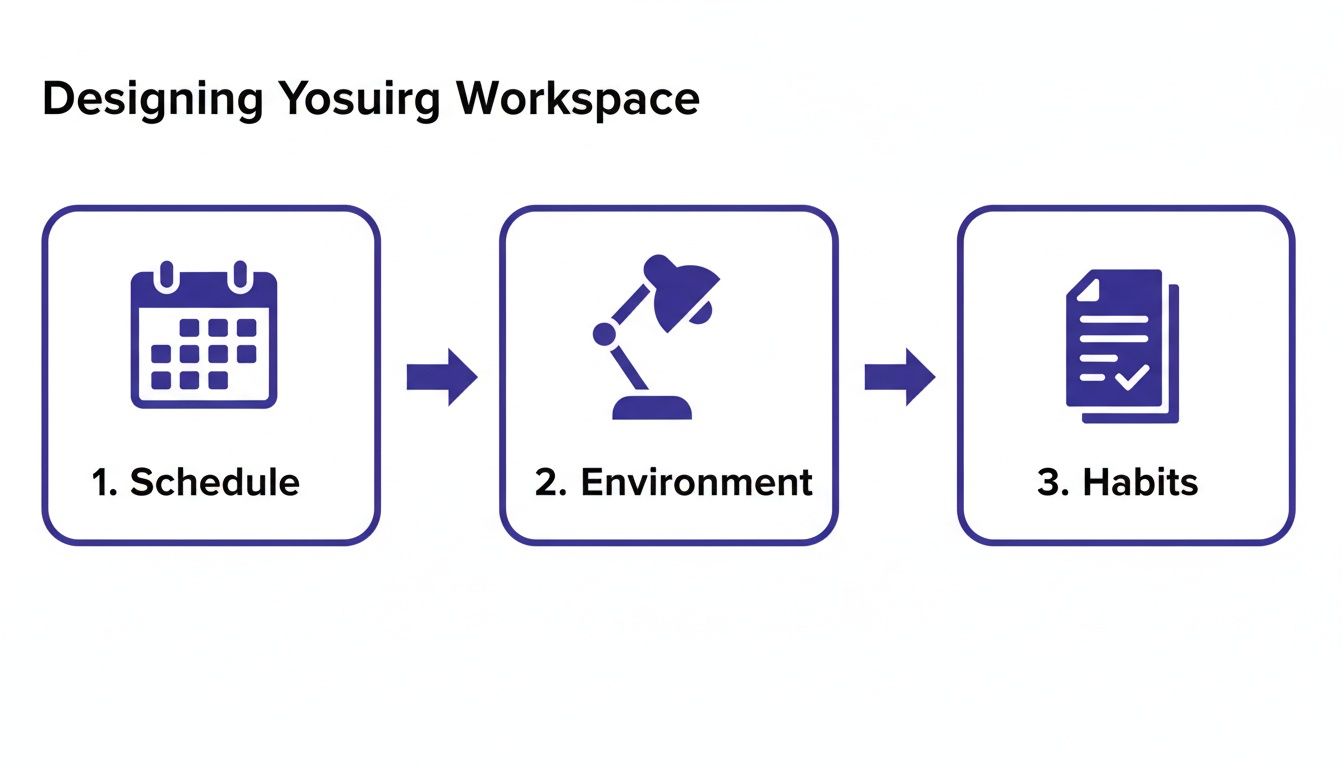
This shows how real productivity emerges when your schedule, environment, and habits all work together to support your goals.
Using AI as a Strategic Partner
Artificial intelligence opens up a whole new frontier for offloading cognitive labor. But its real power isn’t just generating content; it’s acting as a strategic partner to accelerate the early stages of your work, leaving you more time for high-level thinking and refinement.
Forget generic prompts. Instead, think in terms of specific tasks that help you overcome the “blank page” problem.
- For Project Managers: Use AI to draft an initial project scope or create a work breakdown structure from a brief. For example, prompt it with “Generate a WBS for a website redesign project, including phases for discovery, design, development, and launch.” This gives you a solid foundation to edit, saving hours of setup.
- For Researchers: Ask AI to summarize dense academic articles, pulling out key findings and methodologies. You can quickly assess a source’s value without reading the whole thing.
- For Marketers: Use it to brainstorm a list of potential blog titles or social media angles for a campaign. It’s a fantastic way to break through creative blocks and generate a wide range of ideas.
Key Insight: The smartest way to use AI isn’t to replace your thinking but to augment it. Automate the first 80% of a task—the drafting, summarizing, or brainstorming—and you free up your cognitive energy for the final 20%, where human nuance, creativity, and strategy add the most value.
Using technology this intelligently is a core skill for any modern professional. To learn more about folding these tools into your daily routine, check out our guide on making everyday AI easy and effective. The goal is clear: reinvest the time you save not to cram more work into your day, but to create more space for deep, focused thinking.
The Role of Rest in Sustained High Performance

It sounds completely backward, but one of the most effective ways to increase productivity has nothing to do with working harder. It’s about being intentional with your rest. “Hustle culture” has conditioned us to view downtime as weakness, but neuroscience tells a much different story.
Your brain isn’t a machine that can run nonstop. Sustained mental effort, especially on tough problems, burns through neurotransmitters and drains glucose—the main fuel source for your brain cells. Without breaks, your prefrontal cortex, which handles all the heavy lifting like decision-making and focus, gets exhausted. This isn’t just a feeling; it has real consequences: slower thinking, worse memory, and a total collapse of creativity. Rest isn’t the opposite of work; it’s the partner that makes elite performance possible.
The Neuroscience of How Your Brain Recharges
When you finally disconnect, your brain flips into a completely different gear. One of the most important is the default mode network (DMN), a web of brain regions that lights up when you’re at rest but still awake. While you’re daydreaming or letting your mind wander, the DMN is busy connecting ideas, consolidating memories, and sorting through subconscious thoughts.
This is exactly why your best ideas seem to pop into your head in the shower, on a walk, or just before you drift off to sleep. You step away from the problem, and you give your brain the space it needs to solve it. This same principle works on a smaller scale throughout the day. Micro-breaks—short, deliberate breaks that last just a few minutes—are surprisingly powerful for fighting off mental fatigue.
- Look away from the screen: Just gazing out a window for 60 seconds can reduce eye strain and give your visual cortex a breather.
- Stand and stretch: A quick stretch gets blood flowing back to the brain, delivering a fresh shot of oxygen and glucose.
- Step outside: Even five minutes of fresh air can lift your mood and reset your ability to concentrate.
Think of a consultant who takes a 10-minute walk after every intense client meeting. They aren’t slacking off. They are actively preventing decision fatigue so they can return to their desk sharp, clear, and ready for the next challenge.
Challenging the Burnout Narrative
The “always-on” mindset doesn’t just tank your productivity in the short term; it causes long-term damage to your brain’s executive functions. Burnout isn’t just being tired—it’s a state of chronic stress that can throw your entire nervous system out of whack and cripple your cognitive performance.
Important Note: Burnout, anxiety, and depression are serious conditions. This article is for educational purposes only. If you are experiencing symptoms, it is crucial to seek help from a qualified medical or mental health professional.
For long-term performance, setting firm boundaries isn’t optional. It’s non-negotiable. This means having clear start and end times for your workday and—this is the hard part—actually sticking to them. If you’re feeling fried, learning how to recover from burnout is the essential first step toward building back healthier, more sustainable habits.
Key Insight: True disconnection means your brain isn’t still chewing on work problems. Casually checking email on your phone after hours seems harmless, but it keeps your brain in a state of low-grade alert, preventing the deep cognitive rest you need to be at your best the next day.
By treating rest as a core part of your productivity strategy, you shift from a model of short-term sprints and inevitable crashes to one of sustainable, long-term achievement. Sleep, breaks, and true time off aren’t luxuries. They are fundamental requirements for anyone serious about doing their best work consistently.
Editor’s Take: What Actually Works
My name is Jeremy Jarvis, and for years, I’ve been the guinea pig for just about every productivity system, app, and framework you can imagine. After wading through all that noise, here’s my honest take: the biggest wins never come from the trendiest new app. They come from mastering the fundamentals.
The real 80/20 of productivity is about two things: ruthlessly protecting your focus for deep work and being relentlessly intentional with your schedule. Almost everything else is a distraction or, worse, a sophisticated form of procrastination. We tell ourselves that organizing our to-do list for the tenth time is progress, when it’s really just a clever way to avoid the hard, meaningful work staring us in the face.
Who Is This Advice Best For?
These strategies are most effective for knowledge workers, creatives, and anyone whose job requires deep thinking and problem-solving rather than manual labor. If your day is a mix of meetings, strategic work, and independent tasks, these principles will be a game-changer. They are less applicable to roles that are purely reactive, like customer service, where the workflow is dictated by external demand.
My rule of thumb is simple: If a tool requires more time to manage than the time it saves you, it’s not a productivity tool. It’s a hobby. A simple calendar for time blocking, a basic timer for Pomodoro sprints, and a minimalist notes app are often all you really need.
The Most Important Takeaway
Ultimately, no single system works for everyone. The hunt for a perfect, one-size-fits-all solution is a trap. What works for a freelance graphic designer is going to look completely different from what a project manager in a huge corporation needs. The only goal is to find what works for you.
Sustainable productivity is built on self-compassion and the flexibility to adapt. It is not about rigid adherence to a framework that leaves you feeling stressed and burned out. If a system isn’t serving you, it’s okay to abandon it and try something else.
True productivity should feel calm, focused, and intentional. It’s about building systems that support your well-being, not ones that drain it. Start with the basics: guard your focus, manage your energy, and give yourself the grace to adjust as you go.
Frequently Asked Questions (FAQ)
Putting these ideas into practice is where the real work begins. Here are answers to some of the most common questions.
How long does it take to see results from these productivity methods?
You can feel some benefits almost immediately. The first day you try time blocking or the Pomodoro Technique, you’ll likely notice a boost in focus. However, according to behavioral research, forming a truly automatic habit takes consistency over several weeks. Start small and aim for progress, not perfection.
Can these strategies help with ADHD or other focus challenges?
Yes, many people find these structured approaches very helpful for managing attention. Techniques like breaking down tasks, designing a low-distraction environment, and externalizing your schedule onto a calendar are evidence-based strategies that can support executive function. However, please remember this article is for educational purposes and is not a substitute for professional medical advice. If you have concerns about ADHD, anxiety, or other conditions, please consult a qualified healthcare provider.
What is the single most impactful change I can make?
Protect the first 90 minutes of your workday for your single most important task. Before checking email or Slack, make meaningful progress on the one thing that will advance your long-term goals. This single habit builds momentum for the entire day and trains your brain to prioritize deep work over shallow, reactive tasks.
Are there any tools you recommend for getting started?
Start simple. You don’t need complex software. A physical planner or a digital calendar (like Google Calendar) is perfect for time blocking. A simple timer on your phone or a browser extension works great for the Pomodoro Technique. The goal is to reduce friction, not add another complex tool to your plate.
Disclaimer: The information provided in this article is for educational and informational purposes only and is not intended as medical or psychological advice. This article may contain affiliate links, which means we may earn a small commission at no extra cost to you. Always consult with a qualified professional for any health concerns.
At Mind Clarity Hub, our work is all about giving you science-backed, actionable guides to help you reclaim your attention and energy. To go deeper on any of these topics, feel free to explore our full library of books and resources.
Explore the Mind Clarity Hub library
Explore the Mind Clarity Hub Library
Practical books on focus, digital habits, resilience, and building a calmer mind.
The Power of Clarity
Unlock mental focus, build momentum, and create the life you were meant to live.
View book →
AI & ChatGPT for Beginners
No PhD needed — a 2025 guide to AI, prompts, and productivity without coding.
View book →
Zen in the Digital Jungle
Mindfulness for a chaotic world.
View book →
The Slow Reset
Mindful living in a fast-paced world.
View book →
Perfectly Imperfect
Stop self-criticism, set boundaries, and embrace the real you.
View book →
Reclaiming Silence
A dopamine detox guide to finding peace in a noisy world.
View book →
The Focused Freelancer
Productivity, pricing & positioning for independents in 2025.
View book →
ChatGPT Side Hustle System
Launch your AI-driven online business in 30 days.
View book →
Burnout, Interrupted
A proven path to restore energy and reclaim your life.
View book →
Attention Unleashed
Focus strategies for the distracted mind.
View book →
Side Hustle Launchpad
Your quick-start guide to extra income.
View book →
Digital Clarity
Rewire your brain, escape dopamine traps & regain focus.
View book →
Break the Scroll
Reduce screen time and take back control of your life.
View book →
Climate Compassion
Transform eco-anxiety into empowered action.
View book →
Village Mentality
The power of community for mental wellness.
View book →
Restful Nights
Overcoming sleep anxiety in a 24/7 world.
View book →
Connected Again
Combat loneliness and build meaningful relationships.
View book →
Focus Recharged
Mastering attention and productivity in the digital era.
View book →
Marketing Magic with ChatGPT
AI-powered content, campaigns, and copywriting to grow faster.
View book →
The 6-Figure Creator
Turn knowledge into passive income with books, courses & AI.
View book →
Burnout Breakthrough
Reset your work-life balance and thrive in 2025.
View book →
The Emotionally Intelligent Man
A modern guide to self-awareness and communication.
View book →
AI Personalized Wellness
Create your custom health plan with data-driven habits.
View book →
Everyday AI Made Easy
Use ChatGPT and smart tools to simplify life.
View book →
Money Mindfulness
A financial wellness guide for Gen Z & Millennials.
View book →
Startup Smarter with AI
ChatGPT strategies and tools to grow your business.
View book →
ChatGPT for Writers & Creators
Unlock AI-powered brainstorming, drafting & editing.
View book →