

Published:
Effective note-taking is more than just highlighting. It’s an active process—a conversation where you question, summarize, and connect the author’s ideas to your own life. This guide is all about turning passive reading into lasting knowledge by creating a system you can actually use.
Affiliate Disclosure: At Mind Clarity Hub, we believe in transparency. Some of the links in this article may be affiliate links, which means we may earn a small commission if you make a purchase, at no extra cost to you. We only recommend products we trust.
Why Your Book Notes Aren’t Sticking
Have you ever finished a brilliant book, your copy filled with highlights and sticky notes, only to realize a month later you can barely recall the key concepts?
It’s a deeply frustrating experience, but the problem isn’t your memory. It’s your method. Most of us were taught to transcribe information. This is a passive act that does little to actually encode it into long-term memory.

This guide shows you how to take notes for a book in a way that truly sticks. We’re going to shift from passive highlighting to active engagement—a skill for deeper thinking, not just copying.
The Science of Forgetting
Our brains are wired to forget information that isn’t important. Passively dragging a highlighter across a page doesn’t create the strong neural connections needed for real recall. From a neuroscience perspective, true learning only happens when you actively process information—summarizing, questioning, or connecting ideas to what you already know. This forces your brain to work, signaling that the material is actually worth remembering.
When you just highlight, you’re tricking your brain into thinking you’ve learned something. Psychologists call this the fluency illusion. The text feels familiar, but familiarity doesn’t equal comprehension. You end up with a library of highlights, not a repository of wisdom. This approach also leads to information overload, making it impossible to find what truly matters later. You can dive deeper into this topic in our guide on what is cognitive overload.
Building a System for Real Learning
To fix this, you need a system built for active engagement. This guide is designed for busy professionals, students, and lifelong learners who want to turn what they read into knowledge they can use.
We’ll explore:
- Actionable systems that work with physical notebooks or digital apps.
- Simple frameworks for annotating, summarizing, and pulling out key insights.
- AI-assisted shortcuts to make your process more efficient without sacrificing depth.
This approach isn’t about creating more notes. It’s about creating better, more meaningful notes that become a permanent part of your personal knowledge base.
By focusing on active recall and synthesis, you’ll stop being a passive consumer of information and start becoming an active participant in your own learning.
This content is for educational purposes only and is not a substitute for professional medical or psychological advice, diagnosis, or treatment. It is not intended to diagnose or treat conditions like anxiety, depression, ADHD, or burnout. Always seek the advice of your physician or other qualified health provider with any questions you may have regarding a medical condition.
Adopt the Mindset of an Active Reader
Before you ever pick up a pen, the most critical part of taking notes isn’t about the system you use. It’s about shifting how you think about reading itself. Most of us were taught to read passively, absorbing words like we’re watching a movie. But if you want to learn and remember, that just won’t cut it.

Instead, you need to become an active reader. Think of it less like listening to a lecture and more like having a conversation with the author. You question their claims, hunt for specific insights, and connect their ideas back to your own life.
Define Your Purpose Before You Begin
The foundation of reading actively is knowing why you’re reading in the first place. Without a clear goal, your brain doesn’t know what to latch onto. Everything feels equally important, which usually means everything is equally forgettable.
Setting a purpose primes your brain’s reticular activating system (RAS). This is a bundle of neurons that acts like a filter for information. By deciding what you’re looking for, you tell your brain which details matter. This makes them pop off the page as you read.
Mini-Scenario: A manager is about to read a book on leadership. Instead of just starting, they write down a clear goal: “I want to find one new technique for giving constructive feedback to my team.” This simple mission turns a casual read into a focused hunt for practical solutions.
Ask Questions as You Read
Passive readers accept what an author says. Active readers poke and prod at it. The best way to do this is to constantly ask questions as you go. This transforms the book from a monologue into a dialogue.
- “How does this connect to what I already know?” This question forces you to build bridges between new information and existing knowledge—a cornerstone of memory.
- “Do I agree with this argument?” Challenging the author helps you form your own opinions. It also helps you understand the topic on a much deeper level.
- “How could I apply this in my own life or work?” This is the most important question for turning abstract ideas into practical wisdom.
Mini-Scenario: A freelance designer reading about pricing strategies shouldn’t just highlight a section on value-based pricing. An active reader would pause and ask, “How can I build this model into my client proposal next week? What are the exact steps I’d need to take?”
This questioning process is a cornerstone of learning. If you want to go deeper, we have more resources on the principles of active reading.
Connect Ideas to Your Personal Experience
Your brain isn’t a filing cabinet; it’s a web of connections. New information sticks best when it’s hooked onto something personal. This could be an experience, an emotion, or an existing memory.
When you come across a new concept, don’t just write it down. Take a moment to think about how it relates to something you’ve actually lived through. This act of personalization makes abstract ideas concrete and far more memorable.
Mini-Scenario: A book discusses the “fight or flight” stress response. You might jot down a note about that high-pressure work deadline you had last month. By linking the scientific concept to a vivid personal memory, you give your brain a powerful hook to hang the new information on. This is how you stop just collecting facts and start building genuine understanding.
Choosing Your Note-Taking System
The whole analog versus digital debate can feel like a trap. Pen and paper? Or a sleek app? The truth is, the best system is the one you actually stick with. There’s no single right answer here. There is only the method that fits your goals, your environment, and the way you think.

This isn’t just about personal preference, either. The choice has real cognitive consequences. The trick is to understand the trade-offs. Compare the focused, tactile experience of a notebook versus the efficient, searchable power of a digital tool. Once you see the pros and cons, you can decide how to take notes for a book in a way that truly serves you.
The Case For Analog Handwriting
There’s a reason physical books and notebooks have such an enduring appeal. It isn’t just nostalgia. It’s wired into our brains. Research in neuroscience shows that handwriting lights up regions linked to memory and learning in a way that typing just doesn’t. This physical act forces a slower, more deliberate engagement with the text, which can give your comprehension a serious boost.
This tactile connection is a big reason why print is still king. Globally, the books market hit USD 150.99 billion in 2024, and print books are on track to serve 1.9 billion readers by 2029. This preference for physical media underscores the power of analog methods for deep learning. You can discover more insights about the global book market on grandviewresearch.com.
Some classic analog methods include:
- Marginalia: Scribbling your thoughts, questions, and connections directly in the margins of the book itself.
- Commonplace Book: A dedicated journal where you transcribe meaningful passages and add your own reflections. We have a great guide to some excellent journals for productivity that are perfect for this.
Mini-Scenario: Imagine a university student wrestling with a dense philosophy textbook. By using a notebook to physically write summaries after each chapter, they’re forced to process the complex arguments. This leads to much better retention for their final exam.
The Power Of Digital Systems for Note-Taking
While analog is fantastic for deep focus, digital systems offer efficiency and organization that are hard to beat. Apps like Notion, Obsidian, or Evernote can turn your notes from static pages into a dynamic, searchable knowledge base. This is a game-changer when you’re managing insights from dozens of different sources.
The main advantages here are speed and connectivity. You can capture quotes from an ebook with a simple copy-paste. You can also tag notes with keywords for easy retrieval, and link related ideas across countless books. Synthesizing information and spotting patterns becomes remarkably simple.
Mini-Scenario: A busy professional listening to a business audiobook on their commute can quickly capture voice notes on their phone. Later, they can use an app to transcribe those thoughts, tag them with “leadership” and “Q3 goals,” and link them to relevant articles they’ve already saved.
If you want to explore more options, these 10 effective note-taking methods offer a great overview of systems that can help you master information.
Analog vs Digital Note-Taking Systems for Books
This table compares key features of analog and digital systems to help you decide how to take notes for a book in a way that fits your goals.
| Feature | Analog System (Pen and Paper) | Digital System (Apps and Software) |
|---|---|---|
| Cognitive Engagement | Higher due to kinesthetic feedback, which can boost memory and recall. | Lower, as typing can become automatic and less mindful for some users. |
| Speed and Efficiency | A slower, more deliberate process that encourages thoughtful summary. | Faster for capturing large amounts of text, highlights, and external links. |
| Search and Organization | Difficult to search; relies on manual systems like indexes or sticky tabs. | Instant search, powerful tagging, and cross-linking capabilities. |
| Accessibility | Limited to the physical location of your notebook or book. | Accessible across multiple devices, such as your phone, laptop, and tablet. |
| Distraction Level | Minimal distractions, which promotes a state of deep focus and concentration. | High potential for distraction from notifications and the temptation to multitask. |
| Best For | Deep conceptual understanding, creative brainstorming, and reducing screen fatigue. | Efficiency, managing large volumes of information, and integrating with other digital tools. |
Ultimately, the choice really boils down to your specific needs. Are you optimizing for deep comprehension of a single, complex text? Or are you trying to efficiently manage a wide range of information from many sources? Neither is better than the other—they just serve different purposes.
A Practical Workflow for Taking Better Book Notes
Knowing the theory is one thing, but actually putting it into practice is where the real learning happens. A solid workflow takes the guesswork out of the process. This helps you pull real value from every single book you read.
I’ve found a simple three-phase process—before, during, and after reading—works wonders. It’s flexible enough for a paper notebook or a digital app like Notion or Obsidian.
This approach turns reading from a passive activity into an active, intentional one. It ensures you don’t just capture ideas, but truly understand and integrate them into your thinking. Following these steps will help you learn how to take notes from a book in a way that builds lasting wisdom, not just a library of highlights.
This infographic breaks down the simple three-step process for choosing the right note-taking system for your own needs.
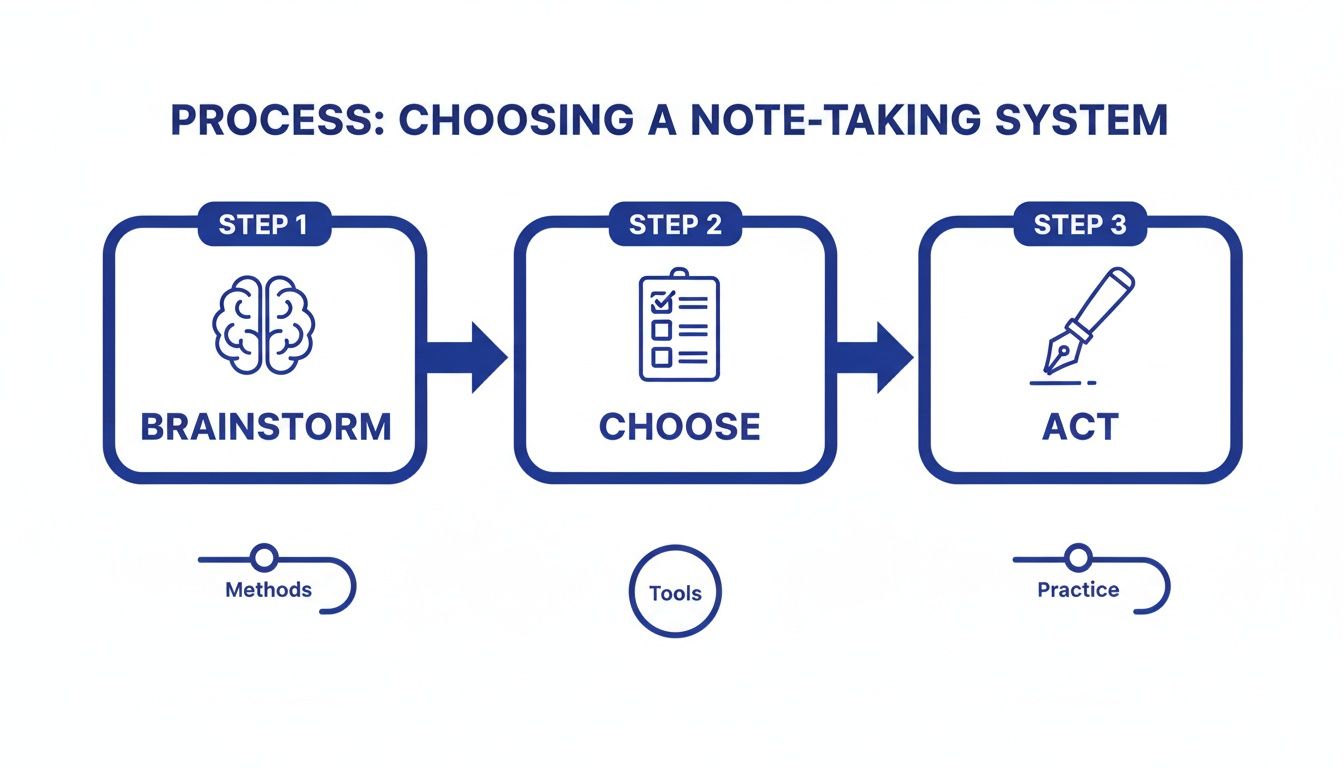
As the visual shows, it all starts with brainstorming your goals, picking the right tool for the job, and then consistently taking action.
The Pre-Reading Phase: What to Do Before You Even Open the Book
The best note-taking starts before you even read the first page. This whole phase is about setting a clear intention and getting your space ready for focused work. Think of it like a chef prepping their ingredients before cooking. You need to prepare your mind and your tools for learning.
First, define your purpose. Just ask yourself: “What do I want to get out of this book?” Maybe you’re looking for actionable business strategies. Or a deeper understanding of a historical event. Or insights for personal growth. Writing down your goal actually primes your brain to spot the information that matters most.
Next, create a dedicated space for your notes. This could be a new section in a physical journal or a fresh page in a digital app. Giving your thoughts a designated home keeps you organized. It also signals to your brain that it’s time for a serious learning session.
Mini-Scenario: Before starting a book on personal finance, you open your note-taking app. You create a new page titled “Notes: [Book Title]” and write your goal at the top: “Find three actionable tips to improve my monthly budget.” Now you’re ready to learn with intention.
During Reading: Annotation and Active Recall
This is where the real work happens. As you read, your goal is to engage directly with the text, not just passively soak it in. It’s time to ditch the mindless highlighting. This often just creates a false sense of accomplishment. Instead, adopt a simple, active annotation system.
A great system doesn’t need to be complicated. Try this:
- Underline sentences that feel like a core idea or a powerful argument.
- Use an asterisk (*) in the margin next to anything that feels immediately actionable or relevant to your goals.
- Write questions or brief comments in the margins to challenge or connect with what the author is saying.
The most crucial habit during this phase is to pause after each chapter and write a short, two-to-three-sentence summary in your own words. This forces active recall, a process that strengthens neural pathways and dramatically improves long-term memory.
The Post-Reading Phase: Synthesis and Solidification
Finishing the last page isn’t the end of the line. The final phase is all about synthesis. This means reviewing your scattered annotations and turning them into a cohesive, useful resource. This is the step that separates casual readers from serious learners.
Once you’ve finished the book, set aside about 30 minutes to review all your underlines, asterisks, and summaries. Look for patterns, recurring themes, and the most important takeaways. Your goal is to consolidate all this raw information into a more permanent, useful format.
Here are a few popular synthesis methods I’ve seen work well:
- Create a one-page summary: Distill the book’s most critical concepts onto a single page.
- Draw a mind map: Visually connect the main ideas, sub-topics, and key examples.
- Make digital flashcards: Use an app like Anki for key definitions or facts you want to lock into memory.
Busy professionals are increasingly leaning on digital tools for this phase. The global note-taking management software market was valued at USD 7.36 billion in 2023. It is projected to hit USD 11.82 billion by 2032. Apps allow you to search, tag, and organize notes with incredible speed, turning reading into a measurable productivity gain. You can find more details about the growth of the note-taking software market at zionmarketresearch.com.
How to Use AI to Enhance Your Book Notes
Artificial intelligence can feel like a complicated beast. But you don’t need a degree in computer science to make it work for you. The trick is to stop thinking of AI as a replacement for your brain. Start treating it like a very capable assistant. The goal isn’t to outsource your thinking. It’s to offload the tedious parts so you can focus on what matters: understanding and connecting ideas.
For instance, if you’re staring down a particularly dense chapter, why not ask an AI tool to summarize it before you even start reading? This gives you a mental scaffold. It primes your brain to latch onto the most important concepts as you read through it yourself.
This is a core principle in learning how to use AI for productivity without getting overwhelmed. It’s all about smart, targeted assistance.
Practical AI Workflows for Better Note-Taking
Beyond summaries, AI can act as your personal tutor. Stuck on a complex scientific theory or a winding philosophical argument? Just copy and paste the passage into a chatbot. Then ask it to explain the idea in simpler terms or create an analogy. This simple step can save you hours of banging your head against the wall.
Audiobook listeners, this is for you. When a great idea hits you on a walk or during your commute, just capture it as a quick voice note on your phone. Later, you can feed those recordings into an AI transcription service to get clean, editable text. It’s a brilliant way to bridge the gap between passive listening and active note-taking.
Here’s what this looks like in the real world:
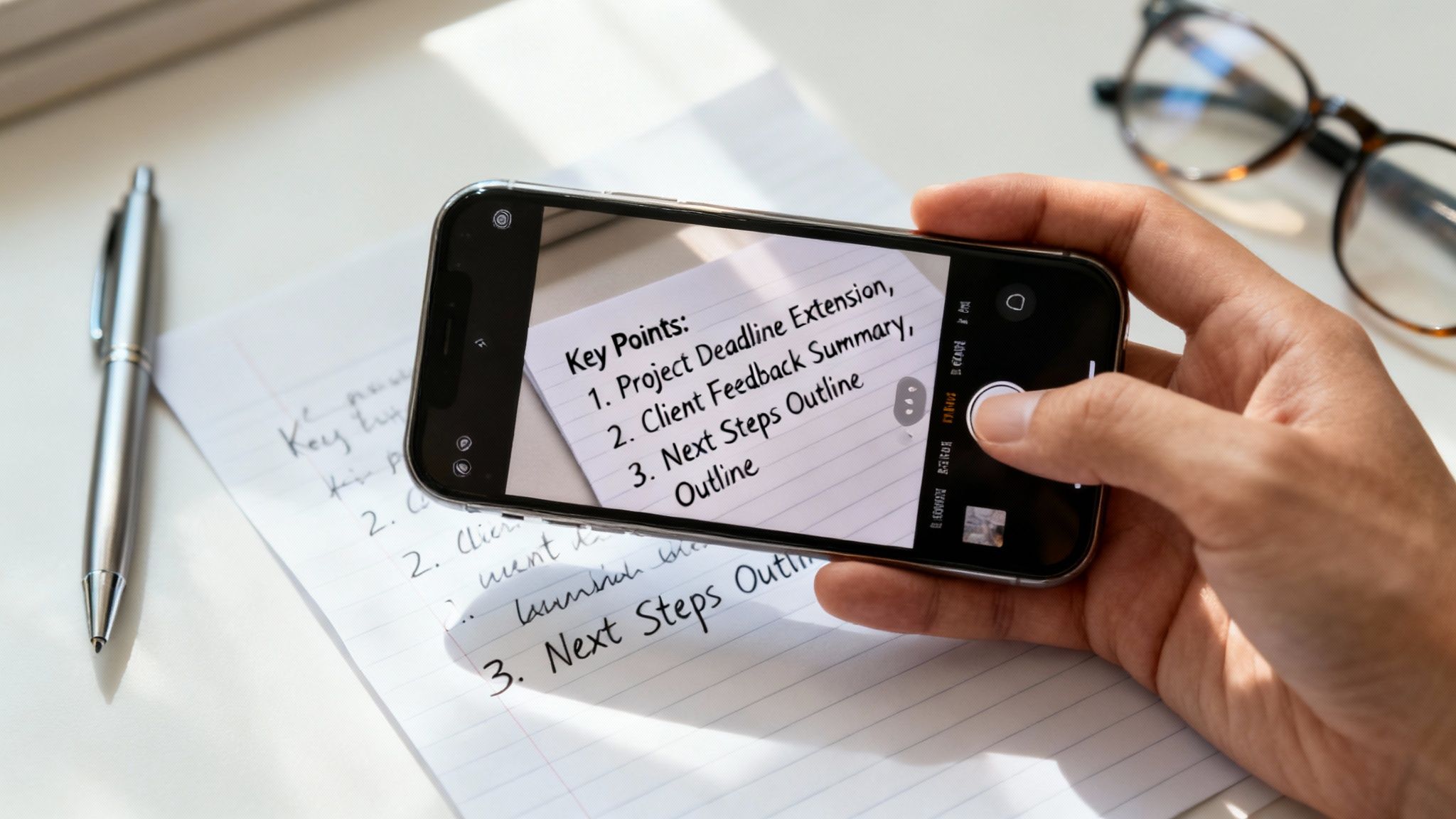
- You finish a chapter and have a page of messy, handwritten notes.
- You snap a quick photo of the page.
- You upload it to an AI tool and ask it to digitize and organize your notes into a clean, bulleted list.
- For an extra step, you could even prompt it to suggest related topics or questions for you to explore next.
This isn’t about letting the AI do the work. It’s about letting it handle the administrative grunt work so you can spend your precious mental energy engaging with the ideas themselves.
Making Your AI-Assisted Notes More Effective
To get the most out of these tools, it helps to guide them. One of the best ways to do this is by mastering keyword extraction from text. This skill helps you quickly pinpoint the central themes of a chapter or an entire book. You can then use this to direct your AI summaries or queries.
It’s no surprise that the note-taking app market is projected to hit $11.11 billion by 2025. Much of that growth is being fueled by tools that help users retrieve ideas up to 30% faster. Think about it: an AI can automatically tag your book notes with themes like “leadership,” “mental models,” or “cognitive biases.” A month later, you can find every insight you’ve ever had on a topic with a single click.
Editor’s Take: What Actually Works
When it comes down to it, the best way to take notes from a book is deeply personal. There’s no one-size-fits-all system. But after years of experimenting, I’ve found that every truly effective approach shares three core traits: it’s active, it involves synthesis, and it’s consistent.

Who This Advice Is For: This guide is best for students, professionals, and lifelong learners who want to retain more from non-fiction books. The methods are designed to turn reading into an active process of learning and application.
What Actually Works: The single most effective habit is summarizing each chapter in your own words immediately after reading it. This forces active recall, which is scientifically proven to build stronger memories. A hybrid approach often works best: use analog notes for deep thinking and then digitize them for long-term organization.
Caveats: Don’t get obsessed with finding the “perfect” system. Consistency is far more important than the specific tool you use. If your system is too complex, you won’t stick with it. Start simple and build from there. Also, remember this advice is geared toward non-fiction; taking notes for fiction is a different experience focused on appreciation, not just information retention.
Key Takeaways: How to Take Notes for a Book
- Read with a Purpose: Always know what you want to get out of a book before you start. This primes your brain to find the most relevant information.
- Engage Actively: Don’t just highlight. Ask questions, challenge arguments, and connect the author’s ideas to your own experiences.
- Summarize in Your Own Words: At the end of each chapter, pause and write a brief summary from memory. This active recall is crucial for long-term retention.
- Choose the Right Tool for You: Analog (pen and paper) is great for deep focus and memory, while digital tools (apps) excel at organization and searchability. The best system is one you will consistently use.
- Synthesize, Don’t Just Collect: After finishing a book, take time to review your notes. Create a one-page summary or mind map to connect the key ideas and solidify your understanding.
- Use AI as an Assistant: Leverage AI tools to handle tedious tasks like summarizing dense text or transcribing notes, but always keep the critical thinking for yourself.
A Few Final Thoughts on Better Note-Taking
If you take away just one thing from this guide, let it be this: effective note-taking is about active engagement. It’s not just passively copying words from a page. This isn’t about creating a perfect, flawless transcript of a book. It’s about having a conversation with the author and, more importantly, with yourself.
Here’s a quick rundown of the core ideas that will genuinely transform how you read and learn.

These are the principles I come back to again and again:
- Read With a Purpose: Before you even open the book, ask yourself: “What am I trying to get out of this?” Having a clear goal primes your brain to hunt for the most relevant insights.
- Summarize in Your Own Words: At the end of a chapter, put the book down. Jot down a quick summary from memory. This simple act forces your brain to process the information, which is the secret to making it stick.
- Connect Ideas to Your Life: Don’t let new concepts just hang in the air. Actively link them to your own experiences, projects, or problems. This makes abstract ideas concrete and far easier to recall later.
- Synthesize Your Notes: Once you’ve finished the book, the real work begins. Take an hour to review all your highlights and scribbles. Then create a single-page summary or a mind map. This is where you connect the dots and solidify your understanding.
Think of these techniques as the foundation of a solid system. If you want to go deeper, we explore more strategies in our guide on how to retain what you read.
Disclaimer: This article contains affiliate links, which may generate a small commission at no extra cost to you. The content provided here is for educational and informational purposes only and is not a substitute for professional medical or psychological advice, diagnosis, or treatment.
Frequently Asked Questions
Let’s dig into some of the most common questions that come up. These answers should help clarify the key ideas from this guide and give you a bit more confidence as you start taking better notes.

1. How do you take notes on a book you own?
When the book is yours, the margins are your playground. This classic method, known as marginalia, is one of the most immediate ways to have a conversation with the text. Underline sentences that land, scribble questions next to confusing parts, and use symbols like asterisks for ideas you want to act on. You’re turning the book into a living document of your thinking.
2. What is the best way to take notes from a book for studying?
For studying, the goal is active recall, not just passive highlighting. After you finish a chapter, close the book. Try to write a short summary from memory, in your own words. This forces your brain to retrieve the information, which builds much stronger memory pathways than rereading ever could. For key terms and concepts, creating flashcards is a tried-and-true method.
3. How can I take notes on an audiobook?
This requires a two-step process. While listening, capture quick voice notes on your phone whenever an insight hits. Later, use a transcription tool to turn those audio snippets into text. From there, you can clean them up and organize them into your primary note-taking app like Notion or Obsidian. This captures the idea in the moment without breaking your stride.
4. Should I take notes for fiction books?
Absolutely, if it deepens your enjoyment! With fiction, your notes will look different. You’re not hunting for “actionable takeaways.” Instead, you might track themes, jot down notes on character arcs, or save a beautifully written sentence that moved you. It’s less about extraction and more about appreciation and understanding the craft of storytelling.
5. How do I organize my book notes so I can find them later?
This is where digital tools really shine. The key is a consistent tagging system. In an app like Notion or Obsidian, you can tag each note with the book’s title, the author, and relevant themes (e.g., “productivity,” “leadership,” “cognitive science”). Over time, this builds a searchable, personal wiki of everything you’ve learned.
6. How many notes should I take per chapter?
Think quality over quantity. Your goal isn’t to transcribe the book. Aim to capture the one to three biggest ideas from each chapter. A great rule of thumb is to force yourself to write a two- or three-sentence summary after you finish a chapter. This small constraint forces you to distill the core message.
7. What’s the difference between highlighting and taking notes?
Highlighting is a passive act of recognition—your brain is just saying, “Oh, that looks important.” It doesn’t require much effort. Taking notes is an active act of processing. You have to summarize, question, or connect an idea in your own words. Real learning happens during that active processing, not passive recognition.
8. How long after reading a book should I review my notes?
Review them within a day or two of finishing the book. This is the sweet spot. Your chapter-by-chapter notes are still fresh in your mind. This makes it the perfect time to synthesize them into a single, cohesive summary or a mind map. This final review cements the book’s big ideas into your long-term memory.
9. Can I use AI to take notes for me?
Think of AI as a smart assistant, not a replacement for your own brain. AI is fantastic for summarizing a dense chapter, transcribing your voice notes, or cleaning up handwritten thoughts into a neat list. But the critical thinking—the questioning, connecting, and internalizing—that’s where the real learning happens. You have to do that part yourself.
10. What if I don’t have time to take detailed notes?
If you’re pressed for time, adopt this one tiny habit. At the end of each chapter, write down one single sentence that captures its main point. This takes less than 60 seconds. It feels almost too simple to work, but it forces that crucial step of active recall. This makes it one of the highest-leverage, time-efficient learning strategies there is.
Ready to build a clearer, more focused mind? Explore the full library of science-backed books and guides at Mind Clarity Hub. Find practical roadmaps to conquer digital burnout, master productivity, and reclaim your attention.
Explore the Mind Clarity Hub Library
Practical books on focus, digital habits, resilience, and building a calmer mind.
The Power of Clarity
Unlock mental focus, build momentum, and create the life you were meant to live.
View book →
AI & ChatGPT for Beginners
No PhD needed — a 2025 guide to AI, prompts, and productivity without coding.
View book →
Zen in the Digital Jungle
Mindfulness for a chaotic world.
View book →
The Slow Reset
Mindful living in a fast-paced world.
View book →
Perfectly Imperfect
Stop self-criticism, set boundaries, and embrace the real you.
View book →
Reclaiming Silence
A dopamine detox guide to finding peace in a noisy world.
View book →
The Focused Freelancer
Productivity, pricing & positioning for independents in 2025.
View book →
ChatGPT Side Hustle System
Launch your AI-driven online business in 30 days.
View book →
Burnout, Interrupted
A proven path to restore energy and reclaim your life.
View book →
Attention Unleashed
Focus strategies for the distracted mind.
View book →
Side Hustle Launchpad
Your quick-start guide to extra income.
View book →
Digital Clarity
Rewire your brain, escape dopamine traps & regain focus.
View book →
Break the Scroll
Reduce screen time and take back control of your life.
View book →
Climate Compassion
Transform eco-anxiety into empowered action.
View book →
Village Mentality
The power of community for mental wellness.
View book →
Restful Nights
Overcoming sleep anxiety in a 24/7 world.
View book →
Connected Again
Combat loneliness and build meaningful relationships.
View book →
Focus Recharged
Mastering attention and productivity in the digital era.
View book →
Marketing Magic with ChatGPT
AI-powered content, campaigns, and copywriting to grow faster.
View book →
The 6-Figure Creator
Turn knowledge into passive income with books, courses & AI.
View book →
Burnout Breakthrough
Reset your work-life balance and thrive in 2025.
View book →
The Emotionally Intelligent Man
A modern guide to self-awareness and communication.
View book →
AI Personalized Wellness
Create your custom health plan with data-driven habits.
View book →
Everyday AI Made Easy
Use ChatGPT and smart tools to simplify life.
View book →
Money Mindfulness
A financial wellness guide for Gen Z & Millennials.
View book →
Startup Smarter with AI
ChatGPT strategies and tools to grow your business.
View book →
ChatGPT for Writers & Creators
Unlock AI-powered brainstorming, drafting & editing.
View book →