


Published:
Heads up: This article contains affiliate links. If you buy something through a link, we may earn a small commission at no extra cost to you. Your support helps us create helpful content like this!
Medical Disclaimer
The ideas and strategies in this article are for informational and educational purposes only. They are not a substitute for professional medical advice, diagnosis, or treatment from a qualified healthcare provider. This content is not intended to diagnose or treat conditions like anxiety, depression, ADHD, or burnout.
Always talk with your physician or another trusted health professional if you have questions about a medical or psychological condition. Never ignore their guidance or delay seeking it because of something you have read here. For more details on our approach to health information, you can also review Mindful-UK’s Medical Disclaimer.
What Is Decision Fatigue and Why Does It Matter?
Ever get to the end of a long day and find that choosing what to watch on Netflix feels like a monumental task? You’re not just tired. You’re experiencing decision fatigue. It’s the quiet erosion of your ability to make good choices after a long stretch of making them. Think of your willpower as a muscle. The more you use it throughout the day, the more exhausted it gets. Each choice, from what to wear in the morning to how to handle a major project, is like one more rep at the gym.
Eventually, that muscle is spent.
The Science Behind a Tired Brain
This mental wear-and-tear has a name in psychology: ego depletion. The core idea, grounded in behavioral research, is that our self-control is a finite resource. As we go through the day, our brain’s command center—the prefrontal cortex—gets overworked from constantly weighing options, making trade-offs, and resisting impulses.
When that happens, your brain starts looking for shortcuts. It’s too tired for careful analysis, so it defaults to the easiest path. This might mean acting impulsively to get a decision over with, or avoiding the choice entirely. It’s why you might renew a subscription you don’t really need—it’s simply easier than deciding to cancel.
Real-World Scenario: Imagine a project manager. She starts her day fresh, carefully allocating resources for a high-stakes project. By 4 PM, after countless emails, team questions, and budget adjustments, a vendor asks for a contract extension with less favorable terms. Her prefrontal cortex is depleted. Instead of carefully analyzing the new terms, she impulsively agrees just to get the task off her plate.
This is closely related to another common challenge we explore in our guide on what is cognitive overload.
To put it simply, here’s how the process usually unfolds.
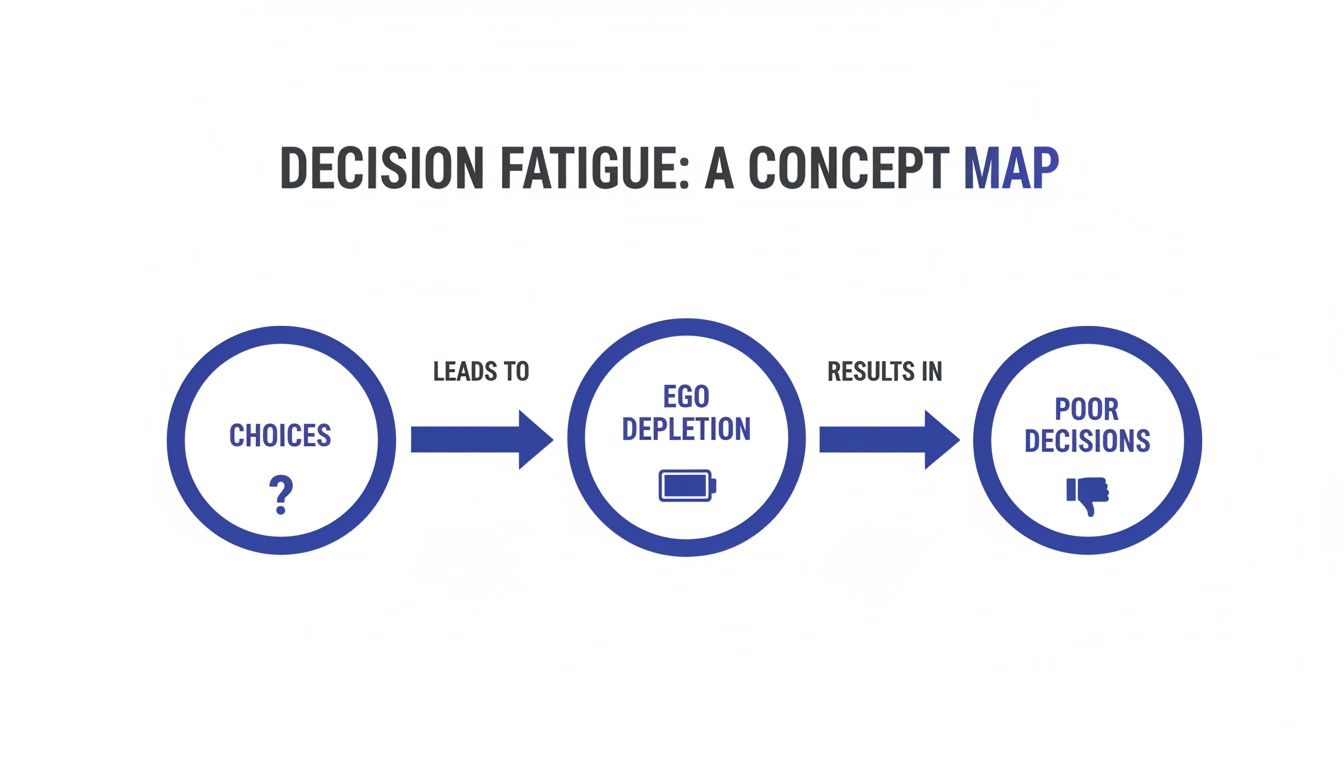
alt=”what is decision fatigue: A concept map showing how numerous choices lead to a tired brain and poor decisions.”
As you can see, the path from being overwhelmed with choices to making poor decisions is a straight line, fueled by the slow drain of your mental energy.
To get a clearer picture of how this works, we can break it down into its core components.
Decision Fatigue At A Glance
This table breaks down the core components of decision fatigue, showing its causes, the mental processes involved, and the common outcomes.
| Core Concept | Underlying Science | Common Outcome |
|---|---|---|
| Too Many Choices | The prefrontal cortex, responsible for executive functions, becomes overworked by constant evaluation. | Mental exhaustion and a reduced capacity for thoughtful decision-making. |
| Ego Depletion | Willpower and self-control are treated as a limited resource that gets used up throughout the day. | Increased impulsivity, procrastination, or defaulting to the easiest option. |
| Degraded Quality | The brain conserves energy by taking mental shortcuts instead of engaging in careful analysis. | Poor choices, decision avoidance, and a higher likelihood of making mistakes. |
Understanding these interconnected parts is the first step toward managing your mental energy more effectively.
How It Plays Out in the Real World
Decision fatigue isn’t just an abstract concept; it has tangible consequences.
Imagine a freelancer who starts their morning sharp and confident, setting fair rates for a new project. Fast-forward to late afternoon. After a dozen client emails, several small project tweaks, and juggling invoices, a client asks for “just one more thing.” Mentally drained, the freelancer agrees to the scope creep without adjusting the price—a choice they’d never have made with a fresh mind.
Their decision-making quality didn’t just dip; it degraded. Recognizing this pattern is the key to protecting your most important choices, a central theme I explore in my book, The Power of Clarity.
Recognizing the Signs of Decision Fatigue in Daily Life
Decision fatigue isn’t a dramatic breakdown. It’s more like a slow, quiet leak in your mental energy. The first step to plugging that leak is learning to spot the subtle signs that it’s happening. It often shows up looking like laziness or garden-variety stress, but the real root is cognitive exhaustion.
So, how do you know when your decision-making battery is running low? It creeps into your behavior in ways that might seem completely unrelated to the choices you’ve been making all day. Learning to spot these patterns is the key to managing your mental resources before they run dry.
Common Symptoms You Might Overlook
Decision fatigue often wears the mask of procrastination. You know you have three important work emails to answer, but instead, you spend an hour meticulously organizing your desktop icons. This isn’t laziness; it’s decision avoidance. Your brain is too tired to grapple with complex choices, so it defaults to a simple, low-stakes task that feels productive but isn’t.
Another classic sign is impulsive behavior. After a day packed with back-to-back meetings and constant problem-solving, you might find yourself mindlessly adding things to an online shopping cart you don’t need. Your prefrontal cortex, the part of your brain that governs self-control, is depleted. As a result, the easy, gratifying choice—buy the thing—wins out over the more rational one. This can feel a lot like the mental drain that contributes to what causes brain fog, where clear thinking becomes a real struggle.
Finally, there’s a heavy reliance on the default option. This is when you let a subscription renew even though you don’t use it, simply because the act of canceling feels like too much work. To conserve its last scraps of energy, your brain just sticks with the path of least resistance.
“Decision fatigue doesn’t feel like a dramatic breakdown. It feels like taking the easiest path—saying ‘yes’ to one more cookie, skipping the gym, or sticking with the default settings—because you simply lack the mental capacity to argue with yourself.”
Are You Experiencing Decision Fatigue?
Sometimes it’s hard to tell the difference between a tough day and a pattern of cognitive exhaustion. This simple checklist can help you connect your everyday behaviors to the underlying strain of decision fatigue. See if any of these feel familiar.
| Symptom | What It Looks Like (Real-World Example) | A Simple First Step |
|---|---|---|
| Procrastination | You have a big project to start, but you spend the morning answering unimportant emails and tidying your desk. | Pick one tiny, 5-minute task related to the project and do only that. |
| Impulsive Choices | After a stressful workday, you order expensive takeout you can’t really afford instead of cooking. | Decide what you’ll have for dinner before 4 PM, when your willpower is stronger. |
| Decision Avoidance | You put off making a simple choice, like which doctor to call, for days or even weeks. | Ask a trusted friend for their opinion to break the inertia. |
| Sticking to Defaults | You keep paying for a streaming service you never watch because canceling seems like too much effort. | Set a calendar reminder for 10 minutes tomorrow to find and click the “cancel” link. |
| Irritability | A simple question like “What do you want for dinner?” makes you feel instantly annoyed and overwhelmed. | Have a go-to “no-decision” meal for tired nights (e.g., eggs on toast, leftovers). |
If you see yourself in a few of these examples, it doesn’t mean you’re failing. It’s just a signal that your brain is overloaded and needs more support.
Practical Tools for Real-World Scenarios
Once you start recognizing these signs, you can become proactive instead of reactive. If you notice a pattern of making poor food choices or impulse buys in the evening, you can build systems to protect your future self from your tired self.
Using a time blocking planner to schedule your most important decisions for the morning—when your willpower is at its peak—is a simple but incredibly effective strategy. For those prone to late-night impulse buys, a phone lock box timer can create a physical barrier between you and mindless scrolling. By consciously designing your environment, you drastically reduce the number of in-the-moment choices you have to make when you’re already running on empty.
How Decision Fatigue Chips Away at Your Productivity and Well-Being
Decision fatigue isn’t some vague feeling of being mentally tired. It has real, measurable costs that can quietly sabotage your most important goals. The constant drain on your mental bandwidth doesn’t just make you feel overwhelmed; it directly degrades the quality of your decisions and your overall sense of well-being.
When your brain is fried from making one choice after another, its ability to handle high-level thinking plummets. This isn’t just a hunch; the data backs it up. A working paper from the National Bureau of Economic Research found that the accuracy of financial analysts’ forecasts dropped significantly over the course of a day.
By their fourth or fifth forecast, their prediction errors jumped by a staggering 12-15% compared to their first one. It’s a clear picture of a brain shifting from careful, deliberate analysis to tired, error-prone shortcuts. For anyone running their own business, this is a stark reminder that making critical financial or strategic calls when you’re fatigued can lead to expensive mistakes. You can see the full financial study here.
The Ripple Effect on Your Professional Life
This mental drain has a direct, and often invisible, impact on your productivity.
Think about a manager trying to make a hiring decision late on a Friday. After a full week of back-to-back meetings and putting out fires, their ability to thoughtfully weigh each candidate is shot. They’re far more likely to rush the choice or just go with a gut feeling instead of objective criteria. The result? A bad hire that costs the company precious time and money.
Or picture an entrepreneur who spends all morning making dozens of small operational decisions. By the evening, when it’s time to price a major project, their mental gas tank is empty. They might underprice their work just to get the decision over with, leaving a huge amount of revenue on the table. Even small physical annoyances, like a poorly designed workspace, can pile on. Simply using an ergonomic mouse can reduce the physical strain that quietly adds to this mental load.
The Toll on Your Personal Well-Being
The damage from decision fatigue doesn’t stop when you close your laptop. It’s a major contributor to the downward spiral of burnout, a topic I explore in-depth in my book, Burnout Breakthrough.
When you arrive home completely drained, you have almost no willpower left to make healthy choices. This is the exact reason you might skip a planned workout or grab greasy takeout instead of cooking the healthy meal you intended. Your brain, desperate for the path of least resistance, defaults to whatever brings the quickest reward.
These seemingly small daily choices—the workout you skipped, the easy meal you ordered—add up. Over time, they lead to more stress, worse health habits, and a gnawing sense of being completely underwater. Understanding the science behind dopamine and motivation can really shine a light on why our brains fall into this trap.
Actionable Strategies to Combat Decision Fatigue
Knowing you have decision fatigue is one thing; fighting back is another. The key isn’t just reacting to exhaustion but building systems that actively conserve your mental energy. We can organize these practical, evidence-based tactics into three pillars: Simplify, Automate, and Recharge.

These pillars work together to lower the daily cognitive load that quietly drains your focus and willpower.
Simplify Your Choices
The most direct way to push back against decision fatigue is to eliminate trivial choices from your day altogether. By creating routines, you put low-impact decisions on autopilot, saving that precious brainpower for what truly matters.
- Create a “Uniform”: Decide on a few go-to work outfits for the week. This single choice saves you from staring into your closet every morning, burning mental fuel before you’ve even had coffee.
- Plan Your Meals: Spend an hour on Sunday mapping out your meals. This prevents the daily “what’s for dinner?” debate that hits right when your energy is at its lowest.
- Standardize Small Decisions: Always park in the same area of the lot. Buy the same brand of staple groceries. These micro-decisions add up, and standardizing them removes dozens of tiny mental speed bumps from your day.
A simple habit tracker journal can be a fantastic tool here, helping you build and stick to these new simplifying routines. It’s the consistency that makes these strategies so powerful.
Automate and Batch Your Tasks
Automation isn’t just for complex software; it’s a mindset. It’s about grouping similar tasks together and using tools to handle repetitive work, which frees up your mental RAM.
For instance, instead of letting email interrupt you every 15 minutes, batch it into two or three dedicated blocks per day. This stops the constant context-switching that kills deep focus. A core strategy here is learning how to prioritize tasks at work, which often involves delegating lower-priority items to get them off your plate entirely.
A pomodoro timer is perfect for this batching approach. It helps you focus intensely for a set period and then take a short, deliberate break, structuring your work sessions to protect you from mental drain. For a deeper dive, check out our guide on how to automate repetitive tasks.
Recharge Your Cognitive Battery
You cannot out-work a depleted brain. Strategic rest is non-negotiable for restoring your decision-making capacity. This goes far beyond just getting enough sleep—it’s about weaving recovery moments into your actual workday.
The data on this is startling. One study of physicians found that after making just six consecutive patient decisions, their diagnostic error rates spiked by 15-25%. That’s a massive drop in performance from a relatively small number of choices, and it underscores just how quickly our cognitive batteries drain without proactive rest.
Strategic breaks aren’t a sign of weakness; they are a sign of professional self-awareness. Taking just 5-10 minutes to step away from your screen can help reset your prefrontal cortex, improving the quality of your very next decision.
Putting on noise-canceling headphones for a few minutes of pure silence can be a powerful way to guard your focus and recharge. Ultimately, though, quality sleep is the foundation of all cognitive recovery, a theme I explore in my book, Restful Nights.
Editor’s Take
Here’s the honest truth: the best way to beat decision fatigue is to get ahead of it. It’s less about finding a magic cure for a tired brain and more about building systems that ruthlessly eliminate non-essential choices from your day. This is especially true for busy professionals, creatives, and anyone feeling the slow drain of a ‘death by a thousand cuts’ from dozens of tiny, daily decisions.
A word of caution, though: trying to fix everything at once can ironically cause more fatigue. Start with just one area. Maybe it’s planning your entire work week on Sunday or creating a dead-simple morning routine you don’t have to think about. A productivity journal can be a great ally here, helping you track that slow, sustainable progress.
By systematically chipping away at the number of choices you have to make, you reclaim your best mental energy for the decisions that actually move the needle. This is a core idea I explore in my book, The Power of Clarity.
Key Takeaways
Feeling mentally shot by the end of the day? It’s probably not just you—it’s the sheer weight of choices. Here’s a quick rundown of decision fatigue and how to get a handle on it.
- What Is Decision Fatigue, Really? It’s the slow decline in your ability to make good choices after a long stretch of making them. Think of your willpower like a muscle. Each decision, big or small, is another rep. Eventually, that muscle gets tired.
- How to Spot It in the Wild: The classic signs are putting off important tasks, making impulsive choices you second-guess later, or just defaulting to the easiest option because you’re too drained to think through anything else.
- How to Push Back: You can fight this mental drain. The best tools are simplifying your routines (like planning meals for the week), automating small decisions (like handling all your email in one batch), and taking real breaks to let your brain actually recharge.
- Guard Your Best Hours: Your brain is sharpest in the morning. That’s your prime time. Schedule your most important and complex decisions for this window to give them the best mental energy you’ve got.
A Final Note on This Guide
Just so you know, some of the links in this article are affiliate links. This means if you decide to purchase something through them, we might earn a small commission—at absolutely no extra cost to you.
It’s also important to remember that everything here is for informational purposes. This guide isn’t a substitute for professional medical or psychological advice. If you have a health concern, please talk to a qualified professional. Your well-being is the top priority, and a real person can offer guidance that’s tailored to your specific situation.
Your Questions on Decision Fatigue, Answered
To help you put these ideas into practice, I’ve gathered some of the most common questions that come up. Think of this as a quick reference to solidify your understanding and get you started on the right foot.
1. What is the best way to start combating decision fatigue?
Start small. Honestly, the single most effective thing you can do is simplify one recurring daily choice. Don’t try to overhaul your entire life overnight. Just pick one thing—like laying out your work clothes for the whole week on Sunday, or eating the same healthy breakfast every weekday. This gives you an immediate, easy win and starts saving you mental energy from day one.
2. Is decision fatigue the same as just being tired?
Not quite, though they definitely feel related. General tiredness is that familiar feeling of physical or mental exhaustion after a long day. Decision fatigue, sometimes called ego depletion, is different—it’s a specific decline in the quality of your choices that happens after you’ve made too many of them. You can be physically rested on the couch and still be suffering from a bad case of it.
3. Can decision fatigue affect my physical health?
Absolutely, though it’s usually indirect. When your willpower is shot, you’re far more likely to make the easy, less healthy choice. You order the greasy takeout instead of cooking, skip the workout you planned, or stay up an hour too late scrolling. Over time, these small, fatigue-driven decisions can have a huge impact on your well-being. A good night’s sleep is a powerful antidote; tools like a sleep mask blackout can really help improve sleep quality, which is crucial for restoring willpower.
4. How long does it take to recover from a bout of decision fatigue?
Recovery time varies, but the good news is that even short, strategic breaks work wonders. A 10–15 minute walk outside, listening to a favorite album with noise canceling headphones, or just stepping away from your screen can start to refill your mental tank. Of course, a solid night of sleep is the ultimate reset button for your brain’s executive functions.
5. Does technology make decision fatigue worse?
Without a doubt. Every single notification, email, and app alert forces a micro-decision: “Do I deal with this now?” This constant, low-grade stream of choices is one of the biggest drivers of cognitive overload in modern life. We actually have a whole guide with practical strategies for this, which you can find right here: digital detox tips.
Understanding More About What is Decision Fatigue
6. Are some people more prone to decision fatigue than others?
Yes, definitely. People in high-stakes roles who make one critical choice after another—think doctors, air traffic controllers, or senior managers—are highly susceptible. Personality plays a role, too. If you tend to overthink or ruminate on every option, you might find your mental battery drains a lot faster than someone who is naturally more decisive.
7. What is the “default choice” and how does it relate to this?
The default choice is simply the option that gets selected if you do nothing. When your brain is fried from making decisions, it desperately wants to conserve energy, so it will almost always stick with the default. This is why you keep paying for a subscription you don’t use or stick with a utility provider that overcharges. It’s a classic sign that your cognitive resources are running on empty.
8. Can I improve my ‘decision-making stamina’ over time?
Yes, you absolutely can. Think of it like strength training for your willpower. By building strong habits and routines, you automate the low-impact decisions (what to wear, what to eat for lunch). This builds a much stronger reserve of mental energy for the high-impact choices that actually move your life forward. A habit tracker journal is a fantastic tool for making this process visual and consistent.
9. What’s the difference between decision fatigue and burnout?
This is a great question. Decision fatigue is a short-term cognitive state that you can often fix with rest, a good meal, or simplifying your day. Burnout, which I cover in-depth in my book Burnout Interrupted, is a much more severe, long-term state of emotional, physical, and mental exhaustion caused by prolonged stress. Think of it this way: chronic, unmanaged decision fatigue can be a major highway leading directly to burnout.
10. Does my physical workspace affect decision fatigue?
It has a much bigger impact than most people realize. A cluttered, messy desk forces your brain to make constant, tiny decisions about where to look and what to ignore. That visual noise is draining. A clean, organized setup with helpful tools like a laptop stand for desk and a monitor light bar reduces that friction, helping you preserve your precious cognitive energy for the work that matters.
