


Published:
Disclosure: This post may contain affiliate links. If you purchase through these links, we may earn a small commission at no extra cost to you. We only recommend products we believe in.
If you want to stop multitasking, you have to see it for what it is. It is not a skill but a habit of rapidly switching between tasks. This constant gear-shifting drains your mental energy and tanks your productivity. The fix is to intentionally focus on one single thing at a time. This involves building an environment that protects you from interruptions.
The Hidden Costs of Multitasking
Ever find yourself juggling emails during a meeting while a project deadline looms? You definitely feel busy, but are you actually being productive? This is the core myth of multitasking in action. We believe we’re doing several things at once. However, neuroscience paints a very different picture of this process.
Our brains aren’t wired to run complex tasks in parallel. What’s really happening is task-switching—a frantic back-and-forth between activities. Every single time we switch, our brain pays a price. This is crucial for anyone learning how to stop multitasking.
Understanding the Brain’s ‘Switch Cost’
This mental toll is known as the “switch cost.” Think of it like shifting gears in a manual car. There’s a burst of effort and a brief loss of momentum. When you toggle from a spreadsheet to an email and back again, your brain disengages from one set of rules. Then, it must completely reload another. This constant gear-shifting is exhausting for your brain.
It’s this cognitive friction that leaves you feeling wiped out at the end of the day. You often have little to show for your efforts. You’ve burned more energy managing the act of switching than on the actual work. Over time, this constant drain is a fast track to mental fatigue and burnout. We dive deep into this topic in our book, Burnout Interrupted.
A Real-World Example of Cognitive Friction
Let’s look at Alex, a marketing manager. On their screen are three open windows. These include a creative brief for a new campaign, an active team chat, and their email inbox. This setup is common for people who need to learn how to stop multitasking.
A chat notification pops up. Alex clicks over to answer a “quick question.” Just as they finish, an urgent email arrives. They switch again, draft a response, and finally return to the creative brief. But now, the original train of thought is gone. The creative spark is replaced by a sense of mental clutter. Each tiny interruption derailed their focus. This is the switch cost in real-time, sabotaging deep work.
Alex’s experience is backed by research. A landmark study found that productivity can plummet by as much as 40% when people try to multitask. What we call multitasking is just rapid task-switching. It racks up a hefty cognitive price. In a typical office, it can take up to 23 minutes to regain focus after a single distraction. You can explore the data behind this in this in-depth analysis.
By the end of the day, Alex has touched many tasks but completed none to a high standard. Their brain feels overworked, and the campaign brief remains unfinished. This cycle of fragmented attention is a direct path to cognitive overload.
Understanding this hidden cost is the first, most crucial step. Once you recognize that multitasking is an illusion—a draining habit—you can start looking for a better way. The goal isn’t just to get more done. It’s to do better work with far less mental strain.
Multitasking Myths vs Single-Tasking Reality
It’s easy to stick with multitasking because we’ve been told it’s a valuable skill. But when you look at cognitive science, the story falls apart. Here’s a breakdown of common myths versus the reality of how your brain works. Learning how to stop multitasking starts with busting these myths.
| Common Myth About Multitasking | Scientific Reality of Single-Tasking |
|---|---|
| “Multitasking makes me more productive and efficient.” | “Productivity drops by up to 40%. Single-tasking allows for deep focus, producing higher-quality work in less overall time.” |
| “I’m good at it—I can handle multiple things at once.” | “Our brains can’t truly do two complex tasks simultaneously. You’re just task-switching, which increases errors and mental fatigue.” |
| “It’s necessary to keep up in a fast-paced environment.” | “Single-tasking reduces the time lost to re-focusing (up to 23 mins per interruption), making you more agile and responsive.” |
| “I’ll miss something important if I’m not always connected.” | “Focused work blocks followed by intentional check-ins lead to better outcomes than being in a state of constant partial attention.” |
| “Doing one thing is boring and slow.” | “Single-tasking creates a state of ‘flow,’ which is deeply engaging and rewarding. It reduces stress and the feeling of overwhelm.” |
Seeing the comparison laid out like this makes it clear. The promise of multitasking is a mirage. The real gains in clarity, quality, and well-being come from embracing how our brains are built. They are designed to do one thing well.
How to Stop Multitasking: Laying Your Single-Tasking Foundation
Ready to trade multitasking chaos for the calm of deep focus? This shift doesn’t require a massive life overhaul. It starts with a few foundational habits that gently retrain your brain. You can learn to do one thing at a time, and do it well.
The first step is simply to stop making your brain switch gears so often. This is where task batching comes in. It’s the simple practice of grouping similar activities together. Then you tackle them in one dedicated block of time. Instead of answering emails as they trickle in, set aside two 30-minute windows for your inbox. This is a powerful strategy for those learning how to stop multitasking.
This works because it honors how our brains operate best. By sticking to one type of task, you stay in the same cognitive “mode.” You avoid the jarring mental leap from jumping between different activities. This preserves your precious mental energy.
Embrace the Power of Time Blocking
To put task batching into practice, many people find a time blocking planner is a game-changer. This isn’t just a to-do list. It’s a concrete commitment to how you’ll spend your time.
- Mini-Scenario: A freelance writer named Sarah used to start her day by checking emails. Then she would check social media, write a few sentences, and jump back to emails. Her mornings felt scattered. By adopting time blocking, she now dedicates 9:00 AM to 10:30 AM exclusively to writing. Her phone is in another room, and her email client is closed. The result? She produces higher-quality work in less time because her focus is totally undivided.
Frequent multitasking doesn’t just slow you down. It also spikes your stress and burnout risk. This constant context-switching can devour up to 40% of your productive time. You can read the full research on job demands and multitasking to understand the impact.
The following infographic drives this point home. It shows how the juggle of multitasking inevitably leads to a decline in performance.
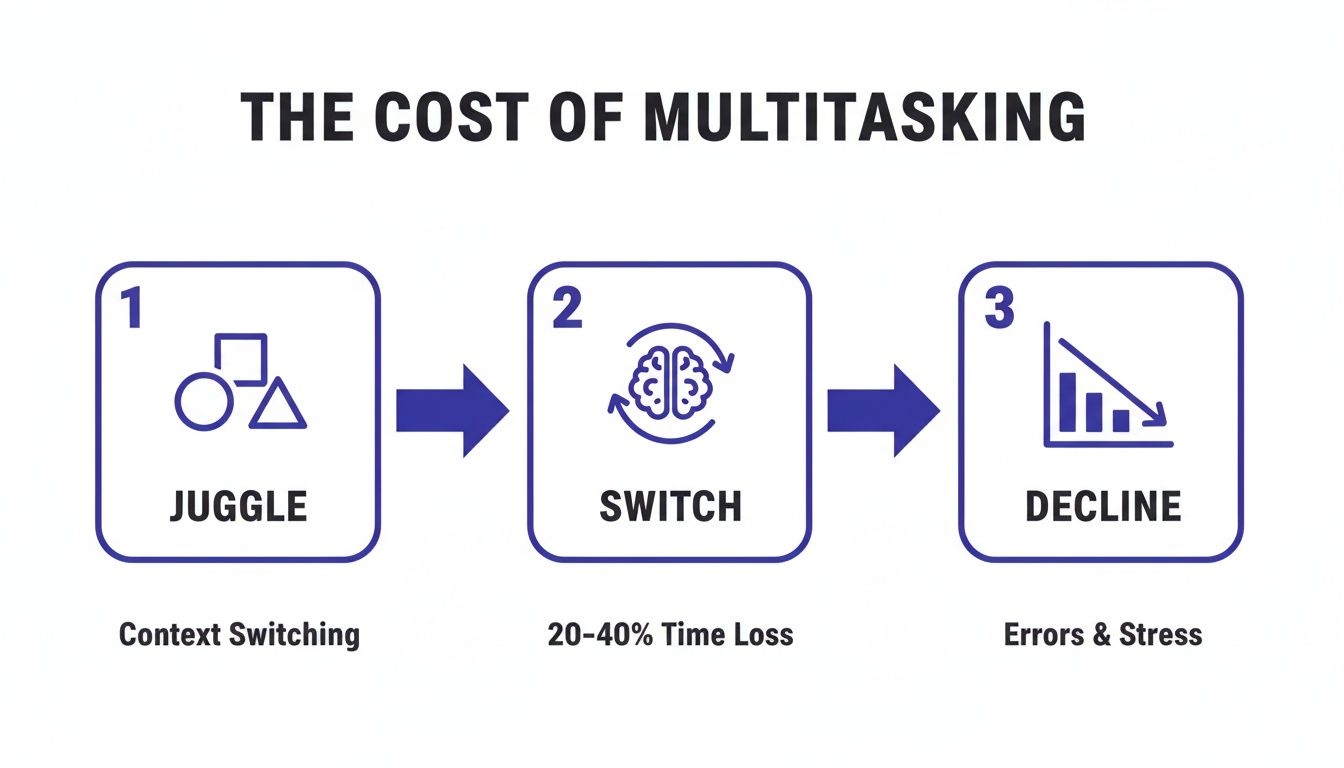
This visual makes it painfully clear. Every time you switch away from your main task, you pay a hidden cognitive price. This ultimately leads to errors and exhaustion.
Build Focus Endurance with the Pomodoro Technique
If a 90-minute focus block feels intimidating, start smaller. The Pomodoro Technique is a fantastic method for building focus endurance. It’s incredibly simple:
- Choose one task. Just one.
- Set a timer for 25 minutes. A simple pomodoro timer is perfect for this.
- Work on that single task without interruption until the timer goes off.
- Take a short 5-minute break. Get up, stretch, or look out a window.
- Repeat. After four “Pomodoros,” take a longer break of 15-30 minutes.
This technique trains your brain to sustain attention in manageable bursts. It provides a structure to resist the urge to switch tasks. It proves to yourself that you can stay focused for a set period. If concentration is a battle, our guide on how to train your brain to focus can help.
Conduct a Personal Distraction Audit
Finally, you can’t fight an enemy you can’t see. A distraction audit is a simple exercise to identify your personal focus-killers. For one full workday, keep a notepad handy. Just make a tally mark every time you get distracted or switch tasks on impulse.
At the end of the day, look at your list. Was it the ping of social media notifications? A noisy coworker? The urge to check the news? Identifying your top three distractions is the first step toward creating a targeted plan to neutralize them. This is a practical step in learning how to stop multitasking.
Designing Your Distraction-Proof Environment to Stop Multitasking
Your environment can be your greatest ally or your biggest saboteur. Learning how to stop multitasking often starts with smart, intentional design. When you deliberately engineer your workspaces, you reduce the number of in-the-moment decisions. This helps you control what gets your attention.
Think of your workspace as a cockpit for deep work. Every element should serve a purpose. Anything that doesn’t needs to go. For most of us, that cleanup process starts with our digital world. It is usually the loudest source of interruptions.

Taming Your Digital Space
The constant barrage of notifications is the primary enemy of single-tasking. Each ping, buzz, and banner is a siren call for your brain to switch tasks. This triggers that costly mental gear shift. It’s a tax on your attention.
The first step is to practice a form of digital minimalism. This isn’t about abandoning technology. It’s about using it on your own terms. Turn off all non-essential notifications on your phone and computer. Social media alerts, news, and promotional emails can all wait. You decide when to check them, not the other way around. My book Digital Clarity offers a complete guide on this topic.
Next, reclaim your browser. It’s so easy for it to become a minefield of distraction. Use extensions to block time-wasting websites during your focus blocks. Get into the habit of closing all unrelated tabs. This simple act creates a clean, focused digital canvas.
Engineering Your Physical Focus Zone
The space around you sends powerful cues to your brain. A cluttered desk quietly encourages a cluttered mind. On the flip side, an organized space is a direct invitation to focus. This is a key principle in how to stop multitasking.
Real-World Scenario: I once coached a remote worker, Maria. Her desk was a mess of old mail, coffee mugs, and tangled wires. Her email pinged constantly. She felt scattered all day. By spending just 15 minutes clearing her desk, silencing her phone, and putting on noise canceling headphones, she transformed her space. The headphones sent a clear “do not disturb” signal to her family.
These physical cues are surprisingly effective. They help create a ritual that transitions your brain into a state of deep concentration.
Here are a few simple adjustments that make a huge difference:
- A Tidy Workspace: A clear desk means fewer visual stimuli competing for your attention. Keep only the essentials for your current task within arm’s reach.
- Ergonomic Comfort: A proper setup minimizes physical discomfort that can pull you out of a flow state. A laptop stand for desk and a quality ergonomic keyboard can prevent strain.
- Strategic Boundaries: If you work in a shared environment, physical boundaries are crucial. It’s worth exploring how you can create distraction-free zones.
Mindful Environmental Design
Creating a distraction-proof environment isn’t a one-and-done project. It’s an ongoing practice of being mindful. You need to consider how your surroundings affect your state of mind. You can go deeper by learning how light, sound, and architecture affect cognitive performance in our guide.
By taking control of both your digital and physical environments, you’re building an external support system. You’re making focus the path of least resistance. That’s the real secret to making the single-tasking habit stick for good.
How to Stop Multitasking by Mastering the Psychology of Deep Focus
Winning the war against multitasking is mostly an inside job. Changing your environment is a great start. However, the real victory comes from understanding and taming the internal urges that pull you away. This is the heart of learning how to stop multitasking.

That constant pull toward distraction is rooted in your brain’s chemistry. Every time you switch tasks, your brain gets a tiny hit of dopamine. This neurotransmitter is tied to pleasure and novelty. It creates a powerful feedback mechanism known as a dopamine-seeking loop.
Your brain starts to crave the novelty of the next ping or email. It rewards you for switching, not for focusing. This makes multitasking feel compelling, almost addictive. This happens even when you know it’s wrecking your productivity.
Mindful Awareness Over Willpower
You can’t break this cycle with brute-force willpower. A much better approach is to cultivate mindful awareness. This is the simple act of noticing the impulse to switch tasks without immediately acting on it. It’s about creating a tiny pause between the urge and your action.
Scenario: The Focused Student
Picture Leo, a student studying for an exam. His phone is on his desk, silent. He feels a sudden, intense urge to check it. Instead of grabbing it, he pauses. He takes one deep breath and acknowledges the feeling: “There’s the urge to check my phone.” He doesn’t judge it; he just observes it. After a moment, the intensity fades, and he turns back to his textbook.
This small moment of non-reaction weakens the dopamine loop. Each time you notice the urge and gently redirect your focus, you’re retraining your brain. Using a simple habit tracker journal can be a fantastic way to log these small wins.
Think heavy multitaskers are masters of chaos? A classic Stanford study found the opposite. It showed that chronic multitaskers make 50% more errors. They are also slower to switch between tasks than people who focus on one thing. The research makes it clear: multitasking actively erodes the cognitive skills needed for deep work.
Set Boundaries to Protect Your Focus
Managing your internal state also means communicating your needs to others. You have to protect your focus time by setting polite but firm boundaries. Many people hesitate to take this step. They worry they’ll seem unhelpful or rude.
But clear communication is an act of respect—for your own work and for your colleagues. Here are a few simple scripts you can adapt:
- For interruptions at your desk: “I’m in a deep focus session right now. Can I swing by your desk in about an hour when I’m at a good stopping point?”
- For non-urgent chat messages: “Thanks for reaching out. I’m heads-down on the project report until 3 PM but will get back to you right after that.”
These small scripts protect your concentration without damaging relationships. To really nail this, you need practical strategies to stay focused at work.
Editor’s Take: What Really Works to Stop Multitasking
Let’s be honest: breaking the multitasking habit is a marathon, not a sprint. This guide is for busy professionals, students, and creators who feel scattered. It is for those who know their current approach isn’t sustainable.
If you’re looking for the most effective strategies, design a distraction-proof environment. Also, use a pomodoro timer to build your ‘focus muscles’ in short bursts. These two actions are almost always the most effective.
For most people, combining a time blocking planner with conscious task batching delivers the quickest results. It creates the structure your brain craves. It also minimizes the cognitive whiplash of constantly switching gears. Exploring the principles of what is deep work can give you a powerful framework.
A critical caveat: This content is educational and not a substitute for professional care for conditions like ADHD, anxiety, or burnout. It offers general guidance on productivity and focus for a broad audience. Always consult with a qualified professional for personalized advice.
Ultimately, learning to stop multitasking is less about willpower. It is more about building a system that makes focus the path of least resistance. Small, consistent changes will always beat occasional heroic efforts to “just focus harder.”
Key Takeaways: How to Stop Multitasking for Good
- Multitasking is a myth: Your brain is actually task-switching, which drains energy and reduces productivity by up to 40%.
- Start with structure: Use time blocking and task batching to group similar activities together, minimizing mental gear-shifting.
- Build focus endurance: Practice the Pomodoro Technique (25 minutes on, 5 minutes off) to train your attention span in manageable intervals.
- Design your environment: Create a distraction-proof physical and digital workspace by clearing clutter and silencing non-essential notifications.
- Understand the psychology: Recognize the dopamine-seeking loop that makes multitasking feel addictive and use mindfulness to create a pause before acting on distractions.
- Set clear boundaries: Politely communicate your focus periods to colleagues to protect your concentration and improve work quality.
FAQ: Your Questions on How to Stop Multitasking
Deciding to move away from a habit as wired-in as multitasking is going to bring up some questions. It’s totally normal. Here are some honest answers to the most common concerns.
1. Is It Ever Okay to Multitask?
Yes, but it’s all about the kind of tasks you’re pairing. The real distinction is between tasks that need brainpower and those that are automatic. It’s fine to multitask when one activity is routine. Think listening to a podcast while folding laundry or using an under desk walking pad during an audiobook. These work because one task is on autopilot. Where you run into trouble is trying to pair two things that both demand focus. That’s not multitasking; it’s just doing two things badly.
2. What If My Job Demands I Multitask?
This is a big one. Many jobs create the illusion that you have to be a master multitasker. But what they usually want is someone who can manage multiple priorities without letting anything drop. Instead of juggling everything, start communicating your workflow. Try batching email and Slack messages into dedicated blocks. Politely let your team know when you’re in a deep work session. You’ll find you produce higher-quality work and are actually more responsive. Learning these boundaries is a huge part of what we cover in Reclaiming Silence.
3. How Long Does It Take to Break the Multitasking Habit?
There’s no magic number here. Behavioral science tells us it can take anywhere from a few weeks to several months. The real key is consistency, not perfection. Don’t get discouraged if you slip back into old patterns. Every time you focus on one thing—even for just one Pomodoro session with a visual timer for desk—you’re strengthening the neural pathways for concentration.
4. Can Multitasking Actually Hurt My Brain?
Yes, chronic multitasking can have a real cognitive cost. Research shows that heavy multitaskers often struggle more with filtering out irrelevant information. They also have difficulty managing their working memory and switching tasks efficiently. By constantly practicing distraction, you get better at being distracted. The good news is the reverse is also true. You can retrain your brain for deep work with consistent single-tasking.
5. I Feel Anxious or Bored When I Try to Single-Task. What Should I Do?
This is an incredibly common feeling. Your brain has likely grown accustomed to the constant dopamine hits from jumping between tasks. When you take that away, it can feel like withdrawal. The fix is to start small. Don’t try to leap into a two-hour deep work session overnight. Use the Pomodoro Technique to practice for just 25 minutes. When that urge to switch tasks pops up, just notice it without acting. This helps you build your tolerance for focus.
How to Stop Multitasking in a Distracting World
6. How Do I Actually Start Single-Tasking?
The best way to start is with a few concrete moves. First, grab a time blocking planner and give your day structure. Second, create a distraction-free bubble by turning off notifications and clearing your workspace. Finally, practice the Pomodoro Technique to build focus endurance. These small, structured steps make the transition feel doable. For a full roadmap, our book The Power of Clarity is a fantastic resource.
7. What Tools Can Help Me Stop Multitasking?
A few simple tools can make a huge difference. A physical pomodoro timer gives your focus sessions structure. A productivity journal helps you plan your day with intention. For your environment, quality noise canceling headphones are invaluable. And if your phone is your weakness, a phone lock box timer can be a surprisingly powerful tool.
8. How Do I Handle Interruptions from Coworkers?
Handling interruptions gracefully is a skill. It’s all about being polite but firm in protecting your focus. You can use simple scripts like: “I’m in a focus block right now, but I can circle back with you at 3 PM.” This approach respects your colleague’s needs while honoring your commitment to your work.
9. Will Single-Tasking Make Me Fall Behind?
This is a common fear, but the opposite is almost always true. It might feel slower at first, but single-tasking eliminates the “switch cost.” Because you’re producing higher-quality work with fewer mistakes, you’ll spend far less time on revisions. You’ll end your day with more completed projects, not a long list of half-finished ones.
10. What If I Have ADHD or Another Condition That Affects Focus?
If you have a condition like ADHD, strategies like time blocking and using timers can be helpful. However, it’s important to recognize that generic productivity advice may not fully address your unique neurobiology. This article is for educational purposes and is not a substitute for professional medical or psychological advice. It’s crucial to work with a healthcare professional to build a personalized plan.
Disclaimer: This article is for educational and informational purposes only and does not constitute medical or psychological advice. The content is not intended to be a substitute for professional consultation, diagnosis, or treatment. This post may also contain affiliate links, which means we may earn a small commission on purchases at no extra cost to you.
At Mind Clarity Hub, we believe reclaiming your focus is the first step toward a more productive and peaceful life. Our collection of books, including Attention Unleashed and The Focused Freelancer, provides science-backed roadmaps to help you master your attention in a world full of distractions.
