


Feeling scattered? Like your brain is juggling a dozen tabs while notifications ping, emails pile up, and your to-do list just keeps growing? You’re not alone.
The answer isn’t to force a perfectly empty mind—that’s a recipe for frustration. Instead, learning how to be present is a skill you build with small, consistent actions, gently guiding your attention back to the here and now. This guide offers practical, evidence-based strategies to help you navigate a busy world with greater calm and clarity.
This article may contain affiliate links. If you make a purchase through these links, we may earn a small commission at no extra cost to you. We only recommend products we trust. Thank you for your support.
The Four Pillars of Presence for Modern Professionals
In a world that’s practically engineered to pull at our attention, being present is a superpower. It’s more than just putting your phone away. It’s about intentionally structuring your focus, your environment, and your routines to work with your brain, not against it.
Modern neuroscience shows us that presence isn’t some innate talent people are born with; it’s a trainable capacity. By consistently practicing small, targeted actions, you can actually rewire your brain’s attention networks to better resist the constant pull of distraction. This is a concept known as neuroplasticity, where the brain’s structure and function can change based on experience.
We can break this down into four core strategies:
- Mindful Anchoring: Using sensory input—like your breath or the feeling of your feet on the floor—to ground your attention in the present moment when your mind starts to wander.
- Intentional Transitions: Creating brief mental ‘air gaps’ between tasks. This simple practice helps you reset your focus and stops mental clutter from one meeting bleeding into the next.
- Digital Environment Design: Structuring your digital workspace to minimize automatic distractions. The goal is to make focus the path of least resistance.
- Neuroscience-Backed Routines: Building small habits that signal to your brain it’s time to concentrate, leaning on the science of how habits actually form.
This infographic gives you a quick visual breakdown of the core strategies we’ll be digging into throughout this guide.
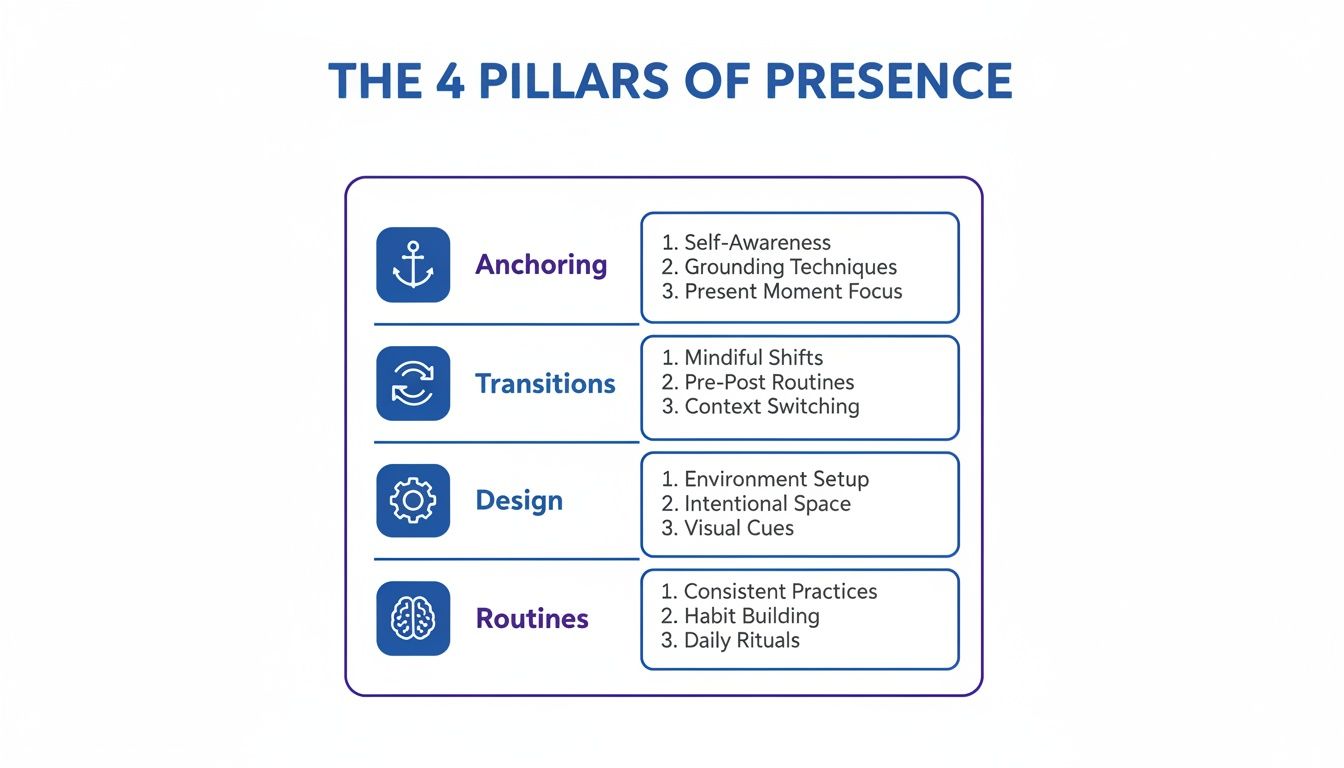
Each of these pillars represents a practical area where you can make small changes that lead to huge improvements in your ability to stay present and focused.
To make this even clearer, here’s a quick summary of how these pillars work in practice.
Four Pillars of Presence for Modern Professionals
A summary of the key strategies covered in this guide to help you learn how to be present.
| Strategy | Core Principle | Real-World Application |
|---|---|---|
| Mindful Anchoring | Grounding attention in physical sensation to counter mental drift. | Taking three slow breaths before joining a video call to center your focus. |
| Intentional Transitions | Creating a deliberate pause between tasks to reset cognitive load. | Closing all tabs and walking around your desk for 60 seconds after finishing a report. |
| Digital Environment Design | Reducing environmental triggers that hijack focus automatically. | Turning off all non-essential desktop notifications and using a “focus mode” app. |
| Neuroscience-Backed Routines | Using consistent cues to signal “focus time” to the brain. | Starting your workday with the same 15-minute, single-tasking ritual every morning. |
Think of these pillars not as a rigid checklist but as a flexible framework. You don’t need to master all four at once.
Putting the Pillars into Practice
Instead, pick the one area that speaks to your biggest challenge right now.
- Real-World Example: If you find yourself constantly derailed by notifications, starting with Digital Environment Design will give you the most immediate relief. On the other hand, if your days are a blur of back-to-back meetings where you feel mentally checked out, focusing on Intentional Transitions can be a game-changer.
By integrating these pillars into your daily life, you’re not just fighting distraction—you’re proactively building a foundation for deep work and mental clarity. It’s a shift from a reactive mindset to an intentional one.
Why Your Brain Is Wired for Distraction (and How to Be Present Anyway)
If you’ve ever sat down to write an important email, only to find yourself mentally replaying a conversation from yesterday, you’re not alone. That mental drift isn’t a personal failure. It’s a core feature of your brain’s architecture, and understanding it is the first step toward reclaiming your focus in a world designed to pull you away.
At the center of this is a neural network called the Default Mode Network (DMN). Think of it as your brain’s autopilot. When you’re not engaged in a specific, demanding task, the DMN kicks in, letting your mind wander through old memories, future plans, and daydreams. While this is essential for creativity and self-reflection, it’s also the biological source of that nagging inability to stay in the moment.
The Dopamine Loop of Modern Tech
The DMN’s tendency to wander gets supercharged by our digital world. Every notification, like, or new email triggers a tiny hit of dopamine, the neurotransmitter tied to reward and motivation. Behavioral psychology research shows this creates a powerful feedback loop: your brain gets a small jolt of novelty, it craves more, and it learns to constantly seek out these interruptions.
Over time, this process trains your attention to be fractured. Your brain becomes conditioned to expect—and even hunt for—the next stimulus, making sustained focus feel almost impossible. It’s like trying to have a deep conversation in a room where someone keeps tapping you on the shoulder.
Scenario in Action: A freelance designer sits down to work on a critical project. Her phone is on silent, but her brain, conditioned by years of digital pings, starts to feel restless. Without a conscious thought, her mind drifts to her grocery list, then to a snippet of a podcast she heard, and finally to the urge to just “quickly check” her inbox. This isn’t a lack of willpower; it’s a deeply ingrained, dopamine-seeking habit at work.
Your Brain Is Malleable, Not Broken
Here’s the good news: your brain is incredibly adaptable. This concept, known as neuroplasticity, means you can intentionally retrain your attention. Just like you can build physical muscle through repetition at the gym, you can strengthen your “focus muscle” with the right practices.
By using techniques that gently guide your attention back to a single point, you can weaken the pull of the DMN and build stronger pathways in the brain regions responsible for executive control. This is the whole game when it comes to learning how to be present. It’s not about fighting your brain; it’s about giving it a new, more intentional direction. Understanding the neuroscience of single-tasking gives you a powerful roadmap for reclaiming your attention, one moment at a time.
Simple Mindfulness Anchors: Your Toolkit for How to Be Present
Knowing your brain is wired for distraction is one thing; having a practical toolkit to gently guide it back is another. This is where mindfulness anchors come in.
Think of them not as complex meditation, but as quick, discreet “mental push-ups” you can do anywhere to strengthen your focus and learn how to be present in just a few seconds.
These anchors work by pulling your attention out of the chaotic stream of thoughts about the past or future and grounding it in the physical, sensory reality of the present moment. This simple act interrupts the brain’s autopilot—what neuroscientists call the Default Mode Network—and activates the regions responsible for intentional focus.

The 5-4-3-2-1 Grounding Technique
One of the most effective anchors is the 5-4-3-2-1 method. It’s powerful because it engages all your senses, making it incredibly difficult for your mind to keep wandering. Best of all, it’s completely silent and can be done anywhere without anyone knowing.
- Notice 5 things you can see: Look around you and mentally name five distinct objects. Don’t just glance—really see them. A pen on your desk, a crack in the ceiling, the specific shade of blue on your screen’s border.
- Notice 4 things you can feel: Bring your awareness to physical sensations right now. The warmth of your coffee mug, the texture of your chair against your back, the solid feeling of your feet on the floor.
- Notice 3 things you can hear: Listen for three distinct sounds, tuning in to your environment. Maybe it’s the hum of your computer, the sound of distant traffic, or even the subtle sound of your own breathing.
- Notice 2 things you can smell: This one can be tricky, so it forces you to pay closer attention. The faint aroma of coffee, the scent of a book, or even the neutral, clean smell of the air in the room.
- Notice 1 thing you can taste: A sip of water, the lingering taste of your last meal, or simply the sensation of your tongue in your mouth.
Real-World Example: An entrepreneur is minutes away from a high-stakes investor pitch. Her heart is racing, and her mind is spinning with “what-ifs.” Sitting in the waiting area, she discreetly runs through the 5-4-3-2-1 exercise. By the time her name is called, her nervous system has settled, and her focus is sharp and grounded in the room, not in her anxiety. This is a powerful demonstration of how to be present under pressure.
Micro-Anchors for Everyday Moments
You don’t always need a full, structured technique. Any sensory detail can become a “micro-anchor” to pull you back to the now. These small habits, when practiced consistently, can genuinely rewire neural pathways over time, improving your ability to manage stress and concentrate on demand.
- The Sound Anchor: Instead of immediately reacting to a notification, just pause and listen to the sound it makes. This simple act turns a jarring distraction into a mindfulness cue. For a deeper practice, you could try our 3-minute sound ritual to reset your focus.
- The Breath Anchor: Before you open your email client, take just three slow, deliberate breaths. Actually feel the air enter your lungs and then leave. This creates a tiny buffer between tasks, preventing that feeling of mental clutter from building up.
- The Taste Anchor: When you take that first sip of coffee in the morning, actually taste it. Notice its warmth, its bitterness, its aroma. Do this instead of drinking it on autopilot while scrolling through your phone.
This growing interest in mindfulness isn’t just a wellness trend; it’s a global shift. With global meditation practice rising from 29% in 2018 to a projected 35% in 2025, more and more people are seeking ways to find calm in the chaos.
And it works. Studies reveal that workplace meditation can boost focus for 86% of employees and cut stress for 82%, proving these small anchors can have a massive impact.
Designing Your Digital Environment for Deep Focus and Presence
Cultivating presence isn’t just an internal mental game. Your external world—specifically, the digital environment where you spend hours each day—plays a massive role. It can either support your focus or systematically dismantle it. By intentionally designing this space, you can make being present the path of least resistance.
This isn’t about sheer willpower; it’s about architecture. Behavioral research is clear: we are heavily influenced by environmental cues. When your desktop is a chaotic landscape of notifications and tempting icons, your brain expends precious cognitive energy just trying to stay on task.

Taking Command of Your Technology
The real goal here is to slash the constant decision fatigue that fuels distraction. Instead of forcing yourself to decide not to click on a notification every two minutes, you eliminate the notification entirely. This frees up mental bandwidth for the deep work that actually matters.
Real-World Example: A remote worker named Alex felt constantly overwhelmed. His desktop was a mess of project folders, his phone buzzed incessantly, and he kept multiple social media tabs open “just in case.” He was always busy but rarely productive. Alex decided to take control. He moved all non-essential icons off his desktop, shut down every single notification except for calendar alerts, and installed an app-blocking extension on his browser. The first few days felt strange, even a little boring. But soon, he found he could sink into his work for an hour or more without a single interruption. He wasn’t fighting his technology anymore; he had designed it to support his focus.
Practical Steps for a Distraction-Free Workspace
Creating a focused digital environment doesn’t require a complete tech overhaul. It’s about small, high-impact changes. One of the most powerful strategies is task batching, where you schedule specific, limited times for activities like checking email instead of letting them interrupt you all day.
- Curate a Minimalist Desktop: Keep only the applications and files for your current project on your main desktop. Drag everything else into a single folder to kill the visual clutter.
- Use Blocking Tools: Browser extensions like Freedom or StayFocusd are non-negotiable for serious focus. They block access to time-wasting websites during your work hours, removing the temptation entirely.
- Schedule Your Distractions: Set aside two or three 15-minute blocks per day to check email, Slack, and social media. Outside of those times, keep them closed. Our guide on effective digital detox tips offers more strategies for this.
This shift toward mindful technology use is part of a much larger movement. Globally, 275 million people now practice some form of meditation to counter digital burnout. In the U.S. alone, adult use has more than tripled to 14.2% (35.2 million people), a clear signal of the widespread desire to reclaim attention from our devices.
These practices directly support the kind of focus needed for a well-designed digital life. You can explore more about these trends and their market impact in this detailed statistical analysis of meditation practices.
How to Be Present by Building Brain-Friendly Rituals
The moments before and between your tasks are just as important as the tasks themselves. This is where presence is either won or lost. Building small, consistent rituals is a powerful way to signal to your brain that it’s time to shift gears and concentrate, tapping into the simple psychology of habit formation.
These aren’t complicated, time-consuming routines. Think of them as brief, intentional actions that create a clear mental boundary between distraction and deep work. They act as a cue, telling your brain’s attention networks to come online and get ready.

Pre-Work and Shutdown Rituals
How you bookend your day can dramatically shape your ability to stay present. A simple pre-work ritual primes your mind for focus, while a shutdown ritual helps you cleanly disengage, preventing work thoughts from spilling into your personal time.
- Five-Minute Brain Dump: Before you even think about opening your email, grab a notebook. Write down every stray thought, nagging to-do, and lingering worry that’s cluttering your mind. This act of getting the noise out of your head frees up precious cognitive space for the work ahead. We explore more ideas in our guide to morning rituals for focus.
- End-of-Day Shutdown: When you’re ready to wrap up, take two minutes. Briefly review what you accomplished and jot down your top one or two priorities for tomorrow. Then, say a simple phrase out loud like, “Work is complete.” This creates a clear psychological endpoint for the day.
Real-World Example: A project manager used to feel completely frazzled and mentally scattered from back-to-back calls. She started a tiny transition ritual: between each call, she stands up, stretches her arms overhead for 30 seconds, and takes three deep breaths. This small habit acts as a mental reset button, allowing her to enter each new meeting fully present instead of carrying the stress from the last one.
This isn’t just theory; it’s backed by a clear link between mindfulness practices and improved focus. A recent 2025 Meditation Practice Report revealed that 56.6% of practitioners meditate daily. For busy workers, these short rituals translate to an incredible 82% reduction in stress and an 86% gain in focus.
Editor’s Note: What Actually Works for Being Present
Let’s be honest, you don’t need a dozen new habits. For busy professionals, learning how to be present really comes down to two core principles that deliver the biggest impact.
First, you have to create intentional digital boundaries to reduce the constant pull of distractions. Second, it’s about practicing short, daily mindfulness anchors that ground your attention when things get chaotic.
This advice is specifically for professionals, students, or anyone who feels their attention is constantly fragmented but doesn’t have time for lengthy meditation sessions. The most practical first step is to pick one tiny practice—something like a two-minute breathing exercise before you open your laptop—and stick with it for a week. To truly succeed, you need to understand how to rebuild attention in a world of distraction.
Important Caveat: The key here is that this isn’t a quick fix for a wandering mind. True presence is built with gentle, consistent practice over weeks, not in one afternoon. Consistency with a small habit beats sporadic, intense efforts every single time. This is not a treatment for chronic conditions like ADHD, anxiety, or burnout, but a set of skills to improve daily focus.
Your Questions on How to Be Present, Answered
As you start weaving these practices into your life, questions will inevitably pop up. That’s a good sign—it means you’re engaged in the process. Here are a few common ones I hear, along with some practical answers to keep you grounded on the path.
How Long Does This Actually Take to Work?
You can feel a real, immediate shift from a single exercise. Try the 5-4-3-2-1 technique we covered earlier, and you’ll likely notice a tangible sense of calm right away. That’s a genuine, short-term win. But building a durable sense of presence—the kind that sticks with you through a chaotic workday—is more like building muscle. It’s a gradual process that involves forging new neural pathways. Most behavioral research suggests you’ll notice significant, lasting improvements in your focus and overall calm after 2-4 weeks of daily practice. Even 5-10 minutes a day is enough to start seeing a change.
Can I Practice Presence if I Have ADHD or Anxiety?
Absolutely. In fact, many people with conditions like ADHD and anxiety find these techniques to be incredibly supportive. The core of these practices—training your attention and calming your nervous system—can help manage some of the daily challenges associated with these conditions. However, it is crucial to remember that this article is for educational purposes only. The information provided is not a substitute for professional medical or psychological advice, diagnosis, or treatment. Always seek the advice of your physician or other qualified health provider with any questions you may have regarding a medical condition.
What if My Mind Just… Won’t Stop Wandering?
Welcome to the club. A wandering mind isn’t a sign of failure; it’s a sign that you have a perfectly normal human brain. The goal here is not to achieve a perfectly silent, empty mind. That’s one of the biggest myths out there. The real practice is the gentle act of noticing. You notice your mind has drifted off, and you kindly, without judgment, guide it back to your anchor (your breath, a sound, a sensation). Every time you notice you’ve wandered and you bring your attention back, you’ve just done one rep for your focus muscle. Be patient with yourself.
Disclaimer: This article is for informational and educational purposes only and does not constitute medical or psychological advice. The content is not intended to be a substitute for professional medical advice, diagnosis, or treatment. This post may contain affiliate links, which means we may receive a small commission if you make a purchase through a link, at no additional cost to you.
Explore the Mind Clarity Hub Library
Practical books on focus, digital habits, resilience, and building a calmer mind.
The Power of Clarity
Unlock mental focus, build momentum, and create the life you were meant to live.
View book →
AI & ChatGPT for Beginners
No PhD needed — a 2025 guide to AI, prompts, and productivity without coding.
View book →
Zen in the Digital Jungle
Mindfulness for a chaotic world.
View book →
The Slow Reset
Mindful living in a fast-paced world.
View book →
Perfectly Imperfect
Stop self-criticism, set boundaries, and embrace the real you.
View book →
Reclaiming Silence
A dopamine detox guide to finding peace in a noisy world.
View book →
The Focused Freelancer
Productivity, pricing & positioning for independents in 2025.
View book →
ChatGPT Side Hustle System
Launch your AI-driven online business in 30 days.
View book →
Burnout, Interrupted
A proven path to restore energy and reclaim your life.
View book →
Attention Unleashed
Focus strategies for the distracted mind.
View book →
Side Hustle Launchpad
Your quick-start guide to extra income.
View book →
Digital Clarity
Rewire your brain, escape dopamine traps & regain focus.
View book →
Break the Scroll
Reduce screen time and take back control of your life.
View book →
Climate Compassion
Transform eco-anxiety into empowered action.
View book →
Village Mentality
The power of community for mental wellness.
View book →
Restful Nights
Overcoming sleep anxiety in a 24/7 world.
View book →
Connected Again
Combat loneliness and build meaningful relationships.
View book →
Focus Recharged
Mastering attention and productivity in the digital era.
View book →
Marketing Magic with ChatGPT
AI-powered content, campaigns, and copywriting to grow faster.
View book →
The 6-Figure Creator
Turn knowledge into passive income with books, courses & AI.
View book →
Burnout Breakthrough
Reset your work-life balance and thrive in 2025.
View book →
The Emotionally Intelligent Man
A modern guide to self-awareness and communication.
View book →
AI Personalized Wellness
Create your custom health plan with data-driven habits.
View book →
Everyday AI Made Easy
Use ChatGPT and smart tools to simplify life.
View book →
Money Mindfulness
A financial wellness guide for Gen Z & Millennials.
View book →
Startup Smarter with AI
ChatGPT strategies and tools to grow your business.
View book →
ChatGPT for Writers & Creators
Unlock AI-powered brainstorming, drafting & editing.
View book →