

Learning how to take notes from books is really about one thing: turning passive reading into an active conversation with the author. The goal is to physically engage with the material, whether you’re writing by hand or typing. From a neuroscience perspective, this simple act recruits motor pathways in your brain alongside visual ones, creating a much stronger and more durable memory trace. This helps lock information into your memory so it doesn’t vanish the moment you close the cover.
Key Takeaways
- Active vs. Passive Reading: Taking notes transforms passive reading into an active process, engaging your brain to improve memory and comprehension.
- Set Your Purpose: Before you read, define what you want to learn. This primes your brain to filter for relevant information, making note-taking more efficient.
- Proven Systems: Use structured methods like the Cornell Method for facts, the Feynman Technique for deep understanding, or Mind Mapping for visual connections.
- Review is Crucial: Use spaced repetition to review notes (e.g., after 24 hours, one week, one month). This retrieval practice is scientifically proven to combat the “forgetting curve” and build long-term memory.
(Note: As an Amazon Associate, we earn from qualifying purchases. This article contains affiliate links that may generate a small commission at no extra cost to you.)
Why You Forget Almost Everything You Read
We’ve all been there. You finish a groundbreaking business book, buzzing with fresh ideas and ready to change everything. A week later, a colleague asks what you learned, and all you can recall is a vague concept or two. The specific, actionable advice? Gone.
This isn’t a personal failure—it’s how our brains are wired for efficiency. Our brains constantly discard information that isn’t actively used or reinforced to prevent cognitive overload. It’s a survival mechanism that keeps us from being buried under a mountain of useless data. You can see how this plays out in our hyper-connected world in our guide on escaping digital overwhelm and attention hijacking.
The Neuroscience of Forgetting
The real culprit here is passive consumption. When you just let your eyes drift over the words, you’re only engaging the shallowest parts of your brain’s processing power. For memories to become stable, they need to be consolidated, a process involving the hippocampus that strengthens neural connections. Passive reading doesn’t provide a strong enough signal to initiate this process effectively.
This isn’t a new problem. In the 19th century, psychologist Hermann Ebbinghaus mapped it out with his Forgetting Curve. Modern psychology research confirms that without deliberate effort to remember, you can forget up to 90% of new information within just one week. The drop-off is shockingly steep, starting almost immediately.

Shifting from Passive to Active Reading
This is exactly why note-taking is non-negotiable if you want knowledge to stick. It’s not about mindlessly copying the book word-for-word. It’s about forcing your brain to engage with the material.
When you take notes, something powerful happens in your brain:
- You engage multiple senses. The physical act of writing or typing lights up different parts of your brain (motor cortex, visual cortex), creating a much richer memory trace than just reading alone.
- You’re forced to summarize. You can’t write everything, so you must distill complex ideas into your own words. This cognitive effort, known as elaboration, requires a deeper level of processing and understanding.
- You create a personal knowledge asset. Your notes become a tool for future review—the only real way to beat the forgetting curve for good.
If you’re serious about making what you read a part of you, it helps to explore methods on how to study a textbook effectively and retain information. By treating note-taking as an essential part of the reading process, you shift from being a passive consumer to an active learner.
Set Your Intention: A Guide on How to Take Notes From Book Before You Read
Meaningful note-taking doesn’t start when you pick up a pen. It starts long before you even open the book, with a clear and focused purpose.
If you don’t know why you’re reading, your brain’s attentional systems treat every word with equal importance, which means most of it will be forgotten. Setting a clear intention primes your prefrontal cortex to act like a filter, pulling in only the most relevant ideas and arguments.
This mental prep work is the core of active reading. Before you dive in, ask yourself one simple question: What specific problem am I trying to solve, or what skill am I hoping to learn from this book?
This question instantly shifts your brain from passively receiving information to actively hunting for answers. It also makes it much easier to be fully how to be present with the text, which is a foundational skill for real learning.
Create a Mental Map Before You Read
One of the most durable frameworks for this is the SQ3R method: Survey, Question, Read, Recite, and Review. The first two steps—Survey and Question—are all about preparing your mind.
And it works. Cognitive psychology research has shown this approach can boost comprehension by a staggering 30-50%. This isn’t some old-school academic trick; it’s a cognitively efficient method that’s perfectly suited for a world where the note-taking app industry is a massive $9.54 billion market. You can find more on the growing note-taking app industry on superagi.com.
First, survey the book. Give yourself five minutes to scan the table of contents, the introduction, all the chapter titles, and any bold headings. This creates a mental schema, or framework, for your brain to hang new information on, which dramatically improves retention.
Next, turn those chapter titles into questions. If a chapter is called “The Art of Negotiation,” your question might become, “What are the three most critical tactics for a successful negotiation?” This simple act transforms you from a passive tourist into an active detective.
Real-World Scenario: An entrepreneur reading a marketing book isn’t just reading for fun. Her brain is primed by her goal: “How can I apply these customer acquisition strategies to my e-commerce store with a limited budget?” In contrast, a student cramming for an exam is probably asking, “What are the key theories I need to memorize for the test?” Their unique goals dictate their entire approach, ensuring they extract only what is most valuable to them.
Proven Systems for Taking Better Book Notes
Once you know why you’re reading, the next question is how you’re going to capture what you learn. Trying to take notes from a book without a clear system is like shouting into the wind—the ideas are there for a moment, but they vanish almost immediately. A proven system gives you the scaffolding to build lasting knowledge.
There’s no single “best” method. The right approach depends on your learning style and goals. We’ll walk through three powerful systems: the structured Cornell Method, the deep-thinking Feynman Technique, and the visual freedom of Mind Mapping.
The Cornell Method for Structured Recall
Developed at Cornell University, this classic system forces you to process information on multiple levels, which is fantastic for locking ideas into your memory.
You divide your page into three sections: a main notes column on the right, a smaller “cues” column on the left, and a summary section at the bottom.
- Main Notes Column (Right): As you read, jot down primary notes here. Use bullet points and abbreviations to capture key ideas.
- Cues Column (Left): After reading, review your main notes and pull out keywords or questions. These become your prompts for reviewing later.
- Summary Section (Bottom): This is where the magic happens. Cover the main notes and try to summarize the page in one or two sentences. This act of recall is what cements the learning.
Real-World Example: A student learning about the American Revolution uses the main column to note key dates, events, and figures. In the cues column, she writes “Causes of Tea Party?” and “Key figures in Continental Congress.” Later, for the summary, she writes: “Growing tax disputes and a desire for self-governance led to organized colonial resistance.” This structure turns a passive list of facts into a powerful study tool.
This system is perfect for dense, factual material. For those who enjoy this kind of structure, pairing it with dedicated journals for productivity can make the process even smoother.
The Feynman Technique for True Understanding
If your goal is to truly understand a concept, the Feynman Technique is in a class of its own. Named after Nobel Prize-winning physicist Richard Feynman, it’s built on a simple premise: you don’t really know something until you can explain it in simple terms. Psychologically, this forces you to confront and resolve cognitive dissonance between what you think you know and what you actually know.
Here’s the process:
- Write the concept’s name at the top of a blank page.
- Explain it in your own words, as if teaching a child. Ditch the jargon.
- Any time you get stuck or use complicated language, go back to the book and clarify your understanding.
- Keep refining your explanation until it’s simple and clear.
Real-World Example: Someone trying to understand “compound interest” writes it down. They start explaining, “It’s when your money makes money…” but get stuck on the details. They go back to the book, then refine their explanation: “Imagine you have $100 and earn 10% interest. Next year, you earn interest not just on the original $100, but on the $110. It’s interest on your interest, which is why it grows so fast.” Now they truly get it.
Mind Mapping for Visual Connections
For visual thinkers, linear notes can feel restrictive. Mind mapping offers a dynamic way to capture information, focusing on the relationships between ideas. This method leverages your brain’s ability to process images and spatial relationships far more quickly than text.
Start with the book’s central theme in the middle of a blank page. Draw branches for each major chapter or core idea, then add smaller sub-branches for supporting details and your own thoughts.
Real-World Example: A designer reading a book about user experience (UX) design places “Good UX Design” in the center. Main branches become “Accessibility,” “Usability,” and “Visual Hierarchy.” Sub-branches from “Accessibility” might include “Color Contrast” and “Screen Reader Support.” This visual overview helps them see how all the pieces fit together at a glance.
If you want to see more strategies like this in action, check out a modern guide to effective book note taking.
Choosing Your Note-Taking Method
Not sure which system is the right fit? This table breaks down the strengths of each method to help you decide.
| Method | Best For | Key Benefit | Time Investment |
|---|---|---|---|
| Cornell Method | Factual, dense non-fiction, academic texts, and exam preparation. | Structured Recall: Forces active processing and creates a built-in study guide. | Medium |
| Feynman Technique | Complex concepts, scientific principles, or any topic you need to deeply internalize. | True Understanding: Exposes gaps in your knowledge and solidifies comprehension. | High |
| Mind Mapping | Big-picture books, interconnected ideas, brainstorming, and creative thinking. | Visual Connection: Shows the relationships between ideas and provides a high-level overview. | Low to Medium |
Ultimately, the best system is the one you’ll actually use. Feel free to experiment. The key is to be intentional and choose the tool that best serves your learning goals.
Turning Raw Notes Into Lasting Knowledge
Capturing ideas is just the first step. The real magic happens during synthesis—the process of turning scattered notes into a connected knowledge base. Simply transcribing what an author says doesn’t build understanding. You have to actively connect the dots yourself.
This is the moment you shift from stenographer to thinker. It involves summarizing arguments in your own words and linking concepts across chapters. This active processing is what helps your brain move information from short-term memory into long-term storage where it can actually stick.
Building Your Personal Knowledge System
The end goal is to build a “second brain”—a searchable, external home for your most valuable insights. This is where digital tools like Notion, Obsidian, or Evernote shine. When you transfer synthesized notes into a digital system, you create a permanent, searchable archive.
A powerful way to structure this is through atomic notes. Think of an atomic note as a single, self-contained idea.
- One Idea, One Note: Each note centers on a single concept, making it easy to link and resurface later.
- Write in Your Own Words: This is non-negotiable. It forces you to process the information.
- Link Your Notes: Connect new ideas to existing ones, mirroring how your brain forms associative networks.
This diagram shows how foundational systems can distill raw text into core concepts for your atomic notes.
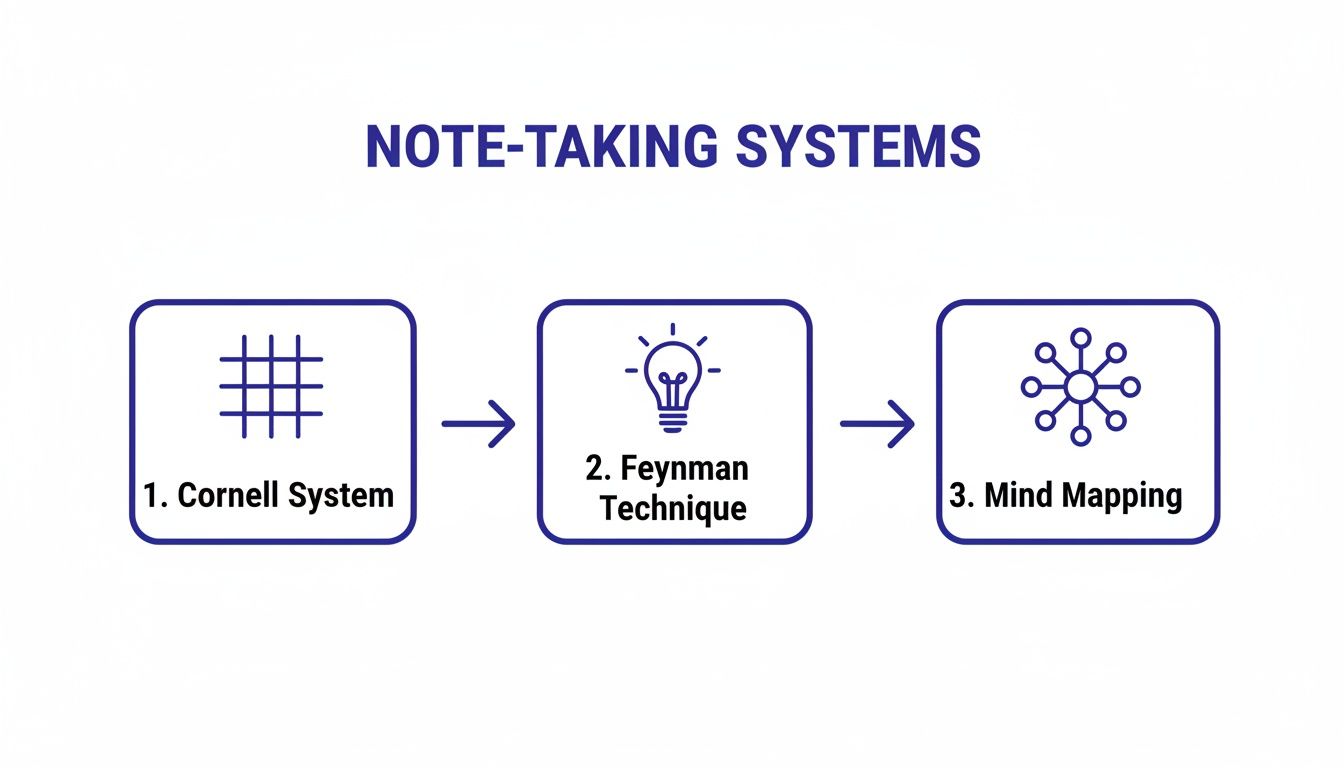
Each method gives you a different lens to break down complex text. The insights you pull from them become the building blocks of your digital system.
Real-World Scenario: Imagine you read a book on habit formation. You create one atomic note explaining the “cue-routine-reward” loop, a concept from behavioral psychology. A few months later, while reading a productivity book, you can link a new note about “time blocking” directly back to your note on habit cues. Over time, you build a powerful, interconnected web of ideas. This entire process demands deep concentration, so for more strategies, check our guide on how to improve focus while studying.
Using AI to Accelerate Synthesis
Modern tools can streamline this workflow. AI-powered apps can transcribe handwritten notes and even generate a first-draft summary or flashcards. This doesn’t replace critical thinking, but it can speed up the grunt work.
Think of AI as your synthesis assistant, not your replacement. Use it to:
- Generate summaries of long chapters to check against your own.
- Create flashcards from your key terms for later review.
- Suggest connections between different notes you’ve already taken.
By combining timeless principles with smart tools, you can build a robust knowledge system that ensures you never lose a valuable idea again.
How to Review Your Notes Without Wasting Time
Taking notes is only half the battle. The final step is turning those ideas into permanent knowledge through intentional review. This isn’t about cramming; it’s about working with your brain’s natural process for memory consolidation.
The neuroscience is clear: our brains strengthen the neural pathways for information we repeatedly try to recall. This process, retrieval practice, is far more powerful than passively re-reading. Every time you force yourself to recall a concept, you’re sending a strong signal to your brain: “This is important. Keep it.”

Spaced Repetition: A Simple Schedule for a Stronger Memory
To make retrieval practice work, you have to get the timing right. This is where spaced repetition comes in. Instead of reviewing a concept ten times in one night, you review it at increasing intervals. This approach systematically interrupts the forgetting curve right as your memory starts to fade, strengthening the connection each time.
A simple, actionable schedule looks like this:
- Review 1: Within 24 hours of taking the notes.
- Review 2: One week later.
- Review 3: One month later.
- Review 4: Three to six months later.
Each review can be brief—even 5-10 minutes is enough. Consistency matters more than duration.
Practical Techniques for Active Review
Just re-reading is the least effective way to learn. Turn your review sessions into active mini-tests.
Real-World Scenario: Let’s say you used the Cornell Method for a chapter on negotiation. To review, you’d cover the main notes column. Using only the keywords and questions in the “cue” column, try to explain the concepts out loud. This simple act of self-quizzing makes the knowledge stick.
Another powerful technique is to explain a key idea to a friend. This forces you to organize your thoughts clearly and instantly reveals any weak spots in your understanding.
This process requires intense mental effort. You can learn more about getting into that mindset by reading our guide on how to achieve flow state. By making your review sessions active and consistent, you ensure your investment in reading pays off.
Editor’s Take: What Actually Works for Busy People
Let’s be honest, it’s easy to get lost in complex note-taking systems. But while digital tools and elaborate methods have their place, the single most important part of learning how to take notes from books is just to start. The best method is the one you’ll actually stick with.
For most people, I recommend starting with the Cornell Method on a simple notepad. There’s a good reason for this: neuroscience research suggests the physical act of writing engages motor pathways in the brain, significantly improving memory encoding. It makes ideas stickier from the very beginning. This advice is best for students, professionals, and lifelong learners who want to retain more from non-fiction books. If you are reading for pure entertainment, this level of effort is likely overkill.
Focus on consistency over perfection. Capturing three key ideas from a chapter is far more valuable than designing a perfect but unused digital system.
The real 80/20 of effective note-taking comes down to two things: reading actively and reviewing your notes quickly and regularly. The specific format you choose—whether it’s lines, bubbles, or atomic notes—matters far less than your genuine engagement with the material. Pick a simple method, and turn it into a habit.
Disclaimer: This article may contain affiliate links, which means we may earn a small commission on purchases made through our links at no additional cost to you. The content provided here is for educational and informational purposes only and does not constitute medical or psychological advice. It is not a substitute for professional care or treatment for conditions such as anxiety, depression, ADHD, or burnout. Always consult a qualified healthcare provider for any health concerns.
FAQ: Your Questions on How to Take Notes From Book Answered
As you start building a better note-taking habit, a few common sticking points always seem to pop up. Let’s tackle them head-on so you can move forward with a clear, practical system.
Should I take notes by hand or on my laptop?
The best system is often a hybrid. Neuroscience research suggests there’s a real cognitive benefit to writing by hand—the physical act helps sear information into your memory. For that first raw capture of ideas, a simple notebook is excellent. But for long-term organization and searchability, digital notes in a tool like Notion or Obsidian are unbeatable. A great workflow is to capture initial thoughts by hand, then synthesize and store polished versions digitally.
How many notes should I be taking per chapter?
Quality over quantity is key. Resist the urge to transcribe the book. Your goal is to be a curator, not a court reporter. Aim to capture just the 3–5 most important concepts, surprising facts, or actionable ideas from each chapter. This forces you to identify the core message, which is a powerful learning exercise in itself.
Can I actually take useful notes from fiction?
Absolutely, but the objective changes from capturing facts to analyzing story and theme. Use your notes to track character development, identify recurring symbols, map out the plot structure, or record powerful quotes. This turns note-taking from a memory exercise into a tool for deeper literary appreciation.
What’s the best way to organize my notes?
For digital notes, creating a system based on themes or projects is more effective than organizing by book title alone. Using tags (e.g., #productivity, #psychology) allows you to connect ideas from different books on the same topic. This helps you build a web of knowledge rather than a series of isolated book summaries.
At Mind Clarity Hub, we curate practical guides on focus, mindful productivity, and AI-enabled workflows to help you reclaim your mental space. Explore our science-based self-help and digital clarity books to build better habits.
Explore the full library of books at Mind Clarity Hub
Explore the Mind Clarity Hub Library
Practical books on focus, digital habits, resilience, and building a calmer mind.
The Power of Clarity
Unlock mental focus, build momentum, and create the life you were meant to live.
View book →
AI & ChatGPT for Beginners
No PhD needed — a 2025 guide to AI, prompts, and productivity without coding.
View book →
Zen in the Digital Jungle
Mindfulness for a chaotic world.
View book →
The Slow Reset
Mindful living in a fast-paced world.
View book →
Perfectly Imperfect
Stop self-criticism, set boundaries, and embrace the real you.
View book →
Reclaiming Silence
A dopamine detox guide to finding peace in a noisy world.
View book →
The Focused Freelancer
Productivity, pricing & positioning for independents in 2025.
View book →
ChatGPT Side Hustle System
Launch your AI-driven online business in 30 days.
View book →
Burnout, Interrupted
A proven path to restore energy and reclaim your life.
View book →
Attention Unleashed
Focus strategies for the distracted mind.
View book →
Side Hustle Launchpad
Your quick-start guide to extra income.
View book →
Digital Clarity
Rewire your brain, escape dopamine traps & regain focus.
View book →
Break the Scroll
Reduce screen time and take back control of your life.
View book →
Climate Compassion
Transform eco-anxiety into empowered action.
View book →
Village Mentality
The power of community for mental wellness.
View book →
Restful Nights
Overcoming sleep anxiety in a 24/7 world.
View book →
Connected Again
Combat loneliness and build meaningful relationships.
View book →
Focus Recharged
Mastering attention and productivity in the digital era.
View book →
Marketing Magic with ChatGPT
AI-powered content, campaigns, and copywriting to grow faster.
View book →
The 6-Figure Creator
Turn knowledge into passive income with books, courses & AI.
View book →
Burnout Breakthrough
Reset your work-life balance and thrive in 2025.
View book →
The Emotionally Intelligent Man
A modern guide to self-awareness and communication.
View book →
AI Personalized Wellness
Create your custom health plan with data-driven habits.
View book →
Everyday AI Made Easy
Use ChatGPT and smart tools to simplify life.
View book →
Money Mindfulness
A financial wellness guide for Gen Z & Millennials.
View book →
Startup Smarter with AI
ChatGPT strategies and tools to grow your business.
View book →
ChatGPT for Writers & Creators
Unlock AI-powered brainstorming, drafting & editing.
View book →