


Productivity journals are specialized notebooks or apps built to help you wrestle your goals, tasks, and habits into a coherent system. Think of it as more than just a glorified to-do list; a well-designed journal is a command center for turning vague intentions into clear, daily actions. It’s a remarkably simple but powerful tool for directing your focus where it matters most.
This article is for educational purposes only and is not a substitute for professional medical or psychological advice, diagnosis, or treatment. If you are struggling with mental health concerns such as anxiety, depression, ADHD, burnout, or sleep problems, please consult a qualified healthcare provider.
Affiliate Disclosure: Please note that this article may contain affiliate links. If you make a purchase through these links, we may earn a small commission at no extra cost to you. This helps support our work in creating valuable content.
Why Using Journals for Productivity Is So Effective
In a world buzzing with notifications and a never-ending stream of priorities, finding genuine focus can feel like an uphill battle. This is precisely where a productivity journal steps in, acting less like a planner and more like a powerful cognitive tool. It provides a structured, quiet space to declutter your mind—a process psychologists call cognitive offloading.
When you write down your tasks, ideas, and worries, you’re literally moving them from your brain’s very limited working memory onto paper or a screen. Behavioral research shows this simple act frees up a surprising amount of mental bandwidth. Instead of constantly trying to remember everything, your brain can engage in deeper, more creative thinking. It’s like closing a dozen unnecessary tabs on your computer to help it run faster.
Real-World Scenario: Imagine a project manager, Maria, juggling three projects. Her mind is a storm of deadlines, team questions, and new ideas. Instead of just trying to keep it all in her head, she spends five minutes writing everything down in her journal. The simple act of externalizing the chaos onto a page allows her to see the tasks clearly, prioritize them logically, and approach her day with a sense of calm control rather than reactive panic.
This single practice unlocks some pretty significant benefits:
- Improved Focus: By deciding on your priorities at the start of the day, you’re telling your brain exactly what’s important. This helps it filter out the noise and directs your attention to activities that actually move the needle.
- Reduced Overwhelm: A chaotic storm of tasks swirling around in your head is a recipe for stress. Organizing them in a journal transforms that chaos into a clear, actionable plan, which can dramatically lower feelings of anxiety.
- Enhanced Mental Clarity: The act of writing forces you to articulate your thoughts. This process of externalizing your thinking is crucial for focus, and you can learn more about how to improve mental clarity in our dedicated guide.
- Stronger Habit Formation: Tracking your progress on new habits—like a daily workout or reading goal—creates a visual record of your wins. Seeing that chain of success reinforces the behavior and builds momentum, making it easier to stick with it over time.

Image Caption: A productivity planning session is a core component of using journals for productivity to organize daily tasks and goals.
Image Description: A professional sits at a wooden desk with a planner, a pen, and a cup of coffee. They are using their journal for productivity to plan their day, with a focus on organization and efficiency.
Think of it this way: an architect wouldn’t dream of building a skyscraper without a blueprint. A productivity journal provides the blueprint for your day, ensuring you build what you actually intend to, one focused task at a time.
The Neuroscience Behind Productive Journaling Methods
Ever wonder why the simple act of writing in a journal actually works? It’s not just a nice organizational habit. It’s a way of talking directly to your brain to shape your focus, motivation, and even your mood. When you use a journal for productivity, you’re applying practical neuroscience—turning fuzzy goals into concrete actions your brain can lock onto.
At the center of it all is a part of your brainstem called the Reticular Activating System (RAS). Think of the RAS as your brain’s attention filter. It decides which of the millions of sensory inputs get your attention and which ones fade into the background.
When you take a moment to write down a specific goal—like “Draft the project proposal by noon”—you’re giving your RAS clear instructions. The physical act of writing signals, “Hey, this is important.” Your brain then gets primed to notice everything related to that task: resources, ideas, and opportunities. You become far more likely to act on it.
Freeing Up Your Mental RAM with Journals for Productivity
Your brain’s working memory—the mental sticky note you use for immediate tasks—is incredibly limited. Trying to juggle deadlines, creative ideas, and your to-do list all in your head is like running a high-end laptop with a dozen heavy programs open at once. Sooner or later, everything grinds to a halt.
This is where your journal becomes a tool for cognitive offloading.
By getting your plans, worries, and reminders out of your head and onto paper or a screen, you are literally clearing your mental RAM. This frees up precious cognitive bandwidth, letting you dive deeper into the task at hand and access higher-level creative thinking.
This mental decluttering is one of the most immediate benefits of a productivity journal. It doesn’t just organize your tasks; it organizes your mind. You can explore how this sharpens your focus in our guide on the neuroscience of single-tasking.
Creating a Dopamine-Fueled Momentum Loop
Another powerful force at play is your brain’s reward system, which runs on the neurotransmitter dopamine. Dopamine isn’t just about pleasure; its primary role is motivation. It’s the chemical that tells your brain, “That was good. Let’s do it again.”
When you write down a small, achievable goal in your journal and then check it off, your brain releases a satisfying little hit of dopamine. This feeling of accomplishment reinforces the behavior, making you eager to tackle the next thing on your list.
This creates a powerful positive feedback loop:
- Plan: You write down a clear, manageable task.
- Act: You get it done.
- Reward: You check it off, triggering that dopamine release.
- Repeat: The good feeling motivates you to keep the cycle going.
This is how tiny wins build into serious momentum. It’s no surprise that tools enabling this cycle are booming. The global market for digital journal apps was valued at $5.1 billion in 2024 and is projected to hit an incredible $13.58 billion by 2033. This surge shows a massive shift toward using journaling as a serious tool for modern life and work. You can read the full research on the digital journaling market to see the trend breakdown.
Here’s How It Looks in Real Life: Imagine Sarah, a freelance designer, feeling completely swamped by a huge project. Her mind is a chaotic mess of client feedback, design ideas, and a looming deadline. Instead of panicking, she opens her journal and does some cognitive offloading. She writes down every single thing causing her stress. Then, she breaks it down into just three small, actionable steps she can take in the next two hours:
- Review and sort client feedback into categories.
- Sketch three new concepts for the logo variation.
- Email the client a quick progress update.
Instantly, the mountain of anxiety transforms into a clear, manageable path. As she finishes and checks off the first item, she feels a surge of control and accomplishment. That’s the dopamine loop kicking in. She just used her journal not just to plan, but to actively regulate her focus and state of mind.
Choosing Your Tool: Physical vs. Digital Journals for Productivity
Deciding between a classic paper notebook and a sleek digital app is often the first real choice you’ll make on your journaling journey. There’s no single “right” answer here. The best tool isn’t the one with the most features, but the one that feels the most natural for you—the one you’ll actually look forward to opening each day.
Both physical and digital journals have unique strengths, rooted in how our brains process information and engage with the world. The goal is to pick the medium that removes friction and makes daily planning and reflection feel less like a chore and more like a welcome ritual.
The Case for Physical Journals
There’s something uniquely grounding about a paper journal that digital tools just can’t mimic. The simple act of putting pen to paper engages different neural pathways than typing on a keyboard. This physical connection, known as haptic feedback, can slow down your thinking, which may lead to deeper processing and stronger memory of your goals and ideas.
For many, a paper notebook is a much-needed sanctuary from the endless glare of screens. It offers a quiet, dedicated space free from notifications, pop-ups, and the temptation of just one more browser tab. If you find yourself battling screen fatigue, a physical journal can be a powerful antidote.
A physical journal is a single-tasking device in a multitasking world. Its only job is to hold your thoughts, plans, and reflections, making it a powerful tool for deep, focused work.
And it’s not just a niche preference. The demand for analog tools is surprisingly strong. The global market for physical planners and diaries is set to climb from $1.98 billion in 2024 to an estimated $3.07 billion by 2033. This growth shows that even as technology advances, people still crave the clarity that pen and paper provide. If you’re interested in the data, you can read the full market research on planners here.
Feeling overwhelmed is often a sign that your thoughts are swirling without a clear outlet. As the simple flowchart below shows, the act of writing things down is one of the most direct ways to regain a sense of calm.
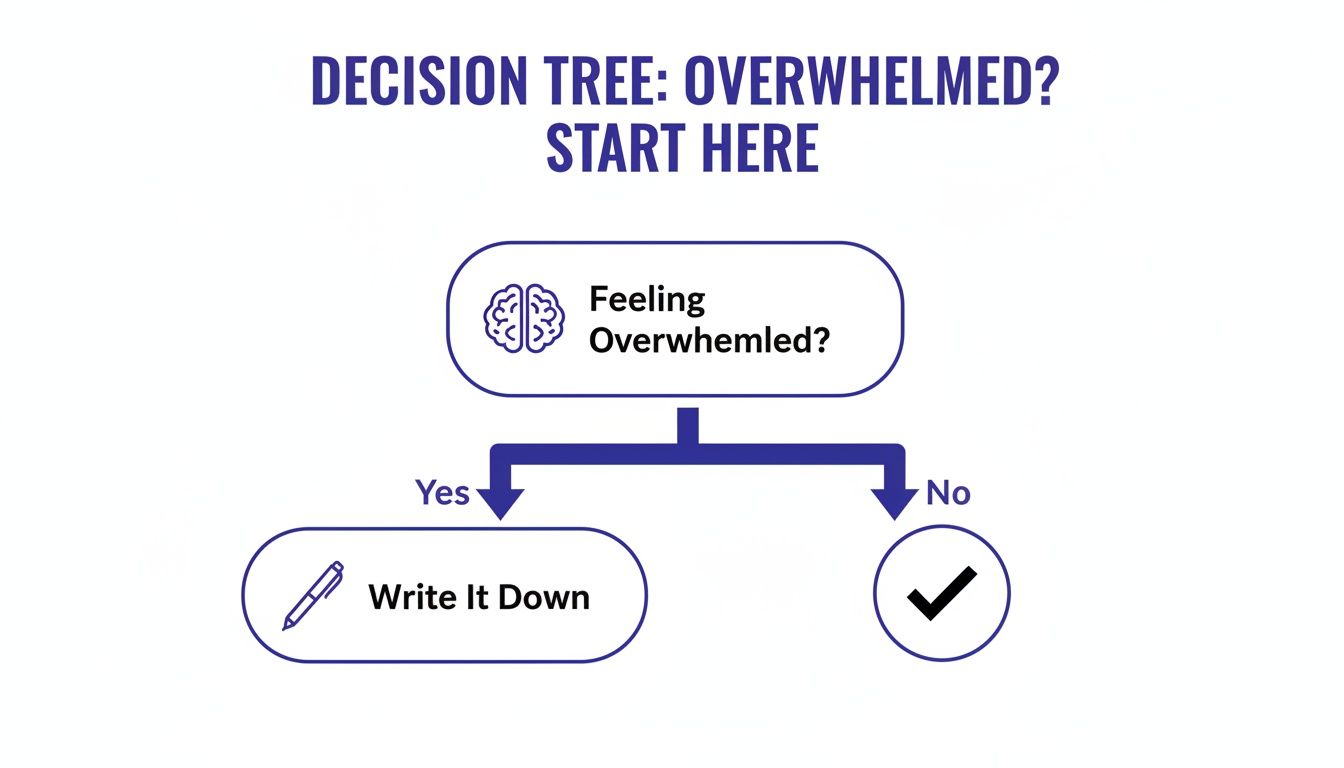
Image Caption: A simple decision tree shows how writing in journals for productivity can be an effective strategy for managing overwhelm.
Image Description: This flowchart starts with the question “Feeling Overwhelmed?” and branches to “Write it down.” It illustrates the concept of cognitive offloading using journals for productivity to reduce mental clutter and stress.
This process of externalizing your thoughts is the core magic of journaling—it gets ideas out of your head and onto the page, instantly reducing mental clutter.
The Power of Digital Journals
Where physical journals offer focus, digital journals deliver convenience, power, and portability. With an app on your phone, tablet, or computer, your entire productivity system is always in your pocket, ready for a quick note, an updated to-do list, or on-the-go planning.
The standout advantages of digital tools are hard to ignore:
- Searchability: Need to find that brilliant idea you had three months ago? A quick search pulls it up in seconds, no frantic page-flipping required.
- Integration: Your journal can talk to your other tools. Link entries to your calendar, connect tasks to your project management app, and create a truly unified workflow.
- AI Features: Many modern apps now include AI assistants that can summarize your progress, suggest goals based on your entries, or even help you rephrase your thoughts for clarity.
- Backups & Security: Your thoughts are safely backed up to the cloud, protecting them from spills, loss, or damage.
If you find yourself constantly battling digital overload, it’s worth exploring strategies for managing it. Our guide on what is digital fatigue and how to recover faster offers practical tips.
Physical Journals vs Digital Journals for Productivity
So, how do you decide? This table breaks down the key differences to help you find the best fit for your workflow.
| Feature | Physical Journals (Paper) | Digital Journals (Apps) |
|---|---|---|
| Focus & Mindfulness | Excellent. Creates a distraction-free, single-tasking environment. | Fair. Prone to notifications and multitasking temptations from the device. |
| Tactile Experience | High. The act of writing can improve memory and deepen thinking. | Low. Lacks the sensory feedback of pen on paper. |
| Portability & Access | Good. Easy to carry one notebook, but becomes cumbersome with multiple journals. | Excellent. Access your entire journal history from any device, anywhere. |
| Search & Organization | Limited. Relies on manual indexing, tabs, or flipping through pages. | Excellent. Instant search, tagging, and linking make finding information effortless. |
| Integration & Automation | None. Fully analog and disconnected from other digital tools. | High. Can connect with calendars, task managers, and other apps to automate workflows. |
| Durability & Backup | Vulnerable. Susceptible to loss, damage, or wear and tear. No easy backup. | Excellent. Data is securely stored and backed up in the cloud. |
| Cost | Low to High. Can be as cheap as a basic notebook or as expensive as a premium planner. | Variable. Many apps offer free versions, with premium features available via subscription. |
Ultimately, the choice comes down to what you value most. If you’re seeking a quiet space for deep thinking, a physical journal is a fantastic tool. If you need a dynamic, interconnected system that’s always with you, a digital app is likely the better choice.
Finding Your Fit: The Hybrid Approach
Here’s a secret: you don’t actually have to choose. Some of the most productive people use a hybrid system, blending the strengths of both analog and digital to create a workflow that truly serves them. This isn’t about duplicating work; it’s about using the right tool for the right kind of thinking.
A Real-World Example: Think of a project manager named Alex. His day starts not with a screen, but with a cup of coffee and his physical journal. This is his protected, quiet time for big-picture thinking. He sketches out creative solutions to a project bottleneck and sets his three most important priorities for the day. The physical act of writing helps him untangle complex thoughts. Once the workday kicks into high gear, Alex switches to his digital app. He uses it to log project updates, check off shared tasks with his team, and set reminders for upcoming deadlines. The app’s searchability and integration with his calendar are perfect for managing the fast-moving, collaborative details of his job. By using a hybrid approach, Alex gets the best of both worlds: the deep, reflective benefits of analog and the efficient, connected power of digital.
Actionable Templates for Your Productivity Journal
Knowing why a productivity journal works is one thing. Actually putting pen to paper is where the real magic happens. That leap from theory to action can feel like the hardest part, which is why having a solid structure is so critical. These templates are designed to kill “blank page” paralysis. Instead of wondering what to write, you can use these simple, proven frameworks to guide your focus, reflection, and planning. They’re minimalist by design—you should be spending your time doing the work, not just planning it.
Let’s turn that empty notebook into your personal command center.

Image Caption: The “Top 3 Priorities” method is a simple yet powerful technique for using journals for productivity.
Image Description: An open notebook shows a prioritized to-do list with the heading “Top 3 Priorities.” One item is checked off, illustrating the satisfaction of completing a key task planned in a journal for productivity.
The Daily Planner Template for Maximum Focus
Your daily entry is the bedrock of any productivity journal. Its job is simple: create clarity and intention before the day’s chaos pulls you into reactive, low-impact work. The key is to keep it sharp and focused on what actually moves the needle. This template is built around the “Top 3 Priorities” idea, a killer method for forcing you to identify the tasks that will generate real momentum.
The Daily Template:
- Date:
- Today’s Focus Prompt: What one thing, if I get it done, will make today a success?
- Top 3 Priorities:
- Secondary Tasks: (A spot for smaller, less urgent to-dos)
- End-of-Day Review:
- One Win:
- One Lesson Learned:
Here’s how it looks in the real world for a busy professional:
Date: October 26
Today’s Focus Prompt: What one thing, if I get it done, will make today a success? Getting the Q4 budget presentation completely finalized.
Top 3 Priorities:
- Finalize and proofread the Q4 budget presentation slides.
- Draft the follow-up email to the marketing team about the new campaign launch.
- Complete the performance review notes for my direct report.
Secondary Tasks: Book dentist appointment, clear out non-urgent emails.
End-of-Day Review:
- One Win: Nailed the presentation ahead of schedule and felt totally prepared.
- One Lesson Learned: I really underestimated how long that email draft would take. Next time, I need to block out dedicated writing time for important comms.
This daily rhythm trains your brain to tackle high-impact work first, making sure that even on the craziest days, you’re still making meaningful progress.
The Weekly Review for Strategic Progress
A week can just vanish in a blur of meetings, emails, and small tasks. The weekly review is your chance to hit pause, zoom out, and make sure your daily grind is actually aligned with your bigger goals. This is a non-negotiable practice for course-correcting, learning, and celebrating wins—all of which reinforces the habits you want to build. This template helps you quickly analyze what worked, what didn’t, and what you need to tweak for the week ahead.
The Weekly Review Template:
- Big Wins This Week: What went well? What are you proud of? (List 2-3 things)
- Challenges & Obstacles: What got in the way? Where did you get stuck?
- Key Lessons Learned: What insights did you gain from both the wins and the struggles?
- Priorities for Next Week: Based on this review, what are the 1-3 most important things to focus on next week?
This simple framework turns your journal from a simple task list into a powerful tool for strategic self-improvement.
The Goal-Setting Framework for Big Ambitions
Big, ambitious goals can feel totally paralyzing without a concrete plan. This template is all about breaking down those huge goals into manageable quarterly, monthly, and weekly chunks. It transforms a vague dream like “launch a new service” into a clear, actionable roadmap. Breaking down your objectives this way is a fundamental first step. You can dig into more strategies for this in our guide on setting powerful goals for self-improvement.
The Goal Breakdown Template:
- Ambitious Goal: (e.g., Launch a new coaching service by the end of Q4)
- This Quarter’s Objective: What’s the major milestone you have to hit in the next 90 days?
- Example: Finalize the service offering and pricing, and build a waitlist of 20 people.
- This Month’s Target: What piece of that quarterly objective will you tackle this month?
- Example: Outline the full service curriculum and create the sales page copy.
- This Week’s Actionable Steps: What specific tasks will move you toward this month’s target?
- Draft the service curriculum outline.
- Research competitor pricing.
- Write the first draft of the sales page headline.
By leaning on these templates, you’re not just journaling—you’re building a structured, repeatable system. This consistency is what creates unstoppable momentum.
Common Journaling Pitfalls and How to Avoid Them
Getting a productivity journal started is the easy part. The real challenge—and where most people get stuck—is turning it into a habit that actually sticks. The good news? Most roadblocks are incredibly common, and you can get past them with a few simple mindset shifts. The goal is never perfection. It’s about building a sustainable practice that serves you.
Even seasoned journalers run into walls. Instead of seeing these moments as failures, think of them as signals—opportunities to tweak your system until it fits your life, not the other way around.
The Perfectionism Paralysis Trap
One of the biggest hurdles is perfectionism paralysis—that nagging fear of messing up your beautiful, clean notebook. It shows up as anxiety over messy handwriting or feeling pressure to create Instagram-worthy layouts. This completely defeats the purpose. A journal is a tool, not a performance. This fear often leads to a mental block where you just can’t bring yourself to write anything. If you find yourself staring at a blank page, our guide on overcoming blank mind syndrome has some great strategies for getting your thoughts moving again.
How to Overcome It: Give yourself permission to be imperfect. Scribble, cross things out, use it as a rough draft for your day. A great little trick is to christen the first page of any new journal as your “messy page.” Intentionally write sloppy notes or test your pens. It breaks the seal of perfection right from the start.
Overcomplicating Your System
It’s so easy to get inspired by complex, color-coded journaling systems online. While they look amazing, starting out with a dozen different trackers for habits, moods, and metrics is a fast track to burnout. When a system feels like a chore, we abandon it.
Your productivity journal should reduce complexity, not add to it. The best system is the simplest one you can stick with consistently. Start small and earn your complexity.
How to Overcome It: Begin with just one simple template, like the daily planner we covered earlier. Stick with that for a couple of weeks until it feels automatic. Once that core habit is locked in, you can start thoughtfully adding one new element at a time, like a weekly review or a single habit tracker.
Breaking the Cycle of Inconsistency
Falling off the journaling wagon is normal. Life gets chaotic, you miss a day, and suddenly it’s been a week. The secret is to ditch the all-or-nothing mindset. Missing a few entries doesn’t erase all your progress.
A powerful technique from behavioral psychology for this is habit stacking. This just means linking your new journaling habit to a routine you already have locked in. For example: “After I pour my morning coffee, I will open my journal for five minutes.” By tethering the new habit to an old one, you take willpower out of the equation.
Mini-Scenario: A student named Maya journaled consistently for two weeks, then stopped cold during a stressful exam period. A week later, she feels guilty for breaking her streak. Instead of giving up, she just opens her journal to a fresh page, writes today’s date, and jots down one priority for the day. She proves that progress is always more important than perfection. You don’t need to go back and fill in the blanks; just start again right where you are.
Editor’s Take: What Really Works for Productivity Journaling
Let’s cut through the noise. The best of all the journals for productivity isn’t a specific brand or app—it’s the one you actually use. The magic isn’t hidden in a leather-bound notebook or a slick piece of software; it’s forged in the simple, daily habit of looking at your day with intention.
For most of us navigating a chaotic professional life, a hybrid system tends to be the most practical. Use a digital tool to catch those fleeting ideas or manage tasks you share with a team. But for the deep, strategic thinking—the kind that moves the needle—a physical journal is your best bet. It provides a necessary break from screen glare and endless pings. This blend gives you digital efficiency paired with analog mindfulness.
The point isn’t to curate a perfect, Instagram-worthy journal. It’s to build a functional, no-nonsense system that cuts through the overwhelm, sharpens your focus, and helps you make real progress on the things that actually matter.
Who This Advice Is Best For
This approach is for anyone who feels like they’re drowning in a sea of to-do lists—freelancers, entrepreneurs, students, and remote workers. If you’re hunting for a real-world method to bring order to your day and connect your daily actions to your bigger goals, starting a journaling habit is a powerful move. It’s designed for people who value consistency over complexity. However, if you are looking for a diagnostic or treatment tool for conditions like ADHD or anxiety, this advice is not a substitute for professional care.
_**Disclaimer:** This article contains affiliate links; purchases may generate a commission at no extra cost to you. The content provided is for educational and informational purposes only and is not a substitute for professional medical or psychological advice, diagnosis, or treatment. Always seek the advice of a qualified health provider with any questions you may have regarding a medical condition._
FAQ: Your Questions About Journals for Productivity
When you’re just starting with a productivity journal, a few questions almost always come up. Let’s clear the air on the most common ones so you can dive in with confidence.
How Much Time Should I Spend Journaling Every Day?
Consistency trumps duration. You absolutely do not need to block out an hour to see real benefits. In fact, starting with just 5-10 minutes a day is the sweet spot. Use that brief window to map out your priorities or reflect on what got done. A short, daily check-in is far more powerful than a marathon session once a week.
What’s the Difference Between a Productivity Journal and a Diary?
While both involve writing, their core purpose is different. A classic diary is retrospective—it’s a space for recording memories and processing feelings about past events. A productivity journal is forward-looking and action-oriented. Its main job is to help you plan, prioritize, and execute your goals. It’s a tool for intentionally designing your future, one day at a time.
Can I Just Use a Plain, Blank Notebook as a Journal for Productivity?
Absolutely. You don’t need a fancy, pre-printed planner to build a powerful productivity system. A simple blank notebook is an incredibly flexible tool. Systems like the Bullet Journal were born from this exact idea, giving you a framework to create a completely custom setup that flexes with your needs. The freedom of a blank page means you can experiment and find what genuinely clicks.
What if I Miss a Few Days of Journaling?
It’s not a question of if you’ll miss a day, but when. Life happens. Inconsistency is a normal part of building any new routine. The answer is simple: just start again. Don’t fall into the trap of guilt or feel you have to go back and fill in the blank pages. Just open your journal to a fresh page, write today’s date, and pick up right where you are. Progress over perfection is what makes a journaling practice stick for the long haul.
Ready to build a system that clears the mental clutter and sharpens your focus? Explore the full library of science-backed guides at Mind Clarity Hub to create practical routines for calm, effective work.
Explore the Mind Clarity Hub Library
Practical books on focus, digital habits, resilience, and building a calmer mind.
The Power of Clarity
Unlock mental focus, build momentum, and create the life you were meant to live.
View book →
AI & ChatGPT for Beginners
No PhD needed — a 2025 guide to AI, prompts, and productivity without coding.
View book →
Zen in the Digital Jungle
Mindfulness for a chaotic world.
View book →
The Slow Reset
Mindful living in a fast-paced world.
View book →
Perfectly Imperfect
Stop self-criticism, set boundaries, and embrace the real you.
View book →
Reclaiming Silence
A dopamine detox guide to finding peace in a noisy world.
View book →
The Focused Freelancer
Productivity, pricing & positioning for independents in 2025.
View book →
ChatGPT Side Hustle System
Launch your AI-driven online business in 30 days.
View book →
Burnout, Interrupted
A proven path to restore energy and reclaim your life.
View book →
Attention Unleashed
Focus strategies for the distracted mind.
View book →
Side Hustle Launchpad
Your quick-start guide to extra income.
View book →
Digital Clarity
Rewire your brain, escape dopamine traps & regain focus.
View book →
Break the Scroll
Reduce screen time and take back control of your life.
View book →
Climate Compassion
Transform eco-anxiety into empowered action.
View book →
Village Mentality
The power of community for mental wellness.
View book →
Restful Nights
Overcoming sleep anxiety in a 24/7 world.
View book →
Connected Again
Combat loneliness and build meaningful relationships.
View book →
Focus Recharged
Mastering attention and productivity in the digital era.
View book →
Marketing Magic with ChatGPT
AI-powered content, campaigns, and copywriting to grow faster.
View book →
The 6-Figure Creator
Turn knowledge into passive income with books, courses & AI.
View book →
Burnout Breakthrough
Reset your work-life balance and thrive in 2025.
View book →
The Emotionally Intelligent Man
A modern guide to self-awareness and communication.
View book →
AI Personalized Wellness
Create your custom health plan with data-driven habits.
View book →
Everyday AI Made Easy
Use ChatGPT and smart tools to simplify life.
View book →
Money Mindfulness
A financial wellness guide for Gen Z & Millennials.
View book →
Startup Smarter with AI
ChatGPT strategies and tools to grow your business.
View book →
ChatGPT for Writers & Creators
Unlock AI-powered brainstorming, drafting & editing.
View book →