


We’ve all been sold a myth: that the secret to getting more done is to master your calendar. We cram our days with color-coded blocks, lean on sophisticated apps, and try to wring every last drop of productivity from our 24 hours.
But this relentless focus on time management often leaves us feeling drained, overwhelmed, and surprisingly unproductive. We finish the day having checked all the boxes, yet we feel like we’ve run a marathon with nothing to show for it. The problem isn’t our work ethic; it’s the outdated operating system we’re using.
The real fuel for meaningful work isn’t the clock—it’s your personal energy. Shifting your focus from managing energy to managing your energy is about aligning your most important tasks with your natural cycles of mental and physical vitality. It’s the difference between forcing yourself to work and tapping into a natural, sustainable flow.
Affiliate Disclosure: Please note that some links in this article may be affiliate links. If you make a purchase through them, we may earn a small commission at no extra cost to you. This helps support our work in bringing you science-backed content.
The Flaw in the Old Time-Obsessed Model
Think about Sarah, a project manager who starts her Monday with a perfectly structured plan. She’s blocked out 9 AM for strategic planning and 11 AM for a critical report. But after a morning barrage of emails and an unexpected team issue, her prefrontal cortex—the brain’s command center for focus and decision-making—is overloaded.
She stares blankly at the report, feeling mentally exhausted. Her time is managed flawlessly, but her cognitive energy tank is empty. Behavioral psychology explains this as “decision fatigue,” where the quality of your choices deteriorates after a long session of decision-making. The rest of her day becomes a battle against mental fog.
Sarah’s experience isn’t a personal failure. It’s a systemic one. The old model of time management is built on the false assumption that all hours in a day are created equal. They’re not. An hour at 9 AM when you’re sharp and rested is worth far more than an hour at 3 PM when you’re struggling to stay awake.
To really get to the bottom of this, it’s helpful to see the two approaches side-by-side.
Time Management vs Energy Management: A Fundamental Shift
This table breaks down the key differences between the traditional time-based approach and the more effective energy-based method.
| Focus Area | Traditional Time Management | Modern Energy Management |
|---|---|---|
| Primary Resource | The clock (hours in a day) | Personal vitality (mental, physical, emotional) |
| Core Goal | Fill time slots efficiently | Align high-impact tasks with peak energy |
| View of the Workday | A linear, 8-hour sprint | A series of energy cycles (sprints and rests) |
| Metric of Success | Tasks completed; hours worked | Quality of output; sustainable performance |
| Approach to Breaks | Breaks are for when work is “done” | Recovery is a strategic part of the work cycle |
| Source of Burnout | Inevitable result of “not enough time” | A sign of misaligned energy and recovery |
Seeing the contrast makes it clear: one system treats you like a machine, while the other treats you like a human. This isn’t just a semantic difference; it’s a completely different way of approaching your work and life.
Your Brain’s Natural Performance Cycle
Neuroscience gives us a much better roadmap for productivity. Our bodies operate on natural energy cycles called ultradian rhythms, which are 90-to-120-minute waves that occur all day long. During these cycles, our brains move from a state of high alertness into a period of lower focus and fatigue. This is a biological reality, not a sign of weakness.
When we ignore these signals and try to power through the lulls, we’re fighting our own biology. It’s like trying to swim against a current. Working smarter means learning to ride these waves—tackling your most demanding tasks during your energy peaks and using the troughs for rest, recovery, or low-effort activities.
The Data Backs the Energy Approach
This isn’t just a nice idea; the research is clear. Recent findings show that employees who get good at managing their energy are 50% more engaged and 21% more productive than their peers.
On the flip side, the American Psychological Association reports that a staggering 64% of professionals experience work-related stress directly linked to poor energy management. This isn’t about working harder; it’s about working in sync with your body’s natural rhythm.
By focusing on your energy, you stop treating yourself like a machine that can operate at 100% capacity all day. Instead, you begin working like a strategic athlete, alternating periods of intense effort with intentional recovery to achieve sustainable high performance.
To truly unlock your potential, it’s essential to understand how managing your energy improves focus and productivity. This subtle change in perspective can dramatically reshape your workday, transforming feelings of constant depletion into a sense of controlled, effective output. It also provides a clear path for those wondering how to increase productivity at work without simply adding more hours to their schedule.
Please note: This article is for educational purposes only. It is not intended as a substitute for professional medical or psychological advice, diagnosis, or treatment. If you are experiencing symptoms of burnout, anxiety, depression, or other conditions, please consult a qualified healthcare provider.
How To Conduct Your Personal Energy Audit
Alright, let’s move from theory to action. This is where the real change happens. You can’t manage what you don’t measure, so your first job is to become a detective of your own internal resources. A personal energy audit is a simple, low-tech way to map your unique daily patterns of vitality.
This isn’t about complicated bio-hacking or expensive gadgets. It’s just about paying attention. For one week, your goal is to observe and record your energy levels at different points in the day. Think of it as gathering intel to find your natural peaks and troughs. This awareness is the foundation for building a work schedule that actually works with you, not against you.
Tracking Your Four Core Energy Dimensions
To get the full picture, we need to look beyond just feeling physically tired. Our ability to get things done is fueled by four distinct types of energy, and each one needs to be managed and refilled in its own way.
- Physical Energy: This is the most obvious one, tied to your body’s health. It’s all about sleep, nutrition, and movement. When you check in, ask: “Do I feel rested and strong, or sluggish and heavy?”
- Mental Energy: This is your capacity to focus, solve problems, and think creatively. The key question here is: “Is my mind sharp and clear, or foggy and distracted?”
- Emotional Energy: This involves your mood and resilience. It’s about your ability to stay patient, optimistic, and engaged with others. Ask yourself: “Do I feel calm and positive, or irritable and anxious?”
- Spiritual Energy: This has nothing to do with religion; it’s about your sense of purpose and meaning. It’s the juice you get from doing work that aligns with your values. A good prompt is: “Do I feel connected to a purpose, or am I just going through the motions?”
The point of an energy audit is to gather data without judgment. There are no “good” or “bad” energy levels—only information. This data will help you understand your natural rhythms so you can make smarter choices about how you structure your day.
If you want to go deeper, understanding the biological basis of energy is key. At the cellular level, it’s all about improving mitochondrial health, which is the engine of your body’s energy production.
A Simple Framework for Your Audit
You don’t need a special app for this—in fact, simpler is often better. A basic notebook or a spreadsheet works perfectly. Many people find that using dedicated journals for productivity helps solidify the habit of self-reflection and keeps everything in one place.
Just set a few reminders on your phone throughout the day. Good starting points are 9 AM, 11 AM, 1 PM, 3 PM, and 5 PM.
When the alarm goes off, take two minutes. Rate each of the four energy dimensions on a simple scale of 1 to 10 (where 1 is completely drained and 10 is fully energized). Then, add a quick note about what you were doing right before the check-in. That’s it.
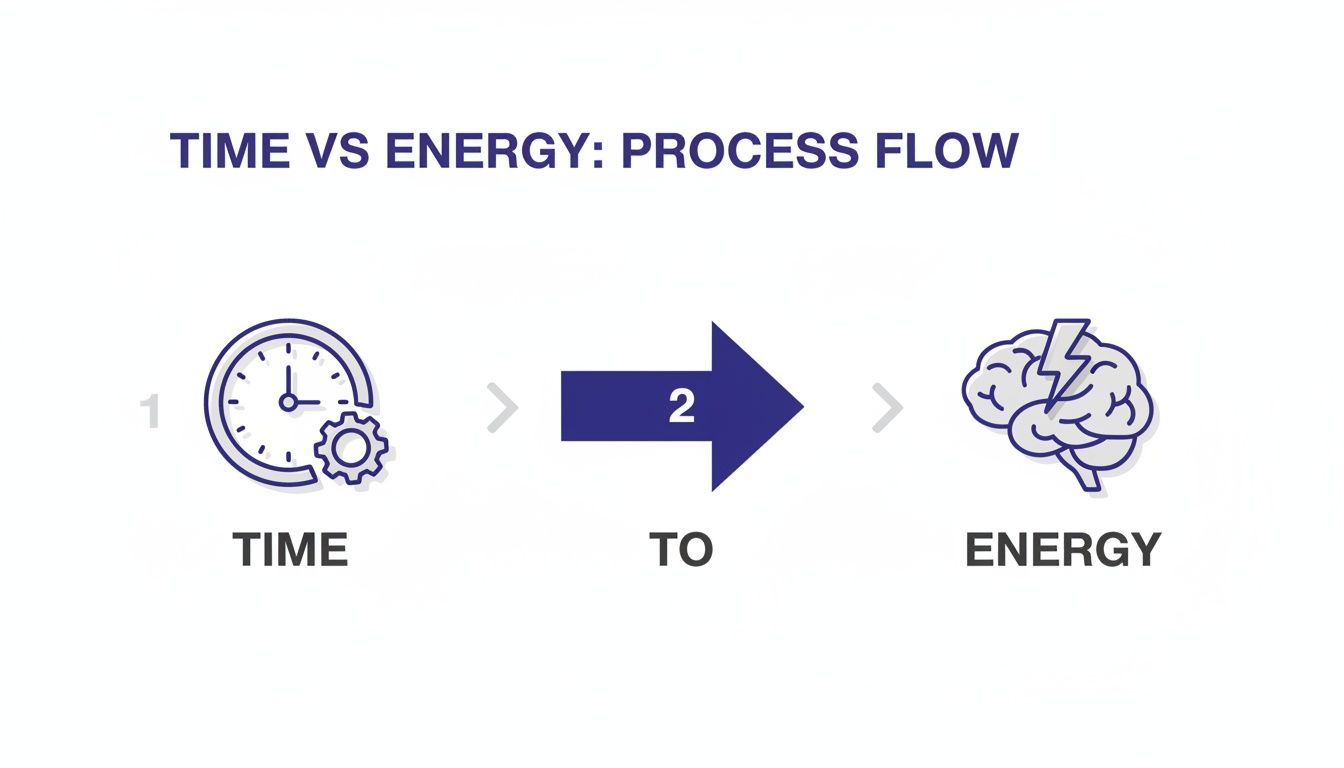
This simple visual helps capture the shift from just managing the clock to optimizing your internal state.
The goal isn’t just to fill hours; it’s to convert the raw material of time into high-quality, focused energy.
A Real-World Example in Action
Let’s look at a real-world case. Alex, a freelance graphic designer, felt perpetually burned out despite being “productive.” He decided to track his energy for a week and discovered a pattern he never would have guessed.
He had always forced himself to tackle big creative projects first thing in the morning, believing that was “peak time.” His audit, however, showed his mental and creative energy didn’t actually peak until around 10:30 AM.
But he also saw that his emotional energy was highest right at the start of the day. This made his morning the perfect time for client communication—a task he used to dread and put off. He also noticed a sharp, predictable energy crash around 2:30 PM every single day, which he used to fight with more coffee.
Armed with this data, Alex totally restructured his day:
- 8:30 AM – 10:00 AM: Client emails and project check-ins (high emotional energy).
- 10:30 AM – 1:00 PM: Deep creative work (peak mental energy).
- 2:30 PM: A scheduled 20-minute walk outside (strategic renewal instead of caffeine).
This simple shift was a game-changer. By aligning his tasks with his natural energy flow, Alex produced better work in less time and ended his days feeling accomplished instead of drained. That’s the power of managing your energy, not just your time.
Design Your Week Around Your Natural Energy Rhythms
You’ve done the audit. You have the raw data on your personal energy flows. Now it’s time to stop just observing and start architecting. This is where you build a schedule that works with your body’s natural currents instead of constantly fighting against them.
Forget the old model of time blocking, where the goal was just to cram tasks into every available slot. We’re moving to energy blocking—a smarter approach that matches your most critical work to the moments you’re best equipped to handle it. It’s about assigning the right task to the right energy, not just the right hour.

This simple shift turns your calendar from a rigid taskmaster into a strategic asset. You’ll reserve your best mental resources for the work that actually moves the needle.
Aligning High-Impact Work with Peak Energy
Your energy audit almost certainly revealed a 2-3 hour window where your focus is sharpest and your mind is clearest. These are your golden hours. This block of time is precious, and it should be guarded fiercely for deep, cognitively demanding work.
What qualifies as deep work? Think about the tasks that create the most value:
- Strategic Planning: Charting the next quarter for your business.
- Creative Content: Writing a complex report, designing a new product, or coding a tough feature.
- Problem-Solving: Untangling a tricky operational knot that needs your full concentration.
During these peak windows, your brain is primed to enter a state of deep concentration. We break down how to cultivate this in our guide on how to achieve flow state. By reserving this time for your most challenging projects, you dramatically improve the quality of your output.
Conversely, your low-energy periods—like that classic afternoon slump—are perfect for administrative tasks. Answering routine emails, filling out expense reports, or organizing digital files doesn’t require peak brainpower. Shifting this “shallow work” to your energy troughs prevents you from wasting your best hours on low-impact activities.
The Science of Task Batching and Attention Residue
A core strategy here is task batching—grouping similar activities together and knocking them out in one dedicated block. This is so powerful because it minimizes a massive energy drain known as attention residue.
Attention residue is the mental noise that lingers when you switch from one unfinished task to another. Research from psychology shows that even after you’ve moved on, part of your brain is still chewing on the previous item. This cognitive friction saps your mental energy and makes it nearly impossible to focus deeply on the new task.
Studies show the average employee spends a staggering 57% of their time just communicating through meetings, emails, and chats. That leaves a tiny fraction of the day for actual productive work. This constant context switching is an energy catastrophe, leaving a trail of attention residue that kills focus.
By batching your tasks, you let your brain settle into one “mode” for a sustained period. Process all your emails at once. Make all your calls in a single block. Handle all your accounting in one go. This slashes the mental cost of switching gears, preserving your cognitive resources for what truly matters.
A Real-World Energy Blocking Makeover
Let’s look at an entrepreneur named Maria who felt perpetually swamped. Her energy audit showed her mental focus was highest from 9 AM to noon. The problem? Her days were a chaotic mix of client calls, team huddles, and strategic work, all jumbled together.
She redesigned her week using energy blocking:
- Mornings (9 AM – 12 PM): This became a sacred, no-meetings zone. She dedicated this time exclusively to product development and marketing strategy—the core growth drivers of her business.
- Afternoons (1 PM – 4 PM): She batched all her external communication here. Client calls, vendor meetings, and team check-ins were all scheduled during this lower-energy window.
To pull this off, she had to communicate her new boundaries clearly. She set up a scheduling tool that only offered afternoon slots and added a note to her email signature explaining her new focus-oriented schedule.
At first, she was nervous about pushback. But her clients and team respected her commitment to delivering high-quality work. The result? Her business growth accelerated, and her feelings of burnout vanished.
Strategic Renewal For Sustainable Performance
Sustained high performance isn’t about pushing harder; it’s about recharging smarter. Once you’ve designed your week around your natural energy rhythms, the next move is to build in moments of what I call strategic renewal. Think of it as the essential maintenance that keeps your engine running smoothly.
Without intentional recovery, even the most perfectly planned schedule will eventually lead you straight toward depletion. The goal here is to weave small, science-backed “micro-routines” into your day that replenish your four core energy dimensions. This isn’t about cramming more onto your to-do list. It’s about finally recognizing that brief, deliberate pauses are not a luxury—they are a biological necessity for focus, resilience, and creativity.
Managing your energy, not just your time, means treating recovery as an active part of your workflow, not something you only get to when you’re completely running on fumes.

Fueling Your Physical Energy
Your physical renewal is the bedrock. It’s the foundation that your mental and emotional stamina are built upon. When your body is depleted, your brain’s executive functions—like sharp decision-making and impulse control—are always the first casualties.
One of the most counterintuitive findings in this area comes from the University of Bristol. Their research showed that exercise doesn’t just boost physical health; it directly improves mental-interpersonal skills, time management, and concentration at work. So many of us cite a “lack of time” as the reason we skip a workout, yet the science suggests movement paradoxically creates more usable time by amplifying your energy and focus for hours afterward. Even a small bit of activity is a high-return investment.
Actionable Micro-Routines:
- The 10-Minute Walk: A short, brisk walk can increase blood flow to the brain, measurably improving cognitive function for up to two hours. Try scheduling one mid-morning or right when that classic afternoon slump hits.
- Hydration Breaks: Dehydration is a notorious saboteur of focus, leading to mental fog and fatigue. I set a recurring timer on my watch to drink a glass of water every 90 minutes.
- Mindful Snacking: Instead of grabbing a sugary snack that will inevitably lead to an energy crash, go for something that combines protein and complex carbs. An apple with almond butter, for instance, will stabilize your blood sugar and provide sustained energy.
Recharging Your Mental Energy
Your brain is an energy hog, especially when you’re deep in focused work. Without taking mental breaks, you’ll slide into decision fatigue, a state where the quality of your choices literally deteriorates over time. Strategic mental renewal is all about clearing out that cognitive clutter before it builds up.
The Pomodoro Technique is a perfect, structured example of this in action. It works by breaking your work into 25-minute focused sprints, separated by short 5-minute breaks. This rhythm forces you to step away before mental fatigue can take hold, preserving your cognitive endurance throughout the day.
Mental renewal is about creating deliberate “white space” in your day. It’s in these moments of disengagement that your brain consolidates information and generates its most creative insights.
Protecting Your Emotional Energy
Emotional energy is your capacity to stay calm, patient, and optimistic, especially when the pressure is on. This resource gets drained by negative interactions, constant interruptions, and a lack of clear boundaries.
Picture a manager who spends their entire day in back-to-back meetings, absorbing everyone else’s stress and problems. Without a way to reset, that emotional residue gets carried into the next meeting, and the next, leading to irritability and poor leadership. A simple micro-routine, like taking five deep, slow breaths before joining the next video call, can completely reset their emotional state.
Boundary-Setting Examples:
- The “Office Hours” Auto-Reply: Set an auto-responder on your chat app that says, “I’m in deep work until 11 AM but will respond then.” This isn’t rude; it’s clear communication that manages expectations and protects your focus.
- The End-of-Day Shutdown: Create a firm ritual to signal that your workday is over. Close your laptop, put your work phone away, and even say it out loud: “My workday is now complete.” This creates a powerful psychological boundary between your work and personal life.
If you find that emotional drain is becoming a chronic issue, it might be a sign of a larger problem. For anyone feeling completely overwhelmed, it’s worth understanding the practical steps outlined in our guide on how to recover from burnout.
Editor’s Take: What Really Works?
Let’s be honest: the whole managing energy, not time idea works best for people who have a decent amount of control over their calendars—like entrepreneurs, freelancers, and knowledge workers. If your day is a wall of back-to-back meetings in a rigid corporate structure, you’ll need to adapt these principles, not just copy them. You probably can’t block out your entire morning for deep work, but you can reclaim your lunch break for actual renewal (a walk outside, not scrolling at your desk). You can also manage your focus inside those meetings by consciously tuning out distractions.
Who is this best for? Anyone who feels busy but not productive and understands that human performance isn’t a straight line.
What’s the biggest limitation? External demands can make perfect implementation difficult. The real win isn’t a flawless schedule; it’s the mental shift of seeing yourself as a human to be cultivated, not a machine to be optimized.
The single most important starting point is the personal energy audit. Self-awareness is the bedrock of this entire approach. This isn’t a one-and-done hack; it’s an ongoing practice of checking in with yourself and making small adjustments. Over time, those adjustments compound into sustainable performance.
FAQ: Your Top Questions on Managing Energy, Not Time
Here are answers to the most common questions about shifting from time management to energy management.
1. What’s the real difference between managing energy and just feeling tired?
Feeling tired is a symptom, a general state of needing rest. Managing energy is a proactive strategy. It’s about intentionally cultivating and spending your four core energy types—physical, mental, emotional, and spiritual—to perform at your best without burning out. Tiredness is the warning light; managing energy is the engine maintenance that prevents the light from coming on.
2. My energy levels are unpredictable. How can I plan my week?
The key isn’t perfect prediction but flexible adaptation. Your weekly plan is a template, not a rigid script. Have a pre-made list of low-energy tasks (e.g., organizing files, clearing your inbox) that you can swap in when a high-energy task suddenly feels impossible.
3. How do I explain this ‘managing energy’ idea to my boss?
Frame it in the language of results and quality. For example: “I’ve analyzed my workflow and found I produce my sharpest strategic work in the morning. To leverage that, I’d like to block off 9-11 AM for deep focus on Project X. I’ll be fully available for meetings in the afternoon when I’m better primed for collaborative work.” This shows strategic thinking, not flakiness.
4. What if I have a high-demand job with zero schedule flexibility?
Focus on what you can control. You might not move a meeting, but you own the 15 minutes before and after. Use micro-renewals: stand up, stretch, or take deep breaths between calls. Guard your lunch break as a non-negotiable recovery period. Manage your energy within constraints by taking notes by hand to stay engaged or tuning out irrelevant side conversations.
5. I did an energy audit, and my energy is just low all day. What now?
Your audit is a diagnostic tool. If it reveals consistently low energy, it’s a signal to examine the fundamentals: are you getting 7-9 hours of quality sleep? Is your diet supporting sustained energy? Are you moving your body regularly? If you’ve addressed these basics and nothing changes, it may be a sign of burnout or an underlying health issue, and consulting a healthcare provider is a good next step.
6. How long does this actually take to work?
You will likely feel small wins within the first week from increased self-awareness. However, completely rewiring your habits typically takes a few weeks of consistent effort. The goal is to make energy-aware choices instinctively, which takes time. Be patient with the process.
7. Can technology help or hurt my energy management?
Tech is a double-edged sword. It can be an energy drain (constant pings, mindless scrolling) or a powerful ally. Use it intentionally: block out focus time on your calendar, use timers to remind you to take breaks, and use apps to block distracting sites during your peak energy hours. Make your tech work for you.
8. Is this just another productivity fad?
No. The core principles—alternating intense effort with strategic recovery—are rooted in human physiology and have been used by elite performers for decades. We are now applying that same logic to knowledge work, recognizing that the brain performs best when we respect its natural cycles. It’s a necessary adaptation to avoid issues like what is cognitive overload.
9. What’s the single biggest mistake people make when starting out?
Trying to be perfect from day one. They design a flawless “ideal week” and then feel like a failure when life inevitably gets in the way. Instead of perfection, aim for 80% consistency. Start small by protecting just one high-energy block each day and build from there.
10. How do I know if this is actually working? How do I measure success?
Success is measured by more than just tasks completed. Look for qualitative signs: do you end the day feeling accomplished instead of drained? Is your focus sharper? Are you more present with others? Also, look for quantitative signs: is the quality of your output improving? Are you spending less total time on tasks?
Disclaimer & Affiliate Disclosure: Please remember that the content in this article is for educational and informational purposes only. It is not intended to be a substitute for professional medical advice, diagnosis, or treatment. Always seek the advice of your physician or other qualified health provider with any questions you may have regarding a medical condition. Some of the links in this post may be affiliate links, meaning we may earn a small commission if you make a purchase, at no extra cost to you.
At Mind Clarity Hub, we are dedicated to providing science-backed, practical guides to help you master your focus and productivity. Explore our full library of books on topics from digital clarity to burnout recovery. https://mindclarityhub.com
Explore the Mind Clarity Hub Library
Practical books on focus, digital habits, resilience, and building a calmer mind.
The Power of Clarity
Unlock mental focus, build momentum, and create the life you were meant to live.
View book →
AI & ChatGPT for Beginners
No PhD needed — a 2025 guide to AI, prompts, and productivity without coding.
View book →
Zen in the Digital Jungle
Mindfulness for a chaotic world.
View book →
The Slow Reset
Mindful living in a fast-paced world.
View book →
Perfectly Imperfect
Stop self-criticism, set boundaries, and embrace the real you.
View book →
Reclaiming Silence
A dopamine detox guide to finding peace in a noisy world.
View book →
The Focused Freelancer
Productivity, pricing & positioning for independents in 2025.
View book →
ChatGPT Side Hustle System
Launch your AI-driven online business in 30 days.
View book →
Burnout, Interrupted
A proven path to restore energy and reclaim your life.
View book →
Attention Unleashed
Focus strategies for the distracted mind.
View book →
Side Hustle Launchpad
Your quick-start guide to extra income.
View book →
Digital Clarity
Rewire your brain, escape dopamine traps & regain focus.
View book →
Break the Scroll
Reduce screen time and take back control of your life.
View book →
Climate Compassion
Transform eco-anxiety into empowered action.
View book →
Village Mentality
The power of community for mental wellness.
View book →
Restful Nights
Overcoming sleep anxiety in a 24/7 world.
View book →
Connected Again
Combat loneliness and build meaningful relationships.
View book →
Focus Recharged
Mastering attention and productivity in the digital era.
View book →
Marketing Magic with ChatGPT
AI-powered content, campaigns, and copywriting to grow faster.
View book →
The 6-Figure Creator
Turn knowledge into passive income with books, courses & AI.
View book →
Burnout Breakthrough
Reset your work-life balance and thrive in 2025.
View book →
The Emotionally Intelligent Man
A modern guide to self-awareness and communication.
View book →
AI Personalized Wellness
Create your custom health plan with data-driven habits.
View book →
Everyday AI Made Easy
Use ChatGPT and smart tools to simplify life.
View book →
Money Mindfulness
A financial wellness guide for Gen Z & Millennials.
View book →
Startup Smarter with AI
ChatGPT strategies and tools to grow your business.
View book →
ChatGPT for Writers & Creators
Unlock AI-powered brainstorming, drafting & editing.
View book →