


Published:
Ever feel like your brain is just… done? The telltale signs of mental fatigue often sneak up on us. You might notice a persistent brain fog that won’t lift. Perhaps you have a short fuse with loved ones. Trouble focusing on simple tasks is another common signal. Finally, a deep-seated exhaustion that a good night’s sleep can’t seem to touch often appears.
This isn’t just about being tired. Instead, it’s a state of cognitive burnout where your mental resources are completely spent.
(Our posts may contain affiliate links. If you purchase through these links, we may earn a small commission at no extra cost to you.)
What Is Mental Fatigue and What Does It Feel Like?
Think of your brain’s daily energy supply like a smartphone battery. Every complex problem you solve drains that battery. Every decision you make also takes a toll. Even spending hours on video calls can deplete your energy. Consequently, mental fatigue is what happens when you hit that dreaded 1%.
Your brain feels sluggish. Your thinking gets fuzzy. As a result, simple tasks suddenly feel like climbing a mountain.
Neuroscience gives us a clearer picture of what’s happening under the hood. This feeling of depletion is often linked to an overworked prefrontal cortex. This is the part of your brain responsible for executive functions like planning, focus, and self-control. When it runs out of gas, your brain’s performance drops. It’s just like a phone that starts lagging when its battery is almost dead.
Learning to recognize these signals early is the first step toward preventing a full-blown shutdown.
The Four Main Categories of Symptoms
Mental fatigue rarely stays confined to your head. In fact, it’s a full-body experience that ripples out. It affects your emotions, actions, and even your physical health.
It tends to show up in four key areas:
Cognitive Signs: This is the classic “brain fog” territory. For example, you might struggle to recall simple words. Or you may find decision-making exhausting. You might also notice your attention span is shorter than a mayfly’s. We dive deeper into this feeling in our guide on what causes brain fog.
Emotional Signs: Feeling unusually irritable, cynical, or detached? That could be mental fatigue talking. For instance, small frustrations can feel monumental. This can lead to mood swings, heightened anxiety, or a sense of being emotionally numb.
Behavioral Signs: Procrastination often kicks into high gear. As a real-world example, you might find yourself withdrawing from friends. You could also make more careless mistakes at work. Or you might watch your productivity nosedive as you stare at a task without starting.
Physical Signs: The mind-body connection is incredibly strong. Mental exhaustion can manifest physically as tension headaches or sleep disturbances like insomnia. It can even cause mysterious aches and pains. This heavy, drained feeling is sometimes compared to the relentless fatigue and ‘fibro fog’ that accompanies certain chronic conditions.
To give you a clearer picture, here’s a quick summary of the signs to watch for in yourself.
Quick Overview of Mental Fatigue Signs
A summary of the primary indicators of mental fatigue, categorized for easy identification in your daily life.
| Category | Common Signs of Mental Fatigue |
|---|---|
| Cognitive | Brain fog, difficulty concentrating, poor memory, indecisiveness, reduced creativity. |
| Emotional | Irritability, anxiety, cynicism, apathy, feeling overwhelmed, mood swings. |
| Behavioral | Procrastination, social withdrawal, making more errors, reduced productivity, low motivation. |
| Physiological | Headaches, insomnia or sleep issues, unexplained body aches, fatigue, digestive problems. |
Recognizing these patterns is the crucial first step. It’s your brain’s way of sending up a flare. It lets you know it’s time to ease up on the cognitive throttle and recharge.
Exploring the Cognitive and Behavioral Signs of Mental Fatigue
When mental fatigue creeps in, its first casualties are almost always your thinking and your actions. The cognitive signs can feel like a dense fog rolling into your mind. This makes everything you do feel like you’re wading through mud.
This “brain fog” isn’t just a vague feeling; it has real roots in neuroscience. It’s often a sign that your prefrontal cortex is overworked. Think of this brain region as your mental CEO. It’s in charge of high-level stuff like planning, making decisions, and staying focused. When you’ve pushed it too hard for too long, it starts to get sluggish. For instance, you might find yourself rereading the same paragraph five times. Or you could stare at a simple to-do list, unable to decide what’s most important.

From Brain Fog to Behavioral Changes
It doesn’t take long for that mental slowdown to spill over into your behavior. One of the most common signs you’ll see is procrastination. And no, this isn’t about laziness. Instead, it’s actually a self-preservation tactic. It is your brain’s way of hitting the brakes when it’s too drained to handle another complex thought.
For example, a project manager who usually nails every deadline might suddenly lose hours scrolling through social media. This happens instead of building out the next project plan. Their brain is actively dodging the mental effort required for the task. This avoidance is a clear signal that their cognitive resources are running on fumes. If this feels familiar, you might want to read our guide on what is cognitive overload.
Another major behavioral shift is a nagging desire to quit or find a new job. This urge often points to deep disengagement, fueled by that same cognitive drain. While global burnout hit a staggering 48%, the desire to job search was reported by 30% of employees feeling change fatigue and 23% dealing with high stress. This desire to escape is what happens when a mind is so exhausted that focus disappears and productivity takes a nosedive.
Your brain is not a machine. When it starts sending signals like procrastination or disengagement, it’s asking for rest, not more discipline. Trying to power through only makes the fatigue worse.
Here’s an actionable step: try using a productivity journal to track your focus levels. Just jotting down when you feel sharp versus when the brain fog sets in can help you spot the patterns behind your mental drain. Recognizing these cognitive and behavioral red flags is the first move toward creating more sustainable work habits. For anyone ready to build a system that protects their focus, our book The Power of Clarity offers a complete roadmap.
How Mental Exhaustion Affects Your Emotions
When your brain is running on fumes, your emotions are often the first to send up a flare. Mental exhaustion can dramatically shorten your fuse. It leaves you feeling unusually irritable, anxious, or even cynical about things you normally care about.
If you find yourself snapping over small things or feeling a sense of dread about your day, it’s not a character flaw. Rather, it’s a clear signal that your mind is overloaded and desperately needs a break.
This happens because sustained cognitive stress throws your brain’s emotional regulation system off-kilter. Specifically, it messes with the amygdala. This is the part of your brain that acts like an emotional smoke detector. An overactive amygdala makes you far more reactive to minor frustrations that you’d normally just brush off.
Think of a remote worker who has been stuck in back-to-back video calls all day. When a family member asks a simple question, they snap. Their reaction isn’t about the question. Instead, it’s a symptom of a brain that has zero capacity left to process one more piece of input, no matter how small.
The Rise of Change Fatigue and Anxiety
In today’s fast-moving workplaces, constant organizational shifts can fuel a low-grade but persistent state of anxiety. Psychologists call this “change fatigue,” and it’s a huge driver of mental exhaustion. It’s that emotionally frayed feeling you get when the goalposts seem to move every other week.
This isn’t just a feeling; the data backs it up. Recent research found a staggering 83% of millennials reported feeling more anxious at work than they did the previous year. This spike in anxiety is strongly tied to change fatigue. Shifting policies on remote work and time off negatively impacted two-thirds of workers. You can read the full research on workplace change fatigue here.
The emotional signs of mental fatigue—like irritability and anxiety—are not character flaws. They are biological signals from a brain that has been pushed beyond its sustainable limits.
One of the simplest ways to start creating a calmer internal environment is to reduce sensory overstimulation. A good pair of noise canceling headphones can make a surprisingly big difference. They give your brain fewer things to process at once. If you find yourself wrestling with emotional exhaustion at work, our book, Burnout Interrupted, offers practical strategies to get back on solid ground.
It’s important to note that while these feelings can overlap with symptoms of clinical anxiety or depression, this article is for educational purposes only. If you’re concerned about your mental health, please talk to a qualified healthcare professional. You can also explore our guide to learn more about how to manage chronic stress.
The Physical Signs That Signal Mental Overload
Mental exhaustion doesn’t just stay in your head. In fact, it creates real, tangible effects throughout your body. The mind-body connection isn’t some abstract concept—it’s a powerful two-way street. When your brain is overloaded, your physical health often pays the price. These signals are your body’s way of waving a white flag, telling you the mental battery is critically low.
This all comes down to your brain’s stress system. When you’re under constant cognitive strain, your brain keeps the emergency broadcast system on. This triggers a steady drip of stress hormones like cortisol. While helpful in short bursts, chronic exposure leads to physical wear and tear. This is where those persistent tension headaches, digestive issues, or unexplained muscle aches come from.

Why You Feel Wired but Tired
One of the most confusing signs of mental fatigue is how it messes with your sleep. You might feel utterly drained all day. However, the moment your head hits the pillow, your mind starts racing. This classic “wired but tired” feeling is a hallmark of an overstimulated nervous system.
Your brain has been revved up to a high RPM from the day’s mental demands. It simply struggles to downshift into a restful state. This often leads to insomnia or fragmented, poor-quality sleep, which only digs the hole of fatigue deeper. Think of a student cramming for exams. Even if they’re in bed for eight hours, the constant headaches and restless nights mean they’re not getting restorative sleep. Their brain is just too activated.
Simple environmental tweaks can make a surprisingly big difference here. Wearing blue light blocking glasses in the evening can help your brain get the message that it’s time to produce melatonin. This hormone signals sleep. Likewise, using a sunrise alarm clock can gently ease you awake. This supports a more natural sleep-wake cycle instead of a jarring alarm that just adds to the grogginess.
Paying close attention to these physical cues is crucial for catching mental fatigue early. If you’re also wrestling with cognitive issues, you might want to explore our guide on vitamins that can help with brain fog for a more holistic approach to getting your clarity back.
Mental Fatigue vs. Burnout vs. Depression: Understanding the Differences
It’s crucial to tell the difference between mental fatigue, burnout, and depression. While they can feel similar on the surface, they come from different places. They also need very different kinds of support. Mistaking one for another is a fast track to frustration. This is especially true when a good night’s sleep doesn’t fix a problem that runs much deeper.
Getting clear on the nuances helps you name what you’re actually going through. This is the first step toward getting the right kind of help.
A simple phone analogy can help draw the lines:
- Mental Fatigue: Think of your brain like a smartphone at the end of a long day. You’ve used it heavily, and now the battery is drained. A solid overnight charge (a good rest) brings it right back to 100%.
- Burnout: This is more like a damaged phone battery. No matter how long you plug it in, it just can’t hold a full charge anymore. It drains alarmingly fast, even with light use.
- Depression: This isn’t a battery problem; it’s an issue with the phone’s entire operating system. A core glitch is affecting every single function, making it hard to do anything at all.
Spotting the Key Distinctions
Mental fatigue is mostly about cognitive exhaustion. It’s that feeling of being mentally “full” or “fried” after a long period of intense focus or decision-making. The good news is that it’s usually short-term. It gets much better with genuine rest and a break from the strain.
Burnout, however, is a much more chronic state tied specifically to unmanaged workplace stress. It’s defined by a toxic trio of symptoms: deep cynicism, a feeling of detachment from your work, and a nagging sense of ineffectiveness. We cover this in depth in our guide on how to recover from burnout.
This diagram shows how that relentless mental strain can start to show up physically.
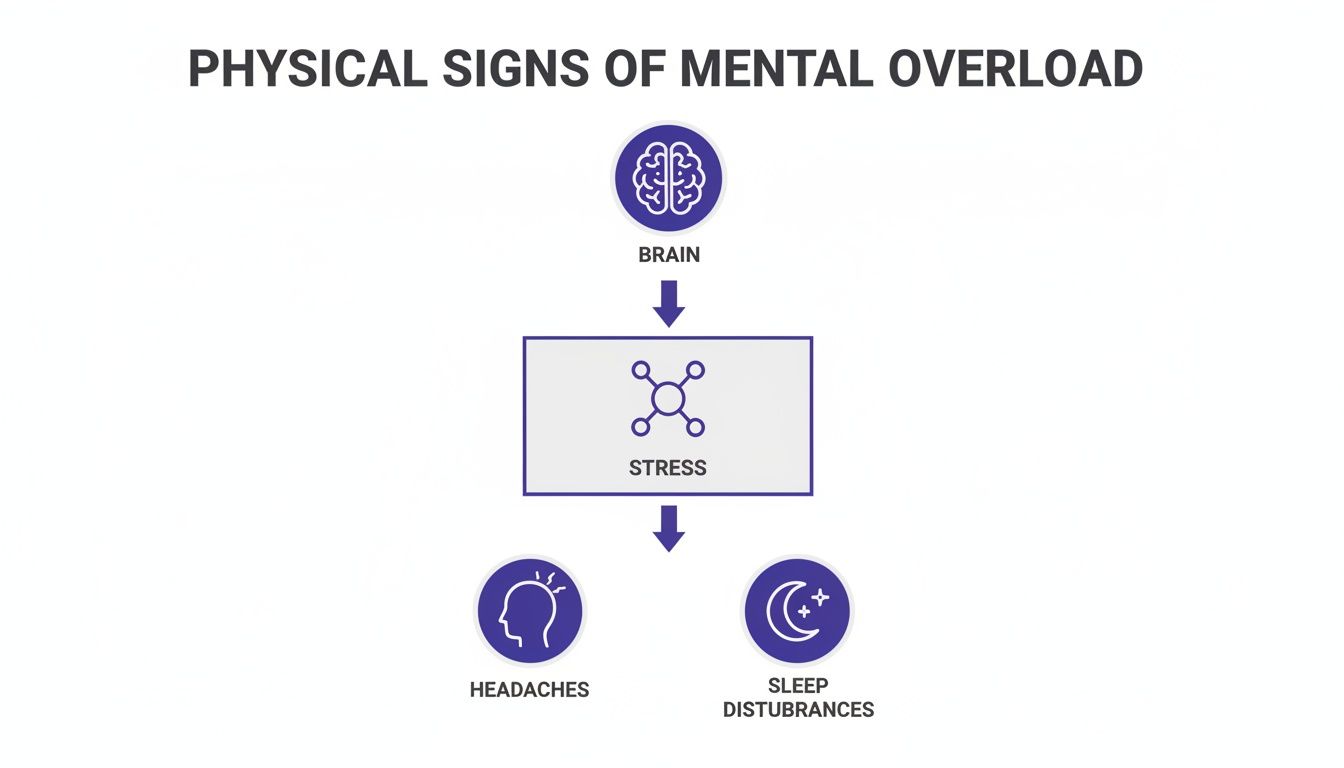
As you can see, when your brain is overloaded, it triggers the body’s stress response systems. This isn’t just an abstract feeling. In fact, it can directly cause very real symptoms like tension headaches and disrupted sleep.
Depression is a clinical mood disorder that casts a shadow over your entire life, not just your job. It involves a persistent low mood and a loss of interest in things you once enjoyed. Feelings of hopelessness are also common and almost always require professional care to navigate.
A habit tracker journal can be a surprisingly helpful tool here. By jotting down your daily energy levels and moods, you start to see patterns. This data is not just for you. It can be incredibly useful when you talk to a doctor or therapist.
Mental Fatigue vs. Burnout vs. Depression
Understanding the key differences between these related but distinct conditions is the first step toward finding the right path forward. This table breaks down the core distinctions.
| Aspect | Mental Fatigue | Burnout | Depression |
|---|---|---|---|
| Primary Cause | Prolonged cognitive effort, overstimulation. | Chronic, unmanaged workplace stress. | Complex interplay of biological, psychological, and social factors. |
| Duration | Typically short-term; resolves with rest. | Long-term; requires significant intervention. | Persistent; often requires clinical treatment. |
| Core Feeling | Brain feels ‘full’ or ‘drained’. | Cynicism, detachment, and inefficacy. | Pervasive low mood, hopelessness, and anhedonia. |
| Scope | Primarily affects cognitive performance. | Mainly related to one’s job. | Affects all aspects of life. |
Ultimately, knowing what you’re up against empowers you to seek the right kind of support. This helps you avoid trying solutions that don’t match the problem.
Disclaimer: This information is for educational purposes only and is not a substitute for professional diagnosis or treatment. If you are concerned about your symptoms, please consult a qualified healthcare provider.
Practical Strategies to Combat Mental Fatigue
Recognizing the signs of mental fatigue is the first half of the battle; taking action is the second. Moving from awareness to recovery means adopting practical, evidence-informed strategies. These protect your brain’s limited resources. These aren’t just quick fixes. Instead, they’re techniques to help you manage your mental energy and prevent the deep exhaustion that leads to burnout.
The goal here is to build a toolkit of habits that work for your brain, not against it. You’d be surprised how much of a difference small, consistent adjustments can make in how you feel day-to-day.

Structure Your Focus and Breaks
One of the most powerful ways to stop mental overload before it starts is to be intentional. You must be deliberate about how you structure your work sessions. The Pomodoro Technique is a fantastic method. You work in focused 25-minute bursts separated by short breaks. Using a simple pomodoro timer enforces these boundaries. This gives your prefrontal cortex a much-needed chance to rest and recharge between demanding tasks.
Similarly, time blocking is a game-changer. By scheduling specific blocks of time for deep work, you’re actively preventing multitasking. This is a notorious cognitive drain. This approach protects your focus and stops you from constantly switching contexts. This constant switching is one of the biggest culprits behind mental fatigue. You can organize this schedule easily with a time blocking planner.
Reduce Digital and Physical Strain
Your environment plays a massive role in your mental energy. Constant digital pings and notifications keep your brain in a state of high alert. As you can imagine, this is exhausting. Taking deliberate steps to quiet this noise is crucial for recovery. For a deeper dive into managing your digital world, our book, Digital Clarity, is a great place to start.
Physical discomfort also quietly chips away at your mental reserves. Simple ergonomic adjustments can make a huge difference here. Using an ergonomic keyboard or a laptop stand for desk reduces low-grade physical stress. This stress slowly drains your mental stamina all day long. A good monitor light bar can also reduce eye strain significantly.
Don’t underestimate the impact of your work environment. Workplace stress is a huge factor, with 77% of US workers experiencing it. This stress snowballs into burnout for 57% of them. Furthermore, 31% report feeling emotionally exhausted. These numbers reveal how unchecked stress bleeds directly into mental fatigue. This is especially true when you consider that 76% of people in toxic work settings say their job harms their mental health. You can discover more insights about these workplace well-being findings from the American Psychological Association.
Ultimately, one of the most effective strategies is also one of the most fundamental. Focus on how to improve sleep quality to ensure you wake up truly restored. You can also create dedicated distraction-free time. Using a phone lock box timer can physically remove the temptation to scroll, giving your brain a genuine break.
Key Takeaways on Mental Fatigue
- Mental fatigue is cognitive, not just physical: It’s a sign that your brain’s processing resources are depleted from prolonged mental effort, which is different from simple sleepiness.
- Symptoms appear in four key areas: Look for signs in your thinking (brain fog), emotions (irritability), behavior (procrastination), and body (headaches, sleep issues).
- It’s distinct from burnout and depression: Mental fatigue is usually short-term and improves with rest, whereas burnout is chronic and work-related, and depression is a clinical mood disorder affecting all life areas.
- Proactive strategies are essential: You can combat mental fatigue with practical steps like using the Pomodoro Technique, time blocking, reducing digital distractions, and prioritizing high-quality sleep.
- Your environment matters: Both digital noise and physical discomfort contribute to mental drain. Creating a calm, ergonomic workspace can preserve your cognitive energy.
- Listen to your body’s signals: These signs are not weaknesses; they are important data from your brain and body telling you it’s time to recharge.
Disclaimer: This article contains affiliate links. If you make a purchase, we may earn a small commission at no extra cost to you. The content here is for educational purposes and should not be taken as a substitute for professional medical or psychological advice.
Editor’s Take
After diving deep into the signs and science, it’s easy to get lost in complex solutions. But in my experience, the most powerful strategy for managing mental fatigue is refreshingly simple: consistently prioritize intentional rest and set firm boundaries.
This advice is aimed squarely at busy professionals, students, and freelancers. It is for anyone feeling that familiar brain-fried overwhelm but who isn’t yet dealing with clinical burnout or depression. Think of these strategies as preventative maintenance for your mind. They are not a cure for chronic conditions that need and deserve professional support.
The biggest wins often come from surprisingly low-tech changes. Scheduling a daily walk without your phone, for instance, can be very effective. Or, using an analog alarm clock to create a screen-free bedroom can work wonders. Even just turning off non-essential notifications can restore more mental energy than any complicated productivity system. It’s the small, consistent acts of disconnection that truly move the needle.
Your Questions on Mental Fatigue, Answered
As you start to notice the signs of mental fatigue, questions naturally come up. It’s a fuzzy, frustrating experience. Getting clear answers is the first step toward feeling better. We’ve gathered some of the most common questions we hear to give you that clarity right now.
1. How Is Mental Fatigue Different from Just Being Tired?
Think of it this way: regular tiredness is your body’s battery running low. A good night’s sleep is like plugging it in to recharge. Usually, you wake up feeling refreshed.
Mental fatigue, on the other hand, is when your brain’s processing power is overloaded. Sleep helps, but it often isn’t enough. You might wake up still feeling that sluggish, “brain full” sensation. This is because the cognitive load hasn’t actually been cleared.
2. Can My Diet and Hydration Really Affect Mental Fatigue?
Absolutely. Your brain is an incredibly energy-hungry organ. Even mild dehydration has been shown to mess with your cognitive function. It can make focus and memory feel harder.
The same goes for food. A diet heavy in processed foods can lead to energy crashes and inflammation. However, a balanced diet gives your brain the steady fuel it needs to operate. It’s not about perfection, but consistent fuel and water make a huge difference. A good magnesium glycinate supplement might also support relaxation and brain health.
3. Does Exercise Make Mental Fatigue Worse?
This is a huge misconception. When you’re mentally fried, the last thing you want to do is move. But moderate physical activity is one of the best tools for recovery. This could be a brisk walk or a few stretches.
Exercise isn’t just about burning energy. It boosts blood flow to the brain and triggers the release of endorphins. This can sharpen your focus, improve your mood, and leave you feeling more mentally energized. An under desk walking pad is a great way to sneak this in without it feeling like a chore.
4. How Long Does It Take to Recover from Mental Fatigue?
There’s no one-size-fits-all answer here. The recovery timeline really depends on how deep the fatigue runs. It also depends on what’s causing it.
For a mild case, a weekend of true disconnection and intentional rest might be enough to reset. But if you’re dealing with more chronic mental exhaustion, it could take several weeks of consistent effort. This means prioritizing sleep, setting firm boundaries, and using strategies like a visual timer for desk to manage focus.
5. Can I Experience Mental Fatigue Even If I Love My Job?
Yes, and this is incredibly common. Mental fatigue has nothing to do with whether you like your work. Instead, it’s about the sheer cognitive load.
Even work that is deeply meaningful and engaging can be mentally taxing. Passion doesn’t make your brain immune to overload. Without building in adequate recovery time, even the most fulfilling job can lead to serious mental exhaustion.
What Are Some Less Obvious Signs of Mental Fatigue?
6. What Are Some Less Obvious Signs of Mental Fatigue?
Beyond the classic brain fog and irritability, mental fatigue can show up in more subtle ways. You might notice a total loss of creativity. Or you could feel a sense of detachment from things you normally enjoy.
It can even manifest physically. For example, you might find yourself with an upset stomach more often. You may also notice you’re becoming clumsy. And pay attention to your crutches. Are you relying more on coffee or a sugary snack to push through the afternoon?
7. Is Procrastination Always a Sign of Mental Fatigue?
Not always, but there’s a very strong link. When your brain is overloaded, its primary goal is self-preservation. It will naturally start avoiding any task that requires a heavy cognitive lift.
What looks and feels like procrastination is often just your brain’s defense mechanism kicking in. A productivity journal can be a great, non-judgmental tool to help you spot these patterns as they happen.
8. How Can I Tell if My Sleep Problems Are From Mental Fatigue?
One of the clearest signs is that “wired but tired” feeling. You’ve been dragging yourself through the day, completely exhausted. But the moment your head hits the pillow, your mind starts racing.
This is a classic symptom of an overstimulated nervous system. It goes hand-in-hand with mental overload. Creating a truly dark, quiet space with something like a sleep mask blackout can help calm those inputs. It signals to your brain that it’s safe to rest.
9. Can Technology Contribute to My Mental Fatigue?
Definitely. Our digital environment is a huge source of cognitive load. The constant notifications and context-switching between apps demand a massive amount of your brain’s processing power. The blue light from screens also contributes.
Setting intentional boundaries with your technology isn’t just a nice idea. In fact, it’s a crucial step in recovering from mental fatigue. For a full guide on how to do this, check out our book, Digital Clarity.
10. When Should I Seek Professional Help for My Symptoms?
If your symptoms are sticking around, it’s time to talk to someone. This is especially true if they get in the way of your daily life. If they are not getting better with rest or lifestyle changes, professional help is key.
A doctor or therapist can help you rule out any underlying medical conditions. They can also offer support and strategies tailored to what you’re going through. You don’t have to figure this out alone.
Ready to build a system that prevents mental burnout before it starts? Explore the full library of practical, science-backed guides at Mind Clarity Hub. Start with our foundational book, The Power of Clarity, to create a calmer, more productive life.
