...

Tag: better sleep

  • Evening Smartphone Boundaries Checklist for Better Sleep

    Evening Smartphone Boundaries Checklist for Better Sleep

    Quick answer: an evening smartphone boundaries checklist for better sleep is a small set of phone rules you run before bedtime: silence nonessential alerts, park high-stimulation apps, dim the screen, move the charger away from the bed, and decide when the phone is allowed back in the morning. The goal is not to become anti-technology. The goal is to keep your phone from making the last hour of the day louder than it needs to be.

    This guide is written for adults who use a phone for work, family, alarms, or reading, yet want a calmer night without a dramatic digital detox. It also supports readers building a bigger digital clarity plan through Break the Scroll, Restful Nights, and the full Jeremy Jarvis books hub.

    What is an evening smartphone boundaries checklist for better sleep?

    An evening smartphone boundaries checklist for better sleep is a repeatable shutdown routine for your phone. It decides what your phone can interrupt, where it sleeps, which apps are available, and what you do when you are tempted to reopen it. A checklist works better than a vague promise because bedtime decisions happen when willpower is already low.

    The checklist is not medical treatment, and it does not replace care for insomnia, anxiety, shift-work sleep problems, or other sleep conditions. It is a practical environment design tool. You are reducing light, alerts, novelty, and late-night decision friction so your evening has a clearer finish line.

    Why phone boundaries work better than willpower at night

    Phone use near bedtime is hard to manage because the phone mixes practical tools with high-reward distractions. The same device can hold your alarm, family messages, meditation app, shopping tabs, work chat, breaking news, and short videos. A tired brain treats that mix as one open door.

    Sleep education sources commonly recommend reducing electronic stimulation before bed because light, alerts, and emotionally engaging content can delay wind-down. The Sleep Foundation explains how electronics can affect sleep, while CDC sleep guidance emphasizes regular sleep habits and a supportive routine. A recent open-access study in PMC on adult screen use and sleep timing also reinforces why evening screen habits deserve specific boundaries.

    That does not mean every person needs a two-hour phone ban. It means your phone should stop behaving like an always-open room. The strongest evening smartphone boundaries checklist for better sleep is usually simple enough to repeat on a normal Tuesday.

    How do you use this checklist tonight?

    Use the checklist in three passes. First, set the phone rules while you are still alert. Second, move the phone out of your easiest reach. Third, create a morning re-entry point so the boundary feels complete rather than punitive.

    Pass What to decide Fast option Better option
    Notifications Who can interrupt? Do Not Disturb Sleep Focus or Bedtime mode with allowed contacts
    Apps What is off limits? Move social apps off the home screen Set app limits or block lists after a fixed time
    Placement Where does the phone sleep? Across the room Outside the bedroom with a backup alarm
    Re-entry When can you check it? After getting out of bed After light, water, and first planned action

    If you only do one thing tonight, move the charger. A phone on the pillow side of the bed asks for attention even when it is silent. A phone across the room becomes a tool again.
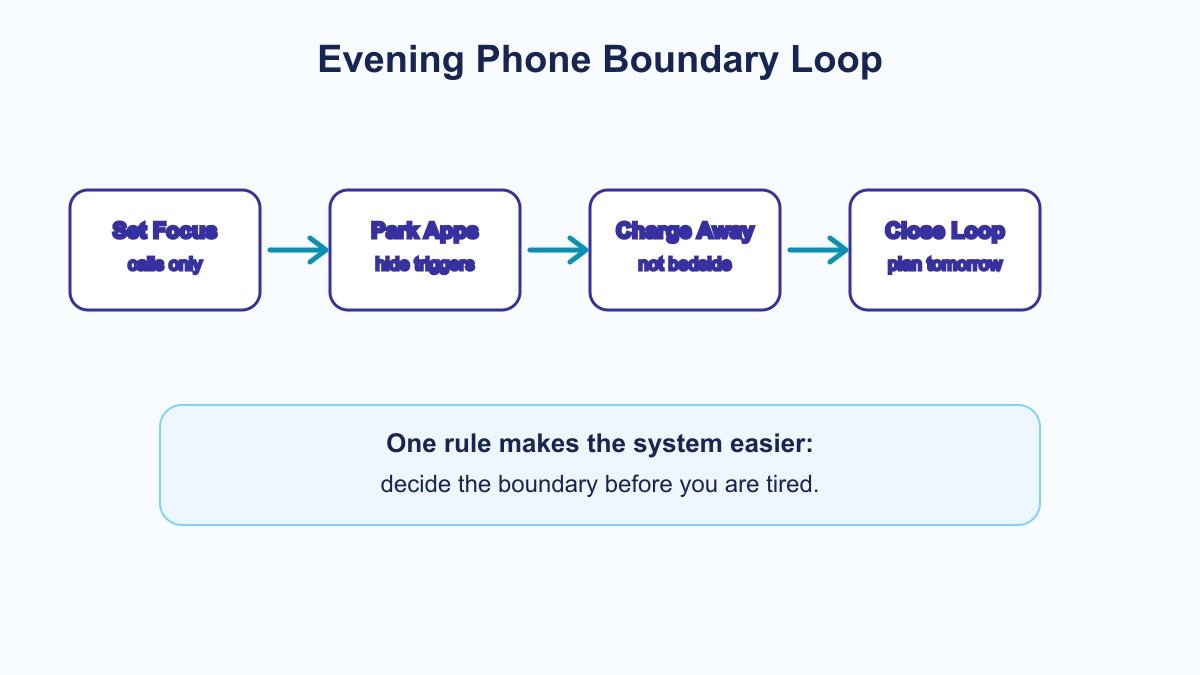
    Evening smartphone boundaries checklist for better sleep shown as a four step phone boundary loop
    Use this loop to set phone boundaries before you are tired.

    The 10-minute evening phone boundary routine

    This routine is designed to fit inside the last practical part of the evening, before teeth brushing, reading, journaling, or lights out. Start about 30 to 60 minutes before bed if you can. If that is unrealistic, start with the last 10 minutes.

    Minute 1: choose the phone’s bedtime

    Pick a clear time, not a mood. For example: β€œAt 9:45, the phone goes to the charger.” A clock time is easier to honor than β€œwhen I feel done scrolling.” If your evening schedule changes, tie the boundary to an anchor such as after dishes, after the kids are down, or after the final work check.

    Minute 2: turn on the right mode

    On iPhone, Apple provides Focus and Sleep tools that can allow chosen people, customize screens, and quiet apps. Apple documents those settings in its Focus setup guide. On Android, Google Digital Wellbeing includes Bedtime mode, app timers, Focus mode, grayscale, and Do Not Disturb options through the Digital Wellbeing feature set.

    Minute 3: allow the real exceptions

    A good boundary has humane exceptions. Allow partner, caregiver, school, emergency, or work-on-call contacts if needed. Do not make the boundary so strict that you feel anxious about missing something important. The point is to remove noise, not support a brittle rule.

    Minute 4: hide the apps that pull you back

    Put the most tempting apps behind friction. Move them off the home screen. Log out if needed. Use app limits for social, shopping, short video, news, and work chat. If you need one calming app, place only that app on a low-stimulation evening screen.

    Minute 5: dim and simplify the screen

    Lower brightness, use night shift or night light tools, and try grayscale if color pulls you into browsing. This is not magic. It is a cue. A duller phone is less inviting, and that makes the next boundary easier.

    Minute 6: write tomorrow’s first action

    Many people reopen the phone because the next day feels unresolved. Before you park the device, write one small first action for tomorrow. It can be β€œsend invoice,” β€œpack lunch,” or β€œopen draft.” This gives your brain a handoff.

    Minute 7: move the charger

    Place the charger across the room, in the hallway, in the kitchen, or at a small charging station. If you need your phone as an alarm, put it far enough away that you must stand up to turn it off. If that creates stress, use a separate alarm clock.

    Minute 8: choose a replacement cue

    Do not leave a blank space and expect it to feel relaxing. Replace phone time with one small cue: a book, a paper checklist, a stretch, a glass of water, a two-minute tidy, or the pre-sleep journaling template. The replacement should be boring in a good way.

    Minute 9: close open loops

    If a task feels urgent, write it down instead of solving it from bed. A parking list keeps the thought from becoming a search session. Use one line per task. Stop when you have captured enough to continue tomorrow.

    Minute 10: decide the morning rule

    The evening boundary is easier when the morning is clear. Decide whether the phone returns after you stand up, after water, after breakfast, or after the first focus block. A morning rule prevents revenge checking from becoming the first habit of the day.

    What should be on the checklist?

    Use this as the default evening smartphone boundaries checklist for better sleep. Keep it visible for one week, then simplify it to the three steps you actually need.

    • Sleep Focus, Do Not Disturb, or Bedtime mode is scheduled.
    • Emergency contacts are allowed, and everything else is quiet.
    • Social, shopping, news, short video, and work chat are hidden or limited.
    • Brightness is low, and grayscale or night mode is on if helpful.
    • The next morning’s first action is written outside the phone.
    • The phone is charging away from the bed.
    • A replacement cue is ready: book, paper note, stretch, water, or journal.
    • The morning re-entry rule is clear.

    If that list feels like too much, use the short version: quiet it, park it, replace it. A simple evening smartphone boundaries checklist for better sleep repeated nightly beats a perfect checklist used twice.
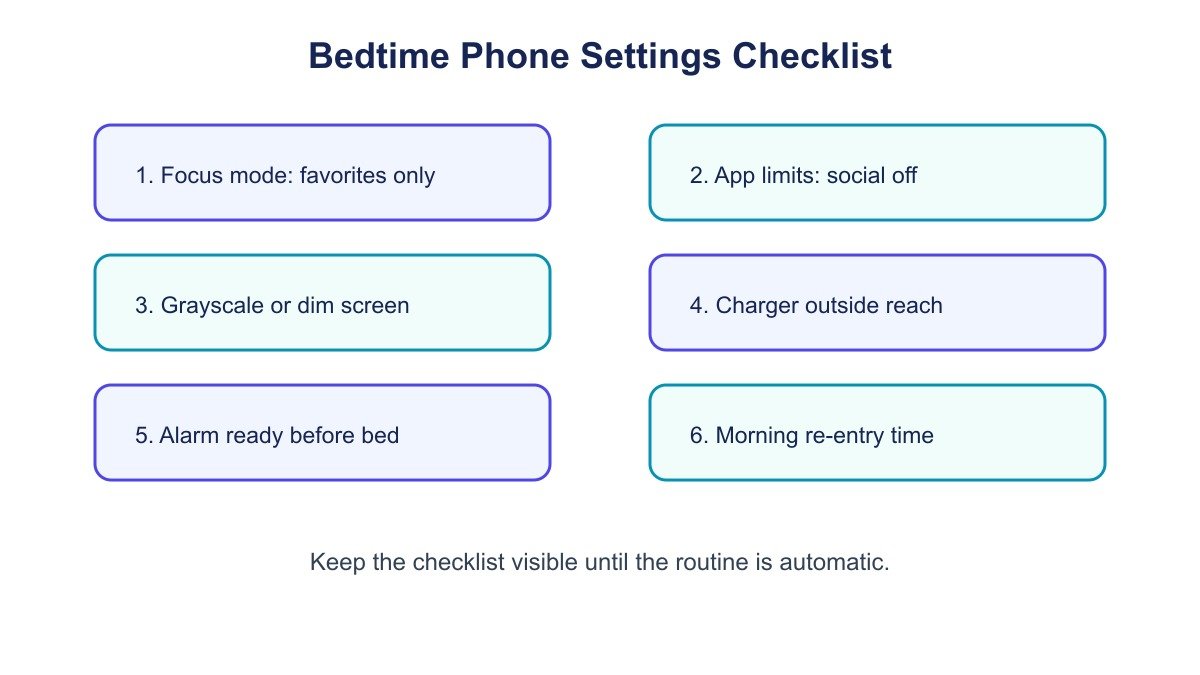
    Bedtime phone settings checklist for an evening smartphone boundaries routine
    A quick settings checklist for putting the phone to bed before you go to bed.

    iPhone settings that support evening phone boundaries

    For iPhone users, the most useful starting point is Focus. You can create a Sleep Focus, choose allowed people, choose allowed apps, and simplify the Lock Screen. The official Apple guidance is the best place to check exact menus because iOS labels change over time.

    Need iPhone setting Boundary it supports
    Allow family but silence noise Sleep Focus allowed people Important contact access without every app alert
    Reduce visual prompts Custom Lock Screen and Home Screen Fewer tempting apps at bedtime
    Protect the sleep window Sleep schedule and Focus schedule Automatic evening start
    Reduce repeated checking Notification summaries and app limits Less novelty in the final hour

    The key is to make the setting match your life. If a parent, partner, or client must reach you, allow that route. If one reading or sound app helps you wind down, keep it available. Remove the rest from the bedtime path so the evening smartphone boundaries checklist for better sleep stays focused.

    Android settings that support evening phone boundaries

    Android phones vary by manufacturer, but the Digital Wellbeing and Bedtime mode pattern is similar: reduce notifications, fade the screen, and set a schedule. Google describes Digital Wellbeing tools such as app timers, Focus mode, and Bedtime mode on the Digital Wellbeing app page and related Android support materials.

    Need Android setting Boundary it supports
    Quiet the phone Do Not Disturb or Bedtime mode Fewer sleep interruptions
    Make scrolling less rewarding Grayscale during Bedtime mode Lower pull from colorful feeds
    Limit problem apps App timers or Focus mode Clear stop point for distracting apps
    Start automatically Bedtime schedule Boundary runs without a nightly debate

    If your phone brand uses different labels, search Settings for β€œDigital Wellbeing,” β€œBedtime,” β€œFocus,” β€œDo Not Disturb,” or β€œModes.” The exact path matters less than the outcome: fewer alerts, fewer triggers, and a phone that is not waiting beside your pillow. This keeps the evening smartphone boundaries checklist for better sleep practical across devices.

    Where should your phone charge at night?

    The best charging spot is the nearest place that makes checking inconvenient without making life harder. For some readers, that is a dresser. For others, it is the kitchen, hallway, office, or a shelf outside the bedroom. Start with distance before you buy anything.

    Charging spot Best for Watch out for
    Across the bedroom People who use a phone alarm You may still check it after lights out
    Hallway shelf Light sleepers and couples Emergency contact settings need to be right
    Kitchen station Strongest separation Needs a separate alarm or smart speaker alarm
    Home office Remote workers Can reopen work if the room is not closed

    Do not turn the charger into a productivity shrine. A cable, a small tray, and a paper note are enough. If the charging station becomes complicated, the phone will migrate back to the bed.

    What if you need the phone for sleep sounds, alarms, or family?

    Keep the useful function and remove the open-ended browsing. A phone can still provide a white-noise app, audiobook timer, medication reminder, or family emergency route. The boundary is not β€œnever use your phone.” It is β€œonly the intended tool remains easy.”

    For sleep sounds, start the audio before the phone goes to its spot. For alarms, place the phone across the room or use a separate clock. For family, allow selected contacts through Sleep Focus or Do Not Disturb. For on-call work, keep the on-call route but block every nonessential app.

    This is where many plans fail: they confuse access with invitation. You may need access. You do not need the phone inviting you into every feed at midnight.

    What should you do instead of scrolling?

    The replacement should be short, repeatable, and not more stimulating than the phone. If you replace scrolling with an ambitious routine, you may avoid both. Choose a small action that gives your nervous system a familiar closing cue.

    • Read two pages of a paper book.
    • Write tomorrow’s first action on a sticky note.
    • Do a three-minute stretch with the lights low.
    • Set clothes, water, or breakfast supplies for the morning.
    • Use the pre-sleep journaling template if looping thoughts are the real pull.
    • Use the gentle evening wind-down routine if you want a fuller shutdown.

    The best replacement is not necessarily relaxing on the first night. It is simply less stimulating and easier to repeat.

    Common mistakes with evening phone boundaries

    Most people do not fail because they lack discipline. They fail because the boundary has too many loopholes, starts too late, or depends on a future tired version of themselves to make a good decision.

    Mistake Why it breaks Better rule
    Keeping the phone beside the pillow Reach turns into checking Charge across the room or outside the bedroom
    Blocking every contact Creates anxiety about emergencies Allow a short emergency contact list
    Starting after you are exhausted Too much decision friction Start after a stable evening anchor
    Using the phone for every replacement habit The tool reopens the feeds Use paper, a book, or a simple offline cue
    Making a huge detox rule Feels like punishment Use a narrow bedtime rule first

    If you already have a broader digital declutter plan, this article should not replace it. Use the digital declutter checklist for screens across the week, then use this page for the evening sleep boundary.

    A seven-night phone boundary experiment

    Run the experiment for seven nights before judging it. One night can be distorted by stress, weather, family needs, caffeine, work, travel, or a bad mattress. Seven nights give you enough repetition to see what actually helps.

    1. First night: choose the phone bedtime and charger spot.
    2. Second evening: add Sleep Focus, Do Not Disturb, or Bedtime mode.
    3. Third pass: remove the top two tempting apps from the evening screen.
    4. Fourth reset: write tomorrow’s first action before parking the phone.
    5. Fifth trial: test a replacement cue for 10 minutes.
    6. Sixth check: adjust emergency contacts and app exceptions.
    7. Final review: keep the three rules that made the largest difference.

    Track only three things: when the phone was parked, whether it stayed parked, and how the morning felt. Do not over-measure. The point is a cleaner routine, not another dashboard.

    Examples for different households

    For parents: allow school, family, and emergency contacts, then block everything else. Keep the phone on a dresser if a child may need you. Put a paper card beside the charger that says what is allowed: family calls, medication reminders, and alarms. Everything else can wait.

    For remote workers: create a separate work shutdown before the phone boundary. Close team chat, write the next work action, and set a morning re-entry rule. If the phone is your work device, move work apps into a folder named Tomorrow so the label itself becomes a cue.

    For students: park the phone after the last study block and keep only alarm, calendar, and a calm audio app available. If group chats run late, use a status message that says you check again in the morning.

    For couples: agree on light, sound, and charging zones. One person can keep an emergency phone nearby while the other charges outside the room. The shared goal is less interruption, not identical behavior.

    Make the boundary easier to keep

    The environment should do most of the work. Put a book where the phone used to sit. Place the charger where you naturally walk after brushing your teeth. Keep a pen and paper at the charging station. If you use smart lights or a routine app, set the evening cue to start before your usual scrolling window.

    Expect friction for the first few nights. The habit may feel strangely quiet. That is useful feedback. You are noticing how much stimulation the phone had been adding. Keep the rule small, repeat it, and let the evening become more predictable. Over time, the evening smartphone boundaries checklist for better sleep should feel like a normal closeout rather than a restriction.

    How this connects to digital clarity

    An evening smartphone boundaries checklist for better sleep is one piece of digital clarity. It gives your day a boundary. That boundary protects rest, and rest protects attention the next day. If your larger issue is constant screen pull, read Digital Clarity vs Digital Detox next. If the issue is a phone habit that feels automatic, Break the Scroll is the more direct book path.

    If sleep anxiety, racing thoughts, or bedtime worry are the main problem, Restful Nights is the more relevant reader path. If you want the full shelf by topic, start at the Mind Clarity books hub.

    When should you get more help?

    Phone boundaries can support better sleep habits, but they are not a cure-all. If you regularly cannot sleep, wake often, feel unsafe, experience severe anxiety, or feel exhausted despite enough time in bed, consider talking with a qualified health professional. Practical routines are useful, but persistent sleep problems deserve real support.

    Also look beyond the phone. Caffeine timing, alcohol, shift work, pain, room temperature, caregiving, workload, and stress can all affect sleep. A phone boundary is one lever. It works best when it is part of a realistic evening system.

    The simplest version to save

    Save this version if the full article feels like too much: at the same time each evening, turn on Sleep Focus or Bedtime mode, write tomorrow’s first action, charge the phone outside easy reach, and do one low-stimulation replacement for 10 minutes. That is the core evening smartphone boundaries checklist for better sleep.

    Frequently asked questions

    Is it bad to sleep with your phone next to your bed?

    For many people, the issue is not the phone’s existence. It is easy access to alerts, light, and stimulating content. If the bedside phone leads to checking, move it farther away and keep only essential interruptions enabled.

    How long before bed should I stop using my phone?

    Start with 30 minutes if a longer window feels unrealistic. Some sleep guidance recommends a longer electronics buffer, but a consistent 30-minute boundary is better than an ideal rule you never use.

    What phone settings are best for sleep?

    Use Sleep Focus, Do Not Disturb, Bedtime mode, grayscale, app limits, and a schedule. The best settings are the ones that silence nonessential alerts while preserving true emergency access.

    Can I still use my phone as an alarm?

    Yes, but place it across the room so turning it off requires standing up. If that still leads to checking, use a separate alarm clock and charge the phone outside the bedroom.

    What if my partner does not want the same phone rules?

    Make the boundary personal and practical. Use your own charger spot, your own Focus settings, and a low-light agreement. You do not need identical rules to reduce your own friction.

    Should I buy a lockbox or phone safe?

    Only if simpler steps fail. Try charger placement, app limits, Focus settings, and a paper replacement first. A lockbox can help some people, but it is not required for a strong evening boundary.

    Sources and update note

    Last reviewed: June 20, 2026. This guide uses practical sleep-habit framing and current public documentation from CDC sleep and health guidance, Sleep Foundation electronics and sleep guidance, Sleep Foundation blue light guidance, Apple Focus support, Google Digital Wellbeing information, and the open-access PMC study linked above.

    Helpful resources for your next step

    Affiliate disclosure: As an Amazon Associate, Mind Clarity Hub may earn from qualifying purchases at no extra cost to you. Use this link only if it genuinely helps your planning.

    If Evening Smartphone Boundaries Checklist for Better Sleep is a routine you want to keep using, a simple workbook, planner, or desk tool can make the steps easier to repeat.

    Compare related planners, workbooks, and organization tools on Amazon.
  • How to Fall Asleep Instantly: Proven Techniques

    How to Fall Asleep Instantly: Proven Techniques

    That agonizing feeling of staring at the ceiling while your mind races is a painfully modern experience. While actually falling asleep instantly is something of a myth, there are powerful ways to dramatically shorten the time it takes to drift off. Tonight, we can give you a practical tool to quiet that inner monologue and gently guide your brain toward rest.

    Affiliate Disclosure: Some of the links in this article are affiliate links. If you make a purchase through them, we may earn a small commission at no extra cost to you. We only recommend products we believe in.

    If you’re struggling with ongoing sleep problems, anxiety, depression, or ADHD, it’s important to recognize that this article is for educational purposes only. The information here is not a substitute for professional medical or psychological care from a qualified healthcare provider.

    A person in bed looks upwards, with a glowing blue lamp and a smartphone on a wooden nightstand, wondering how to fall asleep instantly.

    The natural instinct is to β€œtry harder” to sleep, but this almost always backfires. This creates more frustration and reinforces a cycle of anxiety. Instead of forcing it, we need to gently distract the part of your brain that’s keeping you awake. This is where a simple but surprisingly effective technique can make a real difference tonight.

    Why You Can’t Fall Asleep and What to Do Tonight

    If you’re lying awake, your brain is likely stuck in what neuroscientists call hyperarousal. This is a state where your brain’s threat-detection system, the amygdala, stays on high alert. It’s often fueled by the leftover stress from your workday, anxiety about tomorrow, or just plain overstimulation from screens. Your brain gets trapped in a behavioral loop of planning and worrying, making it almost impossible to relax.

    The Cognitive Shuffle: A Quick Fix for a Racing Mind

    Instead of counting sheep, which can be too monotonous, try the Cognitive Shuffle. Developed by Dr. Luc Beaudoin, this technique is designed to scramble the logical, narrative thought patterns that keep you awake. It works by mimicking the random, unconnected imagery that happens as you naturally drift into sleep, a state known as hypnagogia.

    Essentially, you’re giving your worrying brain a new, nonsensical job to do. This allows your body’s natural sleep drive to finally take over.

    Here’s how to do it:

    • First, pick a simple, neutral word with at least five unique letters. Something like β€œBEDTIME” works perfectly. Don’t pick a word with heavy emotional baggage.
    • Next, visualize items starting with the first letter. Close your eyes and calmly picture different things that start with β€œB.” Imagine a banana, then a boat, then a bicycle. Spend about five seconds on each image. Don’t strain; just let the images float in and out of your mind.
    • Then, move to the next letter. Once you run out of β€œB” words or notice your mind wandering, just shift to the next letter, β€œE.” Picture an egg, then an elephant, then an envelope.
    • Keep going through the word until you fall asleep. The truth is, most people don’t even make it past the second or third letter before their mind gives up and drifts off.

    Real-World Scenario: Imagine a busy professional whose mind is buzzing with deadlines after a long day. Their brain is stuck replaying a meeting. By starting the Cognitive Shuffle with the word β€œNIGHT,” they visualize a napkin, then a nest, then a notebook. This simple, unrelated imagery breaks the stressful thought loop, allowing their nervous system to finally calm down enough for sleep.

    For a clearer picture of why this works, it’s helpful in understanding the causes of insomnia and how to address them. While the cognitive shuffle is a powerful first-aid tool for a rough night, lasting change comes from building solid sleep habits. If you often feel overwhelmed by anxiety at bedtime, you can get some rest with our targeted guide.

    Using Your Breath to Calm Your Nervous System

    When your mind is racing at night, your breath is one of the most powerful tools you have to quiet the noise. It’s not just a mental trickβ€”it’s a direct line to your body’s internal wiring. You’ve probably noticed that when you’re stressed, your breathing gets shallow and fast. From a behavioral psychology perspective, this pattern keeps your nervous system on high alert, stuck in β€œfight or flight” mode.

    By deliberately slowing down your breath, you can physically shift your body out of that state. It helps you move into the β€œrest and digest” mode that’s essential for sleep. Slow, deep breathing activates the vagus nerve. This sends a powerful signal to your brain that you’re safe. In response, your heart rate drops, your blood pressure lowers, and the mental chatter starts to fade. It’s like sending a physical command to your body to power down.

    The 4-7-8 Breathing Method

    The 4-7-8 breathing technique is a simple but profound rhythm designed to force deep relaxation. It pulls your focus away from anxious thoughts and grounds you in the physical sensation of your breath.

    Here’s how it works:

    1. Start by exhaling completely through your mouth with a gentle whoosh.
    2. Close your mouth and inhale quietly through your nose for a count of four.
    3. Hold that breath for a count of seven. This is the most important part of the cycle, as it gives your body time to fully absorb the oxygen.
    4. Exhale slowly and completely through your mouth for a full count of eight.
    5. Repeat this cycle for three or four rounds when you first get into bed.

    Real-World Scenario: An entrepreneur is lying awake, stressed about a big presentation. Instead of spiraling through β€œwhat-ifs,” they can use the 4-7-8 rhythm to break the anxiety loop. The simple act of counting and breathing calms their nervous system enough to finally let sleep in. If you find this kind of physical response to stress is a regular blocker, our guide on how to calm down offers more techniques.

    Box Breathing for Simple Focus

    If the 4-7-8 count feels a little too much to remember when you’re already tired, Box Breathing is a fantastic alternative. Its simple, even structure is incredibly easy to follow. This is true even when you’re feeling completely exhausted.

    Just picture a square and trace it with your breath:

    • Inhale slowly through your nose for four seconds.
    • Hold your breath for four seconds.
    • Exhale slowly through your mouth for four seconds.
    • Hold your breath again for four seconds.

    Repeat this cycle until you feel your body getting heavier and your mind getting quieter. You’re giving your brain a simple, repetitive task to focus on instead of your worries.

    When you pair these breathing exercises with a pitch-black room, you’re sending an undeniable signal to your brain that it’s time to shut down. One popular item shoppers love is a good sleep mask blackout to block all light. You might also want to explore ways to maintain better breathing while you sleep, which is why some people are now using oral tape to improve nighttime breathing. By taking control of this fundamental function, you gain a reliable method for how to fall asleep instantly when your mind just won’t quit.

    How to Fall Asleep Instantly With the Military Method

    You’ve probably heard whispers of the β€œmilitary method,” a technique supposedly used by soldiers to fall asleep in under two minutes, even in high-stress environments. It’s not just a legendβ€”it’s a real, systematic relaxation process that works by intentionally releasing physical tension. This sends a powerful signal to your brain that it’s safe to power down.

    At its core, the technique is a form of progressive muscle relaxation. You methodically scan your body, releasing one muscle group at a time. This simple process breaks the feedback loop between a tense body and an anxious mind. When your body is physically limp and heavy, it’s remarkably difficult for your mind to keep racing.

    A 4-step infographic illustrates how to fall asleep instantly using breathing techniques for sleep, including 4-7-8 and box breathing.

    Before you even start with the muscles, grounding yourself with a few slow, controlled breaths can make a huge difference. Techniques like 4-7-8 or box breathing calm your nervous system, setting the stage for the physical release to come.

    Your Step-by-Step Guide to the Military Method

    Ready to try it? The whole point is to move slowly. Don’t rush it. Give each part of your body your full attention as you invite it to let go.

    • Start with your face. Your face holds a shocking amount of tension. Close your eyes. Consciously unclench your jaw and let your tongue fall away from the roof of your mouth. Feel the tiny muscles around your eyes soften and your forehead smooth out.
    • Move to your shoulders and arms. Let your shoulders drop as low as they can possibly go. Feel the release in your neck and upper back. Then, one arm at a time, let it go completely limp from your bicep down to your fingertips. Imagine it becoming heavy and sinking into the mattress.
    • Breathe into your chest. Take a slow, deep breath in, and as you exhale, feel your entire chest and stomach soften. Picture the tension leaving your body with each breath.
    • Work down through your legs. Bring your awareness to your lower body. Start with your right thigh, letting it feel heavy and loose. Then move down to your calf, ankle, and foot. Repeat the entire process on your left side until your whole body feels grounded.

    Why This Works When Your Mind Won’t Quit

    This method is so effective because it gives your racing mind a gentle, concrete job to do. Instead of getting tangled in anxious thoughts about tomorrow’s to-do list, you’re focusing on the physical sensation of release. It’s a form of active mindfulness that shifts you out of your head and into your body.

    Real-World Scenario: A freelance graphic designer just wrapped a demanding project. Her mind is buzzing with client feedback and deadlines. Lying in bed, she methodically works through the military method. She releases her jaw from hours of clenching. Then, she drops her shoulders from hunching over a desk. She lets her legs go heavy. This process pulls her attention away from the project and grounds her in the present moment, allowing sleep to finally arrive.

    If this scenario feels familiar, and daily stress consistently sabotages your sleep, it might be a signal to look at the bigger picture. When you’re frequently dealing with work-related burnout, it can be a symptom of a deeper issue. It may be time to explore more robust strategies for managing stress before it follows you to bed. Browse the library for books that can help. For instance, Burnout Interrupted offers targeted strategies.

    Best Options for Your Nightly Wind-Down Routine

    While in-the-moment breathing techniques are a lifesaver, a consistent evening routine is your best long-term play against sleeplessness. Think of it as creating a predictable off-ramp for your brain. It teaches your mind to shift from the high gear of β€œdoing” into the gentle coast of β€œbeing.” Getting this habit dialed in is one of the most powerful moves you can make toward falling asleep faster, night after night.

    A simple, memorable way to build this off-ramp is the 10-3-2-1-0 rule. It’s not about being rigid or perfect. Instead, it’s a gradual, science-backed countdown that helps you systematically reduce stimulation. It signals to your body that rest is coming.

    A bedside table with water, phone, a book, and a sleep mask, suggesting a relaxing wind-down routine for how to fall asleep instantly.

    The 10-3-2-1-0 Rule Explained

    This isn’t about adding more to your to-do list. It’s about creating intentional boundaries that work with your biology, not against it. Let’s walk through what each number means and the neuroscience behind why it works so well.

    • 10 Hours Before Bed: No More Caffeine
      Caffeine has a surprisingly long half-life. This means half of that afternoon coffee can still be buzzing through your system hours later. Cutting off all caffeineβ€”that includes coffee, most teas, and even some sodasβ€”a full 10 hours before bed gives your body plenty of time to clear it out. This prevents it from blocking adenosine, the key neurotransmitter that builds up during the day to make you feel sleepy.

    • 3 Hours Before Bed: No More Big Meals or Alcohol
      This one is critical. Winding down large meals and stopping alcohol intake about three hours before you get into bed gives your body a fighting chance to cool down and relax. Digestion is an active, heat-producing process. And while alcohol might feel like it helps you doze off, it wrecks your sleep quality later in the night. It particularly impacts your REM sleep.

    • 2 Hours Before Bed: No More Work
      Putting a hard stop to all work-related thinking two hours before bed is non-negotiable for a quiet mind. It’s your brain’s signal to disengage from planning, problem-solving, and worrying. This transition is essential for dialing down the mental hyperarousal that so often keeps us staring at the ceiling. The day’s obligations are done.

    • 1 Hour Before Bed: No More Screens
      If you only follow one part of this rule, make it this one. The blue light blasting from phones, tablets, and computers directly shuts down your brain’s production of melatonin. This is the hormone that tells your body it’s nighttime. If you absolutely can’t avoid a screen, a good pair of blue light blocking glasses can be a game-changer by filtering out the most disruptive wavelengths.

    • 0 Snooze Buttons in the Morning
      This one is about the morning, but it sets up your next night. Hitting snooze feels good for a second, but it fragments your sleep. This can leave you feeling groggy and β€œoff” all day. Waking up with a gentle sunrise alarm clock at a consistent time anchors your body’s internal clock. This makes it much easier to feel sleepy at the right time each evening.

    How to choose the best wind-down activity

    That final, screen-free hour is your golden opportunity to actively relax and downshift. The best activity for you depends on what your mind and body need most. Are you physically tense? Is your mind racing with worries? This comparison can help you find a starting point.

    Wind-Down Activity Comparison

    Activity Best For Why It Works
    Reading a Paper Book A racing mind Mental distraction without sleep-disrupting blue light.
    Journaling/Habit Tracker Processing worries Offloads anxious thoughts from your brain onto paper.
    Gentle Stretching Physical tension Releases stored tightness from a long day at a desk.
    Listening to a Calm Podcast Soothing focus Provides gentle auditory input without a screen.

    The key is to experiment. Maybe you discover that certain sounds are incredibly calming. For example, some find a white noise machine very effective. For others, it’s a distraction. If you’re curious about the role of sound, our guide on whether music can help you sleep is a great place to dig in. See the book that fits your goal to build better habits.

    Ultimately, all of these tactics are about creating strong digital and mental boundaries to protect your rest. It’s about actively reclaiming your evenings from the chaos of the day with a clearer mind. Explore strategies for this in The Power of Clarity.

    Troubleshooting Common Barriers to Sleep

    You’ve followed all the advice. You have a solid wind-down routine. Yet here you are, staring at the ceiling, wondering why sleep won’t come. It’s a frustratingly common experience. It’s often because a few sneaky barriers are quietly sabotaging your efforts. Tackling these roadblocks head-on is one of the most important steps you can take toward falling asleep faster.

    Two of the biggest culprits are an inconsistent sleep schedule and a bedroom that’s secretly working against you. Most people think a strict bedtime is the key. However, behavioral research consistently shows that a consistent wake-up time is far more powerful. Waking up at the same time every single dayβ€”yes, even on weekendsβ€”is the strongest signal you can send to anchor your internal clock, or circadian rhythm.

    This simple act programs your body to anticipate sleep at a predictable time each night. It helps regulate the natural rhythm of hormones like cortisol (which wakes you up) and melatonin (which makes you sleepy). When your wake-up time is stable, your body learns when to start releasing melatonin. This makes sleep feel less like a fight and more like a natural conclusion to your day.

    How to Handle a Restless Night

    Even with the best schedule, you’ll still have nights when your brain just refuses to switch off. In those moments, how you react is everything. Lying in bed for hours, tossing and turning, only teaches your brain to associate your bed with frustration and anxietyβ€”a miserable cycle known as conditioned arousal.

    To break that pattern, sleep experts recommend the 15-minute rule, a cornerstone of Cognitive Behavioral Therapy for Insomnia (CBT-I).

    • If you’re still awake after what feels like 15-20 minutes, get out of bed.
    • Move to another room and do something quiet and calming in very dim light. Think reading a boring book, listening to soft music, or doing some gentle stretches. Avoid screens at all costs.
    • Only head back to bed when you feel genuinely sleepy again.

    Real-World Scenario: You wake up at 2 AM with your mind racing about a project. Instead of staying in bed feeling anxious, you get up. You go to the living room and read a few pages of a dull book under a dim lamp. After about 10 minutes, your eyelids feel heavy. You return to bed and fall back asleep quickly, breaking the negative association.

    The whole point is to re-establish your bed as a place for sleep, and only sleep. It’s about breaking the link between your bed and anxious wakefulness. For those moments when sleep anxiety feels especially overwhelming, our book Restful Nights offers targeted strategies for breaking that frustrating cycle.

    Optimizing Your Sleep Environment

    Your bedroom can be a sanctuary for sleep or a source of subtle, constant disruption. A room that’s too hot, bright, or noisy makes it physically harder for your body to relax. It becomes difficult to reach the deep, restorative stages of sleep. A noisy environment, for instance, can keep your nervous system on a low-level alert, even if you don’t consciously wake up.

    Worldwide, over 30% of adults report symptoms of insomnia. Recent data from a poll by sleep trends at SingleCare shows people now average just 6.8 hours of sleep per night. This is a significant drop from the 9 hours common a century ago.

    A simple but incredibly effective fix for noise is a good white noise machine. It creates a constant, soothing auditory blanket. It can mask disruptive sounds like street traffic or a snoring partner. Beyond that, making sure your room is cool and completely dark is non-negotiable.

    Don’t forget about physical comfort, either. An old, unsupportive pillow can cause neck and shoulder pain that keeps you shifting all night. It might be time to learn how often you should change your pillow to make sure you’re getting the right support. By troubleshooting these common barriers, you give yourself the best possible shot at falling asleep fast.

    Editor’s Take and Our Key Principles for Faster Sleep

    Let’s be honest: the idea of β€œinstant” sleep is mostly a myth. However, you can absolutely learn to fall asleep much faster. This isn’t magic. It’s about using techniques grounded in neuroscience and psychology that work with your body’s own wiring.

    What Actually Works: Methods like the Military Method or 4-7-8 breathing genuinely shorten the time it takes to doze off. They do this by calming your nervous system and shifting you out of a β€œfight-or-flight” state. This is a real, physiological change you can feel.

    Who It’s Best For: These strategies are powerful tools for anyone whose mind won’t stop racing at 11 PM. They are perfect for people who carry the day’s stress into bed. They work best for a brain that’s overstimulated.

    Important Caveats: They are not a cure for underlying medical conditions. If you suspect you’re dealing with something more serious like chronic insomnia, sleep apnea, anxiety, or depression, it is essential to talk to a qualified healthcare provider. This advice is educational, not medical. For most of us, the path to faster sleep isn’t one secret hack. It’s about pairing these in-the-moment techniques with a predictable, calming wind-down routine. Think of it as building a reliable off-ramp from the busy highway of your day to the quiet side street of sleep.

    Key Takeaways for Falling Asleep Instantly

    When your head hits the pillow but your brain is still buzzing, come back to these core ideas. This is your toolkit for guiding your body and mind toward the rest you need.

    • Calm Your Nervous System First: Before you do anything else, focus on your breath. Simple, rhythmic breathing like the 4-7-8 method sends a direct signal to your body that it is safe to relax and power down.

    • Relax Your Body, Systematically: Physical tension keeps the mind alert. Use the military method to consciously release stored tension, muscle by muscle, from your face all the way down to your toes. It’s much harder for your mind to hold onto stress when your body is fully at ease.

    • Build a Consistent Wind-Down Routine: The 10-3-2-1-0 rule gives you a simple, memorable structure for preparing your mind and body for bed. A predictable habit is one of the most effective long-term strategies you can build.

    • Control Your Sleep Environment: A dark, cool, and quiet room is non-negotiable for quality sleep. Simple tools like a sleep mask blackout can make a massive difference in signaling to your brain that it’s time for rest.

    • Know When to Get Out of Bed: If you’re still wide awake after 15-20 minutes, don’t just lie there getting frustrated. Get up, move to another dimly lit room, and do something quiet until you feel genuinely sleepy again.

    Disclaimer: The affiliate links in this article may generate a small commission at no extra cost to you. This content is for educational purposes only and is not a substitute for professional medical or psychological advice. Please consult a qualified healthcare provider for any health concerns.

    Sleep FAQs: Your Toughest Questions, Answered

    Making sense of sleep advice in the real world can be a mess. Let’s clear up some of the most common questions about falling asleep fast and building a more reliable sleep rhythm.

    Can You Really Train Yourself to Fall Asleep in 2 Minutes?

    Yes, but it’s not a magic trick. The military method is a form of conditioningβ€”a skill you build over time, not a switch you flip on night one.

    By consistently guiding your body through that same muscle relaxation sequence, you’re creating a powerful conditioned response. Your brain gradually learns to associate the routine with shutting down for the night. You might not hit the two-minute mark on your first try, but with practice, you can get surprisingly close.

    What if I Wake Up in the Middle of the Night?

    Whatever you do, don’t just lie there getting frustrated. That’s a surefire way to teach your brain that bed is a place for anxiety.

    Instead, follow the 15-minute rule from Cognitive Behavioral Therapy for Insomnia (CBT-I). If you’re still wide awake after 15 or 20 minutes, get out of bed. Go to another room with dim lighting and do something quiet and non-stimulating, like reading a paper book or listening to calm music. Only head back to bed when you feel genuinely sleepy again.

    This breaks the toxic link between your bed and anxious wakefulness.

    Do Sleep Supplements Like Magnesium Actually Work?

    For some people, absolutely. A magnesium glycinate supplement is often a great place to start, as this form is easily absorbed and well-known for its calming effect on the nervous system.

    However, supplements are never a one-size-fits-all fix, and their effectiveness can vary a lot from person to person. It’s critical to talk with your doctor before starting any new supplement to make sure it’s safe for you and won’t interact with anything else you’re taking.

    Is It Bad to Use My Phone Before Bed With a Blue Light Filter?

    Using a blue light filter or β€œnight mode” is better than nothing, but it only solves half the problem. The filter may reduce your exposure to the specific light wavelengths that suppress melatonin, but it does zero to stop the mental stimulation.

    Scrolling through social media, reading the news, or firing off emails keeps your brain engaged and β€œwired.” The cognitive and emotional engagement is often the real barrier to sleep. Your best bet is to put all screens away for at least an hour before bed.

    What Is the Most Important Habit for Falling Asleep Faster?

    While all these techniques can help, the single most powerful habit for regulating your sleep is a consistent wake-up time.

    Getting up at the same time every single dayβ€”even on weekends and holidaysβ€”anchors your body’s internal clock, or circadian rhythm. This helps your body learn when to release melatonin, making it much, much easier to feel sleepy at the right time each night. It’s the non-negotiable foundation of good sleep.

    Free download: 7-Day Mind Clarity Reset preview

    Free download: 7-Day Mind Clarity Reset

    A short daily reset you can actually stick with (no fluff).