...

Tag: preventing burnout

  • Building Resilience at Work to Thrive Under Pressure

    Building Resilience at Work to Thrive Under Pressure

    Building resilience at work isn’t about ignoring problems or developing a tough exterior. It’s the psychological and emotional muscle you build to adapt to workplace stressors, navigate adversity, and bounce back from challenges. Think of it less as avoiding difficulty and more as learning how to move through it effectively. This approach helps you come out stronger on the other side. Ultimately, it is your best defense against burnout and a huge boost to your overall well-being.

    As an Amazon Associate, I earn from qualifying purchases. This means if you click a link and make a purchase, I may receive a small commission at no extra cost to you.

    Understanding Workplace Resilience and Why It Matters Now

    The modern workplace can feel like a pressure cooker. It is often filled with crushing deadlines and sudden project pivots. Therefore, it’s easy to get overwhelmed. Workplace resilience is the skill of navigating these pressures without feeling completely depleted. In essence, it’s your capacity to recover, adapt, and even thrive when you hit professional roadblocks.

    This isn’t about pretending challenges don’t exist. It’s the opposite. It’s about acknowledging them and processing what’s happening in a constructive way. Then, you can move forward with a sense of purpose. From a neuroscience perspective, this is crucial. Chronic stress can impair the prefrontal cortexβ€”the part of your brain in charge of decision-making and emotional regulation. Building resilience is how you actively counteract that effect.

    The Science of Bouncing Back

    Here’s the great news: resilience isn’t a fixed trait you’re born with. It’s a skill, and like any skill, it can be developed. This is thanks to a concept called neuroplasticity. This is your brain’s incredible ability to reorganize itself by forming new neural connections. Every time you practice a resilient behavior, you are literally rewiring your brain. For instance, reframing a negative thought or taking a mindful break helps you handle stress better in the future.

    And the need for these skills has never been more urgent. We’re facing a resilience crisis in the modern workplace. Global data reveals that only 30% of workers are genuinely resilient. This leaves a staggering 70% vulnerable to stress and burnout. Here in the U.S., the situation is even more concerning. In fact, 81% of workers fall into the less resilient or vulnerable categories.

    Why Resilience Is a Business Imperative for Building Success at Work

    Fostering a resilient workforce isn’t just a β€œnice-to-have.” It’s a strategic necessity. When leaders implement effective employee wellbeing strategies, they’re investing in their greatest asset. Resilient people are more engaged, innovative, and collaborative. Consequently, they create a healthier, more positive work environment that benefits everyone.

    For the organization, this translates directly into tangible results:

    • Improved Employee Engagement: Resilient employees can stay focused and motivated, even when things get tough.
    • Reduced Burnout and Turnover: A team equipped to handle pressure is far less likely to burn out. This means lower turnover costs.
    • Enhanced Problem-Solving: The ability to stay calm under pressure allows for clearer, more creative thinking when you need it most.

    Ultimately, building resilience is a proactive investment in both your personal health and the long-term health of your organization. You can explore more strategies in our guide to workplace stress management techniques.

    Disclaimer: This article is for educational purposes only. It is not a substitute for professional medical or psychological advice, diagnosis, or treatment. Always seek the advice of a qualified health provider with any questions you may have regarding a medical condition.

    Adopting a Resilient Mindset for Workplace Challenges

    The way you think about challenges fundamentally shapes how you experience them. Resilience isn’t just about bouncing back. It’s about how you frame situations in your mind before they knock you over. Learning to build this mental muscle allows you to navigate setbacks without getting completely derailed. Think of your mindset as the internal filter through which you see every deadline and difficult conversation. By consciously adjusting this filter, you can start turning obstacles into opportunities. Let’s walk through three powerful, psychology-backed mindset shifts that form the bedrock of workplace resilience.

    Embrace a Growth Mindset

    A growth mindset is the core belief that your abilities can be developed through dedication and hard work. It stands in stark contrast to a fixed mindset, which assumes your skills are innate and unchangeable. Adopting a growth mindset is critical for resilience. It reframes failure as a learning opportunity, not a final verdict on your capabilities. From a behavioral science standpoint, people with a growth mindset are far more likely to persevere through difficulty. They see effort as the path to mastery and are more open to hearing and acting on constructive feedback.

    Real-World Scenario: Imagine you receive tough feedback on a major project. A fixed mindset reaction might be, β€œI’m just not good at this.” However, a growth mindset response sounds more like, β€œThis feedback is hard to hear. But what can I learn from it to make the next version better?” That simple shift changes the entire emotional and cognitive experience.

    Practice Genuine Self-Compassion

    Many high-achievers are their own harshest critics. While that inner critic can feel motivating, research consistently shows it backfires. It increases stress and the fear of failure. Self-compassion, on the other hand, is about treating yourself with the same kindness you’d offer a friend. This isn’t about making excuses. It’s about acknowledging that making mistakes is a universal part of being human. This practice helps regulate your emotional response to setbacks. It prevents you from spiraling into negative self-talk that drains your mental energy. If you find yourself stuck in these patterns, understanding how to deal with anxiety at work can offer extra strategies.

    Real-World Scenario: You miss a deadline because of an unforeseen issue. Instead of berating yourself (β€œI’m so disorganized!”), self-compassion sounds like this. β€œThat was a frustrating outcome. I did my best with the information I had. What can I do now to move forward?”

    Cultivate Cognitive Flexibility

    Cognitive flexibility is the mental skill of adapting your thinking as new information or challenges pop up. Think of it as the ability to β€œzoom out” when you feel stuck. When you’re hyper-focused on a problem, your thinking can become rigid and narrow. This can block you from seeing other solutions. This mental agility allows you to pivot your approach when your initial plan isn’t working. It’s a cornerstone of creative problem-solving and a powerful tool for resilience. To manage this effectively, it’s crucial to know how to prioritize tasks at work.

    Here are a few ways to practice zooming out:

    • Ask β€œwhat if”: What if I approached this from a completely different angle?
    • Seek another perspective: How would my mentor or a colleague see this situation?
    • Change your environment: Step away from your desk. Go for a short walk to clear your head.

    A simple productivity journal can become a powerful tool for practicing all three of these mindsets. You can use it to challenge fixed-mindset thoughts, write down self-compassionate phrases, or brainstorm new solutions by zooming out on a problem.

    Daily Habits That Strengthen Your Resilience at Work

    Big, dramatic gestures can feel inspiring for a moment. However, real, lasting resilience isn’t built overnight. It’s forged in the small, consistent things you do every single day. Think of these habits as foundational blocks that reinforce your mental and physical stamina. They help you manage your energy, keep your focus sharp, and handle stress without getting derailed.

    From a neuroscience perspective, these habits give your brain and body the regular recovery periods they desperately need. When you’re in a constant high-alert state, your cognitive resources get depleted fast. This leaves you reactive and frazzled. Small, intentional habits interrupt this cycle. They allow your prefrontal cortexβ€”the part of your brain handling focus and emotional regulationβ€”to actually recharge.

    Master Your Energy with Structured Breaks

    One of the most powerful shifts you can make is to start managing your energy, not just your time. Your brain simply wasn’t built for eight straight hours of intense focus. It works in natural cycles of high and low energy. Learning to work with these rhythms instead of fighting them is a game-changer. This is where structured break techniques, tracked with a visual timer for desk, come in. They’re designed to prevent cognitive fatigue by forcing you to step away before you feel that familiar brain drain.

    The Pomodoro Technique is a classic for a reason: you work in focused 25-minute sprints, then take a mandatory five-minute break. It’s simple, effective, and keeps you from hitting a wall.

    Real-World Scenario: Sarah, a graphic designer, used to feel completely wiped out by 3 p.m. every day. She started using the Pomodoro method with a simple pomodoro timer. She’d stand up, stretch, or just stare out the window. That small change was enough to keep her energy levels stable all day.

    Incorporate Mindful Micro-Resets

    You don’t need an hour for meditation to get the benefits of mindfulness. Micro-resets are your secret weapon. These are brief, one- to three-minute exercises that can quickly calm your nervous system. They are incredibly effective at lowering cortisol, your body’s primary stress hormone. One of the simplest and most powerful techniques is β€œbox breathing.” You can do it right at your desk.

    • Inhale slowly through your nose for a count of four.
    • Hold your breath for a count of four.
    • Exhale slowly through your mouth for a count of four.
    • Hold again for a count of four.

    Repeat this cycle for just two minutes between meetings. These tiny resets activate your parasympathetic nervous system (your body’s β€œrest and digest” mode). This is the perfect antidote to the fight-or-flight response that stress triggers. For more ideas on starting your day with intention, check out our guide on how to create a morning routine.

    Design a Resilient Workday Structure

    A lack of structure can be a massive, hidden source of stress. When your day is a chaotic mess of competing priorities, you’re forced to constantly make decisions. This leads directly to decision fatigue, which saps your mental reserves. Creating a structured workday helps you proactively allocate your time and energy. Time blocking is a fantastic way to do this. You divide your day into dedicated blocks for specific activities. This approach reduces the cognitive load of a messy to-do list and creates clear boundaries for your focus.

    It’s also crucial to remember that physical discomfort is a quiet drain on your mental resilience. An uncomfortable workspace creates a low-grade, chronic stress. Simple ergonomic tweaksβ€”like using a laptop stand for desk to get your screen at eye level or switching to an ergonomic keyboardβ€”can reduce physical strain and free up precious mental energy.

    The Four Pillars of Daily Resilience

    To bring these ideas together, think of your daily habits as supporting four core pillars. Each one contributes to a more robust and sustainable sense of well-being at work.

    Pillar of ResilienceDaily Practice ExampleNeuroscience Benefit
    Energy ManagementUse the Pomodoro Technique (25 min work, 5 min break)Prevents prefrontal cortex fatigue by working with the brain’s natural ultradian rhythms.
    Mindful RecoveryPractice 2 minutes of box breathing between meetingsActivates the parasympathetic nervous system, reducing cortisol levels and calming the stress response.
    Cognitive StructureTime block your day for specific tasks (e.g., Deep Work 9-11 AM)Reduces decision fatigue and cognitive load, conserving mental energy for high-priority work.
    Physical FoundationDo a 5-minute stretch or walk during a breakReleases endorphins and reduces muscle tension, which can otherwise contribute to mental stress.

    By intentionally nurturing each of these pillars with small, daily actions, you’re not just getting through the day. You’re actively building a stronger foundation that can withstand the inevitable pressures of modern work.

    Fostering Team Resilience in a Hybrid Workplace

    Individual resilience is a great starting point. However, it truly takes off when it becomes a team-wide habit. A resilient workplace is one where people feel connected, supported, and safe to take risks. This is especially true when navigating hybrid work dynamics. It’s about building a culture where the team, as a unit, can absorb shocks and adapt to change.

    This kind of collective strength doesn’t just happen. It’s built, conversation by conversation, by managers and teammates. The key ingredients are straightforward communication and a shared sense of purpose. Most importantly, it requires psychological safety. This is the unspoken agreement that it’s okay to ask a question or admit a mistake. When you have that foundation, failures stop being something to hide and start becoming something to learn from.

    Building Psychological Safety to Enhance Resilience at Work

    From a brain-science perspective, psychological safety is non-negotiable because it keeps us out of β€œthreat mode.” When we feel psychologically threatened, our prefrontal cortexβ€”the part of the brain for rational thoughtβ€”goes offline. A manager who cultivates safety keeps their team in a state where they can think clearly and creatively. This is true even when the pressure is on.

    Real-World Scenario: Alex’s team just blew a major project deadline. Instead of pointing fingers, Alex’s manager, Maria, kicked off the debrief by saying this. β€œOkay, that wasn’t the outcome we wanted. Let’s walk through what happened so we can learn from it.” By framing failure as a collective learning moment, Maria lowers fear and encourages honesty. This makes the whole team better equipped for the next challenge.

    Leveraging the Hybrid Model for Resilience

    While hybrid work has its headaches, it also offers unique upsides for building resilience. In fact, remote work seems to be a powerful tool for well-being. A 2023 report found that people working from home report the highest levels of overall resilience. They also maintain healthier habits around sleep and work-life boundaries. This points to a clear link between autonomy and our ability to handle stress. You can dig into the data in The Wellbeing and Resilience Report 2023.

    The trick is to be intentional about how you do hybrid. This means getting practical about:

    • Creating Clear Communication Norms: Set real expectations for response times and which channel to use for what.
    • Protecting Focus Time: Encourage the team to use tools that signal when they’re in deep work. In a busy office, a good pair of noise-canceling headphones can be the difference between a productive day and a frustrating one.
    • Fostering Real Connection: Schedule regular, informal virtual hangouts to keep social bonds from fraying.

    For leaders looking to build stronger, more connected teams, our book Connected Again is packed with strategies for navigating the social side of modern work. And for more ideas on optimizing your remote setup, you might find our guide to remote work best practices useful.

    Key Takeaways for Building Resilience at Work

    • Resilience Is a Skill: Thanks to neuroplasticity, your brain can adapt. Consistent, small actions can rewire your brain to handle stress more effectively.
    • Mindset Is Foundational: A growth mindset, self-compassion, and cognitive flexibility are crucial. They help turn setbacks into learning opportunities.
    • Daily Habits Matter: Micro-habits like structured breaks and mindful resets create lasting change. A time blocking planner can help structure your day for success.
    • Team Support Amplifies Resilience: Collective strength is built on psychological safety and clear communication. This creates a workplace where everyone can thrive.
    • Prioritize Recovery: True resilience requires periods of rest. Ensure you’re getting quality sleep and taking time to disconnect completely.

    Editor’s Take: What Actually Works for Resilience

    So, what’s the real bottom line?

    From my experience, true workplace resilience doesn’t come from heroic efforts during a crisis. It’s quietly built through small, consistent habits that you can actually maintain when you’re tired. Things like a daily mindset check-in using a habit tracker journal or strategically taking micro-breaks feel small. However, they are far more powerful in the long run than a one-off wellness seminar.

    This advice is best for people who are already thinking about their well-being. It is for those ready to put a few new routines into practice. But it’s critical to be honest about the limits. Individual resilience strategies can only take you so far in a toxic workplace. No amount of personal effort can fully override a dysfunctional organizational culture.

    Ultimately, think of these strategies as powerful tools for taking back control. They give you a solid foundation to handle pressure and navigate challenges. However, they are most effective when your workplace is doing its part, too.

    Frequently Asked Questions About Building Resilience at Work

    Navigating professional life takes a strong set of mental and emotional tools. As you start putting these resilience strategies into practice, questions are bound to come up. This section tackles some of the most common ones with practical answers.

    1. What’s the first step I should take to build resilience?

    The most effective starting point is self-awareness. Before you can build anything, you have to know your foundation. For one week, observe your reactions to stress without judgment. Notice what triggers you and how you feel physically. A simple habit tracker journal can be a fantastic tool here. It helps you spot patterns you might otherwise miss. This awareness makes all other strategies click.

    2. How long does it take to see a real difference?

    Resilience isn’t a switch you flip; it’s a muscle you build. You can feel immediate, short-term benefits from practices like mindful breathing in as little as five minutes. However, for lasting change, consistency is everything. Most people start to notice a tangible difference in their ability to handle pressure after consistently applying these strategies for 4 to 6 weeks.

    3. Can I build resilience if I’m already feeling burned out?

    Yes, but the approach needs to be gentle. When you’re already burned out, the top priority is recovery and replenishment. Start with low-effort habits that focus on calming your nervous system. This might mean getting serious about your sleep. Using a sleep mask blackout can improve its quality. Or you could take short, five-minute walks outside. If you’re struggling with burnout, our book Burnout Breakthrough offers a structured path back to solid ground.

    4. Is resilience just about managing stress better?

    Managing stress is a huge piece of the puzzle, but true resilience goes deeper. It’s also about your capacity to find meaning in challenges and maintain a sense of purpose. It is about fostering strong connections with your colleagues. Resilience is proactive. It involves building the mental and emotional resources you need before the storm hits. For deeper insights, my book The Power of Clarity can help you define that purpose.

    5. How can I encourage resilience in my team without overstepping?

    As a leader or colleague, your best tool is to model the behavior yourself. Create a safe environment for others. You can foster team resilience by:

    • Promoting Psychological Safety: Talk openly about mistakes as learning opportunities.
    • Respecting Boundaries: Avoid sending after-hours emails and encourage your team to disconnect.
    • Acknowledging Effort: Recognize hard work and progress, not just successful outcomes.

    This approach creates a culture where people feel supported enough to build their own resilience skills.

    Daily Strategies for Building Resilience at Work

    6. What are some simple habits for building resilience at work?

    The most effective habits are the ones you can actually stick with every day. A great place to start is by incorporating structured breaks using a pomodoro timer to manage your focus. Another powerful habit is ending your workday with a two-minute reflection. Jot down one thing that went well and one thing you learned. This simple practice trains your brain to seek out positives.

    7. Does my physical workspace affect my resilience?

    Absolutely. Your physical environment sends constant signals to your brain. A cluttered, uncomfortable workspace creates a low-grade, chronic stressor that quietly drains your mental energy. Simple changes can make a surprising difference. Using an ergonomic mouse can reduce wrist strain, and adding a monitor light bar can reduce eye fatigue during long days.

    8. How do I maintain resilience when dealing with difficult coworkers?

    Dealing with difficult colleagues is a major energy drain. A key resilience skill here is learning to set emotional boundaries. This means recognizing that you cannot control their behavior. However, you can control your reaction. Practice cognitive distancingβ€”observing their behavior without absorbing the negativity yourself. A few mindful breaths before and after tough interactions can also help you stay centered.

    9. What’s the link between sleep and workplace resilience?

    The link is direct and profound. During sleep, your brain clears out metabolic waste and consolidates memories. A lack of quality sleep impairs your prefrontal cortex. This governs emotional regulation, problem-solving, and focus. Prioritizing sleep is one of the most high-impact things you can do for your resilience. If you struggle with noise, a white noise machine can be a game-changer.

    10. Can technology help or hurt my resilience?

    Technology is a double-edged sword. Constant notifications can fragment your attention and increase stress. However, when used intentionally, it can be a powerful ally. Apps for meditation, digital planners, and even a simple visual timer for desk can provide support. The key is to manage your technology, not let it manage you. For a deep dive into this, check out our book, Digital Clarity.


    Disclaimer: This article is for educational purposes and is not a substitute for professional medical or psychological advice. This post may contain affiliate links, meaning we may earn a commission if you purchase through them, at no extra cost to you.

    At Mind Clarity Hub, we are dedicated to providing you with science-backed, actionable strategies to improve your focus, productivity, and overall well-being. Explore our full library of books to find the perfect guide for your journey toward greater mental clarity.

    Browse the Full Mind Clarity Hub Library

  • 10 Research-Backed Burnout Prevention Strategies That Work in 2026

    10 Research-Backed Burnout Prevention Strategies That Work in 2026

    10 Research-Backed Burnout Prevention Strategies That Work in 2026

    Jeremy Jarvis β€” Mind Clarity Hub founder
    Mind Clarity Hub β€’ Research-aware focus & digital wellness

    In a culture that relentlessly champions productivity, burnout has become a pervasive, silent epidemic. It transcends simple fatigue, manifesting as a state of chronic physical and emotional exhaustion that can critically undermine your health, well-being, and professional life. The typical advice to β€˜just relax’ or β€˜take a bubble bath’ often falls short because it fails to address the systemic roots of the problem. True prevention requires a more robust and strategic toolkit.

    What You’ll Learn in This Guide: 10 Science-Backed Burnout Prevention Strategies That Protect Your Focus and Nervous System

    This comprehensive guide moves beyond generic tips to offer ten actionable, science-backed burnout prevention strategies you can integrate into your life immediately. We will explore practical systems for managing your digital environment, structuring your workday, and aligning your tasks with your core values. Each strategy is grounded in neuroscience, psychology, and behavioral research, but explained in plain language rather than heavy jargon. We will explain not just what to do, but why it works to safeguard your cognitive resources and regulate your nervous system against chronic stress.


    Affiliate Disclosure: This post may contain affiliate links. If you make a purchase through these links, we may earn a small commission at no extra cost to you. We only recommend products we trust and believe in.


    You won’t find vague suggestions here. Instead, you’ll get step-by-step instructions, real-world examples, and helpful resources to build a sustainable defense against exhaustion. We will cover everything from dopamine detox protocols and async-first communication to mindful movement and AI-enabled productivity hacks. This is your practical roadmap to reclaiming your energy, focus, and sense of purpose before burnout takes hold.

    Key Takeaways:

    • Burnout is a systemic issue, not a personal failing, often driven by chronic overstimulation, a lack of clear boundaries, and a disconnect from meaningful work.
    • Effective burnout prevention strategies involve a multi-faceted approach, targeting your daily routines, work environment, digital habits, and nervous system regulation.
    • Neuroscience-backed tactics like dopamine detox, structured breaks, and sleep optimization are foundational for restoring cognitive and emotional resilience.
    • Important Disclaimer: This article is for informational and educational purposes only and is not a substitute for professional medical or psychological advice. If you are struggling with severe burnout, anxiety, depression, ADHD, or sleep problems, please consult a qualified healthcare provider for diagnosis and treatment.

    1. Using Dopamine Detox as a Burnout Prevention Strategy

    Constant digital connection creates a state of chronic overstimulation. Every notification, ping, and social media scroll triggers a small release of dopamine, the neurotransmitter associated with reward and motivation. According to behavioral psychology research, this creates a variable reward schedule, similar to a slot machine, which makes it highly addictive. Over time, our brains adapt, requiring higher levels of stimulation to feel pleasure and focus. This cycle leads directly to attention fatigue, reduced motivation for less-stimulating (but more meaningful) work, and is a significant driver behind modern burnout. A dopamine detox, a core concept in digital minimalism, is a structured approach to resetting this sensitivity.
    By intentionally reducing high-dopamine activities, you allow your brain’s reward pathways to recalibrate. This isn’t about eliminating technology entirely; it’s about reclaiming control.

    Real-World Example: Alex, a marketing manager, noticed their focus was shattered by constant Slack notifications. They implemented β€œphone-free mornings,” dedicating the first 90 minutes of their day to deep, uninterrupted work on a campaign strategy. By preventing dopamine-triggering inputs, their focus improved, and the strategic work felt more rewarding. This is one of the most effective burnout prevention strategies for knowledge workers whose attention is their primary asset.

    Why It Works for Burnout Prevention

    This strategy directly counteracts the exhaustion from being β€œon.” When you reduce compulsive digital checking, your brain regains its ability to sustain focus on complex tasks. Behavioral research shows this recalibration of your brain’s reward system can decrease mental friction, as your baseline dopamine levels stabilize, making normal work activities feel more engaging again.

    Quick Implementation Steps

    • Start with a β€˜Digital Sunset’: Power down all screens at least one hour before bed to improve sleep quality and reduce nighttime stimulation.
    • Use App Blockers: Install tools like Freedom or Cold Turkey on your devices to block distracting websites and apps during your peak work hours.
    • Schedule an Analog Swap: Replace 30 minutes of daily social media scrolling with an analog activity like reading a physical book, journaling, or taking a walk without your phone.
    • Track Your Focus: Use a Pomodoro timer to work in focused 25-minute sprints, which helps train your attention span and provides measurable progress. For those seeking a deeper dive, there are many effective ways to reduce screen time that can guide a more structured detox.

    2. Structured Breaks and Pomodoro: A Key Strategy to Prevent Exhaustion

    Sustained mental effort without recovery is a direct path to cognitive exhaustion. Neuroscience research on ultradian rhythms shows the human brain operates in natural cycles of peak focus and rest, typically lasting around 90-120 minutes. Pushing past these natural limits creates β€œattention residue,” where thoughts from a previous task linger and disrupt your current focus, diminishing performance and accelerating burnout. Structured break methodologies, like the Pomodoro Technique, are designed to work with this biological reality, not against it.

    By deliberately alternating focused work sprints with short, mandatory breaks, you create a sustainable rhythm for high-quality output. This isn’t just about taking time off; it’s a strategic approach to managing your cognitive resources.

    Real-World Example: A remote software development team implemented β€œfocus blocks” using Pomodoro principles. They set a rule that during these 45-minute coding sprints, Slack statuses were automatically set to β€œFocusing – will reply later.” This simple protocol protected their intervals, leading to fewer bugs and a shared sense of calm. This practice acknowledges that consistent, predictable recovery is a core component of professional productivity and a key burnout prevention strategy.

    A tomato-shaped Pomodoro timer beside a smartphone, notebook, pen, and succulent on a white desk, illustrating **burnout prevention strategies** for better focus and healthy work rhythms.

    Why It Works for Burnout Prevention

    This method directly targets cognitive fatigue by building recovery directly into your workflow. Instead of waiting until you feel completely drained, you proactively recharge your mental batteries. Psychologically, this prevents the cumulative exhaustion that defines burnout, stabilizes energy levels throughout the day, and improves the quality of your focus during work intervals. The enforced breaks also reduce the mental strain of task-switching, leading to less friction and a greater sense of control over your workload.

    Quick Implementation Steps

    • Experiment with Intervals: The classic 25/5 minute Pomodoro is a starting point. If it feels too short, try a 45/15 or 90/20 cycle to align with your personal focus rhythms.
    • Make Breaks Analog: Use your break time to move, not to scroll. Step away from your desk, stretch, walk around, or get a glass of water to give your eyes and brain a true rest from screens.
    • Plan a Longer Reset: After completing four consecutive work sprints (or β€œpomodoros”), take a longer, more substantial break of 20-30 minutes to facilitate deeper mental recovery.
    • Utilize Focus Tools: Apps like Forest gamify the process by growing a virtual tree during your focus session, which dies if you leave the app. This creates a tangible commitment to staying on task.

    3. Creating Boundaries with Async Communication to Avoid Burnout

    The modern workplace often operates under an implicit assumption of constant availability. This β€œalways on” culture, fueled by instant messaging, forces continuous context switching and fragments attention. From a cognitive psychology perspective, this directly contributes to cognitive overload and burnout. An async-first communication protocol is a systematic approach to reclaiming your focus by prioritizing asynchronous channels (email, project updates, recorded videos) over synchronous, immediate demands (unscheduled calls, instant messages).

    This model fundamentally shifts expectations from immediate response to thoughtful contribution. It establishes clear boundaries that protect deep work and essential recovery time, which is critical for sustainable performance.

    Real-World Example: A global marketing agency adopted an async-first policy. Instead of daily stand-up meetings, each team member posted a written update in a dedicated channel by 10 AM in their local time zone. This eliminated scheduling chaos across time zones and gave everyone an uninterrupted morning for focused work. This is one of the most powerful burnout prevention strategies for distributed teams.

    Why It Works for Burnout Prevention

    This strategy directly attacks the chronic stress caused by the pressure to be constantly responsive. By setting clear communication boundaries and defaulting to asynchronous methods, you create predictable blocks of uninterrupted time for deep work. This reduces the mental tax of constant task-switching, lowers anxiety tied to notification alerts, and empowers you to manage your energy and attention more effectively, leading to a greater sense of control and accomplishment.

    Quick Implementation Steps

    • Establish a β€˜No-Meeting Day’: Designate one day a week, such as Wednesday, for focused, meeting-free work. If successful, you can expand this to more days or specific blocks of time.
    • Use Tools for Async Updates: Instead of a status update meeting, use a tool like Loom to record a short screen-share video explaining your progress. This allows team members to review and comment on their own schedule.
    • Create a Communication Protocol: Draft a simple document for your team outlining which channel to use for what purpose (e.g., Slack for quick, non-urgent questions; email for formal requests; project management tool for task updates; meetings for complex problem-solving only).
    • Batch-Process Your Inbox: Set up filters and labels to organize incoming messages automatically. Dedicate two specific, focused windows each day to process email, which can drastically improve your ability to manage email overload and prevent it from dictating your schedule.

    4. How Mindful Movement Serves as a Burnout Prevention Strategy

    Chronic stress keeps the body in a prolonged state of fight-or-flight, flooding the system with cortisol and adrenaline. Neuroscience shows this physiological tension is a core component of burnout, leading to physical exhaustion, muscle aches, and a dysregulated nervous system. Mindful movement and somatic practices, such as yoga or body scans, directly interrupt this stress-response cycle. They work by shifting focus from external stressors to internal bodily sensations, activating the parasympathetic nervous system, which is responsible for β€œrest and digest.”

    This approach signals safety to the brain and allows stress hormones to normalize.

    Real-World Example: A customer service representative who spends all day on calls schedules a five-minute stretching routine between intense calls. They focus on releasing tension in their neck and shoulders, consciously breathing into the tight areas. This small act prevents the physical manifestation of stress from accumulating throughout the day. This conscious engagement with the body is one of the most effective burnout prevention strategies because it addresses the physical source of stress, not just the mental symptoms.

    A young woman performs a yoga pose on a mat in a sunlit room, showcasing **burnout prevention strategies** through mindful movement and stress relief.

    Why It Works for Burnout Prevention

    This strategy directly calms a hyper-aroused nervous system, the physiological engine of burnout. By engaging in gentle, body-focused movement, you reduce cortisol levels and decrease muscle tension. From a neuroscience perspective, this creates a powerful feedback loop: a calmer body sends signals of safety to the brain, which in turn reduces mental anxiety and rumination, restoring a sense of equilibrium and control.

    Quick Implementation Steps

    • Start with a β€˜Body Scan’: Before work or after a stressful event, take five minutes to sit quietly and mentally scan your body from head to toe, noticing sensations without judgment. Apps like Insight Timer can guide you.
    • Schedule β€˜Movement Snacks’: Integrate short 5-10 minute movement breaks into your calendar. A brief walk, a simple yoga flow from an app like Down Dog, or a few qigong exercises can reset your state.
    • Practice β€˜Walking Meditation’: During a short walk, focus entirely on the physical sensation of your feet hitting the ground, the air on your skin, and the movement of your body.
    • Explore Guided Practices: Use resources to help establish a routine. To further deepen your awareness and integrate physical and mental well-being, explore a practical guide to mind-body connection exercises.

    5. Strategic Prioritization and Energy-Based Burnout Prevention

    Traditional productivity systems often push us to tackle tasks based on external deadlines or arbitrary urgency, ignoring our internal biological rhythms. This mismatch between task demand and cognitive capacity is a direct path to mental exhaustion. Energy-based task sequencing is a strategic approach that flips this model, aligning your most demanding work with your natural peaks in energy and focus, which is a powerful burnout prevention strategy.

    This methodology involves identifying your chronotype (your natural inclination for activity at certain times) and mapping your daily energy cycles. By understanding when you are most alert, you can schedule work accordingly.

    Real-World Example: A freelance writer identifies their peak creative β€œgenius hours” from 8 AM to 11 AM. They ruthlessly protect this block for high-value client work. Administrative tasks like invoicing and responding to non-urgent emails are scheduled for the post-lunch energy dip around 2 PM. This simple shift maximizes output while minimizing perceived effort and cognitive strain.

    Why It Works for Burnout Prevention

    This strategy directly addresses the cognitive fatigue from forcing your brain to perform high-level work when it lacks resources. From a behavioral science standpoint, working with your body’s natural energy flow reduces mental friction and preserves willpower. This leads to a greater sense of control and accomplishment, as you complete important tasks more efficiently, preventing the slow-burning drain that characterizes burnout.

    Quick Implementation Steps

    • Chart Your Energy: For one week, track your energy and focus on a 1-10 scale at hourly intervals. Note the times you consistently feel sharp and the times you feel sluggish.
    • Identify Critical Tasks: Each week, determine the 2-3 most important tasks that require deep thinking. Schedule these exclusively within your identified peak energy windows.
    • Batch Low-Energy Work: Group administrative, repetitive, or less demanding tasks (like answering emails or organizing files) to handle during your energy troughs.
    • Build in Buffers: Schedule short 10-15 minute breaks between high-demand tasks to allow your brain to recover, preventing consecutive mental exhaustion. To go deeper, consider managing energy, not time as your core productivity principle.

    6. Nature Exposure as a Core Strategy to Prevent Workplace Burnout

    Humans are not wired for sterile, indoor environments, yet modern work often confines us to them. This disconnect from the natural world contributes to mental fatigue and stress. Incorporating nature into the workday, whether through outdoor work sessions or scheduled green breaks, leverages our innate biophilia. This approach is grounded in Attention Restoration Theory from environmental psychology, which suggests that natural settings provide β€œsoft fascination,” allowing our capacity for directed, focused attention to recover without effort.

    This isn’t just about a change of scenery; it’s a powerful physiological reset.

    Real-World Example: A project manager, feeling drained by back-to-back video calls, decides to take their one-on-one β€œwalking meetings” in a nearby park. The combination of gentle movement and a natural environment reduces the mental strain of the calls and leaves them feeling more refreshed and creative afterward. These practices are effective burnout prevention strategies because they combat the cognitive exhaustion endemic to office-based work.

    A silver laptop beside a coffee cup on a wooden park bench under green trees, illustrating burnout prevention strategies through outdoor work breaks and nature time.

    Why It Works for Burnout Prevention

    Exposure to natural environments has been shown to lower cortisol levels, reduce blood pressure, and improve mood. It directly counteracts the physiological stress response that fuels burnout. By providing a restorative setting, nature allows the prefrontal cortex, the brain region responsible for focusing and decision-making, to rest and recharge. The result is improved cognitive function, decreased irritability, and a greater sense of calm, building resilience against chronic workplace stress.

    Quick Implementation Steps

    • Schedule β€˜Nature Transitions’: Intentionally take a 10-minute walk outside between major work blocks to clear your head and reset your focus.
    • Identify Your Green Zone: Locate a nearby park, garden, or quiet outdoor space. Start by taking low-demand tasks there, like checking emails or planning your day, to get comfortable.
    • Combine Nature with Movement: Use your phone for walking meetings or take calls while pacing in a green area. This stacks the benefits of physical activity and nature exposure.
    • Bring Nature Indoors: If outdoor access is limited, place plants on your desk, use a high-quality nature soundscape as background audio, or set your computer background to a dynamic, high-resolution nature scene.

    7. Sleep Optimization and Circadian Rhythm Burnout Prevention Strategies

    Sleep is not a passive state; it is the brain’s foundational recovery process. During sleep, your brain consolidates memories, clears metabolic waste like beta-amyloid, and regulates emotions. Chronic sleep deprivation directly degrades cognitive function, emotional stability, and stress resilience, making it a primary physiological pathway to burnout. Optimizing sleep involves aligning your sleep-wake cycle with your natural circadian rhythm, ensuring you consistently get the right quantity (7-9 hours for most adults) and quality of sleep.

    This strategy is about treating sleep with the same importance as a critical work project.

    Real-World Example: A manager experiencing decision fatigue started by setting a non-negotiable β€œsleep window” from 10:30 PM to 7:00 AM in their calendar. They also implemented a β€œpower-down hour” at 9:30 PM where all screens were turned off. Within two weeks, they noticed improved mood and clearer thinking during the workday. This reframes sleep from a luxury to a non-negotiable biological necessity for peak performance and is one of the most potent burnout prevention strategies.

    Why It Works for Burnout Prevention

    This strategy directly restores the neurological and hormonal systems that protect against burnout. Quality sleep lowers cortisol (the primary stress hormone), improves prefrontal cortex function for better executive decision-making, and enhances emotional regulation. When you are well-rested, you have a greater capacity to manage workplace stressors, maintain focus, and engage in creative problem-solving, preventing the downward spiral of exhaustion and cynicism.

    Quick Implementation Steps

    • Establish a Baseline: Track your sleep for one week using a wearable device or a simple journal to understand your current patterns and deficits.
    • Anchor Your Rhythm: Get 10-30 minutes of bright light exposure within 30 minutes of waking. This signals your internal clock, stabilizing your sleep-wake cycle.
    • Implement a β€˜Caffeine Curfew’: Avoid caffeine after 2 PM. With a half-life of 5-6 hours, an afternoon coffee can significantly disrupt your ability to fall asleep.
    • Create a β€˜Power-Down’ Hour: Set a strict screen cutoff 60-90 minutes before bed. Blue light from devices suppresses melatonin production, delaying sleep onset. Replace screens with relaxing analog activities like reading or gentle stretching.

    8. Meaningful Work Alignment: A Strategy to Prevent Burnout from Within

    Burnout often has an existential component, stemming from a deep disconnect between what you do every day and what you truly value. This misalignment drains intrinsic motivation, making even simple tasks feel like a monumental effort. Meaningful work alignment is a proactive strategy focused on identifying your core personal and professional values and then intentionally shaping your work to honor them. It transforms work from an obligation into a source of purpose and energy.

    This process involves an honest audit of your current role and responsibilities.

    Real-World Example: An employee working in a large corporation valued mentorship but had no formal opportunity to practice it. They proposed and launched a pilot β€œbuddy program” for new hires, dedicating 10% of their time to the project. This small change restored a profound sense of meaning to their job, boosting their overall engagement and energy levels. This is one of the most profound burnout prevention strategies because it addresses the β€œwhy” behind your work, not just the β€œwhat” or β€œhow.”

    Why It Works for Burnout Prevention

    This strategy directly combats cynicism and inefficacy, two core dimensions of burnout. Psychological research on self-determination theory shows that when daily tasks connect to a larger purpose you believe in, your resilience to stress increases. You are no longer just depleting energy reserves; you are investing them in something meaningful. This restores a sense of autonomy and personal accomplishment, making you less susceptible to emotional exhaustion.

    Quick Implementation Steps

    • Identify Your Core Values: Use a guided exercise like a β€˜values card sort’ to identify your top 3-5 core values (e.g., creativity, security, community, autonomy).
    • Conduct a Weekly Alignment Audit: At the end of each week, briefly reflect in a journal: which tasks energized you and felt meaningful? Which tasks felt hollow and draining?
    • Create a β€˜Values Statement’: Write 2-3 sentences that define your personal mission. Use this statement as a filter when making decisions about projects, jobs, or opportunities.
    • Initiate Alignment Conversations: Use one-on-one meetings or performance reviews to discuss how your role could be adjusted to better align with your values and the company’s mission. A core component of restoring your energy involves implementing effective actionable tips for getting more deep sleep to maximize recovery for these important discussions.

    9. Social Connection as a Buffer: A Key Burnout Prevention Tactic

    Chronic isolation is a powerful accelerant for burnout. When we lack genuine human connection, the emotional weight of professional and personal challenges multiplies. Deliberately cultivating a community built on authentic connection and vulnerability acts as a critical buffer against this stress. This isn’t about superficial networking; it’s about building a trusted circle where you can share struggles, not just successes.

    This strategy involves intentionally seeking out and maintaining relationships that provide emotional and psychological support.

    Real-World Example: A freelance graphic designer joined a private Slack community for creative professionals. Instead of just discussing tools and trends, the group had a dedicated channel called #the-struggle-is-real where members could openly discuss client challenges, creative blocks, and feelings of isolation. This peer support system became a vital resource for navigating the emotional ups and downs of freelance life.

    Why It Works for Burnout Prevention

    This approach directly combats the emotional exhaustion and cynicism that characterize burnout. From a social psychology perspective, sharing your struggles with trusted peers normalizes the experience, reducing the shame and isolation that often accompany feeling overwhelmed. This sense of belonging strengthens emotional resilience, provides fresh perspectives on problems, and reinforces that you are not alone in your challenges, making this one of the most effective burnout prevention strategies for long-term well-being.

    Quick Implementation Steps

    • Schedule Connection: Book recurring (weekly or bi-weekly) 1-on-1 calls or meetings with 2-3 trusted peers or mentors specifically to discuss challenges.
    • Practice Specificity: Instead of saying β€œI’m stressed,” try naming the specific struggle: β€œI’m feeling overwhelmed by my Q3 sales target and it’s impacting my sleep.”
    • Join or Create a Peer Group: Seek out professional mastermind groups, industry-specific forums (like Indie Hackers), or even local meetups focused on shared challenges rather than just networking.
    • Normalize Vulnerability: When you connect with your community, make a point to share a current struggle before sharing a recent win. This sets a tone of authenticity and encourages others to do the same. For those struggling with isolation, there are actionable steps for how to deal with loneliness that can help build these foundational connections.

    10. Using Skill Development to Manage Cognitive Load and Prevent Burnout

    Burnout often stems from a dual problem: stagnation and overwhelm. Stagnation occurs when work becomes repetitive, leading to disengagement, while overwhelm happens when mental resources are depleted by excessive information. This strategy tackles both by pairing intentional skill growth with the systematic reduction of mental clutter. By actively learning, you stay engaged. Simultaneously, by offloading cognitive tasks to external systems, you free up mental bandwidth.

    This combined approach creates a powerful, sustainable work cycle.

    Real-World Example: A marketing analyst felt bored with their routine reporting tasks (stagnation) but overwhelmed by the manual data-pulling process (cognitive load). They dedicated time to learning Python for data automation. This not only made their reporting process faster (reducing cognitive load) but also added a valuable new skill, making their work more engaging and opening up new career opportunities. Adopting these burnout prevention strategies ensures that your energy is invested in growth, not just maintenance.

    Why It Works for Burnout Prevention

    This method directly addresses a lack of autonomy and chronic cognitive overload. Behavioral research shows that building new skills increases your sense of competence and control, a powerful psychological buffer against stress. At the same time, managing cognitive load reduces the low-level stress of trying to remember everything, which preserves your executive function for work that truly matters. The result is a more engaging, less draining professional life where challenges feel exciting rather than exhausting. For a deeper understanding of how mental overwhelm impacts performance, you can explore the principles of what cognitive overload is and how to manage it.

    Quick Implementation Steps

    • Create a 6-Month Learning Plan: Identify one high-impact skill you want to develop. Dedicate a specific time block each week (e.g., 3 hours on Friday) to focused learning activities.
    • Seek β€˜Stretch Projects’: Volunteer for tasks that are just outside your current comfort zone, ideally with a mentor or supportive team. This ensures you are challenged but not overwhelmed.
    • Adopt a β€˜Trusted System’: Choose a single digital tool (like Asana or Notion) to capture all tasks, ideas, and reminders. Commit to using it exclusively for 30 days to offload your working memory.
    • Identify and Delegate One Task: Pinpoint one low-value, repetitive task you currently handle. Create a plan to delegate it to a colleague, hire a virtual assistant, or automate it within the next month.

    Editor’s Take: What Actually Works for Preventing Burnout

    These ten strategies are powerful, but trying to implement them all at once is a recipe for overwhelm. So what actually works?

    For most people struggling with the early signs of burnoutβ€”feeling constantly wired, tired, and distractedβ€”the highest-impact starting points are #7 Sleep Optimization and #1 Dopamine Detox. Why? Because they directly address the physiological and neurological foundations of burnout. You can’t out-strategize a sleep deficit or a brain hijacked by notifications. Fixing your sleep and reclaiming your focus provides the stable ground needed for everything else to work.

    This advice is best for: Knowledge workers, remote employees, and anyone whose job demands high levels of focus and screen time. If your burnout is more physical (e.g., from manual labor or healthcare), starting with #4 Mindful Movement and #6 Nature Exposure might provide more immediate relief.

    Important Caveat: These strategies are for prevention and managing moderate stress. They are not a cure for clinical burnout, depression, or severe anxiety. If you feel deeply cynical, emotionally numb, or completely detached from your work and life, that is a signal to seek professional help from a therapist or medical doctor immediately. These tools are supplements to, not replacements for, professional care.


    Disclaimer: The information in this article is for educational and informational purposes only and is not intended as medical or psychological advice. This content should not be used as a substitute for professional diagnosis or treatment. The article may contain affiliate links, meaning we may earn a commission if you purchase through our links, at no cost to you.


    Frequently Asked Questions (FAQ) about Burnout Prevention Strategies

    1. What are the earliest warning signs of burnout?
    Early signs often include persistent fatigue that isn’t relieved by rest, increased cynicism or irritability toward your job, feeling less effective or accomplished, and physical symptoms like headaches or sleep disturbances.

    2. How long does it take for burnout prevention strategies to work?
    The timeline varies. Physiological strategies like improving sleep can yield noticeable benefits within a week. Behavioral changes like setting boundaries or digital detoxing may take 3-4 weeks to feel impactful as new habits form. The key is consistency.

    3. Can I be burned out from something other than my job?
    Yes. Burnout can stem from any role that involves chronic, overwhelming stress without adequate recovery. This includes caregiver burnout, parental burnout, and academic burnout. The same principles of setting boundaries, managing energy, and seeking support apply.

    4. Which burnout prevention strategy is the most important?
    While all are interconnected, sleep optimization is arguably the most foundational. Quality sleep is essential for regulating the hormones, brain functions, and emotional resilience needed to implement any of the other strategies effectively.

    5. How do I talk to my manager about feeling burned out?
    Frame the conversation around solutions and observations, not just complaints. For example, say β€œI’ve noticed our team’s meeting schedule is impacting my ability to do focused work. Could we try a β€˜no-meeting Wednesday’ to improve productivity?” This focuses on workflow rather than personal feelings alone.

    Burnout Prevention Strategies FAQ: How to Spot Early Signs, Set Boundaries, and Recover Before It Gets Worse

    6. Is a vacation a good strategy for burnout?
    A vacation can provide temporary relief and is an excellent circuit breaker, but it’s not a long-term solution. If you return to the same conditions that caused the burnout, the symptoms will likely reappear. True prevention requires changing daily habits and systems.

    7. How is burnout different from stress?
    Stress is characterized by over-engagement, urgency, and hyperactivity. Burnout, in contrast, is characterized by disengagement, helplessness, and emotional exhaustion. Think of it as the difference between feeling frantic and feeling empty.

    8. Can technology help prevent burnout?
    Yes, if used intentionally. Tools for blocking distractions (Freedom), managing tasks (Asana, Notion), guiding meditation (Insight Timer), and tracking sleep (Oura Ring) can be powerful allies. However, unintentional technology use (constant notifications, social media) is a major cause of burnout.

    9. What if I don’t have time to implement these strategies?
    Start incredibly small. The goal is not to add more to your plate but to change how you manage it. Begin with a β€œmovement snack” (5 minutes of stretching), a β€œdigital sunset” (turning off your phone 30 minutes before bed), or saying β€œno” to one small request. Small, consistent actions build momentum.

    10. Are these burnout prevention strategies a substitute for professional help?
    Absolutely not. This article is for educational purposes. If you are experiencing severe symptoms of burnout, depression, anxiety, or other mental health concerns, it is crucial to consult with a qualified therapist, psychologist, or medical doctor for proper diagnosis and treatment.

  • Peak Productivity By Managing Energy Not Time

    Peak Productivity By Managing Energy Not Time

    Peak Productivity By Managing Energy Not Time

    Jeremy Jarvis β€” Mind Clarity Hub founder
    Mind Clarity Hub β€’ Research-aware focus & digital wellness

    We’ve all been sold a myth: that the secret to getting more done is to master your calendar. We cram our days with color-coded blocks, lean on sophisticated apps, and try to wring every last drop of productivity from our 24 hours.

    But this relentless focus on time management often leaves us feeling drained, overwhelmed, and surprisingly unproductive. We finish the day having checked all the boxes, yet we feel like we’ve run a marathon with nothing to show for it. The problem isn’t our work ethic; it’s the outdated operating system we’re using.

    The real fuel for meaningful work isn’t the clockβ€”it’s your personal energy. Shifting your focus from managing energy to managing your energy is about aligning your most important tasks with your natural cycles of mental and physical vitality. It’s the difference between forcing yourself to work and tapping into a natural, sustainable flow.


    Affiliate Disclosure: Please note that some links in this article may be affiliate links. If you make a purchase through them, we may earn a small commission at no extra cost to you. This helps support our work in bringing you science-backed content.

    The Flaw in the Old Time-Obsessed Model

    Think about Sarah, a project manager who starts her Monday with a perfectly structured plan. She’s blocked out 9 AM for strategic planning and 11 AM for a critical report. But after a morning barrage of emails and an unexpected team issue, her prefrontal cortexβ€”the brain’s command center for focus and decision-makingβ€”is overloaded.

    She stares blankly at the report, feeling mentally exhausted. Her time is managed flawlessly, but her cognitive energy tank is empty. Behavioral psychology explains this as β€œdecision fatigue,” where the quality of your choices deteriorates after a long session of decision-making. The rest of her day becomes a battle against mental fog.

    Sarah’s experience isn’t a personal failure. It’s a systemic one. The old model of time management is built on the false assumption that all hours in a day are created equal. They’re not. An hour at 9 AM when you’re sharp and rested is worth far more than an hour at 3 PM when you’re struggling to stay awake.

    To really get to the bottom of this, it’s helpful to see the two approaches side-by-side.

    Time Management vs Energy Management: A Fundamental Shift

    This table breaks down the key differences between the traditional time-based approach and the more effective energy-based method.

    Focus AreaTraditional Time ManagementModern Energy Management
    Primary ResourceThe clock (hours in a day)Personal vitality (mental, physical, emotional)
    Core GoalFill time slots efficientlyAlign high-impact tasks with peak energy
    View of the WorkdayA linear, 8-hour sprintA series of energy cycles (sprints and rests)
    Metric of SuccessTasks completed; hours workedQuality of output; sustainable performance
    Approach to BreaksBreaks are for when work is β€œdone”Recovery is a strategic part of the work cycle
    Source of BurnoutInevitable result of β€œnot enough time”A sign of misaligned energy and recovery

    Seeing the contrast makes it clear: one system treats you like a machine, while the other treats you like a human. This isn’t just a semantic difference; it’s a completely different way of approaching your work and life.

    Your Brain’s Natural Performance Cycle

    Neuroscience gives us a much better roadmap for productivity. Our bodies operate on natural energy cycles called ultradian rhythms, which are 90-to-120-minute waves that occur all day long. During these cycles, our brains move from a state of high alertness into a period of lower focus and fatigue. This is a biological reality, not a sign of weakness.

    When we ignore these signals and try to power through the lulls, we’re fighting our own biology. It’s like trying to swim against a current. Working smarter means learning to ride these wavesβ€”tackling your most demanding tasks during your energy peaks and using the troughs for rest, recovery, or low-effort activities.

    A person managing their day with a planner and coffee, illustrating the concept of managing energy not time.

    The Data Backs the Energy Approach

    This isn’t just a nice idea; the research is clear. Recent findings show that employees who get good at managing their energy are 50% more engaged and 21% more productive than their peers.

    On the flip side, the American Psychological Association reports that a staggering 64% of professionals experience work-related stress directly linked to poor energy management. This isn’t about working harder; it’s about working in sync with your body’s natural rhythm.

    By focusing on your energy, you stop treating yourself like a machine that can operate at 100% capacity all day. Instead, you begin working like a strategic athlete, alternating periods of intense effort with intentional recovery to achieve sustainable high performance.

    To truly unlock your potential, it’s essential to understand how managing your energy improves focus and productivity. This subtle change in perspective can dramatically reshape your workday, transforming feelings of constant depletion into a sense of controlled, effective output. It also provides a clear path for those wondering how to increase productivity at work without simply adding more hours to their schedule.

    Please note: This article is for educational purposes only. It is not intended as a substitute for professional medical or psychological advice, diagnosis, or treatment. If you are experiencing symptoms of burnout, anxiety, depression, or other conditions, please consult a qualified healthcare provider.

    How To Conduct Your Personal Energy Audit

    Alright, let’s move from theory to action. This is where the real change happens. You can’t manage what you don’t measure, so your first job is to become a detective of your own internal resources. A personal energy audit is a simple, low-tech way to map your unique daily patterns of vitality.

    This isn’t about complicated bio-hacking or expensive gadgets. It’s just about paying attention. For one week, your goal is to observe and record your energy levels at different points in the day. Think of it as gathering intel to find your natural peaks and troughs. This awareness is the foundation for building a work schedule that actually works with you, not against you.

    Tracking Your Four Core Energy Dimensions

    To get the full picture, we need to look beyond just feeling physically tired. Our ability to get things done is fueled by four distinct types of energy, and each one needs to be managed and refilled in its own way.

    • Physical Energy: This is the most obvious one, tied to your body’s health. It’s all about sleep, nutrition, and movement. When you check in, ask: β€œDo I feel rested and strong, or sluggish and heavy?”
    • Mental Energy: This is your capacity to focus, solve problems, and think creatively. The key question here is: β€œIs my mind sharp and clear, or foggy and distracted?”
    • Emotional Energy: This involves your mood and resilience. It’s about your ability to stay patient, optimistic, and engaged with others. Ask yourself: β€œDo I feel calm and positive, or irritable and anxious?”
    • Spiritual Energy: This has nothing to do with religion; it’s about your sense of purpose and meaning. It’s the juice you get from doing work that aligns with your values. A good prompt is: β€œDo I feel connected to a purpose, or am I just going through the motions?”

    The point of an energy audit is to gather data without judgment. There are no β€œgood” or β€œbad” energy levelsβ€”only information. This data will help you understand your natural rhythms so you can make smarter choices about how you structure your day.

    If you want to go deeper, understanding the biological basis of energy is key. At the cellular level, it’s all about improving mitochondrial health, which is the engine of your body’s energy production.

    A Simple Framework for Your Audit

    You don’t need a special app for thisβ€”in fact, simpler is often better. A basic notebook or a spreadsheet works perfectly. Many people find that using dedicated journals for productivity helps solidify the habit of self-reflection and keeps everything in one place.

    Just set a few reminders on your phone throughout the day. Good starting points are 9 AM, 11 AM, 1 PM, 3 PM, and 5 PM.

    When the alarm goes off, take two minutes. Rate each of the four energy dimensions on a simple scale of 1 to 10 (where 1 is completely drained and 10 is fully energized). Then, add a quick note about what you were doing right before the check-in. That’s it.

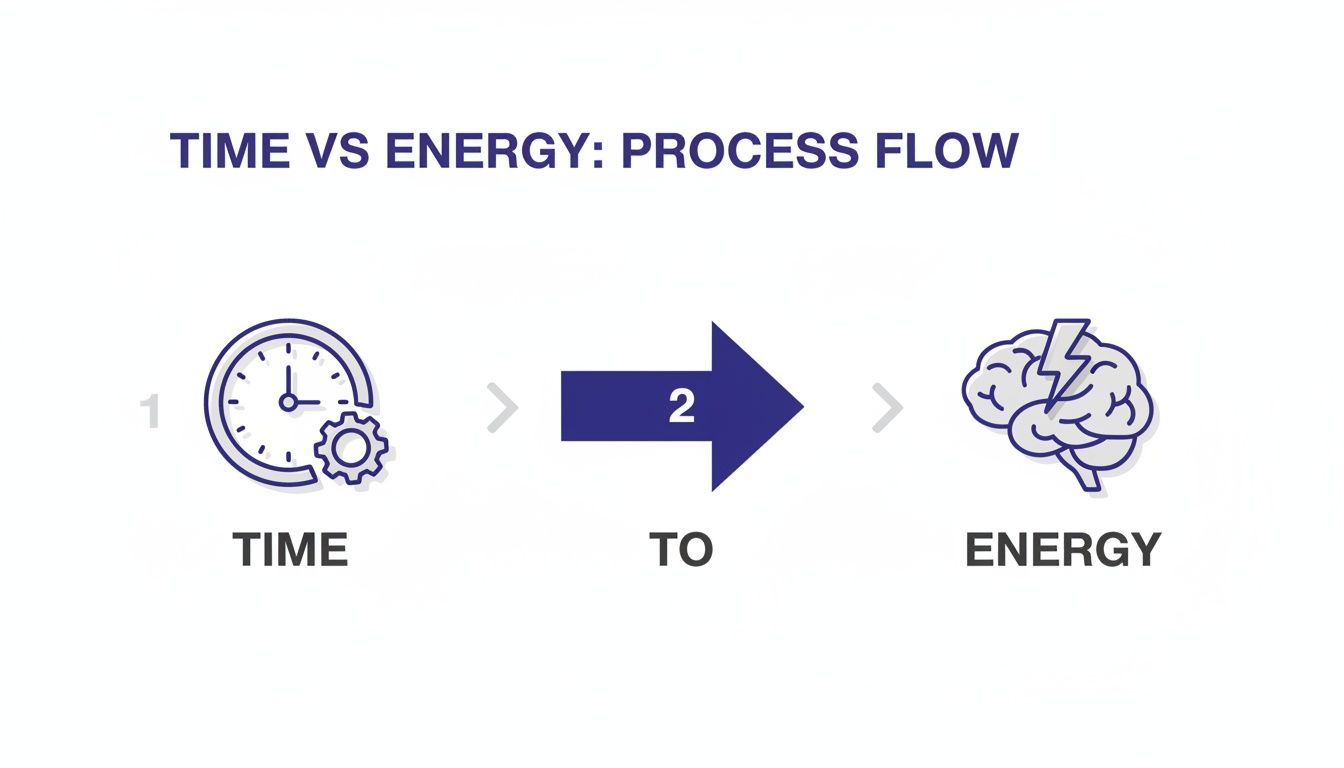
    This simple visual helps capture the shift from just managing the clock to optimizing your internal state.

    A process flow diagram illustrates the conversion of time into energy, depicted with clock and brain icons, showing the process of managing energy not time.

    The goal isn’t just to fill hours; it’s to convert the raw material of time into high-quality, focused energy.

    A Real-World Example in Action

    Let’s look at a real-world case. Alex, a freelance graphic designer, felt perpetually burned out despite being β€œproductive.” He decided to track his energy for a week and discovered a pattern he never would have guessed.

    He had always forced himself to tackle big creative projects first thing in the morning, believing that was β€œpeak time.” His audit, however, showed his mental and creative energy didn’t actually peak until around 10:30 AM.

    But he also saw that his emotional energy was highest right at the start of the day. This made his morning the perfect time for client communicationβ€”a task he used to dread and put off. He also noticed a sharp, predictable energy crash around 2:30 PM every single day, which he used to fight with more coffee.

    Armed with this data, Alex totally restructured his day:

    • 8:30 AM – 10:00 AM: Client emails and project check-ins (high emotional energy).
    • 10:30 AM – 1:00 PM: Deep creative work (peak mental energy).
    • 2:30 PM: A scheduled 20-minute walk outside (strategic renewal instead of caffeine).

    This simple shift was a game-changer. By aligning his tasks with his natural energy flow, Alex produced better work in less time and ended his days feeling accomplished instead of drained. That’s the power of managing your energy, not just your time.

    Design Your Week Around Your Natural Energy Rhythms

    You’ve done the audit. You have the raw data on your personal energy flows. Now it’s time to stop just observing and start architecting. This is where you build a schedule that works with your body’s natural currents instead of constantly fighting against them.

    Forget the old model of time blocking, where the goal was just to cram tasks into every available slot. We’re moving to energy blockingβ€”a smarter approach that matches your most critical work to the moments you’re best equipped to handle it. It’s about assigning the right task to the right energy, not just the right hour.

    A hand places an orange and blue block on a "Deep Work" planner, with a pen and phone nearby, a great example of managing energy not time.

    This simple shift turns your calendar from a rigid taskmaster into a strategic asset. You’ll reserve your best mental resources for the work that actually moves the needle.

    Aligning High-Impact Work with Peak Energy

    Your energy audit almost certainly revealed a 2-3 hour window where your focus is sharpest and your mind is clearest. These are your golden hours. This block of time is precious, and it should be guarded fiercely for deep, cognitively demanding work.

    What qualifies as deep work? Think about the tasks that create the most value:

    • Strategic Planning: Charting the next quarter for your business.
    • Creative Content: Writing a complex report, designing a new product, or coding a tough feature.
    • Problem-Solving: Untangling a tricky operational knot that needs your full concentration.

    During these peak windows, your brain is primed to enter a state of deep concentration. We break down how to cultivate this in our guide on how to achieve flow state. By reserving this time for your most challenging projects, you dramatically improve the quality of your output.

    Conversely, your low-energy periodsβ€”like that classic afternoon slumpβ€”are perfect for administrative tasks. Answering routine emails, filling out expense reports, or organizing digital files doesn’t require peak brainpower. Shifting this β€œshallow work” to your energy troughs prevents you from wasting your best hours on low-impact activities.

    The Science of Task Batching and Attention Residue

    A core strategy here is task batchingβ€”grouping similar activities together and knocking them out in one dedicated block. This is so powerful because it minimizes a massive energy drain known as attention residue.

    Attention residue is the mental noise that lingers when you switch from one unfinished task to another. Research from psychology shows that even after you’ve moved on, part of your brain is still chewing on the previous item. This cognitive friction saps your mental energy and makes it nearly impossible to focus deeply on the new task.

    Studies show the average employee spends a staggering 57% of their time just communicating through meetings, emails, and chats. That leaves a tiny fraction of the day for actual productive work. This constant context switching is an energy catastrophe, leaving a trail of attention residue that kills focus.

    By batching your tasks, you let your brain settle into one β€œmode” for a sustained period. Process all your emails at once. Make all your calls in a single block. Handle all your accounting in one go. This slashes the mental cost of switching gears, preserving your cognitive resources for what truly matters.

    A Real-World Energy Blocking Makeover

    Let’s look at an entrepreneur named Maria who felt perpetually swamped. Her energy audit showed her mental focus was highest from 9 AM to noon. The problem? Her days were a chaotic mix of client calls, team huddles, and strategic work, all jumbled together.

    She redesigned her week using energy blocking:

    • Mornings (9 AM – 12 PM): This became a sacred, no-meetings zone. She dedicated this time exclusively to product development and marketing strategyβ€”the core growth drivers of her business.
    • Afternoons (1 PM – 4 PM): She batched all her external communication here. Client calls, vendor meetings, and team check-ins were all scheduled during this lower-energy window.

    To pull this off, she had to communicate her new boundaries clearly. She set up a scheduling tool that only offered afternoon slots and added a note to her email signature explaining her new focus-oriented schedule.

    At first, she was nervous about pushback. But her clients and team respected her commitment to delivering high-quality work. The result? Her business growth accelerated, and her feelings of burnout vanished.

    Strategic Renewal For Sustainable Performance

    Sustained high performance isn’t about pushing harder; it’s about recharging smarter. Once you’ve designed your week around your natural energy rhythms, the next move is to build in moments of what I call strategic renewal. Think of it as the essential maintenance that keeps your engine running smoothly.

    Without intentional recovery, even the most perfectly planned schedule will eventually lead you straight toward depletion. The goal here is to weave small, science-backed β€œmicro-routines” into your day that replenish your four core energy dimensions. This isn’t about cramming more onto your to-do list. It’s about finally recognizing that brief, deliberate pauses are not a luxuryβ€”they are a biological necessity for focus, resilience, and creativity.

    Managing your energy, not just your time, means treating recovery as an active part of your workflow, not something you only get to when you’re completely running on fumes.

    A person in jeans and sneakers walks into a sunlit office, passing a potted plant, illustrating how small breaks are key to managing energy not time.

    Fueling Your Physical Energy

    Your physical renewal is the bedrock. It’s the foundation that your mental and emotional stamina are built upon. When your body is depleted, your brain’s executive functionsβ€”like sharp decision-making and impulse controlβ€”are always the first casualties.

    One of the most counterintuitive findings in this area comes from the University of Bristol. Their research showed that exercise doesn’t just boost physical health; it directly improves mental-interpersonal skills, time management, and concentration at work. So many of us cite a β€œlack of time” as the reason we skip a workout, yet the science suggests movement paradoxically creates more usable time by amplifying your energy and focus for hours afterward. Even a small bit of activity is a high-return investment.

    Actionable Micro-Routines:

    • The 10-Minute Walk: A short, brisk walk can increase blood flow to the brain, measurably improving cognitive function for up to two hours. Try scheduling one mid-morning or right when that classic afternoon slump hits.
    • Hydration Breaks: Dehydration is a notorious saboteur of focus, leading to mental fog and fatigue. I set a recurring timer on my watch to drink a glass of water every 90 minutes.
    • Mindful Snacking: Instead of grabbing a sugary snack that will inevitably lead to an energy crash, go for something that combines protein and complex carbs. An apple with almond butter, for instance, will stabilize your blood sugar and provide sustained energy.

    Recharging Your Mental Energy

    Your brain is an energy hog, especially when you’re deep in focused work. Without taking mental breaks, you’ll slide into decision fatigue, a state where the quality of your choices literally deteriorates over time. Strategic mental renewal is all about clearing out that cognitive clutter before it builds up.

    The Pomodoro Technique is a perfect, structured example of this in action. It works by breaking your work into 25-minute focused sprints, separated by short 5-minute breaks. This rhythm forces you to step away before mental fatigue can take hold, preserving your cognitive endurance throughout the day.

    Mental renewal is about creating deliberate β€œwhite space” in your day. It’s in these moments of disengagement that your brain consolidates information and generates its most creative insights.

    Protecting Your Emotional Energy

    Emotional energy is your capacity to stay calm, patient, and optimistic, especially when the pressure is on. This resource gets drained by negative interactions, constant interruptions, and a lack of clear boundaries.

    Picture a manager who spends their entire day in back-to-back meetings, absorbing everyone else’s stress and problems. Without a way to reset, that emotional residue gets carried into the next meeting, and the next, leading to irritability and poor leadership. A simple micro-routine, like taking five deep, slow breaths before joining the next video call, can completely reset their emotional state.

    Boundary-Setting Examples:

    • The β€œOffice Hours” Auto-Reply: Set an auto-responder on your chat app that says, β€œI’m in deep work until 11 AM but will respond then.” This isn’t rude; it’s clear communication that manages expectations and protects your focus.
    • The End-of-Day Shutdown: Create a firm ritual to signal that your workday is over. Close your laptop, put your work phone away, and even say it out loud: β€œMy workday is now complete.” This creates a powerful psychological boundary between your work and personal life.

    If you find that emotional drain is becoming a chronic issue, it might be a sign of a larger problem. For anyone feeling completely overwhelmed, it’s worth understanding the practical steps outlined in our guide on how to recover from burnout.

    Editor’s Take: What Really Works?

    Let’s be honest: the whole managing energy, not time idea works best for people who have a decent amount of control over their calendarsβ€”like entrepreneurs, freelancers, and knowledge workers. If your day is a wall of back-to-back meetings in a rigid corporate structure, you’ll need to adapt these principles, not just copy them. You probably can’t block out your entire morning for deep work, but you can reclaim your lunch break for actual renewal (a walk outside, not scrolling at your desk). You can also manage your focus inside those meetings by consciously tuning out distractions.

    Who is this best for? Anyone who feels busy but not productive and understands that human performance isn’t a straight line.

    What’s the biggest limitation? External demands can make perfect implementation difficult. The real win isn’t a flawless schedule; it’s the mental shift of seeing yourself as a human to be cultivated, not a machine to be optimized.

    The single most important starting point is the personal energy audit. Self-awareness is the bedrock of this entire approach. This isn’t a one-and-done hack; it’s an ongoing practice of checking in with yourself and making small adjustments. Over time, those adjustments compound into sustainable performance.

    FAQ: Your Top Questions on Managing Energy, Not Time

    Here are answers to the most common questions about shifting from time management to energy management.

    1. What’s the real difference between managing energy and just feeling tired?

    Feeling tired is a symptom, a general state of needing rest. Managing energy is a proactive strategy. It’s about intentionally cultivating and spending your four core energy typesβ€”physical, mental, emotional, and spiritualβ€”to perform at your best without burning out. Tiredness is the warning light; managing energy is the engine maintenance that prevents the light from coming on.

    2. My energy levels are unpredictable. How can I plan my week?

    The key isn’t perfect prediction but flexible adaptation. Your weekly plan is a template, not a rigid script. Have a pre-made list of low-energy tasks (e.g., organizing files, clearing your inbox) that you can swap in when a high-energy task suddenly feels impossible.

    3. How do I explain this β€˜managing energy’ idea to my boss?

    Frame it in the language of results and quality. For example: β€œI’ve analyzed my workflow and found I produce my sharpest strategic work in the morning. To leverage that, I’d like to block off 9-11 AM for deep focus on Project X. I’ll be fully available for meetings in the afternoon when I’m better primed for collaborative work.” This shows strategic thinking, not flakiness.

    4. What if I have a high-demand job with zero schedule flexibility?

    Focus on what you can control. You might not move a meeting, but you own the 15 minutes before and after. Use micro-renewals: stand up, stretch, or take deep breaths between calls. Guard your lunch break as a non-negotiable recovery period. Manage your energy within constraints by taking notes by hand to stay engaged or tuning out irrelevant side conversations.

    5. I did an energy audit, and my energy is just low all day. What now?

    Your audit is a diagnostic tool. If it reveals consistently low energy, it’s a signal to examine the fundamentals: are you getting 7-9 hours of quality sleep? Is your diet supporting sustained energy? Are you moving your body regularly? If you’ve addressed these basics and nothing changes, it may be a sign of burnout or an underlying health issue, and consulting a healthcare provider is a good next step.

    6. How long does this actually take to work?

    You will likely feel small wins within the first week from increased self-awareness. However, completely rewiring your habits typically takes a few weeks of consistent effort. The goal is to make energy-aware choices instinctively, which takes time. Be patient with the process.

    7. Can technology help or hurt my energy management?

    Tech is a double-edged sword. It can be an energy drain (constant pings, mindless scrolling) or a powerful ally. Use it intentionally: block out focus time on your calendar, use timers to remind you to take breaks, and use apps to block distracting sites during your peak energy hours. Make your tech work for you.

    8. Is this just another productivity fad?

    No. The core principlesβ€”alternating intense effort with strategic recoveryβ€”are rooted in human physiology and have been used by elite performers for decades. We are now applying that same logic to knowledge work, recognizing that the brain performs best when we respect its natural cycles. It’s a necessary adaptation to avoid issues like what is cognitive overload.

    9. What’s the single biggest mistake people make when starting out?

    Trying to be perfect from day one. They design a flawless β€œideal week” and then feel like a failure when life inevitably gets in the way. Instead of perfection, aim for 80% consistency. Start small by protecting just one high-energy block each day and build from there.

    10. How do I know if this is actually working? How do I measure success?

    Success is measured by more than just tasks completed. Look for qualitative signs: do you end the day feeling accomplished instead of drained? Is your focus sharper? Are you more present with others? Also, look for quantitative signs: is the quality of your output improving? Are you spending less total time on tasks?


    Disclaimer & Affiliate Disclosure: Please remember that the content in this article is for educational and informational purposes only. It is not intended to be a substitute for professional medical advice, diagnosis, or treatment. Always seek the advice of your physician or other qualified health provider with any questions you may have regarding a medical condition. Some of the links in this post may be affiliate links, meaning we may earn a small commission if you make a purchase, at no extra cost to you.


    At Mind Clarity Hub, we are dedicated to providing science-backed, practical guides to help you master your focus and productivity. Explore our full library of books on topics from digital clarity to burnout recovery. https://mindclarityhub.com

    Explore the Mind Clarity Hub Library

    Practical books on focus, digital habits, resilience, and building a calmer mind.

    The Power of Clarity β€” book cover

    The Power of Clarity

    Unlock mental focus, build momentum, and create the life you were meant to live.

    View book β†’
    AI & ChatGPT for Beginners β€” book cover

    AI & ChatGPT for Beginners

    No PhD needed β€” a 2025 guide to AI, prompts, and productivity without coding.

    View book β†’
    Zen in the Digital Jungle β€” book cover

    Zen in the Digital Jungle

    Mindfulness for a chaotic world.

    View book β†’
    The Slow Reset β€” book cover

    The Slow Reset

    Mindful living in a fast-paced world.

    View book β†’
    Perfectly Imperfect β€” book cover

    Perfectly Imperfect

    Stop self-criticism, set boundaries, and embrace the real you.

    View book β†’
    Reclaiming Silence β€” book cover

    Reclaiming Silence

    A dopamine detox guide to finding peace in a noisy world.

    View book β†’
    The Focused Freelancer β€” book cover

    The Focused Freelancer

    Productivity, pricing & positioning for independents in 2025.

    View book β†’
    ChatGPT Side Hustle System β€” book cover

    ChatGPT Side Hustle System

    Launch your AI-driven online business in 30 days.

    View book β†’
    Burnout, Interrupted β€” book cover

    Burnout, Interrupted

    A proven path to restore energy and reclaim your life.

    View book β†’
    Attention Unleashed β€” book cover

    Attention Unleashed

    Focus strategies for the distracted mind.

    View book β†’
    Side Hustle Launchpad β€” book cover

    Side Hustle Launchpad

    Your quick-start guide to extra income.

    View book β†’
    Digital Clarity β€” book cover

    Digital Clarity

    Rewire your brain, escape dopamine traps & regain focus.

    View book β†’
    Break the Scroll β€” book cover

    Break the Scroll

    Reduce screen time and take back control of your life.

    View book β†’
    Climate Compassion β€” book cover

    Climate Compassion

    Transform eco-anxiety into empowered action.

    View book β†’
    Village Mentality β€” book cover

    Village Mentality

    The power of community for mental wellness.

    View book β†’
    Restful Nights β€” book cover

    Restful Nights

    Overcoming sleep anxiety in a 24/7 world.

    View book β†’
    Connected Again β€” book cover

    Connected Again

    Combat loneliness and build meaningful relationships.

    View book β†’
    Focus Recharged β€” book cover

    Focus Recharged

    Mastering attention and productivity in the digital era.

    View book β†’
    Marketing Magic with ChatGPT β€” book cover

    Marketing Magic with ChatGPT

    AI-powered content, campaigns, and copywriting to grow faster.

    View book β†’
    The 6-Figure Creator β€” book cover

    The 6-Figure Creator

    Turn knowledge into passive income with books, courses & AI.

    View book β†’
    Burnout Breakthrough β€” book cover

    Burnout Breakthrough

    Reset your work-life balance and thrive in 2025.

    View book β†’
    The Emotionally Intelligent Man β€” book cover

    The Emotionally Intelligent Man

    A modern guide to self-awareness and communication.

    View book β†’
    AI Personalized Wellness β€” book cover

    AI Personalized Wellness

    Create your custom health plan with data-driven habits.

    View book β†’
    Everyday AI Made Easy β€” book cover

    Everyday AI Made Easy

    Use ChatGPT and smart tools to simplify life.

    View book β†’
    Money Mindfulness β€” book cover

    Money Mindfulness

    A financial wellness guide for Gen Z & Millennials.

    View book β†’
    Startup Smarter with AI β€” book cover

    Startup Smarter with AI

    ChatGPT strategies and tools to grow your business.

    View book β†’
    ChatGPT for Writers & Creators β€” book cover

    ChatGPT for Writers & Creators

    Unlock AI-powered brainstorming, drafting & editing.

    View book β†’