
...

Tag: sleep science

  • How to Fall Asleep Instantly: Proven Techniques

    How to Fall Asleep Instantly: Proven Techniques

    That agonizing feeling of staring at the ceiling while your mind races is a painfully modern experience. While actually falling asleep instantly is something of a myth, there are powerful ways to dramatically shorten the time it takes to drift off. Tonight, we can give you a practical tool to quiet that inner monologue and gently guide your brain toward rest.

    Affiliate Disclosure: Some of the links in this article are affiliate links. If you make a purchase through them, we may earn a small commission at no extra cost to you. We only recommend products we believe in.

    If you’re struggling with ongoing sleep problems, anxiety, depression, or ADHD, it’s important to recognize that this article is for educational purposes only. The information here is not a substitute for professional medical or psychological care from a qualified healthcare provider.


    A person in bed looks upwards, with a glowing blue lamp and a smartphone on a wooden nightstand, wondering how to fall asleep instantly.

    The natural instinct is to “try harder” to sleep, but this almost always backfires. This creates more frustration and reinforces a cycle of anxiety. Instead of forcing it, we need to gently distract the part of your brain that’s keeping you awake. This is where a simple but surprisingly effective technique can make a real difference tonight.

    Why You Can’t Fall Asleep and What to Do Tonight

    If you’re lying awake, your brain is likely stuck in what neuroscientists call hyperarousal. This is a state where your brain’s threat-detection system, the amygdala, stays on high alert. It’s often fueled by the leftover stress from your workday, anxiety about tomorrow, or just plain overstimulation from screens. Your brain gets trapped in a behavioral loop of planning and worrying, making it almost impossible to relax.

    The Cognitive Shuffle: A Quick Fix for a Racing Mind

    Instead of counting sheep, which can be too monotonous, try the Cognitive Shuffle. Developed by Dr. Luc Beaudoin, this technique is designed to scramble the logical, narrative thought patterns that keep you awake. It works by mimicking the random, unconnected imagery that happens as you naturally drift into sleep, a state known as hypnagogia.

    Essentially, you’re giving your worrying brain a new, nonsensical job to do. This allows your body’s natural sleep drive to finally take over.

    Here’s how to do it:

    • First, pick a simple, neutral word with at least five unique letters. Something like “BEDTIME” works perfectly. Don’t pick a word with heavy emotional baggage.
    • Next, visualize items starting with the first letter. Close your eyes and calmly picture different things that start with “B.” Imagine a banana, then a boat, then a bicycle. Spend about five seconds on each image. Don’t strain; just let the images float in and out of your mind.
    • Then, move to the next letter. Once you run out of “B” words or notice your mind wandering, just shift to the next letter, “E.” Picture an egg, then an elephant, then an envelope.
    • Keep going through the word until you fall asleep. The truth is, most people don’t even make it past the second or third letter before their mind gives up and drifts off.

    Real-World Scenario: Imagine a busy professional whose mind is buzzing with deadlines after a long day. Their brain is stuck replaying a meeting. By starting the Cognitive Shuffle with the word “NIGHT,” they visualize a napkin, then a nest, then a notebook. This simple, unrelated imagery breaks the stressful thought loop, allowing their nervous system to finally calm down enough for sleep.

    For a clearer picture of why this works, it’s helpful in understanding the causes of insomnia and how to address them. While the cognitive shuffle is a powerful first-aid tool for a rough night, lasting change comes from building solid sleep habits. If you often feel overwhelmed by anxiety at bedtime, you can get some rest with our targeted guide.

    Using Your Breath to Calm Your Nervous System

    When your mind is racing at night, your breath is one of the most powerful tools you have to quiet the noise. It’s not just a mental trick—it’s a direct line to your body’s internal wiring. You’ve probably noticed that when you’re stressed, your breathing gets shallow and fast. From a behavioral psychology perspective, this pattern keeps your nervous system on high alert, stuck in “fight or flight” mode.

    By deliberately slowing down your breath, you can physically shift your body out of that state. It helps you move into the “rest and digest” mode that’s essential for sleep. Slow, deep breathing activates the vagus nerve. This sends a powerful signal to your brain that you’re safe. In response, your heart rate drops, your blood pressure lowers, and the mental chatter starts to fade. It’s like sending a physical command to your body to power down.

    The 4-7-8 Breathing Method

    The 4-7-8 breathing technique is a simple but profound rhythm designed to force deep relaxation. It pulls your focus away from anxious thoughts and grounds you in the physical sensation of your breath.

    Here’s how it works:

    1. Start by exhaling completely through your mouth with a gentle whoosh.
    2. Close your mouth and inhale quietly through your nose for a count of four.
    3. Hold that breath for a count of seven. This is the most important part of the cycle, as it gives your body time to fully absorb the oxygen.
    4. Exhale slowly and completely through your mouth for a full count of eight.
    5. Repeat this cycle for three or four rounds when you first get into bed.

    Real-World Scenario: An entrepreneur is lying awake, stressed about a big presentation. Instead of spiraling through “what-ifs,” they can use the 4-7-8 rhythm to break the anxiety loop. The simple act of counting and breathing calms their nervous system enough to finally let sleep in. If you find this kind of physical response to stress is a regular blocker, our guide on how to calm down offers more techniques.

    Box Breathing for Simple Focus

    If the 4-7-8 count feels a little too much to remember when you’re already tired, Box Breathing is a fantastic alternative. Its simple, even structure is incredibly easy to follow. This is true even when you’re feeling completely exhausted.

    Just picture a square and trace it with your breath:

    • Inhale slowly through your nose for four seconds.
    • Hold your breath for four seconds.
    • Exhale slowly through your mouth for four seconds.
    • Hold your breath again for four seconds.

    Repeat this cycle until you feel your body getting heavier and your mind getting quieter. You’re giving your brain a simple, repetitive task to focus on instead of your worries.

    When you pair these breathing exercises with a pitch-black room, you’re sending an undeniable signal to your brain that it’s time to shut down. One popular item shoppers love is a good sleep mask blackout to block all light. You might also want to explore ways to maintain better breathing while you sleep, which is why some people are now using oral tape to improve nighttime breathing. By taking control of this fundamental function, you gain a reliable method for how to fall asleep instantly when your mind just won’t quit.

    How to Fall Asleep Instantly With the Military Method

    You’ve probably heard whispers of the “military method,” a technique supposedly used by soldiers to fall asleep in under two minutes, even in high-stress environments. It’s not just a legend—it’s a real, systematic relaxation process that works by intentionally releasing physical tension. This sends a powerful signal to your brain that it’s safe to power down.

    At its core, the technique is a form of progressive muscle relaxation. You methodically scan your body, releasing one muscle group at a time. This simple process breaks the feedback loop between a tense body and an anxious mind. When your body is physically limp and heavy, it’s remarkably difficult for your mind to keep racing.

    A 4-step infographic illustrates how to fall asleep instantly using breathing techniques for sleep, including 4-7-8 and box breathing.

    Before you even start with the muscles, grounding yourself with a few slow, controlled breaths can make a huge difference. Techniques like 4-7-8 or box breathing calm your nervous system, setting the stage for the physical release to come.

    Your Step-by-Step Guide to the Military Method

    Ready to try it? The whole point is to move slowly. Don’t rush it. Give each part of your body your full attention as you invite it to let go.

    • Start with your face. Your face holds a shocking amount of tension. Close your eyes. Consciously unclench your jaw and let your tongue fall away from the roof of your mouth. Feel the tiny muscles around your eyes soften and your forehead smooth out.
    • Move to your shoulders and arms. Let your shoulders drop as low as they can possibly go. Feel the release in your neck and upper back. Then, one arm at a time, let it go completely limp from your bicep down to your fingertips. Imagine it becoming heavy and sinking into the mattress.
    • Breathe into your chest. Take a slow, deep breath in, and as you exhale, feel your entire chest and stomach soften. Picture the tension leaving your body with each breath.
    • Work down through your legs. Bring your awareness to your lower body. Start with your right thigh, letting it feel heavy and loose. Then move down to your calf, ankle, and foot. Repeat the entire process on your left side until your whole body feels grounded.

    Why This Works When Your Mind Won’t Quit

    This method is so effective because it gives your racing mind a gentle, concrete job to do. Instead of getting tangled in anxious thoughts about tomorrow’s to-do list, you’re focusing on the physical sensation of release. It’s a form of active mindfulness that shifts you out of your head and into your body.

    Real-World Scenario: A freelance graphic designer just wrapped a demanding project. Her mind is buzzing with client feedback and deadlines. Lying in bed, she methodically works through the military method. She releases her jaw from hours of clenching. Then, she drops her shoulders from hunching over a desk. She lets her legs go heavy. This process pulls her attention away from the project and grounds her in the present moment, allowing sleep to finally arrive.

    If this scenario feels familiar, and daily stress consistently sabotages your sleep, it might be a signal to look at the bigger picture. When you’re frequently dealing with work-related burnout, it can be a symptom of a deeper issue. It may be time to explore more robust strategies for managing stress before it follows you to bed. Browse the library for books that can help. For instance, Burnout Interrupted offers targeted strategies.

    Best Options for Your Nightly Wind-Down Routine

    While in-the-moment breathing techniques are a lifesaver, a consistent evening routine is your best long-term play against sleeplessness. Think of it as creating a predictable off-ramp for your brain. It teaches your mind to shift from the high gear of “doing” into the gentle coast of “being.” Getting this habit dialed in is one of the most powerful moves you can make toward falling asleep faster, night after night.

    A simple, memorable way to build this off-ramp is the 10-3-2-1-0 rule. It’s not about being rigid or perfect. Instead, it’s a gradual, science-backed countdown that helps you systematically reduce stimulation. It signals to your body that rest is coming.

    A bedside table with water, phone, a book, and a sleep mask, suggesting a relaxing wind-down routine for how to fall asleep instantly.

    The 10-3-2-1-0 Rule Explained

    This isn’t about adding more to your to-do list. It’s about creating intentional boundaries that work with your biology, not against it. Let’s walk through what each number means and the neuroscience behind why it works so well.

    • 10 Hours Before Bed: No More Caffeine
      Caffeine has a surprisingly long half-life. This means half of that afternoon coffee can still be buzzing through your system hours later. Cutting off all caffeine—that includes coffee, most teas, and even some sodas—a full 10 hours before bed gives your body plenty of time to clear it out. This prevents it from blocking adenosine, the key neurotransmitter that builds up during the day to make you feel sleepy.

    • 3 Hours Before Bed: No More Big Meals or Alcohol
      This one is critical. Winding down large meals and stopping alcohol intake about three hours before you get into bed gives your body a fighting chance to cool down and relax. Digestion is an active, heat-producing process. And while alcohol might feel like it helps you doze off, it wrecks your sleep quality later in the night. It particularly impacts your REM sleep.

    • 2 Hours Before Bed: No More Work
      Putting a hard stop to all work-related thinking two hours before bed is non-negotiable for a quiet mind. It’s your brain’s signal to disengage from planning, problem-solving, and worrying. This transition is essential for dialing down the mental hyperarousal that so often keeps us staring at the ceiling. The day’s obligations are done.

    • 1 Hour Before Bed: No More Screens
      If you only follow one part of this rule, make it this one. The blue light blasting from phones, tablets, and computers directly shuts down your brain’s production of melatonin. This is the hormone that tells your body it’s nighttime. If you absolutely can’t avoid a screen, a good pair of blue light blocking glasses can be a game-changer by filtering out the most disruptive wavelengths.

    • 0 Snooze Buttons in the Morning
      This one is about the morning, but it sets up your next night. Hitting snooze feels good for a second, but it fragments your sleep. This can leave you feeling groggy and “off” all day. Waking up with a gentle sunrise alarm clock at a consistent time anchors your body’s internal clock. This makes it much easier to feel sleepy at the right time each evening.


    How to choose the best wind-down activity

    That final, screen-free hour is your golden opportunity to actively relax and downshift. The best activity for you depends on what your mind and body need most. Are you physically tense? Is your mind racing with worries? This comparison can help you find a starting point.

    Wind-Down Activity Comparison

    ActivityBest ForWhy It Works
    Reading a Paper BookA racing mindMental distraction without sleep-disrupting blue light.
    Journaling/Habit TrackerProcessing worriesOffloads anxious thoughts from your brain onto paper.
    Gentle StretchingPhysical tensionReleases stored tightness from a long day at a desk.
    Listening to a Calm PodcastSoothing focusProvides gentle auditory input without a screen.

    The key is to experiment. Maybe you discover that certain sounds are incredibly calming. For example, some find a white noise machine very effective. For others, it’s a distraction. If you’re curious about the role of sound, our guide on whether music can help you sleep is a great place to dig in. See the book that fits your goal to build better habits.

    Ultimately, all of these tactics are about creating strong digital and mental boundaries to protect your rest. It’s about actively reclaiming your evenings from the chaos of the day with a clearer mind. Explore strategies for this in The Power of Clarity.

    Troubleshooting Common Barriers to Sleep

    You’ve followed all the advice. You have a solid wind-down routine. Yet here you are, staring at the ceiling, wondering why sleep won’t come. It’s a frustratingly common experience. It’s often because a few sneaky barriers are quietly sabotaging your efforts. Tackling these roadblocks head-on is one of the most important steps you can take toward falling asleep faster.

    Two of the biggest culprits are an inconsistent sleep schedule and a bedroom that’s secretly working against you. Most people think a strict bedtime is the key. However, behavioral research consistently shows that a consistent wake-up time is far more powerful. Waking up at the same time every single day—yes, even on weekends—is the strongest signal you can send to anchor your internal clock, or circadian rhythm.

    This simple act programs your body to anticipate sleep at a predictable time each night. It helps regulate the natural rhythm of hormones like cortisol (which wakes you up) and melatonin (which makes you sleepy). When your wake-up time is stable, your body learns when to start releasing melatonin. This makes sleep feel less like a fight and more like a natural conclusion to your day.

    How to Handle a Restless Night

    Even with the best schedule, you’ll still have nights when your brain just refuses to switch off. In those moments, how you react is everything. Lying in bed for hours, tossing and turning, only teaches your brain to associate your bed with frustration and anxiety—a miserable cycle known as conditioned arousal.

    To break that pattern, sleep experts recommend the 15-minute rule, a cornerstone of Cognitive Behavioral Therapy for Insomnia (CBT-I).

    • If you’re still awake after what feels like 15-20 minutes, get out of bed.
    • Move to another room and do something quiet and calming in very dim light. Think reading a boring book, listening to soft music, or doing some gentle stretches. Avoid screens at all costs.
    • Only head back to bed when you feel genuinely sleepy again.

    Real-World Scenario: You wake up at 2 AM with your mind racing about a project. Instead of staying in bed feeling anxious, you get up. You go to the living room and read a few pages of a dull book under a dim lamp. After about 10 minutes, your eyelids feel heavy. You return to bed and fall back asleep quickly, breaking the negative association.

    The whole point is to re-establish your bed as a place for sleep, and only sleep. It’s about breaking the link between your bed and anxious wakefulness. For those moments when sleep anxiety feels especially overwhelming, our book Restful Nights offers targeted strategies for breaking that frustrating cycle.

    Optimizing Your Sleep Environment

    Your bedroom can be a sanctuary for sleep or a source of subtle, constant disruption. A room that’s too hot, bright, or noisy makes it physically harder for your body to relax. It becomes difficult to reach the deep, restorative stages of sleep. A noisy environment, for instance, can keep your nervous system on a low-level alert, even if you don’t consciously wake up.

    Worldwide, over 30% of adults report symptoms of insomnia. Recent data from a poll by sleep trends at SingleCare shows people now average just 6.8 hours of sleep per night. This is a significant drop from the 9 hours common a century ago.

    A simple but incredibly effective fix for noise is a good white noise machine. It creates a constant, soothing auditory blanket. It can mask disruptive sounds like street traffic or a snoring partner. Beyond that, making sure your room is cool and completely dark is non-negotiable.

    Don’t forget about physical comfort, either. An old, unsupportive pillow can cause neck and shoulder pain that keeps you shifting all night. It might be time to learn how often you should change your pillow to make sure you’re getting the right support. By troubleshooting these common barriers, you give yourself the best possible shot at falling asleep fast.

    Editor’s Take and Our Key Principles for Faster Sleep

    Let’s be honest: the idea of “instant” sleep is mostly a myth. However, you can absolutely learn to fall asleep much faster. This isn’t magic. It’s about using techniques grounded in neuroscience and psychology that work with your body’s own wiring.

    What Actually Works: Methods like the Military Method or 4-7-8 breathing genuinely shorten the time it takes to doze off. They do this by calming your nervous system and shifting you out of a “fight-or-flight” state. This is a real, physiological change you can feel.

    Who It’s Best For: These strategies are powerful tools for anyone whose mind won’t stop racing at 11 PM. They are perfect for people who carry the day’s stress into bed. They work best for a brain that’s overstimulated.

    Important Caveats: They are not a cure for underlying medical conditions. If you suspect you’re dealing with something more serious like chronic insomnia, sleep apnea, anxiety, or depression, it is essential to talk to a qualified healthcare provider. This advice is educational, not medical. For most of us, the path to faster sleep isn’t one secret hack. It’s about pairing these in-the-moment techniques with a predictable, calming wind-down routine. Think of it as building a reliable off-ramp from the busy highway of your day to the quiet side street of sleep.

    Key Takeaways for Falling Asleep Instantly

    When your head hits the pillow but your brain is still buzzing, come back to these core ideas. This is your toolkit for guiding your body and mind toward the rest you need.

    • Calm Your Nervous System First: Before you do anything else, focus on your breath. Simple, rhythmic breathing like the 4-7-8 method sends a direct signal to your body that it is safe to relax and power down.

    • Relax Your Body, Systematically: Physical tension keeps the mind alert. Use the military method to consciously release stored tension, muscle by muscle, from your face all the way down to your toes. It’s much harder for your mind to hold onto stress when your body is fully at ease.

    • Build a Consistent Wind-Down Routine: The 10-3-2-1-0 rule gives you a simple, memorable structure for preparing your mind and body for bed. A predictable habit is one of the most effective long-term strategies you can build.

    • Control Your Sleep Environment: A dark, cool, and quiet room is non-negotiable for quality sleep. Simple tools like a sleep mask blackout can make a massive difference in signaling to your brain that it’s time for rest.

    • Know When to Get Out of Bed: If you’re still wide awake after 15-20 minutes, don’t just lie there getting frustrated. Get up, move to another dimly lit room, and do something quiet until you feel genuinely sleepy again.


    Disclaimer: The affiliate links in this article may generate a small commission at no extra cost to you. This content is for educational purposes only and is not a substitute for professional medical or psychological advice. Please consult a qualified healthcare provider for any health concerns.

    Sleep FAQs: Your Toughest Questions, Answered

    Making sense of sleep advice in the real world can be a mess. Let’s clear up some of the most common questions about falling asleep fast and building a more reliable sleep rhythm.

    Can You Really Train Yourself to Fall Asleep in 2 Minutes?

    Yes, but it’s not a magic trick. The military method is a form of conditioning—a skill you build over time, not a switch you flip on night one.

    By consistently guiding your body through that same muscle relaxation sequence, you’re creating a powerful conditioned response. Your brain gradually learns to associate the routine with shutting down for the night. You might not hit the two-minute mark on your first try, but with practice, you can get surprisingly close.

    What if I Wake Up in the Middle of the Night?

    Whatever you do, don’t just lie there getting frustrated. That’s a surefire way to teach your brain that bed is a place for anxiety.

    Instead, follow the 15-minute rule from Cognitive Behavioral Therapy for Insomnia (CBT-I). If you’re still wide awake after 15 or 20 minutes, get out of bed. Go to another room with dim lighting and do something quiet and non-stimulating, like reading a paper book or listening to calm music. Only head back to bed when you feel genuinely sleepy again.

    This breaks the toxic link between your bed and anxious wakefulness.

    Do Sleep Supplements Like Magnesium Actually Work?

    For some people, absolutely. A magnesium glycinate supplement is often a great place to start, as this form is easily absorbed and well-known for its calming effect on the nervous system.

    However, supplements are never a one-size-fits-all fix, and their effectiveness can vary a lot from person to person. It’s critical to talk with your doctor before starting any new supplement to make sure it’s safe for you and won’t interact with anything else you’re taking.

    Is It Bad to Use My Phone Before Bed With a Blue Light Filter?

    Using a blue light filter or “night mode” is better than nothing, but it only solves half the problem. The filter may reduce your exposure to the specific light wavelengths that suppress melatonin, but it does zero to stop the mental stimulation.

    Scrolling through social media, reading the news, or firing off emails keeps your brain engaged and “wired.” The cognitive and emotional engagement is often the real barrier to sleep. Your best bet is to put all screens away for at least an hour before bed.

    What Is the Most Important Habit for Falling Asleep Faster?

    While all these techniques can help, the single most powerful habit for regulating your sleep is a consistent wake-up time.

    Getting up at the same time every single day—even on weekends and holidays—anchors your body’s internal clock, or circadian rhythm. This helps your body learn when to release melatonin, making it much, much easier to feel sleepy at the right time each night. It’s the non-negotiable foundation of good sleep.
    Free download: 7-Day Mind Clarity Reset preview

    Free download: 7-Day Mind Clarity Reset

    A short daily reset you can actually stick with (no fluff).
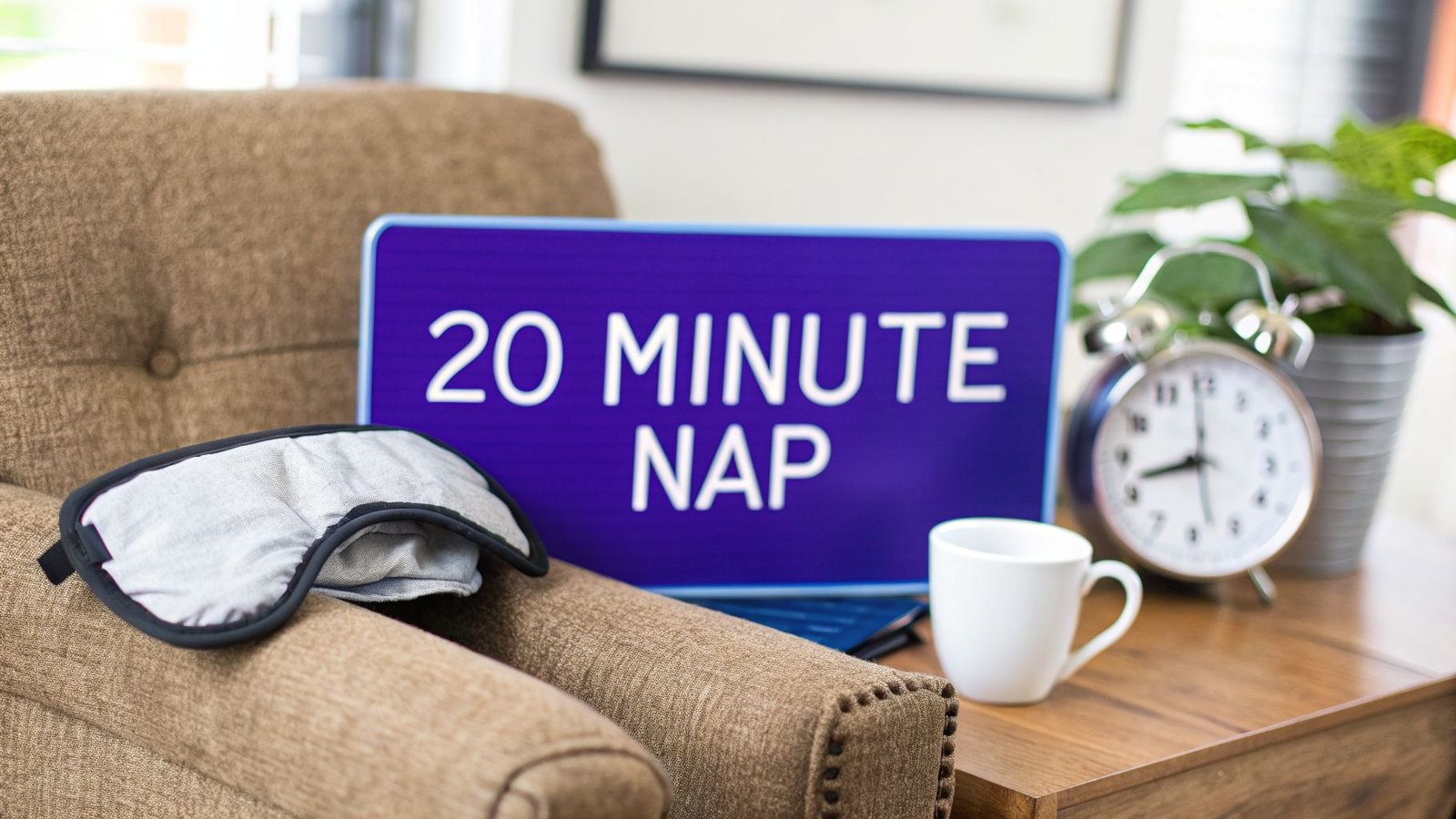
  • The Perfect 20 Minute Nap: Your Guide to a Brain-Boosting Power Nap

    The Perfect 20 Minute Nap: Your Guide to a Brain-Boosting Power Nap

    A quick 20 minute nap isn’t a luxury—it’s a scientifically validated tool for sharpening your mind, boosting alertness, and kickstarting creativity. This short rest is just enough time to give your brain a cognitive tune-up without the groggy hangover that comes with longer naps.

    Affiliate Disclosure: This post may contain affiliate links. If you make a purchase, we may earn a small commission at no extra cost to you.

    A smiling American man in a blue suit and sleep mask takes a 20 minute nap in his office chair.

    Why a 20 Minute Nap Unlocks Your Brain’s Potential

    Far from being a sign of laziness, a strategic 20 minute nap is one of the most effective resets you can use. This is especially true when you hit that midday slump and notice the first 12 key signs of mental fatigue. The magic is in the timing and the brain science behind it.

    When you doze off for about 20 minutes, you dip into the first two stages of non-REM sleep (N1 and N2). During this light sleep, your brain gets to work. It clears out adenosine, a chemical that builds up while you’re awake and makes you feel sleepy. Think of it as your brain’s cleaning crew tidying up your mental workspace. This process is why you wake up feeling sharper and more alert.

    • Real-World Example: Imagine you’re a designer trying to finish a project by a deadline. By 2 PM, you feel foggy and unfocused. Instead of pushing through, you take a 20-minute nap. When you wake up, that mental fog has lifted, and you can focus on the details again.

    Spark Creativity and Solve Problems With a 20 Minute Nap

    But a quick nap does more than just fight off sleepiness. Neuroscience research shows it can actually help you solve stubborn problems. Imagine you’re hitting a wall on a project, staring at a puzzle your brain just won’t crack. A 2023 study from the University of Hamburg found that a short nap could be the key to your next “eureka” moment.

    In the study, researchers had participants work on a puzzle with a hidden pattern. An incredible 85.7% of the nappers who entered the N2 sleep stage figured it out afterward. Compare that to just 55.5% of those who stayed awake. That’s a nearly 30% advantage in insightful problem-solving, all from a brief rest.

    This shows that even a short nap helps your brain forge new connections, giving you a serious edge. The broader Napping Benefits extend to overall well-being. They confirm that this habit doesn’t just make you feel better—it helps you think better. Something as simple as a sleep mask blackout can help you signal to your brain that it’s time to rest, creating the perfect environment for that restorative 20-minute reset.

    How to Take the Perfect 20 Minute Nap

    There’s an art to the perfect 20 minute nap. It’s not just about closing your eyes and hoping for the best; it’s a specific skill you can build. When you get it right, a short nap becomes a powerful tool for rebooting your brain, not a recipe for feeling groggy. The trick is to work with your body’s natural rhythms, not against them.

    That midday wave of sleepiness you feel after lunch isn’t a sign of weakness. It’s your body’s internal clock, or circadian rhythm, taking its natural dip. Behavioral psychology suggests leaning into this is the secret to falling asleep quickly and waking up refreshed.

    For most people, the sweet spot for a 20 minute nap falls somewhere between 1 PM and 3 PM. Napping in this window aligns perfectly with that natural dip in alertness. Just as importantly, it’s early enough in the day that it won’t steal from your ability to get a full night’s sleep later.

    Best Way to Create Your Ideal Napping Environment

    Once you’ve found your time, the next piece of the puzzle is your environment. To make a short nap work, you need to send clear signals to your brain that it’s time to power down. This is true even if it’s just for a little while.

    A great nap space really comes down to three simple things. It needs to be cool, dark, and quiet. Think of it as a mini-version of creating a healthy sleep environment.

    • Cool: A room that’s slightly cool helps trigger the small drop in body temperature that naturally happens before you fall asleep.
    • Dark: Light is your brain’s most powerful “stay awake” signal. Blackout curtains are great. However, a good sleep mask blackout is a nap-saver, especially in a bright room or office.
    • Quiet: Sudden noises are the enemy of a light nap. If you can’t guarantee silence, a pair of noise canceling headphones is your best friend. You can also see whether music can help you sleep.

    A remote worker I know carves out a nap in her time blocking planner every afternoon. She slips on her headphones, pulls on a sleep mask, and sets a timer. That simple ritual lets her brain completely switch off. As a result, she comes back to her desk feeling genuinely sharp.

    Set a Timer to Prevent Groggy After-Effects

    This might be the most important rule of the power nap: you have to wake up on time. The whole point of a 20 minute nap is to get the restorative benefits of light sleep. You want to avoid slipping into the deep sleep stages.

    Oversleeping is what causes sleep inertia. This is that sluggish, disoriented feeling that can make you feel even worse than before you lay down.

    Always set an alarm. Your phone will do the job. However, using a simple analog alarm clock can help you resist checking notifications before and after you rest. I recommend setting it for 20-25 minutes. This gives you a few minutes to drift off but ensures you wake up before you sink too deep. Consequently, you’ll pop back up feeling recharged and ready to go.

    What to Buy First for Your 20 Minute Nap Sanctuary

    You don’t need a high-tech sleep pod to build a great napping spot. The goal isn’t to buy everything on some master list. Instead, solve your single biggest problem first.

    So, ask yourself: what’s the one thing that most often gets in the way of a good 20 minute nap?

    Maybe it’s bright office lights or the sound of your family moving around. Or perhaps it’s an uncomfortable chair that won’t let you relax. Your answer points you directly to your first and most effective purchase.

    Best Nap Aids for Your Environment

    If you’re trying to nap in a bright or noisy space, your first priority is simple. Block out the world. You have to create an artificial pocket of darkness and quiet.

    For this, a high-quality sleep mask blackout and a solid pair of noise-canceling headphones are your best friends. Together, they create an instant sensory deprivation chamber. This signals to your brain that it’s time to power down, even in the middle of the afternoon.

    But if your environment is already dark and quiet, the problem is likely comfort. In that case, a supportive neck pillow or an ergonomic cushion will give you a far better return than a sleep mask you don’t really need.

    Light and sound are powerful environmental cues. They directly shape your brain’s ability to focus and rest. You can go deeper into the science by exploring how architecture affects cognitive performance. The right tool is simply the one that removes your biggest point of friction.

    Flowchart illustrating a nap decision guide for a 20 minute nap, based on time, place, and method for a productive nap.

    As this flowchart shows, a successful nap hinges on a few key decisions. Nail the time, control your environment, and use the right method to wake up.

    How to Choose Your Ideal Nap Aid

    To find the best starting point for your personal nap kit, compare the tools below. Each one is designed to solve a specific, common napping problem. Compare options to see which fits your needs.

    ToolBest ForKey Benefit
    Sleep Mask BlackoutBright rooms or napping during the dayBlocks light to signal rest to your brain.
    Noise-Canceling HeadphonesNoisy offices, homes, or coffee shopsCreates a bubble of silence to prevent interruptions.
    White Noise MachineUnpredictable background soundsMasks sudden noises that can jolt you awake.
    Analog Alarm ClockAvoiding phone distractions before and after your napEnsures a reliable wakeup without the risk of scrolling.

    You don’t need all of these at once. Just start with the one that targets your most immediate challenge. As a result, you’ll be well on your way to mastering the 20 minute nap.

    How a 20 Minute Nap Sustains Alertness and Focus

    That dreaded 2 PM brain fog isn’t just a feeling; it’s a physical process. As your day wears on, a chemical called adenosine slowly builds up in your brain. This chemical signals that it’s time to sleep. A short 20 minute nap acts like a targeted reset. It clears out just enough adenosine to refresh your brain without causing grogginess.

    It’s a quick, biological tune-up for your mind.

    • Real-World Example: A long-haul truck driver feels their attention drifting after hours on the road. They pull over for a planned 20-minute nap. The short rest clears adenosine from their brain, restoring their vigilance and making the rest of their drive safer.
    A tired American student taking a 20 minute nap on a desk next to a laptop, an alarm clock, and colorful books.

    This mental refresh translates directly into better performance. This is especially true when you need to hold onto your concentration. Instead of grabbing another coffee—which just temporarily blocks adenosine receptors—a nap actually lowers the levels of the chemical itself. You can read more in our guide on the crash from coffee.

    The Science of Sustained Vigilance from a 20 Minute Nap

    The connection between short naps and renewed focus isn’t just a productivity hack. It’s backed by solid neuroscience. Researchers have confirmed that a quick nap is one of the most effective ways to maintain what they call “vigilance.” This is your ability to stay alert and responsive over long periods.

    A landmark study on this topic drives the point home.

    Researchers found that subjects who took a 20-minute nap around 2 PM not only felt significantly less sleepy. They also performed much better on cognitive tasks afterward. Their brain scans confirmed it, showing patterns linked to heightened alertness. Meanwhile, the group that didn’t nap saw their performance steadily drop. You can discover more about these findings on vigilance.

    This tells us that a midday nap isn’t laziness. It’s a smart strategy that works with our body’s natural circadian dip to keep our minds sharp. If you struggle with focus, poor habits might be the cause. My book, The Power of Clarity, can help you build better routines.

    Editor’s Take: What Actually Works for a 20 Minute Nap

    Here’s the honest truth: the 20 minute nap can be a game-changer for clearing out afternoon brain fog. It’s a powerful tool, but only if you approach it with some ground rules.

    I see it work best for people fighting that heavy 2–3 PM slump. These are the people who need a sharp mental reset but don’t have time for a full siesta. Think of it as a targeted intervention, not a cure-all.

    A nap is a supplement, not a substitute. If you are running on fumes from chronic sleep debt, a 20-minute doze won’t fix the underlying problem. Deep, restorative nighttime sleep is non-negotiable.

    If you’re wrestling with ongoing exhaustion, anxiety, or burnout, it’s worth talking to a medical professional. This article is for educational purposes only. It is not a substitute for professional medical or psychological care. A book like Restful Nights can offer strategies for anxiety-related sleep issues, but it can’t replace proper medical advice.

    The biggest hurdle for some people is “sleep inertia”—that groggy feeling after waking. The good news is that keeping your nap to 20 minutes or less usually prevents it. A “caffeine nap” (drinking coffee right before you lie down) is a surprisingly effective trick to wake up feeling alert. From my own experience, a good sleep mask blackout is a tiny investment that makes a huge difference.

    Key Takeaways: Mastering the 20 Minute Nap

    • Stick to 10-20 Minutes: This is the ideal duration to boost alertness without causing grogginess.
    • Nap in the Early Afternoon: The best time is between 1 PM and 3 PM to align with your body’s natural energy dip.
    • Create a Restful Environment: A cool, dark, and quiet space is essential. Use tools like a sleep mask or noise-canceling headphones.
    • Always Set an Alarm: An alarm prevents oversleeping and ensures your nap doesn’t interfere with nighttime sleep.
    • Don’t Replace Nightly Sleep: A 20-minute nap is a supplement for focus, not a cure for chronic sleep deprivation.

    Frequently Asked Questions About the 20 Minute Nap

    1. Is a 10-minute nap as good as a 20-minute one?

    Yes, a 10-minute nap is also very effective. Any rest in the 10-20 minute window provides a cognitive boost by keeping you in the light stages of sleep. A 10-minute nap is like a quick espresso shot for your brain. A 20-minute nap offers a more complete refresh.

    2. What if I can’t fall asleep during my 20 minute nap time?

    Don’t worry about it. Even just resting quietly with your eyes closed, a practice known as “quiet wakefulness,” can be beneficial. This reduces stress hormones and helps you conserve mental energy. With consistent practice, your brain will learn to associate this time with rest, making it easier to fall asleep.

    3. Will a 20 minute nap interfere with my sleep at night?

    For most people, a short nap between 1 PM and 3 PM will not interfere with nighttime sleep. This timing aligns with your natural circadian dip. However, napping too late in the afternoon can disrupt your sleep-wake cycle. So, it’s best to avoid napping after 4 PM.

    4. What is a “caffeine nap” and does it actually work?

    A caffeine nap involves drinking coffee or tea right before your 20-minute nap. It works because caffeine takes about 20-30 minutes to kick in. By the time your nap is over, the caffeine starts to take effect. This provides a double benefit of rest and a stimulant boost, leading to increased alertness.

    5. Should I take a 20 minute nap if I have insomnia or anxiety?

    If you have a diagnosed sleep disorder like insomnia, or conditions like anxiety or depression, it is crucial to consult a doctor or sleep specialist before starting a napping routine. While beneficial for many, napping can sometimes complicate these conditions. This content is for educational purposes only and is not medical advice. For strategies on managing a racing mind at night, see the book that fits your goal, like Restful Nights.


    Disclaimer: This article contains affiliate links. If you purchase through a link, we may earn a small commission at no extra cost to you. The content provided is for educational and informational purposes only and does not constitute medical or psychological advice. Always consult with a qualified professional for any health concerns or before making any changes to your health regimen.

    Free download: 7-Day Mind Clarity Reset preview

    Free download: 7-Day Mind Clarity Reset

    A short daily reset you can actually stick with (no fluff).

  • Can Music Help You Sleep The Science of Sound and Restful Nights

    Can Music Help You Sleep The Science of Sound and Restful Nights

    Let’s get straight to the point: yes, the right kind of music can absolutely help you sleep. This isn’t just wishful thinking; it’s a strategy grounded in solid science. From a neuroscience perspective, the right sounds can physically slow your heart rate, quiet a racing mind, and create a buffer between you and the day’s worries, making it much easier to drift off.

    Affiliate Disclosure: Please note this article contains affiliate links. Purchases made through these links may generate a small commission at no extra cost to you.

    Can Music Help You Sleep

    Ever notice how a gentle melody can make you feel instantly more relaxed? That feeling is your nervous system physically responding. When you’re stressed or anxious, your body is stuck in a state of high alert—a psychological state making sleep feel just about impossible. Calming music acts as a signal to your brain and body that it’s finally time to power down.

    Music works its magic in a few key ways. For one, it soothes the autonomic nervous system, which controls all the things you don’t think about, like your heart rate and breathing. A slow, steady tempo can physically lower your heart rate and blood pressure, easing your body out of “fight or flight” mode and into a state of rest.

    It also helps manage the mental chatter that so often keeps us awake. If you find yourself replaying conversations or worrying about tomorrow, music provides a gentle, welcome distraction.

    This guide breaks down the science behind why this works, but in simple, practical terms. We’ll cover:

    • How certain sounds influence your brain’s activity to encourage rest.
    • The ideal types of music to choose for your bedtime playlist.
    • A simple, actionable routine to make music a consistent part of your night.

    For many people, a racing mind is the biggest barrier to sleep. If that sounds familiar, our guide on how to calm down offers extra strategies that pair perfectly with a musical wind-down routine.

    Disclaimer: This article is for educational purposes only. It is not intended as a substitute for professional medical or psychological advice, diagnosis, or treatment for conditions like anxiety, depression, or sleep disorders.

    How Music Improves Sleep A Quick Overview

    So, how does this all come together? This quick overview breaks down the core ways music helps you transition from a state of wakeful stress to peaceful rest. Think of it as a cheat sheet for understanding the science of a good night’s sleep.

    MechanismHow It WorksPrimary Benefit
    Autonomic RegulationSlows heart rate, lowers blood pressure, and reduces stress hormones like cortisol.Physical Relaxation: Eases bodily tension and prepares you for rest.
    Cognitive DistractionEngages the brain’s auditory centers, drawing focus away from anxious thoughts or worries.Mental Quiet: Quiets the “inner monologue” and reduces mental stimulation.
    Emotional ShiftTriggers the release of dopamine, a neurotransmitter associated with pleasure and calmness.Mood Improvement: Creates a positive emotional state conducive to sleep.

    Each of these mechanisms works together, creating a powerful synergy. Music doesn’t just mask noise; it actively changes your physiological and psychological state, making it a reliable tool for anyone looking to improve their sleep.

    How Music Influences Your Brain For Better Sleep

    Ever wondered why a gentle melody can feel so deeply calming? It’s not just a feeling—it’s your brain and body responding to sound on a physiological level. The right kind of music can trigger powerful changes that literally pave the way for a good night’s rest.

    When you listen to a slow, steady rhythm, you’re giving your body an external cue to downshift. This process helps soothe your autonomic nervous system, the body’s control panel for automatic functions like breathing, heart rate, and digestion.

    Think of it like this: a stressful day can leave your nervous system stuck in “fight or flight” mode. Your heart is pounding, your breathing is shallow, and your muscles are tight. Calming music acts as a guide, gently leading your body back to the “rest and digest” state it needs to be in to fall asleep.

    Calming Your Body’s Stress Response

    One of the most direct ways music helps you sleep is by physically relaxing you. Slow-tempo music, especially tracks around 60 to 80 beats per minute (BPM), happens to mirror a healthy resting heart rate. This alignment encourages your own heart to sync up and slow down.

    This process helps lower both your heart rate and blood pressure. It also dials down levels of cortisol, the primary stress hormone that keeps you wired and alert. High cortisol at night is a recipe for staring at the ceiling, and music offers a natural, simple way to bring those levels back into balance.

    Let’s make this real:

    Imagine a project manager still buzzing from a day of back-to-back meetings and last-minute emails. Their mind is racing, their body is tense. By putting on a curated playlist of slow instrumental music, they actively signal to their body that the day is over. Their breathing deepens, their heart rate slows, and the physical grip of stress starts to loosen, making it far easier to finally unwind.

    This is a three-pronged approach: music relaxes the body, quiets the mind, and buffers you from distracting noises that can pull you out of sleep.

    As you can see, music isn’t just a pleasant background noise. It’s an active tool for creating the internal conditions needed for restorative sleep.

    Guiding Your Brainwaves Toward Sleep

    Beyond simple relaxation, music can actually influence your brain’s electrical activity—a process known as brainwave entrainment. Your brain is constantly producing tiny electrical pulses, or brainwaves, which shift depending on your mental state. When you’re awake and alert, you’re producing faster beta waves.

    As you start to relax and drift off, your brain needs to transition to slower alpha and then theta waves. Slow, rhythmic music can help nudge it along. The steady beat provides a predictable pattern for your brainwaves to follow, gently “entraining” them to a slower, more sleep-friendly frequency.

    It’s a bit like rocking a baby to sleep. The consistent, gentle motion creates a soothing rhythm that encourages the baby to relax and drift off. The steady rhythm of calming music does something very similar for your brain.

    Distracting Your Mind From Anxious Thoughts

    Finally, music is a powerful mental buffer. For many of us, the biggest barrier to sleep is a racing mind—that endless loop of worries, to-do lists, and replayed conversations. This “inner monologue” keeps you mentally stimulated and emotionally agitated.

    Music offers a gentle but engaging distraction. It gives your auditory cortex—the part of the brain that processes sound—something pleasant to focus on instead of your own anxious thoughts. By redirecting your attention, music helps break that cycle of rumination.

    • It provides a focal point: Instead of chasing worries, your mind can anchor to the melody or rhythm.
    • It masks disruptive noises: Music can block out jarring external sounds like traffic or a snoring partner, creating a more stable sleep environment.
    • It improves your mood: Listening to enjoyable music can trigger the release of dopamine, a neurotransmitter that promotes feelings of pleasure and well-being, easing you into a more positive mental state for sleep.

    The soundscape of your environment has a huge impact on your mental state. To learn more about this connection, you can explore our detailed guide on neuro-sound rituals for focus. This helps create a holistic setting for rest, where music is just one powerful piece of the puzzle.

    Choosing The Best Music To Help You Sleep

    Not all music is created equal when it comes to sleep. That rock anthem that gets you through a workout is probably the last thing you want firing up your brain when it’s time to wind down. The real key is finding sounds that gently guide your brain and body toward rest, not stimulation.

    Think of it like curating a sonic environment that sends a clear signal to your nervous system: it’s safe to power down now. You’re aiming for predictability and calm, not emotional rollercoasters or complex musical puzzles.

    Key Traits Of Sedative Music

    So, what exactly should you be looking for? Scientists often use the term sedative music to describe audio with sleep-promoting qualities. These tracks aren’t accidentally relaxing; they share a few common traits that make them perfect for a bedtime routine.

    • Slow Tempo: Aim for music between 60 and 80 beats per minute (BPM). This range closely mirrors a healthy resting heart rate, and it actually encourages your own heart to slow down and sync up.
    • Simple Melodies: Music with complex, unpredictable patterns can keep your brain engaged and analytical. What you want are simple, repetitive melodies that allow your mind to quietly disengage.
    • No Lyrics: Lyrics, especially in a language you understand, light up the language centers of your brain. Your mind will naturally try to follow the story or sing along, which is the exact opposite of the mental quiet needed for sleep.
    • Minimal Dynamic Shifts: Sudden jumps in volume or intensity can be startling. Even a subtle change can trigger a small stress response that pulls you right out of a relaxed state. The best sleep music holds a consistent, soft volume from start to finish.

    These same principles apply to other kinds of audio, too. For instance, our guide on neuro-sound rituals for focus explores how different soundscapes can either energize or calm the mind, all depending on their underlying structure.

    Music Genres That Promote Rest

    With these characteristics in mind, some genres are just naturally a better fit for sleep. You don’t have to be a musicologist to find good tracks—a quick search for these styles on any streaming service will give you a ton of great options.

    Research clearly shows that sedative music—defined by its slow tempo, soft volume, and smooth melody—was significantly more effective than rhythmic music for improving sleep. Further studies found that people listening to slow-tempo instrumental music or music with a frequency of 432 Hz often reported falling asleep faster and experiencing higher quality deep sleep.

    Here are a few ideal genres to start exploring:

    • Ambient Music: This genre is literally designed to create an atmosphere without demanding your attention. It often uses long, sustained notes and lacks a strong rhythm, making it perfect for drifting off.
    • Classical Music: Look for slower pieces, especially from the Baroque or Romantic periods. Think solo piano or gentle string arrangements that are melodic and soothing.
    • Instrumental Music: A lot of modern composers create music specifically for relaxation and sleep. These tracks often blend piano, strings, and soft electronic sounds into a calming mix.

    Many people also find that listening to meditative music helps quiet the mind. It’s composed specifically to create a sense of peace, making it a powerful addition to your bedtime routine.

    What To Avoid In Your Sleep Playlist

    Knowing what to leave out of your playlist is just as important as knowing what to include. The wrong music can be as disruptive as a car alarm going off outside your window.

    Steer clear of any music that is emotionally charged, even if it’s slow. A sad ballad or an epic film score can trigger strong feelings, memories, and mental images. This kind of emotional activation keeps your mind buzzing and can completely derail the relaxation process.

    Choosing The Right Music For Sleep

    Here’s a simple comparison table to help you build an effective sleep playlist. Think of it as a cheat sheet for spotting the difference between sounds that soothe and sounds that stimulate.

    CharacteristicPromotes SleepHinders Sleep
    TempoSlow (60-80 BPM)Fast and upbeat (120+ BPM)
    VocalsInstrumental onlyProminent, understandable lyrics
    VolumeConsistent and softSudden loud parts or crescendos
    RhythmSimple and predictableComplex, syncopated, or heavy beat
    EmotionNeutral and calmingIntense, sad, or exciting

    By sticking to tracks that fit squarely in the “Promotes Sleep” column, you can curate a powerful, personalized tool that helps you unwind and finally get the deep, restful nights you deserve.

    How To Build Your Bedtime Music Routine

    Alright, let’s turn all this science into a practical, nightly ritual. Knowing why music helps is one thing, but actually building a consistent routine is where the real magic happens. The goal is to train your brain with a powerful psychological cue, signaling that it’s officially time to wind down.

    This is about more than just hitting “play” on a random playlist. It’s about setting the stage for sleep by creating a calm, predictable, and screen-free bubble. Consistency is the secret ingredient that makes this habit stick.

    Set The Right Timing For Sleep Music

    Timing is everything. You need to give your body and mind enough runway to respond to the music’s calming effects before you actually expect to be asleep.

    Aim to start your playlist 30 to 60 minutes before your intended bedtime. This window gives your heart rate time to slow, your breathing to deepen, and your mind to gently detach from the day’s loose ends. Setting a sleep timer on your music app is also a great move, so the audio can fade out gracefully after you’ve drifted off.

    Create A Calm Environment

    Music works best when it’s part of a larger, sleep-friendly environment. Think of it as creating a “digital sunset” that tells your brain the day is truly over. A few simple tweaks can make a huge difference.

    • Dim the Lights: Lowering the lights an hour before bed signals to your brain to start producing melatonin, the hormone that gets you sleepy.
    • Put Screens Away: The blue light from our phones and tablets actively suppresses melatonin and keeps your brain wired. Try to make your bedroom a screen-free zone.
    • Ensure Comfort: Get your room temperature right and make sure your bed is a comfortable, inviting space that you associate only with rest.

    A large-scale survey revealed that people believe music helps them sleep for several key reasons. It becomes part of a normal routine, induces a mental state conducive to sleep, and blocks out disruptive stimuli. Discover more insights from this study about how music use predicts sleep quality.

    Make Consistency Your Goal

    The most important part of any successful habit is consistency. Listening to sleep music once in a while might help on a stressful night, but making it a nightly ritual is what truly builds its power.

    When you do the same calming things at the same time each night, you’re tapping into classical conditioning. Your brain starts to forge a strong link between that specific playlist, the dim lights, and the act of falling asleep. Over time, that connection gets so strong that just starting your routine can make you feel drowsy.

    For more ideas on building effective nightly habits, explore our guides on creating a personalized sleep routine. Remember, music isn’t a magic pill. It’s a powerful tool in your sleep hygiene toolkit that helps pave the way for consistently restful nights.

    What The Research Reveals About Music And Sleep

    We’ve talked about the theory, but what does the hard evidence actually say? Does putting on a playlist at bedtime really move the needle? The science is surprisingly clear: a consistent nightly music routine can create measurable, meaningful improvements in your sleep.

    When researchers want to figure out how well someone is sleeping, they often turn to a gold-standard survey called the Pittsburgh Sleep Quality Index (PSQI). It’s a detailed questionnaire that asks about everything from how long it takes you to doze off to how often you wake up during the night. A lower score means better sleep, and the data consistently shows that music helps drive that number down.

    The Power Of Subjective Sleep Quality

    One of the most fascinating findings is how strongly music impacts subjective sleep quality. That’s the scientific way of describing how rested and refreshed you feel when you wake up. While lab instruments can track your brainwaves, they can’t always capture the feeling of a truly restorative night’s sleep.

    This is where music shines. Even when objective metrics like total sleep time only shift a little, people who listen to music before bed almost always report feeling better about their sleep. At the end of the day, that feeling is what dictates your energy, mood, and focus. If the mental side of poor sleep—the anxiety and frustration—is your main battle, our guide on a restful night’s sleep with anxiety offers strategies that pair perfectly with a music routine.

    Clinically Significant Improvements

    And just to be clear, the changes researchers are seeing aren’t just tiny, statistical blips. They are often clinically significant, meaning they’re powerful enough to make a real-world difference. Music therapy is no longer an alternative wellness fad; it’s a scientifically validated tool for better sleep.

    A huge review of 27 recent studies found that music therapy dramatically improves sleep quality, slashing PSQI scores by an average of 4.55 points. To put that in perspective, an improvement of just 3.0 points is considered clinically important. You can dig into the findings from this meta-narrative review for a closer look.

    This is solid proof that the effect isn’t just a placebo. The positive impact of music is strong enough to be comparable to some sleep medications in certain studies. It’s a safe, non-pharmacological, and powerful tool. So, if you’re asking, “can music help you sleep?” The research offers a definitive yes.

    Editor’s Take: What Really Works for Using Music to Sleep

    Let’s be direct. Music can be an incredible tool for quieting a racing mind at night, but it isn’t a magic cure for chronic insomnia or deeper sleep disorders. It works best for people whose sleep problems come from stress, anxiety, or a brain that just won’t shut off—sound familiar in our always-on world? Think of it as a fantastic first step in improving your wind-down habits.

    This strategy is best for the “worried well”—individuals who are generally healthy but struggle to disconnect at the end of the day. For most of us, a consistent routine with slow, instrumental music is a low-risk, high-reward strategy for better sleep. The goal is to create a predictable signal for your brain that the day is officially over.

    However, if you even suspect an underlying issue like sleep apnea, restless leg syndrome, or true chronic insomnia, your first call should be to a healthcare provider. Those conditions need a real medical evaluation and are far beyond what a playlist can solve.

    Key Takeaways: Can Music Help You Sleep?

    Here is a quick summary of the most important points from this guide:

    • Music Physically Relaxes You: Slow-tempo music (60-80 BPM) can lower your heart rate, blood pressure, and stress hormones, preparing your body for rest.
    • It Quiets a Racing Mind: Music provides a gentle distraction, helping to break the cycle of anxious thoughts and worries that often keep people awake.
    • Choose the Right Type: Opt for slow, instrumental music without lyrics or sudden volume changes. Genres like ambient, classical, and meditative music are ideal.
    • Consistency is Crucial: Listening to music every night builds a powerful psychological association, training your brain to recognize it as a cue for sleep.
    • Create a Routine: Start your playlist 30-60 minutes before bed as part of a calming wind-down ritual that includes dim lights and no screens.

    Final Disclaimer

    Please note that this post may contain affiliate links, which help support our work at no extra cost to you. The content in this article is for educational and informational purposes only and is not a substitute for professional medical or psychological advice, diagnosis, or treatment.

    When you pair your new music ritual with the principles of good sleep hygiene, you create an even more powerful foundation for truly restorative sleep.

    Frequently Asked Questions About Using Music for Sleep

    1. How long should I listen to music before bed?

    The sweet spot is 30 to 60 minutes before you plan to be asleep. This window gives your body and mind enough time to respond to the music’s calming effects. Your heart rate can slow down, your breathing can deepen, and your brain gets the signal to start disengaging.

    2. Is it okay to leave music on all night?

    It’s generally safe, but probably not ideal for sleep quality. Some research suggests continuous sound can disrupt natural sleep cycles. The best solution is to use a sleep timer on your music app, setting it to fade out after 45 to 90 minutes.

    3. Why should I avoid music with lyrics?

    When you hear words, your brain’s language centers automatically activate to process them. This is an active, stimulating process—the exact opposite of what you want when trying to wind down. The most effective sleep music is simple and instrumental.

    4. What if I find music distracting instead of relaxing?

    If music feels more distracting than comforting, you haven’t found the right sound for you. Try shifting to something with less structure, like ambient soundscapes, nature sounds, or white noise. Experimentation is key to finding what your brain prefers.

    5. Are headphones or speakers better for sleep music?

    This is all about personal comfort. If you’re a side sleeper, bulky headphones are impractical. Sleep-specific headbands with flat speakers are a great option. Otherwise, a small bedside speaker on low volume works just as well.

    6. What’s the ideal BPM for sleep music?

    The magic number is a tempo between 60 and 80 beats per minute (BPM). This range mirrors a healthy resting heart rate. Listening to music in this zone can encourage your own heart rate to slow down, promoting deep physical relaxation.

    7. Can music help with tinnitus at night?

    For many people, yes. Tinnitus often feels loudest in a silent room. Calming music or ambient noise provides a gentle auditory distraction, known as sound masking. This makes the internal ringing less noticeable and helps you relax into sleep.

    8. Are there specific apps that help you sleep with music?

    Absolutely. Apps like Calm, Headspace, and BetterSleep have huge libraries of curated sleep music and soundscapes. Streaming services like Spotify and Apple Music also have thousands of sleep-focused playlists ready to go.

    9. Is white noise better than music for sleep?

    Neither is universally “better”—it depends on what problem you’re solving. White noise is best for blocking external sounds, while music is better for calming an anxious mind. Choose the tool that addresses your specific sleep barrier.

    10. How quickly will I notice a difference in my sleep?

    Some people feel a benefit on the very first night. However, the real power is in consistency. Give your new routine at least one to two weeks of nightly use to build a strong psychological association between the sound and sleep.


    At Mind Clarity Hub, we focus on science-based strategies to help you reclaim your focus and build healthier habits. Explore our collection of books for practical, step-by-step guidance on everything from digital wellness to mindful productivity. Find your next read on Mind Clarity Hub.

    Free download: 7-Day Mind Clarity Reset preview

    Free download: 7-Day Mind Clarity Reset

    A short daily reset you can actually stick with (no fluff).