Disclosure: This post may contain affiliate links. If you purchase through them, we may earn a small commission at no extra cost to you. We only recommend products we trust.
Do you ever finish a chapter of a book, close the cover, and realize you can’t recall a single key idea? This frustrating experience isn’t a memory flaw; it’s a processing issue. We often fall into passive reading, where our eyes simply scan words without our brain truly engaging with the concepts. Neuroscientifically, this is like driving on autopilot; your brain’s default mode network is active, but the executive functions needed for deep encoding aren’t. This is the default in a world filled with constant pings and notifications, making it nearly impossible to absorb complex information. The result is forgotten facts, missed details, and wasted time. True learning requires a more deliberate approach.
This guide is your solution. We’ll explore ten powerful active reading techniques designed to transform reading from a passive activity into an engaging, memorable experience. Forget highlighting entire pages and hoping the information sticks. Instead, you’ll learn actionable strategies grounded in cognitive science to build focus, deepen comprehension, and convert information into lasting knowledge. These methods are for students overwhelmed with textbooks, professionals needing to master dense reports, and anyone feeling the strain of digital burnout who wants to truly connect with what they read.
You will learn how to question texts, visualize concepts, and teach ideas back to yourself to solidify understanding. We will provide step-by-step instructions, practical examples, and downloadable templates for each technique. From structured frameworks like SQ3R to dynamic methods like the Feynman Technique, you’ll find a system that fits your learning style. It’s time to stop just reading words and start building a permanent library of knowledge in your mind.
1. Structured Multi-step Reading Frameworks (SQ3R & PQRST)
Instead of passively letting words wash over you, structured frameworks transform reading into a strategic, multi-step process. These active reading techniques, like SQ3R and PQRST, provide a reliable system to deconstruct dense material, which is ideal for busy professionals and students facing complex information. Popularized by Francis P. Robinson in his 1946 book Effective Study, the SQ3R method remains a cornerstone of academic and professional learning.
Both frameworks share a similar five-step cognitive sequence designed to boost comprehension and long-term retention. From a behavioral psychology perspective, they create a “learning loop” by setting clear goals (questions) and providing immediate feedback (answers). By turning reading into a proactive mission, you prime your brain to search for answers, making the information more memorable. This approach is especially useful when you need to not just read, but understand and apply new knowledge.
How It Works: A Five-Step Cycle
These frameworks guide you through a purposeful engagement cycle:
- SQ3R: Survey, Question, Read, Recite, Review
- PQRST: Purpose, Question, Read, Summarize, Test
You begin by setting a clear intention (Purpose/Survey), generating questions to guide your focus (Question), engaging with the text to find answers (Read), articulating what you learned in your own words (Recite/Summarize), and finally, verifying your understanding (Review/Test).
Real-World Application
Imagine a freelancer researching digital burnout to redesign her work habits. Using PQRST, she first defines her purpose: “Identify three actionable strategies to reduce screen fatigue.” She then formulates questions like, “What is the link between blue light and sleep?” and “How does context switching affect focus?” While reading, she highlights answers, and afterward, she summarizes the key strategies in her habit tracker journal. Finally, she tests herself by explaining the concepts to a colleague, solidifying her grasp of the material. This structured approach ensures she extracts exactly what she needs. For those looking to build a more consistent reading habit, you might want to learn more about how to read more books and integrate these techniques.
2. Annotation and Margin Notes
Annotation transforms reading from a passive intake of information into an active dialogue with the text. This classic active reading technique involves marking, commenting, and adding visual cues to a document, creating a personalized layer of meaning. Popularized by Mortimer Adler in his influential 1940s book How to Read a Book, this method engages multiple cognitive pathways. Psychologically, this “generation effect” — creating your own notes — boosts memory encoding and makes future retrieval far more efficient.
By physically or digitally interacting with the material, you are forced to slow down and process the information more deeply. Circling unfamiliar terms, underlining key concepts, or writing questions in the margins creates a direct connection between your thoughts and the author’s words. This process is highly effective for anyone needing to distill complex information into actionable insights, from students to busy professionals.
How It Works: Creating a Dialogue
The core idea is to make the text your own by adding your intellectual fingerprint. This system is flexible but often includes a few key actions:
- Highlighting/Underlining: Pinpoint main ideas, powerful statements, or supporting evidence. A good rule of thumb is to limit highlighting to 10-15% of the text to ensure only the most critical information stands out.
- Margin Notes: Write questions, connections to other ideas, or brief summaries next to relevant passages. This converts passive reading into an active Q&A session.
- Symbols & Cues: Use symbols like asterisks (*) for important points, question marks (?) for confusing sections, or exclamation points (!) for surprising insights.
- Vocabulary Building: Circle or box unfamiliar terms and jot down a quick definition in the margin.
Real-World Application
Consider a remote worker reading an article on focus techniques to combat digital burnout. As she reads, she highlights sentences describing the impact of context switching. In the margin, she jots down a personal question: “How can I apply this to my Slack notifications?” She circles the term “attentional residue” and adds a simple definition. When she finishes, her annotations create a personalized roadmap for her weekly planning session using her time blocking planner. For those who do most of their reading digitally, mastering note taking on PDF can streamline this process, allowing for efficient and organized digital annotations.
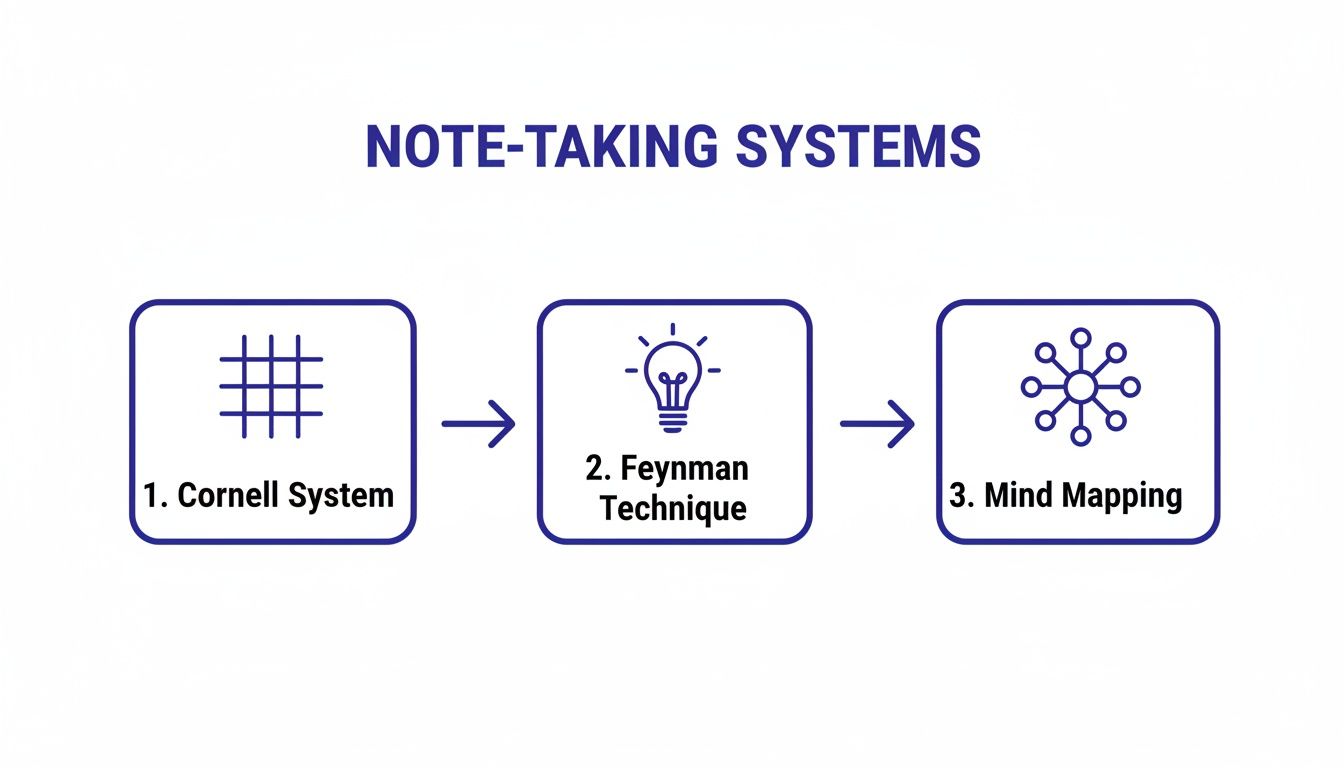
3. Mind Mapping and Visual Synthesis
Mind mapping moves beyond linear note-taking, transforming reading into a creative and analytical process of visual synthesis. Popularized by Tony Buzan in the 1960s, this active reading technique uses a non-linear diagram to capture relationships between concepts. By placing a central idea at the core and branching out into related themes, you create a spatial representation of the text’s knowledge architecture. This taps into your brain’s visual processing centers, which are evolutionarily older and more powerful than those for verbal processing.
This method forces your brain to identify connections and hierarchies rather than just transcribing information. The act of drawing links between ideas activates multiple cognitive functions, enhancing both comprehension and memory recall. It is especially powerful for complex, non-fiction material where understanding the interplay between different concepts is crucial for true mastery.
How It Works: A Radiating Structure
Mind mapping follows a simple yet profound structure that mirrors how our brains naturally associate ideas:
- Central Idea: Start with the book’s main theme or chapter title in the center of the page.
- Main Branches: Draw thick branches radiating from the center for each major topic or argument. Label each branch with a single keyword or short phrase.
- Sub-Branches: Add smaller, thinner branches extending from the main ones to capture supporting details, examples, or evidence.
- Keywords and Images: Use single words, short phrases, and simple icons to represent ideas. This keeps the map clean and encourages recall over simple recognition.
Real-World Application
Consider a productivity consultant reading The Power of Clarity to refine their deep work principles. After finishing a chapter, they place “Deep Work Principles” in the center of a large sheet of paper. They draw main branches for key concepts like “Focus Techniques,” “Environment Design,” and “Time-Blocking.” From the “Environment Design” branch, they add sub-branches for “Noise Canceling Headphones,” “Monitor Light Bar,” and “Phone Lock Box Timer.” This visual map not only summarizes the content but also creates a tangible framework they can use to coach clients, turning passive reading into an actionable professional tool.
4. The Feynman Technique (Teaching-to-Learn)
Instead of just consuming information, the Feynman Technique forces you to deeply understand it by explaining the concept in the simplest terms possible. This method, popularized by Nobel Prize-winning physicist Richard Feynman, transforms reading into an act of teaching. It operates on a simple premise: true understanding is demonstrated not by using complex jargon, but by translating intricate ideas into plain, accessible language.
This active reading technique is exceptionally powerful because it quickly reveals gaps in your knowledge. Neurologically, this process of active retrieval and simplification builds stronger neural pathways, making information more durable and easier to recall later. When you attempt to explain a topic and find yourself stumbling or reverting to the original text’s complex phrasing, you’ve pinpointed exactly where your comprehension is weak.
How It Works: A Four-Step Cycle
The technique guides you through a cycle of learning, explaining, and refining:
- Read & Study: Choose a concept from the material you’ve just read and write it at the top of a blank page.
- Explain Simply: Below the concept, write an explanation as if you were teaching it to a complete beginner. Avoid technical terms and use simple analogies.
- Identify Gaps: Review your explanation. Where did you get stuck? What parts were confusing or required you to look back at the source material? This is where your learning is incomplete.
- Refine & Simplify: Return to the original text to fill in your knowledge gaps. Then, refine your explanation until it is clear, concise, and easy to understand. To deepen your understanding and truly internalize complex subjects, explore how to apply the Feynman Technique.
Real-World Application
Imagine a remote worker reading a book on neuroscience-backed focus strategies, such as dopamine detox. After reading a chapter, they grab a productivity journal and attempt to explain the concept of “intermittent variable rewards” to a hypothetical colleague. They realize they can’t clearly articulate why unpredictable notifications are so addictive. This signals a knowledge gap. They return to the book, reread that section, and refine their explanation, perhaps creating a simple analogy about a slot machine. They have now moved from passive reading to genuine understanding.
5. Chunking and Segmented Reading
Instead of treating reading as an endurance marathon, chunking transforms it into a series of manageable sprints. This active reading technique involves breaking down texts into smaller, digestible segments based on time, chapters, or concepts. By distributing the cognitive load, you give your brain necessary recovery time, which is especially beneficial for professionals and students battling screen fatigue and information overload. This approach aligns with cognitive psychology principles, showing that our brains process and retain information more effectively in small, focused bursts.
This method directly combats the diminishing returns of long, unfocused reading sessions. Psychologically, it leverages the Zeigarnik effect — our tendency to remember uncompleted tasks — making you more likely to return to your reading. By setting clear boundaries for each session with a pomodoro timer, you create a sustainable rhythm that enhances both comprehension and concentration. The goal is to absorb information deeply within a short interval, rather than skim superficially over a long period.
How It Works: A Cycle of Focus and Rest
Chunking operates on a simple yet effective cycle of focused reading followed by a deliberate break. This prevents mental exhaustion and reinforces learning.
- Define Your Chunk: Decide on the size of your segment. This could be a set time (like 25 minutes, following the Pomodoro Technique), a specific number of pages, or a single chapter or section.
- Engage Fully: During your reading chunk, eliminate distractions and give the text your undivided attention. Your goal is deep engagement, not just covering ground.
- Pause and Process: When the chunk is complete, stop reading. Use the break to briefly summarize what you just read, stretch, or hydrate. Crucially, avoid turning to another screen.
- Repeat: Continue this cycle of reading and resting for as long as your schedule allows, ensuring each segment remains productive.
Real-World Application
Consider a remote worker trying to master new software from a dense technical manual. Instead of dedicating a whole Saturday to it, she uses chunking. She sets a visual timer for desk for 25 minutes each morning to read one specific section. After the timer goes off, she writes a single sentence summarizing the key function she learned in her journal. She then takes a five-minute break before starting her workday. By the end of the week, she has not only finished the manual but has also retained the information far better than she would have in a single cramming session, a strategy detailed in books like Focus Recharged. This segmented approach makes absorbing complex material feel effortless.
6. Critical Reading and Argumentative Analysis
Instead of passively accepting information, critical reading transforms you into an active evaluator of the author’s claims. This active reading technique involves dissecting an argument’s evidence, logic, and underlying assumptions. Rooted in academic philosophy and championed by thinkers like Carl Sagan, this approach is essential in an era of information overload. It activates the prefrontal cortex, the brain’s hub for executive functions like judgment and decision-making, helping you filter signal from noise.
This method moves beyond simple comprehension to a deeper level of analysis. It requires you to question what you read, identifying the core argument, assessing the quality of supporting evidence, and uncovering potential biases. By engaging with texts as a thoughtful skeptic rather than a passive consumer, you build a more robust and nuanced understanding of any topic. This is crucial when you need to make informed decisions based on what you learn.
How It Works: A Detective’s Approach
Critical reading encourages you to investigate the text by asking probing questions:
- Deconstruct the Argument: What is the author’s primary claim? What evidence do they provide to support it?
- Evaluate the Evidence: Is the evidence credible, relevant, and sufficient? Look for citations to peer-reviewed research or verifiable data.
- Uncover Assumptions: What unstated beliefs or assumptions does the author hold? Do these assumptions weaken or strengthen the argument?
- Identify What’s Missing: What information or alternative viewpoints are omitted? A one-sided argument may signal bias.
- Assess Logical Coherence: Does the conclusion logically follow from the evidence presented? Look for logical fallacies or inconsistencies.
Real-World Application
Imagine a manager reading a popular book on dopamine-detox strategies to combat digital burnout. Instead of blindly adopting the advice, they apply critical reading. For a claim like “Social media abstinence rewires your brain in 7 days,” they check for citations. They discover the book references anecdotal stories rather than peer-reviewed neuroscience. This critical analysis helps them separate evidence-based advice from marketing hype, allowing them to adopt strategies with more confidence, like using an ergonomic keyboard to reduce physical strain during work sessions. This investigative mindset is key if you want to learn how to train your brain to focus effectively and avoid ineffective fads.
7. Dialogical Reading (Conversation with Text)
Instead of passively accepting an author’s words, dialogical reading transforms the process into an active conversation. This powerful active reading technique involves engaging with the text as if you were in a direct discussion with the author. You ask questions, raise objections, note agreements, and connect ideas to your own life, creating a rich, dynamic intellectual exchange. This method, rooted in the work of thinkers like Mortimer Adler and Paulo Freire, deepens comprehension by making reading a participatory act.
From a psychological standpoint, this technique leverages “self-referencing,” where information is better remembered when it’s related to one’s own experiences and thoughts. By treating the text as a conversation partner, you actively construct meaning, challenge assumptions, and forge personal connections with the material. This cognitive engagement makes the content more memorable and relevant. It’s an ideal approach for anyone wanting to critically evaluate complex arguments.
How It Works: A Conversational Exchange
Dialogical reading is a fluid process of call and response between you and the text. The core steps involve:
- Questioning: Ask the author for clarification. Challenge their assumptions. Inquire about the implications of their ideas.
- Responding: Articulate your agreements, disagreements, and personal reflections directly in the margins or a separate journal.
- Connecting: Link the author’s points to your own experiences, other texts you’ve read, or broader concepts.
- Synthesizing: After reading, review your “conversation” to summarize how your perspective was shaped, challenged, or confirmed.
Real-World Application
Imagine a project manager reading a book on team productivity, like Burnout Interrupted. While reading a chapter on deep work, she might write in the margins, “This is a great ideal, but how does it apply to a reactive, client-facing role?” Later, when the author suggests turning off notifications, she might note, “Disagree. A better solution might be dedicated ‘focus blocks’ communicated in advance.” She could also connect the ideas to a past project’s success, writing, “This explains why our last launch was so smooth; we accidentally created a ‘deep work’ environment.” By actively dialoguing with the text, she co-creates a practical strategy tailored to her specific reality.
8. Guided Note-Taking and Structured Outlining
Rather than just passively highlighting, this method transforms reading into an act of knowledge architecture. Guided note-taking uses a systematic, hierarchical outline to mirror the text’s logical structure, creating a distilled reference document. This active reading technique forces you to identify main ideas, supporting details, and the relationships between them, converting raw information into organized, usable knowledge.
This approach is highly effective for professionals and students who need to master complex subjects and retain key information for future use. The act of structuring information engages the prefrontal cortex, enhancing your brain’s ability to organize and store memories efficiently. By building an outline, you are not just copying information; you are actively processing and structuring it. This process encodes the material more deeply, turning a fleeting read into a permanent mental framework.
How It Works: Deconstructing to Reconstruct
The core of this technique is to create a scaffold that reflects the author’s argument and then fill it in with key details. The process is iterative and focused on clarity:
- Identify the Core Structure: Start by noting the main sections or chapters as your top-level points (e.g., I, II, III).
- Capture Main Arguments: Under each main section, list the primary arguments or sub-topics as second-level points (e.g., A, B, C).
- Add Supporting Details: Flesh out each argument with crucial evidence, examples, or action steps as third-level points (e.g., 1, 2, 3).
- Use Action-Oriented Language: Frame sub-points with action words (e.g., “Implement time-blocking”) to make them more practical and memorable.
Real-World Application
Imagine a freelancer reading a guide on dopamine detox to combat digital burnout. She creates an outline: I. The Science of Dopamine (A. How notifications create loops, B. Impact on focus). II. Practical Detox Strategies (A. Schedule “tech-free” blocks, B. Use a phone lock box timer during deep work sessions). She includes personal examples, like noting her own habit of checking emails every ten minutes. This structured approach not only helps her understand the concepts but also produces an immediate, actionable plan. To refine this process further, you can explore detailed strategies on how to take notes from a book that align with this outlining method.
9. Immersive and Slow Reading
In a culture obsessed with speed and efficiency, Immersive and Slow Reading is a deliberate act of resistance. This active reading technique rejects skimming and multitasking, advocating instead for deep, unhurried engagement with a single text. Influenced by the Slow Living movement and championed by thinkers like Maryanne Wolf, this approach treats reading as a contemplative practice, fostering a richer, more profound connection with the material.
Neuroscientifically, slow reading allows for “cognitive uncoupling,” giving your brain the space to make novel connections and reflect on the text’s deeper implications. The core idea is to fully absorb content without the pressure of a deadline. By dedicating focused attention to one book or essay, you allow your brain to move beyond surface-level comprehension and engage in deeper critical thinking. This method is particularly effective for readers experiencing digital burnout who want to rediscover the joy of sustained focus.
How It Works: A Mindful Cycle
Slow reading isn’t about reading at a snail’s pace; it’s about reading at the speed of understanding. The cycle is fluid and prioritizes depth over volume:
- Select: Choose a single text and commit to it.
- Immerse: Create a distraction-free environment. Put away your phone, perhaps using a phone lock box timer to remove the temptation entirely.
- Savor: Read deliberately. Pay attention to language, structure, and the author’s tone. Perhaps wear blue light blocking glasses if reading in the evening.
- Pause & Reflect: Stop after a chapter or a key passage to contemplate the ideas. Don’t rush to the next section.
- Re-read: Return to sentences or paragraphs that resonate or feel complex. Understanding often deepens with repetition.
Real-World Application
Imagine a writer feeling overwhelmed by constant information. She decides to practice slow reading with one book for 30 minutes each day. She finds a quiet corner, uses her noise-canceling headphones, and reads from a physical copy to reduce screen fatigue. After each session, she jots down a few thoughts in her productivity journal. Instead of racing to finish the book, she allows herself to fully process each concept, leading to more meaningful insights that she can apply to her work habits. This intentional practice helps rebuild her attentional endurance. For anyone looking to cultivate this kind of deep focus, it is essential to learn how to improve focus while studying or reading.
10. Active Retrieval Practice and Spaced Review
Instead of passively re-reading, which often creates an illusion of mastery, active retrieval practice transforms learning into a dynamic, effortful process. This research-backed technique involves repeatedly testing yourself on material at increasing intervals. This method leverages two powerful cognitive principles: retrieval practice (the act of recalling information) and the spacing effect (reviewing information over time). Pioneered by Hermann Ebbinghaus’s work on the “forgetting curve” in the 1880s, this approach is designed to move knowledge from your fragile short-term memory to durable, long-term storage.
From a neuroscience perspective, forcing your brain to actively retrieve information strengthens the neural pathways associated with that knowledge, making it more accessible later. This is one of the most effective active reading techniques for busy professionals and students who need to build a lasting understanding of complex topics, not just cram for a single event. It shifts the focus from simply recognizing information to truly knowing it.
How It Works: A Cycle of Recall and Reinforcement
This technique is built on a simple yet powerful feedback loop:
- Create Retrieval Cues: While reading, create questions, flashcards, or practice problems based on the material. Focus on concepts, not just definitions.
- Actively Recall: Without looking at the source, try to answer your questions or explain the concepts from memory. This is the “retrieval practice” step.
- Check and Refine: Compare your recalled information with the source material to verify accuracy and identify knowledge gaps.
- Space Your Reviews: Schedule your next review session. Initial reviews might be daily, then weekly, then monthly. Digital tools can automate this schedule.
Real-World Application
Imagine an entrepreneur reading about AI productivity tools. During her reading session, she uses a productivity journal to create flashcards in a digital app like Anki. One card asks, “How can I apply the ‘prompt chaining’ technique to my weekly marketing report?” The next day, she quizzes herself. A week later, the app reminds her to review it again. By the time a month has passed, the concept is so ingrained that she’s applying it effortlessly. This system ensures that valuable insights are not forgotten after the initial reading. For anyone serious about making knowledge stick, it is crucial to understand how to retain what you read through these proven methods.
10 Active Reading Techniques — Side-by-Side Comparison
| Method | 🔄 Implementation complexity | ⚡ Resources & efficiency | ⭐ Expected outcomes | 📊 Ideal use cases | 💡 Key advantages / tips |
|---|---|---|---|---|---|
| Structured Multi-step Reading Frameworks (SQ3R & PQRST) | 🔄 Medium — five staged routine, requires discipline | ⚡ Moderate time upfront; minimal tech | ⭐⭐⭐⭐⭐ — strong long-term retention & comprehension | 📊 Dense, technical texts; professional reading & study | 💡 Purpose-driven reading; build question list and self-test after reading |
| Annotation and Margin Notes | 🔄 Low — simple actions during reading | ⚡ Low tools (pen/highlighters); quick to do per passage | ⭐⭐⭐⭐ — improves encoding and later retrieval | 📊 Active study, quick review, note-rich texts | 💡 Limit highlights (10–15%); write questions, not verbatim notes |
| Mind Mapping and Visual Synthesis | 🔄 Medium — non-linear, creative process | ⚡ Moderate to high time; analog or digital tools | ⭐⭐⭐⭐ — excellent for structure & connections | 📊 Organizing complex topics, brainstorming, synthesis | 💡 Start with 5–7 branches; photograph analog maps for storage |
| The Feynman Technique (Teaching-to-Learn) | 🔄 Medium — cyclic explain/identify/refine workflow | ⚡ Moderate time; requires paper/voice or listener | ⭐⭐⭐⭐⭐ — reveals gaps; deep conceptual mastery | 📊 Technical or abstract material, teaching, rapid upskilling | 💡 Explain in simple language; use hand-writing or voice memos |
| Chunking and Segmented Reading | 🔄 Low — simple scheduling habit | ⚡ Low tools (timer); high schedule compatibility | ⭐⭐⭐⭐ — reduces fatigue, improves sustained focus | 📊 Busy schedules, screen-fatigue, habit formation | 💡 Time-box 15–30 min; write one-sentence takeaway after each chunk |
| Critical Reading & Argumentative Analysis | 🔄 High — analytical, evidence-focused process | ⚡ Moderate–high time; requires background knowledge | ⭐⭐⭐⭐ — improves discernment and source evaluation | 📊 Evaluating claims, research, AI/productivity advice | 💡 Use Claim |
| Dialogical Reading (Conversation with Text) | 🔄 Medium — interactive, reflective practice | ⚡ Low tools (notes/margins); slower pacing | ⭐⭐⭐⭐ — increases personal relevance and insight | 📊 Reflective work, idea development, applied reading | 💡 Develop annotation symbols (*, !, ?, +); keep a separate dialogue log |
| Guided Note-Taking & Structured Outlining | 🔄 Medium — systematic outlining skill required | ⚡ Moderate time; note system or app helpful | ⭐⭐⭐⭐ — produces usable reference and quick retrieval | 📊 Preparing summaries, implementation plans, research notes | 💡 Keep 2–3 outline levels; add 1–2 concrete examples per point |
| Immersive and Slow Reading | 🔄 Low–Medium — requires time protection and habit | ⚡ Low tool needs; high calendar/time cost | ⭐⭐⭐⭐ — deep, nuanced understanding; contemplative gains | 📊 Philosophy, conceptual texts, restorative reading practice | 💡 Read one book at a time; prefer analog and re-read resonant passages |
| Active Retrieval Practice & Spaced Review | 🔄 Medium — setup and ongoing scheduling discipline | ⚡ Moderate tools (Anki/flashcards) and repeated time investment | ⭐⭐⭐⭐⭐ — gold standard for long-term retention | 📊 Long-term knowledge maintenance, exam prep, workplace recall | 💡 Create application-focused questions; automate spacing with SRS tools |
Editor’s Take
So, what really works? For most people, the biggest returns come from combining Annotation with Chunking. Simply reading for 25 minutes with a pen in hand is a low-effort habit that immediately boosts engagement. If you need to master a complex topic for the long haul, Active Retrieval Practice (using flashcards or self-quizzing) is non-negotiable; it’s the gold standard for durable learning.
Who is this for? These techniques are a game-changer for students, lifelong learners, and professionals who read to solve problems. However, if you’re reading fiction for relaxation, don’t feel pressured to turn it into a homework assignment.
Important Caveat: No technique can overcome a poor reading environment. Your first step should always be to minimize distractions. Put your phone away (a phone lock box timer can be a great help) and find a quiet space. Without focused attention, even the best strategies will fall flat.
Putting It All Together: Your Active Reading Toolkit
You’ve explored a comprehensive suite of ten powerful active reading techniques, moving from structured frameworks like SQ3R to dynamic methods like the Feynman Technique. We’ve dissected everything from the simple, profound act of annotating in the margins to the complex cognitive process of critical analysis. Each strategy is more than just a tip; it’s a tool designed to transform reading from a passive act of consumption into an engaging, dynamic dialogue with information. The goal isn’t just to get through a text, but to let the text get through to you, reshaping your understanding and embedding knowledge for the long term.
This journey from passive to active reading is a skill built through consistent, intentional practice. It’s a habit, and like any new habit, it requires a deliberate start. You don’t need to feel overwhelmed by the idea of implementing all ten techniques at once. The key is to start small and build momentum.
Your First Actionable Steps
Begin by choosing just one or two methods that resonate most with your current goals and learning style.
- For the time-crunched professional: Try ‘Chunking’ your reading into focused 25-minute sessions. Grab a simple pomodoro timer and dedicate distraction-free blocks to that dense report or industry journal.
- For the tactile learner or student: Start with ‘Annotation and Margin Notes’. Simply keeping a pen in hand as you read creates a physical connection to the text, encouraging you to question, highlight, and summarize as you go.
- For the visual thinker or creator: Experiment with ‘Mind Mapping’. After reading a chapter, spend ten minutes sketching out the core ideas and their connections. This visual synthesis can reveal patterns a linear outline might miss.
As you integrate these practices, perhaps using a dedicated habit tracker journal to track your sessions, you’ll notice a profound shift. The change isn’t just in what you remember, but in how you think. Information ceases to be static text on a page and becomes a dynamic resource for inquiry, connection, and creation. This is the very foundation of true learning, deep work, and intellectual clarity.
The Broader Impact: Beyond the Page
Mastering these active reading techniques is an investment that pays dividends far beyond comprehension scores. It’s a foundational skill for any knowledge worker, student, or entrepreneur in today’s information-saturated world. By learning to engage deeply with text, you are sharpening your ability to:
- Think Critically: You move from accepting information at face value to deconstructing arguments, identifying biases, and forming your own informed opinions.
- Solve Complex Problems: Active reading helps you synthesize diverse sources of information, connecting disparate ideas to innovate and find novel solutions.
- Communicate with Impact: By truly understanding a topic, as the Feynman Technique demonstrates, you can articulate your ideas with greater precision, confidence, and authority.
Ultimately, reading actively is an act of reclaiming your attention from a world designed to scatter it. It’s a deliberate choice to go deep when the culture pushes for shallow skimming. This disciplined focus is a cornerstone of productivity and mental well-being. For those seeking to build a life around such intentionality, exploring concepts in books like The Power of Clarity or Attention Unleashed can provide a broader framework for applying these principles to all areas of life. Reading becomes a powerful tool not just for learning, but for living a more focused and fulfilling life.
Key Takeaways
- Passive vs. Active Reading: Passive reading is simply scanning words. Active reading is a dynamic, engaged process that involves questioning, annotating, and summarizing to improve comprehension and retention.
- Start Simple: You don’t need to use all ten techniques at once. Begin by combining “Chunking” (reading in short, focused bursts) with “Annotation” (making notes in the margins) to immediately increase engagement.
- Match the Technique to the Task: Use structured frameworks like SQ3R for dense textbooks, the Feynman Technique for complex concepts you need to master, and Mind Mapping for synthesizing ideas.
- Environment is Crucial: No technique will work without a distraction-free environment. Prioritize dedicated time and space, and consider using tools like noise-canceling headphones or a phone lock box timer.
- Retention Requires Retrieval: To remember what you read long-term, you must practice active retrieval. Use flashcards or self-quizzing to force your brain to recall information, strengthening memory pathways.
- Reading is a Dialogue: The most effective active readers treat reading as a conversation. Question the author, connect ideas to your own life, and critically evaluate the arguments presented.
Disclaimer: This article is for educational purposes only and is not a substitute for professional medical or psychological advice, diagnosis, or treatment. Always seek the advice of your physician or other qualified health provider with any questions you may have regarding a medical condition. This post may contain affiliate links.
Ready to build a complete system for focus and intentional living? At Mind Clarity Hub, we provide the frameworks and tools you need to cut through the noise and do your best work. Explore our resources and books to transform these active reading techniques into a sustainable habit for lifelong learning and productivity. Discover more at Mind Clarity Hub.
Frequently Asked Questions About Active Reading Techniques
1. What is the main difference between active and passive reading?
Passive reading is like watching a movie—you absorb what’s presented without much effort, and often forget the details later. Active reading is like being a detective—you question, analyze, and connect clues (information) to build a deep understanding. It’s an engaged, two-way process.
2. I’m a busy professional. Which technique is the most time-efficient?
Chunking is your best friend. Breaking down your reading into focused 25-minute sessions (the Pomodoro Technique) with a pomodoro timer is highly efficient. Pair it with simple annotation to highlight key takeaways you can review later. This fits easily into a busy schedule.
3. Do these techniques work for digital reading on a tablet or computer?
Absolutely. All these techniques are adaptable. For digital texts, use PDF readers with annotation tools, dedicated note-taking apps, or digital mind-mapping software. Using a good laptop stand for desk and an ergonomic mouse can also reduce physical strain during long digital reading sessions.
4. Can active reading help with my short attention span?
Yes, it’s one of the best ways to rebuild your focus. Techniques like Chunking and Immersive Reading train your brain to stay on one task for a set period. By actively engaging with the material instead of just scanning, you give your brain a clear task, which naturally improves concentration.
5. How many active reading techniques should I use at once?
Start with one or two. A great starting pair is Annotation + Chunking. Once that becomes a habit, you can experiment with others like the Feynman Technique when you encounter a particularly difficult concept. Overloading yourself with too many new methods at once can be counterproductive.
How Can Active Reading Techniques Improve Memory?
6. How exactly do these methods improve my memory of what I’ve read?
Active reading techniques engage multiple cognitive processes. Annotation creates a physical connection (motor memory), mind mapping uses visual and spatial memory, and the Feynman Technique forces active recall. This multi-pronged approach creates stronger, more diverse neural pathways for the information, making it much easier to retrieve later.
7. Is re-reading a good active reading strategy?
Passive re-reading is not very effective because it creates a false sense of familiarity. However, active re-reading, where you return to a passage to answer a specific question or clarify a concept you noted as confusing, is highly effective. It should be purposeful, not mindless.
8. What is the single most powerful technique for long-term retention?
Research consistently points to Active Retrieval Practice (self-quizzing) combined with Spaced Review. Forcing your brain to pull information from memory, rather than just recognizing it, is the most powerful way to signal that this knowledge is important and should be stored for the long term.
9. Can I use these techniques for reading fiction?
While often used for non-fiction, they can enhance fiction reading too. You could create a mind map of characters and their relationships, annotate passages with beautiful language, or make notes about themes and foreshadowing. It can deepen your appreciation of the story.
10. What if I try these techniques and still can’t focus?
If you consistently struggle with focus, attention, or mood despite trying behavioral strategies, it’s important to consider other factors. Issues like burnout, anxiety, or ADHD can significantly impact concentration. This article is educational, not a substitute for medical advice. Please consult a qualified healthcare professional for personalized guidance.
Free download: 7-Day Mind Clarity Reset
A short daily reset you can actually stick with (no fluff).
Helpful resources for your next step
Affiliate disclosure: As an Amazon Associate, Mind Clarity Hub may earn from qualifying purchases at no extra cost to you. Use this link only if it genuinely helps your planning.
If 10 Powerful Active Reading Techniques to Deepen Focus in 2026 is a routine you want to keep using, a simple workbook, planner, or desk tool can make the steps easier to repeat.
Compare related planners, workbooks, and organization tools on Amazon.