
How to Recover from Burnout: A Science-Backed Guide

Published: December 14, 2025
Recovering from burnout isn’t a marathon you start running on day one. It begins with an immediate, intentional stop. The goal is to halt the cycle of exhaustion before you even think about rebuilding.
This first, crucial phase is about creating psychological distance from your stressors, prioritizing real rest over cheap distractions, and simplifying your world to lower your cognitive load. Think of it as triage for your nervous system—stabilize first, then heal. This approach is grounded in behavioral science, which shows that interrupting stress cycles is the essential first step toward recovery.
Your First 72 Hours of Burnout Recovery

When you finally hit the burnout wall, your nervous system is stuck in overdrive. From a neuroscience perspective, your brain’s prefrontal cortex—the part that handles decision-making, emotional control, and planning—is running on fumes. This is why even simple choices feel monumental and your gut instinct might be to just keep pushing through the fog.
Don’t.
The only goal for the next three days is to interrupt the momentum of depletion. You’re putting out the fire, not rebuilding the house. This initial period is all about creating a buffer between you and the demands that drained you, giving your mind and body the space to finally downshift.
For a quick-reference guide, the table below outlines the immediate, science-backed actions you can take to start stabilizing right now.
Immediate Burnout Stabilization Actions
This table provides a snapshot of the most effective first steps for burnout recovery, breaking down what to do, why it’s scientifically sound, and how it looks in the real world.
| Action | Why It Works (The Science) | Practical Example |
|---|---|---|
| Set a Protective “Out of Office” | Offloads the mental burden of incoming requests, signaling to your brain that it’s safe to disengage from work-related threats. | “Thank you for your message. I am out of office until [Date] with limited access to email. For urgent matters, please contact [Colleague].” |
| Delegate One Critical Task | Reduces immediate stress and cognitive load, providing an instant sense of relief and control by shrinking your mental to-do list. | Ask a coworker: “Could you please cover the 10 AM client check-in for me? I’d appreciate the help.” At home: “I don’t have the capacity to handle school drop-off this week, can you take it?” |
| Silence All Work Notifications | Lowers the constant state of hyper-vigilance by cutting off digital alerts that keep your stress-response system (the amygdala) activated. | Go into your phone’s settings and turn off all banners, sounds, and badge notifications for email, Slack, Teams, and any other work app. No exceptions for 72 hours. |
| Engage in Active Rest | Gentle, low-impact activities like walking in nature actively lower cortisol levels and engage the parasympathetic nervous system (the “rest and digest” state). | Take a slow, 20-minute walk without your phone. Notice the sounds, the air, the feeling of your feet on the ground. This isn’t exercise; it’s sensory engagement. |
| Simplify Your Environment | Reduces sensory input and decision fatigue, lowering the overall cognitive load on your already-depleted brain. | Tidy one small, chaotic space, like your nightstand or kitchen counter. Eat simple, pre-prepared meals (soup, salad, yogurt). Wear comfortable clothes that require no thought. |
These actions aren’t about long-term solutions; they are about immediate relief. They create the quiet space needed for the deeper work of recovery to begin.
Create Immediate Psychological Distance
Your first move is to send a clear signal to your brain: it’s safe to stand down. This means creating a hard boundary between you and your primary stressors, which for most of us is work.
- Set a protective “out of office” message. Don’t just flip the switch. Craft a message that actively manages expectations and protects your time off. This simple act of communication offloads the mental weight of worrying about what’s piling up.
- Delegate one critical task. Look at your to-do list and find the single most stressful item on it. Now, hand it off. Asking a coworker to cover a meeting or telling your partner you just can’t manage a certain chore provides an immediate sense of relief.
- Silence all notifications. This is non-negotiable. Research from institutions like the American Psychological Association confirms that constant digital pings keep our stress-response system on high alert. Turn off every work-related alert on your phone and computer. The silence is the point.
Prioritize True Rest Over Distraction
When you’re burned out, your brain craves the easy, high-dopamine hits from scrolling social media or binge-watching a show. While it feels like rest, it’s usually just a form of numbing that fails to replenish your cognitive batteries.
The key is to distinguish between passive consumption and active restoration. Scrolling social media can keep your brain in a state of agitated distraction, while a gentle walk in nature actively lowers cortisol levels and promotes recovery.
Instead of grabbing your phone, aim for activities that are genuinely restorative and require almost zero mental effort.
- Active Rest: This involves gentle activities that engage your body without taxing your mind. Think slow walks in a park, light stretching, listening to calming music without lyrics, or just sitting by a window watching the clouds.
- Passive Rest: This is about letting your mind go completely blank. Lie on the couch with your eyes closed (no pressure to sleep), take a warm bath, or just stare out a window. Many people feel mentally exhausted after doing nothing precisely because their “rest” is packed with digital noise, not true stillness.
Simplify Your Environment
Cognitive load is the total amount of mental work your brain is doing at any given moment. Burnout shrinks this capacity to almost nothing. To help your brain recover, you need to reduce the number of decisions you have to make and the amount of sensory information it has to process.
For the next 72 hours, make your world as simple as possible.
Eat simple meals. Wear comfortable clothes. Tidy one small space that feels chaotic. This isn’t about productivity. It’s about creating a calm, low-demand environment that gives your fried nervous system a chance to heal.
Identifying Your Personal Burnout Profile
Before you can create a recovery plan that actually works, you have to get clear on the specific flavor of burnout you’re experiencing. Think of it like a doctor diagnosing an illness before writing a prescription; a generic approach won’t get you very far. A targeted one will.
Burnout isn’t just one feeling—it’s a syndrome with distinct dimensions. Leading behavioral research, including foundational work by psychologists like Christina Maslach, consistently points to three core components. By figuring out which one is most prominent for you, you can focus your energy where it will make the biggest impact.
The Three Faces of Burnout
Burnout usually shows up as some combination of emotional exhaustion, cynicism, and a reduced sense of professional efficacy. While most people feel a bit of all three, one dimension often feels louder than the others.
See if you can recognize yourself here:
Emotional Exhaustion: This is the symptom most people know. It’s that profound, bone-deep tiredness that a good night’s sleep doesn’t seem to touch. Your emotional and physical batteries are completely drained, leaving you with nothing left for your job, your colleagues, or even your family at the end of the day.
Cynicism and Detachment (Depersonalization): This is the emotional distance you create to protect yourself. You start feeling negative, irritable, or overly critical about your work and the people involved. A creeping sense of detachment makes you feel like you’re just going through the motions, a disconnected observer of your own life.
Reduced Professional Efficacy: This is the nagging feeling that you’re just not good at your job anymore. You doubt your abilities, feel like your contributions don’t matter, and wrestle with a sense of failure. It’s especially damaging because it chips away at your professional identity and self-worth.
A quick note: This self-assessment is for educational purposes to help you gain clarity and is not a substitute for a professional diagnosis from a qualified healthcare provider. If your symptoms feel severe or persistent, please seek professional support, as burnout can co-occur with conditions like anxiety and depression.
What Does Your Burnout Look Like in Real Life?
Abstract definitions are one thing, but the daily reality of burnout is another. Let’s translate these ideas into real-world scenarios to help you pinpoint your primary struggle.
Scenario 1: Emotional Exhaustion
You’re a project manager who used to thrive on juggling deadlines. Now, the thought of opening your email in the morning fills you with a sense of dread. After work, you have zero energy for hobbies or seeing friends, often canceling plans just to lie on the couch. You might even find yourself getting tearful over small frustrations because your emotional reserves are just gone.
Scenario 2: Cynicism and Detachment
You work in a customer-facing role you once enjoyed. Lately, you find yourself using sarcastic humor when talking about clients with coworkers. You inwardly roll your eyes during team meetings and feel a growing resentment toward your manager’s “pep talks.” You’ve stopped joining team lunches, preferring to eat at your desk to avoid small talk. The passion is gone, replaced by a shield of indifference.
At its core, cynicism is a defense mechanism. When your work environment consistently demands more emotional energy than you have, your brain starts to disconnect to protect itself. This detachment can feel like a loss of your former self.
Scenario 3: Reduced Professional Efficacy
As a graphic designer, you used to be proud of your creative solutions. Now, you stare at a blank screen, convinced every idea you have is terrible. You second-guess every decision, spend hours on tasks that used to be simple, and feel a pang of imposter syndrome when you get positive feedback, thinking, “They just don’t know I’m faking it.” No matter how hard you work, you feel like you’re falling behind.
By identifying whether you are primarily exhausted, detached, or feeling ineffective, you can start to tailor your recovery. For a deeper look into the patterns that lead to these states, our guide on what happens when your burnout is interrupted offers further insights. Understanding the root cause is the first step toward reclaiming your well-being.
Rebuilding Your Foundation with Restorative Sleep

Let’s be blunt: you cannot recover from burnout without repaying your sleep debt. It’s a physiological impossibility. Chronic stress doesn’t just make you feel tired; it fundamentally disrupts your sleep architecture, making deep, restorative rest feel completely out of reach.
Here’s the science in simple terms: when you’re burned out, your body’s stress-response system is stuck in the “on” position. It floods your system with cortisol, the primary stress hormone, at all the wrong times.
High cortisol levels at night are the enemy of good sleep. They actively block your brain from dropping into the deep, slow-wave sleep cycles where the real physical and mental repair work happens. Your goal isn’t just more hours in bed, but more quality hours. This means intentionally creating the right conditions for your nervous system to finally downshift.
Why a Single Vacation Often Fails
So many of us pin our hopes on a week-long vacation to fix everything, only to come back feeling just as drained. A short break simply isn’t enough time to reset a chronically activated stress system.
A vacation might offer a temporary escape from the immediate stressors, but it doesn’t touch the underlying physiological disruption or the daily habits that got you here.
True, sustainable recovery comes from building restorative practices into your daily and weekly routines. In fact, comprehensive workplace data from sources like CignaGlobal.com shows that employees who take regular, fully unplugged breaks are significantly less likely to experience burnout symptoms. The takeaway is clear: consistent rest beats a frantic, one-off escape every time.
Designing a Cortisol-Lowering Wind-Down Routine
To get that deep, restorative sleep, you have to actively signal to your body that the day is over and it’s safe to power down. This calls for a deliberate “wind-down” routine that kicks off 60-90 minutes before you even think about getting into bed. The entire point is to systematically lower cortisol and quiet your mind.
Think of it as a sequence of calming, low-stimulation activities.
- Dim the Lights: Bright light—especially the blue light from screens—suppresses the production of melatonin, your natural sleep hormone. Lower the lights in your home, switch all your devices to “night mode,” or better yet, put them away completely.
- Lower Your Body Temperature: A slight drop in your core body temperature is a powerful biological trigger for sleep. A warm bath or shower about an hour before bed does this perfectly; as your body cools down afterward, you’ll start to feel naturally drowsy.
- Do a ‘Brain Dump’: A racing mind is one of the biggest sleep thieves. Spend ten minutes with a pen and paper and write down everything that’s swirling around in your head—worries, to-do lists, random thoughts. Getting it out of your brain and onto the page offloads the mental burden.
Burnout recovery hinges on shifting from a mindset of ‘crashing’ into bed to one of ‘landing’ gently. Your pre-sleep routine is the runway you build each night to ensure a smooth descent into deep rest.
Optimizing Your Sleep Environment for True Recovery
Your bedroom needs to be a sanctuary for sleep, not a multi-purpose extension of your office or living room. Every single element should support the goal of deep, uninterrupted rest.
Here are a few evidence-backed adjustments you can make tonight:
- Keep it Cool: The consensus from sleep research suggests a room temperature between 60-67°F (15-19°C) is ideal. A cooler room helps your body achieve the natural drop in temperature it needs to initiate and maintain sleep.
- Make it Dark: I mean really dark. Total darkness is crucial for optimal melatonin production. Invest in blackout curtains, cover or remove any electronics with glowing lights, and don’t underestimate the power of a comfortable sleep mask.
- Keep it Quiet: Unpredictable noises can easily pull you out of deep sleep, even if you don’t fully wake up. A good pair of earplugs or a white noise machine can create a consistent, peaceful soundscape that masks disruptions.
If you find that racing thoughts and anxiety are the main things keeping you awake night after night, you may need more targeted strategies. For a deeper dive, our guide to getting a restful night’s sleep despite anxiety can help. But these foundational sleep hygiene practices are the non-negotiable first step for anyone serious about how to recover from burnout.
Reconnect with Your Life Outside of Work
Burnout has a clever way of shrinking your world until your job title feels like your entire identity. Over time, the things that once brought you joy—hobbies, friendships, time to just be—get pushed to the margins. Eventually, only work and exhaustion remain.
This part of your recovery is all about intentionally rebuilding those lost connections. It’s not about adding more obligations to an already depleted schedule. Instead, it’s about rediscovering meaning and play outside the context of productivity, reminding your brain that your value isn’t tied to your output.
The Neuroscience of Play and Recovery
When you’re burned out, your brain’s reward system is running on empty. The neurotransmitter dopamine, which governs motivation and pleasure, becomes dysregulated from the constant stress and lack of reward, making it hard to feel excited about anything.
This is where “play” comes in. Engaging in activities done purely for their own sake, with no goal in mind, helps replenish this system. Neuroscientific studies show that intrinsically rewarding activities, whether it’s picking up a guitar or trying a new board game, can help build new neural pathways. This process restores a sense of agency and reminds your brain how to experience genuine satisfaction again.
The goal is to schedule moments of “unproductive” joy. This deliberate act is a powerful signal to your nervous system that it’s safe to disengage from the constant pressure to achieve.
Small Steps to Reclaim Your Identity
Rebuilding your life outside of work can feel daunting, so the key is to start small. Choose low-effort, high-reward activities that feel restorative, not draining.
Here are a few practical, low-pressure ideas to get you started:
- Reconnect with one person. Don’t try to revitalize your entire social life at once. Just send a simple text to one friend you trust, suggesting a low-key coffee or a walk. For example: “Hey, it’s been a while. Would you be free for a quiet coffee sometime next week? No pressure if not.” The aim is connection, not elaborate planning.
- Revisit a forgotten hobby for 15 minutes. Did you used to draw, play an instrument, or garden? Set a timer for just 15 minutes and dive in without any expectation of producing something great. The process is the point.
- Inject a dose of curiosity. Go to a library or bookstore and just browse a section you know nothing about. Listen to a podcast on a completely random topic. Curiosity is the antidote to the cynicism burnout breeds, and it helps re-engage the parts of your brain that have gone quiet.
Rebuilding Relationships and Social Support
Burnout almost always leads to isolation. When you’re emotionally and physically exhausted, the natural instinct is to withdraw. But strong social connections are one of the most significant protective factors against the long-term effects of chronic stress, according to a large body of psychological research.
Reaching out can feel like a monumental effort, but it’s a crucial part of recovery. If you’re struggling with feelings of detachment, you’re not alone. Our book offers a deeper look at the link between loneliness and well-being, providing actionable steps to help you feel connected again when relationships feel strained. Rebuilding this support network isn’t just a nice-to-have; it’s a vital part of learning how to recover from burnout for good.
How to Return to Work Without Relapsing
Stepping back into work after burnout isn’t about picking up where you left off. Think of it as starting a new job—one with a fresh set of rules designed to protect your well-being. Lasting recovery depends on changing the very conditions that burned you out, which means you have to become the number one advocate for your own sustainable pace.
This isn’t a plunge back into the deep end; it’s a phased, strategic return. Trying to just “be more resilient” is a surefire recipe for relapse. The real goal is to reshape your entire relationship with your work, your workload, and your workplace culture.
This timeline captures the essential mindset shifts. You’re moving from a state of pure exhaustion toward intentional engagement, using play, connection, and curiosity as your guides.
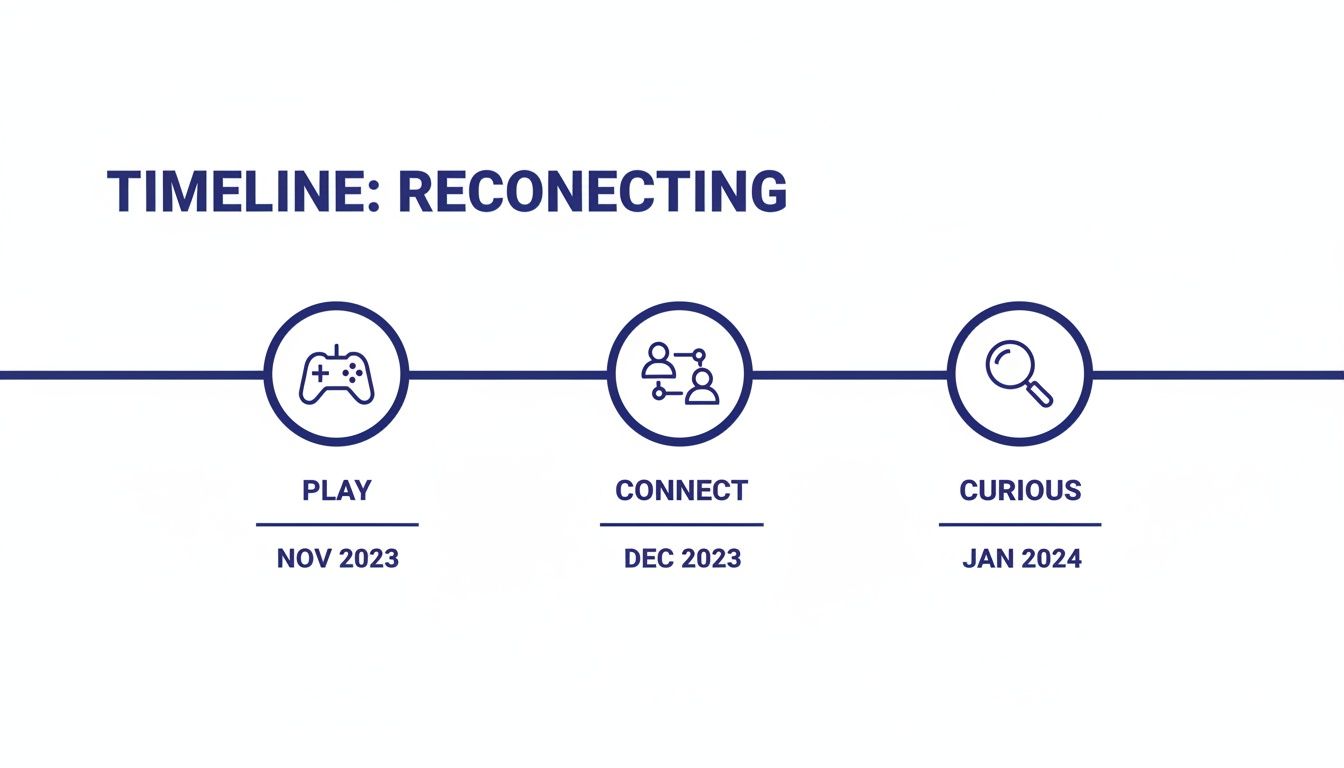
Think of this as a process, not an event. Reconnecting with yourself is the non-negotiable first step before you can re-engage with work in a healthy, sustainable way.
Get Brutally Honest About Your Core Workplace Stressors
Before you can build better defenses, you need to know exactly what you’re fighting. Burnout rarely comes from a single source. It’s usually a toxic cocktail of several factors brewing over time. Was it the sheer volume of tasks? The constant feeling of being undervalued? Or a total lack of control over your own projects?
Take a moment to pinpoint your specific triggers. Get granular.
- Excessive Workload: Were you consistently logging late nights or trying to juggle an impossible number of projects?
- Lack of Autonomy: Did you feel micromanaged into oblivion or powerless to make decisions about your own work?
- Values Mismatch: Did the company’s mission or the daily grind feel completely disconnected from what you actually care about?
- Unsupportive Environment: Was there a toxic lack of community, genuine recognition, or psychological safety?
Identifying these root causes is everything. If an unsustainable workload drove you to burnout, your recovery plan must center on workload management—no amount of mindfulness practice alone will fix that.
Set Sustainable Workplace Boundaries
This is where the real work begins. Boundaries are the guardrails that protect your time and energy. They aren’t about being difficult or uncooperative; they’re about being clear, predictable, and sustainable. For many of us, this is the hardest part of returning because it forces us to communicate our needs directly and hold the line, even when it feels uncomfortable.
A little preparation goes a long way. Having a few simple, polite scripts in your back pocket can feel much less confrontational than fumbling for the right words in a stressful moment.
Here’s a quick comparison of common burnout triggers and the boundaries you can set to counteract them.
| Burnout Trigger | Boundary to Set | Example Communication Script |
|---|---|---|
| “Urgent” after-hours emails and messages. | Protect your non-working hours by setting a clear communication cut-off time. | “I’ll be offline after 6 PM to recharge, but I’ll be sure to review this first thing in the morning with fresh eyes.” |
| Being pulled into every meeting and project. | Protect your focus by politely declining non-essential commitments. | “Thank you for thinking of me for this. My plate is full with my core priorities right now, so I’ll have to pass to ensure they get the attention they need.” |
| Unrealistic deadlines and scope creep. | Protect your workload by clarifying expectations and negotiating timelines upfront. | “I can definitely get that done. To do it well, I’ll need to shift the deadline for Project X to Friday. Does that work for you?” |
Consistently setting these boundaries helps repair your executive function, which often takes a serious hit during burnout. For a deeper dive into rebuilding your brain’s management system, our step-by-step guide to executive function repair for overwhelmed adults offers more targeted strategies.
Strategically Manage Your Workload and Energy
Once you’re back, you simply cannot operate at the same pace or with the same habits as before. Your brain and body won’t allow it. You need a system—a filter—for deciding where your limited energy goes. One of the most effective frameworks is the “Four D’s.”
It forces you to be ruthless and intentional with your to-do list:
- Delete: What tasks are on your list out of habit but are actually unnecessary? Example: That weekly status report that no one actually reads.
- Delegate: What can you hand off to someone else who is better suited for the task? Example: Ask a junior team member to pull the initial data for a report.
- Defer: What can be postponed to a later, less critical time without causing problems? Example: Move that “nice-to-have” brainstorming session to next quarter.
- Do: What truly requires your direct and immediate attention? Example: Prepare for the major client presentation that’s two days away.
This method prevents that slow, insidious creep of overwhelm that leads straight back to burnout. It’s a proactive defense, not a reactive scramble. This is especially critical because real recovery takes time. Clinical and workplace studies show it often requires weeks or months, not just a long weekend.
A common recovery window involves 4–12 weeks of a reduced workload or formal leave. Why? Because research shows that returning too quickly without making significant adjustments dramatically increases the risk of relapse.
By structuring your day around your energy—hitting complex tasks when you’re sharp and saving routine stuff for lulls—you create a sustainable rhythm. This isn’t a temporary fix. It’s how you learn to manage your workload for the long haul.
When to Seek Professional Support
While this guide offers a framework for recovery, self-help strategies can only take you so far. Sometimes, you need to bring in a professional. Knowing when to make that call is a crucial part of taking care of yourself.
If feelings of exhaustion, cynicism, or hopelessness have been stuck on a loop for weeks despite your best efforts, it’s probably time to talk to someone. The same goes if your symptoms are starting to seriously strain your relationships or make it hard to just get through the day.
How a Therapist Can Help
Therapies like Cognitive Behavioral Therapy (CBT) are incredibly effective for burnout. A good therapist can help you spot and reframe the thought patterns that keep the burnout cycle going—things like perfectionism or all-or-nothing thinking. It’s a confidential space to build real resilience and develop coping skills that actually fit your life.
Don’t forget to check in with a medical doctor, too. They can rule out underlying health issues like thyroid problems or vitamin deficiencies, which often masquerade as burnout.
Ultimately, the best approach is a layered one. Research from reputable sources consistently shows that combining therapy with practical changes at work and a strong support system gives you the best shot at a lasting recovery.
Disclaimer: This article is for informational purposes only and is not a substitute for professional medical advice, diagnosis, or treatment. Always seek the advice of your physician or another qualified health provider with any questions you may have regarding a medical condition.
FAQs: Your Questions About Burnout Recovery Answered
If you’re wondering how to recover from burnout, you’re not alone. The path isn’t always clear, and it’s normal to have questions. Here are some straightforward answers based on behavioral research and psychology.
How Long Does Burnout Recovery Take?
There’s no magic number. Recovery depends on the severity of the burnout and the changes you’re able to implement. It’s a process of weeks or months, not days. Some psychological studies point to an initial window of 4–12 weeks of reduced workload for meaningful improvement to even begin. Rushing back into the same environment that burned you out is a recipe for relapse. Patience is non-negotiable.
What Is the First Step I Should Take?
The single most critical first step is to create psychological distance from your primary stressors. This isn’t about solving everything at once. It’s about stopping the cycle of depletion. Take a deliberate break, even if it’s just for 72 hours. During this initial pause, your only job is to simplify:
- Disconnect completely. Turn off all work notifications. No exceptions.
- Rest deeply. Prioritize restorative sleep and low-effort activities.
- Reduce cognitive load. Minimize decisions, chores, and mental clutter.
This initial break isn’t about fixing the problem; it’s about creating the mental and physical space you need for the real work of recovery to begin.
Can I Recover from Burnout While Still Working?
Yes, but it demands serious, non-negotiable changes to your work habits and environment. If taking extended time off isn’t an option, your recovery hinges on aggressively protecting your energy while you’re on the clock. This means you have to get serious about:
- Setting firm boundaries around your work hours and sticking to them.
- Strategically managing your workload with a system like the “Four D’s” (Delete, Delegate, Defer, Do).
- Scheduling non-negotiable micro-breaks throughout the day to decompress.
Recovering while you’re still working is almost always a slower path. It requires constant vigilance to avoid slipping back into old patterns. This isn’t just about enduring your job; it’s about fundamentally changing your relationship with it.
Ready to build a more resilient and focused life? The books at Mind Clarity Hub offer science-backed, step-by-step guides to help you overcome burnout, reclaim your attention, and create sustainable productivity systems. Explore the full library of guides on Mind Clarity Hub.
Explore the Mind Clarity Hub Library
Practical books on focus, digital habits, resilience, and building a calmer mind.
The Power of Clarity
Unlock mental focus, build momentum, and create the life you were meant to live.
View book →
AI & ChatGPT for Beginners
No PhD needed — a 2025 guide to AI, prompts, and productivity without coding.
View book →
Zen in the Digital Jungle
Mindfulness for a chaotic world.
View book →
The Slow Reset
Mindful living in a fast-paced world.
View book →
Perfectly Imperfect
Stop self-criticism, set boundaries, and embrace the real you.
View book →
Reclaiming Silence
A dopamine detox guide to finding peace in a noisy world.
View book →
The Focused Freelancer
Productivity, pricing & positioning for independents in 2025.
View book →
ChatGPT Side Hustle System
Launch your AI-driven online business in 30 days.
View book →
Burnout, Interrupted
A proven path to restore energy and reclaim your life.
View book →
Attention Unleashed
Focus strategies for the distracted mind.
View book →
Side Hustle Launchpad
Your quick-start guide to extra income.
View book →
Digital Clarity
Rewire your brain, escape dopamine traps & regain focus.
View book →
Break the Scroll
Reduce screen time and take back control of your life.
View book →
Climate Compassion
Transform eco-anxiety into empowered action.
View book →
Village Mentality
The power of community for mental wellness.
View book →
Restful Nights
Overcoming sleep anxiety in a 24/7 world.
View book →
Connected Again
Combat loneliness and build meaningful relationships.
View book →
Focus Recharged
Mastering attention and productivity in the digital era.
View book →
Marketing Magic with ChatGPT
AI-powered content, campaigns, and copywriting to grow faster.
View book →
The 6-Figure Creator
Turn knowledge into passive income with books, courses & AI.
View book →
Burnout Breakthrough
Reset your work-life balance and thrive in 2025.
View book →
The Emotionally Intelligent Man
A modern guide to self-awareness and communication.
View book →
AI Personalized Wellness
Create your custom health plan with data-driven habits.
View book →
Everyday AI Made Easy
Use ChatGPT and smart tools to simplify life.
View book →
Money Mindfulness
A financial wellness guide for Gen Z & Millennials.
View book →
Startup Smarter with AI
ChatGPT strategies and tools to grow your business.
View book →
ChatGPT for Writers & Creators
Unlock AI-powered brainstorming, drafting & editing.
View book →