


Published:
Getting better at solving problems isn’t about grinding harder—it’s about thinking smarter. It’s a deliberate process of breaking down challenges, seeing around corners, and actually learning from what happens. This guide gives you a practical, no-fluff program for improving problem solving skills for good.
(Note: This article contains affiliate links. If you purchase a product through one of these links, we may earn a small commission at no extra cost to you. This content is for educational purposes only and is not a substitute for professional medical or psychological advice.)
Why Improving Your Problem-Solving Skills Matters More Than Ever
Ever feel like you’re just staring at a project that’s gone completely sideways? A dozen priorities are screaming for your attention, some unexpected tech glitch just blew up your workflow, and the deadline is breathing down your neck. Your brain gets stuck in a loop, replaying the same bad ideas until you’re completely overwhelmed.
That feeling is often a sign of cognitive overload, and it’s precisely where strong problem-solving skills make all the difference. In today’s messy, fast-moving world of work, the ability to dissect a problem and map out a real solution isn’t a “soft skill” anymore. It’s a core survival tool. It’s what separates reactive stress from proactive progress.

The Real-World Cost of Underdeveloped Skills
Let’s be clear: weak problem-solving isn’t just some abstract career limiter. It has tangible, measurable costs. Research from the OECD shows a direct link between adaptive problem-solving and income, with higher proficiency tied to a 7% increase in hourly wages and better odds of staying in the workforce.
But it’s not just about landing a better job or navigating huge crises. It’s about handling the daily grind with less friction:
- Decoding a client’s vague feedback without sinking into an endless cycle of revisions.
- Fixing a recurring bug at its root instead of just slapping on another temporary patch.
- Navigating a team conflict so people can actually get back to working together.
Without a solid process, we default to our worst cognitive habits. Neuroscience explains that when we’re stressed, the brain’s emotional center (the amygdala) can override the logical, reasoning part (the prefrontal cortex). This triggers what’s known as “solution-jumping”—we grab the first, easiest answer we can think of, not the best one.
(This article is for educational purposes and is not a substitute for professional medical or psychological advice, diagnosis, or treatment. If you are experiencing symptoms of burnout, anxiety, or other mental health concerns, please consult a qualified healthcare provider.)
You Can Systematically Build This Skill
Here’s the good news: problem-solving isn’t some innate talent reserved for a lucky few. It’s a skill, like learning an instrument or a new language. You can train it. By practicing specific mental frameworks and building the right habits, you can literally rewire how your brain approaches a challenge.
This guide isn’t about fuzzy advice like “think outside the box.” We’re giving you a step-by-step program—from honest self-assessment and targeted micro-drills to advanced cognitive strategies. It’s built for busy professionals who need methods that work, not just theories that sound good.
Assess Your Current Approach to Solving Problems
Before you can build stronger problem-solving skills, you need a clear, honest picture of where you’re starting. Think of it like a fitness assessment before a new training plan—without a baseline, you can’t track your progress or focus your energy where it actually counts. This isn’t about some formal quiz; it’s about candid self-reflection.
When a surprise problem lands on your desk and throws your day off course, what’s your first instinct? Do you dive in headfirst, trying solutions on the fly? Or do you take a beat to figure out what’s really going on? Your gut reaction reveals a lot about your default problem-solving style.

Solution-Jumping vs. Problem-Framing
Many of us are conditioned to be “solution-jumpers.” It’s a cognitive shortcut where the brain, desperate to resolve uncertainty, grabs the first plausible fix it finds. It feels productive in the moment, but it’s a trap. This habit often leads to patching up symptoms instead of addressing the root cause, all but guaranteeing the problem will pop up again later.
In sharp contrast, problem-framing is the deliberate practice of defining the issue before you even think about solutions. It means asking clarifying questions, gathering context, and resisting that powerful urge for a quick fix. This more methodical approach is a cornerstone of strong executive function—the mental command center that governs how we plan, focus, and execute complex tasks.
If you feel like this is a constant battle, our guide on how to repair executive function offers deeper, more targeted strategies.
A well-defined problem is a half-solved problem. Rushing this step is like trying to build a house on a shaky foundation—the effort you save upfront will cost you much more down the road.
A Real-World Scenario Uncovering Blind Spots
Consider a project manager, Sarah, who noticed her team kept missing deadlines for a specific type of task. Her immediate, solution-jumping reaction was to blame the project management software and start researching expensive alternatives. It was a classic case of aiming for a fast, visible fix.
But then she paused to assess her own approach. Instead of assuming the tool was the problem, she started framing the issue by asking herself a few sharp questions:
- Is this happening with the whole team, or just a few people?
- Does the delay occur at a specific point in our workflow?
- Have I been crystal clear about the dependencies for this task?
Through this self-assessment, Sarah found the bottleneck. It wasn’t the software at all; it was an ambiguous handoff step between the design and development phases. Team members were making different assumptions, which led to rework and delays. Her blind spot was assuming the process was clear to everyone just because it was clear to her. By framing the problem correctly, she implemented a simple handoff checklist. The issue was solved without spending a dime on new software.
Identify Your Problem-Solving Style
So, how do you typically react when things go sideways? Your habits, your mood, and even your stress levels can dictate your approach. This table isn’t a test, but a mirror. Use it to reflect on your common patterns and see where your default style might be holding you back.
| Common Situation | Reactive Approach (Impulsive) | Structured Approach (Mindful) |
|---|---|---|
| Facing a vague request | Immediately starts working on what you think is needed. | Asks clarifying questions to define the scope and goal first. |
| An initial solution fails | Feels frustrated and tries a slightly different version of the same idea. | Pauses to analyze why it failed before formulating a new hypothesis. |
| Under pressure | Jumps at the first, easiest fix to relieve the immediate stress. | Takes a moment to breathe and map out the core components of the problem. |
| A complex problem emerges | Feels overwhelmed and avoids the issue, focusing on smaller, easier tasks. | Breaks the large problem down into smaller, more manageable sub-problems. |
Looking at these patterns, do you see yourself leaning one way or the other? Recognizing whether your default is reactive or structured is the essential first step. It shines a light on the specific habits you need to build for more effective, reliable problem-solving.
Mastering Core Cognitive Strategies for Improving Problem Solving Skills
Once you get a feel for your default problem-solving habits, you can start upgrading your mental toolkit. This isn’t about finding a single “magic bullet” technique. It’s about mastering a few powerful cognitive strategies—mental models that shift how you see a problem in the first place.
Think of them as different lenses you can look through. Each one reveals a unique angle of a challenge, helping you move past the obvious, surface-level fixes to find more robust, fundamental solutions. These aren’t just abstract theories; they are practical frameworks you can actively use.
And these skills are surprisingly rare. Data from the OECD’s PISA 2012 assessment revealed that, on average, just 11% of 15-year-old students across 44 countries were top performers in problem-solving. This points to a huge gap between basic troubleshooting and the kind of adaptive thinking needed for complex modern challenges. You can check out more insights from this global skills assessment on the OECD website.
Use First Principles Thinking to Deconstruct Problems
One of the most powerful ways to cut through complexity is First Principles Thinking. The idea is to break a problem down into its most basic, undeniable truths—the “first principles”—and then build your solution up from there. Instead of relying on assumptions or what’s always been done, you reason from the ground up.
This approach forces you to question everything. Your prefrontal cortex, the brain’s hub for logical reasoning, is brilliant at this kind of deconstruction when you give it the time and space to work. For a deeper look at specific methods, it’s worth exploring these essential structured problem-solving techniques.
Scenario: The Freelance Web Designer
A freelance designer gets a vague but common request from a client: “We need a new, modern website.”
- Conventional Approach: The designer immediately starts looking at trendy website templates and creating mockups based on current design fads.
- First Principles Approach: The designer hits pause and asks fundamental questions:
- What is the absolute core purpose of this website? Is it for lead generation? E-commerce sales? An information hub?
- Who is the end-user, and what is the single most important action we want them to take?
- Stripped of all jargon, what are the essential elements required to get them to take that action?
By reasoning from these first principles, the designer’s focus shifts from just a “modern look” to building a site that serves the client’s foundational business goals. The result is a far more effective final product.
Anticipate Consequences with Second-Order Thinking
While First Principles breaks a problem down, Second-Order Thinking builds it back up by exploring what happens next. It’s the simple practice of thinking beyond the immediate result of a decision. First-order thinking is quick and easy (“This will solve our immediate problem”). Second-order thinking is deeper: “And then what will happen? And what will be the consequence of that?”
This mental model helps you spot unintended consequences and avoid creating new problems down the line. It’s a critical skill for any kind of strategic decision. Sustaining this level of forward-thinking takes real mental energy, which is why our guide on improving focus and concentration can be a valuable resource for building that cognitive stamina.
Second-order thinking is the voice in your head that asks, “And then what?” It separates good decision-makers from great ones by forcing a disciplined look at the chain reaction of effects over time.
Scenario: The Software Team Lead
A team lead is tempted to use a “quick and dirty” code patch to meet a tight deadline for a new feature.
- First-Order Thinking: “This patch will fix the bug and let us ship on time. The client will be happy.”
- Second-Order Thinking: The lead forces themself to ask, “And then what?”
- The patch introduces “technical debt,” making future updates slower and more difficult.
- The team might get used to taking shortcuts, lowering overall code quality.
- If the patch causes another bug after the launch, it will damage the client’s trust far more than a slight delay ever would.
Recognizing these long-term consequences, the lead decides to negotiate a one-day deadline extension to implement a proper, stable fix.
Work Backward with Inversion
Sometimes the clearest path forward is found by looking backward. Inversion is a powerful mental model where you start by identifying the outcome you want to avoid, and then work backward to figure out what you need to do to prevent it from happening. Instead of asking, “How can I achieve success?” you ask, “What could cause this to fail completely?”
This little psychological trick helps you sidestep cognitive biases like over-optimism. By focusing on potential failures, you proactively spot risks, weaknesses, and blind spots you might otherwise miss.
Scenario: The Marketing Manager
A manager is planning a major product launch campaign.
- Conventional Approach: The manager focuses on all the things that need to go right: “We need great ad copy, a smooth website experience, and positive press coverage.”
- Inversion Approach: The manager convenes the team for a “pre-mortem” and poses the question: “Imagine it’s six months from now and this launch was a total disaster. What went wrong?”
- Team members might suggest failures like: “Our key messaging was confusing,” “The website crashed from all the traffic,” or “A competitor launched a similar product a week before us and stole our thunder.”
By identifying these potential failure points upfront, the team can create specific contingency plans—like stress-testing the website or refining the messaging—to prevent those exact disasters from happening.
- Team members might suggest failures like: “Our key messaging was confusing,” “The website crashed from all the traffic,” or “A competitor launched a similar product a week before us and stole our thunder.”
Building Your Practice Routine for Improving Problem Solving Skills
Knowing the cognitive strategies is one thing, but building real skill happens in the trenches. It comes from consistent, deliberate practice. Just like strengthening a muscle, you can’t improve your problem-solving abilities without a dedicated routine. The goal is to move these mental models from a state of conscious, clunky effort to an automatic, intuitive habit.
This isn’t just a metaphor; you’re literally creating new neural pathways. When you consistently practice a specific way of thinking, your brain strengthens the synaptic connections involved. This process, known as neuroplasticity, makes that thought pattern faster and more efficient over time. This is the heart of habit formation—turning intentional action into second nature.
This diagram shows a simplified flow for how you might apply these powerful cognitive strategies in a practice session.
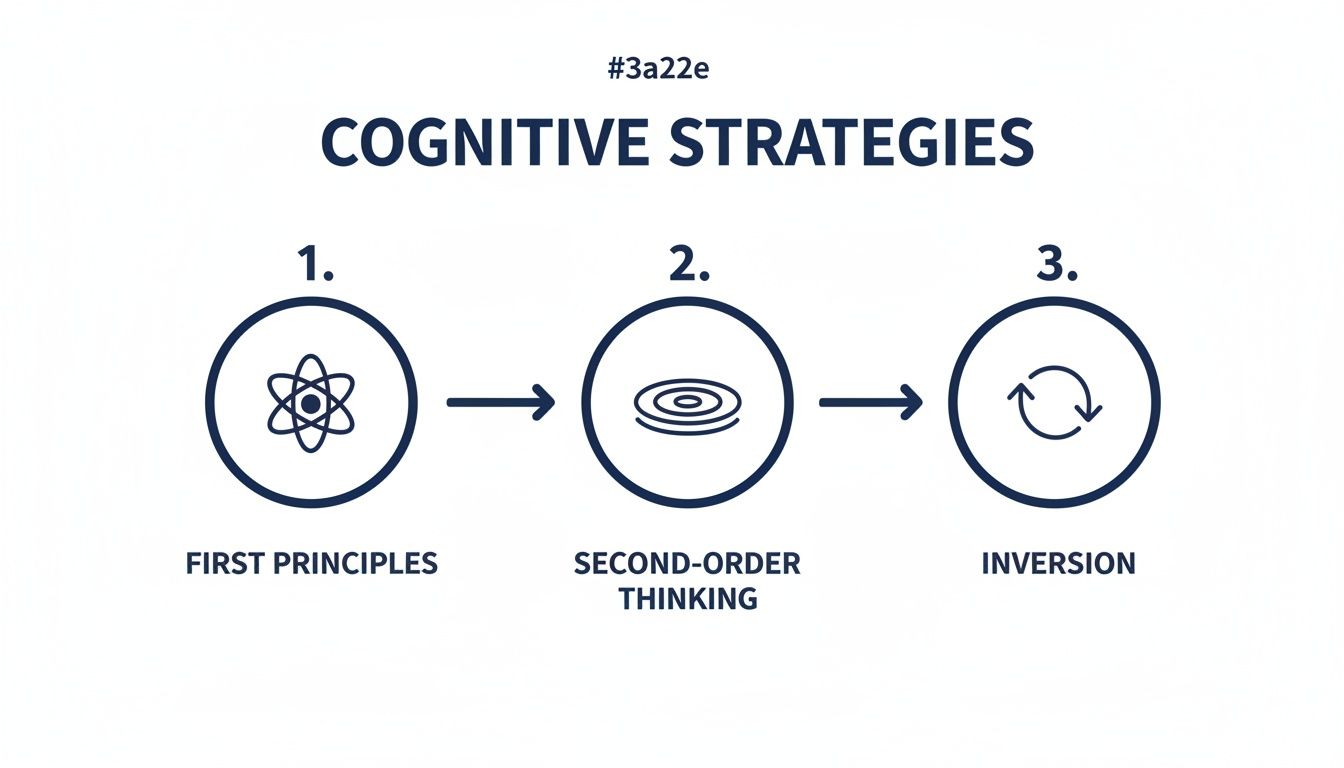
It’s a great visual reminder of the process: start by breaking a problem down to its core truths (First Principles), then explore the long-term ripple effects of potential solutions (Second-Order Thinking), and finally, spot risks by imagining what could go wrong (Inversion).
Design Your Practice Sessions
An effective routine isn’t about grinding for hours. It’s about a smart balance of short, focused exercises and longer, more immersive sessions. This variety keeps your practice engaging and targets different aspects of your cognitive function.
- Micro-Practice Drills (5-10 minutes): These are quick, targeted exercises designed to fit into a busy day. Think of them as mental push-ups. The goal here is pure repetition and reinforcement of a single skill. For example, grab a common workplace problem—like an unclear email request—and spend just five minutes deconstructing it using First Principles. That’s it.
- Deep Work Sessions (45-minute blocks): This is your dedicated, uninterrupted time for a complex problem. The time constraint is actually a feature, not a bug—it forces you to focus intensely and push your cognitive limits. Aiming for one deep work session a week is a fantastic way to build mental endurance.
The key is consistency, not intensity. A daily 10-minute drill is far more effective for long-term skill development than one heroic, three-hour session once a month.
Manage Your Brain’s Chemistry for Better Focus
Your ability to sink into deep problem-solving is heavily influenced by your brain’s neurochemical state, especially dopamine. Our modern digital lives often flood our brains with cheap dopamine hits from notifications, social media feeds, and constant context-switching.
Behavioral research shows this endless stimulation trains your brain to crave novelty and distraction. That makes it incredibly difficult to sustain the prolonged focus needed for deep work. It’s not just about productivity; managing your screen time is about protecting your very capacity for clear, methodical thought.
Actionable Tip: Schedule your deep work sessions before you check emails or social media. This saves your prefrontal cortex’s finite daily resources for high-value thinking instead of draining them on reactive, low-value tasks first thing in the morning.
Use AI as a Sparring Partner, Not a Shortcut
AI tools like ChatGPT can be incredible for practice, but only if you use them correctly. The goal is to scaffold your thinking, not to outsource it. It’s tempting to ask for the answer, but that builds zero skill.
Instead, treat AI like a collaborator to push your own thinking further:
- Generate Scenarios: “Act as a project manager. Give me a complex scenario where a software launch is behind schedule due to an unexpected technical issue.”
- Critique Your Solutions: “Here is my proposed solution to that scenario. What are three potential flaws or unintended consequences of this approach?”
- Deepen Your Analysis: “Help me apply Second-Order Thinking to this decision. What are the likely ripple effects in one month? Six months? One year?”
This approach forces you to articulate your thought process and defend your logic, which is where the real learning happens.
Sample Weekly Practice Schedule
A structured plan helps turn good intentions into real action. Here’s a simple template you can adapt to your own schedule and goals. Keeping a dedicated notebook for these exercises can also be a game-changer; you can find great options in our guide to the best journals for productivity.
| Day | Focus Activity | Duration | Goal |
|---|---|---|---|
| Monday | First Principles Drill | 10 min | Deconstruct a recent work email or request into its fundamental truths. |
| Tuesday | Inversion Practice | 15 min | Take an upcoming project and brainstorm all the ways it could fail. |
| Wednesday | Deep Work Session | 45 min | Tackle a significant, non-urgent problem using your chosen strategies. |
| Thursday | Second-Order Drill | 10 min | Analyze a recent decision you made and map out its potential future consequences. |
| Friday | AI Sparring Session | 20 min | Use an AI tool to generate a new scenario and critique your response. |
This blend of micro-drills and deep work creates a balanced routine that builds skill without causing burnout. It makes improving your problem-solving skills a sustainable, lifelong habit.
From Analysis to Action With Decision Frameworks
All the analysis in the world is useless until it leads to a decision. This is where problem-solving stops being a thought exercise and starts creating real-world change. To make that leap without getting stuck, you need a few battle-tested decision frameworks to guide you from insight to action.
Without a good model, it’s incredibly easy to fall into analysis paralysis. This isn’t a character flaw; it’s a known cognitive state where too many options overwhelm your brain’s executive functions. Your prefrontal cortex gets stuck in a loop, endlessly weighing variables without ever landing on a conclusion. Decision frameworks act as a filter, helping you cut through the noise.
This skill is rarer than you might think. OECD data reveals that only 5% of adults reach the highest level of adaptive problem-solving—the very skill needed for smart decisions under pressure. Meanwhile, nearly a third struggle with multi-step tasks, showing a clear need for frameworks to guide action. You can see more on these adult problem-solving skills on OECD.org.
First, Separate the Urgent from the Important
Not all problems are created equal. The Eisenhower Matrix is a brilliantly simple tool for figuring out what truly deserves your immediate attention. It forces you to sort tasks into four quadrants based on just two criteria: urgency and importance.
- Urgent & Important: Do these first, and do them now.
- Important, Not Urgent: Schedule these. This is where strategic progress happens.
- Urgent, Not Important: Delegate these if you can. They’re often other people’s priorities.
- Neither Urgent Nor Important: Eliminate these. They’re just distractions.
Scenario: An office manager is swamped. The printer is jammed (urgent, not important), a major quarterly budget report is due next week (important, not urgent), and a coworker just asked for help with a minor spreadsheet formula (urgent, not important). Using the matrix, the manager asks the coworker to wait, calls IT for the printer, and carves out dedicated time to work on the crucial budget report. This prevents the immediate but low-value tasks from derailing strategic work.
Making Smart Calls in Fast-Moving Situations
For problems that are constantly changing, the OODA Loop is an invaluable mental model. Developed by military strategist John Boyd, it’s a four-stage cycle for making decisions in fluid environments: Observe, Orient, Decide, and Act.
The OODA Loop isn’t a linear checklist but a rapid, iterative cycle. The person or team who can cycle through it fastest—observing new information, reorienting their understanding, and acting decisively—gains a significant strategic advantage.
Imagine a small coffee shop owner who notices a new competitor opening across the street with a big marketing splash. Instead of panicking, she pauses and studies what they’re doing—what’s on their menu, how they’re pricing things, and who they seem to be targeting.
Pretty quickly, she sees the pattern: they’re pushing sugary, high-margin drinks and trying to win people with hype and discounts. Her shop, on the other hand, has a reputation for high-quality, single-origin coffee and customers who actually care about taste.
So she makes a clear decision: she’s not going to fight a price war she doesn’t need. She’s going to lean harder into what makes her different. Then she takes action by launching a “Coffee Connoisseur’s Club,” with tasting nights and simple educational workshops that turn casual customers into loyal regulars.
The result is that she doesn’t just survive the new competition—she sidesteps it. By moving through her OODA loop faster and with better judgment, she responds in a way the competitor didn’t anticipate, and she strengthens her position instead of weakening it.
Clarifying Who Does What in Team Decisions
When a decision involves multiple people, ambiguity is the enemy. The RAPID framework is designed to eliminate confusion by clarifying exactly who has which role, preventing stalemates and ensuring someone is accountable.
- Recommend: The person who proposes a course of action.
- Agree: Stakeholders who must sign off on the recommendation.
- Perform: The team that will actually implement the decision.
- Input: People who are consulted for information and expertise.
- Decide: The single person with the final authority to say “yes” or “no.”
For a visual way to map out more complex choices, using a good decision tree template can provide a clear strategic guide.
Turn Every Outcome into a Lesson
Finally, getting better at problem-solving means learning from your choices—both the good and the bad. After a decision is made and the outcome is clear, take a few minutes to conduct a brief error analysis.
This isn’t about beating yourself up. It’s about taking an honest look at what worked and what didn’t. Ask yourself what you overlooked, which assumptions didn’t hold up, and what you’d change if you had to do it again. The point is to learn from the outcome and use those lessons to make the next attempt smarter.
This simple habit, rooted in behavioral psychology principles of feedback loops, transforms every decision into a lesson for the next challenge. As you get more comfortable with this, you might explore our guide on how to use AI for productivity to help analyze data and outcomes more efficiently.
Editor’s Take: The Truth About Improving Problem-Solving Skills
Let’s cut right to it: you can’t read your way to becoming a great problem-solver. No amount of passively consuming articles on mental models will sharpen your thinking. Real, lasting improvement comes from one place and one place only: consistent, deliberate practice. The frameworks in this guide are powerful, but only if you get your hands dirty.
Who is this advice best for? This approach is for professionals, students, and entrepreneurs who are ready to lean into the cognitive friction that real growth requires. It’s for people who understand that quick fixes are usually just temporary patches.
What are the limitations? The biggest barrier isn’t a lack of information; it’s the mental static and stress that kicks in the moment you face a problem without an obvious solution. These techniques are less effective when you’re burned out or overwhelmed. Managing your well-being isn’t optional; it’s a prerequisite for clear thinking. The path to mastery is measured in months of consistent effort, not days of cramming.
Frequently Asked Questions About Improving Problem-Solving Skills
Here are answers to common questions about sharpening your problem-solving abilities.
1. How long does it take to see real improvement in problem-solving skills?
You can notice small shifts, like pausing before reacting, within a few weeks of consistent practice. However, making these structured approaches your default way of thinking under pressure typically takes several months of dedicated effort.
2. Can I use these techniques for personal problems, too?
Absolutely. Mental models like First Principles Thinking, Second-Order Thinking, and Inversion are universal. They are just as effective for untangling a personal finance issue or navigating a family conflict as they are for a complex work project.
3. What is the single biggest mistake people make?
Solution-jumping. It’s the powerful, instinctual urge to grab the first plausible fix without truly understanding the root cause of the problem. This habit leads to treating symptoms instead of the underlying issue, ensuring the problem will return.
4. How can I practice if my job is repetitive?
Even in a structured role, you can create practice scenarios. Run “what-if” drills: “What if our primary software failed for a full day? What’s our backup plan?” You can also apply these analytical skills to non-work challenges, like planning a vacation or optimizing a fitness routine.
5. Are there any specific apps or tools that help with problem-solving skills?
While no app can do the work for you, some can support your practice. Mind-mapping tools like Miro or XMind help visualize complex problems. Brain-training apps like Luminosity can sharpen analytical thinking, and AI assistants like ChatGPT are excellent for generating practice scenarios.
6. What’s the difference between critical thinking and problem-solving?
Think of critical thinking as the analysis phase. It’s the skill of questioning assumptions, identifying biases, and evaluating evidence. Problem-solving is the entire process that includes critical thinking, but also involves defining the problem, generating solutions, deciding on a course of action, and implementing it.
7. What should I do when a problem feels completely overwhelming?
When you feel overwhelmed, your brain’s emotional centers are overriding its logical ones. The best first step is to disengage to calm your nervous system. Take a short walk, do a few minutes of deep breathing, or write down your worries. Return to the problem only when you feel more grounded.
8. Is it better to solve problems alone or in a group?
It depends on the problem. For highly technical issues where one person has deep expertise, solving it alone can be faster. For complex, ambiguous problems that require diverse perspectives, a collaborative group approach is almost always superior.
9. How can I start teaching these problem-solving skills to my team?
Lead by example. Use the language of these frameworks in meetings. When breaking down a problem, verbalize your thought process. Introduce a “pre-mortem” exercise (a form of Inversion) before your next big project. Insist on a clear, agreed-upon problem definition before anyone suggests solutions.
10. What role does creativity play in logical problem-solving?
Creativity is essential. Logic and structured thinking help you dissect a problem into its core components. Creativity is what allows you to see novel connections between those components and generate innovative solutions that aren’t immediately obvious. The best problem-solvers masterfully blend both.
(Disclaimer: This article contains affiliate links. If you purchase a product, we may earn a small commission at no extra cost to you. The content provided is for educational purposes only and is not a substitute for professional medical or psychological advice. Always consult a qualified professional for personal health concerns.)
Ready to stop feeling overwhelmed and start solving problems with confidence? The books from Mind Clarity Hub offer science-backed, step-by-step guides to help you build focus, manage your attention, and think more clearly. Explore the full library and find the right guide for you at mindclarityhub.com.
Explore the Mind Clarity Hub Library
Practical books on focus, digital habits, resilience, and building a calmer mind.
The Power of Clarity
Unlock mental focus, build momentum, and create the life you were meant to live.
View book →
AI & ChatGPT for Beginners
No PhD needed — a 2025 guide to AI, prompts, and productivity without coding.
View book →
Zen in the Digital Jungle
Mindfulness for a chaotic world.
View book →
The Slow Reset
Mindful living in a fast-paced world.
View book →
Perfectly Imperfect
Stop self-criticism, set boundaries, and embrace the real you.
View book →
Reclaiming Silence
A dopamine detox guide to finding peace in a noisy world.
View book →
The Focused Freelancer
Productivity, pricing & positioning for independents in 2025.
View book →
ChatGPT Side Hustle System
Launch your AI-driven online business in 30 days.
View book →
Burnout, Interrupted
A proven path to restore energy and reclaim your life.
View book →
Attention Unleashed
Focus strategies for the distracted mind.
View book →
Side Hustle Launchpad
Your quick-start guide to extra income.
View book →
Digital Clarity
Rewire your brain, escape dopamine traps & regain focus.
View book →
Break the Scroll
Reduce screen time and take back control of your life.
View book →
Climate Compassion
Transform eco-anxiety into empowered action.
View book →
Village Mentality
The power of community for mental wellness.
View book →
Restful Nights
Overcoming sleep anxiety in a 24/7 world.
View book →
Connected Again
Combat loneliness and build meaningful relationships.
View book →
Focus Recharged
Mastering attention and productivity in the digital era.
View book →
Marketing Magic with ChatGPT
AI-powered content, campaigns, and copywriting to grow faster.
View book →
The 6-Figure Creator
Turn knowledge into passive income with books, courses & AI.
View book →
Burnout Breakthrough
Reset your work-life balance and thrive in 2025.
View book →
The Emotionally Intelligent Man
A modern guide to self-awareness and communication.
View book →
AI Personalized Wellness
Create your custom health plan with data-driven habits.
View book →
Everyday AI Made Easy
Use ChatGPT and smart tools to simplify life.
View book →
Money Mindfulness
A financial wellness guide for Gen Z & Millennials.
View book →
Startup Smarter with AI
ChatGPT strategies and tools to grow your business.
View book →
ChatGPT for Writers & Creators
Unlock AI-powered brainstorming, drafting & editing.
View book →