

Improving your focus at work isn’t about brute-force willpower; it’s a strategic battle against constant interruptions. To win, you first have to understand what distractions truly cost you. They’re far more expensive than just a few lost seconds. Grounded in neuroscience and behavioral psychology, the real key to reclaiming your productivity is building smarter systems to manage and protect your attention.
Affiliate Disclosure: Please note that this article may contain affiliate links. If you make a purchase through these links, we may earn a small commission at no extra cost to you. This helps support our work in bringing you high-quality, research-backed content.
The Hidden Costs of Workplace Distraction
If you feel like you’re struggling to concentrate at work, you’re not alone. The modern office—whether physical or virtual—is practically engineered to break our focus. A relentless stream of pings from Slack, an endless flow of emails, and a calendar packed with notifications create a state of what experts call continuous partial attention.
This isn’t a personal failing. It’s a systemic problem, an “attention tax” levied on us all day long.
Every time you switch from a primary task—like drafting a report—to check a notification, your brain engages in context switching. From a neuroscience perspective, this is a heavy lift. Your prefrontal cortex, which handles complex goals, has to dump one entire set of information and load a completely new one. This mental gear-shifting burns a surprising amount of cognitive energy.
Why Small Interruptions Cause Big Problems for Focus at Work
Let’s make this real. Imagine a project manager, Sarah, trying to finalize a quarterly budget. A Slack message pops up asking for a quick link. She finds it and sends it off—a task that takes maybe 30 seconds.
But what happens next is the real problem. Her brain now has to disengage from the chat, re-engage with the complex spreadsheet, recall her previous train of thought, and find her exact place again. This mental reset is where the true cost of distraction lies.
This is one of the biggest drains on our focus. Research from the University of California, Irvine, found that after a single disruption, it takes an average of 23 minutes and 15 seconds to get back to the same level of concentration you had before.
Think about that. Just five of those “quick” interruptions can quietly erase nearly two hours of your most productive time.
This diagram really drives the point home, showing the staggering recovery time needed after just one interruption.
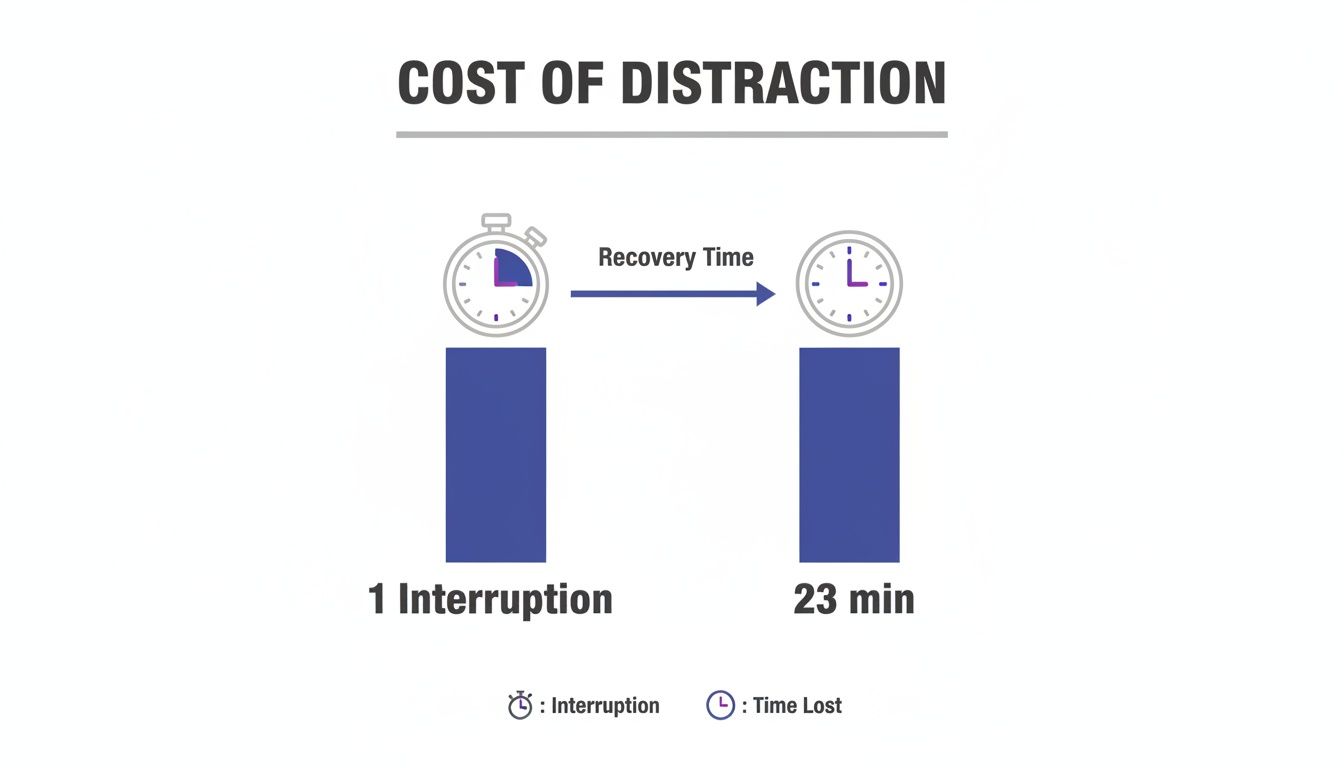
The data makes it crystal clear: the issue isn’t the interruption itself, but the long, cognitively expensive runway your brain needs to get back on track.
The Accumulating Debt of Distraction
These brief interruptions add up throughout the day, creating a kind of productivity debt that leaves you feeling drained and perpetually behind. Your brain simply isn’t built for rapid, continuous task-switching. When you overload it, the result is mental fatigue, more errors in your work, and that frustrating feeling of being busy but not actually productive.
Let’s look at how quickly this debt accumulates over a typical work week.
The Daily Cost of Common Workplace Distractions
This table illustrates the cumulative time lost to typical interruptions, highlighting how small distractions add up to significant productivity losses over a week.
| Distraction Source | Typical Occurrences per Day | Time to Refocus per Interruption | Total Focus Time Lost per Week |
|---|---|---|---|
| Email Notifications | 10 | 23 minutes | 19.2 hours |
| Slack/Team Messages | 8 | 23 minutes | 15.3 hours |
| “Quick Question” Tap | 3 | 23 minutes | 5.75 hours |
| Phone Alerts | 5 | 23 minutes | 9.6 hours |
The numbers are sobering. Even a conservative estimate shows how dozens of hours can evaporate each week, not to the distractions themselves, but to the recovery time between them.
The constant digital noise doesn’t just steal time; it fragments our attention, making deep, meaningful work nearly impossible. Learning how to improve focus at work means building a fortress around your attention.
Understanding this ‘attention tax’ is the first, most crucial step. The solution isn’t to just “try harder.” Instead, you have to build intentional systems and routines to shield your mind from the relentless pull of digital distractions—a concept that ties directly into the hidden costs of screen time we’ve explored before.
Build Your Foundation with Daily Focus Routines
Your ability to focus isn’t just about raw willpower—it’s about building a reliable structure. Think of it like an athlete warming up before a game. You can prime your brain for deep concentration by creating intentional routines that bookend your workday.
These small, repeated actions signal to your brain when it’s time to engage and, just as importantly, when it’s time to disconnect. This isn’t just a “hack.” It’s grounded in how our brains form habits. Consistent routines carve out neural pathways that make focus feel more automatic and less draining, a psychological principle known as automaticity.

Prime Your Brain for Focus with a Morning Ritual
How you start your morning sets the trajectory for the rest of your day. For most people, that means immediately checking emails or scrolling social media. This habit instantly puts your brain into a reactive, scattered state, flooding it with other people’s priorities before you’ve even had a chance to consider your own.
A much better approach is to kick things off with a brief, proactive ritual. The goal here is to activate your prefrontal cortex—the part of the brain that handles planning and decision-making—before the digital noise takes over.
A Simple 5-Minute Focus Planner
Instead of diving into your inbox, take the first five minutes of your workday to answer three questions in a notebook:
- What is the single most important task I need to complete today? This forces clarity and gives you a definite target.
- What potential distractions might get in my way? Acknowledging them upfront makes you more resilient when they pop up.
- When will I schedule time for deep work on my main task? This turns a vague intention into a concrete plan.
This tiny exercise is like a cognitive warm-up, shifting your brain from reactive to intentional. You can find more ideas for a powerful start to your day in these morning rituals for focus.
Disconnect and Recharge with a Shutdown Routine
Ever find yourself still chewing on work problems long after you’ve logged off? That lingering anxiety is a real phenomenon known as the Zeigarnik effect, where our brains get stuck on unfinished tasks. An end-of-day shutdown routine is the perfect way to “close those cognitive loops.”
This isn’t about working longer; it’s about giving your brain a clear signal that the workday is officially over. By tidying up your mental workspace, you stop work stress from bleeding into your personal time, which is critical for preventing burnout.
A consistent shutdown ritual does more than just organize tomorrow’s tasks. It gives your mind permission to fully disconnect, which is essential for memory consolidation and creative problem-solving that happens during rest.
Real-World Scenario: A Freelance Designer’s Shutdown Routine
Maria, a freelance graphic designer, used to feel like she was “always on.” She’d be thinking about client revisions during dinner and wake up at 3 a.m. worrying about a deadline.
She decided to implement a strict 15-minute shutdown ritual to reclaim her evenings:
- Review and Plan: She spends five minutes looking over what she finished and lists the top three priorities for the next day. This way, she knows exactly where to start in the morning.
- Final Check: She does one last, quick scan of her email and Slack for anything urgent, then closes both apps completely for the day.
- Physical Cue: Finally, she tidies her physical desk and says out loud, “Work is done.” This combination of a physical and verbal cue powerfully reinforces the transition.
By creating this clear boundary, Maria effectively closed the loops that kept her mind racing. She sleeps better and returns to her desk feeling refreshed and ready to focus, proving how these simple habits can dramatically improve focus at work.
Engineer Your Environment to Eliminate Distractions
Your internal routines are the engine for focus, but your external environment is the track it runs on. If that track is littered with obstacles, even the most powerful engine will stall out. To truly get a handle on how to improve focus at work, you have to deliberately shape your physical and digital spaces to support deep concentration.
This whole process is sometimes called attention architecture. The idea is simple: make it easy to do what you want to do (focus) and hard to do what you don’t want to do (get distracted). Our brains are incredibly responsive to environmental cues, so taking control of those cues gives you a massive advantage in the battle for your own attention.
Design Your Physical Workspace for Deep Work
Think of your desk as the cockpit for your workday. A space filled with visual clutter—piles of paper, random sticky notes, half-finished projects—sends a constant stream of low-level distracting signals to your brain. Each item represents an open loop or a potential task, all of which subtly drain your cognitive resources.
A clean, minimalist workspace, on the other hand, quiets those signals. It creates an environment where the only compelling thing to engage with is the task right in front of you. You don’t need a fancy office; you just need to be intentional.
Practical Steps for a Focus-Friendly Desk:
- Start with a clean slate. Remove everything from your desk except the absolute essentials: your monitor, keyboard, and mouse.
- Keep it to one thing at a time. Only have the tools and documents related to your current task within arm’s reach. Everything else should be stored away, out of sight.
- Use visual “go away” signs. A good pair of noise-canceling headphones is a universal symbol for “do not disturb.” They create a psychological barrier against interruptions, even if you aren’t listening to anything.
To really dial this in, it’s worth thinking about the overall best home office setup for productivity and focus, which gets into the nitty-gritty of ergonomics and lighting. The way your space is arranged can powerfully influence your mental state; you can learn more about how light, sound, and architecture affect cognitive performance in our detailed guide.
Tame Your Digital Environment to Improve Focus
Let’s be honest: your digital workspace is often far more chaotic than your physical one. Notifications, endless browser tabs, and tempting apps are literally designed to hijack your attention. The only real solution is to use technology against itself by creating a “distraction-free bubble.”
Most modern operating systems (like iOS, Android, Windows, and macOS) have powerful, built-in “Focus” or “Do Not Disturb” features. You can use them to create custom modes that block specific apps and notifications during scheduled work blocks. For even more firepower, apps like Freedom or Cold Turkey can block distracting websites across all your devices at once.
A well-configured Focus Mode isn’t about restriction; it’s about liberation. It frees your mind from the constant need to resist temptation, allowing that mental energy to be redirected toward meaningful work.
Implement a Practical Dopamine Detox During Work Hours
The term “dopamine detox” can sound a little extreme, but the core principle is incredibly practical for the workplace. It’s not about eliminating all pleasure. It’s about reducing your brain’s exposure to hyper-palatable digital stimuli—those quick, easy hits of dopamine you get from social media, news feeds, and games.
When your brain gets used to these constant, high-dopamine rewards, a challenging work task can feel boring and unappealing in comparison. By intentionally dialing back these stimuli during your work blocks, you start to recalibrate your brain’s reward system. This makes it much easier to find genuine satisfaction in deep, focused work.
Real-World Scenario: An Engineer’s Focus Bubble
Alex, a remote software engineer, was struggling with his morning focus. He kept finding himself checking tech news and personal email instead of digging into complex coding problems. He decided to create a two-hour “deep work bubble” from 9 AM to 11 AM every single day.
Here’s his system:
- Phone Configuration: He set up an automated “Work Focus” mode on his phone that kicks in at 9 AM. It silences all notifications except for calls from his wife and his boss. All social media and news app badges are hidden.
- Laptop Lockdown: He uses a simple browser extension to block Twitter, Reddit, and YouTube during his scheduled focus block.
- Physical Cues: He puts on his noise-canceling headphones and starts a “deep work” playlist of ambient music.
This simple, automated system removes the need for willpower. Alex doesn’t have to decide not to get distracted; his environment is already engineered to keep him on track. This makes it far easier to improve focus at work and get his most important tasks done first thing.
Master Deep Work Scheduling to Improve Focus at Work
Getting your environment right is a great defensive move. Now it’s time to go on offense.
Instead of just reacting to whatever your calendar throws at you, you need to learn how to command it. This is where you proactively schedule and fiercely protect your most valuable hours. It’s a total shift in how you approach productivity.

This proactive stance is so powerful because it puts you back in control. Global data shows that having control over when and how you work is directly tied to your mental health—and by extension, your ability to focus.
A 2023 survey found that 81% of workers who were satisfied with their level of control also rated their mental health as good or excellent. That number plummeted to just 44% for those who felt they lacked control. The connection is clear. You can dig into more of the data in the American Psychological Association’s report.
Implement Time Blocking and The Pomodoro Technique for Focus
Two of the most battle-tested methods for structuring deep work are time blocking and the Pomodoro Technique. A lot of people see them as separate, but they’re most effective when you combine them.
Time blocking is simply the act of scheduling specific blocks of time for specific tasks, right on your calendar. Instead of a vague to-do list you hope to get to, you have a concrete plan. This simple shift creates a powerful psychological commitment.
The Pomodoro Technique then gives you structure inside those blocks. You work in focused 25-minute sprints, separated by short 5-minute breaks. The method is brilliant because it works with your brain’s natural limits on attention and cognitive fatigue, not against them. Those little breaks are essential—they prevent burnout and help you maintain a high level of concentration over a much longer period.
Overcome Inertia with Task Bracketing
One of the biggest hurdles to deep work is just getting started. Big, complex projects feel so intimidating that we put them off. This is where a simple psychological trick called task bracketing can make all the difference.
Task bracketing means creating a clear “start” and “end” ritual for your deep work sessions. Think of it like a warm-up and cool-down for your brain. Just like a shutdown routine signals the end of your workday, a start-up ritual can slash the mental friction of diving into a hard task.
Your start-up ritual doesn’t need to be complex. It could be as simple as closing all unnecessary tabs, putting on your focus playlist, and reviewing your single goal for that block. This small routine signals to your brain: “It’s time to focus now.”
This technique works because it creates a defined container for your effort. You aren’t committing to finishing the whole massive project; you’re just committing to focusing for this one block. It’s an idea closely related to the concepts we explore in our guide on the neuroscience of single-tasking.
Align Your Schedule with Your Chronotype to Improve Focus
Here’s a hard truth: not all hours in the day are created equal. Your personal chronotype—your natural tendency to be a “morning lark” or a “night owl”—dictates your peak performance windows.
Scheduling your most cognitively demanding work during these peak times is an absolute game-changer for your focus.
- Morning Larks: You probably feel most alert and sharp from roughly 8 AM to 1 PM. This is your golden window for analytical work, writing, or complex problem-solving.
- Night Owls: You tend to hit your stride later, with peak focus often showing up from early afternoon into the evening. You might save your creative brainstorming or deep coding sessions for these hours.
Ignoring your chronotype is like trying to swim against the current—you can do it, but it’s exhausting. By identifying and respecting your natural energy rhythms, you make deep work feel less like a struggle and more like a state of natural flow.
Real-World Scenario: An Accountant’s Focus Block
Take David, an accountant who was constantly being pulled out of his complex analysis by meetings and “quick questions.” His output was tanking and his stress was through the roof. He decided to implement a strict time-blocking system that honored his chronotype.
As a morning person, he blocked off 9 AM to 11:30 AM every single day as “No-Interruption Analysis Time.” He declined all meetings during this window and set his Slack status to “Deep Work.” Inside this block, he used the Pomodoro Technique to stay on track.
The result? This proactive scheduling not only doubled his analysis output but also dramatically lowered that constant feeling of being overwhelmed.
Use AI as Your Focus Partner for Smarter Workflows
Beyond tweaking your environment and calendar, you can now use a powerful new ally to protect your attention. When used the right way, artificial intelligence can become an incredibly effective focus partner, taking on all those low-value, fragmented tasks that drain your cognitive energy.
The goal isn’t to replace your critical thinking. It’s to delegate the “shallow work” that quietly eats up your day. Think of it as outsourcing the mental clutter so you can save your brainpower for the creative, strategic, and deep work that actually moves the needle.

This approach helps solve a huge problem in modern work. When people aren’t sure what “good work” even looks like, they tend to scatter their attention across email, meetings, and busywork instead of locking in on high-impact tasks.
It’s no surprise that highly engaged teams—who usually have more clarity and better focus—see a 41% reduction in absenteeism and a 43% difference in turnover compared to their less-engaged peers, according to Gallup’s research. Those numbers point to better energy and commitment on the job, which is exactly what a smart AI workflow can support.
Offload Cognitive Drains with Specific AI Workflows
AI assistants are exceptionally good at handling the routine, repetitive, and time-sucking tasks that kill your momentum. By building a few simple AI-driven habits, you can reclaim hours each week and seriously improve focus at work.
Here are a few practical workflows you can start with today:
- Summarize long emails and meeting transcripts. Instead of wading through a dense 30-minute email chain, ask an AI tool to pull out the key takeaways and action items for you. It takes seconds.
- Draft routine communications. Use AI to generate first drafts for standard emails, project updates, or follow-ups. This totally beats the “blank page” problem and saves you from reinventing the wheel every single time.
- Conduct preliminary research. Ask an AI model to gather initial info on a topic, find relevant stats, or create a list of sources. It can handle the broad, time-sinking part of research, leaving you to do the actual analysis.
The key is to see AI not as another shiny object vying for your attention, but as a shield that protects it. By delegating the shallow, you create more space for the deep.
You can dive deeper into these strategies in our complete guide on how to use AI for productivity.
Set Clear Boundaries to Keep AI as an Ally
Of course, the biggest risk with any new tech is that it becomes just another distraction. To keep that from happening, you have to set clear boundaries.
Treat AI as a tool you command, not a constant companion. Schedule specific times to use it for specific tasks, just like you would for anything else on your calendar.
Real-World Scenario: A Marketer’s AI-Assisted Workflow
Jenna, a content marketer, used to spend the first few hours of her day staring at a blank document, trying to brainstorm social media captions and blog post ideas. It was a massive drain on her creative energy.
Now, she uses ChatGPT for 15 minutes each morning. She feeds it a topic and asks for ten potential blog headlines and five social media hooks. This simple step eliminates all that initial friction. With a solid list of ideas ready to go, she can jump straight into the creative work of writing and refining.
She saves hours of tedious groundwork and, more importantly, preserves her best focus for the tasks that truly demand her unique expertise.
Editor’s Note
Let’s cut through the noise. The most powerful approach isn’t some magic productivity hack, but a personalized system built around how you actually work.
What works is deeply personal. If you’re a manager drowning in back-to-back meetings, your biggest lever is mastering asynchronous communication to claw back some calendar space. But for a developer or creative, aggressively protecting two-hour deep work blocks is completely non-negotiable.
The common thread? Proactively designing your day instead of just reacting to whatever comes your way.
Consistency beats intensity every single time. Small, sustainable habits—like a five-minute morning planner or a non-negotiable shutdown ritual—build attentional fitness far more effectively than occasional, heroic efforts to focus.
Who This Advice Is Best For
This guidance is built for knowledge workers who feel like their attention is constantly under attack. If your job depends on your ability to think, create, or solve complex problems, these systems will help you protect the cognitive resources you need to do that work well.
But here’s the crucial caveat: these are systems for managing attention, not quick fixes or a substitute for professional care. If you are struggling with persistent issues like anxiety, burnout, or symptoms of ADHD, this article is for educational purposes only and is not a substitute for seeking help from a qualified medical or psychological professional. The goal here is sustainable focus, not perfect, machine-like productivity every single day.
For a deeper dive, these practical, energy-aligned tips to improve focus at work without burning out are a great next step.
Disclaimer: This article may contain affiliate links, which means we may earn a small commission if you make a purchase at no extra cost to you. This content is for informational and educational purposes only and is not a substitute for professional medical or psychological advice, diagnosis, or treatment.
FAQ: Your Questions on How to Improve Focus at Work
1. What is the single most effective way to improve focus at work?
The most effective strategy is “time blocking” combined with eliminating distractions. Proactively schedule blocks of uninterrupted time for your most important tasks and use tools to block notifications during those periods.
2. How can I improve my focus if I have an open-plan office?
In an open office, noise-canceling headphones are essential. They act as both a physical barrier to sound and a visual “do not disturb” sign. Also, find quiet corners or book small meeting rooms for short “focus sprints.”
3. Is multitasking really that bad for my concentration?
Yes. Neuroscience shows our brains don’t truly multitask; they “context switch” rapidly between tasks. This process is cognitively expensive, burns mental energy, and leads to more errors and less deep thinking.
4. How does sleep affect my ability to focus at work?
Sleep is critical. During sleep, your brain clears out metabolic waste and consolidates memories. A lack of quality sleep directly impairs the prefrontal cortex, which governs attention, decision-making, and impulse control.
5. Can diet and exercise really help me concentrate better?
Absolutely. Regular exercise boosts blood flow to the brain and releases neurotransmitters that improve mood and alertness. A diet low in processed sugar and high in omega-3s and antioxidants supports long-term brain health and cognitive function.
How to Stop Getting Distracted by Your Own Thoughts While Working
6. I get easily distracted by my own thoughts. What can I do?
This is very common. Keep a “distraction pad” (a simple notebook or text file) on your desk. When an unrelated thought pops up, quickly jot it down to deal with later. This “offloads” the thought from your working memory, freeing you to return to your task.
7. How do I stay focused when working from home with many distractions?
Create clear physical and temporal boundaries. Have a dedicated workspace, even if it’s just a corner of a room. Use a shutdown ritual to signal the end of the workday. Communicate your “focus hours” to family or roommates.
8. What is the Pomodoro Technique and why does it work?
It’s a time management method where you work in 25-minute focused intervals separated by 5-minute breaks. It works because it forces you to single-task, creates a sense of urgency, and provides regular breaks to prevent mental fatigue, aligning with the brain’s natural attention cycles.
9. Are focus-enhancing supplements effective?
The science on many supplements is mixed, and they are not a substitute for foundational habits like sleep, diet, and exercise. While some substances like caffeine are proven to enhance alertness, it’s crucial to consult a healthcare professional before starting any new supplement regimen. This article does not provide medical advice.
10. What should I do if my lack of focus is seriously impacting my job performance?
If your inability to focus is persistent and causing significant distress or impairment, it may be a symptom of an underlying condition like ADHD, anxiety, depression, or burnout. It is essential to speak with a doctor or mental health professional for a proper evaluation. This content is for educational purposes only and not a substitute for professional care.
Next Steps: Explore Mind Clarity Hub Books to Reclaim Your Focus and Build Lasting Attention
Ready to build a complete, science-backed system for reclaiming your attention? The strategies in this article are just the beginning. At Mind Clarity Hub, you can explore Jeremy Jarvis’s full library of books, including practical guides on deep work, dopamine detox, and AI-assisted workflows. Discover your next step toward a more focused and productive life.
Explore the books at Mind Clarity Hub
Explore the Mind Clarity Hub Library
Practical books on focus, digital habits, resilience, and building a calmer mind.
The Power of Clarity
Unlock mental focus, build momentum, and create the life you were meant to live.
View book →
AI & ChatGPT for Beginners
No PhD needed — a 2025 guide to AI, prompts, and productivity without coding.
View book →
Zen in the Digital Jungle
Mindfulness for a chaotic world.
View book →
The Slow Reset
Mindful living in a fast-paced world.
View book →
Perfectly Imperfect
Stop self-criticism, set boundaries, and embrace the real you.
View book →
Reclaiming Silence
A dopamine detox guide to finding peace in a noisy world.
View book →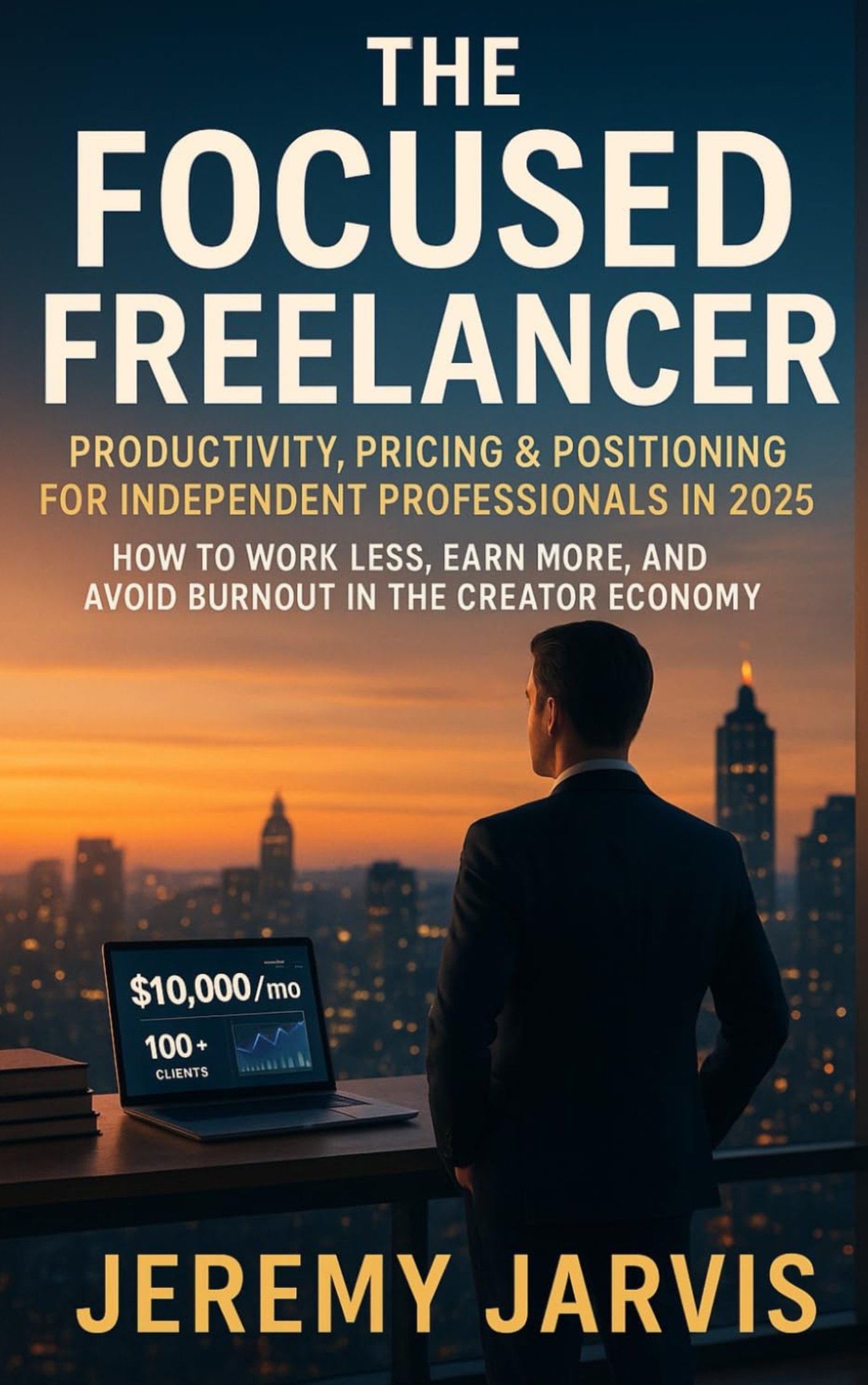
The Focused Freelancer
Productivity, pricing & positioning for independents in 2025.
View book →
ChatGPT Side Hustle System
Launch your AI-driven online business in 30 days.
View book →
Burnout, Interrupted
A proven path to restore energy and reclaim your life.
View book →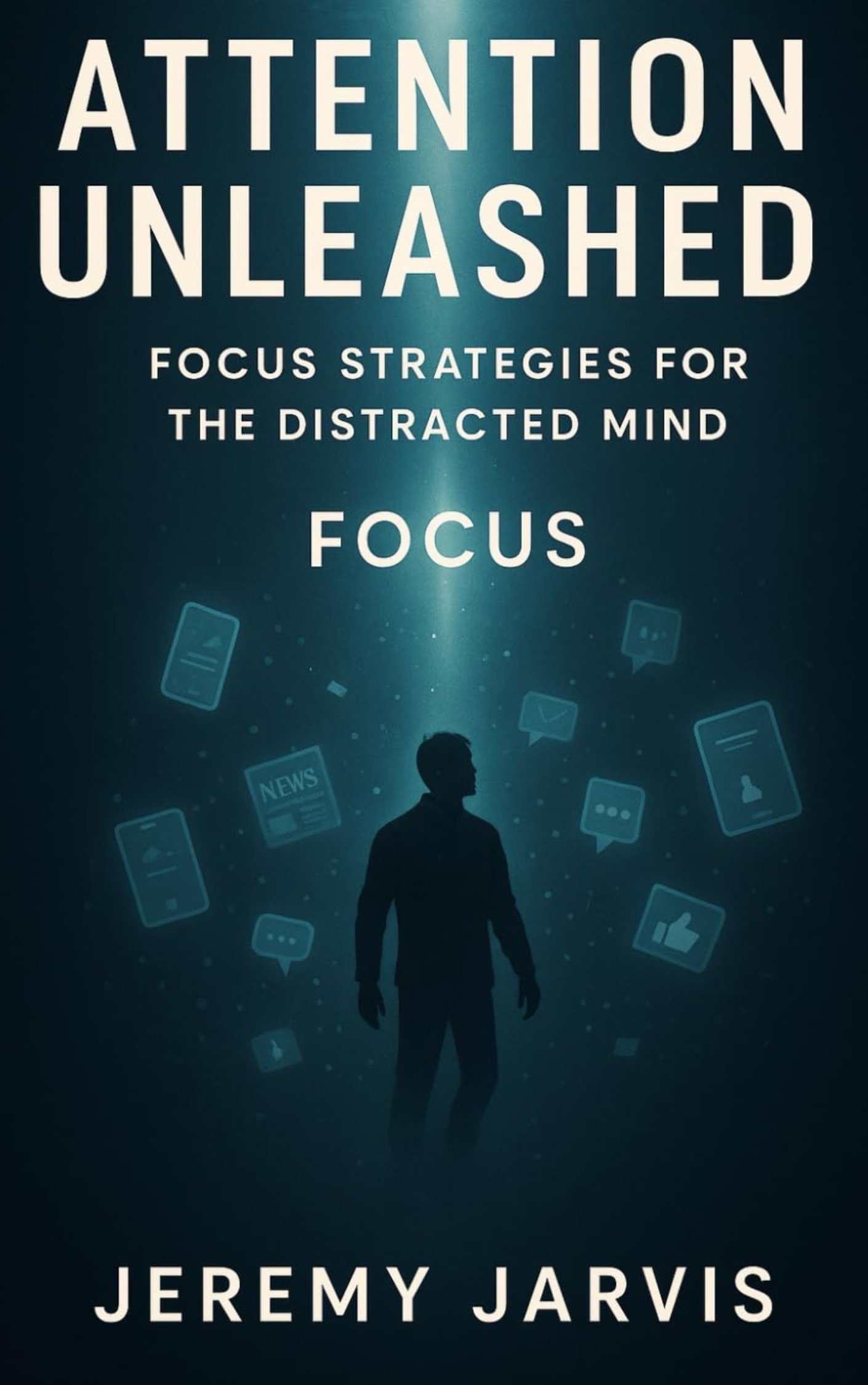
Attention Unleashed
Focus strategies for the distracted mind.
View book →
Side Hustle Launchpad
Your quick-start guide to extra income.
View book →
Digital Clarity
Rewire your brain, escape dopamine traps & regain focus.
View book →
Break the Scroll
Reduce screen time and take back control of your life.
View book →
Climate Compassion
Transform eco-anxiety into empowered action.
View book →
Village Mentality
The power of community for mental wellness.
View book →
Restful Nights
Overcoming sleep anxiety in a 24/7 world.
View book →
Connected Again
Combat loneliness and build meaningful relationships.
View book →
Focus Recharged
Mastering attention and productivity in the digital era.
View book →
Marketing Magic with ChatGPT
AI-powered content, campaigns, and copywriting to grow faster.
View book →
The 6-Figure Creator
Turn knowledge into passive income with books, courses & AI.
View book →
Burnout Breakthrough
Reset your work-life balance and thrive in 2025.
View book →
The Emotionally Intelligent Man
A modern guide to self-awareness and communication.
View book →
AI Personalized Wellness
Create your custom health plan with data-driven habits.
View book →
Everyday AI Made Easy
Use ChatGPT and smart tools to simplify life.
View book →
Money Mindfulness
A financial wellness guide for Gen Z & Millennials.
View book →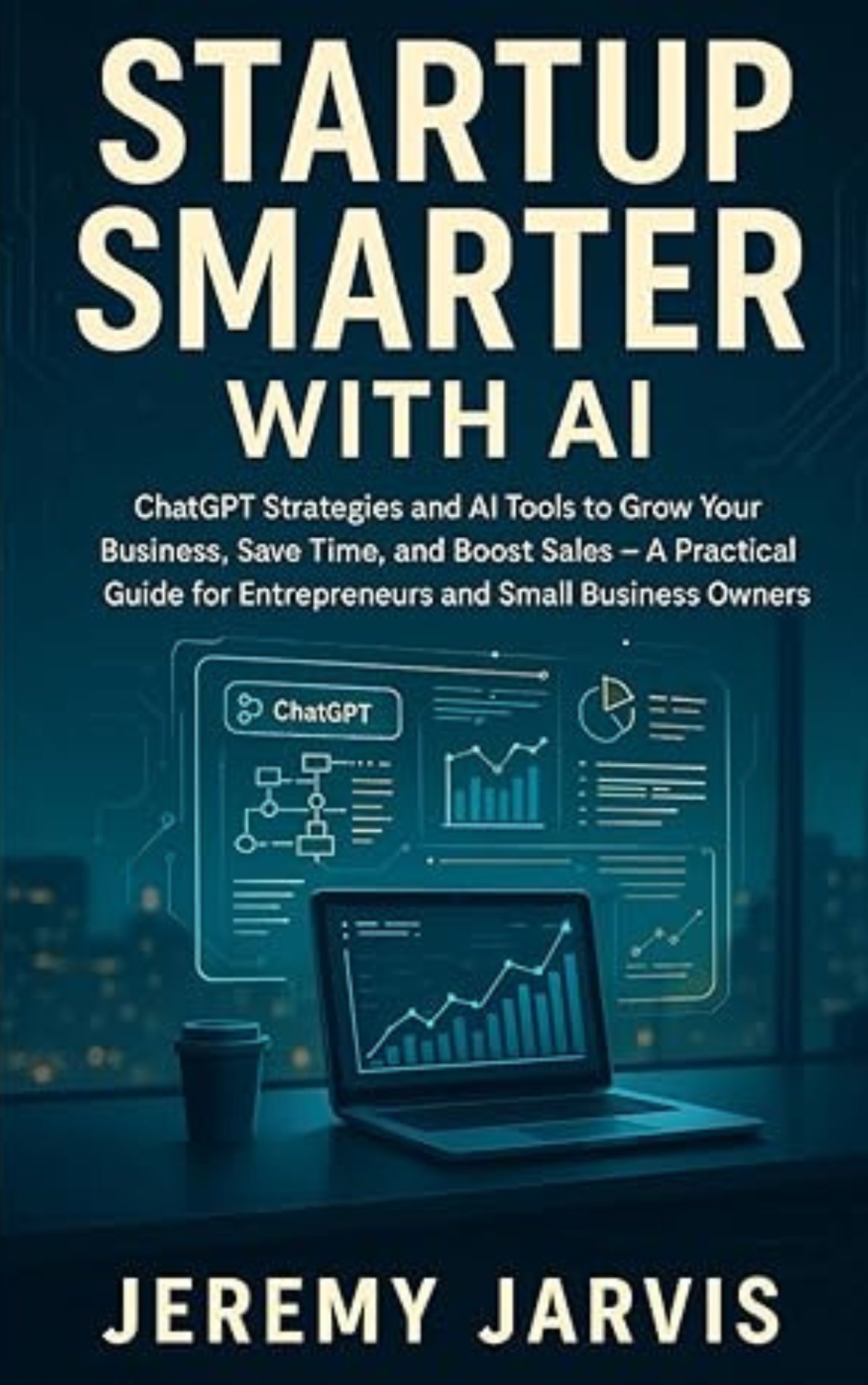
Startup Smarter with AI
ChatGPT strategies and tools to grow your business.
View book →
ChatGPT for Writers & Creators
Unlock AI-powered brainstorming, drafting & editing.
View book →