

Published:
Ever feel like your attention is being pulled in a dozen different directions at once? It’s a common feeling, but here’s the good news: you can absolutely learn how to train your brain to focus. This isn’t about brute-forcing concentration. It’s about methodically building habits that strengthen your attention, one day at a time. This process involves understanding your daily practices, your environment, and a little bit of insight into how your own brain works.
Why Your Ability to Focus Is a Trainable Skill
In a world buzzing with notifications and digital noise, it’s easy to think a short attention span is just the new normal. But neuroscience tells a much more optimistic story. Your brain has an incredible ability called neuroplasticity. This is the scientific term for its capacity to rewire itself by forming new neural connections throughout your life.
This means your focus isn’t a fixed trait you’re stuck with; it’s a mental muscle. Like any muscle, you can strengthen it with the right exercises and routines. Behavioral research shows that consistent practice can lead to measurable improvements in attention control.

Think of this guide as a workout program for your mind. It’s built for busy professionals, entrepreneurs, and students. It provides practical, science-backed techniques that actually stick—not just flimsy quick fixes.
The Problem With Modern Distractions
The constant stream of alerts from our devices is actively training our brains for distraction. Each notification delivers a tiny hit of dopamine. This neurotransmitter is linked to pleasure and reward in the brain’s limbic system. Over time, your brain starts craving these small, frequent rewards. This makes it much harder to sink into deep, uninterrupted work that offers a delayed—but far more satisfying—sense of accomplishment.
It’s a tough cycle to break. Understanding this neurological loop is the first step in fighting back against constant distraction.
The real challenge isn’t a lack of willpower; it’s a battle against a neurological feedback loop. Once you understand this, you can stop blaming yourself and start using strategies that work with your brain’s wiring, not against it.
What This Guide Will Teach You
We’re going to move way beyond theory and get straight to the actionable stuff. This isn’t about “trying harder.” It’s about training smarter to improve your focus.
You will learn how to:
- Understand the Core Science: Get a simple grasp of how your prefrontal cortex and limbic system manage focus and distraction. No PhD required.
- Build Sustainable Habits: We’ll walk through daily routines and simple cognitive exercises that gradually improve your concentration.
- Create a Focused Environment: Learn to take control of your digital and physical spaces to shut down interruptions before they start.
For a wider perspective on how mental training impacts results, exploring the principles of sport psychology for mental performance offers a solid foundation. Top athletes train their minds just as rigorously as their bodies. This skill translates directly to your professional and personal goals.
Let’s get started building your program for lasting mental clarity.
Understanding the Neuroscience of Your Attention Span
To really get a handle on training your brain for focus, you first need to understand the tug-of-war happening inside your head. This isn’t just about willpower; it’s biology. Your brain is a complex machine, and different parts often have competing agendas.
At the heart of this battle for your attention are two key players: the prefrontal cortex and the limbic system.
The CEO and the Toddler in Your Brain
Think of your prefrontal cortex (PFC) as the brain’s CEO. It sits right behind your forehead. The PFC handles all the executive functions—planning, decision-making, and impulse control. When you decide to sit down and grind through a tough report, your PFC is in charge. It helps you stay on task and think logically.
But then there’s the limbic system, which acts more like an impulsive toddler. This is a deeper, more ancient part of your brain. It is driven entirely by emotions and the hunt for immediate rewards. It’s constantly scanning for threats or chances for pleasure. This is exactly why a sudden email notification can feel impossibly urgent and compelling.
Every time you get distracted, it’s usually the limbic system overriding the PFC’s well-laid plans. The promise of a quick dopamine hit from a social media “like” is far more appealing to your inner toddler than the delayed gratification of finishing a project.
Why Your Focus Fades Throughout the Day
Ever notice how your concentration is razor-sharp in the morning but completely shot by 3 PM? That’s because your brain runs on a finite supply of what neuroscientists call attentional resources. This mental energy is like a battery. It drains with every decision you make and every distraction you fight off.
Each time you switch from your work to check an email and then back again, you pay a “cognitive cost.” This constant task-switching drains your attentional resources, making it harder to concentrate on what truly matters.
This constant drain is why building better habits for improving focus and concentration is so critical. It’s not about pushing harder. It’s about being smarter with your mental energy and saving it for the tasks that count.
The Dopamine Loop That Trains You for Distraction
Modern technology has perfected the art of hijacking your brain’s reward system. Each notification, like, or comment triggers a small release of dopamine. This neurotransmitter is tied to pleasure and motivation. This creates a powerful feedback loop that’s hard to break.
- Trigger: Your phone buzzes.
- Action: You check the notification.
- Reward: You get a tiny hit of dopamine from your brain’s reward center.
Over time, this cycle trains your brain to crave these constant, tiny rewards. Your mind learns that distraction feels good. This makes deep, sustained focus feel boring and unrewarding by comparison. Breaking this loop is a fundamental step in retraining your brain for better focus.
Mini-Scenario: Resisting the Digital Urge
Picture Sarah, a remote worker trying to finish an important report. Her prefrontal cortex is telling her to focus, but her limbic system is on high alert for distractions. An email notification pops up. Ping. Her limbic system screams, “Check it! It could be important!”
Sarah resists for a moment, but the urge is too strong. She spends five minutes reading and replying. When she gets back to the report, it takes another ten minutes just to find her train of thought. This cycle repeats all day with social media alerts and news updates. It completely drains her attentional resources and sabotages her efforts to train her brain to focus.
Building Your Daily Focus Training Routine
Improving your ability to concentrate isn’t about brute-forcing more willpower. It’s about building a consistent, practical routine—much like training a muscle. Psychological research shows that mental fitness, just like physical fitness, responds best to a structured plan.
The goal here isn’t to add hours of work to your day. In fact, you can build a powerful foundation with just 15 dedicated minutes. The real secret is consistency, not intensity.
Start with Targeted Cognitive Exercises to Train Your Brain to Focus
Think of these as specific workouts for your prefrontal cortex. This is the part of your brain that handles focus and decision-making. They’re designed to strengthen your working memory and attentional control.
- N-Back Tasks: This exercise is a real workout for your working memory. It involves remembering a sequence of things (like letters you hear) and flagging when the current one matches an item from ‘n’ steps back. It’s tough but incredibly effective for training your brain to hold and manipulate information.
- Stroop Tests: You’ve probably seen this one before. The word “BLUE” is written in red ink, and you have to say the color of the ink, not read the word. This simple conflict forces your brain to suppress a deeply ingrained habit (reading). This directly trains your impulse control, a key part of focus.
For a gentle and sustained cognitive lift, many people find incorporating matcha into their routine helps. There’s growing research into matcha’s potential for boosting energy and focus, making it a great natural complement to these exercises.
Implement Structured Work Protocols
Beyond quick exercises, the way you structure your actual work has a massive impact on your focus. Two of the most battle-tested methods are Deep Work blocks and the Pomodoro Technique. Both give your day a framework that helps you manage and direct your mental energy where it matters most.
Our brains are wired for distraction. The moment we feel even a hint of friction or boredom, our emotional brain (the limbic system) takes over. It seeks a quick dopamine hit from something more interesting. These structures help prevent that.
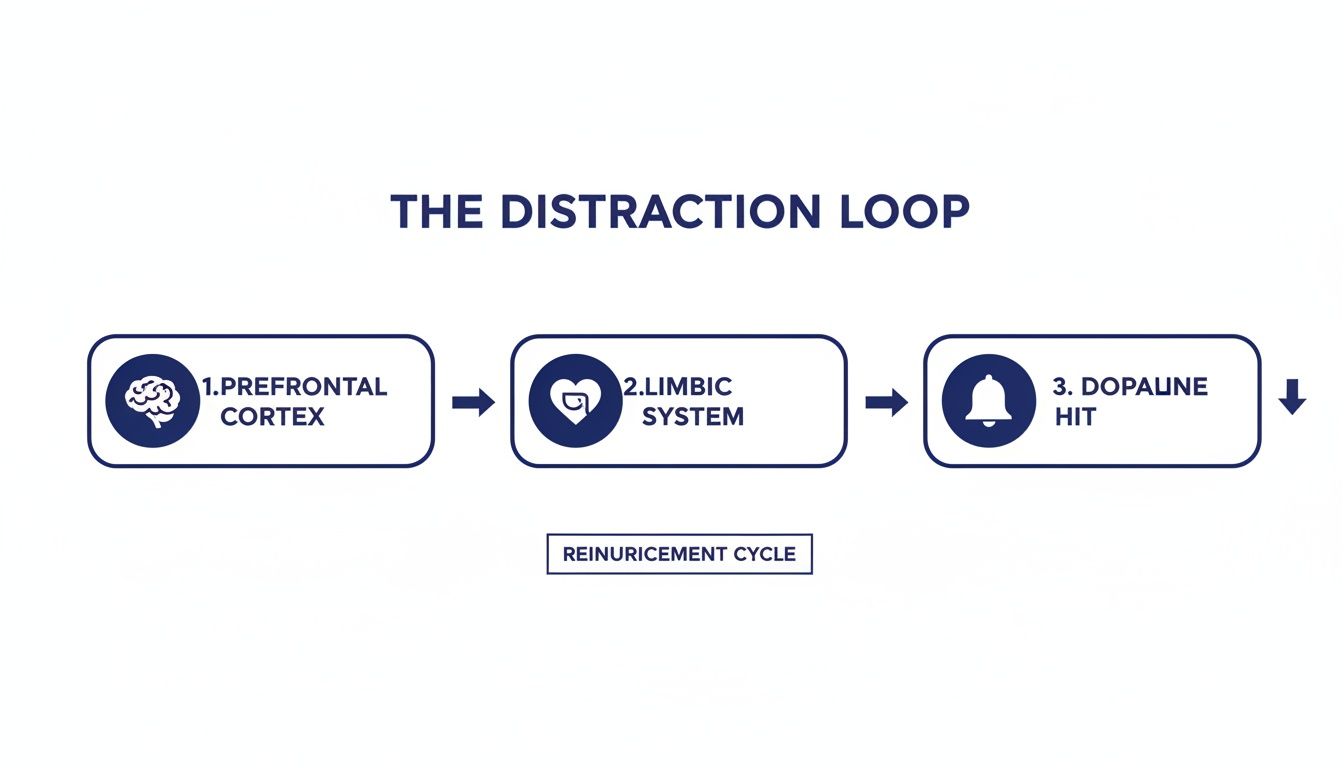
This loop shows how an external cue can bypass your rational prefrontal cortex and light up the limbic system. The resulting dopamine reward reinforces the habit of getting off-task. This makes it harder to stay focused next time.
Mini-Scenario: Deep Work Blocks In Action
Let’s take a practical example. Imagine a startup founder named Alex whose most critical work is product strategy. But her day is a constant stream of emails and team messages that pull her away.
To fight this, Alex now schedules two 90-minute “Deep Work” sessions into her calendar every morning. During this time, her phone goes in another room. All non-essential tabs are closed, and a timer is set. By treating focus like a non-negotiable appointment, she signals to her brain—and her team—that this time is protected.
The Pomodoro Technique for Improved Focus
If a 90-minute block feels like too much to start with, the Pomodoro Technique is your best friend. It’s wonderfully simple:
- Pick one—and only one—task.
- Set a timer for 25 minutes.
- Work without any interruptions until the timer goes off.
- Take a real 5-minute break (stand up, stretch, look out a window).
- After four of these “pomodoros,” take a longer break of 15-30 minutes.
This method is brilliant because it breaks down big projects into small, manageable chunks. This makes it much easier to just get started.
Make Your New Habits Stick
The real trick to making any new routine last is to make it as easy and automatic as possible. A powerful tool from behavioral science for this is called habit stacking. The idea is simple: you link a new habit you want to form with an existing one you already do without thinking.
Instead of relying on motivation, which comes and goes, habit stacking piggybacks your new focus training onto an established part of your day. It leverages your brain’s existing wiring to build new pathways with less friction.
For instance, you could stack a 10-minute focus exercise onto your morning coffee. The trigger becomes the coffee itself. The new sequence in your brain becomes: “After I pour my morning coffee, I will open my n-back training app for one session.”
You can learn more about building these kinds of powerful, automatic behaviors in our complete guide on how to create a morning routine.
Your Weekly Focus Training Schedule
To help you get started, here is a sample weekly schedule. Think of it as a flexible template, not a rigid set of rules. The goal is to integrate these different focus techniques into your life in a way that feels sustainable and effective for you.
| Day | Morning (15-20 min) | Work Block (90 min) | Afternoon (10 min) | Evening |
|---|---|---|---|---|
| Monday | N-Back Training (15 min) | Deep Work Block (Strategy/Planning) | Mindful Breathing (5 min) | Read a book (no screens) |
| Tuesday | Stroop Test Practice (10 min) | Pomodoro Sprints (4×25 min) on a key project | Walk outside (no phone) | Journal/Reflect |
| Wednesday | N-Back Training (15 min) | Deep Work Block (Creative/Writing) | Meditate or sit in silence | Unwind with a hobby |
| Thursday | Mindful Observation (10 min) | Pomodoro Sprints (4×25 min) on admin tasks | Stretch/Mindful movement | Connect with family/friends (no screens) |
| Friday | Review weekly goals (15 min) | Deep Work Block (Finish key tasks) | Plan the week ahead | Disconnect/Relax |
| Weekend | Optional: Light focus game or mindful activity | Unstructured time | Enjoy nature or a hobby | Rest & Recharge |
This schedule provides a rhythm, mixing intense focus sessions with deliberate rest. Adjust the times and activities to fit your own life. The key is to create a predictable pattern that your brain can learn to anticipate. This makes deep focus less of a battle and more of a natural habit.
Mastering Digital Hygiene and Your Dopamine Levels
Let’s be honest: digital distractions are the single biggest threat to focus in our modern world. Every ping, buzz, and notification is a tiny papercut on your attention. They slowly drain your mental energy until you’re left feeling scattered and fried.
Taking control of your digital world isn’t about throwing your phone away. It’s about making technology work for you, not against you. This is what we call digital hygiene.
It all starts with understanding dopamine. This powerful neurotransmitter is a key part of your brain’s reward system. Tech companies are masters at pulling its levers. Each notification delivers a small, unpredictable reward. This trains your brain to constantly check for more. This cycle creates a state of continuous partial attention, making deep focus feel next to impossible.

Taking Back Control of Your Digital Environment to Train Your Brain to Focus
The first step is to stop letting your devices dictate your attention. You need to create some intentional friction between you and your biggest distractions. This isn’t about raw willpower; it’s about smart environmental design.
Start with these incredibly practical moves to clean up your digital space:
- Kill Non-Essential Notifications: Go through your phone and ruthlessly disable alerts for every app that isn’t truly urgent. No, you don’t need to know about a flash sale or a new Instagram post the second it happens.
- Set Firm App Time Limits: Most smartphones have built-in features to cap your daily time on specific apps. Use them. A hard 15-minute daily limit on TikTok can be a game-changer for reclaiming hours of mindless scrolling.
- Create a Minimalist Home Screen: Shove distracting apps off your main home screen and into folders on a second or third page. That simple act of adding an extra tap can be just enough to break an impulsive habit.
The Overlooked Power of a Dopamine Detox
A “dopamine detox” sounds a lot more intense than it is. It’s really just about scheduling intentional, screen-free time. This gives your brain’s reward system a much-needed break from constant overstimulation.
When you temporarily step back from high-dopamine activities like scrolling social media, you allow your brain to recalibrate. This reset actually helps restore your sensitivity to lower-dopamine, high-reward activities. Examples include reading a book or working on a challenging project. You’re not starving your brain of pleasure. You’re retraining it to find satisfaction in deeper, more meaningful tasks.
To get a better handle on the science, check out our deep dive on the link between dopamine and motivation in our detailed guide.
By consciously stepping away from constant digital input, you’re not just avoiding distraction; you’re actively recalibrating your brain’s reward pathways. This makes focused, meaningful work feel less like a chore and more like the rewarding experience it’s supposed to be.
Mini-Scenario: A Real-World Dopamine Detox
Take Maria, a freelance graphic designer. She noticed her creativity and focus were tanking, thanks to the constant digital noise. She decided to try two simple rules grounded in digital hygiene.
First, she established “no-screen Sundays.” One day a week, her phone, tablet, and laptop were put away. She spent the day reading, hiking, and actually connecting with friends in person.
Second, she made her bedroom a phone-free zone. She bought a cheap, old-school alarm clock. She started leaving her phone to charge in the living room overnight.
The results were immediate and striking. Within a few weeks, Maria reported sleeping better and waking up with far more mental clarity. Her creative blocks started melting away, and her focus during work hours became razor-sharp. She hadn’t changed her work at all—only the digital environment around it.
Using Technology to Fight Technology
It might sound ironic, but some of the best tools for enforcing these new boundaries are, well, technology. Think of them as digital guardrails. They help you stick to your intentions when your own resolve starts to wobble.
Consider trying out a few of these:
- Freedom: This app blocks distracting websites and apps across all your devices for a set period. It’s perfect for creating protected deep-work sessions.
- Forest: This is a fun, gamified app where you grow a virtual tree during a focus session. If you leave the app to get distracted, your poor little tree withers and dies.
- StayFocusd: A simple but effective Chrome extension that lets you set time limits on specific websites. Bye-bye, YouTube rabbit holes.
Using tools like these isn’t a sign of weakness; it’s a smart strategy. You’re using technology to protect your most valuable asset: your attention.
How to Measure Your Focus and Overcome Plateaus
If you want to stick with training your brain, you need to see that it’s actually working. Just like tracking reps at the gym, measuring your mental fitness shows you where you’re making progress. It also helps you spot when you’ve hit a wall. Without some kind of feedback, it’s far too easy to get discouraged and let your new habits slide.
The good news is that tracking doesn’t need to be complicated. In fact, simpler is usually better. The goal is to build a quick, daily ritual that gives you an honest snapshot of your progress without feeling like a chore.
Simple Ways to Track Your Focus
You can start with just a few easy-to-monitor metrics. Pick one or two that resonate with you. Then, log them in a notebook or a digital note at the end of each day.
- Uninterrupted Sessions: How many Pomodoro or Deep Work sessions did you complete without getting pulled off track? This is a fantastic, objective measure of your sustained attention.
- Subjective Focus Rating: On a scale of 1-10, how would you rate your overall focus for the day? This subjective score helps you tune into how you feel, connecting your daily actions to your mental state.
- Distraction Count: Keep a running tally. Just make a quick tick mark in a journal every time you catch yourself compulsively checking your phone or email outside of a planned break.
For those who prefer a more structured, automated approach, there are plenty of excellent digital tools out there. You can find some of our top recommendations in our guide to the best habit tracking apps.
Breaking Through a Focus Plateau
Sooner or later, you’re going to hit a plateau. It’s completely normal. Just like in physical fitness, your brain adapts, and progress can seem to stall out. When this happens, it’s not a sign that you’ve failed. It’s a signal to troubleshoot and adjust your strategy.
A plateau is simply your brain telling you it’s time for a new challenge or that an underlying factor is draining your energy. It’s an opportunity to refine your training, not abandon it.
Mini-Scenario: Overcoming a Plateau
Take Alex, a writer who was successfully crushing four Pomodoro sessions every morning. After a few weeks of solid progress, he suddenly found himself struggling to finish even two. He was stalled and frustrated. So, he went back and reviewed his daily focus log.
He quickly spotted a pattern: on the days with poor focus ratings, he’d also noted getting less than six hours of sleep the night before. His inconsistent sleep schedule was the hidden energy leak sabotaging his focus. By recommitting to a consistent bedtime, Alex broke through his plateau in less than a week.
His story is a great reminder that training your brain is a long game with natural ups and downs. By measuring your efforts and paying attention to the data—even simple data—you can make smart adjustments and keep moving forward.
Key Takeaways: How to Train Your Brain for Lasting Focus
We’ve covered the science and the strategies. Now, let’s boil it all down to the essentials—the core principles you can lean on when things get noisy again. Think of this as your quick-reference guide. Training your brain is a long game, not a one-time fix.
Focus Is a Skill, Not a Gift: Your brain isn’t set in stone. Thanks to neuroplasticity, you can actively strengthen your attention span with consistent practice. It’s a muscle—use it deliberately, and it gets stronger.
Your Environment Does the Heavy Lifting: Willpower is overrated and easily depleted. A thoughtfully designed digital and physical space that minimizes distractions is your greatest ally. It works even when your motivation doesn’t.
Consistency Beats Intensity, Every Time: A short, daily commitment is far more powerful than heroic, once-a-week efforts. Just fifteen minutes of focused practice each day is enough to build the mental habits that stick.
You Have to Manage Your Dopamine: Modern tech has trained our brains to crave distraction. Intentionally unplugging with a “dopamine detox”—even for a short period—helps reset your brain’s reward system, making deep work feel satisfying again.
What Gets Measured, Gets Managed: Tracking your focus sessions and how you feel afterward is crucial for staying motivated. It’s not about perfection; it’s about having the data you need to see what’s working and troubleshoot when you hit a plateau.
Editor’s Take
Let’s be real for a moment. If I had to pick the single most effective strategy from this entire guide, it’s this: master your environment.
You can practice all the cognitive exercises you want. But if your phone is buzzing every two minutes and notifications are lighting up your screen, you are fighting a battle you will eventually lose.
Start by being absolutely ruthless with your notifications. Then, create sacred, screen-free zones and times. Your bedroom is a great place to start. The goal isn’t to get rid of your phone. The goal is to put it back in its place as a tool you control, not the other way around.
This advice is designed for busy professionals, students, and creatives who feel like their attention is constantly being pulled apart. If you’re struggling with something deeper—like chronic anxiety, burnout, depression, or you suspect you have ADHD—these techniques can certainly help, but they are not a substitute for professional care. Please, talk to a doctor or a mental health professional for a proper diagnosis and treatment plan.
Disclaimer: This article may contain affiliate links, which means we may earn a small commission if you make a purchase at no extra cost to you. This content is for educational and informational purposes only and does not constitute medical or psychological advice. If you have concerns about anxiety, depression, ADHD, or other conditions, please consult with a qualified professional.
FAQ: Your Questions on How to Train Your Brain to Focus
You’ve got questions about training your brain to focus, which is a great sign. It means you’re ready to move from just reading about it to actually doing it. Let’s get straight to the practical answers for the things people ask most often.
How Long Does It Take to See Results from Brain Training?
There’s no magic number here, as it really depends on your starting point and how consistent you are. That said, most people report feeling a real, noticeable shift in their ability to handle distractions and hold focus within two to four weeks of daily practice. Behavioral research is clear: small, daily efforts compound into big changes. The key is consistency, not intensity.
Can These Techniques Help If I Have ADHD?
Yes, these strategies can be incredibly supportive for anyone looking to manage their attention better, including those with ADHD. Core practices like creating a distraction-free space, using timers to structure work, and breaking big projects into smaller pieces are often recommended as part of a toolkit for managing ADHD symptoms. However, this article is for educational purposes only and is not a substitute for professional medical or psychological care. If you have or suspect you have ADHD, please talk to a qualified healthcare professional.
What Is the Difference Between Mindfulness and Focus Training?
This is a fantastic question because the two are deeply connected but serve different functions.
- Mindfulness is about developing a broad, non-judgmental awareness of the present moment. You’re simply observing your thoughts and feelings without getting swept away.
- Focus training, on the other hand, is about directed attention. You are deliberately choosing to concentrate on one specific thing while actively filtering out everything else.
Think of it this way: mindfulness is like turning up the lights to see the whole room clearly, while focus is like pointing a spotlight on a single object.
Are Brain Training Apps Effective for Improving Focus?
They can be, if you use them as one tool in a bigger toolkit. The best brain training apps gamify cognitive exercises (like n-back tasks). This makes the daily practice of strengthening your working memory or impulse control much more engaging. But an app by itself isn’t a silver bullet. The biggest improvements always come from combining those exercises with real-world strategies, like optimizing your environment.
How Do I Stay Motivated to Train My Brain Daily?
Motivation comes and goes, so don’t rely on it. Build habits instead. Start so small it feels almost ridiculous—like a five-minute focus session. Then, use habit stacking: link your new focus practice to something you already do every day, like right after you pour your morning coffee. Also, track your progress. Seeing a simple chart of your completed focus sessions gives you tangible proof that your effort is paying off.
Is It Possible to Over-train Your Brain for Focus?
Absolutely. Just like any muscle, your brain can get fatigued. We often call this cognitive burnout or mental fatigue. If you try to force yourself through hours of intense deep work without any real breaks, your performance will nosedive, and you’ll just end up feeling mentally fried. The answer is to work in focused sprints with genuine rest in between—it’s the entire principle behind the Pomodoro Technique.
What Should I Do on Days I Feel Completely Unfocused?
First off, don’t beat yourself up about it. Everyone has off days; it’s part of being human. On days when deep work feels impossible, shift gears. Pivot to lower-energy tasks, like cleaning out your inbox or organizing files. Another option is to lean into it and declare it a “recovery” day. Go for a walk, do some light stretching, or get to bed a little earlier. Sometimes the most productive thing you can do for long-term focus is to strategically rest.
How Do Diet and Exercise Help Train My Brain to Focus?
Your brain is a physical organ, and its performance is directly linked to your body’s health. Exercise boosts blood flow to the brain, delivering vital oxygen and nutrients. Even a brisk walk can provide a temporary lift in focus. A balanced diet fuels your brain for the long haul. Foods rich in omega-3s and antioxidants support brain health and help regulate mood and energy, which are the very foundation of concentration.
How Does Sleep Affect My Ability to Train My Brain to Focus?
Sleep is arguably the single most critical factor for a sharp mind. While you sleep, your brain consolidates memories and clears out metabolic waste that builds up during the day. When you skimp on sleep, you directly impair your prefrontal cortex. This leads to poor impulse control and a shorter attention span. If you’re serious about improving your focus, making 7-9 hours of quality sleep a non-negotiable priority is the first and most important step.
What Is the Single Most Important Habit for Better Focus?
If I had to pick just one, it would be this: proactively managing your environment. This means turning off all non-essential notifications, putting your phone completely out of sight during work blocks, and creating a dedicated, clutter-free workspace. Willpower is a finite resource that runs out, but a well-designed environment works on your behalf 24/7. It’s the foundation for learning how to train your brain to focus effectively.
At Mind Clarity Hub, we specialize in providing science-backed, actionable guides to help you master your focus and productivity. Explore our full library of books and resources to build a system that works for your life.
Find your path to clarity at https://mindclarityhub.com
Explore the Mind Clarity Hub Library
Practical books on focus, digital habits, resilience, and building a calmer mind.
The Power of Clarity
Unlock mental focus, build momentum, and create the life you were meant to live.
View book →
AI & ChatGPT for Beginners
No PhD needed — a 2025 guide to AI, prompts, and productivity without coding.
View book →
Zen in the Digital Jungle
Mindfulness for a chaotic world.
View book →
The Slow Reset
Mindful living in a fast-paced world.
View book →
Perfectly Imperfect
Stop self-criticism, set boundaries, and embrace the real you.
View book →
Reclaiming Silence
A dopamine detox guide to finding peace in a noisy world.
View book →
The Focused Freelancer
Productivity, pricing & positioning for independents in 2025.
View book →
ChatGPT Side Hustle System
Launch your AI-driven online business in 30 days.
View book →
Burnout, Interrupted
A proven path to restore energy and reclaim your life.
View book →
Attention Unleashed
Focus strategies for the distracted mind.
View book →
Side Hustle Launchpad
Your quick-start guide to extra income.
View book →
Digital Clarity
Rewire your brain, escape dopamine traps & regain focus.
View book →
Break the Scroll
Reduce screen time and take back control of your life.
View book →
Climate Compassion
Transform eco-anxiety into empowered action.
View book →
Village Mentality
The power of community for mental wellness.
View book →
Restful Nights
Overcoming sleep anxiety in a 24/7 world.
View book →
Connected Again
Combat loneliness and build meaningful relationships.
View book →
Focus Recharged
Mastering attention and productivity in the digital era.
View book →
Marketing Magic with ChatGPT
AI-powered content, campaigns, and copywriting to grow faster.
View book →
The 6-Figure Creator
Turn knowledge into passive income with books, courses & AI.
View book →
Burnout Breakthrough
Reset your work-life balance and thrive in 2025.
View book →
The Emotionally Intelligent Man
A modern guide to self-awareness and communication.
View book →
AI Personalized Wellness
Create your custom health plan with data-driven habits.
View book →
Everyday AI Made Easy
Use ChatGPT and smart tools to simplify life.
View book →
Money Mindfulness
A financial wellness guide for Gen Z & Millennials.
View book →
Startup Smarter with AI
ChatGPT strategies and tools to grow your business.
View book →
ChatGPT for Writers & Creators
Unlock AI-powered brainstorming, drafting & editing.
View book →