Neurowave therapy is a form of brain training, but not in the way most of us think of it. It’s not about puzzles or memory games. Instead, it’s a process of learning to guide your own brain activity using real-time feedback. This helps you shift from states like distraction into calmer, more focused ones. The therapy is grounded in neuroscience, using technology to help you understand and influence your brain’s behavior.
Affiliate Disclosure: This article may contain affiliate links. If you make a purchase through these links, we may earn a small commission at no extra cost to you.
Disclaimer: This article is for educational purposes only. It is not intended as a substitute for professional medical or psychological advice for conditions like ADHD, anxiety, depression, burnout, or sleep problems. Always consult a qualified health provider with any questions.
What Is Neurowave Therapy and How Does It Work?
Think of your brain as having different operating modes. Sometimes, it gets stuck in the wrong one. For instance, your mind might race with anxiety before a big presentation. Or, you might feel foggy and unfocused during an important task. Neurowave therapy, also known as neurofeedback, is like a coach showing your brain how to switch modes more effectively.
The process is completely non-invasive. Small sensors are placed on your scalp to listen to your brain’s electrical chatter, known as brainwaves. Behavioral research shows these patterns correspond to different mental states:
Alpha waves often appear when you’re in a state of calm, relaxed alertness.
Beta waves are dominant when you’re actively problem-solving or concentrating.
Theta waves can signal drowsiness, deep meditation, or a mind that’s wandering.
Depending on your goal—like sharpening your focus—the system gives you immediate feedback. If the aim is to boost concentration, you might hear a pleasant sound every time your brain produces more helpful beta waves.
Tapping into Your Brain’s Adaptability with Neurowave Therapy
This feedback loop works because of a fundamental feature of our brains: neuroplasticity. This is your brain’s natural ability to reorganize itself by creating and strengthening neural connections. Each time you get positive feedback for producing a helpful brainwave pattern, you reinforce that neural pathway.
Over time, your brain learns to produce these patterns on its own, without needing prompts. It’s much like learning to ride a bike. At first, you rely heavily on training wheels (the feedback), but eventually, balancing becomes second nature. This simple but powerful cycle is what makes the change stick.
As the visual shows, neurowave therapy creates a learning loop where your brain gradually learns to regulate its own activity. It’s not about being controlled; it’s about building your capacity for self-regulation.
A Real-World Example of Neurowave Therapy
Let’s take a busy professional who’s all too familiar with that afternoon brain fog. After lunch, their focus evaporates. During a neurowave session, their task might be to keep a video playing on a screen. The video only plays as long as their brain maintains a state of focused attention (dominant beta waves).
If their mind drifts and theta waves take over, the video dims. This subtle cue prompts them to gently bring their attention back. To make this training even more effective, many people use a pair of noise-canceling headphones to block out distractions and tune into the audio cues. Ultimately, the goal isn’t just to perform well during the session. It’s to build lasting mental skills you can use in your daily life. To learn more about how your surroundings influence your mind, see our guide on how light, sound, and architecture affect cognitive performance.
The Science Behind Your Brainwaves and Neurowave Therapy
To understand how neurowave therapy works, you must understand what it measures: your brainwaves. Think of your brain as a massive orchestra where millions of neurons are constantly firing. This creates a steady hum of electrical energy. Brainwaves are the rhythmic, collective patterns of that activity.
These patterns aren’t random. They have distinct frequencies, measured in Hertz (Hz), and they directly map to your mental state. When your brain’s “music” changes, so does the way you think and feel. Learning to recognize this music is the first step toward learning how to guide it.
Decoding Your Brain’s Rhythms with Neurowave Therapy
While your brain always produces a mix of these waves, one frequency usually takes the lead. Behavioral research shows clear links between brainwave frequencies and specific cognitive states. By understanding them, you see the logic behind how neurowave therapy helps you train your brain.
Scenario: The Creative vs. The Analyst
A graphic designer hitting a creative wall might want to encourage more Alpha or Theta waves. These are tied to relaxed, free-flowing ideas. However, a financial analyst preparing a report needs to sustain sharp, focused Beta waves to stay on top of details.
Our mental states aren’t just vague feelings; they are tied to measurable patterns in the brain. If you want to change your mind, you often have to start by changing your brainwaves. This connection makes neurowave therapy a practical tool. It gives you a direct window into your cognitive orchestra, showing you which “instruments” are playing and helping you learn to conduct them. For a deeper look at how these patterns relate to memory, you can explore our article on the memory wave.
A Quick Guide to Understanding Your Brainwaves for Neurowave Therapy
To make this feel more concrete, let’s break down the five main types of brainwaves. The table below connects each wave to its associated mental state and gives an everyday example. Think of it as a quick reference for what’s happening in your head throughout the day.
Brainwave Type
Associated Mental State
Everyday Example
Delta (0.5–4 Hz)
Deep, dreamless sleep; healing and regeneration
The deepest stage of sleep where you feel completely “out.”
Theta (4–8 Hz)
Deep relaxation, meditation, creativity, light sleep
Daydreaming during a quiet moment or that “aha!” flash of creative insight.
Alpha (8–12 Hz)
Calm, relaxed focus; a state of “flow”
Being gently absorbed in a hobby like painting, gardening, or light reading.
Beta (12–38 Hz)
Active thinking, problem-solving, alertness, focus
Debating an idea in a meeting or working on a complex spreadsheet.
Gamma (38–100 Hz)
Peak concentration, high-level information processing
Intense problem-solving or those moments of peak performance when you feel “in the zone.”
This table shows the full spectrum of your brain’s activity. Neurowave therapy is designed to help you get better at shifting into the right state for the task at hand.
Sharpening Your Attention with Neurowave Therapy
For many of us, staying focused is a constant battle against distractions. Neurowave therapy offers a way to fight back by directly training the brainwave patterns associated with deep concentration. From a neuroscience standpoint, this means learning to dial up your Beta waves—the brain activity linked to active problem-solving. At the same time, you practice dialing down excessive Theta wave activity, the signature of a wandering mind.
Real-World Scenario: Escaping “Work Mode”
Picture a remote worker who can’t switch off at the end of the day. Her brain stays stuck in high-gear “work mode” (high Beta waves), making it impossible to relax. Through neurowave therapy, she can learn to intentionally guide her brain into a calmer Alpha wave state. This creates a clear mental boundary between her professional and personal life.
This ability to consciously shift gears is an incredibly powerful skill for preventing mental exhaustion and burnout. Our book, Burnout Interrupted, offers a full roadmap for this kind of professional recovery.
Managing Mood and Emotional Regulation Through Neurowave Therapy
Your emotional landscape is also written in your brainwaves. Stress and anxiety often show up as overactive, high-frequency brainwave patterns in certain parts of the brain. Neurowave therapy gives you a direct way to practice calming those patterns down.
By getting real-time feedback, you learn to gently guide your brain toward states of greater balance. This isn’t about suppressing feelings. It’s about building your brain’s resilience so it can better regulate its response to stressors. It’s like building an internal shock absorber for your emotions. For more on this, our guide to neuro-sound rituals for focus explores related methods.
Preparing Your Brain for Restful Sleep with Neurowave Therapy
While neurowave therapy won’t put you to sleep on the spot, it’s a powerful tool for tackling a big sleep thief: a racing mind. The training helps quiet the “mental chatter” that keeps so many of us staring at the ceiling.
By practicing the shift from active Beta waves to calmer Alpha and Theta waves during the day, you’re rehearsing the process of letting go. This makes it easier for your brain to downshift at bedtime. Pairing this practice with solid sleep hygiene—like using a sleep mask blackout to ensure total darkness—creates a potent routine for deeper rest. You can also explore broader strategies for how to improve focus and concentration.
How to Choose the Right Neurowave Therapy for You
Once you decide to explore neurowave therapy, the next question is practical: which path is right for you? Your options generally fall into two camps: professionally guided sessions and at-home consumer devices. Each has its own trade-offs.
Making the right call comes down to your goals, budget, and schedule. If you’re trying to tackle a significant focus challenge, the structured oversight of a clinical setting might be best. But if you’re aiming for general mental fitness and better stress management, an at-home device could be a game-changer. You might even find a time blocking planner helpful to schedule your sessions and build consistency.
Comparison: In-Clinic vs. At-Home Neurowave Therapy
To help you decide, let’s break down the key differences. Think of it like choosing between a personal trainer at a gym versus using a fitness app at home. Both can get you results, but the experience, cost, and guidance are worlds apart.
Feature
In-Clinic Therapy
At-Home Devices
Guidance
Led by a trained clinician with personalized protocols.
Self-guided, relies on user discipline and app instructions.
Cost
Higher per-session cost; potential for insurance coverage.
One-time purchase cost, varies by device quality.
Convenience
Requires scheduled appointments and travel.
Highly flexible; can be used anytime at home.
Technology
Clinical-grade, multi-channel EEG equipment.
Simplified 1-4 channel EEG sensors.
There’s no single “better” option here. The right choice is the one that aligns best with your needs. A clinic offers expert-led protocols, but at-home devices provide flexibility.
Best Option for Structured, Personalized Training
If you’re dealing with significant challenges in focus or mood, starting with in-clinic neurowave therapy is often the smartest move. A trained professional can perform a detailed brain map (QEEG) to create a personalized protocol. This ensures the training targets the exact neural pathways that need support.
This expert oversight is the biggest advantage. A clinician can monitor your progress and adjust protocols as your brain responds. While the cost is higher—sessions can run from $75 to $200 each—that structured guidance provides a level of personalization at-home devices can’t match.
Best for Busy Professionals Seeking Flexibility
For busy professionals looking to build mental resilience or manage stress, at-home devices are a compelling alternative. Their main benefit is pure convenience. You can fit sessions into your own schedule.
However, that flexibility comes with a trade-off: you are in charge of your own consistency. Success with an at-home device hinges on your self-discipline. For those who want to build better habits around focus, our book, Attention Unleashed, provides practical frameworks. When you compare options, think about how much guidance you need versus how much flexibility you value. While some devices are effective, our review of the Genius Wave explores why it’s so important to look closely at the science behind any at-home program.
Editor’s Take: What Actually Works with Neurowave Therapy
Let’s be honest: while neurowave therapy shows real promise for helping people self-regulate their attention and relaxation, it is not a magic bullet. Think of it as a powerful tool, not a cure-all, and one that requires your active participation.
Results vary from person to person. They depend on your biology, your practitioner’s skill, and your consistency. The therapy works best when it’s part of a bigger plan that includes healthy lifestyle habits. For example, using a phone lock box timer to carve out distraction-free time can amplify the focus you build during your sessions.
Who is Neurowave Therapy Best For?
This therapy is an excellent fit for people who are patient and see it as a skill-building exercise. You are literally learning to guide your own brain activity, a process that feels like developing any other new skill. It absolutely requires your engagement.
Neurowave therapy is ideal for:
Professionals looking to sharpen cognitive performance and manage stress.
Individuals interested in a data-driven approach to mental wellness.
Anyone who has struggled with traditional meditation and wants a more guided method.
Important Caveats:
Neurowave therapy is a commitment. Lasting results require consistent sessions over several weeks or months.
The quality of both practitioners and at-home devices varies. Do your research before investing time and money.
This is not a standalone treatment for clinical conditions like severe depression, anxiety, or ADHD. It should be used alongside, not in place of, professional medical care.
Our goal is to give you a trusted, no-hype perspective. Neurowave therapy is a powerful method for building mental control, but your commitment is the most important ingredient. Think of it as joining a gym for your brain—the equipment helps, but you still have to do the work. For a deeper understanding of mental clarity, start with this chapter from our cornerstone book, The Power of Clarity.
Key Takeaways on Neurowave Therapy
Here is a quick look at what you need to know about starting your journey with neurowave therapy.
It’s Guided Brain Practice: Neurowave therapy is built on neuroplasticity—your brain’s ability to change. It uses real-time feedback to help you consciously steer your brainwave activity toward states of calm or focus.
You Learn Self-Regulation: By getting direct feedback, you train the core skill of self-regulation. With consistency, you can learn to dial down a racing mind, manage stress, and improve attention, which often has a positive knock-on effect on sleep. This is why it pairs well with tools that create a stable sensory environment, like a white noise machine.
Two Paths to Choose From: You have a choice between structured sessions in a clinical setting or using more flexible at-home devices. The best route depends on your specific needs, budget, and whether you need a clinician’s guidance.
Set Clear Expectations: Think of this as building a mental skill, not taking a magic pill. Neurowave therapy is a process, and your success hinges on consistent practice and active engagement. It works best when it’s part of a larger strategy for your mental well-being. For a comprehensive guide on building focus, see our book, Focus Recharged.
Disclaimer: This article contains affiliate links. The content is for educational and informational purposes only and is not a substitute for professional medical or psychological advice, diagnosis, or treatment. Always seek the advice of your physician or other qualified health provider.
Neurowave Therapy: FAQ
We’ve explored the science behind neurowave therapy, but you probably still have practical questions. Let’s tackle the most common ones with direct, straightforward answers.
Is Neurowave Therapy Safe?
Yes, for most people, neurowave therapy is considered very safe. It’s a non-invasive training method that simply reads your brain’s natural electrical activity and provides feedback. Nothing is being put into your brain. Side effects are uncommon and usually mild. A few people report temporary fatigue or a slight headache, much like feeling tired after an intense workout as your brain adapts.
How Long Until I See Results from Neurowave Therapy?
This is one of the most common questions, and the honest answer is: it varies. Some people report subtle shifts in focus or mood within just a few sessions. However, for significant, lasting change, you need to be consistent. Most clinical protocols recommend a course of 20 to 40 sessions to achieve durable results. Think of it less like a quick fix and more like physical therapy for your brain—consistency drives success.
What Is the Difference Between Neurowave Therapy and Meditation?
While both can improve your mental state, they get there through different paths. Meditation is a subjective practice that relies on your internal awareness, without external data to guide you. Neurowave therapy, on the other hand, gives you objective, real-time biological feedback on your brainwave patterns. It provides concrete data to help steer your brain, which can make the learning process feel less abstract. For those who find traditional meditation a struggle, our book Reclaiming Silence offers other paths to a quieter mind.
Can I Use an At-Home Device for a Medical Condition?
It is strongly advised not to use consumer-grade devices to self-treat a diagnosed medical or psychological condition. This applies to conditions like ADHD, major depressive disorder, or severe anxiety. Always start by consulting a qualified healthcare professional. They can offer an accurate diagnosis and guide you toward clinically validated treatments that are appropriate and safe for your specific situation.
Does Insurance Cover Neurowave Therapy?
Insurance coverage for neurowave therapy is inconsistent at best. Whether you get reimbursed depends heavily on your specific plan, your location, and the clinical diagnosis being treated. More often than not, it is considered an out-of-pocket expense. It’s essential to call your insurance provider directly and ask about your specific policy before you commit to a course of treatment.
Free download: 7-Day Mind Clarity Reset
A short daily reset you can actually stick with (no fluff).
Helpful resources for your next step
Affiliate disclosure: As an Amazon Associate, Mind Clarity Hub may earn from qualifying purchases at no extra cost to you. Use this link only if it genuinely helps your planning.
If Your Guide to Neurowave Therapy for Better Focus and Mood is a routine you want to keep using, a simple workbook, planner, or desk tool can make the steps easier to repeat.
Affiliate Disclosure: This post may contain affiliate links. If you make a purchase through these links, we may earn a small commission at no extra cost to you. This helps support our work in bringing you valuable content.
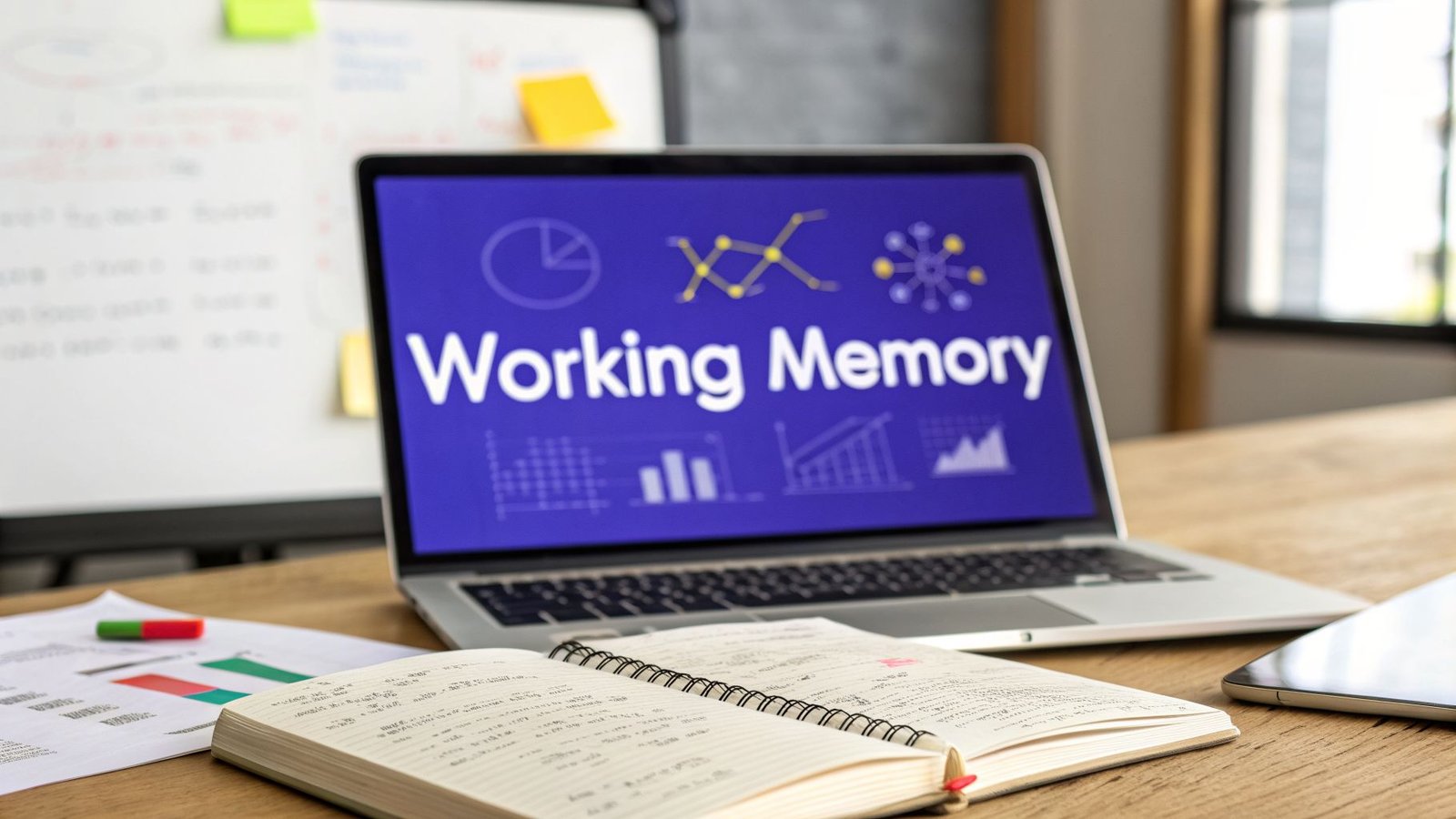
Working memory is the brain’s active workspace, a temporary holding area where you manipulate information to complete tasks, solve problems, and make decisions. It’s the mental notepad that holds a phone number while you find a pen, the cognitive engine that processes a colleague’s feedback during a meeting, and the focus filter that lets you follow a complex recipe. When it’s sharp, you feel clear, productive, and in control. When it’s overloaded, you experience brain fog, lose your train of thought, and struggle with simple mental tasks. Neuroscience research shows that this system, primarily managed by the prefrontal cortex, has a very limited capacity, which is why the feeling of juggling too many mental tabs is a direct symptom of working memory strain.
Working Memory Improvement Strategies That Reduce Cognitive Load and Boost Daily Focus
Improving this critical cognitive function isn’t about magical brain hacks or grueling mental gymnastics. It’s about implementing practical, evidence-based systems that reduce cognitive load and enhance your brain’s natural ability to process information. The working memory improvement strategies in this guide are designed for immediate application, helping you manage information more effectively without burnout. You will learn how to structure tasks to prevent overload, use powerful mnemonic techniques to encode information, and build daily habits that support sustained cognitive performance.
This article provides a comprehensive roundup of actionable techniques, moving beyond generic advice to give you step-by-step instructions grounded in cognitive psychology and neuroscience. We will cover short-term drills, long-term lifestyle adjustments, and smart ways to use external aids. Whether you’re a professional aiming for deeper focus, a student looking for better retention, or anyone feeling the strain of information overload, these strategies offer a clear path to a sharper, more reliable working memory.
Disclaimer: This article is for educational purposes only and is not a substitute for professional medical or psychological advice. If you are struggling with conditions like anxiety, depression, ADHD, burnout, or sleep problems, please consult a qualified healthcare provider.
1. Chunking to Improve Your Working Memory
Chunking is a powerful cognitive strategy for organizing information into smaller, meaningful units. This process significantly reduces the cognitive load on your working memory. Instead of trying to recall a long string of individual items, your brain groups related elements into a single “chunk.” This allows you to hold and process more complex information efficiently, making it one of the most effective working memory improvement strategies. This technique leverages the brain’s natural ability to detect patterns, a principle famously explored in psychologist George A. Miller’s research on memory capacity.
This method is more intuitive than it sounds and is something you already do daily. A phone number, for instance, isn’t remembered as ten separate digits (5551234567) but as three chunks (555-123-4567). This simple grouping makes the number vastly easier to recall.
Real-World Example: Applying Chunking
Imagine you have a long, unstructured to-do list for a new project. It feels overwhelming. Instead of tackling 20 individual items, you “chunk” them:
Chunk 2 (Drafting): Outline proposal, write first draft, create slides.
Chunk 3 (Review): Get feedback from team, revise draft, submit for approval.
Now, your brain only has to track three items, not twenty, making the project feel manageable.
Key Insight: Chunking works by creating meaningful connections between individual pieces of information. By assigning a higher-level meaning to a group of items, you only need to hold the “chunk” in your working memory, not every single component part.
By consciously implementing chunking, you can handle more complex data, reduce mental strain, and enhance your ability to focus on what truly matters. It’s a foundational skill for deep work and a cornerstone of efficient knowledge management. For more on structuring your focus, explore the principles in The Power of Clarity.
2. The Method of Loci (Memory Palace)
The Method of Loci, also known as the Memory Palace, is an ancient mnemonic technique that leverages your brain’s powerful spatial memory. It involves mentally placing information you need to remember along a familiar physical route, like your home or commute. By visualizing a journey through this space, you can retrieve information by “seeing” it where you left it. This method powerfully connects abstract data to concrete imagery, making it one of the most enduring working memory improvement strategies. Neuroscience shows this technique taps into the hippocampus, a brain region critical for both memory formation and spatial navigation.
This powerful technique was famously used by ancient Roman orators to recall long speeches without notes. By associating each point of their speech with a specific location in a villa, they could mentally “walk” through the space to remember the sequence. Modern memory champions use the same principle to memorize decks of cards and long strings of numbers.
Real-World Example: Applying the Memory Palace
Let’s say you need to remember the five key points for a presentation. You choose your apartment as your Memory Palace.
Front Door: Place the introduction here. Imagine a giant, flashing “Welcome” sign.
Entryway Table: The first key point (e.g., market trends). Picture a chart of rising trends sitting on the table.
Living Room Couch: The second key point (e.g., customer feedback). Visualize your clients sitting on your couch giving you a thumbs-up.
Kitchen Counter: The third key point (e.g., financial data). See stacks of money on the counter.
Back Door: The conclusion. Imagine a giant “The End” sign blocking the exit.
To recall your points, you simply “walk” through your apartment.
Key Insight: The Method of Loci works by translating difficult-to-remember information into a format the brain excels at: visual-spatial data. Creating bizarre or exaggerated mental images strengthens these associations, making recall nearly effortless.
By building and practicing with a memory palace, you can significantly expand the amount of sequential information you hold in your working memory. This ancient tool is a game-changer for public speaking, studying, and organizing complex tasks.
3. Spaced Repetition for Better Long-Term Recall
Spaced repetition is an evidence-based learning technique that leverages the “spacing effect” to transfer information from your short-term working memory into durable, long-term storage. Instead of cramming information in one session, this method involves reviewing it at increasing intervals over time. This process interrupts the natural forgetting curve, signaling to your brain that the information is important and reinforcing the neural pathways needed for recall. As a result, it is one of the most efficient working memory improvement strategies for retaining knowledge.
This technique, pioneered by psychologist Hermann Ebbinghaus, works by making your brain work just hard enough to retrieve the memory. Each successful retrieval at a progressively longer interval strengthens the memory’s trace, making it less likely to be forgotten. A software developer, for instance, might review a new coding pattern after one day, then three days, then a week, cementing the concept far more effectively than reading the documentation five times in one afternoon.
Real-World Example: Applying Spaced Repetition
You are learning key details about a new client. You create a few digital flashcards with their company name, key contacts, and business goals.
Day 1: You review the flashcards in the morning.
Day 2: You review them again.
Day 4: The app prompts you to review them.
Day 8: You get another prompt.
By the big meeting on Day 10, the information is solidly in your memory without any last-minute cramming. A simple habit tracker journal can help you stay consistent with these review sessions.
Key Insight: Spaced repetition optimizes learning by timing reviews at the precise moment you are about to forget something. This “desirable difficulty” forces your brain to work harder to retrieve the information, which in turn strengthens the memory for long-term retention.
By systematically spacing out your learning, you commit information to memory more effectively, reduce the need for last-minute cramming, and build a reliable foundation of knowledge. To learn more about building effective learning habits, explore the systems in Focus Recharged.
4. Active Recall & The Testing Effect Strategy
Active recall is a learning process centered on deliberately retrieving information from your memory. In contrast to passively rereading or reviewing material, this method forces your brain to actively reconstruct knowledge, creating much stronger neural pathways. Research on the “Testing Effect,” pioneered by scientists like Henry Roediger and Jeffrey Karpicke, demonstrates that the act of retrieval itself is a powerful memory enhancer. This effortful process is one of the most potent working memory improvement strategies because it solidifies information for long-term storage, freeing up working memory for new tasks.
This technique fundamentally changes how you interact with information. Instead of just recognizing familiar concepts, you are challenged to produce them from scratch. This cognitive effort signals to your brain that the information is important and worth holding onto, making it more accessible for future use.
Real-World Example: Applying Active Recall
After reading a chapter in a business book, instead of just highlighting passages:
Close the book.
Open a blank document or notebook page.
Write down everything you can remember from the chapter, including the main ideas and key examples.
This simple act forces your brain to retrieve the information, not just recognize it. This is why learning how to retain information when studying is so critical.
Key Insight: Active recall works because it treats your brain like a muscle. Each time you successfully retrieve a piece of information, you strengthen the neural connection to it, making it easier and faster to access the next time.
By making active recall a regular habit, you shift from being a passive consumer of information to an active participant in your own learning. This leads to more robust knowledge that you can depend on when you need it most. Discover more about building effective learning habits in How to Retain What You Read.
5. Working Memory Load Management (Cognitive Load Theory)
Cognitive Load Theory (CLT) is based on the scientific premise that working memory has a finite capacity. Developed by psychologist John Sweller, this theory suggests that learning and performance are optimized when tasks are designed to match this limit. Managing your cognitive load means actively reducing unnecessary mental processing, freeing up precious cognitive resources. This makes it one of the most essential working memory improvement strategies for knowledge workers. By consciously designing your workflow to minimize mental strain, you can enhance focus, reduce errors, and make better decisions.
This principle explains why a cluttered digital workspace feels so overwhelming. Every notification, open tab, and unnecessary visual element consumes a small piece of your working memory. In contrast, a minimalist environment allows your brain to dedicate its full capacity to the task at hand. It’s about working smarter, not harder, by aligning your tasks with your brain’s natural architecture.
Real-World Example: Applying Cognitive Load Theory
Your manager sends a complex email with five different requests buried in long paragraphs. Your working memory is immediately strained trying to track them all.
The Problem: High cognitive load.
The Solution: You copy each request into a numbered list in a separate task manager app.
By externalizing the information and simplifying its presentation, you’ve reduced the cognitive load. Now you can focus on completing one task at a time instead of holding all five in your head. A time blocking planner is perfect for visualizing and simplifying your schedule.
Key Insight: Your working memory is a finite resource. Cognitive Load Theory teaches you to treat it as such by intentionally removing distractions (extraneous load) and simplifying complex tasks (intrinsic load) so you can focus on what truly matters for growth and learning (germane load).
By managing your cognitive load, you prevent mental fatigue and create an environment where deep work can flourish. It is a foundational strategy for anyone looking to sustain high-level performance without burnout. To understand the consequences of ignoring these limits, you can learn more about what happens during cognitive overload.
6. Elaboration (Linking New Information to Existing Knowledge)
Elaboration is a cognitive process where you actively connect new information to your existing knowledge, creating a rich, interconnected web in your long-term memory. Instead of passively absorbing facts, you process them deeply by questioning, explaining, or finding analogies. This method strengthens retrieval pathways, making it easier to pull information back into your conscious mind. As one of the most robust working memory improvement strategies, it moves learning from rote memorization to genuine understanding, a concept rooted in Craik & Lockhart’s “Levels of Processing” theory in psychology.
This technique is about giving new data context and meaning. When a project manager relates a new agile methodology to a successful past project, they are using elaboration. They aren’t just learning rules; they are integrating the new framework into a pre-existing mental model of what works. This connection makes the new information stickier and more accessible.
Real-World Example: Applying Elaboration
You’re learning about a new software product your company is launching.
Passive Learning: Reading the feature list.
Elaboration: You ask yourself, “How is this new feature like the one in our old software, but better? How would my biggest client use this to solve their main problem?”
By linking the new information to your existing knowledge of clients and old software, you create a deeper, more meaningful understanding that’s easier to recall.
Key Insight: Elaboration transforms passive reception into active engagement. By forcing your brain to build connections, you are creating multiple mental hooks for the new information, making it significantly easier to recall and apply under pressure.
By making elaboration a habit, you not only improve your working memory but also deepen your expertise. This active learning approach is fundamental to improving your problem-solving skills and becoming a more insightful, adaptable professional.
7. Attention Restoration & Focused Attention Intervals (Pomodoro & Deep Work Blocks)
Focused attention intervals are a disciplined approach to managing your cognitive energy. This method involves structuring your work into dedicated blocks of intense focus followed by deliberate rest periods. This cyclical pattern prevents the cognitive fatigue that degrades working memory. By aligning with the brain’s natural ultradian rhythms, this is one of the most sustainable working memory improvement strategies for long-term productivity and mental clarity. This concept was famously explored by sleep researcher Nathaniel Kleitman and popularized in modern productivity by Cal Newport’s “Deep Work” and Francesco Cirillo’s Pomodoro Technique.
This strategy works by treating your attention like a muscle that requires both exertion and recovery. Instead of pushing through hours of continuous, low-quality work, you alternate between peak performance and complete rest. A common application is the Pomodoro Technique: 25 minutes of focused work on a single task, followed by a 5-minute break. This prevents mental overload and keeps your working memory sharp and ready for the next interval.
Real-World Example: Applying Focused Intervals
You have to write a complex report. Instead of staring at a blank page for two hours straight:
Set a pomodoro timer for 25 minutes. During this time, you only write—no emails, no phone, no distractions.
When the timer rings, you take a 5-minute break to stretch or grab a glass of water.
You repeat this cycle four times, then take a longer 20-minute break.
This structured approach keeps your focus sharp and prevents the burnout that clouds working memory.
Key Insight: The power of focused intervals lies in the quality of both the work and the rest. Protecting your attention from distractions during work blocks is just as important as protecting your breaks from work-related stimuli. This discipline is what restores your working memory capacity.
By adopting focused attention intervals, you can produce higher-quality work in less time, reduce mental fatigue, and maintain a high level of cognitive performance throughout the day. To learn more about the specifics of this popular technique, you can explore the Pomodoro method in detail.
Best Options for Getting Started with Working Memory Improvement
Deciding where to begin depends on your biggest challenge. Do you struggle with retaining new information or managing daily tasks? Here’s a quick comparison to help you choose.
Best For…
Start With This Strategy
Why It Works
Next Step
Busy Professionals
External Encoding
Immediately reduces mental clutter by offloading tasks and reminders to a trusted system.
8. External Encoding & Off-Loading (Writing, Diagramming, Digital Tools)
External encoding is the strategic practice of moving information out of your head and into an external, reliable format. This process, often called “off-loading,” dramatically reduces the strain on your working memory. Instead of juggling tasks, ideas, and complex details internally, you capture them in notes, diagrams, or digital tools. This liberates cognitive resources, making it one of the most practical working memory improvement strategies for busy professionals. The principle was famously systemized by productivity consultant David Allen in his Getting Things Done methodology, which emphasizes capturing everything in a trusted external system.
This behavioral psychology technique acknowledges that your brain is for having ideas, not for holding them. For remote workers, this might mean using Notion or Obsidian as a digital “second brain” to track projects and knowledge. For engineers, it means maintaining detailed documentation instead of relying on memory for complex system specs. By externalizing, you create space for deeper thinking, analysis, and creative problem-solving.
Real-World Example: Applying External Encoding
You’re in a meeting, and brilliant ideas and action items are flying around.
Without Off-loading: You try to remember everything. By the time you get back to your desk, you’ve forgotten half of it.
With Off-loading: You open a notes app or a productivity journal and jot down every idea and task as it’s mentioned.
Your working memory is now free to actively participate in the conversation instead of struggling to hold onto information.
Key Insight: Your working memory is a temporary, limited workspace, not a permanent storage drive. External encoding treats it as such, using reliable external tools for storage and retrieval so your mind can focus on high-value cognitive tasks like analysis and creativity.
By consistently off-loading information, you build a reliable system that supports your cognitive functions, preventing mental clutter and burnout. It’s a foundational habit for anyone looking to manage complex work effectively.
9. Interleaving (Mixed Practice Over Blocked Practice)
Interleaving is a potent learning technique where you mix different but related topics or skills during a single practice session. Instead of practicing one skill repeatedly before moving to the next (blocked practice), interleaving forces your brain to constantly retrieve and apply different solutions. This method strengthens neural pathways and improves your ability to distinguish between concepts, making it one of the most durable working memory improvement strategies. Research by cognitive psychologists like Doug Rohrer has consistently shown that this “desirable difficulty” leads to more robust, long-term learning.
This approach initially feels less intuitive and more challenging than mastering one thing at a time. For example, a sales professional might find it easier to practice handling pricing objections for an hour straight. However, mixing in practice on competitor-related and feature-related objections in the same session builds a more flexible and responsive skill set that better mirrors real-world client conversations.
Real-World Example: Applying Interleaving
You need to learn three different functions in a spreadsheet program (e.g., VLOOKUP, Pivot Tables, Conditional Formatting).
Interleaving: On Monday, you do one VLOOKUP problem, then one Pivot Table problem, then one Conditional Formatting problem, and repeat the cycle.
While it feels harder, interleaving forces your brain to choose the right tool for the job each time, leading to deeper, more flexible learning.
Key Insight: Interleaving enhances learning by forcing your brain to discriminate between different types of problems and select the correct strategy. This active retrieval and comparison process creates stronger, more flexible memories than the passive repetition of blocked practice.
By deliberately mixing your practice, you train your brain for the complexity of the real world, where problems rarely appear in neatly blocked categories. This cognitive workout is a powerful way to turn fragile knowledge into lasting skill. For more on building resilient focus, see the methods in Attention Unleashed.
Metacognition, or “thinking about your thinking,” is the practice of monitoring your own cognitive processes to adjust your strategies. This involves actively assessing what you know, identifying gaps in your understanding, and recognizing when you need to change your approach. This self-awareness prevents you from wasting cognitive resources on ineffective methods, making it one of the most sophisticated working memory improvement strategies. Research in educational psychology, pioneered by John Flavell, shows that well-calibrated metacognition is a key differentiator in efficient learning and problem-solving.
This strategy helps you distinguish between the feeling of familiarity and true comprehension. For example, after reading a complex report, you might feel like you understand it, but metacognition prompts you to actively test that assumption. This prevents the overconfidence described by researchers Dunning and Kruger in their famous behavioral studies, ensuring your working memory is allocated to mastering information, not just passively reviewing it.
Real-World Example: Applying Metacognition
You’re preparing for an important client presentation.
Without Metacognition: You read through your slides five times and feel confident because they look familiar.
With Metacognition: You read through your slides once, then turn away and try to explain the core message of each slide out loud. You quickly realize you’re fuzzy on slide #3, so you focus your remaining prep time there.
This self-monitoring identifies your actual weaknesses, allowing you to study more efficiently.
Key Insight: Strategic self-monitoring works by making your learning process an active, conscious effort. By regularly checking your confidence against objective evidence (like self-testing), you direct your working memory’s limited capacity toward areas that need the most attention, leading to more robust and reliable knowledge.
By consciously practicing metacognition, you transform from a passive information consumer into an active, strategic learner. This approach not only improves memory but also builds the intellectual humility required for continuous growth. For more on developing self-awareness in your professional life, see the frameworks in The Power of Clarity.
How to Choose the Best Working Memory Tools
Selecting the right tools can accelerate your progress. Here’s how a few popular options compare for different needs.
For Digital Organization: A time blocking planner is excellent for visual learners who need to structure their day. It helps manage cognitive load by laying out tasks clearly, so your brain doesn’t have to juggle a schedule internally. It’s a great first step for externalizing your day.
For Focused Work: A pomodoro timer is a simple but powerful device. Its non-digital, tactile nature helps create a clear boundary between work and rest. This is ideal for anyone easily distracted by phone timers or browser extensions.
For Consistent Habits: A habit tracker journal is perfect for implementing strategies like Spaced Repetition or Active Recall. The physical act of checking off a daily review session reinforces the behavior, making it more likely to stick.
For Reduced Distractions: For those who work in noisy environments, a good pair of noise canceling headphones can be a game-changer. They directly reduce the extraneous cognitive load from auditory distractions, freeing up working memory for the task at hand.
Editor’s Take
Let’s be honest: not all these strategies will work for everyone, and some require more effort than others. Based on our research and application, the most impactful strategies for immediate results are External Encoding and Focused Attention Intervals. Why? Because they don’t require you to fundamentally change how you learn, but rather how you manage your work. Simply offloading your to-do list and working in focused 25-minute sprints can dramatically reduce mental fog. These are best for busy professionals who feel overwhelmed. More complex techniques like the Memory Palace are incredibly powerful but best for specific goals, like memorizing a speech, rather than daily use. The key is to start small: pick one strategy, apply it for a week, and see how it feels.
Key Takeaways: From Theory to Daily Practice
The most critical insight to carry forward is that working memory is not a fixed trait but a dynamic skill. It responds directly to how you manage your attention, structure information, and care for your cognitive health.
Internal vs. External Strategies: A powerful approach combines strengthening your internal capacity (like using the Method of Loci) with smart external off-loading (like using a to-do list or digital tools). You don’t need to hold everything in your head; you just need a reliable system.
Active Engagement is Non-Negotiable: Passive learning is the enemy of strong working memory. Techniques like the testing effect and elaboration force you to actively engage with material, creating stronger neural pathways and making information stick.
Environment Shapes Performance: Your cognitive capacity is profoundly influenced by your surroundings. Managing distractions, implementing focused work blocks, and even reducing digital noise are fundamental working memory improvement strategies.
Be Proactive, Not Reactive: Instead of waiting for brain fog to set in, proactively design your workflow to support your working memory. Chunk projects, schedule focus blocks, and externalize reminders before you feel overwhelmed.
Disclaimer: The information in this article is for educational purposes only and should not be considered a substitute for professional medical or psychological advice. The affiliate links included help support our content creation at no extra cost to you.
Frequently Asked Questions (FAQ)
1. What is the fastest way to improve working memory?
The fastest strategy for immediate relief is External Encoding. By writing down tasks, ideas, and reminders in a trusted system (like a notebook or app), you immediately free up mental bandwidth. This reduces the cognitive load your working memory has to carry, providing a quick sense of clarity and focus.
2. Can working memory be permanently improved?
While you can’t increase its raw capacity, you can dramatically improve its efficiency. Consistent use of strategies like chunking, spaced repetition, and active recall builds stronger neural pathways for encoding and retrieval. This makes your use of working memory so effective that it feels like you have more of it.
3. How does sleep affect working memory?
Sleep is critical. During deep sleep, the brain consolidates memories, transferring important information from temporary stores (like working memory) to long-term storage. A lack of quality sleep impairs this process, leading to a noticeable decline in working memory function, focus, and clarity the next day.
4. Are “brain training” games effective for working memory?
Research suggests that while brain training games can make you better at the games themselves, this improvement often doesn’t transfer to real-world tasks. Strategies like active recall and managing cognitive load, which are applied directly to your work and learning, are generally more effective for practical working memory improvement.
5. How is working memory different from short-term memory?
Short-term memory is like a temporary storage folder; it simply holds information for a brief period. Working memory is an active workspace. It not only holds information but also manipulates, organizes, and uses it to complete a task, such as solving a math problem in your head or following a multi-step recipe.
Ready to build the focus and mental clarity that powers a high-performance mind? The strategies in this article are a fantastic start, and if you want to dive deeper into creating sustainable systems for productivity and well-being, explore the resources at Mind Clarity Hub. Our books, like The Power of Clarity, are designed to help you cut through the noise and unlock your full cognitive potential.
Free download: 7-Day Mind Clarity Reset
A short daily reset you can actually stick with (no fluff).
Answer in brief: Working memory improves when you lower cognitive load, externalize details, and schedule short retrieval practice—supported by sleep, movement, and calmer attention habits. No single app replaces these fundamentals.
Note: This section may mention tools. If you purchase via an existing affiliate link on this page, we may earn a small commission at no extra cost to you.
Workflow Map
Offload non-essentials (lists, calendar, templates)
Focus 25–40 min single task window
Quick retrieve (2–3 prompts)
Short rest (1–3 min)
Repeat; space reviews across the week
The 3–2–1 Working Memory Reset (5 minutes)
Use this anytime you feel mentally “tab‑cluttered.”
Three offloads (90 seconds): write the top 3 open loops you keep rehearsing. Move each to a next action on your task list or calendar. Your brain stops re‑holding what it trusts is parked.
Two cues (2 minutes): for the task you’re about to do, define two clear cues: (a) a single‑sentence outcome, (b) the very first action. Example: “Outline slide 1–3 for client review” → “Open deck; list three bullets for slide 1.”
One minute of preview (1 minute): look away from screens and mentally rehearse the next two steps. This gentle pre‑load reduces switching friction.
Then run a 25–40 minute focus block. End with a 60–90 second summary note so your future self can re‑enter without re‑thinking.
Practical examples in everyday contexts
Work meeting: Before the call, offload agendas and open questions to a shared doc. During the call, keep a narrow capture list with just decisions, owners, and due dates. After the call, schedule a 2‑minute review at +1 day to retrieve the three key decisions.
Studying a chapter: Chunk headings into 3–5 big ideas, close the book, and recall them from memory. Check what you missed, then re‑retrieve at +10 minutes and +1 day. Short retrieval beats rereading.
Remembering names: Hear the name, repeat it back once, create a quick visual link (“Rose” → imagine a rose on their name tag), and retrieve it twice during the conversation and once after you walk away.
Cooking a new recipe: Stage ingredients by step (mise en place), label bowls 1–4 for sequence, and keep only the current instruction visible. This removes clutter from working memory.
Toolbox: external aids vs. mental training—when to use which
External aids and mental drills are complements, not competitors. Use this simple comparison to choose wisely.
Use external aids when: details are numerous (dates, specs, steps), errors are costly, or tasks repeat. Examples: checklists, calendar blocks, email templates, kanban boards, sticky notes for “next actions.”
Use mental training when: you need flexible manipulation, quick recall, or concept linking. Examples: retrieval practice, spaced review, chunking, mnemonics, elaboration (explaining ideas in your own words).
Quick decision rule: If information is stable and referenceable, park it externally. If it must be transformed or combined right now, train it internally.
A simple 90‑day progression (evidence‑minded, practical)
This progression favors small, durable habits. Adjust timings to your context.
Weeks 1–2: Reduce load
Daily: Run the 3–2–1 Reset before your first deep‑work block.
Create two reusable checklists: (1) meeting notes template (decisions, owners, dates), (2) daily shutdown (capture, plan tomorrow’s first action, clear desk).
Sleep anchor: keep consistent wake time; protect the last hour before bed from heavy cognitive work to support next‑day working memory.
Weeks 3–6: Add gentle retrieval
For each key topic, schedule 3 micro‑reviews: +10 minutes, +1 day, +1 week. Each review = 2–3 questions or a 1‑minute free recall. Keep it short to avoid fatigue.
Names and facts: use a tiny spaced deck (paper or app) with 5–10 cards/day. Stop at “good enough” rather than perfection.
Movement microdose: 3–5 brisk minutes (stairs, walk, mobility) before a focus block can lift alertness without overstimulating.
Weeks 7–12: Strengthen flexibility
Concept linking: once per week, create a one‑page map connecting 3 ideas from different projects. You’re practicing manipulation, not just storage.
Switching hygiene: batch similar tasks; use 2 daily do‑not‑disturb windows (25–40 minutes). Protect them like meetings.
Review stack: at the end of each week, scan your notes and star only the 10% worth revisiting next week. Curate to keep load light.
Quick checklist for busy days
Before starting: define the outcome and first action in one sentence.
During: one screen, one window, one note.
After: 60‑second summary note; schedule +1 day micro‑review.
When stuck: run the 3–2–1 Reset.
Protect sleep and short movement breaks.
Fast fixes vs. foundations
Fast fixes help today: 3–2–1 Reset, single‑task windows, summary note, +10 minute recall.
Both matter. Use fast fixes to create space; invest it in foundations that make thinking feel lighter over time.
Working Memory FAQs
How long does it take to notice working memory improvements?
Many people feel less mental clutter within 1–2 weeks of offloading and single‑tasking. More durable changes from spaced retrieval and better sleep often build over 6–12 weeks. Timelines vary by workload, stress, and consistency.
Do brain‑training apps improve everyday working memory?
They can improve performance on the trained tasks. For everyday benefits, pair any app with real‑world retrieval (self‑quizzing), external aids (lists, templates), movement, and sleep. This combined approach is more transferable than apps alone.
Is multitasking actually hurting my working memory?
Rapid task‑switching increases cognitive load and error rates for most knowledge work. Try batching similar tasks, using do‑not‑disturb focus windows, and keeping a capture list so you can return to ideas without juggling them in your head.
What’s the best way to remember names without feeling awkward?
Focus on the person, repeat the name once, make a quick visual link, use it naturally in the conversation, and retrieve it again after 2, 10, and 60 minutes. Short, spaced recalls are more effective than rehearsing it nonstop.
Do I need supplements to support working memory?
Supplements are not required for most people. Start with sleep, stress reduction, hydration, and balanced nutrition. If you’re considering supplements or have underlying health conditions, consult a qualified clinician. Evidence for many products is mixed.
This content is educational and not medical advice. If memory concerns are persistent or impact daily functioning, consider speaking with a qualified healthcare professional.
Helpful resources for your next step
Affiliate disclosure: As an Amazon Associate, Mind Clarity Hub may earn from qualifying purchases at no extra cost to you. Use this link only if it genuinely helps your planning.
If 10 Powerful Working Memory Improvement Strategies to Boost Focus in 2026 is a routine you want to keep using, a simple workbook, planner, or desk tool can make the steps easier to repeat.
To provide the best experiences, we use technologies like cookies to store and/or access device information. Consenting to these technologies will allow us to process data such as browsing behavior or unique IDs on this site. Not consenting or withdrawing consent, may adversely affect certain features and functions.
Functional
Always active
The technical storage or access is strictly necessary for the legitimate purpose of enabling the use of a specific service explicitly requested by the subscriber or user, or for the sole purpose of carrying out the transmission of a communication over an electronic communications network.
Preferences
The technical storage or access is necessary for the legitimate purpose of storing preferences that are not requested by the subscriber or user.
Statistics
The technical storage or access that is used exclusively for statistical purposes.The technical storage or access that is used exclusively for anonymous statistical purposes. Without a subpoena, voluntary compliance on the part of your Internet Service Provider, or additional records from a third party, information stored or retrieved for this purpose alone cannot usually be used to identify you.
Marketing
The technical storage or access is required to create user profiles to send advertising, or to track the user on a website or across several websites for similar marketing purposes.