...

Tag: cognitive function

  • Supplements That Help With Brain Fog: A Guide to Mental Clarity

    Supplements That Help With Brain Fog: A Guide to Mental Clarity

    Affiliate Disclosure: This post contains affiliate links. If you purchase through these links, we may earn a small commission at no extra cost to you. We only recommend products we trust.

    Some of the most effective supplements that help with brain fog include Omega-3 fatty acids, certain B vitamins, and adaptogens like Rhodiola Rosea. They each work a little differently. For instance, they can cool inflammation, fuel brain cells, or help your body manage stress.

    What Is Brain Fog and Why Do You Feel It?

    Brain fog isn’t a formal medical diagnosis. However, it’s a frustratingly real experience for millions. It’s that feeling of wading through mental molasses. Concentrating feels impossible and your memory seems to have a fuzzy filter over it. For a deeper look at the signs, you can read more about understanding brain fog symptoms and what they mean.

    From a neuroscience perspective, that feeling usually points back to a handful of core issues. Your brain’s communication network might be sluggish or its energy supply might be running low.

    The Science Behind the Fog: Key Factors

    One of the biggest culprits is inflammation. Think of your brain’s neural pathways as a superhighway. When inflammation is high, it’s like having construction crews shut down lanes. This slows communication to a crawl. Your thinking gets sluggish and congested as a result.

    Another key factor is an imbalance in your neurotransmitters, the brain’s chemical messengers. If messengers like dopamine (for focus) or acetylcholine (for memory) are running low, important mental β€œpackages” get delayed or lost. This creates that classic feeling of being mentally stuck in first gear. This concept is a core part of building mental resilience, a topic explored in The Power of Clarity.

    Finally, poor blood flow can starve your brain of the oxygen and nutrients it needs to run smoothly. When that supply line is restricted, your cognitive horsepower naturally drops.

    Modern Life and Its Triggers for Brain Fog

    These biological glitches aren’t random. They’re often a direct response to the pressures of modern life. The chronic stress from a demanding job, for instance, can fuel persistent inflammation. This is a common theme in burnout, a condition we cover in our book Burnout Interrupted.

    Here are a few of the most common triggers we see:

    • Inadequate Sleep: Your brain has a brilliant janitorial system that cleans out metabolic waste while you sleep. Skimp on quality rest, and that gunk can build up, leaving you foggy.
    • Digital Overload: Constant pings, notifications, and screen time exhaust your brain’s attentional systems. It becomes much harder to maintain focus when your brain is perpetually on high alert.
    • Nutrient Gaps: Deficiencies in key vitamins and minerals can directly sabotage brain energy. It also affects the production of those crucial neurotransmitters.

    Mini-Scenario: Imagine Sarah, a project manager, staring at her screen. She’s rereading the same email for the fifth time. That experience isn’t a character flaw. It’s a direct outcome of a high-pressure job and too many digital distractions. Once you start connecting the dots, you can get a clearer sense of what causes brain fog in your own life.

    Important Note: This article is educational and is not a substitute for medical or psychological care. If your symptoms feel linked to burnout, anxiety, ADHD, or depression, please consult a healthcare provider.

    How to Choose the Best Supplements for Your Brain Fog

    Before you even think about buying supplements that help with brain fog, it’s important to have a strategy. It’s tempting to look for a quick fix in a bottle. However, lasting mental clarity is almost never found there. It’s built on a foundation of daily habits.

    The most reliable way to beat brain fog is to start with the fundamentals: sleep, diet, and stress. Think of supplements as a supporting cast, not the main character. They can help sharpen the picture, but only after you’ve adjusted the antenna.

    Mini-Scenario: Imagine an entrepreneur named David who’s been hearing a lot about nootropics. He’s drowning in options and has no idea where to start. His first move shouldn’t be to add something to his cart. Instead, he needs to look at his actual life. Is he getting enough sleep? Is his diet full of brain-supporting foods? How is he handling stress? This is the real starting line.

    A flowchart illustrating brain fog triggers like stress, poor sleep, and digital overload, and potential solutions.

    As the decision tree above shows, common culprits like stress and poor sleep are often the root cause. The first step toward a real solution is figuring out your primary trigger.

    A Practical Framework for Selecting the Best Supplements That Help With Brain Fog

    Once you’ve started shoring up those lifestyle foundations, you can look at supplements in a much more intelligent way.

    David realizes his biggest problem is inconsistent sleep, which torpedoes his focus. Instead of a generic β€œbrain booster,” he researches single ingredients for rest and cognition. This is a much safer and more effective path.

    Here’s a practical process you can follow to do the same:

    • Research One Ingredient at a Time: Don’t get overwhelmed by complex formulas. Pick one compound, like a specific B-vitamin, and get to know what it does. Dig into its function and science. Learn more in our guide on the best time of day to take vitamin B-12.
    • Check for Quality and Safety: The supplement industry is notoriously under-regulated. Look for products with third-party testing seals from organizations like NSF or USP. These certifications ensure purity and potency.
    • Start Low and Go Slow: Always begin with the lowest effective dose to see how your body responds. You can use a simple habit tracker journal to note any changes in your energy and focus. This creates your own personal data.
    • Talk to a Professional: This step is non-negotiable. Before you start anything new, run it by your doctor or a pharmacist. They can screen for potential interactions with medications you’re taking. They can also give you advice tailored to your health history.

    This methodical approach helps you move from being a passive consumer to an informed partner in your own health. You start making choices that genuinely support your brain.

    Evidence-Backed Supplements That Help With Brain Fog

    When your thinking feels muddy, it’s natural to look for help. The supplement aisle can be confusing, but certain compounds really do have solid science behind them. The demand is hugeβ€”the brain health supplement market in North America alone was projected to reach USD 1.22 billion by 2025.

    Let’s cut through the marketing noise. We’ll focus on what the research actually says about the most promising options for supporting mental clarity.

    Supplements that help with brain fog shown as various science-backed pills and capsules on a desk beside a document, bottle, and glasses.

    Omega-3 Fatty Acids (EPA & DHA)

    Omega-3s are true superstars for brain health, especially the DHA and EPA in high-quality fish oil. This makes sense when you remember your brain is nearly 60% fat. A huge portion of that is DHA. It’s a fundamental building block for your brain cell membranes.

    Think of DHA as the premium oil that keeps your brain’s machinery running smoothly. It ensures neuron membranes stay flexible. This is critical for sending and receiving signals efficiently. Both EPA and DHA also bring powerful anti-inflammatory properties to the table. They help cool down the low-grade inflammation that often contributes to a foggy mind.

    B Vitamins For Brain Energy and Less Brain Fog

    The B-vitamin familyβ€”particularly B6, B9 (folate), and B12β€”are workhorses for cognitive function. They act as essential helpers in countless metabolic processes. This includes the all-important job of producing energy inside your brain cells.

    Mini-Scenario: Imagine Maria, a college student prepping for finals who feels sluggish. She starts a B-complex supplement and tracks her energy in her productivity journal. After a few weeks, she notices a steady improvement in her concentration during long study sessions. That’s because B vitamins are crucial for turning food into cellular fuel and for making neurotransmitters like dopamine and serotonin.

    It’s also worth noting how gut health connects to this. A healthy microbiome is essential for B vitamin production and absorption. You can learn more about how probiotic supplements for gut health can play a supporting role.

    Adaptogens and Nootropics for Sharper Focus

    This category includes natural compounds that help your body adapt to stress and sharpen cognitive performance. They’re not magic pills. But they can provide targeted support when your brain feels drained.

    • Rhodiola Rosea: This is a classic adaptogenic herb known for fighting mental fatigue. Research shows it helps balance the body’s stress-response system. It makes you more resilient to the fogginess that comes from burnout.
    • Lion’s Mane Mushroom: This functional mushroom is getting a lot of attention for its ability to stimulate Nerve Growth Factor (NGF). NGF is a protein that encourages the growth and maintenance of your neurons. This unique mechanism makes Lion’s Mane a promising tool for supporting focus and memory.
    • Magnesium: This mineral is a quiet hero, involved in over 300 biochemical reactions in the body. Many of these happen in the brain. Some people find that taking a quality magnesium glycinate supplement before bed helps quiet their mind. A specific form, Magnesium L-Threonate, is celebrated for its ability to cross the blood-brain barrier effectively. It may enhance synaptic plasticityβ€”the ability of brain connections to grow and change.

    Comparison: How to Choose Supplements That Help With Brain Fog

    When choosing a supplement, it helps to match the ingredient to your primary goal. Use this table to decide whether you’re looking to reduce stress-related fog, improve memory, or boost overall cognitive energy. Ready to find the right fit? Compare options below.

    SupplementPrimary BenefitBest ForEvidence Strength
    Omega-3s (DHA/EPA)Reduces inflammation, supports cell membranesOverall long-term brain health and moodStrong
    Magnesium L-ThreonateImproves brain plasticity and memoryAge-related cognitive decline and learningModerate to Strong
    Lion’s Mane MushroomStimulates nerve growth factor (NGF)Focus, memory, and nerve healthEmerging to Moderate
    Rhodiola RoseaAdaptogen; reduces fatigue under stressProfessionals dealing with burnout and mental fatigueModerate

    This table provides a snapshot, but individual responses can vary. For those whose cognitive changes are linked to hormonal shifts, specific guidance on the best supplements for menopause brain fog can be especially helpful.

    What Nootropics Actually Work for Focus?

    The word β€œnootropics” often brings up images of synthetic β€œsmart drugs.” However, some of the most reliable and well-researched cognitive enhancers are actually natural compounds. Instead of trying to hotwire your brain, they work with its existing chemistry. They help sharpen focus and calm distraction. Here, we’ll look at a few options that have solid evidence behind them.

    The demand for a mental edge is real. The global brain health supplements market is already massive. It was projected to grow from USD 12.6 billion in 2025 to USD 13.99 billion in 2026. Nootropics make up a huge 50% of that market. This shows just how many people are looking for support.

    A desk scene with a 'FOCUS STACK' box, Lion's Mane supplements, a tea cup, and a laptop with supplements that help with brain fog on the screen.

    The L-Theanine and Caffeine Synergy

    One of the most popular and evidence-backed pairings for focus is L-theanine and caffeine. L-theanine is an amino acid found in green tea. On its own, it’s known for promoting calm alertness. It works by increasing alpha brain wavesβ€”the same brain waves associated with relaxed, meditative focus.

    When you pair L-theanine with caffeine, it brilliantly smooths out the rough edges. It can take the jittery, anxious feeling from a strong cup of coffee and dial it down. It does this all while preserving the stimulant’s powerful focus-boosting effects. The result is a clean, smooth energy that’s perfect for deep work.

    How a Simple Focus Stack Works in Real Life

    Mini-Scenario: Imagine a freelance writer who needs to block out the world and write for three solid hours. She might start her morning with her usual coffee and an L-theanine capsule. This simple β€œfocus stack” helps her ease into her work without feeling wired or anxious.

    To give her session more structure, she also uses a pomodoro timer, working in focused 25-minute sprints. This is a perfect example of combining a smart supplement strategy with a proven productivity technique. This kind of layered approach is a core theme in our guide on improving focus and concentration. You can also see the book that fits your goal by exploring our focus and productivity titles.

    A Note on Safety: While many natural nootropics are generally safe, we strongly advise against using unregulated synthetic nootropics. These compounds often lack long-term safety data and can carry significant risks. Always stick to well-researched ingredients from trusted sources.

    Best Nootropic Option for Beginners

    If you’re just starting to explore nootropics, it’s always best to begin with single, well-understood ingredients. This way, you can see how your body responds to one thing at a time. L-Theanine is an excellent starting point. You can try it alone for calm focus or pair it with your morning coffee. This allows you to see if it enhances the effects and reduces any jitters. This simple, single-ingredient approach is often the smartest first step.

    Editor’s Take: What Actually Works to Get Rid of Brain Fog

    Let’s be honest: no pill can ever replace the fundamentals of a clear mind. While certain supplements that help with brain fogβ€”like Magnesium L-Threonate or high-quality Omega-3sβ€”have solid science behind them, it’s best to think of them as β€˜helpers,’ not β€˜heroes.’

    True mental clarity is built on a foundation of 7–9 hours of quality sleep, a nutrient-rich diet, regular physical activity, and proactive stress management. Nothing works without these pillars in place. To get a better handle on these foundations, a time blocking planner can be a game-changer for scheduling sleep and exercise.

    Supplements are most effective for people who already have those fundamentals dialed in but still need an extra edge, or for those addressing a specific nutrient deficiency confirmed by a doctor. They are not a quick fix for chronic burnout, anxiety, or depression. Those conditions are complex and require professional support from a qualified clinician.

    To build the foundational habits that make any supplement truly effective, I recommend starting with the frameworks in my book, The Power of Clarity. For a deeper look at how we vet products, check our guide to product reviews and science deep dives.

    Key Takeaways: Supplements That Help With Brain Fog

    • Foundations First: Prioritize sleep, nutrition, and stress management. Supplements are support, not a substitute for healthy lifestyle habits.
    • Target Your Needs: Choose supplements based on your specific issue. Use Omega-3s for inflammation, B vitamins for energy, and adaptogens for stress.
    • Quality Matters: Always select supplements with third-party testing (like NSF or USP seals) to ensure purity and potency.
    • Start Simple: Introduce one new supplement at a time. This helps you gauge its effectiveness and monitor for any side effects.
    • Consult a Professional: Always talk to your doctor before starting any new supplement. This ensures safety and prevents interactions with other medications.

    Final Disclaimer and Affiliate Notice

    This article contains affiliate links, which means we may earn a small commission on purchases at no extra cost to you. The content provided here is for educational and informational purposes only and does not constitute medical or psychological advice. Always consult with a qualified healthcare professional before making any decisions about your health or treatment.

    Frequently Asked Questions About Supplements for Brain Fog

    Here are some straightforward answers to the questions we hear most often about using supplements for brain fog.

    How long does it take for brain fog supplements to work?

    There’s no magic timeline. How long it takes depends on the person, the supplement, and the root cause of the fog. Some people feel a subtle shift in energy within a few weeks. For others, it could take several months of consistent daily use to notice a real difference, especially with compounds like Omega-3s.

    Can I take multiple supplements for brain fog at once?

    It’s almost always better to introduce them one at a time. This is the only way you can accurately figure out how your body is responding to each one. If you start three new supplements and feel better, you won’t know which one helped. Always talk to your healthcare provider before combining supplements to check for potential interactions.

    Are lifestyle changes more effective than supplements?

    Yes. Full stop. The most powerful tools for clearing brain fog are foundational lifestyle habits. No pill can outperform the benefits of consistent, high-quality sleep, a balanced diet, and real stress management. A good sleep mask blackout and a non-negotiable bedtime will do far more for focus than any supplement if you’re sleep-deprived. Building those habits is always the first step. For a deeper dive on this, my book Restful Nights offers a clear roadmap.

    What is the best supplement to start with for general brain fog?

    This depends on your situation, but a great starting point is a high-quality Omega-3 supplement with a good amount of DHA. Its role in building brain cell membranes and tamping down inflammation makes it a strong choice. Another excellent option is a B-Complex vitamin, as deficiencies in these are common and directly impact mental energy.

    When should I see a doctor about my brain fog?

    You should consult a healthcare professional if your brain fog is severe, persistent, or gets worse suddenly. It’s also a red flag if it shows up with other concerning symptoms like persistent headaches, debilitating fatigue, significant mood changes (like new anxiety or depression), or memory loss that interferes with daily life. These could be signals of an underlying medical condition that needs a proper diagnosis and treatment.

  • Magnesium Malate vs Glycinate for Focus, Sleep, and Energy

    Magnesium Malate vs Glycinate for Focus, Sleep, and Energy

    When you’re trying to decide between magnesium malate and magnesium glycinate, the best choice really comes down to what you’re trying to fix. For quieting a racing mind, dialing down stress, and getting better sleep, magnesium glycinate is almost always the winner. But if your main goal is to boost physical energy and fight off muscle fatigue, magnesium malate is the form you want.

    Affiliate Disclosure: Purchases made through links in this article may generate a small commission at no extra cost to you. This helps support our research and content creation.

    Educational Disclaimer: This article is for informational purposes only and is not a substitute for professional medical or psychological advice, diagnosis, or treatment. If you are dealing with concerns like anxiety, depression, or sleep problems, please consult a qualified healthcare provider. This content is not intended to diagnose, treat, or cure any condition.

    Best Magnesium Option for Your Performance Goals

    Navigating the world of supplements can feel like a part-time job. However, zeroing in on the right form of a nutrient can make a world of difference. When it comes to magnesium, picking the right type isn’t just about getting more of the mineral. It’s a strategic tool for fine-tuning your mental and physical performance.

    Two of the most popular and effective forms are magnesium malate and magnesium glycinate. Both are chelated, which means they are bound to an amino acid. This binding makes them highly bioavailable. Your body can actually absorb and use them without the digestive upset common with cheaper forms like magnesium oxide.

    Yet, despite both being excellent, they serve very different purposes.

    A home office desk with a magnesium supplement bottle, a glass of water, and a keyboard, illustrating the choice of magnesium malate vs glycinate.

    The choice between them really boils down to matching the supplement to your daily challenges.

    How to Choose Between Magnesium Malate vs Glycinate Based on Your Goals

    Are you trying to fight off that 2 PM slump and power through your workday? Or is your goal to quiet a busy brain so you can get truly restorative sleep? Understanding how each form works is the key to making a smart decision.

    For example, a freelance writer might struggle with mental chatter that derails their focus. In this case, magnesium glycinate could help quiet that β€œnoise.” Conversely, a retail worker on their feet all day might benefit more from magnesium malate to combat physical exhaustion.

    If you’re struggling with general mental fogginess, you might also find it helpful to look into other vitamins to help with brain fog. This guide gives you an evidence-backed comparison to help you choose wisely. For a quick overview, check out this comparison.

    Quick Comparison: Magnesium Glycinate vs Magnesium Malate

    FeatureMagnesium GlycinateMagnesium Malate
    Primary GoalCalm, relaxation, sleepEnergy, muscle function
    Best ForStress, anxiety, winding downFatigue, soreness, focus
    Time of DayEvening or bedtimeMorning or afternoon

    This side-by-side view makes the main distinction clear. Think glycinate for mental calm and malate for physical get-up-and-go. Ready to find your fit? Compare options now.

    Why Magnesium Is Essential for Your Brain and Body

    Before we can really get into the magnesium malate vs. glycinate debate, we need to take a step back. We must understand why this mineral is so foundational in the first place. Think of magnesium as a master key for your body’s biochemistry. It’s a helper moleculeβ€”or cofactorβ€”in more than 300 essential reactions. These control everything from your heartbeat to your ability to think clearly.

    When your magnesium levels drop, key systems start to lag. This often shows up as frustratingly common complaints. You might experience persistent brain fog, dragging energy levels, and restless nights. Because many modern diets are low in magnesium, a deficiency can go unnoticed. Routine blood work doesn’t always screen for it, either.

    This is especially true for busy professionals. They might just write off their afternoon slump or irritability as the cost of a demanding job. But these issues are often rooted in biochemistry, not just a heavy workload. For example, relying on caffeine to push through fatigue is a common habit. However, it only masks the underlying need for cellular energy support.

    Your Brain’s On-Off Switch: A Look at Magnesium Malate vs Glycinate

    Magnesium plays a fascinating dual role in the brain. It manages both your energy production and your ability to find calm. From a neuroscience perspective, it acts as a critical gatekeeper for your brain’s N-methyl-D-aspartate (NMDA) receptors.

    These receptors are central to learning, memory, and brain plasticity. When they get overstimulated by the neurotransmitter glutamate, your nerve cells can become over-excited. This leads to that familiar feeling of anxiety, mental restlessness, and an inability to truly focus.

    Magnesium steps in to naturally block these NMDA receptors, preventing over-excitation. This action helps quiet the mental β€œnoise” that shatters productivity. It allows you to shift from scattered reactivity to intentional clarity. It’s a core theme we explore in our book, The Power of Clarity.

    On the other side of the coin, magnesium is indispensable for creating adenosine triphosphate (ATP). ATP is your body’s primary energy currency. Every single one of your cells, from muscle fibers to neurons, runs on it. A great ergonomic mouse might save your wrist, but only proper cell fuel can sustain your focus.

    As you can see, without enough magnesium, your body simply can’t generate the fuel it needs. This directly explains why low levels can leave you feeling physically and mentally drained long before the day is over.

    Magnesium Glycinate: Best for Calm Focus and Restful Sleep

    While magnesium malate is a powerhouse for physical energy, magnesium glycinate is the go-to choice for your mind. In the magnesium malate vs glycinate debate, glycinate shines for its calming influence on the nervous system. This form is chelated, meaning the magnesium is bound to glycine. Glycine is an amino acid known for its own relaxing properties.

    This smart pairing helps the magnesium cross the blood-brain barrier more easily. It also gives you the extra benefits of glycine. The result is a highly bioavailable supplement that’s also famously gentle on the stomach.

    The Neuroscience of Calm: How Glycinate Helps

    Glycine itself acts as an inhibitory neurotransmitter in the brain. Think of it as a dimmer switch for the overactive neural circuits that fuel stress and anxious thoughts. It works by boosting the effects of GABA, which is essentially the brain’s main β€œoff switch.”

    When you’re under constant pressure, your brain can get stuck in a state of overstimulation. Magnesium glycinate helps dial back that mental noise. This restores balance and paves the way for calm focus. It’s an ideal choice for professionals looking to unwind after a demanding day.

    For example, taking a magnesium glycinate supplement in the evening can quiet a racing mind. This makes the transition to sleep feel much smoother. It works similarly to using a sleep mask blackoutβ€”both create signals for your brain that it’s time for deep, restorative rest.

    A bedside table with a sleep spray bottle and a sleep mask, illustrating how to prepare for rest when considering magnesium malate vs glycinate.

    This kind of deliberate ritual is a key strategy for regulating the nervous system. It is crucial for preventing burnout and maintaining long-term performance.

    Research on Magnesium Glycinate and Mental Well-being

    This calming effect isn’t just a feeling; it’s backed by clinical research. One systematic review found that five out of seven studies noted improvements in self-reported anxiety with magnesium supplementation. Evidence even points to the potential for rapid recovery from certain mood-related symptoms. This can occur within as little as 7 days of consistent use.

    This makes it an excellent tool for anyone wrestling with the cognitive load of a modern career. If your mind gets particularly active when your head hits the pillow, our guide on managing anxiety at bedtime offers more strategies that pair perfectly with glycinate.

    Magnesium Malate: Best for Energy and Physical Vitality

    While magnesium glycinate is the go-to for calming a busy mind, magnesium malate shines for physical energy. In the magnesium malate vs glycinate debate, this is where the lines are drawn most clearly. Malate is all about fueling your body.

    This form of magnesium is bound to malic acid, a natural compound found in fruits like apples. That specific pairing makes it so useful for physical performance. Malic acid is a key player in the Krebs cycleβ€”your body’s core engine for turning food into cellular energy, or ATP.

    Fueling Your Body’s Engine with Magnesium Malate

    If you feel physically drained or your muscles ache after little effort, it can be a sign. Your cellular energy production might be struggling to keep up. Magnesium malate steps in to directly support this process. It helps your body create the fuel it needs to run smoothly.

    This makes it an excellent choice for pushing back against deep physical fatigue. It can also improve your overall stamina. Of course, topping up cellular energy is just one part of the puzzle. Smart strategies like optimizing post-workout recovery are also crucial for anyone active.

    A fitness setup with running shoes and an 'ENERGY BOOST' sign, representing the benefits of magnesium malate in the magnesium malate vs glycinate choice.

    When your energy systems are well-supported, it’s easier to stay active and productive. This applies whether you’re at the gym or just trying to get through a long workday.

    Magnesium Malate: Ideal for Physical Fatigue and Muscle Support

    Think about someone who uses an under desk walking pad to stay active. They might still find themselves hitting a wall of muscle fatigue by the afternoon. This is a perfect scenario where magnesium malate could make a real difference. By helping to ramp up ATP production, it can ease muscle soreness and fight exhaustion.

    Magnesium malate’s role in energy metabolism makes it a powerful tool. It’s great for anyone feeling physically run down from daily life, intense exercise, or chronic conditions.

    It has also been explored in research for conditions tied to both fatigue and muscle pain, like fibromyalgia. Its ability to boost energy and help relax muscles gives it a unique edge. This ties directly into the larger picture of how your body creates and uses fuel, a core part of mitochondrial renewal and fat metabolism.

    So, if your main complaints are feeling tired, sluggish, or sore, magnesium malate is almost always the better pick in the magnesium malate vs glycinate matchup.

    How to Choose: Magnesium Malate vs Glycinate

    So, you’re standing at the supplement aisleβ€”or scrolling online. You’re staring at two popular forms of magnesium. Malate or glycinate? It can feel like a toss-up, but the choice is actually simpler than it seems.

    The real question is: are you trying to calm your mind or fuel your body? While both are fantastic, highly absorbable forms of magnesium, they work in different arenas. One targets your brain and nervous system. The other focuses on your muscles and cellular energy. Your best bet is to pick the one that aligns with your main goal.

    Quick Comparison: A Deeper Dive into Magnesium Glycinate vs Magnesium Malate

    To make the right call, it helps to see their core strengths side-by-side. Think of this table as a quick cheat sheet. It will help you match the right magnesium to your daily challenges.

    FeatureMagnesium GlycinateMagnesium Malate
    Primary BenefitCalming, relaxation, sleep support, anxiety reductionEnergy production, muscle relaxation, reduces fatigue
    Best ForStress, anxiety, poor sleep, mental restlessnessLow energy, muscle soreness, physical fatigue
    Best Time to TakeEvening or bedtime to promote relaxation and sleepMorning or early afternoon to support energy levels
    MechanismGlycine acts as an inhibitory neurotransmitter in the brainMalic acid is a key part of the cellular energy (ATP) cycle
    Digestive EffectsVery gentle, minimal laxative effectGenerally gentle, can have a mild laxative effect

    As you can see, the main difference is your goal. Magnesium glycinate is your go-to for calming down the nervous system. Meanwhile, magnesium malate is built to fire up your body’s energy production.

    Why Bioavailability Matters for Your Magnesium Choice

    Another key piece of the puzzle is bioavailability. This is how much of the mineral your body can actually absorb and use. Here, magnesium glycinate has a clear edge.

    Studies show its absorption rates can reach 90-95%. This is significantly higher than the 70-80% seen with magnesium malate. For anyone looking for sustained mental clarity, that difference is huge. The chelated structure of glycinate acts like a protective escort. It shields the magnesium through your gut so more reaches your brain. You can read more on these absorption findings to dig into the science.

    The image below gets straight to the point: glycinate is for rest, and malate is for action.

    This really sums it up. Choose glycinate for evening calm and better sleep. Or, grab malate for daytime energy and physical recovery. This choice is as strategic as using a time blocking planner to organize your day.

    Of course, you don’t have to choose just one. Some people get the best of both worlds. They take magnesium malate in the morning for a clean energy boost. Then, they take a magnesium glycinate supplement at night to unwind. This strategic timing is key for getting the most from supplements. This principle applies to other nutrients, too. If that sparks your curiosity, you might find our guide on the best time of day to take Vitamin B12 helpful.

    Editor’s Take: What Actually Works with Magnesium Malate vs Glycinate

    So, after all the science, what’s the real-world answer? For most people I’ve worked with who feel mentally wired, stressed, or can’t quiet their minds, magnesium glycinate is the most reliable starting point. Its gentle, high-absorption formula is fantastic for supporting sleep and managing feelings of anxiety, making it best for professionals, students, and parents navigating high-pressure lives.

    However, if your primary complaint is physicalβ€”that deep-in-your-bones fatigue or muscle sorenessβ€”then magnesium malate is a more direct tool. It’s best for active individuals, people with physically demanding jobs, or anyone dealing with conditions where energy production is a key issue. The main caveat is that its benefits are more about physical stamina than mental calm. Don’t expect it to quiet a racing mind at bedtime. You can browse the library for more strategies on managing mental energy.

    Key Takeaways: Magnesium Malate vs Glycinate

    Here are the essential points to guide your decision:

    • Choose Glycinate for Calm: If stress, anxiety, or poor sleep quality is your main issue, reach for magnesium glycinate. It’s best taken in the evening to help your mind and body wind down.
    • Choose Malate for Energy: If physical fatigue, low stamina, or muscle pain is what you’re trying to solve, opt for magnesium malate. It’s most effective when taken in the morning or before a workout.
    • Glycinate Has the Absorption Edge: Magnesium glycinate is slightly better absorbed. This gives it an advantage for delivering neurological benefits quickly and gently.
    • Let Your Symptoms Decide: The best form of magnesium is the one that directly addresses your problem. Listen to what your body needs most.

    If quieting a racing mind is your top priority, you might find value in the strategies from our book, Restful Nights. For those more focused on rebuilding stamina, our guide on managing energy, not time offers a deeper framework.

    Flowchart to choose between magnesium malate vs glycinate: Malate for energy or Glycinate for calm.

    As you can see, your core goal is the most important factor. Everything else is secondary.


    Disclaimer: This article contains affiliate links, which may generate a small commission at no extra cost to you. The content provided is for educational and informational purposes only and does not constitute medical or psychological advice, diagnosis, or treatment. Always consult a qualified healthcare professional before starting any new supplement regimen or for any health concerns.

    Magnesium FAQ: Your Questions, Answered

    Making sense of supplements can feel like a project in itself. Here are some honest, straightforward answers to the questions that come up most often when choosing between magnesium malate and glycinate.

    Can I take magnesium malate and glycinate together?

    Absolutely. In fact, many people find this is the best way to get the benefits of both. A common approach is to take magnesium malate in the morning to support daytime energy. Then, take magnesium glycinate in the evening to help your mind and body wind down for sleep. This strategy lets you target different needs at different times. Just be mindful of your total daily intake of elemental magnesium to stay within a healthy range.

    How long does it take for magnesium to work?

    This depends on your body and your goals. For the calming effects of magnesium glycinate, some people feel a shift within a few days to a week. You might notice it’s easier to fall asleep or you feel less on-edge. For the energy support from magnesium malate, it can take a bit longer, maybe a couple of weeks. That’s because it’s helping your cells produce energy more efficiently, which builds over time. Consistency is key.

    What is a good starting dose for magnesium?

    A typical daily dose for either form is usually between 200–400 mg of elemental magnesium. It’s very important to read the supplement label. Sometimes the large number on the front is the total compound (e.g., magnesium glycinate), not the amount of actual elemental magnesium. It’s always smart to start on the lower end of the dosage range. Also, consult your doctor to determine the right dose for your needs.

    Are there any side effects to worry about with these magnesium types?

    Both magnesium malate and glycinate are known for being incredibly gentle. When people compare magnesium malate vs glycinate, glycinate often gets top marks for being easy on the stomach. It has almost no laxative effect. This is a big contrast to forms like magnesium oxide or citrate. Those are much more likely to cause digestive upset. As long as you stick to the recommended dose, side effects are rare.

    Can’t I just get enough magnesium from my food?

    While you can get magnesium from food, it’s getting harder. Modern farming practices have left much of the soil depleted of minerals. Food processing can also strip them out. So, even a healthy diet might not be enough. Leafy greens, nuts, seeds, and beans are fantastic sources. However, if you’re dealing with high stress or have specific health goals, supplementing can be an effective way to ensure you’re getting an optimal amount. To improve your sleep, pair a supplement with strategies from our book, Restful Nights.

  • What Is the Best Time of Day to Take Vitamin B12 for Energy and Focus?

    What Is the Best Time of Day to Take Vitamin B12 for Energy and Focus?

    Affiliate Disclosure: This article may contain affiliate links. If you make a purchase through these links, we may earn a small commission at no extra cost to you. We only recommend products we trust and believe will add value to our readers.

    For most people, the verdict is in: the best time of day to take vitamin b12 is in the morning, right after you wake up. Taking it with a glass of water on an empty stomach gives it the best shot at absorption. This timing also syncs nicely with your body’s natural energy cycles. It can set you up for a more focused and alert day.

    Why Timing Your Vitamin B12 Intake Is Crucial

    You have a vitamin B12 supplement on your counter, but just remembering to take it isn’t the whole story. When you take it can make a huge difference in how well it works. From a behavioral psychology perspective, this is about habit stacking. You link a new habit (taking a vitamin) to an existing one (waking up). This simple action gets your brain and body ready for the day ahead.

    This guide isn’t about generic wellness tips. We’re going to get into the science of B12 timing. We will explore how it works with your body’s internal clockβ€”your circadian rhythm. Nailing this relationship is the key to unlocking the full potential of your supplement. This can lead to sustained energy and mental clarity.

    This article is for educational purposes only. It is not a substitute for professional medical or psychological advice, diagnosis, or treatment. Always seek the advice of your physician or another qualified health provider with any questions you may have regarding a medical condition. Do not disregard professional medical advice or delay in seeking it because of something you have read here.

    What You Will Learn in This Guide

    This article is for busy professionals, students, or anyone looking to sharpen their cognitive edge. We’ll give you science-backed strategies you can put into practice immediately.

    Here’s a quick look at what we’ll cover:

    • Maximizing Absorption: Why an empty stomach first thing in the morning is the gold standard.
    • Energy and Sleep: How B12 can either power your day or mess with your night.
    • Actionable Tips: Simple, real-world routines you can actually stick with.
    • Dosage and Forms: Figuring out what works best for your specific needs.

    Knowing when to take B12 is a huge piece of the energy puzzle. For a wider view on how different nutrients fit in, you can check out guides to the best vitamins for energy. Our goal here is to give you the knowledge to make smart decisions. This turns that little pill into a powerful tool for managing your energy, not just your time.

    A hand holds a white pill above a glass of water on a sunlit kitchen counter, highlighting the best time of day to take vitamin b12 with a simple daily routine.

    The Best Time of Day to Take Vitamin B12 For Peak Absorption

    To get why morning is the undisputed best time to take vitamin B12, we need to look at how your body actually uses it. The whole process hinges on a special protein your stomach makes called Intrinsic Factor (IF).

    Think of Intrinsic Factor as a dedicated ferry service. It is designed for one job and one job only: to shuttle B12 from your gut into your bloodstream where it can get to work. From a neuroscience perspective, this is the first crucial step for B12 to support neuron health and cognitive function.

    When you wake up after fasting all night, your stomach is empty. This means the IF ferry is also empty, docked, and ready for its first and most important passenger. Taking your B12 with a simple glass of water gives it VIP treatment. It gets a clear, unobstructed ride with zero competition.

    A miniature wooden fishing boat carrying a large fish oil capsule floats near a pier at sunset, representing the **best time of day to take vitamin b12** as part of a healthy supplement routine.

    The Problem with a Protein-Packed Breakfast

    Now, picture taking that same B12 supplement alongside a big, protein-rich breakfast. For example, scrambled eggs or a protein shake. The proteins from your food also need to be broken down and processed. This creates a chaotic, crowded dock.

    Suddenly, your B12 has to fight for a spot on the ferry. This competition can seriously slash how much of the vitamin actually makes it into your system.

    By taking B12 first thing in the morning, you give it a clear, unobstructed path into your system. This simple timing strategy helps you get the maximum benefit from every dose.

    This isn’t just theory; it has real-world consequences. Research confirms that B12 absorption is highest on an empty stomach. This is because your body’s Intrinsic Factor capacity is fully reset and waiting. It lines up perfectly with your natural circadian rhythm for peak uptake.

    While bioavailability from supplements is already about 50% higher than from food, absorption rates plummet once the IF system gets saturated. This makes that first-morning dose absolutely crucial. You can learn more about B12 absorption science from the NIH.

    A Tale of Two Project Managers

    Let’s look at a practical scenario to see how this plays out.

    • Scenario 1: Sarah, the Early Bird
      Sarah is a project manager with a demanding schedule who needs to stay sharp. She has made taking her B12 a non-negotiable part of her routine. (You can find more ideas in our guide on morning rituals to boost your metabolism and energy.) She takes it with water as soon as she wakes up. This is a good 30 minutes before her first cup of coffee or breakfast. By the time her 9 AM team meeting rolls around, she feels alert, focused, and ready to tackle whatever comes her way.

    • Scenario 2: Mark, the Breakfast Taker
      Her colleague Mark also takes B12, but he just washes it down with his morning coffee and protein smoothie. While he’s not getting zero benefit, the effect is far less noticeable. He often feels his energy slump mid-morning. He also struggles to maintain the same deep focus as Sarah.


    The only difference is timing. Sarah’s morning habit gives her B12 a direct, express route to absorption. Mark’s approach, on the other hand, creates a traffic jam. This simple adjustment can be the difference between feeling a clear boost in mental clarity and wondering if your supplement is even working at all.

    The Best Time of Day To Take Vitamin B12 To Avoid Sleep Issues

    While you can technically take B12 at night, it might not be the wisest choice if you value your sleep quality. Because B12 is so central to your body’s energy production, taking it right before bed can sometimes act like a mild stimulant. This can gently nudge your brain to stay awake.

    For some of us, a late-day dose basically signals β€˜daytime’ to the brain. This happens precisely when it should be winding down for the night. This can make it tougher to fall asleep and get that deep, restorative rest your mind needs. Your brain needs this rest to perform at its peak the next day. This isn’t a universal rule, though.

    How you react depends on a few things: your individual sensitivity, the specific dose you’re taking, and even the form of B12. Not everyone feels this energizing effect, but the risk is definitely there.

    The Brain on B12: Stimulant or Sleep Aid?

    From a neuroscience standpoint, the connection comes down to B12’s role in converting food into adenosine triphosphate (ATP). This is the primary energy currency for every cell in your body. An evening dose could theoretically ramp up this process. This would promote alertness just as your natural circadian rhythm is trying to hit the brakes.

    Think of a college student cramming for finals. After popping their B12 supplement during a late-night study session, they find they just can’t switch their brain off and fall asleep. The next day, they feel groggy and mentally sluggish. This happens even though they got a full eight hours in bed.

    Scenario in Action: The student decides to switch their B12 to the morning. After just a few days, they notice a huge difference. They can still study late. But when their head finally hits the pillow, they drift off easily and wake up feeling refreshed and sharp for their exams.

    This simple timing adjustment shows how you can better align your supplement routine with your brain’s natural sleep-wake cycle. For a deeper look at how other external factors can influence rest, you might find our article exploring if music can help you sleep interesting.

    To help you make the best choice, let’s put the two timing options head-to-head.

    Morning vs. Night B12 Timing at a Glance

    This table breaks down the pros and cons of taking Vitamin B12 in the morning versus at night. It gives you a clear summary to help you decide what’s best for your goals.

    Morning (Recommended)

    • Energy Cycle: Syncs perfectly with your body’s natural energy production for daytime use.
    • Sleep Quality: Zero interference; supports a well-rested state for the next day.
    • Absorption: Optimal on an empty stomach right after your overnight fast.
    • Best For: Anyone looking to boost daytime energy, focus, and mental clarity.

    Night (Use with Caution)

    • Energy Cycle: May create an energy spike that directly conflicts with your sleep cycle.
    • Sleep Quality: Potential to delay sleep onset or cause restless sleep in sensitive people.
    • Absorption: Absorption can be hindered by your evening meal, reducing the supplement’s punch.
    • Best For: Generally not recommended, but might be tolerable for those who aren’t sensitive.

    Ultimately, listening to your body is key. But for most knowledge workers aiming for peak daily performance and restorative sleep, the evidence points clearly toward making B12 a part of your morning routine.

    How Your Body Actually Uses Vitamin B12

    To get the most out of your vitamin B12, it helps to understand how your body actually absorbs it. This isn’t just a simple case of swallowing a pill. Your body has a surprisingly sophisticated, two-part system for getting this nutrient into your bloodstream. Then it can go to work on your energy and focus.

    The first, and most efficient, pathway relies on a special protein called Intrinsic Factor (IF). Think of it as a dedicated ferry service. It is designed to carry small, dietary amounts of B12 from your gut into your system. This process is incredibly effective but has a tiny capacity. It’s like a ferry that can only take a few passengers at a time.

    The Two Pathways for B12 Absorption

    Now, when you take a large supplemental dose, your body has to switch to a backup plan: passive diffusion. This is less like a ferry and more like a huge wave crashing onto the shore. While the wave is massive, only a tiny fraction of the waterβ€”around 1% of a 1,000 mcg doseβ€”actually makes it inland and gets absorbed.

    This is exactly why you can’t just absorb 100% of a high-dose B12 supplement. Your body’s VIP ferry system gets completely overwhelmed. This leaves the far less effective wave method to pick up the slack. This biological reality makes your dosage and timing absolutely critical.

    Knowing about these two pathways helps explain why timing is so important. By taking your supplement in the morning, you give the efficient β€œferry” system the first and best chance to work without interference.

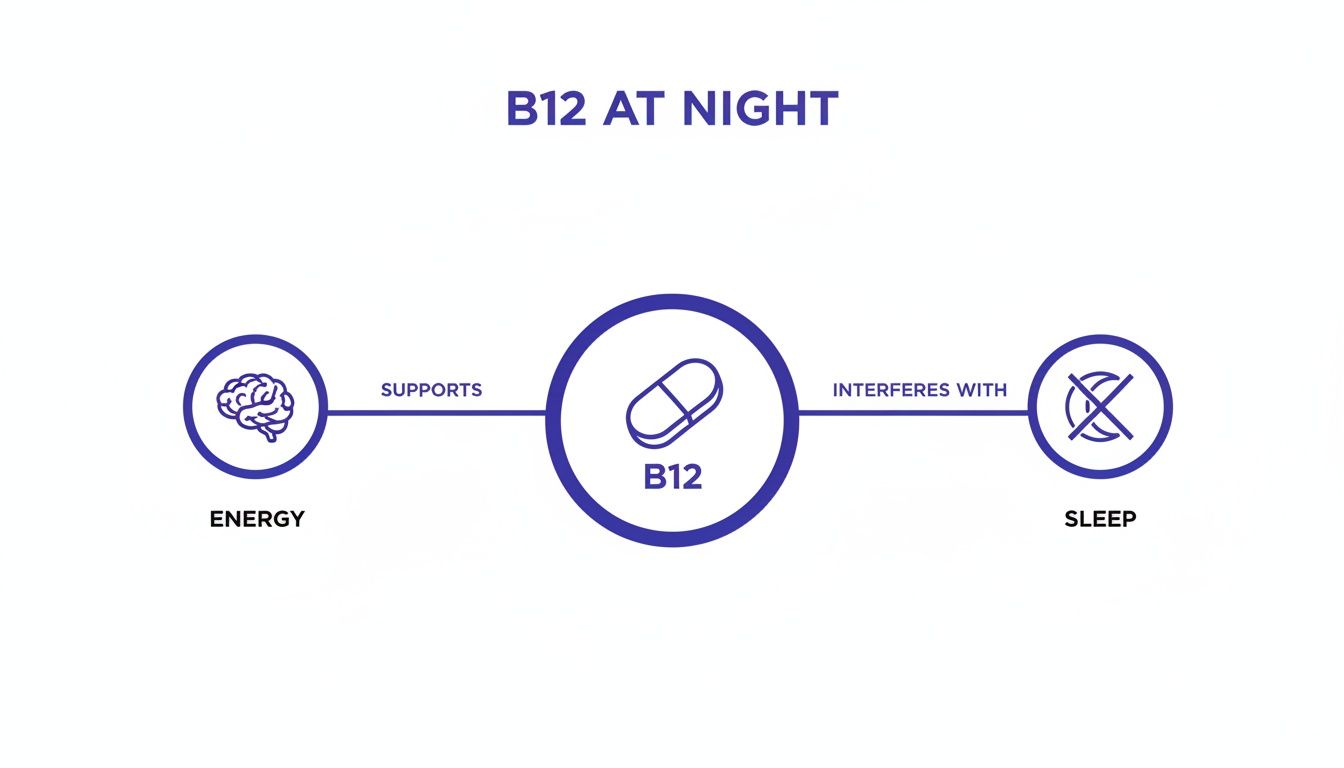
    This concept map shows why taking B12 at night is a bad idea. It can fire up your energy systems right when your body should be powering down for sleep.

    Diagram showing B12 supports energy but interferes with sleep, recommending against B12 at night.

    As you can see, B12 supplementation is directly linked to increased energy production. This makes it a poor fit for any pre-sleep routine.

    Optimizing Your Timing with Science

    To get the most out of this two-part system, timing is everything. Research suggests taking B12 in the morning, ideally between 6-9 AM, can maximize its impact. This is especially true if you’re looking for a productivity boost. This window lines up perfectly with your body’s natural circadian rhythm. At this time, dips in cortisol and melatonin create the ideal environment for that IF-mediated β€œferry” absorption.

    Taken in the morning, your B12 levels will then hit their peak in your bloodstream about 3-4 hours later. This is right when you need that mental lift. You can find more tips in our guide to the best vitamins to help with brain fog.

    This morning strategy also sidesteps competition. Proteins from a big lunch can interfere with absorption. This is a big deal since your body can only absorb about 1.5-2.5 mcg per meal through that highly efficient IF pathway. By working with your body’s natural processes, you turn that supplement into a powerful tool for your day.

    Editor’s Take: What Actually Works for B12 Timing

    So, what’s the bottom line? For most people trying to sharpen their focus and get a real energy lift, taking vitamin B12 first thing in the morning on an empty stomach is the simplest and most effective move you can make.

    This small habit works with your body’s natural absorption rhythms, not against them. It’s a straightforward way to get the best possible return on your investment. This is especially true for busy professionals, students, or anyone who’s just tired of feeling drained every single day.

    But here’s the thing: biology is personal. Your own health history and circumstances always play the lead role in what works for you. This advice is best for individuals who are generally healthy and are using B12 for energy and cognitive support, not to treat a severe deficiency.

    Who Needs to Be More Careful

    If any of these sound like you, a one-size-fits-all approach isn’t going to cut it:

    • You’re on certain medications: Common drugs like metformin (for diabetes) are known to interfere with B12 absorption.
    • You have digestive issues: Conditions like Crohn’s disease or atrophic gastritis can seriously limit how well your body can even access B12.
    • You’re over 50: As we age, stomach acid levels naturally decline. This makes it harder to absorb B12 from food sources.

    Think of the morning routine as a powerful starting point. However, it is never a substitute for professional medical advice. It’s essential to talk to your doctor to figure out the right dosage and timing for your unique health profile.

    Finding the best time of day to take vitamin b12 is all about learning to work with your body’s specific needs. Sometimes that requires a plan tailored just for you. Nothing replaces that personalized guidance for your long-term health.

    Final Checklist for Your B12 Routine

    When it comes to getting the most out of your vitamin B12 supplement, a little bit of timing and a whole lot of consistency make all the difference. Think of these takeaways as your quick-reference guide to building a smart routine that actually works. This routine is designed to boost your energy and sharpen your focus.

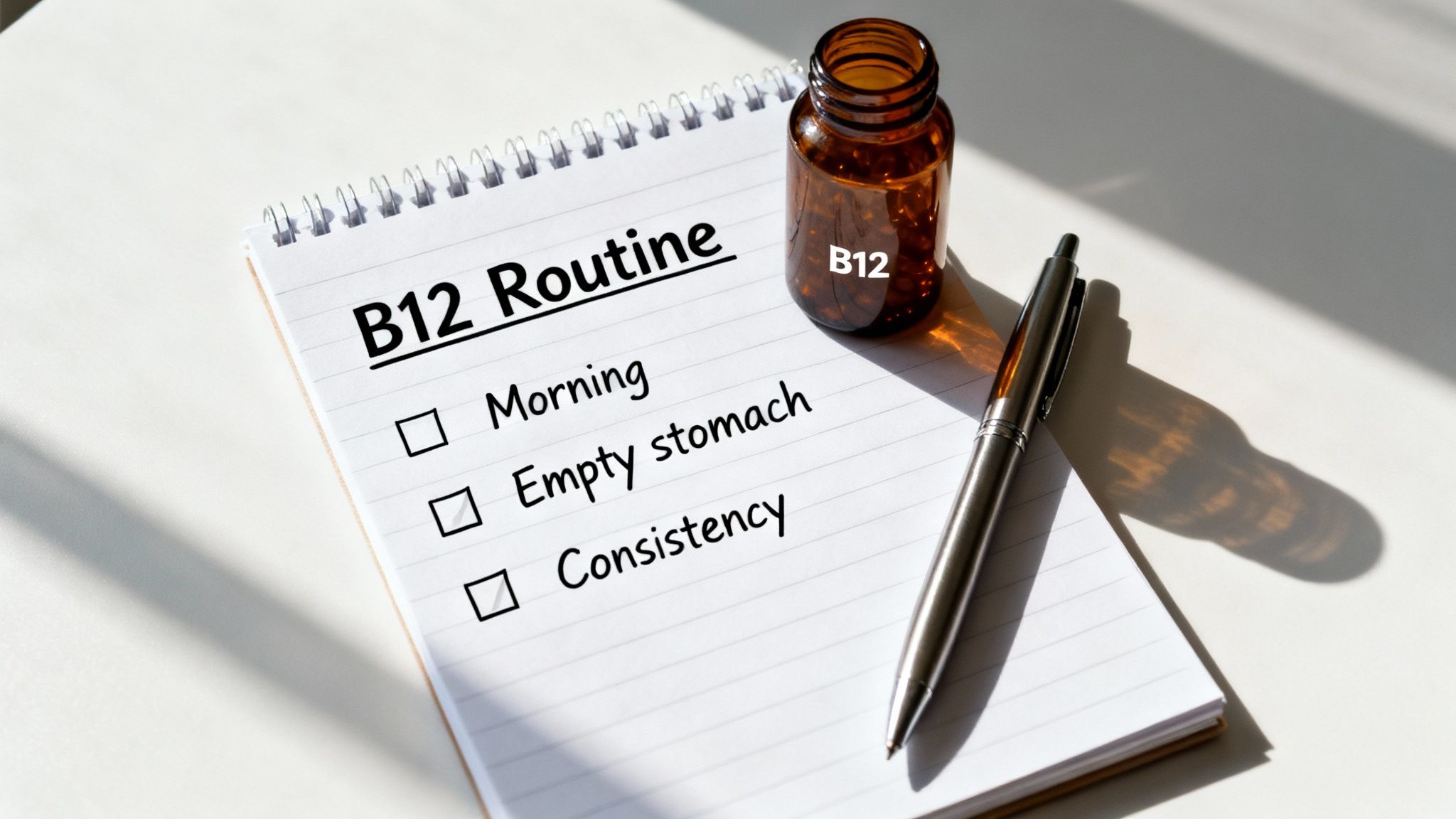
    Notebook showing a β€œB12 Routine” checklist beside a vitamin B12 bottle and pen, illustrating the best time of day to take vitamin b12 for a daily supplement routine.

    Actionable B12 Best Practices

    These are the core rules for dialing in your supplement strategy. Nail these, and you’ll be well on your way.

    • Morning Is Your Best Bet: The ideal time is first thing in the morning, on an empty stomach. This gives your body a clean slate for maximum absorption before food gets in the way.

    • Steer Clear of Nighttime Doses: B12 is a key player in your body’s energy production. Taking it right before bed can mess with your natural sleep cycle and might leave you feeling restless.

    • Watch Out for Interactions: If you take high doses of vitamin C, be mindful. It can interfere with B12 absorption. A good rule of thumb is to space them out by at least two hours to make sure you get the full benefit of each.


    The single most powerful habit you can build is taking your B12 with a glass of water right after you wake up. It’s a simple move that works with your body’s natural rhythms, giving you the best shot at feeling a real, tangible difference in your energy.

    For anyone on a plant-based diet, staying on top of key nutrients is vital. You can learn more by Spotting Vegan Vitamin Deficiency Symptoms.

    At the end of the day, consistency is what separates a supplement that works from one that doesn’t. Stick with it, and you’ll unlock the long-term cognitive and physical benefits B12 has to offer.

    Key Takeaways

    • Morning on an Empty Stomach: The absolute best time to take vitamin B12 is in the morning, at least 30 minutes before food or coffee, to maximize absorption.
    • Avoid Nighttime Doses: B12 can interfere with sleep due to its role in energy production. It’s best to avoid taking it in the evening.
    • Consistency is Crucial: To experience the full benefits for energy and mental clarity, make taking your B12 a consistent part of your daily morning routine.
    • Form Matters: Methylcobalamin is a highly bioavailable form of B12 that the body can use immediately without conversion.
    • Consult a Professional: While morning is a great general rule, always consult with your doctor, especially if you have underlying health conditions or take other medications.

    Disclaimer: This article is for informational and educational purposes only and does not constitute medical or psychological advice. It may contain affiliate links, which means we may earn a commission if you make a purchase. Always consult with a qualified healthcare professional before making any decisions about your health or supplement regimen.

    Frequently Asked Questions

    1. What is the absolute best time to take vitamin B12?

    Hands down, the consensus points to one clear winner: first thing in the morning, on an empty stomach. Taking your B12 with a glass of water at least 30 minutes before your first meal or coffee gives it a clean runway for absorption. This timing also works with your body’s natural energy rhythms.

    2. Can I take vitamin B12 with my morning coffee?

    It’s better to wait a little while. While a cup of coffee won’t completely cancel out the benefits, caffeine can slightly reduce how well your body absorbs B vitamins. For the best outcome, take your B12 with water and wait at least 30 minutes before your coffee.

    3. I forgot to take my B12 this morningβ€”what should I do?

    No need to stress if you miss a dose. Just take it as soon as you remember, as long as it’s not too close to bedtime. If it’s already late afternoon or evening, your best bet is to simply skip that day’s dose and get back on your regular morning schedule the next day.

    4. Does the form of B12 I take actually matter?

    Yes, the form can make a real difference. Methylcobalamin is the active, bioavailable form that your body can put to use immediately, no conversion required. This is often a better choice than cyanocobalamin, which your body has to process first.

    5. Can I take vitamin B12 and vitamin C together?

    You can, but timing is key. High doses of vitamin C can interfere with your body’s ability to absorb vitamin B12 properly. To get around this, just space them out by at least two hours. A simple approach is to take your B12 first thing in the morning and then take your vitamin C with lunch.

    6. Will taking B12 on an empty stomach upset my stomach?

    It’s unlikely. Vitamin B12 is water-soluble and is generally very well-tolerated on an empty stomach. Unlike some other supplements like iron or fat-soluble vitamins, it rarely causes any digestive issues. However, if you have a sensitive stomach, you can try it with a small snack.

    7. How long does it take to feel the effects of B12?

    This really varies from person to person. Some people report feeling a noticeable energy lift within just a few hours of their first dose. For others, especially those correcting a deficiency, it might take several days or even a few weeks of consistent use to see significant improvements.

    8. Is it okay to take B12 every single day?

    For most people, yes. Daily supplementation is both safe and effective, particularly if you have a diagnosed deficiency or fall into a risk category (like following a vegan diet). Just be sure to stick to the dosage recommended by your healthcare provider.

    9. Can vitamin B12 really help with brain fog?

    Absolutely. B12 plays a vital role in neurological function. A deficiency is often linked to symptoms like fatigue and that frustrating feeling of what causes brain fog. By restoring your B12 levels, you’re giving your brain the raw materials it needs for sharper cognitive performance.

    10. Should I take B12 with other B vitamins?

    It’s a great idea. The B vitamins are a team, and they often work best together. Taking B12 as part of a B-complex supplement can be highly effective because these vitamins are synergistic. For example, B6 and folate work hand-in-hand with B12 to support healthy methylation, a process essential for mood regulation.


    Discover practical, science-backed strategies to reclaim your focus and build lasting habits with the digital library at Mind Clarity Hub. Explore our curated collection of books designed for busy minds seeking calm and productivity. Start your journey at https://mindclarityhub.com.

  • What Causes Brain Fog and How to Finally Find Your Focus

    What Causes Brain Fog and How to Finally Find Your Focus

    What Causes Brain Fog and How to Finally Find Your Focus

    Jeremy Jarvis β€” Mind Clarity Hub founder
    Mind Clarity Hub β€’ Research-aware focus & digital wellness

    Brain fog isn’t just a catchy phraseβ€”it’s that frustrating, molasses-slow feeling when your thoughts refuse to connect. It’s caused by a perfect storm of modern pressures, from chronic stress and poor sleep to inflammation and nutrient gaps.

    From a neuroscience perspective, it helps to think of it less as a medical diagnosis and more as a signal flare from your brain. Something is out of balance, and it’s disrupting your ability to think with your usual sharpness.


    Affiliate Disclosure: Please note that this article contains affiliate links. If you make a purchase through these links, we may earn a small commission at no extra cost to you. We only recommend products we trust and believe will be of value to our readers.


    What Is Brain Fog and Why Does It Feel So Overwhelming?

    Ever sit down to tackle an important email, only to find the words just won’t come? Your thoughts feel sticky and slow, like you’re trying to think through a thick haze. That’s the classic brain fog experienceβ€”a state of cognitive drag that gets in the way of concentration, memory, and clear thinking.

    While the term has become more visible lately, especially with long COVID, the feeling itself is universal. It’s the mental equivalent of trying to drive in a dense fog; you know the road is there, but you can’t see it clearly enough to move forward confidently.

    This article is for educational purposes only and is not a substitute for professional medical or psychological advice, diagnosis, or treatment. If you are experiencing symptoms related to anxiety, depression, ADHD, burnout, or other health concerns, please consult a qualified healthcare provider.

    Your Brain’s Check-Engine Light

    Instead of seeing brain fog as a personal failure, it helps to reframe it as your brain’s check-engine light. It’s a physiological warning that your cognitive resources are running on empty.

    From a neuroscience standpoint, that β€œfog” often points to disruptions in how your brain cells (neurons) communicate. For example, chronic stress floods your system with cortisol, a hormone that directly interferes with your prefrontal cortexβ€”the brain’s hub for focus, planning, and executive function. When it’s under siege by these stress chemicals, everything feels harder.


    Mini-Scenario: Imagine you’re in a team meeting, and your boss asks for your input on a project you know well. But when you open your mouth, you can’t find the right words. Your mind feels blank. This isn’t about not knowing the answer; it’s your brain’s communication network being temporarily disrupted by factors like poor sleep or high stress.


    Quick Answer: What Are the Main Causes of Brain Fog?

    To help you quickly identify the primary triggers behind the feeling of mental slowness and fatigue, this table summarizes the most common culprits.

    Primary CauseHow It Contributes to Brain Fog
    Chronic Stress & BurnoutHigh cortisol levels disrupt prefrontal cortex function, impairing focus and memory.
    Poor Sleep QualityPrevents the brain from clearing metabolic waste, leading to next-day cognitive drag.
    InflammationSystemic inflammation can cross the blood-brain barrier, affecting neural communication.
    Nutrient DeficienciesLack of key nutrients like B vitamins, omega-3s, or iron can slow down brain energy production.

    Understanding these connections is the first step toward clearing the fog. Each cause represents a lever you can pull to start restoring your mental clarity.

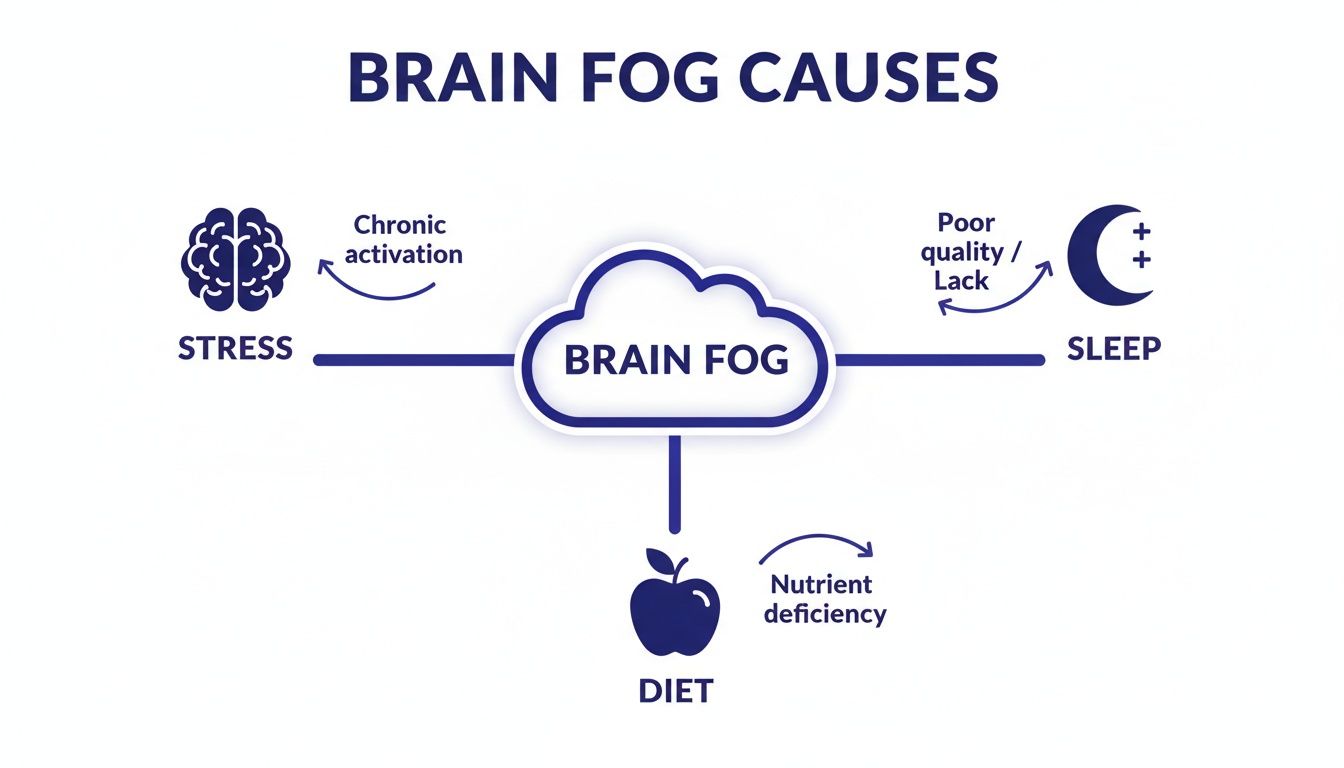
    This concept map shows how major lifestyle factorsβ€”stress, sleep, and dietβ€”are all directly wired to that feeling of mental fog.

    Diagram illustrating the main causes of brain fog: stress, poor sleep, and nutrient deficiency.

    As you can see, brain fog isn’t just one thing. It’s a symptom that emerges when these interconnected systems fall out of sync.

    Figuring out what causes brain fog is the first, most critical step toward reclaiming your mental sharpness. Throughout this guide, we’ll dig into each of these root causes and connect them to practical, science-backed strategies. For a deeper dive into the biology, you can explore the science of mental fog in our comprehensive article.

    Our goal is to give you the knowledge you need to feel empowered, not overwhelmed. This feeling is manageable once you understand where it’s coming from.

    How Stress and Burnout Hijack Your Brain’s Performance

    Ever feel like your brain is an overheating computer with dozens of tabs open, each one demanding attention? That’s not just a feeling; it’s a near-perfect analogy for how chronic stress causes brain fog. This is a measurable biological process that can temporarily downgrade your cognitive performance.

    When you’re under constant pressure, your body’s ancient β€œfight or flight” system gets stuck in the β€œon” position. From a behavioral research standpoint, this system, run by the hypothalamic-pituitary-adrenal (HPA) axis, floods your body with hormones like adrenaline and cortisol. While incredibly useful for escaping a real threat, a nonstop flow of these chemicals is toxic to clear thinking.

    Young man working on a laptop at a desk with smoke above his head, symbolizing what causes brain fog.

    This prolonged state of high alert is the fast track to burnoutβ€”a condition of deep emotional, physical, and mental exhaustion. Brain fog is one of burnout’s most defining cognitive symptoms, turning everyday mental tasks into uphill battles.

    This section discusses concepts related to stress and burnout for educational purposes. It is not a substitute for professional psychological or medical advice. If you are struggling, please consult a qualified healthcare provider.

    The Cortisol Effect on Your Brain

    Think of cortisol as your body’s built-in alarm system. In short bursts, it’s incredibly helpful. But when stress becomes chronicβ€”day after day of tight deadlines, financial worries, or emotional strainβ€”cortisol levels stay elevated.

    This constant hormonal bath begins to wear down key brain regions responsible for higher-level thinking. Neuroscience research shows that sustained high cortisol can physically alter your brain’s architecture in several ways:

    • It weakens the Prefrontal Cortex (PFC): This is your brain’s CEO, in charge of decision-making, focus, and impulse control. Chronic cortisol disrupts communication between neurons here, making it harder to concentrate and organize your thoughts.
    • It shrinks the Hippocampus: This sea-horse-shaped structure is vital for learning and memory. Elevated cortisol can reduce its size and impair its ability to create and retrieve memoriesβ€”which is why you might forget a colleague’s name mid-sentence when you’re overwhelmed.

    Neuroscience Nugget: Chronic stress effectively puts your brain’s β€œthinking” centers offline while keeping its β€œreacting” centers (like the amygdala) on high alert. This is why, under pressure, you’re more likely to have an emotional outburst than a brilliant insight.

    This explains why what causes brain fog during stressful periods isn’t a lack of effort but a biological disability. Your brain is allocating all its resources to perceived survival, leaving little left for complex problem-solving.

    A Real-World Burnout Scenario

    Imagine Sarah, a freelance graphic designer juggling three major projects with overlapping deadlines. For weeks, she works late nights, skips meals, and constantly checks her email for client feedback.

    At first, she feels productive, running on adrenaline. But soon, the chronic stress takes its toll. She starts making simple mistakes in her designsβ€”misaligning text, using the wrong color codesβ€”things she would normally catch instantly. When a client provides feedback, she finds it difficult to process the request and feels defensive instead of collaborative.

    Sarah’s brain fog isn’t a sign of incompetence. It’s a direct result of her HPA axis being stuck in overdrive. Her prefrontal cortex is so bogged down by cortisol that her executive functionsβ€”attention to detail, emotional regulation, and problem-solvingβ€”are severely compromised. Her brain is stuck in survival mode, not creative mode.

    This cycle is a hallmark of professional burnout. If this scenario feels familiar, it may be helpful to explore resources on how to recover from burnout and restore your mental energy. Recognizing the biological roots of stress-induced brain fog is the first step toward breaking the cycle.

    Daily Habits That Cause Brain Fog

    It’s not always the big, dramatic stressors that leave your mind feeling cloudy. More often than not, the most powerful triggers of brain fog are hiding in plain sight, woven directly into our daily routines.

    These seemingly small habits can pile up over time, systematically draining your cognitive reserves. The result? That frustrating feeling of being slow, unfocused, and mentally exhausted. The good news is that understanding these lifestyle factors is empowering because they’re often the most direct and actionable areas for improvement.

    A stressed man holding his head at a desk with a computer showing many open windows, symbolizing what causes brain fog.

    Let’s break down three of the most common culprits behind that mental haze and explore why they have such a profound effect on your brain’s performance.

    The High Cost of Sleep Deprivation

    Sleep isn’t just passive downtime; it’s an active, essential maintenance period for your brain. One of its most vital jobs is managed by the glymphatic system, which you can think of as your brain’s dedicated cleaning crew.

    This network kicks into high gear during deep sleep, flushing out metabolic waste and toxic proteins that accumulate while you’re awake. When you consistently get less than the recommended seven to nine hours of sleep, you’re essentially cutting the cleaning shift short. This leads to a buildup of cellular junk that directly interferes with how efficiently your neurons communicate.

    Neuroscience Nugget: Imagine a city that never runs its garbage collection. At first, it’s a minor inconvenience. But after a few nights, the accumulated waste starts to clog the streets, slowing down traffic and disrupting the entire system. That’s what’s happening inside your brain after a few nights of poor sleep.


    Mini-Scenario: The All-Nighter’s Toll

    Picture a student named Alex pulling an all-nighter to cram for a big exam. Fueled by energy drinks, he manages to study through the night. The next morning, he feels wired but strangely disconnected. When he sits down for the test, he can’t recall key formulas he reviewed just hours before. His thinking is slow, and he struggles to structure his answers.

    Alex’s brain fog is a direct result of skipping his brain’s cleaning cycle. The buildup of metabolic waste is physically slowing down his neural processing speed and memory recall, making all his hard work far less effective.


    How Nutrient Gaps Slow Down Your Brain

    Your brain is an incredibly energy-hungry organ. It consumes about 20% of your body’s total calories despite making up only 2% of its weight. To run smoothly, it needs a steady supply of specific micronutrients that act as key players in producing energy and creating neurotransmitters.

    When your diet lacks these essential building blocks, your brain’s performance suffers. It’s like trying to run a high-performance car on low-grade fuelβ€”it will still run, but sluggishly and inefficiently. Three nutrient categories are frequently tied to brain fog:

    • B Vitamins (especially B12 and B9/Folate): These are vital for creating the red blood cells that carry oxygen to the brain. They’re also crucial for synthesizing neurotransmitters like dopamine and serotonin, which regulate your focus and mood.
    • Omega-3 Fatty Acids (EPA & DHA): These healthy fats are the primary building blocks of your brain cell membranes. A shortage can make these membranes rigid, slowing down the electrical signals between neurons.
    • Magnesium: This mineral is a workhorse, involved in over 300 biochemical reactions in the body, including many that support nerve transmission and energy production inside your brain cells.

    A diet high in processed foods and sugar only makes things worse by promoting inflammation. A balanced diet full of whole foods, on the other hand, provides the clean fuel needed for a sharp mind. This constant cycle of poor nutrition and the hunt for a quick energy fix can even contribute to behavioral patterns like a micro-dopamine addiction, which you can read more about here.

    The Surprising Impact of Mild Dehydration

    One of the most overlooked yet potent causes of brain fog is simple dehydration. Even a tiny drop in your body’s hydration levelsβ€”as little as a 2% loss in body waterβ€”can significantly mess with cognitive functions like attention, memory, and decision-making.

    Your brain is roughly 75% water and relies on proper hydration to maintain the balance of electrolytes (like sodium and potassium) that your nerve cells need to fire correctly. When you’re dehydrated, this delicate electrical signaling gets disrupted.

    On top of that, dehydration can temporarily cause your brain tissue to shrink, pulling it away from the skull. This physical change can lead to headaches and that general feeling of mental sluggishness. The fix is often straightforward yet profound: consistently drinking enough water throughout the day. For many people battling that afternoon slump, the real issue isn’t a lack of caffeineβ€”it’s a lack of water.

    The Hidden Link Between Inflammation and Brain Fog

    While everyone talks about stress and poor sleep, one of the most powerfulβ€”and often overlookedβ€”drivers of brain fog is systemic inflammation. Think of inflammation as your body’s internal fire alarm. When it spots a threat like an injury or an infection, it sounds the alarm and sends immune cells rushing to the scene.

    This is a good thing; it’s how you heal. But what happens when that alarm gets stuck in the β€œon” position? Chronic issues like a poor diet, a stubborn illness, or gut problems can create a low-grade, smoldering fire that spreads throughout your entire body. This isn’t just about sore joints. It directly impacts your brain.

    Pills spilled from a bottle, a glass of water, and a phone showing 3:17 AM on a bedside table, depicting what causes brain fog from poor lifestyle choices.

    Tiny inflammatory molecules called cytokines can actually cross the protective blood-brain barrier, gumming up the works and disrupting communication between your neurons. This is a process called neuroinflammation, and it’s a key reason you feel that mental sludge, forget words, or can’t seem to focus.

    The Gut-Brain Axis Connection

    A huge amount of chronic inflammation starts in your gut. Your digestive system and brain are in constant conversation through a pathway known as the gut-brain axis. If the community of bacteria in your intestinesβ€”your microbiomeβ€”is out of balance, it can send inflammatory signals straight up to your brain.

    Imagine your gut lining as a tightly secured border. When it’s healthy, only good stuff like nutrients gets through. But if it gets damaged or β€œleaky” from a bad diet or chronic stress, inflammatory particles can escape into your bloodstream and set off that body-wide fire alarm.

    Analogy: Your gut-brain axis is like a superhighway. When there’s a multi-car pileup (gut imbalance), it doesn’t just stop local traffic. Emergency signals flood the network, disrupting operations miles away at the central command centerβ€”your brain.

    This connection is real. That foggy feeling you get after eating a bunch of processed junk isn’t just in your head; it’s a physiological response that started in your gut. It’s a clear example of how your diet is directly tied to brain fog. For those exploring this hidden link, studies suggest that practices like using an infrared sauna for inflammation can be a natural approach to reducing the body’s inflammatory load.

    Infection, Illness, and Post-Viral Brain Fog

    Another major trigger for neuroinflammation is your body’s response to getting sick. When your immune system goes to war against a virus or bacteria, it unleashes a massive wave of cytokines. This is necessary to win the fight, but that intense inflammatory response can hang around long after you’ve recovered, leaving persistent brain fog in its wake.

    This has become impossible to ignore with Long COVID. Millions of people who recovered from the initial illness now find they can’t sustain deep focus, struggle to find the right words, or feel mentally wiped out after simple tasks.

    This isn’t a personal failing; it’s a direct consequence of post-viral inflammation messing with the brain. Analysis of over 273,000 individuals found that up to 26% of people report cognitive symptoms like impaired concentration three to six months after infection. With an estimated 16.5 million working-age adults in the United States alone now reporting some cognitive limitation, this is a massive public health concern.

    Whether it’s simmering in your gut or lingering after an illness, inflammation is a key piece of the brain fog puzzle. Tackling it can have huge benefits, as we explore in our guide on inflammation, fatigue, and weight plateaus.

    When to See a Doctor About Brain Fog

    Most of the time, brain fog is just a temporary signal that your lifestyle needs a tune-upβ€”a little more sleep, a little less stress, or a better approach to nutrition. But how do you know when that mental sluggishness is pointing to something more serious?

    Knowing the difference is key to advocating for your health without unnecessary alarm. While small adjustments can clear the fog for many, persistent or severe symptoms are worth a conversation with a healthcare professional. Think of it as gathering data; your symptoms are the clues, and your doctor is there to help you interpret them.

    Red Flags That Signal a Deeper Issue

    Some symptoms shouldn’t be ignored. If your brain fog shows up alongside any of the following red flags, it’s a clear sign to schedule a medical evaluation. This isn’t meant to cause panic, but to empower you to take your symptoms seriously.

    Key warning signs to watch for include:

    • Sudden and Severe Onset: The fog appears abruptly and intensely, rather than developing slowly over weeks or months.
    • Persistent Symptoms: It just won’t lift, even after you’ve diligently improved your sleep, diet, and stress for several weeks.
    • Other Neurological Signs: You’re also experiencing symptoms like severe or unusual headaches, numbness or tingling, vision changes, or problems with balance and coordination.
    • Significant Functional Impairment: Your cognitive struggles are severe enough to interfere with your ability to work, manage daily tasks, or maintain your relationships.

    Important Note: This information is for educational purposes only and is not a substitute for professional medical advice. If you are experiencing symptoms related to anxiety, depression, ADHD, or other health concerns, please consult a qualified healthcare provider.

    The Impact of Illness on Long-Term Brain Fog

    Sometimes, brain fog is the lingering ghost of a past illness, a condition often seen in post-viral syndromes. Research on Long COVID gives us a powerful window into how the severity and length of an illness can be tied to cognitive symptoms long after the infection is gone.

    One fascinating two-year follow-up study of hospitalized COVID-19 patients found that 87.8% still reported at least one brain fog symptom two years later. The severity of the initial illness really mattered; patients who experienced acute respiratory distress had worse global cognition scores than those with milder cases.

    These findings show that while brain fog can improve, it can also stick around for a very long time. It also highlights why a professional consultation is so important if your symptoms kicked in after you were sick. You can read the full research about these post-COVID findings here.

    How to Prepare for Your Doctor’s Appointment

    To make that conversation as productive as possible, you need to go in prepared. A doctor will have a much easier time helping you if you can provide clear, organized information about what you’ve been experiencing.

    Start by keeping a symptom journal for a week or two before your visit. Your goal is to track when your brain fog is at its worst and what, if anything, seems to make it better.

    What to Track in Your Journal:

    1. Symptom Details: Describe the feeling. Is it memory loss? Trouble focusing? An inability to find the right word?
    2. Timing and Patterns: Does it hit at a certain time of day? Does it get worse after eating certain foods or after specific activities?
    3. Lifestyle Factors: Log your sleep duration and quality, daily stress levels, diet, and how much water you’re drinking.
    4. Full Symptom List: Include any other physical or emotional symptoms you’re dealing with, even if they seem totally unrelated.

    Bringing this data helps your doctor see the bigger picture. It moves you much closer to understanding what causes brain fog in your specific case and helps them rule out any underlying medical conditions more efficiently.

    Editor’s Take: What Actually Clears Brain Fog

    Here’s the straightforward truth: for most people, brain fog isn’t a permanent state. It’s a warning light. It’s your brain’s way of signaling that it’s overwhelmed by burnout, chronic stress, or simply a lack of fundamental care.

    Before you start chasing complex bio-hacks, master the basics. Consistent 7-8 hour sleep, proper hydration, and managing stress with non-negotiable breaks are the pillars of mental clarity. For many, addressing these core needs is the most effective way to start feeling sharper again. You can find more structured techniques in our guide on how to reset your brain.

    This advice is most effective for lifestyle-induced brain fog. If your symptoms are severe, appeared suddenly, persist despite lifestyle changes, or follow an illness, the single most important step is to consult a healthcare professional. They can help you investigate underlying medical causes and get to the root of what causes brain fog in your specific situation.


    Final Disclaimer & Affiliate Notice: The information in this article is for educational purposes only and is not intended as a substitute for professional medical or psychological advice, diagnosis, or treatment. Please consult a qualified healthcare provider for any health concerns or before making any changes to your health regimen. This content may also contain affiliate links, which means we may earn a small commission on purchases at no extra cost to you.


    Frequently Asked Questions (FAQ)

    When your mind feels cloudy, it’s natural to have questions. Here’s a breakdown of the most common ones we hear, with clear answers to help you understand what’s going on and what steps you can take to regain your mental sharpness.

    1. How long does brain fog typically last?

    This depends entirely on the root cause. If it’s from a single night of poor sleep or mild dehydration, you might feel clear again within a day after resting and rehydrating. However, for brain fog tied to chronic burnout or stress, it can linger for weeks or even months until the underlying issues are addressed. In post-viral cases like Long COVID, symptoms can persist for many months or years.

    2. Can my diet really cause brain fog?

    Absolutely. A diet high in processed foods, sugar, and unhealthy fats can promote systemic inflammation, which directly impacts brain function. Likewise, deficiencies in key nutrients like B vitamins (especially B12), omega-3 fatty acids, and iron can slow down the energy production your brain needs to think clearly.

    3. Is brain fog a symptom of anxiety or depression?

    Yes, it is a very common cognitive symptom of both. In psychology, it’s understood that chronic anxiety keeps your brain in a β€œfight-or-flight” state, diverting resources away from the prefrontal cortex needed for clear thinking. Depression can similarly dampen cognitive function, making it hard to concentrate and recall information. If your brain fog is accompanied by persistent low mood or worry, consulting a mental health professional is recommended.

    4. Does too much screen time contribute to what causes brain fog?

    Without a doubt. Behavioral research shows that constant notifications and information overload from screens create cognitive exhaustion. The blue light from screens can also disrupt melatonin production, harming sleep quality. This combination of mental fatigue and poor sleep is a perfect recipe for what many call β€œdigital brain fog.”

    5. What are the first practical steps to fight brain fog?

    Start with the foundational habits. For one week, prioritize these three actions:

    1. Protect Your Sleep: Aim for 7-8 hours of quality sleep to allow your brain’s glymphatic (waste-clearing) system to work.
    2. Hydrate Consistently: Drink water throughout the day. Even mild dehydration can impair cognitive function.
    3. Take β€œCognitive Breaks”: Step away from your screen for 5 minutes every hour to give your prefrontal cortex a chance to rest and reset.

    A practical guide to improving sleep quality can provide more detailed strategies.

    6. Can certain medications cause brain fog?

    Yes, many prescription and over-the-counter drugs can have cognitive side effects that feel like brain fog. Common culprits can include some antihistamines, sleep aids, antidepressants, and certain blood pressure medications. If you suspect a medication is the cause, speak with your doctor. Do not stop taking any prescribed medication without medical guidance.

    7. What is the link between hormones and brain fog?

    Hormonal fluctuations are a major cause of brain fog, particularly for women. Changes in estrogen levels during the menstrual cycle, perimenopause, and pregnancy can significantly affect neurotransmitters in the brain that control memory and focus. Similarly, thyroid imbalances (both hypo- and hyperthyroidism) can disrupt brain metabolism and lead to mental sluggishness.

    8. Will a β€œdopamine detox” cure my brain fog?

    A β€œdopamine detox” (reducing high-stimulation activities like social media) can help combat the cognitive overload that contributes to brain fog. It improves focus by giving your brain a break. However, it will not β€œcure” brain fog caused by underlying physiological issues like inflammation, nutrient gaps, or a medical condition. It’s a helpful tool for digital burnout, but not a complete solution for all causes.

    9. What is the difference between normal tiredness and brain fog?

    Tiredness is primarily a physical sensation of sleepiness or bodily fatigue. Brain fog is a cognitive state. You can feel physically rested but mentally slow, fuzzy, and unable to concentrate. Conversely, you can be physically exhausted after a workout but still mentally sharp. The key difference is whether the impairment is in your body or your mind’s processing speed.

    10. When should I see a doctor about brain fog?

    You should consult a healthcare professional if your brain fog:

    • Appeared suddenly and is severe.
    • Persists for weeks despite improving your sleep, diet, and stress levels.
    • Is accompanied by other serious symptoms like severe headaches, numbness, vision changes, or difficulty with balance.

    A doctor can help rule out underlying medical conditions that may be the primary cause of your cognitive symptoms.


    At Mind Clarity Hub, we specialize in providing science-based, practical guides to help you cut through the noise of modern life. Explore our collection of books on focus, burnout recovery, and mindful productivity to find your path back to mental clarity. Visit our library of books today.

    Explore the Mind Clarity Hub Library

    Practical books on focus, digital habits, resilience, and building a calmer mind.

    The Power of Clarity β€” book cover

    The Power of Clarity

    Unlock mental focus, build momentum, and create the life you were meant to live.

    View book β†’
    AI & ChatGPT for Beginners β€” book cover

    AI & ChatGPT for Beginners

    No PhD needed β€” a 2025 guide to AI, prompts, and productivity without coding.

    View book β†’
    Zen in the Digital Jungle β€” book cover

    Zen in the Digital Jungle

    Mindfulness for a chaotic world.

    View book β†’
    The Slow Reset β€” book cover

    The Slow Reset

    Mindful living in a fast-paced world.

    View book β†’
    Perfectly Imperfect β€” book cover

    Perfectly Imperfect

    Stop self-criticism, set boundaries, and embrace the real you.

    View book β†’
    Reclaiming Silence β€” book cover

    Reclaiming Silence

    A dopamine detox guide to finding peace in a noisy world.

    View book β†’
    The Focused Freelancer β€” book cover

    The Focused Freelancer

    Productivity, pricing & positioning for independents in 2025.

    View book β†’
    ChatGPT Side Hustle System β€” book cover

    ChatGPT Side Hustle System

    Launch your AI-driven online business in 30 days.

    View book β†’
    Burnout, Interrupted β€” book cover

    Burnout, Interrupted

    A proven path to restore energy and reclaim your life.

    View book β†’
    Attention Unleashed β€” book cover

    Attention Unleashed

    Focus strategies for the distracted mind.

    View book β†’
    Side Hustle Launchpad β€” book cover

    Side Hustle Launchpad

    Your quick-start guide to extra income.

    View book β†’
    Digital Clarity β€” book cover

    Digital Clarity

    Rewire your brain, escape dopamine traps & regain focus.

    View book β†’
    Break the Scroll β€” book cover

    Break the Scroll

    Reduce screen time and take back control of your life.

    View book β†’
    Climate Compassion β€” book cover

    Climate Compassion

    Transform eco-anxiety into empowered action.

    View book β†’
    Village Mentality β€” book cover

    Village Mentality

    The power of community for mental wellness.

    View book β†’
    Restful Nights β€” book cover

    Restful Nights

    Overcoming sleep anxiety in a 24/7 world.

    View book β†’
    Connected Again β€” book cover

    Connected Again

    Combat loneliness and build meaningful relationships.

    View book β†’
    Focus Recharged β€” book cover

    Focus Recharged

    Mastering attention and productivity in the digital era.

    View book β†’
    Marketing Magic with ChatGPT β€” book cover

    Marketing Magic with ChatGPT

    AI-powered content, campaigns, and copywriting to grow faster.

    View book β†’
    The 6-Figure Creator β€” book cover

    The 6-Figure Creator

    Turn knowledge into passive income with books, courses & AI.

    View book β†’
    Burnout Breakthrough β€” book cover

    Burnout Breakthrough

    Reset your work-life balance and thrive in 2025.

    View book β†’
    The Emotionally Intelligent Man β€” book cover

    The Emotionally Intelligent Man

    A modern guide to self-awareness and communication.

    View book β†’
    AI Personalized Wellness β€” book cover

    AI Personalized Wellness

    Create your custom health plan with data-driven habits.

    View book β†’
    Everyday AI Made Easy β€” book cover

    Everyday AI Made Easy

    Use ChatGPT and smart tools to simplify life.

    View book β†’
    Money Mindfulness β€” book cover

    Money Mindfulness

    A financial wellness guide for Gen Z & Millennials.

    View book β†’
    Startup Smarter with AI β€” book cover

    Startup Smarter with AI

    ChatGPT strategies and tools to grow your business.

    View book β†’
    ChatGPT for Writers & Creators β€” book cover

    ChatGPT for Writers & Creators

    Unlock AI-powered brainstorming, drafting & editing.

    View book β†’
  • What Is Blank Mind Syndrome and How Can You Reclaim Your Focus

    What Is Blank Mind Syndrome and How Can You Reclaim Your Focus

    What Is Blank Mind Syndrome and How Can You Reclaim Your Focus

    Jeremy Jarvis β€” Mind Clarity Hub founder
    Mind Clarity Hub β€’ Research-aware focus & digital wellness

    Have you ever been right in the middle of making a crucial point, maybe in a big meeting, only for your thoughts to completely vanish? Or maybe you’ve sat staring at a blank page, a deadline breathing down your neck, and your brain offers nothing but static.

    This frustratingβ€”and sometimes alarmingβ€”experience is often called blank mind syndrome. While not a formal medical diagnosis, it perfectly describes that sudden mental void. This guide will explore the science behind why this happens and provide practical, evidence-based strategies to help you reclaim your focus and mental clarity.

    Please note: This post may contain affiliate links. If you make a purchase through these links, we may earn a small commission at no extra cost to you. This helps support our work in creating helpful content.

    Understanding What Blank Mind Syndrome Really Is

    It’s that sudden, unnerving feeling where your internal monologue just stops, leaving a mental void where a thought used to be. You’re not just distracted; it feels like your brain’s operating system has momentarily shut down, leaving you feeling lost and unproductive.

    A thoughtful Asian man sits at a desk, typing on a laptop, with a blank thought bubble, experiencing blank mind syndrome.
    Caption: Blank mind syndrome can feel like a sudden mental void, leaving you unable to access your thoughts.


    This isn’t some strange personal failing or a sign you can’t handle the pressure. Neuroscientists call this phenomenon β€œmind blanking,” and it’s a measurable brain state. It’s a common neurological event that happens to almost everyone, often triggered by stress, anxiety, or plain old burnout.

    For example, a student giving a presentation might suddenly freeze mid-sentence, unable to recall their next point. This isn’t a failure of preparation; it’s a real-time example of their brain’s cognitive resources being overwhelmed by performance anxiety, triggering a mind blank.

    Mind Blanking vs. Mind Wandering

    It’s really easy to confuse a blank mind with daydreaming or mind-wandering, but neurologically, they are worlds apart.

    When your mind wanders, your brain is still highly activeβ€”your thoughts are just drifting from one topic to another, usually far away from the task at hand. Your inner monologue is still running; it’s just off-script. In stark contrast, mind blanking is a total absence of thought. Psychologically, it feels like the screen has gone dark.

    To clarify the difference, here’s a simple breakdown of how these two mental states compare.

    Mind Blanking vs Mind Wandering Key Differences

    CharacteristicBlank Mind Syndrome (Mind Blanking)Mind Wandering (Daydreaming)
    Mental ContentA complete absence of thoughts; a mental void or β€œnothingness.”A stream of thoughts, but they are unrelated to the current task.
    Inner MonologueThe internal dialogue stops completely.The internal dialogue is active but has drifted off-topic.
    Brain ActivityCharacterized by a unique β€œsleep-like” pattern of brain-wide neural activity.Involves the brain’s β€œdefault mode network,” which is active during rest and self-reflection.
    FeelingOften feels abrupt, confusing, or even alarming.Typically feels gentle, passive, and sometimes creative or relaxing.
    Task EngagementYou are unable to think or proceed with the task.You are disengaged from the task but still thinking about other things.

    Recognizing this distinction is the first real step toward understanding what’s happening in your brain.

    In fact, research shows this is a widespread experience. One study found that participants reported mind-blanking episodes about 14.5% of the time while working on tasks. This was completely separate from mind-wandering, which happened almost 50% of the time. These β€œmental voids” are a unique and surprisingly common part of our cognitive lives.

    The key difference is the presence of thought. Mind wandering is a journey through various thoughts, while a blank mind is an empty destination.

    So, when your mind goes blank, you aren’t β€œlosing it.” Your brain is simply responding to specific triggers like cognitive overload or stress. That feeling of being suddenly unfocused or mentally lost is a signal that your brain needs a reset.

    If this experience resonates with you, our guide on the quiet crisis of feeling unfocused and lost might offer some deeper insights.


    Disclaimer: This article is for educational purposes only and is not a substitute for professional medical or psychological advice. If you are concerned about symptoms of anxiety, depression, ADHD, burnout, or any other condition, please consult a qualified healthcare provider.

    The Neuroscience Behind Blank Mind Syndrome

    When your mind suddenly goes blank, it’s not a personal failure or a sign that you lack willpower. It’s a physiological eventβ€”a protective measure rooted in your brain’s own wiring.

    Think of your brain’s attention system like a muscle. When you push it too hard for too long without a break, it gets exhausted. This mental fatigue is more than just a feeling; it’s directly tied to your brain chemistry, especially the neurochemical dopamine, which is essential for keeping you focused and motivated. Sustained mental effort, high stress, or not enough sleep can drain your dopamine levels. When that happens, your prefrontal cortexβ€”the brain’s β€œCEO” in charge of complex tasks like decision-making and concentrationβ€”can momentarily go offline.

    Side profile of a man with an illuminated transparent brain showing cognitive activity, illustrating the brain science of blank mind syndrome.
    Caption: Blank mind syndrome is linked to changes in brain activity, where the prefrontal cortex temporarily disengages to prevent overload.

    It’s a bit like a car engine stalling when it overheats. The stall isn’t a flaw; it’s a built-in safety feature that prevents the engine from melting down. Your brain’s temporary shutdown forces a much-needed pause, protecting your neural circuits from being completely overloaded.

    The Brain on Pause: What Happens During Blank Mind Syndrome

    During these blank mind episodes, your brain isn’t just sitting idle. Brain scan studies show that these mental voids coincide with a significant drop in neural activity across large areas of the brain. It’s almost like your brain is taking a quick β€œmicro-sleep.”

    This is why your inner monologue suddenly halts and you can’t retrieve a simple memory or word. It’s a clear physiological signal that your cognitive gas tank is empty. Understanding the science behind this is a huge step. You can learn more about how this overload happens in our guide on the science of mental fog.

    A blank mind isn’t emptiness; it’s a protective response. Your brain is essentially hitting the emergency brake to prevent you from driving your cognitive engine into the ground.

    What’s Happening in a Real-World Moment

    Imagine you’re a designer named Alex, pulling an all-nighter to finish a client’s project. You’ve been staring at the screen for hours, fueled by caffeine and sheer will. Suddenly, as you try to choose a font, your mind goes completely empty. You can’t think. You can’t remember the client’s brief. Nothing.

    Here’s what just happened inside Alex’s brain:

    • Neurochemical Depletion: Hours of intense focus have burned through Alex’s available dopamine and other neurotransmitters crucial for sustained attention.
    • Prefrontal Cortex Offline: His prefrontal cortex, overwhelmed by the sustained cognitive load, has temporarily disengaged to conserve energy.
    • Physiological Response: The β€œblank” is his brain’s way of forcing a mandatory reset to avoid total burnout.

    This scenario shows how blank mind syndrome is a direct biological consequence of pushing your mental limits too far. Recognizing this allows you to shift from self-criticism to proactive, compassionate management.

    Common Triggers That Cause Your Mind to Go Blank

    What really pushes your brain to the breaking pointβ€”that sudden, frustrating moment where everything just goes blank? While it often feels random, a blank mind is usually a direct response to specific pressures overwhelming our cognitive systems. Figuring out these catalysts is the first step toward getting back in control.

    Think of your brain’s available processing power like a smartphone’s battery. Some activities drain it much faster than others. Chronic stress and burnout are two of the biggest power hogs, depleting the mental resources you need to think clearly and stay focused.

    The Impact of Stress, Anxiety, and Burnout on Blank Mind Syndrome

    When you’re under constant pressure, your body gets flooded with stress hormones like cortisol. While useful in short bursts for a β€œfight or flight” response, behavioral research shows that prolonged exposure can seriously interfere with your brain’s ability to pull up memories and hold a thought. The part of the brain responsible for memory, the hippocampus, is particularly sensitive to cortisol.

    Real-World Example: Imagine a project manager juggling a dozen deadlines who suddenly finds their mind completely empty during a crucial team meeting. Their brain, saturated with stress hormones from weeks of high pressure, has simply hit its processing limit and forced a shutdown.

    Similarly, burnout from overwork leaves you feeling hollowed out and mentally drained. It’s a state of deep emotional and physical exhaustion that makes it nearly impossible to summon the energy for focused thinking, turning mind blanks into a frequent, unwelcome guest.

    A blank mind is often just a symptom of an overloaded system. It’s your brain’s way of hitting the emergency brake, forcing a mandatory pause when you refuse to take one yourself.

    Digital Overload in a Constantly Connected World

    Our modern environment is another huge trigger. The constant barrage of notifications, an endless stream of emails, and dozens of open browser tabs create a state of information overload.

    This relentless digital stimulation keeps our brains in a state of high alert, fragmenting our attention and making deep, sustained thought feel almost impossible. The constant demand to switch between tiny tasks can lead to what’s known as micro-dopamine addiction, which taxes our cognitive reserves even further.

    Other common triggers include:

    • Sleep Deprivation: A lack of quality sleep directly impairs brain function, hitting your attention, memory, and decision-making capabilities hard.
    • Anxiety and Depression: Psychological research shows these conditions can alter brain chemistry, making it much harder to regulate mood and thinking, which contributes to feelings of mental emptiness.

    While the occasional memory lapse is normal for everyone, a sharp increase in how often it happens can sometimes point to more serious issues. The World Health Organization notes that cognitive voids similar to mind blanks are a feature in conditions like schizophrenia, which is why it’s so important to seek a professional evaluation if your symptoms feel severe. You can discover more insights about these findings from the WHO.


    Please note, this content is for educational purposes only. If you are experiencing symptoms related to anxiety, depression, ADHD, sleep problems, or other conditions mentioned, it is important to consult a qualified healthcare provider for proper diagnosis and care.

    Practical Strategies to Overcome Blank Mind Syndrome

    When your mind hits a wall, it can feel like a total system failure. But you aren’t powerless against the mental void. The key is to build a personal toolkit of evidence-based strategiesβ€”some for in-the-moment resets, some for building mental endurance, and others for long-term cognitive health.

    The process that leads to a blank mind often follows a predictable, cascading pattern. It starts with cognitive overload, which snowballs into stress and, eventually, mental fatigue.

    Caption: The path to blank mind syndrome often begins with overload, leading to stress and fatigue.
    Image Description: A simple flowchart with icons shows the progression from an overloaded brain (cognitive overload) to a stress symbol, and finally to a low-battery icon (fatigue), illustrating the triggers for blank mind syndrome.

    Understanding this flow shows why preventative care is so crucial. You want to stop the cycle before it even starts.

    Immediate Resets for In-the-Moment Relief

    When your brain goes blank in a high-stakes moment, you need a quick way to reboot. Grounding techniques are incredibly effective here because they pull your attention away from the internal panic and redirect it to the external, physical world. This behavioral trick shifts focus away from the malfunctioning prefrontal cortex to your sensory cortex.

    One of the most powerful is the 5-4-3-2-1 technique. It’s a simple sensory scan that brings you back to the present moment.

    Here’s how it works:

    1. Acknowledge 5 things you can see around you (your desk, a pen, a plant).
    2. Acknowledge 4 things you can feel (the texture of your chair, the cool air on your skin).
    3. Acknowledge 3 things you can hear (the hum of a computer, distant traffic).
    4. Acknowledge 2 things you can smell (the scent of coffee, a nearby book).
    5. Acknowledge 1 thing you can taste (the lingering taste of your last drink or meal).

    Real-World Example: A student feeling overwhelmed before an exam can use this technique. Sitting at their desk, they notice the clock, their textbook, their hands, the feel of their jeans, the sound of other students, and the smell of old paper. This sensory inventory interrupts the mental spiral, giving their prefrontal cortex a chance to come back online.

    Preventative Routines to Build Mental Endurance

    While immediate resets are useful, the real goal is to make blank mind episodes less frequent. This requires building routines that manage your cognitive load before it becomes overwhelming.

    The Pomodoro Technique is a fantastic, research-backed method for structuring your focus. You simply work in focused 25-minute intervals, followed by a short 5-minute break. After four of these cycles, you take a longer break of 15-30 minutes.

    This structured approach prevents the sustained mental effort that depletes neurotransmitters like dopamine, essentially stopping burnout before it can begin. It forces you to recharge, keeping your cognitive engine from overheating.

    Real-World Example: A software developer uses this technique to code. After 25 minutes of intense focus, a timer goes off. They get up, stretch, and grab water for 5 minutes, completely stepping away from the screen. This habit prevents the mental fatigue that leads to errors and mind blanks, allowing for more productive and sustainable work. For those struggling with digital distractions, our guide offers additional digital detox tips to create more focused work sessions.

    Sustainable Lifestyle Adjustments for Cognitive Health

    Finally, long-term resilience against blank mind syndrome comes down to your foundational habits. Improving sleep hygiene is completely non-negotiable. Neuroscience confirms that quality sleep is when your brain clears out metabolic waste and consolidates memories. Aiming for a consistent 7-9 hours per night is one of the most impactful things you can do for your cognitive function.

    Regular physical activity also boosts blood flow to the brain and supports mood regulation, while a balanced diet provides the essential nutrients for optimal brain health. Think of these habits as the essential maintenance that keeps your mind running smoothly.

    Your Anti-Blank Mind Toolkit

    This table outlines a few practical techniques you can start implementing right away, organized by when they’re most effective.

    Strategy TypeExample TechniqueWhen to Use It
    Immediate ResetsThe 5-4-3-2-1 grounding exerciseWhen you feel your mind going blank in a high-pressure situation.
    Preventative RoutinesThe Pomodoro Technique (25/5 intervals)During your workday to manage focus and prevent cognitive overload.
    Long-Term HabitsConsistent 7-9 hours of quality sleepEvery night to support brain health and memory consolidation.

    Think of these tools as a starting point. The goal is to build a personalized approach that helps you feel more in control of your mental clarity.

    Editor’s Take: What Actually Works for Blank Mind Syndrome

    Let’s be real: there’s no magic button to fix a brain that’s running on empty. If you’re dealing with blank mind syndrome, the only thing that truly works is a consistent mix of preventative habits and in-the-moment resets. The strategies in this guide are built for busy professionals, students, and anyone feeling the cognitive drag of our always-on culture.

    Mindfulness and strategic breaks are incredibly effective, but they work best when you’re already on solid ground with good sleep and a handle on your stress. Think of it this way: you can’t expect a quick fix to work if your mental battery is already at zero. The most crucial shift is to become proactive, not just reactive. Don’t wait for a total mental crash before you start thinking about how to recharge.

    This advice is best for individuals experiencing mild to moderate mind blanking due to common triggers like stress, burnout, or information overload. It is not a substitute for professional help if your symptoms are severe, frequent, or accompanied by other concerning issues. The goal isn’t to add more to your plate, but to build a lifestyle that supports mental resilience instead of constantly draining it, and sometimes advanced approaches like limbic system retraining can help with that. Ultimately, it’s the small, consistent actions that make the biggest difference.


    Disclaimer: Please note that this website may contain affiliate links. The content provided is for informational and educational purposes only and is not intended as a substitute for professional medical or psychological advice, diagnosis, or treatment.

    When to Seek Professional Help for Blank Mind Syndrome

    Having your mind go blank once in a while, especially when you’re stressed, is perfectly normal. Think of it as your brain’s circuit breaker flipping for a second when it gets overloaded. But if you find your thoughts disappearing more and more often, it might be a signal to pay closer attention.

    While the strategies in this guide can help you manage everyday cognitive overload, a persistent blank mind syndrome can sometimes point to an underlying health condition. It’s important to know when self-help isn’t enough and it’s time to bring in a professional.

    Knowing When to Make the Call

    If your mind-blanking episodes are showing up with other significant symptoms, it might be time to reach out to a healthcare professional. This isn’t about diagnosing yourselfβ€”it’s about arming yourself with the right information to make an empowered decision about your health.

    Keep an eye out for these specific red flags:

    • Significant Memory Loss: You aren’t just forgetting a word here and there, but entire conversations or important recent events.
    • Physical Symptoms: The episodes come with dizziness, severe headaches, or sudden changes in your vision.
    • Impaired Functioning: The mind blanks are so frequent or severe that they consistently get in the way of your job, daily responsibilities, or relationships.
    • Drastic Mood Changes: The mental voids are paired with intense anxiety, feelings of detachment from yourself (depersonalization), or a persistently low mood.

    A blank mind stops being an occasional inconvenience and becomes a medical concern when it starts actively disrupting your life and well-being.

    Seeking help is a proactive step toward getting clarity. A doctor or mental health expert can help rule out or identify conditions like anxiety disorders, depression, ADHD, or other neurological issues that might be at the root of your symptoms.


    Disclaimer: This article is for educational purposes only. It is not a substitute for professional medical or psychological advice. Always consult a qualified healthcare provider for diagnosis and treatment.

    FAQ: Common Questions About Blank Mind Syndrome

    To round things out, let’s tackle some of the most common questions that pop up around blank mind syndrome. Getting clear on these points can help you feel more grounded and in control when those frustrating mental voids hit.

    Is a Blank Mind Just Another Term for Brain Fog?

    While they feel related, they’re actually quite different experiences. Blank mind syndrome is like a power outageβ€”a sudden, complete, and usually brief loss of thought. Your mind doesn’t feel slow; it feels totally empty. In contrast, brain fog is like a brownoutβ€”a longer-lasting state of mental slowness, confusion, and difficulty concentrating. With brain fog, the thoughts are still there, but they feel sluggish and hard to grab. So, a blank mind is an abrupt void, while brain fog is a persistent murk.

    How Can Diet and Exercise Help Prevent My Mind From Going Blank?

    Your brain is a biological organ, and its performance is directly tied to your physical health. From a neuroscience perspective, good habits provide the fuel for clear thinking. Nutrition rich in omega-3s, antioxidants, and B vitamins supports the structure of your brain cells. Hydration is critical, as even mild dehydration can impair attention. Finally, exercise increases blood flow to the brain, delivering vital oxygen and nutrients while helping manage stress hormones like cortisolβ€”a known trigger for blank mind episodes.

    What’s the Best Way to Explain Blank Mind Syndrome to My Boss?

    Bringing this up at work can feel awkward, so framing it professionally is key. Avoid dramatic language and focus on the cause and your solution. You could say something like: β€œLately, I’ve had moments of temporary cognitive overload where I lose my train of thought, especially when juggling multiple high-focus tasks. It’s usually a sign that I just need to take a brief step back to reset.” This approach sounds professional, shows self-awareness, and proposes a simple solution, framing it as a normal physiological response to intense work.

    Could My Blank Mind Be a Symptom of ADHD or Anxiety?

    Yes, it’s possible. Conditions like ADHD can affect the prefrontal cortex, making it harder to sustain focus and leading to moments where the mind β€œchecks out.” Similarly, anxiety can overwhelm the brain’s processing capacity with worry, triggering a β€œfreeze” response that feels like a blank mind. However, many things can cause this symptom. If you suspect an underlying condition, it’s crucial to consult a healthcare professional for an accurate diagnosis. This article is for educational purposes and is not a substitute for medical advice.


    At Mind Clarity Hub, we specialize in providing science-based guides and books to help you reclaim your focus and build sustainable mental clarity. Explore our full library of resources to find practical, step-by-step systems for overcoming burnout and mastering your attention. Learn more at Mind Clarity Hub.

    Explore the Mind Clarity Hub Library

    Practical books on focus, digital habits, resilience, and building a calmer mind.

    The Power of Clarity β€” book cover

    The Power of Clarity

    Unlock mental focus, build momentum, and create the life you were meant to live.

    View book β†’
    AI & ChatGPT for Beginners β€” book cover

    AI & ChatGPT for Beginners

    No PhD needed β€” a 2025 guide to AI, prompts, and productivity without coding.

    View book β†’
    Zen in the Digital Jungle β€” book cover

    Zen in the Digital Jungle

    Mindfulness for a chaotic world.

    View book β†’
    The Slow Reset β€” book cover

    The Slow Reset

    Mindful living in a fast-paced world.

    View book β†’
    Perfectly Imperfect β€” book cover

    Perfectly Imperfect

    Stop self-criticism, set boundaries, and embrace the real you.

    View book β†’
    Reclaiming Silence β€” book cover

    Reclaiming Silence

    A dopamine detox guide to finding peace in a noisy world.

    View book β†’
    The Focused Freelancer β€” book cover

    The Focused Freelancer

    Productivity, pricing & positioning for independents in 2025.

    View book β†’
    ChatGPT Side Hustle System β€” book cover

    ChatGPT Side Hustle System

    Launch your AI-driven online business in 30 days.

    View book β†’
    Burnout, Interrupted β€” book cover

    Burnout, Interrupted

    A proven path to restore energy and reclaim your life.

    View book β†’
    Attention Unleashed β€” book cover

    Attention Unleashed

    Focus strategies for the distracted mind.

    View book β†’
    Side Hustle Launchpad β€” book cover

    Side Hustle Launchpad

    Your quick-start guide to extra income.

    View book β†’
    Digital Clarity β€” book cover

    Digital Clarity

    Rewire your brain, escape dopamine traps & regain focus.

    View book β†’
    Break the Scroll β€” book cover

    Break the Scroll

    Reduce screen time and take back control of your life.

    View book β†’
    Climate Compassion β€” book cover

    Climate Compassion

    Transform eco-anxiety into empowered action.

    View book β†’
    Village Mentality β€” book cover

    Village Mentality

    The power of community for mental wellness.

    View book β†’
    Restful Nights β€” book cover

    Restful Nights

    Overcoming sleep anxiety in a 24/7 world.

    View book β†’
    Connected Again β€” book cover

    Connected Again

    Combat loneliness and build meaningful relationships.

    View book β†’
    Focus Recharged β€” book cover

    Focus Recharged

    Mastering attention and productivity in the digital era.

    View book β†’
    Marketing Magic with ChatGPT β€” book cover

    Marketing Magic with ChatGPT

    AI-powered content, campaigns, and copywriting to grow faster.

    View book β†’
    The 6-Figure Creator β€” book cover

    The 6-Figure Creator

    Turn knowledge into passive income with books, courses & AI.

    View book β†’
    Burnout Breakthrough β€” book cover

    Burnout Breakthrough

    Reset your work-life balance and thrive in 2025.

    View book β†’
    The Emotionally Intelligent Man β€” book cover

    The Emotionally Intelligent Man

    A modern guide to self-awareness and communication.

    View book β†’
    AI Personalized Wellness β€” book cover

    AI Personalized Wellness

    Create your custom health plan with data-driven habits.

    View book β†’
    Everyday AI Made Easy β€” book cover

    Everyday AI Made Easy

    Use ChatGPT and smart tools to simplify life.

    View book β†’
    Money Mindfulness β€” book cover

    Money Mindfulness

    A financial wellness guide for Gen Z & Millennials.

    View book β†’
    Startup Smarter with AI β€” book cover

    Startup Smarter with AI

    ChatGPT strategies and tools to grow your business.

    View book β†’
    ChatGPT for Writers & Creators β€” book cover

    ChatGPT for Writers & Creators

    Unlock AI-powered brainstorming, drafting & editing.

    View book β†’