...

Tag: cognitive skills

  • What Is Executive Function And How To Improve It

    What Is Executive Function And How To Improve It

    If you’ve ever known exactly what you need to do but can’t seem to start, you’ve run into your brain’s executive function. Think of it as the project manager in your head—the quiet, behind-the-scenes system that helps you plan, prioritize, and see a task through from idea to done.

    From a behavioral research perspective, this is the set of mental skills that lets you manage time, filter out distractions, and switch gears when a meeting gets moved. It’s not about what you know, but how you use what you know to get things done.

    Affiliate Disclosure: This article contains affiliate links. If you make a purchase through these links, we may earn a small commission at no extra cost to you. This helps us continue to create helpful content.

    Your Brain’s CEO Explained: Understanding Executive Function

    So, what is executive function, really? It’s a group of high-level mental skills, mostly managed by the prefrontal cortex—the brain’s command center—that govern how you turn intentions into actions. Neuroscience shows this area is crucial for planning and decision-making. It’s the silent operator coordinating your thoughts and behaviors so you can navigate daily life.

    Without strong executive function, life can feel chaotic. Imagine trying to assemble furniture with the instructions scattered all over the floor. You might have all the right pieces, but you grab them in the wrong order, get distracted halfway through, and end up with a wobbly, unfinished mess. Executive function is what lets you follow the instructions step-by-step, stay on task, and build something solid.

    Why Is Understanding Executive Function Important?

    Strong executive skills are the invisible architecture of a well-functioning life. They’re what allow you to:

    • Plan and Prioritize: Figure out which bill to pay first or how to break a big project into smaller, manageable steps.
    • Stay Focused: Tune out a coworker’s conversation or a phone notification so you can actually finish the report you started.
    • Manage Emotions: Take a breath when you feel frustrated instead of firing off a sharp reply. This is a key aspect of emotional regulation, rooted in the prefrontal cortex’s ability to override impulsive reactions.
    • Adapt to Change: Pivot smoothly when your morning plan gets derailed by an unexpected problem.

    These skills aren’t set in stone. They develop throughout our lives and can absolutely be trained and strengthened at any age. Understanding them is the first step toward building better focus and getting your brain to work with you, not against you. If you’re looking for a roadmap, The Power of Clarity offers a practical framework to start building these skills.

    This article is for educational purposes only and is not a substitute for professional medical or psychological advice. If you are concerned about your mental health, please consult a qualified healthcare provider.

    The Three Pillars of Your Brain’s CEO

    To really get a handle on what executive function is, it helps to break it down into its three core components. Think of these as the specialized departments that report to your brain’s CEO—each one managing a different, crucial aspect of your daily productivity and focus.

    Getting these skills to work together is the secret to navigating the complex demands of modern life, from crushing a big project at work to just getting through your personal to-do list.

    This visual concept map shows how these three pillars—planning, focusing, and adapting—are the core duties of your brain’s CEO.

    A concept map illustrating the Brain CEO's core functions: planning, focus, execution, adaptation, and learning, which are all part of what is executive function.

    The map highlights how these skills are designed to work in concert, allowing you to effectively manage goals from the initial idea all the way to the finish line.

    Working Memory: The Brain’s Mental Post-it Note

    Working memory is your brain’s temporary mental workspace. Psychology research describes it as a system for holding and juggling information for a short period to complete a task. This isn’t long-term storage; it’s the active, in-the-moment processing you need to get things done.

    Real-World Example: Imagine you’re following a new recipe. Your working memory is what holds the list of ingredients and the sequence of steps in your mind as you move around the kitchen. If it’s weak, you’ll find yourself rereading the same instruction over and over. A strong working memory lets you mentally check off steps and keep the bigger picture in mind.

    If this feels like a constant struggle, you can explore our guide on working memory improvement strategies for practical tips.

    Inhibitory Control: The Impulse Filter

    Inhibitory control, or what most of us call self-control, is your ability to tune out distractions and resist temptation. Neuroscience links this skill to specific brain circuits that help you stay locked on your goals instead of acting on every impulse or whim.

    Real-World Example: You’re trying to finish a report while social media notifications keep popping up on your phone. Inhibitory control is what allows you to ignore the ping and stick with the task at hand. When this skill is drained from a long day, you might find yourself endlessly scrolling, even when you know a deadline is looming. Using a phone lock box timer can be a great external tool to support this mental filter.

    Cognitive Flexibility: The Mental Pivot

    Cognitive flexibility is your brain’s ability to adapt to new information and shift your perspective. It’s what allows you to pivot when plans change unexpectedly, letting you think creatively and see problems from different angles.

    Real-World Example: You have your entire day scheduled, but a key meeting is suddenly canceled. Cognitive flexibility is what enables you to calmly re-prioritize your to-do list and use that newfound time productively, rather than feeling flustered or stuck. It’s the “mental pivot” that prevents you from getting derailed by life’s inevitable curveballs.

    To see how these concepts play out in real-time, this table breaks them down into their core jobs and a simple, everyday example.

    The 3 Core Executive Functions at a Glance

    Executive FunctionWhat It DoesEveryday Example
    Working MemoryHolds and manipulates information in your mind for short-term tasks.Remembering a phone number long enough to dial it.
    Inhibitory ControlResists impulses and filters out distractions to stay on task.Ignoring your phone buzzing while you’re in a conversation.
    Cognitive FlexibilityAdapts to new rules, changing plans, and different perspectives.Shifting your project plan when a team member is unexpectedly out sick.

    When these three foundational skills work well together, life feels manageable. When they’re impaired—as is often the case with conditions like ADHD, anxiety, or depression—it can significantly impact daily life. A 2020 study estimated that symptomatic adult ADHD affects 6.76% of adults worldwide, highlighting just how many people grapple with these challenges every day.

    How Executive Function Shows Up in Your Day-to-Day Life

    Think of your executive function skills as the invisible engine driving your day. When that engine is running smoothly, life just feels more manageable. You can juggle a few different projects, stay calm when things get stressful, and actually follow through on the goals you set for yourself.

    Real-World Example: A great project manager effortlessly tracks deadlines, pivots when a team member calls in sick, and keeps the whole team moving in the right direction. This isn’t magic; it’s strong executive function in action. These skills are tied directly to career growth, sane time management, and a feeling of being in control of your own life. They are a huge part of your overall mental well-being.

    A man in a green blazer uses his smartphone at a desk with a laptop, calendar, and notebook, managing his day with his executive function skills.

    When Your Brain’s CEO Is Overwhelmed

    But what happens when your executive functions get strained? Often due to stress, burnout, or anxiety, daily life can start to feel like an uphill battle. This isn’t a personal failing; it’s a sign that your brain’s management system is overloaded.

    You might notice challenges showing up in a few key ways:

    • Chronic Procrastination: You know a task is important, but getting started feels impossible.
    • Disorganization: Your workspace is a mess, you’re always misplacing your keys, and you struggle to keep track of appointments.
    • Emotional Reactivity: Small frustrations trigger big emotional responses because your impulse control is running on empty.
    • Difficulty with Planning: Breaking a big project into smaller, doable steps feels overwhelming. This can also lead to what’s known as decision fatigue from constantly trying to figure out what to do next.

    When this happens, even a simple tool like a time blocking planner can provide some much-needed external structure. It helps offload the mental work of planning and prioritizing, which frees up your brainpower to actually do the work. Think of it as an external scaffold for your brain’s planning department.

    This content is for educational purposes only and should not be considered a substitute for professional medical or psychological advice, diagnosis, or treatment. Always seek the advice of a qualified health provider with any questions you may have regarding a medical or psychological condition.

    If these patterns sound familiar, it might just be a sign that your “brain CEO” is overworked and needs better support. Building stronger habits and systems isn’t about becoming a productivity machine; it’s about reducing the mental friction in your life so you can get back in control.

    Common Signs Your Executive Function Needs a Boost

    Spotting the signs that your brain’s CEO might be overloaded is the first real step toward giving it the support it needs. These moments aren’t signs of personal failure—they’re just signals from your brain that your cognitive skills could use a little reinforcement. Most of us have been there, especially during times of high stress or burnout.

    A wooden desk with a blue sign displaying "SIGNS TO WATCH" in white letters, alongside a clock, notebook, pen, smartphone, and potted plant, all related to what is executive function.

    It’s important to remember this is educational information. While these signs are common, especially with conditions like ADHD, anxiety, or depression, they’re no substitute for a professional evaluation. For a deeper look at the specific challenges professionals face, you might find our guide on ADHD in the workplace helpful.

    Everyday Indicators of Strained Executive Skills

    If you find yourself nodding along to a few of these points, it might be a good time to explore some supportive strategies.

    • Constant Search Parties: You’re regularly misplacing essentials like your keys, phone, or wallet, turning simple moments into frustrating scavenger hunts.
    • The “I’ll Do It Later” Trap: Big projects feel impossible to even start. You know exactly what needs to be done, but taking that first step feels like trying to push a boulder uphill.
    • Time Blindness: You consistently underestimate how long tasks will take, which leads to missed deadlines, chronic lateness, or just a constant feeling of being rushed.
    • Emotional Overwhelm: Small setbacks or unexpected changes trigger a surprisingly strong emotional reaction, leaving you feeling frazzled and completely drained.

    When these skills are taxed, the effects can ripple outward. Research shows a clear link between poor executive functions and significant public health issues. The World Health Organization reports that mental disorders, which often involve executive dysfunction, affect 1 in 10 people globally and are a leading cause of disability. Studies also confirm these core skills predict health behaviors, influencing everything from diet to smoking habits. Learn more about these important research findings.

    Important Note: This list is meant to build self-awareness, not to be a diagnostic tool. If you have serious concerns about your ability to function day-to-day, the best course of action is always to seek advice from a medical or mental health professional. Building awareness is simply the bridge to finding solutions that work.

    How to Choose the Best Strategies to Strengthen Executive Function

    Deciding where to even begin with strengthening your executive function can feel completely overwhelming. With so many different techniques out there, the key isn’t to do everything at once. Instead, think of it as a series of small, targeted adjustments matched to your specific challenges.

    To make this simpler, we can sort these strategies into three main categories. Each one tackles a different part of how you manage your life, from your internal mindset to the world around you. This framework helps you pinpoint what will give you the most leverage right now.

    Best for Beginners: Understanding Your Options

    The most effective approach usually blends small changes from each of these areas.

    • Behavioral Habits: These are the internal routines you build over time. Think of them as direct training for your brain’s “CEO.” This could be a mindfulness practice to sharpen your focus or the habit of breaking big, intimidating projects into tiny first steps.

    • Environmental Adjustments: This is all about changing your physical and digital surroundings to lower the mental strain. You’re essentially making it easier for your brain to do the right thing by setting up a dedicated, distraction-free workspace or using apps that block time-wasting websites.

    • Practical Tools: These are external aids that act like scaffolding for your executive skills. A simple pomodoro timer can help you sustain focus in short, manageable bursts, while a habit tracker journal gives you the visual feedback needed to build consistency.


    Figuring out where to start comes down to one question: What’s your biggest struggle right now? Is it starting tasks? Staying focused? Remembering what you need to do? Your answer will point you toward the most effective tool or habit to try first.

    Best for Busy Professionals: How to Choose a Strategy

    If you’re still not sure where to begin, start with whatever feels easiest to implement. For many people, a practical tool offers the quickest win. It provides immediate structure while you work on building those longer-term behavioral habits. Learning how to prioritize tasks effectively is a fantastic first step.

    Here’s a quick comparison to help you decide:

    Strategy TypeBest ForExample Tool/HabitWho It Suits
    BehavioralBuilding long-term focus and self-control.Daily mindfulness practice.Those seeking sustainable internal change.
    EnvironmentalReducing immediate distractions and decision fatigue.Creating a designated work-only space.People who work from home or in busy offices.
    Practical ToolProviding instant structure and external reminders.Using a visual timer for desk work.Anyone needing immediate support and structure.

    Ultimately, the goal is to build a support system that actually works for you. You don’t need some complex, color-coded productivity system to see real results. More often than not, the simplest adjustments end up making the biggest difference. Why not browse the library for books that can guide you on this journey?

    Editor’s Take: What Actually Improves Executive Function?

    Let’s cut through the noise. When it comes to improving executive function, the most powerful tool isn’t some complex new app or a productivity hack you saw on social media. It’s consistency with simple habits.

    For busy professionals trying to stay focused in a world of digital distractions, it’s the small, repeatable actions that deliver the biggest returns. Things like using a visual timer for desk work to carve out dedicated focus blocks, or spending just ten minutes planning your day each morning.

    This advice is best for knowledge workers feeling swamped who want practical, non-clinical strategies. It is not a replacement for medical or psychological care for conditions like ADHD or anxiety. The real goal is to build supportive routines that lower the mental friction in your day. While some people explore options like specialized IV therapies, such as a brain power drip, for their potential cognitive benefits, sustainable change almost always comes back to practical, evidence-based strategies.

    If you’re ready to move beyond quick fixes and want a clear, step-by-step approach, our guide on executive function repair for overwhelmed adults is the perfect place to start.

    Key Takeaways: Your Executive Function Cheat Sheet

    • It’s Your Brain’s CEO: Executive function is a set of mental skills managed by the prefrontal cortex that helps you plan, focus, and execute tasks.
    • Three Core Pillars: The system relies on Working Memory (your mental sticky note), Inhibitory Control (your impulse filter), and Cognitive Flexibility (your ability to pivot).
    • Overload is Common: Stress, burnout, anxiety, and lack of sleep can significantly weaken your executive skills, leading to procrastination, disorganization, and emotional reactivity.
    • You Can Improve It: Your brain is plastic. You can strengthen these skills at any age through consistent habits, environmental changes, and practical tools.
    • Start Small and Simple: Don’t try to overhaul your life overnight. Pick one small, manageable strategy that addresses your biggest pain point and build from there.

    Frequently Asked Questions About Executive Function

    Let’s clear up some of the most common questions that come up when people first start digging into what executive function is and how it really works day-to-day.

    1. Is Executive Dysfunction the Same as ADHD?

    No, but they’re incredibly close cousins. Think of it this way: nearly everyone with ADHD has challenges with executive function, but not everyone with executive function challenges has ADHD. Executive dysfunction is a descriptive term for a set of struggles—things like planning and focus. ADHD is a clinical, neurodevelopmental condition where significant executive dysfunction is a primary feature. You can also experience a temporary hit to your executive function from stress, burnout, anxiety, or even just a few nights of bad sleep.

    2. Can You Actually Improve Executive Function as an Adult?

    Absolutely. Your brain’s ability to change and form new connections, a process called neuroplasticity, doesn’t stop when you leave your teenage years. While these skills see their biggest growth spurt in childhood, adults can absolutely build stronger executive functions. It happens through consistent practice, building new habits, and leaning on supportive strategies that give your brain the scaffolding it needs to succeed.

    3. What’s the Single Best Tool for Improving Executive Function?

    There’s no magic bullet here, because the “best” tool is the one that solves your specific friction point. The most effective strategy is always to match the support to the problem you’re trying to fix. For losing track of time, a simple visual timer for your desk can be a game-changer. For planning and prioritization, a time blocking planner provides the external structure your brain might be craving. The key is to start with one simple tool that addresses your biggest bottleneck.

    4. How Much Does Sleep Really Impact Executive Function?

    Sleep isn’t a luxury; it’s fundamental maintenance for your brain’s “CEO.” While you sleep, your brain is hard at work clearing out metabolic waste and consolidating memories, essentially preparing your prefrontal cortex for the next day. Research from places like Harvard Health makes it clear: even a single night of poor sleep can hobble your ability to focus and manage impulses. Consistent, high-quality sleep is one of the most powerful levers you can pull. For a deeper dive, you can see the book that fits your goal in our library, like Restful Nights.

    5. Can Stress and Burnout Make Executive Function Weaker?

    Yes, and the effect can be profound. When you’re under chronic stress, your brain is flooded with cortisol, a stress hormone that directly interferes with the prefrontal cortex. This is the neurochemical reason why, when you’re burned out or anxious, a simple task like deciding what to eat can feel monumental. Your brain is busy diverting its precious resources to manage what it perceives as a threat, leaving far less energy for high-level thinking and planning.


    Disclaimer: This article is for educational and informational purposes only and does not constitute medical or psychological advice. The content is not intended to be a substitute for professional medical or psychological advice, diagnosis, or treatment. Some links in this article are affiliate links, which means we may earn a commission if you make a purchase at no extra cost to you.

  • Improving critical thinking skills: A practical guide to smarter decisions

    Improving critical thinking skills: A practical guide to smarter decisions

    Improving your critical thinking skills isn’t about some massive overnight personality change. It’s really about the small, conscious shift from a reactive, emotional gut-check to a more analytical, evidence-based mindset. It’s learning to hit pause, question your own assumptions, evaluate what you’re seeing objectively, and genuinely consider other viewpoints before you land on a conclusion.

    (Affiliate Disclosure: This article may contain affiliate links. If you make a purchase, we may earn a small commission at no extra cost to you.)

    What Critical Thinking Is and Why Improving Your Skills Matters Now

    In a world completely saturated with information, notifications, and now AI-generated content, the ability to think clearly has become a genuine superpower. Critical thinking isn’t some dusty, academic concept; it’s a practical, everyday skill for navigating decisions with intention and clarity.

    It’s the active, methodical process of analyzing, synthesizing, and evaluating information to form a solid judgment.

    Think about the last time a perfectly targeted ad popped up in your social media feed.

    • Reactive Thinking: You see the ad and immediately click “buy.” It hits an emotional nerve or makes a persuasive claim, and you just go with it.
    • Critical Thinking: You pause. Who is behind this ad? What are they really selling me? Is there any actual evidence for their claims? You might check a few independent reviews, compare prices, or just ask yourself, “Do I honestly need this right now?”

    That deliberate pause is more than a good habit; it’s a neurological process. When you engage in critical thinking, you’re firing up your brain’s prefrontal cortex—its executive control center. This part of the brain helps regulate impulses and allows for higher-order reasoning. It effectively puts the brakes on the more primitive, reactive parts of your brain that love to jump to quick conclusions. Mastering this skill is a cornerstone of books like The Power of Clarity, which is all about building systems for intentional thought.

    To make this a bit more concrete, you can break the big idea of “critical thinking” into four core pillars. It’s a useful way to see the different muscles you’re trying to build.

    The Four Pillars of Critical Thinking

    PillarWhat It MeansEveryday Example
    AnalysisBreaking down information into its fundamental parts to understand how they relate to each other.Reading a news article and separating the reported facts from the journalist’s opinion or interpretation.
    InferenceDrawing logical conclusions based on the evidence and reasoning you have available.Noticing that your project team has missed three straight deadlines and concluding that the current workflow is flawed.
    EvaluationAssessing the credibility, relevance, and strength of arguments and evidence.Listening to a political debate and judging the candidates’ statements based on their evidence, not just their charisma.
    InterpretationUnderstanding and explaining the meaning of information, data, or a particular situation.Looking at a sales report and explaining not just what the numbers are, but why they might be trending up or down.

    Seeing it laid out like this makes it feel less like an abstract ideal and more like a set of practical skills you can actually practice, one pillar at a time.

    The Urgency for Better Thinking Skills

    There’s a surprising gap between how much we value critical thinking and how much we actually practice it. A 2020 survey revealed that while 94% of people believe critical thinking is ‘extremely’ or ‘very important,’ only 55% felt their own skills had improved since high school.

    Respondents pointed to modern technology and changing societal norms as major roadblocks, which highlights a clear need for deliberate, focused practice. This skill isn’t just about avoiding a bad purchase online; it’s fundamental to your professional success and personal well-being.

    One of the biggest payoffs here is that as you develop your critical thinking, you’ll naturally improve problem solving skills and learn to approach challenges more strategically.

    Instead of feeling overwhelmed by a complex issue, you’ll have the tools to break it down, analyze its parts, and map out logical solutions. This methodical approach is a game-changer for reducing stress and getting better outcomes, whether you’re trying to manage a project, resolve a conflict on your team, or make a major life decision.

    Building a Daily Routine for Sharper Thinking Skills

    Great thinking isn’t an accident. It’s a habit. Like building muscle in the gym, sharpening your critical thinking skills happens through consistent, deliberate practice. You can train your brain to move from knee-jerk reactions to more thoughtful, analytical responses by weaving small, intentional routines into your day.

    This is all about creating protected time to actually think. I’ve found that using a time blocking planner to schedule these moments is a game-changer. It signals to your brain that this is deep work time, especially when you pair it with something like noise canceling headphones to wall off distractions.

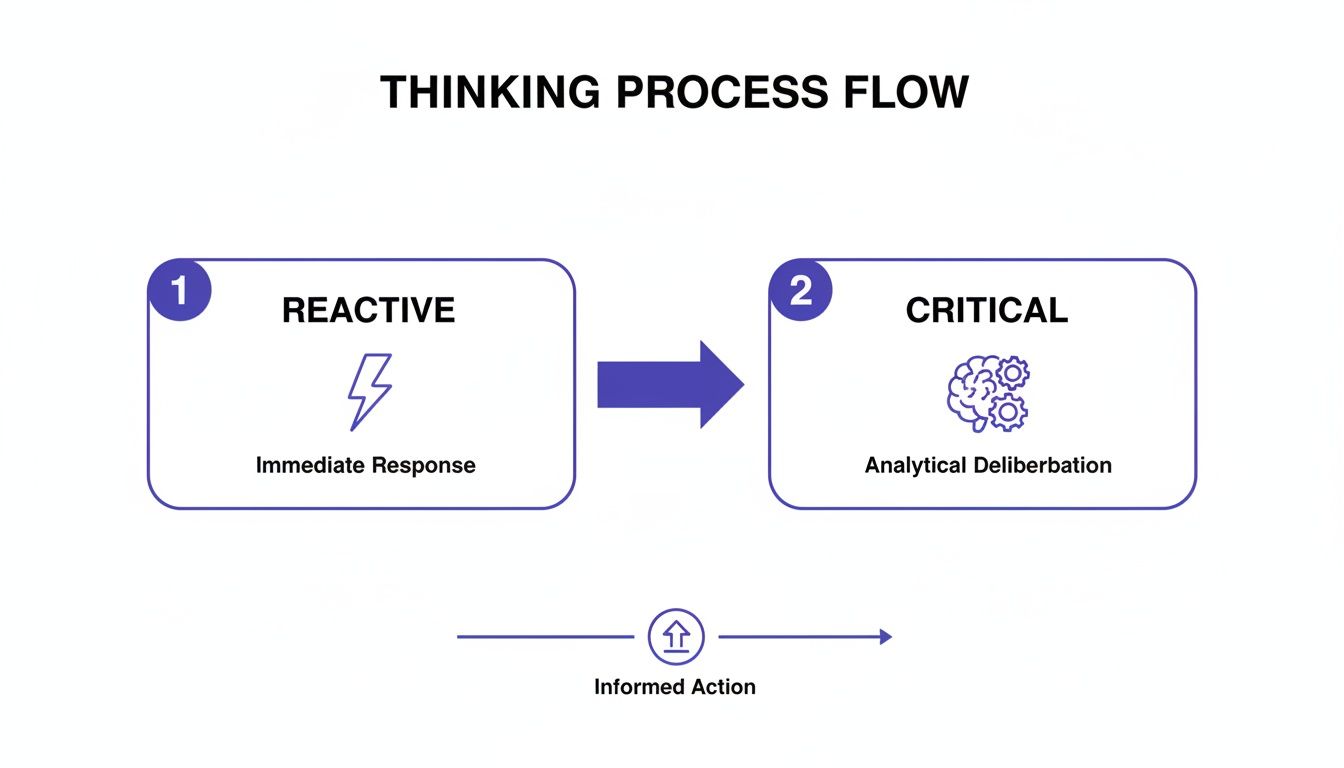
    The goal is to shift from reactive to reflective thinking.

    A thinking process flow diagram showing reactive to critical thinking leading to informed action.

    This diagram gets it right—critical thinking is about inserting a deliberate pause between a trigger and your response. That pause is where analysis happens.

    Start Your Day with a Questioning Mindset

    Before you even think about opening your inbox, carve out the first 15 minutes of your workday to tackle one specific challenge. A fantastic tool for this is the “5 Whys” method. It’s a simple but surprisingly powerful way to dig past surface-level symptoms and uncover the real root of a problem.

    Let’s walk through a real-world example. Say you notice website traffic dipped by 10% last week.

    • Why #1? Why did traffic drop? Because our organic search traffic was lower.
    • Why #2? Why was it lower? Because our ranking for a key blog post slipped.
    • Why #3? Why did the ranking slip? A competitor published a more comprehensive article on the same topic.
    • Why #4? Why is their article better? It includes recent data and expert interviews that ours is missing.
    • Why #5? Why don’t we have those things? We haven’t set up a process for periodically updating our best content.

    And there it is. You went from a vague problem (“traffic is down”) to a concrete, actionable solution: create a content refresh schedule. This kind of structured thinking is all about creating systems to manage your mental energy and get to the core of an issue.

    Curate Your Information Diet

    You’re consuming information all day long, but are you doing it on purpose? A critical thinker is intentional about their inputs. Cognitive psychology is clear on this: our brains have a finite amount of high-quality attention. When you flood it with low-quality, biased, or irrelevant junk, you create “cognitive load,” leaving less bandwidth for the decisions that actually matter.

    Take 10 minutes in the middle of your day to do a quick cleanup.

    • Unfollow social media accounts that thrive on outrage or unverified claims.
    • Unsubscribe from those newsletters you signed up for but never actually read.
    • Set up targeted news alerts for specific topics you need to track, instead of just passively scrolling headlines.

    This isn’t about becoming uninformed; it’s about being deliberate. You’re curating your inputs to create the mental space you need to think deeply. Maybe you can use a laptop stand for desk to create a more organized and intentional workspace.

    End Your Day with Structured Reflection

    The final piece of the daily puzzle is a brief, structured reflection. This habit is what makes the day’s lessons stick and trains your brain to review its own decisions without bias. Before you log off, grab a productivity journal and analyze one key decision you made.

    Ask yourself these four questions:

    1. What was the decision I made?
    2. What assumptions was it based on?
    3. What was the actual outcome?
    4. What would I do differently next time?

    This simple exercise closes the learning loop for the day. It’s the kind of deliberate practice that research confirms is essential for building any skill. For instance, a major study of 120,000 students found that a full one-fifth performed at the lowest level of critical thinking. The researchers’ conclusion? Targeted daily practice and measurement—the very heart of this routine—are what drive real improvement. You can see the full study by the Council for Aid to Education to dig into the data yourself.

    By putting this simple, three-part routine into practice, you build a powerful daily habit for sharper thinking. And if you’re looking for more strategies to get your thoughts in order, our guide on how to organize your thoughts for greater clarity is a great next step.

    Go Deeper: Challenging Your Assumptions with Weekly Exercises for Improving Critical Thinking Skills

    Daily routines are fantastic for building habits, but to really sharpen your critical thinking, you need to stretch your mind with a few focused weekly workouts. Think of these as the mental equivalent of hitting the gym for a longer, more intense session.

    These exercises are designed to pull you out of your intellectual comfort zone. They force you to dismantle arguments, confront your own biases, and spot problems before they snowball. To stay on track, I recommend blocking out a specific time each week and logging your progress in a simple habit tracker journal. Consistency is what turns effort into skill.

    A man actively drawing a mind map about an argument on paper, with a laptop and planner on a desk, creating a hands‑on workspace aimed at improving critical thinking skills.

    Exercise 1: Play Devil’s Advocate

    One of the quickest ways to expose your own blind spots is to actively argue against your strongest opinions. We all naturally gravitate toward information that confirms what we already believe—psychologists call this confirmation bias. This exercise is a direct counter-attack.

    Once a week, pick a belief you hold firmly, especially one related to your work. Maybe you’re convinced that “remote work is always more productive.”

    Your mission is to build the strongest possible case against that belief.

    • Real-World Scenario: A marketing manager believes Instagram is the best platform for their new campaign. To play devil’s advocate, she spends an hour researching why TikTok or LinkedIn might be superior, even though she doubts it. She finds data showing her target audience is highly active on TikTok, forcing her to reconsider her initial, biased assumption.

    The goal isn’t to change your mind. It’s a powerful workout in cognitive flexibility that forces you to engage with opposing views, strengthening your overall grasp of the issue.

    Exercise 2: Deconstruct an Argument

    You’re surrounded by persuasion every single day, from targeted ads to LinkedIn thought leaders. This exercise trains you to see the architecture behind the arguments, making you a much more discerning consumer of information.

    Each week, choose one persuasive piece of content—a news editorial, a viral social media post, or even a marketing email. Your job is to map out its logical structure.

    • First, find the core conclusion. What is the single main point the author wants you to believe?
    • Next, list the supporting premises. What evidence or reasons do they offer?
    • Then, hunt for logical fallacies. Is the author using flawed reasoning to make their point?

    We see flawed arguments everywhere, from political debates to social media threads. Being able to spot them separates a well-reasoned point from one that just feels emotionally convincing. Here are a few of the most common ones to get you started.

    Common Logical Fallacies to Spot in the Wild

    Fallacy NameWhat It IsExample You Might See
    Straw ManMisrepresenting an opponent’s argument to make it easier to attack.“You support reducing the marketing budget? So you just want the company to fail.”
    Ad HominemAttacking the person making the argument instead of the argument itself.“We can’t trust his analysis of the data; he didn’t even go to a top university.”
    False DichotomyPresenting two options as the only possibilities when more exist.“We either have to work weekends to finish this project, or we accept total failure.”
    Appeal to AuthorityClaiming something is true simply because an authority figure said it.“Our CEO said this is the best strategy, so it must be.”

    Learning to spot these errors is a critical thinking superpower. Once you start looking for them, you’ll see them pop up in meetings, articles, and advertisements constantly.

    Exercise 3: Conduct a “Premortem”

    This technique, borrowed from the business world, is an incredible way to sharpen your foresight and planning skills. Instead of conducting a “postmortem” after a project fails, you hold a “premortem” before it even begins.

    Pick a project you’re about to start—either at work or in your personal life. Now, fast forward in your mind. It’s six months from now, and the project has been a complete disaster.

    Get a small group together (or just do this solo) and brainstorm all the plausible reasons for this epic failure. Write everything down, no matter how unlikely it seems.

    • Real-World Scenario: A team planning a software launch holds a premortem. They imagine the launch failed spectacularly. Potential reasons emerge: “A key developer got sick,” “Marketing didn’t understand the product,” and “A competitor launched a similar feature first.” By identifying these risks upfront, they can now build contingency plans, like cross-training developers and preparing competitive response messaging.

    This exercise flips the script from hopeful planning to proactive risk management. By identifying potential points of failure, you can build safeguards into your strategy from day one. It’s a powerful way of improving problem-solving skills because it trains you to anticipate obstacles instead of just reacting when they hit.

    Using Technology and AI to Improve Your Critical Thinking Abilities

    Technology often feels like the enemy of deep thought—a constant stream of pings and notifications pulling you away from anything that requires real concentration. But when you use it with intention, technology and AI can become powerful partners in sharpening your critical thinking.

    The secret is to stop using these tools for quick answers and start using them to ask better, deeper questions. Instead of treating an AI chatbot like a glorified search engine, think of it as an intellectual sparring partner. This requires a whole different way of prompting—one that invites challenge instead of just asking for information.

    A laptop displaying a chat about the definition of knowledge sits beside a phone and a desk clock, creating a study-focused workspace that supports improving critical thinking skills.

    Prompting AI as a Socratic Partner

    Let’s say you have a new business idea. The reactive, low-effort approach is to ask an AI, “Is my business idea good?” You’ll get a generic, unhelpful summary every time.

    A critical thinking approach uses a much more strategic prompt.

    Your Prompt: “Act as a skeptical but fair Socratic partner. I will present my new business idea for a subscription box for indoor plant enthusiasts. Your role is to challenge my core assumptions, point out potential blind spots, and ask probing questions about my target market, pricing model, and competitive advantages. Do not provide answers, only ask questions that force me to justify my reasoning.”

    This simple shift transforms the AI from an information vending machine into a tool that actively sharpens your own thinking. It forces you to defend your ideas against scrutiny, revealing the weak spots you would have otherwise missed.

    Creating an Environment for Deep Thought

    Of course, using AI as a thinking partner only works if you can actually focus. It’s hard to think critically when your phone is buzzing every two minutes with notifications. This is where a few low-tech tools can support your high-level thinking.

    • A phone lock box timer can create a mandatory, distraction-free bubble for an hour of intense work.
    • Investing in a quality monitor light bar can reduce digital eye strain during long research sessions, helping you stay focused for longer without the headache.
    • Sometimes, even a simple tool like an ergonomic keyboard can reduce physical distractions that pull your focus away from complex problems.

    These simple tweaks to your environment support the sustained concentration that critical analysis demands.

    Evaluating AI Content Critically

    It’s crucial to remember that AI-generated content is not gospel. In fact, critically evaluating its output is, in itself, a powerful exercise.

    Always cross-reference significant claims, statistics, or data points with trusted, independent sources. This turns the process from passive consumption into active verification, reinforcing your analytical muscles with every check. You can learn more about using AI for productivity while maintaining that critical edge in our detailed guide.

    This human-AI dynamic is only becoming more important. A recent bibliometric analysis of critical thinking research revealed a massive spike in publications between 2017 and 2021, driven largely by tech-forward nations. This academic surge shows that as AI gets more capable, the global focus on honing human critical thinking has intensified, positioning it as the essential counterpart to machine intelligence.

    Editor’s Take on What Really Works

    Let’s be honest for a second: consistency beats complexity every single time. A simple 15-minute daily reflection habit is far more powerful than a rare, multi-hour deep dive into abstract theories.

    This advice isn’t for academic philosophers; it’s for busy professionals who feel like their brain has too many tabs open. The most important thing to know is that these skills build over months, not days. There are no shortcuts here, and real progress demands patience.

    Simple Tools, Internal Work

    Tools can definitely help grease the wheels. A basic pomodoro timer is fantastic for carving out a protected block of time for an exercise. A dedicated productivity journal can give your end-of-day reflections some much-needed structure.

    But the real work? That’s always internal. The single biggest obstacle you’ll face is your own set of cognitive biases. Genuine critical thinking demands a willingness to question your own assumptions and—most importantly—to be wrong. It’s uncomfortable, but that discomfort is where all the growth happens.

    This practical, no-hype philosophy is the heart of Mind Clarity Hub. We focus on building sustainable habits that lead to clearer thought, a theme we explore in depth in books like The Power of Clarity and Attention Unleashed.

    These exercises are incredible for analyzing new information, which is a huge part of learning. But to make those new insights actually stick, you also need to know how to retain what you read and integrate it into your mental toolkit for good.

    Key Takeaways: Your Core Critical Thinking Toolkit

    Improving your critical thinking isn’t about some massive, overnight transformation. It’s about building small, intentional habits that compound over time. Think of this as your quick-start guide—a scannable summary of the core actions you can take right now.

    Build a Daily Thinking Routine

    Consistency is everything. A brief daily practice builds the mental muscle for deeper, more analytical thought. This could be as simple as using the “5 Whys” method to dig into a problem at work or spending just ten minutes with a productivity journal to reflect on the day’s decisions.

    Challenge Your Assumptions Weekly

    Go a step further with a focused weekly exercise. Deliberately play devil’s advocate against one of your own long-held beliefs. Deconstruct a persuasive argument you find online, or run a “premortem” on an upcoming project to spot weaknesses before they happen. These drills are designed to fight cognitive bias head-on.

    Use Technology as a Socratic Partner

    Instead of asking AI for answers, start using it to ask better questions. Prompt a chatbot to challenge your ideas or poke holes in your logic. You can also use simple tech to protect your focus, like a phone lock box timer, to carve out the uninterrupted mental space required for deep thinking.

    Engineer a Focused Environment

    Your physical space shapes your mental state. Small, deliberate changes can signal to your brain that it’s time to concentrate. A good pair of noise canceling headphones, for example, does more than block out sound—it creates a clear boundary between you and the world of distractions. Ultimately, the goal is to consistently apply what you’ve learned about how to build critical thinking skills and turn these practices into a reliable toolkit for making smarter, more reasoned decisions in everything you do.

    Frequently Asked Questions About Improving Critical Thinking Skills

    Let’s dig into some of the most common questions that come up when you start taking critical thinking seriously. The goal here is to give you straight, practical answers that build on the ideas we’ve already covered.

    1. How Long Does It Take to See Real Improvement?

    There’s no magic number, but you’ll probably notice small shifts within a few weeks of consistent practice. It might be as simple as catching yourself pausing to question a news headline instead of just scrolling past. That’s a win. But developing deep-seated critical thinking habits—the kind that fundamentally change how you solve problems—is a longer game. For significant, noticeable upgrades in your decision-making, you’re likely looking at several months of dedicated effort. The key is consistency, not cramming.

    2. What Is the Best First Step for a Total Beginner?

    Start a daily reflection habit. It’s low-effort but has a massive payoff over time. At the end of each day, take five or ten minutes with a productivity journal. Pick one decision you made and ask yourself:

    • What was my gut reaction or initial assumption?
    • What information did I actually use?
    • How did it turn out?
    • Knowing what I know now, what would I do differently?
      This simple act builds the foundational skill of metacognition—thinking about your thinking. It’s the absolute cornerstone of critical analysis.

    3. Can Critical Thinking Help with Procrastination?

    Absolutely. Procrastination is often just a symptom of feeling overwhelmed or unsure where to even begin. That feeling of being stuck is what’s known as “analysis paralysis.” Critical thinking is the perfect antidote. It gives you the tools to break down huge, intimidating projects into small, logical, and manageable steps. By analyzing the real problem and identifying the very next action, you build clarity and momentum. We actually have a whole guide on how to overcome analysis paralysis with structured thinking if you want to go deeper.

    4. Are There Any Tools That Can Help?

    Yes, but think of them as support systems, not magic solutions. The best tools often just help you create the right environment for deep thought. For example, a visual timer for desk use can help you commit to short, focused bursts of analysis. In the same way, a good pair of noise canceling headphones can carve out a distraction-free zone, signaling to your brain that it’s time to concentrate. These tools help you manage your environment so you can do the real internal work.

    5. How Can I Apply These Skills in a Team Setting?

    This is where critical thinking really shines. You can start by practicing active listening in meetings—genuinely trying to understand a colleague’s viewpoint before you formulate your own response. Another powerful move is to introduce structured questioning. When a new idea is on the table, gently ask clarifying questions like, “What assumptions are we making with this plan?” or “What are the potential second-order effects we haven’t considered?” This steers the conversation away from gut feelings and toward a more evidence-based discussion.

    6. Improving critical thinking skills and reading comprehension

    How can I improve my critical thinking skills when reading? The trick is to read actively, not passively. Instead of just letting the words wash over you, turn it into a mental workout by constantly asking questions. As you read, keep these in your back pocket:

    • What is the author’s core argument here?
    • What evidence are they using to back it up?
    • Is that evidence actually credible? Where did it come from?
    • Are there any obvious logical fallacies in their reasoning?
      This approach transforms reading from consumption into an analytical exercise. It’s a habit that strengthens your ability to evaluate information in every part of your life.

    7. Can Critical Thinking Reduce Stress and Anxiety?

    Yes, it can be an incredibly powerful tool for managing stress, but this is not medical advice. Much anxiety is fueled by vague, looping worries or catastrophizing about what might happen. Critical thinking allows you to put those anxious thoughts on trial. You can ask yourself, “What is the actual, objective evidence that this worst-case scenario will happen?” or “What’s a more realistic, alternative outcome?” This process helps you challenge irrational fears and ground yourself in reality, which can dial down your stress levels significantly. This content is educational and not a substitute for professional psychological care.

    8. What Role Does Environment Play in Critical Thinking?

    Your environment plays a massive role. It is incredibly difficult to think deeply when you’re surrounded by a firehose of distractions and interruptions. Creating a focused space is non-negotiable. This might mean using a phone lock box timer to quarantine your biggest distraction for an hour. It could also be as simple as upgrading your workspace with an ergonomic mouse and other tools that eliminate physical discomfort that constantly pulls at your attention.

    9. Is It Possible to Overthink Instead of Thinking Critically?

    Yes, and this is a crucial distinction to make. Critical thinking is a focused, goal-oriented process. You’re analyzing and evaluating information with the clear aim of solving a problem or making a sound decision. It’s productive. Overthinking, on the other hand, is usually an anxious, repetitive thought loop without a clear purpose or endpoint. It’s dwelling on a problem without moving toward a solution. The key difference is that critical thinking leads to clarity, while overthinking leads to paralysis.

    10. How Do I Know if My Critical Thinking Is Improving?

    You’ll start to see it in the small things. You might find yourself questioning your own gut reactions more often, or you’ll spot the flawed logic in an advertisement that would have flown right past you a month ago. Another key indicator is how you communicate. You’ll likely get better at articulating why you believe something, backing up your opinions with solid reasoning, and genuinely understanding different viewpoints in a debate. Keeping a journal to track your decision-making process is also a great way to see tangible proof of your progress over time.


    (Disclaimer: This article may contain affiliate links. If you make a purchase, we may earn a small commission at no extra cost to you. This content is for educational purposes only and is not a substitute for professional medical or psychological advice, diagnosis, or treatment.)


    At Mind Clarity Hub, we are dedicated to providing practical, science-based guides to help you achieve mental clarity and focus. If you’re ready to build a system for intentional thought and make smarter decisions, explore our cornerstone book, The Power of Clarity, and start your journey today.

  • How to Organize Your Thoughts for Mental Clarity and Focus

    How to Organize Your Thoughts for Mental Clarity and Focus

    This article may contain affiliate links. If you purchase a product through one of our links, we may earn a small commission at no extra cost to you.

    To get a handle on your thoughts, the first move is always to get them out of your head. You need to externalize them—dump every last idea, task, and worry onto paper or a screen. This isn’t just about making a list. From a neuroscience perspective, it’s about reducing the cognitive load on your brain. This frees up the mental space you need to think clearly and set priorities.


    Why a Cluttered Mind Is Costing You More Than Just Peace

    Ever feel like your brain has way too many tabs open? It’s a universal feeling these days, but it’s more than just a minor annoyance. That constant state of mental chaos directly torpedoes your ability to focus, make good decisions, and keep stress at bay.

    How to organize your thoughts as a man in a beige shirt reflects on ideas, surrounded by holographic browser windows and digital sticky notes.

    From a neuroscience standpoint, this is a real phenomenon called cognitive overload. Your brain’s prefrontal cortex—the part responsible for high-level functions like planning and decision-making—gets completely overwhelmed. When you force it to juggle too much information at once, its ability to function properly plummets. This isn’t a personal failing; it’s a predictable consequence of modern life’s relentless demands. The good news is that organizing your thoughts is a learnable skill, not an innate talent. And it all starts with that crucial first step: getting everything out.

    A note on mental health: While organizing your thoughts can help manage feelings of stress or being overwhelmed, this article is for educational purposes only. It is not a substitute for professional medical or psychological advice, diagnosis, or treatment. If you are experiencing symptoms of anxiety, depression, ADHD, or burnout, please consult a qualified healthcare provider.

    The Real Cost of Mental Disorganization

    This mental clutter isn’t just an internal struggle; it has tangible, real-world consequences. At work, disorganized thoughts quickly turn into lost productivity and a lack of engagement. It’s a quiet killer of performance.

    In fact, the global economy loses a staggering $438 billion annually in lost productivity tied directly to low employee engagement—a problem often fueled by this very kind of mental disorganization. With only 21% of workers worldwide feeling genuinely engaged, there’s a massive opportunity for improvement.

    Once you grasp the true cost of a disorganized mind, it’s easier to get motivated. There are proven strategies to improve mental clarity and reclaim your focus, and they can pull you out of that constant mental fog. This guide will give you the tools to finally shut down those distracting mental notifications and start thinking clearly again.

    The goal is to create a system where your mind is for having ideas, not holding them. By offloading the mental burden, you free up cognitive resources for what truly matters: problem-solving, creativity, and deep thinking.

    Getting to this state of mental organization is the foundation of books like The Power of Clarity, which lays out a roadmap for turning mental chaos into focused action. You can start that journey today by committing to the simple, effective techniques we’re about to cover.

    The Brain Dump: Your Practical Guide to Mental Decluttering

    If you’re searching for the single most effective way to quiet the constant noise in your head, look no further than the brain dump. This simple exercise is the fastest route I know to mental clarity. It’s all about getting every single thought, worry, and to-do item out of your mind and onto paper or a screen.

    The psychology behind why this works so well is refreshingly straightforward. Your working memory—the part of your brain juggling information for immediate use—has a surprisingly small capacity. When you try to hold everything in there at once (project deadlines, grocery lists, that brilliant middle-of-the-night idea), you overload the system. This mental multitasking is exhausting, draining your cognitive resources and leaving you feeling scattered and stressed. A brain dump acts as an external hard drive for your mind. It frees up that precious mental RAM for actual thinking and problem-solving.

    How to Do a Brain Dump That Actually Works

    Getting started is the easy part. The goal here is raw, unfiltered output. Forget about grammar, organization, or what anyone else would think. This is for your eyes only.

    First, grab a dedicated productivity journal or just open a blank document. Some people find that putting on a pair of comfortable noise canceling headphones helps signal to the brain that it’s time to focus and minimize distractions.

    Next, set a pomodoro timer for just 15 minutes. A short, defined window like this makes the task feel much less intimidating. For those 15 minutes, your only job is to write.

    A woman writing in a journal learning how to organize her thoughts.

    Let everything flow out without judgment. Capture every single thing that crosses your mind, no matter how small or random:

    • Tasks: “Email finance about that invoice.”
    • Worries: “I’m really nervous about that upcoming presentation.”
    • Ideas: “What if we tried a completely new marketing angle for the Q3 launch?”
    • Random thoughts: “I need to remember to buy new running shoes.”

    The real key is to keep your pen moving or your fingers typing for the entire 15 minutes. Don’t stop to edit or analyze anything. Just get it all out. This process is the foundational first step toward the kind of mental peace explored in books like Reclaiming Silence.

    A Real-World Brain Dump Scenario

    Let’s imagine a project manager named Sarah. She’s completely swamped. Her team is facing three major deadlines, a key designer is out sick, and her inbox is a relentless flood of new requests. She feels totally overwhelmed, jumping from one “urgent” task to another without making any real progress.

    Feeling paralyzed by the chaos, she decides to try a brain dump. She blocks off 15 minutes on her calendar, puts on some quiet instrumental music, and just starts writing in a notebook.

    “Client X report is due Friday… need to follow up with Mark on the graphics… the budget is way too tight this quarter… did I remember to schedule that dentist appointment?… I’m worried the client is going to hate the new design… need to prep for the team meeting tomorrow… we have to hire a new designer, this isn’t sustainable…”

    After 15 minutes, the page is a mess of chaotic, jumbled notes. But for the first time all week, Sarah feels a wave of relief. Seeing everything listed in one place, outside of her head, makes the mountain of stress feel surprisingly manageable. The overwhelming cloud of anxiety starts to lift, replaced by a clear, comprehensive list she can now start to organize and tackle. She has taken back a sense of control.

    Once you have everything out of your head, a great next step is to learn how to create a mind map to visually organize and connect all your captured thoughts. And if you find this practice helpful, exploring different types of journals for productivity can help you find the perfect tool to make brain-dumping a regular habit.

    Turning Mental Chaos into an Actionable Plan

    Getting everything out of your head with a brain dump is a huge win. It’s the first real step to reclaiming your mental space, but it’s only half the battle. Now you’re left with a raw, unfiltered list of thoughts. The next move is to turn that chaos into a clear, organized plan you can actually use. The goal isn’t just to look at your thoughts; it’s to make sense of them. This is where you bring order to the chaos, shifting from feeling overwhelmed to being in control.

    A Simple System for Sorting Your Thoughts

    First, you need to sort every item from your brain dump into one of three simple buckets. This initial triage stops you from trying to tackle everything at once—a classic recipe for overwhelm. Your brain’s prefrontal cortex, which handles planning and decision-making, works best when it can focus on one type of task at a time.

    Here’s the simple sorting framework I use:

    • Actionable: These are concrete tasks you need to do. Think “email the client,” “schedule a doctor’s appointment,” or “outline the project report.” They have a clear verb attached.
    • Incubate: These are ideas or possibilities that aren’t ready for action yet. This bucket holds your future business idea, that vacation you want to plan, or a skill you want to learn someday. Give them a separate home so they don’t clutter your immediate to-do list.
    • Non-Actionable: This category is for your worries, anxieties, and random mental noise that don’t require a task. It’s crucial to acknowledge them, but they absolutely do not belong on your to-do list.

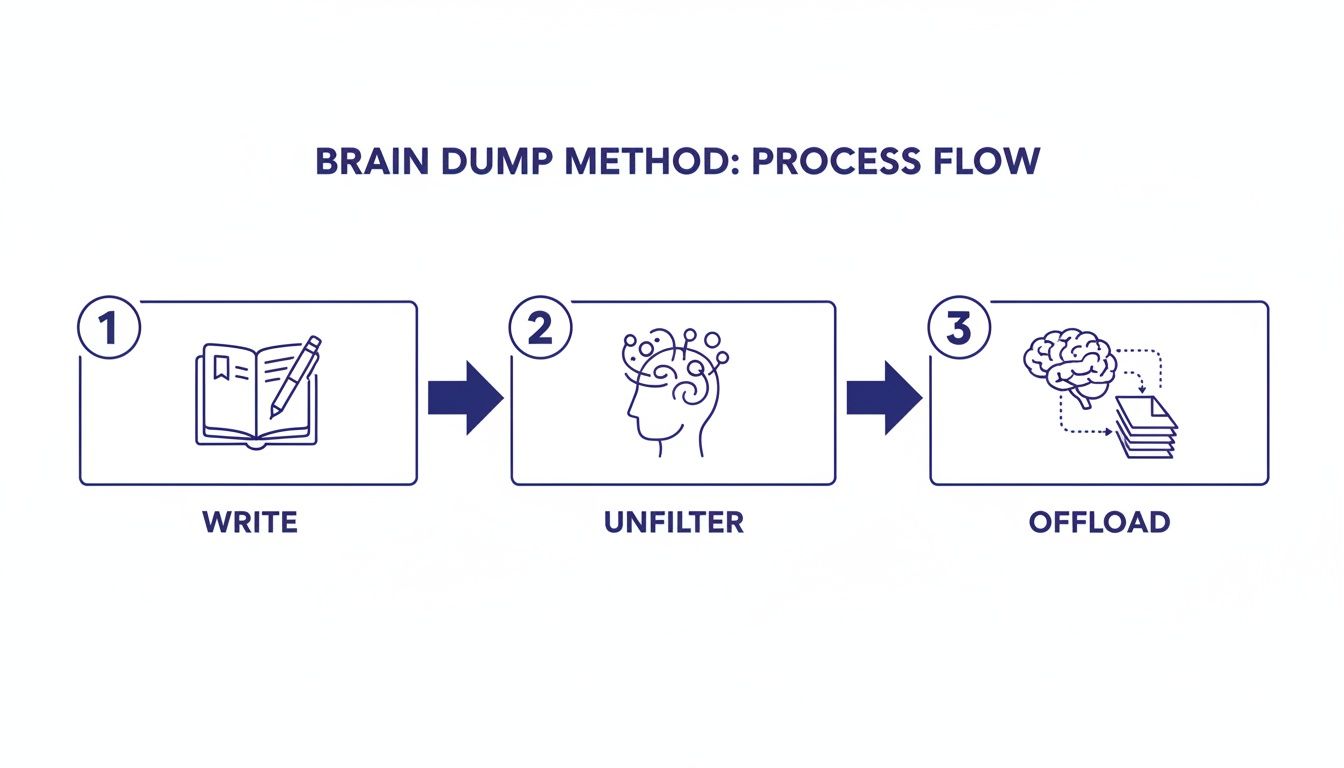
    This whole process is about getting thoughts out of your head so you can deal with them logically.

    How to organize your thoughts with a three-step Brain Dump Method flow diagram: Write, Unfilter, and Offload.

    This flow—Write, Unfilter, Offload—is the essential first step before you can sort and prioritize effectively.

    Prioritizing Your Actionable Tasks with the Eisenhower Matrix

    Now, set aside the “Incubate” and “Non-Actionable” lists and focus entirely on your ‘Actionable’ items. To figure out what to do first, the Eisenhower Matrix is an incredibly effective tool. It forces you to distinguish between what feels urgent and what is truly important—a common stumbling block that leads people to learn how to stop procrastinating.

    The matrix divides your tasks into four quadrants based on their urgency and importance. This isn’t just a theoretical exercise; it’s a practical way to decide what gets a spot in your time blocking planner today.

    The Eisenhower Matrix A Framework for Prioritizing Your Tasks

    Use this table to sort your actionable tasks from your brain dump. This method helps you focus on what truly matters, separating urgent distractions from important, goal-oriented activities.

    QuadrantDescriptionExample Tasks
    Urgent & ImportantTasks with immediate deadlines and significant consequences. Do these first.Finish a client report due today, respond to a project crisis, fix a critical website bug.
    Important & Not UrgentTasks that contribute to long-term goals and personal growth. Schedule time for these.Plan next quarter’s strategy, learn a new skill for your career, exercise and meal prep.
    Urgent & Not ImportantTasks that demand immediate attention but don’t move you toward your goals. Delegate if possible.Answering some emails, scheduling meetings for others, responding to non-critical interruptions.
    Neither Urgent nor ImportantDistractions and time-wasters. Eliminate or minimize these.Mindless social media scrolling, watching irrelevant videos, sorting old junk mail.

    By sorting your ‘Actionable’ list into these four boxes, you create an instant roadmap for your time and energy. You’ll know exactly what needs your attention now, what can be scheduled for later, and what you can safely ignore.

    Applying the Matrix in Real Life

    Let’s make this concrete. Imagine a student named Alex who just did a brain dump right before a week of final exams. His actionable list is a jumbled mess of assignments, study topics, and personal errands.

    Using the matrix, he sorts his tasks:

    1. Do (Urgent & Important): “Finish history paper due tomorrow.” “Study for the calculus exam in two days.”
    2. Schedule (Important & Not Urgent): “Start research for final biology project.” “Go to the gym three times this week.”
    3. Delegate (Urgent & Not Important): He can’t really delegate schoolwork. However, he realizes that instantly responding to every group chat notification is an “urgent but not important” time sink. He decides to check it only twice a day.
    4. Eliminate (Not Urgent & Not Important): “Binge-watch that new TV series.” “Scroll through social media for hours.”

    With this new clarity, Alex can open his planner and block out specific times. He allocates the rest of today to the history paper. He also dedicates focused study blocks for calculus tomorrow. By sorting his thoughts and protecting his time, he’s moved from a state of panic to having a structured, actionable plan.

    Building Daily Habits for a Consistently Organized Mind

    A brain dump and a well-sorted plan can feel like a massive relief. But that clarity won’t last if it’s just a one-off cleanup. True, lasting mental organization isn’t about grand gestures; it’s built through small, consistent habits that stop the clutter from piling up in the first place. This is about creating a default state of order for your mind.

    How to organize your thoughts with a minimalist workspace featuring a laptop on a stand, coffee, a mouse, and a notebook for planning and organizing tasks.

    The secret isn’t willpower—that’s a finite resource that runs out. A much smarter approach is to use a behavioral psychology trick called habit stacking. You simply link a new, tiny routine you want to build onto a habit you already do without even thinking.

    Create a Morning Launchpad

    Instead of grabbing your phone first thing and getting sucked into a vortex of notifications and emails, you can stack a new habit onto making your morning coffee or tea. Think of it as your “morning launchpad”—a quick, five-minute planning session that sets the trajectory for your entire day.

    While the coffee brews, just grab a notebook and jot down the answers to three simple questions:

    1. What is my single most important task for today?
    2. What potential distractions are likely to get in my way?
    3. What will a successful day look like when I’m done?

    This tiny ritual shifts your brain from a reactive state into a proactive one. You’re starting the day with a clear target, making it far easier to organize your thoughts as new demands inevitably pop up. For a deeper dive, check out our complete guide on how to create a morning routine that actually sticks.

    Implement an Evening Shutdown

    Just as you start the day with intention, it’s crucial to end it with a sense of closure. An “evening shutdown” is a 10-minute habit you can stack onto brushing your teeth or getting ready for bed. This routine acts as a signal to your brain that the workday is officially over. This prevents tasks and worries from bleeding into your personal time and wrecking your sleep.

    During your shutdown, you can:

    • Glance at your to-do list and move any unfinished items to tomorrow’s plan.
    • Do a quick, two-minute brain dump of any last-minute thoughts or anxieties.
    • Confirm your schedule and top priority for the next day.

    This practice offloads the mental burden of trying to remember loose ends. Research shows this directly interferes with your ability to relax and get restorative sleep. A simple habit tracker journal can be a great tool to help make both your morning launchpad and evening shutdown feel automatic.

    Optimize Your Environment to Support an Organized Mind

    Your physical and digital spaces have a profound impact on your ability to think clearly. Your brain is constantly adapting to its surroundings; a cluttered desk or a chaotic desktop almost always encourages cluttered thinking. The good news is that a few simple tweaks can reduce that friction and support deep focus.

    An organized desk, maybe with a good laptop stand for desk and an ergonomic mouse, does more than just look nice—it reduces physical strain and distraction. This frees up your cognitive resources to stay on task instead of being pulled away by discomfort.

    Digitally, constant notifications are the number one source of mental fragmentation. To get anything meaningful done, you need to create protected blocks of focus. A phone lock box timer can be a surprisingly effective tool, physically removing your biggest source of distraction for a set period. These practices are essential for preventing the kind of mental drain detailed in Burnout Breakthrough, helping you build a workflow that’s truly sustainable. When you shape your environment, you make it almost effortless for your mind to stay organized.

    Editor’s Take on Organizing Your Thoughts

    The most effective strategy here, without a doubt, is the daily brain dump. It’s not glamorous, but it works every single time. It acts as a pressure-release valve for your mind. This advice is best for professionals, students, and parents who feel constantly overwhelmed by a high volume of tasks and mental clutter. The main limitation is that it’s a capture tool, not a full system. You must follow it up with sorting and prioritizing, otherwise you just create a new source of stress: a messy, unorganized list. For best results, pair it with the Eisenhower Matrix to turn the raw data into a real action plan.

    A Quick-Reference Guide to Organizing Your Thoughts

    Mastering your mind isn’t about finding one magic bullet. It’s about building a reliable system that consistently turns mental noise into actionable clarity. This is your quick-reference guide to the most powerful strategies we’ve covered. It is designed to reinforce the core principles you need to organize your thoughts for good.

    Think of these takeaways as the foundational pillars for a more focused, organized mind. Each one tackles a different aspect of mental clutter. They range from getting thoughts out of your head to building the daily habits that keep them from piling up again.

    The Core Principles of Mental Organization

    The journey from chaos to clarity really comes down to a few key actions. Practicing these consistently will build mental muscle and create lasting change. Start by integrating just one or two, then build from there.

    • Schedule Regular Brain Dumps. Your working memory is for processing, not for storage. Get into the habit of externalizing every task, idea, and worry onto paper or a digital document at least once a day. This single act frees up an incredible amount of cognitive bandwidth, much like clearing the RAM on a computer. You can learn more about finding this kind of focus in my book, Attention Unleashed.

    • Prioritize with a Framework. A raw, unsorted list is just a different kind of overwhelm. Once your thoughts are out, use a proven system like the Eisenhower Matrix to sort your actionable tasks. Learning to distinguish what is truly important from what is merely urgent is probably the single most critical skill for effective time management and focus.

    • Build Small, Consistent Daily Habits. Lasting clarity is a result of routine, not a one-time effort. A five-minute “morning launchpad” to set your daily intention and a ten-minute “evening shutdown” to clear your mind for rest are non-negotiable. Using a good sunrise alarm clock can help make waking up for your morning routine easier.

    • Optimize Your Physical and Digital Spaces. Your environment is a powerful, often overlooked, tool for thought organization. A clean workspace, an ergonomic keyboard, and intentional digital boundaries all work together to minimize distractions. This proactive approach prevents mental clutter from forming in the first place, supporting the deep work principles detailed in The Power of Clarity.


    Key Takeaways: How to Organize Your Thoughts

    • Externalize Everything: The most critical first step is to get all thoughts, tasks, and worries out of your head and onto paper or a screen using a “brain dump.” This reduces cognitive load on your working memory.
    • Sort and Categorize: Don’t stop at the dump. Sort every item into actionable tasks, ideas to incubate for later, and non-actionable worries. This brings order to the chaos.
    • Prioritize Ruthlessly: Use a framework like the Eisenhower Matrix to separate urgent tasks from truly important ones. This ensures your energy goes toward what matters most.
    • Build Daily Routines: Lasting mental clarity comes from small, consistent habits. Implement a 5-minute morning planning session and a 10-minute evening shutdown to maintain organization.
    • Control Your Environment: A cluttered physical or digital workspace leads to cluttered thinking. Optimize your desk and manage notifications to support focus and prevent overwhelm.

    Disclaimer: This article may contain affiliate links, which means we may earn a small commission if you make a purchase. All content is for educational and informational purposes only and is not a substitute for professional medical or psychological advice.

    Frequently Asked Questions About Organizing Your Thoughts

    Common Questions on Getting Your Mind Organized

    We get a lot of questions about the nuts and bolts of this system. Here are some of the most common ones. We have straight-ahead answers based on what we’ve seen work for thousands of people trying to find clarity in the noise.


    1. How often should I really do a brain dump?

    For most people, a daily 10-minute brain dump is the sweet spot. Doing it first thing in the morning helps you map out the day with a clear head. An evening session, on the other hand, is great for offloading the day’s clutter so you can actually rest. That said, if you’re in a particularly chaotic season at work or home, don’t be afraid to do them more often. A quick, 5-minute capture session can be a lifesaver when you feel the overwhelm creeping in.

    2. I’m so overwhelmed I don’t even know where to start. What then?

    Feeling too overwhelmed to start is the exact sign that you need this process the most. It’s a common paradox. The trick is to make the first step ridiculously small. Forget about a perfect, exhaustive list. Just grab a visual timer for desk, set it for three minutes, and write down whatever is loudest in your head. That’s it. Giving yourself a tiny, non-threatening runway is often all it takes to break that feeling of paralysis.

    3. Is technology a friend or foe in all this?

    Honestly, it’s both. Digital note-taking apps and mind-mapping software can be incredible allies for capturing and sorting your thoughts. They’re fast, searchable, and always with you. But let’s be real: the constant pings, alerts, and notifications from our devices are a primary source of mental clutter. The key is to be the master of your tech, not the other way around. Use it with intention. That means turning off non-essential notifications, using focus modes, and setting firm boundaries around your digital tools.

    4. Are there specific strategies here that work well for ADHD brains?

    While this guide isn’t a substitute for professional medical advice, many people with ADHD find that externalizing their thoughts is a game-changer. Techniques like brain dumps, mind mapping, and using a time blocking planner are often effective because they take the immense pressure off of working memory. Visual and tactile tools can also be incredibly helpful. Think sticky notes on a whiteboard, a physical planner you can touch, or color-coded lists. These methods are more engaging for the ADHD brain and can make it easier to maintain focus.

    5. What do I do with all the recurring negative thoughts that come up?

    A brain dump is the perfect place to put them. When you drag a negative thought out of the dark corners of your mind and onto a piece of paper, it often loses some of its power. You can see it for what it is—just a thought, not an absolute truth. Simply acknowledge it without judgment. Park it in your “Non-Actionable” or “Worries” category. If you find these thoughts are persistent and causing you real distress, that’s a good signal to reach out to a mental health professional for more dedicated support.


    How This System Helps You Get More Done

    6. Isn’t this just a fancy way of making a to-do list?

    Not at all. A to-do list is just one small outcome of organizing your thoughts. A to-do list only captures your “Actionable” items. True thought organization is the entire process: capturing everything floating around in your head—tasks, half-baked ideas, worries, random memories—and then sorting it all into its proper place. This clears out the other 90% of mental clutter that a simple to-do list never touches, which is what gives you that feeling of genuine clarity.

    7. How can I use this to prepare for a difficult conversation?

    This is one of the most powerful applications of the whole system. Before you walk into that conversation, do a brain dump focused entirely on that topic. Get it all out:

    • The absolute must-say points you need to communicate.
    • What a successful outcome would look like for you.
    • Your fears and anxieties about how it might go.
    • How the other person might react, and how you could respond calmly.

    By organizing these thoughts beforehand, you arm yourself with clarity. You’re far more likely to stay focused and articulate, rather than getting hijacked by in-the-moment emotions.

    8. Will these techniques help with brainstorming and creative work?

    Absolutely. Mind mapping, in particular, is a powerhouse for creativity because it mirrors how your brain naturally forms connections—non-linearly. You start with a central idea and let your thoughts branch out organically, uncovering associations you’d never find in a straight list. A good old-fashioned brain dump can also be a goldmine for innovation, unearthing brilliant ideas that were simply buried under the noise of your daily mental clutter.

    9. What happens to the ‘Incubate’ and ‘Non-Actionable’ lists? Do they just sit there?

    Great question. Your “Incubate” list—the home for your future ideas and “someday/maybe” projects—is a treasure chest. You’ll want to review it periodically, maybe once a week or once a month. This keeps those brilliant ideas alive without having them clog up your day-to-day thinking. For the “Non-Actionable” list of worries and anxieties, the simple act of writing them down is often the most important step. It externalizes them and shrinks their power. This process is a core part of managing things like decision fatigue, as it frees up mental energy you were spending on unproductive loops.

    10. How long will it take before this feels natural?

    You’ll feel a sense of relief from your very first brain dump. That’s the immediate win. But turning it into a consistent, automatic habit? That usually takes a few weeks of practice. The secret is consistency over intensity. A small, daily routine is far more powerful than a massive, perfect overhaul you only do once. Stick with it, and you’ll find that mental clarity slowly but surely becomes your new normal.


    At Mind Clarity Hub, we’re focused on giving you science-backed, actionable strategies to reclaim your focus and build a more intentional life. Explore our collection of books to find the perfect guide for your journey.

    Discover Your Path to Clarity at Mind Clarity Hub

  • A Science-Backed Guide to Improving Problem Solving Skills

    A Science-Backed Guide to Improving Problem Solving Skills

    A Science-Backed Guide to Improving Problem Solving Skills

    Getting better at solving problems isn’t about grinding harder—it’s about thinking smarter. It’s a deliberate process of breaking down challenges, seeing around corners, and actually learning from what happens. This guide gives you a practical, no-fluff program for improving problem solving skills for good.

    (Note: This article contains affiliate links. If you purchase a product through one of these links, we may earn a small commission at no extra cost to you. This content is for educational purposes only and is not a substitute for professional medical or psychological advice.)

    Why Improving Your Problem-Solving Skills Matters More Than Ever

    Ever feel like you’re just staring at a project that’s gone completely sideways? A dozen priorities are screaming for your attention, some unexpected tech glitch just blew up your workflow, and the deadline is breathing down your neck. Your brain gets stuck in a loop, replaying the same bad ideas until you’re completely overwhelmed.

    That feeling is often a sign of cognitive overload, and it’s precisely where strong problem-solving skills make all the difference. In today’s messy, fast-moving world of work, the ability to dissect a problem and map out a real solution isn’t a “soft skill” anymore. It’s a core survival tool. It’s what separates reactive stress from proactive progress.

    A thoughtful man in a gray sweater looks intently at a diagram on his laptop, a key part of improving problem solving skills.

    The Real-World Cost of Underdeveloped Skills

    Let’s be clear: weak problem-solving isn’t just some abstract career limiter. It has tangible, measurable costs. Research from the OECD shows a direct link between adaptive problem-solving and income, with higher proficiency tied to a 7% increase in hourly wages and better odds of staying in the workforce.

    But it’s not just about landing a better job or navigating huge crises. It’s about handling the daily grind with less friction:

    • Decoding a client’s vague feedback without sinking into an endless cycle of revisions.
    • Fixing a recurring bug at its root instead of just slapping on another temporary patch.
    • Navigating a team conflict so people can actually get back to working together.

    Without a solid process, we default to our worst cognitive habits. Neuroscience explains that when we’re stressed, the brain’s emotional center (the amygdala) can override the logical, reasoning part (the prefrontal cortex). This triggers what’s known as “solution-jumping”—we grab the first, easiest answer we can think of, not the best one.

    (This article is for educational purposes and is not a substitute for professional medical or psychological advice, diagnosis, or treatment. If you are experiencing symptoms of burnout, anxiety, or other mental health concerns, please consult a qualified healthcare provider.)

    You Can Systematically Build This Skill

    Here’s the good news: problem-solving isn’t some innate talent reserved for a lucky few. It’s a skill, like learning an instrument or a new language. You can train it. By practicing specific mental frameworks and building the right habits, you can literally rewire how your brain approaches a challenge.

    This guide isn’t about fuzzy advice like “think outside the box.” We’re giving you a step-by-step program—from honest self-assessment and targeted micro-drills to advanced cognitive strategies. It’s built for busy professionals who need methods that work, not just theories that sound good.

    Assess Your Current Approach to Solving Problems

    Before you can build stronger problem-solving skills, you need a clear, honest picture of where you’re starting. Think of it like a fitness assessment before a new training plan—without a baseline, you can’t track your progress or focus your energy where it actually counts. This isn’t about some formal quiz; it’s about candid self-reflection.

    When a surprise problem lands on your desk and throws your day off course, what’s your first instinct? Do you dive in headfirst, trying solutions on the fly? Or do you take a beat to figure out what’s really going on? Your gut reaction reveals a lot about your default problem-solving style.

    A person's hand writes in a notebook with 'ASSESSMENT' and checkboxes, a core step for improving problem solving skills.

    Solution-Jumping vs. Problem-Framing

    Many of us are conditioned to be “solution-jumpers.” It’s a cognitive shortcut where the brain, desperate to resolve uncertainty, grabs the first plausible fix it finds. It feels productive in the moment, but it’s a trap. This habit often leads to patching up symptoms instead of addressing the root cause, all but guaranteeing the problem will pop up again later.

    In sharp contrast, problem-framing is the deliberate practice of defining the issue before you even think about solutions. It means asking clarifying questions, gathering context, and resisting that powerful urge for a quick fix. This more methodical approach is a cornerstone of strong executive function—the mental command center that governs how we plan, focus, and execute complex tasks.

    If you feel like this is a constant battle, our guide on how to repair executive function offers deeper, more targeted strategies.

    A well-defined problem is a half-solved problem. Rushing this step is like trying to build a house on a shaky foundation—the effort you save upfront will cost you much more down the road.

    A Real-World Scenario Uncovering Blind Spots

    Consider a project manager, Sarah, who noticed her team kept missing deadlines for a specific type of task. Her immediate, solution-jumping reaction was to blame the project management software and start researching expensive alternatives. It was a classic case of aiming for a fast, visible fix.

    But then she paused to assess her own approach. Instead of assuming the tool was the problem, she started framing the issue by asking herself a few sharp questions:

    • Is this happening with the whole team, or just a few people?
    • Does the delay occur at a specific point in our workflow?
    • Have I been crystal clear about the dependencies for this task?

    Through this self-assessment, Sarah found the bottleneck. It wasn’t the software at all; it was an ambiguous handoff step between the design and development phases. Team members were making different assumptions, which led to rework and delays. Her blind spot was assuming the process was clear to everyone just because it was clear to her. By framing the problem correctly, she implemented a simple handoff checklist. The issue was solved without spending a dime on new software.

    Identify Your Problem-Solving Style

    So, how do you typically react when things go sideways? Your habits, your mood, and even your stress levels can dictate your approach. This table isn’t a test, but a mirror. Use it to reflect on your common patterns and see where your default style might be holding you back.

    Common SituationReactive Approach (Impulsive)Structured Approach (Mindful)
    Facing a vague requestImmediately starts working on what you think is needed.Asks clarifying questions to define the scope and goal first.
    An initial solution failsFeels frustrated and tries a slightly different version of the same idea.Pauses to analyze why it failed before formulating a new hypothesis.
    Under pressureJumps at the first, easiest fix to relieve the immediate stress.Takes a moment to breathe and map out the core components of the problem.
    A complex problem emergesFeels overwhelmed and avoids the issue, focusing on smaller, easier tasks.Breaks the large problem down into smaller, more manageable sub-problems.

    Looking at these patterns, do you see yourself leaning one way or the other? Recognizing whether your default is reactive or structured is the essential first step. It shines a light on the specific habits you need to build for more effective, reliable problem-solving.

    Mastering Core Cognitive Strategies for Improving Problem Solving Skills

    Once you get a feel for your default problem-solving habits, you can start upgrading your mental toolkit. This isn’t about finding a single “magic bullet” technique. It’s about mastering a few powerful cognitive strategies—mental models that shift how you see a problem in the first place.

    Think of them as different lenses you can look through. Each one reveals a unique angle of a challenge, helping you move past the obvious, surface-level fixes to find more robust, fundamental solutions. These aren’t just abstract theories; they are practical frameworks you can actively use.

    And these skills are surprisingly rare. Data from the OECD’s PISA 2012 assessment revealed that, on average, just 11% of 15-year-old students across 44 countries were top performers in problem-solving. This points to a huge gap between basic troubleshooting and the kind of adaptive thinking needed for complex modern challenges. You can check out more insights from this global skills assessment on the OECD website.

    Use First Principles Thinking to Deconstruct Problems

    One of the most powerful ways to cut through complexity is First Principles Thinking. The idea is to break a problem down into its most basic, undeniable truths—the “first principles”—and then build your solution up from there. Instead of relying on assumptions or what’s always been done, you reason from the ground up.

    This approach forces you to question everything. Your prefrontal cortex, the brain’s hub for logical reasoning, is brilliant at this kind of deconstruction when you give it the time and space to work. For a deeper look at specific methods, it’s worth exploring these essential structured problem-solving techniques.

    Scenario: The Freelance Web Designer
    A freelance designer gets a vague but common request from a client: “We need a new, modern website.”

    • Conventional Approach: The designer immediately starts looking at trendy website templates and creating mockups based on current design fads.
    • First Principles Approach: The designer hits pause and asks fundamental questions:
      • What is the absolute core purpose of this website? Is it for lead generation? E-commerce sales? An information hub?
      • Who is the end-user, and what is the single most important action we want them to take?
      • Stripped of all jargon, what are the essential elements required to get them to take that action?
        By reasoning from these first principles, the designer’s focus shifts from just a “modern look” to building a site that serves the client’s foundational business goals. The result is a far more effective final product.

    Anticipate Consequences with Second-Order Thinking

    While First Principles breaks a problem down, Second-Order Thinking builds it back up by exploring what happens next. It’s the simple practice of thinking beyond the immediate result of a decision. First-order thinking is quick and easy (“This will solve our immediate problem”). Second-order thinking is deeper: “And then what will happen? And what will be the consequence of that?”

    This mental model helps you spot unintended consequences and avoid creating new problems down the line. It’s a critical skill for any kind of strategic decision. Sustaining this level of forward-thinking takes real mental energy, which is why our guide on improving focus and concentration can be a valuable resource for building that cognitive stamina.

    Second-order thinking is the voice in your head that asks, “And then what?” It separates good decision-makers from great ones by forcing a disciplined look at the chain reaction of effects over time.

    Scenario: The Software Team Lead
    A team lead is tempted to use a “quick and dirty” code patch to meet a tight deadline for a new feature.

    • First-Order Thinking: “This patch will fix the bug and let us ship on time. The client will be happy.”
    • Second-Order Thinking: The lead forces themself to ask, “And then what?”
      • The patch introduces “technical debt,” making future updates slower and more difficult.
      • The team might get used to taking shortcuts, lowering overall code quality.
      • If the patch causes another bug after the launch, it will damage the client’s trust far more than a slight delay ever would.
        Recognizing these long-term consequences, the lead decides to negotiate a one-day deadline extension to implement a proper, stable fix.

    Work Backward with Inversion

    Sometimes the clearest path forward is found by looking backward. Inversion is a powerful mental model where you start by identifying the outcome you want to avoid, and then work backward to figure out what you need to do to prevent it from happening. Instead of asking, “How can I achieve success?” you ask, “What could cause this to fail completely?”

    This little psychological trick helps you sidestep cognitive biases like over-optimism. By focusing on potential failures, you proactively spot risks, weaknesses, and blind spots you might otherwise miss.

    Scenario: The Marketing Manager
    A manager is planning a major product launch campaign.

    • Conventional Approach: The manager focuses on all the things that need to go right: “We need great ad copy, a smooth website experience, and positive press coverage.”
    • Inversion Approach: The manager convenes the team for a “pre-mortem” and poses the question: “Imagine it’s six months from now and this launch was a total disaster. What went wrong?”
      • Team members might suggest failures like: “Our key messaging was confusing,” “The website crashed from all the traffic,” or “A competitor launched a similar product a week before us and stole our thunder.”
        By identifying these potential failure points upfront, the team can create specific contingency plans—like stress-testing the website or refining the messaging—to prevent those exact disasters from happening.

    Building Your Practice Routine for Improving Problem Solving Skills

    Knowing the cognitive strategies is one thing, but building real skill happens in the trenches. It comes from consistent, deliberate practice. Just like strengthening a muscle, you can’t improve your problem-solving abilities without a dedicated routine. The goal is to move these mental models from a state of conscious, clunky effort to an automatic, intuitive habit.

    This isn’t just a metaphor; you’re literally creating new neural pathways. When you consistently practice a specific way of thinking, your brain strengthens the synaptic connections involved. This process, known as neuroplasticity, makes that thought pattern faster and more efficient over time. This is the heart of habit formation—turning intentional action into second nature.

    This diagram shows a simplified flow for how you might apply these powerful cognitive strategies in a practice session.

    A diagram illustrates three cognitive strategies for improving problem solving skills: First Principles, Second-Order Thinking, and Inversion.

    It’s a great visual reminder of the process: start by breaking a problem down to its core truths (First Principles), then explore the long-term ripple effects of potential solutions (Second-Order Thinking), and finally, spot risks by imagining what could go wrong (Inversion).

    Design Your Practice Sessions

    An effective routine isn’t about grinding for hours. It’s about a smart balance of short, focused exercises and longer, more immersive sessions. This variety keeps your practice engaging and targets different aspects of your cognitive function.

    • Micro-Practice Drills (5-10 minutes): These are quick, targeted exercises designed to fit into a busy day. Think of them as mental push-ups. The goal here is pure repetition and reinforcement of a single skill. For example, grab a common workplace problem—like an unclear email request—and spend just five minutes deconstructing it using First Principles. That’s it.
    • Deep Work Sessions (45-minute blocks): This is your dedicated, uninterrupted time for a complex problem. The time constraint is actually a feature, not a bug—it forces you to focus intensely and push your cognitive limits. Aiming for one deep work session a week is a fantastic way to build mental endurance.

    The key is consistency, not intensity. A daily 10-minute drill is far more effective for long-term skill development than one heroic, three-hour session once a month.

    Manage Your Brain’s Chemistry for Better Focus

    Your ability to sink into deep problem-solving is heavily influenced by your brain’s neurochemical state, especially dopamine. Our modern digital lives often flood our brains with cheap dopamine hits from notifications, social media feeds, and constant context-switching.

    Behavioral research shows this endless stimulation trains your brain to crave novelty and distraction. That makes it incredibly difficult to sustain the prolonged focus needed for deep work. It’s not just about productivity; managing your screen time is about protecting your very capacity for clear, methodical thought.

    Actionable Tip: Schedule your deep work sessions before you check emails or social media. This saves your prefrontal cortex’s finite daily resources for high-value thinking instead of draining them on reactive, low-value tasks first thing in the morning.

    Use AI as a Sparring Partner, Not a Shortcut

    AI tools like ChatGPT can be incredible for practice, but only if you use them correctly. The goal is to scaffold your thinking, not to outsource it. It’s tempting to ask for the answer, but that builds zero skill.

    Instead, treat AI like a collaborator to push your own thinking further:

    • Generate Scenarios: “Act as a project manager. Give me a complex scenario where a software launch is behind schedule due to an unexpected technical issue.”
    • Critique Your Solutions: “Here is my proposed solution to that scenario. What are three potential flaws or unintended consequences of this approach?”
    • Deepen Your Analysis: “Help me apply Second-Order Thinking to this decision. What are the likely ripple effects in one month? Six months? One year?”

    This approach forces you to articulate your thought process and defend your logic, which is where the real learning happens.

    Sample Weekly Practice Schedule

    A structured plan helps turn good intentions into real action. Here’s a simple template you can adapt to your own schedule and goals. Keeping a dedicated notebook for these exercises can also be a game-changer; you can find great options in our guide to the best journals for productivity.

    DayFocus ActivityDurationGoal
    MondayFirst Principles Drill10 minDeconstruct a recent work email or request into its fundamental truths.
    TuesdayInversion Practice15 minTake an upcoming project and brainstorm all the ways it could fail.
    WednesdayDeep Work Session45 minTackle a significant, non-urgent problem using your chosen strategies.
    ThursdaySecond-Order Drill10 minAnalyze a recent decision you made and map out its potential future consequences.
    FridayAI Sparring Session20 minUse an AI tool to generate a new scenario and critique your response.

    This blend of micro-drills and deep work creates a balanced routine that builds skill without causing burnout. It makes improving your problem-solving skills a sustainable, lifelong habit.

    From Analysis to Action With Decision Frameworks

    All the analysis in the world is useless until it leads to a decision. This is where problem-solving stops being a thought exercise and starts creating real-world change. To make that leap without getting stuck, you need a few battle-tested decision frameworks to guide you from insight to action.

    Without a good model, it’s incredibly easy to fall into analysis paralysis. This isn’t a character flaw; it’s a known cognitive state where too many options overwhelm your brain’s executive functions. Your prefrontal cortex gets stuck in a loop, endlessly weighing variables without ever landing on a conclusion. Decision frameworks act as a filter, helping you cut through the noise.

    This skill is rarer than you might think. OECD data reveals that only 5% of adults reach the highest level of adaptive problem-solving—the very skill needed for smart decisions under pressure. Meanwhile, nearly a third struggle with multi-step tasks, showing a clear need for frameworks to guide action. You can see more on these adult problem-solving skills on OECD.org.

    First, Separate the Urgent from the Important

    Not all problems are created equal. The Eisenhower Matrix is a brilliantly simple tool for figuring out what truly deserves your immediate attention. It forces you to sort tasks into four quadrants based on just two criteria: urgency and importance.

    • Urgent & Important: Do these first, and do them now.
    • Important, Not Urgent: Schedule these. This is where strategic progress happens.
    • Urgent, Not Important: Delegate these if you can. They’re often other people’s priorities.
    • Neither Urgent Nor Important: Eliminate these. They’re just distractions.

    Scenario: An office manager is swamped. The printer is jammed (urgent, not important), a major quarterly budget report is due next week (important, not urgent), and a coworker just asked for help with a minor spreadsheet formula (urgent, not important). Using the matrix, the manager asks the coworker to wait, calls IT for the printer, and carves out dedicated time to work on the crucial budget report. This prevents the immediate but low-value tasks from derailing strategic work.

    Making Smart Calls in Fast-Moving Situations

    For problems that are constantly changing, the OODA Loop is an invaluable mental model. Developed by military strategist John Boyd, it’s a four-stage cycle for making decisions in fluid environments: Observe, Orient, Decide, and Act.

    The OODA Loop isn’t a linear checklist but a rapid, iterative cycle. The person or team who can cycle through it fastest—observing new information, reorienting their understanding, and acting decisively—gains a significant strategic advantage.

    Imagine a small coffee shop owner who notices a new competitor opening across the street with a big marketing splash. Instead of panicking, she pauses and studies what they’re doing—what’s on their menu, how they’re pricing things, and who they seem to be targeting.

    Pretty quickly, she sees the pattern: they’re pushing sugary, high-margin drinks and trying to win people with hype and discounts. Her shop, on the other hand, has a reputation for high-quality, single-origin coffee and customers who actually care about taste.

    So she makes a clear decision: she’s not going to fight a price war she doesn’t need. She’s going to lean harder into what makes her different. Then she takes action by launching a “Coffee Connoisseur’s Club,” with tasting nights and simple educational workshops that turn casual customers into loyal regulars.

    The result is that she doesn’t just survive the new competition—she sidesteps it. By moving through her OODA loop faster and with better judgment, she responds in a way the competitor didn’t anticipate, and she strengthens her position instead of weakening it.

    Clarifying Who Does What in Team Decisions

    When a decision involves multiple people, ambiguity is the enemy. The RAPID framework is designed to eliminate confusion by clarifying exactly who has which role, preventing stalemates and ensuring someone is accountable.

    • Recommend: The person who proposes a course of action.
    • Agree: Stakeholders who must sign off on the recommendation.
    • Perform: The team that will actually implement the decision.
    • Input: People who are consulted for information and expertise.
    • Decide: The single person with the final authority to say “yes” or “no.”

    For a visual way to map out more complex choices, using a good decision tree template can provide a clear strategic guide.

    Turn Every Outcome into a Lesson

    Finally, getting better at problem-solving means learning from your choices—both the good and the bad. After a decision is made and the outcome is clear, take a few minutes to conduct a brief error analysis.

    This isn’t about beating yourself up. It’s about taking an honest look at what worked and what didn’t. Ask yourself what you overlooked, which assumptions didn’t hold up, and what you’d change if you had to do it again. The point is to learn from the outcome and use those lessons to make the next attempt smarter.

    This simple habit, rooted in behavioral psychology principles of feedback loops, transforms every decision into a lesson for the next challenge. As you get more comfortable with this, you might explore our guide on how to use AI for productivity to help analyze data and outcomes more efficiently.

    Editor’s Take: The Truth About Improving Problem-Solving Skills

    Let’s cut right to it: you can’t read your way to becoming a great problem-solver. No amount of passively consuming articles on mental models will sharpen your thinking. Real, lasting improvement comes from one place and one place only: consistent, deliberate practice. The frameworks in this guide are powerful, but only if you get your hands dirty.

    Who is this advice best for? This approach is for professionals, students, and entrepreneurs who are ready to lean into the cognitive friction that real growth requires. It’s for people who understand that quick fixes are usually just temporary patches.

    What are the limitations? The biggest barrier isn’t a lack of information; it’s the mental static and stress that kicks in the moment you face a problem without an obvious solution. These techniques are less effective when you’re burned out or overwhelmed. Managing your well-being isn’t optional; it’s a prerequisite for clear thinking. The path to mastery is measured in months of consistent effort, not days of cramming.

    Frequently Asked Questions About Improving Problem-Solving Skills

    Here are answers to common questions about sharpening your problem-solving abilities.

    1. How long does it take to see real improvement in problem-solving skills?

    You can notice small shifts, like pausing before reacting, within a few weeks of consistent practice. However, making these structured approaches your default way of thinking under pressure typically takes several months of dedicated effort.

    2. Can I use these techniques for personal problems, too?

    Absolutely. Mental models like First Principles Thinking, Second-Order Thinking, and Inversion are universal. They are just as effective for untangling a personal finance issue or navigating a family conflict as they are for a complex work project.

    3. What is the single biggest mistake people make?

    Solution-jumping. It’s the powerful, instinctual urge to grab the first plausible fix without truly understanding the root cause of the problem. This habit leads to treating symptoms instead of the underlying issue, ensuring the problem will return.

    4. How can I practice if my job is repetitive?

    Even in a structured role, you can create practice scenarios. Run “what-if” drills: “What if our primary software failed for a full day? What’s our backup plan?” You can also apply these analytical skills to non-work challenges, like planning a vacation or optimizing a fitness routine.

    5. Are there any specific apps or tools that help with problem-solving skills?

    While no app can do the work for you, some can support your practice. Mind-mapping tools like Miro or XMind help visualize complex problems. Brain-training apps like Luminosity can sharpen analytical thinking, and AI assistants like ChatGPT are excellent for generating practice scenarios.

    6. What’s the difference between critical thinking and problem-solving?

    Think of critical thinking as the analysis phase. It’s the skill of questioning assumptions, identifying biases, and evaluating evidence. Problem-solving is the entire process that includes critical thinking, but also involves defining the problem, generating solutions, deciding on a course of action, and implementing it.

    7. What should I do when a problem feels completely overwhelming?

    When you feel overwhelmed, your brain’s emotional centers are overriding its logical ones. The best first step is to disengage to calm your nervous system. Take a short walk, do a few minutes of deep breathing, or write down your worries. Return to the problem only when you feel more grounded.

    8. Is it better to solve problems alone or in a group?

    It depends on the problem. For highly technical issues where one person has deep expertise, solving it alone can be faster. For complex, ambiguous problems that require diverse perspectives, a collaborative group approach is almost always superior.

    9. How can I start teaching these problem-solving skills to my team?

    Lead by example. Use the language of these frameworks in meetings. When breaking down a problem, verbalize your thought process. Introduce a “pre-mortem” exercise (a form of Inversion) before your next big project. Insist on a clear, agreed-upon problem definition before anyone suggests solutions.

    10. What role does creativity play in logical problem-solving?

    Creativity is essential. Logic and structured thinking help you dissect a problem into its core components. Creativity is what allows you to see novel connections between those components and generate innovative solutions that aren’t immediately obvious. The best problem-solvers masterfully blend both.


    (Disclaimer: This article contains affiliate links. If you purchase a product, we may earn a small commission at no extra cost to you. The content provided is for educational purposes only and is not a substitute for professional medical or psychological advice. Always consult a qualified professional for personal health concerns.)


    Ready to stop feeling overwhelmed and start solving problems with confidence? The books from Mind Clarity Hub offer science-backed, step-by-step guides to help you build focus, manage your attention, and think more clearly. Explore the full library and find the right guide for you at mindclarityhub.com.

    Explore the Mind Clarity Hub Library

    Practical books on focus, digital habits, resilience, and building a calmer mind.

    The Power of Clarity — book cover

    The Power of Clarity

    Unlock mental focus, build momentum, and create the life you were meant to live.

    View book →
    AI & ChatGPT for Beginners — book cover

    AI & ChatGPT for Beginners

    No PhD needed — a 2025 guide to AI, prompts, and productivity without coding.

    View book →
    Zen in the Digital Jungle — book cover

    Zen in the Digital Jungle

    Mindfulness for a chaotic world.

    View book →
    The Slow Reset — book cover

    The Slow Reset

    Mindful living in a fast-paced world.

    View book →
    Perfectly Imperfect — book cover

    Perfectly Imperfect

    Stop self-criticism, set boundaries, and embrace the real you.

    View book →
    Reclaiming Silence — book cover

    Reclaiming Silence

    A dopamine detox guide to finding peace in a noisy world.
    View book →
    The Focused Freelancer — book cover

    The Focused Freelancer

    Productivity, pricing & positioning for independents in 2025.

    View book →
    ChatGPT Side Hustle System — book cover

    ChatGPT Side Hustle System

    Launch your AI-driven online business in 30 days.

    View book →
    Burnout, Interrupted — book cover

    Burnout, Interrupted

    A proven path to restore energy and reclaim your life.

    View book →
    Attention Unleashed — book cover

    Attention Unleashed

    Focus strategies for the distracted mind.

    View book →
    Side Hustle Launchpad — book cover

    Side Hustle Launchpad

    Your quick-start guide to extra income.

    View book →
    Digital Clarity — book cover

    Digital Clarity

    Rewire your brain, escape dopamine traps & regain focus.

    View book →
    Break the Scroll — book cover

    Break the Scroll

    Reduce screen time and take back control of your life.

    View book →
    Climate Compassion — book cover

    Climate Compassion

    Transform eco-anxiety into empowered action.

    View book →
    Village Mentality — book cover

    Village Mentality

    The power of community for mental wellness.

    View book →
    Restful Nights — book cover

    Restful Nights

    Overcoming sleep anxiety in a 24/7 world.

    View book →
    Connected Again — book cover

    Connected Again

    Combat loneliness and build meaningful relationships.

    View book →
    Focus Recharged — book cover

    Focus Recharged

    Mastering attention and productivity in the digital era.

    View book →
    Marketing Magic with ChatGPT — book cover

    Marketing Magic with ChatGPT

    AI-powered content, campaigns, and copywriting to grow faster.

    View book →
    The 6-Figure Creator — book cover

    The 6-Figure Creator

    Turn knowledge into passive income with books, courses & AI.

    View book →
    Burnout Breakthrough — book cover

    Burnout Breakthrough

    Reset your work-life balance and thrive in 2025.

    View book →
    The Emotionally Intelligent Man — book cover

    The Emotionally Intelligent Man

    A modern guide to self-awareness and communication.

    View book →
    AI Personalized Wellness — book cover

    AI Personalized Wellness

    Create your custom health plan with data-driven habits.

    View book →
    Everyday AI Made Easy — book cover

    Everyday AI Made Easy

    Use ChatGPT and smart tools to simplify life.

    View book →
    Money Mindfulness — book cover

    Money Mindfulness

    A financial wellness guide for Gen Z & Millennials.

    View book →
    Startup Smarter with AI — book cover

    Startup Smarter with AI

    ChatGPT strategies and tools to grow your business.

    View book →
    ChatGPT for Writers & Creators — book cover

    ChatGPT for Writers & Creators

    Unlock AI-powered brainstorming, drafting & editing.

    View book →