...

Tag: focus management

  • What is context switching? Boost Focus with Simple Strategies

    What is context switching? Boost Focus with Simple Strategies

    (A quick heads-up: Some of the links in this article are affiliate links. This means if you decide to purchase something, we may earn a small commission at no extra cost to you. We only recommend tools we genuinely trust and use ourselves.)

    The content on this site—including any discussions about focus, mood, or habits—is for educational and informational purposes only. It is not intended to be a substitute for professional medical or psychological advice, diagnosis, or treatment. This includes topics like anxiety, depression, ADHD, burnout, or sleep problems. Always seek the advice of your physician or another qualified health provider with any questions you may have regarding a medical condition. Never disregard professional medical advice or delay in seeking it because of something you have read on this website.

    What Is Context Switching and Why It Sabotages Your Day

    Ever get to the end of a long workday feeling completely drained, but with almost nothing to show for it? You’re not imagining it. The culprit is almost always context switching—the act of jumping between unrelated tasks, projects, or even different apps on your screen.

    Think of your brain’s focus like a computer’s RAM. Your brain’s prefrontal cortex, which manages executive functions like attention, is designed for serial processing, not parallel. When you focus on one task, it runs beautifully. But try to run twenty different mental programs at once, and everything starts to lag. Each time you leap from drafting a report to checking a Slack notification, your brain has to pay a “cognitive tax” to shut down the old context and load up the new one.

    This constant toggling isn’t just a minor annoyance; it’s a productivity killer with roots in our cognitive architecture.

    The Real Cost of Context Switching by Juggling Tasks

    This mental gymnastics has a massive, measurable impact on your performance. Psychological research shows that the constant shift between tasks, apps, and conversations can eat up to 40% of a knowledge worker’s productive time.

    Let that sink in. An 8-hour day effectively shrinks to just 4.8 hours of real, focused output. This staggering loss comes from a phenomenon called “attention residue”—the lingering thoughts from your previous task that stick around and sabotage your focus on the new one. According to research on this cognitive bottleneck, this friction drains your mental energy and can significantly impact performance.

    This visual breaks down how that cognitive cost adds up.

    Concept map detailing the negative impacts of context switching on your brain: productivity loss, stress, and refocus time.

    As you can see, every single switch fragments your attention. It makes deep, meaningful work almost impossible while ratcheting up your mental strain and stress levels.

    The table below offers a quick summary of these hidden costs.

    The Hidden Costs of Context Switching at a Glance

    Area of ImpactKey StatisticReal-World Consequence
    ProductivityUp to 40% of productive time lostFeeling busy all day but having little to show for it; projects drag on.
    Cognitive LoadTakes up to 23 minutes to fully refocusYou’re never fully “in the zone,” leading to shallow thinking and more mistakes.
    Error RatePerformance can drop by 40% or moreRushed, sloppy work that requires more time to fix later on.
    Mental EnergyIncreases cortisol and adrenalineLeads to chronic stress, decision fatigue, and eventual burnout.

    These numbers aren’t just abstract data points; they represent the friction you feel every single day when your attention is pulled in too many directions.

    What Context Switching Looks Like in Action

    Spotting context switching is the first step to beating it. It often masquerades as productive “multitasking,” but the two are worlds apart. True multitasking is rare, while context switching is the exhausting reality for most of us. (You can learn more in our guide on how to stop multitasking).

    Here are a few all-too-common examples of context switching at work:

    • Mini Scenario: The Notification Trap. You’re deep into building a presentation, but you pause to instantly reply to a non-urgent email or chat message. Your brain has to unload the complex presentation context, load the email context, formulate a reply, and then painstakingly reload the presentation context.
    • App hopping: You find yourself jumping between your CRM, a spreadsheet, and your project management tool just to pull together information for a single, simple task. Each app jump is a micro-switch that adds to your cognitive load.
    • Meeting interruptions: You’re trying to sneak in some work on a report during a video call, all while attempting to listen and contribute to the conversation. Your brain isn’t doing both; it’s rapidly switching between the two, doing neither well.

    Each of these seemingly small shifts chips away at your focus, drains your energy, and leaves you with that nagging feeling of being perpetually behind. Once you start recognizing these patterns, you can finally begin to take back control of your day. To get started, you can browse the library for a book that fits your focus goals.

    The Neuroscience Behind Your Brain’s Switching Tax

    That fried feeling you get after a day of bouncing between tasks? It’s not just in your head. It’s a biological reality rooted in the very architecture of your brain.

    When you really dig into the neurology of context switching, you start to see why it’s so draining—and how to work with your brain instead of against it.

    Focused student writing with a brain-and-network overlay and “ATTENTION RESIDUE” text, illustrating **what is context switching** and its impact on concentration.

    At the center of it all is your prefrontal cortex (PFC). Think of it as your brain’s project manager. It handles all the big-picture stuff: planning, making decisions, and aiming your attention where it needs to go.

    When you settle into a single task, your PFC activates a specific neural network perfectly suited for that job. It’s a clean, efficient connection. But the moment you switch gears—say, pausing a complex report to answer a “quick” email—you force the PFC into a messy, expensive reboot. It has to inhibit one network and activate an entirely different one. This switch is anything but instant or clean.

    The Lingering Problem of Attention Residue

    Here’s where the real cost kicks in. It’s a phenomenon called attention residue, a term coined by researcher Sophie Leroy. It describes how thoughts and fragments of the last task you were doing cling to your consciousness, getting in the way of the new one.

    Even after you’ve clicked over to that spreadsheet, a part of your brain is still mentally polishing the reply to that email. It’s cognitive static. This means you’re never fully present or engaged in the new task because your brain is trying to run two programs at once with limited power.

    If you want to go deeper into how your brain is built for focus, our guide on the neuroscience of single-tasking is a great next step.

    Mini Scenario: The Meeting Aftermath
    You just wrapped up an intense budget meeting and immediately pivot to writing a creative proposal. But for the next 15 minutes, your mind keeps replaying a tense moment from the call. You reread the same sentence three times. That’s attention residue in action. Your PFC is stuck, unable to fully allocate its resources to the creative work at hand.

    This constant mental friction is incredibly taxing. It burns through glucose, your brain’s main fuel source, far faster than staying on one task ever would. The result is what we all know too well: mental fog, more mistakes, and a weaker ability to think critically. For many, it’s a direct line to burnout, a topic we explore in our book Burnout Interrupted.

    How Modern Work Environments Amplify Context Switching

    That nagging feeling of being pulled in a dozen directions at once? It’s not a personal failure. It’s a design feature of the modern workplace. Today’s digital environments are practically engineered to shatter our focus, creating the perfect storm for relentless context switching.

    Our workdays are now defined by a constant barrage of digital pings. We face endless notifications from team chat apps, a steady stream of emails that all feel urgent, and the unspoken pressure of “always-on” availability. This setup forces us into a reactive, fragmented workflow. Instead of proactively managing our day, we spend it reacting to a firehose of digital demands.

    The Digital Whiplash of Daily Work

    Think about this all-too-common scenario. You sit down to finally write that important report. Minutes later, a Slack notification pops up, pulling you into a conversation about a totally different project. As you try to toggle back, an “urgent” email from your boss lands in your inbox. You open it, fire off a reply, then jump into your project management tool to update a task related to that very email.

    Before you know it, 30 minutes have vanished, and you’ve written maybe two sentences of the original report. This constant digital whiplash is the reality for most of us.

    Research from behavioral science shows that the average office worker toggles between different apps and websites around 1,200 times every single day. Even more shocking, many of these switches are followed by another one within just a few seconds. This hyper-stimulus environment is linked to increased levels of cortisol, the stress hormone, contributing to anxiety and fatigue.

    This chaotic workflow makes tools like a good pair of noise canceling headphones feel less like a luxury and more like essential survival gear for anyone trying to carve out a moment of concentration.

    Why App Overload Is a Major Culprit

    The problem gets even worse when you consider the sheer number of tools we’re expected to use. The average employee now juggles around ten different applications every day, from communication platforms to specialized software. Each one lives in its own silo, forcing us to act as the human bridge between them.

    This fragmentation is a primary driver of context switching. You might need to pull data from a CRM, reference a conversation in a chat app, and then plug the results into a spreadsheet—that’s three jarring switches just to complete a single action.

    Each jump adds another layer of cognitive friction, making deep, focused work feel like a constant uphill battle. If your inbox is a major source of this overload, our guide offers practical tips on how to manage email overload and start reclaiming your focus.

    Proven Strategies to Reduce Context Switching

    Knowing that context switching is sabotaging your day is one thing; actually fighting back is another. The good news is you can reclaim huge chunks of your focus with a few intentional strategies. This isn’t about finding more hours in the day—it’s about protecting the ones you already have.

    The goal is to create an environment where deep, single-tasked work is the default, not the rare exception. By giving your day some structure and removing the constant friction of distractions, you can help your brain stay in a state of flow for much longer.

    Flat lay of an organized desk with a blue alarm clock, headphones, planner, and plant, illustrating **what is context switching** and how time blocking supports focus.

    Embrace Task Batching and Time Blocking to Minimize Context Switching

    Two of the most powerful ways to stop the mental whiplash are task batching and time blocking. They sound similar, but they solve slightly different problems.

    • Task Batching: This is all about grouping similar, small tasks and knocking them out in one dedicated session. Instead of answering emails the moment they land, you schedule two 30-minute “email sprints.” This simple habit stops shallow work from constantly slicing your high-value time into confetti.
    • Time Blocking: This strategy takes things a step further. You proactively schedule your entire day into specific blocks of time, assigning a single task to a block. A dedicated time blocking planner creates a clear roadmap for your attention, turning your calendar into a shield against random requests. Our guide on how to do deep work dives deeper into frameworks for protecting your time.

    Design Your Focus Environment

    Your physical and digital spaces have a massive impact on your ability to concentrate. You don’t need a silent cabin in the woods; a few small adjustments can make a world of difference.

    Start by taming your digital notifications. Seriously. Turn off all non-essential alerts on your phone and computer. This one simple act puts you back in the driver’s seat, shifting you from a reactive to a proactive state. You decide when to check messages, not the other way around.

    Even your meetings can be part of your focus environment. Setting a few essential ground rules for a meeting ensures that when you do have to collaborate, the time is spent on focused, productive discussion.

    By combining smarter scheduling with a distraction-free environment, you create the ideal conditions for sustained concentration. These methods help you reclaim precious mental energy, a core concept we explore in our book, Digital Clarity. Starting with just one protected 90-minute deep work session each day can profoundly change your output and slash your mental strain.

    How to Choose the Right Tools to Support Deep Work

    While building better habits is the ultimate goal, the right tools can act as powerful guardrails, making it much easier to stay focused. But choosing wisely is key. You want aids that actually reduce context switching, not just another digital distraction that adds to the problem. The best tool for you depends entirely on your personal workflow and your biggest focus-killers.

    Best Option for Beginners: Analog Timers

    A great starting point is deciding between physical and digital aids. An analog tool often has the huge advantage of being single-purpose, which inherently limits its potential to become a distraction itself.

    It really comes down to what kind of friction helps you the most. Do you need the finality of a physical timer, or the custom tracking of a digital app? Here’s a quick comparison to help you think it through.

    Choosing Your Focus Tool: Analog vs. Digital

    FeatureAnalog Tools (e.g., a pomodoro timer)Digital Tools (e.g., Focus App)
    Distraction PotentialLow. A single-purpose device has no other functions or notifications to pull you away.Higher. It lives on your phone or computer, which is a primary source of distractions.
    CustomizationLimited. You typically get fixed time intervals and basic alarms. That’s it.High. Most apps allow for adjustable timers, background soundscapes, and integrations.
    MindfulnessEncourages an intentional separation and a physical break from all your screens.Keeps you tethered to your phone or computer, even during your planned breaks.
    Tracking & DataManual. You’ll need a separate notebook or system for tracking your focus sessions.Automatic. Apps often include analytics on your focus sessions and track your progress over time.

    For many, the tangible nature of a visual timer for desk use is far more effective at building focus habits than an app buried on a phone. When choosing, consider not just the features but the psychological effect the tool will have on you.

    If you struggle with endless digital distractions, a simple phone lock box timer can create a non-negotiable boundary, physically removing the primary source of interruptions. And to free up mental bandwidth, you can use task automation software to handle repetitive work for you. Compare options if you think a smarter digital solution is the answer, but don’t overlook the power of simple, non-digital solutions.

    Editor’s Take

    The concept of “context switching” sounds technical, but it’s just a name for that frazzled, unproductive feeling we all know. The core issue isn’t a lack of willpower; it’s that our brains are wired for single-tasking, while our digital environment is built for constant interruption.

    What Actually Works: Time blocking is the single most effective strategy. Physically scheduling a 60-minute “deep work” block on your calendar—and turning off all notifications during that time—is a game-changer. It feels rigid at first, but it’s liberating. Task batching (e.g., “email hour”) is a close second.

    Who This Is For: This advice is gold for knowledge workers, freelancers, students, and anyone with a degree of control over their schedule. It’s less applicable for roles that are inherently reactive, like emergency services or front-line customer support.

    Important Caveat: Don’t try to implement everything at once. You’ll get overwhelmed and quit. Pick one thing—like turning off Slack notifications—and stick with it for a week. Small, consistent wins build momentum that lasts.

    Key Takeaways on Context Switching

    Here’s the TL;DR on why context switching drains your energy and what to do about it.

    • Context switching is the hidden tax your brain pays every time you jump between unrelated tasks. Research shows this constant gear-shifting can eat up to 40% of your productive time. It’s not about willpower; it’s a cognitive bottleneck.
    • The modern digital workplace is the primary culprit, with its endless stream of notifications and the pressure to have ten tabs and three chat apps open at all times.
    • You can reclaim that lost time. Proven tactics like time blocking your calendar, task batching similar work (like clearing all your emails at once), and designing a less distracting digital environment are your best defense.
    • Ultimately, no single app can fix this. Real change comes from building a few consistent habits. Start small: protect just one 30-minute block of focused time each day. It’s a simple move, but it’s often the first real step toward getting meaningful work done again.

    Final Disclaimer and Next Steps

    Let’s be honest: there is no magic bullet for eliminating context switching. True, lasting progress comes from building small, sustainable habits.

    (Reminder: This article contains affiliate links, which means we may earn a small commission on purchases at no extra cost to you. The content is for educational purposes and is not a substitute for professional medical or psychological advice.)

    The best way to begin is small. Please don’t try to change your entire workflow this week. Just find one 30-minute window each day, protect it from notifications, and do one thing. That single, focused block is often the most powerful first step you can take.

    And if you’re wrestling with a deeper sense of digital overload and its toll on your mental energy, the strategies we cover in our book, The Power of Clarity, can give you a more structured roadmap for getting back in control.

    Answering Your Questions About Context Switching

    Let’s clear up a few common questions people have when they start trying to rein in the chaos of a fragmented workday.

    1. Is Multitasking Just Another Name for Context Switching?

    Not quite, though they’re deeply related. True multitasking—the kind where you’re genuinely doing two complex things at the exact same time—is a myth for over 97% of us, according to neuroscience. Our brains simply aren’t built for parallel processing complex tasks. What we call multitasking is really just rapid context switching in disguise: the frantic toggling between tasks where you pay a hidden mental tax each time.

    2. Can I Train Myself to Be Better at Context Switching?

    While some people might switch a fraction of a second faster, trying to get “better” at it is like training to become an expert in getting distracted. You’re focusing on the wrong skill. The real win isn’t mastering the switch; it’s needing to switch less often. Your energy is far better spent creating an environment and habits that support deep, single-task work. Reducing interruptions is always more effective.

    3. How Long Does It Really Take to Refocus After an Interruption?

    The most cited psychological research on this is sobering: it can take an average of 23 minutes and 15 seconds to get back to a state of deep focus after you’ve been pulled away. This is due to “attention residue.” This is why that “quick two-minute question” from a colleague is never just two minutes. The real cost isn’t the interruption itself, but the long, slow climb back to where your brain was before.

    4. Are There Any Hidden Benefits to Context Switching?

    In a few, very specific situations, maybe. For instance, during wide-open creative brainstorming, bouncing between different ideas can sometimes spark an unexpected connection. However, for the other 99% of knowledge work—the writing, coding, analyzing, and strategic planning that fills our days—it’s a clear net negative. The tiny, occasional upside is completely dwarfed by the massive, consistent costs to your focus and productivity.

    5. What’s the Single Best First Step I Can Take to Reduce Context Switching?

    Turn off all non-essential notifications. Right now. On your computer, on your phone, everywhere. This one simple behavioral change is the foundation for everything else. It immediately puts you back in control, shifting you from a reactive state (where pings and pop-ups run your day) to a proactive one. You get to decide when it’s time to check for messages, not the other way around.

  • Mastering The Zero Inbox Method To Reclaim Your Focus

    Mastering The Zero Inbox Method To Reclaim Your Focus

    Heads up: This post contains affiliate links. If you buy something through a link, we may earn a small commission at no extra cost to you. We only recommend products we trust. Thanks for your support!

    The zero inbox method is a system for processing emails with one clear goal: keeping your inbox empty, or nearly empty, at all times.

    It’s not about deleting everything in sight. Instead, it’s about making a quick, decisive call on every single email that arrives: delete, delegate, respond, defer, or do. This simple practice stops your inbox from becoming a stressful, cluttered, and endless to-do list.

    Why the Zero Inbox Method Matters for Your Brain

    That wall of unread emails you stare at every morning? It’s more than just a messy digital habit. From a neuroscience perspective, it’s a silent drain on your brain’s resources. It directly sabotages your ability to do meaningful work.

    Every unread message represents an open loop. This is a micro-decision your brain feels compelled to process. It chips away at your mental energy before you’ve even had your coffee. This low-level, constant demand leads straight to what psychologists call decision fatigue. Behavioral research is clear: the quality of our decisions craters after a long session of making choices. Your cluttered inbox forces you to make hundreds of tiny, often meaningless, decisions before you even start your most important tasks for the day.

    The Real Cost of Context Switching

    Each time you even glance at an email notification, your brain performs a “context switch.” This yanks your attention from your main task over to the inbox. The problem isn’t just the interruption itself; it’s the long recovery time.

    Psychological studies show that after checking and handling emails, it can take several minutes to regain your previous level of focus. This constant back-and-forth fragments your attention. It also makes it nearly impossible to enter a state of deep work, a state of peak concentration.

    • Mini-Scenario: Sarah, a project manager, is finalizing a critical project plan with a deadline two hours away. As she works, notifications for new messages and unimportant CCs keep popping up. Even without opening them, her focus shatters. She sees a subject line from her boss. Her mind immediately starts wondering what it’s about, completely derailing her train of thought.

    This is a perfect, everyday example of how a chaotic inbox directly torpedoes productivity. The zero inbox method isn’t just a tidiness hack; it’s a strategic system for reclaiming your mental clarity. Understanding what is cognitive overload helps explain why managing this digital noise is so crucial. A huge part of reclaiming your focus also lies in implementing strong, proactive email communication best practices.

    Drowning in Digital Communication: The Zero Inbox Method Solution

    The sheer volume of email we face is staggering. Global email traffic is projected to hit 392.5 billion emails sent and received daily.

    For the average knowledge worker, this breaks down to around 117 emails hitting their inbox every single day. The cognitive cost is real and measurable. Microsoft data found that workers are interrupted about every two minutes. This leads to significant “cognitive recovery costs” as they struggle to refocus. You can explore more data on how email impacts focus on this detailed analysis.

    By adopting the zero inbox method, you’re not just cleaning up. You’re building a defensive strategy against this digital flood. It’s a necessary approach for anyone who wants to protect their focus and energy.

    The 5 Core Actions Of The Zero Inbox Method

    The real secret to Inbox Zero isn’t a complex new app. It’s a simple, decisive triage system built around 5 core actions. It’s not about getting to zero messages for the sake of it. It’s about making a quick, firm decision on every email you touch. Think of it less like a passive holding pen. Think of it more like an active processing station for your digital life. The goal is to spend less mental energy in your inbox so you have more for the work that matters.

    This idea was first mapped out by productivity expert Merlin Mann in 2006. His core insight was brilliant: the problem isn’t the volume of email, but the mental real estate it occupies. He famously defined ‘zero’ not as zero messages, but as “the amount of time an employee’s brain is in his inbox.” The five-action system he created—Delete, Delegate, Respond, Defer, and Do—is still the gold standard. You can find more on the origin story over on Ohai.ai’s blog.

    Letting emails pile up has a real, tangible cost. It actively sabotages your focus and output.

    Infographic showing the cost of an unmanaged email inbox, leading to clutter, focus drain, and productivity loss when not using the zero inbox method.

    As the visual shows, an unchecked inbox creates a direct line from digital clutter to a serious drop in productivity. It’s an attention drain we can no longer afford.

    Delete or Archive Fearlessly

    Your first and most powerful move is to either delete or archive. Be ruthless here. A huge portion of your inbox is likely informational. This includes CC’d conversations, automated reports, or newsletters you’ve already skimmed. The “delete” key is your new best friend for anything you’ll never need again.

    For anything you might need to reference later, hit “Archive.” This whisks the email out of your immediate view but keeps it safe and searchable. The psychological payoff is enormous. Every archived email is a closed mental loop, freeing up your cognitive bandwidth.

    • Mini-Scenario: An automated daily sales report lands in your inbox. You glance at the key metric, see everything is on track, and immediately hit “Archive.” The task is done. Total time spent: three seconds.

    Delegate to the Right Person

    Just because an email landed in your inbox doesn’t mean it’s your job. A critical skill for the zero inbox method is quickly spotting tasks that belong to someone else.

    When you do this, don’t just forward the email with a vague “FYI.” That just creates more work and confusion. Instead, add a single, clear sentence at the top explaining what needs to happen.

    • Mini-Scenario: A customer emails you with a technical bug report. You forward it straight to the support team with a note: “Hi team, can you please help this customer with their login issue and CC me on the resolution? Thanks.” The task is now off your plate.

    Respond Immediately with the Two-Minute Rule

    The two-minute rule is a cornerstone of this system. It’s simple: if you can read, understand, and reply in under two minutes, do it right then and there.

    This simple habit prevents tiny, easy tasks from piling up into a mountain of dread. A quick response gets the item out of your inbox and, more importantly, out of your head. It never even gets a chance to fester on your to-do list.

    • Mini-Scenario: A colleague pings you: “Are you free for a quick 15-minute call tomorrow at 2 PM?” Instead of letting it sit, you glance at your calendar and reply instantly: “Yep, 2 PM works. Sending an invite now.” Done.

    Defer for Deeper Work

    Of course, some emails require more thought than two minutes. These are the messages you defer. But here’s the crucial part: deferring does not mean leaving it in your inbox to “deal with later.” Your inbox is a terrible to-do list.

    Instead, you need to move the task to a dedicated system. This could be your task manager, a calendar event, or even a simple productivity journal. This action clears the email from your inbox while guaranteeing the task won’t be forgotten.

    • Mini-Scenario: Your boss sends a detailed proposal and asks for feedback. You know this needs at least 30 minutes of focused attention. You immediately move the email to a “To-Do” folder. Then you create a task in your planner: “Friday, 10 AM: Review and send feedback on X proposal.” Then you archive the original email, confident the work is captured.

    Do It Now

    Finally, there’s the “Do” category. These are tasks that are both important and can be completed relatively quickly, maybe a bit longer than two minutes. They’re high-priority items you can knock out during your scheduled email-processing time. Making these firm decisions is a core part of building mental clarity, a theme we explore in our book, The Power of Clarity.

    • Mini-Scenario: You get an urgent email to approve a small expense report that’s holding up a team member’s reimbursement. You open the link, review the items, click “approve,” and archive the email. The whole thing takes five minutes and is done on the spot. For more strategies like this, read our guide on how to manage email overload.

    Setting Up Your Inbox for Automated Zero Inbox Method Success

    If you’re sorting every single email by hand, you’re on a fast track to decision fatigue. The real secret to a sustainable zero inbox method habit isn’t willpower; it’s smart automation. By teaching your email client what to do for you, you create a much calmer inbox. Only the truly important messages—the ones sent by actual humans—will be waiting for your attention.

    The goal here is to build a system that pre-sorts all the digital noise. This lets you engage with your inbox on your own terms. Instead of constantly reacting to a flood of new messages, you get to manage it proactively. This is a foundational principle we explore in our book, Digital Clarity, because it shifts you from a reactive posture to an intentional one.

    A person using the zero inbox method on a laptop displaying an automated inbox, while holding a smartphone.

    Create Your Automatic Filing System

    Your first move is to set up a few simple filters and rules. Think of these as your own personal digital assistant. They work 24/7 to keep your primary inbox clean before you even see it. Both Gmail and Outlook have powerful, built-in tools for exactly this.

    The idea is simple: you identify a type of email and tell your inbox what to do with it. For example, you can create rules that:

    • Auto-Archive Newsletters: Any email from a mailing list can be set to “Mark as Read” and “Archive.” It skips the inbox entirely but is still there if you need to search for it.
    • Label Client Communication: Emails from specific client domains (like @clientcompany.com) can be automatically tagged with a “Clients” label, making them easy to spot.
    • Filter Low-Priority Notifications: Internal system alerts or project management pings (like “new comment added”) can be filtered into a separate folder you only check once a day.

    Best Automation Rule for Beginners

    If you’re just starting your zero inbox method journey, one rule delivers an outsized impact. It is a filter for all your newsletters and marketing emails. These messages often make up the bulk of inbox clutter.

    To get started, just find a recent newsletter in your inbox. In Gmail, click the three-dot menu and select “Filter messages like these.” From there, you can create a filter that automatically archives these messages and applies a “Newsletters” label. This one move can dramatically quiet the noise in your inbox overnight.

    Mini-Scenario: A Freelancer’s Setup

    Alex, a freelance graphic designer, is constantly juggling emails. They receive messages from three active clients, pitches from potential leads, invoices from software subscriptions, and at least a dozen marketing newsletters. It’s a mess.

    To get a handle on it, Alex sets up these three rules:

    1. Rule 1 (Clients): Emails from @clientA.com, @clientB.com, and @clientC.com are automatically labeled “Active Clients” and stay in the inbox. These are top priority.
    2. Rule 2 (Admin): Emails with words like “invoice,” “receipt,” or “payment” from services like Adobe or Dropbox get labeled “Admin” and archived. Alex just reviews this folder once a week.
    3. Rule 3 (Marketing): Emails from known marketing lists are automatically marked as read, labeled “Newsletters,” and archived. They never even hit the main inbox.

    Instantly, Alex’s inbox is transformed. Instead of 50 mixed messages, only the 5-7 critical client emails are waiting. The mental load is lifted. You can find more strategies like this in our guide on how to automate repetitive tasks.

    How to Choose Your Automation Level

    Not everyone needs a complex web of rules. The right amount of automation depends on your role and how much email you get. A good way to decide is to observe your inbox for a day. What are the most common types of low-value emails you receive? Start by creating filters for those. Then, browse the library of options to see what fits your goal.

    Automation Level Comparison

    Automation LevelWho It’s ForExample Rule
    BasicPeople with low email volume or just starting with the zero inbox method.Auto-archive and label all newsletters.
    IntermediateFreelancers or managers juggling multiple projects.Separate rules for each client; filter internal notifications.
    AdvancedExecutives or those in high-volume communication roles.Complex rules for VIP senders, specific keywords, and team routing.

    You can always adjust your system as your workflow changes. The key is to start small and build on what works for you.

    Finally, remember that automation works best with solid time management. Once your inbox is calmer, you can schedule specific blocks for processing email. Using a time blocking planner helps you dedicate focused periods to your inbox. This prevents that constant, distracting “just checking” habit that slowly drains your day.

    Choosing The Right Tools For The Zero Inbox Method

    While the zero inbox method is really a mindset, the right tools can act as powerful guardrails for your new habits. Think of it less as buying more gear and more as building a personalized support system. The goal here is to make smart, targeted choices that reinforce your focus and make automation feel seamless.

    This is all about creating an environment where your brain can do its best work. From a neuroscience perspective, that means reducing the external stimuli that trigger context switching. When you create dedicated blocks of time for email, you are far more effective if you can eliminate the distractions that constantly pull your attention away.

    Best Focus Tools for the Zero Inbox Method

    Protecting your scheduled email processing time is non-negotiable. This is where physical tools can be surprisingly effective. They create clear, tangible boundaries that both you and others can see.

    Investing in a good pair of noise canceling headphones is a game-changer. They create an instant bubble of concentration. This signals to your brain—and just as importantly, to your colleagues—that you are in a deep work session. This simple act reduces the cognitive load of processing ambient sounds, freeing up mental resources.

    Another powerful ally is a visual timer for desk. Setting it for a 25-minute email sprint leverages a psychological principle known as timeboxing. The visual cue of a shrinking timer creates a healthy sense of urgency and commitment. It helps you stick to the task without getting sidetracked.

    Best Triage and Automation Tools

    Your primary tools are the email clients you already use, like Gmail and Outlook. Their built-in features for filters, labels, and rules are the foundation of your automated success. However, a few third-party apps and services can take this a step further.

    For those who find themselves constantly pulled away by technology, finding strategies to manage digital distractions is crucial. We explore this in-depth in our book, Burnout Interrupted. It offers practical roadmaps for creating healthier digital boundaries that stick.

    Your Zero Inbox Method Toolkit Comparison

    Choosing the right tool depends on your specific needs and email volume. This comparison breaks down the options to help you decide what to start with.

    Tool CategoryWhat It DoesBest for BeginnersBest for Busy Professionals
    Email Triage AppsOffers built-in snoozing, keyboard shortcuts, and fast triage features.Native Gmail/Outlook features are a great starting point.Apps like Superhuman or Spark are built for maximum speed.
    Time ManagementHelps you schedule and protect dedicated email processing sessions.A simple phone timer or blocking off time in your digital calendar works well.A physical visual timer for desk creates a clear and respected focus zone.
    Focus AidsHardware that helps you concentrate during your scheduled email time.Simply turning off all notifications on your computer and phone is highly effective.Investing in quality noise canceling headphones actively blocks out external noise.
    Automation ServicesServices like Unroll.me or SaneBox to automatically filter unimportant emails.Manually unsubscribing from newsletters each day helps build awareness of clutter.Using an automated service saves significant time by managing newsletter clutter for you.


    Ultimately, the best tools integrate smoothly into your workflow without adding friction. You don’t need all of them. Start with one or two that address your biggest pain points. Compare options to find the best fit. For instance, many people find that exploring AI-powered assistants can be a significant step up in their productivity. You can learn more about how to leverage AI tools for productivity in our dedicated guide. Remember, every tool should serve the primary goal: spending less of your brain’s valuable time inside the inbox.

    Now that you have your tools, let’s look at what can go wrong.

    Common Inbox Zero Mistakes To Avoid

    Getting started with the zero inbox method is a huge step toward reclaiming your focus. But the journey almost always has a few bumps. Someone gets excited, tries the system, gets frustrated, and gives up, concluding it doesn’t work.

    But the problem usually isn’t the method itself. It’s a few common, fixable mistakes in how it’s applied. By understanding these pitfalls ahead of time, you can sidestep them and build a habit that actually sticks.

    A frustrated american man holds his head while a computer screen displays 'Avoid Mistakes' with an email icon, a common challenge with the zero inbox method.

    Chasing Perfection Over Progress

    The single biggest mistake is taking “zero” literally. This creates a perfectionistic obsession where even one email at the end of the day feels like a failure. Psychologically, this all-or-nothing thinking is a recipe for burnout. Your brain starts to see the task as impossibly rigid, which leads to anxiety and avoidance.

    The real goal isn’t an empty screen; it’s an empty mind. “Zero” doesn’t mean zero messages; it means “zero time wasted thinking about email.” The true objective is to simply make a decision on every email and get it out of sight.

    Mini-Scenario: The Post-Vacation Avalanche

    Imagine returning from a week off to find 300+ emails. The perfectionist approach? Sit there for hours, trying to clear every single one. You’d quickly get overwhelmed and quit.

    A better way is to accept that it will take time. First, scan for anything truly urgent. Then, bulk archive or delete all the newsletters and non-critical CCs. Finally, schedule two or three dedicated 30-minute blocks over the next day to process the rest. That’s progress, not perfection.

    Using Your Inbox as a To-Do List

    Another critical error is letting important but non-urgent emails sit there as reminders. This turns your inbox—a space for communication—into a disorganized, high-stress task list. Every time you open your email, you’re hit with a wall of pending work. This quietly fuels a state of chronic, low-level stress and may contribute to feelings of anxiety.

    The fix is to immediately move any email that requires real work (more than two minutes) into a dedicated system. This creates a clean separation between communication and tasks.

    • Move It Out: When an email with a real task lands, get it out of your inbox. Transfer the actual work to an external tool you trust.
    • Be Specific: A productivity journal or a task app is perfect for this. Write down the specific action and a deadline.
    • Archive Immediately: Once the task is captured somewhere else, archive the email. Your inbox is now clear, and the task is safely logged where it belongs.

    Failing to Schedule Email Time

    Finally, many people fail because they don’t treat email like a scheduled task. They leave their inbox open all day long, letting it constantly interrupt their real work. This reactive approach is the enemy of the zero inbox method, which is built on proactive, batch processing.

    By constantly reacting to pings, you’re fragmenting your attention and draining your cognitive resources. The mental cost of these constant choices is very real—it’s a major contributor to what psychologists call decision fatigue.

    The only sustainable way forward is to schedule specific times to process email. This flips the script from reactive to proactive. It puts you back in control of your attention and energy.

    Key Takeaways: The Zero Inbox Method

    • It’s a Mindset, Not a Number: The goal is not a literal “zero” messages, but zero time wasted thinking about what’s in your inbox. Make a decision on every email.
    • Use the 5 Core Actions: Your strategy for every email is one of five things: Delete, Delegate, Respond (if under 2 mins), Defer (move to a task list), or Do.
    • Automation is Your Ally: Set up filters to automatically archive newsletters and sort low-priority mail. This keeps your main inbox for human-to-human communication.
    • Schedule Your Email Time: Process email in scheduled batches instead of reacting to notifications all day. This protects your focus and prevents context switching.
    • Your Inbox is Not a To-Do List: Move tasks out of your inbox and into a dedicated system like a planner or task app. This reduces mental clutter and stress.

    Disclaimer: This article contains affiliate links. Purchases may generate a small commission at no extra cost to you. The content provided is for educational and informational purposes only and is not a substitute for professional medical or psychological advice, diagnosis, or treatment.


    Editor’s Take

    So, what’s the real story with the zero inbox method? Let’s be honest: the true value isn’t a perfectly empty inbox. That’s just a side effect.

    The real win is the mental freedom that comes from building a decisive, scheduled processing habit. This system is a game-changer for knowledge workers, freelancers, and anyone feeling crushed by digital communication. It is a powerful tool to reduce cognitive load and the mental strain that can contribute to burnout.

    That said, it might be a tough fit for roles that demand constant, real-time email monitoring. Remember, this is a system, not a magic wand. It works best when you pair it with clear communication boundaries and smart time management.

    These are the core ideas we dive into in The Power of Clarity, which offers a full roadmap for building the decisive mindset needed to make the zero inbox method a lasting success.

    Frequently Asked Questions About the Zero Inbox Method

    As you start to put these ideas into practice, a few common questions always seem to pop up. Here are some honest answers based on helping people wrestle their inboxes into submission.

    How long does it take to reach inbox zero the first time?

    The initial clear-out is the biggest hurdle. If you have thousands of messages, set aside 2-3 hours for the first purge. Be ruthless. Bulk-archive anything older than a month. Aggressively delete old newsletters. The goal is momentum, not perfection. You are creating a clean slate so the new habits can stick.

    What if my job requires me to be in my email all day?

    You can still use the principles of the zero inbox method. Instead of staying in your inbox, schedule frequent but short “processing blocks.” Try a 20-minute email sprint every hour. During that sprint, apply the five core actions (Delete, Delegate, Respond, Defer, Do). This respects your job’s demands but stops email from hijacking your day.

    Is it okay to have a few emails in my inbox at the end of the day?

    Absolutely. “Zero” is more a state of mind than a literal number. The real goal is to have zero unanswered questions about what’s left. If you sign off with three emails you’ve intentionally deferred to handle tomorrow, you’ve won. The problem isn’t having emails; it’s having a pile of undecided messages that create mental static and anxiety.

    What is the two-minute rule and should I always follow it?

    The two-minute rule is a guideline: if a task takes less than two minutes, do it immediately. It’s fantastic for clearing out quick hits. However, if you are in a state of deep focus, do not break your concentration for a trivial email. Protect your focus first. Let that quick reply wait for your next scheduled email block.

    Can I use the zero inbox method on my phone?

    Yes, and you should! Your phone is perfect for quick triage—deleting, archiving, and fast replies. Use small pockets of downtime, like waiting in line, to clear out junk. For longer, more thoughtful replies, it’s almost always better to wait until you are at a proper keyboard. Some people even find a phone lock box timer useful for creating firm boundaries with their devices.

    For a broader look at how automation can supercharge these efforts, you might find some useful ideas in these answers to common business automation questions.


    Mind Clarity Hub helps readers find the perfect book to build focus and restore calm. If you’re struggling with distraction and information overload, the next step is building durable habits.

    See our book on building lasting focus systems.

  • A Guide to the Zero Inbox Method and Reclaiming Focus

    A Guide to the Zero Inbox Method and Reclaiming Focus

    The zero inbox method isn’t just about tidiness; it’s a system for handling email so your inbox stays empty, or close to it, most of the time. The real goal is to stop your email from becoming a chaotic, anxiety-inducing to-do list that someone else controls.

    Why Your Overloaded Inbox Is a Cognitive Problem

    Affiliate Disclosure: This post may contain affiliate links. If you make a purchase, we may earn a small commission at no extra cost to you. We only recommend products we trust.**

    That constant ping of new messages isn’t just an annoyance—it’s actively draining your brain’s resources. The feeling of being buried in email is a genuine cognitive and psychological problem, not just a matter of poor organization.

    And the scale of the problem is staggering. In 2025, global daily email traffic hit 376.4 billion messages. The average office worker also gets around 117 emails and another 153 Teams messages every single day. This relentless, multi-channel flood has a real cognitive cost. Research confirms that every time you’re pulled away from a task, it takes significant mental effort to get back on track.

    The Science of a Cluttered Inbox

    Your brain treats every single unread email like an open loop—a task that’s been started but not finished. This creates a low-grade hum of mental tension that follows you all day. From a neuroscience perspective, this constant task-switching depletes glucose in the prefrontal cortex, the part of your brain responsible for focus and decision-making.

    Psychologists call this attention residue. Even after you close the email tab, a part of your brain is still chewing on that vague client request or the “urgent” subject line from your boss. This lingering cognitive load splinters your focus, making it incredibly difficult to sink into deep, meaningful work.

    “A person’s brain, I think, is the most important thing. And the inbox is a place where a lot of people’s brains live. A lot of people’s brains are in their inbox.” – Merlin Mann, creator of the Zero Inbox Method

    This is precisely why the zero inbox method feels so powerful. Its purpose isn’t just to see an empty screen. It’s about reclaiming your mental clarity by systematically closing those open loops and stopping your inbox from dictating your priorities. You can learn more about how this digital clutter contributes to what is known as cognitive overload in our detailed guide.

    From Chaos to Calm: A Real-World Scenario

    Imagine Alex, a project manager, sitting down to start the day. They open their laptop to an inbox with 247 unread emails. They frantically scan for fires to put out, reply to a couple of messages, and flag others for later, but the sheer volume is paralyzing. By 10 AM, they’ve touched dozens of emails but haven’t actually accomplished anything substantial. Their focus is completely shot.

    Now, picture Alex two weeks after adopting the zero inbox method. They open their email and see just three new messages. They have a system now. One email is deleted, another gets a quick reply, and the third is deferred into a scheduled task block in their time blocking planner. In less than ten minutes, their inbox is clear.

    Their mind is calm, ready to tackle the day’s real priorities, free from the background hum of an overflowing inbox. This is the mental freedom the zero inbox method is designed to deliver.

    The Five Actions That Power the Inbox Zero Method

    At its core, the Inbox Zero method isn’t magic—it’s a system for making quick, decisive choices. This whole approach was designed to fight back against the mental clutter that drains our attention and regain a sense of control.

    The idea came from productivity expert Merlin Mann way back in 2007. His goal was never a literally empty inbox. Instead, he wanted to reduce “the amount of time an employee’s brain is in his inbox.” To get there, he created a simple but powerful framework: for every single email, you take one of five possible actions.

    Each action turns your passive, cluttered inbox into an active processing station, freeing up your brainpower for work that actually matters. This flowchart nails the critical first choice you face with every new message—either process it decisively or let it slowly drain your focus.

    Decision tree flowchart illustrating steps to manage email overwhelm and achieve a controlled inbox using the zero inbox method.

    This decision tree shows how the method forces a choice, stopping emails from piling up and becoming another source of cognitive load.

    1. Delete or Archive

    Honestly, the most empowering action is often the simplest. If an email is irrelevant, spam, or needs zero input from you, delete it immediately. For messages you might need for reference later but don’t need to act on, just hit Archive.

    Psychologically, this is a huge win. Deleting provides a satisfying sense of closure. It tells your brain, “This is done,” which prevents it from becoming one of those nagging open loops that sap your mental energy all day.

    • Real-World Example: That promotional newsletter from a service you no longer use pops up. Instead of letting it sit, you hit “Delete” and “Unsubscribe” in one smooth motion. You just saved your future self from dozens of pointless distractions.

    2. Delegate It

    You aren’t always the right person to handle every single request that lands in your inbox. If an email is better suited for a colleague or another department, the right move is to forward it immediately.

    Effective delegation is a game-changer, whether you’re a leader or part of a team. It ensures tasks get to the person best equipped to handle them, preventing bottlenecks and making the whole operation run smoother. A key part of this is practicing effective email etiquette to keep your hand-offs clear and cut down on back-and-forth.

    • Real-World Example: A customer emails you, a marketing manager, about a billing issue. You immediately forward it to the accounting team and CC the customer, letting them know they’re in good hands. The task is now off your plate and with the right expert.

    3. Respond Now

    This one is all about the famous “two-minute rule.” If you can read, understand, and fire off a reply in under two minutes, do it right then and there.

    Putting off a quick reply often takes more mental energy than just dealing with it. Your brain has to log the task, remember to come back to it, and then re-read the entire email later. Responding right away saves you from that cognitive tax.

    • Real-World Example: Your boss shoots you an email asking if you’re free for a quick call at 3 PM. Instead of flagging it, you glance at your calendar and reply, “Yep, 3 PM works!” It takes ten seconds, and the loop is closed.

    4. Defer It for Later

    Let’s be real: not every email can be handled in two minutes. For tasks that require deeper thought, research, or a more detailed response, the action is to defer it. This is where your inbox meets your task management system.

    The key is to move the task out of your inbox and into a dedicated system—a calendar event, a to-do list, or a productivity journal. This keeps your inbox clean while making sure important work doesn’t fall through the cracks. For an in-depth guide to reclaiming your focus, you might find Attention Unleashed particularly useful.

    • Real-World Example: A client sends over a detailed project brief that needs at least an hour of review before you can reply. You create a new task in your project management app—”Review Client Brief”—and schedule it for tomorrow morning. Then, you archive the email. Done.

    5. Do the Task

    Finally, if an email contains a quick task you can knock out in just a few minutes, do it immediately. This is a little different from just responding; it’s about executing a small, self-contained action.

    Checking these quick to-dos off the list prevents them from piling up into a mountain of small, annoying obligations. Plus, according to behavioral psychology, completing small tasks provides a small dopamine hit, creating positive momentum that can carry you through the rest of your workday.

    • Real-World Example: A colleague pings you with a link to a document and asks for your approval. You click the link, review the two sentences that need your sign-off, hit “Approve,” and archive the email. The whole thing takes less than a minute.

    Building Your System With Filters and Automation

    Knowing the five core actions is one thing. Putting them into practice is where you really start to feel the Inbox Zero method click. This is where the magic happens, turning theory into a tangible system inside email clients like Gmail and Outlook.

    Automation is your best friend here. Its entire job is to handle the repetitive, low-value emails so your brain doesn’t have to. Every newsletter you filter, every client email you label—that’s one less decision you have to make.

    This is a direct counterattack on decision fatigue, a very real state where the quality of your choices nosedives after you’ve made too many of them. By automating the small stuff, you save your best mental energy for work that actually moves the needle.

    A laptop on a desk showing email management with 'AUTOMATE INBOX' and 'Waiting for' messages, alongside a notebook and plant, demonstrating the zero inbox method.

    Setting Up Smart Filters and Labels

    Filters are the quiet workhorses of Inbox Zero. Think of them as a digital assistant that sorts your mail before it ever has a chance to distract you.

    You can set up rules for pretty much anything—newsletters, receipts, notifications from project management tools, or emails from a specific client. The goal is to get these emails out of your main inbox and into designated folders or tagged with labels. They don’t clutter your view, and you can review them in batches when you’re ready. For instance, setting up a rule to automatically forward email from Outlook can be a game-changer for streamlining specific tasks, like getting all your invoices over to your accounting software without lifting a finger.

    Here are a few essential filters to build first:

    • Newsletters & Promotions: Create a filter for common phrases like “unsubscribe” or “view in browser.” Set it to automatically archive these emails and apply a “Newsletters” label.
    • Project-Specific: Filter emails from certain clients or with project-specific keywords (e.g., “Project Phoenix”). Have these skip the inbox and go straight to a “Project Phoenix” folder.
    • Notifications: Tame the flood of automated alerts from apps like Asana, Slack, or Google Docs. Send them all to a “Notifications” folder you can skim once a day.

    Real-World Scenario: A Freelancer’s Automated Workflow

    Let’s look at Maria, a freelance graphic designer. Her inbox was a constant source of distraction, with a mix of messages from three main clients, a ton of newsletters, and endless software notifications.

    She decided to get serious about Inbox Zero by setting up a few key automations in Gmail:

    1. Client Filters: She created a filter for each client based on their email domain (e.g., from:@clientA.com). Each filter automatically applies a colored label—”Client A,” “Client B,” “Client C”—and archives the message so it skips the main inbox.
    2. Action Labels: She made two more labels: “Action Required” and “Waiting For.” As she processes her email, she manually adds one of these to important client messages that need a follow-up.
    3. Newsletter Rule: She set up a broad filter that catches most promotional emails and sends them directly to an “Inspiration & News” folder, keeping them out of sight until she’s ready for them.

    The result? Her main inbox now only shows emails that don’t fit a pre-existing rule. She can quickly scan her labeled emails to see what’s urgent. Her workflow went from reactive chaos to organized, proactive control. To dive deeper into building a system like this, check out our guide on how to manage email overload.

    Using Templates and Reinforcing the Habit

    Another powerful automation is the simple template, or canned response. Just think about the emails you write over and over again: acknowledging a new request, sending a standard quote, or answering a frequently asked question.

    Creating a template for these saves an incredible amount of time and mental energy. Most email clients have this feature built right in.

    The final piece is making these new habits stick. Using a habit tracker journal can make a huge difference here. Each day you set up a new filter or use a template, check it off. That small, satisfying action helps lock the behavior in until it becomes a completely natural part of your email routine.

    Choosing the Best Tools for Your Zero Inbox Method

    While the Inbox Zero method is a mindset, the right tools are the scaffolding that makes your new habits stick. Your toolkit doesn’t need to be fancy or complicated. In fact, starting with what you already have is almost always the best way to begin.

    The tools you pick should solve your specific pain points. For most people, the built-in features inside Gmail or Outlook are more than enough to get the job done. They offer powerful filtering, labeling, and templating features without adding another subscription to your budget.

    But if you’re staring down hundreds of emails every single day, a dedicated app might give you the extra horsepower you need to stay afloat.

    This choice isn’t just about software; it’s about creating a focused environment. From a behavioral science angle, setting firm boundaries around when and how you process email is everything. This is where physical tools can be surprisingly powerful. A simple pomodoro timer on your desk creates a potent psychological trigger. When that timer starts, your brain learns it’s time to deal with email—and nothing else.

    Best for Beginners: Native Email Features

    If you’re just getting started with the zero inbox method, don’t overcomplicate things. Stick with the platform you already use. Both Gmail and Outlook have a surprisingly robust set of free features that are perfect for building your system from the ground up.

    • Filters and Rules: You can teach your inbox to automatically sort newsletters, receipts, and low-priority notifications without needing a third-party app.
    • Labels and Folders: These are your best friends for organizing emails by project, client, or priority. They’re essential for creating a clean, actionable view of what’s left.
    • Templates (Canned Responses): Stop typing the same reply over and over. Saving pre-written responses for common questions saves an incredible amount of time and mental energy.

    This approach lets you master the core principles of Inbox Zero—processing, filtering, and organizing—before you even think about paying for more advanced software. You’ll build foundational habits without getting distracted by a bunch of new features you don’t need yet.

    Best for Busy Professionals: Dedicated Email Apps

    Once you have a solid routine down, you might notice your workflow could be more efficient. This is where dedicated email apps like Superhuman or Spark enter the picture. These tools are built from the ground up for people who live in their inbox and offer features designed for pure speed.

    The goal is to find a tool that reduces friction, not adds another layer of complexity. If an app requires a steep learning curve, it might hinder your progress more than it helps.

    Think about upgrading to one of these apps if you find yourself needing:

    • Advanced Keyboard Shortcuts: The ability to navigate and process your entire inbox without ever touching your mouse is a game-changer for high-volume users.
    • AI-Powered Sorting: Smart inboxes can automatically surface what’s important and hide the noise, so you’re only dealing with what truly matters.
    • Integrated Task Management: Turn emails directly into to-do items in your favorite project manager without leaving the app.

    And if your biggest battle is with constant interruptions, a physical tool like a phone lock box timer can create a fortress of focus. It physically removes the temptation to check your phone, allowing you to dedicate your full attention to your scheduled email blocks. For more ideas, you can explore some of the best AI tools for productivity to see how other technologies can streamline your day.

    How to Choose Your Zero Inbox Method Approach

    Picking the right approach is personal. What works for a high-volume executive won’t be the right fit for a freelancer just starting out. This table breaks down the most common strategies to help you find the best fit for your workflow and personality.

    ApproachBest ForKey BenefitPotential Downside
    Native Email ClientBeginners and budget-conscious users.Free and already integrated into your workflow.Requires more manual setup of filters and rules.
    Dedicated Email AppsPower users managing high email volume.Advanced features like AI summaries and shortcuts.Often requires a paid subscription.
    Time-Blocking & BatchingThose prone to constant distraction.Protects deep work time and reduces context switching.Requires discipline to avoid checking email.
    AI-Assisted WorkflowBusy executives and teams needing efficiency.Automated sorting, summarization, and replies.Privacy considerations and potential for AI errors.

    Ultimately, the best tool is the one you’ll actually use consistently. Don’t be afraid to experiment. Try the native features first, and if you hit a wall, then explore a dedicated app. The goal isn’t a perfect system overnight; it’s a sustainable one that gives you back your time and attention. Compare options to find a system that resonates with you.

    How to Make the Zero Inbox Method a Lasting Habit

    Getting to inbox zero for the first time is a rush. That feeling of calm and control? It’s addictive. But the real work—and the real payoff—isn’t in the initial cleanup. It’s in turning that one-time win into a durable, automatic habit.

    Desk setup with open planner, 'Reset' mug, laptop, and plant for using the zero inbox method. Purple background says 'MAKE IT HABIT'.

    This is all about the science of habit formation. Every time you process an email using the five core actions, you’re strengthening neural pathways. What once took deliberate, conscious effort eventually becomes second nature. It’s not about perfection; it’s about consistency.

    The Psychology of Sticking With It

    The secret to making this last is to focus on small, repeatable actions. Forget trying to maintain a perfectly empty inbox every single day. Behavioral research is clear: it’s the repetition that rewires our brains, making new behaviors feel less like a chore and more like a reflex.

    Research by Phillippa Lally shows it takes, on average, about 66 days for a new behavior like this to become automatic. And the investment is tiny—just 2-5 seconds per email to make a decision. The difference between success and failure isn’t the framework itself; it’s the commitment to processing your inbox in small, regular batches.

    That’s why consistency is so much more powerful than intensity. A small, daily commitment to triage your email does more to build the habit than one heroic cleanup session every few months.

    Practical Strategies for a Lasting Habit

    To make this sustainable, you need some practical guardrails. These are the things that keep you on track when you’re busy, overwhelmed, or just don’t feel like it.

    • Schedule a Weekly “Reset.” Look, nobody is perfect. You’re going to have days where the system breaks down. Instead of feeling guilty about it, block off a non-negotiable 30 minutes every Friday afternoon to clear out any backlog. This little ritual ensures you start every week with a clean slate.
    • Resist the Morning Check. This is one of the most destructive habits out there. Checking your email first thing in the morning immediately puts you in a reactive state, letting other people’s priorities hijack your day before it’s even started. Get your most important task for the day done before you even open your inbox.
    • Track Your Progress. Visual cues are incredibly powerful motivators. Using one of the best habit tracking apps can give you that satisfying hit of progress, reinforcing the new behavior each time you stick to your email blocks.

    A note on well-being: This article is for educational purposes only. If you are experiencing significant stress, anxiety, or symptoms of burnout from digital overload, please consult with a qualified medical or mental health professional. This content is not a substitute for professional care for conditions like ADHD or sleep problems.

    Editor’s Take on the Zero Inbox Method

    Honestly, the zero inbox method is a game-changer, but not for its most famous promise. The real magic isn’t the empty screen; it’s the decisiveness it forces. It transforms your inbox from a passive receptacle of other people’s demands into an active processing station where you are in charge.

    Who is it best for? It’s ideal for knowledge workers, freelancers, and managers who need to protect large chunks of time for deep work. If your job’s value comes from focused creation or strategic thinking, this system is a powerful defense against distractions.

    Important Caveats: This is not a great fit for roles requiring constant, real-time responses, like customer support or live event coordination. In those cases, aggressive filtering and templating are more practical than strict batching. Also, remember the goal is mental clarity, not perfection. Obsessing over a literal “zero” every hour is just trading one form of anxiety for another. Adapt the principles to fit your real-world needs.

    Key Takeaways for the Zero Inbox Method

    • It’s a Mindset, Not a Number: The goal is to spend zero mental energy worrying about your inbox, not necessarily to have zero emails in it at all times.
    • The 5 Actions Are Your Foundation: For every email, choose one action: Delete, Delegate, Respond (if <2 mins), Defer (to a task list), or Do (if <2 mins).
    • Automation is Your Ally: Use filters, rules, and labels to sort incoming mail automatically. This saves your decision-making energy for what matters.
    • Batch Processing Protects Focus: Schedule 2-3 specific times to check and process email. Avoid leaving your inbox open all day to prevent constant context-switching.
    • Consistency Trumps Intensity: A little bit of processing every day builds a lasting habit far better than a massive cleanup once a month.

    Disclaimer: The information in this article is for educational purposes only and is not a substitute for professional medical or psychological advice, diagnosis, or treatment. The content may also include affiliate links, which means we may earn a small commission on purchases at no extra cost to you.

    FAQ: Common Questions About the Zero Inbox Method

    1. Is the goal to have literally zero emails in my inbox?

    No, not necessarily. The true goal is to spend “zero brain time” worrying about what’s lurking in your inbox. It means every email has been assessed and has a place—even if that place is sitting in the inbox awaiting a scheduled follow-up. Control, not emptiness, is the real victory.

    2. How often should I check my email with this method?

    For most people, scheduling 2-3 specific blocks of time per day to process email is most effective. This “batching” prevents constant interruptions. According to neuroscience, this reduces the cognitive cost of task-switching, preserving your focus for deep work.

    3. What if my job requires me to be responsive all day?

    You can adapt the method. Instead of batching twice a day, you might need shorter, more frequent check-ins. The key is to keep it intentional. During those checks, fully process what you can (delete, delegate, respond). The goal is to avoid leaving your inbox open as a constant background distraction.

    4. How long does it take to get used to the zero inbox method?

    Be patient. You’re rewiring a long-standing habit. Behavioral research suggests it can take around 66 days for a new behavior to feel automatic. Focus on consistency over perfection in the first few weeks. Each time you stick to the process, you strengthen the new neural pathway.

    5. Can this method truly help with feeling overwhelmed or anxious?

    Yes. An overflowing inbox often functions as an unstructured, anxiety-inducing to-do list controlled by others. By giving every email a clear destination, you reduce the cognitive load and restore a sense of order. This feeling of control is a powerful psychological antidote to the stress of digital overload.


    Ready to build a system that goes beyond your inbox and brings focus to your entire life? Start by reading The Power of Clarity, our foundational guide to calm productivity.

    See the book that fits your goal

  • What Is Cognitive Overload and How to Fix It

    What Is Cognitive Overload and How to Fix It

    What Is Cognitive Overload and How to Fix It

    Jeremy Jarvis — Mind Clarity Hub founder
    Mind Clarity Hub • Research-aware focus & digital wellness

    Ever feel like your brain has too many tabs open? It slows down, stutters, and struggles with even the simplest tasks.

    That feeling has a name: cognitive overload. It’s not a personal failure but a biological signal that your mental workspace—governed by the prefrontal cortex—has hit its capacity. Grounded in neuroscience, this phenomenon is a direct result of pushing your brain’s processing limits.

    What Is Cognitive Overload?

    Cognitive overload happens when the demands placed on your working memory—the brain’s temporary scratchpad for processing information—exceed its capacity. Your prefrontal cortex manages this delicate space, and psychological research shows it can only juggle a few pieces of information at once.

    Affiliate Disclosure: This article may contain affiliate links. If you purchase through these links, we may earn a small commission at no extra cost to you. We only recommend products we trust.

    Think of it like a computer’s RAM. Open too many demanding programs, and the whole system starts to lag, freeze, or even crash. Your brain isn’t much different.

    This mental traffic jam isn’t just about “being busy.” It’s a specific neurological state explained by Cognitive Load Theory. When the total mental effort required of you becomes too much, performance plummets, stress skyrockets, and burnout becomes a real risk. To get ahead of it, we first need to understand where the strain is coming from.

    The Three Types of Cognitive Load

    The mental pressure you feel isn’t just one monolithic thing. Psychologists have broken it down into three distinct types. Knowing the difference helps you stop blaming yourself for not being “good enough” at focusing and start managing your mental energy with precision.

    • Intrinsic Load: This is the baseline difficulty of the task itself. Learning to add two numbers has a low intrinsic load. Trying to understand quantum physics, on the other hand, has a very high one. It’s the core complexity you can’t really change.
      • Real-World Example: A junior developer learning a new programming language for the first time faces a high intrinsic load because the concepts are inherently complex and new to them.
    • Extraneous Load: This is all the useless mental clutter created by how information is presented. Think confusing instructions, a poorly designed website, or a constant barrage of notifications. It’s the junk mail of cognition—it serves no purpose but still drains your energy.
      • Real-World Example: An employee trying to fill out a confusing expense report form with unclear fields and poor navigation is dealing with high extraneous load. The task itself isn’t hard, but the design makes it mentally taxing.
    • Germane Load: This is the “good” kind of effort. It’s the deep processing your brain does to connect new ideas to what you already know, forming durable, long-term memories. This is where real learning and insight happen.
      • Real-World Example: A strategist working on a complex problem takes time to sketch out a mind map, connecting new market data to past campaign results. This effort helps build a deeper, more nuanced understanding and is considered a valuable germane load.

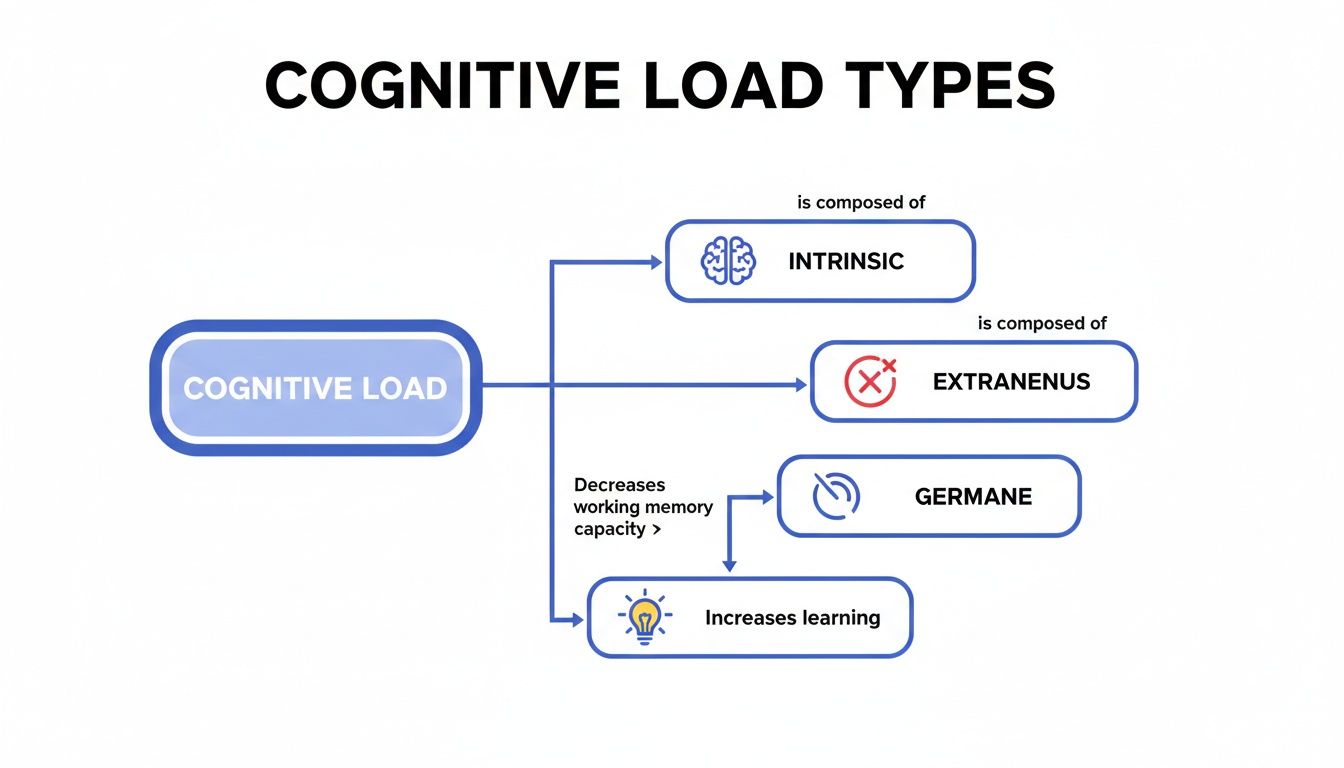
    This flowchart breaks down how these three forces interact to shape your mental state.

    Flowchart detailing cognitive load types: intrinsic, extranenus, and germane, influencing memory and learning.

    As you can see, the intrinsic load is mostly fixed, and the germane load is what we want more of. That leaves extraneous load as the prime target for reduction.

    The goal is not to eliminate all mental effort, but to minimize the distracting, unproductive load so your brain has more resources for the deep thinking that actually matters. This is the foundation of mindful productivity.

    How Extraneous Load Triggers Cognitive Overload and Drains Your Working Memory

    When extraneous load runs high—fueled by endless emails, clunky software, or the myth of multitasking—it eats up your limited working memory. This leaves almost no room for the germane load required for creativity and problem-solving.

    You end up feeling completely exhausted but with little to show for it. You can learn more about the mechanics behind this in our guide on the neurology of attention hijacking. Recognizing this dynamic is the first, most crucial step toward reclaiming your focus.

    Cognitive Overload at a Glance: Signs vs. Causes

    It’s easy to confuse the symptoms of cognitive overload with its root causes. The table below helps you quickly distinguish between what you’re feeling and what’s actually driving that feeling in your daily life.

    Common Signs (What You Feel)Common Causes (Why You Feel It)
    Difficulty making simple decisions (decision fatigue)Constant multitasking and context switching between apps and tasks
    Feeling mentally “foggy” or sluggishInformation overload from emails, news feeds, and social media
    Increased irritability and stressFrequent interruptions from notifications, alerts, and colleagues
    Making more careless mistakes than usualPoorly designed digital tools with confusing layouts (high extraneous load)
    Forgetting things you just heard or readTrying to learn complex new skills without breaking them down (high intrinsic load)
    A persistent feeling of being overwhelmed and “behind”A lack of clear priorities, leading to a sense of urgency for all tasks
    Procrastinating on complex or important tasksSensory overload from a noisy or visually cluttered environment

    Understanding this distinction is powerful. It shifts your perspective from “What’s wrong with me?” to “What in my environment can I change?” This simple reframe is the key to moving from a state of chronic overload to one of intentional clarity.

    The Hidden Costs of What Is Cognitive Overload

    Sustained cognitive overload does more than just leave you feeling drained. It systematically chips away at your performance, your well-being, and even your confidence. When your brain is constantly running at redline, it doesn’t just get sluggish—it starts making critical mistakes. This isn’t a personal flaw; it’s the predictable outcome of pushing a biological system past its design limits.

    What is cognitive overload alt text: A man clutches his head as swirling app icons and browser windows surround him, illustrating what is cognitive overload caused by constant digital distractions.

    The fallout ripples through every part of your professional life, creating a vicious cycle of stress and underperformance. But once you frame cognitive overload as a systemic issue—not an individual one—you can start finding real solutions in your environment and your routines.

    The Decline in Productivity and Accuracy

    One of the first and most obvious costs of mental fatigue is a steep drop in productivity. Research from companies like Neurable shows that cognitive and information overload can slash a knowledge worker’s effectiveness by as much as 40%. That’s a staggering hit, and it’s affecting millions of professionals.

    This isn’t just about working slower. It’s about a fundamental breakdown in the quality of your work.

    • Mini-Scenario: A project manager, swamped by endless Slack pings and back-to-back meetings, overlooks a critical project dependency. Their working memory is so full of notifications that there’s no space to process the project’s details deeply. Weeks later, everything grinds to a halt.

    In every case, the person is more than capable. Their mental resources are just so depleted that mistakes become inevitable.

    Impaired Decision-Making and Creativity

    Beyond simple errors, cognitive overload directly harms higher-level thinking, especially your ability to make sound decisions. The prefrontal cortex, the part of your brain responsible for planning and judgment, gets completely overwhelmed.

    When your mental bandwidth is tied up sorting through a firehose of information, you have very little left for careful, thoughtful choices. This leads to decision fatigue, where psychological studies show you find yourself picking the easiest option instead of the best one.

    This state is the enemy of innovation. When you’re just trying to keep your head above water, there’s no mental space left for proactive problem-solving or creative breakthroughs.

    Over time, this chronic strain can spiral into more serious conditions like burnout. It’s crucial to see how these daily pressures build up and learn how to recover from burnout before the damage becomes long-term. Recognizing these hidden costs isn’t about assigning blame. It’s about validating your own experience. That feeling of being overwhelmed isn’t just in your head—it has real, measurable effects on your work and your life.

    The Causes of Cognitive Overload in the Modern Workplace

    That persistent mental drain you feel isn’t just a sign of a busy day; it’s a direct response to specific triggers baked into the tools we rely on for work. Pinpointing these culprits is the first real step toward getting your energy back.

    While the modern digital workspace offers incredible flexibility, it also creates the perfect storm for mental fatigue. Once you understand the root causes, you can shift from feeling like a victim of your schedule to being an architect of your own focus.

    Let’s break down the main drivers behind this draining feeling.

    The Myth of Multitasking and Constant Interruptions

    Here’s the hard truth, backed by neuroscience: our brains don’t actually multitask. What we call multitasking is really just rapid context switching—jumping from one unrelated thing to another. And every single time you switch, your brain pays a mental tax, losing time and energy as it struggles to re-orient.

    Context switching is a silent thief of productivity and a major cause of mental exhaustion. Understanding what is context switching and how to fix it is non-negotiable for anyone trying to protect their mental space. This constant toggling fragments your attention, making the deep, focused work required for high-quality output nearly impossible.

    Neuroscience confirms that multitasking increases the production of the stress hormone cortisol as well as the fight-or-flight hormone adrenaline, which can overstimulate your brain and cause mental fog.

    • Mini-Scenario: A remote worker is trying to write a detailed project proposal. In just 15 minutes, they get five Slack pings about a separate project, three urgent emails, and a calendar reminder for an upcoming meeting. Each interruption forces their brain to disengage, process new information, and then try to get back on track. The result? A half-finished, subpar proposal and a profound sense of burnout.

    Hijacking Your Brain’s Reward System

    Digital tools are masterfully engineered to grab and hold our attention. Every notification from email, social media, and messaging apps triggers a tiny release of dopamine, the neurotransmitter tied to pleasure and reward. Behavioral research shows this creates a powerful, habit-forming loop.

    Your brain starts craving the novelty and satisfaction of clearing a notification, checking an email, or seeing a new message. Each “ping” yanks you away from meaningful work with the promise of a small, fleeting reward. This constant stimulation keeps your brain in a state of high alert, making it difficult to ever settle into deep work. Over time, this cycle is a huge contributor to that frazzled, drained feeling often called digital fatigue.

    Poorly Designed Digital Environments

    Finally, the very software we use can be a major source of cognitive strain. Cluttered interfaces, confusing navigation, and inconsistent design force your brain to work harder than it should just to perform basic tasks.

    • Mini-Scenario: A new project management tool has a non-intuitive layout, forcing you to hunt for essential features. You waste mental energy figuring out the system (high extraneous load) instead of doing your actual work.

    These design flaws add unnecessary friction to your workflow, creating a constant, low-level drain on your mental resources. When you combine them with endless interruptions and the lure of dopamine hits, you get an environment where cognitive overload is almost guaranteed.

    How to Spot the Signs of Cognitive Overload

    Recognizing cognitive overload before it spirals into full-blown burnout is one of the most critical skills you can develop. Think of these signs as your brain’s early warning system—the subtle (and not-so-subtle) signals that your mental bandwidth is dangerously low. These symptoms aren’t just in your head; they are real, observable changes in your thinking, mood, and even your physical state.

    Please note: While this article discusses topics related to mental well-being, including anxiety and burnout, it is for educational purposes only. It is not a substitute for professional medical or psychological advice, diagnosis, or treatment. Always seek the advice of a qualified health provider with any questions you may have regarding a medical condition.

    What is cognitive overload alt text: A focused young man uses a laptop and smartphone at a desk as floating bubbles represent information overload—showing what is cognitive overload in modern digital work.

    Learning to spot these indicators helps you shift from just reacting to stress to proactively managing your mental load. The symptoms usually show up in three distinct areas.

    Cognitive and Mental Signs

    These are often the first cracks to appear, directly hitting your ability to think clearly and perform well. When your working memory is maxed out, your higher-level brain functions start to stumble.

    • Brain Fog and Difficulty Concentrating: You find yourself rereading the same email three times or completely losing the thread of a conversation. Your mind feels sluggish and fuzzy, making deep, focused work feel impossible.
      • Real-World Example: During a team meeting, you realize you’ve zoned out and missed a key decision, even though you were trying to pay attention. Your brain simply doesn’t have the bandwidth to absorb more information.
    • Memory Lapses: You’re suddenly forgetting appointments, misplacing your keys, or can’t recall a piece of information you just learned five minutes ago. This isn’t just carelessness; it’s your overwhelmed brain failing to properly encode new information.
    • Decision Fatigue: Even simple choices, like what to have for lunch, feel monumentally exhausting. This often leads to procrastination or making impulsive, poorly thought-out decisions just to get them over with. At its most extreme, this can feel like your mind has gone completely blank, a phenomenon some call blank mind syndrome.

    Emotional and Behavioral Signs

    As the mental strain builds, it inevitably spills over into your mood and actions. The prefrontal cortex, which manages emotional regulation, becomes compromised when it’s overloaded with information processing. Your patience wears thin.

    • Increased Irritability and Impatience: You have a much shorter fuse than usual. You might find yourself snapping at colleagues or family over things that normally wouldn’t bother you.
      • Real-World Example: A coworker asks a simple question, and you respond with uncharacteristic sharpness. Your brain perceives the interruption as another threat to its limited resources, triggering a defensive, irritable reaction.
    • Feeling Overwhelmed or Anxious: A constant, low-grade sense of anxiety follows you through the day. You feel perpetually behind and can’t seem to catch up, no matter how hard you work.
    • Avoidance of Complex Tasks: You start putting off important projects in favor of ticking off easier, low-impact tasks. This is a subconscious attempt to protect yourself from further mental strain.

    Physical Signs and Symptoms

    Cognitive overload isn’t just a mental experience—it’s a physiological one. The chronic stress that comes from a constantly taxed brain can show up in very real, physical ways.

    Your mind and body are deeply connected. When your brain is under sustained duress from cognitive overload, your body often pays the price through stress-induced physical responses.

    Be on the lookout for these bodily signals:

    • Tension Headaches: A persistent, dull ache around your temples or at the back of your head is a classic sign of mental strain.
    • Chronic Fatigue: You feel bone-tired even after a full night’s sleep. This isn’t normal tiredness; it’s a deep-seated weariness that another cup of coffee simply can’t fix.
    • Sleep Problems: You might struggle to fall asleep because your mind is racing with unfinished thoughts, or you find yourself waking up frequently throughout the night.

    Actionable Strategies to Reduce Cognitive Overload

    Knowing what cognitive overload is and seeing the signs in your own day is the first step. Now for the important part: actively reclaiming your focus with a few practical, science-backed strategies you can put into practice today.

    The goal here isn’t to get rid of all mental effort. It’s to ditch the draining, unproductive load so you can pour your energy into the work that actually moves the needle. These methods are designed to build sustainable habits that protect your mental resources.

    Structure Your Day for Intentional Focus

    A reactive day is an exhausted day. When your inbox and notifications run your schedule, your brain is constantly playing catch-up. To break that cycle, you have to intentionally design your time around your most important tasks. This proactive approach is a powerful defense against mental clutter.

    • Time Blocking: This is exactly what it sounds like—scheduling specific blocks of time for everything on your to-do list, including checking email and taking breaks. By giving every task a home on your calendar, you eliminate the constant, energy-draining question of, “What should I be doing now?”
      • Real-World Example: A marketing manager blocks 9:00 AM to 10:30 AM for the “Q3 Strategy Document” and a separate 2:00 PM to 2:30 PM slot for “Email Triage.” This structure prevents low-value pings from derailing high-value work.

    Tame Your Digital Environment

    Your digital workspace is either working for you or against you. A cluttered, notification-heavy setup is a primary cause of cognitive overload, constantly splintering your attention with low-value interruptions. Taming this environment is non-negotiable for mental clarity.

    The most powerful change you can make? Embrace single-tasking.

    Neuroscientifically, single-tasking allows your prefrontal cortex to dedicate its full resources to one objective. This leads to higher-quality work, better memory formation, and significantly less mental fatigue.

    Here are a few practical steps:

    1. Disable Non-Essential Notifications: Turn off all the pop-ups, banners, and sounds on your computer and phone.
    2. Use a “Batching” System: Group similar tasks together and knock them out at once. Instead of answering emails as they land, set aside two or three specific times per day to process them all. For teams, specific strategies to reduce email overload in organizations are crucial.
    3. One Task, One Window: When you’re working on something, close every other unrelated browser tab and application. This simple act removes the visual temptation to switch contexts.
      • Real-World Example: A writer working on an article closes their email client, Slack, and all browser tabs except for their research sources and Google Doc. This creates a digital “cone of silence” that protects their focus.

    By consciously choosing to do one thing at a time, you align your workflow with how your brain operates best. You can dive deeper into the neuroscience of single-tasking and see for yourself why it has such a profound impact.

    Restore Your Mind with Strategic Disconnection

    Just like your muscles need rest after a workout, your brain needs downtime to recover from intense cognitive effort. In a culture that prizes being constantly connected, intentional disconnection has become a vital skill for preventing mental burnout. Mindful breaks aren’t lazy—they are essential for cognitive restoration. Behavioral research shows that short, deliberate breaks can significantly improve focus and creativity.

    • Practice the Pomodoro Technique: Work in focused 25-minute sprints, then take a 5-minute break completely away from your screen. After four of these cycles, take a longer 15-30 minute break.
      • Real-World Example: An analyst uses a timer for 25 minutes of intense data analysis. When the timer rings, they get up, stretch, and get a glass of water, deliberately not checking their phone. This short reset helps them return to the data with fresh eyes.

    Editor’s Take: What Really Works

    What is cognitive overload alt text: A person looks at an open planner on a white desk with a laptop, tea, and phone, illustrating what is cognitive overload in a busy digital workday.

    Let’s cut through the noise. While countless apps promise a quick fix for what is cognitive overload, the strategies that stick are almost always foundational and deeply personal. The real wins don’t come from downloading another tool; they come from intentionally designing your environment and daily rhythms.

    This advice is best for professionals in knowledge work who have some autonomy over their schedule and digital tools. It means getting aggressive with your notifications, scheduling non-negotiable blocks for deep work, and learning to truly disconnect at the end of the day.

    A critical caveat here: these habits demand consistency. They are powerful for individuals but cannot single-handedly fix systemic issues like a toxic work culture or unrealistic company-wide expectations. If your environment is the primary source of the overload, addressing it directly with your team or leadership is the only real long-term solution.


    Disclaimer: This article is for educational purposes only and is not a substitute for professional medical or psychological advice, diagnosis, or treatment. It may also contain affiliate links, which means we may earn a small commission on purchases at no extra cost to you. Always seek the advice of a qualified health provider with any questions you may have regarding a medical condition.

    FAQ: Your Questions About Cognitive Overload Answered

    Let’s wrap up by tackling some of the most common questions people have when they first start to unpack the idea of cognitive overload. Think of this as a quick-reference guide to help these concepts stick.

    1. How is cognitive overload different from stress?

    Think of it this way: cognitive overload is a specific cause (too much information for your brain to process), while stress is often the general effect. Stress is a broad response to any demand, but cognitive overload is the unique strain that happens when your working memory gets jammed, which then fuels your overall stress levels.

    2. How long does it take to recover from cognitive overload?

    For a single overwhelming day, a good night’s sleep might be enough. But for chronic overload lasting weeks or months, recovery takes longer and requires deliberate action, like taking real time off and rebuilding sustainable work habits.

    3. What is the role of sleep in preventing overload?

    Sleep is your brain’s maintenance crew. During deep sleep, your brain clears out metabolic waste and consolidates memories, moving information from your limited working memory to long-term storage. Skimping on sleep means you start the day with a “full” and cluttered brain, making you more susceptible to overload.

    4. Does cognitive overload affect long-term memory?

    Yes, absolutely. For new information to be stored long-term, it must first be properly processed by your working memory. When your working memory is overloaded, this encoding process fails. This is why you might forget something minutes after hearing it when you’re feeling overwhelmed.

    5. What is the link between cognitive overload and decision fatigue?

    They are two sides of the same coin. Your prefrontal cortex handles decision-making and runs on a finite amount of mental energy. Cognitive overload burns through that energy fast, leading directly to decision fatigue, where you start making poor or impulsive choices simply because your brain is too tired to think things through properly.

    6. What is the difference between information overload and cognitive overload?

    Information overload is about the sheer volume of data coming at you (the cause). Cognitive overload is the brain’s state of being unable to process it all (the effect). You can experience cognitive overload from too much information, but also from a single, highly complex task with no new information at all.

    7. Can cognitive overload impact my creativity?

    Definitely. Creativity requires mental “whitespace” to make new connections between ideas. When your working memory is clogged with notifications and to-do lists, there are no resources left for innovative thinking. An overloaded mind is a reactive mind, not a creative one.

    8. What are the best tools for managing cognitive load?

    Tools help, but only when paired with good habits. The best ones get things out of your head:

    • Task Managers: Todoist or Asana externalize your to-do list.
    • Focus Apps: Forest or Freedom block distractions.
    • Note-Taking Apps: A “second brain” in Notion or Obsidian offloads information for later.

    9. How can I talk to my manager about cognitive overload?

    Frame the conversation around shared goals like productivity and work quality. Instead of saying “I’m overwhelmed,” try: “I’ve noticed that constant context switching between projects is leading to more errors. Could we try blocking dedicated focus time for each one to improve the final output?” This positions you as a proactive problem-solver.

    10. Can physical exercise help reduce cognitive overload?

    Yes. Behavioral research shows that physical activity, even a short walk, can help reduce the effects of cognitive overload. Exercise increases blood flow to the brain, reduces stress hormones like cortisol, and provides a mental break, allowing your prefrontal cortex to reset and recover.


    At Mind Clarity Hub, our books and guides are designed to give you science-backed, actionable strategies to manage cognitive overload and build a more focused, intentional life. Explore our library to find the right roadmap for you at https://mindclarityhub.com.

    Explore the Mind Clarity Hub Library

    Practical books on focus, digital habits, resilience, and building a calmer mind.

    The Power of Clarity — book cover

    The Power of Clarity

    Unlock mental focus, build momentum, and create the life you were meant to live.

    View book →
    AI & ChatGPT for Beginners — book cover

    AI & ChatGPT for Beginners

    No PhD needed — a 2025 guide to AI, prompts, and productivity without coding.

    View book →
    Zen in the Digital Jungle — book cover

    Zen in the Digital Jungle

    Mindfulness for a chaotic world.

    View book →
    The Slow Reset — book cover

    The Slow Reset

    Mindful living in a fast-paced world.

    View book →
    Perfectly Imperfect — book cover

    Perfectly Imperfect

    Stop self-criticism, set boundaries, and embrace the real you.

    View book →
    Reclaiming Silence — book cover

    Reclaiming Silence

    A dopamine detox guide to finding peace in a noisy world.

    View book →
    The Focused Freelancer — book cover

    The Focused Freelancer

    Productivity, pricing & positioning for independents in 2025.

    View book →
    ChatGPT Side Hustle System — book cover

    ChatGPT Side Hustle System

    Launch your AI-driven online business in 30 days.

    View book →
    Burnout, Interrupted — book cover

    Burnout, Interrupted

    A proven path to restore energy and reclaim your life.

    View book →
    Attention Unleashed — book cover

    Attention Unleashed

    Focus strategies for the distracted mind.

    View book →
    Side Hustle Launchpad — book cover

    Side Hustle Launchpad

    Your quick-start guide to extra income.

    View book →
    Digital Clarity — book cover

    Digital Clarity

    Rewire your brain, escape dopamine traps & regain focus.

    View book →
    Break the Scroll — book cover

    Break the Scroll

    Reduce screen time and take back control of your life.

    View book →
    Climate Compassion — book cover

    Climate Compassion

    Transform eco-anxiety into empowered action.

    View book →
    Village Mentality — book cover

    Village Mentality

    The power of community for mental wellness.

    View book →
    Restful Nights — book cover

    Restful Nights

    Overcoming sleep anxiety in a 24/7 world.

    View book →
    Connected Again — book cover

    Connected Again

    Combat loneliness and build meaningful relationships.

    View book →
    Focus Recharged — book cover

    Focus Recharged

    Mastering attention and productivity in the digital era.

    View book →
    Marketing Magic with ChatGPT — book cover

    Marketing Magic with ChatGPT

    AI-powered content, campaigns, and copywriting to grow faster.

    View book →
    The 6-Figure Creator — book cover

    The 6-Figure Creator

    Turn knowledge into passive income with books, courses & AI.

    View book →
    Burnout Breakthrough — book cover

    Burnout Breakthrough

    Reset your work-life balance and thrive in 2025.

    View book →
    The Emotionally Intelligent Man — book cover

    The Emotionally Intelligent Man

    A modern guide to self-awareness and communication.

    View book →
    AI Personalized Wellness — book cover

    AI Personalized Wellness

    Create your custom health plan with data-driven habits.

    View book →
    Everyday AI Made Easy — book cover

    Everyday AI Made Easy

    Use ChatGPT and smart tools to simplify life.

    View book →
    Money Mindfulness — book cover

    Money Mindfulness

    A financial wellness guide for Gen Z & Millennials.

    View book →
    Startup Smarter with AI — book cover

    Startup Smarter with AI

    ChatGPT strategies and tools to grow your business.

    View book →
    ChatGPT for Writers & Creators — book cover

    ChatGPT for Writers & Creators

    Unlock AI-powered brainstorming, drafting & editing.

    View book →
  • A Science-Based Plan on How to Read More Books

    A Science-Based Plan on How to Read More Books

    A Science-Based Plan on How to Read More Books

    Jeremy Jarvis — Mind Clarity Hub founder
    Mind Clarity Hub • Research-aware focus & digital wellness

    The real secret to reading more isn’t about finding more time—it’s about understanding how your brain has been rewired by the digital world and then gently rewiring it back. Grounded in behavioral science, the key is to acknowledge that modern technology actively trains you for distraction, making deep, focused reading feel like a chore. Once you understand this, you can start building small, consistent habits to reclaim your focus and make reading a natural, effortless part of your day.

    Heads up: This article may contain affiliate links. If you make a purchase through one of these links, we may earn a small commission at no extra cost to you. It’s a great way to support our work and keep the insights coming!

    Why It Feels Harder Than Ever to Read Books

    Ever find yourself staring at a bookshelf full of unread titles, only to instinctively reach for your phone instead? You’re not alone. This isn’t a personal failure; it’s a predictable consequence of the digital world we live in. Our online environments are masterfully engineered to hijack our attention with a nonstop stream of quick, rewarding content.

    This constant firehose of notifications, short videos, and infinite scrolls is literally changing your brain’s reward pathways. From a neuroscience perspective, every ping and alert delivers a tiny hit of dopamine, the chemical messenger tied to pleasure and motivation. Over time, your brain’s reward system starts craving these instant rewards, making slower, more demanding activities—like getting lost in a good book—feel far less appealing.

    A man uses his smartphone to scan books on a bookshelf in a bright, modern living room. This illustrates a modern challenge to the goal of how to read more books.

    The Challenge of Deep Focus

    Sustained reading demands a totally different kind of mental muscle. It requires deep focus, a state that becomes harder to achieve when our brains are conditioned for rapid-fire task-switching.

    Every time you glance at your phone while trying to read, your brain pays a cognitive price called “attentional residue.” A part of your focus stays stuck on whatever you just looked at, making it nearly impossible to fully immerse yourself in the text. If this sounds painfully familiar, you’ll want to read our guide on why you can’t read long articles anymore, which dives deeper into this exact phenomenon.

    Real-World Scenario: Imagine a student trying to read a dense textbook. Their phone is on the desk, screen up. A text message notification flashes. Even if they don’t pick up the phone, a part of their brain is now wondering who texted and what they want. That cognitive “leak” makes it harder to absorb the complex information in the book, forcing them to re-read the same paragraph three times. This is attentional residue in action.

    This mental fragmentation is exactly why picking up a book can feel like an exhausting workout. Your brain, accustomed to the easy dopamine hits from a screen, resists the quiet, sustained effort that deep reading requires.

    The Reading Gap: Why Most People Struggle

    The gap between wanting to read and actually doing it often comes down to a few key habits and environmental factors. Here’s a quick look at how infrequent readers and consistent readers approach the same challenges differently.

    ChallengeTypical Approach (Infrequent Reader)Strategic Approach (Consistent Reader)
    EnvironmentPhone is always within reach, notifications are on. Reads in a high-distraction area.Phone is in another room or on Do Not Disturb. Creates a designated, quiet reading spot.
    Mindset“I don’t have time.” Feels guilty about not reading, which leads to avoidance.“I’ll start with 5 minutes.” Sees reading as a skill to be practiced, not a moral failing.
    StrategyTries to read for an hour straight, gets distracted, and gives up.Uses habit stacking (e.g., reads after morning coffee) and micro-reading (5-minute bursts).
    ToolsRelies on willpower alone to fight digital temptation.Leverages tools like Kindle’s “airplane mode” and read-later apps to reduce friction.

    Seeing these side-by-side makes it clear: consistent reading isn’t about having more willpower. It’s about having a better system. The national data reflects this struggle. It’s not that people don’t want to read; it’s that their environment and habits are working against them. Ultimately, understanding this dynamic is the first real step toward change. It’s not about forcing yourself to read through sheer will. It’s about creating an environment and building routines that make reading the easier, more compelling choice.

    Recalibrating Your Brain for Deep Focus to Read More Books

    Before you can build a reading habit that sticks, we need to address the real reason it feels so hard in the first place: your focus is likely fragmented. If picking up a book feels “boring” or difficult, that’s a huge clue. It signals that your brain has adapted to a high-speed, high-stimulus digital world. This isn’t a character flaw—it’s a predictable neurochemical response.

    Every notification and endless scroll delivers a quick, cheap hit of dopamine. Your brain’s reward circuitry, especially the limbic system, learns to crave these tiny, instant payoffs. The slower, more demanding reward of reading—which requires sustained attention from your prefrontal cortex—simply can’t compete. The first real step is to gently recalibrate this system.

    This isn’t about some punishing, extreme “dopamine fast.” Think of it more like a gentle digital declutter. The goal is to carve out small pockets of quiet in your day, giving your brain a chance to reset its baseline. Over time, this makes slower activities like reading feel engaging and rewarding again.

    Taming Digital Distractions to Improve Reading Habits

    The key is to turn down the volume on the constant, low-level stimulation that keeps your brain on high alert. Start by identifying and shutting down the noisiest interruptions.

    • Silence Non-Essential Notifications: Go into your phone’s settings and turn off alerts for everything except calls, texts from key people, and calendar reminders. Social media, news apps, and email can wait. Each notification you silence is a small win for your focus.
    • Create “No-Phone Zones”: Designate specific areas in your home where phones just aren’t allowed. The dinner table and the bedroom are the perfect places to start. This simple rule creates a physical boundary that helps you mentally disconnect.
    • Schedule Your Screen Time: Instead of checking email and social media whenever the urge strikes, block out specific times for it. Try checking your inbox at 10 AM, 1 PM, and 4 PM—and stay off it otherwise. This puts you back in control of your own attention.

    By consciously reducing digital inputs, you’re not just removing distractions; you’re retraining your brain’s reward circuitry. This process makes the quiet focus required for reading feel less like a chore and more like a welcome relief.

    Real-World Scenario: Imagine a freelance graphic designer who feels constantly wired. Their phone buzzes with client emails and Slack messages late into the evening. They want to read before bed but feel too mentally scattered to even try. They decide on one simple rule: after 7 PM, their phone goes on a charging stand in the living room, not on the nightstand. The first few nights feel strange, almost antsy. But by the end of the week, they notice they actually have the mental space to pick up a novel and read a chapter without feeling the phantom buzz of their phone. This small environmental shift recalibrated their entire evening routine, making reading an appealing choice again.

    Preparing Your Body and Mind for Reading

    Physical comfort is another huge, and often overlooked, part of sustaining focus. After staring at screens all day, our eyes are often shot. For a deep dive, check out this practical guide on how to reduce eye strain. Reducing physical discomfort makes it so much easier to stay locked in with a good book.

    This foundational work on your environment and your brain is crucial. By lowering the background noise of digital life, you create the mental stillness needed for deep reading to take root. This process is similar to what’s explored in techniques for limbic system retraining, where the goal is to calm an overstimulated nervous system to change automatic responses. You are teaching your brain that focus can be just as rewarding as distraction.

    Building a Reading System That Actually Sticks

    Recalibrating your focus is a great start, but good intentions alone won’t get you across the finish line. To make reading a permanent part of your life, you need a system—a set of simple, repeatable actions that work with your brain, not against it.

    Instead of white-knuckling it with motivation that comes and goes, we’ll use a couple of proven behavioral science techniques. These strategies make picking up a book feel less like a chore and more like an automatic, easy choice.

    A diagram illustrating a 3-step process for building effective reading habits, including how to read more books by stacking habits, starting tiny, and using visual cues. This diagram provides tips on how to read more books.

    Use Habit Stacking to Link Reading to Your Existing Routine

    The idea behind Habit Stacking, popularized by author James Clear, is elegantly simple. You just anchor your new desired habit (reading) to an old, deeply ingrained one. The formula looks like this:

    “After I [CURRENT HABIT], I will [NEW HABIT].”

    Your brain loves this because it doesn’t have to carve out a new routine from scratch. It just bolts the new action onto a neural pathway that’s already paved and smooth.

    Here’s how this looks in the real world:

    • Morning Coffee: “After I pour my morning coffee, I will read for five minutes.”
    • Lunch Break: “After I finish eating lunch, I will read one chapter of my book.”
    • Evening Wind-Down: “After I brush my teeth at night, I will get into bed and read until I feel sleepy.”

    The key is to pick an anchor habit that’s rock-solid—something you do every single day without fail. That existing habit becomes a powerful, automatic trigger that reminds you to pick up your book.

    Real-World Scenario: A busy parent wants to read more but their free time feels chaotic. They realize, however, that their toddler has a consistent 15-minute quiet time with puzzles right after lunch. They stack their reading habit onto this existing routine. The rule becomes: “When my child starts their puzzles, I will sit next to them and read my book.” It starts with ten minutes, but soon it becomes a cherished, non-negotiable part of both of their days.

    Start So Small You Can’t Fail with Tiny Habits

    Often, the biggest thing stopping us from reading more is that it feels like a massive commitment. The thought of tackling a 400-page book can be so intimidating that you never even start. This is where the “Tiny Habits” method, developed by Stanford behavior scientist BJ Fogg, is a game-changer.

    The whole point is to make your new habit so laughably small that it’s impossible to say no. You’re not committing to “read for 30 minutes every day.” You’re committing to something like:

    • “I will read one sentence.”
    • “I will open my Kindle app.”
    • “I will read one page.”

    This approach completely bypasses your brain’s natural resistance to effort. And once you’ve read one page, it’s so much easier to just keep going and read another. The goal isn’t the page count; it’s the consistency of starting. That tiny action builds momentum and reinforces your identity as “someone who reads.”

    Create a Reading-Ready Environment

    Your physical space sends constant, powerful signals to your brain about what actions are easy and expected. If your phone is on the coffee table and your book is on a dusty shelf upstairs, you’re making distraction the path of least resistance. To read more, you just need to flip that script. It all comes down to creating obvious visual cues that prompt you to read.

    • Leave a book on your nightstand instead of your phone.
    • Place a book on the coffee table right where you relax in the evening.
    • Keep your Kindle or a paperback in your work bag, ready for any unexpected downtime.

    Every time you see the book, it’s a gentle, passive reminder of your goal. You’re no longer relying on memory or willpower; you’re letting your environment do the heavy lifting for you. And as you read more, you might find you want to remember more of what you’re consuming. Learning how to take effective notes from a book can deepen your engagement and make the whole experience feel even more rewarding.

    Make Smart Tools and Formats Your Reading Allies

    Building a system for reading isn’t just about blocking out time; it’s about removing the tiny points of friction that stop you from picking up a book in the first place. In a life filled with commutes, chores, and endless to-do lists, a traditional paperback isn’t always practical. If you want to genuinely boost your book count, you have to make technology your ally and embrace reading in multiple formats.

    This means completely rethinking what “reading time” looks like. It doesn’t have to be an hour in a quiet armchair. It can be 15 minutes of an audiobook while you walk the dog, a chapter on your Kindle app while waiting for a meeting to start, or listening to a novel as you fold laundry. Using different formats turns moments of “dead time” into genuine reading sessions.

    A diagram illustrating a 3-step process to build effective reading habits, including stacking, starting tiny, and visual cues. A key strategy for how to read more books.

    As you can see, building a solid reading habit is all about attaching small actions to routines you already follow and using visual triggers to make reading the easiest, most obvious choice.

    Embrace Ebooks and Audiobooks Without Guilt

    Digital formats are built for the modern, mobile reader. Ebooks and audiobooks let you carry an entire library in your pocket, making it ridiculously easy to capitalize on any unexpected pocket of free time. Many people find that using multiple formats simply helps them read more books.

    One of the best features for anyone straddling both formats is Amazon’s Whispersync. This slick piece of tech syncs your Kindle ebook with its Audible audiobook counterpart, so you never lose your place.

    Real-World Scenario: You’re reading a non-fiction book on your Kindle during your lunch break. Later, you hop in the car to drive home, open the Audible app on your phone, and the audiobook picks up exactly where you left off reading. That seamless transition removes all the friction, letting you stay immersed in one book across different parts of your day. This is a practical application of how to read more books without finding new pockets of time.

    How to Use Your Digital Tools Strategically

    Just having the apps isn’t enough. To get the most out of digital reading, a few small practices can make all the difference.

    • Curate Your Digital Library: Treat your ebook library like a physical bookshelf. Only fill it with titles you’re genuinely excited about. Use wish lists and read sample chapters to make sure a book grabs you before you commit.
    • Fix Your Device Settings: Don’t let eye strain kill your reading vibe. Adjust the font size, screen brightness, and background color. Most e-readers and apps now have a warm, sepia-toned background that’s much easier on the eyes than a stark white screen.
    • Go into Airplane Mode: The single biggest advantage of a dedicated e-reader like a Kindle is its glorious lack of distractions. Put that thing in airplane mode to create a focused reading bubble, free from notifications and the siren call of the internet.

    Use AI as a Reading Assistant, Not a Replacement

    Finally, let’s talk about AI. Artificial intelligence can be a powerful assistant in your quest to read more, but its role is to make your reading time more effective, not to do the reading for you. For instance, you can use an AI tool to generate a quick, high-level summary of a dense non-fiction book to decide if it’s worth a full read. It’s also great for refreshing your memory on the key concepts from a book you finished months ago.

    For a deeper dive, check out our guide on the best AI tools for productivity to find systems that might fit your workflow.

    How to Protect Your Time for Deep Reading

    Let’s tackle the biggest hurdle: finding the time. The secret isn’t discovering some magical, empty hour in your day. It’s about getting brutally protective of your attention. You don’t find time; you make it. This means shifting from hoping for a free moment to deliberately carving out and defending your reading time like it’s a critical meeting.

    One of the most effective ways to do this is time blocking. It’s simple: treat your reading sessions with the same seriousness you’d give a doctor’s appointment. You schedule it directly into your calendar, turning a vague intention into a non-negotiable commitment.

    A cozy scene with an open book, hot tea, and a calendar marking 'READ' in sunlight. A great example of a setup on how to read more books.

    Real-World Scenario: A remote project manager felt her days were completely eaten by back-to-back video calls. To reclaim her focus, she started blocking out a 25-minute “Reading Break” in her Google Calendar right after her last meeting. That visual block was a powerful signal to herself and her team that this time was occupied, transforming a fuzzy goal into a solid daily practice. This is how to read more books even with a packed schedule.

    Capitalize on Small Windows with Micro-Reading

    Beyond blocking out bigger chunks of time, the art of micro-reading can radically change the game. This is all about using those small, often-wasted five-to-ten-minute gaps scattered throughout your day. Think about the time you spend waiting for a Zoom meeting to start, standing in line for coffee, or watching a file download. Most of us fill these moments by mindlessly scrolling our phones. Instead, these are perfect opportunities to knock out a few pages.

    From a behavioral psychology perspective, consistent, short sessions build stronger and more durable neural pathways for a new habit than rare, lengthy binges. Each tiny session reinforces your identity as a reader.

    Set and Communicate Your Boundaries

    Once you’ve scheduled your reading time, you have to protect it. This is where setting clear boundaries becomes non-negotiable.

    • Be Proactive: Let your family or roommates know about your reading block. A simple, “Hey, I’m taking the next 30 minutes to read and disconnect. I’ll be available right after,” can head off most interruptions.
    • Use Your Tools for Defense: Put your phone on “Do Not Disturb” mode. If you’re working, update your Slack or Teams status to “Focusing” or “Deep Work.” Let your tech signal your unavailability for you.
    • Create a Physical Barrier: If you can, close your office door. Putting on headphones is another universal sign that says, “I’m unavailable right now.”

    To really lock in these habits, you can dive deeper into practical approaches with these helpful Time Management Tips. And if digital distractions are your main enemy, our guide on actionable digital detox tips gives you the framework you need to create more space for focused reading.

    Editor’s Take: What Actually Works to Read More

    After trying just about everything, let’s be honest about what it takes to read more books in a world overflowing with digital noise. Forget the ambitious, shame-inducing goals for a minute.

    The single most effective strategy I’ve found is pairing a gentle digital declutter with the ‘tiny habits’ method. This combination works so well because it attacks the problem from two different angles.

    First, the declutter lowers your brain’s baseline craving for high-stimulus content. This is key. It makes the quiet, slow engagement of a book feel appealing again, not like a chore. Then, starting with a ridiculously small habit—like a “one-page” rule—bypasses the internal resistance and overwhelm that kills most reading goals before they even get off the ground.

    Who This Advice Is Really For

    This approach is tailor-made for busy professionals, students, and frankly, anyone suffering from screen fatigue who feels like their attention span is shot. It’s for those of us who have tried and failed with lofty goals like “read one book a week” because life, inevitably, got in the way.

    The crucial caveat here is that consistency over intensity is everything. It will take a few weeks for your brain to genuinely rewire its focus patterns and stop craving the next notification. Be patient with the process.

    Remember, the goal isn’t just to hit a number. It’s about reclaiming a quiet space for deep, focused thought in a world that constantly demands your attention.

    For people with long commutes or jobs that require staring at a screen all day, audiobooks are the ultimate game-changer. They seamlessly transform unproductive time into valuable reading time without adding more eye strain to your day. This multi-format approach isn’t cheating; it’s a practical solution for a modern problem.


    Disclaimer: This article is for educational and informational purposes only and is not a substitute for professional medical or psychological advice, diagnosis, or treatment. The content may reference topics like anxiety, depression, ADHD, or burnout, but it is not intended to be a substitute for professional care. Always seek the advice of your physician or other qualified health provider with any questions you may have regarding a medical condition. Some links in this article may be affiliate links, meaning we may earn a commission if you make a purchase, at no extra cost to you.

    FAQ: Your Questions About How to Read More Books

    As you start to build a more intentional reading habit, practical questions always come up. Here are answers to 10 common queries to help you find your rhythm.

    1. How many books a year is “well-read”?

    There’s no magic number. “Well-read” has more to do with the quality and diversity of your reading than the quantity. Instead of chasing a specific count, a much healthier goal is consistency. Aim to make reading a regular part of your life, whether that means one book a month or just 15 minutes a day. The real value comes from the ideas you engage with.

    2. What’s the best way to find books I’ll actually enjoy?

    The secret is to follow your genuine curiosity. Start with what you already love in other media, like movies or podcasts, and look for books in similar genres. Websites like Goodreads are fantastic for finding recommendations based on what you’ve enjoyed. Don’t be afraid to “try before you buy”—read the first chapter, and if it doesn’t grab you, move on.

    3. Is it better to read one book at a time or several?

    This is personal preference. Some people thrive on monogamous reading to stay fully immersed. Others find that juggling multiple books (e.g., one fiction, one non-fiction, and an audiobook) keeps things fresh and prevents reading slumps. Experiment to see what feels right. A great start is having one physical book for quiet time and one audiobook for your commute.

    4. How can I improve my reading speed without losing comprehension?

    Boosting reading speed is a skill. A common technique is to minimize subvocalization—the inner voice that says each word. You can practice this by using your finger to trace the lines of text, forcing your eyes to move faster than your inner voice. However, simply reading more will naturally increase your speed and processing efficiency over time.

    5. What are some good reading strategies for someone with ADHD?

    For a brain wired for novelty, a few strategies can be game-changers. Audiobooks engage auditory senses and allow for movement. Embrace “micro-reading” in short, timed bursts of 10-15 minutes. Also, picking books with short chapters or essay collections provides frequent “finish lines,” which can deliver a rewarding dopamine hit and keep you motivated.

    6. Do audiobooks really count as reading?

    Absolutely. Neuroscience shows that whether you listen to a story or read it on a page, your brain processes the language, narrative, and emotional content in remarkably similar ways. Audiobooks are an incredibly powerful tool for turning “dead time” like commutes or chores into productive reading time.

    7. How do I stop buying books and actually read the ones I own?

    This is a common struggle known as tsundoku in Japanese. A great fix is the one-in, one-out rule: you can’t buy a new book until you’ve finished one from your current pile. Another strategy is to “shop your own shelves”—pick up a book you already own and commit to reading just the first chapter. That’s often all it takes to get hooked.

    8. What should I do if I lose my reading streak?

    Don’t panic. An all-or-nothing mindset is the enemy of building any long-term habit. If you miss a day or a week, the most important thing is to simply start again the next day without guilt. A broken streak doesn’t erase your progress. The goal is consistency over perfection.

    9. How can I read more non-fiction without getting bored?

    Start with topics you’re genuinely passionate about. A well-written biography or science book from a skilled storyteller can be as gripping as a novel. It also helps to alternate non-fiction with fiction. And remember, you don’t have to read every single word; it’s okay to skim less relevant sections and dive deep into chapters that capture your interest.

    10. What is the best time of day to read for better retention?

    Research on memory consolidation suggests that reading just before sleep can be highly effective. During sleep, your brain processes and stores information, which can lead to better recall. That said, the true “best” time is simply the time you can consistently protect from interruptions. Consistency will always beat perfect timing.


    Ready to build a sustainable system for focus in a distracted world? At Mind Clarity Hub, we specialize in science-based guides that offer practical, step-by-step roadmaps to help you reclaim your mental space and achieve your goals.

    Explore our full library of books on focus, productivity, and digital clarity.

    Explore the Mind Clarity Hub Library

    Practical books on focus, digital habits, resilience, and building a calmer mind.

    The Power of Clarity — book cover

    The Power of Clarity

    Unlock mental focus, build momentum, and create the life you were meant to live.

    View book →
    AI & ChatGPT for Beginners — book cover

    AI & ChatGPT for Beginners

    No PhD needed — a 2025 guide to AI, prompts, and productivity without coding.

    View book →
    Zen in the Digital Jungle — book cover

    Zen in the Digital Jungle

    Mindfulness for a chaotic world.

    View book →
    The Slow Reset — book cover

    The Slow Reset

    Mindful living in a fast-paced world.

    View book →
    Perfectly Imperfect — book cover

    Perfectly Imperfect

    Stop self-criticism, set boundaries, and embrace the real you.

    View book →
    Reclaiming Silence — book cover

    Reclaiming Silence

    A dopamine detox guide to finding peace in a noisy world.

    View book →
    The Focused Freelancer — book cover

    The Focused Freelancer

    Productivity, pricing & positioning for independents in 2025.

    View book →
    ChatGPT Side Hustle System — book cover

    ChatGPT Side Hustle System

    Launch your AI-driven online business in 30 days.

    View book →
    Burnout, Interrupted — book cover

    Burnout, Interrupted

    A proven path to restore energy and reclaim your life.

    View book →
    Attention Unleashed — book cover

    Attention Unleashed

    Focus strategies for the distracted mind.

    View book →
    Side Hustle Launchpad — book cover

    Side Hustle Launchpad

    Your quick-start guide to extra income.

    View book →
    Digital Clarity — book cover

    Digital Clarity

    Rewire your brain, escape dopamine traps & regain focus.

    View book →
    Break the Scroll — book cover

    Break the Scroll

    Reduce screen time and take back control of your life.

    View book →
    Climate Compassion — book cover

    Climate Compassion

    Transform eco-anxiety into empowered action.

    View book →
    Village Mentality — book cover

    Village Mentality

    The power of community for mental wellness.

    View book →
    Restful Nights — book cover

    Restful Nights

    Overcoming sleep anxiety in a 24/7 world.

    View book →
    Connected Again — book cover

    Connected Again

    Combat loneliness and build meaningful relationships.

    View book →
    Focus Recharged — book cover

    Focus Recharged

    Mastering attention and productivity in the digital era.

    View book →
    Marketing Magic with ChatGPT — book cover

    Marketing Magic with ChatGPT

    AI-powered content, campaigns, and copywriting to grow faster.

    View book →
    The 6-Figure Creator — book cover

    The 6-Figure Creator

    Turn knowledge into passive income with books, courses & AI.

    View book →
    Burnout Breakthrough — book cover

    Burnout Breakthrough

    Reset your work-life balance and thrive in 2025.

    View book →
    The Emotionally Intelligent Man — book cover

    The Emotionally Intelligent Man

    A modern guide to self-awareness and communication.

    View book →
    AI Personalized Wellness — book cover

    AI Personalized Wellness

    Create your custom health plan with data-driven habits.

    View book →
    Everyday AI Made Easy — book cover

    Everyday AI Made Easy

    Use ChatGPT and smart tools to simplify life.

    View book →
    Money Mindfulness — book cover

    Money Mindfulness

    A financial wellness guide for Gen Z & Millennials.

    View book →
    Startup Smarter with AI — book cover

    Startup Smarter with AI

    ChatGPT strategies and tools to grow your business.

    View book →
    ChatGPT for Writers & Creators — book cover

    ChatGPT for Writers & Creators

    Unlock AI-powered brainstorming, drafting & editing.

    View book →
  • 10 Science-Backed Remote Work Productivity Tips for 2025

    10 Science-Backed Remote Work Productivity Tips for 2025

    10 Science-Backed Remote Work Productivity Tips for 2025

    Jeremy Jarvis — Mind Clarity Hub founder
    Mind Clarity Hub • Research-aware focus & digital wellness

    The shift to remote work offers unparalleled flexibility, but it also presents a unique set of challenges to our focus and efficiency. Without the built-in structure of a traditional office, the lines between work and life can easily blur, leaving even the most disciplined professionals feeling scattered and overwhelmed. Mastering a few powerful remote work productivity tips is essential. This guide is designed to cut through the noise with a comprehensive collection of actionable strategies, each grounded in principles of neuroscience and behavioral psychology. Subsequently, we move beyond generic advice to provide specific, evidence-backed techniques you can implement immediately.

    Remote work productivity tips: modern workspace with laptop on video call, desk lamp, plant, and ergonomic chair.

    This isn’t just another list of obvious suggestions. Instead, you’ll find a structured framework for redesigning your workday for maximum output and minimal stress. For example, we will explore how to create an optimized physical and digital workspace, master attention-management techniques like time-blocking and the Pomodoro method, and establish firm boundaries that protect your focus and well-being. Furthermore, you will learn to leverage asynchronous communication to reclaim your schedule and implement simple pre-work and end-of-day rituals that signal your brain when to switch on and off.

    Each tip is presented with a clear rationale, explaining why it works from a psychological or neurological perspective, alongside practical steps and real-world examples. Whether you’re a seasoned remote professional looking to refine your system or a student new to working from home, these strategies will help you build a sustainable, productive, and more balanced remote work life. Think of this as your toolkit for not just getting things done, but for thriving in a location-independent environment.


    Disclosure: This article may contain affiliate links. If you make a purchase through these links, we may earn a small commission at no extra cost to you. This helps support our work in creating valuable content.


    1. Establish a Dedicated Workspace for Better Focus

    Creating a physical and psychological boundary between your professional and personal life is one of the most impactful remote work productivity tips you can implement. When your living room couch doubles as your office, the lines blur, making it difficult for your brain to switch into “work mode” or fully disengage after hours. A dedicated workspace, consequently, acts as a powerful environmental cue, signaling to your brain that it’s time to focus.

    This concept is rooted in environmental psychology, which explores how our physical surroundings influence our thoughts, emotions, and behaviors. By associating a specific location with a specific activity, you create a conditioned response. In other words, stepping into your designated workspace primes your brain for concentration, while leaving it helps you transition back into your personal life, reducing the risk of burnout.

    How to Create Your Dedicated Space

    You don’t need a separate room with a door to reap the benefits. The key is dedication and consistency, not square footage.

    • Define Your Zone: Even a small corner in a quiet room can work. Use a room divider, a bookshelf, or even a rug to visually separate your work area from the rest of the living space.
    • Invest in Ergonomics: Your physical comfort directly impacts your focus. An ergonomic chair and an adjustable standing desk can prevent physical strain and boost energy levels throughout the day.
    • Optimize Your Setup: Ensure good lighting to reduce eye strain and keep the area free of personal clutter. The only items on your desk should be those essential for your work tasks.
    • Set Clear Boundaries: Communicate with family or roommates that when you are in your workspace, you are “at work” and should not be disturbed except for emergencies.

    Real-World Example: Sarah, a graphic designer in a one-bedroom apartment, uses a foldable screen to partition off a corner of her living room. When the screen is up, her partner knows she’s in “deep work” mode. This simple physical cue has drastically reduced interruptions and helped her mentally “leave” work at the end of the day.

    2. Implement the Pomodoro Technique to Boost Productivity

    Maintaining focus over long stretches can feel impossible, especially with the constant digital distractions of remote work. The Pomodoro Technique is a time-management method designed to break this cycle, leveraging timed intervals to maximize concentration and prevent mental fatigue. Consequently, it turns your workday into a series of focused sprints, making large tasks feel more approachable and manageable.

    This method is grounded in the psychological principle that frequent, short breaks can significantly improve mental agility. By working in focused 25-minute bursts (called “pomodoros”), you train your brain’s prefrontal cortex to concentrate intensely. Meanwhile, the built-in breaks allow for mental consolidation and recovery, preventing the cognitive decline associated with sustained effort. This rhythm helps combat decision fatigue and makes it one of the most effective remote work productivity tips.

    Remote work productivity tips: a red tomato-shaped timer set to 25 minutes on a desk with a laptop and notebook.

    How to Implement the Pomodoro Technique

    Getting started is simple. All you need is a timer and a commitment to honor the intervals.

    • Choose a Task: Select a single task to work on to avoid context switching.
    • Set Your Timer for 25 Minutes: Work on the task without interruption. Turn off all notifications to ensure an unbroken focus session.
    • Take a Short 5-Minute Break: When the timer rings, stop working immediately. Use this time to stretch, grab a glass of water, or simply rest your eyes away from the screen.
    • Repeat and Take a Longer Break: After completing four pomodoros, take a longer break of 15-30 minutes. This extended rest is crucial for recharging.

    Real-World Example: Alex, a software developer, uses the Pomodoro Technique to tackle complex coding bugs. He commits to one 25-minute pomodoro to investigate the issue. Often, the focused, uninterrupted time allows him to identify the root cause quickly. The mandatory breaks prevent him from getting stuck and frustrated, which used to lead to hours of unproductive effort.

    3. Set Clear Working Hours and Boundaries to Avoid Burnout

    Without the physical separation of an office, the digital nature of remote work can easily lead to an “always on” culture. Setting clear start and end times for your workday is one of the most critical remote work productivity tips for preventing overworking and burnout. Establishing firm boundaries protects your personal time, which is essential for mental and emotional recovery.

    This practice is grounded in the psychological need for structure and predictability. When work hours are ambiguous, your brain remains in a state of low-grade alert, anticipating the next email. This constant vigilance consumes mental energy and prevents deep rest. By defining a clear “end of day,” you create a cognitive trigger that allows your brain to fully disengage, promoting better sleep, reducing stress, and ultimately improving your focus during work hours.

    How to Enforce Your Work-Life Boundaries

    The goal is to create a clear and consistent separation between your professional responsibilities and personal life.

    • Communicate Explicitly: Announce your working hours to your team. Use your calendar status (e.g., in Microsoft Teams or Slack) to automatically reflect when you are available or offline.
    • Create a Shutdown Ritual: Develop a short routine to signal the end of your workday. This could include reviewing your to-do list for tomorrow, tidying your desk, and closing all work-related applications.
    • Leverage Technology: Set up automatic “out of office” email responses. Schedule emails to be sent during your working hours, even if you write them at night.
    • Separate Your Devices: If possible, avoid using your work computer for personal activities. This physical separation reinforces the mental boundary.

    Real-World Example: Maria, a project manager, updated her Slack status to automatically show a “brb” emoji during her 12:30-1:00 PM lunch break and a “powering down” emoji at 5:30 PM. This small, consistent signal has trained her team not to expect instant replies during those times, allowing her to take a real break and disconnect on time.

    4. Use Time-Blocking for Proactive Remote Work Productivity

    Simply having a to-do list is not enough. Time-blocking is a time management method that involves scheduling every part of your day in advance and dedicating specific “blocks” of time to particular tasks. This proactive approach transforms your calendar from a record of appointments into a strategic plan for your attention.

    This technique is a direct countermeasure to multitasking, which cognitive psychology shows can reduce productivity by as much as 40%. By assigning a specific job to each time slot, you eliminate the mental friction of deciding what to work on next. This preserves your cognitive resources for deep, focused work, turning your schedule into a powerful tool for intentional productivity.

    How to Implement Time-Blocking

    Effective time-blocking is about being realistic and strategic, not rigid.

    • Schedule Deep Work: Identify your peak energy hours (e.g., early morning) and reserve those blocks for your most cognitively demanding tasks.
    • Batch Similar Tasks: Group related activities. For example, create a one-hour “communications block” for answering emails instead of letting them interrupt you all day.
    • Block Distraction-Free Time: Explicitly schedule “Focus Time” on your shared calendar. This signals to colleagues that you are unavailable.
    • Plan for Breaks and Buffers: Schedule short breaks after intense focus sessions. Also, add 15-minute buffers between tasks for mental transition.
    • Review and Adapt Weekly: At the end of each week, review your calendar. Did your time estimates hold up? Adjust for the upcoming week.

    Real-World Example: Ben, a marketing manager, time-blocks his Mondays. He reserves 9-11 AM for “Strategy & Planning,” 11-12 PM for “Team Check-ins,” 1-3 PM for “Content Creation,” and 3-4 PM for “Email & Slack.” As a result, his week starts with clear direction and momentum, preventing him from getting pulled into reactive tasks. For a deeper dive into this, you can learn more about how to increase productivity at work.

    5. Minimize Distractions to Improve Remote Focus

    In a remote setting, your biggest productivity challenge is the battle against interruptions. From social media notifications to household noises, distractions can derail your focus. Minimizing these using technology and environmental adjustments is a critical remote work productivity tip for reclaiming your attention.

    This strategy is about proactively creating a “bubble” of focus. By leveraging digital tools to block out online noise and making small changes to your physical surroundings, you reduce the cognitive load required to constantly fight off interruptions. Consequently, this frees up mental energy, allowing you to direct your full concentration toward complex tasks, a concept central to improving your ability to focus better at work.

    Remote work productivity tips: modern remote work desk setup with a closed laptop, black headphones, and a smartphone on a tray.

    How to Minimize Your Distractions

    A distraction-free environment doesn’t happen by accident; it’s designed. The goal is to make focus the path of least resistance.

    • Deploy Digital Blockers: Use apps like Freedom or Cold Turkey to block distracting websites and applications during your scheduled focus blocks.
    • Curate Your Soundscape: Utilize noise-canceling headphones to eliminate ambient household sounds. For added focus, play concentration-enhancing audio from services like Brain.fm.
    • Manage Notifications Intentionally: Turn off all non-essential notifications on your computer and phone. Use “Focus Mode” or “Do Not Disturb” status in communication apps.
    • Create Physical Boundaries: A simple visual cue like a sign on your door or keeping your headphones on can signal to family that you’re in deep work mode.
    • Separate Your Digital Selves: Create separate browser profiles for work and personal use. This prevents personal bookmarks and social media from tempting you.

    Real-World Example: Chloe, a writer, creates a “Deep Work” profile in her Chrome browser that has no social media bookmarks and uses a distraction-blocking extension. When she switches to this profile, it’s a clear signal to her brain that it’s time to write, and the digital temptations are simply not there.

    6. Take Regular Breaks and Practice Movement

    Chaining yourself to your desk for hours is a direct path to mental fatigue. One of the most counterintuitive yet powerful remote work productivity tips is to intentionally step away. Integrating regular breaks and physical movement prevents cognitive decline, boosts energy levels, and sustains focus over the long term.

    This principle is rooted in how our brains manage energy. Sustained focus depletes cognitive resources, leading to decision fatigue. Short breaks, especially with physical movement, help replenish these resources. Movement increases blood flow to the brain, delivering more oxygen and nutrients, which enhances cognitive function, mood, and alertness.

    Remote work productivity tips: a person in athletic wear stretching on a yoga mat next to a standing desk with a water bottle.

    How to Integrate Breaks and Movement

    The goal is to make breaks a non-negotiable part of your workflow.

    • Implement the 20-20-20 Rule: To combat digital eye strain, every 20 minutes, look at something 20 feet away for at least 20 seconds.
    • Schedule Movement Alarms: Set a timer to go off every hour, prompting you to stand up, stretch, or walk around for just five minutes.
    • Embrace Walking Meetings: For one-on-one calls that don’t require a screen, take the meeting on the go.
    • Protect Your Lunch Break: Step completely away from your workspace to eat. Using this time for a brisk walk is crucial to learn how to recover from burnout.

    Real-World Example: David, a data analyst, sets a recurring calendar event at 2:30 PM every day titled “15-Min Walk.” By putting it on his shared calendar, it becomes a legitimate appointment he’s less likely to skip. He returns to his desk feeling refreshed and often solves problems that he was stuck on before the break.

    7. Master Asynchronous Communication for Deep Work

    Shifting your team’s mindset from real-time urgency to thoughtful, non-real-time collaboration is a transformative remote work productivity tip. Asynchronous communication, where interactions don’t require an immediate response, dismantles the culture of constant interruptions. It frees up long, uninterrupted blocks of time essential for deep, focused work.

    This approach is grounded in attention management. Cognitive psychology teaches us that every interruption incurs a “context-switching” cost, forcing our brains to disengage and then re-engage. By defaulting to asynchronous methods, you minimize these costly switches, preserving cognitive resources. It empowers individuals to engage with messages on their own schedule, leading to more considered responses.

    How to Implement an Async-First Culture

    Building an effective asynchronous system requires clear norms and the right tools. The goal is clarity and autonomy.

    • Default to Async: Train your team to ask, “Could this meeting be an email, a document, or a video message?”
    • Embrace Detailed Documentation: Use platforms like Notion or Confluence to create detailed project briefs and decision logs. This replaces the need for status update meetings.
    • Use Video for Nuance: For complex explanations, record a quick video using a tool like Loom. This provides context without needing a live call.
    • Set Clear Expectations: Establish and communicate expected response times, for instance, a 24-hour window for non-urgent requests. This removes the pressure for instant replies.

    Real-World Example: A globally distributed marketing team replaced their weekly 60-minute status meeting with an asynchronous update thread in Asana. Each team member posts their progress by Monday morning. This saves 60 minutes of meeting time for everyone and creates a written record of progress, all while respecting different time zones.

    8. Adopt a Task Prioritization System for Clarity

    Without a structured system to manage your workload, remote work can quickly devolve into chaos. Implementing a task prioritization system creates clarity, ensuring you focus on high-impact activities. This is one of the most essential remote work productivity tips for maintaining control.

    This approach is grounded in cognitive psychology principles related to executive functioning. By externalizing your workflow into a trusted system, you reduce cognitive load. Instead of trying to remember every to-do item, your brain is freed up to concentrate on complex problem-solving.

    How to Implement a Prioritization System

    The right system is one you will use consistently.

    • Adopt a Framework: Use a proven model like the Eisenhower Matrix to categorize tasks by urgency and importance. This helps you decide what to do now, schedule, delegate, or eliminate.
    • Visualize Your Workflow: A Kanban board (via tools like Trello or Jira) is excellent for visualizing work stages like “To-Do,” “In Progress,” and “Done.”
    • Break It Down: Overcome procrastination by breaking large projects into smaller, actionable sub-tasks. Checking off these smaller items builds momentum.
    • Set Daily Priorities: Before starting your day, identify your top 1-3 “Most Important Tasks” (MITs). This ensures you make meaningful progress.

    Real-World Example: A freelance consultant was overwhelmed by client requests. By implementing a simple Trello board, they created columns for “New Requests,” “This Week,” and “Waiting for Client.” This visual system immediately clarified their priorities and helped them communicate timelines more effectively, reducing their stress significantly.

    9. Develop Rituals to Start and End Your Workday

    In the absence of a physical commute, the psychological lines between home and work can dissolve. Developing pre-work and end-of-day rituals creates the clear mental “on-ramps” and “off-ramps” your brain needs to transition effectively. These consistent routines act as powerful triggers, signaling when it’s time to focus and when it’s time to disengage.

    This practice is grounded in the psychological principle of “transition rituals.” A pre-work ritual primes your brain for focus. Conversely, a shutdown ritual provides closure, allowing you to mentally “close the tabs” on work, which is crucial for preventing chronic stress. This makes it one of the most effective remote work productivity tips for long-term well-being.

    How to Build Your Rituals

    The power of these rituals lies in their consistency, not their complexity.

    • Design Your Morning On-Ramp (10-15 mins): Before opening email, dedicate time to prime your day. This might involve reviewing your calendar and identifying your top three priorities. For more ideas, explore powerful morning rituals for focus on mindclarityhub.com.
    • Craft Your Evening Shutdown (5-10 mins): Create a clear end to your workday. Review what you accomplished, prepare a preliminary task list for tomorrow, and physically tidy your workspace.
    • Use Physical Cues: Incorporate a tangible action, like making a specific type of tea to start your day or closing your laptop to end it.
    • Achieve Psychological Closure: After planning the next day, say a specific phrase aloud, like “Shutdown complete,” to signal to your brain that the workday is officially over.

    Real-World Example: At 5:00 PM, an account manager spends five minutes updating her CRM, then writes her top three priorities for the next day on a sticky note. Finally, she closes her laptop, puts it in a drawer, and says, “Work is done.” This simple, consistent ritual helped her stop checking emails in the evening.

    10. Optimize Communication Channels for Less Noise

    A chaotic communication environment is a silent killer of remote focus. When every message feels urgent, you spend your day context-switching. Optimizing communication channels means establishing clear, team-wide rules about what tool to use for which message, a powerful remote work productivity tip for reclaiming attention.

    This approach is grounded in the cognitive science principle of reducing cognitive load. Every time a random notification pulls you away, your brain pays a “switching cost.” By creating a predictable communication system, you minimize these interruptions, allowing for longer stretches of concentration.

    How to Implement a Communication Protocol

    The goal is to match the message’s urgency with the appropriate channel.

    • Document the Rules: Create a simple document outlining the protocol. For example: Use Slack for quick questions (response within 3 hours), email for formal decisions (response within 24 hours).
    • Segment Your Channels: In tools like Slack or Teams, create specific channels for different topics: #announcements, #project-alpha, and #social.
    • Define Urgency: Reserve a specific method (like a phone call) for true emergencies only.
    • Batch Your Responses: Schedule 2-3 specific times per day to check and respond to messages. This is a key strategy to manage email overload and prevent your inbox from dictating your schedule.

    Real-World Example: A support team was overwhelmed by constant Slack messages. They created a new channel, #urgent-support, and established a rule that it was only for system-down emergencies. All other questions went to the standard #support-questions channel. This immediately reduced interruptions for the on-call engineer by over 70%.

    Editor’s Note

    After reviewing countless strategies, what truly works for remote productivity isn’t a single “miracle app” but a foundational shift in mindset. The most effective tips are #1 (Dedicated Workspace) and #3 (Clear Boundaries). These create the psychological separation necessary for both deep focus and genuine rest. These tips are best for anyone feeling like their work and home lives have completely merged. A key limitation is that not everyone has the physical space for a separate office, but even a designated corner can make a huge difference. While techniques like Pomodoro are excellent, they are less effective if your environment and schedule are constantly bleeding into each other. Start by creating clear boundaries first, then layer on other techniques.


    Disclaimers and Important Information

    • Affiliate Disclosure: Please note that this article contains affiliate links. If you choose to make a purchase through these links, we may earn a small commission at no additional cost to you.
    • Educational Content: The information provided in this article is for educational and informational purposes only and is not intended as a substitute for professional medical or psychological advice, diagnosis, or treatment. Always seek the advice of your physician or other qualified health provider with any questions you may have regarding a medical condition or mental health concern.

    Frequently Asked Questions (FAQ)

    1. What is the single most important remote work productivity tip for beginners?
    For beginners, the most crucial tip is #1: Establish a Dedicated Workspace. Creating a physical boundary is the first step to creating a mental one. It signals to your brain—and others in your home—when it’s time to work, which helps build all other productive habits.

    2. How do I stay focused when I feel unmotivated working from home?
    When motivation is low, try #2: The Pomodoro Technique. The goal of working for just 25 minutes feels much more achievable than tackling a multi-hour task. The small wins from completing a few “pomodoros” can build momentum and reignite your motivation.

    3. My team is constantly messaging me. How can I get deep work done?
    Mastering #7: Asynchronous Communication is key. Propose clear communication guidelines to your team. Advocate for using email or project management tools for non-urgent updates and reserve instant messaging for true emergencies. Additionally, block out “Focus Time” on your calendar so colleagues know you are unavailable.

    4. I feel like I’m working all the time. How do I switch off?
    Implement #9: Pre-Work and End-of-Day Rituals. A simple 5-minute “shutdown ritual”—like planning your next day, tidying your desk, and closing your laptop—creates a powerful psychological cue that the workday is over, making it easier to disconnect.

    5. Are all these remote work productivity tips necessary?
    Not at all. The goal is to build a system that works for you. Start by identifying your biggest challenge—whether it’s distractions, blurred boundaries, or poor prioritization—and implement the one or two tips that directly address it.

    Ready to explore more strategies for mental clarity and peak performance? Browse other resources on Mind Clarity Hub or check out our productivity boards on Pinterest for visual inspiration.

    Explore the Mind Clarity Hub Library

    Practical books on focus, digital habits, resilience, and building a calmer mind.

    The Power of Clarity — book cover

    The Power of Clarity

    Unlock mental focus, build momentum, and create the life you were meant to live.

    View book →
    AI & ChatGPT for Beginners — book cover

    AI & ChatGPT for Beginners

    No PhD needed — a 2025 guide to AI, prompts, and productivity without coding.

    View book →
    Zen in the Digital Jungle — book cover

    Zen in the Digital Jungle

    Mindfulness for a chaotic world.

    View book →
    The Slow Reset — book cover

    The Slow Reset

    Mindful living in a fast-paced world.

    View book →
    Perfectly Imperfect — book cover

    Perfectly Imperfect

    Stop self-criticism, set boundaries, and embrace the real you.

    View book →
    Reclaiming Silence — book cover

    Reclaiming Silence

    A dopamine detox guide to finding peace in a noisy world.

    View book →
    The Focused Freelancer — book cover

    The Focused Freelancer

    Productivity, pricing & positioning for independents in 2025.

    View book →
    ChatGPT Side Hustle System — book cover

    ChatGPT Side Hustle System

    Launch your AI-driven online business in 30 days.

    View book →
    Burnout, Interrupted — book cover

    Burnout, Interrupted

    A proven path to restore energy and reclaim your life.

    View book →
    Attention Unleashed — book cover

    Attention Unleashed

    Focus strategies for the distracted mind.

    View book →
    Side Hustle Launchpad — book cover

    Side Hustle Launchpad

    Your quick-start guide to extra income.

    View book →
    Digital Clarity — book cover

    Digital Clarity

    Rewire your brain, escape dopamine traps & regain focus.

    View book →
    Break the Scroll — book cover

    Break the Scroll

    Reduce screen time and take back control of your life.

    View book →
    Climate Compassion — book cover

    Climate Compassion

    Transform eco-anxiety into empowered action.

    View book →
    Village Mentality — book cover

    Village Mentality

    The power of community for mental wellness.

    View book →
    Restful Nights — book cover

    Restful Nights

    Overcoming sleep anxiety in a 24/7 world.

    View book →
    Connected Again — book cover

    Connected Again

    Combat loneliness and build meaningful relationships.

    View book →
    Focus Recharged — book cover

    Focus Recharged

    Mastering attention and productivity in the digital era.

    View book →
    Marketing Magic with ChatGPT — book cover

    Marketing Magic with ChatGPT

    AI-powered content, campaigns, and copywriting to grow faster.

    View book →
    The 6-Figure Creator — book cover

    The 6-Figure Creator

    Turn knowledge into passive income with books, courses & AI.

    View book →
    Burnout Breakthrough — book cover

    Burnout Breakthrough

    Reset your work-life balance and thrive in 2025.

    View book →
    The Emotionally Intelligent Man — book cover

    The Emotionally Intelligent Man

    A modern guide to self-awareness and communication.

    View book →
    AI Personalized Wellness — book cover

    AI Personalized Wellness

    Create your custom health plan with data-driven habits.

    View book →
    Everyday AI Made Easy — book cover

    Everyday AI Made Easy

    Use ChatGPT and smart tools to simplify life.

    View book →
    Money Mindfulness — book cover

    Money Mindfulness

    A financial wellness guide for Gen Z & Millennials.

    View book →
    Startup Smarter with AI — book cover

    Startup Smarter with AI

    ChatGPT strategies and tools to grow your business.

    View book →
    ChatGPT for Writers & Creators — book cover

    ChatGPT for Writers & Creators

    Unlock AI-powered brainstorming, drafting & editing.

    View book →