...

Tag: memory techniques

  • 10 Proven Ways to Improve Working Memory

    10 Proven Ways to Improve Working Memory

    Affiliate Disclosure: Please note that this article contains affiliate links. If you make a purchase through these links, we may earn a small commission at no extra cost to you. This helps support our work in creating valuable content.

    Feeling like you’re constantly forgetting names, tasks, or where you put your keys? You’re not alone. Our working memory, the brain’s temporary β€˜sticky note’ for managing immediate information, is under constant pressure. Digital overload and endless distractions strain this critical cognitive system. A robust working memory is the engine behind focus, complex problem-solving, and efficient learning. It’s the mental workspace where you actively juggle ideas and make critical decisions. When this system is strained, everything feels harder, from following multi-step instructions to remembering a key detail during a meeting.

    This article moves beyond generic tips. It offers a structured guide on evidence-based ways to improve working memory. We will explore ten specific strategies grounded in neuroscience and psychology. These are designed for busy professionals, students, and anyone looking to sharpen their mental edge. You will learn practical methods like the Memory Palace and information chunking. Forget vague advice; this guide is about actionable techniques for reclaiming your focus. By the end, you’ll have a clear toolkit to help your brain process information more effectively.

    1. The Method of Loci (Memory Palace Technique) to Improve Working Memory

    The Method of Loci, also known as the Memory Palace, is an ancient mnemonic strategy. It powerfully connects your working memory to your long-term spatial memory. This technique involves visualizing a familiar location, such as your home. You mentally β€œplace” pieces of information at specific points along a planned route. By associating new data with a known environment, you give abstract facts a concrete structure. This is one of the most effective ways to improve working memory. It builds on the brain’s natural strength for remembering places.

    • Real-world scenario: Imagine you need to remember five key points for a presentation: market growth, competitor analysis, new strategy, budget, and timeline. In your Memory Palace (your apartment), you could visualize a giant, growing plant (market growth) by the front door. Next, see two rivals (competitor analysis) wrestling on your living room sofa. A detailed map (new strategy) could be spread across your kitchen table. Piles of cash (budget) are overflowing from the sink. Finally, a large clock (timeline) is hanging where your bedroom TV should be.
    A modern American hallway representing one of the ways to improve working memory with the Memory Palace technique.

    Why This Technique Works on a Neurological Level

    Neuroscience shows our brains have a remarkable capacity for spatial navigation. This skill was honed over millennia. Research led by neuroscientist Eleanor Maguire at UCL demonstrated that London taxi drivers have larger posterior hippocampi. This is the brain region associated with spatial memory. The Memory Palace technique taps into this same neural hardware. When you mentally walk through your β€œpalace,” you activate these robust spatial networks. This makes recall feel more like a journey than a test.

    How to Build Your First Memory Palace

    1. Choose Your Palace: Select a location you know intimately. Your childhood home or current apartment are excellent starting points. Familiarity is key so you don’t expend mental energy remembering the layout itself.
    2. Define a Route: Map out a specific, linear path. For example, start at your front door and move into the living room. Then proceed to the kitchen, and finally go upstairs. Always follow the same sequence.
    3. Create Exaggerated Images: To memorize a list, place a bizarre image at each location. Picture your client balancing on the coat rack by the door. Imagine your report printed on giant paper draped over the sofa. See a waterfall of milk cascading over your kitchen counter. The more absurd the image, the more it sticks.
    4. Practice the Walk-Through: Mentally stroll through your palace a few times to solidify the associations. The goal is to see the images pop into your mind as you β€œpass” each location.

    2. Chunking: An Essential Way to Improve Working Memory

    Chunking is a cognitive strategy that directly addresses the natural limits of your working memory. It involves breaking down large pieces of information into smaller, meaningful units. Instead of trying to hold a long string of individual data points, you group them into coherent clusters. This method reduces cognitive load. It makes complex information far more manageable and easier to recall. It’s one of the most fundamental ways to improve working memory. It reorganizes data to fit how our brains are built to process it.

    • Real-world scenario: A new employee needs to learn a 16-digit software activation key: 8409199820231107. Trying to memorize this is nearly impossible. Using chunking, they can group it into meaningful dates: 8409-1998-2023-1107. Or even better, β€œAugust 4th, 1998” and β€œNovember 7th, 2023”. This transforms 16 random items into just two memorable chunks.

    The Psychology Behind Chunking

    The power of chunking was famously highlighted by cognitive psychologist George Miller. In his 1956 paper, he proposed that our working memory has a finite capacity. It typically holds about 5 to 9 items at once. Chunking works by turning multiple items into a single conceptual unit. For example, the sequence 1-9-8-4 becomes one chunk (β€œ1984”). Research on chess masters showed that experts don’t have bigger memories. They just chunk information more effectively, seeing patterns as single units.

    How to Apply Chunking in Your Daily Work

    1. Group by Relationship: Look for natural connections in information. A project manager can chunk 50 tasks into phases like β€œDiscovery,” β€œDesign,” and β€œLaunch.” A student can group historical events by era.
    2. Use Familiar Patterns: Our brains love patterns. A phone number (e.g., 800-555-1234) is a perfect example of chunking. Apply this by grouping your to-do list into categories like β€œEmails,” β€œCalls,” and β€œDeep Work.” A good time blocking planner can help you structure these chunks visually.
    3. Create Meaningful Labels: Give each chunk a simple name. This label acts as a mental handle. For instance, β€œQ3 Marketing Plan” is easier to recall than its 20 individual action items.
    4. Batch Similar Tasks: Apply chunking to your schedule. Instead of answering emails as they arrive, create an β€œemail chunk.” This reduces context switching and preserves mental energy. For a deeper dive, you can learn more about the second brain method here.

    3. Spaced Repetition for Better Working Memory

    Spaced repetition is a powerful learning strategy. It moves information from your fragile working memory into durable long-term storage. Instead of cramming, this technique involves reviewing material at increasing intervals over time. It directly counters the natural memory decay described by the β€œforgetting curve.” By revisiting information right before you’re about to forget it, you strengthen the neural pathways. This makes the memory last longer and require less total study time.

    • Real-world scenario: You’re learning a new language. Instead of studying a list of 20 vocabulary words for an hour straight, you review them for 10 minutes on Day 1. On Day 2, you review them again. Then you wait until Day 4 for the next review, followed by Day 8, and so on. This spaced-out schedule feels less intense but results in much stronger long-term retention.

    Why Spaced Repetition Strengthens Neural Pathways

    This method works because it forces your brain to engage in active recall. This is a more strenuous and effective process than passive review. Each time you retrieve a fading memory, the brain flags it as important. This reinforces the connection through a process called long-term potentiation (LTP). Spaced repetition automates this process. It schedules reviews at the optimal moment to trigger LTP and cement learning. This makes it one of the most efficient ways to improve working memory.

    How to Implement Spaced Repetition

    1. Start with Comprehension: Ensure you fully understand a concept before you begin spacing out reviews. Memorizing without understanding creates isolated, useless facts.
    2. Establish an Initial Schedule: A simple starting point is the 1-3-7 rule. Review new material after one day, then three days later, and then one week later. From there, you can expand.
    3. Use Automation Tools: Digital flashcard systems like Anki or Quizlet use algorithms to schedule reviews. They show you difficult cards more frequently. A good habit tracker journal can also help you manually schedule these review sessions.
    4. Practice Active Recall: Don’t just re-read your notes. When a review is due, actively test yourself. Try to explain the concept aloud or write a summary from memory before checking.
    5. Integrate into Routines: Attach your review sessions to existing habits. For example, spend 10 minutes reviewing flashcards with your morning coffee.

    4. Working Memory Training and N-Back Tasks

    Working memory training involves structured cognitive exercises. They are designed to directly strengthen your ability to hold and manipulate information. One of the most studied forms is the β€œn-back” task. This requires you to monitor a sequence of stimuli and respond when the current one matches the one from β€˜n’ steps earlier. This forces your brain to constantly update information. It acts like a targeted workout for the executive functions of your prefrontal cortex.

    • Real-world scenario: Using an n-back app, you see a series of shapes appearing one by one in different locations on a grid. In a β€œ2-back” task, you must press a button only when the current shape is in the same location as the shape shown two turns ago. This requires you to constantly hold, update, and compare the last two positions in your mind.

    The Neuroscience of Brain Training

    The effectiveness of n-back training stems from its direct engagement with the core components of working memory. Research pioneered by neuroscientist Susanne Jaeggi showed that consistent dual n-back training could lead to improvements in fluid intelligence. The theory is that by repeatedly pushing the limits of your working memory, you stimulate neuroplasticity. This may strengthen the neural circuits responsible for attention control.

    How to Start Working Memory Training

    1. Choose Evidence-Backed Tools: Instead of general β€œbrain games,” opt for applications designed around n-back principles. Apps like Dual N-Back Pro or Brain Wars are good starting points.
    2. Practice Consistently: To see potential benefits, aim for short, regular sessions. Dedicate 15-25 minutes per day, at least five days a week. Consistency is more important than cramming.
    3. Integrate, Don’t Isolate: Use working memory training as a supplement. Combine it with physical exercise, good sleep, and techniques like chunking.
    4. Track Your Progress: Use the app’s built-in metrics to monitor your improvement. Seeing your progress provides motivation. By actively training your brain, you can also learn more about how to train your brain to focus in other areas of your life.

    5. Elaborative Interrogation for Deeper Memory Processing

    Elaborative interrogation is a powerful learning strategy. It strengthens working memory by forcing your brain to engage deeply with new material. Instead of passively reading, this method involves actively questioning information by asking β€œwhy” and β€œhow.” This converts superficial processing into deep encoding. It builds strong neural pathways that transfer information into durable long-term storage. This is one of the most effective ways to improve working memory for complex topics.

    • Real-world scenario: A marketing manager reads a report stating that β€œvideo content on social media increases engagement.” Instead of just accepting this fact, they ask: β€œWhy does video work better than static images? Is it the motion, the storytelling, or the audio? How could our team leverage this principle in our next campaign?” This deep questioning connects the new fact to their existing strategic knowledge.

    Why This Technique Works for Memory Consolidation

    Research from learning scientists has shown that techniques requiring active generation of answers are more effective than passive review. When you ask β€œWhy is this true?”, you activate pre-existing knowledge networks in your brain. This process of linking new facts to old ones creates a richer, more interconnected web of information. This makes the new data easier to retrieve later. There are multiple mental pathways leading to it, reducing the strain on your working memory.

    How to Practice Deep Processing

    1. Ask Probing Questions: As you read a report, continuously pause and ask yourself questions. For example, if you’re reading about a new market trend, ask, β€œWhy is this happening now?”
    2. Generate Self-Explanations: Don’t just read a definition; explain it aloud in your own words. This forces you to process the concept. You can document these thoughts in a dedicated productivity journal to track your understanding.
    3. Apply to Real Scenarios: Constantly connect abstract information to practical situations. An entrepreneur studying a competitor’s success shouldn’t just note their strategy. They should ask, β€œHow could we adapt a similar principle?”
    4. Discuss and Debate: Engage with a colleague about the new information. Articulating your thoughts solidifies your understanding. It also exposes gaps in your knowledge, prompting further deep processing.

    6. Metacognitive Monitoring and Retrieval Practice

    Metacognitive monitoring combined with retrieval practice is a potent strategy for managing and strengthening your working memory. This method involves a two-step process. First, you consciously assess your own knowledge (metacognition). Second, you actively try to recall information from memory (retrieval practice). This creates a powerful feedback loop. You identify what you don’t know and then strengthen those specific memory pathways. This approach turns passive learning into an active, targeted exercise.

    • Real-world scenario: Before a client meeting, a consultant doesn’t just re-read their notes. They take a blank sheet of paper and write down everything they can remember about the client’s goals and challenges. Then, they compare their β€œbrain dump” to their actual notes. The gaps immediately show them exactly what they need to review, making their preparation far more efficient.

    The Psychology of β€œDesirable Difficulty”

    The power of this technique lies in the concept of β€œdesirable difficulty,” a term coined by psychologists. The mental struggle involved in trying to recall information strengthens the neural connections. Research has consistently shown that testing yourself is more effective for long-term retention than re-reading. Metacognition adds a layer of self-awareness. It helps you avoid the β€œillusion of knowing.” This directs your mental energy where it’s needed most.

    How to Implement This Practice

    1. Assess Before You Study: Before diving into a new topic, take a pre-test. This initial assessment establishes a baseline. It highlights the specific gaps in your understanding.
    2. Practice Active Recall: After studying, put your notes away and actively try to recall the information. Write down everything you remember or explain the concept to someone else.
    3. Rate Your Confidence: As you practice retrieval, rate how confident you are in your answer before you check for accuracy. This simple step sharpens your metacognitive skills. To truly master your learning, delve into practical metacognition strategies for students.
    4. Schedule Cumulative Quizzes: Regularly incorporate questions about older topics into your retrieval practice. This reinforces long-term memory. If you want to learn more, find out how to retain more of what you read with proven techniques.

    7. Attention Management to Improve Working Memory

    Attention management is a foundational strategy for protecting your limited working memory. Your cognitive capacity is a finite resource. Every notification and interruption consumes a portion of it. This degrades your ability to think deeply and retain information. By consciously designing your environment to minimize these cognitive drains, you create the conditions for focused work. This is one of the most practical ways to improve working memory performance.

    • Real-world scenario: A writer needs to finish a chapter. Instead of relying on willpower, they turn off their phone’s Wi-Fi. They use an app to block social media sites for two hours. They put on noise canceling headphones and tell their family they are in a β€œdeep work” session. This environmental control protects their working memory from constant interruptions, allowing for sustained focus.
    Productive desk setup with a laptop, alarm clock, phone, and plant, showing ways to improve working memory through focused work habits.

    Why Distractions Overload Your Working Memory

    The concept of β€œattentional residue” explains that when you switch tasks, part of your attention stays on the previous one. This residue clogs your working memory. It makes it harder to concentrate on what’s next. Constant distractions force continuous task-switching. This leads to cognitive fragmentation. By managing your environment and creating focus blocks, you minimize this residue. Discover practical strategies to control your environment to boost your productivity.

    How to Implement Attention Management

    1. Conduct a Distraction Audit: For one week, keep a log of every interruption. This data will reveal your biggest focus-killers. It provides a clear starting point for intervention.
    2. Engineer Your Digital Space: Turn off all non-essential notifications. Use website blockers during work hours to prevent mindless browsing. A well-organized digital workspace is a key part of your overall attention management strategy.
    3. Design Your Physical Environment: Designate a specific spot for deep work. Remove your phone from your desk, perhaps placing it in a phone lock box timer in another room.
    4. Adopt Time-Blocking: Structure your day with β€œmaker time” (uninterrupted focus) and β€œmanager time” (meetings). Batch-check emails at specific times. Establish team-wide norms, like meeting-free afternoons, to protect focus.

    8. Dual Coding and Multimodal Learning

    Dual Coding is a cognitive strategy that engages multiple information channels. This strengthens memory encoding and reduces the strain on your working memory. The core idea is that our brains process information through two primary systems: one for verbal information and another for visual information. When you learn something using both channels, you create two distinct memory traces. This redundancy makes the information more robust and easier to retrieve.

    • Real-world scenario: When trying to understand a complex historical event, you don’t just read the chapter in a textbook. You also watch a documentary that shows maps of the troop movements. You look at photographs from the era. This combination of text (verbal) and visuals (images, maps) creates a much stronger and more durable memory than reading alone.
    A desk with a spiral notebook, digital tablet, and pen, displaying 'Dual Coding' text. A key way to improve working memory is through this multimodal approach.

    Cognitive Science Behind Dual Coding

    This method works by distributing the cognitive load across different processing systems in the brain. Instead of overwhelming the verbal working memory, you offload some processing to the visual system. According to Richard Mayer’s cognitive theory of multimedia learning, meaningful learning occurs when learners actively integrate visual and verbal representations. For example, a tutorial showing code (visual) with a narrator explaining the logic (verbal) engages both systems. This synergy helps your brain build a stronger mental model.

    How to Apply Dual Coding

    1. Combine Visuals and Text: When learning a new process, don’t just read the instructions. Look for or create a flowchart or diagram that illustrates the steps. A simple concept map can connect abstract ideas better than a list.
    2. Narrate Your Actions: If you are learning a hands-on skill, talk through the steps out loud. This pairs the kinesthetic (doing) and visual (seeing) experience with a verbal explanation.
    3. Choose Complementary Media: The goal is for the media types to support, not duplicate, each other. A screenshot shows what to click, while text explains why. This combination is far more effective. A time blocking planner can also help you schedule sessions to review this type of material.

    9. Active Reading Strategies to Improve Working Memory

    Active reading transforms passive consumption of text into an active cognitive process. It profoundly strengthens how information moves from working memory into long-term storage. Unlike passive highlighting, active reading involves a structured conversation with the material. By combining pre-reading, strategic annotation, and post-reading consolidation, you force your brain to engage with the information. This makes it one of the most effective ways to improve working memory for complex topics.

    • Real-world scenario: An executive is reading an industry analysis. Instead of just highlighting interesting sentences, she writes questions in the margins: β€œHow does this threat affect our Q4 launch?” She draws arrows connecting related statistics. At the end of each section, she covers the page and summarizes the key argument in her own words. This active engagement ensures she understands and retains the critical insights.

    Why Active Reading Outperforms Passive Highlighting

    Research has consistently shown that passive reading and highlighting are ineffective study strategies. A meta-analysis confirmed that practices like summarization and self-explanation are far superior for retention. These active methods require you to manipulate information in your working memory. This initiates memory consolidation. When you annotate with a question, you are creating a unique, personal retrieval cue. This links new data to existing knowledge in your brain.

    How to Implement Active Reading

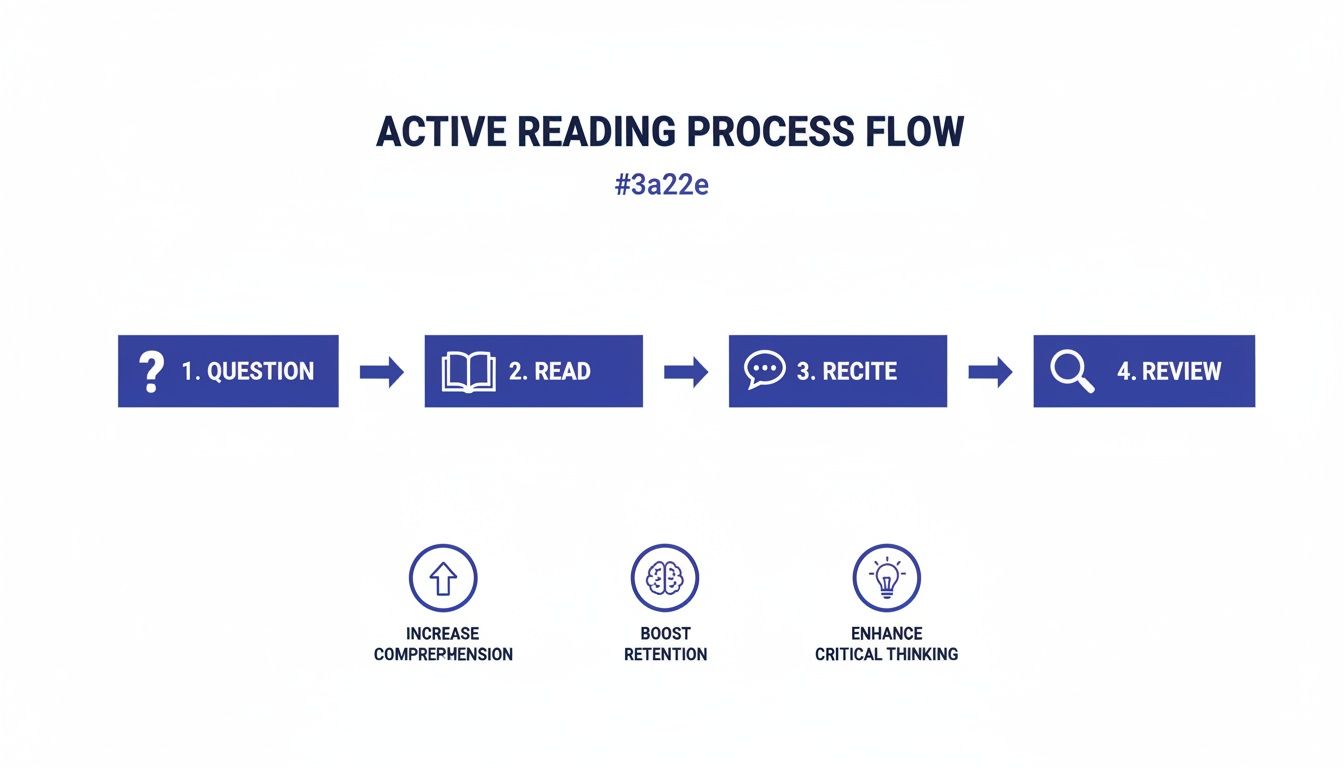
    1. Start with a Framework: Use a proven method like SQ3R (Survey, Question, Read, Recite, Review). Before reading, survey the headings and summary. Formulate questions based on these elements.
    2. Annotate with Purpose: Keep highlighting minimal. Use the margins to write questions, challenge assumptions, or note connections to your own projects.
    3. Pause and Summarize: Every 15-20 minutes, stop reading. Close the document and try to summarize the main points in your own words. This β€œrecite” step is a powerful form of retrieval practice.
    4. Consolidate and Review: After finishing, create a concept map or a brief visual summary. Review your annotations within 24 hours. For a deeper dive, you can learn more about active reading techniques and how to apply them.

    10. Self-Explanation and Teach-Back Protocols

    The Self-Explanation and Teach-Back method is a powerful cognitive strategy. It deepens your understanding and solidifies information in your memory. It involves articulating a concept aloud, either to yourself (self-explanation) or to another person (teach-back). This process forces you to move beyond passive reading. By forcing your brain to structure, simplify, and communicate an idea, you quickly uncover knowledge gaps that silent review often misses.

    • Real-world scenario: After attending a training session on a new software, a team member doesn’t just go back to their desk. They schedule a 30-minute session to β€œteach” the key features to a colleague who couldn’t attend. In the process of preparing and explaining, they realize they are fuzzy on one of the steps. This allows them to seek clarification immediately, solidifying their own knowledge.

    How Teaching Rewires Your Brain for Memory

    This method works because the act of verbalization requires deeper cognitive processing than simply reading. Research in learning sciences shows that explaining concepts forces the brain to organize information logically. It makes connections between new and existing knowledge. When you teach, you are not just reciting facts; you are constructing a mental model. This act of construction strengthens the neural pathways. It’s a fundamental way to improve working memory by making information more meaningful.

    How to Implement Self-Explanation and Teach-Back

    1. Start with Self-Explanation: After learning a new concept, put your notes away. Explain the idea aloud to yourself as if you were teaching a beginner. For programmers, this is β€œrubber ducking.”
    2. Find a β€œStudent”: The next level is teaching someone else. This could be a colleague or a friend. Ask them to listen and ask questions. Their confusion will highlight weak spots in your understanding.
    3. Use Probing Questions: As you explain, actively ask yourself β€œwhy” and β€œhow.” Why does this step come next? How does this connect to what I already know? This prevents shallow memorization.
    4. Teach Without Notes: The real test is explaining a topic from memory. Use your notes only to fill the gaps you discover during the process. This reveals what you’ve truly internalized.

    Best Working Memory Technique For You?

    Choosing the right technique depends on your specific goal. Are you memorizing facts for a test, or trying to understand a complex system? This comparison can help you decide.

    TechniqueBest For Memorizing ListsBest for Understanding ConceptsBest for Long-Term Retention
    Method of Lociβœ…
    Chunkingβœ…
    Spaced Repetitionβœ…βœ…
    Elaborative Interrogationβœ…βœ…
    Teach-Back Protocolβœ…βœ…

    For quick memorization, the Method of Loci and Chunking are excellent choices. For deep, lasting understanding of complex subjects, focus on Elaborative Interrogation and the Teach-Back Protocol. Compare options to find the best fit for your current learning challenge.

    Editor’s Take

    So, what really works when it comes to improving your working memory? While all ten techniques have merit, the most impactful strategies for busy professionals are Attention Management (Environmental Design) and Chunking. Why? Because they address the biggest modern challenges: distraction and information overload. You can’t use sophisticated methods like the Memory Palace if your working memory is constantly being hijacked by notifications.

    Start by creating an environment that protects your focus. This is the non-negotiable foundation. Then, use chunking to make overwhelming projects and data streams manageable. These two practices provide the biggest returns for the least β€œtraining” time. Techniques like Spaced Repetition and N-back training are powerful but require more structured commitment. They are best for those with specific, long-term learning goals, like mastering a language or preparing for a certification.

    Bottom line: First, control your environment. Second, organize the information. Master these two, and you’ve won half the battle for a stronger working memory.

    Key Takeaways: How to Improve Working Memory

    • Protect Your Focus First: Attention management is foundational. You cannot improve working memory if it’s constantly overloaded by distractions. Control your digital and physical environment to create space for deep thinking.
    • Structure Information Actively: Don’t be a passive consumer of information. Use techniques like Chunking, the Method of Loci, and Dual Coding to actively organize what you learn into memorable formats.
    • Engage Deeply, Don’t Just Review: Passive reading is ineffective. Strengthen memory by using active strategies like Elaborative Interrogation, Self-Explanation, and the Teach-Back Protocol to force deeper cognitive processing.
    • Practice Retrieval, Not Just Repetition: The act of recalling information strengthens memory pathways more than simply re-reading it. Use Spaced Repetition and Active Recall to move knowledge from short-term to long-term storage efficiently.
    • Consistency Over Intensity: Small, consistent effortsβ€”like a 15-minute daily review or creating a distraction-free work blockβ€”compound over time to produce significant improvements in cognitive function.

    Disclaimer: This article is for educational and informational purposes only and does not constitute medical or psychological advice. The content is not intended to be a substitute for professional medical advice, diagnosis, or treatment. Always seek the advice of your physician or other qualified health provider with any questions you may have regarding a medical condition. This article may contain affiliate links.

    Ready to build the foundational habits that support a powerful working memory? The strategies in this article work best when paired with a clear, focused mind. Explore the practical systems and neuroscience-backed routines inside The Power of Clarity to reduce mental clutter and sharpen your attention. Start with this chapter to create the mental space your brain needs to thrive.

    Frequently Asked Questions (FAQ)

    1. How long does it take to see improvements in working memory?
    While you can feel immediate benefits from organizational techniques like chunking and attention management, neurological changes from training exercises like N-back tasks or spaced repetition often take 4-8 weeks of consistent practice (e.g., 15-20 minutes, 4-5 times per week) to become noticeable.

    2. Can I improve my working memory permanently?
    Working memory is more like a state of mental fitness than a permanent trait. You can significantly strengthen its capacity and efficiency through consistent practice of the techniques mentioned. However, like physical fitness, if you stop practicing these mental habits, performance may decline. The goal is to integrate these strategies into your daily routines for lasting benefits.

    3. What is the single most important lifestyle factor for working memory?
    While many factors contribute, quality sleep is arguably the most critical. During sleep, particularly deep sleep, the brain consolidates memories, clearing out metabolic waste and transferring important information from short-term to long-term storage. Chronic sleep deprivation severely impairs the prefrontal cortex, which is essential for working memory function.

    4. Are β€œbrain games” a good way to improve working memory?
    The scientific consensus is mixed. While you will get better at the specific game you are playing, the β€œtransfer effect” to real-world cognitive tasks is often limited. For more reliable results, focus on process-based strategies like elaborative interrogation, chunking, and attention management, which are directly applicable to your daily work and learning.

    5. I feel overwhelmed by all these techniques. Which one should I start with?
    Start with Attention Management (#7). It’s the most foundational technique. You can’t effectively use any other memory strategy if your focus is constantly being broken. Begin by turning off non-essential notifications on your phone and computer and creating a dedicated time block for focused work each day. This single change can have an outsized impact.
  • 10 Powerful Working Memory Improvement Strategies to Boost Focus in 2026

    10 Powerful Working Memory Improvement Strategies to Boost Focus in 2026

    Affiliate Disclosure: This post may contain affiliate links. If you make a purchase through these links, we may earn a small commission at no extra cost to you. This helps support our work in bringing you valuable content.

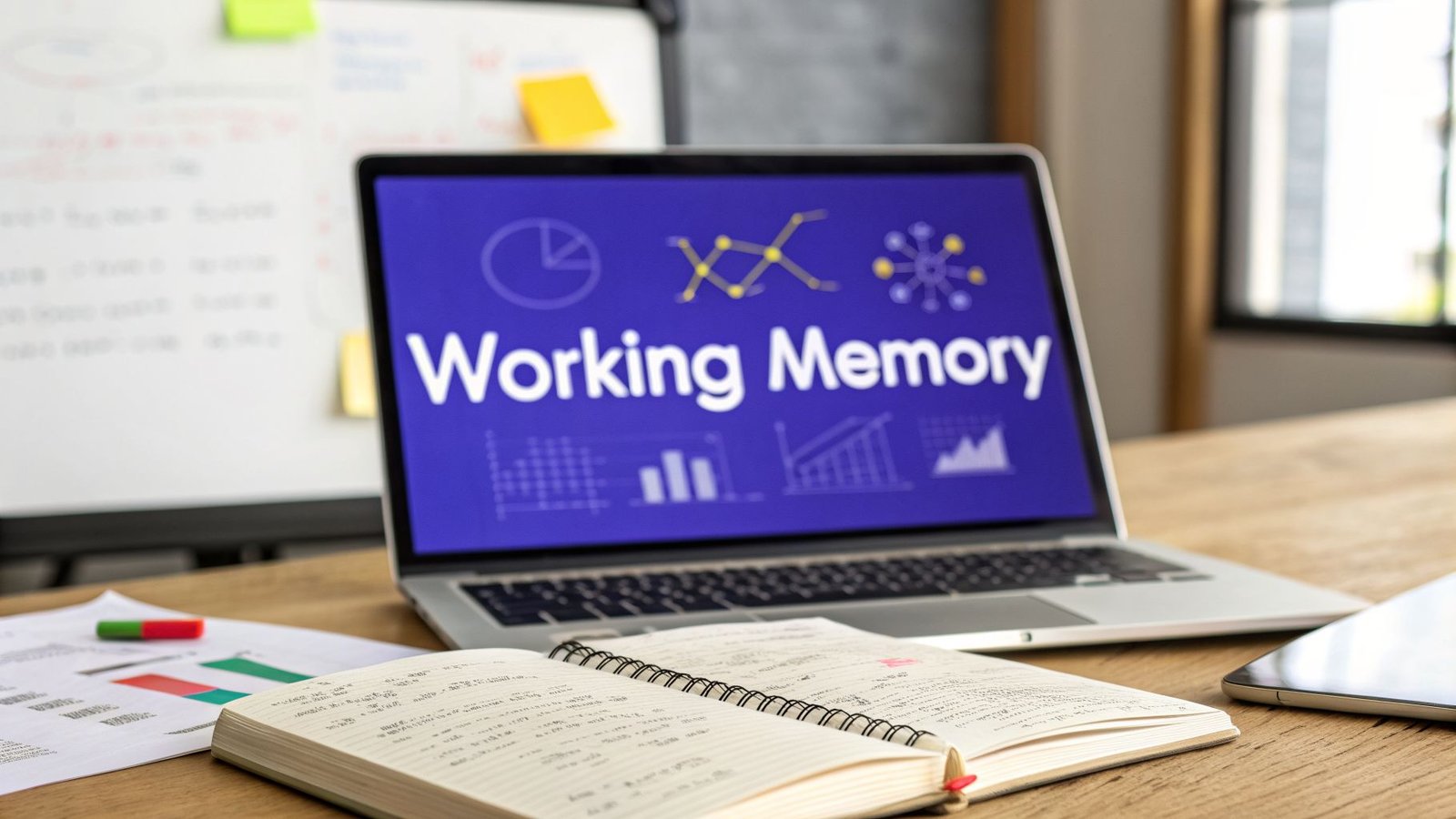
    Working memory is the brain’s active workspace, a temporary holding area where you manipulate information to complete tasks, solve problems, and make decisions. It’s the mental notepad that holds a phone number while you find a pen, the cognitive engine that processes a colleague’s feedback during a meeting, and the focus filter that lets you follow a complex recipe. When it’s sharp, you feel clear, productive, and in control. When it’s overloaded, you experience brain fog, lose your train of thought, and struggle with simple mental tasks. Neuroscience research shows that this system, primarily managed by the prefrontal cortex, has a very limited capacity, which is why the feeling of juggling too many mental tabs is a direct symptom of working memory strain.

    Working Memory Improvement Strategies That Reduce Cognitive Load and Boost Daily Focus

    Improving this critical cognitive function isn’t about magical brain hacks or grueling mental gymnastics. It’s about implementing practical, evidence-based systems that reduce cognitive load and enhance your brain’s natural ability to process information. The working memory improvement strategies in this guide are designed for immediate application, helping you manage information more effectively without burnout. You will learn how to structure tasks to prevent overload, use powerful mnemonic techniques to encode information, and build daily habits that support sustained cognitive performance.

    This article provides a comprehensive roundup of actionable techniques, moving beyond generic advice to give you step-by-step instructions grounded in cognitive psychology and neuroscience. We will cover short-term drills, long-term lifestyle adjustments, and smart ways to use external aids. Whether you’re a professional aiming for deeper focus, a student looking for better retention, or anyone feeling the strain of information overload, these strategies offer a clear path to a sharper, more reliable working memory.

    Disclaimer: This article is for educational purposes only and is not a substitute for professional medical or psychological advice. If you are struggling with conditions like anxiety, depression, ADHD, burnout, or sleep problems, please consult a qualified healthcare provider.

    1. Chunking to Improve Your Working Memory

    Chunking is a powerful cognitive strategy for organizing information into smaller, meaningful units. This process significantly reduces the cognitive load on your working memory. Instead of trying to recall a long string of individual items, your brain groups related elements into a single β€œchunk.” This allows you to hold and process more complex information efficiently, making it one of the most effective working memory improvement strategies. This technique leverages the brain’s natural ability to detect patterns, a principle famously explored in psychologist George A. Miller’s research on memory capacity.

    Two American desk workers organizing blue and white index cards on a wooden table, next to a laptop and keyboard, with a "CHUNK INFORMATION" overlay. This illustrates one of the best working memory improvement strategies.

    This method is more intuitive than it sounds and is something you already do daily. A phone number, for instance, isn’t remembered as ten separate digits (5551234567) but as three chunks (555-123-4567). This simple grouping makes the number vastly easier to recall.

    Real-World Example: Applying Chunking

    Imagine you have a long, unstructured to-do list for a new project. It feels overwhelming. Instead of tackling 20 individual items, you β€œchunk” them:

    • Chunk 1 (Research): Read reports, analyze competitor data, interview stakeholder.
    • Chunk 2 (Drafting): Outline proposal, write first draft, create slides.
    • Chunk 3 (Review): Get feedback from team, revise draft, submit for approval.

    Now, your brain only has to track three items, not twenty, making the project feel manageable.

    Key Insight: Chunking works by creating meaningful connections between individual pieces of information. By assigning a higher-level meaning to a group of items, you only need to hold the β€œchunk” in your working memory, not every single component part.

    By consciously implementing chunking, you can handle more complex data, reduce mental strain, and enhance your ability to focus on what truly matters. It’s a foundational skill for deep work and a cornerstone of efficient knowledge management. For more on structuring your focus, explore the principles in The Power of Clarity.

    2. The Method of Loci (Memory Palace)

    The Method of Loci, also known as the Memory Palace, is an ancient mnemonic technique that leverages your brain’s powerful spatial memory. It involves mentally placing information you need to remember along a familiar physical route, like your home or commute. By visualizing a journey through this space, you can retrieve information by β€œseeing” it where you left it. This method powerfully connects abstract data to concrete imagery, making it one of the most enduring working memory improvement strategies. Neuroscience shows this technique taps into the hippocampus, a brain region critical for both memory formation and spatial navigation.

    A purple sign saying 'MEMORY PALACE' on a doormat in front of a white house door with an open book, illustrating one of the best working memory improvement strategies.

    This powerful technique was famously used by ancient Roman orators to recall long speeches without notes. By associating each point of their speech with a specific location in a villa, they could mentally β€œwalk” through the space to remember the sequence. Modern memory champions use the same principle to memorize decks of cards and long strings of numbers.

    Real-World Example: Applying the Memory Palace

    Let’s say you need to remember the five key points for a presentation. You choose your apartment as your Memory Palace.

    1. Front Door: Place the introduction here. Imagine a giant, flashing β€œWelcome” sign.
    2. Entryway Table: The first key point (e.g., market trends). Picture a chart of rising trends sitting on the table.
    3. Living Room Couch: The second key point (e.g., customer feedback). Visualize your clients sitting on your couch giving you a thumbs-up.
    4. Kitchen Counter: The third key point (e.g., financial data). See stacks of money on the counter.
    5. Back Door: The conclusion. Imagine a giant β€œThe End” sign blocking the exit.

    To recall your points, you simply β€œwalk” through your apartment.

    Key Insight: The Method of Loci works by translating difficult-to-remember information into a format the brain excels at: visual-spatial data. Creating bizarre or exaggerated mental images strengthens these associations, making recall nearly effortless.

    By building and practicing with a memory palace, you can significantly expand the amount of sequential information you hold in your working memory. This ancient tool is a game-changer for public speaking, studying, and organizing complex tasks.

    3. Spaced Repetition for Better Long-Term Recall

    Spaced repetition is an evidence-based learning technique that leverages the β€œspacing effect” to transfer information from your short-term working memory into durable, long-term storage. Instead of cramming information in one session, this method involves reviewing it at increasing intervals over time. This process interrupts the natural forgetting curve, signaling to your brain that the information is important and reinforcing the neural pathways needed for recall. As a result, it is one of the most efficient working memory improvement strategies for retaining knowledge.

    A desk with flashcards, a notebook, a pen, and a calendar illustrating spaced repetition for learning, one of the best working memory improvement strategies.

    This technique, pioneered by psychologist Hermann Ebbinghaus, works by making your brain work just hard enough to retrieve the memory. Each successful retrieval at a progressively longer interval strengthens the memory’s trace, making it less likely to be forgotten. A software developer, for instance, might review a new coding pattern after one day, then three days, then a week, cementing the concept far more effectively than reading the documentation five times in one afternoon.

    Real-World Example: Applying Spaced Repetition

    You are learning key details about a new client. You create a few digital flashcards with their company name, key contacts, and business goals.

    • Day 1: You review the flashcards in the morning.
    • Day 2: You review them again.
    • Day 4: The app prompts you to review them.
    • Day 8: You get another prompt.

    By the big meeting on Day 10, the information is solidly in your memory without any last-minute cramming. A simple habit tracker journal can help you stay consistent with these review sessions.

    Key Insight: Spaced repetition optimizes learning by timing reviews at the precise moment you are about to forget something. This β€œdesirable difficulty” forces your brain to work harder to retrieve the information, which in turn strengthens the memory for long-term retention.

    By systematically spacing out your learning, you commit information to memory more effectively, reduce the need for last-minute cramming, and build a reliable foundation of knowledge. To learn more about building effective learning habits, explore the systems in Focus Recharged.

    4. Active Recall & The Testing Effect Strategy

    Active recall is a learning process centered on deliberately retrieving information from your memory. In contrast to passively rereading or reviewing material, this method forces your brain to actively reconstruct knowledge, creating much stronger neural pathways. Research on the β€œTesting Effect,” pioneered by scientists like Henry Roediger and Jeffrey Karpicke, demonstrates that the act of retrieval itself is a powerful memory enhancer. This effortful process is one of the most potent working memory improvement strategies because it solidifies information for long-term storage, freeing up working memory for new tasks.

    This technique fundamentally changes how you interact with information. Instead of just recognizing familiar concepts, you are challenged to produce them from scratch. This cognitive effort signals to your brain that the information is important and worth holding onto, making it more accessible for future use.

    Real-World Example: Applying Active Recall

    After reading a chapter in a business book, instead of just highlighting passages:

    • Close the book.
    • Open a blank document or notebook page.
    • Write down everything you can remember from the chapter, including the main ideas and key examples.

    This simple act forces your brain to retrieve the information, not just recognize it. This is why learning how to retain information when studying is so critical.

    Key Insight: Active recall works because it treats your brain like a muscle. Each time you successfully retrieve a piece of information, you strengthen the neural connection to it, making it easier and faster to access the next time.

    By making active recall a regular habit, you shift from being a passive consumer of information to an active participant in your own learning. This leads to more robust knowledge that you can depend on when you need it most. Discover more about building effective learning habits in How to Retain What You Read.

    5. Working Memory Load Management (Cognitive Load Theory)

    Cognitive Load Theory (CLT) is based on the scientific premise that working memory has a finite capacity. Developed by psychologist John Sweller, this theory suggests that learning and performance are optimized when tasks are designed to match this limit. Managing your cognitive load means actively reducing unnecessary mental processing, freeing up precious cognitive resources. This makes it one of the most essential working memory improvement strategies for knowledge workers. By consciously designing your workflow to minimize mental strain, you can enhance focus, reduce errors, and make better decisions.

    This principle explains why a cluttered digital workspace feels so overwhelming. Every notification, open tab, and unnecessary visual element consumes a small piece of your working memory. In contrast, a minimalist environment allows your brain to dedicate its full capacity to the task at hand. It’s about working smarter, not harder, by aligning your tasks with your brain’s natural architecture.

    Real-World Example: Applying Cognitive Load Theory

    Your manager sends a complex email with five different requests buried in long paragraphs. Your working memory is immediately strained trying to track them all.

    • The Problem: High cognitive load.
    • The Solution: You copy each request into a numbered list in a separate task manager app.

    By externalizing the information and simplifying its presentation, you’ve reduced the cognitive load. Now you can focus on completing one task at a time instead of holding all five in your head. A time blocking planner is perfect for visualizing and simplifying your schedule.

    Key Insight: Your working memory is a finite resource. Cognitive Load Theory teaches you to treat it as such by intentionally removing distractions (extraneous load) and simplifying complex tasks (intrinsic load) so you can focus on what truly matters for growth and learning (germane load).

    By managing your cognitive load, you prevent mental fatigue and create an environment where deep work can flourish. It is a foundational strategy for anyone looking to sustain high-level performance without burnout. To understand the consequences of ignoring these limits, you can learn more about what happens during cognitive overload.

    6. Elaboration (Linking New Information to Existing Knowledge)

    Elaboration is a cognitive process where you actively connect new information to your existing knowledge, creating a rich, interconnected web in your long-term memory. Instead of passively absorbing facts, you process them deeply by questioning, explaining, or finding analogies. This method strengthens retrieval pathways, making it easier to pull information back into your conscious mind. As one of the most robust working memory improvement strategies, it moves learning from rote memorization to genuine understanding, a concept rooted in Craik & Lockhart’s β€œLevels of Processing” theory in psychology.

    This technique is about giving new data context and meaning. When a project manager relates a new agile methodology to a successful past project, they are using elaboration. They aren’t just learning rules; they are integrating the new framework into a pre-existing mental model of what works. This connection makes the new information stickier and more accessible.

    Real-World Example: Applying Elaboration

    You’re learning about a new software product your company is launching.

    • Passive Learning: Reading the feature list.
    • Elaboration: You ask yourself, β€œHow is this new feature like the one in our old software, but better? How would my biggest client use this to solve their main problem?”

    By linking the new information to your existing knowledge of clients and old software, you create a deeper, more meaningful understanding that’s easier to recall.

    Key Insight: Elaboration transforms passive reception into active engagement. By forcing your brain to build connections, you are creating multiple mental hooks for the new information, making it significantly easier to recall and apply under pressure.

    By making elaboration a habit, you not only improve your working memory but also deepen your expertise. This active learning approach is fundamental to improving your problem-solving skills and becoming a more insightful, adaptable professional.

    7. Attention Restoration & Focused Attention Intervals (Pomodoro & Deep Work Blocks)

    Focused attention intervals are a disciplined approach to managing your cognitive energy. This method involves structuring your work into dedicated blocks of intense focus followed by deliberate rest periods. This cyclical pattern prevents the cognitive fatigue that degrades working memory. By aligning with the brain’s natural ultradian rhythms, this is one of the most sustainable working memory improvement strategies for long-term productivity and mental clarity. This concept was famously explored by sleep researcher Nathaniel Kleitman and popularized in modern productivity by Cal Newport’s β€œDeep Work” and Francesco Cirillo’s Pomodoro Technique.

    This strategy works by treating your attention like a muscle that requires both exertion and recovery. Instead of pushing through hours of continuous, low-quality work, you alternate between peak performance and complete rest. A common application is the Pomodoro Technique: 25 minutes of focused work on a single task, followed by a 5-minute break. This prevents mental overload and keeps your working memory sharp and ready for the next interval.

    Real-World Example: Applying Focused Intervals

    You have to write a complex report. Instead of staring at a blank page for two hours straight:

    • Set a pomodoro timer for 25 minutes. During this time, you only writeβ€”no emails, no phone, no distractions.
    • When the timer rings, you take a 5-minute break to stretch or grab a glass of water.
    • You repeat this cycle four times, then take a longer 20-minute break.

    This structured approach keeps your focus sharp and prevents the burnout that clouds working memory.

    Key Insight: The power of focused intervals lies in the quality of both the work and the rest. Protecting your attention from distractions during work blocks is just as important as protecting your breaks from work-related stimuli. This discipline is what restores your working memory capacity.

    By adopting focused attention intervals, you can produce higher-quality work in less time, reduce mental fatigue, and maintain a high level of cognitive performance throughout the day. To learn more about the specifics of this popular technique, you can explore the Pomodoro method in detail.

    Best Options for Getting Started with Working Memory Improvement

    Deciding where to begin depends on your biggest challenge. Do you struggle with retaining new information or managing daily tasks? Here’s a quick comparison to help you choose.

    Best For…Start With This StrategyWhy It WorksNext Step
    Busy ProfessionalsExternal EncodingImmediately reduces mental clutter by offloading tasks and reminders to a trusted system.See the book that fits your goal
    Students & LearnersActive RecallDirectly strengthens memory retention, making study time more efficient and effective.Browse the library
    Creative ThinkersMethod of LociLeverages visual and spatial memory, which is excellent for organizing abstract concepts and ideas.Compare options in the guide
    Feeling OverwhelmedCognitive Load ManagementFocuses on simplifying your environment and tasks to prevent burnout before it starts.Start with this chapter

    8. External Encoding & Off-Loading (Writing, Diagramming, Digital Tools)

    External encoding is the strategic practice of moving information out of your head and into an external, reliable format. This process, often called β€œoff-loading,” dramatically reduces the strain on your working memory. Instead of juggling tasks, ideas, and complex details internally, you capture them in notes, diagrams, or digital tools. This liberates cognitive resources, making it one of the most practical working memory improvement strategies for busy professionals. The principle was famously systemized by productivity consultant David Allen in his Getting Things Done methodology, which emphasizes capturing everything in a trusted external system.

    This behavioral psychology technique acknowledges that your brain is for having ideas, not for holding them. For remote workers, this might mean using Notion or Obsidian as a digital β€œsecond brain” to track projects and knowledge. For engineers, it means maintaining detailed documentation instead of relying on memory for complex system specs. By externalizing, you create space for deeper thinking, analysis, and creative problem-solving.

    Real-World Example: Applying External Encoding

    You’re in a meeting, and brilliant ideas and action items are flying around.

    • Without Off-loading: You try to remember everything. By the time you get back to your desk, you’ve forgotten half of it.
    • With Off-loading: You open a notes app or a productivity journal and jot down every idea and task as it’s mentioned.

    Your working memory is now free to actively participate in the conversation instead of struggling to hold onto information.

    Key Insight: Your working memory is a temporary, limited workspace, not a permanent storage drive. External encoding treats it as such, using reliable external tools for storage and retrieval so your mind can focus on high-value cognitive tasks like analysis and creativity.

    By consistently off-loading information, you build a reliable system that supports your cognitive functions, preventing mental clutter and burnout. It’s a foundational habit for anyone looking to manage complex work effectively.

    9. Interleaving (Mixed Practice Over Blocked Practice)

    Interleaving is a potent learning technique where you mix different but related topics or skills during a single practice session. Instead of practicing one skill repeatedly before moving to the next (blocked practice), interleaving forces your brain to constantly retrieve and apply different solutions. This method strengthens neural pathways and improves your ability to distinguish between concepts, making it one of the most durable working memory improvement strategies. Research by cognitive psychologists like Doug Rohrer has consistently shown that this β€œdesirable difficulty” leads to more robust, long-term learning.

    This approach initially feels less intuitive and more challenging than mastering one thing at a time. For example, a sales professional might find it easier to practice handling pricing objections for an hour straight. However, mixing in practice on competitor-related and feature-related objections in the same session builds a more flexible and responsive skill set that better mirrors real-world client conversations.

    Real-World Example: Applying Interleaving

    You need to learn three different functions in a spreadsheet program (e.g., VLOOKUP, Pivot Tables, Conditional Formatting).

    • Blocked Practice: Monday = VLOOKUP, Tuesday = Pivot Tables, Wednesday = Conditional Formatting.
    • Interleaving: On Monday, you do one VLOOKUP problem, then one Pivot Table problem, then one Conditional Formatting problem, and repeat the cycle.

    While it feels harder, interleaving forces your brain to choose the right tool for the job each time, leading to deeper, more flexible learning.

    Key Insight: Interleaving enhances learning by forcing your brain to discriminate between different types of problems and select the correct strategy. This active retrieval and comparison process creates stronger, more flexible memories than the passive repetition of blocked practice.

    By deliberately mixing your practice, you train your brain for the complexity of the real world, where problems rarely appear in neatly blocked categories. This cognitive workout is a powerful way to turn fragile knowledge into lasting skill. For more on building resilient focus, see the methods in Attention Unleashed.

    10. Metacognition & Strategic Self-Monitoring (Confidence Calibration)

    Metacognition, or β€œthinking about your thinking,” is the practice of monitoring your own cognitive processes to adjust your strategies. This involves actively assessing what you know, identifying gaps in your understanding, and recognizing when you need to change your approach. This self-awareness prevents you from wasting cognitive resources on ineffective methods, making it one of the most sophisticated working memory improvement strategies. Research in educational psychology, pioneered by John Flavell, shows that well-calibrated metacognition is a key differentiator in efficient learning and problem-solving.

    This strategy helps you distinguish between the feeling of familiarity and true comprehension. For example, after reading a complex report, you might feel like you understand it, but metacognition prompts you to actively test that assumption. This prevents the overconfidence described by researchers Dunning and Kruger in their famous behavioral studies, ensuring your working memory is allocated to mastering information, not just passively reviewing it.

    Real-World Example: Applying Metacognition

    You’re preparing for an important client presentation.

    • Without Metacognition: You read through your slides five times and feel confident because they look familiar.
    • With Metacognition: You read through your slides once, then turn away and try to explain the core message of each slide out loud. You quickly realize you’re fuzzy on slide #3, so you focus your remaining prep time there.

    This self-monitoring identifies your actual weaknesses, allowing you to study more efficiently.

    Key Insight: Strategic self-monitoring works by making your learning process an active, conscious effort. By regularly checking your confidence against objective evidence (like self-testing), you direct your working memory’s limited capacity toward areas that need the most attention, leading to more robust and reliable knowledge.

    By consciously practicing metacognition, you transform from a passive information consumer into an active, strategic learner. This approach not only improves memory but also builds the intellectual humility required for continuous growth. For more on developing self-awareness in your professional life, see the frameworks in The Power of Clarity.

    How to Choose the Best Working Memory Tools

    Selecting the right tools can accelerate your progress. Here’s how a few popular options compare for different needs.

    • For Digital Organization: A time blocking planner is excellent for visual learners who need to structure their day. It helps manage cognitive load by laying out tasks clearly, so your brain doesn’t have to juggle a schedule internally. It’s a great first step for externalizing your day.
    • For Focused Work: A pomodoro timer is a simple but powerful device. Its non-digital, tactile nature helps create a clear boundary between work and rest. This is ideal for anyone easily distracted by phone timers or browser extensions.
    • For Consistent Habits: A habit tracker journal is perfect for implementing strategies like Spaced Repetition or Active Recall. The physical act of checking off a daily review session reinforces the behavior, making it more likely to stick.
    • For Reduced Distractions: For those who work in noisy environments, a good pair of noise canceling headphones can be a game-changer. They directly reduce the extraneous cognitive load from auditory distractions, freeing up working memory for the task at hand.

    Editor’s Take

    Let’s be honest: not all these strategies will work for everyone, and some require more effort than others. Based on our research and application, the most impactful strategies for immediate results are External Encoding and Focused Attention Intervals. Why? Because they don’t require you to fundamentally change how you learn, but rather how you manage your work. Simply offloading your to-do list and working in focused 25-minute sprints can dramatically reduce mental fog. These are best for busy professionals who feel overwhelmed. More complex techniques like the Memory Palace are incredibly powerful but best for specific goals, like memorizing a speech, rather than daily use. The key is to start small: pick one strategy, apply it for a week, and see how it feels.

    Key Takeaways: From Theory to Daily Practice

    The most critical insight to carry forward is that working memory is not a fixed trait but a dynamic skill. It responds directly to how you manage your attention, structure information, and care for your cognitive health.

    • Internal vs. External Strategies: A powerful approach combines strengthening your internal capacity (like using the Method of Loci) with smart external off-loading (like using a to-do list or digital tools). You don’t need to hold everything in your head; you just need a reliable system.
    • Active Engagement is Non-Negotiable: Passive learning is the enemy of strong working memory. Techniques like the testing effect and elaboration force you to actively engage with material, creating stronger neural pathways and making information stick.
    • Environment Shapes Performance: Your cognitive capacity is profoundly influenced by your surroundings. Managing distractions, implementing focused work blocks, and even reducing digital noise are fundamental working memory improvement strategies.
    • Be Proactive, Not Reactive: Instead of waiting for brain fog to set in, proactively design your workflow to support your working memory. Chunk projects, schedule focus blocks, and externalize reminders before you feel overwhelmed.

    Disclaimer: The information in this article is for educational purposes only and should not be considered a substitute for professional medical or psychological advice. The affiliate links included help support our content creation at no extra cost to you.

    Frequently Asked Questions (FAQ)

    1. What is the fastest way to improve working memory?


    The fastest strategy for immediate relief is External Encoding. By writing down tasks, ideas, and reminders in a trusted system (like a notebook or app), you immediately free up mental bandwidth. This reduces the cognitive load your working memory has to carry, providing a quick sense of clarity and focus.

    2. Can working memory be permanently improved?


    While you can’t increase its raw capacity, you can dramatically improve its efficiency. Consistent use of strategies like chunking, spaced repetition, and active recall builds stronger neural pathways for encoding and retrieval. This makes your use of working memory so effective that it feels like you have more of it.

    3. How does sleep affect working memory?


    Sleep is critical. During deep sleep, the brain consolidates memories, transferring important information from temporary stores (like working memory) to long-term storage. A lack of quality sleep impairs this process, leading to a noticeable decline in working memory function, focus, and clarity the next day.

    4. Are β€œbrain training” games effective for working memory?


    Research suggests that while brain training games can make you better at the games themselves, this improvement often doesn’t transfer to real-world tasks. Strategies like active recall and managing cognitive load, which are applied directly to your work and learning, are generally more effective for practical working memory improvement.

    5. How is working memory different from short-term memory?


    Short-term memory is like a temporary storage folder; it simply holds information for a brief period. Working memory is an active workspace. It not only holds information but also manipulates, organizes, and uses it to complete a task, such as solving a math problem in your head or following a multi-step recipe.


    Ready to build the focus and mental clarity that powers a high-performance mind? The strategies in this article are a fantastic start, and if you want to dive deeper into creating sustainable systems for productivity and well-being, explore the resources at Mind Clarity Hub. Our books, like The Power of Clarity, are designed to help you cut through the noise and unlock your full cognitive potential.

  • How to Retain What You Read Using Neuroscience

    How to Retain What You Read Using Neuroscience

    How to Retain What You Read Using Neuroscience

    Jeremy Jarvis β€” Mind Clarity Hub founder
    Mind Clarity Hub β€’ Research-aware focus & digital wellness

    Let’s be honest: retaining what you read feels like a constant battle. The secret isn’t reading more, it’s changing how you read. It all comes down to a simple shift from passive consumption to active engagement. You have to turn reading into a hunt for answers, then summarize the key ideas in your own words and revisit them over time.

    This guide provides practical, evidence-based strategies to help you remember more of what you read. These techniques are grounded in neuroscience and psychology but explained in simple, actionable terms.

    This post may contain affiliate links. If you make a purchase, we may receive a small commission at no extra cost to you. We only recommend products we trust.

    Why We Forget What We Read (and How to Fix It)

    It’s a painfully familiar feeling. You finish a brilliant book or a fascinating article, buzzing with new ideas. A week later? Those insights have vanished, leaving behind only a faint, fuzzy memory.

    This isn’t a personal failure. It’s just how our brains are wired. Our minds are designed for survival, which means they are highly efficient at filtering and discarding information that doesn’t seem immediately useful.

    This phenomenon is explained by the β€œforgetting curve,” a concept from psychology showing how our memory for new information decays exponentially unless we actively reinforce it. Your brain isn’t a hard drive; it’s a dynamic filtering system.

    Understanding the Brain’s β€œUse It or Lose It” Policy to Retain What You Read

    Your brain constantly prunes neural connections it deems unimportant. Neuroscientific research shows that when you passively read something, you create a weak, temporary pathway. If you don’t reinforce it by actively engaging with the material, your brain flags that information as non-essential and lets it fade. This is a natural process of cognitive efficiency.

    To make knowledge stick, you need to send your brain strong, clear signals that the information matters. This guide will show you exactly how to do that.

    β€œToday I escaped from anxiety. Or no, I discarded it, because it was within me, in my own perceptionsβ€”not outside.” – Marcus Aurelius

    This same wisdom applies to learning. Retention isn’t something that just happens to you; it’s a direct result of the actions you take. We’re going to reframe retention not as a chore, but as an engaging, strategic skill you can build.

    Please note, this article is for educational purposes only and is not a substitute for professional medical or psychological advice. If you are experiencing persistent issues with memory, focus, anxiety, or other cognitive or mood concerns, please consult a qualified healthcare provider.

    For a deeper look into the science, these strategies for retaining information when studying offer a great breakdown of how to make your efforts more effective.

    Your Roadmap to Retaining What You Read

    We’ve built a practical, neuroscience-backed roadmap to help you turn what you read into knowledge that actually lasts. Here’s a quick look at the core strategies we’ll cover:

    • Priming Your Brain: How to prepare your mind before you even start reading to create a mental framework for new information.
    • Active Reading: Engaging directly with the text by questioning, summarizing, and connecting ideas as you go.
    • Knowledge Consolidation: Using structured note-taking methods to solidify and organize what you’ve learned.
    • Retrieval Practice: The powerful act of recalling information from memory to strengthen neural pathways for the long haul.

    Prime Your Brain Before You Read to Retain Information

    Truly effective retention doesn’t start when you read the first sentence. It starts before you even open the book.

    Most people dive into a book cold, hoping the information will just passively sink in. But if you want to reliably retain what you read, you have to be intentional. This is a process called primingβ€”a psychological concept where you prepare your brain to receive, filter, and organize new information before it ever arrives.

    A bright overhead shot of a wooden desk with a book, eyeglasses, pen, sticky note, and a phone, a setup for how to retain what you read.

    Think of it like giving your brain a map before starting a journey. Instead of wandering aimlessly, your mind knows what to look for. A simple 5-minute priming routine can dramatically increase how much you actually remember.

    Define Your Purpose and Activate Your Brain’s Filter to Retain What You Read

    Before you start, ask yourself one simple question: β€œWhy am I reading this?”

    Your answer activates the Reticular Activating System (RAS), a network in the brainstem that acts as a filter for information. Behavioral research shows that setting a clear intention primes this system. When you define your purpose, you’re telling your RAS what’s important enough to let through.

    Mini Scenario: You’re reading a book on personal finance.

    • Passive approach: β€œI want to learn about money.” (Too vague)
    • Primed approach: β€œI need to find two specific strategies to reduce my monthly spending.” (Clear and actionable)
      With the second goal, your brain is now on high alert for anything related to spending reduction, making those sections feel more relevant and memorable.

    This single step sharpens your focus and makes learning feel less overwhelming. If you want to go deeper on this, check out our in-depth guide on how to improve focus while studying.

    Create a Mental Map by Skimming to Improve Reading Comprehension

    Next, spend just two minutes creating a mental scaffold for the information. Don’t read word-for-word. Instead, get a quick lay of the land by skimming these key elements:

    • The table of contents
    • Chapter titles and subheadings
    • The introduction and conclusion
    • Any bolded terms, summaries, or callout boxes

    Neuroscience shows that our brains learn best when new information can be attached to an existing structure. Skimming creates that structure in advance, so as you read, your brain already has mental β€œfolders” ready to file away key concepts.

    How to retain what you read using neuroscience: a focused woman reading an open book at a desk with a glowing brain and neural connections above the pages.
    A visual reminder that memory sticks when reading becomes active: attention, meaning, and repetition strengthen recall.

    Just by scanning chapter titles, you get a clear sense of a book’s journey. This mental map prepares you to absorb the details within each section far more effectively.

    Formulate Questions to Turn Reading into an Active Hunt

    Finally, shift your reading from passive consumption into an active hunt for answers. Based on your purpose and your two-minute skim, come up with three to five questions you want the text to answer for you. This engages your curiosity, a key driver of memory formation according to psychological studies on learning.

    Real-World Scenario: Priming for an Industry Report
    A marketing manager needs to read a 50-page industry analysis.

    1. Purpose: β€œI need to identify the top three market trends that will impact our Q4 strategy.”
    2. Skim: She scans the executive summary, section headings (β€œConsumer Behavior Shifts,” β€œCompetitor Innovations”), and key charts.
    3. Questions: She jots down: β€œWhat are the biggest consumer pain points mentioned?” β€œWhich new technologies are competitors adopting?” β€œWhere is the biggest opportunity for growth?”

    Now, as she reads, her brain is actively scanning for the answers. She finishes the report not with a vague sense of its contents, but with concrete, actionable insights.

    Master Active Reading and Strategic Note-Taking to Retain What You Read

    Getting your brain ready is one thing, but the real work of building lasting memory happens when you’re actually reading. To make information stick, you have to move from being a passive consumer to an active participant.

    This means getting past mindless highlighting and actually wrestling with the text. You have to engage in a way that forces your brain to process, question, and connect ideas.

    This isn’t just a study hack; it’s grounded in neuroscience. When you actively grapple with ideas, you forge stronger, more complex neural pathways, making that information far easier to pull up later. Passive reading creates flimsy connections that your brain quickly prunes.

    Explain It Like I’m Five Using the Feynman Technique

    One of the most potent ways to check your understanding is the Feynman Technique. The idea is simple: after reading a section on a complex topic, you pause and try to explain it in the plainest terms possible, as if you were teaching a child.

    If you find yourself stumbling or reaching for jargon, you haven’t truly grasped it yet. This instant feedback forces you to circle back and clarify the concept. This act of simplifying and verbalizing is a powerful form of active recall that cements knowledge in your memory.

    Real-World Scenario: A Student Tackles a Textbook
    Maria is working through a dense chapter on cellular respiration. Instead of just highlighting terms, she reads a paragraph, closes the book, and says aloud, β€œOkay, so the cell takes in sugar, breaks it down in a few steps, and this process releases energy, like a tiny power plant.” This simple act of verbalizing reveals what she knows and what she’s still fuzzy on.

    Use a Structured Approach Like the SQ3R Method for Better Reading Retention

    For more structured material, especially academic or technical texts, the SQ3R method is a time-tested framework. It builds active reading habits directly into your workflow.

    It’s an acronym for:

    1. Survey: First, skim the chapter just like we talked about in the priming stage.
    2. Question: Now, turn those headings into questions. If a heading is β€œThe Role of Mitochondria,” your question becomes, β€œWhat is the role of mitochondria?”
    3. Read: With your question in mind, read the section. Your brain is no longer passively absorbingβ€”it’s actively hunting for an answer.
    4. Recite: After reading the section, look away and recite the answer to your question out loud, in your own words.
    5. Review: Once you’ve finished the entire chapter, go back over your notes and mentally run through your questions and answers to lock in the learning.

    This methodical process stops the β€œin one ear, out the other” problem by forcing you to constantly engage with the material.

    Make Your Notes an Active Tool to Retain Information

    How you take notes is everything. The goal isn’t to create a transcript; it’s to create a tool for thinking. Good note-taking is less about capturing every word and more about processing ideas. There are plenty of proven methods for taking notes from textbooks to boost retention you can explore.

    Use the margins of a book or your notebook to jot down questions, challenge the author’s points, or connect an idea to your own life. This dialogue with the text is what makes information memorable. To go even deeper on this, check out our complete guide on how to take notes from a book for specific templates and workflows.

    A 2023 meta-analysis confirmed that reading on paper boosts comprehension by 20-30% compared to screens, likely because it encourages deeper, more focused processing. This doesn’t mean you have to abandon your Kindle, but it highlights just how valuable focused, active engagement is.

    Comparison of Popular Note-Taking Methods for Reading Retention

    This table breaks down three powerful note-taking systems. Each has its own strengths, so think about what you’re reading and what your goals are.

    MethodBest ForCore Principle
    The Zettelkasten MethodBuilding a long-term, interconnected β€œsecond brain” of ideas from non-fiction books and articles.Creating single-idea atomic notes and linking them together to discover novel connections.
    The Cornell MethodStructured learning from textbooks, lectures, and dense academic papers.Dividing the page into cues, main notes, and a summary section to facilitate active recall.
    Progressive SummarizationExtracting key insights from long articles, reports, or online content you read digitally.Highlighting and summarizing information in multiple layers over time to distill the core essence.

    The best method is the one you’ll actually use. The underlying principle is the same: treat note-taking as an act of thinking, not just recording.

    Solidify Knowledge with Spaced Repetition and Retrieval Practice

    Finishing a book feels like the end. But from a neuroscience perspective, it’s just the beginning. The real work of creating lasting memories kicks off after you’ve closed the cover, during a crucial phase called consolidation. This is where you turn fragile, short-term memories into durable, long-term knowledge.

    To do this right, you need to work with your brain’s natural learning rhythms. Forget passively re-reading; that’s one of the least effective ways to learn. True retention comes from actively pulling information out of your brain using two powerful, evidence-backed tools: Spaced Repetition and Retrieval Practice.

    Flowchart illustrating the active reading process: Question, Read, Recite, Review, leading to increased comprehension and how to retain what you read.

    This simple cycleβ€”Question, Read, Recite, Reviewβ€”turns passive consumption into active engagement, which is exactly where deep memory is built.

    Fight the Forgetting Curve with Spaced Repetition

    Your brain is built to forget. Spaced repetition is the perfect antidote. It involves reviewing information at increasing intervalsβ€”say, after one day, then three days, then a week, and so on.

    Each time you review the material just as you’re about to forget it, you interrupt the forgetting process. This sends a powerful message to your brain: β€œHey, this is important! Keep it.” The neural connection for that memory gets stronger, making it more stable and easier to access down the road. Research in cognitive psychology shows that this method can dramatically improve long-term retention.

    Build Strong Memories Through Retrieval Practice to Retain What You Read

    While spaced repetition tells you when to study, retrieval practice tells you how.

    Retrieval practice is the simple act of pulling information out of your memory, rather than passively looking at it again. Think of it as self-quizzing.

    Every time you force your brain to recall a concept without looking at your notes, you strengthen the memory trace. Neuroscientists call this β€œdesirable difficulty.” The active recall makes the neural pathway for that information more robust and efficient.

    Real-World Scenario: A Consultant Retains Business Frameworks
    A management consultant reads a book on market strategy.

    • Day 1 (Retrieval): She creates flashcards and quizzes herself on the main frameworks without looking at her notes.
    • Day 3 (Spaced Repetition): She reviews the cards again, focusing on the ones she struggled with.
    • Day 7 & Beyond: She continues this process, spacing the reviews further apart.

    When a client meeting comes up a month later, she can confidently recall and apply specific frameworks. This is the difference between fleeting familiarity and true, usable knowledge.

    A Practical Workflow for Long-Term Reading Retention

    Building a sustainable system is everything. Here’s a simple, actionable schedule you can adapt for reviewing notes from any book or important article you read.

    • 24 Hours Later (The First Review): This is the most critical review. Spend 10-15 minutes going over your notes or self-quizzing. This single session does more to combat the initial steep drop of the forgetting curve than anything else.

    • 3-4 Days Later (The Second Review): Your next review should be shorter, maybe just 5-10 minutes. Focus on recalling the main ideas.

    • One Week Later (Consolidation): A quick 5-minute quiz or a brief scan of your summary notes is all you need to help solidify the concepts.

    • One Month Later (Locking It In): This final, brief review helps transfer the information into your very long-term memory.


    This system might feel like extra work upfront, but it saves you from having to completely re-learn information later. If you want to build this into a larger reading habit, our guide on how to read more books can help you create a routine that sticks.

    Editor’s Take: What Actually Works to Retain What You Read

    Let’s cut through the noise. While every technique here is grounded in solid research, the biggest results come from one fundamental shift: moving from passive consumption to active engagement. If you only have the energy to implement two new habits, make them these:

    1. Summarize in Your Own Words (Feynman Technique): After reading a chapter, close the book and explain the core ideas out loud or in writing. If you can’t do it simply, you don’t understand it well enough yet.
    2. Consistent Self-Quizzing (Retrieval Practice): Regularly challenge yourself to recall information without looking at your notes. Use flashcards, ask a friend to quiz you, or use an AI tool.

    This productive struggle is what forges strong, durable neural connections. It’s the difference between information just washing over you and it actually sticking.

    Who This Advice Is Best For

    This approach isn’t for casual browsers. It’s for motivated learnersβ€”students, professionals, and anyone who sees reading as a tool for real-world growth. It’s for people who are willing to put in a little extra effort for a massive long-term payoff in usable knowledge.

    Important Caveats and Limitations

    There is no magic bullet. A simple system you use consistently will always outperform a complex, β€œperfect” system you abandon after a week. Start small. For example, use AI tools like ChatGPT to quickly generate summaries or quizzes from your reading notes to lower the activation energy required to start. This makes your retrieval practice workflow much smoother.

    Final Disclaimer

    This post may contain affiliate links. If you make a purchase through these links, we may receive a small commission at no extra cost to you. This helps support our work. Additionally, the content provided in this article is for informational and educational purposes only. It is not intended to be a substitute for professional medical or psychological advice, diagnosis, or treatment. Always seek the advice of a qualified health provider with any questions you may have regarding a medical or psychological condition.

    Frequently Asked Questions (FAQ) on How to Retain What You Read

    1. What is the most effective technique to remember what I read?

    The single most effective technique is active recall (or retrieval practice). This means actively trying to pull information from your memory, rather than passively re-reading it. Methods like self-quizzing, using flashcards, or explaining a concept to someone else are all forms of active recall that build strong, lasting memories.

    2. How can I improve my reading retention immediately?

    For an immediate boost, use the priming technique before you start reading. Spend just five minutes defining your purpose (Why am I reading this?), skimming the table of contents and headings, and forming a few questions. This prepares your brain to actively look for answers and organize information as you read.

    3. Is it better to read on paper or on a screen for retention?

    Research consistently shows that reading on paper leads to better comprehension and retention compared to screens. The physical act of turning pages and the lack of digital distractions encourage deeper cognitive processing. However, if you prefer digital, you can still achieve high retention by consciously applying active reading strategies.

    4. How does sleep affect my ability to retain what I read?

    Sleep is absolutely critical for memory consolidation. During deep sleep, your brain works to strengthen the neural connections formed during the day, transferring information from short-term to long-term memory. A good night’s sleep after a study session is one of the best things you can do for retention.

    5. Why do I forget things so quickly after reading them?

    This is explained by the β€œforgetting curve.” Our brains are wired to discard information that isn’t reinforced. Without active effortβ€”like summarizing, self-quizzing, or applying the knowledgeβ€”the memory trace for new information fades rapidly, often within hours or days.

    6. Can I improve my memory for reading if I have ADHD?

    While ADHD can present unique challenges with focus and working memory, the strategies in this guide can be particularly helpful. Techniques like the Pomodoro Method (short, focused reading bursts), active note-taking, and turning reading into a β€œhunt” for answers can help manage distractibility. However, this advice is educational and not a substitute for professional medical guidance for ADHD.

    7. How does note-taking help me remember what I read?

    Effective note-taking forces you to process information, not just transcribe it. By summarizing ideas in your own words, asking questions, and connecting concepts, you engage in a deeper level of thinking that strengthens memory formation. The physical act of writing by hand has also been shown to improve recall.

    8. What is spaced repetition and how do I use it?

    Spaced repetition is the practice of reviewing information at increasing intervals over time (e.g., after 1 day, 3 days, 1 week, 1 month). This method works with your brain’s natural forgetting curve, reinforcing a memory just as you’re about to forget it. You can use flashcard apps like Anki or simply set calendar reminders to review your notes.

    9. Does speed-reading hurt retention?

    Generally, yes. True speed-reading techniques often involve skimming and sacrificing deep comprehension for speed. While useful for getting a quick overview, it’s counterproductive for material you need to learn and retain. For important texts, it’s better to read slowly and deliberately.

    10. How do I stay focused while reading boring or difficult material?

    First, create a distraction-free environment. Second, use the priming technique to set a clear, specific purposeβ€”this gives you a mission and makes the reading feel more relevant. Finally, break the material into small, manageable chunks using a timer like the Pomodoro Technique (e.g., 25 minutes of focused reading followed by a 5-minute break). This prevents cognitive burnout and keeps you engaged.


    At Mind Clarity Hub, we’re dedicated to providing science-backed, practical guides to help you master your focus and build a more intentional life. Explore our curated library of books on productivity, digital wellness, and AI-enabled workflows to find your next great read.

    Explore the Mind Clarity Hub Library

    Practical books on focus, digital habits, resilience, and building a calmer mind.

    The Power of Clarity β€” book cover

    The Power of Clarity

    Unlock mental focus, build momentum, and create the life you were meant to live.

    View book β†’
    AI & ChatGPT for Beginners β€” book cover

    AI & ChatGPT for Beginners

    No PhD needed β€” a 2025 guide to AI, prompts, and productivity without coding.

    View book β†’
    Zen in the Digital Jungle β€” book cover

    Zen in the Digital Jungle

    Mindfulness for a chaotic world.

    View book β†’
    The Slow Reset β€” book cover

    The Slow Reset

    Mindful living in a fast-paced world.

    View book β†’
    Perfectly Imperfect β€” book cover

    Perfectly Imperfect

    Stop self-criticism, set boundaries, and embrace the real you.

    View book β†’
    Reclaiming Silence β€” book cover

    Reclaiming Silence

    A dopamine detox guide to finding peace in a noisy world.

    View book β†’
    The Focused Freelancer β€” book cover

    The Focused Freelancer

    Productivity, pricing & positioning for independents in 2025.

    View book β†’
    ChatGPT Side Hustle System β€” book cover

    ChatGPT Side Hustle System

    Launch your AI-driven online business in 30 days.

    View book β†’
    Burnout, Interrupted β€” book cover

    Burnout, Interrupted

    A proven path to restore energy and reclaim your life.

    View book β†’
    Attention Unleashed β€” book cover

    Attention Unleashed

    Focus strategies for the distracted mind.

    View book β†’
    Side Hustle Launchpad β€” book cover

    Side Hustle Launchpad

    Your quick-start guide to extra income.

    View book β†’
    Digital Clarity β€” book cover

    Digital Clarity

    Rewire your brain, escape dopamine traps & regain focus.

    View book β†’
    Break the Scroll β€” book cover

    Break the Scroll

    Reduce screen time and take back control of your life.

    View book β†’
    Climate Compassion β€” book cover

    Climate Compassion

    Transform eco-anxiety into empowered action.

    View book β†’
    Village Mentality β€” book cover

    Village Mentality

    The power of community for mental wellness.

    View book β†’
    Restful Nights β€” book cover

    Restful Nights

    Overcoming sleep anxiety in a 24/7 world.

    View book β†’
    Connected Again β€” book cover

    Connected Again

    Combat loneliness and build meaningful relationships.

    View book β†’
    Focus Recharged β€” book cover

    Focus Recharged

    Mastering attention and productivity in the digital era.

    View book β†’
    Marketing Magic with ChatGPT β€” book cover

    Marketing Magic with ChatGPT

    AI-powered content, campaigns, and copywriting to grow faster.

    View book β†’
    The 6-Figure Creator β€” book cover

    The 6-Figure Creator

    Turn knowledge into passive income with books, courses & AI.

    View book β†’
    Burnout Breakthrough β€” book cover

    Burnout Breakthrough

    Reset your work-life balance and thrive in 2025.

    View book β†’
    The Emotionally Intelligent Man β€” book cover

    The Emotionally Intelligent Man

    A modern guide to self-awareness and communication.

    View book β†’
    AI Personalized Wellness β€” book cover

    AI Personalized Wellness

    Create your custom health plan with data-driven habits.

    View book β†’
    Everyday AI Made Easy β€” book cover

    Everyday AI Made Easy

    Use ChatGPT and smart tools to simplify life.

    View book β†’
    Money Mindfulness β€” book cover

    Money Mindfulness

    A financial wellness guide for Gen Z & Millennials.

    View book β†’
    Startup Smarter with AI β€” book cover

    Startup Smarter with AI

    ChatGPT strategies and tools to grow your business.

    View book β†’
    ChatGPT for Writers & Creators β€” book cover

    ChatGPT for Writers & Creators

    Unlock AI-powered brainstorming, drafting & editing.

    View book β†’