...

Tag: screen fatigue

  • Excessive Screen Time Effects: Reclaim Your Focus and Well-Being

    Excessive Screen Time Effects: Reclaim Your Focus and Well-Being

    Affiliate Disclosure: This article may contain affiliate links. If you make a purchase through these links, we may earn a small commission at no extra cost to you. We only recommend products we trust.

    From mental fog and a fried attention span to poor sleep and a vague sense of burnout, the effects of too much screen time are becoming a daily reality. If you feel your digital habits are leaving you with drained focus and constant overwhelm, you’re not imagining it. Neuroscience and behavioral research show this is a measurable tax on your well-being.

    This article is for educational purposes only and is not a substitute for professional medical or psychological advice. If you have concerns about conditions like anxiety, depression, or sleep problems, please consult a healthcare professional.

    Why Your Screen Time Is Stealing Your Focus

    If you end your workday feeling mentally scrambled, you’re in good company. It’s a hallmark experience for busy professionals. But it’s more than a feeling—it’s a quiet drain on your finite cognitive resources. This mental exhaustion is often a direct result of hours spent staring at glowing rectangles.

    Projections show that by 2026, the average person will spend a staggering 6 hours and 45 minutes glued to a screen daily. That’s nearly 47 hours a week, or roughly 40% of our waking lives. For remote workers, this isn’t just a statistic; it’s a silent thief of deep work.

    The Brain Science Behind Being “Always On”

    This isn’t a problem of weak willpower. The relentless stream of information, pings, and multitasking demands from our devices chips away at our ability to sustain attention. From a neuroscience perspective, your brain’s prefrontal cortex is responsible for focus and planning. Constant interruptions force it to switch tasks rapidly, which is exhausting.

    Think of your focus like a muscle that gets tired. Each notification and task-switch fatigues it. By day’s end, it’s too worn out for deep thought. You feel scattered, drained, and unproductive. Reclaiming your focus is possible. Learning how to rebuild attention in a world of distraction is the first step.

    This guide will unpack the cognitive science behind excessive screen time effects. It will give you actionable strategies to take back your focus and mental clarity.

    The Cognitive Cost of Constant Digital Noise

    Have you ever sat down to work, only to find yourself bouncing between tasks? That’s not a failure of willpower. It’s what happens when our brains adapt to an environment of constant digital noise. This is a core part of the excessive screen time effects we all feel.

    Each alert trains your brain to expect novelty. This constant disruption short-circuits your prefrontal cortex, the brain’s command center for planning and staying on task. Over time, deep, concentrated work starts to feel difficult, even boring, as your brain gets wired for distraction.

    The Dopamine Loop: How Your Attention Span Shrinks

    Think of social media alerts as a tiny slot machine for your brain. Each new post or like is an unpredictable reward. This triggers a small hit of dopamine, the brain chemical tied to motivation. Your brain quickly learns to chase these quick hits, creating a powerful feedback loop.

    This “dopamine loop” hijacks your brain’s natural reward system. Your brain starts to prioritize the fast, easy rewards from your screen. The delayed gratification from finishing a real-world task feels less appealing. As a result, your ability to stay focused shrinks. Behavioral research on attention switching costs shows that even brief interruptions make it much harder to regain focus.

    This map shows how device usage leads to a drain on mental resources.

    A concept map illustrating how time spent on screen time leads to mental drain and negative effects, which is one of the excessive screen time effects.

    As you can see, the path from screen time to cognitive drain is clear, resulting in many negative effects.

    A Real-World Scenario of Excessive Screen Time Effects

    Imagine a freelance writer named Alex. They block three hours to finish a critical report. They start strong, but an email notification pops up. Alex replies, but the flow is gone. A few minutes later, their phone buzzes. Just a quick look, they think. Twenty minutes of scrolling later, Alex feels frustrated and behind schedule. This cycle repeats, turning a three-hour task into an all-day struggle. This pattern is a classic sign of cognitive overload, where the brain’s processing capacity is overwhelmed.

    How to Break the Cycle and Reclaim Your Focus

    The first step is creating intentional periods of zero distractions. You must actively build an environment where deep work is possible. For some, this means putting their smartphone under lock and key. A phone lock box timer is a simple but surprisingly effective tool for this. It creates a physical barrier between you and the dopamine loop.

    By setting aside tech-free time, you allow your prefrontal cortex to do its job. You retrain your brain to find satisfaction in deep work again. Start exploring frameworks to build better habits and regain your focus.

    The Physical Toll of Excessive Screen Time Effects

    The cognitive strain is just one side of the coin. The excessive screen time effects also show up in very real, physical ways. Hours spent hunched over a screen exert a tangible toll on our bodies.

    A man in glasses looking at a laptop, which is an example of one of the excessive screen time effects.

    The post-pandemic world has cemented high screen use into our routines. Adolescent use has doubled to a staggering 7.7 hours daily. The patterns for remote workers aren’t far behind. The physical fallout is wide-ranging, from disrupted sleep to a spike in mental health issues tied to screen habits.

    Digital Eye Strain and Computer Vision Syndrome

    Staring at a screen for hours forces your eyes to work much harder. This overload often leads to digital eye strain, also known as Computer Vision Syndrome.

    The symptoms can be sneaky, building throughout the day. They often include:

    • Dry, irritated eyes because you’re blinking less.
    • Blurry vision as your eye muscles get exhausted.
    • Headaches that cluster around your temples or behind your eyes.

    A simple strategy is the 20-20-20 rule. Every 20 minutes, look at something 20 feet away for 20 seconds. It’s a tiny reset for your eye muscles. If eye strain is a constant battle, our guide explains how to reduce digital eye strain.

    The Rise of Tech Neck and Poor Posture

    Our bodies weren’t designed to hunch over screens. That familiar posture—leaning forward, head tilted down—puts immense strain on your neck and upper back. This “tech neck” can progress from daily stiffness to chronic pain.

    For example, Sarah is a remote project manager. She finishes her day with a throbbing headache and an aching, stiff neck. She spends her day leaning into her laptop. This forward-head posture adds up to 40 extra pounds of pressure on her cervical spine. The pain has become an unwelcome side effect of her job.

    An ergonomic setup isn’t a luxury; it’s a crucial fix. Using a simple laptop stand for desk elevates your screen to eye level. This encourages a neutral spine position and can dramatically reduce physical stress.

    How Screen Time Wrecks Your Sleep

    Perhaps the most significant physical consequence is how excessive screen time dismantles our sleep. Our devices emit high-energy visible light, also known as blue light.

    From a neuroscience standpoint, blue light in the evening tricks your brain. It thinks it’s still daytime. It directly suppresses the production of melatonin, the hormone that signals it’s time to wind down. Without that crucial melatonin signal, your body struggles to prepare for rest. Many people find that wearing blue light blocking glasses for a few hours before bed helps buffer this effect.

    For gamers, weaving in activities like in-game cardio can be a creative way to offset a sedentary habit.

    The Emotional and Social Side of Excessive Screen Time Effects

    Beyond physical strain, the most damaging effects of excessive screen time creep into our emotional and social lives. The very tools designed to connect us can paradoxically make us feel deeply alone.

    Projections show that by 2026, the average person will spend 141 minutes on social media daily. This firehose of curated content creates a warped sense of reality. Our own messy lives can feel inadequate in comparison, which quietly chips away at self-worth.

    A young man on a couch looks at his phone, a sign of excessive screen time effects.

    The Rise of Digital Burnout

    When the pressure to be constantly online becomes too much, it can trigger digital burnout. This isn’t just feeling tired of your phone. It’s a state of emotional and physical exhaustion tied to prolonged digital stress. It manifests as chronic overwhelm, cynicism, and a disconnect from your goals.

    Think of a solopreneur named Maria. She’s online from dawn till dusk. She manages social feeds, answers emails, and networks online. She’s more “connected” than ever, yet feels profoundly isolated and anxious. The constant digital noise has left her drained.

    This is a classic case of digital burnout. The quantity of connection has suffocated its quality. The experience can feel profoundly lonely. Learning how to deal with loneliness in our hyper-connected world is an essential modern skill.

    How to Rebuild Real-World Connections

    The fix isn’t just logging off; it’s replacing screen time with something nourishing. Pushing back against the emotional fallout means a conscious shift toward real-world interaction.

    • Schedule “Analog” Time: Deliberately carve out screen-free periods. This could be a walk without your phone or reading a physical book.
    • Prioritize Face-to-Face Interaction: Make a real effort to see people in person. In-person conversation provides a depth of connection that texts can’t replicate.
    • Monitor Your Digital Habits: A simple habit tracker journal helps you see where your time goes. More importantly, it shows how that time makes you feel. This awareness is the first step toward meaningful change. Browse the library to find a book to help you reconnect.

    By stepping away from the screen, you create space for rest and authentic social connection. This is a central theme in books like Burnout Interrupted, and Connected Again.

    How to Choose Your Digital Reset Strategy

    Realizing the toll of endless screen time is the first step. The next is figuring out what to do about it. You don’t have to throw your phone in a river. You just need a practical strategy that fits your actual life.

    The two most common paths are a “hard reset” (digital detox) and a “soft reset” (digital declutter). Each has its place, depending on how burned out you feel.

    Best Option for a Full Reset: The Digital Detox

    A digital detox is a short, sharp break from all non-essential technology. It’s like a circuit breaker for your brain’s reward system. This approach is best if you feel completely overwhelmed and drained by your digital life. Cutting off the stream of notifications starves your brain of the cheap dopamine hits it expects. This is powerful for breaking addictive cycles.

    However, a total detox can be tough if your job requires you to be online. If a 24– or 72-hour break sounds impossible, you can adapt. Our guide on how to do a dopamine detox shows you how to find a version that works for you.

    Best for Busy Professionals: The Digital Declutter

    A digital declutter is less about a shutdown and more about building healthier habits. You systematically create and enforce rules around how you use your devices. This approach is perfect for busy professionals who need to stay connected on their own terms.

    A few examples include:

    • Setting a firm “no phones at the dinner table” rule.
    • Deleting time-wasting apps.
    • Turning off all non-essential notifications.

    This method is less intense but demands consistent discipline. It’s about making small, conscious choices that add up over time. Compare options to see which method fits your lifestyle best.

    Comparison: Digital Detox vs. Digital Declutter

    Tool/StrategyBest ForMain BenefitPotential Downside
    Digital DetoxSevere burnout; breaking addictive cyclesQuick, powerful reset for your nervous system and attention.Hard to schedule; risk of returning to old habits.
    Digital DeclutterSustainable, long-term habit changeIntegrates into busy life; builds lasting mindfulness.Slower results; requires ongoing discipline.
    Phone Lock BoxForcing distraction-free work blocksCreates a physical barrier to your biggest distraction.Doesn’t build the internal habit of self-control.
    Time BlockingStructuring your day for deep workProtects your focus; makes “offline” time intentional.Can feel rigid; requires planning ahead.

    Ultimately, whether you choose a hard reset or a softer declutter, the most important thing is to begin. You can find more great advice on how to limit screen time. The goal isn’t perfection; it’s progress.

    Editor’s Take: What Actually Works to Combat Excessive Screen Time Effects

    After wading through all the research, here’s my honest take. Gadgets are fine, but they aren’t a magic bullet. A phone lock box timer can force a screen break, but lasting change comes from redesigning your environment and mindset. The most powerful strategy isn’t a single tool; it’s a commitment to intentionality. You have to decide your attention is a valuable resource and protect it.

    Who This Advice Is Best For

    There’s no one-size-fits-all fix. The best approach depends on your personality and how you work.

    • For busy professionals: Time-blocking is your greatest ally. You must schedule deep work blocks and “offline” time. It’s non-negotiable. You can find great systems for this in books like Focus Recharged.

    • For creatives and thinkers: You must schedule “boredom.” Your best ideas rarely show up when you’re scrolling. Carve out time for walks without a podcast or just for being still. This is where your brain gets space to connect ideas. See the book that fits your goal to learn more.


    The most important thing to remember is that consistency beats intensity. A perfect digital detox is useless if you snap back to old habits. Small, daily choices—like putting your phone away during meals—compound into real, lasting well-being.

    Key Takeaways: Your Action Plan for Screen Time

    Let’s cut through the digital noise. Here is a quick summary of the most important takeaways for managing your relationship with screens. Use this as your reference to get your focus, health, and mental space back.

    Understanding the Real Effects of Excessive Screen Time

    • A Drained Brain: Constant pings wear down your prefrontal cortex. That endless loop of quick rewards from apps hijacks your dopamine system. This makes deep work feel almost impossible and chips away at your attention span.
    • A Tired Body: Hours staring at a screen lead to real physical problems. We’re talking digital eye strain, “tech neck,” and posture issues. The blue light from our devices also messes with melatonin, the hormone that helps you sleep.
    • An Emotional Toll: Heavy screen use, particularly on social media, is linked to feeling more lonely, anxious, and burned out. The curated lives we see online can twist our sense of self and reality.

    How to Start Taking Back Control

    • Set Intentional Boundaries: Decide to take action. Start with simple rules like the 20-20-20 rule for your eyes. Carve out screen-free zones and schedule “offline” time. Using a time blocking planner can make this feel concrete.
    • Redesign Your Environment for Focus: Make deep work the easy choice. Simple tweaks can have a huge impact. Get your monitor at eye level with a laptop stand for desk. Wear blue light blocking glasses in the evening to protect your sleep.
    • Give Yourself a Reset: You need to break the cycle. A “hard reset,” like a weekend digital detox, can jolt your system out of addictive loops. A “soft reset”—like a digital declutter—can help you build healthier long-term habits. For a deeper dive, books like Break the Scroll offer a great starting point.

    Disclaimer: This article contains affiliate links. Purchases made may earn us a small commission at no extra cost to you. The content provided is for educational and informational purposes only and is not a substitute for professional medical or psychological advice, diagnosis, or treatment.

    Frequently Asked Questions About Excessive Screen Time Effects

    Here, we’ll tackle some of the most common questions about the effects of screen time. This is a quick-reference guide to help you move from understanding to action.

    How much screen time is too much?

    There isn’t one magic number. “Excessive” depends on your lifestyle and how screen time makes you feel. A good benchmark is when it consistently interferes with essential activities. These include sleep, real-world social connection, and work performance. For adults, if you notice eye strain, bad sleep, or mental fog, it’s a sign to cut back. For kids, the American Academy of Pediatrics suggests no more than one hour daily for ages 2-5 and firm limits for older children.

    What are the first signs of digital burnout?

    Digital burnout creeps in slowly. It often shows up as emotional and physical exhaustion. You might notice a nagging mental fatigue, even after a full night’s sleep. Other early warning signs include a growing cynicism toward online tasks, feeling irritable after scrolling, and a drop in productivity. If these patterns sound familiar, your digital habits may be causing unsustainable stress.

    Can the cognitive effects of too much screen time be reversed?

    Yes, absolutely. Your brain has a remarkable capacity to change, a concept known as neuroplasticity. While chronic screen overload can weaken your focus, you can rebuild your attention span. This happens by intentionally creating an environment that encourages deep focus. By practicing habits like time-blocking and taking screen-free breaks, you actively retrain your brain. It takes consistency, but you can regain your cognitive clarity. For a structured approach, The Power of Clarity offers a great roadmap.

    What’s a simple 5-minute habit to reduce screen time effects today?

    One of the most effective habits is the “First and Last” rule. For the first five minutes after you wake up and the last five before sleep, do not look at your phone. It’s that simple. To make it easier, you can switch to a simple analog alarm clock instead of your phone. This tiny change has an outsized impact. In the morning, it lets your brain wake up naturally. In the evening, it protects your melatonin production, helping your brain prepare for restorative sleep.

    How can I use my phone more mindfully, not just less?

    Mindful phone use is about shifting from restriction to intention. Instead of just trying to use your phone less, focus on using it better. Before you instinctively pick up your phone, pause and ask yourself: “What am I using this for?” This small pause is surprisingly powerful. It breaks the cycle of mindless scrolling and forces you to have a clear purpose. Once you’ve completed that task, put the phone down. This practice transforms your device from a distraction back into a useful tool you control.

  • Your Practical Guide to Digital Eye Strain Relief

    Your Practical Guide to Digital Eye Strain Relief

    Affiliate Disclosure: This post may contain affiliate links. If you make a purchase through these links, we may earn a small commission at no extra cost to you. We only recommend products we trust.

    If you know that tired, gritty feeling in your eyes after a long day staring at screens, you’re not alone. It has a name: digital eye strain. Sometimes called Computer Vision Syndrome (CVS), it’s a cluster of symptoms that crop up after prolonged hours on our devices. The good news? Understanding what’s happening in your eyes and brain is the first step to finding real relief.

    Why Your Eyes Get So Tired from Screens and How to Find Relief

    Staring at a digital screen is surprisingly hard work for your eyes and brain. Unlike the solid, well-defined edges of text on a printed page, the pixels on a screen are brightest at their center and fade out. This lack of sharp contrast forces your eyes into a constant, subtle dance of refocusing to keep things clear. From a neuroscience perspective, this constant adjustment puts a heavy load on your ciliary muscles—the tiny muscles inside your eyes that handle focusing.

    Young American man at a computer desk rubbing his eyes in discomfort, showing digital eye strain relief needs after extended screen time.

    On top of that, we tend to blink way less when we’re locked into a screen—sometimes up to 66% less often. Blinking is how our eyes stay moist and clear of debris. When you cut that down, you’re paving a direct path to the dryness, irritation, and blurred vision that define digital eye strain.

    And this isn’t some niche problem. A staggering 60-70% of Americans grapple with it. Dig a little deeper, and you’ll find that 90% of people who spend three or more hours a day on a computer report these symptoms. With the average American worker logging seven hours a day in front of a screen, it’s no wonder so many of us are dealing with eye fatigue, headaches, and fuzzy vision.

    The Connection Between Eye Strain and Mental Fatigue

    The fallout from digital eye strain goes beyond just physical discomfort; it spills directly into your cognitive performance. When your eyes are strained, the visual information they send to your brain is less clear. Your brain then has to work overtime to interpret these fuzzy signals, burning through a surprising amount of mental energy. This extra cognitive load is what leads to symptoms that can feel like burnout or ADHD, but may be rooted in visual stress.

    This extra cognitive processing can lead to:

    • Difficulty concentrating: Your focus gets split between your actual task and the nagging discomfort in your eyes.
    • Reduced productivity: As your brain gets tired, your efficiency and accuracy naturally start to slide.
    • Increased irritability: That constant, low-grade physical strain can easily shorten your fuse and sour your mood.

    Real-world example: Imagine a graphic designer whose productivity tanks every afternoon. They start getting headaches and find it harder to pick out fine details on their monitor. This isn’t a failure of skill or motivation; it’s their visual system hitting its daily limit. This scenario shows how physical eye strain snowballs into a broader digital fatigue—a state of mental exhaustion that can undercut your work and well-being. To get the full picture, you might be interested in our guide on what digital fatigue is and how to recover from it faster.

    Recognizing the Symptoms of Eye Strain in Your Daily Life

    Catching the signs of digital eye strain early is key to getting ahead of it. You might be experiencing it if you regularly notice:

    • Sore, tired, or burning eyes: A persistent discomfort that seems to get worse as the day wears on.
    • Blurred or double vision: Finding it tough to keep text or images in sharp focus.
    • Watery or dry eyes: Your eyes might feel gritty and dry, or they might overcompensate by tearing up.
    • Headaches: Often felt around the temples or as a dull ache right behind the eyes.
    • Increased sensitivity to light: Bright screens or harsh overhead lighting start to feel genuinely uncomfortable.

    Real-world example: A remote project manager might notice their vision getting blurry near the end of a long video call. Or a student might start getting tension headaches after just an hour or two of online research. Recognizing these patterns is the first real step toward implementing the solutions we’re about to cover. By addressing the root causes, you can find lasting relief and get your focus back.

    Get Relief Now With the 20-20-20 Rule and Other Eye Strain Tricks

    When your eyes are burning and your head starts to pound, you don’t need a five-year plan. You need relief right now. The single most effective tool in your pocket for this is the famous 20-20-20 rule.

    This isn’t just a catchy phrase; it’s a powerful reset button for your overworked eyes. On a neurological level, the rule is all about giving your tiny ciliary muscles a break. These muscles work tirelessly to bend the lens of your eye for close-up focus on a screen. By looking away, you let them relax into their natural, less strenuous state for distance vision.

    Putting the 20-20-20 Rule into Practice for Digital Eye Strain Relief

    The rule itself couldn’t be simpler: Every 20 minutes, look at something at least 20 feet away for a full 20 seconds.

    That’s it. That simple action interrupts the relentless focus that causes so much strain. It allows your eye muscles to reset, helps your blink rate normalize, and gives your brain a micro-break from processing close-up visual data. For a deeper look at how to structure these breaks, our guide on what the Pomodoro Technique is is a perfect companion.

    Real-world example:

    A college student studying for exams sets a pomodoro timer for 25-minute study intervals. When the timer chimes, they don’t just grab their phone. Instead, they stand up, walk to the window, and spend their 5-minute break watching cars pass down the street. This syncs their study habit with a crucial eye-care habit, making both more effective.

    The recent explosion in remote work and online learning has made this habit non-negotiable. Digital eye strain, once affecting a wide but manageable 5-65% of people, has skyrocketed to a staggering 80-94% globally since the pandemic began. As these findings on Zeiss.co.uk show, our eyes are clearly struggling to keep up.

    Beyond the 20-20-20 Rule: More Instant Soothing Techniques for Eye Strain

    While the 20-20-20 rule is your first line of defense, a few other micro-habits can provide powerful, on-the-spot relief. Weaving these into your day can make a huge difference.

    Practice Conscious Blinking

    When we stare at screens, our blink rate can drop by more than half. From a behavioral psychology standpoint, this is due to intense focus overriding our body’s automatic processes. This leads to dry, gritty, and irritated eyes because you’re not spreading a fresh layer of tears over your cornea.

    • The exercise: A few times every hour, consciously blink slowly and completely 10 times. Imagine you’re gently “squeegeeing” your eyeball to restore moisture. This deliberate action helps re-lubricate your eyes and counters the screen-induced “stare.”

    Try the Palming Technique

    Palming is a classic relaxation technique used to give your eyes a moment of complete darkness and rest. The sudden absence of light stimulation allows your photoreceptors and eye muscles to fully relax, which can calm an overstimulated nervous system.

    • How to do it: Rub your hands together to generate a little warmth. Gently cup your palms over your closed eyes without applying any pressure to the eyeballs themselves. Breathe deeply for 30-60 seconds, enjoying the soothing darkness. It’s like a mini sensory-deprivation session that calms your entire visual system.

    Combining these techniques creates a powerful toolkit for immediate relief. They are small, easy to integrate, and require no special equipment. The real key, though, is consistency. Turning them from occasional fixes into automatic habits is where the magic happens. For those seeking to build deeper focus habits, my book, The Power of Clarity, offers a complete framework for mastering your attention.

    Optimizing Your Workspace for Lasting Eye Comfort and Relief

    While quick fixes like eye exercises give you immediate relief, true, lasting comfort comes from building an environment that doesn’t cause the strain in the first place. Your workspace can either be the source of your digital eye strain or your best defense against it.

    Let’s shift from temporary tactics to creating an ergonomic setup that supports your eyes all day long. The goal is simple: reduce the constant, unnecessary demands on your visual system. A few small tweaks to your monitor, lighting, and posture can make a massive difference in how you feel at the end of the day.

    Position Your Monitor for Success to Reduce Eye Strain

    Where you place your screen is probably the single most critical factor in preventing both eye and neck strain. I’ve seen it time and again: people hunched over laptops or craning their necks at poorly placed monitors, wondering why they have headaches by 3 p.m.

    Your eyes have a natural downward gaze that’s more relaxed for close-up tasks. Fighting that for eight hours a day is a recipe for fatigue.

    • Distance is Key: Position your monitor about an arm’s length away—roughly 25 inches. This is the sweet spot where you can see the whole screen without constantly moving your head or squinting.
    • Height Matters: The top edge of your monitor should be at or just slightly below your eye level. This encourages that gentle downward gaze, which is a much more natural and relaxed position for both your eyes and neck. A simple laptop stand for desk is a game-changer for this, getting your screen to the right height and stopping you from hunching over.

    Conquer Glare and Master Your Lighting

    Screen glare is the enemy of comfortable eyes. It forces them to work overtime just to distinguish text from bright reflections, leading directly to fatigue and tension headaches.

    Never, ever place your monitor with a window directly behind you. That creates the worst possible glare scenario. Ideally, your desk should be perpendicular to windows. You can also manage the light with window treatments like solar shades, which cut down on harsh UV rays and reflections.

    A good monitor light bar can also be a fantastic investment. It illuminates your desk area without casting any light or reflections onto your screen itself, which is exactly what you want.

    If you’re looking to build a truly comfortable and productive workspace from the ground up, our guide on home office organizing ideas is a great place to start.

    Fine-Tune Your Screen Settings for Maximum Eye Strain Relief

    Your device’s own display settings are a powerful, often overlooked tool. The factory defaults are almost never optimized for hours of comfortable viewing.

    Real-world example:

    A remote project manager I worked with was plagued by daily afternoon headaches. After we revamped her home office—adjusting her monitor height, moving her desk to avoid window glare, and just bumping up the font size on her screen—she found the discomfort almost completely vanished. Her focus improved, and her workday felt far less draining.

    Take a moment right now to check these three key settings:

    • Brightness: Your screen’s brightness should match the light in your room. A simple test is to hold up a white piece of paper next to your monitor. If the screen glows like a light source, it’s too bright. If it looks dull and gray, it’s too dark.
    • Text Contrast and Size: Make sure text is crisp and easy to see. If letters seem a bit fuzzy, increase the contrast. And don’t hesitate to increase the font size. Making text just 10-15% larger can drastically reduce the effort your eyes have to expend.
    • Color Temperature: As evening approaches, shifting your screen’s color toward warmer, reddish tones can make viewing much more comfortable. This reduces the amount of high-energy blue light, a topic we’ll dive into in the next section.

    Here’s a great visual reminder of the 20-20-20 rule, a foundational habit that should be part of every optimized workspace.

    Infographic explaining the 20-20-20 rule for digital eye strain relief, detailing break duration, distance, and interval.

    Think of this rule as the essential reset button for your eye muscles, giving them a necessary break throughout the day.


    Your Ergonomic Desk Setup Checklist

    Use this quick reference guide to audit and optimize your workspace for better eye health and posture. Small adjustments can lead to significant digital eye strain relief.

    Ergonomic AreaOptimal SetupWhy It Helps
    Monitor DistanceAbout an arm’s length away (~25 inches)Prevents you from leaning in or squinting to see the screen clearly.
    Monitor HeightTop of the screen at or slightly below eye levelEncourages a natural, slight downward gaze, reducing neck and eye muscle strain.
    Lighting & GlareDesk positioned perpendicular to windows; avoid backlightingMinimizes reflections on the screen, which forces your eyes to work harder to focus.
    Screen BrightnessMatched to the ambient light in your roomPrevents your screen from acting like a harsh light source or being too dim to read.
    Text SizeLarge enough to read comfortably without leaning forwardReduces the constant effort of focusing on small characters, a major cause of fatigue.
    Chair & PostureFeet flat on the floor, back supported, arms at a 90-degree angleGood posture reduces overall physical stress, which is directly linked to eye tension.

    A well-designed workspace does more than just help your eyes. It lowers physical stress on your entire body, which in turn can boost your mood and sense of well-being. By taking control of your environment, you’re not just fighting eye strain; you’re building a foundation for healthier, more sustainable work.

    The Truth About Blue Light and Screen Filters for Eye Strain

    Blue light is one of those wellness topics surrounded by a ton of hype, so let’s clear the air. It’s a high-energy, short-wavelength light on the visible spectrum. The sun is our biggest natural source, but our phones, laptops, and tablets pump it out in significant amounts, too.

    While experts still debate its direct role in causing digital eye strain, the science on its effect on our sleep is solid. From a neuroscience perspective, our brains are hardwired to interpret blue light as a signal for daytime. When you’re exposed to it in the evening, it can suppress melatonin—the hormone that tells your body it’s time to sleep.

    This disrupts your circadian rhythm, making it harder to fall asleep and chipping away at the quality of your rest. Poor sleep can exacerbate issues like anxiety and reduce your ability to focus the next day.

    Practical Ways to Manage Blue Light Exposure and Eye Strain

    The goal isn’t to live in fear of blue light, but to be smart about your exposure, especially in the hours before bed. The good news is that our devices already have the tools we need built right in.

    Most smartphones, tablets, and computers come with a “Night Shift” or “Night Light” mode. These features automatically shift your screen’s color temperature toward the warmer, redder end of the spectrum after sunset. It’s a simple tweak that reduces the amount of stimulating blue light hitting your eyes, making evening screen time far less disruptive to your sleep cycle.

    Another powerful tool? A good pair of blue light blocking glasses. Wearing them for the last hour or two of your screen time can filter out a huge chunk of those disruptive wavelengths. Think of them as sunglasses for the digital world, helping your brain wind down even if you’re still finishing up emails or watching a video.

    A Real-World Wind-Down Routine

    Real-world example:

    Imagine an entrepreneur who spends her evenings finalizing plans for the next day. An hour before bed, she puts on her blue light blocking glasses. This simple action is a powerful behavioral cue to her brain that the day is ending. It’s a key part of her digital sunset routine, helping her transition from work mode to rest mode and protecting her sleep quality.

    This practice is more than just an eye-care hack; it’s a foundational habit for mental recovery. Building this kind of intentional space away from stimulating digital inputs is a core theme in my book, Reclaiming Silence, which explores how to build routines that protect your focus and energy.

    You can also dig deeper into the environmental factors affecting your brain in our article on how light, sound, and architecture affect cognitive performance.

    The connection between screen time and fatigue is impossible to ignore. A recent stat revealed that 78% of adults worldwide struggle with digital eye strain, and a staggering 80% use their devices right before trying to sleep. This creates a perfect storm for both eye fatigue and sleep disruption.

    As insights from Beyond Vision Center show, this widespread habit contributes to massive productivity drags as symptom scores rise with every hour logged on a screen.

    By thoughtfully managing blue light, you’re not just aiming for digital eye strain relief. You’re taking a crucial step toward better sleep, which is the ultimate foundation for a clear, focused, and productive next day.

    Weaving Healthy Habits Into Your Day for Lasting Digital Eye Strain Relief

    Quick fixes and ergonomic tweaks are great for in-the-moment relief, but the real secret to kicking digital eye strain for good is to build small, protective habits that eventually run on autopilot.

    Lasting comfort isn’t about remembering a specific exercise when your eyes are already aching. It’s about weaving tiny, supportive actions into the fabric of your day until they become as natural as grabbing your morning coffee. This is where a little behavioral science goes a long way. Our brains are wired to build habits through simple triggers and repetition. If we’re smart about it, we can make eye care an effortless part of our workflow instead of just another item on the to-do list.

    American woman stretching at home beside a desk with a habit tracker, timer, and water bottle, practicing digital eye strain relief during a screen break.

    Use Habit Stacking for Effortless Breaks and Eye Strain Relief

    One of the easiest ways to form a new habit is to piggyback it onto an existing one. It’s a technique called habit stacking, where an old, established routine acts as the trigger for the new behavior you want to adopt.

    Instead of relying on sheer willpower to remember your 20-20-20 breaks, just link them to something you already do without thinking.

    • After you finish a big task, get up and look out the window for 20 seconds.
    • Every time you take a sip of water, do a few slow, conscious blinks to remoisten your eyes.
    • When you send an important email, use that moment to do a quick neck and shoulder roll.

    This simple shift removes the mental effort of remembering. Your eye care breaks just… happen. The goal is to reshape your relationship with your screens, a journey I map out in my book, Digital Clarity, which offers a full framework for more mindful tech use. Of course, if you wear contacts, no amount of breaks will help if the lenses themselves are causing dryness. Learning how to prevent dry eyes with contacts is a crucial piece of the puzzle for all-day comfort.

    Create a “Digital Sunset” Routine

    Just like the actual sunset signals the end of the day, a “digital sunset” signals to your brain and eyes that it’s time to power down. This is your designated screen-free time—ideally 60 to 90 minutes before bed—where you put away all bright, stimulating devices like phones, tablets, and laptops.

    This practice is non-negotiable for two reasons. It gives your eye muscles a much-needed recovery period and allows your brain to produce melatonin without the interference of blue light. It’s a cornerstone of good sleep hygiene and one of the most powerful ways to combat evening eye fatigue. For more ideas on reclaiming your nights from screens, check out our guide on digital detox tips.

    Real-world example:

    A freelance writer I know uses a habit tracker journal to make her new routines stick. Every day, she physically checks off her 20-20-20 breaks and her 9 PM “digital sunset.” That tiny act of checking the box provides a little dopamine hit—a reward that reinforces the behavior. After just two weeks, she told me her eyes felt dramatically less tired at night and she was falling asleep much faster.

    This intentional disengagement is vital. If you find the pull of the infinite scroll is just too strong to resist, my other book, Break the Scroll, offers practical strategies to get your attention back. By building these small, consistent habits, you stop reacting to eye strain and start proactively preventing it. That’s how you get to the end of the day with eyes that still feel clear and comfortable.

    Editor’s Take on What Really Works for Eye Strain

    After digging through all the strategies, one thing has become crystal clear: digital eye strain relief comes from consistency with the basics, not from expensive gadgets. You don’t need to buy a bunch of stuff to feel better. Simple, repeatable habits are far more powerful.

    What Actually Works

    The most effective approach I’ve seen is a simple blend of changing your environment and your behavior.

    When you actually practice the 20-20-20 rule—and I mean really practice it, not just think about it—it’s a total game-changer. It gives those tiny, overworked muscles in your eyes a necessary reset throughout the day.

    Pair that with a proper ergonomic setup. Just adjusting your monitor to the right height and distance prevents that gnawing strain from building up in the first place. These foundational actions do almost all of the heavy lifting.

    Who This Advice Is For

    This guidance is for busy professionals, students, and frankly, anyone who feels overwhelmed by complicated wellness routines.

    If you just need a simple, actionable place to start that delivers real results without a huge investment of time or money, this is it. Focus on these core habits first. They provide 80% of the relief for 20% of the effort.

    The key takeaway is this: Small, consistent changes to your daily environment and screen habits will always offer more profound and lasting results than any single product or quick fix.

    Important Caveats and Limitations

    It’s crucial to be honest about what these tips can and can’t do. They are for relief and prevention, not a cure for underlying vision problems.

    If your symptoms are severe, persistent, or include any kind of sharp pain, you need to see an eye care professional. This article is meant to be educational guidance, not a substitute for a real medical diagnosis or treatment. Your long-term eye health is what matters most, so don’t delay getting professional care when you need it.

    Key Takeaways for Digital Eye Strain Relief

    • Understand the Cause: Digital eye strain comes from the constant refocusing your eyes do on pixelated screens and from reduced blinking, which leads to dryness.
    • Use the 20-20-20 Rule: This is your most powerful tool. Every 20 minutes, look at something 20 feet away for 20 seconds to relax your eye muscles.
    • Optimize Your Workspace: An ergonomic setup is non-negotiable. Adjust your monitor distance and height, control glare, and customize screen settings for comfort.
    • Manage Blue Light Wisely: Use your device’s night mode and consider blue light blocking glasses in the evening to protect your sleep cycle.
    • Build Healthy Habits: Use habit stacking to make breaks automatic and create a “digital sunset” routine to give your eyes a rest before bed.
    • Know When to See a Doctor: While these tips provide relief, they don’t replace professional care. See an eye doctor for severe, persistent, or painful symptoms.

    Frequently Asked Questions About Digital Eye Strain Relief

    Let’s clear up some of the most common questions about digital eye strain. Think of this as a quick-reference guide to reinforce the key ideas we’ve covered.

    How long does digital eye strain last?

    For most people, the symptoms are temporary. That familiar tired, gritty feeling usually fades within an hour or two after you step away from the screen and give your eyes a real break. However, if your symptoms hang around long after you’ve logged off, or if they feel particularly severe, it’s a good signal to check in with an eye care professional. Persistent strain can sometimes point to an underlying vision issue that needs a closer look.

    Can eye strain cause permanent damage?

    The good news is that the discomfort from digital eye strain—like tired and dry eyes—is generally not permanent and doesn’t lead to lasting damage. Most of the symptoms come down to muscle fatigue and surface dryness, which are manageable with better habits. That said, some research does suggest a link between excessive near-work (staring at screens up close) and the progression of myopia (nearsightedness), especially in children and young adults. Prioritizing breaks and healthy screen habits is a wise long-term strategy for everyone.

    Do blue light glasses really work for eye strain?

    The role of blue light in causing eye strain is still a hot topic among experts. The most agreed-upon benefit of blue light blocking glasses is actually related to sleep. By filtering the blue light that can suppress your melatonin production, they can help regulate your circadian rhythm, particularly when you wear them in the evening. While some people swear they feel less eye fatigue wearing them during the day, the most proven methods for immediate relief are still the 20-20-20 rule and proper ergonomics.

    What is the fastest way to relieve eye strain?

    The quickest way to get relief is to practice the 20-20-20 rule. Seriously, it works. Every 20 minutes, look at something at least 20 feet away for a full 20 seconds. This simple act lets your eye muscles relax from the constant close-up focus. For an extra boost, using lubricating eye drops can provide instant relief for dryness. The palming technique—gently covering your closed eyes with warm palms—is another great way to give your eyes a soothing, dark rest for a minute or two.

    When should I see a doctor for eye strain?

    It’s time to schedule a visit with an eye doctor if your symptoms are severe, stick around even after you take screen breaks, or are accompanied by other issues like sharp pain, floaters, or flashes of light. If you’ve optimized your setup and are taking regular breaks but still struggle with headaches, blurred vision, or significant discomfort, it might be a sign of an uncorrected vision problem that needs professional attention.


    Disclaimer: This article may contain affiliate links. If you make a purchase through these links, we may earn a small commission at no extra cost to you. This content is for educational and informational purposes only and is not a substitute for professional medical or psychological advice, diagnosis, or treatment. Always seek the advice of a qualified health provider with any questions you may have regarding a medical condition or mental health concerns.

  • How to Reduce Digital Eye Strain with Science-Backed Tips

    How to Reduce Digital Eye Strain with Science-Backed Tips

    This article may contain affiliate links. If you purchase a product through one of them, we may receive a small commission at no extra cost to you.

    To reduce digital eye strain, you must take frequent screen breaks, adjust your workspace ergonomics, and consciously blink more often. These simple behavioral changes are often more effective than any single product or gadget, forming the foundation of lasting eye comfort.

    Disclaimer: This article is for educational purposes only and is not a substitute for medical or psychological advice. If you are experiencing persistent symptoms related to eye strain, anxiety, burnout, or sleep problems, please consult a qualified healthcare professional.

    What Is Digital Eye Strain and Why Does It Happen?

    If you’ve ever ended a long workday with gritty, tired, and achy eyes, you know what digital eye strain (DES) feels like. Sometimes called computer vision syndrome, it’s not just a feeling. It’s a genuine physiological response to the intense demands we put on our eyes. This is a common issue for anyone dealing with the mental load of constant screen time, something further explored in my book, The Power of Clarity.

    When you stare at a screen, your eyes are locked in a state of constant near-focus.

    Man with red, strained eyes and a tear, holding his face near a computer screen—showing the impact of digital eye strain and why it’s important to reduce digital eye strain.

    This prolonged effort overworks the tiny ciliary muscles inside your eyes. These muscles are responsible for changing your lens shape to see things up close. From a neuroscience perspective, this sustained muscle contraction sends constant signals to your brain, contributing to mental fatigue. Think of it like holding a small weight out in front of you for hours; eventually, the muscle gives out. The same thing happens inside your eyes, leading to that all-too-familiar discomfort and trouble focusing.

    Common Symptoms and Their Triggers

    Understanding the “why” behind your symptoms is the first step to finding solutions that actually stick. Here are the most common signs of digital eye strain and what’s really going on.

    • Dry, Irritated Eyes: When we’re locked onto a screen, our blink rate can plummet by as much as 50%. Behavioral psychology explains this as a byproduct of intense concentration. Blinking is how our eyes stay lubricated; it spreads a fresh layer of tears across the surface. When you blink less, you get dryness and that scratchy, irritated feeling.
    • Headaches and Blurred Vision: The constant flexing of your ciliary muscles can cause tension headaches that radiate from your temples. Your vision might also get blurry when you finally look up. This happens as those overworked muscles struggle to relax and refocus on objects farther away.
    • Neck and Shoulder Pain: Poor posture almost always accompanies heavy screen use. Whether you’re hunching over a laptop or craning your neck to see a poorly positioned monitor, that physical strain travels well beyond your eyes.

    Another huge factor is the persistent light glare from your screen and the lighting around you. When you start connecting these triggers to your symptoms, the simple, science-backed solutions we’ll cover next start to make a lot more sense.

    Mini Scenario: Sarah, a graphic designer, noticed her eyes felt sandy by 3 PM every day. She realized she was so focused on her design work that she would go for nearly an hour without looking away. Her brain was in “deep work” mode, suppressing the natural urge to blink or shift her gaze, leading directly to her discomfort.

    For a deeper look into the broader effects of screen time, it’s worth learning more about what digital fatigue is and how to recover from it.

    Master the 20-20-20 Rule for Instant Eye Relief

    You’ve probably heard of the 20-20-20 rule. It’s one of the simplest, most effective ways to combat digital eye strain, and for good reason. The idea is dead simple: every 20 minutes, look at something at least 20 feet away for at least 20 seconds.

    This isn’t just a random tip. It’s a targeted reset for the ciliary muscles inside your eyes. From a neuroscience standpoint, shifting your focus to a distant object forces these muscles to relax. This breaks the cycle of sustained contraction that causes fatigue and strain.

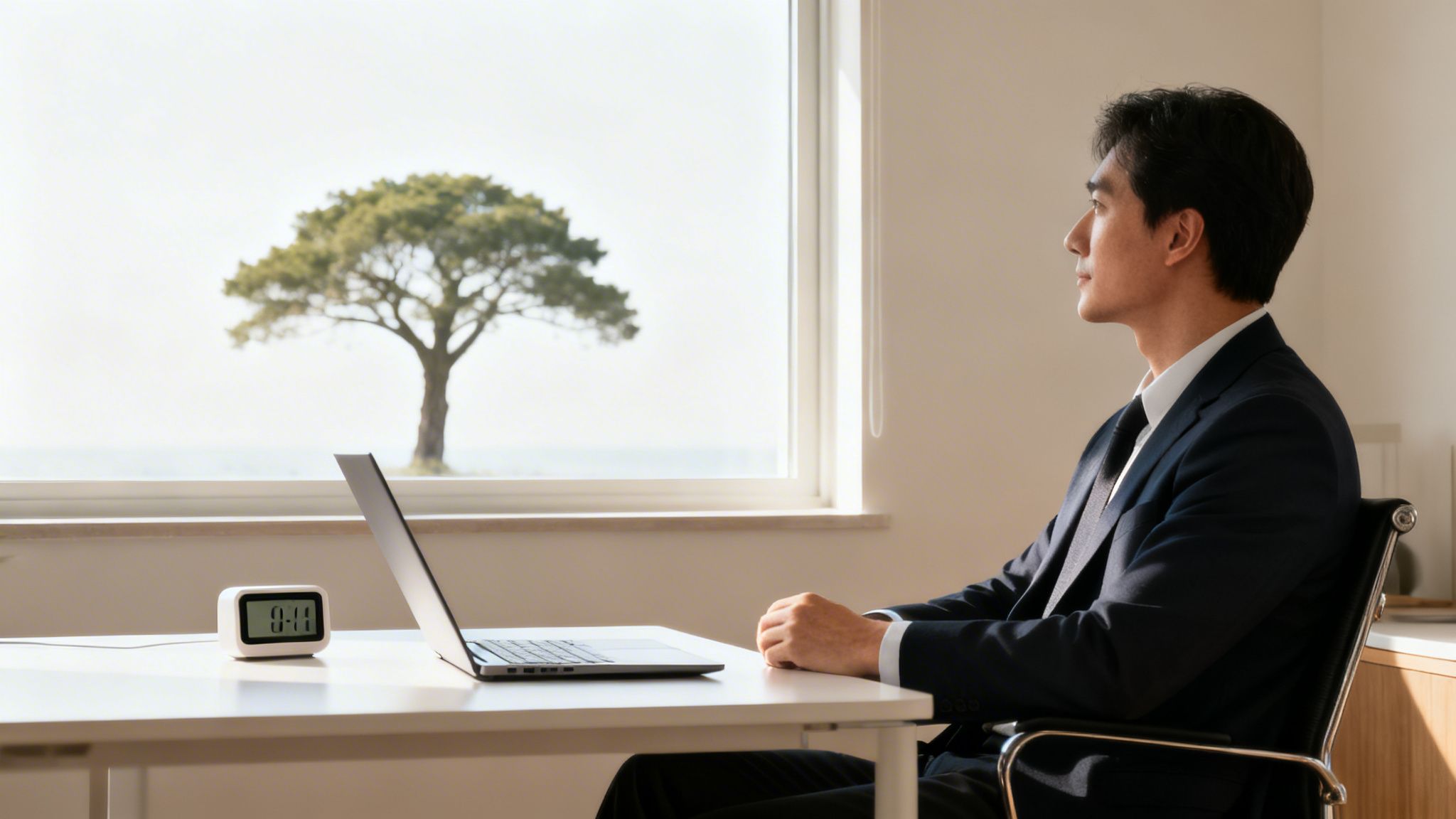
    A man in a suit sits at a desk, gazing out a window at a leafy tree view during a quiet break to reduce digital eye strain.

    Alt text: A man taking a break from his screen shows how to reduce digital eye strain.

    Of course, knowing the rule isn’t the hard part. The real challenge is remembering to do it. When you’re deep in a state of flow, your prefrontal cortex prioritizes the task at hand, ignoring subtle bodily cues of fatigue. The key is to build a system that reminds you, so your brain doesn’t have to.

    Making the 20-20-20 Rule Stick

    Turning this rule into an automatic habit is all about creating a simple, repeatable system. Instead of relying on sheer willpower, you can use a few tools to automate the process.

    • Set Timed Intervals: A simple pomodoro timer is perfect for this. It breaks your work into focused 25-minute sprints. The built-in 5-minute break is a non-negotiable cue to look away from your screen.
    • Use Visual Cues: A silent visual timer for desk can work wonders if you find alarms jarring. Watching a colored disc slowly disappear gives you a low-distraction heads-up that a break is coming. This lets you wrap up a thought without being interrupted.
    • Plan Your Gaze: Decide on your “20-foot spot” ahead of time. It could be a tree outside your window, a picture on a distant wall, or the end of a long hallway. Having a pre-selected target makes the break feel effortless.

    Mini Scenario: Mark, a programmer, was getting slammed with afternoon headaches that tanked his productivity. He started using a visual timer. He set it for 20 minutes and, when it went off, he stood up and looked at a poster on the far wall of his office for 20 seconds. Within a week, the headaches were gone. That small behavioral shift was all it took to make his workday more comfortable and focused.

    Building this routine does more than just relieve your eyes. It helps you practice mindful disengagement from your screen, a core principle we explore in the book Digital Clarity. When you pair this habit with other strategies, you build a powerful defense against digital fatigue. You can explore more practical ways to reduce screen time in our detailed guide.

    Creating an Eye-Friendly Workspace to Reduce Strain

    Your physical environment plays a massive role in how your eyes feel. Setting up a workspace that actually supports your body—instead of forcing it to fight against you—is a foundational step in reducing digital eye strain. This isn’t about fancy gadgets; it’s about thoughtful, intentional design.

    The goal is to arrange your desk so your body can maintain a neutral, relaxed posture. When you’re hunched over a laptop, you’re not just straining your back. You’re also forcing your eyes to work much harder to maintain focus. This posture sends stress signals to your brain, which can affect your mood and concentration.

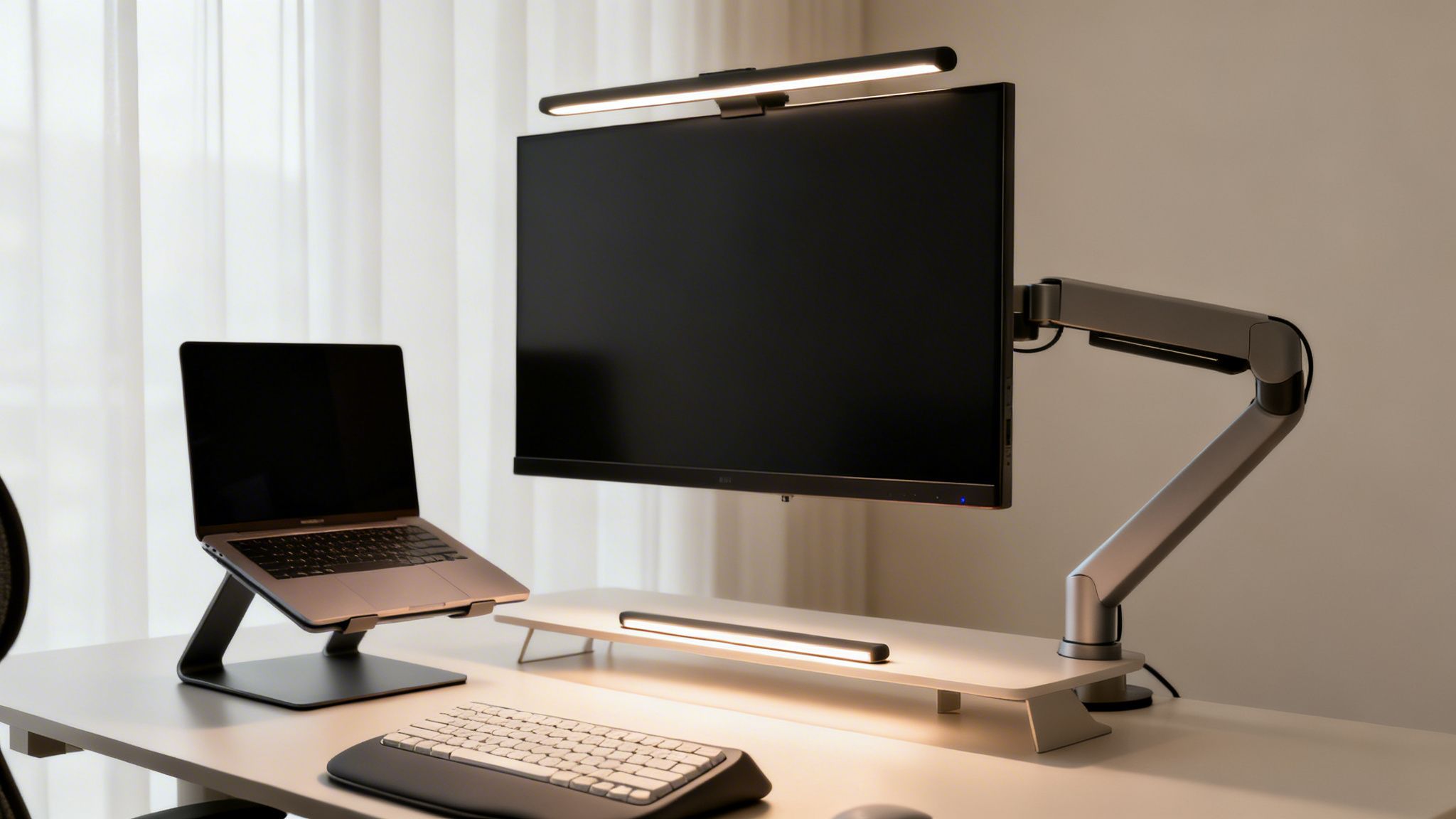
    Modern minimalist home office with laptop, monitor, keyboard, and desk accessories set up to reduce digital eye strain.

    Alt text: An ergonomic desk setup shows how to reduce digital eye strain.

    Optimizing Your Screen and Lighting for Better Eye Health

    Two of the biggest culprits behind eye strain are poor screen placement and harsh lighting. A few simple adjustments here can provide immediate relief.

    Your monitor should be about an arm’s length away from you. The top of the screen should be positioned at or just slightly below your eye level. This setup allows your eyes to gaze slightly downward, which is a far more natural and relaxed position.

    If you’re working on a laptop, a simple laptop stand for desk is non-negotiable. It gets your screen to the right height. You can pair it with an ergonomic keyboard and an ergonomic mouse to keep your wrists comfortable, too.

    Lighting is just as critical. Try to avoid having a bright window directly behind your screen, as the intense contrast creates glare. Instead, position your desk so that the primary light source comes from the side. A quality monitor light bar is a great tool for illuminating your desk without shining light onto your screen or into your eyes.

    Mini Scenario: Maria, a freelance writer, spent months dealing with daily headaches and neck pain. Her setup was a classic recipe for strain: a laptop flat on a desk with a bright window creating glare from behind. By adding a laptop stand, an external keyboard, and a monitor light bar, she transformed her space. The headaches subsided, and her ability to focus improved dramatically. These ergonomic tweaks reduced the physical stress signals her body was sending to her brain, allowing for better concentration.

    For those with presbyopia (age-related farsightedness), ensuring your eyewear is suited for intermediate computer distances can also drastically reduce strain. It’s worth exploring specialized occupational progressive lenses if that sounds like you. A properly organized workspace is a key theme in my book, Focus Recharged.

    Don’t Forget to Blink: Hydration is Your First Line of Defense

    If your eyes feel dry, gritty, and irritated after a few hours on the computer, you’re not alone. The reason is surprisingly simple: when we stare at screens, our natural blink rate plummets—often by more than half.

    It’s a subtle behavioral shift, but it has a huge impact on how your eyes feel.

    Blinking is your body’s built-in lubrication system. Every time you blink, you spread a fresh, protective layer of tears across your eye’s surface. This simple action cleans out debris and locks in moisture. But when you’re deep in concentration, that automatic process slows down, leaving your eyes exposed and prone to dryness.

    Under normal conditions, most people blink 15-20 times per minute. Staring at a screen can drop that number to as low as 5-7 times per minute. This one change is a massive contributor to dry eye. The good news? You can fight back with conscious blink training and artificial tears. This finding is backed by research like these findings on digital eye strain from CooperVision.

    Simple Habits for Better Eye Hydration

    Fortunately, you can manually override your screen-induced “blink amnesia” with a few intentional habits. This is a classic example of using conscious effort to build a new neural pathway until the behavior becomes automatic.

    Mini Scenario: David, a student cramming for exams, struggled with eye irritation. His simple solution was to put a small sticky note on his monitor that just said, “BLINK!” That tiny visual cue was enough to remind him to do full, deliberate blinks periodically. Within a day, that gritty, tired feeling was significantly better during his long study sessions.

    Here are a few actionable strategies you can try right away:

    • Practice Conscious Blinking. Every 20 minutes or so, make a point to close your eyes slowly and completely. Hold for a beat, then open them again. This ensures a full spread of your tear film.
    • Use Artificial Tears. Keep a bottle of over-the-counter lubricating eye drops at your desk. A few drops can provide immediate relief when you feel that telltale dryness or irritation.
    • Add a Humidifier. Dry indoor air from air conditioning or central heating only makes eye dryness worse. A small desk humidifier can add much-needed moisture to your immediate environment.

    For those who burn the midnight oil, some people find that wearing blue light blocking glasses in the evening helps their eyes feel more relaxed. This can also help regulate your brain’s production of melatonin, the sleep hormone. For more on this, my book Restful Nights explores sleep hygiene in detail. You can also find more strategies in our guide with digital detox tips.

    Editor’s Take: What Really Works for Eye Strain

    Let’s be honest for a minute. You can buy all the special glasses and fancy screen filters in the world. But if you really want to reduce digital eye strain, the biggest wins come from changing your habits.

    The things that truly move the needle are the simple, consistent actions. This includes the 20-20-20 rule, remembering to actually blink, and setting up your workspace so your body isn’t fighting you. These are the heavy lifters. This advice is essential for anyone spending more than a few hours a day at a screen—professionals, students, and remote workers alike.

    These habits only work if you do them every single day. Using a habit tracker journal can make a huge difference in staying consistent. This is a practical way to apply the principles of behavioral change to improve your daily well-being. Ultimately, the most powerful strategy is building a foundation of healthy screen routines that become second nature. My book, Digital Clarity, is a much deeper dive into creating these kinds of sustainable systems for long-term focus and well-being.

    Key Takeaways for Reducing Digital Eye Strain

    When it comes to reducing digital eye strain, forget about hunting for a single magic bullet. The real relief comes from building small, consistent habits that add up over time. These repeated actions have a much bigger impact on your daily comfort than any one-off fix.

    The most effective strategies are less about willpower and more about creating smarter systems for your environment and your behavior. This means taking the time to set up your workspace for better ergonomics. It also means making regular breaks a non-negotiable part of your day and paying attention to your body’s simple needs—like remembering to blink.

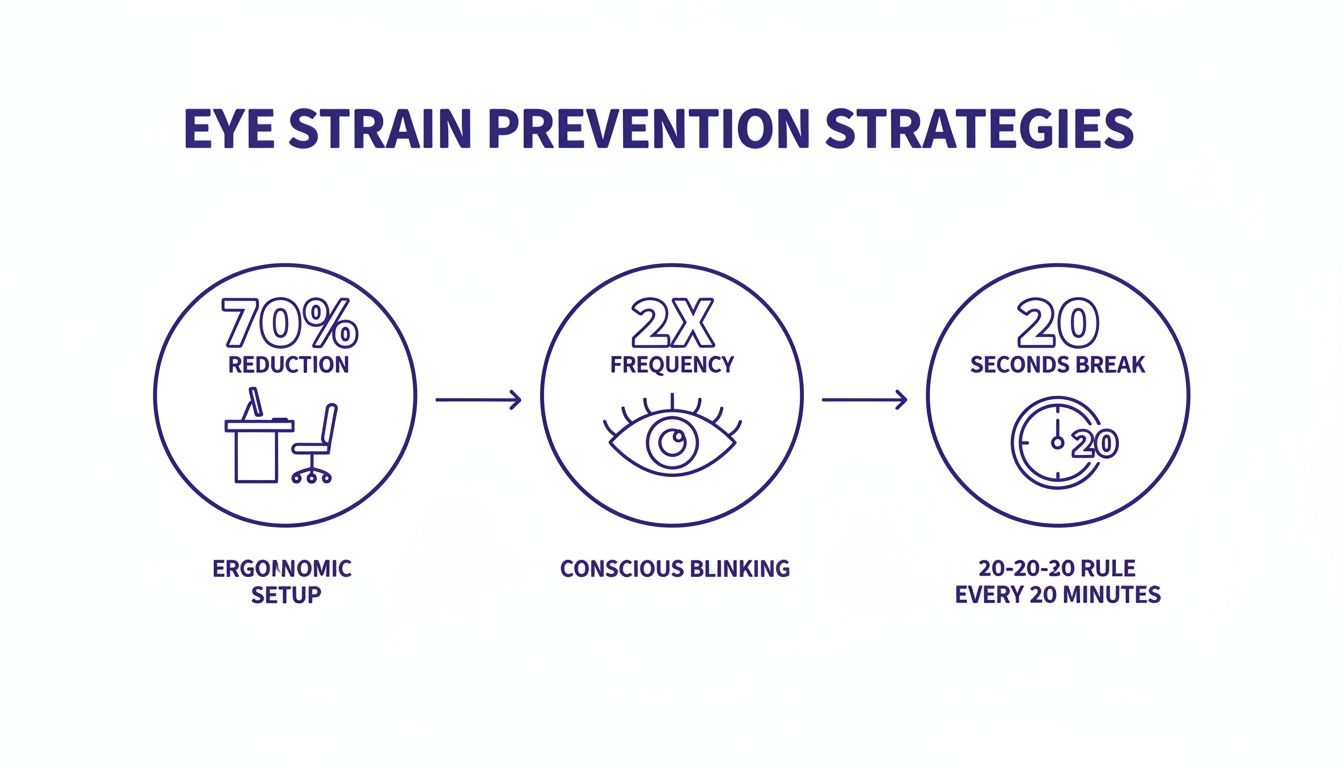
    This visual guide breaks down the core, evidence-based strategies that provide the most relief.

    Infographic displaying three eye strain prevention strategies: ergonomic setup, conscious blinking, and the 20-20-20 rule.

    Alt text: Infographic showing three strategies on how to reduce digital eye strain.

    As you can see, the foundational pillars are straightforward: a proper ergonomic setup, conscious blinking, and the 20-20-20 rule. Weaving these simple habits into your daily routine is the most reliable way to prevent eye strain and keep your focus sharp. For a deeper dive into building these kinds of lasting habits, check out The Power of Clarity.

    Your Digital Eye Strain Questions, Answered

    When you spend your days staring at screens, a lot of questions pop up. It’s only natural to wonder what actually works and what’s just marketing noise. Here are some of the most common questions I hear, with straightforward answers to help you find real relief.

    1. Do Blue Light Blocking Glasses Actually Work?

    This is the big one, and the honest answer is: it’s complicated. Blue light blocking glasses get a lot of hype, but the science is still catching up. The American Academy of Ophthalmology points out there’s no current scientific evidence showing that blue light from our devices actually damages our eyes.

    That said, many people find they make a real difference. They can cut down on glare and boost contrast, which makes the screen feel less harsh. Plus, blue light’s effect on our circadian rhythm—our internal body clock—is well-documented. Wearing them in the evening can genuinely help your brain wind down for sleep. This is a huge part of recovering from the day’s stressors.

    2. Can Digital Eye Strain Cause Permanent Damage?

    For the vast majority of people, the answer is no. The discomfort from digital eye strain—the headaches, dry eyes, and temporary blurriness—is usually temporary. Once you give your eyes a rest or adjust your habits, the symptoms tend to fade.

    It is important to remember, though, that constant, unaddressed strain can sometimes make underlying eye conditions worse. If your symptoms are severe or just won’t go away, it’s a clear signal to book a comprehensive exam with an eye care professional.

    3. What Is the Best Screen Brightness for Your Eyes?

    There’s no magic number here. The golden rule is to match the ambient light in your room. Think of it this way: if your screen is way brighter than your surroundings, it’s like staring into a lamp. It creates glare and makes your pupils work overtime. If it’s too dim, you end up squinting. A quick reality check: open a blank white document. Does it look like a light source? It’s too bright. Does it look dull and gray? It’s too dark. Tweak the setting until it blends in comfortably.

    4. Does Diet Affect Eye Health and Strain?

    Absolutely. While a salad won’t instantly cure a screen-induced headache, what you eat plays a massive role in your long-term eye health. Key nutrients are your best friends here: omega-3 fatty acids, lutein, zinc, and vitamins C and E are all crucial for vision. Omega-3s, found in fish like salmon, are fantastic for combating dry eye. And don’t forget hydration. Staying hydrated with plenty of water is one of the easiest ways to help prevent your eyes from feeling dry. Some people also report that a magnesium glycinate supplement helps with tension-related headaches. As with any supplement, it’s always best to chat with your doctor first.

    5. Are Some Screens Better Than Others for Preventing Eye Strain?

    Yes, screen technology has come a long way. Newer monitors often have features designed to be easier on the eyes. Screens with higher refresh rates (measured in Hz) create smoother motion, which is far less jarring. You’ll also find that matte or anti-glare finishes are a game-changer compared to glossy screens. They dramatically reduce distracting reflections. Many modern monitors even come with built-in “eye comfort” modes that shift colors to a warmer, less intense spectrum.

    How to Reduce Digital Eye Strain

    6. What is the most effective strategy to reduce digital eye strain?

    The most effective strategy isn’t a single magic bullet. It’s about building a system of good habits that support your eyes all day long. It starts with your environment. Get your workspace set up ergonomically—a laptop stand for desk to get the screen to eye level is non-negotiable. Then, get disciplined about taking breaks. The 20-20-20 rule is a great starting point, and using a pomodoro timer can automate the process so you don’t have to think about it. Finally, focus on the fundamentals: make a conscious effort to blink more often and stay hydrated.

    7. Can Children Get Digital Eye Strain?

    Yes, and they might even be more vulnerable. A child’s visual system is still developing. They can get so absorbed in a game or video that they completely forget to blink or take breaks. One of the best antidotes is good old-fashioned outdoor play. Getting outside forces their eyes to focus on things at different distances. It’s also wise to set clear limits on recreational screen time and teach them the same healthy habits you’re learning.

    8. How Often Should I See an Eye Doctor?

    Everyone should have a regular comprehensive eye exam, typically every one to two years. However, if you’re dealing with persistent digital eye strain symptoms—like chronic headaches, frequent blurred vision, or dryness that won’t quit—don’t wait. Schedule an appointment. An eye doctor can spot underlying issues that could be turning minor screen fatigue into a major problem.

    9. Does “Dark Mode” Help Reduce Eye Strain?

    Dark mode can be a huge help for some people, especially when working in a dimly lit room. It cuts down on the overall brightness and glare emitting from the screen. But it’s not for everyone. For some people, especially those with astigmatism, the bright letters on a black background can create a “halation” effect, making the text look fuzzy. The only way to know is to try it out and see what feels best for your eyes.

    10. Is It Better to Work on a Larger Monitor or a Laptop Screen?

    A larger, external monitor is almost always the better choice. It’s not just about size; it’s about control. A bigger screen lets you increase the font size comfortably, which means less squinting. More importantly, it allows for proper ergonomic positioning. You can set it at a healthy arm’s length distance and adjust the height so the top of the screen is at or just below eye level. This simple change can save you from a world of not just eye strain, but neck and shoulder pain, too.


    Disclaimer: This article may contain affiliate links, meaning we may earn a small commission on purchases made through them at no extra cost to you. The content provided is for educational and informational purposes only and does not constitute medical or psychological advice. Please consult a qualified professional for any health concerns.

    At Mind Clarity Hub, we believe in providing practical, science-backed guidance to help you thrive. For a deeper exploration of building sustainable habits for focus and well-being, explore our full library of books, starting with the foundational principles in The Power of Clarity.