


Published:
A dopamine detox is a popular name for a simple idea: taking a deliberate break from things that give you an instant, high-stimulation buzz. Think of it as a reset button for your brain’s reward system, not a way to get rid of dopamine altogether. Dopamine is a vital neurotransmitter you need for motivation, learning, and everyday function.
From a neuroscience perspective, the real goal is to lower your tolerance for constant stimulation. This helps you find more joy and focus in quieter, less intense activities again. The practice is about managing compulsive behaviors, not self-deprivation.
***Affiliate Disclosure:** This post may contain affiliate links. If you make a purchase, we may earn a small commission at no extra cost to you.*
What Is a Dopamine Detox in Simple Terms?
Let’s cut right through the hype. A “dopamine detox” isn’t about literally flushing a chemical out of your brain. Instead, think of it as a strategic reset for your brain’s delicate reward wiring.
Imagine eating nothing but intensely sugary foods for weeks. An apple would suddenly taste bland and boring, right? Your brain’s reward pathways work in a similar way. When they are constantly flooded with pings from social media, endless video game levels, and breaking news alerts, that overstimulation makes quiet, everyday life feel dull. This practice is about intentionally stepping away from those high-dopamine triggers. You give your mental palate a chance to recover its natural sensitivity. Consequently, you can find more engagement in simpler, more meaningful things.
The Real Goal Behind the Buzzword
The term was popularized by Dr. Cameron Sepah, a California psychologist who based the practice on principles of cognitive behavioral therapy (CBT). It’s less about self-deprivation and more about managing impulsive, compulsive behaviors. Behavioral research shows that this approach can help regulate our responses to environmental triggers.
With an estimated 4.9 billion social media users worldwide in 2023, this idea offers a practical shield against digital burnout. I explore how to manage these inputs in more detail in my book, Digital Clarity.
By temporarily removing “junk food” stimuli, you give your brain a chance to recalibrate. A 2023 review, for example, found that people in a dopamine fasting program showed 25% lower anxiety scores after just a 48-hour break. You can read more about these findings on Medical News Today.
The core idea is simple: by abstaining from hyper-stimulating activities, you regain control over your attention and find more satisfaction in less intense, more natural rewards.
Taking a break isn’t about punishment. It’s about empowerment. It’s a conscious choice to stop letting algorithms dictate your mood and focus. For more in-depth strategies, you can explore our complete series on managing dopamine for better focus.
High-Dopamine Triggers vs. Mindful Alternatives
To make this practical, let’s look at a few common habits. The key is swapping high-stimulation activities for more mindful ones. Sometimes a physical barrier helps, like using a phone lock box timer to put space between you and your biggest distraction. Here’s a quick comparison of those compulsive behaviors versus healthier activities that build a more sustained sense of focus and contentment.
High-Dopamine Triggers vs. Mindful Alternatives
| High-Dopamine Habit (Instant Reward) | Mindful Alternative (Sustained Reward) |
|---|---|
| Endlessly scrolling social media feeds | Reading a chapter of a book |
| Binge-watching a TV series for hours | Going for a 30-minute walk outside |
| Playing fast-paced video games | Working on a creative hobby (drawing, writing) |
| Checking notifications every few minutes | Practicing 10 minutes of mindfulness or meditation |
| Consuming sugary snacks or drinks | Preparing a healthy, home-cooked meal |
| Compulsive online shopping | Journaling your thoughts in a productivity journal |
This table gets to the heart of what is a dopamine detox. It’s all about replacing low-value, high-stimulation habits with activities that provide a more lasting sense of fulfillment. In the end, you’re not just taking something away; you’re adding something much better in its place.
The Real Science Behind Dopamine and Your Brain
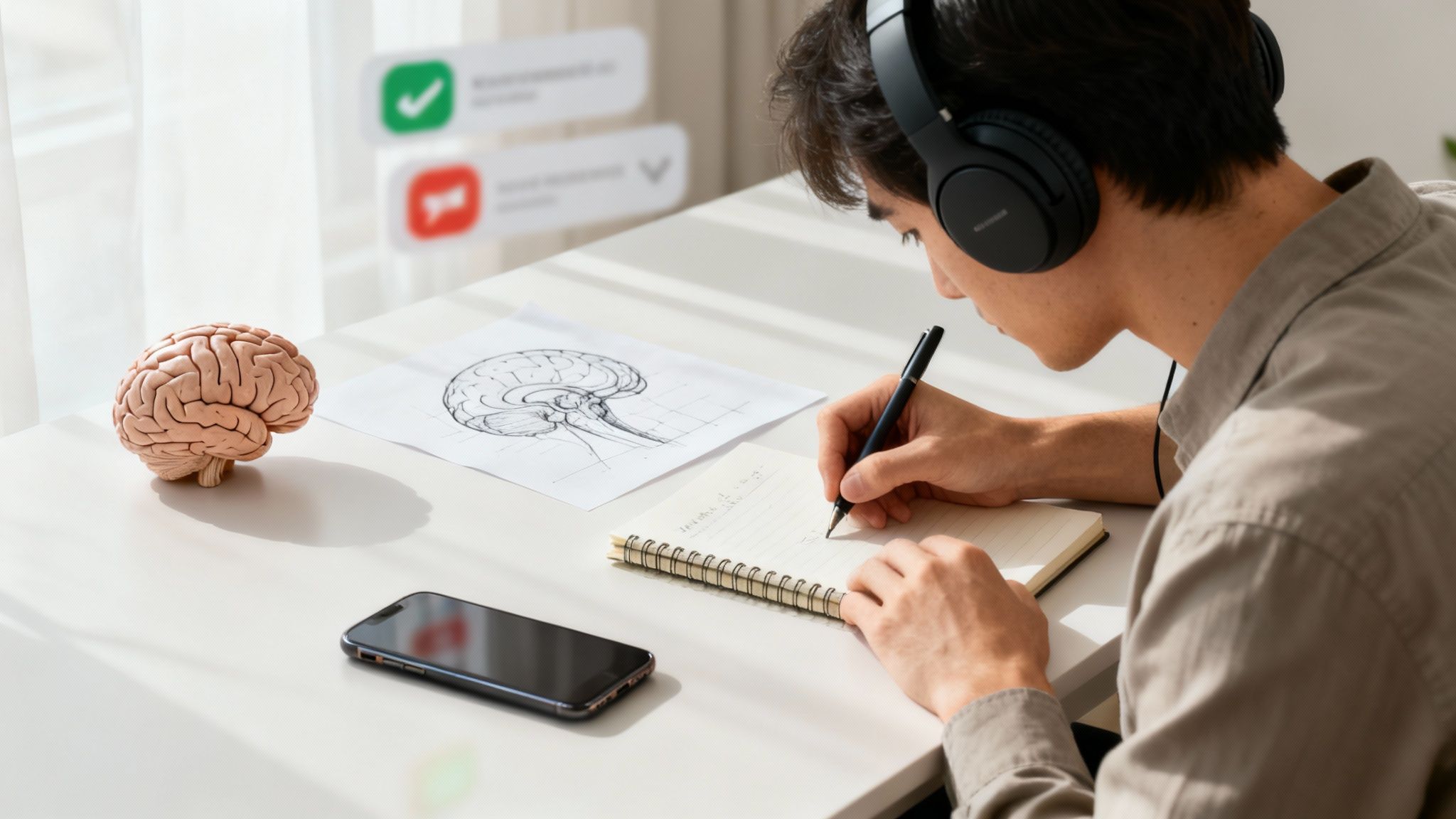
To really get what a “dopamine detox” is about, we need to look at how your brain actually works, without confusing jargon. The first thing to get straight is that dopamine isn’t just a “pleasure chemical.” Neuroscience shows it’s much more about motivation, craving, and anticipation.
Think of dopamine as the neurotransmitter that says, “Hey, pay attention! This could be important.” It’s the chemical that drives you to seek out rewards. In our evolutionary past, this system was absolutely crucial for survival. It pushed us to find food, water, and connection. The trouble is, modern technology has gotten incredibly good at exploiting this ancient brain wiring.
How Technology Hijacks Your Brain’s Motivation System
Many of the apps and platforms we use every day are designed like slot machines for your brain. They’re built around unpredictable rewards—a like, a new comment, a surprising video. These rewards keep your dopamine system on high alert, constantly anticipating the next little hit.
This constant stream of tiny, unpredictable rewards trains your brain to crave more. It’s why you might feel an almost irresistible pull to check your phone for no reason at all. It’s not a moral failure or a lack of willpower; it’s your brain’s motivation circuit being expertly hijacked.
Behavioral psychologists call this a compulsion loop. The anticipation of a potential reward (like a notification) triggers a dopamine release, which drives the action (checking your phone). This creates a powerful, often subconscious, habit loop.
Sometimes, the simplest way to counteract this is to create an environment that gives your brain a fighting chance. Tools as simple as a pair of high-quality noise canceling headphones can physically block out distractions, helping you reclaim your focus.
Real-World Example: The Tug-of-War in Your Brain
Let’s picture Alex, a professional trying to finish an important report. They sit down at their desk, open the document, and commit to focusing. But their phone is right there, screen up.
- The Trigger: A notification flashes on the screen.
- The Brain’s Response: Alex’s brain releases a small spike of dopamine in anticipation of a potential reward. Is it a message from a friend? An important email? A social media comment? The mystery is the point.
- The Tug-of-War: The logical part of Alex’s brain (the prefrontal cortex) knows the report is the priority. However, the more primitive, dopamine-driven part is now highly motivated to find out what that notification is.
- The Action: That dopamine-driven urge often wins. Alex picks up the phone, derailing their focus and making it much harder to get back to the report. You can learn more about the link between dopamine and motivation in our detailed guide.
This cycle repeats itself dozens of times a day, draining your mental energy. A dopamine detox aims to break this very cycle by intentionally removing these triggers. The goal isn’t to get rid of dopamine. It’s to let your brain’s reward pathways “cool down,” reducing the constant pull of digital distractions. As a result, you can regain control over what truly motivates you.
Disclaimer: This article is for educational purposes only. It is not a substitute for professional medical or psychological advice, diagnosis, or treatment. If you are struggling with conditions like ADHD, anxiety, depression, burnout, or sleep problems, please consult a qualified healthcare provider.
Debunking Myths About Dopamine Fasting
The term “dopamine detox” is catchy, but it’s also a magnet for confusion. Let’s clear the air and separate the science-backed principles from the internet fiction. Getting this right is the key to making it work.
One of the biggest myths is that a real dopamine detox means locking yourself in a dark room and doing absolutely nothing. This extreme, unsustainable idea misses the entire point. A proper detox is about strategically pausing specific, problematic behaviors—not shutting down every form of stimulation.
It’s Not a Cure for Clinical Conditions
Another dangerous myth is that a dopamine detox can fix clinical conditions like depression, anxiety, or ADHD. While dialing back digital overload can absolutely improve your mood and focus, it is not a treatment or cure for diagnosed mental health conditions.
These conditions involve complex neurochemical and psychological factors that require professional care. Think of a detox as a supportive practice for your overall well-being. However, never let it replace guidance from a doctor or therapist. For a deeper look, our article on whether a dopamine detox is real or just a myth adds more context.
A dopamine detox is a behavioral tool, not a medical intervention. The goal is to reset your relationship with high-stimulation habits, not to treat underlying psychological disorders.
Balance Over Extreme Deprivation
A sustainable approach is always about balance, not extreme deprivation. It’s about consciously disengaging from your personal, high-stimulation time-wasters. As I talk about in my book Burnout Breakthrough, recovering from chronic stress is about creating sustainable systems. It is not about short-term, extreme fasts that just slingshot you back to old habits.
Think of it this way: instead of disappearing for a whole weekend, you might start by using a phone lock box timer for a few hours each evening. This simple move carves out protected time. It lets you replace mindless scrolling with something that actually fills you up.
Here’s a real-world mini-scenario:
- The Myth-Based Approach: Sarah feels overwhelmed and decides to try a dopamine detox. She spends her entire Saturday in her room with the lights off, trying not to think. She ends up feeling bored, anxious, and quickly gives up. She concludes the whole thing is impossible.
- The Practical Approach: Mark feels the same burnout but takes a different path. He knows his biggest time-sink is scrolling social media after work. So, he decides to put his phone in a drawer from 7 PM to 9 PM every night. In that window, he reads a book from his Reclaiming Silence reading list, works on a puzzle, or just talks with his family.
Mark’s method is targeted, manageable, and replaces a compulsive habit with a rewarding one. This is the true spirit of a dopamine detox—it’s not about eliminating joy, but about rediscovering it in healthier, more sustainable places.
How To Start a Practical Dopamine Detox
So, you’re ready to give this a try? Fantastic. The key is to sidestep the extreme, all-or-nothing approaches you see online. Success isn’t about total sensory deprivation. It’s about taking strategic, intentional breaks from the specific habits that leave you feeling drained and unfocused.
The single most important step is to plan ahead. Simply removing a habit without deciding what to put in its place is a recipe for boredom. Think about it: what will you do with that newfound time? Scheduling both your “offline” periods and the activities that will fill them makes the whole process feel structured and purposeful, not like a punishment.
Not sure if this is the right move for you right now? This quick decision tree can help clarify things.
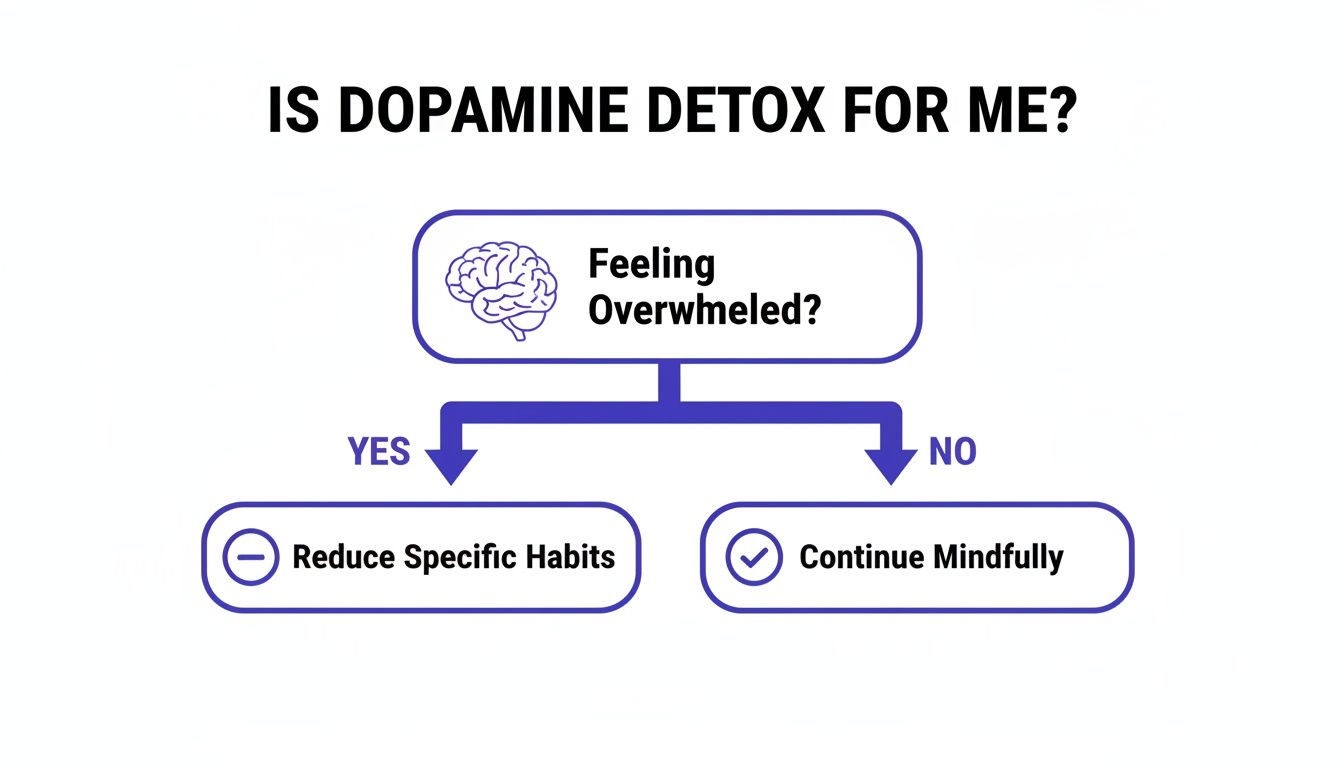
The flowchart gets at a simple but powerful idea. A dopamine detox is most useful as a targeted tool to reduce specific habits when you’re feeling overwhelmed by them.
Three Scalable Dopamine Detox Plans
To make this practical, I’ve broken down the process into three scalable levels. Forget the one-size-fits-all model. The goal is to find a rhythm that works with your life, not against it. Pick the plan that feels like a gentle stretch, not a painful split.
Choose a plan that fits your lifestyle. This table outlines three different levels of a dopamine detox. These range from a gentle start to a more immersive experience.
| Detox Level | Duration | Key Restrictions | Recommended Activities |
|---|---|---|---|
| The Beginner’s Reset | 1–3 hours daily | No social media, news feeds, or video games. | Read a physical book, walk without your phone, listen to an album, cook a new recipe. |
| The Intermediate Challenge | A half-day (4–6 hours) once a week | No non-essential screens (TV, streaming), no online shopping, no work email (barring emergencies). | Work on a creative project, visit a museum, spend quality time with family, organize a room. |
| The Advanced Deep Dive | A full 24 hours, once per month or quarter | No internet, smartphone, or non-essential computer use. No television. | Journaling, engaging in a favorite hobby, spending a day in nature, completing a DIY project. |
Remember, these are templates, not rigid rules. The real power comes from adapting them to your own triggers and goals. Let’s dig into what each level looks like in the real world.
The Beginner’s Reset
This is the perfect entry point. It’s all about creating a small, manageable pocket of disconnected time each day. It won’t turn your life upside down.
A student, for example, might commit to putting their phone in another room for two hours every evening while they study. This small act removes the constant temptation to check notifications, allowing for deeper focus. Using a simple pomodoro timer on their desk can help structure these focused blocks of time.
The Intermediate Challenge
Once you’re comfortable with the daily reset, this level helps you reclaim larger chunks of time. This is where you really start to notice a shift in your mental clarity.
Think of a freelancer who declares Saturday mornings a “screen-free zone.” Instead of instinctively checking client emails, they spend that time hiking or working on a personal passion project. They are not just avoiding screens; they are redirecting that energy toward something restorative. An ergonomic keyboard could make their passion project of writing a novel even more comfortable.
The Advanced Deep Dive
This is a more immersive experience designed for a significant mental reset. It takes a bit more planning but can offer profound benefits. It creates a full day of disconnection from digital noise.
An entrepreneur might schedule a 24-hour unplug once a month. They let their team know, set an auto-responder, and spend the day completely offline. They might spend their time reading, thinking, and planning without a single digital interruption.
As you get the hang of this, you’ll find it complements other mental wellness practices. For instance, exploring practical strategies for reducing anxiety without medication can teach you self-regulation skills. These skills make managing your attention feel more natural.
For a complete walkthrough on integrating these ideas without having to quit technology entirely, check out our full guide on how to reset your dopamine for focus and clarity.
Editor’s Take: What Actually Works and Who It’s For
Let’s be honest: “dopamine detox” is a brilliant name, but it’s not scientifically precise. You can’t actually “detox” from a neurotransmitter your brain needs to function. What people are really talking about is stimulus control. This is a proven technique from cognitive behavioral therapy. It’s all about managing your environment and your reactions to it.
What truly works has nothing to do with extreme self-denial. Instead, it’s about creating intentional breaks from your specific compulsive behaviors. This could be endlessly scrolling Instagram, binge-watching Netflix, or compulsively refreshing news alerts.
Who Is This Really For and What Are the Limits?
This kind of reset is most powerful for people feeling digitally overwhelmed and finding less joy in everyday life. It’s for those whose brains have simply gotten used to a constant firehose of high-intensity stimulation.
However, it is not a cure for clinical burnout, anxiety, or ADHD. If you are wrestling with those, please seek professional guidance. This is a behavioral tweak, not a medical treatment.
The real magic happens when you use that “detox” time to reconnect with meaningful offline activities. It’s about replacing a bad habit, not just leaving a void. Something as simple as a habit tracker journal can help you pinpoint what to replace and track the positive ripple effects on your focus and mood.
Ultimately, the most effective approach is a mindful, targeted reduction of your personal time-wasters. This allows your brain’s reward system to recalibrate, helping you regain control over your attention. For more guidance on creating a healthier relationship with your devices, explore these powerful digital detox tips. This small shift can help you rediscover the quiet satisfaction found in less intense, more fulfilling activities.
Key Takeaways: What Is a Dopamine Detox?
- Behavioral Reset, Not Chemical Flush: A dopamine detox is about taking a strategic break from high-stimulation habits to rest your brain’s reward pathways.
- Goal Is Re-Sensitizing: The purpose is to lower your tolerance for digital noise, helping you find more joy in simpler, everyday activities.
- You Can’t ‘Detox’ from Dopamine: Dopamine is an essential neurotransmitter for motivation. The practice focuses on managing behaviors, not eliminating the chemical.
- Start Small and Be Strategic: The best approach is to start with small, manageable breaks from one specific compulsive habit, like using a visual timer for desk to enforce a no-phone period.
- It’s Not a Medical Cure: While beneficial for focus and mood, it is not a treatment for clinical conditions like ADHD, anxiety, or depression. Always consult a healthcare professional for these concerns.
Final Thoughts: Reclaiming Your Focus
Let’s pull all this together. A dopamine detox is a powerful tool when understood correctly.
It’s a behavioral reset, not a chemical flush. The real goal is to re-sensitize your brain to the simple joys of life. By lowering your tolerance for constant digital noise, you can rediscover engagement in activities that may have started to feel flat or boring. Remember, you can’t actually “detox” from the essential neurotransmitter dopamine. You are simply managing the behaviors that overstimulate its pathways.
The smartest way to approach this is with small, manageable breaks. Don’t try to go monk-mode overnight. Just focus on swapping one compulsive habit, like mindless scrolling, for something more fulfilling. This could be reading a chapter of a real book like The Power of Clarity or taking a walk outside.
Ultimately, this isn’t about punishing yourself; it’s about reclaiming your attention. By intentionally managing how you engage with stimulating activities, you’re taking a powerful step toward avoiding the productivity trap that leaves so many of us feeling scattered and overwhelmed.
Disclaimer: This content is for educational purposes and is not a substitute for professional medical or psychological advice. This post may contain affiliate links; we may earn a small commission from purchases at no extra cost to you.
Frequently Asked Questions About the Dopamine Detox
Jumping into a practice like a dopamine detox always brings up questions. To help you get started with confidence, here are answers to the most common things people ask.
1. How long does a dopamine detox take to work?
There’s no magic number here—it really depends on your starting habits. That said, most people report feeling a real shift in mental clarity and fewer cravings after just three to seven days of consistently cutting back. Deeper changes, like a genuine appreciation for simpler things, usually start showing up after two to four weeks. Consistency is more important than a single perfect day.
2. What should I do when I feel bored or restless?
Feeling bored is a huge sign that the process is actually working. Your brain is recalibrating to a lower baseline of stimulation. Instead of fighting boredom, reframe it as an open space for your mind to wander. When restlessness hits, have a list of simple, offline things to do. You could go for a walk, tidy up a small area, or scribble down your thoughts in a productivity journal.
3. Can I listen to music or exercise during a detox?
Yes, for almost everyone, exercise is highly encouraged. It’s a fantastic, natural way to lift your mood. Swapping screen time for a walk on an under desk walking pad is a perfect example. Music is more nuanced. If you use it as quiet background sound, it’s probably fine. But if you find yourself compulsively using high-energy music to chase a “rush,” you might want to try taking a short break.
4. Is a dopamine detox the same as a digital detox?
They’re closely related but not exactly the same. A digital detox is laser-focused on taking a break from screens. A dopamine detox is broader. It’s about reducing any compulsive behavior that gives you a quick, intense reward. This includes tech but could also mean things like overeating sugary foods. Think of it this way: all digital detoxes are a form of dopamine detox, but not all dopamine detoxes are strictly digital.
5. How often should I do a dopamine detox?
The right frequency is whatever works for your life. There are no rigid rules. Here are a few sustainable models:
- Daily: Carve out a 1-2 hour break from your biggest distractions every evening.
- Weekly: Plan a half-day “unplug” every weekend.
- Monthly or Quarterly: Schedule a full 24-hour deep dive to completely reset.
A time blocking planner can be a great tool for scheduling these periods in advance.
What is a dopamine detox and how do I start?
The easiest way is to start incredibly small. Don’t try to go cold turkey for 24 hours on day one. Instead, pick one specific, high-dopamine behavior you want to reduce and a short, specific time to abstain from it. A great starting point is the “first and last hour” rule. Just commit to not looking at your phone for the first hour after you wake up and the last hour before you go to sleep. This one simple change can have a massive impact on your focus and sleep quality. Swapping your phone for a book like Reclaiming Silence can make this transition feel much smoother.
7. What if I fail or break the rules of my detox?
It’s not a failure; it’s just data. If you slip up, just notice what happened without judging yourself. What was the trigger? What were you feeling right before? This whole practice is about building self-awareness, not getting a perfect score. Just reset and try again. Forgive yourself and remember that every small effort to be more intentional is a win.
8. Will a dopamine detox help with burnout or sleep problems?
Cutting back on constant stimulation can definitely help lower the feelings of overwhelm that feed burnout. For sleep, reducing screen time, especially an hour before bed, can improve sleep quality. Blue light blocking glasses can also help. However—and this is critical—a dopamine detox is not a substitute for professional medical or psychological care. If you are struggling with severe burnout or sleep problems, please talk to a healthcare professional. For more on burnout recovery, you might find Burnout Interrupted to be a helpful resource.
9. Can I still be social during a dopamine detox?
Absolutely! In fact, real, in-person social connection is one of the best things you can do during a detox. It’s a healthy, natural source of fulfillment. The goal is to avoid compulsive digital behaviors, not all forms of pleasure. The key is the quality of the interaction. Mindlessly scrolling through a social media feed is an isolating activity. Having a focused, distraction-free conversation with a friend is deeply rewarding.
10. Does a dopamine detox permanently change your brain?
A short-term detox won’t permanently rewire your brain, but it can absolutely kickstart meaningful changes in your habits. With consistent practice, you help your brain become less dependent on intense, artificial stimuli. It becomes better at finding real satisfaction in everyday life. The long-term benefit comes from integrating the principles of stimulus control into your daily routine. By regularly choosing intentional activities over compulsive ones, you gradually strengthen the neural pathways tied to focus and self-regulation, a topic we explore in depth in The Power of Clarity.

At Mind Clarity Hub, we believe that reclaiming your focus is the first step toward living a more intentional and fulfilling life. Our books and resources are designed to give you the science-backed tools you need to thrive in a distracting world. Explore our full library of guides on focus, productivity, and digital wellness today.
