


Ever feel like your brain has too many tabs open? It slows down, stutters, and struggles with even the simplest tasks.
That feeling has a name: cognitive overload. It’s not a personal failure but a biological signal that your mental workspace—governed by the prefrontal cortex—has hit its capacity. Grounded in neuroscience, this phenomenon is a direct result of pushing your brain’s processing limits.
What Is Cognitive Overload?
Cognitive overload happens when the demands placed on your working memory—the brain’s temporary scratchpad for processing information—exceed its capacity. Your prefrontal cortex manages this delicate space, and psychological research shows it can only juggle a few pieces of information at once.
Affiliate Disclosure: This article may contain affiliate links. If you purchase through these links, we may earn a small commission at no extra cost to you. We only recommend products we trust.
Think of it like a computer’s RAM. Open too many demanding programs, and the whole system starts to lag, freeze, or even crash. Your brain isn’t much different.
This mental traffic jam isn’t just about “being busy.” It’s a specific neurological state explained by Cognitive Load Theory. When the total mental effort required of you becomes too much, performance plummets, stress skyrockets, and burnout becomes a real risk. To get ahead of it, we first need to understand where the strain is coming from.
The Three Types of Cognitive Load
The mental pressure you feel isn’t just one monolithic thing. Psychologists have broken it down into three distinct types. Knowing the difference helps you stop blaming yourself for not being “good enough” at focusing and start managing your mental energy with precision.
- Intrinsic Load: This is the baseline difficulty of the task itself. Learning to add two numbers has a low intrinsic load. Trying to understand quantum physics, on the other hand, has a very high one. It’s the core complexity you can’t really change.
- Real-World Example: A junior developer learning a new programming language for the first time faces a high intrinsic load because the concepts are inherently complex and new to them.
- Extraneous Load: This is all the useless mental clutter created by how information is presented. Think confusing instructions, a poorly designed website, or a constant barrage of notifications. It’s the junk mail of cognition—it serves no purpose but still drains your energy.
- Real-World Example: An employee trying to fill out a confusing expense report form with unclear fields and poor navigation is dealing with high extraneous load. The task itself isn’t hard, but the design makes it mentally taxing.
- Germane Load: This is the “good” kind of effort. It’s the deep processing your brain does to connect new ideas to what you already know, forming durable, long-term memories. This is where real learning and insight happen.
- Real-World Example: A strategist working on a complex problem takes time to sketch out a mind map, connecting new market data to past campaign results. This effort helps build a deeper, more nuanced understanding and is considered a valuable germane load.
This flowchart breaks down how these three forces interact to shape your mental state.
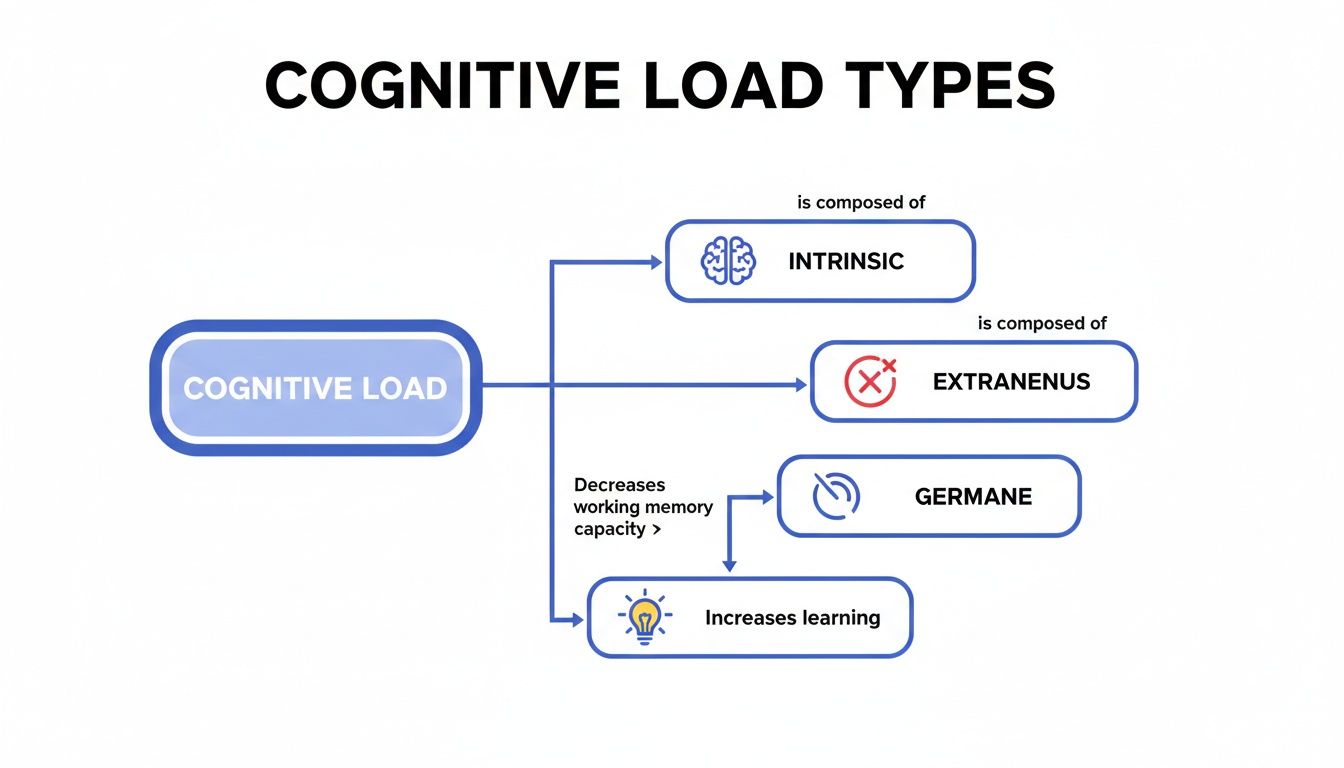
As you can see, the intrinsic load is mostly fixed, and the germane load is what we want more of. That leaves extraneous load as the prime target for reduction.
The goal is not to eliminate all mental effort, but to minimize the distracting, unproductive load so your brain has more resources for the deep thinking that actually matters. This is the foundation of mindful productivity.
How Extraneous Load Triggers Cognitive Overload and Drains Your Working Memory
When extraneous load runs high—fueled by endless emails, clunky software, or the myth of multitasking—it eats up your limited working memory. This leaves almost no room for the germane load required for creativity and problem-solving.
You end up feeling completely exhausted but with little to show for it. You can learn more about the mechanics behind this in our guide on the neurology of attention hijacking. Recognizing this dynamic is the first, most crucial step toward reclaiming your focus.
Cognitive Overload at a Glance: Signs vs. Causes
It’s easy to confuse the symptoms of cognitive overload with its root causes. The table below helps you quickly distinguish between what you’re feeling and what’s actually driving that feeling in your daily life.
| Common Signs (What You Feel) | Common Causes (Why You Feel It) |
|---|---|
| Difficulty making simple decisions (decision fatigue) | Constant multitasking and context switching between apps and tasks |
| Feeling mentally “foggy” or sluggish | Information overload from emails, news feeds, and social media |
| Increased irritability and stress | Frequent interruptions from notifications, alerts, and colleagues |
| Making more careless mistakes than usual | Poorly designed digital tools with confusing layouts (high extraneous load) |
| Forgetting things you just heard or read | Trying to learn complex new skills without breaking them down (high intrinsic load) |
| A persistent feeling of being overwhelmed and “behind” | A lack of clear priorities, leading to a sense of urgency for all tasks |
| Procrastinating on complex or important tasks | Sensory overload from a noisy or visually cluttered environment |
Understanding this distinction is powerful. It shifts your perspective from “What’s wrong with me?” to “What in my environment can I change?” This simple reframe is the key to moving from a state of chronic overload to one of intentional clarity.
The Hidden Costs of What Is Cognitive Overload
Sustained cognitive overload does more than just leave you feeling drained. It systematically chips away at your performance, your well-being, and even your confidence. When your brain is constantly running at redline, it doesn’t just get sluggish—it starts making critical mistakes. This isn’t a personal flaw; it’s the predictable outcome of pushing a biological system past its design limits.

The fallout ripples through every part of your professional life, creating a vicious cycle of stress and underperformance. But once you frame cognitive overload as a systemic issue—not an individual one—you can start finding real solutions in your environment and your routines.
The Decline in Productivity and Accuracy
One of the first and most obvious costs of mental fatigue is a steep drop in productivity. Research from companies like Neurable shows that cognitive and information overload can slash a knowledge worker’s effectiveness by as much as 40%. That’s a staggering hit, and it’s affecting millions of professionals.
This isn’t just about working slower. It’s about a fundamental breakdown in the quality of your work.
- Mini-Scenario: A project manager, swamped by endless Slack pings and back-to-back meetings, overlooks a critical project dependency. Their working memory is so full of notifications that there’s no space to process the project’s details deeply. Weeks later, everything grinds to a halt.
In every case, the person is more than capable. Their mental resources are just so depleted that mistakes become inevitable.
Impaired Decision-Making and Creativity
Beyond simple errors, cognitive overload directly harms higher-level thinking, especially your ability to make sound decisions. The prefrontal cortex, the part of your brain responsible for planning and judgment, gets completely overwhelmed.
When your mental bandwidth is tied up sorting through a firehose of information, you have very little left for careful, thoughtful choices. This leads to decision fatigue, where psychological studies show you find yourself picking the easiest option instead of the best one.
This state is the enemy of innovation. When you’re just trying to keep your head above water, there’s no mental space left for proactive problem-solving or creative breakthroughs.
Over time, this chronic strain can spiral into more serious conditions like burnout. It’s crucial to see how these daily pressures build up and learn how to recover from burnout before the damage becomes long-term. Recognizing these hidden costs isn’t about assigning blame. It’s about validating your own experience. That feeling of being overwhelmed isn’t just in your head—it has real, measurable effects on your work and your life.
The Causes of Cognitive Overload in the Modern Workplace
That persistent mental drain you feel isn’t just a sign of a busy day; it’s a direct response to specific triggers baked into the tools we rely on for work. Pinpointing these culprits is the first real step toward getting your energy back.
While the modern digital workspace offers incredible flexibility, it also creates the perfect storm for mental fatigue. Once you understand the root causes, you can shift from feeling like a victim of your schedule to being an architect of your own focus.
Let’s break down the main drivers behind this draining feeling.
The Myth of Multitasking and Constant Interruptions
Here’s the hard truth, backed by neuroscience: our brains don’t actually multitask. What we call multitasking is really just rapid context switching—jumping from one unrelated thing to another. And every single time you switch, your brain pays a mental tax, losing time and energy as it struggles to re-orient.
Context switching is a silent thief of productivity and a major cause of mental exhaustion. Understanding what is context switching and how to fix it is non-negotiable for anyone trying to protect their mental space. This constant toggling fragments your attention, making the deep, focused work required for high-quality output nearly impossible.
Neuroscience confirms that multitasking increases the production of the stress hormone cortisol as well as the fight-or-flight hormone adrenaline, which can overstimulate your brain and cause mental fog.
- Mini-Scenario: A remote worker is trying to write a detailed project proposal. In just 15 minutes, they get five Slack pings about a separate project, three urgent emails, and a calendar reminder for an upcoming meeting. Each interruption forces their brain to disengage, process new information, and then try to get back on track. The result? A half-finished, subpar proposal and a profound sense of burnout.
Hijacking Your Brain’s Reward System
Digital tools are masterfully engineered to grab and hold our attention. Every notification from email, social media, and messaging apps triggers a tiny release of dopamine, the neurotransmitter tied to pleasure and reward. Behavioral research shows this creates a powerful, habit-forming loop.
Your brain starts craving the novelty and satisfaction of clearing a notification, checking an email, or seeing a new message. Each “ping” yanks you away from meaningful work with the promise of a small, fleeting reward. This constant stimulation keeps your brain in a state of high alert, making it difficult to ever settle into deep work. Over time, this cycle is a huge contributor to that frazzled, drained feeling often called digital fatigue.
Poorly Designed Digital Environments
Finally, the very software we use can be a major source of cognitive strain. Cluttered interfaces, confusing navigation, and inconsistent design force your brain to work harder than it should just to perform basic tasks.
- Mini-Scenario: A new project management tool has a non-intuitive layout, forcing you to hunt for essential features. You waste mental energy figuring out the system (high extraneous load) instead of doing your actual work.
These design flaws add unnecessary friction to your workflow, creating a constant, low-level drain on your mental resources. When you combine them with endless interruptions and the lure of dopamine hits, you get an environment where cognitive overload is almost guaranteed.
How to Spot the Signs of Cognitive Overload
Recognizing cognitive overload before it spirals into full-blown burnout is one of the most critical skills you can develop. Think of these signs as your brain’s early warning system—the subtle (and not-so-subtle) signals that your mental bandwidth is dangerously low. These symptoms aren’t just in your head; they are real, observable changes in your thinking, mood, and even your physical state.
Please note: While this article discusses topics related to mental well-being, including anxiety and burnout, it is for educational purposes only. It is not a substitute for professional medical or psychological advice, diagnosis, or treatment. Always seek the advice of a qualified health provider with any questions you may have regarding a medical condition.

Learning to spot these indicators helps you shift from just reacting to stress to proactively managing your mental load. The symptoms usually show up in three distinct areas.
Cognitive and Mental Signs
These are often the first cracks to appear, directly hitting your ability to think clearly and perform well. When your working memory is maxed out, your higher-level brain functions start to stumble.
- Brain Fog and Difficulty Concentrating: You find yourself rereading the same email three times or completely losing the thread of a conversation. Your mind feels sluggish and fuzzy, making deep, focused work feel impossible.
- Real-World Example: During a team meeting, you realize you’ve zoned out and missed a key decision, even though you were trying to pay attention. Your brain simply doesn’t have the bandwidth to absorb more information.
- Memory Lapses: You’re suddenly forgetting appointments, misplacing your keys, or can’t recall a piece of information you just learned five minutes ago. This isn’t just carelessness; it’s your overwhelmed brain failing to properly encode new information.
- Decision Fatigue: Even simple choices, like what to have for lunch, feel monumentally exhausting. This often leads to procrastination or making impulsive, poorly thought-out decisions just to get them over with. At its most extreme, this can feel like your mind has gone completely blank, a phenomenon some call blank mind syndrome.
Emotional and Behavioral Signs
As the mental strain builds, it inevitably spills over into your mood and actions. The prefrontal cortex, which manages emotional regulation, becomes compromised when it’s overloaded with information processing. Your patience wears thin.
- Increased Irritability and Impatience: You have a much shorter fuse than usual. You might find yourself snapping at colleagues or family over things that normally wouldn’t bother you.
- Real-World Example: A coworker asks a simple question, and you respond with uncharacteristic sharpness. Your brain perceives the interruption as another threat to its limited resources, triggering a defensive, irritable reaction.
- Feeling Overwhelmed or Anxious: A constant, low-grade sense of anxiety follows you through the day. You feel perpetually behind and can’t seem to catch up, no matter how hard you work.
- Avoidance of Complex Tasks: You start putting off important projects in favor of ticking off easier, low-impact tasks. This is a subconscious attempt to protect yourself from further mental strain.
Physical Signs and Symptoms
Cognitive overload isn’t just a mental experience—it’s a physiological one. The chronic stress that comes from a constantly taxed brain can show up in very real, physical ways.
Your mind and body are deeply connected. When your brain is under sustained duress from cognitive overload, your body often pays the price through stress-induced physical responses.
Be on the lookout for these bodily signals:
- Tension Headaches: A persistent, dull ache around your temples or at the back of your head is a classic sign of mental strain.
- Chronic Fatigue: You feel bone-tired even after a full night’s sleep. This isn’t normal tiredness; it’s a deep-seated weariness that another cup of coffee simply can’t fix.
- Sleep Problems: You might struggle to fall asleep because your mind is racing with unfinished thoughts, or you find yourself waking up frequently throughout the night.
Actionable Strategies to Reduce Cognitive Overload
Knowing what cognitive overload is and seeing the signs in your own day is the first step. Now for the important part: actively reclaiming your focus with a few practical, science-backed strategies you can put into practice today.
The goal here isn’t to get rid of all mental effort. It’s to ditch the draining, unproductive load so you can pour your energy into the work that actually moves the needle. These methods are designed to build sustainable habits that protect your mental resources.
Structure Your Day for Intentional Focus
A reactive day is an exhausted day. When your inbox and notifications run your schedule, your brain is constantly playing catch-up. To break that cycle, you have to intentionally design your time around your most important tasks. This proactive approach is a powerful defense against mental clutter.
- Time Blocking: This is exactly what it sounds like—scheduling specific blocks of time for everything on your to-do list, including checking email and taking breaks. By giving every task a home on your calendar, you eliminate the constant, energy-draining question of, “What should I be doing now?”
- Real-World Example: A marketing manager blocks 9:00 AM to 10:30 AM for the “Q3 Strategy Document” and a separate 2:00 PM to 2:30 PM slot for “Email Triage.” This structure prevents low-value pings from derailing high-value work.
Tame Your Digital Environment
Your digital workspace is either working for you or against you. A cluttered, notification-heavy setup is a primary cause of cognitive overload, constantly splintering your attention with low-value interruptions. Taming this environment is non-negotiable for mental clarity.
The most powerful change you can make? Embrace single-tasking.
Neuroscientifically, single-tasking allows your prefrontal cortex to dedicate its full resources to one objective. This leads to higher-quality work, better memory formation, and significantly less mental fatigue.
Here are a few practical steps:
- Disable Non-Essential Notifications: Turn off all the pop-ups, banners, and sounds on your computer and phone.
- Use a “Batching” System: Group similar tasks together and knock them out at once. Instead of answering emails as they land, set aside two or three specific times per day to process them all. For teams, specific strategies to reduce email overload in organizations are crucial.
- One Task, One Window: When you’re working on something, close every other unrelated browser tab and application. This simple act removes the visual temptation to switch contexts.
- Real-World Example: A writer working on an article closes their email client, Slack, and all browser tabs except for their research sources and Google Doc. This creates a digital “cone of silence” that protects their focus.
By consciously choosing to do one thing at a time, you align your workflow with how your brain operates best. You can dive deeper into the neuroscience of single-tasking and see for yourself why it has such a profound impact.
Restore Your Mind with Strategic Disconnection
Just like your muscles need rest after a workout, your brain needs downtime to recover from intense cognitive effort. In a culture that prizes being constantly connected, intentional disconnection has become a vital skill for preventing mental burnout. Mindful breaks aren’t lazy—they are essential for cognitive restoration. Behavioral research shows that short, deliberate breaks can significantly improve focus and creativity.
- Practice the Pomodoro Technique: Work in focused 25-minute sprints, then take a 5-minute break completely away from your screen. After four of these cycles, take a longer 15-30 minute break.
- Real-World Example: An analyst uses a timer for 25 minutes of intense data analysis. When the timer rings, they get up, stretch, and get a glass of water, deliberately not checking their phone. This short reset helps them return to the data with fresh eyes.
Editor’s Take: What Really Works

Let’s cut through the noise. While countless apps promise a quick fix for what is cognitive overload, the strategies that stick are almost always foundational and deeply personal. The real wins don’t come from downloading another tool; they come from intentionally designing your environment and daily rhythms.
This advice is best for professionals in knowledge work who have some autonomy over their schedule and digital tools. It means getting aggressive with your notifications, scheduling non-negotiable blocks for deep work, and learning to truly disconnect at the end of the day.
A critical caveat here: these habits demand consistency. They are powerful for individuals but cannot single-handedly fix systemic issues like a toxic work culture or unrealistic company-wide expectations. If your environment is the primary source of the overload, addressing it directly with your team or leadership is the only real long-term solution.
Disclaimer: This article is for educational purposes only and is not a substitute for professional medical or psychological advice, diagnosis, or treatment. It may also contain affiliate links, which means we may earn a small commission on purchases at no extra cost to you. Always seek the advice of a qualified health provider with any questions you may have regarding a medical condition.
FAQ: Your Questions About Cognitive Overload Answered
Let’s wrap up by tackling some of the most common questions people have when they first start to unpack the idea of cognitive overload. Think of this as a quick-reference guide to help these concepts stick.
1. How is cognitive overload different from stress?
Think of it this way: cognitive overload is a specific cause (too much information for your brain to process), while stress is often the general effect. Stress is a broad response to any demand, but cognitive overload is the unique strain that happens when your working memory gets jammed, which then fuels your overall stress levels.
2. How long does it take to recover from cognitive overload?
For a single overwhelming day, a good night’s sleep might be enough. But for chronic overload lasting weeks or months, recovery takes longer and requires deliberate action, like taking real time off and rebuilding sustainable work habits.
3. What is the role of sleep in preventing overload?
Sleep is your brain’s maintenance crew. During deep sleep, your brain clears out metabolic waste and consolidates memories, moving information from your limited working memory to long-term storage. Skimping on sleep means you start the day with a “full” and cluttered brain, making you more susceptible to overload.
4. Does cognitive overload affect long-term memory?
Yes, absolutely. For new information to be stored long-term, it must first be properly processed by your working memory. When your working memory is overloaded, this encoding process fails. This is why you might forget something minutes after hearing it when you’re feeling overwhelmed.
5. What is the link between cognitive overload and decision fatigue?
They are two sides of the same coin. Your prefrontal cortex handles decision-making and runs on a finite amount of mental energy. Cognitive overload burns through that energy fast, leading directly to decision fatigue, where you start making poor or impulsive choices simply because your brain is too tired to think things through properly.
6. What is the difference between information overload and cognitive overload?
Information overload is about the sheer volume of data coming at you (the cause). Cognitive overload is the brain’s state of being unable to process it all (the effect). You can experience cognitive overload from too much information, but also from a single, highly complex task with no new information at all.
7. Can cognitive overload impact my creativity?
Definitely. Creativity requires mental “whitespace” to make new connections between ideas. When your working memory is clogged with notifications and to-do lists, there are no resources left for innovative thinking. An overloaded mind is a reactive mind, not a creative one.
8. What are the best tools for managing cognitive load?
Tools help, but only when paired with good habits. The best ones get things out of your head:
- Task Managers: Todoist or Asana externalize your to-do list.
- Focus Apps: Forest or Freedom block distractions.
- Note-Taking Apps: A “second brain” in Notion or Obsidian offloads information for later.
9. How can I talk to my manager about cognitive overload?
Frame the conversation around shared goals like productivity and work quality. Instead of saying “I’m overwhelmed,” try: “I’ve noticed that constant context switching between projects is leading to more errors. Could we try blocking dedicated focus time for each one to improve the final output?” This positions you as a proactive problem-solver.
10. Can physical exercise help reduce cognitive overload?
Yes. Behavioral research shows that physical activity, even a short walk, can help reduce the effects of cognitive overload. Exercise increases blood flow to the brain, reduces stress hormones like cortisol, and provides a mental break, allowing your prefrontal cortex to reset and recover.
At Mind Clarity Hub, our books and guides are designed to give you science-backed, actionable strategies to manage cognitive overload and build a more focused, intentional life. Explore our library to find the right roadmap for you at https://mindclarityhub.com.
Explore the Mind Clarity Hub Library
Practical books on focus, digital habits, resilience, and building a calmer mind.
The Power of Clarity
Unlock mental focus, build momentum, and create the life you were meant to live.
View book →
AI & ChatGPT for Beginners
No PhD needed — a 2025 guide to AI, prompts, and productivity without coding.
View book →
Zen in the Digital Jungle
Mindfulness for a chaotic world.
View book →
The Slow Reset
Mindful living in a fast-paced world.
View book →
Perfectly Imperfect
Stop self-criticism, set boundaries, and embrace the real you.
View book →
Reclaiming Silence
A dopamine detox guide to finding peace in a noisy world.
View book →
The Focused Freelancer
Productivity, pricing & positioning for independents in 2025.
View book →
ChatGPT Side Hustle System
Launch your AI-driven online business in 30 days.
View book →
Burnout, Interrupted
A proven path to restore energy and reclaim your life.
View book →
Attention Unleashed
Focus strategies for the distracted mind.
View book →
Side Hustle Launchpad
Your quick-start guide to extra income.
View book →
Digital Clarity
Rewire your brain, escape dopamine traps & regain focus.
View book →
Break the Scroll
Reduce screen time and take back control of your life.
View book →
Climate Compassion
Transform eco-anxiety into empowered action.
View book →
Village Mentality
The power of community for mental wellness.
View book →
Restful Nights
Overcoming sleep anxiety in a 24/7 world.
View book →
Connected Again
Combat loneliness and build meaningful relationships.
View book →
Focus Recharged
Mastering attention and productivity in the digital era.
View book →
Marketing Magic with ChatGPT
AI-powered content, campaigns, and copywriting to grow faster.
View book →
The 6-Figure Creator
Turn knowledge into passive income with books, courses & AI.
View book →
Burnout Breakthrough
Reset your work-life balance and thrive in 2025.
View book →
The Emotionally Intelligent Man
A modern guide to self-awareness and communication.
View book →
AI Personalized Wellness
Create your custom health plan with data-driven habits.
View book →
Everyday AI Made Easy
Use ChatGPT and smart tools to simplify life.
View book →
Money Mindfulness
A financial wellness guide for Gen Z & Millennials.
View book →
Startup Smarter with AI
ChatGPT strategies and tools to grow your business.
View book →
ChatGPT for Writers & Creators
Unlock AI-powered brainstorming, drafting & editing.
View book →