

To truly reset your brain, the focus needs to be on two fronts: reducing chronic stress and digital overload, while at the same time intentionally choosing activities that promote neural repair, like deep sleep and mindfulness. This isn’t about finding a quick fix; it’s a strategic process of restoring your brain’s natural capacity for focus and calm.
Affiliate Disclosure: Some links in this article may be affiliate links. If you make a purchase, we may earn a small commission at no extra cost to you. This helps support our work in bringing you evidence-backed content.
Why Your Brain Feels Overloaded and Ready for a Reset
If you feel mentally scattered, constantly distracted, or like your brain is just running on fumes, you’re not alone. Our modern lives have created a perfect storm for cognitive overload.
The constant barrage of notifications, the never-ending to-do lists, and the unspoken pressure to always be “on” can push our brains well past their functional limits. This isn’t a personal failure; it’s a predictable biological response to an environment that relentlessly demands our attention.

This feeling of being swamped has deep roots in neuroscience. Chronic stress doesn’t just make you feel bad—it physically alters your brain’s architecture. Behavioral research shows that prolonged stress can cause the dendritic branches—the delicate connections between neurons—to shrink in key areas like the prefrontal cortex, which governs focus and decision-making.
The good news? These changes are often reversible through a process called neuroplasticity. You have the power to help your brain heal and rewire itself.
The Cycle of Mental Fatigue
Mental fatigue usually creeps up on you. It starts with small things, like struggling to focus on one task or feeling irritable for no obvious reason. If left unchecked, this can snowball into a state where your brain feels like it’s permanently stuck in a fog.
This is where the idea of a “brain reset” comes into play. It’s not about finding a magic “off” switch. It’s about implementing specific, science-backed practices to:
- Reduce your cognitive load: Intentionally cut back on the amount of information and stimulation your brain is forced to process every day.
- Restore crucial neural pathways: Engage in activities that encourage brain repair and growth, like quality sleep and focused attention.
- Recalibrate your reward system: Break the cycle of cheap dopamine hits from distractions that are actively undermining your motivation and focus.
If you’re already feeling that mental fog, exploring some effective strategies to improve mental clarity and focus can offer some immediate relief.
Understanding the neurology of how our attention gets hijacked is a critical first step. You can dive deeper into the impact of digital overwhelm in our detailed guide.
Build a Strong Foundation for Your Brain Reset
Before you can reset your brain’s software—your habits, focus, and mood—you have to get its hardware right. Think of it like a high-performance computer. You wouldn’t try to run complex code on a machine that’s overheating and low on power. The same goes for your brain.
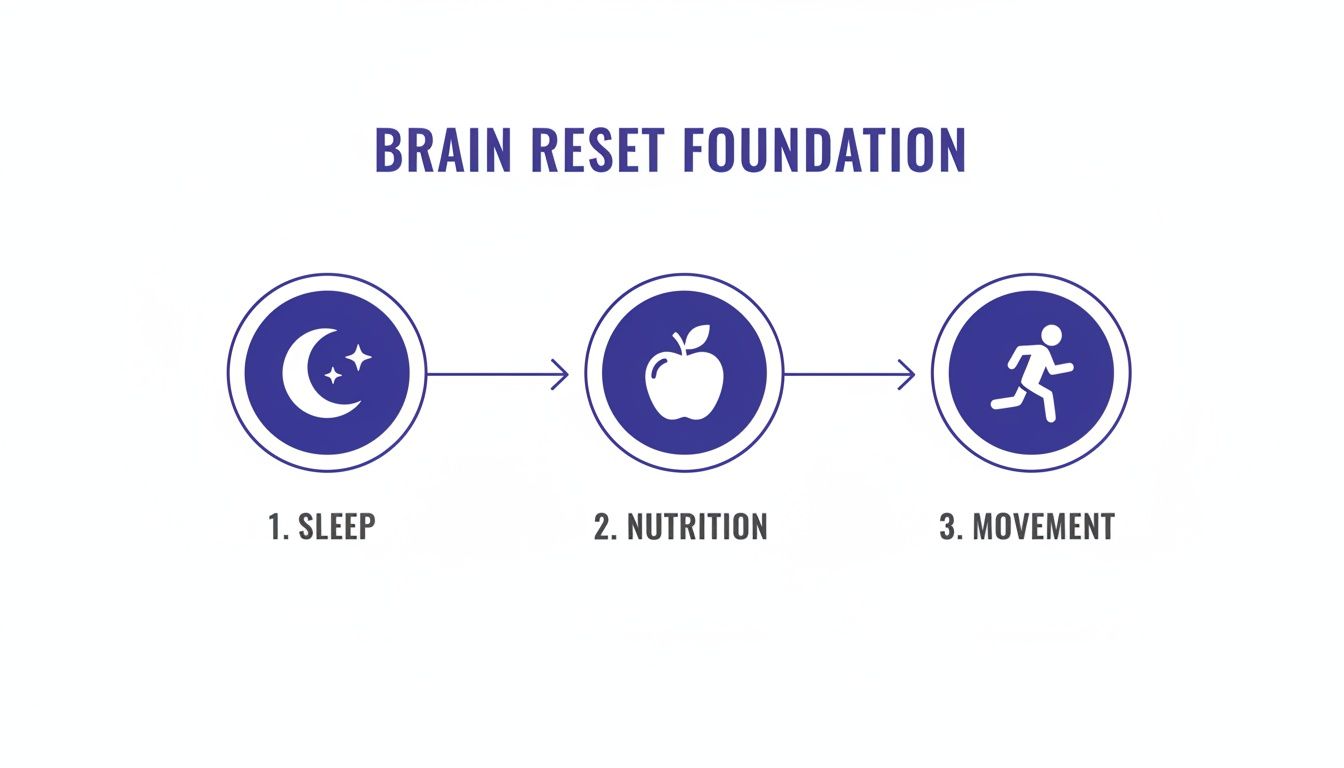
This foundational layer is built on three non-negotiables: sleep, nutrition, and movement.
Getting these fundamentals dialed in creates the biological bedrock for any real mental reset. Without them, you’re just building a house on sand. Let’s look at how to fortify each pillar with small, sustainable changes that actually work in the real world.
Prioritize Sleep to Cleanse and Consolidate Your Brain
Sleep isn’t just passive rest; it’s an active, essential maintenance period for your mind. While you’re asleep, your brain is hard at work. One of its most critical jobs is handled by the glymphatic system, which acts like a microscopic cleanup crew.
This system flushes out metabolic junk that builds up during the day, including the beta-amyloid proteins linked to cognitive decline. At the same time, your brain is busy consolidating memories—strengthening important neural connections and trimming away the weaker, unnecessary ones. This process is vital for learning and literally helps you wake up with a cleaner, more efficient mental workspace.
Real-World Scenario: The Late-Night Scroller
Alex, a project manager, spends an hour scrolling on their phone in bed every night, thinking it helps them “wind down.” But they consistently wake up feeling foggy and sluggish, struggling to organize their thoughts. This isn’t just tiredness. The blue light from the screen suppresses melatonin, delaying the deep sleep their brain needs. As a result, those crucial cleanup and memory processes get cut short, leading directly to that feeling of morning brain fog.
To really support your brain reset, aim for 7-9 hours of quality sleep. This isn’t just about how long you’re in bed, but about consistency and quality. A simple “wind-down” routine—like reading a physical book or listening to calm music for 30 minutes before bed—can make a huge difference in your ability to fall and stay asleep.
Fuel Your Brain with Smart Nutrition
The food you eat directly builds your brain’s structure and fuels its function. Your brain is an incredibly hungry organ, burning through about 20% of your body’s total calories while making up only 2% of your body weight. Giving it the right fuel is non-negotiable for focus, memory, and mood.
Think of it in terms of key players:
- Omega-3 Fatty Acids: Found in foods like salmon, walnuts, and flaxseeds, these are the literal building blocks for your brain cell membranes. They’re critical for neuroplasticity and taming inflammation.
- Complex Carbohydrates: Sources like whole grains, beans, and vegetables provide a slow, steady release of glucose—the brain’s main power source. This prevents the sharp energy spikes and crashes you get from sugary snacks.
- Lean Proteins: Foods rich in amino acids, like chicken, eggs, and lentils, are the precursors to neurotransmitters like dopamine and serotonin, which govern your mood, motivation, and focus.
A simple way to start is to focus on adding whole, unprocessed foods to your diet instead of just trying to eliminate “bad” ones. This positive reframing feels far more sustainable. Our guide on 7 brain-resetting habits offers more detailed nutritional strategies you can start using today.
Real-World Scenario: The Afternoon Brain Fog Fighter
Maria, a remote graphic designer, used to fight her 2 PM slump with a sugary cereal bar and a big coffee. She’d get a quick jolt, followed by an even deeper crash an hour later that made creative work impossible. She switched her lunch to include grilled chicken (protein), quinoa (complex carbs), and avocado (healthy fats). Now, her energy stays stable all afternoon, wiping out the brain fog and letting her stay locked in on complex design projects.
Move Your Body to Grow Your Brain
Physical activity might be the single most powerful tool you have for a brain reset. It does far more than just benefit your body; it sets off a cascade of neurochemical and structural changes in your brain.
When you do aerobic exercise, your brain releases a protein called Brain-Derived Neurotrophic Factor (BDNF). Neuroscientists often call BDNF “Miracle-Gro” for the brain because it supports the survival of your existing neurons and encourages the growth of new ones—a process called neurogenesis.
Movement also cranks up blood flow to the brain, delivering more oxygen and nutrients where they’re needed most. Even a short walk can give an immediate boost to your executive functions, like planning and attention. It’s a direct way to clear your head.
You don’t need to run a marathon. The key is consistency. A brisk 15-20 minute walk on your lunch break, a quick yoga session in the morning, or even a few sets of bodyweight exercises can deliver significant cognitive benefits. The goal is to make movement a non-negotiable part of your daily rhythm.
Use Micro-Resets to Reclaim Your Focus in Minutes
You don’t need a week-long vacation to reset your brain. Sometimes, you just need a minute.
When you’re caught in the middle of a chaotic workday, feeling scattered and completely overwhelmed, what you need are tools to reclaim your focus right now. These are called micro-resets—brief, intentional breaks designed to interrupt the stress cycle and restore your mental energy in minutes.
The real power of a micro-reset is its ability to directly influence your nervous system. When you feel stressed or frantic, your sympathetic nervous system—the “fight or flight” response—is running the show. Micro-resets are your way of hitting the brakes, activating your parasympathetic nervous system (the “rest and digest” state) to bring your mind and body back to a calm equilibrium.
The Physiological Sigh for Instant Calm
One of the most effective and fastest-acting micro-resets is the physiological sigh. This isn’t just taking a deep breath; it’s a specific breathing pattern that research from Stanford’s Huberman Lab shows is the quickest way to voluntarily lower your heart rate and calm your body down.
It works by maximally inflating the tiny air sacs in your lungs (alveoli), which helps offload excess carbon dioxide from your bloodstream. That chemical shift sends a powerful signal straight to your brain to dial down the stress response.
Here’s how you do it:
- Take two sharp inhales through your nose—one deep breath, followed by a second, shorter sip of air right on top of it.
- Then, let out a long, complete exhale through your mouth, letting all the air out slowly.
- Repeat this just one to three times. That’s it.
Real-World Scenario: Before the Big Meeting
Imagine you have a high-stakes presentation in five minutes. Your heart is pounding and your thoughts are racing. Instead of letting the anxiety spiral, you duck into a quiet corner and take two physiological sighs. Almost instantly, you feel your heart rate slow, allowing you to walk into that meeting with a clear head and a steady voice.
This simple technique is a powerful tool for resetting your brain’s state in under 60 seconds, giving you immediate control when you feel overwhelmed.
This visual underscores a key idea: foundational habits like sleep, nutrition, and movement are the pillars supporting any successful brain reset. When you have these in place, micro-resets become even more effective at keeping you sharp and focused all day long.
Non-Sleep Deep Rest for Mental Restoration
Another powerful tool is Non-Sleep Deep Rest (NSDR), a term for protocols that guide you into a state of profound relaxation without you actually falling asleep. Think of practices like yoga nidra or certain guided meditations. NSDR is brilliant for replenishing dopamine levels—crucial for motivation and focus—and has been shown to improve your brain’s ability to consolidate learning.
Think of it as a guided power nap for your neurons.
By directing your focus inward and away from external noise, you give your prefrontal cortex—the part of your brain responsible for planning and decision-making—a much-needed break. This allows it to recover and come back online with renewed strength.
- When to Use It: It’s perfect for that mid-afternoon slump when you feel mentally drained but can’t take a proper nap. A 10-20 minute NSDR session can be far more restorative than scrolling through your phone.
- How to Start: Find a quiet place, lie down, and use a guided audio script. There are countless free resources online that can walk you through the process step-by-step.
Here’s a quick summary of the immediate techniques you can use to reset your focus and calm your nervous system throughout the day.
Your Quick Brain Reset Toolkit
| Technique | When to Use | How It Works (The Science) | Time Required |
|---|---|---|---|
| Physiological Sigh | High-stress moments (before a meeting, after a tough call) | Offloads CO2, activating the parasympathetic nervous system to rapidly slow heart rate. | 1-3 minutes |
| Non-Sleep Deep Rest (NSDR) | Mid-afternoon energy slump or when feeling mentally drained | Guides the brain into a state of deep rest, replenishing dopamine and resting the prefrontal cortex. | 10-20 minutes |
| Sound Ritual | When you need to quickly shift from a chaotic to a calm state | Uses auditory focus to anchor attention and reduce sensory overload, calming the nervous system. | 3-5 minutes |
| Brief Walk Outside | Feeling stuck on a problem or after long screen time | Combines light movement, natural light, and a change of scenery to reset attention and boost mood. | 5-15 minutes |
These tools are your first line of defense against daily overwhelm, giving you the ability to perform a strategic brain reset whenever and wherever you need it most.
For even more quick, actionable strategies to improve focus, you can explore techniques perfect for reclaiming attention in minutes. Another powerful method is using sound to guide your mind into a relaxed state; you can learn exactly how with our 3-minute sound ritual guide.
Reset Your Brain’s Reward System with a Dopamine Detox
Ever feel restless, unmotivated, and constantly reaching for your phone for no real reason? It’s a classic sign that your brain’s reward system is working overtime.
This system, driven largely by the neurotransmitter dopamine, is wired to push you toward survival. But our modern world has completely hijacked it. The constant pings, endless social feeds, and on-demand entertainment create a steady drip of cheap, easy dopamine hits.
Over time, your brain adapts to this high level of stimulation, raising its baseline for what feels rewarding. Suddenly, activities that offer a slower, more meaningful payoff—like reading a book, tackling a complex project, or just having a quiet conversation—start to feel dull and unappealing.
This is where the idea of a “dopamine detox” comes in. It’s not about getting rid of dopamine, which is both impossible and a bad idea. Instead, it’s a practical way to recalibrate your brain’s sensitivity and take back control of your attention. By intentionally stepping back from high-dopamine, low-value activities, you let your reward pathways reset. Natural, productive tasks start to feel engaging again.
Understanding Your Dopamine Triggers
The first real step is to get honest about your personal dopamine triggers. These are the specific, often mindless, activities you turn to for a quick hit of stimulation, especially when you feel bored, stressed, or are avoiding something difficult.
Common triggers usually include:
- Mindlessly scrolling through social media.
- Checking email or notifications every few minutes.
- Indulging in shows or short-form videos.
- Playing mobile games designed with frequent, flashy rewards.
Once you know your triggers, you can start to consciously reduce your engagement. This doesn’t mean you need to go on a week-long, radical retreat from all technology. A far more sustainable approach is to start small.
Real-World Scenario: The Procrastinating Creator
Lena, a freelance writer, noticed a destructive pattern. Every time she sat down to tackle a challenging article, she’d feel an overwhelming urge to check Instagram “for just five minutes.” That five minutes would inevitably bleed into an hour, completely derailing her focus. Her phone was her primary dopamine trigger, offering an easy escape from the mental heavy lifting of deep work.
Lena’s experience is a perfect example of how a miscalibrated reward system fuels procrastination. Her brain had learned that scrolling delivered a much faster and easier reward than the slow, effortful process of writing.
A Practical Guide to How To Reset Your Brain With a Dopamine Fast
A successful dopamine fast, or digital detox, is really about replacing low-value habits with high-value alternatives. The goal isn’t just to remove things; it’s to lower the noise so you can finally hear the signal again.
Start with a simple, manageable plan:
- Tech-Free Evenings: Designate a time each evening, maybe after 8 PM, when all screens go off. Use this time to read a physical book, listen to music, or just talk with family. This creates a much-needed buffer of low stimulation before sleep.
- Scheduled Digital “Sabbath”: Choose one day—or even just a half-day—over the weekend to go completely screen-free. Go for a hike, work on a hobby, or visit a museum. The initial restlessness is totally normal; pushing through it is how you begin to reset.
- Replace Instead of Remove: When you feel the pull of a trigger, have a low-stimulation alternative ready. Instead of scrolling, pick up a book. Instead of watching videos, go for a short walk.
The science behind this is pretty fascinating. By consistently choosing these new, low-stimulation activities, you are literally rewiring your brain. MIT neuroscientists found that as you strengthen certain neural connections (synapses) by engaging in new behaviors, the neighboring synapses tied to old habits actually weaken from disuse. This means every time you choose reading over scrolling, you are physically reinforcing your brain’s pathways for focus.
How to Reset Your Brain With a 25-Minute Writing Ritual That Rebuilds Deep Work
Applying these ideas, Lena created a simple “writing ritual.” She started putting her phone in another room, set a timer for 25 minutes of focused writing, and promised herself a short walk outside as a reward. The first few days were tough, but soon enough, the satisfaction of completing a writing block became its own reward. She was retraining her brain to value deep work again.
If you’re curious about the science and common misconceptions, you can explore whether a dopamine detox is real or just a myth in our detailed article.
Ultimately, a dopamine detox is a powerful tool for anyone looking to reset their brain for better focus, restoring your ability to find motivation and even joy in the things that truly matter.
How to Reset Your Brain for Lasting Focus with Deliberate Practice
Quick fixes are great for getting through a tough afternoon, but a true brain reset is about building lasting change. This means moving beyond temporary relief and actively rebuilding your capacity for deep, sustained attention. The most powerful way to do this is through deliberate practice—intentional activities that tap into your brain’s incredible ability to adapt and rewire itself.
Focus isn’t some mystical, finite resource you’re born with. It’s a mental muscle. And like any muscle, it gets stronger with consistent, targeted training. When you engage in these practices, you’re not just doing a mental exercise; you’re physically strengthening the neural circuits responsible for attention, especially in your prefrontal cortex.

This whole idea is rooted in brain plasticity. For a long time, the common belief was that the brain’s structure was more or less fixed after childhood. We now know that’s not true. Compelling research from institutions like the University of Pennsylvania has shown our brains keep significant plasticity well into adulthood, particularly in the regions that govern executive function.
What does that mean for you? It means that with intentional effort, you can create real, lasting changes in how your brain operates. You can literally build a more focused mind. You can read the full research about these crucial brain development findings here.
Sharpen Attention with Mindfulness Meditation
One of the most evidence-backed methods for training your attention is mindfulness meditation. At its core, mindfulness is simply the practice of paying attention to the present moment without getting tangled up in judgment.
Think of it as doing reps for your prefrontal cortex. Each time your mind wanders during meditation and you gently guide it back to your breath, you are strengthening the neural pathways of focus. It’s a direct workout for your brain’s attention center.
Even just 10-15 minutes a day can make a noticeable difference. This isn’t about emptying your mind—a common misconception. It’s about noticing where your attention goes and learning to consciously direct it. This practice teaches you to become the master of your focus, not its victim.
Embrace the Power of Single-Tasking
In a culture that glorifies doing everything at once, committing to one thing at a time is almost a revolutionary act. The hard truth is, the human brain isn’t built to multitask effectively. What we call multitasking is actually rapid task-switching—a process that burns through cognitive fuel, ramps up error rates, and leaves you feeling mentally exhausted.
Single-tasking, on the other hand, is a powerful form of attention training. By dedicating your full focus to one activity for a set period, you teach your brain to stay engaged and resist the siren call of distractions. This builds cognitive stamina and makes deep, concentrated work possible again. You can learn more about the brain benefits by exploring the neuroscience of single-tasking in our in-depth article.
Real-World Scenario: The Overwhelmed Student
David was prepping for major exams and felt completely scattered. He’d try to study, but his phone would buzz, he’d remember an email he needed to send, and his focus would shatter within minutes. Feeling desperate, he decided to try a new approach. He started each day with a 10-minute guided mindfulness session to calm his mind. Then, he used the Pomodoro Technique, setting a timer for 25 minutes of pure, uninterrupted study—no phone, no email, just the textbook. After each block, he’d take a 5-minute break.
This structured approach changed everything. By combining mindfulness with single-tasking, David was actively rebuilding his ability to concentrate. His study sessions became dramatically more productive, and his retention improved because he was finally allowing his brain to process information without constant interruption. He was learning how to reset his brain for focused work, one block at a time.
Create New Neural Pathways by Learning a Skill
Another powerful way to rebuild your focus is to learn something new and genuinely challenging. Whether it’s picking up a musical instrument, learning a new language, or trying a complex craft like woodworking, the act of acquiring a new skill creates fresh neural pathways.
This process forces your brain to pay close, sustained attention. You have to concentrate to understand new concepts and coordinate new movements. This kind of deep engagement is the antidote to the passive, fragmented attention that scrolling through feeds encourages. It’s an active way to reset your brain and remind it of its incredible capacity for growth and focus.
Editor’s Take on What Really Works for a Brain Reset
Let’s be honest about how to reset your brain: there’s no magic bullet. Forget the quick fixes. A true reset comes from layering consistent, foundational habits with intentional mental practices that build on each other over time.
This advice is best for individuals experiencing mild cognitive fatigue, digital overload, or early stages of burnout. It is not intended to address clinical conditions such as chronic anxiety, depression, or ADHD.
From my experience and review of the research, two strategies deliver the most dramatic results: disciplined sleep hygiene and a structured reduction in digital noise, like a purposeful dopamine detox. Nothing else clears the fog and restores your focus quite like getting those two things right.
However, a critical caveat is patience. Neuroplasticity—your brain’s ability to actually rewire itself—doesn’t happen overnight. It takes consistency. Give yourself several weeks of practicing these habits to notice a real, lasting shift in your focus, mood, and mental stamina. The small efforts you make every day are what compound into a successful brain reset, rebuilding your capacity for deep work and genuine calm.
Frequently Asked Questions about How to Reset Your Brain
Navigating a brain reset can bring up a lot of questions. Here are the ten most common ones we see, with straightforward answers to give you clarity and reinforce the strategies from this guide.
1. How long does it take to truly reset your brain?
There’s no single timeline, but you can feel immediate relief from micro-resets in just a few minutes. For deeper, more lasting changes in focus and mood from new habits—like better sleep or a digital detox—you should commit for at least 3-4 weeks. That’s the rough timeframe it takes for neuroplasticity to start reinforcing new neural pathways.
2. Is a dopamine detox safe for your mental well-being?
Yes, when done correctly. A “dopamine detox” isn’t about eliminating dopamine, which is impossible. It’s about recalibrating your brain’s reward system by reducing overstimulation from low-value activities (like endless scrolling) so that natural, healthy activities feel rewarding again. It is a safe and effective way to regain control over your attention.
3. What is the single most important habit for a brain reset?
While all foundational habits are connected, consistent, high-quality sleep is the bedrock. During sleep, your brain clears out metabolic waste, consolidates memories, and balances crucial neurotransmitters. Without sufficient quality sleep, any other effort to reset your brain will be significantly less effective.
4. Can you reset your brain from burnout or mental exhaustion?
Absolutely. A brain reset is a core part of recovering from burnout. Burnout is a state of chronic stress that depletes your cognitive and emotional resources. The strategies in this guide—prioritizing deep rest, reducing stimulation, and rebuilding healthy routines—are designed to address the root causes of burnout by giving your nervous system a chance to heal.
5. What are the biggest mistakes to avoid when trying to reset your brain?
The biggest mistake is aiming for perfection instead of consistency. Trying to change everything at once often leads to feeling overwhelmed and giving up. Start with small, sustainable changes. Another common error is focusing on mental “hacks” while ignoring foundational pillars like sleep, nutrition, and movement. You can’t hack your way out of biological exhaustion.
6. Do I have to meditate to reset my brain?
Meditation is a powerful, evidence-backed tool for strengthening your prefrontal cortex and training attention, but it’s not the only one. If traditional meditation isn’t for you, other mindfulness practices like focused breathing, taking a quiet walk in nature without your phone, or engaging in a creative hobby can provide similar brain-resetting benefits.
7. How does nutrition actually impact a brain reset?
Your diet provides the literal building blocks your brain uses to function. Foods rich in omega-3s, antioxidants, and B vitamins support neuron health and reduce inflammation. Conversely, a diet high in processed foods and sugar can fuel brain fog and mood swings. Good nutrition is a non-negotiable component of a mental reset.
8. How much exercise is needed to help reset your brain?
You don’t need to live in the gym. Research shows that as little as 20-30 minutes of moderate aerobic exercise (like a brisk walk) a few times a week is enough to make a real difference. This boosts BDNF, a key protein that supports neuron growth and sharpens cognitive function.
9. Can listening to certain sounds or music help reset your brain?
Yes, the right kind of sound can be a fantastic tool for shifting your mental state. Auditory tools like binaural beats, calming nature sounds, or ambient music can help guide your brainwaves into a more relaxed state. This can act as a fast-acting micro-reset, helping you shift from feeling scattered to calm and focused in minutes.
10. When should I see a doctor instead of trying to reset my brain on my own?
This guide is for educational purposes and is not a substitute for professional medical advice. While these strategies can help with general fatigue and mild burnout, they are not a treatment for clinical conditions. If you’re experiencing persistent symptoms of depression, severe anxiety, significant memory loss, or an inability to function in your daily life, it is crucial to seek help from a qualified medical doctor or a licensed therapist.
Disclaimer: The information in this article is for educational purposes only and is not intended as medical or psychological advice. It is not a substitute for professional care. Some of the links in this article may be affiliate links, which means we may earn a small commission if you make a purchase at no extra cost to you.
At Mind Clarity Hub, we curate science-based books and practical guides to help you master your focus and find calm in a noisy world. Explore our full library of resources on dopamine detox, burnout recovery, and mindful productivity to continue your journey toward mental clarity.
Explore the Mind Clarity Hub Library
Practical books on focus, digital habits, resilience, and building a calmer mind.
The Power of Clarity
Unlock mental focus, build momentum, and create the life you were meant to live.
View book →
AI & ChatGPT for Beginners
No PhD needed — a 2025 guide to AI, prompts, and productivity without coding.
View book →
Zen in the Digital Jungle
Mindfulness for a chaotic world.
View book →
The Slow Reset
Mindful living in a fast-paced world.
View book →
Perfectly Imperfect
Stop self-criticism, set boundaries, and embrace the real you.
View book →
Reclaiming Silence
A dopamine detox guide to finding peace in a noisy world.
View book →
The Focused Freelancer
Productivity, pricing & positioning for independents in 2025.
View book →
ChatGPT Side Hustle System
Launch your AI-driven online business in 30 days.
View book →
Burnout, Interrupted
A proven path to restore energy and reclaim your life.
View book →
Attention Unleashed
Focus strategies for the distracted mind.
View book →
Side Hustle Launchpad
Your quick-start guide to extra income.
View book →
Digital Clarity
Rewire your brain, escape dopamine traps & regain focus.
View book →
Break the Scroll
Reduce screen time and take back control of your life.
View book →
Climate Compassion
Transform eco-anxiety into empowered action.
View book →
Village Mentality
The power of community for mental wellness.
View book →
Restful Nights
Overcoming sleep anxiety in a 24/7 world.
View book →
Connected Again
Combat loneliness and build meaningful relationships.
View book →
Focus Recharged
Mastering attention and productivity in the digital era.
View book →
Marketing Magic with ChatGPT
AI-powered content, campaigns, and copywriting to grow faster.
View book →
The 6-Figure Creator
Turn knowledge into passive income with books, courses & AI.
View book →
Burnout Breakthrough
Reset your work-life balance and thrive in 2025.
View book →
The Emotionally Intelligent Man
A modern guide to self-awareness and communication.
View book →
AI Personalized Wellness
Create your custom health plan with data-driven habits.
View book →
Everyday AI Made Easy
Use ChatGPT and smart tools to simplify life.
View book →
Money Mindfulness
A financial wellness guide for Gen Z & Millennials.
View book →
Startup Smarter with AI
ChatGPT strategies and tools to grow your business.
View book →
ChatGPT for Writers & Creators
Unlock AI-powered brainstorming, drafting & editing.
View book →