If you want results that last, build your AI side hustle planning without burnout from day one. In this guide, you will set limits that protect your energy, design short sprints, and use AI as a smart helper instead of a stress multiplier. The outcome is simple: steady output, sane hours, and a clear plan you can keep for months.
AI side hustle planning without burnout: quick answer
Here is the short path. First, cap your weekly hours and protect sleep. Second, plan one clear deliverable per 7-day sprint. Third, use AI to remove drudge work (drafts, outlines, summaries), not to add more projects. Fourth, schedule recovery like a meeting. If you keep those four, you will keep your momentum and stay calm.
Limit work: set a weekly time budget and a two-hour daily cap on weeknights.
Ship small: one scope-locked deliverable per sprint (article, video, feature).
Use AI as a lever: draft, outline, and QA faster; avoid tool sprawl.
Recover on purpose: breaks every 50β90 minutes and one full rest day.
What is burnout and why do side hustles trigger it?
Burnout is a workplace phenomenon marked by exhaustion, cynicism, and reduced efficacy. The World Health Organization lists it in the ICD-11 as an occupational syndrome from chronic stress that is not well managed. Because side hustles add work on top of a job, family, and life, the risk climbs when recovery and limits are missing. Also, scope creep and late-night sessions stack sleep loss, which speeds the slide into poor focus and low mood. Therefore, your plan should assume that stress will rise and should add buffers before it hits.
Because nights and weekends are scarce, start with an energy-first budget. Instead of asking βhow much can I add,β ask βwhat can I remove or reduce?β Then assign a small, fixed sprint scope that fits real life.
Item
Hours
Notes
Weeknights (MonβThu)
4β8
1β2 hours each night; stop 90 minutes before bed
Weekend focus block
2β4
One deep block with a hard stop
Admin (email, comments)
1
Batch on Sunday or Monday
Total weekly cap
7β13
Protect sleep and movement first
Instead of using all available time, pick the low end of your range for three weeks. As a result, you will avoid big spikes that lead to a crash.
A quick energy audit to set your cap
Use this 10-minute check to right-size your plan. It is the engine behind AI side hustle planning without burnout.
List fixed life blocks for the week: job, commute, family care, appointments.
Note sleep target and bedtime. Add a 90-minute buffer before bed.
Mark two exercise or movement slots, even if short walks.
Now see what open hours remain. Take only 50β60% of that time for the hustle.
Round down to the nearest hour. Put that as your weekly cap on the calendar.
Pick one deliverable that fits inside 60β80% of the cap, not 100%.
Leave slack for spillover and life events.
Red flags to watch:
Sleep drops under your target for three nights in a row.
Two work nights with back-to-back late sessions.
Sunday planning gets skipped twice.
When any red flag appears, trim scope by 20% for the next sprint. This single move keeps AI side hustle planning without burnout on track.
A simple calm-hustle cycle you can follow
Calm Hustle Cycle β limit, plan, build, review, recover, repeat. Keep the loop short so momentum stays high.
Limit β Set a weekly hour cap and one deliverable.
Plan β Break into 3β5 tasks and timebox each.
Build β Focus blocks with a visible timer.
Review β QA with a checklist; cut scope if needed.
Recover β Micro-breaks, off-screen rest, and sleep.
Repeat β Adjust scope next week based on lift.
What should your weekly deliverable look like?
Choose a unit of value that you can ship in one sprint. For example, draft a 1,200-word article, edit and publish last weekβs draft, record a 6β8 minute explainer, refine a landing page, or ship a small dataset or notebook. Because the scope is small, you can finish even on a busy week.
One clear owner: you.
Scope fit: 3β5 tasks in under 6β8 hours.
Definition of done: a short checklist you can check off in 3 minutes.
Fast scope math that prevents overrun
Estimate, then cut. Here is a simple, sturdy method that fits AI side hustle planning without burnout.
Break the deliverable into 3β5 tasks.
Give each task a rough time in minutes (40, 60, 90).
Add 30% buffer once. Do not add more per task.
If the total exceeds your weekly cap Γ 0.8, remove one task or split the deliverable.
Task
Base (min)
+30% Buffer
Total
Outline + scope lock
50
15
65
Draft section A
60
18
78
Draft section B
60
18
78
Edit + sources
60
18
78
Polish + publish
90
27
117
Planned total
Β
Β
416 min (β7 h)
When the math does not fit, reduce scope first. Do not push bedtime.
Where should AI help, and where should it stay out?
Use AI for drafting, summarizing, outlining, pattern checks, and first-pass QA. Do not use AI to spawn four new projects or to distract you with endless prompts and tool-hopping. Instead, script one repeatable workflow for your weekly deliverable and keep it stable for a month.
Task
AI Assist
Human Finish
Topic outline
Generate 3 outlines and merge
Pick one and set scope
First draft
Draft 800β1200 words from your notes
Edit tone, add stories, cut fluff
Data cleanup
Regex, pattern spotting, summaries
Verify, label edge cases
SEO pass
Suggest headings, questions, schema
Check relevance, add sources
Final QA
Create a checklist from specs
Run checklist; publish
Because you keep the workflow narrow, you reduce switching costs and improve quality. That choice also supports AI side hustle planning without burnout by removing noise that drains focus.
AI pitfalls to avoid (and what to do instead)
Chasing prompts: save three proven prompts and stop searching this week. Revisit monthly.
Tool sprawl: one model, one notes app, one timer for 30 days. Then review.
Scope creep from AI ideas: capture new ideas in a backlog. Do not add them mid-sprint.
Source slippage: ask AI for source types, then you find and verify the actual links.
Endless edits: set a two-pass rule. After pass two, publish or archive.
How do you build a weekly plan that protects energy?
Use timeboxing and implementation intentions. Timeboxing sets a fixed time for each task. Implementation intentions (ifβthen plans) link cues to actions, which improves follow-through in research on goal pursuit. For example, βIf it is 7:30 pm on Tuesday, then I will write the intro for 40 minutes.β
Here is a weekly shape that works for many busy people who build after work. It keeps AI side hustle planning without burnout front and center by mixing short, deep sessions with gentle recovery.
Day
Focus
Block
Recovery
Mon
Outline + scope lock
50β70 min
Walk 10β15 min
Tue
Draft section A
50β70 min
Stretch + water
Wed
Draft section B
50β70 min
Off-screen break
Thu
Edit + sources
50β70 min
Light reading
Fri
Rest or light admin
Skip or 20β30 min
Sleep on it
Sat
Polish + publish
90β120 min
Reward + time outside
Sun
Plan next sprint
20β30 min
Early wind-down
Calendar layer and boundary scripts
Block your time, then defend it with simple words. The goal is calm, firm, and kind.
Decline a low-priority invite: βThanks for the invite. Iβm booked this evening. Could we try next week?β
Hold the hard stop: βIβm signing off at 9. Letβs pick this up tomorrow.β
Protect a weekend: βSaturday morning is a focus block. Iβm free after noon.β
Reset scope mid-week: βTo ship on time, Iβm dropping feature X and keeping Y.β
These small scripts remove friction and support AI side hustle planning without burnout by keeping your cap intact.
A 7-day micro-sprint you can copy
Here is a simple content sprint that uses AI well and keeps scope gentle. Because the plan is small, you can stick with AI side hustle planning without burnout even when work gets busy.
Sun: Define the deliverable and write a one-sentence success spec.
Mon: Use AI to propose 3 outlines; pick one; set a 2β3 point scope.
Tue: Draft section A with AI; you rewrite for voice.
Wed: Draft section B; add 2β3 solid sources.
Thu: Edit with a checklist; cut 20% of fluff.
Sat: Final QA and publish; post a short summary to one channel.
Sun: Note what helped, what hurt; shrink or grow next weekβs scope by 10β20%.
Recovery habit tied to a cue (walk after each block)
Why do breaks help focus and output?
Short breaks reset attention. In a cognition study, brief task-unrelated breaks reduced vigilance decrement. That is one reason the 50β10 or 90β15 rhythm works. Meanwhile, chronic stress at work links to poor health and higher error rates, which is why CDC/NIOSH guidance pushes stress reduction. For you, that means a timer, a walk, some water, and no guilt. Also, it means one full day each week with no side-hustle tasks.
Micro (during a block): stand up, stretch, sip water, two minutes of deep breathing.
Meso (between blocks): 10β15 minute walk outside; no phone.
Macro (weekly): one full day off; light social time or nature time.
Simple recovery beats complex plans. It is how you maintain AI side hustle planning without burnout across many months.
Stopping burnout is a planning choice. Photo by Nataliya Vaitkevich on Pexels. Source.
This is your reminder that capacity, not desire, should set your scope. Because the plan guards your energy, you can work with calm and still ship.
Which AI prompts and SOPs keep you on track?
Instead of new prompts every night, lock a small set. Save them as notes or in a simple SOP doc. That pattern supports AI side hustle planning without burnout because it prevents decision fatigue.
Outline prompt: βPropose 3 outlines for [topic]. Each should fit a 1,200-word post with 4 sections and 2 examples.β
Draft prompt: βDraft section [A/B] (250β300 words) based on this outline and notes. Use short sentences and cite 2 credible sources to verify claims.β
QA prompt: βCreate a 10-point checklist for readability, sources, and clarity for this draft. Include a step to cut 15β20%.β
SOP library: three sample flows
Pick the one that matches your deliverable and keep it steady for a month.
Article SOP: outline β draft A β draft B β edit for meaning β edit for style β source check β publish β social summary.
Short video SOP: hook script β outline 5 beats β record in one take β cut dead air β add captions β upload β title/description β post.
Use a checklist app or a plain-text note. The fewer choices, the more you finish.
Tool choice: minimal beats maximal
Pick one main writing or coding model, one note system, and one timer. Keep the stack lean for a month. Also, schedule reviews to remove tools if you do not use them. Less is more for focus.
Need
Simple Option
Why it fits
Draft and outline
One reliable AI chat model
Fast starts; keeps tone drafts consistent
Notes and tasks
Plain-text or one notes app
Low friction, easy search
Timer
Phone or desktop timer
Visible timebox; helps breaks happen
Sources
Reference manager or bookmarks
Keep links for citations and updates
Because your stack is simple, onboarding and context loss drop. That is a quiet win you will feel by week two.
How do you keep quality high when time is short?
Use a pre-flight and post-flight checklist. Also, keep a tiny style guide for your voice and formatting. Then add a two-pass edit: first for meaning, second for sentences.
Pre-flight: confirm target, audience, scope, and sources.
Pass 1: content and logic; fill gaps and cut tangents.
Pass 2: sentences; shorten, smooth, and clarify.
Final: run AI QA checklist; verify every source link opens and fits.
Quality signals to check before you ship
Clarity: can a busy reader grasp the point in 10 seconds?
Credibility: at least two reputable sources where claims are made.
Consistency: headings, voice, and formatting match your style.
Conciseness: 10β20% of fluff removed.
Metrics that matter (and the ones that donβt)
Track what you control each week. That is the heart of AI side hustle planning without burnout.
Metric
Target
Why it helps
Deliverables shipped
1 per week
Finishing muscle beats volume
Hours within cap
β€ weekly cap
Guards sleep and mood
Break adherence
β₯ 80% of blocks
Preserves focus
Scope changes mid-week
0
Prevents chaos
Sleep duration
Your target Β± 30 min
Protects health
Ignore vanity metrics early, like follower spikes. They fluctuate. Build cadence first; growth follows.
When should you pause, pivot, or quit?
Here are simple rules. Miss two sprints in a row due to life? Pause one week and trim scope by 30%. Results stall for a month? Pivot the deliverable or channel. Sleep or mood takes a hit for three weeks? Quit the current project and switch to a lighter one. These rules support AI side hustle planning without burnout by giving you permission and structure to protect health.
Pause: after two missed sprints; cut scope and reset.
Pivot: after four weeks of flat results; change topic or format.
Quit: after three weeks of harm; choose a gentler path.
Motivation without hype
Because you will not be motivated every night, design for action without hype. Tie tasks to cues. Make tasks small. Reward completion. Also, write down why the work matters for you and one person you help. That note will carry you when willpower is thin.
Mindset shifts that reduce stress
From volume to value: one finished unit beats five starts.
From speed to cadence: steady beats sprint-then-crash.
From tools to systems: one workflow > five shiny apps.
From hustle to craft: get 1% better each week.
Common mistakes and easy fixes
Too many goals at once β pick one lever per week.
No definition of done β write a 3β5 line checklist before you start.
Late-night doom scroll β place your phone in another room during blocks.
All learning, no shipping β set a 70/30 build-to-learn ratio.
Perfectionism β set a βgood enoughβ publish threshold in advance.
Checklists make decisions easier on busy days. Photo by Nataliya Vaitkevich on Pexels. Source.
Troubleshooting guide
Problem: I start blocks late. Fix: Move the block earlier by 20 minutes and set a phone alarm labeled βStart the first sentence.β
Problem: I overrun timeboxes. Fix: Stop at the bell, add a 15-minute spill slot at the end of the week.
Problem: I add tasks mid-week. Fix: Backlog them in a note titled βNext Sprint Ideas.β Review on Sunday only.
Problem: I skip recovery. Fix: Pair breaks with a cue (water bottle, walking shoes by the door).
Problem: I keep changing tools. Fix: Set a 30-day tool freeze and a single review date.
Next steps: build your calm system
Also, learn deeply and keep your workflow clean. For a book-first path to focus, see the AI productivity picks in the Mind Clarity Hub Books hub. If you want a structured, practical system that matches this guide, review the Jeremy Jarvis AI productivity book next. Each page offers clear steps, checklists, and examples that pair well with your plan.
Meanwhile, keep your AI side hustle planning without burnout simple: one deliverable, one workflow, one week at a time. That is how pros last.
A helpful walkthrough from a creator with a day job
What is the fastest way to cut my weekly workload?
Cut scope by 20β30%, keep one deliverable, and timebox admin to 20β30 minutes. Also, remove one tool you do not use each week.
How can AI help me avoid overwork, not cause it?
Use AI to draft and outline, but lock the project scope first. Then limit yourself to one AI workflow per deliverable for a full month.
What break rhythm works best at night?
Try 50β10 or 90β15. Brief breaks help attention reset, which supports better work and energy.
How do I keep weekends from turning into a second job?
Set one 90β120 minute deep block with a hard stop, then ban all work after. Put recovery on the calendar first.
Can I grow output without adding hours?
Yes. Improve your outline quality, reuse templates, and build a tiny library of prompts and checklists. Quality systems multiply results without longer days.
Top Picks: Best Habit Tracking Apps for Daily Routines
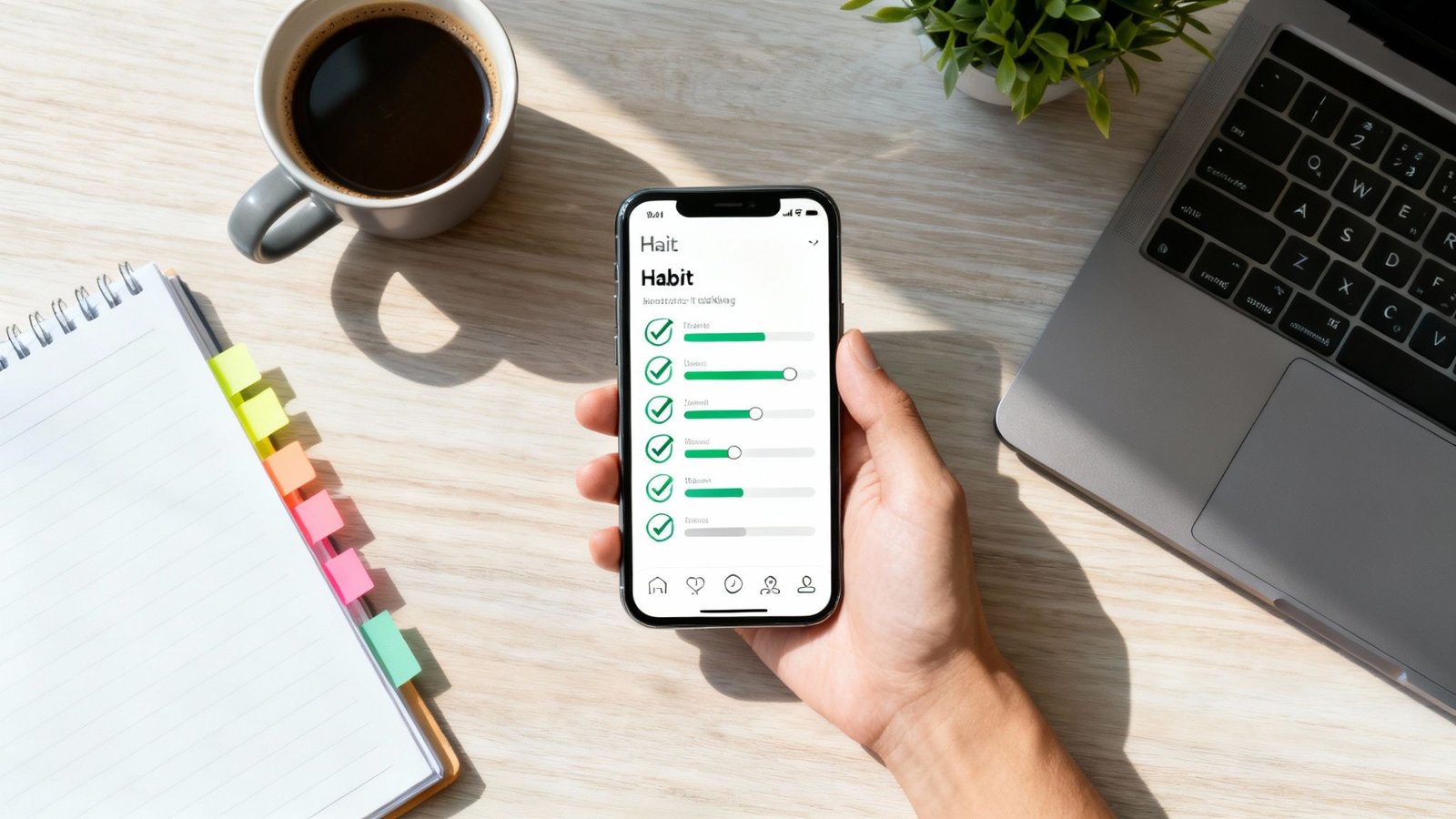
Establishing new habits can feel like an uphill battle. Whether youβre a professional aiming for deep work, a student managing deadlines, or anyone trying to recover from digital burnout, the initial motivation often fades. This is where the best habit tracking apps become powerful allies, not just for accountability, but for how they interact with your brainβs reward system.
Behavioral psychology research shows that small, consistent wins create positive feedback loops in the brain. When you check off a task, your brain releases a small amount of dopamine, a neurotransmitter linked to motivation and reward. This reinforces the behavior, making you more likely to repeat it. A well-designed app visualizes this progress, turning abstract goals into tangible streaks and data points that build momentum. For example, seeing a 10-day streak for βmorning walkβ provides the immediate, structured feedback our brains crave, which is often missing when we rely on willpower alone.
Disclosure:This article contains affiliate links. If you make a purchase through these links, we may earn a small commission at no extra cost to you. This helps support our work in creating valuable content.
How to Choose the Best Habit Tracking Apps for Your Goals, Routine, and Motivation Style
This comprehensive guide moves beyond generic feature lists to help you find the right tool for your specific needs. Weβve analyzed the top apps, focusing on their suitability for different user types, from busy entrepreneurs to those seeking a healthier screen-time balance. Understanding how these tools fit into the broader landscape of the latest digital habit trends can provide valuable perspective as you choose your system.
Inside, youβll find detailed breakdowns of each app, including:
Honest pros and cons based on real-world use.
Practical implementation tips and onboarding templates.
Screenshots, pricing details, and direct links to download.
Our goal is to equip you with a system that sticks, helping you build focus and achieve your goals one day at a time.
This article is for educational purposes only and is not a substitute for professional medical or psychological advice, diagnosis, or treatment. If you are experiencing challenges with anxiety, depression, ADHD, burnout, or sleep, please consult a qualified healthcare provider.
1. Apple App Store: Discovering the Best Habit Tracking Apps on iOS
For anyone integrated into the Apple ecosystem, the App Store is the essential first stop for finding the best habit tracking apps. Itβs not a single app, but rather the primary, secure marketplace for discovering, purchasing, and managing a vast library of tools designed for iOS, iPadOS, macOS, and watchOS. This centralized hub provides a trusted environment to explore top-tier options like Streaks, Habitify, and Strides.
The platform excels in user trust and convenience. Every transaction is handled through your Apple ID, streamlining subscriptions, one-time purchases, and even refund requests. This unified system eliminates the need to manage separate billing details for each app you try.
Key Features and User Experience
Appleβs App Store stands out for its curation and robust user-feedback systems. Editorial spotlights and curated collections often highlight innovative or effective habit trackers, helping you discover apps you might otherwise miss.
Practical Tips for Effective Use:
Utilize App Privacy Labels: Before downloading, check the βApp Privacyβ section on any appβs page. This transparent report details what data the app collects, helping you make informed decisions aligned with your personal privacy standards.
Leverage Family Sharing: If an app supports it, use Family Sharing to share a single purchase with up to five family members, making premium tools more affordable.
Read Recent Reviews: Sort user reviews by βMost Recentβ to get a current perspective on an appβs performance, latest updates, and any emerging bugs. A real-world example would be checking recent reviews for a habit app after a major iOS update to see if users are reporting any new bugs.
Pros:
High standards for security and user privacy
Centralized platform for billing, trials, and reviews
Excellent discovery tools like curated lists and editorβs picks
Cons:
Limited to Apple devices only
Direct feature-by-feature comparison between apps is difficult
2. Google Play Store: A Hub for the Best Habit Tracking Apps on Android
For the millions of Android users, the Google Play Store is the definitive starting point for finding the best habit tracking apps. It serves as the official and secure marketplace for a massive variety of applications compatible with Android phones, tablets, and Wear OS devices. This centralized platform is home to everything from minimalist, open-source options like Loop to feature-rich suites like HabitNow and TickTick.
The store streamlines the entire app management experience. All purchases, subscriptions, and refund requests are handled directly through your Google account, providing a simple and unified billing system. This convenience is extended through features like the Family Library, which allows for sharing paid app purchases with family members.
Key Features and User Experience
The Google Play Storeβs main advantage is its immense and diverse selection, offering tools for every possible budget and use case. The platform also provides clear details on app permissions, update frequency, and user reviews to help you make informed choices.
Practical Tips for Effective Use:
Check App Permissions: Before installing, review the βPermissionsβ section on an appβs page to understand what data and device features it needs to access. For example, if a simple habit tracker asks for access to your contacts, itβs a red flag that it might not align with your privacy comfort level.
Filter for New and Updated Apps: Use search filters to find recently updated apps. This often indicates active development and better support from the creators.
Utilize the Wishlist Feature: Save interesting habit trackers to your wishlist to compare them later or wait for a potential sale before purchasing.
Pros:
Vast selection of apps, including many high-quality free and open-source options
Simple installation, billing, and refund process across all Android devices
Family Library makes it easy to share paid apps
Cons:
App quality can vary significantly, requiring more user research
Discovery of hidden gems can be challenging without strong editorial curation
3. Strides: One of the Best Habit Tracking Apps for Goal Setters
For users who want to go beyond simple streak counting, Strides offers a powerful and flexible framework for goal achievement. Itβs designed for those who need more than just a binary βyes/noβ tracker, providing four distinct tracking models to fit nearly any objective. This makes it one of the best habit tracking apps for quantifying progress on complex professional goals, personal finance targets, or fitness benchmarks.
The platformβs strength lies in its analytical depth. Each goal gets its own dashboard with charts, calendars, and progress lines, allowing you to visualize momentum. According to behavioral research, this type of detailed, immediate feedback can be a powerful motivator, as it activates the brainβs reward system and links daily actions to long-term success. If youβre interested in the connection between visual progress and motivation, you can learn more about dopamineβs role in goal pursuit.
Key Features and User Experience
Strides stands out with its four versatile tracker types: Habit (for building good or bad habits), Target (to reach a goal by a specific date), Average (to track a value over time), and Project (to complete milestones). The guided SMART goal setup workflow helps you define clear, actionable objectives from the start.
Practical Tips for Effective Use:
Use the βProjectβ Tracker for Complex Goals: A real-world example would be breaking down a large goal like βlaunch a websiteβ into smaller, manageable milestones (e.g., βbuy domain,β βdesign logo,β βwrite contentβ) within a single tracker to see the full picture.
Set Pace Lines: For βTargetβ goals, use the pace line feature to see if you are on, ahead, of, or behind schedule, allowing for timely course correction.
Review Your Dashboard Weekly: Dedicate time each week to review the all-in-one dashboard to identify patterns, celebrate wins, and adjust your strategy for the upcoming week.
Pros:
Strong analytics and reporting for serious goal tracking
Four flexible tracker types for any kind of goal
Clear SMART goal configuration and templates
Cons:
iOS-centric with no native Android app
Can feel overly complex for very simple habit tracking
4. Streaks: A Top Contender for Best Habit Tracking Apps on Apple Devices
For users deeply embedded in the Apple ecosystem who value simplicity and a singular focus, Streaks is a top-tier habit tracker. Itβs built around the βdonβt break the chainβ methodology, a concept popularized in productivity circles. This provides a visually satisfying and straightforward way to build consistency. As one of the best habit tracking apps for minimalists, it forgoes complex analytics for a clean, distraction-free interface that excels at one thing: maintaining your momentum.
Streaks stands out with its one-time purchase model, a refreshing alternative to the subscription-heavy app market. All your data syncs seamlessly across iPhone, iPad, Mac, and Apple Watch via iCloud, ensuring your progress is always up to date. This approach provides a polished and reliable experience without recurring fees.
Key Features and User Experience
The appβs design is its greatest strength, offering a highly polished and intuitive experience that makes logging habits quick and easy. Its deep integration with Apple Health is a significant advantage, automatically completing health-related goals like βWalk 10,000 stepsβ or βPractice mindfulnessβ by pulling data directly from your Health app or Apple Watch. Setting up these automated trackers helps reinforce positive behaviors and aligns perfectly with broader goals for self-improvement.
Practical Tips for Effective Use:
Leverage Health Integration: A great example is connecting Streaks to the Health app to automate tracking for your daily step count. This reduces manual entry and ensures accuracy, making the habit feel effortless to log.
Customize Your Dashboard: Use the wide range of icons and color themes to create a visually motivating dashboard that you enjoy looking at daily.
Use the Apple Watch App: The companion Apple Watch app is excellent for logging habits on the go, providing quick access and complications for your watch face.
Pros:
One-time purchase with no ongoing subscriptions
Minimal, highly polished design that is easy to navigate
Excellent integration with Apple Health, iCloud, and Apple Watch
Cons:
Limited to Apple devices with no native Android or web version
Lacks advanced analytics or reporting features found in other apps
5. Habitify: Cross-Platform Support in a Habit Tracking App
For users who refuse to be tethered to a single device, Habitify stands out as one of the best habit tracking apps due to its true cross-platform availability. It offers a seamless experience across iOS, Android, macOS, and the Web, ensuring your habit data is always in sync, no matter which device youβre using. This makes it an ideal choice for professionals and students who switch between a phone, tablet, and computer throughout their day.
Habitify goes beyond simple check-ins by providing detailed analytics and progress reports. Its interface cleanly organizes habits by time of day (Morning, Afternoon, Evening), which helps in structuring routines. From a psychological standpoint, this βhabit stackingβ technique reduces cognitive load by linking new habits to existing parts of your day. This is especially useful for anyone looking to build a consistent schedule, as discussed in this guide on how to create a morning routine.
Key Features and User Experience
Habitifyβs strength lies in its blend of simplicity and powerful features. The app allows for deep customization, from setting specific goals for each habit (e.g., read 20 pages) to integrating with Apple Health and Google Fit for automated tracking of health-related goals. It also supports automation through an API, Zapier, and IFTTT for advanced users.
Practical Tips for Effective Use:
Use the Journaling Feature: For each habit completion, add a quick note. For instance, if your habit is βmeditate for 10 minutes,β you could note βfelt distracted todayβ or βfelt very calm.β This provides context to your progress and helps you identify what makes a habit stick.
Leverage Time-of-Day Grouping: Organize your habits into Morning, Afternoon, and Evening blocks to create a structured daily flow and reduce decision fatigue.
Explore Challenges: Join community or private challenges to stay motivated. Competing with friends or family can add a powerful layer of social accountability.
Pros:
Excellent multi-platform support including a dedicated web app
Detailed analytics, charts, and progress reports
Powerful reminder system and automation integrations
Cons:
Pricing has changed in the past; always verify the current subscription cost inside the app or on the App Store page
Some advanced features may require the premium version
6. Habitica: Gamify Your Goals with This Unique Habit Tracking App
For those who find traditional to-do lists uninspiring, Habitica transforms habit building into a role-playing game (RPG). This unique platform gamifies your tasks, turning daily routines and goals into quests where you level up a custom avatar, earn in-game currency, and collect gear. Itβs one of the best habit tracking apps for anyone motivated by progress bars, rewards, and a sense of adventure, leveraging the same psychological principles of variable rewards that make video games engaging.
Available on the web and mobile, Habitica allows you to battle monsters with friends by completing your real-life tasks. This social accountability mechanic, where your party takes damage if someone misses their goals, adds a powerful layer of external motivation that many other apps lack.
Key Features and User Experience
Habiticaβs core strength lies in its ability to make productivity feel less like a chore and more like a game. The platform divides tasks into Habits, Dailies, and To-Dos, each affecting your characterβs health and experience points differently.
Practical Tips for Effective Use:
Join a Guild and a Party: Find a guild related to your goals (e.g., βProductivity,β βFitnessβ) to share strategies. A real-world scenario is forming a small party with coworkers to tackle a shared project, adding social accountability to professional goals.
Balance Risk and Reward: Set challenging but achievable goals. If tasks are too hard, your avatar will constantly lose health, which can be demotivating. Start small and increase the difficulty as you build momentum.
Customize Your Rewards: Create custom in-game rewards that translate to real-life treats, like βWatch one episode of a showβ or β30 minutes of free time,β to link virtual success with tangible breaks. This method can also be an effective part of learning how to reset your brain after intense focus periods.
Pros:
Highly motivating RPG system for gamers and creative individuals
Strong community features with guilds, parties, and challenges
Robust free version with cross-platform synchronization
Cons:
The gamified interface can feel cluttered or overwhelming for minimalists
Focus is more on task completion than detailed data tracking
7. Coach.me: A Habit Tracker with Human Accountability
For those who find that digital tools alone arenβt enough, Coach.me introduces a powerful human element to the habit-building process. It combines a free, straightforward habit tracker with a marketplace of professional coaches, making it one of the best habit tracking apps for users who thrive on external accountability and expert guidance. The platform is built on behavioral science principles showing that consistent support can dramatically improve follow-through.
.
Key Features and User Experience
While the habit tracker itself is basic, the real value lies in the layered accountability system. You can receive encouragement from the community, get targeted advice through Q&A forums, or hire a coach for personalized support.
Practical Tips for Effective Use:
Start with Community Support: Before hiring a coach, engage with the free community features. For example, if your goal is βmeditate daily,β join the meditation group and give βpropsβ to others. This small act of social engagement can boost your own commitment.
Ask Specific Questions in Q&A: Instead of a generic question, ask something specific like, βWhatβs the best way to handle mid-day energy slumps without caffeine?β to get actionable advice from experienced community members and coaches.
Vet Coaches Carefully: If you decide to hire a coach, read their reviews, check their credentials, and consider a short-term plan first to ensure a good fit.
Pros:
Human accountability from a coach can significantly boost adherence
The core habit tracking app is completely free to use
Flexible coaching categories and plan options suit different goals
Cons:
Hiring a coach adds a significant ongoing cost
The quality of coaching can vary depending on the individual
8. TickTick: An All-in-One Task and Habit Tracking App
For users who want their habits to live alongside their daily tasks and schedules, TickTick offers a powerful all-in-one solution. Itβs a comprehensive productivity app that seamlessly integrates a to-do list, calendar, Pomodoro timer, and a dedicated habit tracker into a single, unified interface. This approach is ideal for professionals and students who want to see how their habits fit into the broader context of their daily responsibilities without switching between multiple apps.
TickTickβs strength lies in its ecosystem. With robust apps available for iOS, Android, Windows, macOS, and the web, it provides a mature, cross-platform experience that ensures your tasks and habits are always in sync. This makes it one of the best habit tracking apps for those who work across different devices throughout their day.
Key Features and User Experience
TickTick makes habit formation a natural part of your workflow. The habit module is straightforward, allowing you to track streaks, view logs, and see basic stats, which is often sufficient for users whose primary goal is consistency rather than deep data analysis.
Practical Tips for Effective Use:
Use the Pomo Timer for Habits: Connect your habit-building with focused work sessions by using the built-in Pomodoro timer. For a real-world scenario, you could set a timer for a 25-minute reading habit directly within the app, ensuring you remain focused and get credit for your habit.
View Habits in the Calendar: Enable the calendar view for your habits to visually plan when youβll work on them, just like you would with any other appointment or task.
Integrate Habits with To-Do Lists: Create a specific list or tag for habit-related tasks, such as βPrepare gym bag,β to link your daily actions directly to your long-term goals.
Pros:
All-in-one productivity suite combines tasks, habits, and calendars
Excellent cross-platform synchronization across all major devices
9. Loop Habit Tracker: A Privacy-First Habit App for Android
For Android users who prioritize privacy and simplicity, Loop Habit Tracker is a standout choice. It is a completely free, open-source application that operates entirely offline, meaning it requires no account, no internet connection, and contains absolutely no ads or trackers. This dedication to user privacy and minimalist design makes it one of the best habit tracking apps for those who want a powerful tool without any data-sharing concerns.
The app is celebrated for its lightweight feel and powerful analytics. It uses a sophisticated formula to calculate the strength of your habits over time, providing more nuanced feedback than a simple streak counter. Psychologically, this focus on consistency rather than perfection helps users build sustainable routines without the pressure of maintaining a flawless record, which can prevent the βall-or-nothingβ thinking that derails many habit-building efforts.
Key Features and User Experience
Loop Habit Tracker offers a clean, straightforward interface that is easy to navigate. Its core strength lies in its detailed charts and statistics, which visualize your progress and help you understand when and how you are building your habits.
Practical Tips for Effective Use:
Analyze Your Habit Score: Pay attention to the βHabit Scoreβ for each goal. This metric provides a more holistic view of your consistency than a simple checkmark. For example, if you miss a day after a long streak, your score will dip slightly but wonβt reset to zero, encouraging you to get back on track.
Use the Widgets: Place the appβs customizable widgets on your home screen for at-a-glance progress tracking and quick check-ins, which reduces the friction of opening the app.
Export Your Data: Since the app is completely offline, you can export your data as a CSV or SQLite database file to create your own backups or perform custom analysis.
10. Way of Life: A Visual and Fast Habit Tracking App
Way of Life is a long-standing and respected iOS app that excels at simplicity and visual feedback. It is built around a straightforward yes/no or skip logging system, making daily check-ins incredibly fast. This design is ideal for users who want to see powerful trend data without getting bogged down in complex configurations, making it one of the best habit tracking apps for those focused on consistency.
The appβs core strength lies in its color-coded charts and graphs, which provide an at-a-glance overview of your progress over weeks and months. This visual reinforcement helps you quickly identify patterns in your behavior, making it easier to stay motivated or adjust your strategy. Itβs a tool designed for rapid data entry and insightful reflection.
Key Features and User Experience
Way of Life stands out by prioritizing speed and clarity over an exhaustive feature list. Its simple interface allows you to log an entire dayβs habits in just a few seconds, which significantly reduces the friction often associated with daily tracking.
Practical Tips for Effective Use:
Use the Notes Feature: While the logging is binary, you can add notes. For a real-world scenario, you could use this to provide context for why you succeeded or missed a habit (e.g., βSkipped gym β felt unwell,β or βWoke up early β felt greatβ).
Leverage Tagging: Organize habits with tags like βHealth,β βWork,β or βMindfulness.β This allows you to filter your charts and analyze specific areas of your life.
Customize Your Dashboard: Arrange your habits on the main screen based on priority or time of day to make your daily check-in even more efficient.
Pros:
Extremely fast yes/no logging for minimal daily friction
Powerful charts and visualizations for identifying long-term trends
Established app with a history of reliability and updates
Cons:
Primarily focused on iOS and Apple Watch
Less suited for tracking quantitative habits (e.g., number of pages read)
Everyday is a beautifully simple βdonβt break the chainβ habit tracker designed for visual learners. It transforms your progress into a colorful grid, making it incredibly motivating to see your streaks grow over time. This platform is perfect for anyone who wants a minimalist, board-style view of their habits without the complexity of more feature-heavy apps. Itβs available on Web, iOS, Mac, and Apple Watch, ensuring your data syncs seamlessly.
The core appeal of Everyday lies in its visual feedback loop. Neuroscience tells us that our brains are wired to recognize patterns. Seeing an unbroken chain of colored squares provides a powerful, immediate sense of accomplishment that reinforces consistent action. The design philosophy is intentionally focused, stripping away distractions to help you concentrate solely on maintaining momentum.
Key Features and User Experience
Everyday excels at making habit tracking an enjoyable and aesthetically pleasing process. The unified board gives you an at-a-glance overview of all your commitments, while the color-coding helps distinguish different habits instantly. This makes it one of the best habit tracking apps for those who thrive on visual cues.
Practical Tips for Effective Use:
Utilize Skip Logic: For habits that arenβt daily, like working out three times a week, use the βskipβ function. This allows you to maintain your streak on rest days, preventing unfair breaks in the chain. This is a great real-world feature for building sustainable, non-daily routines.
Color-Code Strategically: Assign specific colors to categories of habits (e.g., green for health, blue for work). This makes your board easier to read and helps you visually balance your efforts.
Review Your Stats: Periodically check the intuitive streak and progress statistics to identify patterns. You might notice your consistency dips on certain days, offering insights for adjustment.
Pros:
Clean, motivating visuals that make consistency rewarding
Very easy to onboard and maintain with a simple interface
Multi-platform sync across web, desktop, and mobile
Cons:
Feature set is intentionally limited compared to more robust apps
Pricing tiers and in-app purchase options can vary by platform
12. Product Hunt: Discovering the Newest Habit Tracking Apps
For those looking to discover the next big thing in productivity, Product Hunt is the go-to discovery platform. Itβs not a single app but an active community hub where new and innovative habit trackers launch daily. This makes it an invaluable resource for finding niche tools that solve specific problems, often before they hit the mainstream app stores. It provides a direct line to the creators and a vibrant community of early adopters.
The platform thrives on community curation. New apps are upvoted, commented on, and discussed, providing immediate social proof and real-world feedback. Instead of acting as a store, Product Hunt aggregates these launches and links directly to official websites and app stores, centralizing the discovery process for tech enthusiasts and anyone searching for the best habit tracking apps.
Key Features and User Experience
Product Huntβs strength lies in its dynamic, user-driven ecosystem. The daily feed of new products, combined with filters for categories like βProductivityβ and platforms like βiOSβ or βAndroid,β allows you to find cutting-edge tools tailored to your specific needs.
Practical Tips for Effective Use:
Check the Comments Section: Read the discussions on an appβs launch page. A great real-world application of this is finding honest feedback about bugs or feature requests directly from early adopters, which is invaluable for vetting a new tool.
Follow Collections: Users often curate collections like βHabit Trackersβ or βMental Wellness Apps.β Following these can help you discover vetted tools you might have missed.
Search by βHabitβ: Use the search bar to look for terms like βhabit,β βgoals,β or βroutineβ to find a comprehensive list of relevant apps that have launched on the platform.
Pros:
Excellent for discovering new, innovative, or specialized habit trackers
Community feedback and upvotes help vet early-stage products
Direct interaction with app creators is often possible
Cons:
Not a direct storefront; it links out to external sites for installation
The quality and longevity of newly launched apps can vary significantly
Editorβs Take: What Actually Works with Habit Tracking Apps
After reviewing dozens of apps and the behavioral science behind them, hereβs the honest summary: The best habit tracking app isnβt about features, itβs about reducing friction. The app that works is the one you actually open and use every single day. For most people, this means choosing simplicity over complexity.
Who is this for? Habit tracking apps are best for individuals who already have a clear idea of what they want to change but struggle with consistency and motivation. They provide the structure and positive reinforcement (that little dopamine hit from checking a box) that our brains need to build new neural pathways.
What truly works:
Starting Small: Donβt track 10 habits. Track one. Master it for 30 days, then add another. This aligns with research on cognitive load and willpower.
Visual Feedback: Apps like Streaks and Everyday are effective because their primary feedback mechanismβthe unbroken chainβis incredibly motivating and easy to understand at a glance.
Integration: For busy professionals, an all-in-one like TickTick is often more practical because it lives where you already work, reducing the need to juggle multiple apps.
Important Caveats: These apps are tools for accountability, not magic wands. They cannot create motivation out of thin air. They are also not a substitute for professional help for conditions like ADHD, anxiety, or depression. If youβre struggling with underlying mental health challenges, these tools can be a helpful supplement, but they are not a treatment.
Launches/discovery, upvotes, comments, links to stores
β β β ββ
π° Free to browse; links out to purchase/install
π₯ Early adopters, product discoverers
β¨ Live community feedback & trending discovery
Apple App Store (Way of Life listing)
(App Store listing) fast yes/no logging, trends
β β β β β
π° App purchase or IAP via App Store
π₯ iOS users wanting quick logs
β¨ Longstanding app with robust trend charts
Final Thoughts on the Best Habit Tracking Apps
Navigating the crowded digital landscape to find the best habit tracking apps can feel overwhelming, but the journey is ultimately about self-discovery and intentionality. Weβve explored a dozen powerful tools, from the gamified world of Habitica to the minimalist elegance of Streaks and the data-rich insights of Strides. The core takeaway is that the βperfectβ app doesnβt exist; instead, the most effective tool is the one that aligns seamlessly with your unique personality, lifestyle, and cognitive wiring.
The true power of these applications lies not in their features, but in their ability to act as external triggers and reward systems. They leverage established behavioral science principles, like the habit loop (cue, routine, reward) and the concept of βatomic habits,β to make consistency more achievable. By providing visual feedback and celebrating small wins, they tap into the brainβs dopamine pathways, reinforcing positive behaviors and building momentum one day at a time. This digital scaffolding can be the crucial difference between a fleeting intention and a lasting, identity-shaping habit.
Key Takeaways and Your Next Steps
Before you download the first app that catches your eye, pause and reflect on what you truly need. Your goal is to choose a partner in your self-improvement journey, not just another notification to ignore.
Hereβs a simplified decision-making framework to guide you:
For the Data-Driven Professional: If you thrive on charts, graphs, and detailed progress reports, your best options are Strides or Habitify. These apps provide the granular feedback necessary to optimize your routines for peak performance.
For the Simplicity Seeker: If your goal is to reduce digital friction and focus on pure consistency, the minimalist design of Streaks or the open-source clarity of Loop Habit Tracker will serve you best. They are designed to get you in and out quickly.
For the Motivation-Hungry Gamer: If you need a dose of fun and external accountability to stay engaged, the RPG-style mechanics of Habitica are unparalleled. Turning your to-do list into a quest can be a powerful motivator.
For the All-in-One Organizer: If you want to integrate your habits with your daily tasks, projects, and calendar, TickTick is the undisputed champion. It consolidates your entire productivity system into a single, cohesive interface.
Start Small With Keystone Habits (Then Use Your App to Lock In the Routine)
Once youβve made your choice, the real work begins. Start small. Resisting the urge to track ten new habits at once is critical. Neuroscience shows that our capacity for willpower and cognitive load is finite. Pick one or two keystone habits, like βmeditate for five minutesβ or βwalk for 15 minutes after lunch,β and commit to them for 30 days. Use the appβs reminder and widget features to create unavoidable environmental cues.
Remember, these tools are simply a means to an end. The ultimate objective is to internalize these behaviors until they become automatic. The best habit tracking apps are the ones you eventually no longer need because the routine has become an intrinsic part of who you are. Embrace the process, be patient with your progress, and celebrate every small victory along the way.
Disclaimer:This article is for informational and educational purposes only. It is not intended to be a substitute for professional medical or psychological advice, diagnosis, or treatment. Always seek the advice of your physician or other qualified health provider with any questions you may have regarding a medical condition. The article may contain affiliate links, which means we may earn a commission if you purchase through our links, at no extra cost to you.
If youβre looking to build a deeper, more resilient system for focus and productivity beyond just tracking habits, explore the resources at Mind Clarity Hub. We offer neuroscience-backed courses and templates that help you design a holistic system for deep work, mental clarity, and sustainable achievement. Discover how to create an environment where your best habits can thrive at Mind Clarity Hub.
Frequently Asked Questions (FAQ)
1. What is the best habit tracking app overall? There isnβt one habit app thatβs best for everyone, because the right pick depends on what you need. If you want something simple and visually motivating on Apple devices, Streaks is a strong option. For a more data-driven approach with analytics, Strides stands out. Android users who care about privacy often love Loop Habit Tracker. If youβre looking for an all-in-one productivity system, TickTick is one of the most complete choices.
2. Are habit tracking apps actually effective? Yes, they can be highly effective. According to behavioral psychology, they work by providing immediate positive reinforcement (visual streaks, checkmarks), creating accountability, and making abstract goals tangible. This leverages the brainβs reward system (dopamine release) to strengthen new neural pathways, making the habit more automatic over time.
Best Free Habit Tracking Apps You Can Start Using Today
3. Is there a good free habit tracking app? Absolutely. Loop Habit Tracker (Android) is completely free, open-source, and ad-free. Habitica offers a robust free version with its core gamification features. Many other apps like Strides and Habitify have freemium models that are sufficient for tracking a few habits.
4. Can a habit app help with anxiety or ADHD? While these apps can be a supportive tool for building routines that may help manage symptoms (e.g., a consistent meditation practice or exercise schedule), they are not a substitute for medical or psychological treatment. If you are struggling with anxiety, ADHD, or other mental health conditions, it is crucial to consult with a qualified healthcare professional. This article is for educational purposes only.
5. How many habits should I track at once? Neuroscience suggests that our willpower and executive function are limited resources. For the best results, start with just one or two βkeystone habitsββsmall actions that can lead to broader positive changes. Overloading yourself with too many new habits at once is a common reason for failure. Master one before adding another.
Stay Consistent With the βDonβt Break the Chainβ Method
6. What is the βdonβt break the chainβ method? Itβs a simple but powerful productivity technique. For each day you complete your desired habit, you mark an βXβ on a calendar. After a few days, youβll have a chain of Xβs. Your only job is to not break the chain. Apps like Streaks and Everyday digitize this concept, making it visually motivating.
7. Is it better to have a habit tracker on my phone or a physical journal? This is a personal preference. Phone apps offer convenience, automated reminders, and data analytics. Physical journals can be more mindful, free from digital distractions, and creatively fulfilling. The best system is the one you will use consistently. Some people use bothβa journal for reflection and an app for daily check-ins.
How the Best Habit Tracking Apps Keep You Consistent
8. What makes a habit tracking app good for motivation? A good motivational app provides clear, immediate, and positive feedback. Features like satisfying animations, streak counters, progress charts, and gamified elements (like in Habitica) tap into the brainβs desire for reward and progress, making the process feel less like a chore and more like a game.
9. How long does it take to form a habit using an app? The old β21 daysβ myth is an oversimplification. Research from University College London suggests it can take anywhere from 18 to 254 days for a new behavior to become automatic, with the average being around 66 days. The complexity of the habit and individual differences play a huge role. The app is a tool to help you stay consistent through this formation period.
10. Do any of these apps work on a desktop or web browser? Yes. Habitify, TickTick, Habitica, and Everyday all offer excellent web and/or desktop applications that sync seamlessly with their mobile counterparts. This is ideal for users who spend a lot of time on a computer and want to manage their habits without picking up their phone.
Explore the Mind Clarity Hub Library
Practical books on focus, digital habits, resilience, and building a calmer mind.
Productivity journals are specialized notebooks or apps built to help you wrestle your goals, tasks, and habits into a coherent system. Think of it as more than just a glorified to-do list; a well-designed journal is a command center for turning vague intentions into clear, daily actions. Itβs a remarkably simple but powerful tool for directing your focus where it matters most.
This article is for educational purposes only and is not a substitute for professional medical or psychological advice, diagnosis, or treatment. If you are struggling with mental health concerns such as anxiety, depression, ADHD, burnout, or sleep problems, please consult a qualified healthcare provider.
Affiliate Disclosure: Please note that this article may contain affiliate links. If you make a purchase through these links, we may earn a small commission at no extra cost to you. This helps support our work in creating valuable content.
Why Using Journals for Productivity Is So Effective
In a world buzzing with notifications and a never-ending stream of priorities, finding genuine focus can feel like an uphill battle. This is precisely where a productivity journal steps in, acting less like a planner and more like a powerful cognitive tool. It provides a structured, quiet space to declutter your mindβa process psychologists call cognitive offloading.
When you write down your tasks, ideas, and worries, youβre literally moving them from your brainβs very limited working memory onto paper or a screen. Behavioral research shows this simple act frees up a surprising amount of mental bandwidth. Instead of constantly trying to remember everything, your brain can engage in deeper, more creative thinking. Itβs like closing a dozen unnecessary tabs on your computer to help it run faster.
Real-World Scenario: Imagine a project manager, Maria, juggling three projects. Her mind is a storm of deadlines, team questions, and new ideas. Instead of just trying to keep it all in her head, she spends five minutes writing everything down in her journal. The simple act of externalizing the chaos onto a page allows her to see the tasks clearly, prioritize them logically, and approach her day with a sense of calm control rather than reactive panic.
This single practice unlocks some pretty significant benefits:
Improved Focus: By deciding on your priorities at the start of the day, youβre telling your brain exactly whatβs important. This helps it filter out the noise and directs your attention to activities that actually move the needle.
Reduced Overwhelm: A chaotic storm of tasks swirling around in your head is a recipe for stress. Organizing them in a journal transforms that chaos into a clear, actionable plan, which can dramatically lower feelings of anxiety.
Enhanced Mental Clarity: The act of writing forces you to articulate your thoughts. This process of externalizing your thinking is crucial for focus, and you can learn more about how to improve mental clarity in our dedicated guide.
Stronger Habit Formation: Tracking your progress on new habitsβlike a daily workout or reading goalβcreates a visual record of your wins. Seeing that chain of success reinforces the behavior and builds momentum, making it easier to stick with it over time.
Image Caption: A productivity planning session is a core component of using journals for productivity to organize daily tasks and goals. Image Description: A professional sits at a wooden desk with a planner, a pen, and a cup of coffee. They are using their journal for productivity to plan their day, with a focus on organization and efficiency.
Think of it this way: an architect wouldnβt dream of building a skyscraper without a blueprint. A productivity journal provides the blueprint for your day, ensuring you build what you actually intend to, one focused task at a time.
The Neuroscience Behind Productive Journaling Methods
Ever wonder why the simple act of writing in a journal actually works? Itβs not just a nice organizational habit. Itβs a way of talking directly to your brain to shape your focus, motivation, and even your mood. When you use a journal for productivity, youβre applying practical neuroscienceβturning fuzzy goals into concrete actions your brain can lock onto.
At the center of it all is a part of your brainstem called the Reticular Activating System (RAS). Think of the RAS as your brainβs attention filter. It decides which of the millions of sensory inputs get your attention and which ones fade into the background.
When you take a moment to write down a specific goalβlike βDraft the project proposal by noonββyouβre giving your RAS clear instructions. The physical act of writing signals, βHey, this is important.β Your brain then gets primed to notice everything related to that task: resources, ideas, and opportunities. You become far more likely to act on it.
Freeing Up Your Mental RAM with Journals for Productivity
Your brainβs working memoryβthe mental sticky note you use for immediate tasksβis incredibly limited. Trying to juggle deadlines, creative ideas, and your to-do list all in your head is like running a high-end laptop with a dozen heavy programs open at once. Sooner or later, everything grinds to a halt.
This is where your journal becomes a tool for cognitive offloading.
By getting your plans, worries, and reminders out of your head and onto paper or a screen, you are literally clearing your mental RAM. This frees up precious cognitive bandwidth, letting you dive deeper into the task at hand and access higher-level creative thinking.
This mental decluttering is one of the most immediate benefits of a productivity journal. It doesnβt just organize your tasks; it organizes your mind. You can explore how this sharpens your focus in our guide on the neuroscience of single-tasking.
Creating a Dopamine-Fueled Momentum Loop
Another powerful force at play is your brainβs reward system, which runs on the neurotransmitter dopamine. Dopamine isnβt just about pleasure; its primary role is motivation. Itβs the chemical that tells your brain, βThat was good. Letβs do it again.β
When you write down a small, achievable goal in your journal and then check it off, your brain releases a satisfying little hit of dopamine. This feeling of accomplishment reinforces the behavior, making you eager to tackle the next thing on your list.
This creates a powerful positive feedback loop:
Plan: You write down a clear, manageable task.
Act: You get it done.
Reward: You check it off, triggering that dopamine release.
Repeat: The good feeling motivates you to keep the cycle going.
This is how tiny wins build into serious momentum. Itβs no surprise that tools enabling this cycle are booming. The global market for digital journal apps was valued at $5.1 billion in 2024 and is projected to hit an incredible $13.58 billion by 2033. This surge shows a massive shift toward using journaling as a serious tool for modern life and work. You can read the full research on the digital journaling market to see the trend breakdown.
Hereβs How It Looks in Real Life: Imagine Sarah, a freelance designer, feeling completely swamped by a huge project. Her mind is a chaotic mess of client feedback, design ideas, and a looming deadline. Instead of panicking, she opens her journal and does some cognitive offloading. She writes down every single thing causing her stress. Then, she breaks it down into just three small, actionable steps she can take in the next two hours:
Review and sort client feedback into categories.
Sketch three new concepts for the logo variation.
Email the client a quick progress update. Instantly, the mountain of anxiety transforms into a clear, manageable path. As she finishes and checks off the first item, she feels a surge of control and accomplishment. Thatβs the dopamine loop kicking in. She just used her journal not just to plan, but to actively regulate her focus and state of mind.
Choosing Your Tool: Physical vs. Digital Journals for Productivity
Deciding between a classic paper notebook and a sleek digital app is often the first real choice youβll make on your journaling journey. Thereβs no single βrightβ answer here. The best tool isnβt the one with the most features, but the one that feels the most natural for youβthe one youβll actually look forward to opening each day.
Both physical and digital journals have unique strengths, rooted in how our brains process information and engage with the world. The goal is to pick the medium that removes friction and makes daily planning and reflection feel less like a chore and more like a welcome ritual.
The Case for Physical Journals
Thereβs something uniquely grounding about a paper journal that digital tools just canβt mimic. The simple act of putting pen to paper engages different neural pathways than typing on a keyboard. This physical connection, known as haptic feedback, can slow down your thinking, which may lead to deeper processing and stronger memory of your goals and ideas.
For many, a paper notebook is a much-needed sanctuary from the endless glare of screens. It offers a quiet, dedicated space free from notifications, pop-ups, and the temptation of just one more browser tab. If you find yourself battling screen fatigue, a physical journal can be a powerful antidote.
A physical journal is a single-tasking device in a multitasking world. Its only job is to hold your thoughts, plans, and reflections, making it a powerful tool for deep, focused work.
And itβs not just a niche preference. The demand for analog tools is surprisingly strong. The global market for physical planners and diaries is set to climb from $1.98 billion in 2024 to an estimated $3.07 billion by 2033. This growth shows that even as technology advances, people still crave the clarity that pen and paper provide. If youβre interested in the data, you can read the full market research on planners here.
Feeling overwhelmed is often a sign that your thoughts are swirling without a clear outlet. As the simple flowchart below shows, the act of writing things down is one of the most direct ways to regain a sense of calm.
Image Caption: A simple decision tree shows how writing in journals for productivity can be an effective strategy for managing overwhelm. Image Description: This flowchart starts with the question βFeeling Overwhelmed?β and branches to βWrite it down.β It illustrates the concept of cognitive offloading using journals for productivity to reduce mental clutter and stress.
This process of externalizing your thoughts is the core magic of journalingβit gets ideas out of your head and onto the page, instantly reducing mental clutter.
The Power of Digital Journals
Where physical journals offer focus, digital journals deliver convenience, power, and portability. With an app on your phone, tablet, or computer, your entire productivity system is always in your pocket, ready for a quick note, an updated to-do list, or on-the-go planning.
The standout advantages of digital tools are hard to ignore:
Searchability: Need to find that brilliant idea you had three months ago? A quick search pulls it up in seconds, no frantic page-flipping required.
Integration: Your journal can talk to your other tools. Link entries to your calendar, connect tasks to your project management app, and create a truly unified workflow.
AI Features: Many modern apps now include AI assistants that can summarize your progress, suggest goals based on your entries, or even help you rephrase your thoughts for clarity.
Backups & Security: Your thoughts are safely backed up to the cloud, protecting them from spills, loss, or damage.
Physical Journals vs Digital Journals for Productivity
So, how do you decide? This table breaks down the key differences to help you find the best fit for your workflow.
Feature
Physical Journals (Paper)
Digital Journals (Apps)
Focus & Mindfulness
Excellent. Creates a distraction-free, single-tasking environment.
Fair. Prone to notifications and multitasking temptations from the device.
Tactile Experience
High. The act of writing can improve memory and deepen thinking.
Low. Lacks the sensory feedback of pen on paper.
Portability & Access
Good. Easy to carry one notebook, but becomes cumbersome with multiple journals.
Excellent. Access your entire journal history from any device, anywhere.
Search & Organization
Limited. Relies on manual indexing, tabs, or flipping through pages.
Excellent. Instant search, tagging, and linking make finding information effortless.
Integration & Automation
None. Fully analog and disconnected from other digital tools.
High. Can connect with calendars, task managers, and other apps to automate workflows.
Durability & Backup
Vulnerable. Susceptible to loss, damage, or wear and tear. No easy backup.
Excellent. Data is securely stored and backed up in the cloud.
Cost
Low to High. Can be as cheap as a basic notebook or as expensive as a premium planner.
Variable. Many apps offer free versions, with premium features available via subscription.
Ultimately, the choice comes down to what you value most. If youβre seeking a quiet space for deep thinking, a physical journal is a fantastic tool. If you need a dynamic, interconnected system thatβs always with you, a digital app is likely the better choice.
Finding Your Fit: The Hybrid Approach
Hereβs a secret: you donβt actually have to choose. Some of the most productive people use a hybrid system, blending the strengths of both analog and digital to create a workflow that truly serves them. This isnβt about duplicating work; itβs about using the right tool for the right kind of thinking.
A Real-World Example: Think of a project manager named Alex. His day starts not with a screen, but with a cup of coffee and his physical journal. This is his protected, quiet time for big-picture thinking. He sketches out creative solutions to a project bottleneck and sets his three most important priorities for the day. The physical act of writing helps him untangle complex thoughts. Once the workday kicks into high gear, Alex switches to his digital app. He uses it to log project updates, check off shared tasks with his team, and set reminders for upcoming deadlines. The appβs searchability and integration with his calendar are perfect for managing the fast-moving, collaborative details of his job. By using a hybrid approach, Alex gets the best of both worlds: the deep, reflective benefits of analog and the efficient, connected power of digital.
Actionable Templates for Your Productivity Journal
Knowing why a productivity journal works is one thing. Actually putting pen to paper is where the real magic happens. That leap from theory to action can feel like the hardest part, which is why having a solid structure is so critical. These templates are designed to kill βblank pageβ paralysis. Instead of wondering what to write, you can use these simple, proven frameworks to guide your focus, reflection, and planning. Theyβre minimalist by designβyou should be spending your time doing the work, not just planning it.
Letβs turn that empty notebook into your personal command center.
Image Caption: The βTop 3 Prioritiesβ method is a simple yet powerful technique for using journals for productivity. Image Description: An open notebook shows a prioritized to-do list with the heading βTop 3 Priorities.β One item is checked off, illustrating the satisfaction of completing a key task planned in a journal for productivity.
The Daily Planner Template for Maximum Focus
Your daily entry is the bedrock of any productivity journal. Its job is simple: create clarity and intention before the dayβs chaos pulls you into reactive, low-impact work. The key is to keep it sharp and focused on what actually moves the needle. This template is built around the βTop 3 Prioritiesβ idea, a killer method for forcing you to identify the tasks that will generate real momentum.
The Daily Template:
Date:
Todayβs Focus Prompt:What one thing, if I get it done, will make today a success?
Top 3 Priorities:
Β
Β
Β
Secondary Tasks: (A spot for smaller, less urgent to-dos)
End-of-Day Review:
One Win:
One Lesson Learned:
Hereβs how it looks in the real world for a busy professional: Date: October 26 Todayβs Focus Prompt:What one thing, if I get it done, will make today a success? Getting the Q4 budget presentation completely finalized. Top 3 Priorities:
Finalize and proofread the Q4 budget presentation slides.
Draft the follow-up email to the marketing team about the new campaign launch.
Complete the performance review notes for my direct report. Secondary Tasks: Book dentist appointment, clear out non-urgent emails. End-of-Day Review:
One Win: Nailed the presentation ahead of schedule and felt totally prepared.
One Lesson Learned: I really underestimated how long that email draft would take. Next time, I need to block out dedicated writing time for important comms.
This daily rhythm trains your brain to tackle high-impact work first, making sure that even on the craziest days, youβre still making meaningful progress.
The Weekly Review for Strategic Progress
A week can just vanish in a blur of meetings, emails, and small tasks. The weekly review is your chance to hit pause, zoom out, and make sure your daily grind is actually aligned with your bigger goals. This is a non-negotiable practice for course-correcting, learning, and celebrating winsβall of which reinforces the habits you want to build. This template helps you quickly analyze what worked, what didnβt, and what you need to tweak for the week ahead.
The Weekly Review Template:
Big Wins This Week: What went well? What are you proud of? (List 2-3 things)
Challenges & Obstacles: What got in the way? Where did you get stuck?
Key Lessons Learned: What insights did you gain from both the wins and the struggles?
Priorities for Next Week: Based on this review, what are the 1-3 most important things to focus on next week?
This simple framework turns your journal from a simple task list into a powerful tool for strategic self-improvement.
The Goal-Setting Framework for Big Ambitions
Big, ambitious goals can feel totally paralyzing without a concrete plan. This template is all about breaking down those huge goals into manageable quarterly, monthly, and weekly chunks. It transforms a vague dream like βlaunch a new serviceβ into a clear, actionable roadmap. Breaking down your objectives this way is a fundamental first step. You can dig into more strategies for this in our guide on setting powerful goals for self-improvement.
The Goal Breakdown Template:
Ambitious Goal: (e.g., Launch a new coaching service by the end of Q4)
This Quarterβs Objective: Whatβs the major milestone you have to hit in the next 90 days?
Example: Finalize the service offering and pricing, and build a waitlist of 20 people.
This Monthβs Target: What piece of that quarterly objective will you tackle this month?
Example: Outline the full service curriculum and create the sales page copy.
This Weekβs Actionable Steps: What specific tasks will move you toward this monthβs target?
Draft the service curriculum outline.
Research competitor pricing.
Write the first draft of the sales page headline.
By leaning on these templates, youβre not just journalingβyouβre building a structured, repeatable system. This consistency is what creates unstoppable momentum.
Common Journaling Pitfalls and How to Avoid Them
Getting a productivity journal started is the easy part. The real challengeβand where most people get stuckβis turning it into a habit that actually sticks. The good news? Most roadblocks are incredibly common, and you can get past them with a few simple mindset shifts. The goal is never perfection. Itβs about building a sustainable practice that serves you.
Even seasoned journalers run into walls. Instead of seeing these moments as failures, think of them as signalsβopportunities to tweak your system until it fits your life, not the other way around.
The Perfectionism Paralysis Trap
One of the biggest hurdles is perfectionism paralysisβthat nagging fear of messing up your beautiful, clean notebook. It shows up as anxiety over messy handwriting or feeling pressure to create Instagram-worthy layouts. This completely defeats the purpose. A journal is a tool, not a performance. This fear often leads to a mental block where you just canβt bring yourself to write anything. If you find yourself staring at a blank page, our guide on overcoming blank mind syndrome has some great strategies for getting your thoughts moving again.
How to Overcome It: Give yourself permission to be imperfect. Scribble, cross things out, use it as a rough draft for your day. A great little trick is to christen the first page of any new journal as your βmessy page.β Intentionally write sloppy notes or test your pens. It breaks the seal of perfection right from the start.
Overcomplicating Your System
Itβs so easy to get inspired by complex, color-coded journaling systems online. While they look amazing, starting out with a dozen different trackers for habits, moods, and metrics is a fast track to burnout. When a system feels like a chore, we abandon it.
Your productivity journal should reduce complexity, not add to it. The best system is the simplest one you can stick with consistently. Start small and earn your complexity.
How to Overcome It: Begin with just one simple template, like the daily planner we covered earlier. Stick with that for a couple of weeks until it feels automatic. Once that core habit is locked in, you can start thoughtfully adding one new element at a time, like a weekly review or a single habit tracker.
Breaking the Cycle of Inconsistency
Falling off the journaling wagon is normal. Life gets chaotic, you miss a day, and suddenly itβs been a week. The secret is to ditch the all-or-nothing mindset. Missing a few entries doesnβt erase all your progress.
A powerful technique from behavioral psychology for this is habit stacking. This just means linking your new journaling habit to a routine you already have locked in. For example: βAfter I pour my morning coffee, I will open my journal for five minutes.β By tethering the new habit to an old one, you take willpower out of the equation.
Mini-Scenario: A student named Maya journaled consistently for two weeks, then stopped cold during a stressful exam period. A week later, she feels guilty for breaking her streak. Instead of giving up, she just opens her journal to a fresh page, writes todayβs date, and jots down one priority for the day. She proves that progress is always more important than perfection. You donβt need to go back and fill in the blanks; just start again right where you are.
Editorβs Take: What Really Works for Productivity Journaling
Letβs cut through the noise. The best of all the journals for productivity isnβt a specific brand or appβitβs the one you actually use. The magic isnβt hidden in a leather-bound notebook or a slick piece of software; itβs forged in the simple, daily habit of looking at your day with intention.
For most of us navigating a chaotic professional life, a hybrid system tends to be the most practical. Use a digital tool to catch those fleeting ideas or manage tasks you share with a team. But for the deep, strategic thinkingβthe kind that moves the needleβa physical journal is your best bet. It provides a necessary break from screen glare and endless pings. This blend gives you digital efficiency paired with analog mindfulness.
The point isnβt to curate a perfect, Instagram-worthy journal. Itβs to build a functional, no-nonsense system that cuts through the overwhelm, sharpens your focus, and helps you make real progress on the things that actually matter.
Who This Advice Is Best For
This approach is for anyone who feels like theyβre drowning in a sea of to-do listsβfreelancers, entrepreneurs, students, and remote workers. If youβre hunting for a real-world method to bring order to your day and connect your daily actions to your bigger goals, starting a journaling habit is a powerful move. Itβs designed for people who value consistency over complexity. However, if you are looking for a diagnostic or treatment tool for conditions like ADHD or anxiety, this advice is not a substitute for professional care.
_**Disclaimer:** This article contains affiliate links; purchases may generate a commission at no extra cost to you. The content provided is for educational and informational purposes only and is not a substitute for professional medical or psychological advice, diagnosis, or treatment. Always seek the advice of a qualified health provider with any questions you may have regarding a medical condition._
FAQ: Your Questions About Journals for Productivity
When youβre just starting with a productivity journal, a few questions almost always come up. Letβs clear the air on the most common ones so you can dive in with confidence.
How Much Time Should I Spend Journaling Every Day?
Consistency trumps duration. You absolutely do not need to block out an hour to see real benefits. In fact, starting with just 5-10 minutes a day is the sweet spot. Use that brief window to map out your priorities or reflect on what got done. A short, daily check-in is far more powerful than a marathon session once a week.
Whatβs the Difference Between a Productivity Journal and a Diary?
While both involve writing, their core purpose is different. A classic diary is retrospectiveβitβs a space for recording memories and processing feelings about past events. A productivity journal is forward-looking and action-oriented. Its main job is to help you plan, prioritize, and execute your goals. Itβs a tool for intentionally designing your future, one day at a time.
Can I Just Use a Plain, Blank Notebook as a Journal for Productivity?
Absolutely. You donβt need a fancy, pre-printed planner to build a powerful productivity system. A simple blank notebook is an incredibly flexible tool. Systems like the Bullet Journal were born from this exact idea, giving you a framework to create a completely custom setup that flexes with your needs. The freedom of a blank page means you can experiment and find what genuinely clicks.
What if I Miss a Few Days of Journaling?
Itβs not a question of if youβll miss a day, but when. Life happens. Inconsistency is a normal part of building any new routine. The answer is simple: just start again. Donβt fall into the trap of guilt or feel you have to go back and fill in the blank pages. Just open your journal to a fresh page, write todayβs date, and pick up right where you are. Progress over perfection is what makes a journaling practice stick for the long haul.
Ready to build a system that clears the mental clutter and sharpens your focus? Explore the full library of science-backed guides at Mind Clarity Hub to create practical routines for calm, effective work.
Explore the Mind Clarity Hub Library
Practical books on focus, digital habits, resilience, and building a calmer mind.
A short daily reset you can actually stick with (no fluff).
Manage Consent
To provide the best experiences, we use technologies like cookies to store and/or access device information. Consenting to these technologies will allow us to process data such as browsing behavior or unique IDs on this site. Not consenting or withdrawing consent, may adversely affect certain features and functions.
Functional
Always active
The technical storage or access is strictly necessary for the legitimate purpose of enabling the use of a specific service explicitly requested by the subscriber or user, or for the sole purpose of carrying out the transmission of a communication over an electronic communications network.
Preferences
The technical storage or access is necessary for the legitimate purpose of storing preferences that are not requested by the subscriber or user.
Statistics
The technical storage or access that is used exclusively for statistical purposes.The technical storage or access that is used exclusively for anonymous statistical purposes. Without a subpoena, voluntary compliance on the part of your Internet Service Provider, or additional records from a third party, information stored or retrieved for this purpose alone cannot usually be used to identify you.
Marketing
The technical storage or access is required to create user profiles to send advertising, or to track the user on a website or across several websites for similar marketing purposes.