
How to Create a Morning Routine: Simple Steps to Start Strong
To build a morning routine that actually sticks, you have to understand why it works. This isn’t just about forcing yourself to wake up earlier. It’s about making a few small, intentional choices that set the trajectory for your focus, energy, and mood for the entire day.
Heads up: This article may contain affiliate links. If you buy something through one of these links, we may earn a small commission at no extra cost to you. Thanks for your support!
The Science of a Successful Morning
How you spend the first hour after you wake up has a massive impact on the rest of your day. A structured start isn’t just about feeling organized—it’s about working with your brain’s natural chemistry, not against it. By consciously choosing your first few actions, you can help regulate key hormones and neurotransmitters that govern everything from your alertness to your stress levels.

Imagine knowing within the first 10 minutes whether your day is going to soar or stumble. That’s the reality for 37% of Americans. Research from Naturepedic and Talker Research shows how the opening moments of your day can dictate its entire path.
Top performers consistently lean on simple, evidence-backed actions: 49% make sure they eat breakfast, 46% get a dose of fresh air, and 42% prioritize hydration. They’re setting the tone for success before the day’s chaos even begins.
How Your Brain Responds to Morning Cues
When you first wake up, your brain is in a delicate transitional state. The choices you make during this period can either prime it for success or trigger a cycle of distraction and stress.
For instance, behavioral research shows that grabbing your phone immediately floods your prefrontal cortex—the part of your brain handling decision-making and focus—with a firehose of notifications, emails, and social media updates. This shoves your brain into a reactive, “fight-or-flight” mode, spiking cortisol (the stress hormone) before you’ve even had a glass of water.
Real-World Example: Sarah, an accountant, used to start her day by checking work emails in bed. She felt anxious and overwhelmed before her feet even hit the floor. Her brain was starting the day in a high-alert, cortisol-fueled state, making it harder to focus on her actual tasks later.
A simple routine, on the other hand, acts as a protective buffer. Activities like hydration, light exposure, and gentle movement send powerful, calming signals to your brain.
- Hydration: After hours of sleep, your body is naturally dehydrated. A glass of water is the simplest way to rehydrate your cells, supporting cognitive function and helping flush out metabolic waste.
- Light Exposure: Stepping outside or just opening the blinds tells your internal clock (your circadian rhythm) that the day has officially begun. Neuroscience confirms this helps suppress melatonin (the sleep hormone) and provides a natural, sustainable energy boost.
- Movement: Even five minutes of stretching gets the blood flowing to your brain, delivering the oxygen and nutrients it needs for better mental clarity and an improved mood.
This deliberate start preserves your most valuable cognitive resources. Instead of draining your willpower on a dozen small, reactive decisions first thing, you follow a simple, almost automatic sequence. This frees up your best mental energy for the complex problems and creative thinking your day actually demands.
Building a Foundation for Focus and Calm
A consistent morning routine also helps tame the amygdala, the brain’s emotional alarm system. It’s often hyperactive in the morning, which can lead to that familiar feeling of anxiety about the day ahead.
By incorporating just a brief moment of mindfulness—like a few deep breaths or writing a single sentence in a journal—you activate the prefrontal cortex, which helps regulate those emotional responses. You can discover more about how stillness benefits brain performance in our detailed guide: https://mindclarityhub.com/science-of-stillness-brain-performance-2025/.
This practice of grounding yourself creates an immediate sense of control and intentionality. It’s a proactive step that shifts your entire mindset from, “What’s going to come at me today?” to “What do I want to accomplish today?”
To make this clearer, let’s break down the foundational components of a great routine into a simple framework. Think of these as the core pillars you can build upon.
Core Pillars of an Effective Morning Routine
| Pillar | Why It Works (The Science) | Simple Action Example |
|---|---|---|
| Hydration | Rehydrates the brain and body after sleep, improving cognitive function and energy levels. | Drink a 12-oz glass of water before coffee. |
| Light Exposure | Signals the circadian rhythm to suppress melatonin and increase alertness naturally. | Open the blinds or step outside for 5 minutes. |
| Movement | Increases blood flow and oxygen to the brain, enhancing mood and mental clarity. | Do 5-10 minutes of light stretching or a short walk. |
| Mindfulness/Stillness | Calms the amygdala (emotional center) and activates the prefrontal cortex (focus center). | Meditate or practice deep breathing for 3-5 minutes. |
These four elements work together to stabilize your brain chemistry, giving you a calm, focused foundation to build your day on.
A morning routine is a form of decision-making hygiene. By automating your first hour, you protect your most valuable asset—your executive function—for the work that truly matters.
Ultimately, crafting a morning routine is less about cramming more tasks into your morning and more about creating a protective space for your mind. It’s a quiet promise to yourself that you will start the day with clarity and purpose, no matter what unfolds later.
Designing Your Personalized Routine Framework
Alright, let’s move from the why to the how. This is where you start building a framework that actually fits your life—not a carbon copy of some influencer’s perfect morning. The best routines aren’t rigid checklists; they’re flexible systems designed with a clear purpose.
Before you even think about habits like journaling or meditation, the first and most critical step is to define your primary goal.

Seriously, what do you truly need more of right now? Is it sustained energy to power through long afternoons? Sharper focus for a complex project at work? Or just a sense of calm to act as a buffer against daily stress?
Choosing one main objective is like giving yourself a filter. It helps you cut through the noise and select habits that directly serve that one outcome.
Define Your Morning’s North Star: Creating a Morning Routine with a Goal
Your goal gives your routine direction. It makes it so much easier to stick with when your motivation inevitably dips. A routine built for “more energy” is going to look completely different from one designed for “less stress.”
Here are a few common goals and what they’re really about:
- More Energy: The goal here is to fight off fatigue and that groggy feeling of sleep inertia by stimulating your body and brain.
- Better Focus: This is all about quieting the mental chatter to prime your prefrontal cortex for deep, meaningful work.
- Less Stress: This approach focuses on calming the nervous system and dialing down that anticipatory anxiety about the day ahead.
- Increased Productivity: For this one, you’ll prioritize planning and organizing to create a clear roadmap for your day.
Once you have your “North Star,” you can start building with habits that genuinely align with it. This is a core part of managing energy, not time, because it ensures every ounce of effort is invested in activities that actually move the needle for you.
Identify Your Keystone Habits for Creating a Morning Routine
Some habits pack a bigger punch than others. They create a positive ripple effect that makes other good behaviors feel easier to adopt. These are what behavioral scientists call keystone habits.
For many people, making the bed is a classic example. It’s a small, tangible win that gives you an immediate sense of accomplishment. That tiny bit of order can inspire more productivity throughout the rest of your day.
Your keystone habit doesn’t have to be some monumental feat. It just needs to be the first domino that gets a positive chain reaction going.
Scenario: The Busy Parent
Sarah, a mom of two young kids, feels like her mornings are pure chaos. Her goal is to feel less reactive and more grounded. She decides her keystone habit will be drinking a full glass of water before she even leaves her bedroom. This tiny act gives her a moment of quiet autonomy before the day’s demands kick in, making her feel more prepared to handle breakfast and the school run with patience.
Master the Art of Habit Stacking
One of the most powerful ways to lock in new behaviors is habit stacking. The idea is simple: you anchor a new habit you want to adopt to an existing one that’s already automatic. This piggybacks on your brain’s natural tendency to form strong neural pathways by linking actions together in a sequence.
The formula is dead simple: “After [Current Habit], I will [New Habit].”
You’re not relying on willpower here; you’re leveraging an established neural pathway. The old habit becomes the trigger for the new one, making it feel almost effortless over time.
- After my alarm goes off, I will place my feet on the floor and do ten stretches.
- After I brush my teeth, I will write down one thing I’m grateful for.
- After I pour my first cup of coffee, I will sit in silence for two minutes.
This method completely removes the guesswork of “when” and “where” you’ll do the new habit, which is often the biggest barrier to staying consistent. If you want to go deeper on this, there are some great practical strategies for creating a morning routine you can stick with.
Scenario: The Remote Freelancer
Alex is a freelance writer whose goal is better focus. He often starts his day by scrolling through client emails, which immediately throws him into a reactive state. He decides to use habit stacking to create a buffer. His new rule is, “After I turn on the coffee pot, I will open my journal and write my top priority for the day.” This five-minute action shifts his mindset from reactive to proactive, ensuring he starts with his own agenda, not someone else’s.
By starting with a clear goal, identifying a powerful keystone habit, and using habit stacking to weave in new behaviors, you create a personalized framework that works for you, not against you. This approach is far more sustainable than just trying to copy a rigid, one-size-fits-all list of “shoulds.”
Essential Habits for Your Morning Routine
Now that you have a framework, let’s get to the good stuff: choosing the building blocks. The most powerful morning routines aren’t complicated. They’re built from a handful of small, strategic habits that work together to prime your brain and body for the day.
Think of these as a menu. You’re not meant to do everything. Instead, you pick and choose based on your main goal—whether that’s more energy, less stress, or sharper focus.
Each habit has a specific job. Some are designed to gently wake up your cognitive functions, while others exist to calm your nervous system. When you understand the “why” behind each one, you can build a routine that feels intentional, not just like another thing on your to-do list.
Mindful Hydration to Wake Up Your Brain
This might be the simplest yet most overlooked habit of all. After a full night’s sleep, your body is naturally dehydrated, a state that can directly impair cognitive function and leave you feeling sluggish.
Starting your day with a glass of water—before coffee, before anything else—rehydrates your brain and kick-starts your metabolism. It’s a simple biological signal that tells your body it’s time to shift from rest to activity. From a habit-building perspective, it’s also a tiny, immediate win that builds momentum for the rest of your routine.
Real-World Example: Put a glass of water on your nightstand before you go to bed. This makes hydration the easiest possible choice the second you wake up, even before you think about your phone. It requires zero willpower and sets a positive tone in the first 60 seconds of your day.
Light Movement to Boost Brain Function
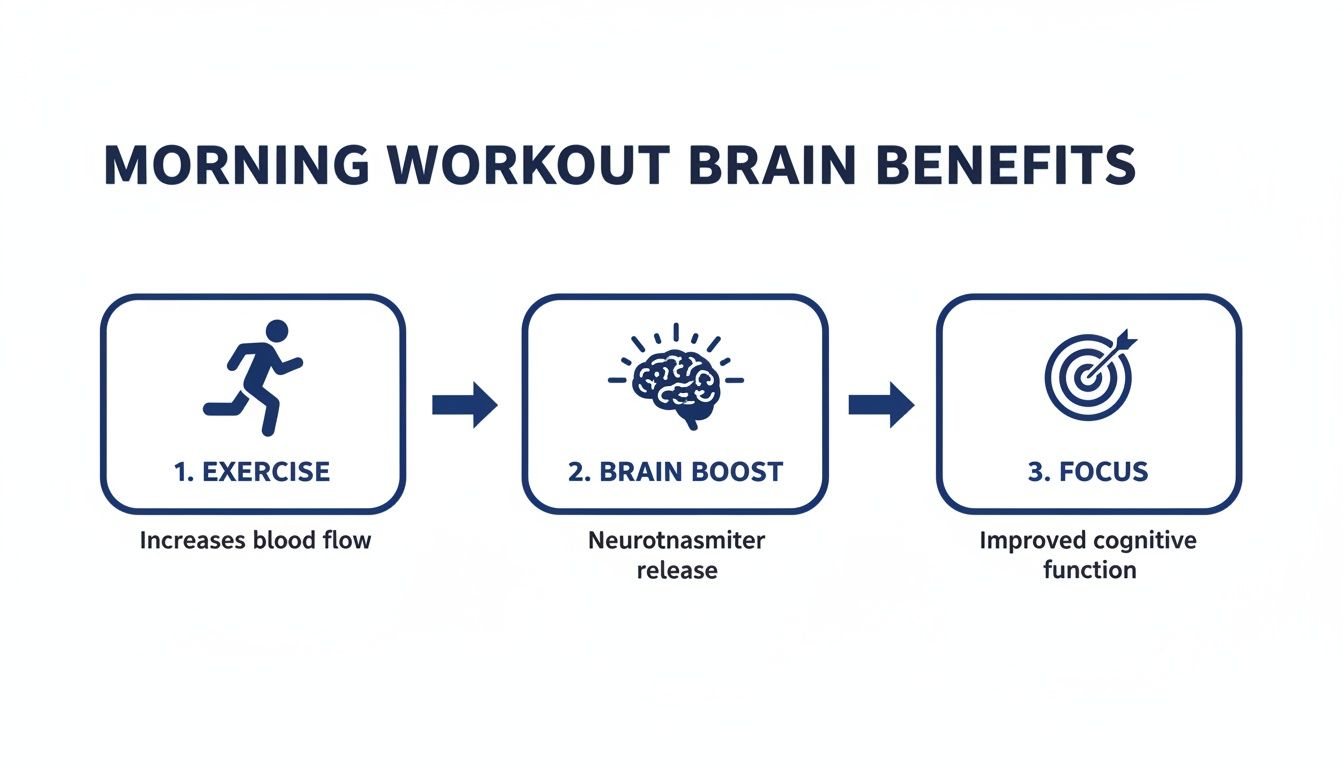
You don’t need a grueling workout to get the cognitive benefits of morning movement. Just five to ten minutes of light exercise is enough to increase blood flow to the brain, delivering a fresh supply of oxygen and nutrients.
This activity stimulates the release of brain-derived neurotrophic factor (BDNF), a protein so important for neuron growth that neuroscientists often call it “Miracle-Gro for the brain.” A short burst of movement also helps regulate morning cortisol levels, clearing away grogginess and boosting your mood.
Want to go deeper on this? You can explore the full benefits of early morning exercise.
- Simple Stretch: A few neck rolls, shoulder shrugs, and a gentle hamstring stretch can do wonders.
- Quick Walk: Step outside for a five-minute walk. The combination of movement and natural light is a powerful wake-up call.
- Yoga Poses: A few rounds of Cat-Cow or a couple of Sun Salutations are perfect for awakening your spine.
A Brief Meditation to Calm Your Amygdala
Your brain’s alarm system, the amygdala, can be extra sensitive in the morning, easily triggering anxiety about the day’s looming demands. A short meditation practice is a direct way to soothe this response.
Just a few minutes of focused breathing activates your parasympathetic nervous system—your body’s “rest and digest” mode. This helps shift you out of a reactive, stressed state and into a more centered, proactive one. It strengthens the connection to your prefrontal cortex, the part of your brain that handles focus and emotional regulation.
Try This: Sit comfortably, close your eyes, and take five slow, deep breaths. Inhale through your nose for a count of four, hold for four, and exhale through your mouth for six. This simple exercise can instantly lower your heart rate and quiet the mental chatter.
The No-Phone Rule for a Dopamine Detox
When you reach for your phone first thing, you’re handing over control of your brain’s reward system to an algorithm. The endless scroll of notifications and social media provides unpredictable hits of dopamine, training your brain to crave constant, low-value stimulation all day long.
A simple “no-phone for the first 30 minutes” rule acts as a mini dopamine detox. It creates a small, sacred space for your own thoughts to emerge without outside influence. This allows your brain to start the day with intention rather than distraction, preserving your finite mental energy for what actually matters.
Journaling for Cognitive Clarity
Getting your thoughts out of your head and onto paper is a scientifically-backed method for achieving cognitive clarity. The physical act of writing helps you process emotions, organize tangled thoughts, and solidify your intentions for the day.
This practice essentially offloads mental clutter from your working memory, freeing up cognitive bandwidth for real problem-solving and creative thinking. You don’t need to write for pages; even a few focused sentences can be incredibly effective.
Simple Journaling Prompts:
- What is my main focus for today?
- What is one thing that could make today great?
- How am I feeling right now, and what do I need?
Daily routines are a powerful anchor for our overall health. Research shows that disruptions to these patterns are linked to negative health outcomes, while stability brings measurable benefits. For instance, adults with consistent sleep and meal schedules have shown 20-30% better diet quality and reduced risks of chronic disease. Foundational habits are often simple: 65% of people start with brushing their teeth and 60% drink water, giving their brain the 30 minutes it needs to fully wake up. Learn more about the research on daily routines and health.
Adapting Your Morning Routine to Real Life
Theory is one thing; putting it into practice when your alarm blares on a Tuesday morning is another beast entirely. The most perfectly crafted routine on paper can shatter under the weight of real life—an early meeting pops up, a kid wakes up grumpy, or you’re just not feeling it. The goal isn’t a rigid, unbreakable schedule. It’s a flexible blueprint you can lean on.
To give you a feel for how these habits can flow together, I’ve put together three adaptable templates. Think of them as starting points, not strict prescriptions. They’re designed for different schedules and goals, showing how you can sequence activities for the biggest impact, even when time is tight.
Morning Routine Templates at a Glance
This table offers a quick comparison of the three sample routines. Use it to find a starting point that feels realistic for your current lifestyle and what you want to achieve each morning.
| Activity | The 20-Min Power Start | The 45-Min Focus Flow | The 60-Min Mindful Morning |
|---|---|---|---|
| Goal | Quick energy and clarity for busy days | Prime the brain for deep, focused work | Reduce anxiety and build calm intention |
| Duration | 20 minutes | 45 minutes | 60 minutes |
| Ideal For | Parents, commuters, anyone short on time | Remote workers, freelancers, creatives | Anyone recovering from burnout or seeking calm |
| Core Elements | Hydration, dynamic movement, quick planning | Screen-free walk, focused journaling, planning | Mindful hydration, light exercise, meditation |
Each template is built around a core principle—efficiency, focus, or mindfulness—so you can align your morning actions directly with your daily intentions.
The 20-Minute Power Start
This is your high-impact, minimal-time routine. It’s built for busy parents, professionals with a killer commute, or anyone who swears they have “no time” for a morning routine. The entire sequence is about efficiency, designed to activate your body and brain quickly to set a proactive tone for the day.
- 6:00–6:02 AM: Hydrate & Get Light
- Keep a glass of water on your nightstand and drink it the moment you sit up. While you’re at it, open the blinds. That one-two punch of hydration and light is a powerful signal to your brain to shut down sleep inertia.
- 6:02–6:07 AM: Dynamic Stretching
- Just five minutes of simple movements—neck rolls, arm circles, leg swings. The goal isn’t a workout; it’s to get blood and oxygen moving to your brain.
- 6:07–6:10 AM: Mindful Breathing
- While the coffee brews, take three slow, deep breaths. This tiny pause is enough to calm your nervous system and shift you out of a reactive state.
- 6:10–6:20 AM: Plan & Fuel
- Grab a quick, protein-rich snack like a shake or a handful of nuts while you identify your top one or two priorities for the day. That’s it. You’re ready to go.
The 45-Minute Focus Flow
I designed this one for remote workers, freelancers, and anyone who needs to prime their brain for deep, concentrated work. This routine creates a deliberate buffer between waking up and getting sucked into the digital vortex, helping you start the day with clarity and control over your own attention.
- 7:00–7:05 AM: Hydrate & Gentle Movement
- Start with water and a few light stretches to gently wake your body up.
- 7:05–7:20 AM: Screen-Free Movement
- Take a 15-minute walk outside. Critically, leave your phone behind. The combination of natural light and physical movement is a potent cocktail for boosting mood and alertness.
- 7:20–7:30 AM: Focused Journaling
- Write down your single most important task for the day. This simple act sharpens your focus and commits your brain to a clear objective before other people’s agendas take over.
- 7:30–7:45 AM: Fuel & Plan
- Make a simple breakfast. This is also the perfect time to glance at your calendar before you open your inbox.
The 60-Minute Mindful Morning
This longer routine is ideal for anyone looking to dial down anxiety, recover from burnout, or just start their day from a place of deep calm and intention. Every step is meant to be slower and more mindful, grounding you before the day’s pressures kick in. (Note: This section is for educational purposes and is not a substitute for professional medical or psychological care for conditions like burnout or anxiety.)
- 6:30–6:40 AM: Mindful Hydration & Gratitude
- Slowly drink a glass of warm water with lemon. As you do, think of one thing you’re genuinely grateful for. This simple practice primes your brain for positivity.
- 6:40–7:00 AM: Light Exercise
- Engage in 20 minutes of gentle activity, like yoga or a brisk walk. A key to making any routine stick is doing it consistently, and exploring strategies for maintaining consistency, even in a fitness context, offers some great insights here.
- 7:00–7:15 AM: Meditation or Quiet Reflection
- Sit in silence or use a guided meditation app. This 15-minute block is crucial for calming the nervous system and strengthening your prefrontal cortex—the part of your brain responsible for focus and emotional regulation.
- 7:15–7:30 AM: Intentional Breakfast
- Enjoy a sit-down breakfast without screens. Use this time to savor your food and mentally prepare for what’s ahead.
Not sure which habits to plug into your routine? This flowchart can help you select activities based on whether your primary goal is to feel more energized, focused, or calm.
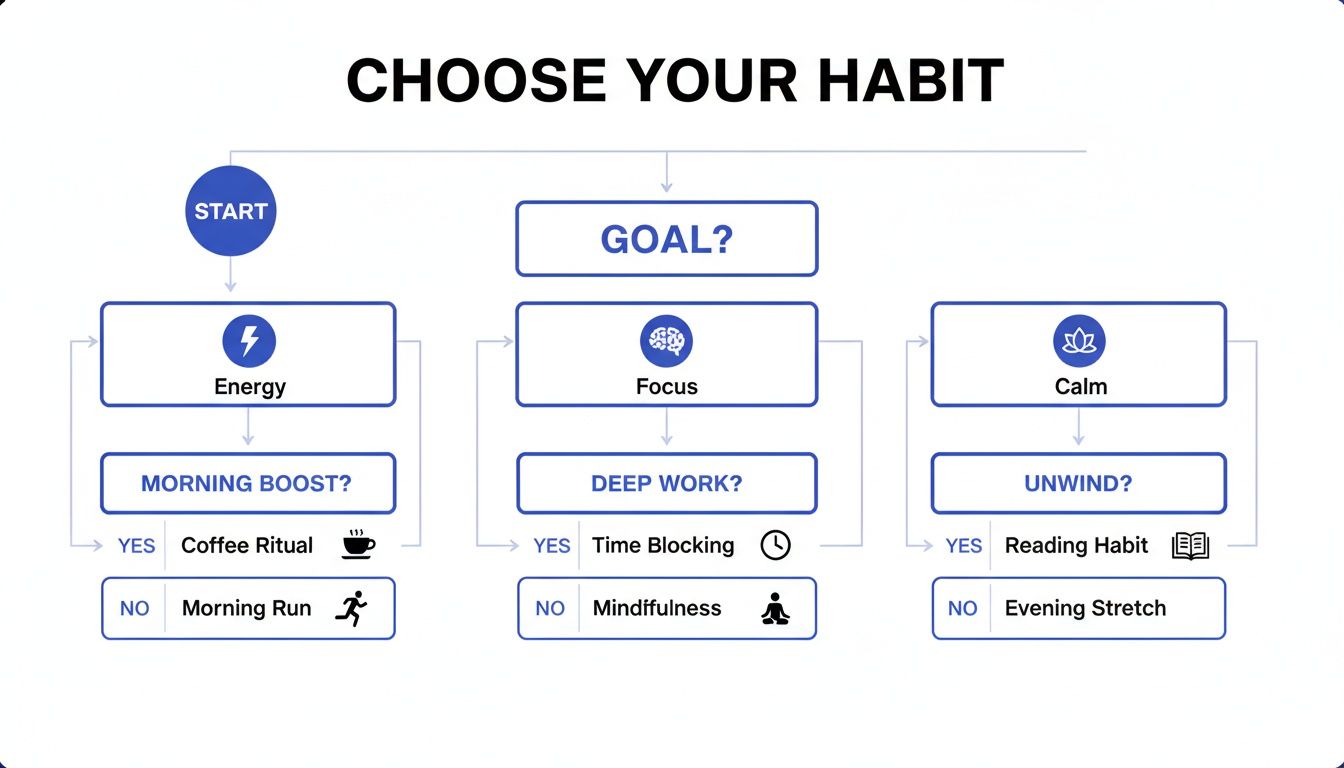
When you start with your end goal in mind, you can build a routine with activities that directly support that outcome, making it feel purposeful instead of like just another thing on your to-do list.
Troubleshooting Your Morning Routine Challenges
Even with the best intentions, a new morning routine can fall apart. Life gets in the way. That early burst of motivation disappears. The alarm clock starts to feel more like an enemy than a tool. Instead of chasing perfection, the real goal is to build a routine that’s resilient enough to survive a bad day. Knowing the common roadblocks—and having a plan for them—is what makes new habits actually stick.
When You Keep Hitting the Snooze Button
The siren call of the snooze button is hard to resist, but it’s a battle you’re biologically destined to lose. Every time you hit snooze, you’re not getting more restful sleep; you’re fragmenting it. This triggers sleep inertia—that heavy, groggy feeling that can linger long after you’re finally up.
Those repeated alarms jolt your system, messing with your natural wake-up cycle and leaving you in a mental fog. If this feels familiar, understanding what causes brain fog can shed some light on why starting your day this way feels so counterproductive. (Note: Persistent sleep problems or brain fog should be discussed with a healthcare professional.)
The Fix: Make the snooze button harder to reach. The simplest trick is often the best: move your alarm clock or phone across the room. This forces you to physically get out of bed to silence it. Once you’re on your feet and moving, you’ve already won half the battle against inertia.
When You Feel Like You Have No Time
“I just don’t have enough time” is probably the number one reason routines fail. This usually comes from an all-or-nothing mindset—the belief that a routine only “counts” if it’s a solid 30 or 60 minutes long. That’s a trap. It sets you up to quit the moment your schedule gets tight.
The Fix: Start ridiculously small with the “Two-Minute Rule.” This idea, borrowed from behavioral psychology, is simple: a new habit should take less than two minutes to do. Instead of a 20-minute meditation, commit to two minutes of focused breathing. Instead of a full workout, just do one minute of stretching.
The point isn’t to get a huge result right away. It’s to master the art of showing up. These tiny, consistent actions build momentum and make the behavior automatic, so you can scale it up later when it feels natural.
When Your Motivation Fades After a Few Days
That initial wave of excitement for a new routine is great, but it never lasts. Motivation is an emotion, and emotions fluctuate. Relying on it to build a long-term habit is a recipe for failure. Real consistency comes from having a system that works even on the days you don’t feel like it.
The Fix: Tie the routine to your identity and make it almost effortless to start. Instead of thinking, “I need to start meditating,” reframe it as, “I’m the kind of person who values a calm start to the day.” An identity-based goal is far more powerful than a task-based one.
Then, lower the barrier to entry so it’s easier to do it than to avoid it. Set out your workout clothes, fill your water glass, or place your journal and pen on your desk the night before. This dramatically reduces the activation energy—the effort it takes to get started—making you far more likely to follow through, even when motivation is low.
Editor’s Take on What Really Works
Let’s be honest for a moment. The perfect, Instagram-worthy morning routine is a myth for most of us. The best way forward isn’t about elaborate rituals; it’s about finding a simple sequence you can actually stick with when you’re tired and uninspired.
For busy professionals feeling overwhelmed by life’s demands, a complicated, hour-long routine is just a recipe for failure. The truth is, a simple 15-minute routine focusing on three core actions delivers about 80% of the potential benefits.
Start with these three non-negotiables:
- Hydration: Drink a glass of water before anything else touches your lips.
- Movement: Do just five minutes of gentle stretching or a quick walk.
- Mindfulness: Take ten deep breaths or write one sentence in a journal.
This minimalist approach is designed as a practical starting point, not a complete life overhaul. It’s for anyone who wants to build momentum without feeling defeated before they even begin.
The real goal is sustainability, not perfection. This small investment provides the structure needed to improve your focus and mood, influencing the delicate balance of dopamine and motivation that shapes your entire day.
Disclaimer: This article contains affiliate links. If you make a purchase through these links, we may earn a small commission at no extra cost to you. This content is for educational purposes only and is not a substitute for professional medical or psychological advice, diagnosis, or treatment. Always consult with a qualified professional for any health concerns.
FAQ: Your Guide on How to Create a Morning Routine
It’s completely normal to have questions when you’re trying to build a new routine from the ground up. Here are some of the most common ones I hear, along with some practical answers to help you sidestep the usual hurdles.
1. How long does it really take to form a morning routine habit?
You’ve probably heard the 21-day myth. While it’s a nice, clean number, the reality is a bit messier. Behavioral science research suggests it takes, on average, closer to 66 days for a new behavior to feel automatic. The most important part is consistency, not perfection. If you miss a day, don’t sweat it. Just show up the next morning.
2. What’s the single most important habit for starting a good morning routine?
If I had to pick just one, it wouldn’t be a trendy biohack. It’s a simple principle backed by a mountain of neuroscience: get natural light in your eyes within the first hour of waking. This is the most powerful signal you can send to your internal body clock (your circadian rhythm). It tells your brain to shut down melatonin production and kickstart alertness. Just open the curtains or step outside for five minutes.
3. Does my morning routine have to start at 5 AM?
Absolutely not. A “morning routine” is about what you do in the first 30-60 minutes after you wake up, not the specific time on the clock. Whether you’re up at 5 AM or 10 AM, the principles are the same. You’re creating an intentional buffer between sleep and the demands of the world. Hydration, movement, and a moment of quiet work just as well at 9 AM as they do before sunrise.
4. Is checking my phone first thing really that bad for my morning?
Ideally, you should avoid it. When your phone is the very first thing you reach for, you’re letting external demands dictate your mental state. This floods your brain with notifications and often triggers a reactive, high-stress response by spiking cortisol. Try a “no-phone for the first 30 minutes” rule. It allows you to start the day proactively, not reactively.
5. What’s the difference between a routine and a ritual?
This is a great question. A routine is just a sequence of actions you follow, like making coffee. A ritual, on the other hand, is a routine that you fill with intention and meaning. Making coffee becomes a ritual when you’re fully present for it—smelling the beans, listening to the water, savoring that first sip without scrolling on your phone. Turning mundane tasks into mindful rituals makes them far more enjoyable and psychologically rewarding.
6. How can I stick to my routine when I travel?
The key is to have a pared-down “travel version” of your routine. You can’t replicate your home setup, so don’t even try. Instead, focus on the most essential, portable habits that anchor you. Maybe that’s a 5-minute stretching sequence you can do in any hotel room, a meditation app on your phone, and a firm commitment to drink a glass of water as soon as you wake up.
7. What if I have young children and my mornings are chaotic?
Start incredibly small. Your routine might just be one minute long. For example, before getting out of bed, take three deep breaths. Or, while the kids eat breakfast, you do five stretches in the kitchen. The goal isn’t a long, uninterrupted block of time; it’s about finding tiny pockets of intention amidst the chaos.
8. How do I know if my morning routine is working?
Pay attention to how you feel around mid-morning and early afternoon. Are you less reactive to stress? Is it easier to focus on your first big task of the day? Do you feel a greater sense of control and calm? These are the real metrics of success, not just whether you checked every box on a list.
9. What are some good morning routine ideas for more energy?
For an energy-focused routine, prioritize habits that stimulate your body and brain. Try a short, brisk walk outside (light + movement), a cold splash of water on your face, dynamic stretches like jumping jacks, and a protein-rich breakfast. These actions work together to quickly shake off sleep inertia.
10. Can creating a morning routine help with focus and ADHD?
While this guide is not medical advice, many people with ADHD find that a structured morning routine helps with executive function. Predictability reduces decision fatigue, and habits like a quick workout or a ‘brain dump’ journal entry can help regulate attention and organize thoughts for the day. If you have ADHD, consider discussing routine-building strategies with a healthcare provider or therapist.
Ready to build a life with more focus, calm, and intention? The books at Mind Clarity Hub provide science-based, actionable roadmaps to help you reclaim your mental space.
Explore the full library of guides on focus, productivity, and digital wellness at Mind Clarity Hub.
Explore the Mind Clarity Hub Library
Practical books on focus, digital habits, resilience, and building a calmer mind.
The Power of Clarity
Unlock mental focus, build momentum, and create the life you were meant to live.
View book →
AI & ChatGPT for Beginners
No PhD needed — a 2025 guide to AI, prompts, and productivity without coding.
View book →
Zen in the Digital Jungle
Mindfulness for a chaotic world.
View book →
The Slow Reset
Mindful living in a fast-paced world.
View book →
Perfectly Imperfect
Stop self-criticism, set boundaries, and embrace the real you.
View book →
Reclaiming Silence
A dopamine detox guide to finding peace in a noisy world.
View book →
The Focused Freelancer
Productivity, pricing & positioning for independents in 2025.
View book →
ChatGPT Side Hustle System
Launch your AI-driven online business in 30 days.
View book →
Burnout, Interrupted
A proven path to restore energy and reclaim your life.
View book →
Attention Unleashed
Focus strategies for the distracted mind.
View book →
Side Hustle Launchpad
Your quick-start guide to extra income.
View book →
Digital Clarity
Rewire your brain, escape dopamine traps & regain focus.
View book →
Break the Scroll
Reduce screen time and take back control of your life.
View book →
Climate Compassion
Transform eco-anxiety into empowered action.
View book →
Village Mentality
The power of community for mental wellness.
View book →
Restful Nights
Overcoming sleep anxiety in a 24/7 world.
View book →
Connected Again
Combat loneliness and build meaningful relationships.
View book →
Focus Recharged
Mastering attention and productivity in the digital era.
View book →
Marketing Magic with ChatGPT
AI-powered content, campaigns, and copywriting to grow faster.
View book →
The 6-Figure Creator
Turn knowledge into passive income with books, courses & AI.
View book →
Burnout Breakthrough
Reset your work-life balance and thrive in 2025.
View book →
The Emotionally Intelligent Man
A modern guide to self-awareness and communication.
View book →
AI Personalized Wellness
Create your custom health plan with data-driven habits.
View book →
Everyday AI Made Easy
Use ChatGPT and smart tools to simplify life.
View book →
Money Mindfulness
A financial wellness guide for Gen Z & Millennials.
View book →
Startup Smarter with AI
ChatGPT strategies and tools to grow your business.
View book →
ChatGPT for Writers & Creators
Unlock AI-powered brainstorming, drafting & editing.
View book →