...

Tag: emotional regulation

  • How to Stop Procrastinating Using Neuroscience

    How to Stop Procrastinating Using Neuroscience

    To stop procrastinating, you first have to understand what it really is: an emotional response, not a character flaw. It’s your brain’s go-to coping mechanism for avoiding negative feelings like anxiety, boredom, or self-doubt. The real key isn’t to just “try harder”—it’s to manage those emotions, break overwhelming tasks into tiny steps, and build momentum with a few quick wins.

    Affiliate Disclosure: This article contains affiliate links. If you make a purchase through these links, we may earn a small commission at no extra cost to you. We only recommend products we trust.

    Why We Procrastinate (It’s Not About Laziness)

    That big project is looming, but you suddenly find yourself organizing your spice rack or scrolling through vacation photos from three years ago. Sound familiar?

    This detour isn’t a sign of laziness or some deep moral failing. Instead, it’s a profoundly human, brain-based reaction to uncomfortable feelings. Behavioral research shows that procrastination is less about poor time management and far more about managing difficult emotions.

    how to stop procrastinating: young Asian man sitting at a clean desk, looking intently at a closed laptop

    The Brain’s Internal Conflict: How to Stop Procrastinating

    At the heart of this struggle is a battle between two key parts of your brain. On one side, you have the amygdala, your brain’s emotional alarm system. Neuroscience explains that it flags any task that triggers feelings of boredom, anxiety, insecurity, or frustration. Subsequently, its only goal is to find immediate relief from that discomfort.

    On the other side is the prefrontal cortex, the more rational, evolved part of your brain that handles planning and long-term goals. When the amygdala sounds the alarm, the prefrontal cortex can get completely steamrolled by the immediate emotional reaction.

    The result? You choose the short-term mood boost of a distraction over the long-term reward of actually finishing the task. This internal tug-of-war is central to understanding how to stop procrastinating for good. If you want to go deeper on this, our guide on executive function skills is a great next step.

    Procrastination is an emotion regulation problem, not a time management problem.

    — Dr. Tim Pychyl, Associate Professor of Psychology, Carleton University

    A Modern Epidemic

    This internal conflict is more common than ever. Back in 1978, only about 5% of the population considered themselves chronic procrastinators. Today, that number has shot up to over 20% of adults worldwide.

    That’s a four-fold increase in just a few decades, which tells you something important. Modern distractions are pouring fuel on our brain’s natural tendency to seek comfort. Consequently, to really get a handle on it, it’s crucial to uncover the real reasons for procrastination and move past the myth that it’s just about being lazy.

    Recognizing this emotional root is the first and most critical step. Once you reframe the problem, you can shift from self-blame to proactive, practical strategies. The rest of this guide will give you actionable, science-backed methods to manage these feelings, regain control, and finally get things done.

    Quick Wins to Break Procrastination Now

    When you’re stuck, you don’t need more theory. You need practical, powerful tools that cut through the mental fog right now. The following techniques are grounded in behavioral psychology and designed to give you an immediate sense of control and momentum.

    These strategies work because they trick your brain by lowering the perceived effort of a task. In other words, they make the first step feel so small and manageable that your internal resistance just… gives up. Once you build that tiny bit of momentum, it’s far easier to keep the ball rolling.

    how to stop procrastinating: a person using a red tomato Pomodoro timer on a white desk with a smartphone, headphones, and a notebook nearby

    Use the Pomodoro Technique to Get Started

    The Pomodoro Technique is a classic for a reason. It’s a time management method that breaks work into focused, 25-minute sprints separated by short breaks. This approach is a lifesaver for those huge, intimidating projects that feel too big to even think about.

    Committing to just 25 minutes of focused work feels way less daunting than staring down an eight-hour day. From a psychological perspective, this short burst helps bypass your brain’s initial “nope” response. Plus, knowing a break is just around the corner gives you a clear finish line, making it easier to stay on track. This method is a core principle in understanding the neuroscience of single-tasking.

    • Mini Scenario: You have a 10-page report to write, and the thought is paralyzing. Instead of freaking out, you set a timer and tell yourself, “I’m just going to work on the outline for 25 minutes.” When the timer dings, you get up, stretch for five minutes, and then dive into another session. Suddenly, you’re making progress.

    Apply the Two-Minute Rule for Quick Wins

    Coined by productivity guru David Allen, the Two-Minute Rule is beautifully simple: if a task takes less than two minutes to complete, just do it immediately. This is your secret weapon against the tiny tasks that pile up and create a feeling of overwhelming clutter.

    The real goal here isn’t just to clear your to-do list; it’s about building the habit of taking action. Every time you knock out a two-minute task, you get a small dopamine hit from your brain’s reward system. This reinforces a positive feedback loop that makes you feel capable and productive, creating momentum you can carry into much bigger challenges.

    • Mini Scenario: You see a dirty dish in the sink, remember you need to fire off a quick email, and spot a bill on the counter. Instead of leaving them for “later,” you wash the dish (one minute), send the email (one minute), and pay the bill online (two minutes). In less than five minutes, you’ve erased three sources of low-grade mental static.

    Don’t overthink it. Overthinking can be just as paralyzing as procrastination. You can’t do everything you need to do all at once. Break it up in a way that makes sense—just start taking small steps and you will get there.

    Leverage Temptation Bundling to Make Tasks Appealing

    Temptation bundling is a clever concept from behavioral economics where you pair something you want to do with something you should do. This strategy links an immediate reward with a beneficial but less appealing task you’ve been avoiding.

    It works by hijacking your brain’s reward system. Instead of dwelling on the dread of the task, your brain starts anticipating the pleasure of the activity you’ve bundled with it. Consequently, this simple shift makes the undesirable chore feel more attractive and much easier to start.

    • Mini Scenario: You despise folding laundry. You decide you’re only allowed to listen to your favorite true-crime podcast while you’re folding. Now, the chore is directly linked to an activity you genuinely look forward to, transforming it from a burden into an opportunity.

    For an even deeper toolkit of actionable methods, explore these 10 practical ways to stop procrastination. These tactics can provide immediate relief and help you reclaim your focus, one small, manageable step at a time.

    How to Stop Procrastinating With Long-Term Systems

    Quick fixes are great for snapping out of a moment of paralysis, but let’s be honest—lasting change demands more. If you really want to stop fighting the same battles every week, you have to build better systems. This means creating habits that work with your brain’s natural wiring, not against it. This is where we move beyond sheer willpower and start designing our days to make procrastination the harder path.

    Instead of trying to force yourself to do things, you can craft routines that make productive actions feel almost automatic. This isn’t about being perfect; it’s about making good behavior the path of least resistance. Therefore, you can save your mental energy for the work that actually matters.

    Use Implementation Intentions to Pre-Decide Your Actions

    One of the most effective, science-backed ways to get out of your own way is to use implementation intentions. It sounds complex, but it’s a dead-simple strategy: you decide in advance exactly when and where you’ll tackle a specific task.

    The formula is just “If [SITUATION], then I will [ACTION].”

    This “If-Then” plan creates a pre-loaded response in your brain, a concept well-supported by behavioral research. When the trigger happens, the action you planned automatically comes to mind. It cuts through the internal debate and the mental friction that so often lead to putting things off.

    • Mini Scenario: Let’s say you always put off reviewing your weekly finances. You’d create an implementation intention like this: “If I finish my last meeting on Friday afternoon, then I will immediately open my budget spreadsheet and review it for 20 minutes.” When Friday comes and that meeting ends, the next step feels obvious, not like a chore you have to talk yourself into.

    Build Momentum with Habit Stacking

    Another game-changer is habit stacking. The idea is to anchor a new habit you want to build onto a solid, existing one you already do without thinking. Your current habits are strong, well-worn neural pathways. By linking a new behavior to an established one, you’re essentially borrowing its momentum.

    You just need to connect the new action to something you do every single day. For instance, you could link it to brewing coffee, brushing your teeth, or walking in the door after work. The formula looks like this: “After [CURRENT HABIT], I will [NEW HABIT].”

    • Mini Scenario: You want to get better at planning your day so you don’t feel so overwhelmed. You could decide: “After I pour my first cup of coffee in the morning, I will sit down and write my top three priorities for the day.” The act of pouring coffee becomes a powerful cue, making the new planning habit much easier to lock in.

    This tiny, consistent action creates immediate clarity. Moreover, it heads off that aimless feeling that so often fuels procrastination. Discover more strategies for achieving this in my book, The Power of Clarity.

    Design Your Environment for Success

    Your physical and digital spaces have a massive, often invisible, influence on your behavior. Environment design is all about intentionally structuring your surroundings to make good habits easier and distracting ones harder. It’s about removing the little decision points that stand between you and the task you need to do.

    Procrastination loves convenience. If your phone is right there and your project files are buried three folders deep, your brain will almost always choose the easier, more distracting path. The goal is to flip that equation.

    Here are a few ways to put environment design into practice:

    • Increase Friction for Distractions: Log out of your social media accounts when you’re done for the day. Put your phone in another room when it’s time to focus. A little bit of friction goes a long way.
    • Reduce Friction for Good Habits: Lay out your workout clothes the night before. Put the book you want to read right on your pillow. Make the next right action the most obvious one.
    • Optimize Your Workspace: Clear your desk of everything except what you need for your current task. This simple act minimizes the visual clutter that creates mental noise.

    “A river cuts through rock, not because of its power, but because of its persistence.”

    — James N. Watkins

    The costs of not building these systems are kind of shocking when you see the numbers. The average person procrastinates for about 3.6 hours per day. That adds up to 55 days of lost productivity every single year. For an individual, that can translate to a financial loss of nearly $8,875 annually. You can discover more insights about the cost of procrastination and see just how much those “I’ll do it later” moments really add up.

    By rewiring your habits with these strategies, you’re not just getting more done—you’re reclaiming that lost time and energy for good.

    Immediate vs Long-Term Procrastination Strategies

    Before we dive deeper into the mental skills you’ll need, let’s clarify the difference between the quick tactics we covered earlier and the long-term strategies we’re discussing now.

    This table breaks down the two types of approaches. Immediate tactics are your first-aid kit for getting unstuck right now. Long-term strategies are the lifestyle changes that prevent you from getting stuck in the first place.

    Strategy TypeTechniquesBest ForHow It Works
    Immediate TacticsTime-Boxing, Pomodoro Technique, Temptation BundlingBreaking through acute procrastination on a specific, urgent task.Creates external structure and immediate rewards to overcome in-the-moment resistance and inertia.
    Long-Term StrategiesImplementation Intentions, Habit Stacking, Environment DesignBuilding sustainable systems that prevent procrastination over time.Automates good behavior by linking it to existing routines and removing environmental friction.

    Both are essential. You need the quick fixes for bad days, but you need the long-term systems to have fewer bad days overall. Using them together gives you a complete toolkit for taking consistent, meaningful action.

    Mastering the Emotions That Fuel Procrastination

    At its core, procrastination is rarely about the task itself. It’s about avoiding the uncomfortable feelings the task brings up—boredom, anxiety, self-doubt, or plain old frustration. To really get a handle on it, you have to go beyond simple productivity hacks and learn to manage the emotional triggers hiding underneath.

    This is your mental toolkit, grounded in neuroscience, to help you face challenging tasks with resilience instead of avoidance. It’s about changing your relationship with discomfort so it no longer runs the show.

    Please note: This article provides educational information and is not a substitute for professional medical or psychological advice. If you are struggling with severe anxiety, depression, burnout, sleep problems, ADHD, or other mental health concerns, please consult a qualified healthcare provider. This content is not intended to diagnose, treat, or cure any condition.

    how to stop procrastinating: hands writing “I feel anxious — name it to tame it” in a notebook on a white desk with a cup of tea

    Use the “Name It to Tame It” Strategy

    When that wave of dread hits you before starting a big project, your brain’s emotional hub, the amygdala, is firing on all cylinders. A surprisingly effective technique to calm this down is to simply label the emotion you’re feeling.

    This strategy, often called “Name It to Tame It,” involves acknowledging the feeling out loud or just writing it down. Neuroscience research shows that putting feelings into words can dampen the amygdala’s alarm bells and engage the more logical prefrontal cortex. That tiny pause creates just enough mental space to choose a more rational response than running away.

    • Mini Scenario: You have to prep a presentation, but a knot of anxiety is tightening in your stomach. Instead of reflexively opening a new browser tab, you pause. You say to yourself, “Okay, I feel anxious about this because I’m worried it won’t be good enough.” Just naming that fear dials down its power, making it easier to actually open the file and start on the first slide.

    Manage and Protect Your Mental Energy

    Every single decision you make all day, no matter how small, chips away at a finite resource of mental energy. This is a real phenomenon known as decision fatigue. When your brain is tired from making endless choices, your ability to exert self-control and tackle difficult tasks takes a nosedive.

    Procrastination loves it when your willpower is low. A powerful long-term strategy, then, is to protect your mental energy by creating simple, predictable routines. This cuts down on the trivial decisions you have to make, saving your cognitive bandwidth for what actually matters.

    You can learn more about managing your brain’s emotional responses by exploring how to retrain your limbic system for greater calm and focus.

    If you struggle with procrastination, the odds are that you won’t learn to stop it overnight. It may take some trial and error. Even when you struggle, though, there is still one thing you can do to avoid repeating the behavior. That step is to pay close attention.

    Prioritize True Recovery and Rest

    In a culture that glorifies the nonstop hustle, it’s easy to forget that rest isn’t a luxury—it’s a biological necessity for sustained focus and performance. When you’re overworked and exhausted, your brain’s capacity for emotional regulation and executive function weakens. This state of burnout makes procrastination almost inevitable.

    True recovery isn’t just about getting more sleep; it’s about intentionally scheduling activities that restore your mental and emotional reserves.

    • Take Micro-Breaks: Step away from your desk for five minutes every hour. Stretch. Look out a window. Just disconnect.
    • Disconnect Fully: Set clear boundaries for your workday. Stop checking emails or work messages during your downtime. Seriously.
    • Engage in Restorative Activities: Spend time in nature, practice mindfulness, or get lost in a hobby that has absolutely nothing to do with being productive.

    Building these practices into your life is non-negotiable. For those who find this balance especially tough, books like Focus Recharged and Burnout Interrupted offer practical roadmaps for reclaiming your energy and attention. By mastering your emotional landscape, you get to the root cause of procrastination and build a more resilient foundation for getting things done.

    Editor’s Take: What Actually Works to Stop Procrastinating?

    After digging through countless tactics, what’s the one thing that truly helps you stop procrastinating? Here’s the honest answer: it isn’t a single magic trick. The most effective approach is a powerful one-two punch that combines an immediate fix with a long-term habit change.

    Think of it like this: You use an instant tactic like the Pomodoro Technique to break through the inertia on a task you’re dreading today. At the same time, you start building a long-term strategy like environment design to make starting that same kind of task easier tomorrow.

    This dual strategy gives you both instant relief and lasting, sustainable change. It tackles the in-the-moment emotional friction that fuels procrastination while systematically building a foundation that makes future inaction far less likely.

    Who This Advice Is Really For

    This guide is for motivated professionals, students, and freelancers who know they have a pattern of delay and are ready for practical, science-backed solutions. It’s for anyone who struggles to get started, gets easily sidetracked by digital rabbit holes, or feels paralyzed by big, overwhelming projects.

    The key is a genuine willingness to experiment with these small behavioral shifts. If you’re looking for a way to regain control and build consistent momentum, these strategies offer a clear path forward. By focusing on small wins and building better systems, you can create a more productive and much less stressful way of working. For a deeper dive into building these systems, The Power of Clarity offers a structured roadmap.

    Important Caveats and Limitations

    It’s crucial to understand the scope of this advice. While these strategies are highly effective for managing everyday procrastination, they are not a substitute for professional medical or psychological care.

    If your procrastination feels debilitating or is deeply tangled up with symptoms of severe anxiety, depression, burnout, or ADHD, please see these techniques as helpful complements to—not replacements for—guidance from a qualified healthcare provider. They are powerful tools for building better habits, but they aren’t designed to treat underlying clinical conditions. Your mental health always comes first.

    Your Action Plan to Overcome Procrastination

    Alright, let’s turn these ideas into a real-world action plan. Think of this as your personal checklist for the next time you feel that familiar pull to put something off. These are the core strategies, ready to grab and use today.

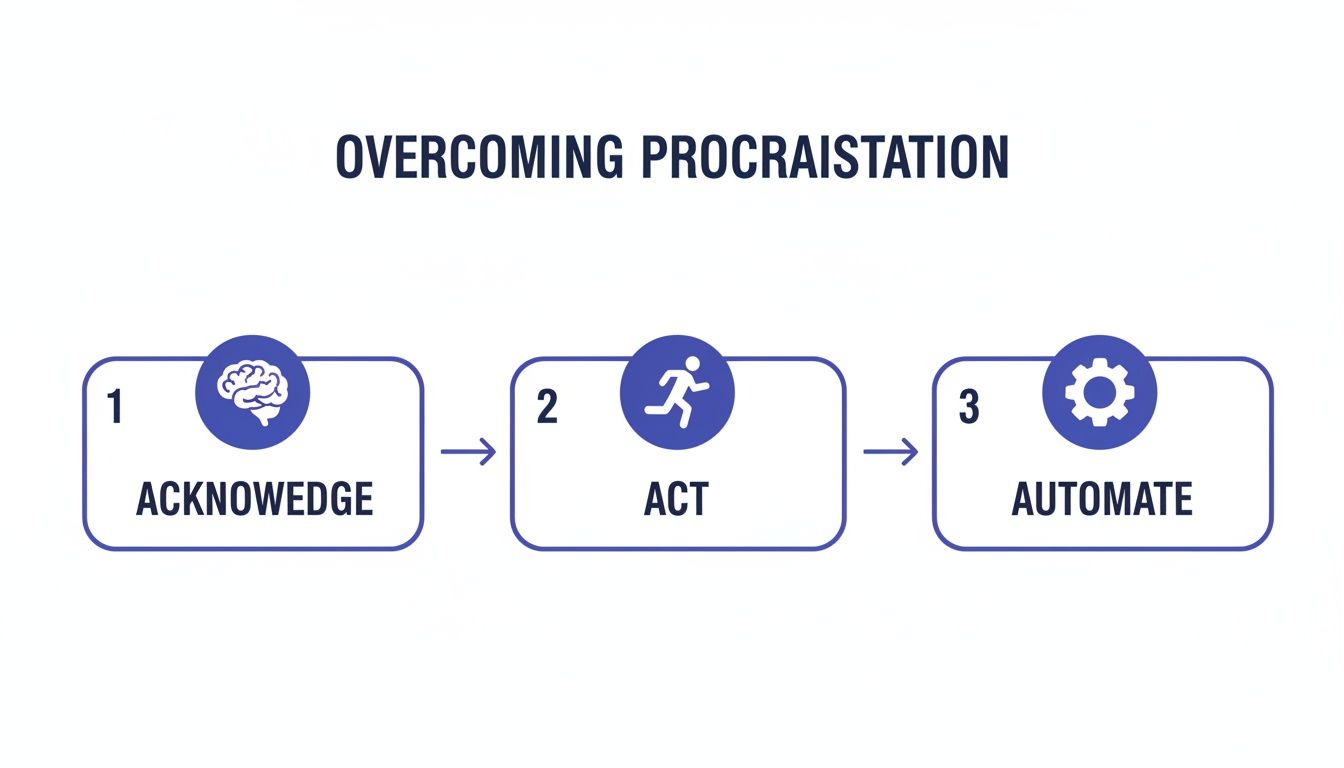
    • Acknowledge the Emotion First
      Before you do anything else, pause and name the feeling. Procrastination isn’t about laziness; it’s an emotional response. Are you feeling anxious, bored, overwhelmed, or afraid of failing? Just putting a label on it—”Okay, I’m feeling overwhelmed by this report”—can take away some of its power over you.

    • Shrink the First Step
      Momentum is everything. Use the 2-Minute Rule to get the ball rolling. If a task takes less than two minutes, just do it. This small win sends a positive signal to your brain, making the next, bigger step feel far less intimidating.


    Design a Supportive System to Stop Procrastinating

    Here’s the thing: long-term change isn’t about white-knuckling your way through with willpower. It’s about building systems that make the right choices easier.

    • Automate Your Actions with “If-Then” Plans: This is about removing the decision-making step that so often trips us up. Instead of waiting for motivation, create an implementation intention. For example, “If it’s 3 PM, then I will work on my report for 15 minutes.” This simple script makes the action almost automatic.

    • Design Your Environment for Focus: Make your desired action the path of least resistance. If you need to focus, put your phone in another room. Clear the clutter off your desk. A clean, well-designed space reduces the friction between you and the work that matters. If you want to dive deeper into this, our guide on how to train your brain to focus is a great next step.


    The secret to getting more done is not to work harder, but to remove the barriers that stop you from starting in the first place. Create a path of least resistance to your most important tasks.

    When you combine these quick wins with a thoughtfully designed system, you create a powerful, sustainable way to finally move past procrastination for good.

    Key Takeaways on How to Stop Procrastinating

    • Procrastination is an emotional response, not a character flaw. Your brain avoids tasks that trigger negative feelings like anxiety or boredom.
    • The brain is in conflict. The emotional amygdala seeks immediate relief, often overpowering the logical prefrontal cortex that handles long-term goals.
    • Start with quick wins. Use the Pomodoro Technique (25-minute sprints) or the Two-Minute Rule to build momentum and trick your brain into starting.
    • Build long-term systems. Use “If-Then” plans (implementation intentions) and habit stacking to automate good behavior and reduce reliance on willpower.
    • Design your environment for success. Increase friction for distractions (e.g., phone in another room) and reduce friction for good habits (e.g., workout clothes laid out).
    • Manage your emotions. Use the “Name It to Tame It” strategy to acknowledge and reduce the power of negative feelings that fuel procrastination.
    • This advice is educational, not medical. For chronic procrastination linked to conditions like ADHD, anxiety, or depression, consult a professional.

    Disclaimer: This article contains affiliate links that may generate a small commission at no extra cost to you. The content provided is for educational and informational purposes only and does not constitute medical or psychological advice. Always consult a qualified healthcare professional for personalized guidance.

    A three-step diagram outlining how to overcome procrastination: Acknowledge, Act, Automate.

    Your Procrastination Questions, Answered

    Let’s dig into some of the most common questions that come up around procrastination. Getting clear on these ideas will help you move forward with a lot more confidence and a lot less self-blame.

    1. Is procrastination just a sign of laziness?

    Not at all. This is probably the biggest misconception out there. Laziness is an unwillingness to act. Procrastination is something else entirely—it’s an active choice to do something else, even when you know you probably shouldn’t. That choice is almost always about managing uncomfortable feelings. Think anxiety, boredom, insecurity, or just the sheer overwhelm of a task. It’s an emotional regulation problem, not a character flaw.

    2. So why do I always procrastinate on the most important things?

    It seems backward, doesn’t it? But we often put off the most important tasks for a few very human reasons. Fear of failure, perfectionism, vague goals, or low self-efficacy can all make the pressure feel too high. Avoiding the task feels safer than facing the possibility of not meeting expectations.

    3. Can procrastination be a symptom of something more?

    Yes, absolutely. While everyone procrastinates sometimes, chronic and severe procrastination can be a sign of an underlying condition. It’s often linked with ADHD, anxiety disorders, or depression. If your procrastination feels completely debilitating and you’re seeing other persistent symptoms, it’s a good idea to chat with a medical or mental health professional. This guide is for educational purposes and isn’t a substitute for professional care.

    4. What’s actually happening in my brain when I procrastinate?

    Think of it as a battle between two parts of your brain. On one side, you have the limbic system—your emotional, instant-gratification center. On the other, you have the prefrontal cortex, which handles rational planning. When you face a task you dread, your limbic system screams, “This feels bad! Let’s do something fun instead!” It wants immediate relief and often overpowers the prefrontal cortex.

    5. Just how common is this, really?

    It’s incredibly common. You are far from alone. While roughly 20-25% of adults are chronic procrastinators, the numbers explode in academic environments. Studies show that 80-95% of college students procrastinate. Researchers have also linked chronic procrastination to serious health issues like hypertension and anxiety. You can read the full research about these academic and health consequences if you want to dig into the data.

    6. What can I do right now to stop procrastinating?

    To get moving immediately, you have to make the first step ridiculously small. Try the Two-Minute Rule: if something takes less than two minutes, just do it now. No debate. For bigger projects, the Pomodoro Technique is your best friend. Work in a focused 25-minute sprint, then take a short break. These tiny, contained bursts of effort are brilliant for bypassing your brain’s initial resistance.

    7. How do I overcome procrastination for good?

    Lasting change isn’t about heroic sprints; it’s about building better systems. Use Implementation Intentions—simple “If-Then” plans like, “If it’s 9 AM on Monday, then I will open my project document.” Pair that with Environment Design. Make your workspace a cue for focus by putting your phone in another room and removing distractions. The goal is to make doing the right thing the path of least resistance.

    8. Is there ever a good side to procrastination?

    In very specific, rare cases, maybe. Some people engage in “active procrastination,” where they intentionally delay a task to use the pressure as a motivator. For them, the adrenaline rush works. But for the vast majority of us, the stress, anxiety, and drop in work quality far outweigh any perceived benefits. It’s generally a losing strategy.

    9. What is “revenge bedtime procrastination”?

    This one has become really common. Revenge bedtime procrastination is when you sacrifice sleep for leisure time because you feel like your day was completely controlled by other people’s demands. It’s a way of reclaiming a few hours of freedom for yourself. While the impulse is understandable, it backfires. The resulting sleep deprivation tanks your focus and emotional regulation the next day, making you even more likely to procrastinate. If this cycle sounds familiar, the book Restful Nights offers some great strategies for breaking it.

    10. How can I help someone else who procrastinates?

    The most important thing is to approach them with empathy, not judgment. Criticism will only amplify the shame that’s likely fueling the behavior. Instead, try to understand what’s behind the delay. Offer to help them break a big, scary task into tiny, manageable steps. Sometimes, just offering to be an accountability partner provides the external structure they need to finally get started.


  • Your Guide to Limbic System Retraining for Focus and Calm

    Your Guide to Limbic System Retraining for Focus and Calm

    Your Guide to Limbic System Retraining for Focus and Calm

    Jeremy Jarvis — Mind Clarity Hub founder
    Mind Clarity Hub • Research-aware focus & digital wellness

    Think of your brain’s limbic system as its emotional alarm. After a period of intense stress or burnout, that alarm can become way too sensitive, triggering a huge reaction to something small. Limbic system retraining is a collection of practices designed to turn down the sensitivity on that alarm system, using your brain’s incredible ability to rewire itself.

    A quick heads-up: This post may contain affiliate links. If you make a purchase through one of our links, we may earn a small commission at no extra cost to you. We only recommend products we trust.

    Your Brain’s Emotional Alarm System

    Ever found yourself completely losing it over a minor setback? Maybe a slightly critical email sends your heart pounding, or a last-minute change of plans leaves you feeling a wave of anxiety that just feels… disproportionate.

    That’s not a personal failure. In neuroscience terms, it’s often a sign that your limbic system has become sensitized.

    This deep-seated network of brain structures, including the amygdala and hippocampus, is basically your emotional headquarters. Behavioral research shows it’s in charge of processing feelings, filing away memories, and kicking off your fight-or-flight response. When you go through prolonged stress, trauma, or burnout, this system can get stuck on high alert.

    What Happens When the Alarm Is Stuck On

    A hyper-reactive limbic system feels like an internal smoke detector that goes off every time you toast a piece of bread. Even when there’s no real fire, the alarm is blaring. From a psychological perspective, this state of constant alert can show up in a few key ways:

    • Heightened Emotional Reactions: Small triggers lead to big feelings.
      • Real-World Example: You misplace your keys and feel a surge of intense frustration that ruins your morning, rather than just a moment of annoyance.
    • Persistent Anxiousness: A low-grade hum of worry or unease that follows you around all day.
      • Real-World Example: You’re constantly replaying conversations in your head, worrying about what you said or how others perceived you, even when there’s no logical reason to.
    • Difficulty Focusing: Your brain is so busy scanning for threats that it struggles to concentrate on the task at hand. This is a huge contributor to what most of us call mental fog. You can find a deeper dive on this in our guide to the science of mental fog.
    • Physical Symptoms: The chronic stress from a nervous system stuck in overdrive can lead to fatigue, sleep problems, and even digestive issues.

    Important Note: This article is for educational purposes and is not a substitute for professional medical or psychological advice. If you’re struggling with symptoms related to anxiety, depression, burnout, ADHD, or sleep problems, please consult a qualified healthcare provider for diagnosis and treatment.

    How Retraining Rewires Your Brain

    The whole point of limbic system retraining isn’t to stuff your emotions down—it’s to change your brain’s automatic reaction to them. It works because of neuroplasticity, a core concept in neuroscience that describes the brain’s amazing capacity to reorganize itself by forming new connections.

    Think of it like forging a new path in a dense forest. The old, well-worn path (your reactive habit) is easy to slip back into. But if you intentionally start clearing a new trail, it takes conscious effort at first. With enough repetition, that new path becomes the default, and the old one slowly gets overgrown from disuse.

    Limbic system retraining visualization — glowing brain hovering above a tidy workspace, representing reduced stress reactivity and improved emotional regulation

    This isn’t just a nice metaphor; it’s grounded in biology. Neuroimaging studies show that persistent stress can physically ramp up activity in limbic areas like the amygdala. But those same studies are also showing that targeted practices can create measurable changes, calming that reactivity back down.

    By consistently engaging in specific exercises, you can literally teach this ancient part of your brain to respond with more calm and less alarm. You’re not broken—your alarm system just needs a tune-up.

    The Four Pillars of Your Retraining Practice

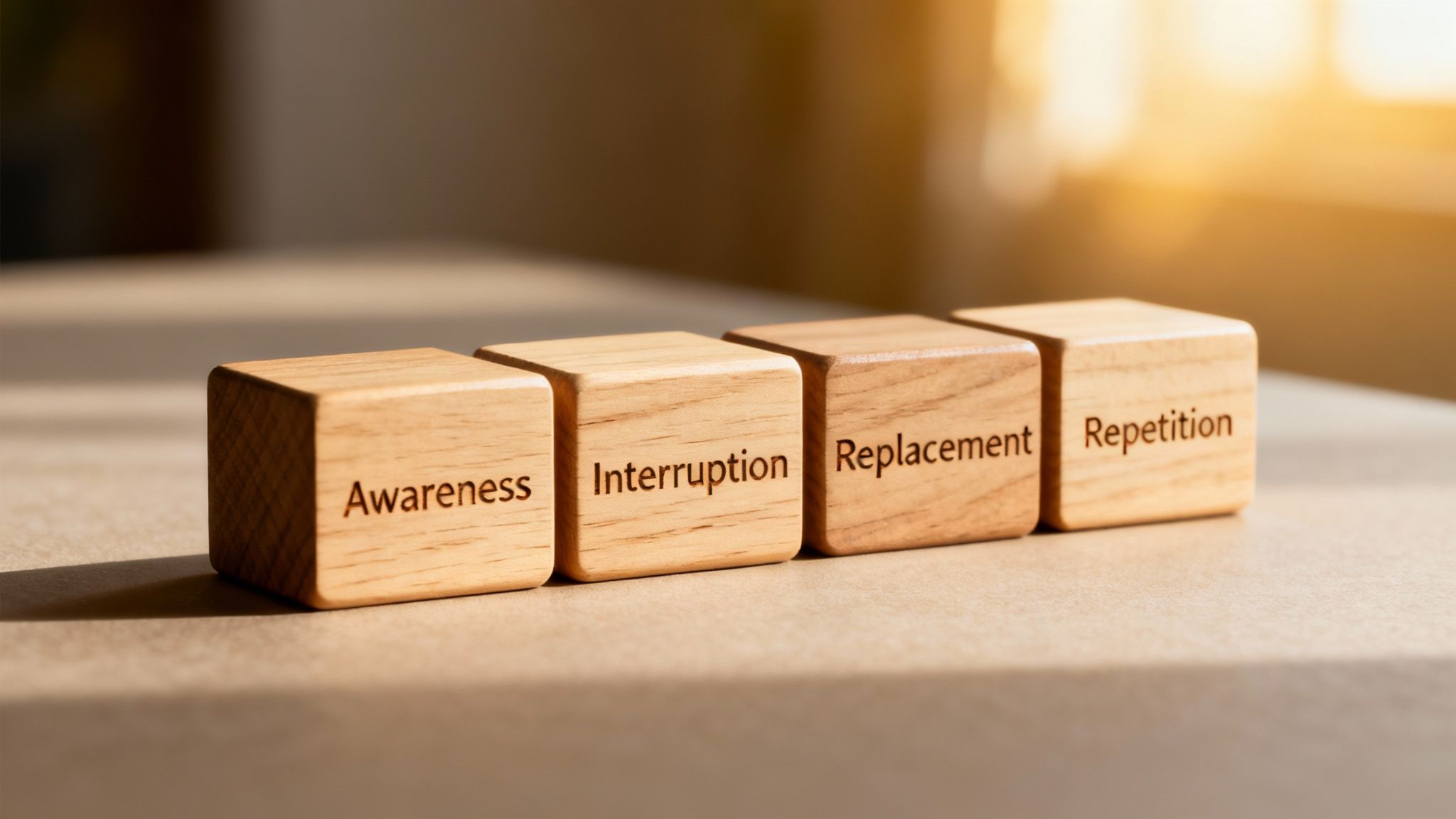
    Limbic system retraining isn’t about memorizing a rigid set of complicated rules. It’s much more practical than that. The whole practice is built on a foundation of four core pillars that work together in a continuous cycle based on principles of behavioral psychology.

    Think of these not as strict steps you follow in order, but as a framework that gives you a repeatable process for consciously guiding your brain’s reactions.

    A row of wooden blocks showing the Limbic System Retraining cycle: Awareness, Interruption, Replacement, Repetition.

    This framework gives you something tangible to lean on when you’re dealing with triggers—from small, daily annoyances to major, life-altering stressors. Once you understand how each pillar works, you can start applying these ideas in your own life, right away.

    Awareness: The Art of Noticing

    The first and most crucial pillar is Awareness. This is simply the practice of spotting the exact moment your internal alarm system gets tripped. It’s about learning to recognize the subtle physical and mental cues that signal a limbic response is kicking in, long before it snowballs into a full-blown reaction.

    This isn’t about judging yourself; it’s pure, curious observation. Your only job here is to become a scientist of your own inner world.

    So, what does this actually look like? You might notice:

    • A physical sensation: That sudden tightness in your chest, a familiar knot in your stomach, or your shoulders tensing up toward your ears.
    • An emotional shift: A quick flash of irritation when someone cuts you off, a wave of dread before a meeting, or a surge of defensiveness during a conversation.
    • A recurring thought: “I can’t handle this,” “They’re going to be so angry,” or “This is guaranteed to be a disaster.”

    Real-World Example: You’re a freelancer and an email from a big client lands in your inbox with the subject line “Urgent feedback.” Before you even open it, you feel your heart pick up speed and a sense of dread wash over you. That moment—of simply noticing the physical and emotional shift—is Awareness in action.

    Interruption: Creating a Conscious Pause

    Once you’re aware that a trigger has set off your internal alarm, the next pillar is Interruption. This is where you deliberately create a pause—a tiny wedge of space—between the trigger and your automatic reaction. The whole point is to stop the old, well-worn neural pathway from firing on autopilot.

    An interruption doesn’t need to be dramatic. It’s often just a simple, conscious action that breaks the pattern and yanks you back into the present moment.

    Effective interruption techniques can be:

    • Verbal: Silently or audibly saying a simple word like “Pause,” “Stop,” or “Hold.” This acts as a clear command to your brain to halt the automatic process.
    • Physical: Clenching and unclenching your fists, pressing your feet firmly into the floor, or taking a single, slow, deep breath. These actions ground you in your body.
    • Mental: Visualizing a big red stop sign in your mind’s eye or picturing a gate closing on that reactive thought pattern.

    Real-World Example: After noticing the dread from the client email (Awareness), you deliberately place your hand on your desk and take one slow, deep breath before clicking to open it. This tiny action breaks the immediate panic response and gives you a split second of control.

    Replacement: Choosing a New Response

    After you’ve successfully interrupted the old pattern, you arrive at the third pillar: Replacement. This is the most creative and empowering part of the process. In that moment of choice you just created, your task is to intentionally select a new, more constructive thought, feeling, or behavior.

    This isn’t about forced positivity or pretending a problem doesn’t exist. It’s about consciously choosing a response that serves your well-being better than the old, reactive one did. You are actively laying the groundwork for a brand-new neural pathway.

    The old automatic thought might be, “This client is going to tear my work apart. I’m going to lose this contract.”

    A new replacement thought could be, “This is just feedback. It’s a normal part of the creative process and will help me deliver an even better final product.”

    Real-World Example: Instead of opening the email with a feeling of doom, you consciously think, “Okay, feedback is how I improve. I’m ready to learn.” This shifts your mental state from threat to opportunity before you’ve even read the first word.

    Repetition: Making the New Path Stick

    The final pillar, Repetition, is what makes this entire practice work for the long haul. A single conscious choice is a fantastic start, but true, lasting change comes from repeating the new pattern over and over again until it becomes your new default.

    This is neuroplasticity in its most practical form. Every single time you move through the cycle of Awareness, Interruption, and Replacement, you strengthen the new neural connection. You are, quite literally, carving a new, healthier path in your brain.

    Real-World Example: Every time you receive a potentially stressful email, you repeat the cycle: notice the feeling, take a breath, and reframe your mindset before opening it. After a few weeks, you notice the initial jolt of panic is much weaker because the new, calmer response is becoming your brain’s new habit.

    For more on building habits that support this kind of sustainable change, check out our guide on the 7 powerful habits to reset your brain.

    Building a Retraining Routine That Actually Sticks

    The whole point of limbic retraining is to reduce stress, not add another overwhelming task to your to-do list. Success here isn’t about intensity; it’s about sustainability. We’re aiming to weave tiny, powerful practices into the fabric of your day until they feel as natural as brushing your teeth.

    When you start small and make consistency the priority, you build a practice that genuinely supports you instead of feeling like a chore.

    Steaming coffee mug beside a smartphone and Limbic System Retraining “Morning Mindset” notebook on a sunlit kitchen counter.

    This is about lowering the barrier to entry so low that you can still do it on your worst days. It’s the gentle, repeated effort that slowly carves out new neural pathways and makes a lasting difference in how your brain responds to the world.

    The Power of Habit Stacking

    One of the smartest ways to make a new behavior stick is habit stacking. The idea, popularized by author James Clear, is brilliantly simple: you link your new, tiny retraining exercise to a habit you already do on autopilot. This hijacks an existing neural superhighway to build your new one.

    You’re not trying to magically find more time in your day. You’re just attaching a new micro-habit to an old one, turning otherwise dead moments into opportunities for intentional change.

    Here’s what this looks like in the real world:

    • While your coffee brews: Instead of letting your mind race ahead to the day’s anxieties, intentionally bring to mind one thing you’re grateful for.
      • Real-World Example: As you wait for your morning tea, you think, “I’m grateful for this quiet moment before the day starts.”
    • While you brush your teeth: Stand firmly and just notice the sensation of your feet on the floor. This simple act of grounding can interrupt an anxious thought loop and pull you right back into the present moment.
      • Real-World Example: As you brush, you focus entirely on the feeling of the bristles and the taste of the toothpaste, giving your brain a two-minute break from worrying.
    • Before you check your phone: Just before you unlock the screen to start scrolling, take one single, conscious breath.
      • Real-World Example: Your hand reaches for your phone, but you pause, inhale slowly, and ask, “Am I checking this with intention, or just out of habit?”

    Sample Routines You Can Adapt

    Remember, consistency beats intensity every single time. It’s better to do two minutes every day than 30 minutes once a month. Having a few go-to mini-routines gives you structure without feeling rigid. Think of these as flexible templates you can adjust to your energy and schedule.

    The Five-Minute Morning Mindset

    Starting your day with intention can set the tone for everything that follows. Before you even think about emails or news, dedicate just five minutes to calibrating your nervous system for calm.

    1. Hydrate and Breathe: As you drink your first glass of water, take three slow, deep breaths. Feel the air fill your lungs and then leave your body. This anchors you in the here and now.
    2. Set One Gentle Intention: Ask yourself, “What feeling do I want to cultivate today?” Maybe it’s calm, maybe it’s focus, or maybe it’s just patience. This isn’t a goal to achieve; it’s an emotional state to return to.
    3. Positive Recall: Bring to mind one small thing you are genuinely looking forward to today. It could be a cup of tea, a conversation, or five minutes of sunshine. This shifts your brain from anticipatory anxiety to positive expectation.

    The Evening Wind-Down for Screen Fatigue

    In our digitally wired world, the transition from “on” to “off” is a huge challenge. All that screen time can keep your nervous system in a state of low-grade agitation, wrecking your ability to get restorative sleep. An evening wind-down signals to your brain that it’s safe to power down.

    • Tech Transition: Set an alarm for 30-60 minutes before you want to sleep. When it rings, all screens go away. This creates a non-negotiable boundary between the day’s stimulation and your mind’s need for rest.
    • Somatic Scan: Lie down and bring a gentle awareness to your body. Without judgment, just notice any areas of tension—your jaw, your shoulders, your hands—and consciously invite them to soften.
    • Gratitude Reflection: Mentally list three specific things that went well during your day, no matter how tiny. This practice is scientifically shown to counteract the brain’s negativity bias, which gets louder when we’re tired.

    If you find yourself really struggling with digital overload, creating these intentional breaks is crucial. We have a full guide with more practical digital detox tips to help you reclaim your focus and quiet the mental noise.

    These techniques aren’t just theory. Early participant-reported data from one self-directed program showed an average ~25% reduction in anxiety and a ~36% improvement in energy and cognition within the first six weeks. While this isn’t from a controlled clinical trial, it gives a sense of the real-world improvements people are finding. You can read more about these preliminary findings from self-directed neuroplasticity programs from LymeDisease.org.

    How to Track Your Progress and Stay Motivated

    When you start a journey like limbic system retraining, it’s a real commitment. So how do you actually know if all that effort is paying off? The key isn’t to get bogged down in complicated metrics. It’s about simple, consistent observation.

    Tracking your progress gives you tangible proof that change is happening. That proof is absolutely essential for staying motivated, especially when the work feels tough.

    An open Limbic System Retraining notebook tracking “Progress,” “Date,” and “Reactivity Score,” with a pen, succulent, and a small glitter star on a clean white desk.

    Instead of chasing some perfect score, the real goal is to notice the small, subtle shifts over time. Honestly, this practice of self-awareness is a huge part of the retraining process itself.

    Simple and Effective Tracking Methods

    You really don’t need a fancy app or a complicated spreadsheet. A simple notebook or even a note on your phone is all it takes to build a feedback loop that reinforces your progress. From my experience, the most effective methods are always the ones that are easiest to stick with.

    Here are two practical ways to monitor your journey:

    • The Reactivity Score: Before you begin an interruption exercise, quickly rate the intensity of your emotional or physical reaction on a scale of 1 to 10. After the exercise, rate it again. Seeing a drop from a 7 to a 5 is a huge win. It’s concrete evidence that you just successfully shifted your own state.
      • Real-World Example: You get a stressful text and rate your anxiety an 8. You take three deep breaths (interrupt), then remind yourself you can handle it (replace). You re-rate your anxiety and find it’s now a 6. That’s a measurable victory.
    • The Focus Journal: At the end of each day, take just two minutes. Jot down any moments where you felt genuinely present or focused. It could be a five-minute conversation where you didn’t get distracted or a brief window of deep work. This practice helps you start noticing positive changes that are otherwise easy to overlook.
      • Real-World Example: You write: “Today, I read three whole pages of a book without checking my phone. Felt good.”

    Navigating Plateaus and Frustration

    There will absolutely be days when you feel stuck, frustrated, or like you’re taking a step backward. This is a normal and expected part of any deep behavioral change. A “bad day” doesn’t erase your progress; in fact, it’s often a sign that your brain is hard at work, adapting.

    When you hit a plateau, resist the urge to just push harder or judge yourself. Instead, get curious.

    • Were there new stressors? A lack of sleep or a really busy week can temporarily make your system more sensitive. That’s okay.
    • Is your practice feeling stale? Sometimes, just trying a different replacement thought or a new interruption technique is all it takes to reignite your momentum.
    • Are you celebrating the small wins? Acknowledging even the most minor victories is crucial for long-term motivation.

    Remember, the goal isn’t perfection; it’s persistence. Each time you return to your practice after a difficult moment, you are strengthening the neural pathways of resilience itself.

    The Power of Celebrating Small Victories

    Motivation is fueled by evidence of success. With limbic retraining, the most important successes are often the smallest and most internal. They won’t earn you a promotion or applause from others, but they are the bedrock of lasting change.

    What does a small victory actually look like?

    • Catching a negative thought before it spirals out of control.
    • Remembering to take a deep breath when you feel your shoulders tense up.
    • Choosing to go for a walk instead of doomscrolling when you feel overwhelmed.

    These moments are where the real work happens. Every single one is a rep for your brain, strengthening the new, desired response. Keep a running list of these small wins in your journal. On days when you feel discouraged, reading through that list will be a powerful reminder of just how far you’ve already come.

    Editor’s Take: What Really Works with Limbic System Retraining

    Let’s be perfectly clear: limbic system retraining isn’t a magic pill. It’s a dedicated practice that demands patience, a good dose of self-compassion, and, most importantly, consistency. The real power isn’t in some expensive, branded course, but in the simple, daily work of applying its core principles.

    Who it’s best for: This approach is most effective for individuals dealing with general stress, high emotional reactivity, or mild burnout who are ready for a structured, self-guided method to build resilience. It’s for people who want a practical toolkit to manage their reactions in the moment.

    What actually works: The true change happens in the consistent, sometimes tedious, work of noticing your patterns and consciously choosing a different response. Small, repeatable actions—like a single deep breath before answering a stressful email—are far more impactful than one intense session a week. Habit stacking is your best friend here.

    Important caveats: This is not a substitute for professional therapy, especially for trauma, severe anxiety, or depression. While the principles are sound, the formal scientific evidence is still emerging. A 2023–2024 synthesis of research on neuroplasticity interventions from this academic review noted that while many studies show promise, they often have small sample sizes and need more long-term follow-up. Think of this as a powerful set of skills to complement, not replace, professional care.

    When to Seek Professional Support

    The self-guided practices in this guide are powerful tools for building emotional resilience, but it’s just as important to understand their limits.

    The techniques here are designed to help you manage everyday emotional reactivity and build a stronger foundation for focus and calm. They are not intended to diagnose, treat, or cure any medical or mental health condition like clinical anxiety, depression, ADHD, or PTSD.

    Knowing the Difference Between Self-Help and Treatment

    Think of limbic system retraining like nutrition or exercise—it’s a foundational practice for well-being. It can be a fantastic complement to a professional treatment plan, but it should never replace one.

    It’s crucial to consult with a qualified professional if you’re experiencing symptoms that significantly get in the way of your daily life, relationships, or ability to function. Pay close attention if you notice:

    • Persistent feelings of sadness, hopelessness, or emptiness.
    • Overwhelming anxiety, panic attacks, or chronic worry you can’t seem to shake.
    • Intrusive memories or flashbacks related to a traumatic event.
    • An inability to cope with daily stress, leading to conditions like burnout.

    A licensed therapist, psychologist, or medical doctor can give you an accurate diagnosis and create a comprehensive treatment strategy tailored to your specific needs. They can help you understand the root cause of your symptoms and recommend evidence-based therapies, medication, or other interventions that go beyond what self-guided work can do.

    When Professional Guidance Is a Must

    If your symptoms are severe, persistent, or seem to be getting worse, seeking professional help is the most important step you can take. A healthcare provider can help you navigate complex conditions where self-guided methods alone just aren’t enough.

    For instance, while these exercises might help manage the stress that comes with burnout, they don’t replace the need for a structured recovery plan. For a deeper look at this, our guide explains in detail how to recover from burnout with professional input.

    Ultimately, your well-being is the top priority. Using these retraining techniques alongside professional support can create a powerful, well-rounded approach to improving your mental and emotional health. Please don’t delay seeking help if you feel you need it.


    Disclaimer: The information in this article is for educational and informational purposes only and is not intended to be a substitute for professional medical or psychological advice, diagnosis, or treatment. Always seek the advice of your physician or other qualified health provider with any questions you may have regarding a medical condition. This article may also contain affiliate links, which means we may earn a small commission if you make a purchase at no extra cost to you.

    FAQ: Common Questions About Limbic System Retraining

    How long does limbic system retraining take to work?

    There’s no set timeline, as it depends on consistency. Many people report noticing small, subtle shifts—like catching a reactive thought faster—within 2 to 4 weeks of daily practice. More significant, lasting changes in mood and behavior often take several months of dedicated effort. The key is consistent, gentle repetition, not intensity.

    Is limbic retraining just a different name for mindfulness?

    No, though they are related. Mindfulness is primarily about observing your thoughts and feelings without judgment. Limbic system retraining is a more active process: after observing a trigger (Awareness), you deliberately Interrupt the automatic reaction and Replace it with a new, chosen response. Mindfulness is a great tool for the awareness step, but retraining focuses on actively rewiring specific patterns.

    Can I use these techniques if I’m in therapy?

    Absolutely. Limbic retraining can be an excellent practical tool to complement the work you’re doing with a licensed therapist or psychologist. It provides in-the-moment strategies for managing the reactions you might be exploring in therapy. However, it is essential to discuss any new self-help practices with your healthcare provider to ensure they are appropriate for your specific situation. This guide is for educational purposes only and is not medical advice.

    What’s the best time of day to practice?

    The best time is whenever you will actually do it. Many people find success with “habit stacking”—linking a small practice to an existing daily habit. For example, practicing a one-minute breathing exercise while your coffee brews or doing a brief gratitude reflection after brushing your teeth. Consistency is more important than the specific time of day. For some, a big part of creating that space involves reducing digital noise, a concept explored in discussions about whether a doping detox is real or just a myth.


    The journey to a calmer, more focused mind is a personal one, and the tools in this guide are designed to support you every step of the way. For more science-backed guides on focus, burnout recovery, and mindful productivity, explore our resources at Mind Clarity Hub.

    Explore the Mind Clarity Hub Library

    Practical books on focus, digital habits, resilience, and building a calmer mind.

    The Power of Clarity — book cover

    The Power of Clarity

    Unlock mental focus, build momentum, and create the life you were meant to live.

    View book →
    AI & ChatGPT for Beginners — book cover

    AI & ChatGPT for Beginners

    No PhD needed — a 2025 guide to AI, prompts, and productivity without coding.

    View book →
    Zen in the Digital Jungle — book cover

    Zen in the Digital Jungle

    Mindfulness for a chaotic world.

    View book →
    The Slow Reset — book cover

    The Slow Reset

    Mindful living in a fast-paced world.

    View book →
    Perfectly Imperfect — book cover

    Perfectly Imperfect

    Stop self-criticism, set boundaries, and embrace the real you.

    View book →
    Reclaiming Silence — book cover

    Reclaiming Silence

    A dopamine detox guide to finding peace in a noisy world.

    View book →
    The Focused Freelancer — book cover

    The Focused Freelancer

    Productivity, pricing & positioning for independents in 2025.

    View book →
    ChatGPT Side Hustle System — book cover

    ChatGPT Side Hustle System

    Launch your AI-driven online business in 30 days.

    View book →
    Burnout, Interrupted — book cover

    Burnout, Interrupted

    A proven path to restore energy and reclaim your life.

    View book →
    Attention Unleashed — book cover

    Attention Unleashed

    Focus strategies for the distracted mind.

    View book →
    Side Hustle Launchpad — book cover

    Side Hustle Launchpad

    Your quick-start guide to extra income.

    View book →
    Digital Clarity — book cover

    Digital Clarity

    Rewire your brain, escape dopamine traps & regain focus.

    View book →
    Break the Scroll — book cover

    Break the Scroll

    Reduce screen time and take back control of your life.

    View book →
    Climate Compassion — book cover

    Climate Compassion

    Transform eco-anxiety into empowered action.

    View book →
    Village Mentality — book cover

    Village Mentality

    The power of community for mental wellness.

    View book →
    Restful Nights — book cover

    Restful Nights

    Overcoming sleep anxiety in a 24/7 world.

    View book →
    Connected Again — book cover

    Connected Again

    Combat loneliness and build meaningful relationships.

    View book →
    Focus Recharged — book cover

    Focus Recharged

    Mastering attention and productivity in the digital era.

    View book →
    Marketing Magic with ChatGPT — book cover

    Marketing Magic with ChatGPT

    AI-powered content, campaigns, and copywriting to grow faster.

    View book →
    The 6-Figure Creator — book cover

    The 6-Figure Creator

    Turn knowledge into passive income with books, courses & AI.

    View book →
    Burnout Breakthrough — book cover

    Burnout Breakthrough

    Reset your work-life balance and thrive in 2025.

    View book →
    The Emotionally Intelligent Man — book cover

    The Emotionally Intelligent Man

    A modern guide to self-awareness and communication.

    View book →
    AI Personalized Wellness — book cover

    AI Personalized Wellness

    Create your custom health plan with data-driven habits.

    View book →
    Everyday AI Made Easy — book cover

    Everyday AI Made Easy

    Use ChatGPT and smart tools to simplify life.

    View book →
    Money Mindfulness — book cover

    Money Mindfulness

    A financial wellness guide for Gen Z & Millennials.

    View book →
    Startup Smarter with AI — book cover

    Startup Smarter with AI

    ChatGPT strategies and tools to grow your business.

    View book →
    ChatGPT for Writers & Creators — book cover

    ChatGPT for Writers & Creators

    Unlock AI-powered brainstorming, drafting & editing.

    View book →