...

Tag: focus strategies

  • How to Improve Focus and Concentration for Deep Work

    How to Improve Focus and Concentration for Deep Work

    If you feel like your ability to focus and concentrate is slipping, you’re in good company. This constant battle for your attention isn’t a personal failure. It’s a completely natural response to the hyper-connected world we live in. Getting a handle on the science behind your distracted mind is the first real step toward reclaiming your ability to do deep, meaningful work.

    Affiliate Disclosure: This post may contain affiliate links. If you make a a purchase through these links, we may earn a small commission at no extra cost to you. We only recommend products we trust and believe will add value to our readers.

    Why You Struggle with Focus and Concentration

    That feeling of a scattered mind isn’t just in your headβ€”it’s baked into your brain’s biology. Our brains evolved to react instantly to new threats and opportunities. A rustle in the grass, a flash of movement. That ancient wiring is now constantly being hijacked by digital alerts.

    Person holding a smartphone with colorful app icons beside a laptop reading β€œSCATTERED FOCUS,” highlighting ways to improve focus and concentration.

    Each notification, email, or news alert is today’s version of that rustle in the grass. It triggers a tiny hit of dopamine, the neurotransmitter tied to pleasure and reward. Your brain quickly learns to crave these little intermittent rewards, creating a powerful feedback loop that makes it almost impossible to stick with one thing.

    The Overwhelmed Brain CEO

    Think of your prefrontal cortex as your brain’s CEO. It’s the part in charge of high-level jobs like planning, making decisions, and directing your attention where it needs to go. But just like any CEO, it has limited bandwidth.

    When you’re constantly bouncing between a report, your inbox, and a social media feed, you’re forcing your brain’s CEO to rapidly switch contexts. This β€œtask-switching” is incredibly draining and inefficient. It fractures your attention, making deep concentration feel like a distant memory.

    If you often find yourself wondering β€œwhy can’t I focus anymore?”, this cognitive overload is almost always the main culprit. You can go deeper into the reasons why focus has become so challenging in our article on the topic.

    Our Shrinking Attention Spans

    The data on this paints a pretty stark picture. Over the last two decades, our average attention span has plummeted. Research shows people now spend only about 47 seconds on any given screen before switching to something else.

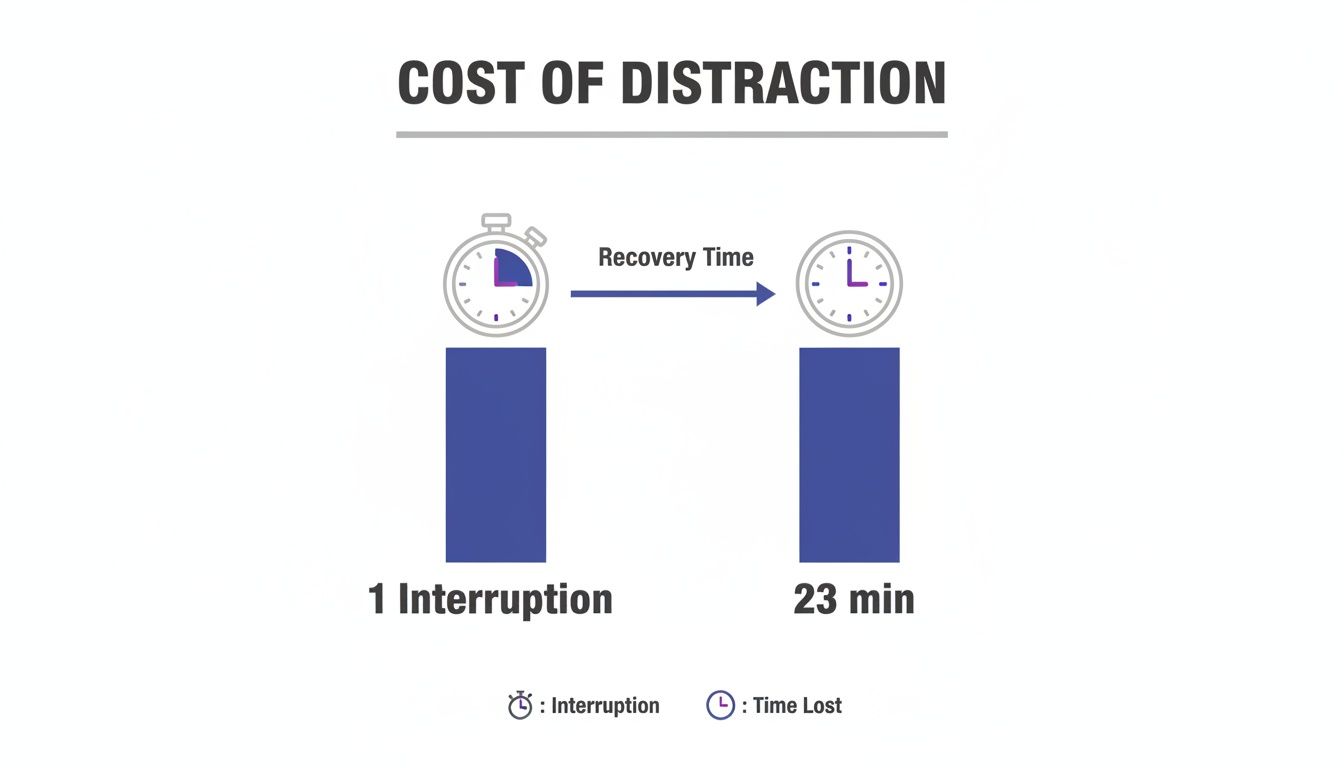
    This creates a vicious cycle. Each distraction makes it harder to get back on track, and on average, we only spend about 10 minutes on a task before an interruption pulls us away. If you’re struggling with this, looking at broader strategies can help you improve focus at work and achieve deep work.

    This constant fragmentation isn’t just a minor annoyance; it fundamentally prevents the sustained thought required for creativity, problem-solving, and meaningful progress. Understanding this biological reality is the essential first step.

    The good news is that you can fight back. Once you understand these neurological pulls, you can start putting strategies in place that work with your brain’s nature, not against it. To get a solid grasp of this, you can see the book that fits your goal and start learning how to regain your mental space in The Power of Clarity. This knowledge sets the stage for the practical, actionable solutions we’ll explore next.

    How to Design Your Environment for Deep Work

    Your ability to lock into deep work often has less to do with raw willpower and more to do with your surroundings. A chaotic environment is constantly pinging your brain with signals that it’s time to be distracted. By deliberately designing your workspace, you can send a much clearer message: this is where focus happens.

    β€œDEEP WORK ZONE” sign on a wooden desk with headphones, smartphone, plant, alarm clock, and notebook to improve focus and concentration.

    The first step is to hunt down and remove β€œattentional triggers”—anything in your line of sight or earshot that can yank you away from what matters. From a neuroscience perspective, your brain is wired to notice novelty and unresolved loops. That stack of mail, a buzzing phone, or a cluttered desktop all represent open threads your brain wants to pull on.

    Crafting Your Physical Focus Zone

    It all starts with a dedicated space for focused work, even if it’s just the corner of your bedroom. This simple practice builds a powerful psychological anchor; when you sit down here, your brain understands it’s time to concentrate.

    Start by decluttering your desk until it’s almost bare. Remove everything that isn’t essential for the task at hand. A clear workspace lowers the cognitive load on your brain, freeing up precious mental RAM for the actual work.

    Next, get serious about sensory inputs. Auditory chaos is a notorious focus-killer. A great pair of noise canceling headphones can be a game-changer, creating a bubble of silence that blocks out household chatter or an open-office hum. You can learn more about how light and sound affect cognitive performance in our detailed guide.

    Mastering Your Digital Hygiene

    Your digital environment is just as crucialβ€”if not more soβ€”than your physical one. The endless stream of notifications is engineered to hijack your attention. To take it back, you have to be ruthless.

    • Disable Non-Essential Notifications: Go on a notification diet. Turn off all alerts for email, social media, and news apps on your phone and computer. The only pings that should survive are the ones that are genuinely time-sensitive.
    • Use Blocker Apps: Tools like Freedom or Cold Turkey are your best friends here. They can block distracting websites and apps for set periods, effectively automating your discipline and removing the temptation entirely.
    • Schedule Your Inputs: Instead of letting email and social media be a constant drip-feed, batch them. Schedule specific blocks of time to check in, like 11 AM and 4 PM only. This puts you back in control.

    A β€œdigital sunset” routine is also non-negotiable for protecting your sleep, which is the very foundation of focus. An hour before bed, put all screens away. Wearing blue light blocking glasses in the evening can also help signal to your brain that it’s time to wind down, protecting the melatonin production you need for restorative sleep.

    Best Options for Your Focus Toolkit

    Picking the right tools can make a massive difference in managing your workspace distractions. Here’s a quick comparison to help you find the best fit for your specific challenges and improve your concentration.

    ToolBest ForHow It Improves FocusExample Scenario
    Noise-Canceling HeadphonesOpen offices or noisy home environmentsReduces auditory distractions that pull your attention away from tasks.A remote worker uses them to block out household noise during a deep work session.
    Phone Lock Box TimerChronic phone checkers and social media scrollersCreates a physical barrier to your biggest distraction, forcing a digital detox.A student locks their phone for a 2-hour study block to prevent mindless scrolling.
    Website/App Blocker SoftwareThose who get lost in internet rabbit holesAutomates discipline by making distracting sites inaccessible during work periods.A freelancer blocks social media and news sites from 9 AM to 12 PM daily.
    Monitor Light BarReducing eye strain during long screen sessionsProvides focused, non-glare light, which can reduce fatigue and help maintain concentration.A designer uses one to stay comfortable and focused during late-night projects.

    These simple changes can transform your workspace from a source of endless distraction into a sanctuary for deep work. It’s not about finding a magic bullet, but about intentionally layering small advantages that give your focus a fighting chance.

    Structuring Your Time to Improve Concentration

    A well-designed workspace is a great start, but how you manage your time is what truly shields your focus from the chaos of a normal day. Let’s be honest: the modern workplace often feels like a pinball machine, bouncing you from one reactive task to the next. This leaves almost no room for the deep, intentional work that actually moves the needle.

    Structuring your day isn’t about creating a rigid, joyless schedule. Think of it as building a container for your attention. When you have a clear framework, you offload the mental work of constantly deciding what to do next. This cuts down on decision fatigue and frees up your brain’s precious resources for the work that matters.

    And those resources are under assault. Since 2000, collaborative demands have ballooned by over 50%, with many managers now burning 85% of their week on meetings and messaging alone. Worse, Asana’s Anatomy of Work Index reveals that a staggering 62% of knowledge workers’ hours disappear into β€˜work about work’—not the core projects they were hired to do.

    How to Choose The Best Time Management Technique

    The β€œbest” technique is the one that actually fits your workflow and personality. Some people need long, uninterrupted blocks to get into a flow state, while others thrive on short, intense bursts of effort. Let’s look at a few proven methods so you can find a good match.

    TechniqueBest ForHow It WorksReal-World Scenario
    The Pomodoro TechniqueProcrastinators & anyone overwhelmed by huge tasks.Work in focused 25-minute sprints, with 5-minute breaks in between. This makes intimidating projects feel far more approachable. To learn more, read our deep-dive on what is pomodoro technique.A writer uses a pomodoro timer on their desk to tackle a chapter, breaking it down into four 25-minute sprints with short walks between each one.
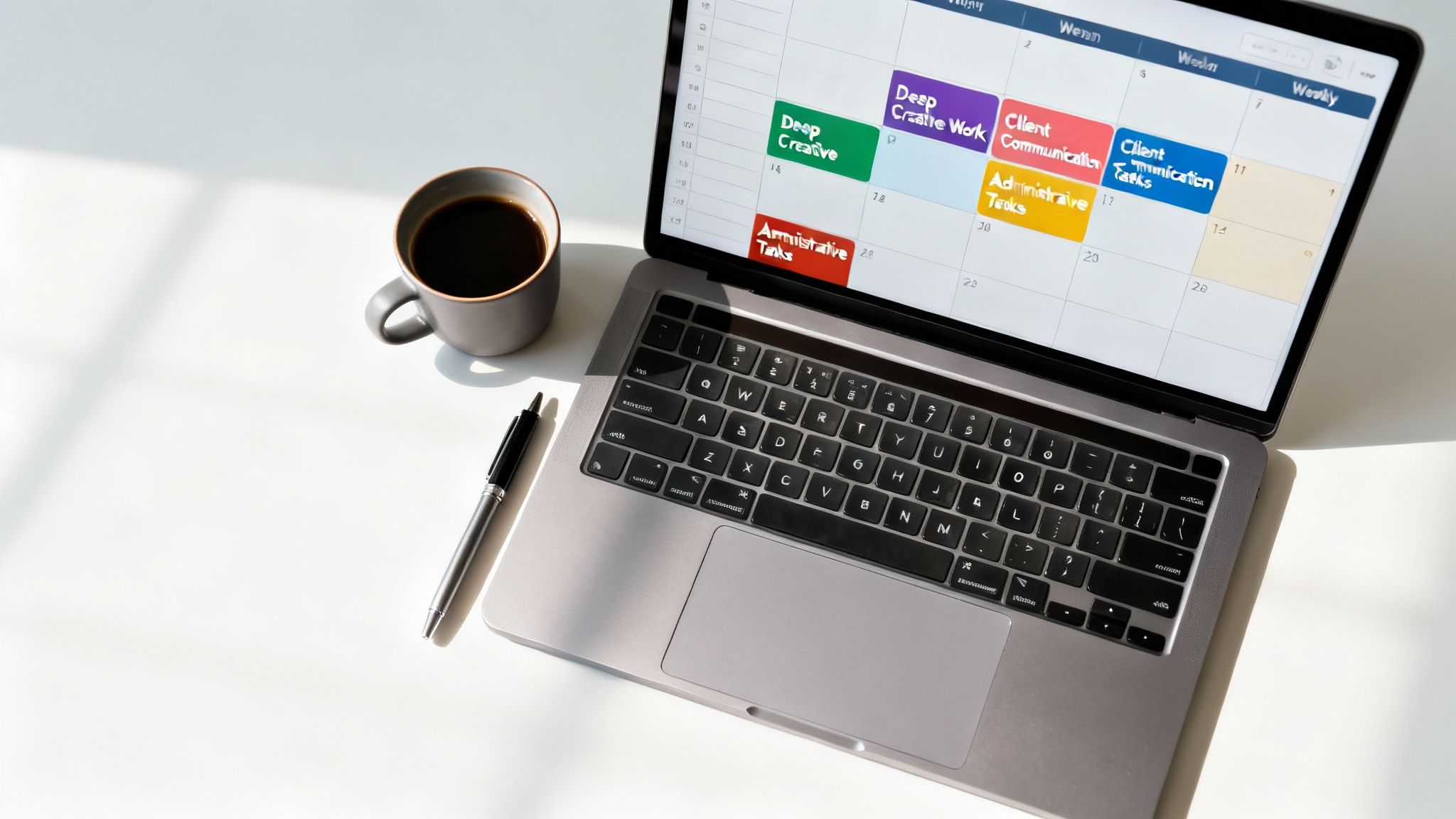
    Time BlockingBusy professionals juggling multiple projects and meetings.Every minute of your day is assigned a specific β€œjob” on your calendar, from deep work to checking email. This prevents your schedule from being dictated by others.A project manager blocks out 9–11 AM for β€œDeep Work: Q3 Strategy” and 3–3:30 PM for β€œEmail Triage,” guaranteeing that meetings can’t hijack their most productive hours.
    Themed DaysEntrepreneurs & freelancers with a wide range of responsibilities.Assign a clear theme to each day of the week, like Marketing Mondays, Finance Fridays, or Deep Work Wednesdays.A small business owner dedicates Mondays to creating content and Tuesdays to client outreach, which stops them from constantly switching between different types of thinking.

    The only way to know what works is to experiment. Try one for a week and see how it feels. You might even end up blending methods, like using Pomodoro sprints inside a larger time-blocked schedule.

    Putting Time Structures Into Practice

    Let’s make this real. Imagine a project manager whose calendar is a battlefield of meeting invites, leaving them with no time for the strategic planning that’s actually their most important work.

    To take back control, they start time blocking. Every Sunday evening, they sit down with a time blocking planner and map out the week ahead. The most important change? They schedule a recurring 90-minute β€œDeep Work” session every morning before their first meeting. This block becomes non-negotiable.

    During this protected time, all notifications are silenced, and they focus on nothing but high-level strategy. This simple act of pre-commitment shields their most valuable cognitive hours from the reactive chaos of the day.

    To make this even stickier, you can implement effective habit stacking by anchoring this new routine to an existing one. For instance, our project manager might decide their deep work block always starts right after they finish their morning coffee.

    This approach is so effective because it externalizes decision-making. Instead of relying on sheer willpower to resist distractions all day, the plan is already set. Your brain isn’t wasting energy deciding what to do; it’s simply executing the plan.

    The Lifestyle Habits That Fuel a Focused Mind

    Your ability to concentrate isn’t just about willpower or clever time management tricks. It’s deeply rooted in your biology.

    Think of your brain as a high-performance engine; it needs the right fuel, proper maintenance, and adequate rest to run smoothly. When you neglect these foundational habits, even the best productivity systems will stall out.

    The connection between lifestyle and focus is grounded in neuroscience. Your prefrontal cortex, the brain’s command center for attention and decision-making, is highly sensitive to your physical state. Sleep deprivation, poor nutrition, and a sedentary life directly impair its function, making it harder and harder to sustain attention and resist distractions.

    Prioritize Sleep to Sharpen Your Mind

    Sleep isn’t a luxury; it’s a non-negotiable maintenance process for your brain. During deep sleep, your brain clears out metabolic waste that builds up during the day. When you don’t get enough quality sleep, this junk remains, leading to that foggy, sluggish feeling that makes concentration feel impossible.

    Research consistently shows that even one night of poor sleep can significantly dial down activity in the prefrontal cortex. This means your ability to plan, problem-solve, and stay on task takes a major hit. Building better sleep hygiene is one of the most powerful things you can do for your mind.

    A few tips to get started:

    • Create a consistent schedule: Go to bed and wake up around the same time every day, even on weekends. This helps regulate your body’s internal clock, or circadian rhythm.
    • Optimize your environment: A dark, cool, and quiet room is essential. A quality sleep mask blackout can make a huge difference in blocking out light pollution.
    • Design an evening wind-down: Ditch the screens an hour before bed. Consider a gentle, non-digital routine to signal to your brain that it’s time to rest. You can find more strategies in our book on achieving Restful Nights.
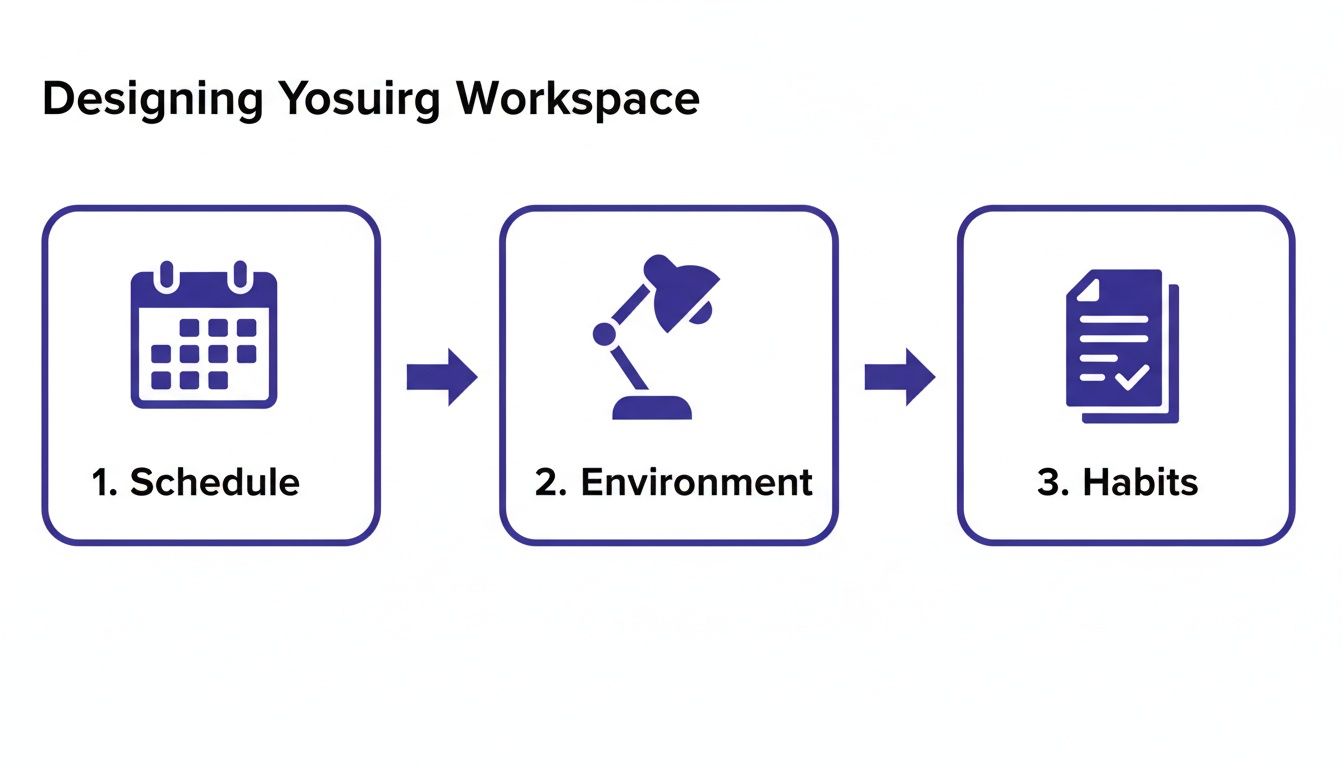
    A diagram illustrating a time management process with three steps: Pomodoro, Time Blocking, and Themed Days.

    This graphic shows how powerful time management techniquesβ€”like the Pomodoro Method, Time Blocking, and Themed Daysβ€”build on one another. These structures are fantastic, but they work best when your brain has the biological foundation to actually execute them.

    Fuel Your Brain with Smart Nutrition and Movement

    What you eat and how often you move have a direct, almost immediate impact on your cognitive function. Your brain consumes about 20% of your body’s total energy, so the quality of fuel you provide it matters immensely.

    Focus on a balanced diet rich in whole foods. Sugary, processed stuff can cause sharp spikes and crashes in blood sugar, which leads to those familiar energy dips and mental fatigue. Instead, opt for complex carbohydrates, healthy fats, and lean proteins to provide a steady stream of energy. Hydration is also key; even mild dehydration can impair your attention and memory.

    Movement is another powerful lever. Physical activity increases blood flow to the brain, delivering more oxygen and nutrients. It also triggers the release of neurochemicals like dopamine and norepinephrine, which play a crucial role in sharpening focus and motivation.

    You don’t need grueling gym sessions to get the benefit. Even a short walk can work wonders. Many people find that an under desk walking pad is a great way to incorporate gentle movement throughout the workday without breaking their flow. For more ideas, you might be interested in our guide on 10 good daily habits to adopt.

    Real-World Example:
    A college student was struggling to keep up with their coursework, constantly feeling distracted and tired. Instead of just trying to study longer, they focused on their lifestyle. They set a strict 11 PM bedtime and started taking 15-minute walk breaks between study sessions. Within two weeks, they noticed a dramatic improvement in their ability to concentrate during lectures and retain information.

    How to Keep Your Focus for the Long Haul (and Sidestep Burnout)

    Intense concentration is a powerful tool, but it’s also a finite resource. Think of it like a muscleβ€”your brain’s ability to lock in and focus gets tired with overuse. Trying to force high-level concentration without a break isn’t discipline; it’s a fast track to cognitive fatigue and, eventually, burnout. The secret isn’t to push harder. It’s to build sustainable habits that balance deep, meaningful work with intentional recovery.

    From a behavioral standpoint, your brain absolutely needs downtime to consolidate what you’ve learned and restore the energy reserves required for executive functions like paying attention. When you’re in a state of chronic stress, your body is swimming in cortisol. Over time, that hormone can actually impair the function of your prefrontal cortexβ€”your brain’s command center for focus. This is exactly why relentless hustle almost always backfires, leaving you with diminishing returns and a profound sense of mental exhaustion.

    Embrace Intentional Rest and Recovery to Improve Your Focus

    To genuinely improve your focus and concentration over the long term, you have to start treating rest as a productive activity in its own right. This means scheduling downtime with the same seriousness you’d schedule a meeting with your boss. This isn’t about being lazy; it’s about strategic, intelligent recovery.

    One of the most effective ways I’ve seen this work is by getting lost in hobbies that have absolutely nothing to do with your day job. Activities that fire up different parts of your brain and body give your main cognitive circuits a desperately needed break.

    • Physical Hobbies: Things like hiking, gardening, or even just playing a sport can boost blood flow to the brain and release endorphins. That’s a double win for improving your mood and melting away stress.
    • Creative Pursuits: Learning an instrument, painting, or getting into woodworking can nudge you into a state of β€œflow” that is both deeply restorative and incredibly satisfying.
    • Mindful Practices: Activities like yoga or simply spending quiet time in nature help calm your nervous system, pulling you out of the chronic β€œfight or flight” mode that so many of us live in.

    By deliberately stepping away from your work, you give your subconscious mind the space it needs to keep chewing on problems in the background. It’s a phenomenon known as the incubation effect, and it’s why your best ideas often show up when you’re in the shower or out for a walk.

    Setting Boundaries to Prevent Cognitive Overload

    A healthier, more sustainable work rhythm is built on a foundation of firm boundaries. If you don’t draw clear lines between your work life and your personal time, your brain never truly gets the chance to switch off and recover. This is where so many well-intentioned focus strategies completely fall apart.

    Setting and, more importantly, enforcing these boundaries is a skill you have to practice. It might look like turning off all work notifications after 6 PM, saying no to non-essential weekend requests, or just communicating your availability clearly to your team. You can find some excellent, real-world burnout prevention strategies in our guide that goes much deeper on this.

    Here’s a real-world example:
    An entrepreneur I know was clocking 70-hour weeks and saw her creativity and decision-making skills absolutely tank. Realizing she was on the verge of burning out, she implemented a strict β€œno-work-on-weekends” rule. To keep herself honest, she used a habit tracker journal to log her restorative activities: Saturday morning hikes and Sunday afternoons spent reading. Within a month, she felt more energized, and her focus during the workweek was sharper than it had been in years. The lesson? Resting wasn’t lost time; it was a direct investment in her performance.

    Editor’s Note: What Really Works to Improve Focus and Concentration

    Let’s cut through the noise. While there are a million focus hacks out there, the ones that actually move the needle usually come down to two things: intentionally designing a distraction-free environment and deliberately structuring your time.

    That’s it. There’s no magic pill here. Consistency will always matter more than perfection.

    This advice is best for knowledge workers, students, and freelancersβ€”anyone who feels like their attention is constantly being pulled in a dozen different directions and wants to get it back.

    That said, if you feel you might be dealing with significant issues like anxiety, depression, ADHD, or burnout, please know this article is for educational purposes only. It is not a substitute for medical or psychological care. The best first step is always to talk to a qualified professional. These techniques are powerful, but they take real effort and need to be adapted to how you actually work.

    The challenge we’re all facing is very real, and it has a steep cost. Globally, managers lose a shocking 683 hours every year just to interruptions. In the US alone, this distraction epidemic adds up to an estimated $468 billion in lost productivity annually. You can dig into the staggering cost of lost focus in this study from The Economist.

    Ultimately, getting your focus back is a marathon, not a sprint. The best approach is to start small, be patient with yourself, and build on whatever works.

    Key Takeaways: Your Focus Improvement Checklist

    If you’re ready to start reclaiming your attention, here’s a quick summary of the most important takeaways from this guide. Think of this as your starting checklistβ€”four core principles you can put into practice right away.

    • Shape Your Environment. Start by clearing the decks, both physically and digitally. A clean workspace and a simplified digital setup reduce the constant, low-grade pull on your attention, giving your brain a fighting chance to concentrate.

    • Structure Your Time. Don’t leave focus to chance. Use proven systems like Time Blocking or the Pomodoro method to build intentional rituals for deep work. This isn’t about rigidity; it’s about protecting your most valuable cognitive hours from decision fatigue.

    • Work With Your Biology. Never forget the non-negotiable link between your body and your brain. Quality sleep, regular movement, and proper nutrition are the foundational pillars of a focused mind. You can’t out-strategize a tired brain.

    • Practice Strategic Rest. True focus is a marathon, not a sprint, and your brain needs recovery time. Intentionally schedule downtime to let your cognitive energy recharge. This isn’t lazinessβ€”it’s what prevents burnout and makes sustained concentration possible.


    Disclaimer: The information in this article is for educational purposes only and is not intended as a substitute for professional medical or psychological advice, diagnosis, or treatment. This post may also contain affiliate links, which means we may earn a small commission if you make a purchase through them, at no extra cost to you.

    FAQ: Your Questions on How to Improve Focus and Concentration

    We’ve covered a lot of ground on rebuilding focus from the ground up. Still, a few common questions always pop up when people start putting these ideas into practice. Here are some honest answers.

    1. How long does it take to actually feel a difference in focus?

    You can feel a small, immediate win today. Simple environmental tweaksβ€”like clearing your desk or putting your phone in a drawerβ€”can give you a pocket of clarity almost instantly. However, for deep, lasting change, behavioral research suggests you should expect to put in several weeks of consistent effort. This allows your brain to form new habits through neuroplasticity, making deep focus feel more like your default mode. Be patient. For a primer on this process, The Power of Clarity is a fantastic read.

    2. Can I really improve my concentration in a noisy, distracting job?

    Absolutely, but you can’t fight a chaotic environment with willpower alone. The strategy here is to create β€œfocus pockets”—short, protected blocks of 15 or 25 minutes where you go all-in on a single, high-value task. It’s about quality, not quantity. Then, use tools to build a personal bubble. A solid pair of noise-canceling headphones is non-negotiable in an open office. You also need to communicate your boundaries with a simple desk sign or a β€œHeads Down” status on your team’s chat app.

    3. What’s the best first step to improve focus for a beginner?

    While it’s different for everyone, the single most powerful starting point is creating a distraction-free environment. From a psychological standpoint, your willpower is a finite resource. Every time you have to resist the urge to check your phone or click a notification, you drain that resource. By proactively removing those temptations, you make focus the path of least resistance. Curating your physical and digital workspaces is the foundation that makes all other techniques easier.

    4. Is a β€œdopamine detox” a real way to improve concentration?

    The term is a bit of a misnomer, but the underlying concept is sound. You’re not trying to get rid of dopamine, which is a vital neurotransmitter for motivation. Instead, the goal is to reset your brain’s reward circuitry. Our brains get used to cheap, easy rewards from scrolling social media, which makes slower, meaningful work feel dull. By deliberately cutting back on hyper-stimulating inputs, you lower your baseline and allow your brain to find satisfaction in complex tasks again.

    5. Are focus supplements and nootropics worth trying?

    While some people find that certain supplements, like a magnesium glycinate supplement, may offer a cognitive edge, they are not a magic bullet. They are the potential last 10% of the equation, not the core 90%. The most powerful β€œsupplements” for your brain will always be the fundamentals: high-quality sleep, a balanced diet, consistent physical activity, and strategic work routines. Get those right first. Always.


    At Mind Clarity Hub, we believe focus isn’t something you’re born withβ€”it’s a system you build. If you’re ready to design a personalized system for deep work, the next step is finding the right book for your goals.

    Browse the library to find your next step.

  • 10 Proven Ways to Improve Working Memory

    10 Proven Ways to Improve Working Memory

    Affiliate Disclosure: Please note that this article contains affiliate links. If you make a purchase through these links, we may earn a small commission at no extra cost to you. This helps support our work in creating valuable content.

    Feeling like you’re constantly forgetting names, tasks, or where you put your keys? You’re not alone. Our working memory, the brain’s temporary β€˜sticky note’ for managing immediate information, is under constant pressure. Digital overload and endless distractions strain this critical cognitive system. A robust working memory is the engine behind focus, complex problem-solving, and efficient learning. It’s the mental workspace where you actively juggle ideas and make critical decisions. When this system is strained, everything feels harder, from following multi-step instructions to remembering a key detail during a meeting.

    This article moves beyond generic tips. It offers a structured guide on evidence-based ways to improve working memory. We will explore ten specific strategies grounded in neuroscience and psychology. These are designed for busy professionals, students, and anyone looking to sharpen their mental edge. You will learn practical methods like the Memory Palace and information chunking. Forget vague advice; this guide is about actionable techniques for reclaiming your focus. By the end, you’ll have a clear toolkit to help your brain process information more effectively.

    1. The Method of Loci (Memory Palace Technique) to Improve Working Memory

    The Method of Loci, also known as the Memory Palace, is an ancient mnemonic strategy. It powerfully connects your working memory to your long-term spatial memory. This technique involves visualizing a familiar location, such as your home. You mentally β€œplace” pieces of information at specific points along a planned route. By associating new data with a known environment, you give abstract facts a concrete structure. This is one of the most effective ways to improve working memory. It builds on the brain’s natural strength for remembering places.

    • Real-world scenario: Imagine you need to remember five key points for a presentation: market growth, competitor analysis, new strategy, budget, and timeline. In your Memory Palace (your apartment), you could visualize a giant, growing plant (market growth) by the front door. Next, see two rivals (competitor analysis) wrestling on your living room sofa. A detailed map (new strategy) could be spread across your kitchen table. Piles of cash (budget) are overflowing from the sink. Finally, a large clock (timeline) is hanging where your bedroom TV should be.
    A modern American hallway representing one of the ways to improve working memory with the Memory Palace technique.

    Why This Technique Works on a Neurological Level

    Neuroscience shows our brains have a remarkable capacity for spatial navigation. This skill was honed over millennia. Research led by neuroscientist Eleanor Maguire at UCL demonstrated that London taxi drivers have larger posterior hippocampi. This is the brain region associated with spatial memory. The Memory Palace technique taps into this same neural hardware. When you mentally walk through your β€œpalace,” you activate these robust spatial networks. This makes recall feel more like a journey than a test.

    How to Build Your First Memory Palace

    1. Choose Your Palace: Select a location you know intimately. Your childhood home or current apartment are excellent starting points. Familiarity is key so you don’t expend mental energy remembering the layout itself.
    2. Define a Route: Map out a specific, linear path. For example, start at your front door and move into the living room. Then proceed to the kitchen, and finally go upstairs. Always follow the same sequence.
    3. Create Exaggerated Images: To memorize a list, place a bizarre image at each location. Picture your client balancing on the coat rack by the door. Imagine your report printed on giant paper draped over the sofa. See a waterfall of milk cascading over your kitchen counter. The more absurd the image, the more it sticks.
    4. Practice the Walk-Through: Mentally stroll through your palace a few times to solidify the associations. The goal is to see the images pop into your mind as you β€œpass” each location.

    2. Chunking: An Essential Way to Improve Working Memory

    Chunking is a cognitive strategy that directly addresses the natural limits of your working memory. It involves breaking down large pieces of information into smaller, meaningful units. Instead of trying to hold a long string of individual data points, you group them into coherent clusters. This method reduces cognitive load. It makes complex information far more manageable and easier to recall. It’s one of the most fundamental ways to improve working memory. It reorganizes data to fit how our brains are built to process it.

    • Real-world scenario: A new employee needs to learn a 16-digit software activation key: 8409199820231107. Trying to memorize this is nearly impossible. Using chunking, they can group it into meaningful dates: 8409-1998-2023-1107. Or even better, β€œAugust 4th, 1998” and β€œNovember 7th, 2023”. This transforms 16 random items into just two memorable chunks.

    The Psychology Behind Chunking

    The power of chunking was famously highlighted by cognitive psychologist George Miller. In his 1956 paper, he proposed that our working memory has a finite capacity. It typically holds about 5 to 9 items at once. Chunking works by turning multiple items into a single conceptual unit. For example, the sequence 1-9-8-4 becomes one chunk (β€œ1984”). Research on chess masters showed that experts don’t have bigger memories. They just chunk information more effectively, seeing patterns as single units.

    How to Apply Chunking in Your Daily Work

    1. Group by Relationship: Look for natural connections in information. A project manager can chunk 50 tasks into phases like β€œDiscovery,” β€œDesign,” and β€œLaunch.” A student can group historical events by era.
    2. Use Familiar Patterns: Our brains love patterns. A phone number (e.g., 800-555-1234) is a perfect example of chunking. Apply this by grouping your to-do list into categories like β€œEmails,” β€œCalls,” and β€œDeep Work.” A good time blocking planner can help you structure these chunks visually.
    3. Create Meaningful Labels: Give each chunk a simple name. This label acts as a mental handle. For instance, β€œQ3 Marketing Plan” is easier to recall than its 20 individual action items.
    4. Batch Similar Tasks: Apply chunking to your schedule. Instead of answering emails as they arrive, create an β€œemail chunk.” This reduces context switching and preserves mental energy. For a deeper dive, you can learn more about the second brain method here.

    3. Spaced Repetition for Better Working Memory

    Spaced repetition is a powerful learning strategy. It moves information from your fragile working memory into durable long-term storage. Instead of cramming, this technique involves reviewing material at increasing intervals over time. It directly counters the natural memory decay described by the β€œforgetting curve.” By revisiting information right before you’re about to forget it, you strengthen the neural pathways. This makes the memory last longer and require less total study time.

    • Real-world scenario: You’re learning a new language. Instead of studying a list of 20 vocabulary words for an hour straight, you review them for 10 minutes on Day 1. On Day 2, you review them again. Then you wait until Day 4 for the next review, followed by Day 8, and so on. This spaced-out schedule feels less intense but results in much stronger long-term retention.

    Why Spaced Repetition Strengthens Neural Pathways

    This method works because it forces your brain to engage in active recall. This is a more strenuous and effective process than passive review. Each time you retrieve a fading memory, the brain flags it as important. This reinforces the connection through a process called long-term potentiation (LTP). Spaced repetition automates this process. It schedules reviews at the optimal moment to trigger LTP and cement learning. This makes it one of the most efficient ways to improve working memory.

    How to Implement Spaced Repetition

    1. Start with Comprehension: Ensure you fully understand a concept before you begin spacing out reviews. Memorizing without understanding creates isolated, useless facts.
    2. Establish an Initial Schedule: A simple starting point is the 1-3-7 rule. Review new material after one day, then three days later, and then one week later. From there, you can expand.
    3. Use Automation Tools: Digital flashcard systems like Anki or Quizlet use algorithms to schedule reviews. They show you difficult cards more frequently. A good habit tracker journal can also help you manually schedule these review sessions.
    4. Practice Active Recall: Don’t just re-read your notes. When a review is due, actively test yourself. Try to explain the concept aloud or write a summary from memory before checking.
    5. Integrate into Routines: Attach your review sessions to existing habits. For example, spend 10 minutes reviewing flashcards with your morning coffee.

    4. Working Memory Training and N-Back Tasks

    Working memory training involves structured cognitive exercises. They are designed to directly strengthen your ability to hold and manipulate information. One of the most studied forms is the β€œn-back” task. This requires you to monitor a sequence of stimuli and respond when the current one matches the one from β€˜n’ steps earlier. This forces your brain to constantly update information. It acts like a targeted workout for the executive functions of your prefrontal cortex.

    • Real-world scenario: Using an n-back app, you see a series of shapes appearing one by one in different locations on a grid. In a β€œ2-back” task, you must press a button only when the current shape is in the same location as the shape shown two turns ago. This requires you to constantly hold, update, and compare the last two positions in your mind.

    The Neuroscience of Brain Training

    The effectiveness of n-back training stems from its direct engagement with the core components of working memory. Research pioneered by neuroscientist Susanne Jaeggi showed that consistent dual n-back training could lead to improvements in fluid intelligence. The theory is that by repeatedly pushing the limits of your working memory, you stimulate neuroplasticity. This may strengthen the neural circuits responsible for attention control.

    How to Start Working Memory Training

    1. Choose Evidence-Backed Tools: Instead of general β€œbrain games,” opt for applications designed around n-back principles. Apps like Dual N-Back Pro or Brain Wars are good starting points.
    2. Practice Consistently: To see potential benefits, aim for short, regular sessions. Dedicate 15-25 minutes per day, at least five days a week. Consistency is more important than cramming.
    3. Integrate, Don’t Isolate: Use working memory training as a supplement. Combine it with physical exercise, good sleep, and techniques like chunking.
    4. Track Your Progress: Use the app’s built-in metrics to monitor your improvement. Seeing your progress provides motivation. By actively training your brain, you can also learn more about how to train your brain to focus in other areas of your life.

    5. Elaborative Interrogation for Deeper Memory Processing

    Elaborative interrogation is a powerful learning strategy. It strengthens working memory by forcing your brain to engage deeply with new material. Instead of passively reading, this method involves actively questioning information by asking β€œwhy” and β€œhow.” This converts superficial processing into deep encoding. It builds strong neural pathways that transfer information into durable long-term storage. This is one of the most effective ways to improve working memory for complex topics.

    • Real-world scenario: A marketing manager reads a report stating that β€œvideo content on social media increases engagement.” Instead of just accepting this fact, they ask: β€œWhy does video work better than static images? Is it the motion, the storytelling, or the audio? How could our team leverage this principle in our next campaign?” This deep questioning connects the new fact to their existing strategic knowledge.

    Why This Technique Works for Memory Consolidation

    Research from learning scientists has shown that techniques requiring active generation of answers are more effective than passive review. When you ask β€œWhy is this true?”, you activate pre-existing knowledge networks in your brain. This process of linking new facts to old ones creates a richer, more interconnected web of information. This makes the new data easier to retrieve later. There are multiple mental pathways leading to it, reducing the strain on your working memory.

    How to Practice Deep Processing

    1. Ask Probing Questions: As you read a report, continuously pause and ask yourself questions. For example, if you’re reading about a new market trend, ask, β€œWhy is this happening now?”
    2. Generate Self-Explanations: Don’t just read a definition; explain it aloud in your own words. This forces you to process the concept. You can document these thoughts in a dedicated productivity journal to track your understanding.
    3. Apply to Real Scenarios: Constantly connect abstract information to practical situations. An entrepreneur studying a competitor’s success shouldn’t just note their strategy. They should ask, β€œHow could we adapt a similar principle?”
    4. Discuss and Debate: Engage with a colleague about the new information. Articulating your thoughts solidifies your understanding. It also exposes gaps in your knowledge, prompting further deep processing.

    6. Metacognitive Monitoring and Retrieval Practice

    Metacognitive monitoring combined with retrieval practice is a potent strategy for managing and strengthening your working memory. This method involves a two-step process. First, you consciously assess your own knowledge (metacognition). Second, you actively try to recall information from memory (retrieval practice). This creates a powerful feedback loop. You identify what you don’t know and then strengthen those specific memory pathways. This approach turns passive learning into an active, targeted exercise.

    • Real-world scenario: Before a client meeting, a consultant doesn’t just re-read their notes. They take a blank sheet of paper and write down everything they can remember about the client’s goals and challenges. Then, they compare their β€œbrain dump” to their actual notes. The gaps immediately show them exactly what they need to review, making their preparation far more efficient.

    The Psychology of β€œDesirable Difficulty”

    The power of this technique lies in the concept of β€œdesirable difficulty,” a term coined by psychologists. The mental struggle involved in trying to recall information strengthens the neural connections. Research has consistently shown that testing yourself is more effective for long-term retention than re-reading. Metacognition adds a layer of self-awareness. It helps you avoid the β€œillusion of knowing.” This directs your mental energy where it’s needed most.

    How to Implement This Practice

    1. Assess Before You Study: Before diving into a new topic, take a pre-test. This initial assessment establishes a baseline. It highlights the specific gaps in your understanding.
    2. Practice Active Recall: After studying, put your notes away and actively try to recall the information. Write down everything you remember or explain the concept to someone else.
    3. Rate Your Confidence: As you practice retrieval, rate how confident you are in your answer before you check for accuracy. This simple step sharpens your metacognitive skills. To truly master your learning, delve into practical metacognition strategies for students.
    4. Schedule Cumulative Quizzes: Regularly incorporate questions about older topics into your retrieval practice. This reinforces long-term memory. If you want to learn more, find out how to retain more of what you read with proven techniques.

    7. Attention Management to Improve Working Memory

    Attention management is a foundational strategy for protecting your limited working memory. Your cognitive capacity is a finite resource. Every notification and interruption consumes a portion of it. This degrades your ability to think deeply and retain information. By consciously designing your environment to minimize these cognitive drains, you create the conditions for focused work. This is one of the most practical ways to improve working memory performance.

    • Real-world scenario: A writer needs to finish a chapter. Instead of relying on willpower, they turn off their phone’s Wi-Fi. They use an app to block social media sites for two hours. They put on noise canceling headphones and tell their family they are in a β€œdeep work” session. This environmental control protects their working memory from constant interruptions, allowing for sustained focus.
    Productive desk setup with a laptop, alarm clock, phone, and plant, showing ways to improve working memory through focused work habits.

    Why Distractions Overload Your Working Memory

    The concept of β€œattentional residue” explains that when you switch tasks, part of your attention stays on the previous one. This residue clogs your working memory. It makes it harder to concentrate on what’s next. Constant distractions force continuous task-switching. This leads to cognitive fragmentation. By managing your environment and creating focus blocks, you minimize this residue. Discover practical strategies to control your environment to boost your productivity.

    How to Implement Attention Management

    1. Conduct a Distraction Audit: For one week, keep a log of every interruption. This data will reveal your biggest focus-killers. It provides a clear starting point for intervention.
    2. Engineer Your Digital Space: Turn off all non-essential notifications. Use website blockers during work hours to prevent mindless browsing. A well-organized digital workspace is a key part of your overall attention management strategy.
    3. Design Your Physical Environment: Designate a specific spot for deep work. Remove your phone from your desk, perhaps placing it in a phone lock box timer in another room.
    4. Adopt Time-Blocking: Structure your day with β€œmaker time” (uninterrupted focus) and β€œmanager time” (meetings). Batch-check emails at specific times. Establish team-wide norms, like meeting-free afternoons, to protect focus.

    8. Dual Coding and Multimodal Learning

    Dual Coding is a cognitive strategy that engages multiple information channels. This strengthens memory encoding and reduces the strain on your working memory. The core idea is that our brains process information through two primary systems: one for verbal information and another for visual information. When you learn something using both channels, you create two distinct memory traces. This redundancy makes the information more robust and easier to retrieve.

    • Real-world scenario: When trying to understand a complex historical event, you don’t just read the chapter in a textbook. You also watch a documentary that shows maps of the troop movements. You look at photographs from the era. This combination of text (verbal) and visuals (images, maps) creates a much stronger and more durable memory than reading alone.
    A desk with a spiral notebook, digital tablet, and pen, displaying 'Dual Coding' text. A key way to improve working memory is through this multimodal approach.

    Cognitive Science Behind Dual Coding

    This method works by distributing the cognitive load across different processing systems in the brain. Instead of overwhelming the verbal working memory, you offload some processing to the visual system. According to Richard Mayer’s cognitive theory of multimedia learning, meaningful learning occurs when learners actively integrate visual and verbal representations. For example, a tutorial showing code (visual) with a narrator explaining the logic (verbal) engages both systems. This synergy helps your brain build a stronger mental model.

    How to Apply Dual Coding

    1. Combine Visuals and Text: When learning a new process, don’t just read the instructions. Look for or create a flowchart or diagram that illustrates the steps. A simple concept map can connect abstract ideas better than a list.
    2. Narrate Your Actions: If you are learning a hands-on skill, talk through the steps out loud. This pairs the kinesthetic (doing) and visual (seeing) experience with a verbal explanation.
    3. Choose Complementary Media: The goal is for the media types to support, not duplicate, each other. A screenshot shows what to click, while text explains why. This combination is far more effective. A time blocking planner can also help you schedule sessions to review this type of material.

    9. Active Reading Strategies to Improve Working Memory

    Active reading transforms passive consumption of text into an active cognitive process. It profoundly strengthens how information moves from working memory into long-term storage. Unlike passive highlighting, active reading involves a structured conversation with the material. By combining pre-reading, strategic annotation, and post-reading consolidation, you force your brain to engage with the information. This makes it one of the most effective ways to improve working memory for complex topics.

    • Real-world scenario: An executive is reading an industry analysis. Instead of just highlighting interesting sentences, she writes questions in the margins: β€œHow does this threat affect our Q4 launch?” She draws arrows connecting related statistics. At the end of each section, she covers the page and summarizes the key argument in her own words. This active engagement ensures she understands and retains the critical insights.

    Why Active Reading Outperforms Passive Highlighting

    Research has consistently shown that passive reading and highlighting are ineffective study strategies. A meta-analysis confirmed that practices like summarization and self-explanation are far superior for retention. These active methods require you to manipulate information in your working memory. This initiates memory consolidation. When you annotate with a question, you are creating a unique, personal retrieval cue. This links new data to existing knowledge in your brain.

    How to Implement Active Reading

    1. Start with a Framework: Use a proven method like SQ3R (Survey, Question, Read, Recite, Review). Before reading, survey the headings and summary. Formulate questions based on these elements.
    2. Annotate with Purpose: Keep highlighting minimal. Use the margins to write questions, challenge assumptions, or note connections to your own projects.
    3. Pause and Summarize: Every 15-20 minutes, stop reading. Close the document and try to summarize the main points in your own words. This β€œrecite” step is a powerful form of retrieval practice.
    4. Consolidate and Review: After finishing, create a concept map or a brief visual summary. Review your annotations within 24 hours. For a deeper dive, you can learn more about active reading techniques and how to apply them.

    10. Self-Explanation and Teach-Back Protocols

    The Self-Explanation and Teach-Back method is a powerful cognitive strategy. It deepens your understanding and solidifies information in your memory. It involves articulating a concept aloud, either to yourself (self-explanation) or to another person (teach-back). This process forces you to move beyond passive reading. By forcing your brain to structure, simplify, and communicate an idea, you quickly uncover knowledge gaps that silent review often misses.

    • Real-world scenario: After attending a training session on a new software, a team member doesn’t just go back to their desk. They schedule a 30-minute session to β€œteach” the key features to a colleague who couldn’t attend. In the process of preparing and explaining, they realize they are fuzzy on one of the steps. This allows them to seek clarification immediately, solidifying their own knowledge.

    How Teaching Rewires Your Brain for Memory

    This method works because the act of verbalization requires deeper cognitive processing than simply reading. Research in learning sciences shows that explaining concepts forces the brain to organize information logically. It makes connections between new and existing knowledge. When you teach, you are not just reciting facts; you are constructing a mental model. This act of construction strengthens the neural pathways. It’s a fundamental way to improve working memory by making information more meaningful.

    How to Implement Self-Explanation and Teach-Back

    1. Start with Self-Explanation: After learning a new concept, put your notes away. Explain the idea aloud to yourself as if you were teaching a beginner. For programmers, this is β€œrubber ducking.”
    2. Find a β€œStudent”: The next level is teaching someone else. This could be a colleague or a friend. Ask them to listen and ask questions. Their confusion will highlight weak spots in your understanding.
    3. Use Probing Questions: As you explain, actively ask yourself β€œwhy” and β€œhow.” Why does this step come next? How does this connect to what I already know? This prevents shallow memorization.
    4. Teach Without Notes: The real test is explaining a topic from memory. Use your notes only to fill the gaps you discover during the process. This reveals what you’ve truly internalized.

    Best Working Memory Technique For You?

    Choosing the right technique depends on your specific goal. Are you memorizing facts for a test, or trying to understand a complex system? This comparison can help you decide.

    TechniqueBest For Memorizing ListsBest for Understanding ConceptsBest for Long-Term Retention
    Method of Lociβœ…
    Chunkingβœ…
    Spaced Repetitionβœ…βœ…
    Elaborative Interrogationβœ…βœ…
    Teach-Back Protocolβœ…βœ…

    For quick memorization, the Method of Loci and Chunking are excellent choices. For deep, lasting understanding of complex subjects, focus on Elaborative Interrogation and the Teach-Back Protocol. Compare options to find the best fit for your current learning challenge.

    Editor’s Take

    So, what really works when it comes to improving your working memory? While all ten techniques have merit, the most impactful strategies for busy professionals are Attention Management (Environmental Design) and Chunking. Why? Because they address the biggest modern challenges: distraction and information overload. You can’t use sophisticated methods like the Memory Palace if your working memory is constantly being hijacked by notifications.

    Start by creating an environment that protects your focus. This is the non-negotiable foundation. Then, use chunking to make overwhelming projects and data streams manageable. These two practices provide the biggest returns for the least β€œtraining” time. Techniques like Spaced Repetition and N-back training are powerful but require more structured commitment. They are best for those with specific, long-term learning goals, like mastering a language or preparing for a certification.

    Bottom line: First, control your environment. Second, organize the information. Master these two, and you’ve won half the battle for a stronger working memory.

    Key Takeaways: How to Improve Working Memory

    • Protect Your Focus First: Attention management is foundational. You cannot improve working memory if it’s constantly overloaded by distractions. Control your digital and physical environment to create space for deep thinking.
    • Structure Information Actively: Don’t be a passive consumer of information. Use techniques like Chunking, the Method of Loci, and Dual Coding to actively organize what you learn into memorable formats.
    • Engage Deeply, Don’t Just Review: Passive reading is ineffective. Strengthen memory by using active strategies like Elaborative Interrogation, Self-Explanation, and the Teach-Back Protocol to force deeper cognitive processing.
    • Practice Retrieval, Not Just Repetition: The act of recalling information strengthens memory pathways more than simply re-reading it. Use Spaced Repetition and Active Recall to move knowledge from short-term to long-term storage efficiently.
    • Consistency Over Intensity: Small, consistent effortsβ€”like a 15-minute daily review or creating a distraction-free work blockβ€”compound over time to produce significant improvements in cognitive function.

    Disclaimer: This article is for educational and informational purposes only and does not constitute medical or psychological advice. The content is not intended to be a substitute for professional medical advice, diagnosis, or treatment. Always seek the advice of your physician or other qualified health provider with any questions you may have regarding a medical condition. This article may contain affiliate links.

    Ready to build the foundational habits that support a powerful working memory? The strategies in this article work best when paired with a clear, focused mind. Explore the practical systems and neuroscience-backed routines inside The Power of Clarity to reduce mental clutter and sharpen your attention. Start with this chapter to create the mental space your brain needs to thrive.

    Frequently Asked Questions (FAQ)

    1. How long does it take to see improvements in working memory?
    While you can feel immediate benefits from organizational techniques like chunking and attention management, neurological changes from training exercises like N-back tasks or spaced repetition often take 4-8 weeks of consistent practice (e.g., 15-20 minutes, 4-5 times per week) to become noticeable.

    2. Can I improve my working memory permanently?
    Working memory is more like a state of mental fitness than a permanent trait. You can significantly strengthen its capacity and efficiency through consistent practice of the techniques mentioned. However, like physical fitness, if you stop practicing these mental habits, performance may decline. The goal is to integrate these strategies into your daily routines for lasting benefits.

    3. What is the single most important lifestyle factor for working memory?
    While many factors contribute, quality sleep is arguably the most critical. During sleep, particularly deep sleep, the brain consolidates memories, clearing out metabolic waste and transferring important information from short-term to long-term storage. Chronic sleep deprivation severely impairs the prefrontal cortex, which is essential for working memory function.

    4. Are β€œbrain games” a good way to improve working memory?
    The scientific consensus is mixed. While you will get better at the specific game you are playing, the β€œtransfer effect” to real-world cognitive tasks is often limited. For more reliable results, focus on process-based strategies like elaborative interrogation, chunking, and attention management, which are directly applicable to your daily work and learning.

    5. I feel overwhelmed by all these techniques. Which one should I start with?
    Start with Attention Management (#7). It’s the most foundational technique. You can’t effectively use any other memory strategy if your focus is constantly being broken. Begin by turning off non-essential notifications on your phone and computer and creating a dedicated time block for focused work each day. This single change can have an outsized impact.

  • Why You Leave Half of Books Unread and How to Fix It

    Why You Leave Half of Books Unread and How to Fix It

    That stack of half of books on your nightstand isn’t a moral failing. It’s a common experience, a quiet signal of a very modern reality: our brains are overwhelmed by endless choices and digital noise, making it harder than ever to finish what we start.

    Β As an Amazon Associate, I earn from qualifying purchases. This site may contain other affiliate links, which means I may receive a small commission if you make a purchase, at no additional cost to you. This content is for educational purposes only and is not a substitute for professional medical or psychological advice.

    Β The Mystery of the Unfinished Shelf

    Looking at a pile of half-read books can feel like a personal shortcoming. You had every intention of finishing them, but somewhere along the way, lifeβ€”or your phoneβ€”got in the way.

    This isn’t a simple lack of willpower. It’s a textbook case of the β€œintention-action gap,” a psychological term for when our goals don’t quite translate into our behavior. The truth is, our brains are simply mismatched for today’s reading environment. From a behavioral science perspective, we’re drowning in options, which triggers decision fatigue. When faced with too many choices, our prefrontal cortexβ€”the brain’s decision-making centerβ€”gets overworked. This makes it far easier to just give up and scroll through a feed instead. This problem has been supercharged by a huge shift in the publishing world.

    The Impact of Endless Choices and Leaving Half of Books Unread

    The sheer volume of books available right now is staggering. A massive driver of this is the boom in self-publishing, where roughly half of books entering the market are now self-published.

    This explosion of content means that over 2.6 million new self-published titles appeared in 2023 alone. You can dig into the full industry research on self-publishing growth to see just how dramatic this trend has been.

    This abundance is a double-edged sword. While it gives us incredible access to specialized knowledgeβ€”like the frameworks in my book The Power of Clarityβ€”it also makes committing to a single book much, much harder.

    Real-World Scenario: Imagine standing in a bookstore with thousands of titles. You feel excited at first, but after 20 minutes, you leave with nothing because the mental effort of choosing became too great. That’s decision fatigue in action, and it happens every time you browse for a new book online.

    Instead of fighting your brain, the key is to learn how to work with it.

    Understanding Your Brain’s Battle with Half of Books

    Ever sit down to read, only to feel a magnetic pull toward your phone after just a few pages? That’s not a personal failure; it’s your brain’s reward system doing exactly what it’s been trained to do. When you leave half of books unfinished, it’s often a biological response to our modern environment.

    This article is for educational purposes only and is not a substitute for professional medical or psychological advice. If you are experiencing challenges with focus, anxiety, depression, burnout, or sleep, please consult a qualified healthcare provider for personalized care.

    Our brains are wired to hunt for novelty and rewards. Every social media ping or email alert delivers a tiny hit of dopamineβ€”a neurotransmitter tied to pleasure and motivation. According to neuroscience, reading a book offers a slower, more delayed form of gratification. It demands sustained attention, which is a metabolically expensive job for the brain.

    In this constant battle for your focus, the quick, easy dopamine hits from our devices almost always win. This relentless task-switching fragments our attention, making it biologically tough to stay locked into a complex narrative. Over time, our neural pathways can adapt to this rapid-fire style of information, which can make the quiet focus needed for reading feel difficult or even boring.

    Dopamine vs. Deep Reading: The Science Behind Unfinished Books

    Think of your brain’s attention as a spotlight. When you’re scrolling a feed, that spotlight jumps around wildly, lighting up dozens of things for a split second each. But when you’re reading a book, you’re asking that spotlight to hold steady on one subject for a long time. Modern life trains our β€œspotlight” to jump, not to hold.

    This cycle is something most of us can recognize.

    A concept map illustrates the causes and effects of leaving half of books unfinished, including choice overload, distraction, and guilt.

    As the visual shows, this isn’t just about distraction. It’s about how an overabundance of choices and constant interruptions lead to that familiar pile of unfinished booksβ€”and the guilt that comes with it.

    A huge part of winning this battle is making the act of reading itself more rewarding. When you actively work to improve reading comprehension skills, the process becomes more engaging and satisfying, which helps you stick with it. Better comprehension is its own reward.

    But you also have to design an environment that supports deep focus. This means intentionally cutting off the sources of those quick-hit dopamine jolts that compete with your book. Something as simple as using a phone lock box timer can create a distraction-free bubble, giving your brain the quiet space it needs to sink into a story.

    By understanding these cognitive forces, you can stop fighting against your brain and start building habits that work with its natural tendencies.

    How to Choose Books You Will Actually Finish

    The secret to finishing more books often has less to do with willpower and more with what you choose in the first place. It’s a game of strategic selection, not just grabbing the latest bestseller and hoping for the best.

    When you deliberately pick a book that fits your current mental state and solves an immediate problem, your chances of reaching the last page skyrocket. This is especially critical when you know that people, on average, leave half of books unfinished.

    From a psychological standpoint, this approach dramatically lowers decision fatigue. When a book speaks directly to a real curiosity or a pressing need, the motivation to keep reading is built right in. The book stops feeling like another task on your to-do list and becomes a genuine solution.

    Best for Busy Professionals: Match Your Next Read to Your Current Goal

    To put this into practice, pause and ask yourself: What am I trying to solve right now? Are you desperate for a reset from digital burnout, or are you trying to build a new professional skill from scratch? Your answer acts as a powerful filter, helping you cut through the noise of endless book recommendations and find something that will actually serve you today.

    Mini-Scenario: An entrepreneur feels overwhelmed by her chaotic schedule. Instead of picking up a dense biography she feels she should read, she chooses a book on time management. Because the content offers immediate, practical relief for her daily stress, she finishes it in a week.

    Use this table to align your book choice with your immediate needs, making it far more likely you’ll reach the final page.

    Your Current GoalBest Book TypeExample Mind Clarity Hub Book
    I need a quick reset from digital overload.Actionable guide with clear checklists.Break the Scroll or Digital Clarity
    I feel burnt out and need a recovery plan.Framework-based book on sustainable habits.Burnout Breakthrough
    I want to sharpen my focus for deep work.Science-backed book on attention management.The Power of Clarity or Focus Recharged
    I’m exploring a new skill like AI for marketing.Practical roadmap with clear examples.Marketing Magic with ChatGPT

    This kind of strategic selection turns reading from a chore into a targeted, rewarding activity. When a book directly addresses a pain point, your brain is far more invested in absorbing its lessons. To discover more options, see the book that fits your goal and explore our library.

    For an even wider selection, our guide to finding great Kindle books on Amazon can also help you pinpoint your next great read.

    Build a Reading Habit That Sticks and Finish More Than Half of Books

    The real gap between a shelf of half-read novels and a rich reading life isn’t about finding more time. It’s about turning good intentions into a consistent habit. Building this doesn’t require a massive schedule overhaul, just a few small, practical, and brain-friendly strategies you can use today to stop leaving half of books unfinished.

    Reading routine setup with an open book, pen, digital clock, plants, and headphones on a wooden desk, representing **half of books** focused reading and study habits.

    The core idea is simple: lower the barrier to starting and make the process itself rewarding. This behavioral psychology approach works with your brain’s natural tendencies, not against them.

    Carve Out and Protect Your Time

    One of the most reliable ways to make reading happen is to give it an official spot on your calendar. Time blocking, where you schedule specific tasks just like meetings, is perfect for this.

    Mini-Scenario: A busy professional wants to read more but feels drained by evening. She uses a time blocking planner to schedule a 20-minute β€œreading break” right after lunchβ€”a time when her brain is already looking for a reset. By making it an appointment, she honors the commitment.

    That dedicated slot removes the guesswork. It makes reading a non-negotiable appointment with yourself and signals to your brain that this activity is a real priority.

    Lower the Barrier to Entry with the 5-Page Rule

    Often, the biggest hurdle is just picking up the book. To beat inertia, use the β€œ5-Page Rule.” Commit to reading just five pages. That’s it. The task is so small that your brain won’t register it as a major effort. What happens next? More often than not, the story or the ideas will pull you in, and you’ll keep reading without even trying.

    A visual timer for desk is a great tool to pair with this. Setting it for just 15 or 20 minutes makes the session feel tangible and less intimidating than an open-ended commitment.

    How to Choose Your Focus Tools

    Deciding between a physical timer and a digital app depends on your goal.

    • Best for Deep Focus: A pomodoro timer is excellent for breaking work into focused intervals, but a simple visual timer is often better for a relaxing reading session.
    • Best for Avoiding Distractions: An analog timer or a dedicated visual timer won’t tempt you with notifications like a phone app will.
    • Best for Habit Tracking: A habit tracker journal can visually reinforce your progress, creating a satisfying feedback loop that encourages consistency.

    You can find more strategies for building consistency in our guide on how to read more books.

    Create a Focused Reading Cocoon

    Your environment sends powerful cues to your brain. If your phone is buzzing on the table, your attention will inevitably split. Creating a β€œreading cocoon” can make a world of difference.

    Mini-Scenario: Someone who commutes on a noisy train uses noise canceling headphones to block out the chaos. That simple act creates a portable library, signaling to their brain that it’s time to focus on the book in their hands. This small ritual reinforces the habit and makes the experience far more immersive and enjoyable.

    Embrace Strategic Abandonment

    Finally, a crucial part of a healthy reading habit is giving yourself permission to quit. If a book isn’t resonating or delivering the value you hoped for, it is perfectly fine to stop. This isn’t failure; it’s strategic abandonment. This mindset frees up your time and mental energy for a book that will capture your interest.

    How to Get Value from the Half of Books You Abandon

    What if not finishing a book wasn’t a failure, but a strategy? This simple mindset shift can turn that guilt-inducing stack of half of books into a smart, on-demand resource library. The goal isn’t always about getting to the last page; it’s about extracting real-world value.

    When you let go of the β€œcover-to-cover” rule, you give yourself permission to read for solutions, not just for the sake of finishing. This approach actually lines up with how our brains learn bestβ€”by hunting down answers to specific, immediate questions. Suddenly, your bookshelf isn’t a monument to your failures; it’s a toolkit.

    Open book with stacked books, markers, and sticky notes on a wooden desk with β€œCHAPTER MINING” text, illustrating **half of books** note-taking and content extraction.

    Use Tactical Reading Methods to Avoid Leaving Half of Books Unread

    Instead of starting at page one and just hoping you make it to the end, you can use a more surgical approach to get exactly what you need, fast. Two of the most effective methods are chapter mining and the bookend method. These strategies are just part of a larger toolkit you can find in our full guide on 10 powerful active reading techniques.

    • Chapter Mining: Glance at the table of contents and find the one or two chapters that speak directly to your current problem. Read only those sections. That’s it.
    • The Bookend Method: Read the introduction to understand the book’s core argument and overall framework. Then, jump straight to the conclusion to get the key takeaways. This simple trick often gives you 80% of the value in 20% of the time.

    Mini-Scenario: A freelancer feeling unfocused grabs a copy of The Focused Freelancer. Instead of reading it cover-to-cover, she chapter mines the section on deep work and immediately applies a new technique to her workflow. She got her solution in minutes, not days. Ready to try? Pick up a book you abandoned and start with this chapter.

    Use AI Summaries Responsibly

    AI tools can definitely be helpful for getting a quick gist of a book’s main ideas, but they should be used as a supplement, not a replacement for actual reading. A summary can help you decide if a book is worth a deeper dive, or it can jog your memory about key concepts from a book you’ve already mined. Think of it like a movie trailerβ€”it gives you the highlights but doesn’t replace the experience of actually watching the film.

    The real learning and insight happen when you engage directly with the author’s words and frameworks, even if it’s only for a single, targeted chapter. This approach turns every single book on your shelf, finished or not, into a potential solution waiting for a problem.

    Editor’s Take: What Really Works for Finishing Books

    After digging through all the research and a decade of my own trial-and-error, the honest truth is simpler than most productivity guides make it seem. The single most effective way to actually finish a book is to pick one that solves a painful, immediate problem in your life. Nothing makes you turn the page like the promise of a real solution to a real headache.

    Who This Advice Is Best For: This approach is perfect for busy professionals, students, or anyone who feels overwhelmed by their β€œto-read” pile and wants practical, low-effort ways to start making progress again.

    What Actually Works: The most durable combination I’ve seen is pairing short, scheduled reading blocks with a tangible focus tool. Using something as simple as a visual timer for desk for just 15 minutes makes your intention feel concrete. It short-circuits the mental friction that stops so many of us from even starting in the first place.

    Important Caveats: You have to give yourself permission to abandon books that aren’t a good fit. This isn’t a moral failing; it’s a strategic allocation of your most precious resourceβ€”your attention. Stop pouring energy into the half of books that don’t serve you and redirect it to the one that will. These aren’t magic tricks; they’re just practical ways to build a reading habit that sticks.

    Key Takeaways: How to Stop Leaving Half of Books Unfinished

    To build a reading habit that actually fits your life, keep these ideas in mind:

    • Choose Strategically: Pick up books that solve a problem you have right now or that tap into a genuine, burning curiosity. Motivation is built-in.
    • Lower the Barrier to Entry: Use simple behavioral tricks like the β€œ5-Page Rule” to make starting feel almost effortless. Small, consistent wins build momentum.
    • Embrace Strategic Quitting: It’s smart to abandon a book that isn’t clicking. Giving yourself that permission frees up your time and mental energy for a book that’s a much better fit.
    • Read for Insights, Not Just Completion: Shift your goal from finishing every word to extracting value. Using techniques like chapter mining turns every book into a useful resource, whether you read it cover-to-cover or not.
    • Manage Your Environment: Create a β€œreading cocoon” by minimizing digital distractions. Simple tools like noise-canceling headphones or a phone lock box can make a huge difference.

    And once you start pulling those valuable insights out, you’ll want a system to capture them. To make sure nothing gets lost, check out our full guide on how to take notes from a book.


    Disclaimer: This site may contain affiliate links, which means we may receive a small commission if you make a purchase, at no additional cost to you. This content is for educational purposes only and is not a substitute for professional medical or psychological advice. Always consult with a qualified healthcare provider for personalized guidance.

    Frequently Asked Questions About Reading Habits

    If you feel like you’re in a constant battle with your to-be-read pile, you’re not alone. Let’s clear up some common questions so you can stop leaving half of your books unfinished and build a reading life that actually feels good.

    1. How many books should I read at once?

    There’s no magic number. Some people thrive by pouring all their attention into one book at a time. Others prefer to have two or three on the goβ€”maybe a non-fiction for the morning, a novel for the evening. The right answer is whatever keeps you from feeling overwhelmed. If you notice you’re making zero progress on all five books on your nightstand, it’s probably a signal to narrow your focus back down to just one.

    2. Is it really okay to not finish a book?

    Absolutely. In fact, learning to strategically quit books is one of the healthiest reading habits you can build. Forcing yourself to grind through a book you aren’t enjoying is a fast track to reading burnout. Giving yourself permission to quit frees you up to find a book that genuinely clicks with you right now. Life’s too short for bad books.

    3. Why do e-books seem easier to abandon than physical books?

    It’s not just you; the digital format and market play a huge role. With over 50% of e-book sales now coming from self-published titles, we have instant access to a nearly infinite library. Psychologically, this endless choice can trigger serious decision fatigue, making it easier to just swipe away. Plus, you’re usually reading on a device buzzing with notifications, creating an environment ripe for distraction. You can discover more insights about these industry trends that shape our habits.

    4. I haven’t read in ages. How do I start again?

    Start small. Seriously, smaller than you think. Don’t set a goal to read for an hour every day. Instead, commit to just five minutes or one page. The goal isn’t to hit an impressive metric; it’s to gently rebuild the habit itself by making it so easy you can’t say no. Momentum will build from there. And if you don’t finish, knowing how to summarize book chapters is a great skill for grabbing the core ideas.

    5. What’s the best time of day to read?

    This is completely personal and depends on your own life rhythm and energy levels. Some people are at their best first thing in the morning, fitting in a chapter before the day’s distractions kick in. Others find that reading is the perfect way to unwind and signal to their brain that it’s time for sleep. Experiment with different slotsβ€”a morning session, a lunchtime break, an evening wind-downβ€”and see what feels most natural and sustainable for you.

  • 10 Good Daily Habits to Supercharge Your Focus in 2026

    10 Good Daily Habits to Supercharge Your Focus in 2026

    Disclosure: This article may contain affiliate links. If you purchase a product through one of our links, we may earn a small commission at no extra cost to you. This helps support our work in creating valuable content.

    In a world saturated with digital noise and endless demands on our attention, the pursuit of productivity can feel overwhelming. The secret to regaining control isn’t found in a single life-altering decision but in the small, consistent actions we take every day. These good daily habits are the foundational building blocks of a focused, intentional, and effective life. They act as a powerful system that runs quietly in the background, automating your success and protecting your most valuable resource: your cognitive energy.

    This guide moves beyond generic advice like β€œwake up early” or β€œbe positive.” Instead, we will explore ten specific, evidence-backed daily habits designed for busy professionals, freelancers, and anyone feeling the strain of digital fatigue. Each habit is presented as a complete toolkit, grounded in principles of neuroscience and behavioral psychology to explain why it works. You will learn not just what to do, but precisely how to implement it with actionable micro-steps.

    Disclaimer: This article is for educational purposes only and is not a substitute for professional medical or psychological advice, diagnosis, or treatment. If you are experiencing symptoms of anxiety, depression, burnout, or sleep problems, please consult with a qualified healthcare provider.

    Here, you’ll find practical systems to help you cultivate deep work, minimize distractions, and manage your energy without succumbing to burnout. Whether you’re looking to optimize your focus with a reliable productivity journal or reclaim your evenings from screen time, these strategies provide a clear roadmap. Think of this article as your personal blueprint for building a more resilient, productive, and balanced daily routine, one small, powerful habit at a time.

    1. Good Daily Habits Start with a Morning Clarity Ritual

    Imagine starting your day with clarity and purpose, rather than a frantic rush through notifications. This is the goal of the Morning Clarity Ritual, one of the most impactful good daily habits you can adopt. It involves intentionally delaying engagement with email, social media, and news for the first 60 minutes after waking. This practice protects your most valuable asset: your morning attention.

    The Neuroscience of a Calm Start

    Neuroscience shows that your brain’s cortisol levels naturally peak in the morning, providing a biological boost for alertness. Simultaneously, your dopamine sensitivity is at its highest. When you immediately reach for your phone, you allow external agendasβ€”emails from your boss, social media updatesβ€”to hijack this peak brain state. This reactive mode triggers decision fatigue early, setting a distracted tone for the entire day. By creating a screen-free buffer, you use this prime cognitive window to set your own intentions, dramatically improving focus and proactive decision-making.

    How to Implement Your Digital Detox Hour

    Making this shift requires a deliberate plan. For example, a freelance writer might start her day by journaling her top three priorities instead of checking client emails. This small change shifts her from a reactive to a proactive mindset.

    • Create a Tech-Free Zone: The simplest step is to leave your phone in another room overnight. If you use it as an alarm, consider switching to an analog alarm clock to break the habit of grabbing your device first thing.
    • Replace, Don’t Remove: Fill the new space with a positive, non-digital activity. Replace scrolling with brewing tea, five minutes of journaling in a habit tracker journal, or gentle stretching.
    • Set Clear Boundaries: Communicate your new routine to family or partners. A simple, β€œI’m offline until 8 AM to focus,” establishes expectations and creates accountability.

    By reclaiming the first hour, you train your brain to prioritize your goals over digital noise. To build a comprehensive plan tailored to your needs, you can learn more about creating a powerful morning routine and take control of your day from the start.

    2. Deep Work Block Scheduling: A Foundational Daily Habit

    Imagine structuring your workday not by the clock, but by your brain’s natural rhythm for peak focus. Deep Work Block Scheduling is one of the most effective good daily habits for knowledge workers, involving dedicated 90-minute sprints of intense, single-task work. This method moves you from a state of constant distraction to one of profound productivity by aligning your efforts with your mind’s built-in concentration cycles.

    Clean organized workspace by a sunny window with a laptop, productivity timer, notebook, and coffee mug, supporting good daily habits for focus.

    The Neuroscience of Ultradian Rhythms

    Your brain operates on cycles of high and low energy throughout the day, known as ultradian rhythms. Behavioral research shows these cycles last approximately 90-120 minutes, after which cognitive performance naturally declines. Forcing yourself to push past this limit leads to burnout and diminished returns. By working in 90-minute blocks followed by a 15-20 minute restorative break, you honor this biological reality. This prevents β€œattention residue,” the lingering cognitive load from switching between tasks, allowing you to return to your next block fully recharged.

    How to Implement Your 90-Minute Focus Cycles

    Adopting this rhythm requires treating your focus time as a non-negotiable appointment. For instance, a software developer might block 9:00 AM to 10:30 AM for coding, turn off Slack, and then take a 20-minute walk. This structure protects their most demanding cognitive work.

    • Schedule Your Blocks: Treat your focus cycles like important meetings. Block them out in your calendar using a time blocking planner to signal to yourself and others that this time is unavailable for interruptions.
    • Eliminate Distractions: During each 90-minute cycle, turn off notifications and use a website blocker. Batch all administrative tasks, such as checking email, for the periods outside your deep work blocks.
    • Plan Your Breaks: Your break is as important as the focus period. Intentionally plan non-digital activities like a short walk, stretching, or hydrating. Avoid scrolling social media, as it can deplete your focus before the next cycle begins.

    By systematically scheduling deep work, you create a powerful structure for achieving your most important goals. To fully master this technique, you can learn more about how to do deep work and transform your productivity.

    3. Strategic Notification Elimination as a Daily Habit

    Imagine a workday where your attention isn’t constantly hijacked by pings, buzzes, and pop-ups. This is the power of Strategic Notification Elimination, a foundational practice among good daily habits for reclaiming deep focus. This habit involves systematically disabling all non-essential notifications on your devices, moving from a reactive state of constant interruption to one of intentional engagement.

    The Neuroscience of Interruption

    Our brains are wired to respond to novelty, and a notification is a powerful digital trigger. Each buzz or alert releases a small amount of dopamine, creating an addictive feedback loop that keeps you checking your device. However, this same mechanism also triggers a cortisol response, keeping you in a state of low-grade stress and fractured attention. Behavioral research shows it can take over 20 minutes to fully regain focus after a single interruption. By eliminating these cues, you prevent this addictive cycle, preserving your cognitive resources for meaningful work.

    How to Implement Your Notification Shutdown

    This isn’t about willpower; it’s about system design. A manager could implement this by turning off email pop-ups and setting a status on Slack that says, β€œIn focused work until 11 AM; will respond then.” This communicates boundaries and protects their team’s focus as well.

    • Perform a Ruthless Audit: Go through every app on your phone and computer. Turn off all notifications (badges, sounds, and banners) for anything that is not mission-critical and time-sensitive.
    • Establish Focus Blocks: Use your device’s built-in tools like iOS Focus or Android’s Do Not Disturb modes. Schedule 90-minute blocks where only allowlisted contacts can break through.
    • Batch Your Communication: Instead of reacting in real-time, schedule two or three specific times per day to check email and messages. Placing your phone in a phone lock box timer during work sprints can make this easier to enforce.

    By strategically eliminating notifications, you take back control of your attention. To learn more about curating a focused digital life, explore the principles in my book, Digital Clarity, and build an environment that serves your goals.
    4. Dopamine Detox: A Reset for Your Daily Habits

    Imagine regaining your ability to find joy in simple activities, like reading or a quiet walk, without feeling the constant pull of high-stimulation distractions. This is the purpose of a Dopamine Detox, a planned fast from activities that flood your brain with cheap rewards. This practice is one of the most transformative good daily habits for restoring focus and appreciating natural sources of satisfaction. It involves periodically abstaining from social media, streaming, and other high-dopamine triggers.

    The Neuroscience of a Baseline Reset

    Your brain’s dopamine system is designed for seeking rewards, but modern life constantly overloads it. According to neuroscience research, this chronic overstimulation can downregulate your dopamine receptors, meaning you need bigger and bigger β€œhits” to feel pleasure. This leads to a state where normal, healthy activities feel dull. A scheduled fast allows these receptors to reset, restoring your sensitivity to dopamine. After a detox, a simple conversation or completing a task can feel genuinely satisfying again.

    How to Implement Your Dopamine Fast

    This isn’t about permanent deprivation but strategic resets. For example, a student feeling burned out from social media might decide to deactivate their accounts from Friday evening to Sunday evening, spending that time hiking and reading instead.

    • Schedule Your First Fast: Start with a manageable 24-hour period on a low-pressure day, like a weekend. Plan non-digital replacement activities in advance, such as hiking, cooking, or working on a puzzle.
    • Create a Low-Stimulation Zone: Make it difficult to access your triggers. Place your devices away, shut down your laptop, and keep sugary snacks out of sight. The goal is to reduce temptation, not to test your willpower.
    • Reintroduce Slowly: After the fast, don’t indulge on everything at once. Reintroduce high-dopamine activities mindfully. This helps you identify which ones most negatively impact your focus and mood, allowing you to build a more balanced digital life.

    By scheduling these resets, you can recalibrate your brain’s reward system for sustained motivation. To dive deeper into this practice, you can learn more about how to do a dopamine detox and reclaim your natural drive.

    5. Intentional Break Rituals: Strategic Recovery Habits

    Recharging your focus isn’t about stopping work; it’s about recovering strategically. The Intentional Break Ritual is a system of structured, non-screen breaks designed to restore your attention and dopamine baseline. Unlike mindless scrolling, which further depletes cognitive resources, these purposeful pauses engage your parasympathetic nervous system, making it one of the most effective good daily habits for sustained productivity.

    A person taking a mindful walk on a path in a sunny park, holding a water bottle, representing good daily habits.

    The Neuroscience of Strategic Recovery

    Attention Restoration Theory from psychology explains that our brains have two attention systems: directed attention (for focused tasks) and involuntary attention (effortlessly engaged by nature). When directed attention is fatigued, a short walk outside can restore it. This β€œsoft fascination” allows the prefrontal cortex to rest. Fully disengaging from work for 15-20 minutes prevents decision fatigue and resets your brain for the next high-focus session, significantly improving its quality.

    How to Implement Your Strategic Recovery Protocol

    The goal is to make breaks non-negotiable recovery sessions. For example, a project manager sets a timer for a 15-minute break after a 90-minute planning session. During that time, they leave their desk to stretch and get a glass of water, avoiding their phone entirely.

    • Schedule and Protect Your Breaks: Treat your breaks like important meetings. Block them out in your calendar to make them a firm commitment.
    • Create a Recovery Menu: Your brain needs variety. Alternate your break activities: a brisk walk, five minutes of guided meditation, or simple stretching by your desk.
    • Fully Disconnect to Reconnect: During your break, put your phone on β€œDo Not Disturb.” The key is to prevent β€œwork leakage” by completely disengaging from professional thoughts, which allows your brain to truly reset.

    By making your breaks intentional, you transform them into a powerful tool for enhancing focus. To dive deeper into managing your energy and preventing mental exhaustion, discover strategies in our guide to overcoming burnout and reclaim your peak performance.

    6. Evening Digital Sunset: A Crucial Nightly Habit

    Imagine ending your day with restorative calm instead of the stimulating glow of a screen. The Evening Digital Sunset is one of the most powerful good daily habits for cognitive recovery. It involves intentionally disconnecting from all screensβ€”phones, laptops, and TVsβ€”for one to two hours before bedtime, creating a crucial buffer that protects your sleep and recharges your mind for the next day.

    Cozy bedside night scene with a steaming mug, open book, and warm lamp light, reflecting good daily habits before sleep.

    The Neuroscience of Restful Sleep

    Your brain’s sleep-wake cycle is governed by melatonin, a hormone that signals it’s time to rest. According to sleep science, the blue light emitted from digital screens is a potent suppressor of melatonin production. Exposing your eyes to this light in the evening tricks your brain into thinking it’s still daytime, delaying sleep onset and fragmenting vital deep sleep stages. By implementing a screen cutoff, you allow your natural melatonin synthesis to proceed uninterrupted, leading to deeper, more restorative sleep and significantly improved next-day focus.

    How to Implement Your Digital Sunset

    Making this transition is about creating a deliberate, screen-free pre-sleep ritual. A professional working from home could set an alarm for 9 PM, at which point they plug their phone in the kitchen and pick up a book or listen to a podcast until bedtime.

    • Create a Landing Zone: Designate a spot outside your bedroom to charge your devices overnight. This simple change removes the bedside temptation to scroll.
    • Replace and Relax: Fill the new, screen-free time with a calming wind-down activity. Replace social media with reading a physical book, listening to quiet music, or light stretching.
    • Signal the Transition: Dim the lights in your home and switch to warm-toned bulbs in the evening to mimic a natural sunset. Communicate your boundary to others, saying, β€œI’m offline after 9 PM to wind down.”

    By protecting the hours before sleep from digital interference, you signal to your brain that it is time to recover. To discover more strategies for a healthier tech-life balance, you can explore other effective ways to reduce screen time and reclaim your evenings.

    7. Batch Processing: A Habit for Efficient Communication

    Imagine reclaiming hours of focused work from the constant stream of notifications. This is the power of Batch Processing, one of the most transformative good daily habits for any knowledge worker. It involves grouping similar tasks, like responding to emails and Slack messages, into specific, dedicated time blocks rather than reacting to them as they arrive. This practice directly combats the productivity drain of constant multitasking.

    The Neuroscience of Attention Residue

    Psychology research reveals a phenomenon called β€œattention residue.” When you switch from one task to another, a part of your cognitive bandwidth remains stuck on the previous task. This residue fragments your focus and reduces cognitive performance. Behavioral research shows that batching tasks minimizes this context-switching cost. By handling all communications at once, you allow your brain to fully disengage and then transition completely to your next high-value activity, preserving mental energy.

    How to Implement Your Batch Processing System

    Adopting an async-first communication model is a deliberate strategy. For example, a remote team leader can set a new norm: β€œCheck emails at 10 AM and 3 PM.” This allows the team to engage in deep work for long stretches without feeling pressure to respond instantly.

    • Schedule Your Batches: Designate specific times for communication. A common starting point is 10 AM, 2 PM, and 4 PM. Add these blocks to your calendar to visually map out your day.
    • Communicate Your System: Set clear expectations. Use an auto-responder for email or a status in Slack that says, β€œI’m in deep work and will be checking messages at 10 AM and 2 PM.”
    • Eliminate Distractions: When you are in a deep work block, close your email and communication apps completely. Don’t just minimize them. An under desk walking pad can be a great way to stay active during administrative tasks like these.

    By batching shallow tasks, you protect your most valuable windows for creative and strategic thinking. You can learn more about defeating digital distractions and build a system that prioritizes deep, meaningful work.

    8. Intentional Technology Selection & Friction Design

    Imagine a digital life where your tools serve your goals, rather than dictate your attention. This is the essence of Intentional Technology Selection. It involves deliberately choosing tools that support focus and adding β€œfriction” to distracting platforms, making it one of the most effective good daily habits for the modern worker. Instead of defaulting to what’s popular, you design an ecosystem that works for you.

    The Neuroscience of Digital Friction

    Your brain is wired to follow the path of least resistance. Addictive apps are designed with zero friction, using variable rewards and push notifications to trigger dopamine hits and keep you engaged. According to behavioral research, adding frictionβ€”such as logging out after each sessionβ€”interrupts this automated stimulus-response loop. This pause forces your prefrontal cortex, the center for rational thought, to engage. It gives you a moment to ask, β€œDo I really need to do this now?”

    How to Implement Intentional Technology Use

    Adopting this habit means becoming the architect of your digital world. For instance, a student struggling with social media distraction could delete the apps from their phone and only access them via a web browser on their laptop. This added step provides enough friction to reduce mindless scrolling.

    • Audit and Purge: Review every app on your phone and computer. Ask: Does this tool support or drain my focus? Delete anything that doesn’t serve a clear, productive purpose.
    • Add Intentional Friction: Make it harder to access distracting sites. Log out of social media after each use. Use website blockers during work hours. To truly master your digital environment, explore the best Chrome extensions for productivity.
    • Replace and Upgrade: Swap high-addiction apps for better alternatives. Replace endless scrolling with curated podcasts. Switch from a distracting tablet to a dedicated e-ink device like a Kindle for reading.

    9. Journaling & Reflection: A Habit for Clarity

    Transforming your internal monologue into a structured dialogue, this practice moves journaling from a simple diary to a powerful tool for metacognitive clarity. Unlike unstructured venting, this habit involves intentional reflection to externalize thoughts and identify cognitive patterns. It’s one of the most effective good daily habits for converting chaotic mental noise into actionable insights.

    The Neuroscience of Externalized Thinking

    Neuroscience explains that the act of writing engages multiple brain regions, including the prefrontal cortex, which is responsible for executive functions like planning. When you translate abstract thoughts into written language, you force your brain to structure them logically. This process, known as cognitive offloading, frees up working memory. Research indicates that just 10-15 minutes of daily journaling can reduce anxiety by helping you articulate problems and design solutions with greater clarity.

    How to Implement Your Metacognitive Clarity Practice

    A team lead could use a 5-minute journal entry each morning to outline their top priority and identify one potential obstacle. This simple act primes their brain for proactive problem-solving throughout the day.

    • Choose a Consistent Time: Dedicate a specific time for reflection. Morning journaling sets your intentions for the day, while evening journaling helps process events.
    • Use Simple Prompts: Overcome the blank page by using prompts. Start with questions like, β€œWhat is the most important thing I need to accomplish today?” or β€œWhat pattern did I notice in my focus today?” A dedicated productivity journal can provide this structure for you.
    • Keep It Simple and Analog: Aim for just three to five sentences to start. Handwriting thoughts can improve retention and provides a welcome break from digital screens, reducing fatigue.

    By consistently externalizing your thoughts, you create a feedback loop that sharpens your thinking. To find the right tools for this habit, you can learn more about journals for productivity and start building deeper self-awareness today.

    10. Movement & Exercise: A Habit for Better Cognition

    Viewing physical activity as a tool for cognitive enhancement transforms it into one of the most powerful good daily habits. Intentional daily movement is a non-negotiable for busy professionals aiming to boost attention and regulate mood naturally. This isn’t about extreme fitness; it’s about using exercise as a direct intervention to optimize your brain’s performance.

    The Neuroscience of a Sharper Mind

    Physical exercise is one of the most effective ways to increase brain-derived neurotrophic factor (BDNF), a protein often called β€œMiracle-Gro for the brain.” BDNF supports the survival of existing neurons and encourages the growth of new ones, which is critical for learning and memory. Neuroscience research shows that even a 20-minute walk can regulate dopamine pathways, improving focus and motivation for hours afterward. Consistent exercise is a cornerstone habit for mental clarity.

    How to Implement Your Cognitive Boost

    Integrating movement doesn’t require a radical lifestyle change. An executive might replace a mid-morning coffee break with a brisk 15-minute walk outside, returning to their desk feeling more alert and focused than caffeine alone could provide.

    • Start Small and Stack: Begin with a 20-minute walk before you start your workday or during your lunch break.
    • Prioritize Consistency Over Intensity: A daily 20-minute walk is more beneficial for sustained cognitive function than one grueling workout twice a week. Consistency is what drives the long-term changes in brain structure and function.
    • Track the Cognitive Benefit: After exercising, pay close attention to your focus and energy levels. Actively noticing the improvement reinforces the habit loop, making you more likely to stick with it.

    The key to sustained cognitive and physical benefits lies in consistency. For practical strategies on building this crucial habit, you can explore guides on how to stay consistent with your workouts to create a routine that lasts.

    Editor’s Take

    So, what actually works from this list? After years of writing about productivity and testing these habits myself, the two with the highest, most immediate impact are the Morning Clarity Ritual and the Evening Digital Sunset. Protecting the first and last hours of your day from screens creates an incredible buffer for your mind. It sets a proactive tone in the morning and ensures restorative sleep at night, which magnifies the effectiveness of every other habit.

    This advice is best for knowledge workers, freelancers, and students who feel overwhelmed by digital distractions and are looking for sustainable, low-cost ways to regain control over their focus. The biggest limitation is that these habits require consistency. You won’t see a change overnight. But by starting with just oneβ€”like leaving your phone out of the bedroomβ€”you can build momentum toward a more focused life.

    Key Takeaways

    • Protect Your Bookends: The most impactful habits are protecting the first hour of your day (Morning Clarity Ritual) and the last hour before sleep (Evening Digital Sunset) from screens.
    • Work With Your Brain, Not Against It: Use 90-minute Deep Work Blocks to align with your brain’s natural ultradian rhythms for peak focus and avoid burnout.
    • Design Your Environment: Reduce reliance on willpower by strategically eliminating notifications, adding friction to distracting apps, and scheduling breaks.
    • Recovery is Productive: Intentional, screen-free breaks and daily physical movement are not luxuries; they are essential for restoring cognitive resources and maintaining long-term focus.
    • Start Small: Don’t try to implement all ten habits at once. Pick one that feels most achievable and commit to it for one week to build sustainable momentum.

    Final Disclaimer and Affiliate Disclosure

    Please remember that the information in this article is for educational and informational purposes only and is not intended as medical or psychological advice. Always consult with a qualified health professional for any health concerns or before making any changes to your routine. This site may contain affiliate links, which means we may receive a small commission if you make a purchase through our links, at no extra cost to you.

    From Information to Action: Your Next Step

    You’ve just navigated a comprehensive blueprint for reclaiming your focus in a digitally saturated world. We’ve explored ten powerful, neuroscience-backed good daily habits, from initiating a Morning Clarity Ritual to implementing an Evening Digital Sunset. Each one is a tool designed not just to make you more productive, but to restore your sense of control.

    The Power of One Percent Better

    The temptation now might be to try implementing all ten habits at once. We strongly advise against that approach. The path to burnout is paved with unsustainable ambitions. Instead, the most effective strategy is to embrace the philosophy of marginal gains. Your goal is not perfection; it is progress.

    Your immediate next step is to choose just one habit from this list. Which one resonated the most? Did the idea of a screen-free first hour feel like a breath of fresh air? Pick the single habit that feels both most impactful and most achievable for you right now.

    Once you’ve chosen your starting point, commit to it for just one week. Seven days. Don’t worry about mastering it. Simply focus on showing up and trying. Observe the effects without judgment. Notice any small shifts in your mood, your focus levels, or your sense of calm. This initial, small win will build the momentum needed to layer on another habit when you’re ready.

    Building Your Personal Operating System

    Think of these good daily habits as the building blocks for your personal operating system. By consciously selecting and integrating them, you move from being a passive recipient of digital noise to an active architect of your own attention. You are not just managing your time; you are managing your cognitive energy.

    This journey is about replacing reactive, draining routines with proactive, energizing ones. It’s about building a life where your technology serves your goals, not the other way around. For a deeper dive into creating systems that support this transformation, my book, The Power of Clarity, offers a complete framework for structuring your life around what matters most.


    Ready to go deeper? If you’re serious about building a focused, intentional life, Mind Clarity Hub offers a complete ecosystem of books and resources designed to help you thrive in the digital age. Explore our library at Mind Clarity Hub to find the perfect guide for your journey toward mastering your attention and achieving your goals.

    Frequently Asked Questions (FAQ)

    1. What are the 3 most important daily habits?

    The three most impactful daily habits for most people are: establishing a screen-free morning routine to set intentions, scheduling dedicated blocks of β€œdeep work” to protect focus, and implementing an evening β€œdigital sunset” to ensure high-quality sleep. These three habits protect your mind at the beginning, middle, and end of the day.

    2. How long does it take to form a good daily habit?

    While the old β€œ21 days” myth is popular, behavioral research shows it’s more complex. On average, it can take anywhere from 18 to 254 days for a new habit to become automatic. The key is not the timeline but consistency. Focus on showing up every day, even if imperfectly, rather than hitting a specific number of days.

    3. Can good daily habits really reduce anxiety or burnout?

    Yes, consistent, positive daily habits can significantly impact your mental well-being. Habits like daily movement, journaling, and intentional breaks help regulate the nervous system, reduce cortisol (the stress hormone), and provide a sense of control, which are all crucial factors in managing feelings of anxiety and preventing burnout. However, this content is educational and not a substitute for professional medical or psychological care.

    4. What if I miss a day? Have I failed?

    Absolutely not. Missing a day is part of the process. The most important rule of habit formation is to β€œnever miss twice.” If you skip a day, simply make sure you get back on track the very next day. Perfection is not the goal; consistency and resilience are.

    5. What is the easiest good daily habit to start with?

    The easiest habit is often one that requires minimal effort and can be β€œstacked” onto an existing routine. A great starting point is the β€œEvening Digital Sunset.” Simply plugging your phone in outside your bedroom an hour before sleep is a small, concrete action with a huge payoff for your sleep quality and next-day focus.

  • The Inbox Zero Method: A Neuroscience-Backed Guide to Reclaiming Focus

    The Inbox Zero Method: A Neuroscience-Backed Guide to Reclaiming Focus

    Let’s be honest: the term β€œinbox zero method” sounds a little intimidating. It conjures images of a perfectly empty inbox, 24/7, a state of digital grace that feels completely out of reach. But that’s not really the point.

    This method is less about achieving a literal zero and more about a mental shift. It’s a system for processing email so it no longer drains your attention or dictates how you spend your day. You learn to make quick, decisive choices on every message, turning your inbox from a source of low-grade anxiety into a tool you actually control.

    Disclosure: This post contains affiliate links. If you make a purchase, we may earn a small commission at no extra cost to you. We only recommend products we trust.

    Why Your Brain Craves the Inbox Zero Method

    Staring at a wall of unread emails does something subtle but corrosive to your brain. It triggers a low-grade stress response, a constant hum of unfinished business that pulls at the edges of your focus. Each unread message is an open loopβ€”an unanswered question, a pending task, a decision you haven’t made yet. Neuroscience shows our brains are wired to notice and worry about these β€œopen loops,” which drains our mental resources.

    This is where the true value of the inbox zero method clicks into place. It’s not just about organization; it’s about reducing cognitive load.

    Productivity expert Merlin Mann, who first developed the system, framed it perfectly. The goal isn’t an empty inbox; it’s spending zero time and mental energy worrying about your inbox. For so many of us, email feels like eliminating manual work and administrative quicksand that swallows up our most productive hours. The Inbox Zero method offers a way out, helping you achieve the focus detailed in books like The Power of Clarity.

    The Science Behind Email Overload and the Inbox Zero Method

    From a neuroscience perspective, a cluttered inbox is a direct pipeline to decision fatigue. Your brain has a finite capacity for making good choices each day. Forcing it to constantly re-evaluate hundreds of emailsβ€”Should I open this? Reply now? Defer?β€”depletes that resource, leaving you with less mental horsepower for the work that actually matters.

    Every time you switch from a deep task to glance at an email notification, you also create what psychologists call attention residue. Thoughts about that email linger in your mind, preventing you from giving your full attention back to your primary task. You can learn more about this effect in our guide on the neuroscience of single-tasking. By processing emails in a structured, batched way, you minimize these costly mental switches.

    Mini Scenario: Imagine you’re writing a report and an email alert pops up. You glance at itβ€”it’s a non-urgent question from a colleague. Even though you don’t reply, your brain is now partly thinking about that question, making it harder to get back into the flow of writing your report.

    The 5 Core Actions of the Inbox Zero Method

    At the heart of the Inbox Zero system are five simple, powerful actions. This isn’t a complex workflow you need to memorize; it’s a decision-making tree for every single email that lands in front of you.

    Understanding these five moves is the first step to taking back control.

    ActionWhat It MeansWhen to Use It
    DeleteImmediately get rid of emails that are irrelevant or don’t require action. Think junk mail, old promotions, and CC’d threads you don’t need.Use this for the vast majority of non-essential emails. Be ruthless. It’s the fastest way to reduce clutter.
    DelegateForward the email to the person or team who is better equipped to handle it. Then, archive it so it’s out of your sight.Perfect for when a request falls outside your role, expertise, or current priorities.
    RespondIf a reply will take less than two minutes, answer it right away. This simple rule prevents small tasks from piling up and becoming a source of dread.Ideal for quick confirmations, brief answers, or simple acknowledgments that close the loop.
    DeferMove emails requiring more than two minutes of work into a separate β€œAction” or β€œTo-Do” folder. Schedule time to handle them later.Use this for complex requests, research tasks, or thoughtful replies that need your full attention.
    DoIf an email contains a quick task (like scheduling a meeting or uploading a file) that takes less than two minutes, do it immediately.This is for fast actions that are quicker to complete on the spot than to track in a separate system.

    Once you get comfortable with these five options, you’ll find that very few emails can stump you. You’ll have a clear, repeatable process for turning a chaotic inbox into a clean, actionable workspace.

    Mastering the Five Decisions: How the Inbox Zero Method Works in Practice

    Let’s move from theory to practice, because this is where the inbox zero method really clicks. It’s less of a complex system and more of a series of rapid-fire choices you make to retrain your brain for efficiency. When you open your inbox, you’re not just seeing messages; you’re facing a sequence of small decisions. Making them swiftly is what prevents mental clutter and saves your precious cognitive energy.

    Back in 2007, Merlin Mann gave the productivity world a massive upgrade when he laid out this system. His core idea boils down to making one of five decisive moves on every single email: Delete, Delegate, Respond, Defer, or Do. Considering that studies show the average worker gets derailed by email alerts around 11 times per hour, Mann’s framework is a powerful way to cut through the noise. You can read more about Merlin Mann’s original framework and its impact to see the full history.

    This simple decision tree is the heart of the whole process.

    Flowchart illustrating the Inbox Zero decision tree for managing new emails based on actionability and urgency.

    As the visual shows, most emails can be handled with an immediate, simple action. This is keyβ€”it stops them from ever becoming a source of lingering stress in the first place.

    The Two-Minute Rule: A Powerful Psychological Win

    One of the most potent tactics in the entire system is the two-minute rule. The idea is dead simple: if you can read and fully handle an email in less than two minutes, do it right now. Don’t file it, don’t flag it, just do it. This isn’t just about being fast; it’s a brilliant piece of behavioral psychology.

    Every time you complete a small task, your brain gets a tiny hit of dopamine, the neurotransmitter tied to reward and motivation. These little wins build momentum, making you feel accomplished and better prepared to tackle the bigger, heavier items on your list. It’s how you stop minor pings from piling up into a mountain of dread.

    Real-World Example: A colleague pings you for a link to a shared document. Instead of flagging it for later, you find the link and fire it off in 45 seconds. By using the two-minute rule, you’ve just closed a mental loop instantly, freeing up that much more of your attention.

    Delete or Unsubscribe: Your First Line of Defense

    Your first and most common decision should always be Delete. Get ruthless. Promotional junk, irrelevant CC threads, newsletters you signed up for three years ago and never readβ€”they all need to go.

    For any junk that keeps coming back, take the extra five seconds to hit Unsubscribe. This is a high-leverage move. You’re not just deleting one email; you’re preventing dozens of future ones from ever hitting your inbox.

    Delegate and Defer with Purpose

    Not every email that lands in your inbox is actually your problem to solve. Learning to Delegate is a critical skill, whether you’re a manager or part of a team.

    • Scenario: A client sends you a technical question that’s really meant for the IT department. Instead of fumbling for an answer, you forward it to the right person with a quick β€œFYI – can you take a look at this?” and then you archive the original. Done.

    For the emails that genuinely need a thoughtful reply or more than two minutes of work, the Defer action is your best friend. This is where you move the message out of your inbox and into a dedicated folder (I like to use names like β€œ@Action” or β€œ@Reply”).

    This simple act transforms your inbox from a messy, anxiety-inducing to-do list into a clean processing station. You’ll tackle those deferred emails during a scheduled block of time, maybe using a pomodoro timer to stay locked in. This approach is a powerful antidote to the mental drain of a constantly full inboxβ€”a key strategy for managing what psychologists call decision fatigue.

    Building Your System with Folders and Automation

    A trustworthy system is the engine that actually powers the inbox zero method. This is where we stop just making decisions and start building a simple, powerful structure right inside your email clientβ€”whether that’s Gmail, Outlook, or something else. The goal isn’t to create a complex library of folders, but a streamlined workflow that does the heavy lifting for you.

    You only need a few key folders to get started. I’ve found that a simple two-folder system that lines up with the β€œDefer” action we talked about is more than enough. This structure turns your inbox back into what it was always meant to be: a processing station, not a permanent home for your to-do list.

    Inbox zero method setup with a laptop displaying an email client with organized folders and a clock on a bright desk.

    Creating Your Core Folders for the Inbox Zero Method

    Let’s build that framework. Here’s a little trick I’ve used for years: start your folder names with the β€œ@” symbol. It keeps these critical folders pinned right at the top of your list for easy access.

    • @Action: This is for any email that requires a real task or a thoughtful response taking more than two minutes. Think of it as your dedicated to-do list, totally separate from the chaos of new mail hitting your inbox.
    • @Waiting For: Use this for emails where you’ve delegated something or you’re waiting on a reply from someone else. It lets you track all your open loops without having them sit in your main inbox, creating mental clutter.

    Here’s a real-world scenario. You get a project update that requires you to review a document. It’ll probably take you about 20 minutes. Instead of leaving it in your inbox where it will nag at you all day, you immediately move it to your @Action folder. Later, during a scheduled work block, you’ll go through that folder and give the task your full attention.

    Unlocking the Magic of Automation

    Okay, now let’s put your email client to work for you. The real secret to making the inbox zero method stick for the long haul is automation. Filters and rules are your best friends here, automatically sorting all the low-priority messages so you never even have to touch them.

    You can set up rules to automatically:

    • Move all your newsletters into a β€œReading” folder.
    • File away receipts and shipping notifications into a β€œPurchases” folder.
    • Send calendar invites and system alerts to a dedicated β€œNotifications” folder.

    This kind of pre-sorting means that when you finally do open your inbox, you’re only looking at messages that truly need your brainpower. You can learn more about setting up these kinds of workflows in our guide on how to automate repetitive tasks. To take it a step further, consider using an AI email responder to handle routine queries and keep things tidy.

    Protecting Your Focus with Batch Processing

    This might be the most crucial habit of all: batch processing. It just means checking and processing your email at scheduled times only. This practice is a direct counterpunch to the damaging effects of attention residueβ€”that’s the term psychologists use for how thoughts of a previous task linger and wreck your performance on the next one.

    When you constantly check email, your brain never fully disengages from it, leaving a cognitive fog that prevents deep work. Batching protects those deep work sessions.

    Imagine setting your visual timer for desk for two 25-minute email blocks each dayβ€”one at 10 AM and one at 4 PM. Outside of those times, email is closed. Off. Done. This simple ritual reclaims hours of fractured attention and transforms it back into focused, productive time. Pairing this with a good time blocking planner helps you commit to these focus sessions.

    The Hidden Benefits: Well-Being and Security

    The real magic of the Inbox Zero method isn’t just a clean digital slate. It goes much deeper, touching everything from your personal well-being to your digital security. Let’s be honest: a chaotic, overflowing inbox isn’t just a source of stressβ€”it’s a gaping vulnerability.

    Think about it. Malicious phishing emails, the kind designed to steal your credentials or deploy malware, thrive in clutter. They’re designed to blend in, and a sea of unread messages is the perfect camouflage.

    Inbox zero method concept showing a smiling woman with headphones using a laptop, with an email notification icon and a security shield symbol.

    When your inbox is clear, suspicious messages have nowhere to hide. They stick out like a sore thumb, making it easy to spot and delete them before they can do any harm. This isn’t a small thing, especially when you consider that a staggering 80-90% of malware infections start with a malicious email.

    By keeping your inbox tidy, you’re shrinking your personal β€œattack surface” and making a cybercriminal’s job much harder. It’s a simple system that doubles as a powerful security habit, as you can learn more about the urgency of email security.

    Gaining Psychological Calm and Control with the Inbox Zero Method

    Beyond the practical security perks, mastering your inbox delivers a profound psychological payoff. That constant visual nag of an overflowing inbox? It fuels a low-grade, persistent anxiety that hums in the background of your day. A clear system replaces that feeling of being overwhelmed with a genuine sense of control and accomplishment.

    This newfound orderliness sharpens your decision-making. Instead of succumbing to decision fatigue from endlessly re-reading the same messages, you learn to make swift, confident choices. This mental clarity is crucial for sidestepping the kind of chronic stress that leads straight to professional burnout. If that strain feels familiar, our guide on how to recover from burnout offers strategies to get back on track.

    Mini Scenario: A team lead introduces clear email protocols inspired by this method. They cut unnecessary internal email traffic by 30%, reducing team-wide stress and boosting morale by ensuring everyone feels more in command of their workday.

    Ultimately, the goal is to completely reshape your relationship with email. Using tools like noise canceling headphones during your scheduled email blocks can deepen this sense of calm, creating a focused bubble where you are fully in charge. The result is less daily anxiety, sharper focus, and a much more sustainable way to manage your digital life.

    How to Turn the Inbox Zero Method Into a Lasting Habit

    Getting to inbox zero once is a great feeling. Keeping it that way is a whole different ballgame. The real trick is turning the inbox zero method from a one-time spring clean into a daily, automatic routine. It’s less about forcing yourself through a chore and more about rewiring your brain’s workflow.

    The key to making it stick? Start small. Behavioral science is pretty clear on this: trying to build a massive new habit overnight is a recipe for burnout. So instead of demanding a perfectly empty inbox every single day from the get-go, just commit to 15 minutes of focused email processing. That’s it.

    This is a classic habit-stacking approachβ€”you anchor the new behavior to one you already do. For example, you might decide to process your email right after you pour your morning coffee. The old habit (coffee) becomes the trigger for the new one (email triage). Keeping a simple habit tracker journal to tick off your progress gives your brain a nice visual reward, which reinforces the new routine and makes it far more likely to stick around.

    Overcoming Common Habit Obstacles

    As you build this new routine, two psychological hurdles are almost guaranteed to pop up: perfectionism and the fear of missing out (FOMO).

    Perfectionism is that nagging voice whispering that if you can’t clear every single email, you’ve failed for the day. You have to fight this by redefining what β€œsuccess” means. Clearing just your most important messages during your allotted time? That’s a win.

    Then there’s FOMO, the feeling that if you aren’t checking your email constantly, you’ll miss something urgent. This is where boundaries become non-negotiable. Think of a student struggling with distractions while studying. By using something as simple as a phone lock box timer to create an interruption-free work block, they train their brain to focus. The world doesn’t end in 30 minutes, and the important work gets done. You can dig deeper into managing these digital impulses in our guide to understanding dopamine and motivation.

    At the end of the day, email overload leads to around 11 hourly interruptions, completely shattering any chance of deep work. The real genius of the inbox zero method is that it forces you to treat email as a channel for action, not a messy digital storage unit. Research into habit formation suggests it takes roughly 66 days for a new behavior to feel automatic. For anyone trying to avoid burnout, this process aligns perfectly with the principles of getting things done, a core theme in our book on burnout, Burnout Interrupted.

    Editor’s Take: What Actually Works Here

    The real goal of the inbox zero method isn’t to maintain a perfectly empty inbox foreverβ€”that idea alone can create a whole new kind of stress. The real win is clawing back the mental energy you pour into email every day. It’s about reclaiming your focus for the work that actually moves the needle.

    Who It’s Best For: This system is a game-changer for people swimming in high volumes of actionable mailβ€”think project managers, founders, or busy freelancers. If you only get a handful of emails a day, it might feel like using a sledgehammer to crack a nut.

    What Actually Works: If you only take two habits from this entire guide, make them batch processing and the famous β€˜two-minute rule.’ Even a basic ergonomic setup, like a good laptop stand for desk and an ergonomic mouse, can make your focused email sessions more comfortable and effective.

    Important Caveats: Don’t chase perfection. The point is progress, not a flawless record. Some days will be messy, and that’s okay. Steal what works for you and ditch the rest. Consistency with a β€œgood enough” system will always beat chasing a perfect one you never stick to. Think of Inbox Zero less as a rigid dogma and more as a framework for intention. The true aim isn’t zero emails, but zero mental clutter from your inbox.

    Key Takeaways: The Inbox Zero Method

    • Shift Your Mindset: The goal isn’t a literally empty inbox, but spending zero wasted mental energy on email. It’s about reducing cognitive load and anxiety.
    • Use the Five Actions: Every email can be handled with one of five choices: Delete, Delegate, Respond, Defer, or Do. This creates a fast, decisive workflow.
    • Embrace the Two-Minute Rule: If an email can be handled in less than two minutes, do it immediately. This builds momentum and prevents small tasks from piling up.
    • Automate and Organize: Use a simple folder system (like @Action and @Waiting For) and set up rules to automatically filter newsletters, receipts, and notifications.
    • Protect Your Focus with Batch Processing: Check email in scheduled blocks (e.g., twice a day) instead of reacting to every notification. This is crucial for deep work.
    • Start Small to Build the Habit: Don’t try to be perfect overnight. Commit to 15-minute processing sessions and use habit-stacking to make the routine stick.
    • Recognize the Deeper Benefits: A clean inbox improves more than productivity; it enhances your mental well-being, reduces stress, and even bolsters your digital security.

    FAQ: Your Inbox Zero Method Questions Answered

    When you first hear about Inbox Zero, it’s easy to get tangled in the details. Is it a rigid system? A productivity cult? Let’s clear up some of the most common questions so you can see how this actually works in a real, messy work life.

    1. What does β€œInbox Zero” actually mean?

    It’s not about keeping a literally empty inbox 24/7. That would be a nightmare. The term, coined by productivity expert Merlin Mann, means keeping zero mental energy tied up in your email. It’s a system to process messages so your inbox stops feeling like a chaotic, anxiety-inducing to-do list.

    2. How much time should I realistically spend on email each day?

    A great place to start is with two or three dedicated blocks of 15-30 minutes. The real magic isn’t the exact time, but the habit of batch processing. You handle email at specific, scheduled moments instead of letting notifications dictate your entire day. This protects the uninterrupted stretches you need for deep work.

    3. Is the Inbox Zero Method a good fit for everyone?

    It shines brightest for people drowning in a high volume of actionable emailsβ€”like project managers, founders, and freelancers. If you only get a handful of messages a day, a full-blown system might be overkill. However, core principles like the two-minute rule are valuable for just about anyone.

    4. What happens if I can’t hit zero every single day?

    Nothing! That’s completely normal and expected. The goal here is consistency, not perfection. If you end the day with a few emails still sitting there, you haven’t failed. This is about progress and reducing stress, not adopting another rigid standard to beat yourself up with.

    5. If I only start with two things, what should they be?

    Focus on these two habits first, and you’ll feel a massive shift:

    • Batch processing: Check your email at set times. No more, no less.
    • The two-minute rule: If a task or reply takes less than two minutes, do it right then and there.
      Mastering just these two can cut your email-related clutter and anxiety by more than half.

    Making the Inbox Zero Method Work for You

    6. Do I need to buy a fancy app for this?

    Absolutely not. You don’t need any special software. The entire system is built on features already inside modern email clients like Gmail or Outlookβ€”things like folders, labels, and filters. The most powerful β€œtool” is your decision-making framework, not an app.

    7. What do I do with the thousands of emails already in my inbox?

    Don’t try to process them one by one. You’ll burn out before you even start. Instead, declare β€œemail bankruptcy.” Create a folder called something like β€œOld Archive [Date]” and drag everything older than a month into it. Poof. Done. Now you can start fresh with your new system today.

    8. Can this method work in a team environment?

    Yes, and it can be incredibly powerful. When a team agrees on clear protocols for delegating, responding, and using subject lines, it dramatically reduces internal back-and-forth. Important messages get the attention they deserve, and collective productivity gets a serious boost.

    9. I feel anxious about not checking my email constantly. What do I do?

    This is a very real fear of missing out (FOMO). The best way to overcome it is with small experiments. Start by turning off notifications. Commit to just one or two short, distraction-free work blocks. You will quickly discover that almost nothing is so urgent it can’t wait an hour. You’re teaching your nervous system that it’s safe to focus.

    10. Can Inbox Zero genuinely improve my work-life balance?

    Without a doubt. By setting firm boundaries around when and how you engage with your inbox, you stop it from bleeding into your evenings, weekends, and personal time. This is one of the most crucial steps you can take to prevent burnout and reclaim your life from the endless hum of notifications, a topic explored in Burnout Breakthrough.


    Disclaimer & Disclosure: This article is for educational and informational purposes only and does not constitute medical or psychological advice. Always consult a qualified professional for any health concerns, including topics like anxiety, depression, or burnout. This content also contains affiliate links; if you purchase a product through one of these links, we may receive a small commission at no extra cost to you.

    Ready to build a system that finally gives you control over your focus and productivity? The books at Mind Clarity Hub are designed to be actionable roadmaps, not just theory. Start with The Power of Clarity to build the foundational habits that make systems like Inbox Zero stick for good.

  • Managing Competing Priorities With Neuroscience-Backed Focus

    Managing Competing Priorities With Neuroscience-Backed Focus

    When you’re pulled in a dozen different directions, you’re not just busyβ€”you’re actively draining the part of your brain responsible for smart decisions. When every email and message feels urgent, your brain gets overwhelmed, leading to decision fatigue. This is a real psychological phenomenon. Your prefrontal cortex, the bit that handles planning and focus, runs out of steam, making it hard to concentrate on the work that actually moves the needle.

    To fight back, you need a simple, repeatable system to sort through the noise. This isn’t about working harder; it’s about making deliberate choices before you dive in. It’s how you take back control and approach your day with intention instead of just reacting to whatever lands in your inbox.

    Affiliate Disclosure: At Mind Clarity Hub, we believe in transparency. This post may contain affiliate links, which means we may earn a small commission if you make a purchase through them, at no extra cost to you. We only recommend products we genuinely believe will add value to our readers.

    How To Triage Your Tasks And Stop Drowning In Demands

    Feeling pulled in a dozen different directions is a common struggle. When every email, message, and request feels urgent, your brain can easily become overwhelmed, leading to decision fatigue. This is a real psychological phenomenon where the quality of your decisions deteriorates after a long session of decision-making. The prefrontal cortex, responsible for executive functions like planning and focus, gets depleted, making it harder to concentrate on high-impact work.

    To combat this, you need a simple, repeatable system to quickly sort through the noise. This isn’t about working harder; it’s about working smarter by making deliberate choices before you dive in. This approach helps you regain control and approach your day with intention rather than just reacting to whatever comes your way.

    This article is for educational purposes only and is not a substitute for professional medical or psychological advice. If you are struggling with conditions like anxiety, depression, ADHD, burnout, or sleep problems, please consult a qualified healthcare provider.

    The Power Of The Eisenhower Matrix in Managing Competing Priorities

    One of the most effective tools for this is the Eisenhower Matrix. It’s a simple framework that helps you categorize tasks into four quadrants based on two criteria: urgency and importance. This behavioral science trick forces you to pause and evaluate what’s in front of you instead of just reacting to the loudest demand.

    The matrix is brilliant because it’s so simple. It gives you a visual way to make tough calls quickly, which is exactly what you need when you’re feeling swamped.

    A task triage process flow chart for managing competing priorities: Urgent/Important (Do), Important/Not Urgent (Schedule), Urgent/Not Important (Delegate).

    This triage system gives you a clear path forward, helping you allocate your limited time and energy to what truly matters.


    The Eisenhower Matrix For Rapid Triage

    Use this matrix to quickly categorize tasks and decide what to do next. This helps you focus on what truly matters when you’re managing competing priorities.

    CategoryDescription & ActionExample Task
    Do (Urgent & Important)These are your fires and deadlines. Crises with immediate, significant consequences that must be handled now.A major client reports a critical bug that’s halting their operations.
    Schedule (Important & Not Urgent)This is where high-value, strategic work lives. Your goals, planning, and relationship-building. Get these on the calendar.Preparing the slide deck for next quarter’s strategy presentation.
    Delegate (Urgent & Not Important)These are often interruptions from others that feel urgent but don’t align with your core goals. Hand them off if you can.A colleague needs you to find a file for a meeting you’re not in.
    Delete (Not Urgent & Not Important)These are the time-wasters and distractions. Be ruthless about eliminating them from your day.Scrolling through social media feeds or reading irrelevant newsletters.

    Once you get in the habit of running tasks through this mental filter, you’ll find it becomes second nature, saving you from the constant churn of indecision.


    A Real-World Triage Scenario

    Let’s make this real. Imagine you’re a project manager and you’ve just sat down with your ergonomic keyboard to start the day. You’re immediately hit with three things:

    • An urgent bug fix reported by a major client.
    • A flood of unread emails.
    • A reminder for a team meeting in one hour.

    Without a system, it’s tempting to jump into the emails first. It feels productive, right? Clearing the inbox gives your brain a quick hit of dopamine, a neurotransmitter associated with reward and pleasure.

    But with the Eisenhower Matrix, your approach changes completely:

    1. Do (Urgent & Important): The client’s bug fix. This is a fire. It’s time-sensitive, critical for the business, and your absolute top priority.
    2. Delegate (Urgent & Not Important): Some of those emails are probably requests that a team member can handle. Instead of becoming a bottleneck, you can use tools to assign and track tasks and keep things moving.
    3. Schedule (Important & Not Important): That future strategy meeting is important, but preparing for it can happen later. Block out time for it after the crisis is handled.

    This quick sorting process saves you from the mental strain of juggling everything at once, which is a major cause of https://mindclarityhub.com/what-is-cognitive-overload/.

    Multitasking is a myth. Behavioral research shows that constantly switching between tasks can slash your efficiency by a staggering 40%. By triaging your work first, you commit to single-tasking on what actually matters, protecting your focus and energy for where it counts.

    Ultimately, managing competing priorities isn’t about finding more time. It’s about fiercely protecting the time you already have. This initial triage is the first and most critical step in building a workflow that doesn’t leave you burned out. The demands aren’t going away, which makes this skill non-negotiable for anyone trying to do meaningful work.

    Master Your Focus With Neuroscience-Backed Techniques

    Okay, you’ve sorted your tasks. Now comes the hard part.

    The real challenge in managing competing priorities isn’t just deciding what to doβ€”it’s protecting your attention long enough to actually do it without getting pulled in ten different directions. This is where the science of deep work becomes your most valuable asset.

    Think of your brain’s executive functions, which live in your prefrontal cortex, like a muscle. When you’re constantly bouncing between emails, a report, and Slack messages, you’re forcing that muscle into a frantic stop-and-start rhythm. This is called context-switching, and it’s a massive drain on your cognitive energy. It makes deep focus feel almost impossible.

    A task management matrix with sticky notes for managing competing priorities.

    Embrace The Power Of Focused Intervals for Managing Priorities

    To fight that mental fatigue, you have to work with your brain’s natural rhythms, not against them. One of the most effective ways to do this is the Pomodoro Technique. It’s almost laughably simple, but it works.

    You commit to a 25-minute focused sprint on a single task, followed by a non-negotiable 5-minute break. The structure isn’t random; it’s grounded in the psychology of attention restoration. Those short breaks are a mental reset, preventing the burnout that comes from trying to power through for hours on end. They allow your brain to consolidate information and recharge for the next sprint, keeping your performance sharp.

    Mini-Scenario: An accountant has a complex financial report to finish. Instead of staring at the spreadsheet for three hours, she sets a visual timer for desk for 25 minutes. She works intensely, then takes a 5-minute break to stretch and grab water. After four such cycles, she’s made significant progress without feeling mentally drained.

    By intentionally scheduling breaks, you’re not wasting time. You’re actively managing your cognitive loadβ€”a core skill for anyone who’s serious about producing high-quality work without burning out.

    This disciplined approach makes a huge difference. A writer trying to finish a tough chapter will get far more done in four focused 25-minute sessions than they would by trying to force three hours of distracted, unfocused effort.

    Engineer Your Environment For Deep Work

    Let’s be honest: your ability to focus is heavily shaped by your surroundings. Distractions are the enemy of progress, and your environment is probably full of them. Willpower alone is rarely enough to win against the constant pull of notifications.

    So, stop relying on it. Proactively remove the temptations before they even have a chance. Creating a distraction-free bubble for your most important work isn’t a luxury; it’s a non-negotiable part of the process.

    Here are a few practical moves:

    • Silence the Noise: A good pair of noise canceling headphones does more than just block out sound. It sends a powerful signal to your brainβ€”and your colleaguesβ€”that it’s time to concentrate.
    • Lock Away Distractions: The pull of your phone is real and it is strong. Physically removing it with a simple phone lock box timer for a set period is one of the most effective ways to force yourself to stay on task.
    • Signal Your Intent: Let your team or family know when you’re starting a focus block. A quick β€œHeads up, I’m going dark for the next 60 minutes to finish this proposal” sets clear expectations and minimizes interruptions.

    When you design an environment that supports deep work, you stop spending precious mental energy just trying to resist distractions. All that cognitive bandwidth can go toward the important tasks you identified in the first place. You can even improve your workspace with an ergonomic mouse or a useful laptop stand for desk. Ultimately, mastering your focus is how you ensure that once you’ve decided on the right things to do, you have the mental clarity and stamina to execute them well. To go deeper, you can explore our full guide on improving focus and concentration.

    Schedule Your Success With Time Blocking And Task Batching

    A prioritized list is a great starting point, but it’s only half the battle. A list tells you what matters, but it doesn’t create the time to actually do it. To truly get a handle on managing competing priorities, you have to translate your intentions into a concrete schedule.

    This is where the powerful duo of time blocking and task batching comes in. Together, they turn a wish list into a realistic roadmap for your day.

    Time blocking is exactly what it sounds like: you dedicate specific, non-negotiable chunks of your calendar to a single type of work. Instead of staring at a long, vague list of things you could do, your calendar gives you a clear, visual plan. This simple act of assigning a job to a time slot dramatically reduces the mental energy you waste just deciding what to tackle next.

    A person's hands using a Pomodoro timer for managing competing priorities.

    From To-Do List To Action Plan

    Let’s picture a freelance graphic designer who feels constantly pulled in three directions: creative work, client management, and business admin. The competing demands are causing a ton of stress and absolutely tanking their productivity.

    Using a simple time blocking planner, they could give their day some much-needed structure:

    • 9:00 AM – 12:00 PM: Deep Creative Work (No emails, no calls. Just pure design time.)
    • 12:00 PM – 1:00 PM: Lunch & Walk (A non-negotiable break to reset the brain.)
    • 1:00 PM – 3:00 PM: Client Communication Block (Respond to emails, take scheduled calls.)
    • 3:00 PM – 4:00 PM: Admin Hour (Invoicing, updating project boards, contracts.)

    This schedule does more than just organize tasksβ€”it fiercely protects the designer’s most valuable asset: their focused attention. Instead of reacting to every ping and notification, they have a proactive plan that honors their most important goals.

    Leverage Your Brain’s Momentum With Task Batching

    Time blocking works even better when you pair it with another brain-friendly technique: task batching. This is all about grouping similar activities together and knocking them out in one dedicated session.

    Think about email. Answering messages as they trickle in forces your brain to constantly switch gears, a process that is incredibly expensive from a cognitive standpoint. But what if you answered all your emails in one focused 45-minute block? It’s far more efficient.

    This is because of a psychological principle called β€œcognitive set.” When you focus on one type of task, your brain gets into a rhythm and becomes faster and more effective. Each email you answer becomes a little easier than the last because your mind is already primed for that specific mode of thinking.

    By scheduling your time and batching your tasks, you create a system that cuts down on decision fatigue and harnesses your brain’s natural ability to build momentum. This structure is the key to turning reactive chaos into proactive control.

    Protecting Your Scheduled Blocks

    Of course, the real world is messy and full of interruptions. The secret to making this system stick is to treat your time blocks with the same respect you’d give an important meeting.

    • Communicate Your Boundaries: Let colleagues know your schedule. A quick β€œI’m in a deep work block until noon but will check messages then” sets clear expectations and manages their response time.
    • Kill the Notifications: Your scheduled blocks are useless if alerts are constantly yanking you away. Silence your phone, close unnecessary tabs, and turn off desktop notifications.
    • Build in Buffer Time: Don’t schedule every single minute of your day. Leave 10-15 minute gaps between blocks to stretch, grab water, or handle a quick, unexpected issue that pops up.

    This structured approach transforms your calendar from a passive record of appointments into a powerful tool for execution. It provides the clarity and control you need to finally move from feeling overwhelmed to feeling accomplished. For a deeper look into creating these focus zones, you can learn more about what is deep work and how to cultivate it.

    Learn When To Delegate And How To Say No for Better Prioritization

    You can’t do everything. More importantly, you shouldn’t be doing everything. One of the biggest leaps you can make in managing a heavy workload is realizing your time and energy are not infinite. To protect them, you have to get really good at two things: strategic delegation and saying a firm, polite β€œno.”

    This isn’t about dodging work. It’s about taking ownership of your focus so you can pour your energy into the high-impact tasks that only you can do. Setting these kinds of boundaries isn’t a sign of weakness; it’s a mark of a professional who understands their priorities and is committed to delivering quality.

    A digital calendar being used for managing competing priorities.

    A Simple Framework For Smart Delegation

    Good delegation doesn’t create more work for youβ€”it creates leverage. The trick is to hand off tasks in a way that avoids confusion and eliminates the need for endless follow-up questions. For a deeper dive, you can explore how to delegate tasks effectively and start reclaiming your most valuable hours.

    Here’s a quick framework to make sure every handoff is crystal clear:

    • What: Be painfully specific about the task and the desired outcome. What does β€œdone” actually look like? Give them all the context and resources they’ll need right from the start.
    • Who: Match the task to the right person. Think about their skills, their current workload, and even their own development goals. Don’t just find someone who is available; find someone who is best suited for the job.
    • When: Set a clear and realistic deadline. This should be a conversation, not a command, to ensure you both agree and are committed.
    • How: Outline any must-follow processes or standards, but then give them the autonomy to handle the execution. Agree on how you’ll check in on progress so neither of you is left guessing.

    This structure turns a vague β€œCan you look into this?” into a clear, actionable assignment that sets everyone up for success.

    The Art Of Saying No Gracefully

    Protecting your focus often means turning down requests that pull you away from your most important work. Saying no can feel awkward, but it’s a non-negotiable skill for preventing burnout and staying on track. The key is to be polite, firm, and brief. You don’t owe anyone a long, drawn-out explanation.

    Mini-Scenario: Imagine a marketing manager who is head-down planning a major product launch. A colleague from another department asks them to join a new brainstorming committee that meets twice a week. Instead of piling another commitment onto their overflowing plate, they can use a simple script.

    β€œThanks so much for thinking of me for this committee. While the topic sounds really interesting, my primary focus right now is the Q3 launch, and I need to dedicate all my attention there to make sure it’s a success. I’ll have to pass this time.”

    This response is perfect. It’s respectful, it gives a clear reason tied directly to existing business priorities, and it closes the door without damaging the relationship. It’s a textbook example of protecting your most valuable work, a core theme in my book, Burnout Interrupted. You can also create more bandwidth by getting low-value work off your plate entirely. Our guide on https://mindclarityhub.com/how-to-automate-repetitive-tasks/ is packed with strategies for just that.

    Build A Weekly Review System That Actually Works

    Trying to manage competing priorities without a regular check-in is like trying to navigate a ship without a rudder. You end up reacting to every wave instead of steering toward your destination. This is where a simple, 30-minute weekly review becomes your most powerful tool.

    It’s an incredibly high-leverage habit. This small investment of time prevents you from starting Monday morning in a reactive mess, frantically trying to figure out what matters most. Instead, it ensures your daily actions are actually connected to your bigger goals, giving you a sense of clarity and control that lasts all week.

    The goal isn’t to create a rigid, hour-by-hour schedule. It’s to set a clear direction, making it far easier to handle the inevitable curveballs life throws your way. This is the cornerstone of any sustainable productivity system.

    First, Look Back and Gather Your Data

    Before you can plan your week, you need to know what just happened. The first part of any effective review is a quick, honest look back. Think of it as gathering data, not passing judgment.

    Ask yourself a few simple, powerful questions:

    • What were my biggest wins this past week?
    • Where did I get stuck, feel frustrated, or lose momentum?
    • Did I actually spend my time on my most important tasks?

    This reflection process is more than just a nice idea; it has a real impact on your brain. Neuroscience tells us that regularly reflecting on past events activates the brain’s default mode network. This is the system responsible for integrating past experiences with future goals, which sharpens both your self-awareness and your ability to plan ahead.

    Using something like a habit tracker journal can make this feel less like a chore and more like a consistent, automatic practice.

    Then, Plan a High-Impact Week

    Armed with insights from your reflection, you can now look forward with intention. This is where you map out your β€œbig rocks”—the 3-5 most important things you absolutely need to accomplish in the coming week.

    Mini-Scenario: A freelancer reviews her past week and realizes client emails consumed over 10 hours. For the coming week, she identifies her β€œbig rock” as finishing a key project milestone. She blocks out two 3-hour deep work sessions on her calendar specifically for that task before adding anything else.

    Pull up your calendar and your master task list. Based on the triage system we covered earlier, decide what truly moves the needle.

    Once you have your big rocks, block out time for them first. Treat these blocks like non-negotiable appointments with your most important client: yourself. This proactive scheduling is your best defense against the constant stream of smaller, noisier demands that try to crowd out your deep work. It’s a critical tool for fighting the productivity anxiety that plagues so many of us.

    Finally, Reset Your Environment for a Fresh Start

    The last step is a quick reset of your physical and digital workspaces. It only takes a few minutes, but the psychological payoff is huge.

    Clear off your desk, close out all those unnecessary browser tabs, and do a quick tidy-up of your digital files. You might even use a monitor light bar to improve your workspace lighting. Creating a clean slate reduces visual clutter and mental friction, making it ridiculously easy to dive into focused work first thing on Monday.

    This simple ritual signals to your brain that the previous week is complete and a fresh start is here. Juggling endless demands has a real cost; poor employee health, driven by this constant struggle, took a staggering $575 billion toll on US productivity back in 2020. You can find more employee productivity statistics on Yomly.com. A weekly review is a small, personal step toward reclaiming your focus and sanity. For more ideas on effective planning, check out our guide on journals for productivity.

    Editor’s Take: What Actually Works for Managing Priorities

    After testing countless strategies, the truth about managing competing priorities is simple: a good-enough system you use consistently beats a perfect system you abandon after a week. The Eisenhower Matrix is genuinely effective because it’s fast and forces you to be honest about what’s truly important versus what’s just loud. Time blocking is the game-changer for execution. If it’s not on the calendar, it probably won’t happen.

    This advice is best for professionals, students, and freelancers who feel constantly reactive and want to regain control of their workday. It works especially well if you have some autonomy over your schedule. However, these methods can be challenging in jobs where you must be constantly available for unpredictable, urgent tasks (like emergency services or certain customer support roles). Even then, applying these principles to the parts of your job you can control will still provide significant relief.

    Key Takeaways for Managing Competing Priorities

    • Triage First, Act Second: Use a simple framework like the Eisenhower Matrix to sort tasks by urgency and importance before you start working. This prevents you from wasting energy on low-impact activities.
    • Your Brain Needs Breaks: Work in focused intervals (like the Pomodoro Technique) and take scheduled breaks. This respects your brain’s natural rhythms and prevents cognitive fatigue.
    • Schedule Your Priorities: A to-do list is not a plan. Move your most important tasks into specific blocks on your calendar to ensure they get done. Using a time blocking planner makes this tangible.
    • Protect Your Focus Zone: Proactively manage your environment. Use tools like noise canceling headphones and turn off notifications to create a distraction-free space for deep work.
    • Delegate and Decline: You cannot do everything. Learn to strategically delegate tasks and politely say β€œno” to requests that don’t align with your core priorities. This is essential for preventing burnout.
    • The Weekly Review is Non-Negotiable: A consistent 30-minute weekly review to reflect and plan is the cornerstone that holds the entire system together, ensuring you start each week with intention.

    A System for Managing Competing Priorities

    Look, mastering your workload isn’t a one-time fix. It’s a practice. Building a reliable system to triage, focus, and execute is what turns reactive chaos into proactive control. The strategies in this guide aren’t just theory; they’re a framework for getting your most important work done.

    Triage, Focus, Schedule, Protect

    • Triage Your Tasks First: Before diving into work, you have to know what actually matters. Use a simple tool like the Eisenhower Matrix to separate what’s truly urgent and important from all the noise. This single step stops you from burning energy on low-impact activities.

    • Work in Focused Bursts: Your brain isn’t built for eight-hour marathons of deep focus. It just isn’t. Lean into that reality with something like the Pomodoro method. Using a pomodoro timer for short, intense sprints followed by real breaks respects your brain’s limits and, counterintuitively, boosts your total output.

    • Schedule Your Priorities: A to-do list is just a wish list. A plan has a time and a place. Use time blocking to drag your priorities out of a list and drop them into specific slots on your calendar. This turns a vague intention into a concrete commitment, which you can track in a simple productivity journal.

    • Protect Your Time Fiercely: You can’t do it all, and pretending you can is the fastest path to burnout. Get strategic about it. Learn to delegate tasks that don’t absolutely require your unique skills. And just as important, practice saying a polite but firm β€œno” to the requests that threaten to derail your most critical work. My book The Focused Freelancer has entire chapters on this.

    • Maintain Momentum with a Weekly Review: This is the habit that ties everything together. Spend 30 minutes each week looking back at what worked, planning your big priorities for the week ahead, and resetting your workspace. This ensures you start every Monday with clarity instead of confusion.


    If you want to go deeper on building these kinds of systems, books like The Power of Clarity offer a full roadmap for creating sustainable focus in a world that wants to fragment it.


    Disclaimer: The information in this article is for educational purposes only and is not a substitute for professional medical or psychological advice, diagnosis, or treatment. Always seek the advice of your physician or other qualified health provider with any questions you may have regarding a medical condition. This post may also contain affiliate links, which means we may earn a small commission if you make a purchase, at no extra cost to you.

    Frequently Asked Questions About Managing Competing Priorities

    Here are answers to common questions about juggling a heavy workload.

    1. How do I handle an urgent fire without my whole day going up in smoke?

    When a true crisis lands on your desk, pause and ask, β€œWhat am I going to postpone to make room for this?” Make a conscious trade-off instead of just piling it on. If it’s merely urgent but not important, try to delegate it or contain it within a very short, focused time block (e.g., 15-25 minutes).

    2. What’s the real difference between urgent and important?

    Urgent tasks demand immediate attention (e.g., a ringing phone) and are often reactive. Important tasks contribute to your long-term goals (e.g., strategic planning) and are proactive. The goal is to escape the β€œtyranny of the urgent” and spend most of your energy on what is truly important.

    3. My to-do list is a mile long. Where do I even start?

    Stop working from the massive list. Each day, identify just 1-3 β€œMost Important Tasks” (MITs). These are the tasks that, if completed, would make the day a success. Focus on finishing these first before moving on to anything else. A simple habit tracker journal can help you stay on track.

    4. How can I get better at saying β€œno” without feeling guilty?

    Practice a simple, polite script. Try: β€œThank you for thinking of me, but my current priorities won’t allow me to give this the attention it deserves.” It’s firm, respectful, and frames your β€œno” as an act of professional responsibility, not rejection.

    5. How can I tell if my prioritization system is actually working?

    The best sign is feeling a sense of accomplishment at the end of the week, not just exhaustion. Look for concrete evidence: Did you complete your daily MITs? Did you spend more time on important, proactive work? Do you feel more in control of your schedule?

    Mastering the Art of Managing Competing Priorities

    6. What are the biggest mistakes people make when juggling priorities?

    The most common mistakes are: 1) Treating everything as equally important, which lets the loudest task win. 2) Mistaking being busy for being productive (e.g., spending all day in your inbox). 3) Failing to plan, which forces you into a constant state of reaction.

    7. Is multitasking ever a good idea?

    Neuroscience shows that true multitasking on complex tasks is a myth. What we call multitasking is actually rapid context-switching, which drains mental energy and increases errors. It’s only effective for combining a simple, automatic task with a more demanding one (e.g., listening to music while exercising).

    8. How do I stay focused in a noisy, open office?

    You must proactively create a β€œfocus bubble.” A good pair of noise canceling headphones is essential. Combine this with time blocking and communicate your schedule to your team (e.g., β€œI’m in a focus block until 11 AM.”). Protecting your focus also means using tools like blue light blocking glasses to reduce eye strain during long screen sessions.

    9. How do I prioritize when all my tasks feel equally important?

    This is a sign of cognitive overload. Step back and ask: β€œIf I could only accomplish one thing on this list today to make the biggest impact, what would it be?” Force-ranking your tasks, where you can only have one #1, one #2, etc., is another powerful way to break the β€œeverything is important” deadlock.

    10. What if my boss and I disagree on what’s important?

    This requires proactive communication. Schedule a brief meeting to align on priorities. Frame it collaboratively: β€œI want to ensure my efforts are focused on the highest priorities. Can we review my current task list to confirm we’re aligned on what’s most critical for this week?” This shows you are strategic, not just complaining. To learn more, my book The Power of Clarity has a whole section on this.

  • How to Improve Focus at Work and Reclaim Your Attention

    How to Improve Focus at Work and Reclaim Your Attention

    How to Improve Focus at Work and Reclaim Your Attention

    Jeremy Jarvis β€” Mind Clarity Hub founder
    Mind Clarity Hub β€’ Research-aware focus & digital wellness

    Improving your focus at work isn’t about brute-force willpower; it’s a strategic battle against constant interruptions. To win, you first have to understand what distractions truly cost you. They’re far more expensive than just a few lost seconds. Grounded in neuroscience and behavioral psychology, the real key to reclaiming your productivity is building smarter systems to manage and protect your attention.

    Affiliate Disclosure: Please note that this article may contain affiliate links. If you make a purchase through these links, we may earn a small commission at no extra cost to you. This helps support our work in bringing you high-quality, research-backed content.

    The Hidden Costs of Workplace Distraction

    If you feel like you’re struggling to concentrate at work, you’re not alone. The modern officeβ€”whether physical or virtualβ€”is practically engineered to break our focus. A relentless stream of pings from Slack, an endless flow of emails, and a calendar packed with notifications create a state of what experts call continuous partial attention.

    This isn’t a personal failing. It’s a systemic problem, an β€œattention tax” levied on us all day long.

    Every time you switch from a primary taskβ€”like drafting a reportβ€”to check a notification, your brain engages in context switching. From a neuroscience perspective, this is a heavy lift. Your prefrontal cortex, which handles complex goals, has to dump one entire set of information and load a completely new one. This mental gear-shifting burns a surprising amount of cognitive energy.

    Why Small Interruptions Cause Big Problems for Focus at Work

    Let’s make this real. Imagine a project manager, Sarah, trying to finalize a quarterly budget. A Slack message pops up asking for a quick link. She finds it and sends it offβ€”a task that takes maybe 30 seconds.

    But what happens next is the real problem. Her brain now has to disengage from the chat, re-engage with the complex spreadsheet, recall her previous train of thought, and find her exact place again. This mental reset is where the true cost of distraction lies.

    This is one of the biggest drains on our focus. Research from the University of California, Irvine, found that after a single disruption, it takes an average of 23 minutes and 15 seconds to get back to the same level of concentration you had before.

    Think about that. Just five of those β€œquick” interruptions can quietly erase nearly two hours of your most productive time.

    This diagram really drives the point home, showing the staggering recovery time needed after just one interruption.

    A diagram showing one interruption leads to 23 minutes of recovery time, illustrating the cost of distraction which is a key part of learning how to improve focus at work.

    The data makes it crystal clear: the issue isn’t the interruption itself, but the long, cognitively expensive runway your brain needs to get back on track.

    The Accumulating Debt of Distraction

    These brief interruptions add up throughout the day, creating a kind of productivity debt that leaves you feeling drained and perpetually behind. Your brain simply isn’t built for rapid, continuous task-switching. When you overload it, the result is mental fatigue, more errors in your work, and that frustrating feeling of being busy but not actually productive.

    Let’s look at how quickly this debt accumulates over a typical work week.

    The Daily Cost of Common Workplace Distractions

    This table illustrates the cumulative time lost to typical interruptions, highlighting how small distractions add up to significant productivity losses over a week.

    Distraction SourceTypical Occurrences per DayTime to Refocus per InterruptionTotal Focus Time Lost per Week
    Email Notifications1023 minutes19.2 hours
    Slack/Team Messages823 minutes15.3 hours
    β€œQuick Question” Tap323 minutes5.75 hours
    Phone Alerts523 minutes9.6 hours

    The numbers are sobering. Even a conservative estimate shows how dozens of hours can evaporate each week, not to the distractions themselves, but to the recovery time between them.

    The constant digital noise doesn’t just steal time; it fragments our attention, making deep, meaningful work nearly impossible. Learning how to improve focus at work means building a fortress around your attention.

    Understanding this β€˜attention tax’ is the first, most crucial step. The solution isn’t to just β€œtry harder.” Instead, you have to build intentional systems and routines to shield your mind from the relentless pull of digital distractionsβ€”a concept that ties directly into the hidden costs of screen time we’ve explored before.

    Build Your Foundation with Daily Focus Routines

    Your ability to focus isn’t just about raw willpowerβ€”it’s about building a reliable structure. Think of it like an athlete warming up before a game. You can prime your brain for deep concentration by creating intentional routines that bookend your workday.

    These small, repeated actions signal to your brain when it’s time to engage and, just as importantly, when it’s time to disconnect. This isn’t just a β€œhack.” It’s grounded in how our brains form habits. Consistent routines carve out neural pathways that make focus feel more automatic and less draining, a psychological principle known as automaticity.

    A man in a suit thoughtfully concentrates on his laptop, demonstrating how to improve focus at work with digital tools.

    Prime Your Brain for Focus with a Morning Ritual

    How you start your morning sets the trajectory for the rest of your day. For most people, that means immediately checking emails or scrolling social media. This habit instantly puts your brain into a reactive, scattered state, flooding it with other people’s priorities before you’ve even had a chance to consider your own.

    A much better approach is to kick things off with a brief, proactive ritual. The goal here is to activate your prefrontal cortexβ€”the part of the brain that handles planning and decision-makingβ€”before the digital noise takes over.

    A Simple 5-Minute Focus Planner

    Instead of diving into your inbox, take the first five minutes of your workday to answer three questions in a notebook:

    • What is the single most important task I need to complete today? This forces clarity and gives you a definite target.
    • What potential distractions might get in my way? Acknowledging them upfront makes you more resilient when they pop up.
    • When will I schedule time for deep work on my main task? This turns a vague intention into a concrete plan.

    This tiny exercise is like a cognitive warm-up, shifting your brain from reactive to intentional. You can find more ideas for a powerful start to your day in these morning rituals for focus.

    Disconnect and Recharge with a Shutdown Routine

    Ever find yourself still chewing on work problems long after you’ve logged off? That lingering anxiety is a real phenomenon known as the Zeigarnik effect, where our brains get stuck on unfinished tasks. An end-of-day shutdown routine is the perfect way to β€œclose those cognitive loops.”

    This isn’t about working longer; it’s about giving your brain a clear signal that the workday is officially over. By tidying up your mental workspace, you stop work stress from bleeding into your personal time, which is critical for preventing burnout.

    A consistent shutdown ritual does more than just organize tomorrow’s tasks. It gives your mind permission to fully disconnect, which is essential for memory consolidation and creative problem-solving that happens during rest.

    Real-World Scenario: A Freelance Designer’s Shutdown Routine

    Maria, a freelance graphic designer, used to feel like she was β€œalways on.” She’d be thinking about client revisions during dinner and wake up at 3 a.m. worrying about a deadline.

    She decided to implement a strict 15-minute shutdown ritual to reclaim her evenings:

    • Review and Plan: She spends five minutes looking over what she finished and lists the top three priorities for the next day. This way, she knows exactly where to start in the morning.
    • Final Check: She does one last, quick scan of her email and Slack for anything urgent, then closes both apps completely for the day.
    • Physical Cue: Finally, she tidies her physical desk and says out loud, β€œWork is done.” This combination of a physical and verbal cue powerfully reinforces the transition.

    By creating this clear boundary, Maria effectively closed the loops that kept her mind racing. She sleeps better and returns to her desk feeling refreshed and ready to focus, proving how these simple habits can dramatically improve focus at work.

    Engineer Your Environment to Eliminate Distractions

    Your internal routines are the engine for focus, but your external environment is the track it runs on. If that track is littered with obstacles, even the most powerful engine will stall out. To truly get a handle on how to improve focus at work, you have to deliberately shape your physical and digital spaces to support deep concentration.

    This whole process is sometimes called attention architecture. The idea is simple: make it easy to do what you want to do (focus) and hard to do what you don’t want to do (get distracted). Our brains are incredibly responsive to environmental cues, so taking control of those cues gives you a massive advantage in the battle for your own attention.

    Design Your Physical Workspace for Deep Work

    Think of your desk as the cockpit for your workday. A space filled with visual clutterβ€”piles of paper, random sticky notes, half-finished projectsβ€”sends a constant stream of low-level distracting signals to your brain. Each item represents an open loop or a potential task, all of which subtly drain your cognitive resources.

    A clean, minimalist workspace, on the other hand, quiets those signals. It creates an environment where the only compelling thing to engage with is the task right in front of you. You don’t need a fancy office; you just need to be intentional.

    Practical Steps for a Focus-Friendly Desk:

    • Start with a clean slate. Remove everything from your desk except the absolute essentials: your monitor, keyboard, and mouse.
    • Keep it to one thing at a time. Only have the tools and documents related to your current task within arm’s reach. Everything else should be stored away, out of sight.
    • Use visual β€œgo away” signs. A good pair of noise-canceling headphones is a universal symbol for β€œdo not disturb.” They create a psychological barrier against interruptions, even if you aren’t listening to anything.

    To really dial this in, it’s worth thinking about the overall best home office setup for productivity and focus, which gets into the nitty-gritty of ergonomics and lighting. The way your space is arranged can powerfully influence your mental state; you can learn more about how light, sound, and architecture affect cognitive performance in our detailed guide.

    Tame Your Digital Environment to Improve Focus

    Let’s be honest: your digital workspace is often far more chaotic than your physical one. Notifications, endless browser tabs, and tempting apps are literally designed to hijack your attention. The only real solution is to use technology against itself by creating a β€œdistraction-free bubble.”

    Most modern operating systems (like iOS, Android, Windows, and macOS) have powerful, built-in β€œFocus” or β€œDo Not Disturb” features. You can use them to create custom modes that block specific apps and notifications during scheduled work blocks. For even more firepower, apps like Freedom or Cold Turkey can block distracting websites across all your devices at once.

    A well-configured Focus Mode isn’t about restriction; it’s about liberation. It frees your mind from the constant need to resist temptation, allowing that mental energy to be redirected toward meaningful work.

    Implement a Practical Dopamine Detox During Work Hours

    The term β€œdopamine detox” can sound a little extreme, but the core principle is incredibly practical for the workplace. It’s not about eliminating all pleasure. It’s about reducing your brain’s exposure to hyper-palatable digital stimuliβ€”those quick, easy hits of dopamine you get from social media, news feeds, and games.

    When your brain gets used to these constant, high-dopamine rewards, a challenging work task can feel boring and unappealing in comparison. By intentionally dialing back these stimuli during your work blocks, you start to recalibrate your brain’s reward system. This makes it much easier to find genuine satisfaction in deep, focused work.

    Real-World Scenario: An Engineer’s Focus Bubble

    Alex, a remote software engineer, was struggling with his morning focus. He kept finding himself checking tech news and personal email instead of digging into complex coding problems. He decided to create a two-hour β€œdeep work bubble” from 9 AM to 11 AM every single day.

    Here’s his system:

    1. Phone Configuration: He set up an automated β€œWork Focus” mode on his phone that kicks in at 9 AM. It silences all notifications except for calls from his wife and his boss. All social media and news app badges are hidden.
    2. Laptop Lockdown: He uses a simple browser extension to block Twitter, Reddit, and YouTube during his scheduled focus block.
    3. Physical Cues: He puts on his noise-canceling headphones and starts a β€œdeep work” playlist of ambient music.

    This simple, automated system removes the need for willpower. Alex doesn’t have to decide not to get distracted; his environment is already engineered to keep him on track. This makes it far easier to improve focus at work and get his most important tasks done first thing.

    Master Deep Work Scheduling to Improve Focus at Work

    Getting your environment right is a great defensive move. Now it’s time to go on offense.

    Instead of just reacting to whatever your calendar throws at you, you need to learn how to command it. This is where you proactively schedule and fiercely protect your most valuable hours. It’s a total shift in how you approach productivity.

    A clean home office setup is one way to improve focus at work.

    This proactive stance is so powerful because it puts you back in control. Global data shows that having control over when and how you work is directly tied to your mental healthβ€”and by extension, your ability to focus.

    A 2023 survey found that 81% of workers who were satisfied with their level of control also rated their mental health as good or excellent. That number plummeted to just 44% for those who felt they lacked control. The connection is clear. You can dig into more of the data in the American Psychological Association’s report.

    Implement Time Blocking and The Pomodoro Technique for Focus

    Two of the most battle-tested methods for structuring deep work are time blocking and the Pomodoro Technique. A lot of people see them as separate, but they’re most effective when you combine them.

    Time blocking is simply the act of scheduling specific blocks of time for specific tasks, right on your calendar. Instead of a vague to-do list you hope to get to, you have a concrete plan. This simple shift creates a powerful psychological commitment.

    The Pomodoro Technique then gives you structure inside those blocks. You work in focused 25-minute sprints, separated by short 5-minute breaks. The method is brilliant because it works with your brain’s natural limits on attention and cognitive fatigue, not against them. Those little breaks are essentialβ€”they prevent burnout and help you maintain a high level of concentration over a much longer period.

    Overcome Inertia with Task Bracketing

    One of the biggest hurdles to deep work is just getting started. Big, complex projects feel so intimidating that we put them off. This is where a simple psychological trick called task bracketing can make all the difference.

    Task bracketing means creating a clear β€œstart” and β€œend” ritual for your deep work sessions. Think of it like a warm-up and cool-down for your brain. Just like a shutdown routine signals the end of your workday, a start-up ritual can slash the mental friction of diving into a hard task.

    Your start-up ritual doesn’t need to be complex. It could be as simple as closing all unnecessary tabs, putting on your focus playlist, and reviewing your single goal for that block. This small routine signals to your brain: β€œIt’s time to focus now.”

    This technique works because it creates a defined container for your effort. You aren’t committing to finishing the whole massive project; you’re just committing to focusing for this one block. It’s an idea closely related to the concepts we explore in our guide on the neuroscience of single-tasking.

    Align Your Schedule with Your Chronotype to Improve Focus

    Here’s a hard truth: not all hours in the day are created equal. Your personal chronotypeβ€”your natural tendency to be a β€œmorning lark” or a β€œnight owl”—dictates your peak performance windows.

    Scheduling your most cognitively demanding work during these peak times is an absolute game-changer for your focus.

    • Morning Larks: You probably feel most alert and sharp from roughly 8 AM to 1 PM. This is your golden window for analytical work, writing, or complex problem-solving.
    • Night Owls: You tend to hit your stride later, with peak focus often showing up from early afternoon into the evening. You might save your creative brainstorming or deep coding sessions for these hours.

    Ignoring your chronotype is like trying to swim against the currentβ€”you can do it, but it’s exhausting. By identifying and respecting your natural energy rhythms, you make deep work feel less like a struggle and more like a state of natural flow.

    Real-World Scenario: An Accountant’s Focus Block

    Take David, an accountant who was constantly being pulled out of his complex analysis by meetings and β€œquick questions.” His output was tanking and his stress was through the roof. He decided to implement a strict time-blocking system that honored his chronotype.

    As a morning person, he blocked off 9 AM to 11:30 AM every single day as β€œNo-Interruption Analysis Time.” He declined all meetings during this window and set his Slack status to β€œDeep Work.” Inside this block, he used the Pomodoro Technique to stay on track.

    The result? This proactive scheduling not only doubled his analysis output but also dramatically lowered that constant feeling of being overwhelmed.

    Use AI as Your Focus Partner for Smarter Workflows

    Beyond tweaking your environment and calendar, you can now use a powerful new ally to protect your attention. When used the right way, artificial intelligence can become an incredibly effective focus partner, taking on all those low-value, fragmented tasks that drain your cognitive energy.

    The goal isn’t to replace your critical thinking. It’s to delegate the β€œshallow work” that quietly eats up your day. Think of it as outsourcing the mental clutter so you can save your brainpower for the creative, strategic, and deep work that actually moves the needle.

    A productive desk setup with a tomato timer and planner is a great way to improve focus at work.

    This approach helps solve a huge problem in modern work. When people aren’t sure what β€œgood work” even looks like, they tend to scatter their attention across email, meetings, and busywork instead of locking in on high-impact tasks.

    It’s no surprise that highly engaged teamsβ€”who usually have more clarity and better focusβ€”see a 41% reduction in absenteeism and a 43% difference in turnover compared to their less-engaged peers, according to Gallup’s research. Those numbers point to better energy and commitment on the job, which is exactly what a smart AI workflow can support.

    Offload Cognitive Drains with Specific AI Workflows

    AI assistants are exceptionally good at handling the routine, repetitive, and time-sucking tasks that kill your momentum. By building a few simple AI-driven habits, you can reclaim hours each week and seriously improve focus at work.

    Here are a few practical workflows you can start with today:

    • Summarize long emails and meeting transcripts. Instead of wading through a dense 30-minute email chain, ask an AI tool to pull out the key takeaways and action items for you. It takes seconds.
    • Draft routine communications. Use AI to generate first drafts for standard emails, project updates, or follow-ups. This totally beats the β€œblank page” problem and saves you from reinventing the wheel every single time.
    • Conduct preliminary research. Ask an AI model to gather initial info on a topic, find relevant stats, or create a list of sources. It can handle the broad, time-sinking part of research, leaving you to do the actual analysis.

    The key is to see AI not as another shiny object vying for your attention, but as a shield that protects it. By delegating the shallow, you create more space for the deep.

    You can dive deeper into these strategies in our complete guide on how to use AI for productivity.

    Set Clear Boundaries to Keep AI as an Ally

    Of course, the biggest risk with any new tech is that it becomes just another distraction. To keep that from happening, you have to set clear boundaries.

    Treat AI as a tool you command, not a constant companion. Schedule specific times to use it for specific tasks, just like you would for anything else on your calendar.

    Real-World Scenario: A Marketer’s AI-Assisted Workflow

    Jenna, a content marketer, used to spend the first few hours of her day staring at a blank document, trying to brainstorm social media captions and blog post ideas. It was a massive drain on her creative energy.

    Now, she uses ChatGPT for 15 minutes each morning. She feeds it a topic and asks for ten potential blog headlines and five social media hooks. This simple step eliminates all that initial friction. With a solid list of ideas ready to go, she can jump straight into the creative work of writing and refining.

    She saves hours of tedious groundwork and, more importantly, preserves her best focus for the tasks that truly demand her unique expertise.

    Editor’s Note

    Let’s cut through the noise. The most powerful approach isn’t some magic productivity hack, but a personalized system built around how you actually work.

    What works is deeply personal. If you’re a manager drowning in back-to-back meetings, your biggest lever is mastering asynchronous communication to claw back some calendar space. But for a developer or creative, aggressively protecting two-hour deep work blocks is completely non-negotiable.

    The common thread? Proactively designing your day instead of just reacting to whatever comes your way.

    Consistency beats intensity every single time. Small, sustainable habitsβ€”like a five-minute morning planner or a non-negotiable shutdown ritualβ€”build attentional fitness far more effectively than occasional, heroic efforts to focus.

    Who This Advice Is Best For

    This guidance is built for knowledge workers who feel like their attention is constantly under attack. If your job depends on your ability to think, create, or solve complex problems, these systems will help you protect the cognitive resources you need to do that work well.

    But here’s the crucial caveat: these are systems for managing attention, not quick fixes or a substitute for professional care. If you are struggling with persistent issues like anxiety, burnout, or symptoms of ADHD, this article is for educational purposes only and is not a substitute for seeking help from a qualified medical or psychological professional. The goal here is sustainable focus, not perfect, machine-like productivity every single day.

    For a deeper dive, these practical, energy-aligned tips to improve focus at work without burning out are a great next step.

    Disclaimer: This article may contain affiliate links, which means we may earn a small commission if you make a purchase at no extra cost to you. This content is for informational and educational purposes only and is not a substitute for professional medical or psychological advice, diagnosis, or treatment.

    FAQ: Your Questions on How to Improve Focus at Work

    1. What is the single most effective way to improve focus at work?
    The most effective strategy is β€œtime blocking” combined with eliminating distractions. Proactively schedule blocks of uninterrupted time for your most important tasks and use tools to block notifications during those periods.

    2. How can I improve my focus if I have an open-plan office?
    In an open office, noise-canceling headphones are essential. They act as both a physical barrier to sound and a visual β€œdo not disturb” sign. Also, find quiet corners or book small meeting rooms for short β€œfocus sprints.”

    3. Is multitasking really that bad for my concentration?
    Yes. Neuroscience shows our brains don’t truly multitask; they β€œcontext switch” rapidly between tasks. This process is cognitively expensive, burns mental energy, and leads to more errors and less deep thinking.

    4. How does sleep affect my ability to focus at work?
    Sleep is critical. During sleep, your brain clears out metabolic waste and consolidates memories. A lack of quality sleep directly impairs the prefrontal cortex, which governs attention, decision-making, and impulse control.

    5. Can diet and exercise really help me concentrate better?
    Absolutely. Regular exercise boosts blood flow to the brain and releases neurotransmitters that improve mood and alertness. A diet low in processed sugar and high in omega-3s and antioxidants supports long-term brain health and cognitive function.

    How to Stop Getting Distracted by Your Own Thoughts While Working

    6. I get easily distracted by my own thoughts. What can I do?
    This is very common. Keep a β€œdistraction pad” (a simple notebook or text file) on your desk. When an unrelated thought pops up, quickly jot it down to deal with later. This β€œoffloads” the thought from your working memory, freeing you to return to your task.

    7. How do I stay focused when working from home with many distractions?
    Create clear physical and temporal boundaries. Have a dedicated workspace, even if it’s just a corner of a room. Use a shutdown ritual to signal the end of the workday. Communicate your β€œfocus hours” to family or roommates.

    8. What is the Pomodoro Technique and why does it work?
    It’s a time management method where you work in 25-minute focused intervals separated by 5-minute breaks. It works because it forces you to single-task, creates a sense of urgency, and provides regular breaks to prevent mental fatigue, aligning with the brain’s natural attention cycles.

    9. Are focus-enhancing supplements effective?
    The science on many supplements is mixed, and they are not a substitute for foundational habits like sleep, diet, and exercise. While some substances like caffeine are proven to enhance alertness, it’s crucial to consult a healthcare professional before starting any new supplement regimen. This article does not provide medical advice.

    10. What should I do if my lack of focus is seriously impacting my job performance?
    If your inability to focus is persistent and causing significant distress or impairment, it may be a symptom of an underlying condition like ADHD, anxiety, depression, or burnout. It is essential to speak with a doctor or mental health professional for a proper evaluation. This content is for educational purposes only and not a substitute for professional care.


    Next Steps: Explore Mind Clarity Hub Books to Reclaim Your Focus and Build Lasting Attention

    Ready to build a complete, science-backed system for reclaiming your attention? The strategies in this article are just the beginning. At Mind Clarity Hub, you can explore Jeremy Jarvis’s full library of books, including practical guides on deep work, dopamine detox, and AI-assisted workflows. Discover your next step toward a more focused and productive life.
    Explore the books at Mind Clarity Hub

    Explore the Mind Clarity Hub Library

    Practical books on focus, digital habits, resilience, and building a calmer mind.

    The Power of Clarity β€” book cover

    The Power of Clarity

    Unlock mental focus, build momentum, and create the life you were meant to live.

    View book β†’
    AI & ChatGPT for Beginners β€” book cover

    AI & ChatGPT for Beginners

    No PhD needed β€” a 2025 guide to AI, prompts, and productivity without coding.

    View book β†’
    Zen in the Digital Jungle β€” book cover

    Zen in the Digital Jungle

    Mindfulness for a chaotic world.

    View book β†’
    The Slow Reset β€” book cover

    The Slow Reset

    Mindful living in a fast-paced world.

    View book β†’
    Perfectly Imperfect β€” book cover

    Perfectly Imperfect

    Stop self-criticism, set boundaries, and embrace the real you.

    View book β†’
    Reclaiming Silence β€” book cover

    Reclaiming Silence

    A dopamine detox guide to finding peace in a noisy world.

    View book β†’
    The Focused Freelancer β€” book cover

    The Focused Freelancer

    Productivity, pricing & positioning for independents in 2025.

    View book β†’
    ChatGPT Side Hustle System β€” book cover

    ChatGPT Side Hustle System

    Launch your AI-driven online business in 30 days.

    View book β†’
    Burnout, Interrupted β€” book cover

    Burnout, Interrupted

    A proven path to restore energy and reclaim your life.

    View book β†’
    Attention Unleashed β€” book cover

    Attention Unleashed

    Focus strategies for the distracted mind.

    View book β†’
    Side Hustle Launchpad β€” book cover

    Side Hustle Launchpad

    Your quick-start guide to extra income.

    View book β†’
    Digital Clarity β€” book cover

    Digital Clarity

    Rewire your brain, escape dopamine traps & regain focus.

    View book β†’
    Break the Scroll β€” book cover

    Break the Scroll

    Reduce screen time and take back control of your life.

    View book β†’
    Climate Compassion β€” book cover

    Climate Compassion

    Transform eco-anxiety into empowered action.

    View book β†’
    Village Mentality β€” book cover

    Village Mentality

    The power of community for mental wellness.

    View book β†’
    Restful Nights β€” book cover

    Restful Nights

    Overcoming sleep anxiety in a 24/7 world.

    View book β†’
    Connected Again β€” book cover

    Connected Again

    Combat loneliness and build meaningful relationships.

    View book β†’
    Focus Recharged β€” book cover

    Focus Recharged

    Mastering attention and productivity in the digital era.

    View book β†’
    Marketing Magic with ChatGPT β€” book cover

    Marketing Magic with ChatGPT

    AI-powered content, campaigns, and copywriting to grow faster.

    View book β†’
    The 6-Figure Creator β€” book cover

    The 6-Figure Creator

    Turn knowledge into passive income with books, courses & AI.

    View book β†’
    Burnout Breakthrough β€” book cover

    Burnout Breakthrough

    Reset your work-life balance and thrive in 2025.

    View book β†’
    The Emotionally Intelligent Man β€” book cover

    The Emotionally Intelligent Man

    A modern guide to self-awareness and communication.

    View book β†’
    AI Personalized Wellness β€” book cover

    AI Personalized Wellness

    Create your custom health plan with data-driven habits.

    View book β†’
    Everyday AI Made Easy β€” book cover

    Everyday AI Made Easy

    Use ChatGPT and smart tools to simplify life.

    View book β†’
    Money Mindfulness β€” book cover

    Money Mindfulness

    A financial wellness guide for Gen Z & Millennials.

    View book β†’
    Startup Smarter with AI β€” book cover

    Startup Smarter with AI

    ChatGPT strategies and tools to grow your business.

    View book β†’
    ChatGPT for Writers & Creators β€” book cover

    ChatGPT for Writers & Creators

    Unlock AI-powered brainstorming, drafting & editing.

    View book β†’
  • 10 Actionable Goals for Self-Improvement to Transform Your Focus in 2025

    10 Actionable Goals for Self-Improvement to Transform Your Focus in 2025

    10 Actionable Goals for Self-Improvement to Transform Your Focus in 2025

    Jeremy Jarvis β€” Mind Clarity Hub founder
    Mind Clarity Hub β€’ Research-aware focus & digital wellness

    The pursuit of self-improvement often feels like a vague, never-ending marathon. We set ambitious resolutions only to see them fade by February because they lack structure, clarity, and practical steps. This cycle of starting strong and losing momentum isn’t a personal failing; it’s a systems problem. The most effective goals for self-improvement aren’t just about what you want to achieve, but how you plan to get there with actionable, science-backed systems.

    This guide moves beyond generic advice like β€œbe more productive” or β€œspend less time online.” Instead, it provides a comprehensive roundup of specific, measurable goals designed for the challenges of modern work and life. You’ll find concrete ideas organized into clear categories, from mastering deep work and implementing a digital detox to leveraging AI for smarter productivity and prioritizing intentional rest.

    (As an affiliate, we may earn a small commission from qualifying purchases at no extra cost to you. This helps us continue creating helpful content.)

    Please Note: This article is for educational purposes only and is not a substitute for professional medical or psychological advice, diagnosis, or treatment. If you are experiencing symptoms of anxiety, depression, burnout, or other mental health concerns, please consult a qualified healthcare provider.

    1. Clarity on Values & Life Design as a Goal for Self-Improvement

    Establishing your core values is a foundational goal for self-improvement, acting as a compass for every decision you make. This practice involves identifying what truly matters to youβ€”beyond external metrics like income or statusβ€”and intentionally designing your life around those principles. Research from positive psychology suggests that aligning your daily actions with your core values can increase life satisfaction and provide a powerful source of resilience during difficult times.

    Instead of drifting through choices, values clarification enables you to live proactively. It’s the difference between accepting a job for the salary and choosing a role that honors your value of creativity, even if the pay is lower.

    Real-World Example: Sarah, a marketing manager, feels unfulfilled despite a high salary. Her values audit reveals β€œCommunity” and β€œImpact” as top priorities. She starts volunteering for a local non-profit on weekends. Six months later, she transitions to a marketing role at a mission-driven organization, taking a pay cut but experiencing a profound increase in job satisfaction because her daily work now aligns with her core values.

    How to Implement Values-Based Living

    • Conduct a Values Audit: Start by listing 10-15 values that resonate with you (e.g., integrity, curiosity, community). Gradually narrow this list to your top 5 core values. For a structured approach, consider using a free assessment like the VIA Character Strengths Survey.
    • Define and Align: For each core value, write a single sentence defining what it means to you. For example, β€œAdventure means seeking new experiences and stepping outside my comfort zone at least once a month.”
    • Use the β€˜Values-First’ Filter: Before making a significant decision, ask yourself, β€œWhich option best honors my core values?” This simple question reframes the choice, focusing on long-term fulfillment over short-term gains.
    • Schedule Quarterly Check-ins: Set a recurring calendar reminder to review your values. Ask yourself: Are my current projects, relationships, and habits aligned with what I identified as most important? This regular check-in helps you make adjustments before you drift too far off course.

    2. Dopamine Detox & Digital Minimalism Goals for Self-Improvement

    Implementing a dopamine detox is one of the most impactful goals for self-improvement in our hyper-stimulated world. This practice involves intentionally reducing high-dopamine activities like social media scrolling, constant notifications, and binge-watching. Neuroscience research shows that chronic overstimulation elevates our dopamine baseline, making simple, meaningful activities feel less rewarding. By temporarily removing these intense stimuli, you can help reset your brain’s reward system, restoring focus and finding more joy in everyday life.

    A person walks on a sunny forest path, a book in one hand and a phone in the other, symbolizing a balance between technology and nature as a goal for self-improvement.
    A digital detox is one of the most effective goals for self-improvement, allowing you to reconnect with nature and your own thoughts.

    This isn’t about abandoning technology forever; it’s about reclaiming control. It’s the difference between mindlessly reacting to every ping and intentionally scheduling deep work hours. By recalibrating your attention, you make space for creativity, reflection, and genuine connection.

    Real-World Example: Alex, a student struggling with focus for his exams, realizes he spends hours on TikTok. He decides on a 48-hour dopamine detox for the weekend. He deletes the app, puts his phone in another room, and spends his time reading, going for a run, and cooking. By Monday, he finds it significantly easier to sit down and study, as the urge to constantly check his phone has diminished.

    How to Implement a Dopamine Detox

    • Define Your Detox Period: Start with a manageable timeframe, like a 48-hour weekend or a full 7-day period. A defined end date makes the goal less intimidating and increases the likelihood of completion.
    • Delete and Create Friction: Instead of just muting notifications, temporarily delete the most distracting apps from your phone. The extra effort required to reinstall them acts as a powerful barrier against impulsive use.
    • Prepare Replacement Activities: A successful detox requires a plan. Fill the newly created time with fulfilling activities like reading a book, going for a nature walk, exercising, or dedicating time to a creative hobby.
    • Use the β€˜Phone-Free Zone’ Rule: Establish permanent, non-negotiable tech-free zones in your home, such as the bedroom or dining table. This simple environmental change reinforces healthier habits long-term. For a complete strategy, learn more about how to reset your dopamine for focus and clarity on mindclarityhub.com.

    3. Mindful Productivity & Intentional Work Systems

    This approach moves beyond the hustle culture mindset by merging present-moment awareness with structured productivity systems. It’s a foundational goal for self-improvement because it targets not just what you do, but how you do it, fostering high-quality output without burnout. Psychological research shows mindfulness practices can improve focus and emotional regulationβ€”key components of the brain’s executive functions that are critical for sustainable performance.

    Instead of simply tracking hours or tasks, mindful productivity emphasizes aligning your work with your values and energy. It’s the difference between powering through a to-do list while feeling stressed and intentionally focusing on high-impact tasks in a calm, centered state.

    Real-World Example: Maria, a project manager, often feels overwhelmed by back-to-back meetings. She implements 5-minute mindful breaks between calls. Instead of checking emails, she closes her eyes and focuses on her breathing. This small habit helps her reset her nervous system, enter each new meeting feeling composed, and make clearer decisions throughout the day.

    How to Implement Mindful Productivity

    • Start with Daily Intention-Setting: Before you begin work, take five minutes to write down your top three intentions for the day. Align them with your larger goals and values. This small habit frames your day around what truly matters.
    • Use the Eisenhower Matrix: Separate tasks into four quadrants: Urgent/Important, Not Urgent/Important, Urgent/Not Important, and Not Urgent/Not Important. Focus your primary energy on the β€œImportant” tasks to ensure your work has a meaningful impact.
    • Practice Mindful Breaks: Work in focused blocks, followed by a scheduled 5-minute mindful break. During your break, step away from screens, stretch, or simply pay attention to your breathing to reset your focus.
    • Create an β€˜End-of-Day Reflection’ Ritual: At the end of your workday, list three small wins, one key learning, and one thing you will do differently tomorrow. This practice builds momentum and encourages continuous improvement. For those looking to deepen their focus, you can learn more about how to achieve a flow state with these techniques.

    4. Setting Burnout Recovery & Rest Intentionality Goals

    Recovering from burnout is a critical goal for self-improvement that goes beyond taking a simple vacation. It involves systematically addressing the core symptoms of exhaustion, cynicism, and reduced effectiveness by implementing structured rest and rebuilding protective boundaries. Research by psychologists like Christina Maslach highlights that true recovery is a process, often requiring consistent behavioral changes to restore energy and reconnect with a sense of purpose.

    This intentional approach prevents relapse far more effectively than short-term breaks. It’s the difference between a week away from work and redesigning your work habits to include a hard stop at 5 p.m., reclaiming your evenings and improving family relationships.

    Real-World Example: Ben, a graphic designer, is experiencing classic signs of burnout: he’s cynical about projects, constantly tired, and making simple mistakes. His recovery plan starts with one non-negotiable boundary: no work emails after 6 p.m. He also schedules a 30-minute walk during his lunch break every day, without his phone. These small, consistent actions gradually restore his energy and creative drive over several months.

    How to Implement Burnout Recovery

    • Assess and Establish Boundaries: Start by objectively measuring your burnout level using a validated tool like the Maslach Burnout Inventory. Immediately create non-negotiable boundaries, such as no work emails after 6 p.m. and keeping at least one full day per week completely work-free.
    • Prioritize Foundational Recovery: Focus on establishing a consistent sleep window before tackling other changes. Quality sleep is the bedrock of neurological and emotional recovery, stabilizing mood and improving cognitive function.
    • Create a Recovery Plan: Schedule non-work activities that actively replenish your energy. This plan should include weekly time in nature, physical exercise, dedicated hobbies, and social connection with supportive friends or family. Learn more about how to create your own plan with this guide on how to recover from burnout.
    • Communicate and Adjust Workload: Have a direct conversation with your manager or key stakeholders about creating a sustainable workload. If possible, explore options like a temporary role change, reduced hours, or a planned sabbatical to create the space needed for a full recovery.

    5. Digital Detox & Screen-Time Optimization as Goals for Self-Improvement

    A digital detox is an intentional and strategic reduction of screen time, designed to improve focus, sleep quality, and mental wellbeing. This goal for self-improvement is not about eliminating technology, but rather about reclaiming control. Behavioral research consistently links excessive screen time, particularly before bed, to increased anxiety, sleep disruption, and attention fragmentation by interfering with the brain’s natural sleep-wake cycles.

    Instead of unconsciously scrolling, you learn to use technology with purpose. It’s the difference between ending your day with an hour of mindless social media and choosing to read a book, which actively supports your brain’s need to wind down and prepare for restorative sleep.

    Real-World Example: A family notices their evenings are spent in the same room but on separate devices. They implement a β€œtech-free basket” where everyone deposits their phones from 7 p.m. to 9 p.m. They start playing board games and talking more. After a few weeks, they notice deeper connections and better sleep quality for everyone.

    How to Implement a Digital Detox

    • Audit Your Screen Time: Use your phone’s built-in tools (like iOS Screen Time or Android Digital Wellbeing) to track your usage for one week. Identify the apps that consume the most time and attention.
    • Create Phone-Free Zones and Times: Designate specific areas, like the dining table and bedroom, as screen-free. Implement β€œdigital bookends” for your day by avoiding screens for the first 60 minutes after waking and the 60 minutes before sleeping.
    • Reduce Digital Rewards: Move your most distracting apps off the home screen. For a more advanced technique, switch your phone to grayscale mode (iPhone: Accessibility > Display > Color Filters) to make it less visually stimulating to your brain’s reward centers.
    • Plan Your Replacements: Consciously decide what you will do with the time you reclaim. Replace scrolling with activities like walking, conversing with a friend, or engaging in a hobby. For more structured guidance, you can explore detailed strategies for a healthier tech-life balance. Learn more about digital detox tips on mindclarityhub.com.

    6. AI Literacy & Smart Tool Implementation

    Developing AI literacy is a crucial goal for self-improvement in the digital age, enabling you to use tools like ChatGPT or Claude to enhance productivity without undermining your core skills. This involves understanding what AI excels atβ€”like generating first drafts or synthesizing researchβ€”versus what requires human judgment, such as strategic decision-making and emotional intelligence. Effectively implementing smart AI workflows can reclaim hours of your work week, freeing you for higher-value activities.

    Instead of passively accepting AI-generated content, this skill allows you to actively direct these tools as powerful assistants. It’s the difference between asking an AI to β€œwrite a blog post” and providing a detailed prompt with a target audience, tone, and key points to create a specific, high-quality draft that you then refine with your unique expertise.

    Real-World Example: A small business owner spends hours each week writing social media captions. They learn to use an AI tool by providing it with their brand’s voice and key messages. The AI generates ten caption ideas in minutes, which the owner then quickly edits and personalizes. This saves them 3-4 hours per week, which they now use for strategic business planning.

    How to Implement AI Literacy

    • Master One Workflow: Start with a single tool (like ChatGPT) and a specific, recurring task. For example, use it exclusively to brainstorm content ideas or create initial outlines for your projects before expanding to other uses.
    • Learn Prompt Engineering: The quality of your output depends on the quality of your input. Be specific in your requests, define the desired format (e.g., β€œin a bulleted list”), and provide examples of the style you want.
    • Use the β€˜First-Draft’ Filter: Leverage AI for idea generation and creating first drafts, but always reserve final strategic decisions and creative vision for yourself. A writer might use AI to cut drafting time, then spend that saved time on deep editing.
    • Schedule Quarterly Audits: Set a reminder each quarter to review your AI tools and workflows. Ask: Is this tool still saving me time? Are the outputs accurate? This ensures you are using AI effectively and not just creating busywork. Always verify factual claims.

    7. Habit Stacking & Behavior Design as Personal Growth Goals

    Habit stacking is a powerful behavior design technique that anchors a new desired habit to an existing, automatic routine. Popularized by experts like B.J. Fogg and James Clear, this method leverages established neural pathways in the brain, making habit adoption significantly more likely than relying on willpower alone. Instead of trying to remember a brand-new action, you link it to something you already do without thinking.

    This approach dramatically lowers the cognitive load required to start a new behavior. It’s the difference between vaguely intending to meditate and tying it to a concrete trigger: β€œAfter I pour my morning coffee, I will meditate for five minutes.” The coffee is the cue, making the new habit almost effortless to initiate and sustain.

    Real-World Example: Emily wants to get stronger but struggles to stick with a workout routine. She knows she always changes into comfortable clothes the moment she gets home from work. She creates a habit stack: β€œAfter I change into my sweatpants, I will immediately do 10 push-ups.” The action is small, and the trigger is automatic. Soon, this becomes a consistent part of her day.

    How to Implement Habit Stacking

    • Identify Anchor Habits: List routines you already perform daily without fail, such as brushing your teeth, making coffee, or closing your laptop for the day. These are your anchors.
    • Create a Specific β€œStack”: Formulate a clear, simple rule using this structure: β€œAfter [Current Habit], I will [New Habit].” For example, β€œAfter I finish lunch, I will walk outside for 10 minutes.” Be precise.
    • Start Absurdly Small: Make the new habit so easy it’s almost impossible to skip. Aim for two minutes of stretching, reading one page, or writing one sentence. The goal in the first few weeks is consistency, not intensity.
    • Use Visual Cues and Track Progress: Place a physical reminder at the location of your anchor habit, like a book next to your coffee maker. Track your completion with a simple checkmark on a calendar. This provides positive reinforcement to your brain and builds momentum.

    8. Prioritizing Sleep Optimization & Recovery

    Sleep optimization is one of the most impactful goals for self-improvement, serving as the biological foundation for focus, mood, and cognitive function. This involves improving not just the quantity of your sleep but its quality, through deliberate changes to your environment and habits. Research from neuroscientists like Matthew Walker shows that optimized sleep can improve learning capacity and cognitive performance significantly.

    Sunrise illuminates a peaceful bedroom with a neatly made bed and an alarm clock on the nightstand, illustrating one of the key goals for self-improvement.
    Optimizing your sleep environment is a powerful and achievable goal for self-improvement that enhances overall well-being.

    Instead of viewing sleep as a luxury, prioritizing recovery treats it as a non-negotiable part of peak performance. It’s the difference between an entrepreneur removing all screens from the bedroom to gain restorative sleep and a remote worker simply shifting their bedtime an hour earlier, resulting in a jump in morning focus.

    Real-World Example: A college student suffering from afternoon slumps and poor grades realizes they are only getting 5-6 hours of sleep. They implement two changes: no caffeine after 2 p.m. and charging their phone across the room instead of next to their bed. Within two weeks, their sleep duration increases to over 7 hours, and they find it easier to concentrate in class.

    How to Implement Sleep Optimization

    • Anchor Your Circadian Rhythm: Get 15-30 minutes of direct morning sunlight exposure shortly after waking. This signals your brain to start the internal 24-hour clock, which regulates alertness and sleepiness.
    • Create a Sleep Sanctuary: Optimize your bedroom to be cool (around 65Β°F / 18Β°C), completely dark, and quiet. Blackout curtains can make a significant difference. Your brain associates this environment strictly with sleep.
    • Establish a β€˜Power-Down’ Routine: Create a 60-minute pre-sleep ritual that is screen-free. The blue light from screens can suppress melatonin, the hormone that helps you sleep. Activities like reading a physical book or gentle stretching help transition your mind away from the day’s stimulation.
    • Time Your Consumables: Avoid caffeine after 2 p.m. and alcohol within three hours of bedtime. While alcohol can make you feel sleepy, it severely disrupts your REM sleep later in the night, reducing overall sleep quality.

    9. Improving Communication Skills & Boundary Setting

    Mastering assertive communication and firm boundary-setting is one of the most impactful goals for self-improvement, especially for preventing burnout and managing stress. This involves clearly articulating your needs and respectfully declining requests that overextend you. Psychological studies consistently show that individuals with strong boundaries experience less stress and report higher relationship satisfaction.

    Instead of passively accepting every request, this approach builds mutual respect. It’s the difference between silently working late to accommodate scope creep and calmly stating, β€œThis new task falls outside our initial agreement, but I can add it to Phase 2 for an additional fee.”

    Real-World Example: Mark, a freelancer, is constantly stressed by clients contacting him on weekends. He updates his email signature to state his working hours (Mon-Fri, 9-5) and sets an auto-responder for weekends. The first time a client emails on a Saturday, they get the auto-response. On Monday, Mark replies to their request. This simple system professionally trains his clients on his boundaries, protecting his personal time.

    How to Implement Better Communication & Boundaries

    • Identify Your Non-Negotiables: Before you can communicate boundaries, you must know what they are. List your hard limits regarding work hours, availability, and personal time.
    • Communicate Proactively and Clearly: Don’t wait for a boundary to be crossed. Set expectations upfront. A remote worker might state in their email signature, β€œMy working hours are 9 AM to 5 PM ET. I will respond to messages within that timeframe.”
    • Practice the Simple, Direct β€˜No’: You don’t always need a long explanation. A polite but firm refusal like, β€œUnfortunately, I can’t take that on right now,” is often sufficient.
    • Use the β€˜No, And…’ Formula: When appropriate, soften a β€˜no’ by offering an alternative. For instance, a manager could say, β€œI can’t approve this for today’s deadline, and here’s what I can do: we can move the deadline to Friday or simplify the requirements.”
    • Address Violations Promptly: If a boundary is crossed, address it calmly and quickly. For example, if a client calls after hours, you can say, β€œAs we discussed, I’m unavailable after 5 PM. Let’s schedule a call for tomorrow morning to resolve this.”

    10. Financial Literacy & System Automation

    Building financial literacy and creating automated systems for saving and investing is a self-improvement goal that directly reduces long-term stress. This involves understanding core concepts like budgeting, compound interest, and debt management, then using technology to put your financial plan on autopilot. Behavioral economics shows that automating financial decisionsβ€”like auto-transferring money to a savings account on paydayβ€”dramatically increases savings rates by removing the need for daily willpower.

    It’s the difference between hoping you have money left at the end of the month and ensuring your savings goals are met before you spend anything.

    Real-World Example: Maria earns a good salary but never seems to save much. She sets up an automatic transfer of 10% of her paycheck to a high-yield savings account the day after she gets paid. She also automates her credit card payments. Because the money is gone before she sees it, she doesn’t miss it and effortlessly builds an emergency fund without feeling deprived.

    How to Implement Financial Literacy

    • Conduct a Financial Audit: Spend one month tracking every single expense to understand exactly where your money is going. Use an app like Mint or a simple spreadsheet.
    • Create a Simple Budget: Use the 50/30/20 rule as a starting point: 50% of your after-tax income for needs, 30% for wants, and 20% for savings and debt repayment. Adjust the percentages to fit your life.
    • Automate Everything: Set up automatic transfers to your savings and investment accounts for the day after your payday. Automate bill payments to avoid late fees. This β€œpay yourself first” strategy is a cornerstone of building wealth.
    • Schedule a Quarterly Review: Once a quarter, review your budget, check on your savings goals, and adjust your plan as needed. This ensures your financial system continues to work for you as your life changes.

    Editor’s Take

    While all ten goals offer value, the most transformative starting points are Sleep Optimization and Habit Stacking. Why? Because quality sleep is the biological foundation for everything elseβ€”focus, mood, and decision-making. Without it, pursuing other goals is an uphill battle. Habit stacking is the engine that makes change stick; it’s a meta-skill that applies to any other goal on this list. This advice is best for individuals who feel overwhelmed and don’t know where to start. The key limitation is that these goals require consistency over intensity; you won’t see results overnight, but the long-term impact is profound.


    Disclaimer

    This article is for educational and informational purposes only and is not intended as medical or psychological advice. The content is not a substitute for professional consultation, diagnosis, or treatment. Always seek the advice of a qualified health provider with any questions you may have regarding a medical or mental health condition. This site may contain affiliate links, which means we may earn a small commission if you make a purchase through our links, at no additional cost to you.

    Frequently Asked Questions (FAQ)

    1. What are the best goals for self-improvement for beginners?
    For beginners, the best goals are foundational and have a high return on investment. Start with Sleep Optimization (improving energy and focus) and Habit Stacking (learning the skill of consistent behavior change). These two create a strong base for tackling other goals.

    2. How many self-improvement goals should I work on at once?
    It’s best to focus on only one or two major goals at a time. Trying to change too much at once can lead to overwhelm and burnout, which is counterproductive. Once a new habit or system becomes automatic, you can then add another.

    3. How do I stay motivated with my personal growth goals?
    Motivation often follows action, not the other way around. Use Habit Stacking to make starting ridiculously easy. Track your progress with a simple checkmark on a calendar; seeing your streak builds momentum. Also, connect your goal to a core value to give it deeper meaning beyond just the task itself.

    4. Are digital detoxes actually effective?
    Yes, when done correctly. A digital detox can help reset your brain’s reward pathways, making you less dependent on constant digital stimulation. The key is to have a plan for what you’ll do instead of scrolling and to slowly reintroduce technology with intentional boundaries afterward.

    5. What is the difference between self-improvement and self-help?
    While often used interchangeably, β€œself-help” can sometimes refer to passive consumption of books or videos. β€œSelf-improvement” implies the active, intentional process of setting and working toward specific personal development goals. This article focuses on the active process of self-improvement through actionable systems.


    Ready to build the systems that make these goals a reality? The Mind Clarity Hub offers a complete suite of neuroscience-backed planners, worksheets, and courses designed to help you master focus, build better habits, and achieve your most ambitious goals. Turn your intentions into achievements by exploring our toolkit at Mind Clarity Hub.

    Explore the Mind Clarity Hub Library

    Practical books on focus, digital habits, resilience, and building a calmer mind.

    The Power of Clarity β€” book cover

    The Power of Clarity

    Unlock mental focus, build momentum, and create the life you were meant to live.

    View book β†’
    AI & ChatGPT for Beginners β€” book cover

    AI & ChatGPT for Beginners

    No PhD needed β€” a 2025 guide to AI, prompts, and productivity without coding.

    View book β†’
    Zen in the Digital Jungle β€” book cover

    Zen in the Digital Jungle

    Mindfulness for a chaotic world.

    View book β†’
    The Slow Reset β€” book cover

    The Slow Reset

    Mindful living in a fast-paced world.

    View book β†’
    Perfectly Imperfect β€” book cover

    Perfectly Imperfect

    Stop self-criticism, set boundaries, and embrace the real you.

    View book β†’
    Reclaiming Silence β€” book cover

    Reclaiming Silence

    A dopamine detox guide to finding peace in a noisy world.

    View book β†’
    The Focused Freelancer β€” book cover

    The Focused Freelancer

    Productivity, pricing & positioning for independents in 2025.

    View book β†’
    ChatGPT Side Hustle System β€” book cover

    ChatGPT Side Hustle System

    Launch your AI-driven online business in 30 days.

    View book β†’
    Burnout, Interrupted β€” book cover

    Burnout, Interrupted

    A proven path to restore energy and reclaim your life.

    View book β†’
    Attention Unleashed β€” book cover

    Attention Unleashed

    Focus strategies for the distracted mind.

    View book β†’
    Side Hustle Launchpad β€” book cover

    Side Hustle Launchpad

    Your quick-start guide to extra income.

    View book β†’
    Digital Clarity β€” book cover

    Digital Clarity

    Rewire your brain, escape dopamine traps & regain focus.

    View book β†’
    Break the Scroll β€” book cover

    Break the Scroll

    Reduce screen time and take back control of your life.

    View book β†’
    Climate Compassion β€” book cover

    Climate Compassion

    Transform eco-anxiety into empowered action.

    View book β†’
    Village Mentality β€” book cover

    Village Mentality

    The power of community for mental wellness.

    View book β†’
    Restful Nights β€” book cover

    Restful Nights

    Overcoming sleep anxiety in a 24/7 world.

    View book β†’
    Connected Again β€” book cover

    Connected Again

    Combat loneliness and build meaningful relationships.

    View book β†’
    Focus Recharged β€” book cover

    Focus Recharged

    Mastering attention and productivity in the digital era.

    View book β†’
    Marketing Magic with ChatGPT β€” book cover

    Marketing Magic with ChatGPT

    AI-powered content, campaigns, and copywriting to grow faster.

    View book β†’
    The 6-Figure Creator β€” book cover

    The 6-Figure Creator

    Turn knowledge into passive income with books, courses & AI.

    View book β†’
    Burnout Breakthrough β€” book cover

    Burnout Breakthrough

    Reset your work-life balance and thrive in 2025.

    View book β†’
    The Emotionally Intelligent Man β€” book cover

    The Emotionally Intelligent Man

    A modern guide to self-awareness and communication.

    View book β†’
    AI Personalized Wellness β€” book cover

    AI Personalized Wellness

    Create your custom health plan with data-driven habits.

    View book β†’
    Everyday AI Made Easy β€” book cover

    Everyday AI Made Easy

    Use ChatGPT and smart tools to simplify life.

    View book β†’
    Money Mindfulness β€” book cover

    Money Mindfulness

    A financial wellness guide for Gen Z & Millennials.

    View book β†’
    Startup Smarter with AI β€” book cover

    Startup Smarter with AI

    ChatGPT strategies and tools to grow your business.

    View book β†’
    ChatGPT for Writers & Creators β€” book cover

    ChatGPT for Writers & Creators

    Unlock AI-powered brainstorming, drafting & editing.

    View book β†’
  • How to Increase Productivity at Work and Reclaim Your Focus

    How to Increase Productivity at Work and Reclaim Your Focus

    How to Increase Productivity at Work and Reclaim Your Focus

    Jeremy Jarvis β€” Mind Clarity Hub founder
    Mind Clarity Hub β€’ Research-aware focus & digital wellness

    Published: December 15, 2025

    Let’s be honest: the old idea of productivity is broken. For years, we were told that getting more done meant grinding harder and pushing through exhaustion. But that β€œhustle” mindset usually just leads to burnout, not meaningful results. Real productivity isn’t about cramming more tasks into your day. It’s about achieving what truly matters with less stress and more clarity by working with your brain’s natural rhythmsβ€”not against them.

    Group of coworkers collaborating at a shared desk, using laptops and notes to increase productivity at work
    Collaborative workspaces and clear routines can dramatically increase productivity at work for both teams and individuals.

    Β 

    Affiliate Disclosure: At Mind Clarity Hub, we believe in transparency. This article may contain affiliate links, which means we may earn a small commission if you make a purchase through themβ€”at no extra cost to you. We only recommend products we trust.

    Redefining Productivity for the Modern Workplace

    This guide throws out the old rulebook. Instead of chasing more hours, we’ll focus on a smarter, more sustainable, and brain-friendly model for high performance. It all comes down to intention and clarity.

    The real drivers of exceptional work aren’t about brute force. They’re about genuine motivation and deep engagementβ€”the very things that hustle culture often destroys. The research is clear: how people feel at work has a direct impact on what they accomplish. This isn’t just a mood-booster; it’s a core principle of organizational psychology. Our mood influences cognitive functions like problem-solving and creativity, meaning a positive work environment directly fuels innovation and output.

    The Real Driver of High Performance

    Disengaged employees are more than just a morale problem; they represent a staggering loss of human potential. A recent Gallup report on the global workplace is eye-opening: only 21% of employees worldwide feel truly engaged at work.

    This widespread disengagement isn’t a small issue. It’s estimated to cost the global economy a mind-boggling US$438 billion in lost productivity every year. On the flip side, Gallup found that achieving full engagement could inject an incredible US$9.6 trillion back into the world economy.

    That’s not just a numberβ€”it’s proof that motivation is one of the most powerful economic forces we have. You can dig into the complete findings in Gallup’s full analysis.

    To help you reclaim your focus and energy, this guide is built on four core pillars. Think of it as your new operating system for getting things done.

    The Four Pillars of Science-Backed Productivity

    PillarCore PrinciplePrimary Benefit
    Mastering Deep WorkProtect your cognitive resources from constant digital distractions and interruptions.Produce higher-quality work in less time and reduce mental fatigue.
    Designing Your EnvironmentShape your physical workspace and daily schedule to support focus automatically.Make concentration the path of least resistance, requiring less willpower.
    Leveraging TechnologyUse automation and AI to handle repetitive tasks, freeing up mental space.Reclaim time and energy for strategic thinking and creative problem-solving.
    Building Sustainable HabitsUse behavioral science to create productive routines that stick without burnout.Achieve long-term consistency and avoid the boom-and-bust cycle of motivation.

    By mastering these four areas, you’re not just learning productivity β€œhacks.” You’re building a system that allows you to do your best work consistently without sacrificing your well-being.

    • Mastering Deep Work: This is your defense against a world of distraction. We’ll cover how to protect your most valuable cognitive resources from the constant barrage of pings, notifications, and interruptions that fragment your attention.
    • Designing Your Environment: Your workspace and schedule can either fight you or support you. You’ll learn how to shape your surroundings to make focus the default setting, so you don’t have to rely on willpower alone.
    • Leveraging Technology Intelligently: Instead of letting technology manage you, you’ll learn to make it work for you. We’ll explore how to use automation and AI to offload the repetitive, low-value tasks that drain your mental energy. Our insights into future of work and focus recovery show just how critical this skill is becoming.
    • Building Sustainable Habits: Willpower is a finite resource. That’s why we’ll dive into behavioral science to build productive routines that last, turning powerful behaviors into second nature.

    By focusing on these pillars, you’ll create a system that supports sustained high performance without burning you out. This is about doing the right things, betterβ€”and feeling good while you do it. You can follow along for more practical insights on my Pinterest.

    Mastering Deep Work and Conquering Distraction

    How to increase productivity at work: a person wearing headphones works on a laptop displaying β€œInbox 0” next to a tomato timer.

    If you feel like your attention is constantly under attack, you’re not wrong. The modern workday is practically engineered for distraction. An endless stream of notifications, emails, and β€œquick questions” pulls you in a dozen different directions at once.

    This constant fragmentation isn’t just annoying; it actively undermines your brain’s ability to produce high-quality, thoughtful work. Your brain’s prefrontal cortexβ€”the area responsible for complex planning and decision-makingβ€”is wired for single-tasking. When you try to multitask, like drafting a report while keeping an eye on your inbox, you aren’t actually doing two things at once. Instead, you’re forcing your brain to switch gears rapidly, a process called context switching.

    Every time you switch, you pay a β€œcognitive cost,” burning through precious mental energy. This makes it harder and harder to get back into the groove of your main task. This is exactly why a day packed with interruptions can leave you feeling drained, even if you feel you got little done.

    The Power of Intentional Focus Blocks

    The most effective way to fight back against distraction is to deliberately carve out time for focused, uninterrupted work. This isn’t about finding more hours in the dayβ€”it’s about making the hours you already have actually count. Two powerful, research-backed techniques can get you there.

    • Time Blocking: This is where you schedule specific tasks directly into your calendar, just like a meeting. Instead of a vague to-do list, your day has a clear game plan. For example, a marketing manager could block out 9:00 AM to 11:00 AM for β€œQ3 Creative Strategy.” No email. No Slack. Just dedicated time for their most important work.
    • The Pomodoro Technique: This method uses a timer to break down work into focused sprints, traditionally 25 minutes long, separated by short breaks. It works beautifully because it aligns with your brain’s natural attention cycles, preventing cognitive overload. After a 25-minute push, you step away for a 5-minute break to recharge before the next round.

    These methods create a structure that signals to your brain that it’s time to focus, giving you permission to let everything else wait. The goal is to build a predictable rhythm that makes deep work a habit, not a rare event.

    Taming Your Digital Environment

    Your digital world is likely the biggest source of distraction. Getting it under control requires a conscious effort to practice digital minimalismβ€”the idea of using tech to serve your goals, not letting it dictate your attention.

    Start by auditing your notifications. Do you really need an instant alert every time an email lands or someone likes a comment? Each ping is a tiny invitation for your brain to switch contexts, derailing your flow. Be ruthless and turn off all non-essential notifications on your phone and computer.

    Key Takeaway: The average office worker gets interrupted every three minutes. Reclaiming just a fraction of that time for deep work can dramatically increase your output and lower your stress. A quiet digital space is a productive one.

    Consider using website blockers during your focus blocks to prevent mindless scrolling on social media or news sites. This isn’t about a lack of willpower; it’s about creating an environment where you don’t need to rely on willpower in the first place.

    Design Your Workspace and Schedule for Peak Performance

    Your physical environment and daily schedule are silent partners in your productivity. They can either create constant friction or act as powerful engines for focus. The goal is to intentionally design both so that productive behaviors become the path of least resistance, requiring less willpower to sustain.

    This is where behavioral psychology gives us a practical roadmap. Instead of banking on motivation, which is notoriously unreliable, you can use environmental cues to trigger the actions you want to take. A classic example is setting out your workout clothes the night before. That one small change dramatically increases the odds you’ll actually make it to the gym in the morning because it lowers the β€œactivation energy” needed to start.

    It works the same way at your desk. A cluttered workspace filled with half-done projects sends subtle signals of chaos to your brain, making it harder to lock in on one thing. A clean, minimalist setup, on the other hand, creates a clear visual field, which helps you cultivate a clear mental field.

    Aligning Tasks with Your Natural Energy Cycles

    Productivity isn’t just about managing time; it’s about managing your energy. We all have natural high and low-energy periods throughout the dayβ€”what scientists call our chronotype. Some of us are β€œlarks” who do our best thinking first thing in the morning, while others are β€œowls” who don’t truly hit their stride until the afternoon or evening.

    Fighting your natural rhythm is a losing battle. The smarter move is to work with it.

    • Find Your Peak Hours: For one week, take a moment every hour to jot down your energy and focus levels on a scale of 1 to 10. You’ll quickly see a pattern emerge, revealing your prime time for deep, cognitively demanding work.
    • Guard Those Hours Ruthlessly: Once you know your peak windowβ€”say, 9 AM to 11 AMβ€”protect it. That’s when you should be tackling complex problem-solving or creative strategy, not clearing out your inbox.
    • Use Your Dips Strategically: Save your low-energy periods for administrative tasks, routine emails, or planning your next day. This keeps you moving forward without draining your most valuable cognitive resources on low-impact work.

    For a software developer on a hybrid schedule, this might mean dedicating their high-energy remote mornings to solo coding. They can then save their in-office afternoons for collaborative meetings and code reviews. This simple alignment can drastically improve both code quality and job satisfaction.

    Building Automatic Habits with Environmental Design

    Your workspace is more than just a place to put your laptop. It’s a system of cues that can either trigger focus or invite distraction. By consciously designing this space, you can put productive habits on autopilot. This concept is often called habit stacking, where you link a new desired habit to one you already have.

    For instance, you could stack the habit of β€œplanning my top three priorities” onto your existing habit of β€œmaking morning coffee.” While the coffee brews, you take two minutes to write down your most important tasks.

    You can supercharge this by using environmental cues.

    Pro Tip: Create distinct zones for different kinds of work. Using a specific chair just for deep work, a corner for creative brainstorming, or even a designated spot for taking calls can signal to your brain what kind of thinking is required. This minimizes the mental effort needed to switch gears.

    This approach extends to your digital workspace, too. A clean desktop with only the essentials visible reduces the temptation to multitask. The goal is to make your environment do the heavy lifting so your brain doesn’t have to.

    Thoughtful scheduling and workspace design are proving to have a measurable impact, especially as flexible work becomes more common. A recent β€œState of the Workplace” report from ActivTrak found that remote-only workers gained about 29 minutes of extra productive time per day compared to their in-office or hybrid peers. Across multiple datasets, the average workday actually shortened by roughly 36 minutes, even as productivity increasedβ€”proof that a smarter structure leads to better output. You can dive deeper into these workplace statistics and trends here.

    By consciously shaping your schedule around your energy and designing your environment to support your goals, you shift from a reactive state to a proactive one. You stop fighting distractions and start building a system where focus is the default.

    Automate Your Workflow and Use AI Intelligently

    Technology can feel like a double-edged sword. Left unchecked, it becomes a relentless source of distraction. But when you use it intentionally, it’s one of the most powerful tools you have for boosting your productivity and reclaiming your mental energy.

    The trick is to spot the low-value, repetitive tasks that drain your willpower and offload them to technology. These are the small, mindless jobs that chip away at your focus all day: sorting emails, copying data between apps, or scheduling the same follow-ups again and again.

    Reclaim Your Cognitive Bandwidth

    Every time you handle one of these mundane tasks, you’re spending a tiny bit of your limited decision-making capacity. Psychologists call this β€œdecision fatigue.” Automating them isn’t about being lazy; it’s about strategically preserving your best thinking for the work that actually moves the needle.

    You can start with tools you already use. Simple email filters can automatically sort incoming messages, keeping your main inbox clear for what truly matters. For more complex workflows, tools like Zapier connect your apps and create automated sequences, like saving email attachments to a specific cloud folder or adding new leads to a spreadsheet.

    This kind of strategic automation frees up a surprising amount of mental space, letting you invest your time in high-value work instead of administrative drag. The impact is real. Research shows employees can save an average of 3.6 hours per week just by automating routine tasks. On a larger scale, McKinsey estimates that generative AI could boost labor productivity growth by up to 0.6 percentage points annually through 2040. If you want to dig into the numbers, you can explore more employee productivity statistics.

    The diagram below breaks down the three pillars of a truly productive work system: your schedule, your environment, and your habits.

    A three-step diagram for designing a productive workspace including schedule, environment, and habits.

    This shows how real productivity emerges when your schedule, environment, and habits all work together to support your goals.

    Using AI as a Strategic Partner

    Artificial intelligence opens up a whole new frontier for offloading cognitive labor. But its real power isn’t just generating content; it’s acting as a strategic partner to accelerate the early stages of your work, leaving you more time for high-level thinking and refinement.

    Forget generic prompts. Instead, think in terms of specific tasks that help you overcome the β€œblank page” problem.

    • For Project Managers: Use AI to draft an initial project scope or create a work breakdown structure from a brief. For example, prompt it with β€œGenerate a WBS for a website redesign project, including phases for discovery, design, development, and launch.” This gives you a solid foundation to edit, saving hours of setup.
    • For Researchers: Ask AI to summarize dense academic articles, pulling out key findings and methodologies. You can quickly assess a source’s value without reading the whole thing.
    • For Marketers: Use it to brainstorm a list of potential blog titles or social media angles for a campaign. It’s a fantastic way to break through creative blocks and generate a wide range of ideas.

    Key Insight: The smartest way to use AI isn’t to replace your thinking but to augment it. Automate the first 80% of a taskβ€”the drafting, summarizing, or brainstormingβ€”and you free up your cognitive energy for the final 20%, where human nuance, creativity, and strategy add the most value.

    Using technology this intelligently is a core skill for any modern professional. To learn more about folding these tools into your daily routine, check out our guide on making everyday AI easy and effective. The goal is clear: reinvest the time you save not to cram more work into your day, but to create more space for deep, focused thinking.

    The Role of Rest in Sustained High Performance

    How to increase productivity at work: a man in a suit walks down a sunlit path between modern office buildings with trees.

    It sounds completely backward, but one of the most effective ways to increase productivity has nothing to do with working harder. It’s about being intentional with your rest. β€œHustle culture” has conditioned us to view downtime as weakness, but neuroscience tells a much different story.

    Your brain isn’t a machine that can run nonstop. Sustained mental effort, especially on tough problems, burns through neurotransmitters and drains glucoseβ€”the main fuel source for your brain cells. Without breaks, your prefrontal cortex, which handles all the heavy lifting like decision-making and focus, gets exhausted. This isn’t just a feeling; it has real consequences: slower thinking, worse memory, and a total collapse of creativity. Rest isn’t the opposite of work; it’s the partner that makes elite performance possible.

    The Neuroscience of How Your Brain Recharges

    When you finally disconnect, your brain flips into a completely different gear. One of the most important is the default mode network (DMN), a web of brain regions that lights up when you’re at rest but still awake. While you’re daydreaming or letting your mind wander, the DMN is busy connecting ideas, consolidating memories, and sorting through subconscious thoughts.

    This is exactly why your best ideas seem to pop into your head in the shower, on a walk, or just before you drift off to sleep. You step away from the problem, and you give your brain the space it needs to solve it. This same principle works on a smaller scale throughout the day. Micro-breaksβ€”short, deliberate breaks that last just a few minutesβ€”are surprisingly powerful for fighting off mental fatigue.

    • Look away from the screen: Just gazing out a window for 60 seconds can reduce eye strain and give your visual cortex a breather.
    • Stand and stretch: A quick stretch gets blood flowing back to the brain, delivering a fresh shot of oxygen and glucose.
    • Step outside: Even five minutes of fresh air can lift your mood and reset your ability to concentrate.

    Think of a consultant who takes a 10-minute walk after every intense client meeting. They aren’t slacking off. They are actively preventing decision fatigue so they can return to their desk sharp, clear, and ready for the next challenge.

    Challenging the Burnout Narrative

    The β€œalways-on” mindset doesn’t just tank your productivity in the short term; it causes long-term damage to your brain’s executive functions. Burnout isn’t just being tiredβ€”it’s a state of chronic stress that can throw your entire nervous system out of whack and cripple your cognitive performance.

    Important Note: Burnout, anxiety, and depression are serious conditions. This article is for educational purposes only. If you are experiencing symptoms, it is crucial to seek help from a qualified medical or mental health professional.

    For long-term performance, setting firm boundaries isn’t optional. It’s non-negotiable. This means having clear start and end times for your workday andβ€”this is the hard partβ€”actually sticking to them. If you’re feeling fried, learning how to recover from burnout is the essential first step toward building back healthier, more sustainable habits.

    Key Insight: True disconnection means your brain isn’t still chewing on work problems. Casually checking email on your phone after hours seems harmless, but it keeps your brain in a state of low-grade alert, preventing the deep cognitive rest you need to be at your best the next day.

    By treating rest as a core part of your productivity strategy, you shift from a model of short-term sprints and inevitable crashes to one of sustainable, long-term achievement. Sleep, breaks, and true time off aren’t luxuries. They are fundamental requirements for anyone serious about doing their best work consistently.

    Editor’s Take: What Actually Works

    My name is Jeremy Jarvis, and for years, I’ve been the guinea pig for just about every productivity system, app, and framework you can imagine. After wading through all that noise, here’s my honest take: the biggest wins never come from the trendiest new app. They come from mastering the fundamentals.

    The real 80/20 of productivity is about two things: ruthlessly protecting your focus for deep work and being relentlessly intentional with your schedule. Almost everything else is a distraction or, worse, a sophisticated form of procrastination. We tell ourselves that organizing our to-do list for the tenth time is progress, when it’s really just a clever way to avoid the hard, meaningful work staring us in the face.

    Who Is This Advice Best For?

    These strategies are most effective for knowledge workers, creatives, and anyone whose job requires deep thinking and problem-solving rather than manual labor. If your day is a mix of meetings, strategic work, and independent tasks, these principles will be a game-changer. They are less applicable to roles that are purely reactive, like customer service, where the workflow is dictated by external demand.

    My rule of thumb is simple: If a tool requires more time to manage than the time it saves you, it’s not a productivity tool. It’s a hobby. A simple calendar for time blocking, a basic timer for Pomodoro sprints, and a minimalist notes app are often all you really need.

    The Most Important Takeaway

    Ultimately, no single system works for everyone. The hunt for a perfect, one-size-fits-all solution is a trap. What works for a freelance graphic designer is going to look completely different from what a project manager in a huge corporation needs. The only goal is to find what works for you.

    Sustainable productivity is built on self-compassion and the flexibility to adapt. It is not about rigid adherence to a framework that leaves you feeling stressed and burned out. If a system isn’t serving you, it’s okay to abandon it and try something else.

    True productivity should feel calm, focused, and intentional. It’s about building systems that support your well-being, not ones that drain it. Start with the basics: guard your focus, manage your energy, and give yourself the grace to adjust as you go.

    Frequently Asked Questions (FAQ)

    Putting these ideas into practice is where the real work begins. Here are answers to some of the most common questions.

    How long does it take to see results from these productivity methods?

    You can feel some benefits almost immediately. The first day you try time blocking or the Pomodoro Technique, you’ll likely notice a boost in focus. However, according to behavioral research, forming a truly automatic habit takes consistency over several weeks. Start small and aim for progress, not perfection.

    Can these strategies help with ADHD or other focus challenges?

    Yes, many people find these structured approaches very helpful for managing attention. Techniques like breaking down tasks, designing a low-distraction environment, and externalizing your schedule onto a calendar are evidence-based strategies that can support executive function. However, please remember this article is for educational purposes and is not a substitute for professional medical advice. If you have concerns about ADHD, anxiety, or other conditions, please consult a qualified healthcare provider.

    What is the single most impactful change I can make?

    Protect the first 90 minutes of your workday for your single most important task. Before checking email or Slack, make meaningful progress on the one thing that will advance your long-term goals. This single habit builds momentum for the entire day and trains your brain to prioritize deep work over shallow, reactive tasks.
    Are there any tools you recommend for getting started?

    Start simple. You don’t need complex software. A physical planner or a digital calendar (like Google Calendar) is perfect for time blocking. A simple timer on your phone or a browser extension works great for the Pomodoro Technique. The goal is to reduce friction, not add another complex tool to your plate.


    Disclaimer: The information provided in this article is for educational and informational purposes only and is not intended as medical or psychological advice. This article may contain affiliate links, which means we may earn a small commission at no extra cost to you. Always consult with a qualified professional for any health concerns.

    At Mind Clarity Hub, our work is all about giving you science-backed, actionable guides to help you reclaim your attention and energy. To go deeper on any of these topics, feel free to explore our full library of books and resources.

    Explore the Mind Clarity Hub library

    Explore the Mind Clarity Hub Library

    Practical books on focus, digital habits, resilience, and building a calmer mind.

    The Power of Clarity β€” book cover

    The Power of Clarity

    Unlock mental focus, build momentum, and create the life you were meant to live.

    View book β†’
    AI & ChatGPT for Beginners β€” book cover

    AI & ChatGPT for Beginners

    No PhD needed β€” a 2025 guide to AI, prompts, and productivity without coding.

    View book β†’
    Zen in the Digital Jungle β€” book cover

    Zen in the Digital Jungle

    Mindfulness for a chaotic world.

    View book β†’
    The Slow Reset β€” book cover

    The Slow Reset

    Mindful living in a fast-paced world.

    View book β†’
    Perfectly Imperfect β€” book cover

    Perfectly Imperfect

    Stop self-criticism, set boundaries, and embrace the real you.

    View book β†’
    Reclaiming Silence β€” book cover

    Reclaiming Silence

    A dopamine detox guide to finding peace in a noisy world.

    View book β†’
    The Focused Freelancer β€” book cover

    The Focused Freelancer

    Productivity, pricing & positioning for independents in 2025.

    View book β†’
    ChatGPT Side Hustle System β€” book cover

    ChatGPT Side Hustle System

    Launch your AI-driven online business in 30 days.

    View book β†’
    Burnout, Interrupted β€” book cover

    Burnout, Interrupted

    A proven path to restore energy and reclaim your life.

    View book β†’
    Attention Unleashed β€” book cover

    Attention Unleashed

    Focus strategies for the distracted mind.

    View book β†’
    Side Hustle Launchpad β€” book cover

    Side Hustle Launchpad

    Your quick-start guide to extra income.

    View book β†’
    Digital Clarity β€” book cover

    Digital Clarity

    Rewire your brain, escape dopamine traps & regain focus.

    View book β†’
    Break the Scroll β€” book cover

    Break the Scroll

    Reduce screen time and take back control of your life.

    View book β†’
    Climate Compassion β€” book cover

    Climate Compassion

    Transform eco-anxiety into empowered action.

    View book β†’
    Village Mentality β€” book cover

    Village Mentality

    The power of community for mental wellness.

    View book β†’
    Restful Nights β€” book cover

    Restful Nights

    Overcoming sleep anxiety in a 24/7 world.

    View book β†’
    Connected Again β€” book cover

    Connected Again

    Combat loneliness and build meaningful relationships.

    View book β†’
    Focus Recharged β€” book cover

    Focus Recharged

    Mastering attention and productivity in the digital era.

    View book β†’
    Marketing Magic with ChatGPT β€” book cover

    Marketing Magic with ChatGPT

    AI-powered content, campaigns, and copywriting to grow faster.

    View book β†’
    The 6-Figure Creator β€” book cover

    The 6-Figure Creator

    Turn knowledge into passive income with books, courses & AI.

    View book β†’
    Burnout Breakthrough β€” book cover

    Burnout Breakthrough

    Reset your work-life balance and thrive in 2025.

    View book β†’
    The Emotionally Intelligent Man β€” book cover

    The Emotionally Intelligent Man

    A modern guide to self-awareness and communication.

    View book β†’
    AI Personalized Wellness β€” book cover

    AI Personalized Wellness

    Create your custom health plan with data-driven habits.

    View book β†’
    Everyday AI Made Easy β€” book cover

    Everyday AI Made Easy

    Use ChatGPT and smart tools to simplify life.

    View book β†’
    Money Mindfulness β€” book cover

    Money Mindfulness

    A financial wellness guide for Gen Z & Millennials.

    View book β†’
    Startup Smarter with AI β€” book cover

    Startup Smarter with AI

    ChatGPT strategies and tools to grow your business.

    View book β†’
    ChatGPT for Writers & Creators β€” book cover

    ChatGPT for Writers & Creators

    Unlock AI-powered brainstorming, drafting & editing.

    View book β†’