

Dopamine and Motivation: Master Focus, Build Habits, End Procrastination

Ever had a huge project deadline looming, only to find yourself completely lost in emails or scrolling through social media instead? That’s not a failure of willpower. It’s a battle for dopamine and motivation. This powerful brain chemical isn’t really about pleasure; it’s about the drive to chase a goal, creating the “wanting” that fuels you long before any reward actually shows up.
Affiliate Disclosure: We may earn a small commission from affiliate links at no extra cost to you. This helps support our work. This article is for educational purposes and is not a substitute for medical or psychological care.
Your Brain on Dopamine: A New Way to Understand Motivation
Have you ever wondered why checking your phone feels so irresistible, yet starting a big project feels like climbing a mountain? The answer is tucked away in how your brain uses a neurotransmitter called dopamine. It’s often mistaken for the “pleasure chemical,” but neuroscience reveals its role is far more interesting than that.
Dopamine is the brain’s core engine for anticipation, effort, and drive. It’s what makes you want to check that notification or finish one more episode of a show. While this chemical messenger is a key player in your brain’s reward system, its main job is to make you seek rewards, not just enjoy them.
The Real Driver Behind Your Actions: How Dopamine Fuels Motivation
Think of dopamine as your brain’s motivational currency. It’s released when you anticipate something good might happen, pushing you to take action. This is an ancient system, originally designed to keep us pursuing essential goals like finding food or shelter.
- Anticipation, Not Reward: Dopamine surges before you get the reward. It’s the craving or desire that drives your behavior—the feeling of wanting, not the feeling of having.
- Effort Calculation: Your brain uses dopamine signals to decide if a potential reward is worth the effort. This is why low-effort, high-reward tasks (like scrolling social media) are such powerful dopamine magnets.
- Learning and Repetition: When an action leads to an unexpected reward, a jolt of dopamine essentially tells your brain: “Do that again.” This is how habits get wired in.
Real-World Scenario: Imagine you’re about to start writing a report. Just thinking about finishing it and getting praise from your boss releases a small amount of dopamine, creating the initial drive to open the document. But then your phone buzzes. The anticipation of seeing a new message is a more immediate and certain dopamine hit, so your brain urges you to pick up the phone instead. This isn’t a lack of discipline; it’s your brain’s reward system choosing the faster, easier prize.
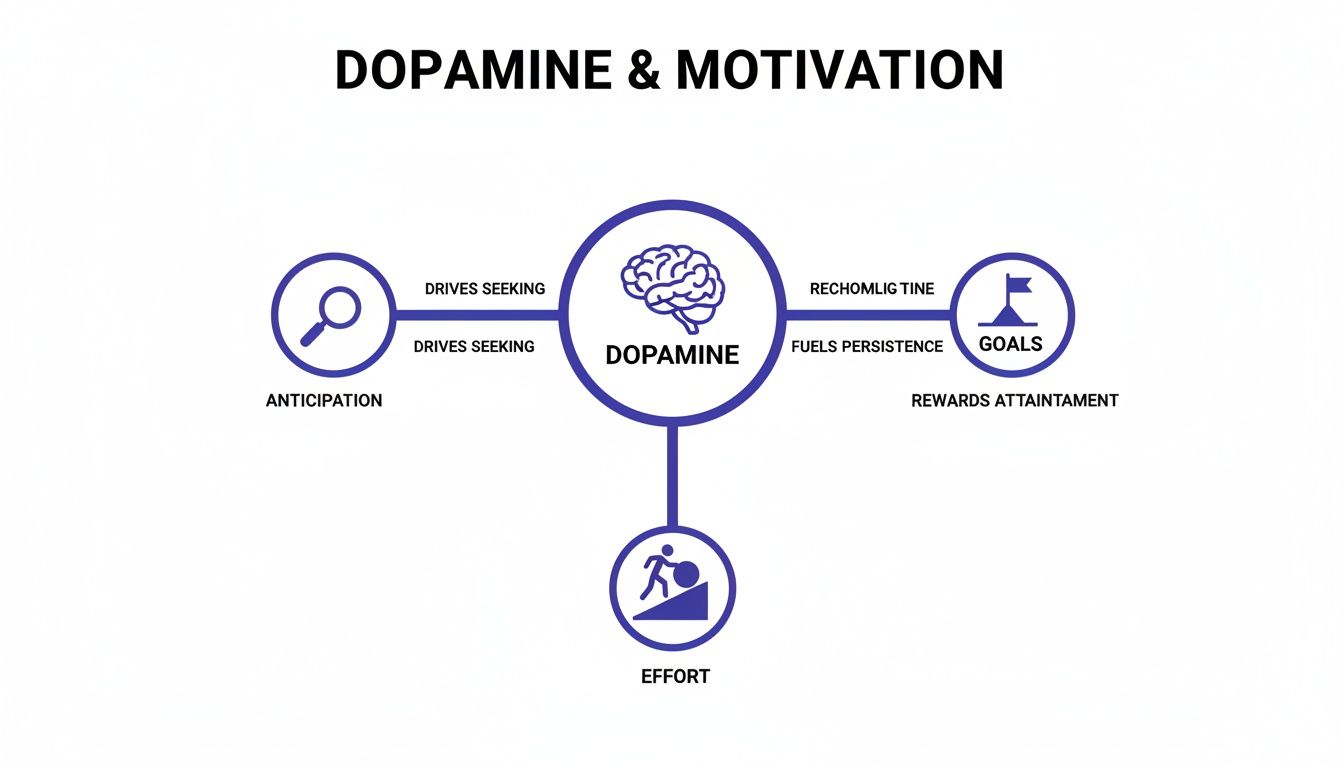
As the infographic shows, dopamine’s influence starts with anticipating a goal, continues by fueling the effort to get there, and finally solidifies the behavior that led to success. Understanding this cycle is the first step toward mastering your own focus and drive. These motivational circuits are deeply connected to the brain’s emotional core. To learn more about how these systems shape your daily habits, see our guide on limbic system retraining.
And if you want to dive deeper into optimizing brain function, you might explore the science behind nootropic supplements for enhanced cognitive performance. By grasping how your brain is wired, you can finally build systems that support your goals instead of working against them.
Debunking Common Myths About Dopamine and Motivation
The conversation around dopamine and motivation is crowded with buzzwords and oversimplifications. If you really want to manage your focus, you first have to separate the pop-psychology myths from the scientific reality. Many popular ideas sound compelling, but they seriously misrepresent how this powerful neurotransmitter actually works in your brain.
So, let’s start by clearing up the biggest misconceptions. Understanding what dopamine isn’t is just as important as knowing what it is. This clarity is the foundation for building strategies that actually work, instead of just chasing the latest productivity fad.

To make this easier, here’s a quick look at the most common myths and the science that corrects them.
Dopamine Myths vs Scientific Reality
| Common Myth | Scientific Explanation |
|---|---|
| Dopamine is the “pleasure chemical.” | Dopamine is the molecule of anticipation and pursuit. It drives the wanting of a reward, not the feeling of pleasure itself. |
| You can “run out” of dopamine. | Your brain doesn’t run out of dopamine. The real issue is receptor downregulation, where your pathways become less sensitive to stimulation. |
| A “dopamine detox” means no fun. | A detox isn’t about eliminating all stimulation. It’s a strategic reset to reduce hyper-stimulating activities and re-sensitize your reward system. |
With these core distinctions in mind, we can dig a little deeper into why these myths are so persistent—and what the truth means for your focus and drive.
Myth 1: Dopamine Is the Pleasure Chemical
This is by far the most stubborn myth out there. While dopamine is absolutely involved in the brain’s reward circuits, it’s not the molecule of pleasure itself. A much better way to think of it is as the molecule of anticipation and pursuit. It’s the neurochemical that creates the feeling of wanting something, driving you to get up and go after it.
The actual sensation of enjoyment or liking something is more closely tied to other brain chemicals, like opioids and endocannabinoids. Dopamine’s main job is to get you off the couch to chase a goal, whether that’s a promotion at work or another cookie from the jar.
This isn’t just a minor detail. A major scientific shift now recognizes dopamine as a motivation regulator that responds to the possibility of a reward. Research from Universitat Jaume I shows its activity often spikes before a reward arrives, encouraging us to start and stick with an action. This means your dopamine system is constantly being trained by everything from looming project deadlines to the unpredictable buzz of your phone.
Myth 2: You Can Run Out of Dopamine
You can’t “run out” of dopamine like a car runs out of gas. Your brain produces it constantly. The real problem isn’t depletion, it’s the dysregulation of your dopamine pathways. When you’re constantly bombarded with high-dopamine stimuli—like endless social media feeds, addictive video games, or processed foods—your brain adapts to protect itself.
Your dopamine receptors can become less sensitive, a process known as receptor downregulation. This means you need more and more of a particular stimulus just to get the same motivational “kick.” The fallout? Normal, everyday tasks start to feel dull and uninspiring because they can’t compete with the intense dopamine hits your brain has gotten used to.
Myth 3: A Dopamine Detox Means Quitting Everything Fun
The term “dopamine detox” is catchy, but it’s often taken to an extreme. A true detox isn’t about avoiding all forms of stimulation—that’s both impractical and unsustainable for pretty much everyone. Instead, it’s about strategically dialing back your exposure to artificial, high-dopamine activities to give your reward pathways a chance to reset.
A more accurate name might be a “dopamine fast” or a “digital reset.” The idea is to consciously step away from the hyper-stimulating inputs, like your phone or streaming services, for a set period. This break helps your brain recalibrate, making natural rewards and important work feel engaging and interesting again. It’s a method for managing your attention, not eliminating a vital brain chemical.
If you want to go deeper, we’ve broken down the science and practical steps in our guide on whether a dopamine detox is real or a myth.
How Your Brain Decides If a Task Is Worth the Effort
Ever wonder why clearing your inbox feels so much easier than starting that massive quarterly report? The answer isn’t laziness. It’s a sophisticated calculation happening deep inside your brain, a process driven by the powerful relationship between dopamine and motivation.
With every choice you face, your brain runs a lightning-fast, subconscious cost-benefit analysis. Think of dopamine as the internal accountant for this operation. Its main job is to weigh the perceived effort of a task against the size and certainty of its potential reward. This mental math happens constantly, shaping whether you dive into a challenging project or opt for a quick, easy win instead.
This explains our magnetic pull toward low-effort, high-feedback activities. Checking email, scrolling a social feed, or even just tidying your desktop gives you an immediate, tangible sense of accomplishment. Your brain’s accountant flags these as low-risk, high-return investments, making them incredibly appealing next to a long-term project with a payoff that feels distant and uncertain.
The Cost-Benefit Calculus of Motivation
Your brain is, above all, an energy-conservation machine. It’s not trying to sabotage your biggest goals; it’s simply wired to prioritize actions that promise the best return on that precious energy. This internal system is always weighing a few key variables:
- Required Effort: How much mental or physical energy will this take?
- Reward Size: How much do I actually care about the outcome?
- Reward Probability: What are the odds I’ll actually get that reward?
- Time Delay: How long will I have to wait for the payoff?
When a task demands high effort for a reward that’s far off and uncertain, your dopamine system signals that it’s a bad deal. That feeling we call procrastination? That’s your brain essentially vetoing the transaction. Knowing this is powerful, because it means you can start re-engineering your tasks to be more “dopamine-friendly.”
Modern neuroscience confirms this isn’t just about feeling pleasure. Dopamine actively shapes how much effort you’re willing to put in. A landmark 2012 Vanderbilt University study found that people described as “go-getters” had higher dopamine signaling in brain areas tied to reward and motivation, like the striatum. In contrast, those who opted for easier tasks with smaller rewards showed more dopamine activity in the anterior insula, a region linked to fatigue and risk aversion. Dopamine, it turns out, is the critical chemical that tunes the brain’s calculation of whether an effort is truly worth making. You can discover more about these dopamine findings on the Vanderbilt University news site.
Hacking the Effort Equation with Dopamine and Motivation in Mind
Once you understand this internal accounting system, you can start structuring your work to feel more achievable and rewarding from the start. The goal is simple: make your most important tasks seem like better investments to your brain.
Breaking a huge project into tiny, concrete steps is the classic example of this principle in action. A massive goal like “write a 20-page report” sounds exhausting and triggers a high-effort alarm. But a small, clear task like “create the report outline” or “write the first paragraph” feels low-effort and provides a quick hit of completion. That small win releases a little dopamine, which actually fuels the motivation to continue.
Real-World Scenario: A student needs to study for a final exam. The idea of “studying for 4 hours” feels overwhelming. Instead, she breaks it down: “Read one chapter,” then “Review flashcards for 20 minutes.” Each small completion provides a satisfying dopamine release, making it easier to keep going. She’s hacking the effort equation to make the task more appealing to her brain’s reward system.
This is one of the core ideas behind the neuroscience of single-tasking, a practice that helps lower cognitive load and makes progress feel real. By reframing the work, you can finally tip the scales in favor of taking action on your biggest goals.
Practical Strategies to Manage Your Dopamine for Better Motivation
Knowing the neuroscience behind dopamine and motivation is one thing, but real change comes from putting that knowledge to work. The goal isn’t to fight your brain’s wiring—it’s to work with it. Think of this as a toolkit of evidence-backed strategies designed to help you guide your dopamine system, making focus and productivity feel less like a battle and more like a natural rhythm.
By making a few deliberate tweaks to your environment and routines, you can gently nudge your motivational circuits toward your long-term goals instead of letting them get hijacked by cheap, short-term distractions.

We’ll cover four key moves: designing a workspace that supports deep work, using rewards intelligently to keep going, building momentum with habit stacking, and resetting your focus with a practical digital reset.
Design a Dopamine-Aware Workspace to Enhance Motivation
Your physical and digital environments are constantly signaling to your brain what it should pay attention to. If your desk is a mess and your screen is a fireworks display of notifications, your brain’s attention is already fractured before you even start. A “dopamine-aware” workspace is simply one that’s intentionally designed to sideline the low-effort, high-reward distractions that drain your motivational fuel.
The principle is dead simple: increase the friction for distracting activities and decrease it for productive ones.
- Physical Space: Clear your desk of everything but the essentials for your current task. Move your phone to another room or tuck it into a drawer—that small physical barrier makes a huge difference.
- Digital Space: Use a separate browser profile for work, with no social media logins. Close all the extra tabs and shut down every non-essential notification on your desktop and in your email.
- Auditory Space: Noise-canceling headphones aren’t just for music; they’re a powerful signal to your brain that it’s time to lock in and focus.
Real-World Scenario: A freelance writer needs to dive into a big article. She turns her phone off and leaves it in the kitchen. She closes her email client and all browser tabs except for her research. By curating her environment, she makes the most important task the easiest and most appealing path for her brain to take.
Use Intermittent Rewards to Sustain Effort
When you’re grinding away on a long, tough project, the final payoff can feel way too distant to fuel today’s motivation. Your brain’s effort calculation flags it as a bad deal. The fix is to slice the project into smaller pieces and sprinkle in small, intermittent rewards along the way.
This strategy cleverly mimics the variable reward schedules that make things like video games so compelling. When you celebrate small milestones, you create a steady drip of dopamine that reinforces your hard work and keeps you in the game. For a deeper dive, exploring effective strategies for improving focus and concentration can offer some powerful complementary techniques.
Leverage Habit Stacking for Effortless Momentum
Trying to build a new positive habit from zero takes a surprising amount of activation energy. “Habit stacking” is a brilliant technique that lowers that barrier by piggybacking a new behavior onto an existing one you already do on autopilot. This move leverages your brain’s well-worn neural pathways to build momentum almost effortlessly.
The formula, made famous by author James Clear, is simple: “After [Current Habit], I will [New Habit].”
- After I pour my morning coffee, I will write down my top three priorities for the day.
- After I finish lunch, I will spend five minutes meditating.
- After I shut down my computer for the day, I will tidy my desk for 1 minute.
This approach neatly sidesteps your brain’s effort calculation. The new habit feels less like a monumental task and more like a natural extension of something you were going to do anyway.
Implement a Practical Digital Reset to Reclaim Dopamine Sensitivity
Constant exposure to hyper-stimulating digital media can slowly numb your dopamine receptors, making normal, productive work feel bland and unappealing. A practical “digital reset” helps recalibrate that reward system, restoring your ability to find motivation in quieter, less intense activities.
This doesn’t mean you have to quit technology cold turkey. A targeted, sustainable approach works far better. The goal is to consciously dial back your intake of high-dopamine, low-value digital content for a set period. If you want a full-blown plan, we’ve built one in our guide on how to reset your dopamine for focus and clarity without quitting tech.
A simple way to start is with a “digital sunset”—avoiding all screens for 60-90 minutes before bed. This not only helps you sleep better but gives your brain a much-needed break from the constant buzz of stimulation.
Dopamine-Aware Productivity Techniques
| Technique | How It Works | Example Application |
|---|---|---|
| Workspace Design | Increases friction for distractions and reduces it for focused work. | Moving your smartphone to another room while working on a deep task. |
| Intermittent Rewards | Provides small, periodic dopamine boosts to sustain motivation for long projects. | Taking a 15-minute walk outside after completing a 90-minute focus block. |
| Habit Stacking | Links a new, desired habit to an existing, automatic one to lower activation energy. | Meditating for 5 minutes immediately after your morning coffee. |
| Digital Reset | Resets dopamine sensitivity by reducing exposure to hyper-stimulating digital media. | Implementing a “digital sunset” by avoiding screens for 60-90 minutes before sleep. |
Editor’s Note: What Actually Works for Boosting Motivation
After digging through the neuroscience and testing these methods, let’s cut to the chase. While every strategy here can sharpen your focus, one stands out for its undeniable impact: designing a distraction-free environment. This is the single most powerful change you can make to fix a broken link between dopamine and motivation.
Getting rid of the constant pings, alerts, and visual clutter does more than just stop interruptions. It rewires your brain’s effort calculation. When your most important task is also the easiest and most obvious thing to do, your dopamine system starts working for you, not against you.

Who this is for: This advice is best for professionals, students, and creatives who feel their productivity is constantly being hijacked by digital distractions and procrastination. It’s for people who know what they should be doing but struggle to find the drive to start and sustain effort.
Caveats and Limitations: These techniques are for optimizing a generally healthy brain. They are not treatments or cures. If you’re struggling with persistent low motivation, chronic focus issues, or symptoms that feel like burnout, ADHD, anxiety, or depression, the most important step is to consult a healthcare professional. These strategies support well-being but are not a substitute for medical or psychological care.
The Deeper Science Behind Dopamine and Motivation
To really get a handle on the relationship between dopamine and motivation, it helps to look past the latest productivity hacks and see the deep scientific history that brought us here. The strategies in this guide aren’t just passing fads; they’re built on more than half a century of rigorous neuroscience.
The story of dopamine as a key player in motivation isn’t new. Its connection to our drive goes way back, starting with its identification in the human brain in 1957 by Katharine Montagu. Early breakthroughs in Parkinson’s disease gave us a stark picture of just how important it is. Scientists saw that a severe loss of dopamine-producing neurons led to profound problems with both physical movement and the will to start an action.
The Brain’s Learning Signal
This history matters because it shows that the whole “dopamine and motivation” conversation rests on a solid, well-researched foundation. Midbrain dopamine neurons fire in response to something called prediction error—the gap between what you expect to happen and what actually does. This signal is what teaches your brain which actions are worth the energy and which ones to avoid, refining how you behave in the future. You can discover more about this foundational research on the National Institutes of Health website.
This learning mechanism is fundamental. It’s what links your intention to act with the physical follow-through, forming the very basis of any goal-directed behavior. When this system is working well, you feel a natural pull toward meaningful tasks.
But when our modern world constantly bombards us with high-stimulation, low-effort rewards, this system gets thrown out of whack. The endless notifications and infinite scrolling create a state of being overstimulated, making it much harder to find the drive for less intense, long-term goals. You can learn more about the signs of being overstimulated by micro-dopamine addictions in our detailed article.
By understanding this deeper context, you can start to see motivation not as some mysterious force to be conquered with willpower, but as a biological system you can intelligently manage.
Disclaimer: This article contains affiliate links, meaning we may earn a commission if you make a purchase. The content is for educational purposes only and is not a substitute for professional medical or psychological advice. Always consult a healthcare professional for any health concerns.
Frequently Asked Questions About Dopamine and Motivation
Here are clear, straightforward answers to the most common questions about the link between dopamine and motivation.
1. What is the main role of dopamine in motivation?
Dopamine’s primary role is not to provide pleasure, but to drive the anticipation and pursuit of a reward. It’s the neurochemical that creates the “wanting” or “craving” that motivates you to take action toward a goal.
2. How can I increase dopamine and motivation naturally?
You can naturally support your dopamine system through regular exercise, getting enough sleep, eating a balanced diet rich in protein, listening to music you enjoy, and practicing mindfulness. Breaking large goals into smaller, achievable steps also provides regular dopamine release.
3. Does low dopamine cause a lack of motivation?
Yes, dysregulation in the dopamine system is strongly linked to a lack of motivation. When your dopamine pathways become less sensitive (often due to overstimulation), it takes more effort to feel motivated, and everyday tasks can seem dull or overwhelming. This is a key factor in procrastination and feelings of apathy.
4. Is dopamine the same as willpower?
No. Willpower is often seen as a conscious, forceful effort to override impulses. Dopamine is the underlying neurochemical system that influences whether you even feel the drive to exert that effort. Managing your dopamine is about making motivation feel more automatic, rather than relying solely on willpower.
5. What is a “dopamine detox” and does it work?
A “dopamine detox” (or more accurately, a stimulus fast) is a temporary break from high-stimulation activities like social media, video games, and junk food. It works by allowing your dopamine receptors to “reset” or re-sensitize, which can restore your ability to find motivation in less intense, more meaningful activities.
6. Can my diet affect my dopamine and motivation?
Absolutely. Your brain needs specific nutrients, especially the amino acid tyrosine (found in foods like chicken, almonds, and avocados), to produce dopamine. A balanced diet supports overall brain health, which is the foundation for a well-functioning motivation system.
7. Why do I lose motivation for long-term goals?
Long-term goals often fail to provide the immediate dopamine feedback your brain craves. The reward is too distant. To maintain motivation, you must break the goal into small milestones and reward yourself for completing them. This creates a steady stream of dopamine that keeps you engaged.
8. How does sleep impact dopamine and motivation?
Sleep is critical for a healthy dopamine system. Poor sleep can reduce the availability of dopamine receptors in your brain, leading to fatigue, mood swings, and a significant drop in motivation. Prioritizing consistent, quality sleep is one of the most effective ways to support your daily drive.
9. Are there any risks to trying to “hack” my dopamine?
The biggest risk is relying on artificial, high-intensity stimuli (like excessive caffeine, sugar, or constant digital notifications) for motivation. This can lead to receptor downregulation and burnout, making it even harder to feel motivated naturally. The goal should always be to work with your brain’s natural systems, not to constantly override them.
10. When should I see a doctor about low motivation?
If you experience persistent low motivation that interferes with your daily life, work, or relationships, and is accompanied by other symptoms like low mood, changes in sleep or appetite, or feelings of hopelessness, it is crucial to consult a doctor or mental health professional. These could be signs of underlying conditions like depression or ADHD, which require professional care. This article is for educational purposes only.
At Mind Clarity Hub, we turn complex neuroscience into simple, actionable steps. If you’re ready to build systems for lasting focus and calm productivity, we invite you to explore our library of science-backed books and guides.
Start reclaiming your mental space and momentum today at MindClarityHub.com
Explore the Mind Clarity Hub Library
Practical books on focus, digital habits, resilience, and building a calmer mind.
The Power of Clarity
Unlock mental focus, build momentum, and create the life you were meant to live.
View book →
AI & ChatGPT for Beginners
No PhD needed — a 2025 guide to AI, prompts, and productivity without coding.
View book →
Zen in the Digital Jungle
Mindfulness for a chaotic world.
View book →
The Slow Reset
Mindful living in a fast-paced world.
View book →
Perfectly Imperfect
Stop self-criticism, set boundaries, and embrace the real you.
View book →
Reclaiming Silence
A dopamine detox guide to finding peace in a noisy world.
View book →
The Focused Freelancer
Productivity, pricing & positioning for independents in 2025.
View book →
ChatGPT Side Hustle System
Launch your AI-driven online business in 30 days.
View book →
Burnout, Interrupted
A proven path to restore energy and reclaim your life.
View book →
Attention Unleashed
Focus strategies for the distracted mind.
View book →
Side Hustle Launchpad
Your quick-start guide to extra income.
View book →
Digital Clarity
Rewire your brain, escape dopamine traps & regain focus.
View book →
Break the Scroll
Reduce screen time and take back control of your life.
View book →
Climate Compassion
Transform eco-anxiety into empowered action.
View book →
Village Mentality
The power of community for mental wellness.
View book →
Restful Nights
Overcoming sleep anxiety in a 24/7 world.
View book →
Connected Again
Combat loneliness and build meaningful relationships.
View book →
Focus Recharged
Mastering attention and productivity in the digital era.
View book →
Marketing Magic with ChatGPT
AI-powered content, campaigns, and copywriting to grow faster.
View book →
The 6-Figure Creator
Turn knowledge into passive income with books, courses & AI.
View book →
Burnout Breakthrough
Reset your work-life balance and thrive in 2025.
View book →
The Emotionally Intelligent Man
A modern guide to self-awareness and communication.
View book →
AI Personalized Wellness
Create your custom health plan with data-driven habits.
View book →
Everyday AI Made Easy
Use ChatGPT and smart tools to simplify life.
View book →
Money Mindfulness
A financial wellness guide for Gen Z & Millennials.
View book →
Startup Smarter with AI
ChatGPT strategies and tools to grow your business.
View book →
ChatGPT for Writers & Creators
Unlock AI-powered brainstorming, drafting & editing.
View book →