...

Tag: workplace productivity

  • Thrive with ADHD in the Workplace: A Guide to Focus and Strengths

    Thrive with ADHD in the Workplace: A Guide to Focus and Strengths

    Working with an ADHD brain in a professional setting can feel like trying to run specialized software on a standard operating system. It’s not about forcing your unique brain wiring into a neurotypical box; it’s about finding the right systems and learning to leverage your genuine strengths.

    Affiliate Disclosure: This article contains affiliate links. If you make a purchase through these links, we may earn a small commission at no extra cost to you. This helps support our work in creating helpful content.

    Understanding ADHD in a Professional Context

    This article is for educational purposes only and is not a substitute for professional medical or psychological advice. Always consult a qualified healthcare provider for diagnosis and treatment related to conditions like ADHD, anxiety, or burnout.

    Let’s start by reframing what ADHD actually is. Forget the idea of a β€œdeficit.” A more useful way to think of it is like having a high-performance engine that requires a specific kind of fuel and maintenance to run at its best. This shift in perspective helps us move past the myths and get straight to practical, supportive strategies.

    From a neuroscience perspective, ADHD primarily affects the brain’s executive functions. Think of these as your brain’s internal project managerβ€”the set of mental skills in the prefrontal cortex responsible for planning, organizing, regulating focus, and managing emotions. When these functions work differently, it can create friction in a structured work environment. You might find it intensely difficult to start a big, vague project or realize an entire afternoon has vanished in what felt like minutes.

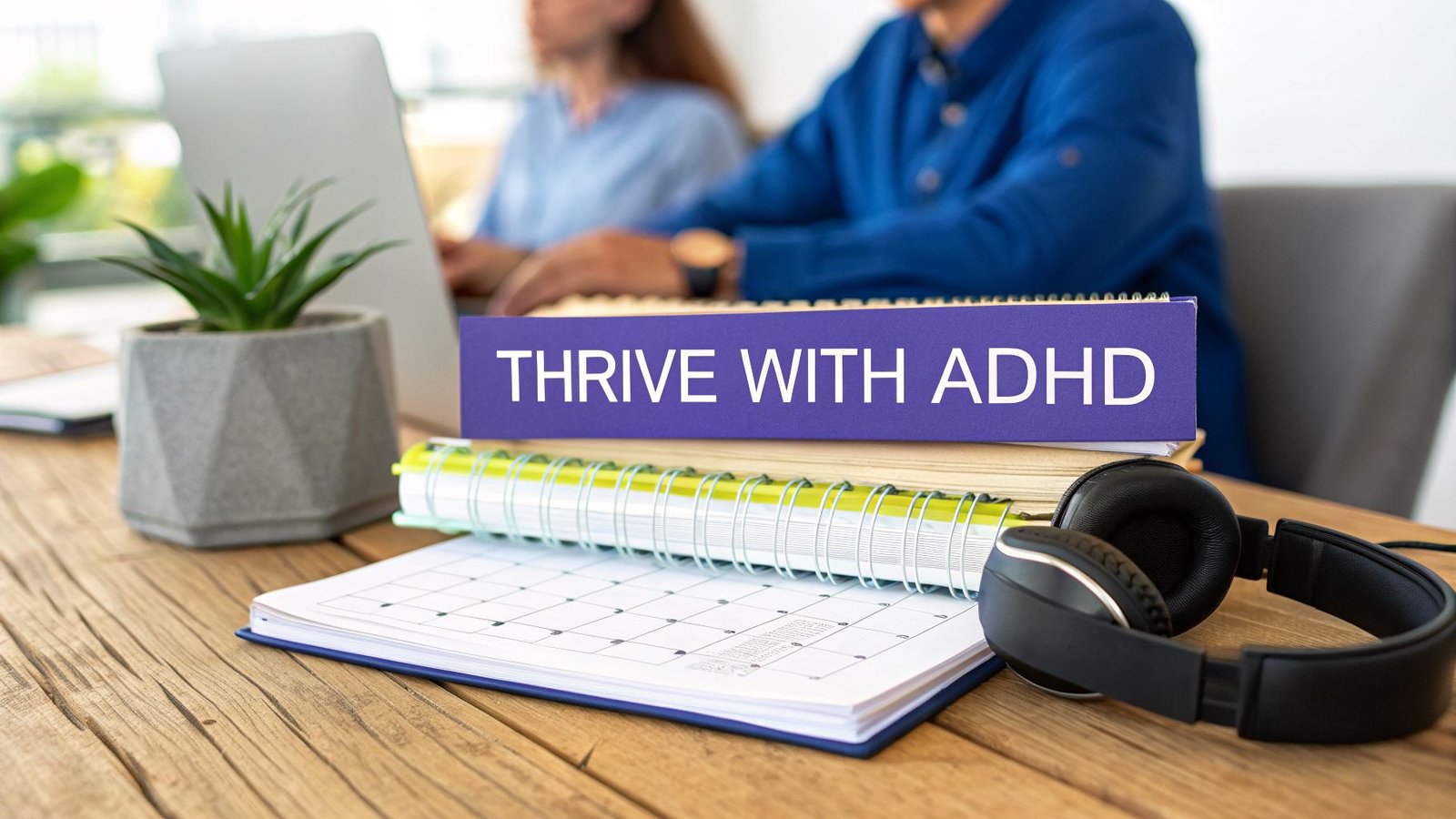
    A tidy workspace featuring an open notebook, pen, a book titled 'UNIQUE BRAIN WIRING', and a small plant, illustrating concepts for managing ADHD in the workplace.

    From Challenges to Strengths: Leveraging Your ADHD in the Workplace

    But this unique wiring isn’t just a source of challenges; it’s also a source of incredible strengths. Many adults with ADHD have a remarkable capacity for creative, out-of-the-box problem-solving and an intense, almost super-powered ability to hyperfocus when a task genuinely captures their interest. These aren’t just minor perks; they are powerful professional assets when you learn how to direct them.

    Real-World Scenario: Imagine an engineer, Maria, who struggles with administrative paperwork. However, when a critical system fails, she enters a state of hyperfocus. For hours, she works with intense concentration, connecting seemingly unrelated data points to find an innovative solution no one else saw. Her unique brain wiring became the company’s biggest asset in that moment.

    ADHD affects about 3.1% of adults globally. While untreated ADHD can lead to lost productivity, embracing this neurodiversity also brings distinct advantages to the table. For instance, research highlights that 80% of individuals with ADHD report the ability to hyperfocus, and 78% identify as being highly creative.

    Building Your Foundational Toolkit for ADHD Success at Work

    The key to harnessing these strengths often starts with creating external structure to support your internal executive functions. A surprisingly powerful tool is a simple time blocking planner, which helps you visually map out your day and assign specific tasks to dedicated time slots. This simple practice builds predictability into your day and dramatically reduces the mental energy you spend just trying to decide what to do next.

    This approach is a cornerstone for building the other skills we’ll explore in this guide. For a deeper look at improving these cognitive skills, check out our guide on how to repair your executive function step-by-step. It’s also crucial to understand how your work environment affects you personally. Exploring the common causes of loss in job satisfaction can offer valuable clues for building a career path that truly aligns with your brain’s natural tendencies.

    How ADHD Presents in a Work Environment

    To really get what ADHD looks like at work, you have to look past the old stereotypes of someone bouncing off the walls. The real challenges are often quiet, internal, and rooted in the brain’s wiring. An ADHD brain just processes time, tasks, and distractions differently, which can create some unique hurdles in a typical nine-to-five.

    One of the most common but misunderstood experiences is time blindness. This isn’t about being bad at managing a calendar; it’s a neurological hiccup in how the brain perceives the passage of time. Behavioral research shows that the internal clock just doesn’t tick along in a steady, predictable way for many with ADHD.

    This makes it incredibly hard to guess how long a project will take, often leading to blown deadlines or being chronically late, no matter how good your intentions are. It can feel like time is either crawling by in slow motion or suddenly lurches forward, leaving you wondering where the day went.

    The Hurdle of Getting Started: Understanding Task Initiation with ADHD

    Another huge one is task initiation. From the outside, it looks exactly like procrastination. But for someone with ADHD, the struggle comes from executive dysfunctionβ€”a kind of mental roadblock that makes starting a boring or complicated task feel almost physically impossible. The brain’s reward system, which is regulated by dopamine, may not provide the β€œkick” needed to begin low-interest activities.

    Example: Alex, a project manager with ADHD, is a genius at big-picture strategy and getting their team fired up. But when it’s time to write the detailed weekly progress reportβ€”a critical but mind-numbing taskβ€”they just… freeze. It’s not a weak work ethic. It’s the sheer cognitive effort needed to organize their thoughts and start typing that creates an invisible wall.

    Distraction, Cognitive Overload, and the Emotional Impact of ADHD

    The modern office is basically a minefield of distractions, from open-plan chatter to the endless ping of notifications. For an ADHD brain, which already struggles to filter out background noise, this kind of environment can trigger serious cognitive overload. Every little interruption can completely derail a train of thought, and getting back on track is exhausting.

    This constant battle takes a heavy emotional toll. The cycle of missed deadlines, half-finished projects, and feeling like you’re always letting people down often spirals into performance anxiety and low self-esteem, paving a fast track to burnout. The employment stats tell a grim story here. Employees with ADHD are 60% more likely to be fired and three times more likely to quit a job on impulse. Globally, unemployment for neurodivergent adults, including those with ADHD, can be as high as 40%.

    Understanding these patterns is the first real step. Once you see them clearly, you can start building supportive strategies that actually work with your brain instead of fighting against it.


    Turning Your ADHD Traits into Career Superpowers

    It’s easy to get bogged down in the challenges of ADHD at work, but focusing only on the difficulties gives you half the picture. The very same brain wiring that creates obstacles can also be the source of some pretty remarkable professional strengths. When you learn how to channel them, these aren’t just minor advantagesβ€”they’re career superpowers.

    Many people with ADHD have this incredible mix of boundless creativity, intense energy, and a surprising knack for resilience. These are the exact qualities that innovative, fast-moving companies are desperate for. Instead of seeing your brain as something that needs to be β€œfixed,” the real work is in reframing your perspective to leverage what it does naturally well.

    The Power of Hyperfocus in the Workplace

    One of the most potent of these strengths is hyperfocus. From a neuroscience standpoint, this is way more than just β€œgetting in the zone.” It’s a state of deep, immersive concentration where the part of your brain that normally handles switching your attention (the prefrontal cortex) basically goes quiet on distractions. This allows you to dive incredibly deep into a single, compelling task.

    While you can’t always summon it on command, when you manage to point that hyperfocus at a work problem, the results can be stunning.

    Example: A marketing analyst with ADHD might get completely lost in a complex dataset. For hours, they can swim through numbers and trends, surfacing subtle patterns and critical insights that their colleagues might have glossed over in a standard analysis.

    Unlocking Non-Linear Thinking and Creativity

    The ADHD brain doesn’t always travel in a straight line from A to B. This non-linear thinkingβ€”the ability to connect seemingly unrelated ideasβ€”is the engine of true innovation. It allows you to come up with novel solutions because your mind isn’t stuck on the conventional path. In fields where originality is currency, this is invaluable.

    It’s no surprise that certain career paths are a natural fit for these traits:

    • Entrepreneurship: Thrives on high energy, a healthy appetite for risk, and the ability to pivot on a dimeβ€”all classic ADHD patterns.
    • Creative Fields: Roles in design, writing, and advertising reward out-of-the-box thinking and people who bring a fresh perspective.
    • Tech and Engineering: Solving messy, complex problems often requires the kind of deep, hyperfocused concentration the ADHD brain was built for.
    • Emergency Services: First responders often excel in high-stakes, fast-paced environments where quick, intuitive decisions are a matter of life and death.

    These strengths aren’t an accident; they’re a direct result of your unique neurobiology. The energy that can feel like restlessness can become a massive engine for productivity, especially when you can move your body with something like an under desk walking pad during long tasks. You can learn more about how to intentionally tap into these states by exploring our guide on how to achieve a flow state.

    By finding the environments and roles that actually align with your natural strengths, you can stop fighting your brain and start using it to its full potential. Ready to go deeper? Browse the library to find a book that fits your specific goals.

    Actionable Strategies for Managing ADHD at Work

    Knowing your brain is wired differently is the first step. The real work is in turning that knowledge into a practical system that works for you, not against you. The goal here isn’t to force yourself into a neurotypical box, but to build a supportive environment that plays to your strengths and smooths out the friction points.

    Think of these strategies as external scaffolding. They provide the structure that helps the ADHD brain’s executive functionsβ€”planning, starting, and finishingβ€”fire on all cylinders. By making a few intentional changes, you can lower your cognitive load and save your best mental energy for the work that truly matters.

    Best Options for Designing Your Ideal Workspace for ADHD

    The ADHD brain is incredibly sensitive to its surroundings. Behavioral psychology explains that distractions that others might barely notice can completely throw you off track. This is why intentionally designing your workspace to minimize interruptions isn’t just a nice-to-have; it’s a game-changer for anyone managing ADHD in the workplace.

    • Create a Focus Bubble: Open-plan offices can feel like a constant sensory assault. A great pair of noise canceling headphones can create an instant sanctuary, signaling to your brainβ€”and your colleaguesβ€”that it’s deep work time.

    • Declutter Your Digital and Physical Space: Every object on your desk and every tab in your browser is quietly competing for your attention. Take five minutes at the end of each day to clear your desk and close out unnecessary tabs. A clean space means less visual noise, making it far easier to lock onto the task at hand.

    • Externalize Your Brain: Stop trying to hold everything in your head. Your working memory is already doing enough. Use whiteboards, sticky notes, or a dedicated productivity journal to get ideas, reminders, and to-do lists out of your brain and into the physical world.


    When you create this kind of structure, you’re not just fighting distractionβ€”you’re unleashing the powerful traits that often come with ADHD.

    ADHD Superpowers Decision Tree diagram showing Creativity, Hyperfocus, and Resilience traits for managing ADHD in the workplace.

    This visual shows how a well-designed environment can channel your energy, turning potential challenges into genuine strengths like creativity and intense hyperfocus.

    Mastering Your Time and Focus

    β€œTime blindness” is a real thing for many with ADHD, making it incredibly difficult to sense how much time is passing. This is where external tools become your best friend for staying on track. For anyone working remotely, this is especially critical. You might find some helpful ideas in these Top 8 Work From Home Time Management Tips.

    One of the most effective and widely-used methods is the Pomodoro Technique. It’s brilliant because it imposes a simple rhythm of focused work followed by a deliberate break. This structure helps prevent burnout and makes huge, intimidating tasks feel much more approachable. You can learn more about the Pomodoro Technique in our detailed guide. Using a simple pomodoro timer makes it almost effortless to start.

    Here’s how it works in real life: Sarah has a four-hour block to β€œwork on the presentation,” which feels impossible to start. Instead, she sets her timer for 25 minutes. Her only goal? Work on the slide deck until the timer rings. After a five-minute break to stretch, she does it again. The daunting marathon just became a series of manageable sprints.

    How to Choose the Best Focus Strategy for Your Brain

    Finding the right system is all about what clicks with your brain and the demands of your day. The key is to experiment. Some days, you might need the rigid structure of Time Blocking; on others, a simple priority list is enough.

    This table breaks down four popular techniques to help you decide which one best fits your work style and current needs.

    StrategyBest ForHow It WorksRecommended Tool
    Pomodoro TechniqueShort bursts of intense focus and preventing burnout.Work for 25 minutes, then take a 5-minute break. Repeat this cycle.Pomodoro timer
    Time BlockingStructuring an entire day or week with dedicated task slots.Assign every task, meeting, and break a specific block in your calendar.Time blocking planner
    Eat the FrogOvercoming procrastination on your most important or dreaded task.Tackle your most difficult task first thing in the morning when your willpower is highest.Productivity journal
    The Ivy Lee MethodPrioritizing a short, focused list for the next day.At the end of each day, list the six most important tasks for tomorrow in order of priority.Habit tracker journal

    Don’t feel locked into just one. The most successful people I know mix and match these methods based on the project, their energy levels, and their deadlines. The goal is progress, not perfection. To find your ideal system, you can compare options across our book library.

    Simplifying Your Overwhelming Tasks

    The ADHD brain has a notorious habit of freezing when a task feels too big, too vague, or too undefined. This is called β€œtask initiation paralysis.” The antidote is to break overwhelming projects down into concrete, bite-sized micro-tasks. This gives your brain a clear, obvious starting point, which is often all you need to get moving.

    A to-do item like β€œLaunch Q3 Marketing Campaign” is a recipe for procrastination. It’s a project, not a task.

    Instead, your list should look more like this:

    1. Draft initial ad copy concepts.
    2. Design three visual mockups.
    3. Set up the ad targeting parameters.
    4. Schedule a 15-minute review with the team.

    See the difference? Each of these steps is small, clear, and can be completed in a single session. Ticking one off delivers that little hit of dopamine and the momentum you need to roll right into the next one. This creates a positive feedback loop that pulls you forward, one tiny win at a time.

    How to Discuss Accommodations at Work

    Talking about workplace accommodations can feel like a high-stakes tightrope walk. Deciding if, when, and how to bring up your ADHD with an employer is a deeply personal choice, and it’s important to remember you are in the driver’s seat.

    The good news? You don’t have to disclose a specific diagnosis just to ask for support. A much better approach is to frame your request around solutions and performance, not problems. This moves the conversation away from a label and toward a practical, work-related need that benefits both you and the company.

    Two american women discuss at a desk, one taking notes, with 'Request Accommodations' text overlay, illustrating how to manage ADHD in the workplace.

    Framing the Conversation for Success with ADHD

    The language you choose matters. A lot. Instead of opening with a diagnosis, lead with a solution-focused observation about your work style. This makes the request feel less like a personal problem and more like a professional strategy for doing your best work.

    Example: Instead of, β€œI have ADHD and get distracted easily,” you could try, β€œI’ve noticed I produce my most accurate and creative work when I can minimize auditory distractions. Would it be possible to use noise canceling headphones during my deep work blocks?”

    This approach is proactive and collaborative. It shows self-awareness and a commitment to qualityβ€”two things any manager will value. The goal is to show how a small adjustment can unlock a significant improvement in your output. Asking for support can be a source of stress, and you can learn more about how to manage anxiety in a work setting in our dedicated guide.

    Common and Reasonable Accommodations for ADHD in the Workplace

    Under the Americans with Disabilities Act (ADA), employers are required to provide β€œreasonable accommodations” for employees with disabilities, which can include ADHD. These are simply modifications or adjustments that allow you to perform the essential duties of your job.

    Here are a few common examples of reasonable accommodations you might consider requesting for ADHD in the workplace:

    • A Quieter Workspace: This could mean a desk in a low-traffic spot, permission to book a private room for focus-heavy tasks, or the option to work from home on certain days.
    • Flexible Scheduling: Adjusting your start and end times to align with when your brain is naturally most alert can be a game-changer for productivity.
    • Written Instructions: Asking for verbal directions to be followed up with a quick email creates an external record. This supports working memory and ensures everyone is clear on the deliverables.
    • Task Management Tools: Access to specific software or even a simple physical whiteboard can make organizing and tracking complex projects feel much more manageable.
    • Regular Check-ins: Short, frequent meetings with your manager can help with prioritization and keep you on track, preventing small issues from snowballing.

    Before you approach your manager, take some time to think. Pinpoint exactly which work-related challenges are causing the most friction for you. Then, brainstorm one or two specific, low-cost accommodations that would directly address them. A clear, well-thought-out request makes it much easier for your employer to say yes and support you.

    Editor’s Take: What Really Works for ADHD in the Workplace

    Let’s cut through the noise. When it comes to managing ADHD at work, there’s no magic app or single productivity hack that will fix everything. If there were, you would have found it by now. The single most powerful strategy is consistent, gentle experimentation to discover what works for your brain in your current role.

    Who This Advice Is Best For: This guide is for professionals who know their brain works differently and are ready to build supportive systems instead of fighting against their natural tendencies. It’s for people tired of feeling overwhelmed and ready to try small, practical changes.

    What Actually Works: Start small. Don’t try to implement all these strategies by Monday. Pick one thing. For example, commit to using a visual timer for desk for one focus session tomorrow. Or just clear your physical workspace before you log off tonight. Small, consistent actions build momentum and create lasting change. The goal is to build a personalized toolkit that makes your workday feel less like a constant battle against your own mind.

    Important Caveats: Remember, these strategies are for support, not a cure. They are most effective when paired with professional medical or psychological care. Thriving with ADHD at work is about making sustainable progress, not chasing an impossible standard of neurotypical perfection. For a comprehensive look at improving focus and clarity, consider starting with a foundational book like The Power of Clarity.

    Key Takeaways: Thriving with ADHD in the Workplace

    • Reframe Your Mindset: View your ADHD not as a deficit, but as a unique cognitive style with powerful strengths like creativity, resilience, and the ability to hyperfocus.
    • Build External Structures: Use tools like planners, timers, and a structured workspace to support your brain’s executive functions. This reduces cognitive load and saves mental energy.
    • Break It Down: Overcome task paralysis by breaking large, vague projects into small, concrete, and actionable steps. This creates momentum and provides regular dopamine hits.
    • Advocate for Your Needs: You can request accommodations without disclosing a diagnosis. Frame your needs around performance and solutions, such as asking for a quieter space to improve concentration.
    • Experiment and Adapt: There is no one-size-fits-all solution. The key to long-term success is to continuously experiment with different strategies and tools to find what works best for you.

    Disclaimer: This article contains affiliate links. The content is intended for educational purposes only and is not a substitute for professional medical or psychological advice, diagnosis, or treatment. Always seek the advice of a qualified health provider with any questions you may have regarding a medical condition.

    FAQ: Your Questions About ADHD at Work, Answered

    Let’s tackle some of the most common questions people have about building a career with ADHD. Think of this as a quick reference guide to reinforce the big ideas and help you figure out your next move.

    1. Can I build a successful career with ADHD?

    Absolutely. Many of the world’s most innovative entrepreneurs, artists, and leaders have ADHD. Success comes from understanding your unique brain wiringβ€”leaning into strengths like hyperfocus and out-of-the-box thinking while building systems to support challenges like organization and time management. It’s about finding or creating an environment where your natural talents can shine.

    2. Should I tell my boss I have ADHD?

    This is a personal decision with no single right answer. You are not legally obligated to disclose. If you trust your manager and believe formal accommodations would significantly improve your performance, a conversation might be beneficial for managing ADHD in the workplace. However, a great alternative is to ask for what you need without a label. For instance, say β€œI concentrate best with written instructions” instead of explaining why.

    3. What is the best tool for managing ADHD at work?

    There’s no single magic bullet, as the β€œbest” tool depends on your specific challenges. However, many people with ADHD find that a good time blocking planner is a game-changer because it provides a visual structure for the day. For managing sensory input in a busy office, a pair of noise canceling headphones is often the most impactful tool for creating an instant focus zone.

    4. How do I handle overwhelm when my to-do list is endless?

    When you feel that wave of overwhelm, the first step is to get the tasks out of your head and onto paper or a screen. Then, break down large projects into the smallest possible action items. This externalizes the chaos, making it feel more manageable. From there, use a simple prioritization method to choose just one or two things to focus on right now. Completing even one tiny task can provide the dopamine boost needed to break the paralysis.

    5. Are some jobs better for people with ADHD?

    While anyone can succeed in any field with the right support, some roles naturally align better with common ADHD strengths. Careers that offer novelty, fast-paced problem-solving, and a sense of urgency can be highly engaging for a brain that craves stimulation. Think of fields like entrepreneurship, emergency services, journalism, creative design, or technology. Conversely, jobs that are highly repetitive and administrative may require more robust external systems to maintain focus and engagement.

  • How to Improve Focus at Work and Reclaim Your Attention

    How to Improve Focus at Work and Reclaim Your Attention

    How to Improve Focus at Work and Reclaim Your Attention

    Jeremy Jarvis β€” Mind Clarity Hub founder
    Mind Clarity Hub β€’ Research-aware focus & digital wellness

    Improving your focus at work isn’t about brute-force willpower; it’s a strategic battle against constant interruptions. To win, you first have to understand what distractions truly cost you. They’re far more expensive than just a few lost seconds. Grounded in neuroscience and behavioral psychology, the real key to reclaiming your productivity is building smarter systems to manage and protect your attention.

    Affiliate Disclosure: Please note that this article may contain affiliate links. If you make a purchase through these links, we may earn a small commission at no extra cost to you. This helps support our work in bringing you high-quality, research-backed content.

    The Hidden Costs of Workplace Distraction

    If you feel like you’re struggling to concentrate at work, you’re not alone. The modern officeβ€”whether physical or virtualβ€”is practically engineered to break our focus. A relentless stream of pings from Slack, an endless flow of emails, and a calendar packed with notifications create a state of what experts call continuous partial attention.

    This isn’t a personal failing. It’s a systemic problem, an β€œattention tax” levied on us all day long.

    Every time you switch from a primary taskβ€”like drafting a reportβ€”to check a notification, your brain engages in context switching. From a neuroscience perspective, this is a heavy lift. Your prefrontal cortex, which handles complex goals, has to dump one entire set of information and load a completely new one. This mental gear-shifting burns a surprising amount of cognitive energy.

    Why Small Interruptions Cause Big Problems for Focus at Work

    Let’s make this real. Imagine a project manager, Sarah, trying to finalize a quarterly budget. A Slack message pops up asking for a quick link. She finds it and sends it offβ€”a task that takes maybe 30 seconds.

    But what happens next is the real problem. Her brain now has to disengage from the chat, re-engage with the complex spreadsheet, recall her previous train of thought, and find her exact place again. This mental reset is where the true cost of distraction lies.

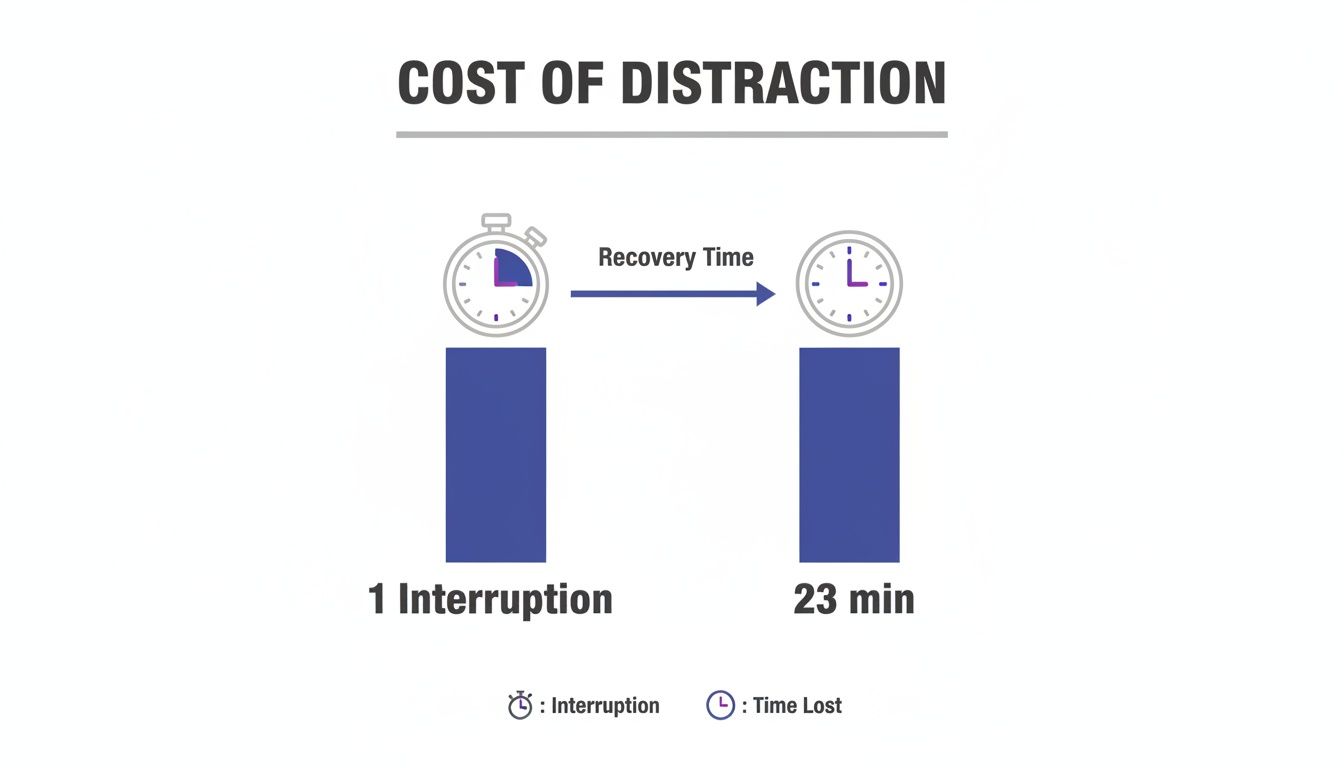
    This is one of the biggest drains on our focus. Research from the University of California, Irvine, found that after a single disruption, it takes an average of 23 minutes and 15 seconds to get back to the same level of concentration you had before.

    Think about that. Just five of those β€œquick” interruptions can quietly erase nearly two hours of your most productive time.

    This diagram really drives the point home, showing the staggering recovery time needed after just one interruption.

    A diagram showing one interruption leads to 23 minutes of recovery time, illustrating the cost of distraction which is a key part of learning how to improve focus at work.

    The data makes it crystal clear: the issue isn’t the interruption itself, but the long, cognitively expensive runway your brain needs to get back on track.

    The Accumulating Debt of Distraction

    These brief interruptions add up throughout the day, creating a kind of productivity debt that leaves you feeling drained and perpetually behind. Your brain simply isn’t built for rapid, continuous task-switching. When you overload it, the result is mental fatigue, more errors in your work, and that frustrating feeling of being busy but not actually productive.

    Let’s look at how quickly this debt accumulates over a typical work week.

    The Daily Cost of Common Workplace Distractions

    This table illustrates the cumulative time lost to typical interruptions, highlighting how small distractions add up to significant productivity losses over a week.

    Distraction SourceTypical Occurrences per DayTime to Refocus per InterruptionTotal Focus Time Lost per Week
    Email Notifications1023 minutes19.2 hours
    Slack/Team Messages823 minutes15.3 hours
    β€œQuick Question” Tap323 minutes5.75 hours
    Phone Alerts523 minutes9.6 hours

    The numbers are sobering. Even a conservative estimate shows how dozens of hours can evaporate each week, not to the distractions themselves, but to the recovery time between them.

    The constant digital noise doesn’t just steal time; it fragments our attention, making deep, meaningful work nearly impossible. Learning how to improve focus at work means building a fortress around your attention.

    Understanding this β€˜attention tax’ is the first, most crucial step. The solution isn’t to just β€œtry harder.” Instead, you have to build intentional systems and routines to shield your mind from the relentless pull of digital distractionsβ€”a concept that ties directly into the hidden costs of screen time we’ve explored before.

    Build Your Foundation with Daily Focus Routines

    Your ability to focus isn’t just about raw willpowerβ€”it’s about building a reliable structure. Think of it like an athlete warming up before a game. You can prime your brain for deep concentration by creating intentional routines that bookend your workday.

    These small, repeated actions signal to your brain when it’s time to engage and, just as importantly, when it’s time to disconnect. This isn’t just a β€œhack.” It’s grounded in how our brains form habits. Consistent routines carve out neural pathways that make focus feel more automatic and less draining, a psychological principle known as automaticity.

    A man in a suit thoughtfully concentrates on his laptop, demonstrating how to improve focus at work with digital tools.

    Prime Your Brain for Focus with a Morning Ritual

    How you start your morning sets the trajectory for the rest of your day. For most people, that means immediately checking emails or scrolling social media. This habit instantly puts your brain into a reactive, scattered state, flooding it with other people’s priorities before you’ve even had a chance to consider your own.

    A much better approach is to kick things off with a brief, proactive ritual. The goal here is to activate your prefrontal cortexβ€”the part of the brain that handles planning and decision-makingβ€”before the digital noise takes over.

    A Simple 5-Minute Focus Planner

    Instead of diving into your inbox, take the first five minutes of your workday to answer three questions in a notebook:

    • What is the single most important task I need to complete today? This forces clarity and gives you a definite target.
    • What potential distractions might get in my way? Acknowledging them upfront makes you more resilient when they pop up.
    • When will I schedule time for deep work on my main task? This turns a vague intention into a concrete plan.

    This tiny exercise is like a cognitive warm-up, shifting your brain from reactive to intentional. You can find more ideas for a powerful start to your day in these morning rituals for focus.

    Disconnect and Recharge with a Shutdown Routine

    Ever find yourself still chewing on work problems long after you’ve logged off? That lingering anxiety is a real phenomenon known as the Zeigarnik effect, where our brains get stuck on unfinished tasks. An end-of-day shutdown routine is the perfect way to β€œclose those cognitive loops.”

    This isn’t about working longer; it’s about giving your brain a clear signal that the workday is officially over. By tidying up your mental workspace, you stop work stress from bleeding into your personal time, which is critical for preventing burnout.

    A consistent shutdown ritual does more than just organize tomorrow’s tasks. It gives your mind permission to fully disconnect, which is essential for memory consolidation and creative problem-solving that happens during rest.

    Real-World Scenario: A Freelance Designer’s Shutdown Routine

    Maria, a freelance graphic designer, used to feel like she was β€œalways on.” She’d be thinking about client revisions during dinner and wake up at 3 a.m. worrying about a deadline.

    She decided to implement a strict 15-minute shutdown ritual to reclaim her evenings:

    • Review and Plan: She spends five minutes looking over what she finished and lists the top three priorities for the next day. This way, she knows exactly where to start in the morning.
    • Final Check: She does one last, quick scan of her email and Slack for anything urgent, then closes both apps completely for the day.
    • Physical Cue: Finally, she tidies her physical desk and says out loud, β€œWork is done.” This combination of a physical and verbal cue powerfully reinforces the transition.

    By creating this clear boundary, Maria effectively closed the loops that kept her mind racing. She sleeps better and returns to her desk feeling refreshed and ready to focus, proving how these simple habits can dramatically improve focus at work.

    Engineer Your Environment to Eliminate Distractions

    Your internal routines are the engine for focus, but your external environment is the track it runs on. If that track is littered with obstacles, even the most powerful engine will stall out. To truly get a handle on how to improve focus at work, you have to deliberately shape your physical and digital spaces to support deep concentration.

    This whole process is sometimes called attention architecture. The idea is simple: make it easy to do what you want to do (focus) and hard to do what you don’t want to do (get distracted). Our brains are incredibly responsive to environmental cues, so taking control of those cues gives you a massive advantage in the battle for your own attention.

    Design Your Physical Workspace for Deep Work

    Think of your desk as the cockpit for your workday. A space filled with visual clutterβ€”piles of paper, random sticky notes, half-finished projectsβ€”sends a constant stream of low-level distracting signals to your brain. Each item represents an open loop or a potential task, all of which subtly drain your cognitive resources.

    A clean, minimalist workspace, on the other hand, quiets those signals. It creates an environment where the only compelling thing to engage with is the task right in front of you. You don’t need a fancy office; you just need to be intentional.

    Practical Steps for a Focus-Friendly Desk:

    • Start with a clean slate. Remove everything from your desk except the absolute essentials: your monitor, keyboard, and mouse.
    • Keep it to one thing at a time. Only have the tools and documents related to your current task within arm’s reach. Everything else should be stored away, out of sight.
    • Use visual β€œgo away” signs. A good pair of noise-canceling headphones is a universal symbol for β€œdo not disturb.” They create a psychological barrier against interruptions, even if you aren’t listening to anything.

    To really dial this in, it’s worth thinking about the overall best home office setup for productivity and focus, which gets into the nitty-gritty of ergonomics and lighting. The way your space is arranged can powerfully influence your mental state; you can learn more about how light, sound, and architecture affect cognitive performance in our detailed guide.

    Tame Your Digital Environment to Improve Focus

    Let’s be honest: your digital workspace is often far more chaotic than your physical one. Notifications, endless browser tabs, and tempting apps are literally designed to hijack your attention. The only real solution is to use technology against itself by creating a β€œdistraction-free bubble.”

    Most modern operating systems (like iOS, Android, Windows, and macOS) have powerful, built-in β€œFocus” or β€œDo Not Disturb” features. You can use them to create custom modes that block specific apps and notifications during scheduled work blocks. For even more firepower, apps like Freedom or Cold Turkey can block distracting websites across all your devices at once.

    A well-configured Focus Mode isn’t about restriction; it’s about liberation. It frees your mind from the constant need to resist temptation, allowing that mental energy to be redirected toward meaningful work.

    Implement a Practical Dopamine Detox During Work Hours

    The term β€œdopamine detox” can sound a little extreme, but the core principle is incredibly practical for the workplace. It’s not about eliminating all pleasure. It’s about reducing your brain’s exposure to hyper-palatable digital stimuliβ€”those quick, easy hits of dopamine you get from social media, news feeds, and games.

    When your brain gets used to these constant, high-dopamine rewards, a challenging work task can feel boring and unappealing in comparison. By intentionally dialing back these stimuli during your work blocks, you start to recalibrate your brain’s reward system. This makes it much easier to find genuine satisfaction in deep, focused work.

    Real-World Scenario: An Engineer’s Focus Bubble

    Alex, a remote software engineer, was struggling with his morning focus. He kept finding himself checking tech news and personal email instead of digging into complex coding problems. He decided to create a two-hour β€œdeep work bubble” from 9 AM to 11 AM every single day.

    Here’s his system:

    1. Phone Configuration: He set up an automated β€œWork Focus” mode on his phone that kicks in at 9 AM. It silences all notifications except for calls from his wife and his boss. All social media and news app badges are hidden.
    2. Laptop Lockdown: He uses a simple browser extension to block Twitter, Reddit, and YouTube during his scheduled focus block.
    3. Physical Cues: He puts on his noise-canceling headphones and starts a β€œdeep work” playlist of ambient music.

    This simple, automated system removes the need for willpower. Alex doesn’t have to decide not to get distracted; his environment is already engineered to keep him on track. This makes it far easier to improve focus at work and get his most important tasks done first thing.

    Master Deep Work Scheduling to Improve Focus at Work

    Getting your environment right is a great defensive move. Now it’s time to go on offense.

    Instead of just reacting to whatever your calendar throws at you, you need to learn how to command it. This is where you proactively schedule and fiercely protect your most valuable hours. It’s a total shift in how you approach productivity.

    A clean home office setup is one way to improve focus at work.

    This proactive stance is so powerful because it puts you back in control. Global data shows that having control over when and how you work is directly tied to your mental healthβ€”and by extension, your ability to focus.

    A 2023 survey found that 81% of workers who were satisfied with their level of control also rated their mental health as good or excellent. That number plummeted to just 44% for those who felt they lacked control. The connection is clear. You can dig into more of the data in the American Psychological Association’s report.

    Implement Time Blocking and The Pomodoro Technique for Focus

    Two of the most battle-tested methods for structuring deep work are time blocking and the Pomodoro Technique. A lot of people see them as separate, but they’re most effective when you combine them.

    Time blocking is simply the act of scheduling specific blocks of time for specific tasks, right on your calendar. Instead of a vague to-do list you hope to get to, you have a concrete plan. This simple shift creates a powerful psychological commitment.

    The Pomodoro Technique then gives you structure inside those blocks. You work in focused 25-minute sprints, separated by short 5-minute breaks. The method is brilliant because it works with your brain’s natural limits on attention and cognitive fatigue, not against them. Those little breaks are essentialβ€”they prevent burnout and help you maintain a high level of concentration over a much longer period.

    Overcome Inertia with Task Bracketing

    One of the biggest hurdles to deep work is just getting started. Big, complex projects feel so intimidating that we put them off. This is where a simple psychological trick called task bracketing can make all the difference.

    Task bracketing means creating a clear β€œstart” and β€œend” ritual for your deep work sessions. Think of it like a warm-up and cool-down for your brain. Just like a shutdown routine signals the end of your workday, a start-up ritual can slash the mental friction of diving into a hard task.

    Your start-up ritual doesn’t need to be complex. It could be as simple as closing all unnecessary tabs, putting on your focus playlist, and reviewing your single goal for that block. This small routine signals to your brain: β€œIt’s time to focus now.”

    This technique works because it creates a defined container for your effort. You aren’t committing to finishing the whole massive project; you’re just committing to focusing for this one block. It’s an idea closely related to the concepts we explore in our guide on the neuroscience of single-tasking.

    Align Your Schedule with Your Chronotype to Improve Focus

    Here’s a hard truth: not all hours in the day are created equal. Your personal chronotypeβ€”your natural tendency to be a β€œmorning lark” or a β€œnight owl”—dictates your peak performance windows.

    Scheduling your most cognitively demanding work during these peak times is an absolute game-changer for your focus.

    • Morning Larks: You probably feel most alert and sharp from roughly 8 AM to 1 PM. This is your golden window for analytical work, writing, or complex problem-solving.
    • Night Owls: You tend to hit your stride later, with peak focus often showing up from early afternoon into the evening. You might save your creative brainstorming or deep coding sessions for these hours.

    Ignoring your chronotype is like trying to swim against the currentβ€”you can do it, but it’s exhausting. By identifying and respecting your natural energy rhythms, you make deep work feel less like a struggle and more like a state of natural flow.

    Real-World Scenario: An Accountant’s Focus Block

    Take David, an accountant who was constantly being pulled out of his complex analysis by meetings and β€œquick questions.” His output was tanking and his stress was through the roof. He decided to implement a strict time-blocking system that honored his chronotype.

    As a morning person, he blocked off 9 AM to 11:30 AM every single day as β€œNo-Interruption Analysis Time.” He declined all meetings during this window and set his Slack status to β€œDeep Work.” Inside this block, he used the Pomodoro Technique to stay on track.

    The result? This proactive scheduling not only doubled his analysis output but also dramatically lowered that constant feeling of being overwhelmed.

    Use AI as Your Focus Partner for Smarter Workflows

    Beyond tweaking your environment and calendar, you can now use a powerful new ally to protect your attention. When used the right way, artificial intelligence can become an incredibly effective focus partner, taking on all those low-value, fragmented tasks that drain your cognitive energy.

    The goal isn’t to replace your critical thinking. It’s to delegate the β€œshallow work” that quietly eats up your day. Think of it as outsourcing the mental clutter so you can save your brainpower for the creative, strategic, and deep work that actually moves the needle.

    A productive desk setup with a tomato timer and planner is a great way to improve focus at work.

    This approach helps solve a huge problem in modern work. When people aren’t sure what β€œgood work” even looks like, they tend to scatter their attention across email, meetings, and busywork instead of locking in on high-impact tasks.

    It’s no surprise that highly engaged teamsβ€”who usually have more clarity and better focusβ€”see a 41% reduction in absenteeism and a 43% difference in turnover compared to their less-engaged peers, according to Gallup’s research. Those numbers point to better energy and commitment on the job, which is exactly what a smart AI workflow can support.

    Offload Cognitive Drains with Specific AI Workflows

    AI assistants are exceptionally good at handling the routine, repetitive, and time-sucking tasks that kill your momentum. By building a few simple AI-driven habits, you can reclaim hours each week and seriously improve focus at work.

    Here are a few practical workflows you can start with today:

    • Summarize long emails and meeting transcripts. Instead of wading through a dense 30-minute email chain, ask an AI tool to pull out the key takeaways and action items for you. It takes seconds.
    • Draft routine communications. Use AI to generate first drafts for standard emails, project updates, or follow-ups. This totally beats the β€œblank page” problem and saves you from reinventing the wheel every single time.
    • Conduct preliminary research. Ask an AI model to gather initial info on a topic, find relevant stats, or create a list of sources. It can handle the broad, time-sinking part of research, leaving you to do the actual analysis.

    The key is to see AI not as another shiny object vying for your attention, but as a shield that protects it. By delegating the shallow, you create more space for the deep.

    You can dive deeper into these strategies in our complete guide on how to use AI for productivity.

    Set Clear Boundaries to Keep AI as an Ally

    Of course, the biggest risk with any new tech is that it becomes just another distraction. To keep that from happening, you have to set clear boundaries.

    Treat AI as a tool you command, not a constant companion. Schedule specific times to use it for specific tasks, just like you would for anything else on your calendar.

    Real-World Scenario: A Marketer’s AI-Assisted Workflow

    Jenna, a content marketer, used to spend the first few hours of her day staring at a blank document, trying to brainstorm social media captions and blog post ideas. It was a massive drain on her creative energy.

    Now, she uses ChatGPT for 15 minutes each morning. She feeds it a topic and asks for ten potential blog headlines and five social media hooks. This simple step eliminates all that initial friction. With a solid list of ideas ready to go, she can jump straight into the creative work of writing and refining.

    She saves hours of tedious groundwork and, more importantly, preserves her best focus for the tasks that truly demand her unique expertise.

    Editor’s Note

    Let’s cut through the noise. The most powerful approach isn’t some magic productivity hack, but a personalized system built around how you actually work.

    What works is deeply personal. If you’re a manager drowning in back-to-back meetings, your biggest lever is mastering asynchronous communication to claw back some calendar space. But for a developer or creative, aggressively protecting two-hour deep work blocks is completely non-negotiable.

    The common thread? Proactively designing your day instead of just reacting to whatever comes your way.

    Consistency beats intensity every single time. Small, sustainable habitsβ€”like a five-minute morning planner or a non-negotiable shutdown ritualβ€”build attentional fitness far more effectively than occasional, heroic efforts to focus.

    Who This Advice Is Best For

    This guidance is built for knowledge workers who feel like their attention is constantly under attack. If your job depends on your ability to think, create, or solve complex problems, these systems will help you protect the cognitive resources you need to do that work well.

    But here’s the crucial caveat: these are systems for managing attention, not quick fixes or a substitute for professional care. If you are struggling with persistent issues like anxiety, burnout, or symptoms of ADHD, this article is for educational purposes only and is not a substitute for seeking help from a qualified medical or psychological professional. The goal here is sustainable focus, not perfect, machine-like productivity every single day.

    For a deeper dive, these practical, energy-aligned tips to improve focus at work without burning out are a great next step.

    Disclaimer: This article may contain affiliate links, which means we may earn a small commission if you make a purchase at no extra cost to you. This content is for informational and educational purposes only and is not a substitute for professional medical or psychological advice, diagnosis, or treatment.

    FAQ: Your Questions on How to Improve Focus at Work

    1. What is the single most effective way to improve focus at work?
    The most effective strategy is β€œtime blocking” combined with eliminating distractions. Proactively schedule blocks of uninterrupted time for your most important tasks and use tools to block notifications during those periods.

    2. How can I improve my focus if I have an open-plan office?
    In an open office, noise-canceling headphones are essential. They act as both a physical barrier to sound and a visual β€œdo not disturb” sign. Also, find quiet corners or book small meeting rooms for short β€œfocus sprints.”

    3. Is multitasking really that bad for my concentration?
    Yes. Neuroscience shows our brains don’t truly multitask; they β€œcontext switch” rapidly between tasks. This process is cognitively expensive, burns mental energy, and leads to more errors and less deep thinking.

    4. How does sleep affect my ability to focus at work?
    Sleep is critical. During sleep, your brain clears out metabolic waste and consolidates memories. A lack of quality sleep directly impairs the prefrontal cortex, which governs attention, decision-making, and impulse control.

    5. Can diet and exercise really help me concentrate better?
    Absolutely. Regular exercise boosts blood flow to the brain and releases neurotransmitters that improve mood and alertness. A diet low in processed sugar and high in omega-3s and antioxidants supports long-term brain health and cognitive function.

    How to Stop Getting Distracted by Your Own Thoughts While Working

    6. I get easily distracted by my own thoughts. What can I do?
    This is very common. Keep a β€œdistraction pad” (a simple notebook or text file) on your desk. When an unrelated thought pops up, quickly jot it down to deal with later. This β€œoffloads” the thought from your working memory, freeing you to return to your task.

    7. How do I stay focused when working from home with many distractions?
    Create clear physical and temporal boundaries. Have a dedicated workspace, even if it’s just a corner of a room. Use a shutdown ritual to signal the end of the workday. Communicate your β€œfocus hours” to family or roommates.

    8. What is the Pomodoro Technique and why does it work?
    It’s a time management method where you work in 25-minute focused intervals separated by 5-minute breaks. It works because it forces you to single-task, creates a sense of urgency, and provides regular breaks to prevent mental fatigue, aligning with the brain’s natural attention cycles.

    9. Are focus-enhancing supplements effective?
    The science on many supplements is mixed, and they are not a substitute for foundational habits like sleep, diet, and exercise. While some substances like caffeine are proven to enhance alertness, it’s crucial to consult a healthcare professional before starting any new supplement regimen. This article does not provide medical advice.

    10. What should I do if my lack of focus is seriously impacting my job performance?
    If your inability to focus is persistent and causing significant distress or impairment, it may be a symptom of an underlying condition like ADHD, anxiety, depression, or burnout. It is essential to speak with a doctor or mental health professional for a proper evaluation. This content is for educational purposes only and not a substitute for professional care.


    Next Steps: Explore Mind Clarity Hub Books to Reclaim Your Focus and Build Lasting Attention

    Ready to build a complete, science-backed system for reclaiming your attention? The strategies in this article are just the beginning. At Mind Clarity Hub, you can explore Jeremy Jarvis’s full library of books, including practical guides on deep work, dopamine detox, and AI-assisted workflows. Discover your next step toward a more focused and productive life.
    Explore the books at Mind Clarity Hub

    Explore the Mind Clarity Hub Library

    Practical books on focus, digital habits, resilience, and building a calmer mind.

    The Power of Clarity β€” book cover

    The Power of Clarity

    Unlock mental focus, build momentum, and create the life you were meant to live.

    View book β†’
    AI & ChatGPT for Beginners β€” book cover

    AI & ChatGPT for Beginners

    No PhD needed β€” a 2025 guide to AI, prompts, and productivity without coding.

    View book β†’
    Zen in the Digital Jungle β€” book cover

    Zen in the Digital Jungle

    Mindfulness for a chaotic world.

    View book β†’
    The Slow Reset β€” book cover

    The Slow Reset

    Mindful living in a fast-paced world.

    View book β†’
    Perfectly Imperfect β€” book cover

    Perfectly Imperfect

    Stop self-criticism, set boundaries, and embrace the real you.

    View book β†’
    Reclaiming Silence β€” book cover

    Reclaiming Silence

    A dopamine detox guide to finding peace in a noisy world.

    View book β†’
    The Focused Freelancer β€” book cover

    The Focused Freelancer

    Productivity, pricing & positioning for independents in 2025.

    View book β†’
    ChatGPT Side Hustle System β€” book cover

    ChatGPT Side Hustle System

    Launch your AI-driven online business in 30 days.

    View book β†’
    Burnout, Interrupted β€” book cover

    Burnout, Interrupted

    A proven path to restore energy and reclaim your life.

    View book β†’
    Attention Unleashed β€” book cover

    Attention Unleashed

    Focus strategies for the distracted mind.

    View book β†’
    Side Hustle Launchpad β€” book cover

    Side Hustle Launchpad

    Your quick-start guide to extra income.

    View book β†’
    Digital Clarity β€” book cover

    Digital Clarity

    Rewire your brain, escape dopamine traps & regain focus.

    View book β†’
    Break the Scroll β€” book cover

    Break the Scroll

    Reduce screen time and take back control of your life.

    View book β†’
    Climate Compassion β€” book cover

    Climate Compassion

    Transform eco-anxiety into empowered action.

    View book β†’
    Village Mentality β€” book cover

    Village Mentality

    The power of community for mental wellness.

    View book β†’
    Restful Nights β€” book cover

    Restful Nights

    Overcoming sleep anxiety in a 24/7 world.

    View book β†’
    Connected Again β€” book cover

    Connected Again

    Combat loneliness and build meaningful relationships.

    View book β†’
    Focus Recharged β€” book cover

    Focus Recharged

    Mastering attention and productivity in the digital era.

    View book β†’
    Marketing Magic with ChatGPT β€” book cover

    Marketing Magic with ChatGPT

    AI-powered content, campaigns, and copywriting to grow faster.

    View book β†’
    The 6-Figure Creator β€” book cover

    The 6-Figure Creator

    Turn knowledge into passive income with books, courses & AI.

    View book β†’
    Burnout Breakthrough β€” book cover

    Burnout Breakthrough

    Reset your work-life balance and thrive in 2025.

    View book β†’
    The Emotionally Intelligent Man β€” book cover

    The Emotionally Intelligent Man

    A modern guide to self-awareness and communication.

    View book β†’
    AI Personalized Wellness β€” book cover

    AI Personalized Wellness

    Create your custom health plan with data-driven habits.

    View book β†’
    Everyday AI Made Easy β€” book cover

    Everyday AI Made Easy

    Use ChatGPT and smart tools to simplify life.

    View book β†’
    Money Mindfulness β€” book cover

    Money Mindfulness

    A financial wellness guide for Gen Z & Millennials.

    View book β†’
    Startup Smarter with AI β€” book cover

    Startup Smarter with AI

    ChatGPT strategies and tools to grow your business.

    View book β†’
    ChatGPT for Writers & Creators β€” book cover

    ChatGPT for Writers & Creators

    Unlock AI-powered brainstorming, drafting & editing.

    View book β†’
  • How to Focus Better at Work: A Neuroscience-Backed Guide

    How to Focus Better at Work: A Neuroscience-Backed Guide

    How to Focus Better at Work: A Neuroscience-Backed Guide

    Jeremy Jarvis β€” Mind Clarity Hub founder

    By

    Founder of Mind Clarity Hub. Research-aware guides on focus, executive function, digital wellness, and practical routines.

    Published: May 27, 2024 Β· Last updated: May 27, 2024

    Trying to get focused work done can feel like swimming against the current. Here’s the thing: it’s not just about willpower. The real secret is understanding that the modern work environment is often actively hostile to deep concentration. The only way to win is to intentionally manage your digital world and fiercely protect your brain’s limited attention with a few smart, science-backed strategies.

    A focused young man in a shirt and tie looks at a laptop with digital communication icons, representing the challenge of maintaining focus at work.

    Β 

    Affiliate note: Some links on this page are affiliate links. If you choose to purchase through them, Mind Clarity Hub may earn a small commission at no extra cost to you. This helps keep the site reader-supported.

    Why Is It So Hard to Focus at Work Now?

    If you’ve ever sat down to tackle a big project only to get derailed by a dozen pings and alerts, you already know the problem firsthand. Today’s workplace is basically an interruption factory. Emails, Slack messages, and meeting reminders create a constant barrage of demands on our attention, making it nearly impossible to sustain the kind of focus needed for truly complex thinking.

    This isn’t a personal failing; it’s a neurological reality. Your brain’s prefrontal cortexβ€”the part responsible for planning, decision-making, and focusβ€”is powerful, but it gets overloaded easily. When you constantly switch between tasks like writing a report, answering an email, and checking a notification, you force it to reconfigure its goals again and again.

    This rapid switching doesn’t just waste time. It creates a kind of cognitive fog known as attention residue. Even after you move on from a quick interruption, a part of your brain is still stuck thinking about the last thing you were doing. This residue degrades your performance, making it much harder to re-engage with what actually matters. You can learn more about how technology hijacks our focus in our guide to the neurology of digital overwhelm.

    The High Cost of Workplace Distractions

    The data paints a pretty stark picture of this modern productivity drain. The table below summarizes just how frequently knowledge workers are pulled away from their primary tasks and what it costs them mentally.

    The High Cost of Workplace DistractionsΒ Β 
    Distraction TypeFrequency (Average)Cognitive Cost
    Digital NotificationsEvery 3-5 minutesHigh attention residue, dopamine disruption
    Unscheduled Calls/Meetings3-4 times per dayComplete task abandonment, high switching cost
    Self-Interruption (e.g., email check)Every 6 minutesReinforces distraction habits, fragments memory

    This isn’t just a minor annoyance; it’s a massive drain on our ability to think deeply. Research from workplace studies consistently shows that after an interruption, it can take an average of 23 minutes to fully regain focus on the original task.

    It’s clear that to get anything meaningful done, we have to fight back against this culture of constant interruption.

    The struggle to focus is a direct consequence of a mismatch between our brain’s ancient wiring and today’s hyper-connected work culture. To succeed, we need to intentionally create pockets of deep, uninterrupted work.

    Understanding this challenge is the first step toward solving it. The good news is that you can get better at focusing by adopting a few specific, neuroscience-backed habits. This guide is your practical toolkit. You’ll learn how to:

    • Defend your attention by optimizing your physical and digital environment

    • Structure your day for sustained periods of deep work

    • Train your brain with mindfulness and strategic breaks

    • Manage your energy, not just your time, for peak mental performance.


    By putting these strategies into action, you can counteract the pull of distraction and reclaim the mental clarity you need to do your best work.

    Design a Workspace That Defends Your Focus

    Your physical environment is constantly sending quiet signals to your brain. A cluttered desk screams chaos and unfinished business, while a clean, organized space invites mental clarity. Learning how to focus better at work starts with being intentional about designing a workspaceβ€”both physical and digitalβ€”that actively defends your attention.

    Think of your workspace as your focus sanctuary. It should be a place where deep work isn’t just possible, but the default. This doesn’t mean you need a corner office with a view; it just requires a few conscious choices about what you allow into your line of sight and earshot.

    Taming Your Physical Environment

    The old saying β€œa clear desk, a clear mind” is more than a clichΓ©; it’s grounded in cognitive science. Every single object in your field of vision demands a tiny slice of your brain’s processing power. A single sticky note might seem harmless, but a dozen of them create a low-level, persistent cognitive load that quietly drains your mental battery.

    Start by stripping your desk down to the bare essentials for the task at hand. Keep your monitor, keyboard, and maybe one notebook. Everything else gets stored out of sight but still within easy reach.

    Real-World Scenario: Sarah’s Focus Transformation
    Sarah, a project manager in a busy open-plan office, felt her attention fraying daily. Her desk was a landscape of old project files, personal trinkets, and half-finished coffee mugs. To reclaim her focus, she spent 15 minutes clearing everything off her desk except her laptop and a single notepad. Then, she put on noise-canceling headphones to mute the office chatter. This simple act of creating a physical β€œfocus zone” dramatically reduced her mental clutter, letting her dive into her work with far fewer self-interruptions.

    The sensory inputs in your space play a massive role, too. Office noise is a notorious focus killer. A good pair of noise-canceling headphones can be a total game-changer, creating a personal bubble of quiet even in a loud environment. Likewise, the quality and temperature of the light around you can significantly affect your alertness and mood. You can learn more about how light and sound affect cognitive performance and the way architecture shapes brain function.

    Conquering Digital Chaos

    Your digital workspace is just as critical as your physical one. Unmanaged notifications are the digital equivalent of someone tapping you on the shoulder every three minutes. Those constant pings from email, team chats, and social media are literally engineered to hijack your attention.

    The single most powerful move you can make is to turn off all non-essential notifications on your computer and phone. Be ruthless. Ask yourself: does this alert truly require my immediate attention, or can it wait until I decide to check?

    • Configure Notification Settings: Dive into your system preferences and app settings. Disable banners, sounds, and badge icons for everything except maybe direct messages from key people or calendar alerts for meetings you absolutely can’t miss.

    • Use Focus Tools: Applications like Freedom or Cold Turkey can temporarily block distracting websites and apps, creating enforced periods of deep work where your willpower gets a break.

    • Implement a β€˜Digital Sunset’: Set a firm time each evening when you completely disengage from work communications. This protects your personal time and allows your brain to fully rechargeβ€”an absolute must for maintaining focus the next day.


    The Remote Work Advantage

    The shift to remote and hybrid work has given us a unique opportunity to design truly personalized focus environments. Recent reports on productivity show that remote workers are often more productive, with some data pointing to a 9% productivity gain over their in-office counterparts. This bump is largely credited to fewer office interruptions and the ability to create a tailored workspace. You can dig into more workplace productivity statistics to see the full picture.

    For anyone working from home, dedicating a specific roomβ€”or even just a cornerβ€”as your designated office helps your brain build a powerful association between that space and focused work. When you step into your home office, you’re signaling to your brain that it’s time to concentrate, making it much easier to slip into a state of flow. By controlling your environment, you control your attention.

    Structure Your Day for Deep Work

    Designing a distraction-free workspace is a huge first step, but how you architect your time is what truly unlocks sustained focus. Willpower alone isn’t enough to power through a day of competing demands and endless pings. The real key to learning how to focus better at work is to intentionally build your schedule around periods of intense, uninterrupted concentration.

    This means you have to move beyond a reactive, β€œfirst-come, first-served” approach to your to-do list. Instead, you proactively block out time for what actually matters. Frameworks like the Pomodoro Technique and time blocking aren’t just trendy productivity hacks; they work because they align with our brain’s natural rhythms of focus and rest.

    Find Your Personal Energy Rhythm

    Ever feel sharp and creative in the morning but struggle to string a sentence together after lunch? That’s not laziness. It’s your chronotype at workβ€”your body’s natural, genetically influenced cycle of sleep and wakefulness.

    Aligning your most demanding tasks with your brain’s peak performance hours is one of the smartest ways to work with your biology instead of fighting it.

    • Early Birds (Larks): Tend to hit their peak focus in the morning, usually from around 8 AM to 12 PM. This is the golden window for tackling complex analytical work, writing, or strategic planning.

    • Night Owls: Often find their cognitive stride later in the day, experiencing peak focus in the late afternoon or even evening. Mornings might be better spent on lighter, administrative tasks.

    • In-Betweeners: Most of us fall somewhere in the middle. We often get a solid block of focus mid-morning and another, smaller one mid-afternoon.


    Try tracking your energy levels for a week. Just jot down when you feel most alert and when you feel foggy. Once you see a pattern, you can start scheduling your most important deep work sessions during those high-energy windows. It’s a game-changer.

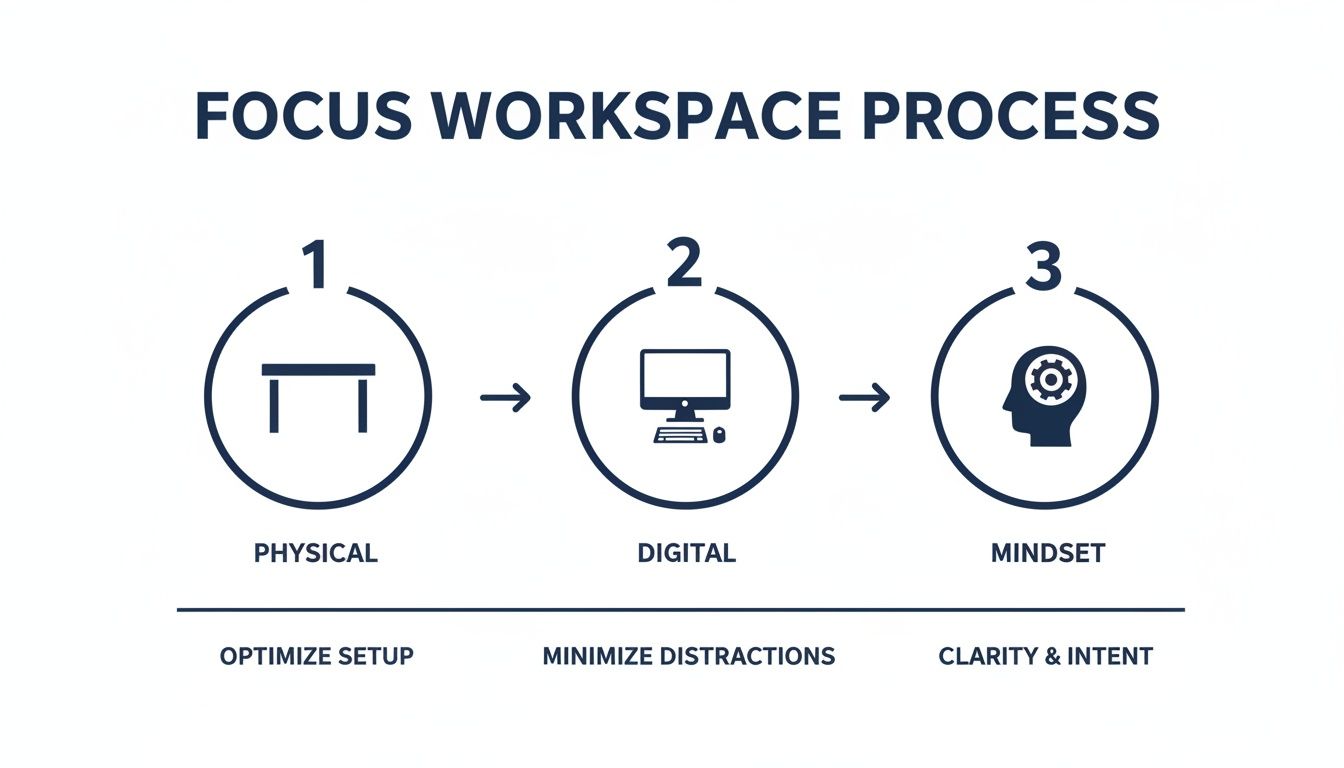
    The diagram below breaks down the whole process of creating a focused workflow, from setting up your physical space to preparing your mind.

    A diagram showing the focus workspace process with steps for physical, digital, and mindset.

    This visual is a great reminder that building an environment for focus involves more than just a clean desk. It’s a holistic approach, moving from the tangible things around you to the digital tools you use and, finally, to your own internal state.

    Build a Deep Work Block

    A Deep Work Block is a pre-scheduled, uninterrupted periodβ€”typically 90 minutesβ€”that you dedicate to a single, high-value task. That duration is a sweet spot for many people, as it aligns with the brain’s natural ultradian rhythms of concentration.

    During this block, all notifications are off. Your door is closed (or your chat status is set to β€œDo Not Disturb”). You commit to making progress on one thing and one thing only. For a deeper dive into why this works so well, check out our guide on the neuroscience of single-tasking.

    Real-World Scenario: David’s Strategic Tuesday
    David, a data analyst, has a complex quarterly report due. Instead of chipping away at it between meetings, he blocks two 90-minute β€œDeep Work” sessions on his calendar for Tuesday. The first is at 9:30 AM, his peak focus time. The second is at 2:00 PM. He schedules all his meetings and email catch-up sessions around these blocks, treating them as non-negotiable appointments. By the end of the day, he’s made significant progress on the report, feeling accomplished instead of fragmented.

    Another powerful method is the Pomodoro Technique, developed by Francesco Cirillo. This framework breaks your work into focused 25-minute intervals separated by short 5-minute breaks. It’s incredibly effective for beating procrastination because committing to just 25 minutes feels far less daunting than facing a multi-hour project.

    After four of these β€œPomodoros,” you take a longer break of 15-30 minutes. This technique is excellent for training your attention span and proves that short, intense bursts of single-tasking are often far more productive than long, unfocused stretches of work. It helps you resist the urge for self-interruption and makes your progress feel tangible, one β€œtomato” at a time.

    Train Your Brain with Mindfulness and Strategic Breaks

    Structuring your day and optimizing your environment are powerful external moves. But learning how to focus better at work also means training your internal worldβ€”your actual mind.

    Think of your ability to concentrate not as a fixed trait but as a mental muscle. With the right exercises, you can strengthen it, just like any other muscle. This is where a practice like mindfulness comes in.

    It’s not about emptying your mind or achieving some perfect state of zen. Far from it. Mindfulness is simply the practice of gently guiding your attention back to the present moment whenever it wanders. Neuroscientifically, this strengthens the neural pathways in your prefrontal cortex, the very region responsible for executive functions like attention regulation and impulse control.

    How to focus better at work: a woman meditates in an office chair with eyes closed, with a 5-minute timer on the desk.

    A Simple 5-Minute Mindfulness Exercise

    You don’t need a quiet room or a yoga mat. You can build this focus muscle right at your desk with a simple, five-minute practice.

    • Set a timer. Put five minutes on your phone or computer.

    • Sit comfortably. Sit upright in your chair, feet flat on the floor, hands resting in your lap. You can close your eyes or just soften your gaze toward the floorFocus on your breath. Bring your full attention to the physical sensation of your breath. Notice the air entering your nostrils, filling your lungs, and then leaving your body. Don’t try to change it; just observe.

    • Acknowledge wandering thoughts. Your mind will wander. That’s what minds do. When you notice you’re thinking about a project, an email, or what to have for lunch, gently and without judgment, acknowledge the thought and guide your attention back to your breath

    • Repeat. Continue this process of noticing and returning for the full five minutes.


    That simple act of returning your focus again and again is the exercise. Each time you do it, you’re performing a mental β€œrep” that reinforces your brain’s attentional control circuits. You can explore more about how stillness impacts your mind in our guide on the science of stillness and brain performance.

    Debunking the Myth of β€œPowering Through”

    Just as important as training your focus is knowing when to let it rest. Our culture loves to glorify β€œpowering through” fatigue, but this is a deeply counterproductive strategy. Your brain consumes a tremendous amount of energyβ€”specifically glucoseβ€”to maintain concentration. When those resources run low, your ability to focus, make good decisions, and regulate your impulses plummets.

    Pushing through mental fatigue is like trying to drive a car on an empty tank of gas. You won’t get very far, and you risk damaging the engine. Strategic breaks are non-negotiable for sustained high performance.

    Breaks aren’t a sign of weakness; they are a biological necessity for cognitive restoration. They give your brain a chance to clear out metabolic waste, replenish energy stores, and consolidate information.

    Choosing the Right Break for Your Brain

    Not all breaks are created equal. Mindlessly scrolling through a social media feed, for instance, doesn’t really rest your brain; it just bombards it with a different kind of high-speed stimuli. The key is to choose a break that counteracts the type of mental work you were just doing. Think of it as prescribing the right medicine for your mental state.

    Here’s a quick guide to help you pick the right kind of pause.

    Break TypeWhen to Use ItPrimary Benefit
    Micro-Break (1-2 mins)Between intense focus blocks (e.g., Pomodoros).Look away from the screen, stretch, or stand up. Relieves eye strain and prevents mental fixation.
    Movement Break (5-10 mins)After a long meeting or a 90-minute deep work session.Take a brisk walk. Boosts blood flow to the brain, improving alertness and creativity.
    Nature Break (15-20 mins)When feeling mentally drained or creatively stuck.Walk in a park or look at plants. Proven to restore directed attention and reduce stress.
    Social Break (15 mins)When feeling isolated or unmotivated.Chat with a colleague about non-work topics. Fulfills a core social need and can boost mood.

    By strategically deploying these different types of breaks throughout your day, you can maintain a much higher baseline of focus and prevent the cognitive burnout that comes from trying to stay β€œon” for eight straight hours.

    Manage Your Energy, Not Just Your Time

    You can have the best focus techniques in the world, but they won’t do a thing if your brain is running on fumes. We often treat concentration like a time management problem, but sustained focus is a biological game first and a mental one second. It’s deeply rooted in your physical energy.

    Thinking you can just β€œwill” yourself to focus misses the most critical part of the equationβ€”the actual fuel your brain needs to perform.

    Your physical state directly dictates your mental capacity. When you’re sleep-deprived or poorly nourished, your brain’s prefrontal cortex just can’t function properly. That’s the very area you rely on for attention, planning, and impulse control. To really learn how to focus, you have to become the chief energy officer for your own mind.

    Prioritize High-Quality Sleep

    Sleep is when your brain does its most critical maintenance. It’s not passive rest; it’s an active process of clearing out metabolic junk, consolidating memories, and recharging the very neural circuits you need for deep thinking.

    Even a single night of bad sleep can kneecap the function of your prefrontal cortex. The result? Irritability, brain fog, and a total inability to resist the pull of distraction. Improving your sleep hygiene is one of the most powerful levers you can pull for better daytime focus.

    • Establish a consistent wind-down routine: An hour before bed, dim the lights and put all your screens away. The blue light from phones and laptops actively suppresses melatonin, the hormone that tells your body it’s time to sleep.

    • Create a sleep sanctuary: Your bedroom should be cool, dark, and quiet. Think blackout curtains, a white noise machine, or earplugs. These aren’t luxuries; they’re tools for cognitive performance.

    • Avoid late-day stimulants and heavy meals: Caffeine has a shockingly long half-life and can mess with your sleep architecture for hours. A big meal can also interfere with your body’s ability to settle into deep rest.


    Fuel Your Brain with Smart Nutrition

    The food you eat is the literal fuel for your brain cells. Sugary, processed foods send your blood glucose on a wild rideβ€”a sharp spike followed by a hard crash. This is the dreaded afternoon slump, and it makes sustained concentration feel impossible.

    Instead, aim for meals that provide a slow, steady release of energy. You’re looking for a good balance of complex carbs, lean proteins, and healthy fats.

    Real-World Scenario: Alex’s Midday Energy Overhaul
    Alex, a software developer, used to power through with a sugary soda and a pastry at lunch. By 3 PM, he was staring at his code, completely unable to think. He switched to a grilled chicken salad with quinoa and started snacking on almonds in the afternoon. The change was immediate. His energy stabilized, the fog lifted, and he could stay sharp right through the end of the day.

    This isn’t about a restrictive diet. It’s about giving your brain the stable fuel it needs to do its job.

    Chronic energy depletion is also a hallmark of burnout, a state that can make focus feel utterly out of reach. If you’re dealing with an exhaustion that feels deeper than just one bad night’s sleep, it’s worth exploring strategies for how to recover from burnout.

    Ultimately, managing your physical energy is the non-negotiable foundation for mental clarity. When you treat sleep and nutrition with the same importance as your to-do list, you create the biological conditions your brain needs for deep, productive work.


    Editor’s Take

    As the editor of Mind Clarity Hub, I’ve tried just about every focus technique out there. If there’s one thing I’ve learned, it’s this: there is no magic bullet. The real secret to learning how to focus better at work is finding the right combination of strategies that fits your unique brain, your specific job, and your personality.

    What works wonders for a software developer in a quiet home officeβ€”say, long, uninterrupted 90-minute deep work blocksβ€”would be a recipe for frustration for a project manager in a bustling open office. That PM might find that the Pomodoro Technique, with its short 25-minute sprints, is the only sustainable way to make headway amid constant pings and shoulder taps.

    For years, I bought into the myth that focus was just a matter of willpower. My turning point came when I realized I was fighting my own biology, not a character flaw. The two shifts that made the biggest difference for me were surprisingly simple:

    • Energy Management Over Time Management: I stopped trying to be productive from 9 to 5. Instead, I identified my peak focus window (10 AM to 1 PM) and guarded it fiercely for my most important creative work. The afternoons became my time for meetings and administrative tasks.

    • Environmental Control: I finally invested in a pair of high-quality noise-canceling headphones. It sounds almost trivial, but this single tool let me create a bubble of concentration, signaling to my brainβ€”and just as importantly, to my colleaguesβ€”that I was in a deep work session.


    What Works: The most effective strategies are the ones you can actually stick with. Consistency beats intensity every single time. Start with one small, manageable change, like turning off your phone notifications or scheduling a single 30-minute focus block each day.

    Who It’s Best For: These techniques are for anyone feeling swamped by digital noise and a reactive workday. Environmental control is a lifeline for people in distracting offices, while energy management is a game-changer for remote workers battling burnout.

    Caveats: This isn’t a quick fix. Building focus is a practice, not a one-time event. You will have days when your attention wanders no matter what you do. The goal is progress, not a flawless record.

    Disclaimer: This article is for educational and informational purposes only and does not provide medical, psychological, or financial advice. Always talk with a qualified professional about your specific situation. Some links may be affiliate links, which means Mind Clarity Hub may earn a small commission if you choose to purchase, at no extra cost to you.

    FAQs: Your Questions About Improving Focus Answered

    When you start the journey to reclaim your attention, a lot of practical questions pop up. Here are the answers to some of the most common ones I hear from people learning how to focus better at work.

    How long until I see real improvements in my focus?

    It’s natural to want a quick fix, but rebuilding focus is a gradual process of retraining your brain. Thanks to a principle called neuroplasticity, your brain physically changes and forms new neural pathways with consistent practice.

    You’ll probably notice small wins within the first weekβ€”maybe you feel less frazzled after turning off notifications for an afternoon. But for those changes to become automatic, you’re looking at anywhere from a few weeks to a couple of months. The real key is consistency over intensity. A small, focused practice every single day is far more powerful than one heroic, all-day effort on a Saturday that leaves you exhausted.

    Can these techniques help if I have ADHD?

    Many of the strategies in this guide can be incredibly supportive for people managing ADHD symptoms. Things like creating a distraction-free space, structuring your day with time blocks, and taking strategic breaks all help build the external scaffolding that can make it easier to start a task and stick with it.

    However, it is crucial to be clear: this article is for educational purposes only. It is not a substitute for professional medical or psychological care. If you have or suspect you have ADHD, the most important step is to work with a qualified healthcare professional for a proper diagnosis and a comprehensive treatment plan.

    If I can only do one thing, what’s the best habit to start with?

    Feeling overwhelmed by all the options? Start here. The single best, highest-impact change you can make today is to disable all non-essential notifications on your phone and computer. This one move cuts off the primary source of the digital interruptions that shatter your attention all day long.

    This isn’t just about getting rid of distractions; it’s about taking back control. Instead of letting your devices dictate where your attention goes, you get to decide when it’s time to check for updates. It’s a small change that creates a massive shift from a reactive to a proactive mindset, and it builds a powerful foundation for every other focus habit you want to build. For more visual inspiration on creating a calm and focused life, you can explore ideas on my official Pinterest profile.


    At Mind Clarity Hub, our goal is to provide you with clear, science-backed roadmaps for reclaiming your mental space. Explore our curated guides and books to build the focus you need to thrive. Remember, this content is for educational purposes and is not a substitute for professional diagnosis or treatment.

    Explore the Mind Clarity Hub Library

    Practical books on focus, digital habits, resilience, and building a calmer mind.

    The Power of Clarity β€” book cover

    The Power of Clarity

    Unlock mental focus, build momentum, and create the life you were meant to live.

    View book β†’
    AI & ChatGPT for Beginners β€” book cover

    AI & ChatGPT for Beginners

    No PhD needed β€” a 2025 guide to AI, prompts, and productivity without coding.

    View book β†’
    Zen in the Digital Jungle β€” book cover

    Zen in the Digital Jungle

    Mindfulness for a chaotic world.

    View book β†’
    The Slow Reset β€” book cover

    The Slow Reset

    Mindful living in a fast-paced world.

    View book β†’
    Perfectly Imperfect β€” book cover

    Perfectly Imperfect

    Stop self-criticism, set boundaries, and embrace the real you.

    View book β†’
    Reclaiming Silence β€” book cover

    Reclaiming Silence

    A dopamine detox guide to finding peace in a noisy world.

    View book β†’
    The Focused Freelancer β€” book cover

    The Focused Freelancer

    Productivity, pricing & positioning for independents in 2025.

    View book β†’
    ChatGPT Side Hustle System β€” book cover

    ChatGPT Side Hustle System

    Launch your AI-driven online business in 30 days.

    View book β†’
    Burnout, Interrupted β€” book cover

    Burnout, Interrupted

    A proven path to restore energy and reclaim your life.

    View book β†’
    Attention Unleashed β€” book cover

    Attention Unleashed

    Focus strategies for the distracted mind.

    View book β†’
    Side Hustle Launchpad β€” book cover

    Side Hustle Launchpad

    Your quick-start guide to extra income.

    View book β†’
    Digital Clarity β€” book cover

    Digital Clarity

    Rewire your brain, escape dopamine traps & regain focus.

    View book β†’
    Break the Scroll β€” book cover

    Break the Scroll

    Reduce screen time and take back control of your life.

    View book β†’
    Climate Compassion β€” book cover

    Climate Compassion

    Transform eco-anxiety into empowered action.

    View book β†’
    Village Mentality β€” book cover

    Village Mentality

    The power of community for mental wellness.

    View book β†’
    Restful Nights β€” book cover

    Restful Nights

    Overcoming sleep anxiety in a 24/7 world.

    View book β†’
    Connected Again β€” book cover

    Connected Again

    Combat loneliness and build meaningful relationships.

    View book β†’
    Focus Recharged β€” book cover

    Focus Recharged

    Mastering attention and productivity in the digital era.

    View book β†’
    Marketing Magic with ChatGPT β€” book cover

    Marketing Magic with ChatGPT

    AI-powered content, campaigns, and copywriting to grow faster.

    View book β†’
    The 6-Figure Creator β€” book cover

    The 6-Figure Creator

    Turn knowledge into passive income with books, courses & AI.

    View book β†’
    Burnout Breakthrough β€” book cover

    Burnout Breakthrough

    Reset your work-life balance and thrive in 2025.

    View book β†’
    The Emotionally Intelligent Man β€” book cover

    The Emotionally Intelligent Man

    A modern guide to self-awareness and communication.

    View book β†’
    AI Personalized Wellness β€” book cover

    AI Personalized Wellness

    Create your custom health plan with data-driven habits.

    View book β†’
    Everyday AI Made Easy β€” book cover

    Everyday AI Made Easy

    Use ChatGPT and smart tools to simplify life.

    View book β†’
    Money Mindfulness β€” book cover

    Money Mindfulness

    A financial wellness guide for Gen Z & Millennials.

    View book β†’
    Startup Smarter with AI β€” book cover

    Startup Smarter with AI

    ChatGPT strategies and tools to grow your business.

    View book β†’
    ChatGPT for Writers & Creators β€” book cover

    ChatGPT for Writers & Creators

    Unlock AI-powered brainstorming, drafting & editing.

    View book β†’
  • How to Increase Productivity at Work and Reclaim Your Focus

    How to Increase Productivity at Work and Reclaim Your Focus

    How to Increase Productivity at Work and Reclaim Your Focus

    Jeremy Jarvis β€” Mind Clarity Hub founder
    Mind Clarity Hub β€’ Research-aware focus & digital wellness

    Published: December 15, 2025

    Let’s be honest: the old idea of productivity is broken. For years, we were told that getting more done meant grinding harder and pushing through exhaustion. But that β€œhustle” mindset usually just leads to burnout, not meaningful results. Real productivity isn’t about cramming more tasks into your day. It’s about achieving what truly matters with less stress and more clarity by working with your brain’s natural rhythmsβ€”not against them.

    Group of coworkers collaborating at a shared desk, using laptops and notes to increase productivity at work
    Collaborative workspaces and clear routines can dramatically increase productivity at work for both teams and individuals.

    Β 

    Affiliate Disclosure: At Mind Clarity Hub, we believe in transparency. This article may contain affiliate links, which means we may earn a small commission if you make a purchase through themβ€”at no extra cost to you. We only recommend products we trust.

    Redefining Productivity for the Modern Workplace

    This guide throws out the old rulebook. Instead of chasing more hours, we’ll focus on a smarter, more sustainable, and brain-friendly model for high performance. It all comes down to intention and clarity.

    The real drivers of exceptional work aren’t about brute force. They’re about genuine motivation and deep engagementβ€”the very things that hustle culture often destroys. The research is clear: how people feel at work has a direct impact on what they accomplish. This isn’t just a mood-booster; it’s a core principle of organizational psychology. Our mood influences cognitive functions like problem-solving and creativity, meaning a positive work environment directly fuels innovation and output.

    The Real Driver of High Performance

    Disengaged employees are more than just a morale problem; they represent a staggering loss of human potential. A recent Gallup report on the global workplace is eye-opening: only 21% of employees worldwide feel truly engaged at work.

    This widespread disengagement isn’t a small issue. It’s estimated to cost the global economy a mind-boggling US$438 billion in lost productivity every year. On the flip side, Gallup found that achieving full engagement could inject an incredible US$9.6 trillion back into the world economy.

    That’s not just a numberβ€”it’s proof that motivation is one of the most powerful economic forces we have. You can dig into the complete findings in Gallup’s full analysis.

    To help you reclaim your focus and energy, this guide is built on four core pillars. Think of it as your new operating system for getting things done.

    The Four Pillars of Science-Backed Productivity

    PillarCore PrinciplePrimary Benefit
    Mastering Deep WorkProtect your cognitive resources from constant digital distractions and interruptions.Produce higher-quality work in less time and reduce mental fatigue.
    Designing Your EnvironmentShape your physical workspace and daily schedule to support focus automatically.Make concentration the path of least resistance, requiring less willpower.
    Leveraging TechnologyUse automation and AI to handle repetitive tasks, freeing up mental space.Reclaim time and energy for strategic thinking and creative problem-solving.
    Building Sustainable HabitsUse behavioral science to create productive routines that stick without burnout.Achieve long-term consistency and avoid the boom-and-bust cycle of motivation.

    By mastering these four areas, you’re not just learning productivity β€œhacks.” You’re building a system that allows you to do your best work consistently without sacrificing your well-being.

    • Mastering Deep Work: This is your defense against a world of distraction. We’ll cover how to protect your most valuable cognitive resources from the constant barrage of pings, notifications, and interruptions that fragment your attention.
    • Designing Your Environment: Your workspace and schedule can either fight you or support you. You’ll learn how to shape your surroundings to make focus the default setting, so you don’t have to rely on willpower alone.
    • Leveraging Technology Intelligently: Instead of letting technology manage you, you’ll learn to make it work for you. We’ll explore how to use automation and AI to offload the repetitive, low-value tasks that drain your mental energy. Our insights into future of work and focus recovery show just how critical this skill is becoming.
    • Building Sustainable Habits: Willpower is a finite resource. That’s why we’ll dive into behavioral science to build productive routines that last, turning powerful behaviors into second nature.

    By focusing on these pillars, you’ll create a system that supports sustained high performance without burning you out. This is about doing the right things, betterβ€”and feeling good while you do it. You can follow along for more practical insights on my Pinterest.

    Mastering Deep Work and Conquering Distraction

    How to increase productivity at work: a person wearing headphones works on a laptop displaying β€œInbox 0” next to a tomato timer.

    If you feel like your attention is constantly under attack, you’re not wrong. The modern workday is practically engineered for distraction. An endless stream of notifications, emails, and β€œquick questions” pulls you in a dozen different directions at once.

    This constant fragmentation isn’t just annoying; it actively undermines your brain’s ability to produce high-quality, thoughtful work. Your brain’s prefrontal cortexβ€”the area responsible for complex planning and decision-makingβ€”is wired for single-tasking. When you try to multitask, like drafting a report while keeping an eye on your inbox, you aren’t actually doing two things at once. Instead, you’re forcing your brain to switch gears rapidly, a process called context switching.

    Every time you switch, you pay a β€œcognitive cost,” burning through precious mental energy. This makes it harder and harder to get back into the groove of your main task. This is exactly why a day packed with interruptions can leave you feeling drained, even if you feel you got little done.

    The Power of Intentional Focus Blocks

    The most effective way to fight back against distraction is to deliberately carve out time for focused, uninterrupted work. This isn’t about finding more hours in the dayβ€”it’s about making the hours you already have actually count. Two powerful, research-backed techniques can get you there.

    • Time Blocking: This is where you schedule specific tasks directly into your calendar, just like a meeting. Instead of a vague to-do list, your day has a clear game plan. For example, a marketing manager could block out 9:00 AM to 11:00 AM for β€œQ3 Creative Strategy.” No email. No Slack. Just dedicated time for their most important work.
    • The Pomodoro Technique: This method uses a timer to break down work into focused sprints, traditionally 25 minutes long, separated by short breaks. It works beautifully because it aligns with your brain’s natural attention cycles, preventing cognitive overload. After a 25-minute push, you step away for a 5-minute break to recharge before the next round.

    These methods create a structure that signals to your brain that it’s time to focus, giving you permission to let everything else wait. The goal is to build a predictable rhythm that makes deep work a habit, not a rare event.

    Taming Your Digital Environment

    Your digital world is likely the biggest source of distraction. Getting it under control requires a conscious effort to practice digital minimalismβ€”the idea of using tech to serve your goals, not letting it dictate your attention.

    Start by auditing your notifications. Do you really need an instant alert every time an email lands or someone likes a comment? Each ping is a tiny invitation for your brain to switch contexts, derailing your flow. Be ruthless and turn off all non-essential notifications on your phone and computer.

    Key Takeaway: The average office worker gets interrupted every three minutes. Reclaiming just a fraction of that time for deep work can dramatically increase your output and lower your stress. A quiet digital space is a productive one.

    Consider using website blockers during your focus blocks to prevent mindless scrolling on social media or news sites. This isn’t about a lack of willpower; it’s about creating an environment where you don’t need to rely on willpower in the first place.

    Design Your Workspace and Schedule for Peak Performance

    Your physical environment and daily schedule are silent partners in your productivity. They can either create constant friction or act as powerful engines for focus. The goal is to intentionally design both so that productive behaviors become the path of least resistance, requiring less willpower to sustain.

    This is where behavioral psychology gives us a practical roadmap. Instead of banking on motivation, which is notoriously unreliable, you can use environmental cues to trigger the actions you want to take. A classic example is setting out your workout clothes the night before. That one small change dramatically increases the odds you’ll actually make it to the gym in the morning because it lowers the β€œactivation energy” needed to start.

    It works the same way at your desk. A cluttered workspace filled with half-done projects sends subtle signals of chaos to your brain, making it harder to lock in on one thing. A clean, minimalist setup, on the other hand, creates a clear visual field, which helps you cultivate a clear mental field.

    Aligning Tasks with Your Natural Energy Cycles

    Productivity isn’t just about managing time; it’s about managing your energy. We all have natural high and low-energy periods throughout the dayβ€”what scientists call our chronotype. Some of us are β€œlarks” who do our best thinking first thing in the morning, while others are β€œowls” who don’t truly hit their stride until the afternoon or evening.

    Fighting your natural rhythm is a losing battle. The smarter move is to work with it.

    • Find Your Peak Hours: For one week, take a moment every hour to jot down your energy and focus levels on a scale of 1 to 10. You’ll quickly see a pattern emerge, revealing your prime time for deep, cognitively demanding work.
    • Guard Those Hours Ruthlessly: Once you know your peak windowβ€”say, 9 AM to 11 AMβ€”protect it. That’s when you should be tackling complex problem-solving or creative strategy, not clearing out your inbox.
    • Use Your Dips Strategically: Save your low-energy periods for administrative tasks, routine emails, or planning your next day. This keeps you moving forward without draining your most valuable cognitive resources on low-impact work.

    For a software developer on a hybrid schedule, this might mean dedicating their high-energy remote mornings to solo coding. They can then save their in-office afternoons for collaborative meetings and code reviews. This simple alignment can drastically improve both code quality and job satisfaction.

    Building Automatic Habits with Environmental Design

    Your workspace is more than just a place to put your laptop. It’s a system of cues that can either trigger focus or invite distraction. By consciously designing this space, you can put productive habits on autopilot. This concept is often called habit stacking, where you link a new desired habit to one you already have.

    For instance, you could stack the habit of β€œplanning my top three priorities” onto your existing habit of β€œmaking morning coffee.” While the coffee brews, you take two minutes to write down your most important tasks.

    You can supercharge this by using environmental cues.

    Pro Tip: Create distinct zones for different kinds of work. Using a specific chair just for deep work, a corner for creative brainstorming, or even a designated spot for taking calls can signal to your brain what kind of thinking is required. This minimizes the mental effort needed to switch gears.

    This approach extends to your digital workspace, too. A clean desktop with only the essentials visible reduces the temptation to multitask. The goal is to make your environment do the heavy lifting so your brain doesn’t have to.

    Thoughtful scheduling and workspace design are proving to have a measurable impact, especially as flexible work becomes more common. A recent β€œState of the Workplace” report from ActivTrak found that remote-only workers gained about 29 minutes of extra productive time per day compared to their in-office or hybrid peers. Across multiple datasets, the average workday actually shortened by roughly 36 minutes, even as productivity increasedβ€”proof that a smarter structure leads to better output. You can dive deeper into these workplace statistics and trends here.

    By consciously shaping your schedule around your energy and designing your environment to support your goals, you shift from a reactive state to a proactive one. You stop fighting distractions and start building a system where focus is the default.

    Automate Your Workflow and Use AI Intelligently

    Technology can feel like a double-edged sword. Left unchecked, it becomes a relentless source of distraction. But when you use it intentionally, it’s one of the most powerful tools you have for boosting your productivity and reclaiming your mental energy.

    The trick is to spot the low-value, repetitive tasks that drain your willpower and offload them to technology. These are the small, mindless jobs that chip away at your focus all day: sorting emails, copying data between apps, or scheduling the same follow-ups again and again.

    Reclaim Your Cognitive Bandwidth

    Every time you handle one of these mundane tasks, you’re spending a tiny bit of your limited decision-making capacity. Psychologists call this β€œdecision fatigue.” Automating them isn’t about being lazy; it’s about strategically preserving your best thinking for the work that actually moves the needle.

    You can start with tools you already use. Simple email filters can automatically sort incoming messages, keeping your main inbox clear for what truly matters. For more complex workflows, tools like Zapier connect your apps and create automated sequences, like saving email attachments to a specific cloud folder or adding new leads to a spreadsheet.

    This kind of strategic automation frees up a surprising amount of mental space, letting you invest your time in high-value work instead of administrative drag. The impact is real. Research shows employees can save an average of 3.6 hours per week just by automating routine tasks. On a larger scale, McKinsey estimates that generative AI could boost labor productivity growth by up to 0.6 percentage points annually through 2040. If you want to dig into the numbers, you can explore more employee productivity statistics.

    The diagram below breaks down the three pillars of a truly productive work system: your schedule, your environment, and your habits.

    A three-step diagram for designing a productive workspace including schedule, environment, and habits.

    This shows how real productivity emerges when your schedule, environment, and habits all work together to support your goals.

    Using AI as a Strategic Partner

    Artificial intelligence opens up a whole new frontier for offloading cognitive labor. But its real power isn’t just generating content; it’s acting as a strategic partner to accelerate the early stages of your work, leaving you more time for high-level thinking and refinement.

    Forget generic prompts. Instead, think in terms of specific tasks that help you overcome the β€œblank page” problem.

    • For Project Managers: Use AI to draft an initial project scope or create a work breakdown structure from a brief. For example, prompt it with β€œGenerate a WBS for a website redesign project, including phases for discovery, design, development, and launch.” This gives you a solid foundation to edit, saving hours of setup.
    • For Researchers: Ask AI to summarize dense academic articles, pulling out key findings and methodologies. You can quickly assess a source’s value without reading the whole thing.
    • For Marketers: Use it to brainstorm a list of potential blog titles or social media angles for a campaign. It’s a fantastic way to break through creative blocks and generate a wide range of ideas.

    Key Insight: The smartest way to use AI isn’t to replace your thinking but to augment it. Automate the first 80% of a taskβ€”the drafting, summarizing, or brainstormingβ€”and you free up your cognitive energy for the final 20%, where human nuance, creativity, and strategy add the most value.

    Using technology this intelligently is a core skill for any modern professional. To learn more about folding these tools into your daily routine, check out our guide on making everyday AI easy and effective. The goal is clear: reinvest the time you save not to cram more work into your day, but to create more space for deep, focused thinking.

    The Role of Rest in Sustained High Performance

    How to increase productivity at work: a man in a suit walks down a sunlit path between modern office buildings with trees.

    It sounds completely backward, but one of the most effective ways to increase productivity has nothing to do with working harder. It’s about being intentional with your rest. β€œHustle culture” has conditioned us to view downtime as weakness, but neuroscience tells a much different story.

    Your brain isn’t a machine that can run nonstop. Sustained mental effort, especially on tough problems, burns through neurotransmitters and drains glucoseβ€”the main fuel source for your brain cells. Without breaks, your prefrontal cortex, which handles all the heavy lifting like decision-making and focus, gets exhausted. This isn’t just a feeling; it has real consequences: slower thinking, worse memory, and a total collapse of creativity. Rest isn’t the opposite of work; it’s the partner that makes elite performance possible.

    The Neuroscience of How Your Brain Recharges

    When you finally disconnect, your brain flips into a completely different gear. One of the most important is the default mode network (DMN), a web of brain regions that lights up when you’re at rest but still awake. While you’re daydreaming or letting your mind wander, the DMN is busy connecting ideas, consolidating memories, and sorting through subconscious thoughts.

    This is exactly why your best ideas seem to pop into your head in the shower, on a walk, or just before you drift off to sleep. You step away from the problem, and you give your brain the space it needs to solve it. This same principle works on a smaller scale throughout the day. Micro-breaksβ€”short, deliberate breaks that last just a few minutesβ€”are surprisingly powerful for fighting off mental fatigue.

    • Look away from the screen: Just gazing out a window for 60 seconds can reduce eye strain and give your visual cortex a breather.
    • Stand and stretch: A quick stretch gets blood flowing back to the brain, delivering a fresh shot of oxygen and glucose.
    • Step outside: Even five minutes of fresh air can lift your mood and reset your ability to concentrate.

    Think of a consultant who takes a 10-minute walk after every intense client meeting. They aren’t slacking off. They are actively preventing decision fatigue so they can return to their desk sharp, clear, and ready for the next challenge.

    Challenging the Burnout Narrative

    The β€œalways-on” mindset doesn’t just tank your productivity in the short term; it causes long-term damage to your brain’s executive functions. Burnout isn’t just being tiredβ€”it’s a state of chronic stress that can throw your entire nervous system out of whack and cripple your cognitive performance.

    Important Note: Burnout, anxiety, and depression are serious conditions. This article is for educational purposes only. If you are experiencing symptoms, it is crucial to seek help from a qualified medical or mental health professional.

    For long-term performance, setting firm boundaries isn’t optional. It’s non-negotiable. This means having clear start and end times for your workday andβ€”this is the hard partβ€”actually sticking to them. If you’re feeling fried, learning how to recover from burnout is the essential first step toward building back healthier, more sustainable habits.

    Key Insight: True disconnection means your brain isn’t still chewing on work problems. Casually checking email on your phone after hours seems harmless, but it keeps your brain in a state of low-grade alert, preventing the deep cognitive rest you need to be at your best the next day.

    By treating rest as a core part of your productivity strategy, you shift from a model of short-term sprints and inevitable crashes to one of sustainable, long-term achievement. Sleep, breaks, and true time off aren’t luxuries. They are fundamental requirements for anyone serious about doing their best work consistently.

    Editor’s Take: What Actually Works

    My name is Jeremy Jarvis, and for years, I’ve been the guinea pig for just about every productivity system, app, and framework you can imagine. After wading through all that noise, here’s my honest take: the biggest wins never come from the trendiest new app. They come from mastering the fundamentals.

    The real 80/20 of productivity is about two things: ruthlessly protecting your focus for deep work and being relentlessly intentional with your schedule. Almost everything else is a distraction or, worse, a sophisticated form of procrastination. We tell ourselves that organizing our to-do list for the tenth time is progress, when it’s really just a clever way to avoid the hard, meaningful work staring us in the face.

    Who Is This Advice Best For?

    These strategies are most effective for knowledge workers, creatives, and anyone whose job requires deep thinking and problem-solving rather than manual labor. If your day is a mix of meetings, strategic work, and independent tasks, these principles will be a game-changer. They are less applicable to roles that are purely reactive, like customer service, where the workflow is dictated by external demand.

    My rule of thumb is simple: If a tool requires more time to manage than the time it saves you, it’s not a productivity tool. It’s a hobby. A simple calendar for time blocking, a basic timer for Pomodoro sprints, and a minimalist notes app are often all you really need.

    The Most Important Takeaway

    Ultimately, no single system works for everyone. The hunt for a perfect, one-size-fits-all solution is a trap. What works for a freelance graphic designer is going to look completely different from what a project manager in a huge corporation needs. The only goal is to find what works for you.

    Sustainable productivity is built on self-compassion and the flexibility to adapt. It is not about rigid adherence to a framework that leaves you feeling stressed and burned out. If a system isn’t serving you, it’s okay to abandon it and try something else.
    True productivity should feel calm, focused, and intentional. It’s about building systems that support your well-being, not ones that drain it. Start with the basics: guard your focus, manage your energy, and give yourself the grace to adjust as you go.

    Frequently Asked Questions (FAQ)

    Putting these ideas into practice is where the real work begins. Here are answers to some of the most common questions.

    How long does it take to see results from these productivity methods?

    You can feel some benefits almost immediately. The first day you try time blocking or the Pomodoro Technique, you’ll likely notice a boost in focus. However, according to behavioral research, forming a truly automatic habit takes consistency over several weeks. Start small and aim for progress, not perfection.

    Can these strategies help with ADHD or other focus challenges?

    Yes, many people find these structured approaches very helpful for managing attention. Techniques like breaking down tasks, designing a low-distraction environment, and externalizing your schedule onto a calendar are evidence-based strategies that can support executive function. However, please remember this article is for educational purposes and is not a substitute for professional medical advice. If you have concerns about ADHD, anxiety, or other conditions, please consult a qualified healthcare provider.

    What is the single most impactful change I can make?

    Protect the first 90 minutes of your workday for your single most important task. Before checking email or Slack, make meaningful progress on the one thing that will advance your long-term goals. This single habit builds momentum for the entire day and trains your brain to prioritize deep work over shallow, reactive tasks.

    Are there any tools you recommend for getting started?

    Start simple. You don’t need complex software. A physical planner or a digital calendar (like Google Calendar) is perfect for time blocking. A simple timer on your phone or a browser extension works great for the Pomodoro Technique. The goal is to reduce friction, not add another complex tool to your plate.


    Disclaimer: The information provided in this article is for educational and informational purposes only and is not intended as medical or psychological advice. This article may contain affiliate links, which means we may earn a small commission at no extra cost to you. Always consult with a qualified professional for any health concerns.

    At Mind Clarity Hub, our work is all about giving you science-backed, actionable guides to help you reclaim your attention and energy. To go deeper on any of these topics, feel free to explore our full library of books and resources.

    Explore the Mind Clarity Hub library

    Explore the Mind Clarity Hub Library

    Practical books on focus, digital habits, resilience, and building a calmer mind.

    The Power of Clarity β€” book cover

    The Power of Clarity

    Unlock mental focus, build momentum, and create the life you were meant to live.

    View book β†’
    AI & ChatGPT for Beginners β€” book cover

    AI & ChatGPT for Beginners

    No PhD needed β€” a 2025 guide to AI, prompts, and productivity without coding.

    View book β†’
    Zen in the Digital Jungle β€” book cover

    Zen in the Digital Jungle

    Mindfulness for a chaotic world.

    View book β†’
    The Slow Reset β€” book cover

    The Slow Reset

    Mindful living in a fast-paced world.

    View book β†’
    Perfectly Imperfect β€” book cover

    Perfectly Imperfect

    Stop self-criticism, set boundaries, and embrace the real you.

    View book β†’
    Reclaiming Silence β€” book cover

    Reclaiming Silence

    A dopamine detox guide to finding peace in a noisy world.

    View book β†’
    The Focused Freelancer β€” book cover

    The Focused Freelancer

    Productivity, pricing & positioning for independents in 2025.

    View book β†’
    ChatGPT Side Hustle System β€” book cover

    ChatGPT Side Hustle System

    Launch your AI-driven online business in 30 days.

    View book β†’
    Burnout, Interrupted β€” book cover

    Burnout, Interrupted

    A proven path to restore energy and reclaim your life.

    View book β†’
    Attention Unleashed β€” book cover

    Attention Unleashed

    Focus strategies for the distracted mind.

    View book β†’
    Side Hustle Launchpad β€” book cover

    Side Hustle Launchpad

    Your quick-start guide to extra income.

    View book β†’
    Digital Clarity β€” book cover

    Digital Clarity

    Rewire your brain, escape dopamine traps & regain focus.

    View book β†’
    Break the Scroll β€” book cover

    Break the Scroll

    Reduce screen time and take back control of your life.

    View book β†’
    Climate Compassion β€” book cover

    Climate Compassion

    Transform eco-anxiety into empowered action.

    View book β†’
    Village Mentality β€” book cover

    Village Mentality

    The power of community for mental wellness.

    View book β†’
    Restful Nights β€” book cover

    Restful Nights

    Overcoming sleep anxiety in a 24/7 world.

    View book β†’
    Connected Again β€” book cover

    Connected Again

    Combat loneliness and build meaningful relationships.

    View book β†’
    Focus Recharged β€” book cover

    Focus Recharged

    Mastering attention and productivity in the digital era.

    View book β†’
    Marketing Magic with ChatGPT β€” book cover

    Marketing Magic with ChatGPT

    AI-powered content, campaigns, and copywriting to grow faster.

    View book β†’
    The 6-Figure Creator β€” book cover

    The 6-Figure Creator

    Turn knowledge into passive income with books, courses & AI.

    View book β†’
    Burnout Breakthrough β€” book cover

    Burnout Breakthrough

    Reset your work-life balance and thrive in 2025.

    View book β†’
    The Emotionally Intelligent Man β€” book cover

    The Emotionally Intelligent Man

    A modern guide to self-awareness and communication.

    View book β†’
    AI Personalized Wellness β€” book cover

    AI Personalized Wellness

    Create your custom health plan with data-driven habits.

    View book β†’
    Everyday AI Made Easy β€” book cover

    Everyday AI Made Easy

    Use ChatGPT and smart tools to simplify life.

    View book β†’
    Money Mindfulness β€” book cover

    Money Mindfulness

    A financial wellness guide for Gen Z & Millennials.

    View book β†’
    Startup Smarter with AI β€” book cover

    Startup Smarter with AI

    ChatGPT strategies and tools to grow your business.

    View book β†’
    ChatGPT for Writers & Creators β€” book cover

    ChatGPT for Writers & Creators

    Unlock AI-powered brainstorming, drafting & editing.

    View book β†’